
Journal of Southern Medical University ›› 2026, Vol. 46 ›› Issue (1): 141-149.doi: 10.12122/j.issn.1673-4254.2026.01.15
Yunneng CUI1,2( ), Minqing FENG3,4,5, Liangfeng YAO2, Jiewen YAN2, Wenhan LI6, Yanping HUANG6()
Received:2025-06-20
Online:2026-01-20
Published:2026-01-16
Contact:
Yanping HUANG
E-mail:letitb@163.com;yale.huangyp@fosu.edu.cn
Yunneng CUI, Minqing FENG, Liangfeng YAO, Jiewen YAN, Wenhan LI, Yanping HUANG. Enhancement of radiomics-based machine learning models for predicting efficacy of high-intensity focused ultrasound ablation of uterine fibroids using undersampling methods[J]. Journal of Southern Medical University, 2026, 46(1): 141-149.
Add to citation manager EndNote|Ris|BibTeX
URL: https://www.j-smu.com/EN/10.12122/j.issn.1673-4254.2026.01.15
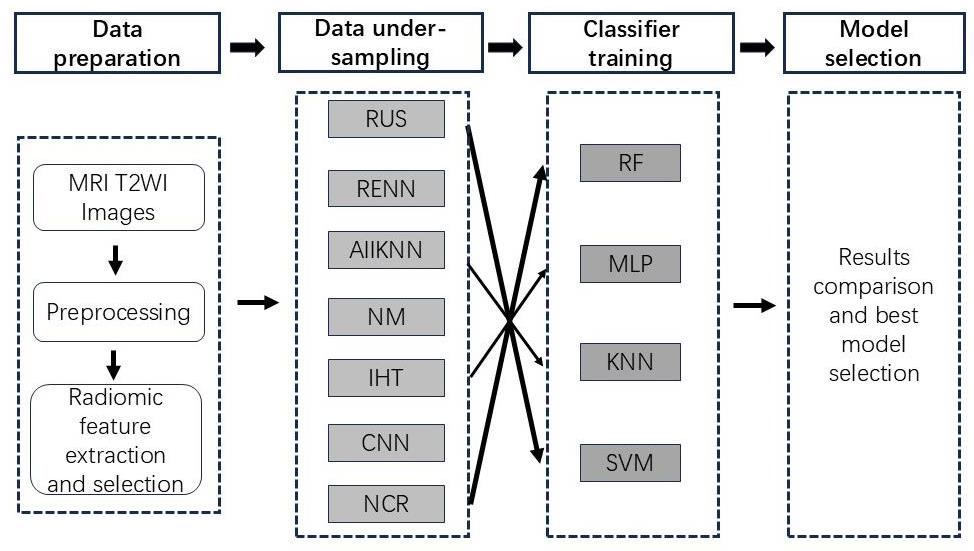
Fig.1 Diagram of the main data processing procedures in this study. Seven undersampling methods are used in combination with 4 types of classifiers to construct predictive models for HIFU treatment of uterine fibroids.
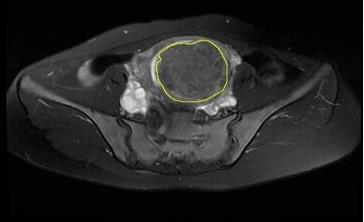
Fig.2 A schematic sketch of the region of interest (ROI).
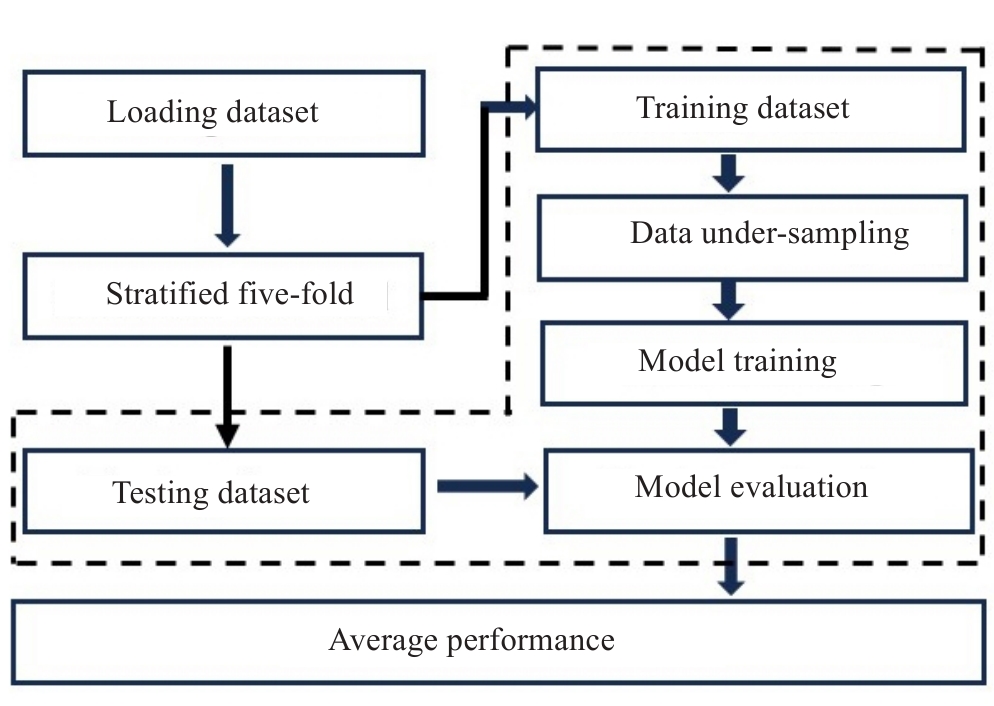
Fig.3 Flowchart of model establishment and evaluation in this study. The procedures boxed using dotted lines are repeated 5 times for the 5-fold cross-validation scheme.
| Models | AUC (95% CI) | Accuracy | Recall | Specificity |
|---|---|---|---|---|
| RUS-KNN | 0.792(0.586-0.958) | 0.679 | 0.728 | 0.664 |
| RENN-KNN | 0.736(0.519-0.925) | 0.643 | 0.678 | 0.637 |
| AllKNN-KNN | 0.708(0.465-0.909) | 0.679 | 0.750 | 0.655 |
| NM-KNN | 0.769(0.558-0.939) | 0.679 | 0.782 | 0.646 |
| CNN-KNN | 0.822(0.635-0.964) | 0.714 | 0.675 | 0.733 |
| NCR-KNN | 0.734(0.507-0.927) | 0.664 | 0.618 | 0.684 |
| IHT-KNN | 0.710(0.479-0.909) | 0.664 | 0.728 | 0.646 |
| KNN-baseline | 0.784(0.571-0.955) | 0.750 | 0.143 | 0.962 |
Tab.1 Performances of different models associated with KNN learning
| Models | AUC (95% CI) | Accuracy | Recall | Specificity |
|---|---|---|---|---|
| RUS-KNN | 0.792(0.586-0.958) | 0.679 | 0.728 | 0.664 |
| RENN-KNN | 0.736(0.519-0.925) | 0.643 | 0.678 | 0.637 |
| AllKNN-KNN | 0.708(0.465-0.909) | 0.679 | 0.750 | 0.655 |
| NM-KNN | 0.769(0.558-0.939) | 0.679 | 0.782 | 0.646 |
| CNN-KNN | 0.822(0.635-0.964) | 0.714 | 0.675 | 0.733 |
| NCR-KNN | 0.734(0.507-0.927) | 0.664 | 0.618 | 0.684 |
| IHT-KNN | 0.710(0.479-0.909) | 0.664 | 0.728 | 0.646 |
| KNN-baseline | 0.784(0.571-0.955) | 0.750 | 0.143 | 0.962 |
| Models | AUC (95% CI) | Accuracy | Recall | Specificity |
|---|---|---|---|---|
| RUS-RF | 0.768(0.556-0.932) | 0.636 | 0.696 | 0.617 |
| RENN-RF | 0.722(0.504-0.907) | 0.543 | 0.793 | 0.465 |
| AllKNN-RF | 0.692(0.476-0.883) | 0.593 | 0.675 | 0.569 |
| NM-RF | 0.701(0.475-0.892) | 0.579 | 0.586 | 0.580 |
| CNN-RF | 0.772(0.566-0.942) | 0.700 | 0.725 | 0.694 |
| NCR-RF | 0.672(0.466-0.876) | 0.614 | 0.504 | 0.656 |
| IHT-RF | 0.656(0.430-0.854) | 0.550 | 0.750 | 0.482 |
| RF-baseline | 0.731(0.518-0.909) | 0.750 | 0.336 | 0.895 |
Tab.2 Performances of different models associated with RF learning
| Models | AUC (95% CI) | Accuracy | Recall | Specificity |
|---|---|---|---|---|
| RUS-RF | 0.768(0.556-0.932) | 0.636 | 0.696 | 0.617 |
| RENN-RF | 0.722(0.504-0.907) | 0.543 | 0.793 | 0.465 |
| AllKNN-RF | 0.692(0.476-0.883) | 0.593 | 0.675 | 0.569 |
| NM-RF | 0.701(0.475-0.892) | 0.579 | 0.586 | 0.580 |
| CNN-RF | 0.772(0.566-0.942) | 0.700 | 0.725 | 0.694 |
| NCR-RF | 0.672(0.466-0.876) | 0.614 | 0.504 | 0.656 |
| IHT-RF | 0.656(0.430-0.854) | 0.550 | 0.750 | 0.482 |
| RF-baseline | 0.731(0.518-0.909) | 0.750 | 0.336 | 0.895 |
| Models | AUC (95% CI) | Accuracy | Recall | Specificity |
|---|---|---|---|---|
| RUS-SVM | 0.791(0.595-0.955) | 0.728 | 0.807 | 0.702 |
| RENN-SVM | 0.702(0.363-0.828) | 0.593 | 0.843 | 0.513 |
| AllKNN-SVM | 0.708(0.490-0.895) | 0.629 | 0.778 | 0.579 |
| NM-SVM | 0.797(0.600-0.950) | 0.664 | 0.836 | 0.607 |
| CNN-SVM | 0.782(0.577-0.950) | 0.757 | 0.700 | 0.780 |
| NCR-SVM | 0.714(0.495-0.902) | 0.671 | 0.643 | 0.684 |
| IHT-SVM | 0.734(0.511-0.912) | 0.621 | 0.778 | 0.568 |
| SVM-baseline | 0.712(0.485-0.910) | 0.743 | 0 | 1 |
Tab.3 Performances of different models associated with SVM learning
| Models | AUC (95% CI) | Accuracy | Recall | Specificity |
|---|---|---|---|---|
| RUS-SVM | 0.791(0.595-0.955) | 0.728 | 0.807 | 0.702 |
| RENN-SVM | 0.702(0.363-0.828) | 0.593 | 0.843 | 0.513 |
| AllKNN-SVM | 0.708(0.490-0.895) | 0.629 | 0.778 | 0.579 |
| NM-SVM | 0.797(0.600-0.950) | 0.664 | 0.836 | 0.607 |
| CNN-SVM | 0.782(0.577-0.950) | 0.757 | 0.700 | 0.780 |
| NCR-SVM | 0.714(0.495-0.902) | 0.671 | 0.643 | 0.684 |
| IHT-SVM | 0.734(0.511-0.912) | 0.621 | 0.778 | 0.568 |
| SVM-baseline | 0.712(0.485-0.910) | 0.743 | 0 | 1 |
| Models | AUC (95% CI) | Accuracy | Recall | Specificity |
|---|---|---|---|---|
| RUS-MLP | 0.791(0.593-0.949) | 0.657 | 0.721 | 0.634 |
| RENN-MLP | 0.723(0.504-0.910) | 0.607 | 0.818 | 0.541 |
| AllKNN-MLP | 0.729(0.520-0.911) | 0.664 | 0.807 | 0.616 |
| NM-MLP | 0.822(0.632-0.960) | 0.729 | 0.786 | 0.713 |
| CNN-MLP | 0.782(0.570-0.954) | 0.679 | 0.728 | 0.666 |
| NCR-MLP | 0.730(0.499-0.913) | 0.693 | 0.614 | 0.722 |
| IHT-MLP | 0.736(0.530-0.909) | 0.629 | 0.811 | 0.568 |
| MLP-baseline | 0.710(0.467-0.911) | 0.736 | 0.414 | 0.847 |
Tab.4 Performances of different models associated with MLP learning
| Models | AUC (95% CI) | Accuracy | Recall | Specificity |
|---|---|---|---|---|
| RUS-MLP | 0.791(0.593-0.949) | 0.657 | 0.721 | 0.634 |
| RENN-MLP | 0.723(0.504-0.910) | 0.607 | 0.818 | 0.541 |
| AllKNN-MLP | 0.729(0.520-0.911) | 0.664 | 0.807 | 0.616 |
| NM-MLP | 0.822(0.632-0.960) | 0.729 | 0.786 | 0.713 |
| CNN-MLP | 0.782(0.570-0.954) | 0.679 | 0.728 | 0.666 |
| NCR-MLP | 0.730(0.499-0.913) | 0.693 | 0.614 | 0.722 |
| IHT-MLP | 0.736(0.530-0.909) | 0.629 | 0.811 | 0.568 |
| MLP-baseline | 0.710(0.467-0.911) | 0.736 | 0.414 | 0.847 |
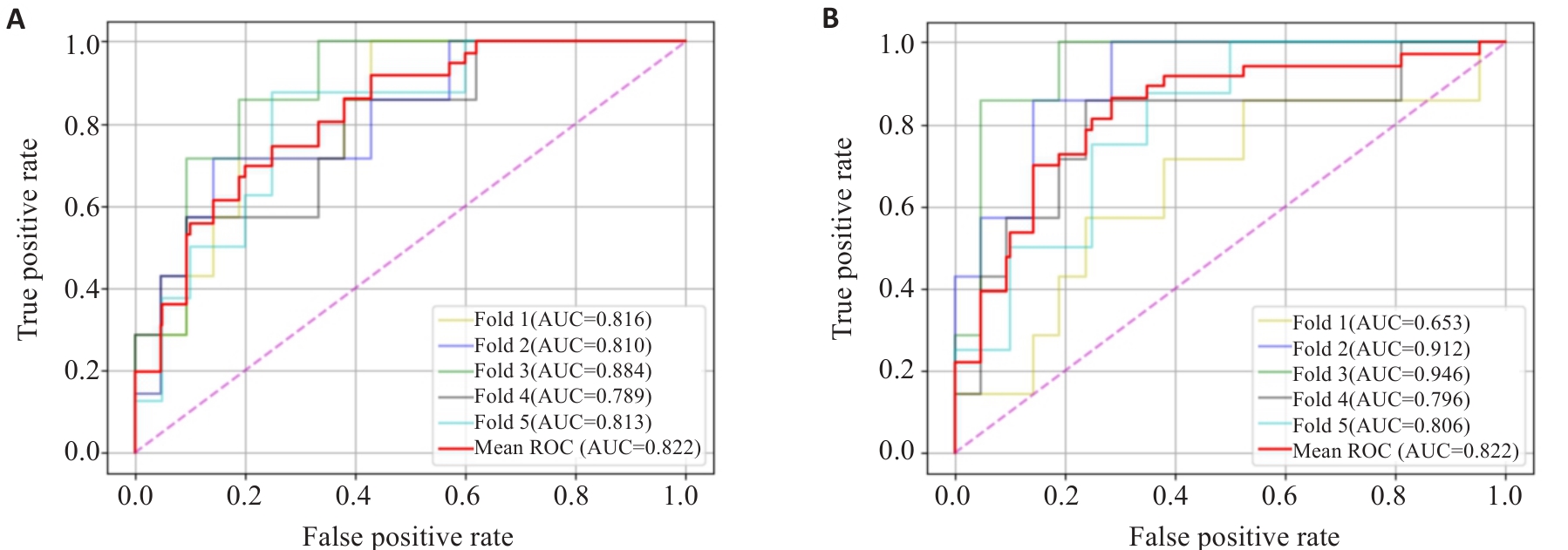
Fig.4 ROC and AUC for the 5-fold cross-validation tests of the two best models: CNN-KNN (A) andNM-MLP (B).
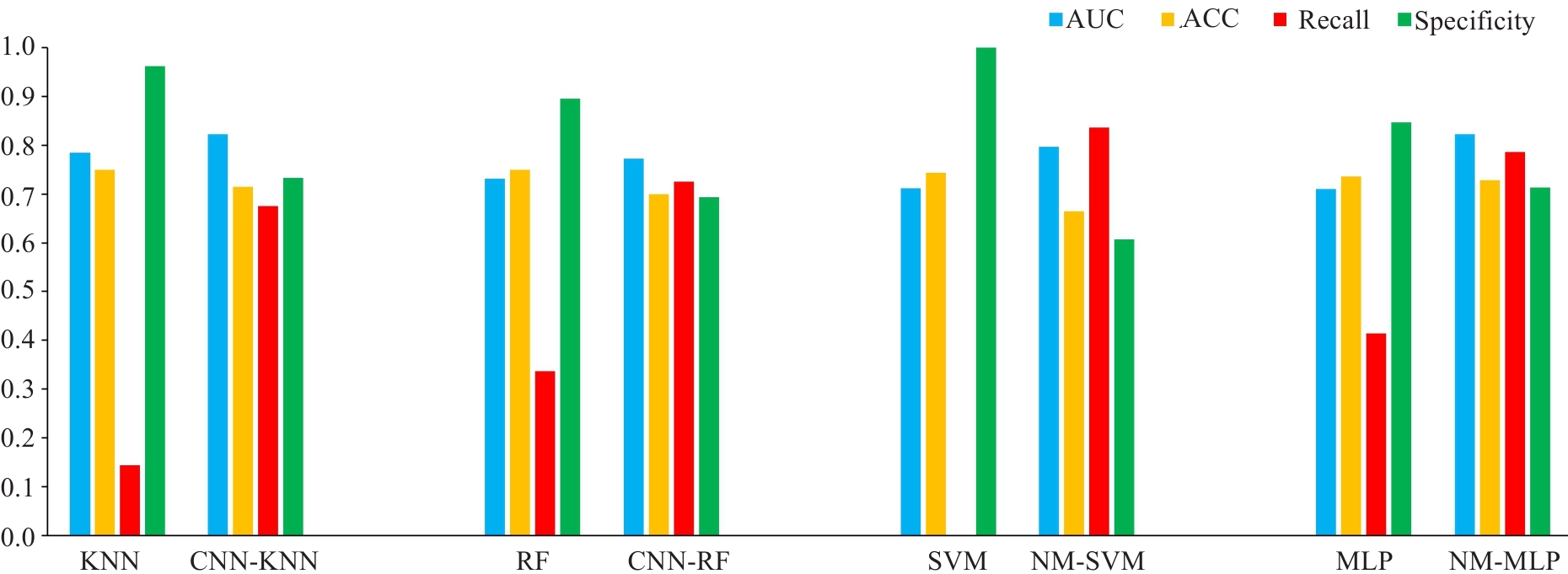
Fig.5 Comparison of prediction performances (AUC, accuracy, recall and specificity) among KNN, RF, SVM and MLP models without and with under-sampling. ACC: Accuracy.
| [1] | Giuliani E, As-Sanie S, Marsh EE. Epidemiology and management of uterine fibroids[J]. Int J Gynaecol Obstet, 2020, 149(1): 3-9. doi:10.1002/ijgo.13102 |
| [2] | Management of symptomatic uterine leiomyomas: ACOG practice bulletin, number 228[J]. Obstet Gynecol, 2021, 137(6): e100-15. doi:10.1097/aog.0000000000004401 |
| [3] | Grube M, Neis F, Brucker SY, et al. Uterine fibroids - current trends and strategies[J]. Surg Technol Int, 2019, 34: 257-63. |
| [4] | Haviv E, Schwarzman P, Bernstein EH, et al. Subsequent pregnancy outcomes after abdominal vs. laparoscopic myomectomy[J]. J Matern Fetal Neonatal Med, 2022, 35(25): 8219-25. doi:10.1080/14767058.2021.1967315 |
| [5] | Hajian-Tilaki K. Sample size estimation in diagnostic test studies of biomedical informatics[J]. J Biomed Inform, 2014, 48: 193-204. doi:10.1016/j.jbi.2014.02.013 |
| [6] | Liu L, Wang T, Lei B. Ultrasound-guided microwave ablation in the management of symptomatic uterine myomas: a systematic review and meta-analysis[J]. J Minim Invasive Gynecol, 2021, 28(12): 1982-92. doi:10.1016/j.jmig.2021.06.020 |
| [7] | Jenne JW, Preusser T, Günther M. High-intensity focused ultrasound: principles, therapy guidance, simulations and applications[J]. Z Für Med Phys, 2012, 22(4): 311-22. doi:10.1016/j.zemedi.2012.07.001 |
| [8] | Machtinger R, Inbar Y, Cohen-Eylon S, et al. MR-guided focus ultrasound (MRgFUS) for symptomatic uterine fibroids: predictors of treatment success[J]. Hum Reprod, 2012, 27(12): 3425-31. doi:10.1093/humrep/des333 |
| [9] | Mindjuk I, Trumm CG, Herzog P, et al. MRI predictors of clinical success in MR-guided focused ultrasound (MRgFUS) treatments of uterine fibroids: results from a single centre[J]. Eur Radiol, 2015, 25(5): 1317-28. doi:10.1007/s00330-014-3538-6 |
| [10] | Lambin P, Rios-Velazquez E, Leijenaar R, et al. Radiomics: Extracting more information from medical images using advanced feature analysis[J]. Eur J Cancer, 2012, 48(4): 441-6. doi:10.1016/j.ejca.2011.11.036 |
| [11] | Avanzo M, Wei L, Stancanello J, et al. Machine and deep learning methods for radiomics[J]. Med Phys, 2020, 47(5): e185-202. doi:10.1002/mp.13678 |
| [12] | Yip SS, Aerts HJ. Applications and limitations of radiomics[J]. Phys Med Biol, 2016, 61(13): R150-66. doi:10.1088/0031-9155/61/13/r150 |
| [13] | Hocquelet A, Denis de Senneville B, Frulio N, et al. Magnetic resonance texture parameters are associated with ablation efficiency in MR-guided high-intensity focussed ultrasound treatment of uterine fibroids[J]. Int J Hyperthermia, 2017, 33(2): 142-9. doi:10.1080/02656736.2016.1241432 |
| [14] | Li ZC, Zhang J, Song Y, et al. Utilization of radiomics to predict long-term outcome of magnetic resonance-guided focused ultrasound ablation therapy in adenomyosis[J]. Eur Radiol, 2021, 31(1): 392-402. doi:10.1007/s00330-020-07076-1 |
| [15] | Zheng Y, Chen L, Liu M, et al. Prediction of clinical outcome for high-intensity focused ultrasound ablation of uterine leiomyomas using multiparametric MRI radiomics-based machine leaning model[J]. Front Oncol, 2021, 11: 618604. doi:10.3389/fonc.2021.618604 |
| [16] | Li DC, Liu CW, Hu SC. A learning method for the class imbalance problem with medical data sets[J]. Comput Biol Med, 2010, 40(5): 509-18. doi:10.1016/j.compbiomed.2010.03.005 |
| [17] | Galar M, Fernandez A, Barrenechea E, et al. A review on ensembles for the class imbalance problem: bagging-, boosting-, and hybrid-based approaches[J]. IEEE Trans Syst, Man, Cybern C, 42(4): 463-84. doi:10.1109/tsmcc.2011.2161285 |
| [18] | Funaki K, Fukunishi H, Funaki T, et al. Magnetic resonance-guided focused ultrasound surgery for uterine fibroids: relationship between the therapeutic effects and signal intensity of preexisting T2-weighted magnetic resonance images[J]. Am J Obstet Gynecol, 2007, 196(2): 184.e1-6. doi:10.1016/j.ajog.2006.08.030 |
| [19] | Kim YS, Lim HK, Park MJ, et al. Screening magnetic resonance imaging-based prediction model for assessing immediate therapeutic response to magnetic resonance imaging-guided high-intensity focused ultrasound ablation of uterine fibroids[J]. Invest Radiol, 2016, 51(1): 15-24. doi:10.1097/rli.0000000000000199 |
| [20] | Jiang Y, Qin S, Wang Y, et al. Intravoxel incoherent motion diffusion-weighted MRI for predicting the efficacy of high-intensity focused ultrasound ablation for uterine fibroids[J]. Front Oncol, 2023, 13: 1178649. doi:10.3389/fonc.2023.1178649 |
| [21] | Carré A, Klausner G, Edjlali M, et al. Standardization of brain MR images across machines and protocols: bridging the gap for MRI-based radiomics[J]. Sci Rep, 2020, 10(1): 12340. doi:10.1038/s41598-020-69298-z |
| [22] | Nyul LG, Udupa JK, Zhang X. New variants of a method of MRI scale standardization[J]. IEEE Trans Med Imaging, 19(2): 143-50. doi:10.1109/42.836373 |
| [23] | Zwanenburg A, Vallières M, Abdalah MA, et al. The image biomarker standardization initiative: standardized quantitative radiomics for high-throughput image-based phenotyping[J]. Radiology, 2020, 295(2): 328-38. doi:10.1148/radiol.2020191145 |
| [24] | Kira K, Rendell LA. A practical approach to feature selection[C]//Proceedings of the 9th International Workshop on Machine Learning(ML 1992), Aberdeen, Scotland, UK, July 1-3, 1992.[S.l.]: Morgan Kaufmann Publishers Inc, 1992: 249-26. doi:10.1016/b978-1-55860-247-2.50037-1 |
| [25] | Prusa J, Khoshgoftaar TM, Dittman DJ, et al. Using random undersampling to alleviate class imbalance on tweet sentiment data[C]//2015 IEEE International Conference on Information Reuse and Integration. August 13-15, 2015. San Francisco, CA, USA. IEEE, 2015: 197-202. doi:10.1109/iri.2015.39 |
| [26] | Tomek I. An experiment with the edited nearest-neighbor rule[J]. IEEE Trans Syst, Man, Cybern, SMC-6(6): 448-52. doi:10.1109/tsmc.1976.4309523 |
| [27] | Wilson DL. Asymptotic properties of nearest neighbor rules using edited data[J]. IEEE Trans Syst, Man, Cybern, SMC-2(3): 408-21. doi:10.1109/tsmc.1972.4309137 |
| [28] | Zhang JP, Mani I: kNN approach to unbalanced data distributions: A case study involving information extraction. In: Proceeding of International Conference on Machine Learning (ICML 2003), Workshop on Learning from Imbalanced Data Sets: 2003; Washington D.C.: ICML; 2003: 1-7. |
| [29] | Hart P. The condensed nearest neighbor rule (Corresp.)[J]. IEEE Trans Inform Theory, 14(3): 515-6. doi:10.1109/tit.1968.1054155 |
| [30] | Laurikkala J. Improving identification of difficult small classes by balancing class distribution[M]//Artificial Intelligence in Medicine. Berlin, Heidelberg: Springer Berlin Heidelberg, 2001: 63-6. doi:10.1007/3-540-48229-6_9 |
| [31] | Smith MR, Martinez T, Giraud-Carrier C. An instance level analysis of data complexity[J]. Mach Learn, 2014, 95(2): 225-56. doi:10.1007/s10994-013-5422-z |
| [32] | Tomaszewski MR, Gillies RJ. The biological meaning of radiomic features[J]. Radiology, 2021, 298(3): 505-16. doi:10.1148/radiol.2021202553 |
| [33] | Zhao WP, Chen JY, Chen WZ. Dynamic contrast-enhanced MRI serves as a predictor of HIFU treatment outcome for uterine fibroids with hyperintensity in T2-weighted images[J]. Exp Ther Med, 2016, 11(1): 328-34. doi:10.3892/etm.2015.2879 |
| [34] | Fribbens C, O'Leary B, Kilburn L, et al. Plasma ESR1 mutations and the treatment of estrogen receptor-positive advanced breast cancer[J]. J Clin Oncol, 2016, 34(25): 2961-8. doi:10.1200/jco.2016.67.3061 |
| [35] | Rogers W, Thulasi Seetha S, Refaee TAG, et al. Radiomics: from qualitative to quantitative imaging[J]. Br J Radiol, 2020, 93(1108): 20190948. doi:10.1259/bjr.20190948 |
| [36] | Zheng Y, Chen L, Liu M, et al. Nonenhanced MRI-based radiomics model for preoperative prediction of nonperfused volume ratio for high-intensity focused ultrasound ablation of uterine leiomyomas[J]. Int J Hyperthermia, 2021, 38(1): 1349-58. doi:10.1080/02656736.2021.1972170 |
| [37] | Walsh R, Tardy M. A comparison of techniques for class imbalance in deep learning classification of breast cancer[J]. Diagnostics: Basel, 2022, 13(1): 67. doi:10.3390/diagnostics13010067 |
| [38] | Guo HX, Li YJ, Shang J, et al. Learning from class-imbalanced data: review of methods and applications[J]. Expert Syst Appl, 2017, 73: 220-39. doi:10.1016/j.eswa.2016.12.035 |
| [39] | Kraiem MS, Sánchez-Hernández F, Moreno-García MN. Selecting the suitable resampling strategy for imbalanced data classification regarding dataset properties. an approach based on association models[J]. Appl Sci, 2021, 11(18): 8546. doi:10.3390/app11188546 |
| [40] | Li M, Wu Z, Wang W, et al. Protein-protein interaction sites prediction based on an under-sampling strategy and random forest algorithm[J]. IEEE/ACM Trans Comput Biol Bioinform, 2022, 19(6): 3646-54. doi:10.1109/tcbb.2021.3123269 |
| Viewed | ||||||
|
Full text |
|
|||||
|
Abstract |
|
|||||
