
Journal of Southern Medical University ›› 2025, Vol. 45 ›› Issue (11): 2375-2384.doi: 10.12122/j.issn.1673-4254.2025.11.10
Previous Articles Next Articles
Dandan MA1( ), Jie CHENG1, Hong ZHANG1, Guang LIU1, Kai² SONG2()
Received:2025-06-07
Online:2025-11-20
Published:2025-11-28
Contact:
Kai2 SONG
E-mail:1173545463@qq.com;mrsongkai@163.com
Dandan MA, Jie CHENG, Hong ZHANG, Guang LIU, Kai² SONG. Electroacupuncture improves post-traumatic stress disorder in rats by alleviating hippocampal mitochondrial injury via regulating Bcl-2/Bax/caspase-3 signaling[J]. Journal of Southern Medical University, 2025, 45(11): 2375-2384.
Add to citation manager EndNote|Ris|BibTeX
URL: https://www.j-smu.com/EN/10.12122/j.issn.1673-4254.2025.11.10
| Target gene | Primer sequences | Product Length (bp) |
|---|---|---|
| Bcl-2 | CTGGTGGACAACATCGCTCT(F) GCATGCTGGGGCCATATAGT(R) | 115 |
| Bax | CAACATGGAGCTGCAGAGGA(F) GGAAAGGAGGCCATCCCAG (R) | 274 |
| Caspase-3 | GAGCTTGGAACGCGAAGAAA(F) TTGCGAGCTGACATTCCAGT (R) | 221 |
| GAPDH | CCTCGTCCCGTAGACAAAATG (F) TGAGGTCAATGAAGGGGTCGT (R) | 133 |
Tab.1 Primer sequences for RT-qPCR and product lengths
| Target gene | Primer sequences | Product Length (bp) |
|---|---|---|
| Bcl-2 | CTGGTGGACAACATCGCTCT(F) GCATGCTGGGGCCATATAGT(R) | 115 |
| Bax | CAACATGGAGCTGCAGAGGA(F) GGAAAGGAGGCCATCCCAG (R) | 274 |
| Caspase-3 | GAGCTTGGAACGCGAAGAAA(F) TTGCGAGCTGACATTCCAGT (R) | 221 |
| GAPDH | CCTCGTCCCGTAGACAAAATG (F) TGAGGTCAATGAAGGGGTCGT (R) | 133 |
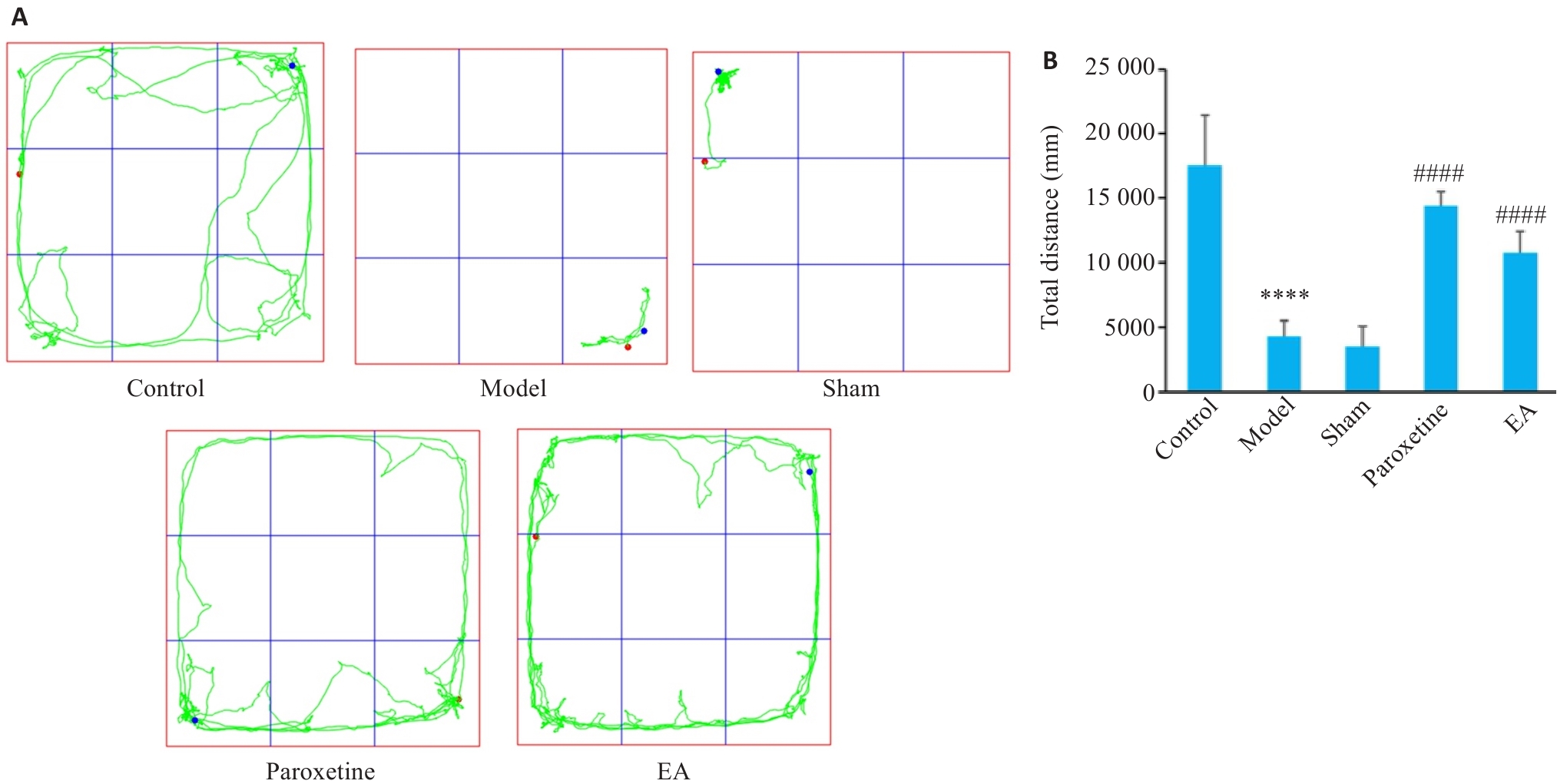
Fig.1 Anxiety-like behaviors of the rats in the 5 groups (Mean±SD, n=8). A: Motion trajectory in open field test. B: Statistics of total distance traveled. ****P<0.0001 vs Control group; ####P<0.0001 vs Model group.
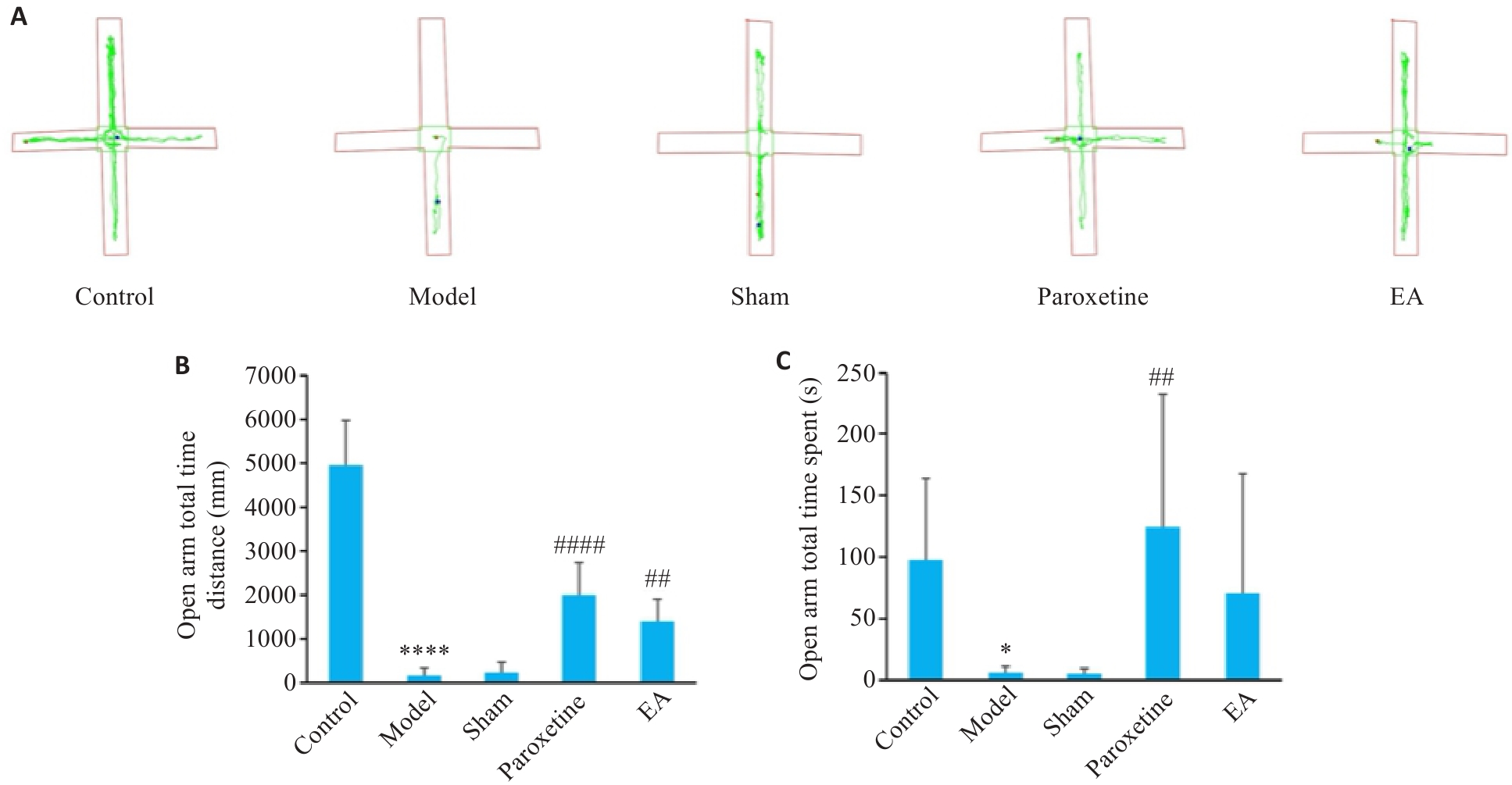
Fig.2 Anxiety-like behaviors of the rats in the 5 in elevated plus maze test (Mean±SD, n=8). A: Representative movement trajectories in the elevated plus maze test. B: Statistics of open arm total distance. C: Open arm total time. *P<0.05, ****P<0.0001 vs Control group; ##P<0.01, ####P<0.0001 vs Model group.

Fig.3 Pathological and morphological characteristics of hippocampal neurons of the rats in the 5 rats (HE staining, scale bar=20 μm). Yellow arrows: Normal neurons; Black arrows: Shrunken neurons; Green arrows: Vacuoles; Red arrows: Perivascular edema.

Fig.4 Comparison of neuronal structure in the hippocampal region of the rats among the 5 groups (Nissl staining, scale bar=50 μm). A: Representative photomicrographs.B: Neuronal cell count (n=3).****P<0.0001 vs Control group; #P<0.05 vs Model group.
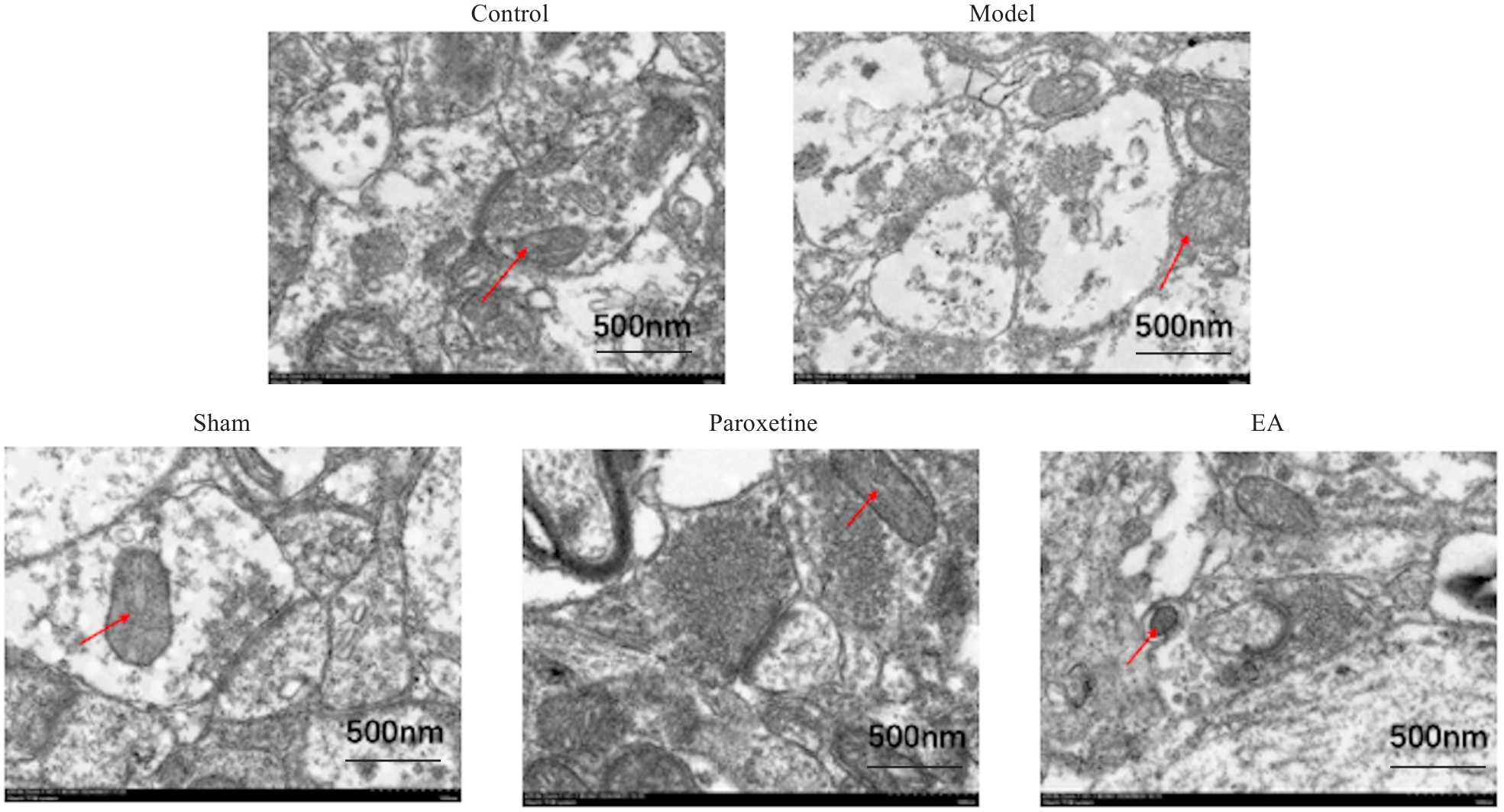
Fig.5 Comparison of mitochondrial morphology in the hippocampal neurons among the 5 groups (scale bar=500 nm). Red arrows indicate mitochondria.

Fig.6 Expression levels of Bcl-2 (A), Bax (B), and caspase-3 (C) mRNA in the hippocampus of the rats in the 5 groups (Mean±SD, n=3). ****P<0.0001 vs Control group; ###P<0.001, ####P<0.0001 vs Model group.

Fig.7 Mean fluorescence intensity of Bcl-2, Bax, and caspase-3 in the hippocampal region of the rats in the 5 group (Original magnification:×400). A: Hippocampal Bcl-2 fluorescence intensity. B: Hippocampal Bax fluorescence intensity. C: Hippocampal caspase-3 fluorescence intensity. D: Quantitative analysis of hippocampal Bcl-2 fluorescence intensity. E: Quantitative analysis of hippocampal Bax fluorescence intensity. F: Quantitative analysis of hippocampal caspase-3 fluorescence intensity. ***P<0.001 vs Control group; #P<0.05, ##P<0.01 vs Model group.
| [1] | Li FH, Cui YH, Li Y, et al. Prevalence of mental disorders in school children and adolescents in China: diagnostic data from detailed clinical assessments of 17, 524 individuals[J]. J Child Psychol Psychiatry, 2022, 63(1): 34-46. doi:10.1111/jcpp.13445 |
| [2] | Romaniuk M, Xia Y, Fisher G, et al. The relationship between chronic PTSD, cortical volumetry and white matter microstructure among Australian combat veterans[J]. Mil Med Res, 2022, 9(1): 50. doi:10.1186/s40779-022-00413-z |
| [3] | Fortney JC, Rajan S, Reisinger HS, et al. Deploying a telemedicine collaborative care intervention for posttraumatic stress disorder in the U.S. Department of Veterans Affairs: a stepped wedge evaluation of an adaptive implementation strategy[J]. Gen Hosp Psychiatry, 2022, 77: 109-17. doi:10.1016/j.genhosppsych.2022.03.009 |
| [4] | Ressler KJ, Berretta S, Bolshakov VY, et al. Post-traumatic stress disorder: clinical and translational neuroscience from cells to circuits[J]. Nat Rev Neurol, 2022, 18(5): 273-88. doi:10.1038/s41582-022-00635-8 |
| [5] | Chen YL, Tong L, Chen Y, et al. miR-153 downregulation alleviates PTSD-like behaviors and reduces cell apoptosis by upregulating the Sigma-1 receptor in the hippocampus of rats exposed to single-prolonged stress[J]. Exp Neurol, 2022, 352: 114034. doi:10.1016/j.expneurol.2022.114034 |
| [6] | Shi HJ, Wang S, Wang XP, et al. Hippocampus: molecular, cellular, and circuit features in anxiety[J]. Neurosci Bull, 2023, 39(6): 1009-26. doi:10.1007/s12264-023-01020-1 |
| [7] | Nie PY, Tong L, Li MD, et al. miR-142 downregulation alleviates rat PTSD-like behaviors, reduces the level of inflammatory cytokine expression and apoptosis in hippocampus, and upregulates the expression of fragile X mental retardation protein[J]. J Neuroinflammation, 2021, 18(1): 17. doi:10.1186/s12974-020-02064-0 |
| [8] | 王庆阁, 赵晓慧, 何宇轩, 等. 芪芎左归颗粒通过上调BDNF/TrkB通路提高衰老大鼠突触可塑性[J]. 南方医科大学学报, 2025, 45(8): 1589-98. |
| [9] | 刘倩汝, 王 丽, 祁 鸣, 等. 电针对PTSD样大鼠学习记忆及海马CA1区Bcl-2/Bax表达的影响[J]. 安徽医科大学学报, 2020, 55(3): 340-4. |
| [10] | Cai MD, Park HR, Yang EJ. Electroacupuncture modulates glutamate neurotransmission to alleviate PTSD-like behaviors in a PTSD animal model[J]. Transl Psychiatry, 2023, 13(1): 357. doi:10.1038/s41398-023-02663-4 |
| [11] | Hollifield M, Hsiao AF, Smith T, et al. Acupuncture for combat-related posttraumatic stress disorder: a randomized clinical trial[J]. JAMA Psychiatry, 2024, 81(6): 545-54. doi:10.1001/jamapsychiatry.2023.5651 |
| [12] | 陈育路. 抑制miR-153通过上调Sigma-1受体及降低海马神经元凋亡改善SPS大鼠PTSD样行为的机制研究[D]. 沈阳: 中国医科大学, 2022. |
| [13] | 孙一萍, 李晓艳, 邵瑞洁, 等. 针刺对创伤后应激障碍大鼠海马内质网应激相关分子的影响[J]. 针刺研究, 2022, 47(3): 224-30. |
| [14] | 魏高文, 邬继红, 王红梅, 等. 针刺对慢性应激抑郁大鼠海马NLRP3炎性小体和炎性细胞因子的影响[J]. 北京中医药大学学报, 2023, 46(3): 427-34. |
| [15] | 李晓艳, 王红梅, 赵 雅, 等. 针刺对慢性应激抑郁大鼠前额叶皮层小胶质细胞活化的影响[J]. 针刺研究, 2021, 46(1): 52-7. |
| [16] | Wang J, Gao F, Cui S, et al. Utility of 7, 8-dihydroxyflavone in preventing astrocytic and synaptic deficits in the hippocampus elicited by PTSD[J]. Pharmacol Res, 2022, 176: 106079. doi:10.1016/j.phrs.2022.106079 |
| [17] | 何存宝, 杨绍杰, 朱国旗. 4-(芳基乙炔基)-吡咯并[2, 3-d]嘧啶通过抑制mGluR5调控ERK1/2-SGK1信号通路改善小鼠创伤后应激障碍[J]. 南方医科大学学报, 2025, 45(4): 765-73. |
| [18] | Xie P, Chen LX, Wang J, et al. Polysaccharides from Polygonatum cyrtonema Hua prevent post-traumatic stress disorder behaviors in mice: Mechanisms from the perspective of synaptic injury, oxidative stress, and neuroinflammation[J]. J Ethnopharmacol, 2024, 319(Pt 1): 117165. doi:10.1016/j.jep.2023.117165 |
| [19] | 中国针灸学会.实验动物常用穴位名称与定位第2部分: 大鼠[J]. 针刺研究, 2021, 46(4): 351-2. |
| [20] | 楼喜强, 刘 襄, 刘春花, 等. 头针调衡电刺激治疗脑梗死后运动性失语疗效观察[J]. 中国针灸, 2021, 41(11): 1211-5. |
| [21] | 宋 凯, 王亚婷, 熊凡捷, 等. 电针对创伤后应激障碍大鼠行为学及海马SYN、PSD95表达的影响[J]. 世界针灸杂志: 英文版, 2023, 33(2): 135-41. |
| [22] | 刘敏琦, 高明威, 褚晓蕾, 等. 不同频率电刺激促进周围神经损伤的恢复[J]. 中国组织工程研究, 2025, 29(14): 3061-9. |
| [23] | 沈乎醒, 郑晓骏, 金 拓, 等. 电针对干眼豚鼠眼表感觉神经痛及P2X3受体和蛋白激酶C表达的影响[J]. 针刺研究, 2022, 47(5): 393-400. |
| [24] | 王永蕊, 郑先丽, 严兴科. “疏肝调神” 法针刺对创伤后应激障碍大鼠焦虑样行为及终纹床核PKC/ERK/CREB通路的影响[J]. 中国针灸, 2024, 44(11): 1281-8. |
| [25] | 李吉鑫, 邢文龙, 姜俊秀, 等. 创伤后应激障碍模型小鼠海马和前额叶皮质的NLRP3表达增加[J]. 神经解剖学杂志, 2024, 40(5): 549-57. |
| [26] | 李 秘, 李 凯, 丁 宁, 等. 电针对创伤后应激障碍大鼠杏仁核及海马区环磷腺苷效应元件结合蛋白的表达及与突触蛋白结合能力的影响[J]. 针刺研究, 2020, 45(7): 517-23. |
| [27] | Taylor KM, Mackelprang JL, Meyer D, et al. Substance use and posttraumatic stress disorder: 12-month outcomes among adults experiencing chronic homelessness in Australia[J]. Drug Alcohol Rev, 2023, 42(2): 439-49. doi:10.1111/dar.13565 |
| [28] | 吕 涛, 吴玉梅. 针刺改善创伤后应激障碍海马损伤的机制研究进展[J]. 中华中医药学刊, 2023, 41(3): 147-53. |
| [29] | Bu JJ, Liu Y, Zhao YF, et al. Paroxetine ameliorates corticosterone-induced myelin damage by promoting the proliferation and differentiation of oligodendrocyte precursor cells[J]. Neuroscience, 2025, 573: 344-54. doi:10.1016/j.neuroscience.2025.03.065 |
| [30] | Collins HM, Gullino LS, Ozdemir D, et al. Rebound activation of 5-HT neurons following SSRI discontinuation[J]. Neuropsychopha-rmacology, 2024, 49(10): 1580-9. doi:10.1038/s41386-024-01857-8 |
| [31] | 孙秀颀, 蔡 静, 张安邦, 等. 电针预处理通过抑制NF-kB/NLRP3信号通路介导炎症和凋亡改善大鼠脑卒中后痉挛[J]. 南方医科大学学报, 2024, 44(11): 2102-9. |
| [32] | 林如辉, 夏金言, 马小涵, 等. 电针通过促进突触再生改善脑缺血再灌注损伤大鼠的学习记忆功能[J]. 南方医科大学学报, 2024, 44(12): 2317-26. |
| [33] | 宋 凯, 张 虹. 电针调控杏仁核神经信号通路对创伤后应激障碍大鼠恐惧消退的影响[J]. 世界中医药, 2024, 19(23): 3619-24, 3631. |
| [34] | 栗文静, 白艳杰. 针刺调节BDNF/TrkB信号通路改善中枢神经系统疾病的研究进展[J]. 中山大学学报: 医学科学版, 2024, 45(4): 530-8. |
| [35] | 张安邦, 孙秀颀, 庞 博, 等. 电针预处理通过调节肠道-大脑轴及Nrf2/HO-1信号通路抑制铁死亡减轻大鼠脑缺血再灌注损伤[J]. 南方医科大学学报, 2025, 45(5): 911-20. |
| [36] | 周桐宇, 曹秋实, 孙雅琴, 等. 抑肝散防治急性应激障碍向创伤后应激障碍发展的作用与机制研究[J]. 时珍国医国药, 2025, 36(3): 419-26. |
| [37] | Iqbal J, Huang GD, Xue YX, et al. The neural circuits and molecular mechanisms underlying fear dysregulation in posttraumatic stress disorder[J]. Front Neurosci, 2023, 17: 1281401. doi:10.3389/fnins.2023.1281401 |
| [38] | Blidy KP, Bustos N, Spalten J, et al. Oxytocin moderates fMRI connectivity and response to implicit threat processing in cocaine use disorder[J]. Psychoneuroendocrinology, 2025, 171: 107217. doi:10.1016/j.psyneuen.2024.107217 |
| [39] | 卢志刚, 杨昌明, 孔祥辉, 等. 醒脑开窍中药治疗脑缺血再灌注损伤作用机制的研究进展[J]. 中国实验方剂学杂志, 2021, 27(24): 235-42. |
| [40] | 李京儒, 赵晋莹, 孙巧悦, 等. 近10年电针疗法治疗慢性失眠的机制概况[J]. 时珍国医国药, 2024, 35(9): 2235-8. |
| [41] | 邓楚玉, 王雪莹, 甘立祥, 等. 电针足三里改善高脂血症小鼠的血脂紊乱: 基于肠道菌群结构的改善[J]. 南方医科大学学报, 2025, 45(8): 1633-42. |
| [42] | Jin YH, Yu LM, Li Y. Paroxetine effect on nerve growth factor, human neurotrophin-4, brain-derived neurotrophic factor levels in post-stroke depression[J]. Mol Neurobiol, 2024, 61(10): 7890-7. doi:10.1007/s12035-024-04084-w |
| [43] | 康吉良, 胡 可, 卢俊樾, 等. 经皮穴位电刺激通过PGC-1α介导的线粒体生物生成和抗氧化应激改善血管性痴呆大鼠的认知功能[J]. 生物化学与生物物理进展, 2024, 51(5): 1191-202. |
| [44] | 陈玉竹, 魏玉婷, 肖 敏, 等. PI3K/AKT通路在阿尔茨海默病中的机制及针刺干预的研究进展[J]. 针刺研究, 2025, 50(8): 965-73. |
| [45] | 李德坤, 姚长风, 单自亮, 等. 基于PI3K/Akt/mTOR信号通路探讨针刺对膝关节骨关节炎模型大鼠膝关节软骨自噬的影响[J/OL]. 中国针灸, 2025: 1-14. (2025-03-14). . |
| [46] | 展俊平, 黄 硕, 孟庆良, 等. 缺氧微环境下补阳还五汤通过抑制BNIP3-PI3K/Akt通路抑制类风湿关节炎滑膜成纤维细胞的线粒体自噬[J]. 南方医科大学学报, 2025, 45(1): 35-42. |
| [47] | 刘 芳, 彭岚竹, 席菁乐. 高表达MYH9通过激活AKT/c-Myc通路抑制非小细胞肺癌细胞凋亡[J]. 南方医科大学学报, 2023, 43(4): 527-36. |
| [48] | 陈桂玲, 廖晓凤, 孙鹏涛, 等. 澳洲茄碱通过调控Bcl-2/Bax/caspase-3信号通路促进非小细胞肺癌发生凋亡[J]. 南方医科大学学报, 2024, 44(6): 1109-16. |
| [49] | 孔凡镇, 韩 芳, 石玉秀. p38、CHOP和细胞凋亡相关因子Bcl-2、Bax在PTSD大鼠中缝背核的表达[J]. 解剖科学进展, 2017, 23(6): 593-7. |
| [50] | 刘倩汝, 王 丽, 祁 鸣, 等. 电针对PTSD样大鼠学习记忆及海马CA1区Bcl-2/Bax表达的影响[J]. 安徽医科大学学报, 2020, 55(3): 340-4. |
| [51] | 李晓明, 韩 芳, 石玉秀. 线粒体凋亡路径参与创伤后应激障碍大鼠海马神经元凋亡的调控[J]. 解剖学报, 2010, 41(2): 201-5. |
| [1] | Kun WANG, Haiyan ZUO, Jiaojiao ZHANG, Xin WU, Wenhui WANG, Shengbing WU, Meiqi ZHOU. Electroacupuncture improves myocardial injury in rats with acute myocardial ischemia by inhibiting HPA axis hyperactivity via modulating hippocampal glutamatergic system [J]. Journal of Southern Medical University, 2025, 45(8): 1599-1607. |
| [2] | Chuyu DENG, Xueying WANG, Lixiang GAN, Dayu WANG, Xiaoyan ZHENG, Chunzhi TANG. Electroacupuncture at Zusanli improves blood lipid disorders in hyperlipidemic mice by improving gut microbiota structure [J]. Journal of Southern Medical University, 2025, 45(8): 1633-1642. |
| [3] | Zejin OU, Ying LI, Shi CHEN, Ziyi WANG, Meiyi HE, Zhicheng CHEN, Shihao TANG, Xiaojing MENG, Zhi WANG. Inhibition of ferroptosis alleviates acute kidney injury caused by diquat in zebrafish [J]. Journal of Southern Medical University, 2025, 45(8): 1743-1750. |
| [4] | Dongning TANG, Yunyun KANG, Wenjie HE, Qing XIA. Electroacupuncture combined with rehabilitation training improves neurological function of mice with cerebral ischemia by promoting astrocyte transdifferentiation [J]. Journal of Southern Medical University, 2025, 45(7): 1434-1441. |
| [5] | Qiongqiong HU, Wenpei LI, Lixia XU, Ruilei GUAN, Dongya ZHANG, Jiaojiao JIANG, Ning WANG, Gaiqing YANG. Neurospecific transmembrane protein 240 colocalizes with peroxisomes and activates Rho GDP dissociation inhibitor β [J]. Journal of Southern Medical University, 2025, 45(6): 1260-1269. |
| [6] | Guanglü HE, Wanyu CHU, Yan LI, Xin SHENG, Hao LUO, Aiping XU, Mingjie BIAN, Huanhuan ZHANG, Mengya WANG, Chao ZHENG. Orexin-A promotes motor function recovery of rats with spinal cord injury by regulating ionotropic glutamate receptors [J]. Journal of Southern Medical University, 2025, 45(5): 1023-1030. |
| [7] | Anbang ZHANG, Xiuqi SUN, Bo PANG, Yuanhua WU, Jingyu SHI, Ning ZHANG, Tao YE. Electroacupuncture pretreatment alleviates cerebral ischemia-reperfusion injury in rats by inhibiting ferroptosis through the gut-brain axis and the Nrf2/HO-1 signaling pathway [J]. Journal of Southern Medical University, 2025, 45(5): 911-920. |
| [8] | Lu ZHANG, Huanzhang DING, Haoran XU, Ke CHEN, Bowen XU, Qinjun YANG, Di WU, Jiabing TONG, Zegeng LI. Shenqi Buzhong Formula ameliorates mitochondrial dysfunction in a rat model of chronic obstructive pulmonary disease by activating the AMPK/SIRT1/PGC-1α pathway [J]. Journal of Southern Medical University, 2025, 45(5): 969-976. |
| [9] | Luyu LIU, Maowei GONG, Guosong LIAO, Weixing ZHAO, Qiang FU. Hypertension exacerbates postoperative learning and memory impairment in rats possibly due to UCP2 downregulation-mediated mitochondrial dysfunction [J]. Journal of Southern Medical University, 2025, 45(4): 725-735. |
| [10] | Cunbao HE, Shaojie YANG, Guoqi ZHU. 4‑(Arylethyl)‑pyrrolo[2,3-d] pyrimidine improves post-traumatic stress disorder in mice by inhibiting mGluR5-regulated ERK1/2-SGK1 signaling pathway [J]. Journal of Southern Medical University, 2025, 45(4): 765-773. |
| [11] | Yue CHEN, Linyu XIAO, Lü REN, Xue SONG, Jing LI, Jianguo HU. Monotropein improves motor function of mice with spinal cord injury by inhibiting the PI3K/AKT signaling pathway to suppress neuronal apoptosis [J]. Journal of Southern Medical University, 2025, 45(4): 774-784. |
| [12] | Ming LIAO, Wenhua ZHONG, Ran ZHANG, Juan LIANG, Wentaorui XU, Wenjun WAN, Chao LI Shu WU. Protein C activator derived from snake venom protects human umbilical vein endothelial cells against hypoxia-reoxygenation injury by suppressing ROS via upregulating HIF-1α and BNIP3 [J]. Journal of Southern Medical University, 2025, 45(3): 614-621. |
| [13] | Yiliu CHEN, Min MA, Ran SU, Yinbin ZHU, Qing FENG, Jiali LUO, Weifeng FENG, Xianxin YAN. Lichong Xiaozheng Granules enhances cisplatin sensitivity of ovarian cancer xenografts in rats by regulating adenine nucleotide translocator 3-mediated mitochondrial apoptosis [J]. Journal of Southern Medical University, 2025, 45(11): 2309-2319. |
| [14] | Ming YI, Ye LUO, Lu WU, Zeheng WU, Cuiping JIANG, Shiyu CHEN, Xiao KE. Astragaloside IV alleviates D-GAL-induced endothelial cell senescence by promoting mitochondrial autophagy via inhibiting the PINK1/Parkin pathway [J]. Journal of Southern Medical University, 2025, 45(11): 2427-2436. |
| [15] | Simeng LI, Jianning CHEN, Siman SHEN, Wanglong LIU, Lili YU, Liangqing ZHANG. Salvianolic acid B promotes mitochondrial homeostasis and improves cardiac function in mice with ischemia-reperfusion injury by inhibiting Sirt1 protein degradation [J]. Journal of Southern Medical University, 2025, 45(10): 2062-2070. |
| Viewed | ||||||
|
Full text |
|
|||||
|
Abstract |
|
|||||
