
南方医科大学学报 ›› 2026, Vol. 46 ›› Issue (9): 2276-2284.doi: 10.12122/j.issn.1673-4254.2026.09.25
• • 上一篇
黄亚芳1,2( ), 杨思邈1,2, 丁霞3, 褚福浩4, 陈润花2()
收稿日期:2025-12-03
出版日期:2026-09-20
发布日期:2026-09-30
通讯作者:
陈润花
E-mail:wind_1016@qq.com;excellentcrh@126.com
作者简介:黄亚芳,在读博士研究生,E-mail: wind_1016@qq.com
基金资助:
Yafang HUANG1,2(), Simiao YANG1,2, Xia DING3, Fuhao CHU4, Runhua CHEN2()
Received:2025-12-03
Online:2026-09-20
Published:2026-09-30
Contact:
Runhua CHEN
E-mail:wind_1016@qq.com;excellentcrh@126.com
摘要:
本研究基于临床数据整合视角,系统梳理了近年来基于多组学技术与临床数据整合的胃癌研究进展。针对胃癌发病率高、死亡率高及异质性显著的特点,通过整合基因组、转录组、蛋白质组等多组学信息与临床资料,系统解析了胃癌的分子分型体系及其驱动基因,并深入探讨了肿瘤微环境中癌细胞与基质细胞等的作用机制。在此基础上,进一步归纳了不同亚型胃癌的临床与分子关联规律,构建了临床数据、多组学网络与肿瘤微环境相结合的全景研究框架,实现从癌前病变到肿瘤进展的全程机制关联。该框架为胃癌的早期预防、筛查及精准诊疗提供了系统的理论支持与转化路径,有助于推动胃癌诊疗向精准化方向发展。
黄亚芳, 杨思邈, 丁霞, 褚福浩, 陈润花. 从临床数据整合视角解析胃癌的发病机制与异质性[J]. 南方医科大学学报, 2026, 46(9): 2276-2284.
Yafang HUANG, Simiao YANG, Xia DING, Fuhao CHU, Runhua CHEN. Insights into the occurrence and heterogeneity of gastric cancer from the perspective of clinical data integration[J]. Journal of Southern Medical University, 2026, 46(9): 2276-2284.
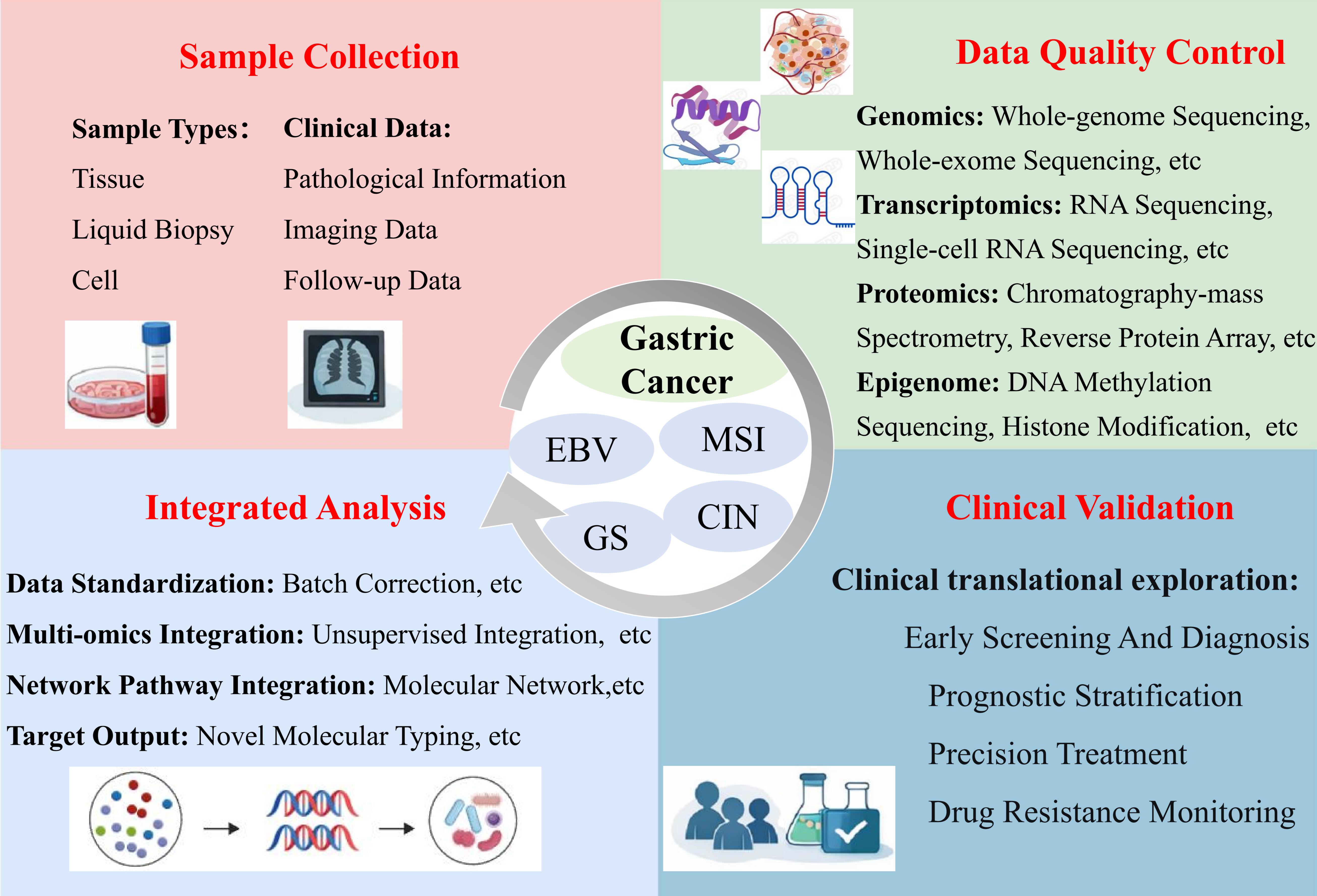
图1 多组学数据整合流程图
Fig.1 Multi-omics data integration flowchart.EBV: Epstein-Barr virus-positive; MSI: Microsatellite instability; GS: Genomically stable; CIN: Chromosomal instability.
| [1] | Bray F, Laversanne M, Sung H, et al. Global cancer statistics 2022: GLOBOCAN estimates of incidence and mortality worldwide for 36 cancers in 185 countries[J]. CA A Cancer J Clin, 2024, 74(3): 229-63. doi:10.3322/caac.21834 |
| [2] | López MJ, Carbajal J, Alfaro AL, et al. Characteristics of gastric cancer around the world[J]. Crit Rev Oncol Hematol, 2023, 181: 103841. doi:10.1016/j.critrevonc.2022.103841 |
| [3] | Hirata Y, Noorani A, Song SM, et al. Early stage gastric adenocarcinoma: clinical and molecular landscapes[J]. Nat Rev Clin Oncol, 2023, 20(7): 453-69. doi:10.1038/s41571-023-00767-w |
| [4] | Salvatori S, Marafini I, Laudisi F, et al. Helicobacter pylori and gastric cancer: pathogenetic mechanisms[J]. Int J Mol Sci, 2023, 24(3): 2895. doi:10.3390/ijms24032895 |
| [5] | Goleij P, Heidari MM, Motevalli H, et al. Targeting the HGF/MET axis in cancer: therapeutic promise for natural compounds[J]. Eur J Med Chem, 2025, 298: 118027. doi:10.1016/j.ejmech.2025.118027 |
| [6] | Su MC, Nethi SK, Dhanyamraju PK, et al. Nanomedicine strategies for targeting tumor stroma[J]. Cancers, 2023, 15(16): 4145. doi:10.3390/cancers15164145 |
| [7] | Liu M, Liu Q, Zou Q, et al. The composition and roles of gastric stem cells in epithelial homeostasis, regeneration, and tumorigenesis[J]. Cell Oncol, 2023, 46(4): 867-83. doi:10.1007/s13402-023-00802-z |
| [8] | Li S, Gao J, Xu Q, et al. A signature-based classification of gastric cancer that stratifies tumor immunity and predicts responses to PD-1 inhibitors[J]. Front Immunol, 2021, 12: 693314. doi:10.3389/fimmu.2021.693314 |
| [9] | Yuan QH, Deng DW, Pan C, et al. Integration of transcriptomics, proteomics, and metabolomics data to reveal HER2-associated metabolic heterogeneity in gastric cancer with response to immunotherapy and neoadjuvant chemotherapy[J]. Front Immunol, 2022, 13: 951137. doi:10.3389/fimmu.2022.951137 |
| [10] | Zeng YJ, Jin RU. Molecular pathogenesis, targeted therapies, and future perspectives for gastric cancer[J]. Semin Cancer Biol, 2022, 86(Pt 3): 566-82. doi:10.1016/j.semcancer.2021.12.004 |
| [11] | Norwood DA, Montalvan-Sanchez E, Dominguez RL, et al. Gastric cancer: emerging trends in prevention, diagnosis, and treatment[J]. Gastroenterol Clin North Am, 2022, 51(3): 501-18. doi:10.1016/j.gtc.2022.05.001 |
| [12] | Wu XZ, Liu ZC, Qin XX, et al. The risk of incident gastric cancer for populations with different precancerous gastric lesions: a prospective follow-up study[J]. Zhonghua Liuxingbingxue Zazhi, 2022, 43(12): 1972-8. |
| [13] | Nie YZ, Gao XC, Cai XQ, et al. Combining methylated SEPTIN9 and RNF180 plasma markers for diagnosis and early detection of gastric cancer[J]. Cancer Commun, 2023, 43(11): 1275-9. doi:10.1002/cac2.12478 |
| [14] | Caliskan R, Sayi Yazgan A, Tokman HB, et al. The cytokine response in THP-1 (monocyte) and HL-60 (neutrophil-differentiated) cells infected with different genotypes of Helicobacter pylori strains[J]. Turk J Gastroenterol, 2015, 26(4): 297-303. doi:10.5152/tjg.2015.8058 |
| [15] | Khazaaleh S, Alomari M, Rashid MU, et al. Gastric intestinal Metaplasia and gastric cancer prevention: Watchful waiting[J]. Cleve Clin J Med, 2024, 91(1): 33-9. doi:10.3949/ccjm.91a.23015 |
| [16] | Ma YB, Jiang ZC, Pan LB, et al. Current development of molecular classifications of gastric cancer based on omics (Review)[J]. Int J Oncol, 2024, 65(3). DOI:10.3892/ijo.2024.5677 . |
| [17] | Nakajima S, Fukai S, Kaneta A, et al. Regulation of the tumor microenvironment through HER2 signaling-insights from gastric cancer cases with heterogeneous HER2 overexpression[J]. Gan To Kagaku Ryoho, 2024, 51(9): 903-5. |
| [18] | Shin M, Ahn S, Jung J, et al. Impact of programmed death-ligand 1 (PD-L1) positivity on clinical and molecular features of patients with metastatic gastric cancer[J]. Cancer Med, 2023, 12(18): 18633-42. doi:10.1002/cam4.6472 |
| [19] | Liu BL, Cleary JM, Shi J, et al. Claudin 18.2 and other therapeutic biomarkers in gastric and gastroesophageal junction adeno-carcinomas[J]. Am J Surg Pathol, 2025, 49(12): 1233-44. doi:10.1097/PAS.0000000000002464 |
| [20] | Decourtye-Espiard L, Guilford P. Hereditary diffuse gastric cancer[J]. Gastroenterology, 2023, 164(5): 719-35. doi:10.1053/j.gastro.2023.01.038 |
| [21] | Lu S, Duan RF, Cong L, et al. The effects of ARID1A mutation in gastric cancer and its significance for treatment[J]. Cancer Cell Int, 2023, 23(1): 296. doi:10.1186/s12935-023-03154-8 |
| [22] | Dixon K, Brew T, Farnell D, et al. Modelling hereditary diffuse gastric cancer initiation using transgenic mouse-derived gastric organoids and single-cell sequencing[J]. J Pathol, 2021, 254(3): 254-64. doi:10.1002/path.5675 |
| [23] | Benton D, Chernoff J. RHOA drivers take alternate routes in gastric cancer[J]. Sci Signal, 2023, 16(816): eadk9171. doi:10.1126/scisignal.adk9171 |
| [24] | Estaji F, Zibaee S, Torabi M, et al. Epstein-Barr Virus and gastric carcinoma pathogenesis with emphasis on underlying epigenetic mechanisms[J]. Discov Oncol, 2024, 15(1): 719. doi:10.1007/s12672-024-01619-4 |
| [25] | Singh AD, Gupta A, Mehta N, et al. Occurrence of gastric cancer in patients with juvenile polyposis syndrome: a systematic review and meta-analysis[J]. Gastrointest Endosc, 2023, 97(3): 407-14.e1. doi:10.1016/j.gie.2022.10.026 |
| [26] | Wang HL, Guo M, Wei HD, et al. Targeting p53 pathways: mechanisms, structures, and advances in therapy[J]. Signal Transduct Target Ther, 2023, 8(1): 92. doi:10.1038/s41392-023-01347-1 |
| [27] | Shi DK, Yang ZH, Cai YN, et al. Research advances in the molecular classification of gastric cancer[J]. Cell Oncol, 2024, 47(5): 1523-36. doi:10.1007/s13402-024-00951-9 |
| [28] | Duan YT, Xu YH, Dou Y, et al. Helicobacter pylori and gastric cancer: mechanisms and new perspectives[J]. J Hematol Oncol, 2025, 18(1): 10. doi:10.1186/s13045-024-01654-2 |
| [29] | Yeoh KG, Tan P. Mapping the genomic Diaspora of gastric cancer[J]. Nat Rev Cancer, 2022, 22(2): 71-84. doi:10.1038/s41568-021-00412-7 |
| [30] | Wen JR, Deng SX, Bi YH, et al. Association between multiple gene promoter hypermethylation and the risk of gastric cancer: a systematic review and meta-analysis[J]. Dig Liver Dis, 2023, 55(1): 40-5. doi:10.1016/j.dld.2022.03.009 |
| [31] | Shi Q, Xu GX, Jiang YL, et al. Phospholipase PLCE1 promotes transcription and phosphorylation of MCM7 to drive tumor progression in esophageal cancer[J]. Cancer Res, 2024, 84(4): 560-76. doi:10.1158/0008-5472.25224600 |
| [32] | Zhang P, Yang MR, Zhang YD, et al. Dissecting the single-cell transcriptome network underlying gastric premalignant lesions and early gastric cancer[J]. Cell Rep, 2019, 27(6): 1934-47.e5. doi:10.1016/j.celrep.2019.04.052 |
| [33] | Hatori S, Sakamaki K, Yokohori T, et al. Clinical significance of PLA2G2A expression in gastric cancer patients who receive gastrectomy and adjuvant S-1[J]. Anticancer Res, 2021, 41(7): 3583-8. doi:10.21873/anticanres.15146 |
| [34] | Chen Y, Bai BJ, Ying KK, et al. Anti-PD-1 combined with targeted therapy: Theory and practice in gastric and colorectal cancer[J]. Biochim Biophys Acta Rev Cancer, 2022, 1877(5): 188775. doi:10.1016/j.bbcan.2022.188775 |
| [35] | Jeong HY, Ham IH, Lee SH, et al. Spatially distinct reprogramming of the tumor microenvironment based on tumor invasion in diffuse-type gastric cancers[J]. Clin Cancer Res, 2021, 27(23): 6529-42. doi:10.1158/1078-0432.ccr-21-0792 |
| [36] | Zheng SW, Wang YY, Ni CX, et al. Helicobacter pylori SlyD stabilizes TPT1 via hnRNPK and enhances OCT1-mediated CDX2 transcriptional activation to drive gastric intestinal Metaplasia [J]. BMC Med, 2025, 23(1): 71. doi:10.1186/s12916-025-03911-8 |
| [37] | Ma Q, Yang FF, Xiao B, et al. Emerging roles of circular RNAs in tumorigenesis, progression, and treatment of gastric cancer[J]. J Transl Med, 2024, 22(1): 207. doi:10.1186/s12967-024-05001-4 |
| [38] | Yang ML, Zheng EK, Ni JJ, et al. Circular RNA circFOXO3 facilitate non-small cell lung cancer progression through upregulating HMGB3 via sponging miR-545-3p/miR-506-3p[J]. Tissue Cell, 2022, 75: 101702. doi:10.1016/j.tice.2021.101702 |
| [39] | Ghafouri-Fard S, Honarmand Tamizkar K, Jamali E, et al. Contribution of circRNAs in gastric cancer[J]. Pathol Res Pract, 2021, 227: 153640. doi:10.1016/j.prp.2021.153640 |
| [40] | Almalki WH, Almujri SS. The dual roles of circRNAs in Wnt/ β‑Catenin signaling and cancer progression[J]. Pathol Res Pract, 2024, 255: 155132. doi:10.1016/j.prp.2024.155132 |
| [41] | Wang JJ, Zhang MX, Hu XH, et al. miRNA-194 predicts favorable prognosis in gastric cancer and inhibits gastric cancer cell growth by targeting CCND1[J]. FEBS Open Bio, 2021, 11(7): 1814-26. doi:10.1002/2211-5463.13125 |
| [42] | Dos Santos EC, Rohan P, Binato R, et al. Integrated network analysis of microRNAs, mRNAs, and proteins reveals the regulatory interaction between hsa-mir-200b and CFL2 associated with advanced stage and poor prognosis in patients with intestinal gastric cancer[J]. Cancers, 2023, 15(22): 5374. doi:10.3390/cancers15225374 |
| [43] | Xie ZL, Li JC, Huang P, et al. Applications and achievements of single-cell sequencing in gastrointestinal cancer[J]. Front Oncol, 2022, 12: 905571. doi:10.3389/fonc.2022.905571 |
| [44] | Gilyazova I, Asadullina D, Kagirova E, et al. MiRNA-146a-a key player in immunity and diseases[J]. Int J Mol Sci, 2023, 24(16): 12767. doi:10.3390/ijms241612767 |
| [45] | Lu JQ, Li D, Jiang HL, et al. The aryl sulfonamide indisulam inhibits gastric cancer cell migration by promoting the ubiquitination and degradation of the transcription factor ZEB1[J]. J Biol Chem, 2023, 299(4): 103025. doi:10.1016/j.jbc.2023.103025 |
| [46] | Mahmoudzadeh-Sagheb A, Panahi M, Jami S, et al. Survivin as a potential biomarker for early diagnosis of the progression of precancerous lesions to gastric cancer[J]. Int J Biol Markers, 2024, 39(1): 52-8. doi:10.1177/03936155231217268 |
| [47] | Shi WH, Wang YS, Xu C, et al. Multilevel proteomic analyses reveal molecular diversity between diffuse-type and intestinal-type gastric cancer[J]. Nat Commun, 2023, 14(1): 835. doi:10.1038/s41467-023-35797-6 |
| [48] | Zhu XY, Chen H, Li H, et al. ITGB1-mediated molecular landscape and cuproptosis phenotype induced the worse prognosis in diffuse gastric cancer[J]. Front Oncol, 2023, 13: 1115510. doi:10.3389/fonc.2023.1115510 |
| [49] | Zheng Z, Zhai YH, Yan XS, et al. Functions and clinical applications of exosomes in gastric cancer[J]. Int J Biol Sci, 2025, 21(5): 2330-45. doi:10.7150/ijbs.98087 |
| [50] | Tanaka M. Crosstalk of tumor stromal cells orchestrates invasion and spreading of gastric cancer[J]. Pathol Int, 2022, 72(4): 219-33. doi:10.1111/pin.13211 |
| [51] | Ramesh P, Nisar M, Neha, et al. Delineating protein biomarkers for gastric cancers: a catalogue of mass spectrometry-based markers and assessment of their suitability for targeted proteomics applications[J]. J Proteomics, 2024, 306: 105262. doi:10.1016/j.jprot.2024.105262 |
| [52] | Soleimani A, Dadjoo P, Avan A, et al. Emerging roles of CD133 in the treatment of gastric cancer, a novel stem cell biomarker and beyond[J]. Life Sci, 2022, 293: 120050. doi:10.1016/j.lfs.2021.120050 |
| [53] | Koelsch N, Manjili MH. From reductionistic approach to systems immunology approach for the understanding of tumor microenvironment[J]. Int J Mol Sci, 2023, 24(15): 12086. doi:10.3390/ijms241512086 |
| [54] | Bian SH, Wang YC, Zhou Y, et al. Integrative single-cell multiomics analyses dissect molecular signatures of intratumoral hetero-geneities and differentiation states of human gastric cancer[J]. Natl Sci Rev, 2023, 10(6): nwad094. doi:10.1093/nsr/nwad094 |
| [55] | Zhang XJ, Ren B, Liu B, et al. Single-cell RNA sequencing and spatial transcriptomics reveal the heterogeneity and intercellular communication of cancer-associated fibroblasts in gastric cancer[J]. J Transl Med, 2025, 23(1): 344. doi:10.1186/s12967-025-06376-8 |
| [56] | Song JQ, Wei RY, Liu CC, et al. Antigen-presenting cancer associated fibroblasts enhance antitumor immunity and predict immunotherapy response[J]. Nat Commun, 2025, 16(1): 2175. doi:10.1038/s41467-025-57465-7 |
| [57] | Xu L, Li K, Li J, et al. IL-18 serves as a main effector of CAF-derived METTL3 against immunosuppression of NSCLC via driving NF-κB pathway[J]. Epigenetics, 2023, 18(1): 2265625. doi:10.1080/15592294.2023.2265625 |
| [58] | Choi KM, Kim B, Lee SM, et al. Characterization of gastric cancer-stimulated signaling pathways and function of CTGF in cancer-associated fibroblasts[J]. Cell Commun Signal, 2024, 22(1): 8. doi:10.1186/s12964-023-01396-7 |
| [59] | Li XC, Sun Z, Peng GX, et al. Single-cell RNA sequencing reveals a pro-invasive cancer-associated fibroblast subgroup associated with poor clinical outcomes in patients with gastric cancer[J]. Theranostics, 2022, 12(2): 620-38. doi:10.7150/thno.60540 |
| [60] | Wang QY, Chen J, Wang YH, et al. The profiles of immunosuppressive microenvironment in the Lauren intestinal-type gastric adenocarcinoma[J]. Cancer Immunol Immunother, 2025, 74(3): 82. doi:10.1007/s00262-024-03938-5 |
| [61] | Zhou L, Yang M, Deng C, et al. Single-cell sequencing reveals the role of IL-33 (+) endothelial subsets in promoting early gastric cancer progression[J]. Imeta, 2025, 4(4): e70050. doi:10.1002/imt2.70050 |
| [62] | Ma HR, Srivastava S, Ho SWT, et al. Spatially resolved tumor ecosystems and cell states in gastric adenocarcinoma progression and evolution[J]. Cancer Discov, 2025, 15(4): 767-92. doi:10.1158/2159-8290.cd-24-0605 |
| [63] | He YX, Wang JY, Deng ZL, et al. FOLR2(+) macrophage depletion from intestinal Metaplasia to early gastric cancer: single-cell sequencing insight into gastric cancer progression[J]. J Exp Clin Cancer Res, 2024, 43(1): 326. doi:10.1186/s13046-024-03245-y |
| [64] | Ji CG, Cai HM, Jin XX, et al. Identification of immune infiltrating cell-related biomarkers in early gastric cancer progression[J]. Technol Cancer Res Treat, 2024, 23: 15330338241262724. doi:10.1177/15330338241262724 |
| [65] | Wang JY, Zhang H, Li JT, et al. Exosome-derived proteins in gastric cancer progression, drug resistance, and immune response[J]. Cell Mol Biol Lett, 2024, 29(1): 157. doi:10.1186/s11658-024-00676-5 |
| [66] | Li NS, Chen SH, Xu XB, et al. Single-cell transcriptomic profiling uncovers cellular complexity and microenvironment in gastric tumorigenesis associated with Helicobacter pylori [J]. J Adv Res, 2025, 74: 471-91. doi:10.1016/j.jare.2024.10.012 |
| [67] | Zheng LT, Qin SS, Si W, et al. Pan-cancer single-cell landscape of tumor-infiltrating T cells[J]. Science, 2021, 374(6574): abe6474. doi:10.1126/science.abe6474 |
| [68] | Kang BX, Camps J, Fan B, et al. Parallel single-cell and bulk transcriptome analyses reveal key features of the gastric tumor microenvironment[J]. Genome Biol, 2022, 23(1): 265. doi:10.1186/s13059-022-02828-2 |
| [69] | Wu J, Zhang PF, Zeng Y, et al. Effects of FAP(+) cancer-associated fibroblasts on anti-PD-1 immunotherapy and CD4+ T cell polari-zation in gastric cancer[J]. Cancer Drug Resist, 2025, 8: 38. doi:10.20517/cdr.2025.97 |
| [1] | 刘馨悦, 张可妮, 乔通, 尹林, 张龙涛, 程歆柯, 王奔, 曹锦麟, 耿志军, 赵皓. 安五脂素通过拮抗JAK1/STAT3通路的激活抑制胃癌细胞恶性生物学行为[J]. 南方医科大学学报, 2026, 46(9): 2242-2257. |
| [2] | 黄炳轶, 高玉洁, 谢靖宜, 严晨, 顾梦茹, 张志郅, 郭锦涛, 刘嵩, 王子良, 杨玉萍, 左芦根, 陈德利. PPT1在胃癌中的预后价值及其对癌细胞脂质代谢的作用和机制[J]. 南方医科大学学报, 2026, 46(8): 1915-1925. |
| [3] | 席一杰, 李宇轩, 林立凡, 陈璐, 袁鑫, 赵丽瑛, 刘浩, 林填, 赵明利, 钟武, 胡彦锋, 郭伟洪. 新辅助免疫治疗背景下局部进展期胃癌的外科诊疗方案的探索与思考[J]. 南方医科大学学报, 2026, 46(8): 1981-1992. |
| [4] | 王淼, 卢必超, 孟昊阳, 周姝含, 毛宁峰, 张洋, 吕文亮. NDUFA13与CRIP1调控慢阻肺B细胞损伤并具备潜在诊断价值[J]. 南方医科大学学报, 2026, 46(6): 1349-1364. |
| [5] | 孙蕊旭, 李煜桐, 左玲, 陶家华, 董璇, 刘宏伟. 杨梅酮通过阻遏HSP90AA1介导的AKT磷酸化抑制膀胱癌细胞的增殖和迁移[J]. 南方医科大学学报, 2026, 46(5): 1039-1052. |
| [6] | 夏黔松, 邱洋, 李宏辉, 聂立铭. 双波长光声显微镜揭示肝纤维化微循环功能障碍及空间异质性[J]. 南方医科大学学报, 2026, 46(5): 1167-1174. |
| [7] | 丁宁, 彭天书, 莫黎, 胡响当, 杨宗亮, 肖佑, 付肖冰, 赵建政, 李磊磊, 张英杰. 多组学整合揭示结直肠癌中的免疫-代谢异质性:针对ANGPTL4/FABP4/RBP7的预后模型及治疗策略[J]. 南方医科大学学报, 2026, 46(5): 977-993. |
| [8] | 董保龙, 彭江山, 李进茹, 孟云, 杨晓军. 过表达miR-593-5p通过靶向PLK1抑制胃癌细胞的迁移、侵袭、增殖并促进其凋亡[J]. 南方医科大学学报, 2026, 46(4): 871-879. |
| [9] | 邹晓松, 张幸, 李平, 田瑞雪, 路晓淼. 姜黄素通过抑制RANBP3L基因表达减轻2型糖尿病小鼠的骨质疏松症[J]. 南方医科大学学报, 2026, 46(2): 325-334. |
| [10] | 王煜煌, 王文锐, 程淑洁, 冯云龙, 张卓, 施其英, 李雨佳, 胡茜文, 吴明彩. 槲皮素通过调控Hippo通路蛋白YAP表达抑制胃癌细胞增殖与迁移并促进其凋亡[J]. 南方医科大学学报, 2026, 46(2): 374-384. |
| [11] | 王强, 柴志欣, 邓玉露, 张志葳, 龚英, 高圣, 冯平锋. cGAS-STING激动剂cGAMP可增强自然杀伤细胞的抗胃癌效应[J]. 南方医科大学学报, 2026, 46(2): 434-442. |
| [12] | 李艳宇, 李晨, 戴传君, 郭润之, 韩浩宇, 卢林明, 周芳芳, 支慧. 皖南蝮蛇抑瘤组分-Ι通过调控RAI14抑制顺铂耐药胃癌细胞的增殖与侵袭[J]. 南方医科大学学报, 2026, 46(1): 113-121. |
| [13] | 刘福水, KHALIUNAA Tumurbaatar, 曹奇光, 杨煜乾, 任长安, 朱金超, 赵小兰, 曹锂, 邓彪, 王小乐. 颈椎病颈椎终板软骨的转录组学特征及针刀干预对FGF18/Akt轴关键分子表达的影响[J]. 南方医科大学学报, 2026, 46(1): 55-65. |
| [14] | 韩圆圆, 孙凤, 刘艳, 徐梦月, 许澈, 李娜, 李娟, 王剑锋. 高度近视白内障患者晶状体前囊膜中circRNAs的差异性表达[J]. 南方医科大学学报, 2025, 45(9): 1997-2005. |
| [15] | 陈子贤, 周家伟, 谭磊, 黄志鹏, 薛康颐, 陈明坤. 基于免疫抑制性Neu_2中性粒细胞亚群模型精准预测前列腺癌生存预后及免疫治疗应答[J]. 南方医科大学学报, 2025, 45(8): 1643-1653. |
| 阅读次数 | ||||||
|
全文 |
|
|||||
|
摘要 |
|
|||||
