
南方医科大学学报 ›› 2026, Vol. 46 ›› Issue (8): 1981-1992.doi: 10.12122/j.issn.1673-4254.2026.08.25
• • 上一篇
席一杰1( ), 李宇轩1(), 林立凡1, 陈璐1, 袁鑫1, 赵丽瑛1, 刘浩1, 林填1, 赵明利1,2, 钟武2(), 胡彦锋1(), 郭伟洪1,2()
收稿日期:2026-04-03
出版日期:2026-08-20
发布日期:2026-08-01
通讯作者:
钟武,胡彦锋,郭伟洪
E-mail:470189464@qq.com;1203554242@qq.com;zhongwu0016@163.com;yfenghu@qq.com;gwh2823@smu.edu.cn
作者简介:席一杰,在读博士研究生,E-mail: 470189464@qq.com基金资助:
Yijie XI1(), Yuxuan LI1(), Lifan LIN1, Lu CHEN1, Xin YUAN1, Liying ZHAO1, Hao LIU1, Tian LIN1, Mingli ZHAO1,2, Wu ZHONG2(), Yanfeng HU1(), Weihong GUO1,2()
Received:2026-04-03
Online:2026-08-20
Published:2026-08-01
Contact:
Wu ZHONG, Yanfeng HU, Weihong GUO
E-mail:470189464@qq.com;1203554242@qq.com;zhongwu0016@163.com;yfenghu@qq.com;gwh2823@smu.edu.cn
摘要:
新辅助免疫治疗的兴起正在重塑局部进展期胃癌的治疗格局,其核心挑战已从“能否增效”拓展为“如何精准筛选获益人群并优化外科干预策略”。系列循证医学证据表明,免疫联合治疗在围手术期应用中显著提高了胃癌患者的病理完全缓解(pCR)率及无事件生存期(EFS),并推动治疗模式从单一化疗及外科根治向“以生物标志物为导向的精准整合治疗”演进。在干预方案方面,微卫星不稳定状态、程序性死亡配体1(PD-L1)表达及人类表皮生长因子受体-2(HER2)精细分型已成为疗效预测与人群筛选的核心工具;而疗效评估手段则正从传统影像学拓展至病理学、液体活检、内镜、功能影像及人工智能等多模态融合体系,为个体化治疗决策提供全流程支持。然而,疗效的提升对外科决策提出了新的观点:原发灶与区域淋巴结治疗反应的不一致性,使得传统以初始分期为依据的D2根治术是否仍为最优选择成为争议焦点。本文系统梳理了局部进展期胃癌新辅助治疗方案的变迁、疗效综合评估手段、重新定义胃切除范围与淋巴结清扫策略。未来随着紧密连接蛋白18.2、成纤维细胞生长因子受体2等新靶点临床转化及人工智能驱动的多模态评估体系成熟,胃癌外科有望突破传统解剖边界,实现从“最大耐受性根治切除”向“生物学根治指导下的功能保留手术”的范式转变,为局部进展期胃癌患者提供真正意义上的个体化精准外科治疗。
席一杰, 李宇轩, 林立凡, 陈璐, 袁鑫, 赵丽瑛, 刘浩, 林填, 赵明利, 钟武, 胡彦锋, 郭伟洪. 新辅助免疫治疗背景下局部进展期胃癌的外科诊疗方案的探索与思考[J]. 南方医科大学学报, 2026, 46(8): 1981-1992.
Yijie XI, Yuxuan LI, Lifan LIN, Lu CHEN, Xin YUAN, Liying ZHAO, Hao LIU, Tian LIN, Mingli ZHAO, Wu ZHONG, Yanfeng HU, Weihong GUO. Reflections on surgical management strategies for locally advanced gastric cancer after neoadjuvant immunotherapy[J]. Journal of Southern Medical University, 2026, 46(8): 1981-1992.
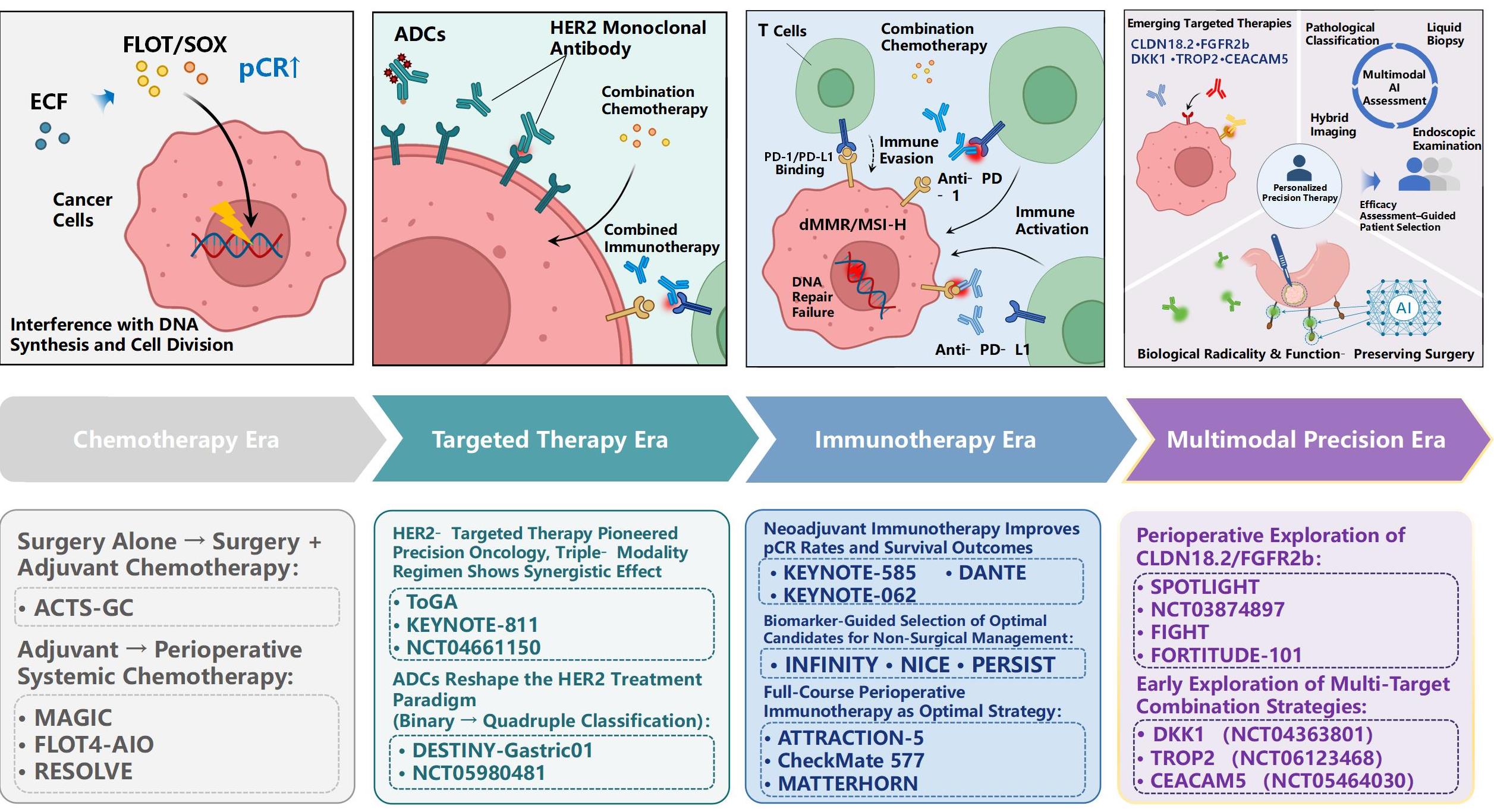
图1 局部进展期胃癌综合治疗方案的演进历程
Fig.1 Evolution of comprehensive treatment strategies for locally advanced gastric cancer.
| [1] | Huang CM, Liu H, Hu YF, et al. Laparoscopic vs open distal gastrectomy for locally advanced gastric cancer: five-year outcomes from the CLASS-01 randomized clinical trial[J]. JAMA Surg, 2022, 157(1): 9. doi:10.1001/jamasurg.2021.7583 |
| [2] | Sasako M, Sakuramoto S, Katai H, et al. Five-year outcomes of a randomized phase III trial comparing adjuvant chemotherapy with S-1 versus surgery alone in stage II or III gastric cancer[J]. J Clin Oncol, 2011, 29(33): 4387-93. doi:10.1200/jco.2011.36.5908 |
| [3] | Cunningham D, Allum WH, Stenning SP, et al. Perioperative chemotherapy versus surgery alone for resectable gastroesophageal cancer[J]. N Engl J Med, 2006, 355(1): 11-20. doi:10.1056/nejmoa055531 |
| [4] | Al-Batran SE, Hofheinz RD, Pauligk C, et al. Histopathological regression after neoadjuvant docetaxel, oxaliplatin, fluorouracil, and leucovorin versus epirubicin, cisplatin, and fluorouracil or capecitabine in patients with resectable gastric or gastro-oesophageal junction adenocarcinoma (FLOT4-AIO): results from the phase 2 part of a multicentre, open-label, randomised phase 2/3 trial[J]. Lancet Oncol, 2016, 17(12): 1697-708. |
| [5] | Zhang XT, Liang H, Li ZY, et al. Perioperative or postoperative adjuvant oxaliplatin with S-1 versus adjuvant oxaliplatin with capecitabine in patients with locally advanced gastric or gastro-oesophageal junction adenocarcinoma undergoing D2 gastrectomy (RESOLVE): an open-label, superiority and non-inferiority, phase 3 randomised controlled trial[J]. Lancet Oncol, 2021, 22(8): 1081-92. doi:10.1016/s1470-2045(21)00297-7 |
| [6] | 陈 杰, 刘凤林. 胃癌新辅助治疗后病理完全缓解的意义及治疗策略[J]. 中华胃肠外科杂志, 2024, 27(7): 666-71. |
| [7] | Bang YJ, Van Cutsem E, Feyereislova A, et al. Trastuzumab in combination with chemotherapy versus chemotherapy alone for treatment of HER2-positive advanced gastric or gastro-oesophageal junction cancer (ToGA): a phase 3, open-label, randomised controlled trial[J]. Lancet, 2010, 376(9742): 687-97. doi:10.1016/s0140-6736(10)61121-x |
| [8] | Lin JX, Xu YC, Lin W, et al. Effectiveness and safety of apatinib plus chemotherapy as neoadjuvant treatment for locally advanced gastric cancer: a nonrandomized controlled trial[J]. JAMA Netw Open, 2021, 4(7): e2116240. doi:10.1001/jamanetworkopen.2021.16240 |
| [9] | Janjigian YY, Kawazoe A, Bai YX, et al. Pembrolizumab plus trastuzumab and chemotherapy for HER2-positive gastric or gastro-oesophageal junction adenocarcinoma: interim analyses from the phase 3 KEYNOTE-811 randomised placebo-controlled trial[J]. Lancet, 2023, 402(10418): 2197-208. doi:10.1016/s0140-6736(23)02033-0 |
| [10] | Peng Z, Zhang XT, Liang H, et al. Atezolizumab and trastuzumab plus chemotherapy for ERBB2-positive locally advanced resectable gastric cancer: a randomized clinical trial[J]. JAMA Oncol, 2025, 11(6): 619. doi:10.1001/jamaoncol.2025.0522 |
| [11] | 赵雪松, 高志冬, 周 静, 等. 免疫检查点抑制剂用于局部进展期胃癌新辅助治疗研究进展[J]. 中国实用外科杂志, 2023, 43(4): 453-60. |
| [12] | Janjigian YY, Shitara K, Moehler M, et al. First-line nivolumab plus chemotherapy versus chemotherapy alone for advanced gastric, gastro-oesophageal junction, and oesophageal adenocarcinoma (CheckMate 649): a randomised, open-label, phase 3 trial[J]. Lancet, 2021, 398(10294): 27-40. doi:10.1016/s0140-6736(21)00797-2 |
| [13] | Sun FJ, Gao XZ, Li TM, et al. Tumor immune microenvironment remodeling after neoadjuvant therapy in gastric cancer: Update and new challenges[J]. Biochim Biophys Acta BBA Rev Cancer, 2025, 1880(3): 189350. doi:10.1016/j.bbcan.2025.189350 |
| [14] | Shitara K, Rha SY, Wyrwicz LS, et al. Neoadjuvant and adjuvant pembrolizumab plus chemotherapy in locally advanced gastric or gastro-oesophageal cancer (KEYNOTE-585): an interim analysis of the multicentre, double-blind, randomised phase 3 study[J]. Lancet Oncol, 2024, 25(2): 212-24. doi:10.1016/s1470-2045(23)00541-7 |
| [15] | Janjigian YY, Al-Batran SE, Wainberg ZA, et al. Perioperative durvalumab in gastric and gastroesophageal junction cancer[J]. N Engl J Med, 2025, 393(3): 217-30. doi:10.1056/nejmoa2503701 |
| [16] | Lorenzen S, Götze TO, Thuss-Patience P, et al. Perioperative atezolizumab plus fluorouracil, leucovorin, oxaliplatin, and docetaxel for resectable esophagogastric cancer: interim results from the randomized, multicenter, phase II/III DANTE/IKF-s633 trial[J]. J Clin Oncol, 2024, 42(4): 410-20. doi:10.1200/jco.23.00975 |
| [17] | 中国抗癌协会胃癌专业委员会. 免疫检查点抑制剂用于进展期胃癌围手术期治疗的中国专家共识(2024版)[J]. 中华消化外科杂志, 2024, 23(3): 309-22. |
| [18] | Shitara K, Van Cutsem E, Bang YJ, et al. Efficacy and safety of pembrolizumab or pembrolizumab plus chemotherapy vs chemotherapy alone for patients with first-line, advanced gastric cancer: the KEYNOTE-062 phase 3 randomized clinical trial[J]. JAMA Oncol, 2020, 6(10): 1571. doi:10.1001/jamaoncol.2020.3370 |
| [19] | Ding X, Chai J, Wang X, et al. 2118P Perioperative sintilimab plus oxaliplatin and S-1 (SOX) versus SOX alone in resectable locally advanced gastric cancer/gastroesophageal junction cancer (GC/GEJC): a multicenter randomized phase II study (PERSIST)[J]. Ann Oncol, 2025, 36: S1113-4. doi:10.1016/j.annonc.2025.08.2738 |
| [20] | Shitara K, Lordick F, Bang YJ, et al. Zolbetuximab plus mFOLFOX6 in patients with CLDN18.2-positive, HER2-negative, untreated, locally advanced unresectable or metastatic gastric or gastro-oesophageal junction adenocarcinoma (SPOTLIGHT): a multicentre, randomised, double-blind, phase 3 trial[J]. Lancet, 2023, 401(10389): 1655-68. doi:10.1016/s0140-6736(23)00620-7 |
| [21] | Qi CS, Liu C, Gong JF, et al. Claudin18.2-specific CAR T cells in gastrointestinal cancers: phase 1 trial final results[J]. Nat Med, 2024, 30(8): 2224-34. doi:10.1038/s41591-024-03037-z |
| [22] | Wainberg ZA, Enzinger PC, Kang YK, et al. Bemarituzumab in patients with FGFR2b-selected gastric or gastro-oesophageal junction adenocarcinoma (FIGHT): a randomised, double-blind, placebo-controlled, phase 2 study[J]. Lancet Oncol, 2022, 23(11): 1430-40. doi:10.1016/s1470-2045(22)00603-9 |
| [23] | Kawakami H. New therapeutic target molecules for gastric and gastroesophageal junction cancer[J]. Int J Clin Oncol, 2024, 29(9): 1228-36. doi:10.1007/s10147-024-02521-3 |
| [24] | 中国临床肿瘤学会指南工作委员会. 中国临床肿瘤学会 (CSCO). 胃癌诊疗指南 2025[M]. 北京: 人民卫生出版社, 2025. |
| [25] | Shitara K, Bang YJ, Iwasa S, et al. Trastuzumab deruxtecan in previously treated HER2-positive gastric cancer[J]. N Engl J Med, 2020, 382(25): 2419-30. doi:10.1056/nejmoa2004413 |
| [26] | Shen L, Peng Z, Li CZ, et al. Disitamab vedotin (DV) plus toripalimab (Tor) and chemotherapy (C)/trastuzumab (Tra) as first-line (1L) treatment of patients (pts) with HER2-expressing locally advanced or metastatic (la/m) gastric cancer[J]. J Clin Oncol, 2025, 43(): 4012. doi:10.1200/jco.2025.43.17_suppl.lba4012 |
| [27] | Eisenhauer EA, Therasse P, Bogaerts J, et al. New response evaluation criteria in solid tumours: Revised RECIST guideline (version 1.1)[J]. Eur J Cancer, 2009, 45(2): 228-47. doi:10.1016/j.ejca.2008.10.026 |
| [28] | Ao S, Wang YC, Song QZ, et al. Current status and future perspectives on neoadjuvant therapy in gastric cancer[J]. Chin J Cancer Res, 2021, 33(2): 181-92. doi:10.21147/j.issn.1000-9604.2021.02.06 |
| [29] | Liu L, Deng WH. Gastric cancer: innovations in screening, diagnosis and treatment[J]. J Pers Med, 2023, 13(1): 127. doi:10.3390/jpm13010127 |
| [30] | Deng J, Zhang WJ, Xu M, et al. Imaging advances in efficacy assessment of gastric cancer neoadjuvant chemotherapy[J]. Abdom Radiol, 2023, 48(12): 3661-76. doi:10.1007/s00261-023-04046-1 |
| [31] | Sato Y, Okamoto K, Kawaguchi T, et al. Treatment response predictors of neoadjuvant therapy for locally advanced gastric cancer: current status and future perspectives[J]. Biomedicines, 2022, 10(7): 1614. doi:10.3390/biomedicines10071614 |
| [32] | Shoji Y, Nunobe S, Nishie N, et al. Impact of preoperative endoscopy for predicting treatment response and prognosis in patients with gastric cancer after neoadjuvant chemotherapy[J]. Endosc Int Open, 2022, 10(1): E62-73. doi:10.1055/a-1635-5855 |
| [33] | Costa JM, Gonçalves B, Miguel Gomes M, et al. Accuracy of endoscopic ultrasound in gastric adenocarcinoma patient selection for neoadjuvant therapy[J]. UEG Journal, 2019, 7(2): 278-86. doi:10.1177/2050640618818942 |
| [34] | Wang ZL, Li YL, Li XT, et al. Role of CT in the prediction of pathological complete response in gastric cancer after neoadjuvant chemotherapy[J]. Abdom Radiol, 2021, 46(7): 3011-8. doi:10.1007/s00261-021-02967-3 |
| [35] | Raimondi A, Lonardi S, Murgioni S, et al. Tremelimumab and durvalumab as neoadjuvant or non-operative management strategy of patients with microsatellite instability-high resectable gastric or gastroesophageal junction adenocarcinoma: the INFINITY study by GONO[J]. Ann Oncol, 2025, 36(3): 285-96. |
| [36] | Zhao LY, Liu H, Yu J, et al. Efficacy and safety of neoadjuvant toripalimab plus chemotherapy in localized deficient mismatch repair/microsatellite instability-high gastric or esophagogastric junction adenocarcinoma (NICE): a multicentre, single-arm, exploratory phase 2 study[J]. eClinicalMedicine, 2025, 87: 103421. doi:10.1016/j.eclinm.2025.103421 |
| [37] | He J, Liu HM, Dong YS, et al. Evolution of HER2 expression after neoadjuvant therapy in locally advanced gastric cancer[J]. iScience, 2025, 28(6): 112710. doi:10.1016/j.isci.2025.112710 |
| [38] | Yang J, Gong YH, Lam VK, et al. Deep sequencing of circulating tumor DNA detects molecular residual disease and predicts recurrence in gastric cancer[J]. Cell Death Dis, 2020, 11(5): 346. doi:10.1038/s41419-020-2531-z |
| [39] | Baiocchi GL, Marrelli D, Verlato G, et al. Follow-up after gastrectomy for cancer: an appraisal of the Italian research group for gastric cancer[J]. Ann Surg Oncol, 2014, 21(6): 2005-11. |
| [40] | Roy S, Kanda M, Nomura S, et al. Diagnostic efficacy of circular RNAs as noninvasive, liquid biopsy biomarkers for early detection of gastric cancer[J]. Mol Cancer, 2022, 21(1): 42. doi:10.1186/s12943-022-01527-7 |
| [41] | Shen LL, Zheng HL, Ding FH, et al. Delta computed tomography radiomics features-based nomogram predicts long-term efficacy after neoadjuvant chemotherapy in advanced gastric cancer[J]. La Radiol Med, 2023, 128(4): 402-14. doi:10.1007/s11547-023-01617-6 |
| [42] | 王胤奎,陕 飞,应项吉, 等. 腹部CT增强扫描与超声胃镜应用于胃癌新辅助化疗后分期准确性的比较.[J]. 中华外科杂志, 2020, 58(8): 614-8. |
| [43] | Giganti F, Ambrosi A, Chiari D, et al. Apparent diffusion coefficient by diffusion-weighted magnetic resonance imaging as a sole biomarker for staging and prognosis of gastric cancer[J]. Chin J Cancer Res, 2017, 29(2): 118-26. doi:10.21147/j.issn.1000-9604.2017.02.04 |
| [44] | Schneider PM, Eshmuminov D, Rordorf T, et al. 18FDG-PET-CT identifies histopathological non-responders after neoadjuvant chemotherapy in locally advanced gastric and cardia cancer: cohort study[J]. BMC Cancer, 2018, 18(1): 548. doi:10.1186/s12885-018-4477-4 |
| [45] | Pang YZ, Zhao L, Luo ZM, et al. Comparison of 68Ga-FAPI and 18F-FDG uptake in gastric, duodenal, and colorectal cancers[J]. Radiology, 2021, 298(2): 393-402. doi:10.1148/radiol.2020203275 |
| [46] | Chen HJ, Pang YZ, Wu JX, et al. Comparison of [68Ga] Ga-DOTA-FAPI-04 and [18F] FDG PET/CT for the diagnosis of primary and metastatic lesions in patients with various types of cancer[J]. Eur J Nucl Med Mol Imag, 2020, 47(8): 1820-32. doi:10.1007/s00259-020-04866-z |
| [47] | Bai ZD, Xie X, Li CZ, et al. Claudin18.2-targeted SPECT/CT imaging for gastric cancer: preclinical evaluation and clinical translation of the 99mTc-labeled nanobody (PHG102) radiotracer[J]. ACS Pharmacol Transl Sci, 2024, 7(8): 2465-75. doi:10.1021/acsptsci.4c00280 |
| [48] | 中华医学会外科学分会腹腔镜与内镜外科学组, 中国研究型医院学会机器人与腹腔镜外科专业委员会, 中国抗癌协会腔镜与机器人外科分会, 等. 腹腔镜胃癌手术操作指南(2023版)[J]. 中华消化外科杂志, 2023, 22(4): 425-36. |
| [49] | Conlon K. Staging laparoscopy for gastric cancer[J]. Annal Italian Di Chirurgia, 2001, 72(1): 33-7. |
| [50] | Hu QC, Zhang SY, Yang K, et al. 68Ga-FAPI-04 PET for detecting occult peritoneal metastasis in locally advanced gastric cancer: diagnostic performance and cost analyses in a single-center, prospective cohort study[J]. J Nucl Med, 2026, 67(1): 53-9. doi:10.2967/jnumed.125.270633 |
| [51] | Han Z, Zhang ZC, Yang XQ, et al. Development and interpretation of a pathomics-driven ensemble model for predicting the response to immunotherapy in gastric cancer[J]. J Immunother Cancer, 2024, 12(5): e008927. doi:10.1136/jitc-2024-008927 |
| [52] | Chen ZF, Chen Y, Sun Y, et al. Predicting gastric cancer response to anti-HER2 therapy or anti-HER2 combined immunotherapy based on multi-modal data[J]. Sig Transduct Target Ther, 2024, 9: 222. doi:10.1038/s41392-024-01932-y |
| [53] | Wang W, Huang WC, Yang XQ, et al. Multimodal radiopathomics approach for predictions of prognosis and immunotherapy response in patients with gastric cancer: a multicohort retrospective study[J]. Int J Surg, 2025, 111(11): 7606-21. doi:10.1097/js9.0000000000002939 |
| [54] | Al-Batran SE, Homann N, Pauligk C, et al. Perioperative chemotherapy with fluorouracil plus leucovorin, oxaliplatin, and docetaxel versus fluorouracil or capecitabine plus cisplatin and epirubicin for locally advanced, resectable gastric or gastro-oesophageal junction adenocarcinoma (FLOT4): a randomised, phase 2/3 trial[J]. Lancet, 2019, 393(10184): 1948-57. |
| [55] | Cheedella NKS, Suzuki A, Xiao L, et al. Association between clinical complete response and pathological complete response after preoperative chemoradiation in patients with gastroesophageal cancer: analysis in a large cohort[J]. Ann Oncol, 2013, 24(5): 1262-6. doi:10.1093/annonc/mds617 |
| [56] | 中华医学会外科学分会胃肠外科学组, 中国医师协会外科医师分会肿瘤外科学组, 中国医师学会外科医师分会上消化道学组, 等. 中国胃癌保功能手术外科专家共识(2025版)[J]. 中华胃肠外科杂志, 2025, 28(2): 109-20. |
| [57] | 臧明德, 王 亮, 刘凤林. 胃癌保功能手术(精准外科治疗)——传承中突破 创新中前行[J]. 中华胃肠外科杂志, 2026, 29(1): 18-23. |
| [58] | Song JH, Park SH, Cho M, et al. Proximal gastrectomy is associated with lower incidence of Anemia and vitamin B12 deficiency compared to total gastrectomy in patients with upper gastric cancer[J]. Cancer Res Treat, 2025, 57(1): 174-85. doi:10.4143/crt.2024.319 |
| [59] | Yuan Z, Cui H, Xu QX, et al. Total versus proximal gastrectomy for proximal gastric cancer after neoadjuvant chemotherapy: a multicenter retrospective propensity score-matched cohort study[J]. Int J Surg, 2024, 110(2): 1000-7. doi:10.1097/js9.0000000000000927 |
| [60] | Deng HS, Zhou J, Chen HL, et al. Impact of lymphadenectomy extent on immunotherapy efficacy in postresectional recurred non-small cell lung cancer: a multi-institutional retrospective cohort study[J]. Int J Surg, 2024, 110(1): 238-52. doi:10.1097/js9.0000000000001347 |
| [61] | Saddawi-Konefka R, Al Msari R, Tang SQ, et al. The tumor-sentinel lymph node immuno-migratome reveals CCR7⁺ dendritic cells drive response to sequenced immunoradiotherapy[J]. Nat Commun, 2025, 16: 6578. doi:10.1038/s41467-025-61780-4 |
| [62] | Chen YH, Chen XJ, Lin Y, et al. Oncological risk of proximal gastrectomy for proximal advanced gastric cancer after neoadjuvant chemotherapy[J]. BMC Cancer, 2024, 24(1): 255. doi:10.1186/s12885-024-11993-5 |
| [63] | Jongh C, Triemstra L, van der Veen A, et al. Pattern of lymph node metastases in gastric cancer: a side-study of the multicenter LOGICA-trial.[J]. Gastric Cancer, 2022, 25(6): 1060-72. doi:10.1007/s10120-022-01329-2 |
| [64] | Becker K, Mueller JD, Schulmacher C, et al. Histomorphology and grading of regression in gastric carcinoma treated with neoadjuvant chemotherapy[J]. Cancer, 2003, 98(7): 1521-30. doi:10.1002/cncr.11660 |
| [65] | Ryan R, Gibbons D, Hyland JP, et al. Pathological response following long-course neoadjuvant chemoradiotherapy for locally advanced rectal cancer[J]. Histopathology, 2005, 47(2): 141-6. doi:10.1111/j.1365-2559.2005.02176.x |
| [66] | Fields RC, Strong VE, Gönen M, et al. Recurrence and survival after pathologic complete response to preoperative therapy followed by surgery for gastric or gastrooesophageal adenocarcinoma[J]. Br J Cancer, 2011, 104(12): 1840-7. doi:10.1038/bjc.2011.175 |
| [67] | 张子臻, 刘梓航, 曹 晖. 精准外科时代人工智能赋能胃癌R 0切除的再度审视及未来展望[J]. 中华消化外科杂志, 2025, 24(3): 337-42. |
| [68] | Chen YH, Liu D, Wei KK, et al. Carcinoembryonic antigen trajectory predicts pathological complete response in advanced gastric cancer after neoadjuvant chemotherapy[J]. Front Oncol, 2025, 15: 1525324. doi:10.3389/fonc.2025.1525324 |
| [69] | Zhong Q, Wu D, Liu ZY, et al. Long-term oncological outcomes of indocyanine green fluorescence imaging-guided laparoscopic lymphadenectomy for gastric cancer: 5-year outcomes from the FUGES-012 randomized clinical trial[J]. BMC Med, 2025, 23(1): 497. doi:10.1186/s12916-025-04334-1 |
| [70] | 黄昌明, 梁 寒, 郑朝辉, 等. 吲哚菁绿导航腹腔镜胃癌根治术的应用实践[J]. 中国肿瘤临床, 2024, 51(13): 663-9. |
| [71] | Shen GD, Jia XH, Qi TY, et al. Data-driven design of triple-targeted protein nanoprobes for multiplexed imaging of cancer lymphatic metastasis[J]. Adv Mater, 2024, 36(38): 2405877. doi:10.1002/adma.202470307 |
| [72] | Chalabi M, Fanchi LF, Dijkstra KK, et al. Neoadjuvant immunotherapy leads to pathological responses in MMR-proficient and MMR-deficient early-stage colon cancers[J]. Nat Med, 2020, 26(4): 566-76. doi:10.1038/s41591-020-0805-8 |
| [73] | Benson AB, Venook AP, Adam M, et al. NCCN guidelines® insights: rectal cancer, version 3.2024: featured updates to the NCCN guidelines[J]. J Natl Compr Cancer Netw, 2024, 22(6): 366-75. |
| [74] | Kang YK, Terashima M, Kim YW, et al. Adjuvant nivolumab plus chemotherapy versus placebo plus chemotherapy for stage III gastric or gastro-oesophageal junction cancer after gastrectomy with D2 or more extensive lymph-node dissection (ATTRACTION-5): a randomised, multicentre, double-blind, placebo-controlled, phase 3 trial[J]. Lancet Gastroenterol Hepatol, 2024, 9(8): 705-17. doi:10.1016/s2468-1253(24)00156-0 |
| [75] | Shi JW, Zhou Y, Wu S. Clinical efficacy and safety of adjuvant immunotherapy (Tislelizumab) plus chemotherapy vs. adjuvant chemotherapy alone in lymph node-positive patients with gastric cancer after D2 radical resection: a prospective, 2-arm, phase II study[J]. European Rev Med Pharmacol Sci, 2023, 27(21): 10472-80. |
| [76] | Kelly RJ, Ajani JA, Kuzdzal J, et al. Adjuvant nivolumab in resected esophageal or gastroesophageal junction cancer[J]. N Engl J Med, 2021, 384(13): 1191-203. doi:10.1056/nejmoa2032125 |
| [77] | Pei WG, Chen WZ, Wu YK, et al. Immune-related adverse events associated with immune checkpoint inhibitors for advanced gastric and gastroesophageal junction cancer: a meta-analysis[J]. World J Gastrointest Oncol, 2023, 15(2): 352-67. doi:10.4251/wjgo.v15.i2.352 |
| [78] | Kennedy LB, Salama AKS. A review of cancer immunotherapy toxicity[J]. CA Cancer J Clin, 2020, 70(2): 86-104. doi:10.3322/caac.21596 |
| [1] | 江千里, 刘涛菘, 王子展, 江汕, 吴海扬, 林永臻, SHIYING LU, 陈灵熙, 张嘉兴, 唐露霞, Raut Rakesh kumar, 许重远. CD4/TGF-β双特异性抗体在治疗恶性黑色素瘤腹膜转移小鼠模型中的疗效[J]. 南方医科大学学报, 2026, 46(6): 1331-1338. |
| [2] | 王强, 柴志欣, 邓玉露, 张志葳, 龚英, 高圣, 冯平锋. cGAS-STING激动剂cGAMP可增强自然杀伤细胞的抗胃癌效应[J]. 南方医科大学学报, 2026, 46(2): 434-442. |
| [3] | 李煜桐, 宋杏钰, 孙蕊旭, 董璇, 刘宏伟. PYCR1的泛癌分析及其对膀胱癌化疗和免疫治疗应答的潜在预测价值[J]. 南方医科大学学报, 2025, 45(4): 880-892. |
| [4] | 贺松其, 刘洋, 秦梦晨, 何春雨, 江稳滔, 王一钦, 谭思蕊, 孙海燕, 孙海涛. 中医药调控糖酵解重塑肿瘤免疫微环境的研究进展[J]. 南方医科大学学报, 2025, 45(10): 2277-2284. |
| [5] | 朱名扬, 王博康, 张秀森, 周克旭, 苗泽宇, 孙江涛. 基线水平CCL19+树突状细胞可有效预测肺腺癌患者免疫治疗的敏感性[J]. 南方医科大学学报, 2024, 44(8): 1529-1536. |
| [6] | 张自然, 谭家乐, 于子航, 刘承栋, 王 剑, 吴德华, 白 雪. FARSB对泛肿瘤的预后和冷肿瘤微环境的分层作用:基于整合单细胞和大块组织的DNA测序[J]. 南方医科大学学报, 2023, 43(5): 667-679. |
| [7] | 龚 英, 艾丽飞热·艾麦提, 何宗忠. CD39小分子抑制剂ARL67156增强NK细胞对胃癌细胞的杀伤作用[J]. 南方医科大学学报, 2023, 43(12): 2006-2014. |
| [8] | 李芮宁, 黄超艺, 洪 畅, 王家仁, 李绮美, 胡诚毅, 崔 浩, 董忠谊, 朱红波, 刘 莉, 肖芦山. 非甾体抗炎药对原发性肝癌抗PD-1疗效的影响[J]. 南方医科大学学报, 2022, 42(5): 698-704. |
| [9] | 林 萱, 毛 铎, 白瑞霞. 三种商品化光敏剂诱导小鼠免疫原性细胞死亡的效果比较[J]. 南方医科大学学报, 2022, 42(12): 1791-1798. |
| [10] | 刘严友葓,徐虹铃,赖 楠,杨子科,康世均 . 过表达IL-12的恶性黑色素瘤细胞在肿瘤免疫微环境重建过程中抑制T细胞表面PD-1的表达[J]. 南方医科大学学报, 2020, 40(06): 856-863. |
| [11] | 付倩梅,唐华明,张 鹏,阙克婷,刘作金,周 赟. 偶联 CD206 抗体载 Fe3O4的 PLGA 纳米微球促进巨噬细胞 M1型极化[J]. 南方医科大学学报, 2020, 40(02): 246-254. |
| [12] | 张翘楚,李玺,刘瑞磊,姜华,黄泽楠,刘宇,汤谧,黄勇. 人源性荷三阴乳腺癌NOD/SCID小鼠模型建立及其免疫应答[J]. 南方医科大学学报, 2015, 35(01): 56-. |
| [13] | 黄永红,曹云飞,高枫,张森,张磊昌,龙军先. 外周血及大肠癌组织TGF-β1含量检测及临床意义[J]. 南方医科大学学报, 2014, 34(12): 1790-. |
| [14] | 安军,蔡松旺,李昀,张军航. WT1多肽特异性T细胞受体基因转导正常T细胞的抗肺癌效应[J]. 南方医科大学学报, 2014, 34(09): 1319-. |
| [15] | 郭伟伟,刘莉,吴德华. DC-CIK细胞免疫治疗联合TACE术治疗原发性肝癌[J]. 南方医科大学学报, 2014, 34(05): 674-. |
| 阅读次数 | ||||||
|
全文 |
|
|||||
|
摘要 |
|
|||||
