
南方医科大学学报 ›› 2026, Vol. 46 ›› Issue (10): 2494-2508.doi: 10.12122/j.issn.1673-4254.2026.10.18
• • 上一篇
胡敦林1( ), 郭慧1, 汪晓娟1, 李煜1, 张弛1, 陈小虎1, 聂晓莉1,2()
收稿日期:2026-03-25
出版日期:2026-10-20
发布日期:2026-10-26
通讯作者:
聂晓莉
E-mail:hudunlin1218@163.com;nxl117@163.com
作者简介:胡敦林,在读硕士研究生,E-mail: hudunlin1218@163.com
基金资助:
Dunlin HU1(), Hui GUO1, Xiaojuan WANG1, Yu LI1, Chi ZHANG1, Xiaohu CHEN1, XiaoLi NIE1,2()
Received:2026-03-25
Online:2026-10-20
Published:2026-10-26
Contact:
XiaoLi NIE
E-mail:hudunlin1218@163.com;nxl117@163.com
Supported by:摘要:
目的 基于“糖-心-肾”轴,采用生物信息学与网络药理学探索糖尿病肾病(DKD)合并慢性心力衰竭(CHF)的免疫-胞葬共病机制,预测“异病同治”中药干预策略。 方法 整合公共数据库的DKD与CHF的转录组数据,利用差异表达分析结合加权基因共表达网络分析(WGCNA)构建共病核心基因集。通过蛋白质互作(PPI)网络与分子复合物检测(MCODE)算法识别枢纽基因,将其与胞葬相关基因集取交集,结合外部数据集进行多重验证,进行功能富集分析。利用Coremine Medical数据库预测调控中药,分析性味归经,分子对接验证核心成分与靶点结合。收集临床血清样本,用ELISA检测核心靶点蛋白水平。 结果 共鉴定50个共病核心基因,主要富集于磷脂酰肌醇3-激酶/蛋白激酶B(PI3K-Akt)、肿瘤坏死因子(TNF)、晚期糖基化终末产物及其受体(AGE-RAGE)及氧化磷酸化等通路,提示免疫炎症、代谢重编程及胞葬功能障碍是共病的潜在核心机制。半乳糖凝集素3(LGALS3)被识别为核心枢纽基因(Hub genes),在验证集中差异表达且与胞葬功能相关。基于Hub genes预测的黄芩、黄芪、牛膝、姜黄等216味中药,药性以寒、温为主,味多苦、甘、辛,归肝、肺、脾、肾经。临床ELISA显示,DKD+CHF组血清LGALS3显著高于健康对照组、单纯DKD组和单纯CHF组(均P<0.001)。校正协变量后,共病状态仍与LGALS3独立正相关(β=51.20,P<0.001),效应量大于NT-proBNP的独立贡献。 结论 DKD合并CHF的发生发展与炎症、代谢通路异常及胞葬介导的免疫清除障碍相关。多组学分析及初步临床验证提示,LGALS3可能是连接TNF、PI3K-Akt等炎症通路与靶器官胞葬功能障碍的关键节点。预测的黄芪、黄芩、牛膝等中药体现“益气温阳、清热化瘀、泄浊解毒”治法,可能通过靶向LGALS3调节胞葬功能及免疫代谢微环境,为心肾共病防治提供新策略和思路。
胡敦林, 郭慧, 汪晓娟, 李煜, 张弛, 陈小虎, 聂晓莉. LGALS3作为糖尿病肾病合并心力衰竭的胞葬相关生物标志物及潜在中药治疗靶点[J]. 南方医科大学学报, 2026, 46(10): 2494-2508.
Dunlin HU, Hui GUO, Xiaojuan WANG, Yu LI, Chi ZHANG, Xiaohu CHEN, XiaoLi NIE. LGALS3 is an efferocytosis-related biomarker and potential traditional Chinese medicine therapeutic target for diabetic kidney disease complicated with heart failure[J]. Journal of Southern Medical University, 2026, 46(10): 2494-2508.
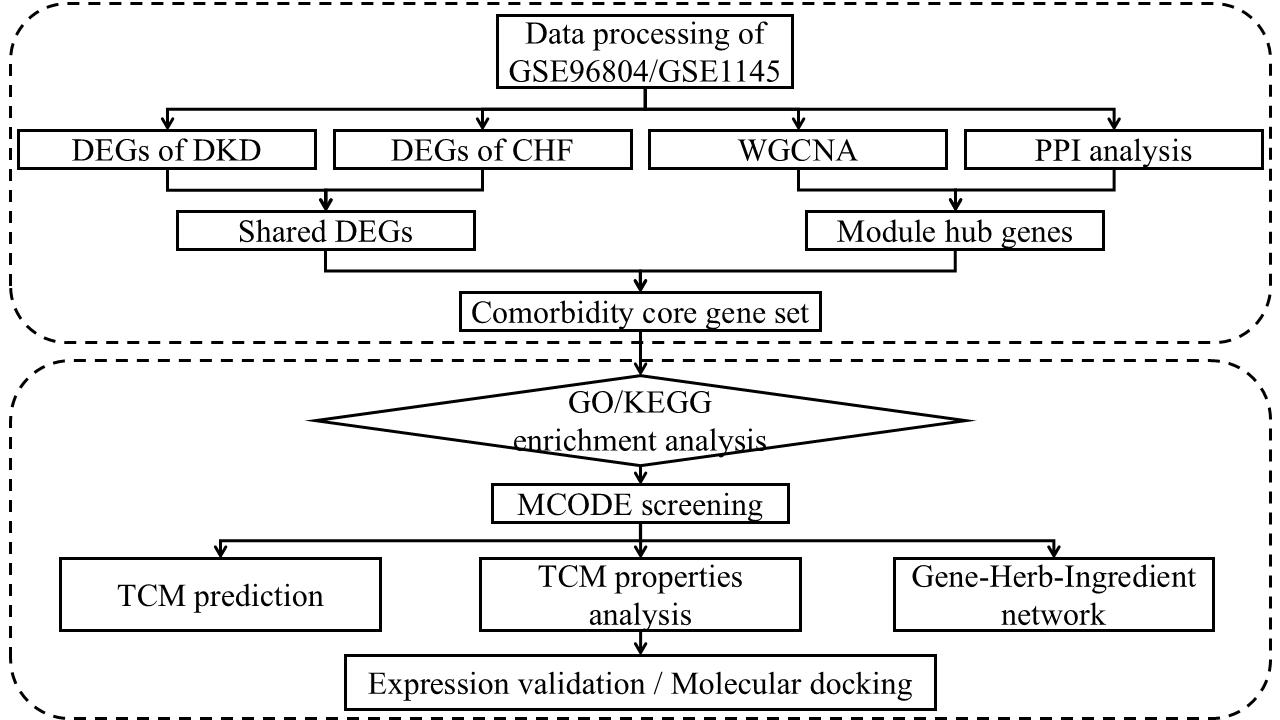
图1 本研究的技术路线图
Fig.1 Flowchart of the study design and analysis process.
| Gene | Candidate TCMs |
|---|---|
| S100A9 | Albizia julibrissin, Caragana sinensis (whole herb, root, flower), Isatis tinctoria leaf, Baphicacanthus cusia root, Smilax glabra, Gentiana scabra, Abelmoschus manihot, Alisma plantago-aquatica, Momordica charantia, Evodia rutaecarpa, Rheum palmatum, Catharsius molossus |
| FPR2 | Rhododendron dauricum, Sparganium stoloniferum, Sargentodoxa cuneata, Patrinia villosa, Lindera aggregata, Ganoderma applanatum, Scolopendra subspinipes, Corydalis yanhusuo, Cyperus rotundus, Paeonia lactiflora, Glycyrrhiza uralensis, Angelica sinensis |
| TREM1 | Abelmoschus manihot, Ligusticum spp. (including L. chuanxiong, L. sinense), Rehmannia glutinosa (fresh & dried), Prunus persica (seed, immature fruit, twig), Angelica sinensis |
| LGALS3 | Stellaria dichotoma, Smilax china, Notopterygium incisum, Gynostemma pentaphyllum, Panax japonicus (whole herb & leaf), Camellia japonica (root & flower), Rehmannia glutinosa (fresh & dried), Arca subcrenata, Crataegus pinnatifida |
| CD86 | Cyathula officinalis, Plantago asiatica (herb & seed), Patrinia villosa, Ganoderma lucidum, Poria cocos, Polygonum cuspidatum, Arisaema erubescens, Pinellia pedatisecta, Achyranthes bidentata, Hericium erinaceus, Belamcanda chinensis, Polyporus umbellatus, Nidus vespae, Lycium barbarum (cultivated & wild fruit), Cordyceps sinensis, Curcuma longispica*, Moschus (natural & artificial), Astragalus membranaceus, Sanguisorba officinalis, Atractylodes macrocephala, Sargentodoxa cuneata, Platycodon grandiflorus, Panax ginseng (whole herb, leaf, flower, dew), Cistanche deserticola, Uncaria rhynchophylla, Rosa laevigata (root & fruit), Caesalpinia sappan, Laminaria japonica, Forsythia suspensa, Codonopsis spp. (including C. pilosula, C. lanceolata), Scutellaria baicalensis, Panax notoginseng (whole herb, leaf, flower), Schizonepeta tenuifolia, Arca subcrenata, Dryopteris crassirhizoma, Lindera aggregata, Manis pentadactyla, Schisandra chinensis, Collocalia esculenta nest |
| CXCL1 | Albizia julibrissin, Sanguisorba officinalis, Lycoris radiata, Manis pentadactyla, Scutellaria baicalensis, Artemisia capillaris, Siraitia grosvenorii, Hibiscus mutabilis flower, Chrysanthemum indicum, Oroxylum indicum, Hedyotis diffusa, Angelica dahurica |
| FCGR2A | Polygonum multiflorum, Codonopsis pilosula, Naja naja |
| IL1R2 | Artemisia argyi fruit, Artemisia (Baihuahao), Perilla frutescens (seed, fried seed, stalk), Camellia sinensis, Bufo bufo (Fried), Eugenia caryophyllata (root, bark, leaf, twig, oil, dew), Pimenta dioica, Psidium guajava leaf, Achyranthes aspera, Cinnamomum cassia bark, Piper betle leaf, Prunus armeniaca seed (Bitter), Sonchus arvensis, Amomum villosum, Mosla chinensis, Dianthus chinensis, Origanum vulgare, Cinnamomum camphora, Aconitum coreanum, Laurus nobilis seed, Myrrha (Processed) |
| CD1C | Areca catechu (seed, processed seed, pericarp), Codonopsis lanceolata, Santalum album, Thevetia peruviana (leaf & seed), Mentha spicata, Tremella fuciformis, Achyranthes bidentata, Angelica dahurica, Ligusticum chuanxiong |
| FLT3 | Dolichos lablab (whole herb, flower, coat), Atractylodes macrocephala, Lonicera japonica caulis, Rehmannia glutinosa (fresh & dried), Coriandrum sativum (whole herb & fruit), Lonicera japonica flower, Camellia sinensis root, Astragalus membranaceus |
| SOCS3 | Omphalia lapidescens, Mahonia fortunei (whole herb, leaf, wood), Alisma plantago-aquatica, Curcuma aromatica, Curcuma zedoaria, Lindera aggregata, Peucedanum praeruptorum, Tremella fuciformis, Rosa chinensis flower, Cuscuta chinensis, Euphorbia kansui, Tribulus terrestris, Limonite, Isinglass, Scutellaria baicalensis, Dendrobium nobile, Artemisia capillaris, Artemisia anomala, Polygala tenuifolia, Atractylodes lancea, Perilla frutescens (whole herb, seed, stalk, tops), Momordica charantia, Isatis tinctoria leaf |
| S100A8 | Albizia julibrissin, Smilax glabra, Abelmoschus manihot, Catharsius molossus, Bubalus bubalis horn, Portulaca oleracea, Cervus nippon antler (velvet & osseous), Rheum palmatum, Ganoderma lucidum |
| MSR1 | Gentiana lutea, Elephantopus scaber, Sophora alopecuroides, Arctium lappa (root & seed), Atractylodes macrocephala, Laminaria japonica, Curcuma aromatica, Curcuma longa, Perilla frutescens |
表1 中药预测结果
Tab.1 Predicted results for Chinese medicines
| Gene | Candidate TCMs |
|---|---|
| S100A9 | Albizia julibrissin, Caragana sinensis (whole herb, root, flower), Isatis tinctoria leaf, Baphicacanthus cusia root, Smilax glabra, Gentiana scabra, Abelmoschus manihot, Alisma plantago-aquatica, Momordica charantia, Evodia rutaecarpa, Rheum palmatum, Catharsius molossus |
| FPR2 | Rhododendron dauricum, Sparganium stoloniferum, Sargentodoxa cuneata, Patrinia villosa, Lindera aggregata, Ganoderma applanatum, Scolopendra subspinipes, Corydalis yanhusuo, Cyperus rotundus, Paeonia lactiflora, Glycyrrhiza uralensis, Angelica sinensis |
| TREM1 | Abelmoschus manihot, Ligusticum spp. (including L. chuanxiong, L. sinense), Rehmannia glutinosa (fresh & dried), Prunus persica (seed, immature fruit, twig), Angelica sinensis |
| LGALS3 | Stellaria dichotoma, Smilax china, Notopterygium incisum, Gynostemma pentaphyllum, Panax japonicus (whole herb & leaf), Camellia japonica (root & flower), Rehmannia glutinosa (fresh & dried), Arca subcrenata, Crataegus pinnatifida |
| CD86 | Cyathula officinalis, Plantago asiatica (herb & seed), Patrinia villosa, Ganoderma lucidum, Poria cocos, Polygonum cuspidatum, Arisaema erubescens, Pinellia pedatisecta, Achyranthes bidentata, Hericium erinaceus, Belamcanda chinensis, Polyporus umbellatus, Nidus vespae, Lycium barbarum (cultivated & wild fruit), Cordyceps sinensis, Curcuma longispica*, Moschus (natural & artificial), Astragalus membranaceus, Sanguisorba officinalis, Atractylodes macrocephala, Sargentodoxa cuneata, Platycodon grandiflorus, Panax ginseng (whole herb, leaf, flower, dew), Cistanche deserticola, Uncaria rhynchophylla, Rosa laevigata (root & fruit), Caesalpinia sappan, Laminaria japonica, Forsythia suspensa, Codonopsis spp. (including C. pilosula, C. lanceolata), Scutellaria baicalensis, Panax notoginseng (whole herb, leaf, flower), Schizonepeta tenuifolia, Arca subcrenata, Dryopteris crassirhizoma, Lindera aggregata, Manis pentadactyla, Schisandra chinensis, Collocalia esculenta nest |
| CXCL1 | Albizia julibrissin, Sanguisorba officinalis, Lycoris radiata, Manis pentadactyla, Scutellaria baicalensis, Artemisia capillaris, Siraitia grosvenorii, Hibiscus mutabilis flower, Chrysanthemum indicum, Oroxylum indicum, Hedyotis diffusa, Angelica dahurica |
| FCGR2A | Polygonum multiflorum, Codonopsis pilosula, Naja naja |
| IL1R2 | Artemisia argyi fruit, Artemisia (Baihuahao), Perilla frutescens (seed, fried seed, stalk), Camellia sinensis, Bufo bufo (Fried), Eugenia caryophyllata (root, bark, leaf, twig, oil, dew), Pimenta dioica, Psidium guajava leaf, Achyranthes aspera, Cinnamomum cassia bark, Piper betle leaf, Prunus armeniaca seed (Bitter), Sonchus arvensis, Amomum villosum, Mosla chinensis, Dianthus chinensis, Origanum vulgare, Cinnamomum camphora, Aconitum coreanum, Laurus nobilis seed, Myrrha (Processed) |
| CD1C | Areca catechu (seed, processed seed, pericarp), Codonopsis lanceolata, Santalum album, Thevetia peruviana (leaf & seed), Mentha spicata, Tremella fuciformis, Achyranthes bidentata, Angelica dahurica, Ligusticum chuanxiong |
| FLT3 | Dolichos lablab (whole herb, flower, coat), Atractylodes macrocephala, Lonicera japonica caulis, Rehmannia glutinosa (fresh & dried), Coriandrum sativum (whole herb & fruit), Lonicera japonica flower, Camellia sinensis root, Astragalus membranaceus |
| SOCS3 | Omphalia lapidescens, Mahonia fortunei (whole herb, leaf, wood), Alisma plantago-aquatica, Curcuma aromatica, Curcuma zedoaria, Lindera aggregata, Peucedanum praeruptorum, Tremella fuciformis, Rosa chinensis flower, Cuscuta chinensis, Euphorbia kansui, Tribulus terrestris, Limonite, Isinglass, Scutellaria baicalensis, Dendrobium nobile, Artemisia capillaris, Artemisia anomala, Polygala tenuifolia, Atractylodes lancea, Perilla frutescens (whole herb, seed, stalk, tops), Momordica charantia, Isatis tinctoria leaf |
| S100A8 | Albizia julibrissin, Smilax glabra, Abelmoschus manihot, Catharsius molossus, Bubalus bubalis horn, Portulaca oleracea, Cervus nippon antler (velvet & osseous), Rheum palmatum, Ganoderma lucidum |
| MSR1 | Gentiana lutea, Elephantopus scaber, Sophora alopecuroides, Arctium lappa (root & seed), Atractylodes macrocephala, Laminaria japonica, Curcuma aromatica, Curcuma longa, Perilla frutescens |
| TCM | Frequency | Targets |
|---|---|---|
| Scutellaria baicalensis | 3 | CD86、CXCL1、SOCS3 |
| Rehmannia glutinosa (Fresh) | 3 | TREM1、LGALS3、FLT3 |
| Rehmannia glutinosa (Dried) | 3 | TREM1、FLT3、LGALS3 |
| Atractylodes macrocephala | 3 | CD86、FLT3、MSR1 |
| Albizia julibrissin | 3 | CXCL1、S100A8、S100A9 |
| Abelmoschus manihot | 3 | S100A9、TREM1、S100A8 |
| Lindera aggregata | 3 | SOCS3、FPR2、CD86 |
| Ligusticum chuanxiong | 2 | TREM1、CD1C、 |
| Astragalus membranaceus | 2 | CD86、FLT3 |
| Gentiana scabra | 2 | S100A9、MSR1 |
| Achyranthes bidentata | 2 | CD86、CD1C |
| Rheum palmatum | 2 | S100A8、S100A9 |
| Alisma plantago-aquatica | 2 | S100A9、SOCS3 |
| Curcuma aromatica | 2 | SOCS3、MSR1 |
| Curcuma longa | 2 | MSR1、CD86 |
表2 中药的作用频次
Tab.2 Gene effect frequency of various herbal materials
| TCM | Frequency | Targets |
|---|---|---|
| Scutellaria baicalensis | 3 | CD86、CXCL1、SOCS3 |
| Rehmannia glutinosa (Fresh) | 3 | TREM1、LGALS3、FLT3 |
| Rehmannia glutinosa (Dried) | 3 | TREM1、FLT3、LGALS3 |
| Atractylodes macrocephala | 3 | CD86、FLT3、MSR1 |
| Albizia julibrissin | 3 | CXCL1、S100A8、S100A9 |
| Abelmoschus manihot | 3 | S100A9、TREM1、S100A8 |
| Lindera aggregata | 3 | SOCS3、FPR2、CD86 |
| Ligusticum chuanxiong | 2 | TREM1、CD1C、 |
| Astragalus membranaceus | 2 | CD86、FLT3 |
| Gentiana scabra | 2 | S100A9、MSR1 |
| Achyranthes bidentata | 2 | CD86、CD1C |
| Rheum palmatum | 2 | S100A8、S100A9 |
| Alisma plantago-aquatica | 2 | S100A9、SOCS3 |
| Curcuma aromatica | 2 | SOCS3、MSR1 |
| Curcuma longa | 2 | MSR1、CD86 |
| TCM | Degree | Betweenness Centrality | Closeness Centrality |
|---|---|---|---|
| Scutellaria baicalensis | 29 | 0.543300408 | 0.276162791 |
| Astragalus membranaceus | 14 | 0.329422848 | 0.238693467 |
| Rehmannia glutinosa (Fresh) | 14 | 0.283225084 | 0.201271186 |
| Curcuma aromatica | 9 | 0.160821599 | 0.213963964 |
| Achyranthes bidentata | 8 | 0.307002216 | 0.247395833 |
表3 关键中药拓扑参数
Tab.3 Topological parameters of key traditional Chinese medicines
| TCM | Degree | Betweenness Centrality | Closeness Centrality |
|---|---|---|---|
| Scutellaria baicalensis | 29 | 0.543300408 | 0.276162791 |
| Astragalus membranaceus | 14 | 0.329422848 | 0.238693467 |
| Rehmannia glutinosa (Fresh) | 14 | 0.283225084 | 0.201271186 |
| Curcuma aromatica | 9 | 0.160821599 | 0.213963964 |
| Achyranthes bidentata | 8 | 0.307002216 | 0.247395833 |
| TCM | Ingredient | Mol ID | Mw | AlogP (MiLogP) | Hdon | Hacc | OB (%) | DL | Lipinski (Y/N) | |
|---|---|---|---|---|---|---|---|---|---|---|
| Scutellaria baicalensis | coptisine | MOL 001458 | 320.34 | 3.25 | 0 | 4 | 30.67 | 0.86 | Y | |
| baicalein | MOL 002714 | 270.25 | 2.33 | 3 | 5 | 33.52 | 0.21 | Y | ||
| wogonin | MOL 000173 | 284.2 | 2.59 | 2 | 5 | 30.68 | 0.23 | Y | ||
| Astragalus membranaceus | quercetin | MOL 000098 | 302.25 | 1.5 | 5 | 7 | 46.43 | 0.28 | Y | |
| kaempferol | MOL 000422 | 286.25 | 1.77 | 4 | 6 | 41.88 | 0.24 | Y | ||
| Curcuma aromatica | (E)-5-Hydroxy-7-(4-hydroxyphenyl) -1-phenyl-1-heptene | MOL 004263 | 282.41 | 4.59 | 2 | 2 | 46.9 | 0.19 | Y | |
| Achyranthes bidentata | epiberberine | MOL 002897 | 336.39 | 3.45 | 0 | 4 | 43.09 | 0.78 | Y | |
| Rehmannia glutinosa (Fresh) | salidroside | HBIN 042854 | 300.3 | 3.2 | 3 | 5 | N/A | N/A | Y | |
| diincarvilone A | HBIN 024020 | 480.64 | -0.6 | 5 | 7 | N/A | N/A | Y | ||
表4 关键中药成分
Tab.4 Key ingredients in traditional Chinese medicines
| TCM | Ingredient | Mol ID | Mw | AlogP (MiLogP) | Hdon | Hacc | OB (%) | DL | Lipinski (Y/N) | |
|---|---|---|---|---|---|---|---|---|---|---|
| Scutellaria baicalensis | coptisine | MOL 001458 | 320.34 | 3.25 | 0 | 4 | 30.67 | 0.86 | Y | |
| baicalein | MOL 002714 | 270.25 | 2.33 | 3 | 5 | 33.52 | 0.21 | Y | ||
| wogonin | MOL 000173 | 284.2 | 2.59 | 2 | 5 | 30.68 | 0.23 | Y | ||
| Astragalus membranaceus | quercetin | MOL 000098 | 302.25 | 1.5 | 5 | 7 | 46.43 | 0.28 | Y | |
| kaempferol | MOL 000422 | 286.25 | 1.77 | 4 | 6 | 41.88 | 0.24 | Y | ||
| Curcuma aromatica | (E)-5-Hydroxy-7-(4-hydroxyphenyl) -1-phenyl-1-heptene | MOL 004263 | 282.41 | 4.59 | 2 | 2 | 46.9 | 0.19 | Y | |
| Achyranthes bidentata | epiberberine | MOL 002897 | 336.39 | 3.45 | 0 | 4 | 43.09 | 0.78 | Y | |
| Rehmannia glutinosa (Fresh) | salidroside | HBIN 042854 | 300.3 | 3.2 | 3 | 5 | N/A | N/A | Y | |
| diincarvilone A | HBIN 024020 | 480.64 | -0.6 | 5 | 7 | N/A | N/A | Y | ||
| Protein | Protein structure | Molecular | Affinity (kcal/mol) |
|---|---|---|---|
| LGALS3 | 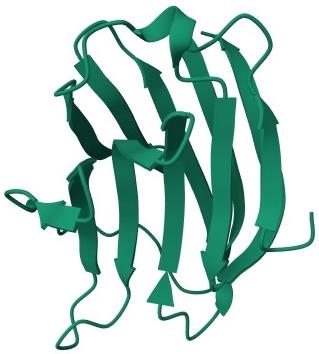 | quercetin | 6.8 |
| kaempferol | 6.1 |
表5 分子对接结合能情况
Tab.5 Vina scores for docking simulations
| Protein | Protein structure | Molecular | Affinity (kcal/mol) |
|---|---|---|---|
| LGALS3 | | quercetin | 6.8 |
| kaempferol | 6.1 |
| Clinical Indicators | HC (n=15) | DKD (n=15) | CHF (n=15) | DKD+CHF (n=15) | (F/H/χ2) | P |
|---|---|---|---|---|---|---|
| Male [male, n (%)] | 7 (46.7%) | 7 (46.7%) | 7 (46.7%) | 8 (53.3%) | χ2=0.20 | 0.978 |
| Age (Mean±SD) | 66.40±11.30 | 66.67±6.59 | 65.73±13.66 | 68.80±7.76 | F=0.25 | 0.859 |
| BMI (Mean±SD) | 22.98±2.04 | 24.33±3.49 | 22.69±3.56 | 24.79±3.70 | F=1.47 | 0.232 |
| Cr (Median [IQR]) | 68.00 [62.50, 77.50] | 478.00 [271.50, 503.50]** | 71.00 [63.50, 84.50]## | 293.00 [201.00, 576.50]**&& | H=36.47 | <0.001 |
| BUN (Median [IQR]) | 5.06 [4.58, 5.80] | 24.10 [16.30, 29.30]** | 6.20 [5.65, 7.50]## | 17.10 [9.90, 23.30]**&& | H=40.46 | <0.001 |
| UA (Median [IQR]) | 324.00 [280.00, 364.00] | 416.00 [326.00, 475.00] | 362.00 [280.00, 483.50] | 406.00 [272.50, 504.00] | H=5.12 | 0.163 |
| eGFR (Mean±SD) | 87.60±7.64 | 14.87±10.50** | 84.20±13.92## | 25.67±29.51**&& | F=70.88 | <0.001 |
| LVEF (Mean±SD) | 64.40±4.67 | 65.07±3.67 | 40.53±10.76**## | 52.80±9.99**##&& | F=32.02 | <0.001 |
| LVEDD (Mean±SD) | 43.80±3.55 | 44.93±4.18 | 58.00±10.06**## | 49.53±5.14&& | F=15.84 | <0.001 |
| HbA1c (Mean±SD) | 5.59±0.28 | 7.51±1.49** | 5.64±0.40## | 7.95±2.00**&& | F=14.05 | <0.001 |
NT_proBNP (Median [IQR]) | 59.37 [28.41, 162.60] | 382.00 [283.50, 744.65]** | 4480.00 [2989.00, 17888.50]**## | 3120.00 [1432.50, 24311.00]**## | H=44.46 | <0.001 |
| hs_cTnT (Median [IQR]) | 7.20 [6.08, 9.27] | 25.10 [17.45, 31.20]** | 43.68 [31.50, 74.00]**# | 79.80 [47.15, 141.06]**# | H=37.11 | <0.001 |
| TC (Mean±SD) | 4.46±0.74 | 3.92±1.03 | 4.15±0.71 | 3.90±0.87 | F=1.42 | 0.247 |
| TG (Median [IQR]) | 1.26 [0.99, 1.60] | 1.73 [1.50, 2.33]* | 1.20 [0.86, 1.57]# | 1.85 [1.51, 2.13]*& | H=17.15 | <0.001 |
| LDL_C (Mean±SD) | 2.77±0.63 | 2.13±0.56* | 2.14±0.54* | 2.26±0.63 | F=3.93 | 0.013 |
表6 各组临床受试者基线特征比较
Tab.6 Comparison of baseline characteristics of clinical subjects in each group
| Clinical Indicators | HC (n=15) | DKD (n=15) | CHF (n=15) | DKD+CHF (n=15) | (F/H/χ2) | P |
|---|---|---|---|---|---|---|
| Male [male, n (%)] | 7 (46.7%) | 7 (46.7%) | 7 (46.7%) | 8 (53.3%) | χ2=0.20 | 0.978 |
| Age (Mean±SD) | 66.40±11.30 | 66.67±6.59 | 65.73±13.66 | 68.80±7.76 | F=0.25 | 0.859 |
| BMI (Mean±SD) | 22.98±2.04 | 24.33±3.49 | 22.69±3.56 | 24.79±3.70 | F=1.47 | 0.232 |
| Cr (Median [IQR]) | 68.00 [62.50, 77.50] | 478.00 [271.50, 503.50]** | 71.00 [63.50, 84.50]## | 293.00 [201.00, 576.50]**&& | H=36.47 | <0.001 |
| BUN (Median [IQR]) | 5.06 [4.58, 5.80] | 24.10 [16.30, 29.30]** | 6.20 [5.65, 7.50]## | 17.10 [9.90, 23.30]**&& | H=40.46 | <0.001 |
| UA (Median [IQR]) | 324.00 [280.00, 364.00] | 416.00 [326.00, 475.00] | 362.00 [280.00, 483.50] | 406.00 [272.50, 504.00] | H=5.12 | 0.163 |
| eGFR (Mean±SD) | 87.60±7.64 | 14.87±10.50** | 84.20±13.92## | 25.67±29.51**&& | F=70.88 | <0.001 |
| LVEF (Mean±SD) | 64.40±4.67 | 65.07±3.67 | 40.53±10.76**## | 52.80±9.99**##&& | F=32.02 | <0.001 |
| LVEDD (Mean±SD) | 43.80±3.55 | 44.93±4.18 | 58.00±10.06**## | 49.53±5.14&& | F=15.84 | <0.001 |
| HbA1c (Mean±SD) | 5.59±0.28 | 7.51±1.49** | 5.64±0.40## | 7.95±2.00**&& | F=14.05 | <0.001 |
NT_proBNP (Median [IQR]) | 59.37 [28.41, 162.60] | 382.00 [283.50, 744.65]** | 4480.00 [2989.00, 17888.50]**## | 3120.00 [1432.50, 24311.00]**## | H=44.46 | <0.001 |
| hs_cTnT (Median [IQR]) | 7.20 [6.08, 9.27] | 25.10 [17.45, 31.20]** | 43.68 [31.50, 74.00]**# | 79.80 [47.15, 141.06]**# | H=37.11 | <0.001 |
| TC (Mean±SD) | 4.46±0.74 | 3.92±1.03 | 4.15±0.71 | 3.90±0.87 | F=1.42 | 0.247 |
| TG (Median [IQR]) | 1.26 [0.99, 1.60] | 1.73 [1.50, 2.33]* | 1.20 [0.86, 1.57]# | 1.85 [1.51, 2.13]*& | H=17.15 | <0.001 |
| LDL_C (Mean±SD) | 2.77±0.63 | 2.13±0.56* | 2.14±0.54* | 2.26±0.63 | F=3.93 | 0.013 |
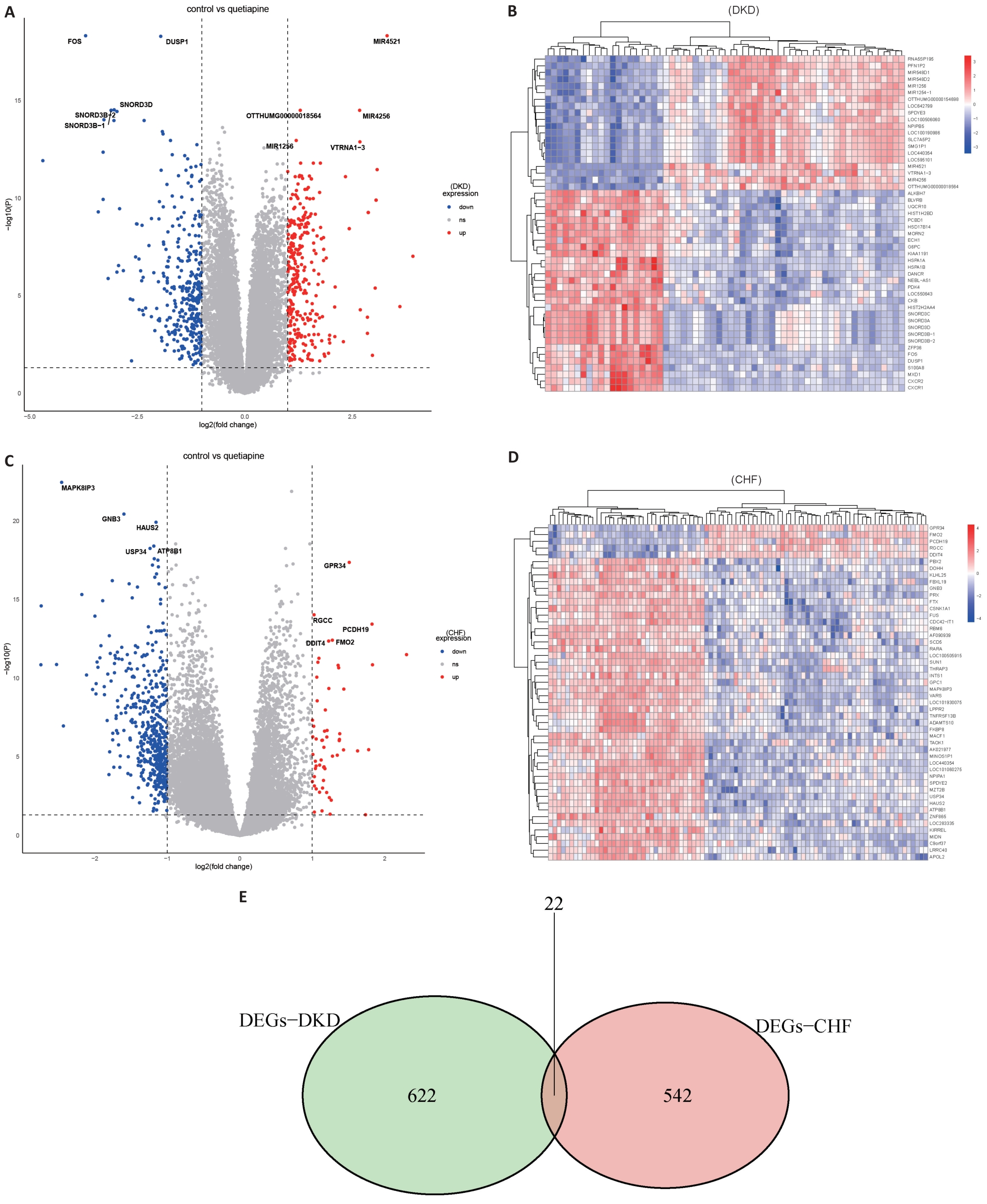
图2 DKD与CHF差异表达基因的识别
Fig.2 Identification of DEGs in DKD and CHF. Fig.2 Identification of the differentially expressed genes (DEGs) in diabetic kidney disease (DKD) and chronic heart failure (CHF). A: Volcano plot of DEGs in DKD (red represents up-regulated and green represents down-regulated genes). B: Heatmap of DEGs in DKD. C: Volcano plot of DEGs in CHF. D: Heatmap of DEGs in CHF. E: Venn diagram illustrating the intersection of DEGs between DKD and CHF, identifying a total of 22 shared comorbidity DEGs.
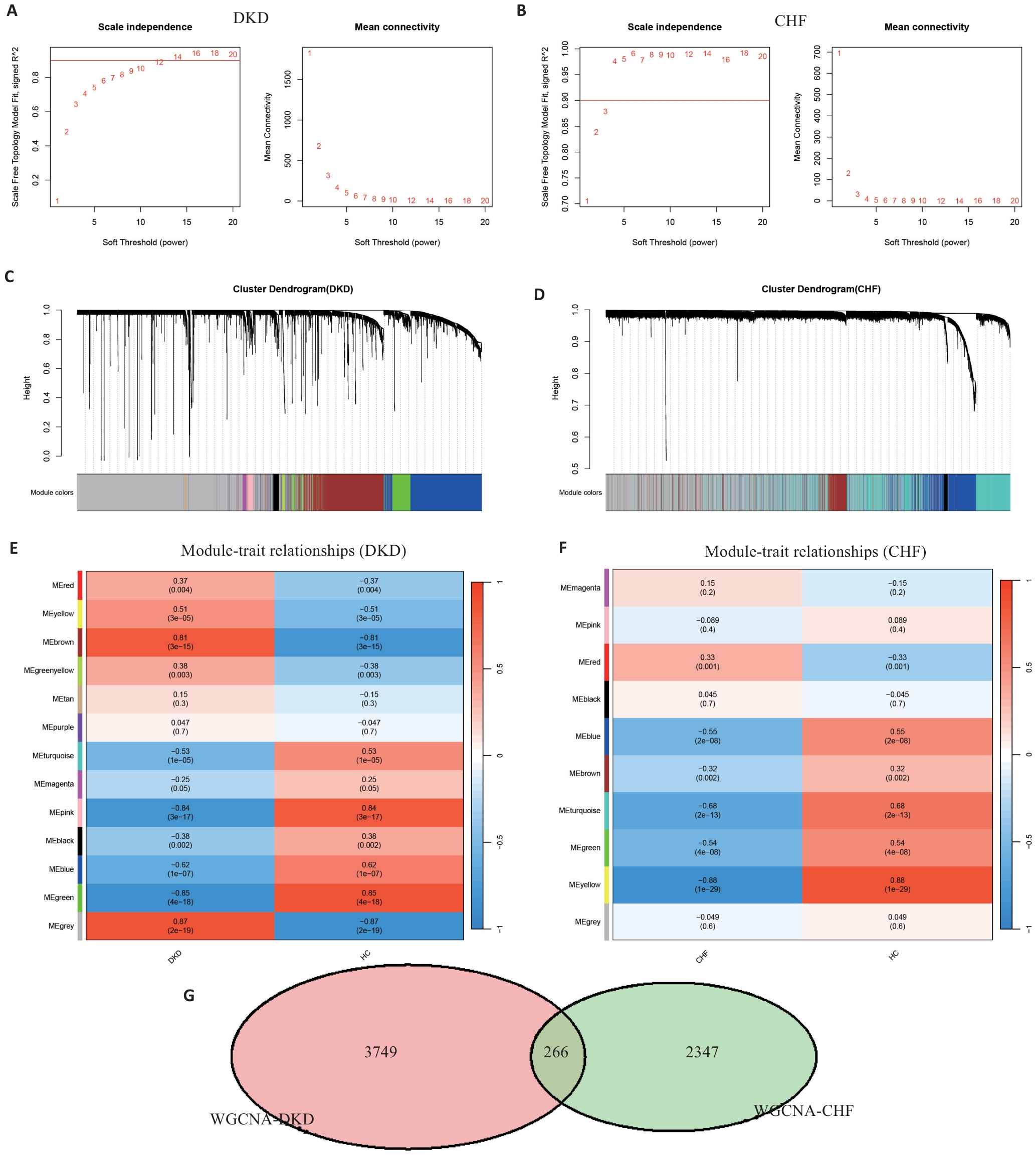
图3 WGCNA核心模块筛选
Fig.3 Screening of key co-expression modules via weighted gene co expression network analysis (WGCNA). A, B: Network topology analysis of the DKD (A) and CHF (B) datasets. C, D: Gene clustering dendrograms and module cutting for DKD (C) and CHF (D). E, F: Heatmaps of module-trait relationships for DKD (E) and CHF (F). G: Shared module genes of WGCNA.
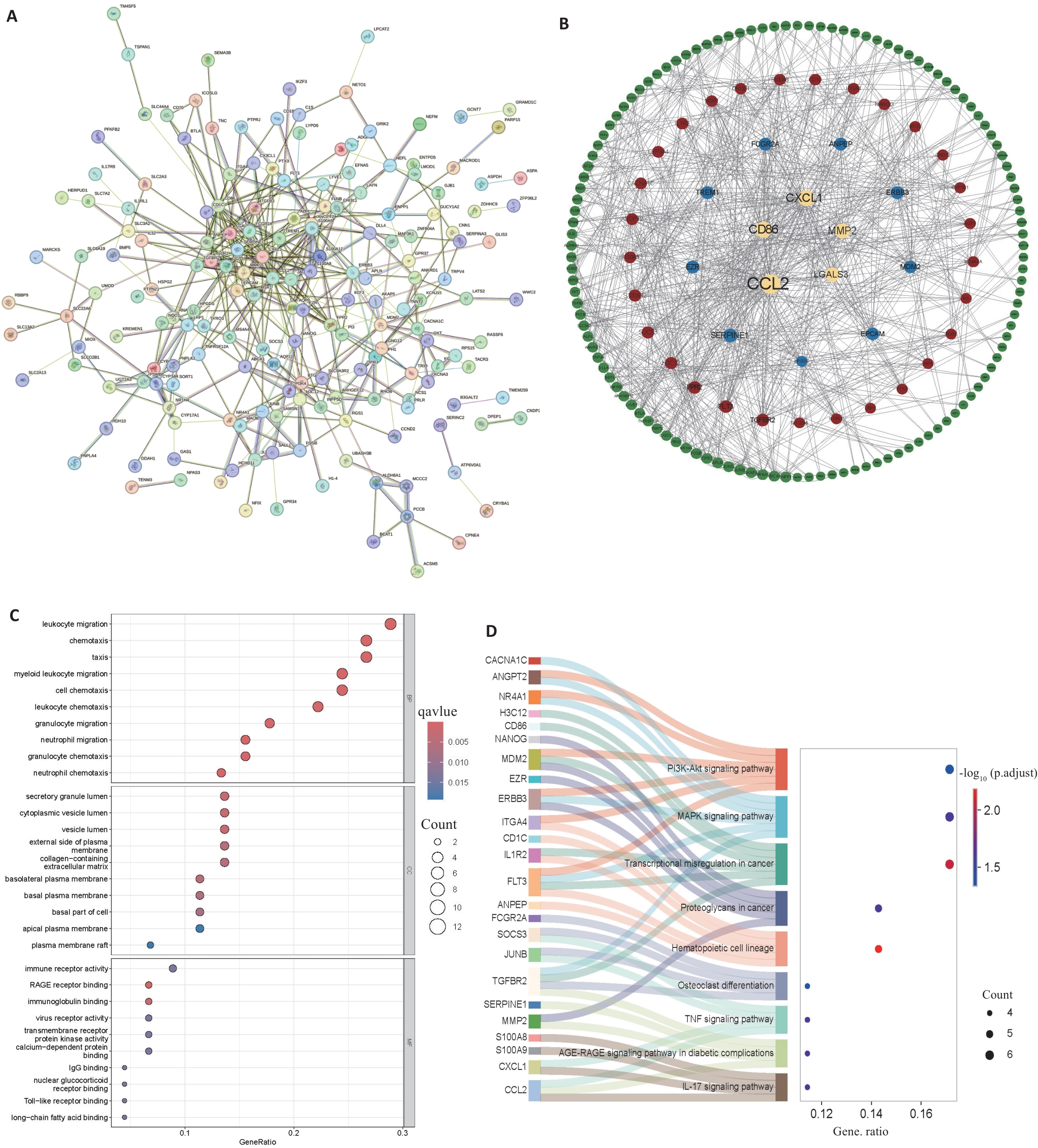
图4 共病核心基因集的功能富集分析
Fig.4 Functional enrichment analysis of the common core genes. A, B: Complete PPI networks of core targets constructed using the STRING database (A: Full network; B: Key modules). C: Bubble plot of GO enrichment analysis. D: Sankey diagram of KEGG pathway enrichment analysis. In C and D, the size of the dots represents the number of genes, and the color indicates the significance of the P-value.
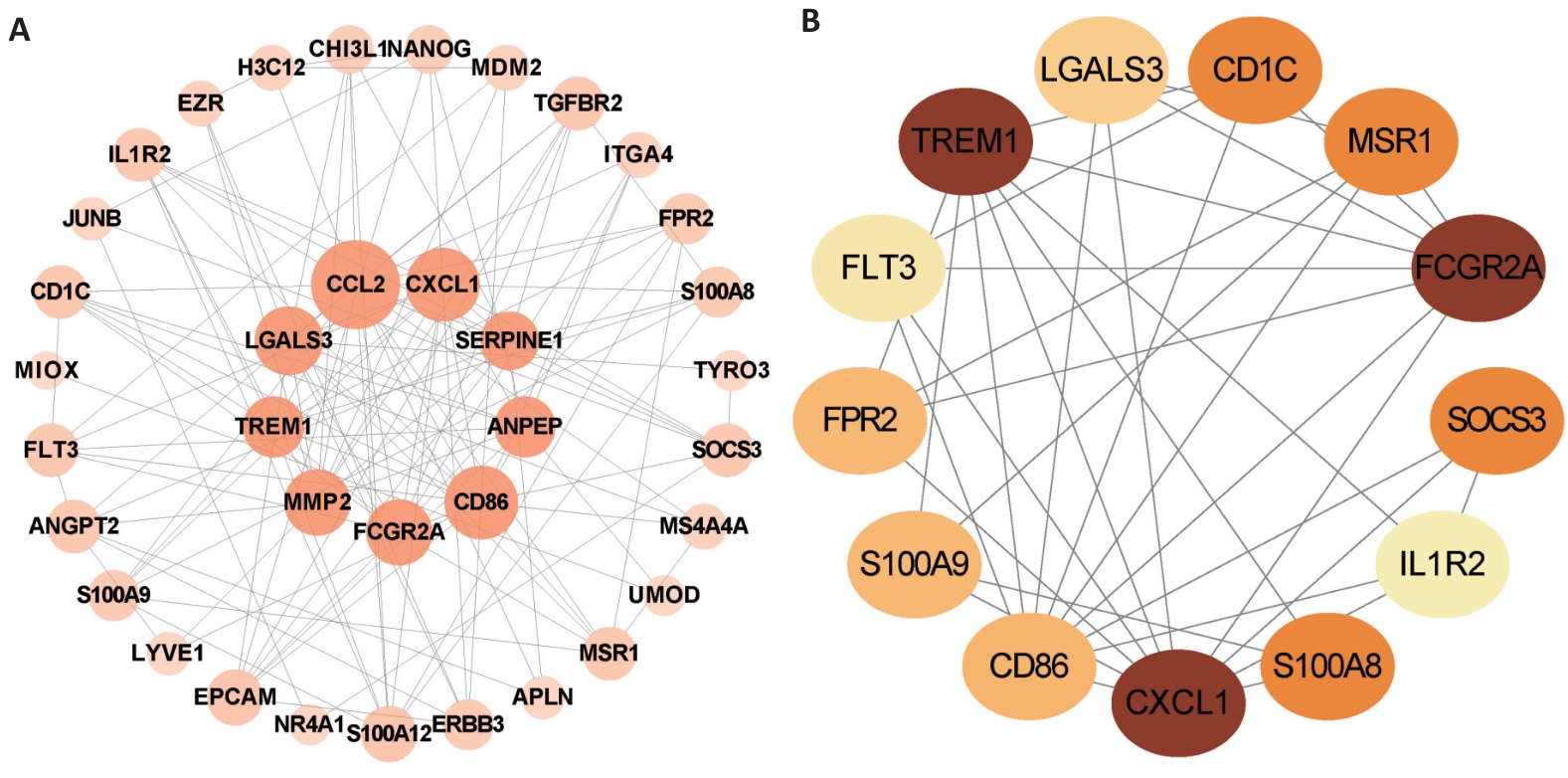
图5 PPI网络构建与Hub genes筛选
Fig.5 PPI network construction and screening of hub genes. A: PPI network of the 50 comorbidity core genes constructed based on the STRING database. B: A key module comprising 13 hub genes identified through clustering using the MCODE plugin in Cytoscape.
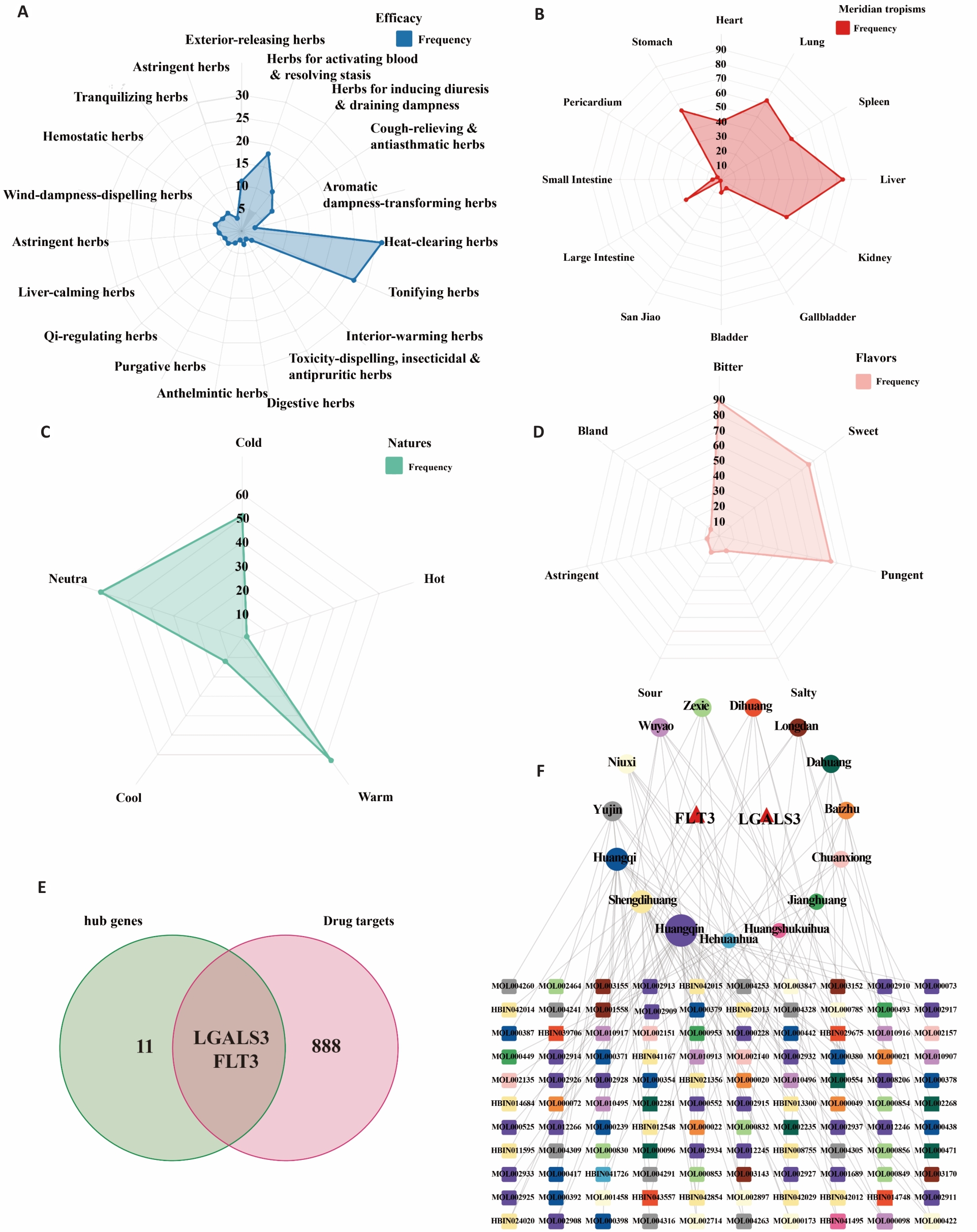
图6 潜在调控中药的药理属性及"基因-中药-成分"网络
Fig.6 Pharmacological properties of potential TCMs and the "Gene-Herb-Ingredient" network. A-D: Statistical distributions of the pharmacological properties of the predicted TCMs (A: Efficacy categories; B: Meridian tropisms; C: Natures; D: Flavors). E: Venn diagram of the intersecting targets between the diseases and the predicted TCMs. F: "Core comorbidity gene-TCM-active ingredient" regulatory network (larger nodes indicate higher Degree values).
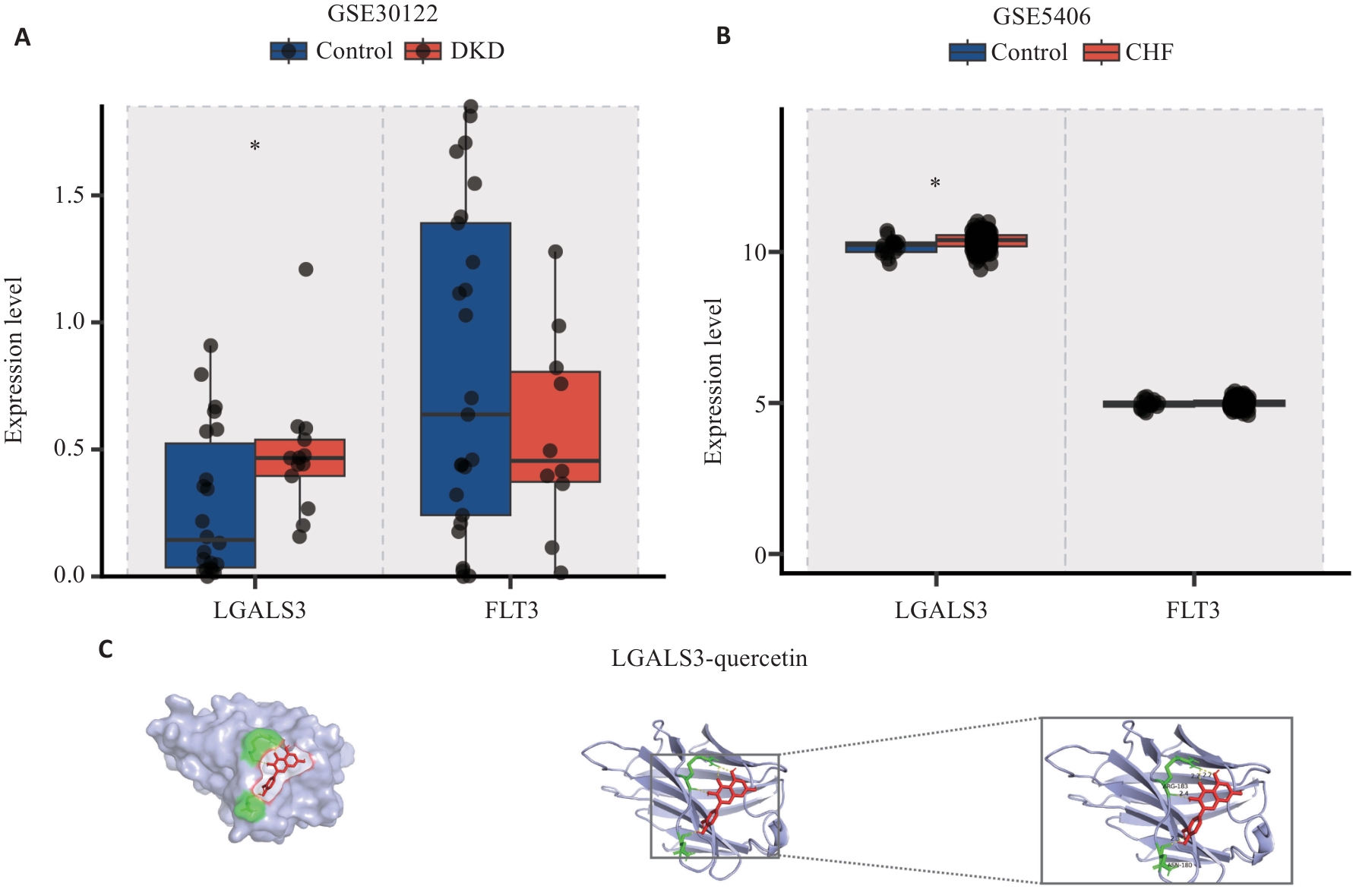
图7 核心基因表达验证及分子对接模式图
Fig.7 Validation of hub gene expression and molecular docking simulation. A, B: Expression levels of the core genes in the validation datasets (A: DKD dataset GSE30122; B: CHF dataset GSE5406). C: Molecular docking model of the key active ingredient quercetin with the core target LGALS3 (binding energy: -6.8 kcal/mol). (*P<0.05).
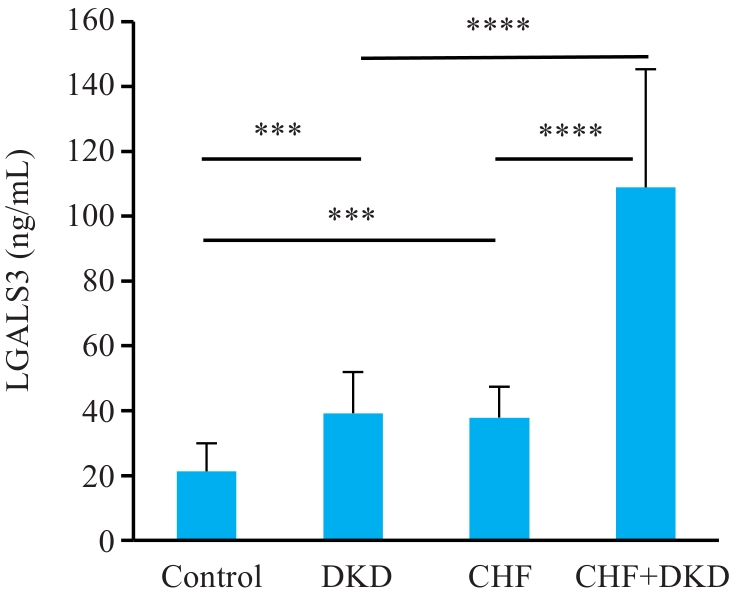
图8 四组受试者血清中 LGALS3 蛋白表达水平比较
Fig.8 Comparison of serum LGALS3 levels among the 4 groups (Mean±SD, n=15). Control: Healthy control group; DKD: Diabetic kidney disease group; CHF: Chronic heart failure group; DKD+CHF: DKD combined with CHF group. ***P<0.001, ****P<0.0001.
| Variables | β | SE | 95% CI | t | P |
|---|---|---|---|---|---|
| (Intercept) | 31.88 | 28.48 | -25.32-89.09 | 1.12 | 0.268 |
| Group DKD (vs HC) | -9.84 | 13.1 | -36.17-16.49 | -0.75 | 0.456 |
| Group CHF (vs HC) | -7.19 | 11.65 | -30.61-16.23 | -0.62 | 0.54 |
| Group DKD+CHF (vs HC) | 51.2 | 13.29 | 24.50-77.91 | 3.85 | <0.001 |
| Age | -0.04 | 0.26 | -0.57-0.49 | -0.15 | 0.88 |
| Gender(Male) | -7.37 | 4.96 | -17.35-2.60 | -1.49 | 0.144 |
| eGFR | -0.26 | 0.16 | -0.58-0.05 | -1.68 | 0.099 |
| logNTproBNP | 5.17 | 2.18 | 0.78-9.56 | 2.37 | 0.022 |
| HbA1c | -0.54 | 2.01 | -4.58-3.51 | -0.27 | 0.79 |
表7 血清LGALS3影响因素的多元线性回归分析
Tab.7 Multivariate linear regression analysis of factors affecting serum LGALS3
| Variables | β | SE | 95% CI | t | P |
|---|---|---|---|---|---|
| (Intercept) | 31.88 | 28.48 | -25.32-89.09 | 1.12 | 0.268 |
| Group DKD (vs HC) | -9.84 | 13.1 | -36.17-16.49 | -0.75 | 0.456 |
| Group CHF (vs HC) | -7.19 | 11.65 | -30.61-16.23 | -0.62 | 0.54 |
| Group DKD+CHF (vs HC) | 51.2 | 13.29 | 24.50-77.91 | 3.85 | <0.001 |
| Age | -0.04 | 0.26 | -0.57-0.49 | -0.15 | 0.88 |
| Gender(Male) | -7.37 | 4.96 | -17.35-2.60 | -1.49 | 0.144 |
| eGFR | -0.26 | 0.16 | -0.58-0.05 | -1.68 | 0.099 |
| logNTproBNP | 5.17 | 2.18 | 0.78-9.56 | 2.37 | 0.022 |
| HbA1c | -0.54 | 2.01 | -4.58-3.51 | -0.27 | 0.79 |
| [1] | Wang LY, Li LX, Liu JX, et al. Associated factors and principal pathophysiological mechanisms of type 2 diabetes mellitus[J]. Front Endocrinol, 2025, 16: 1499565. doi:10.3389/fendo.2025.1499565 |
| [2] | Parmar S, Lopez T, Shah R, et al. Risk of hospital admissions and death in patients with heart failure and chronic kidney disease: findings from a novel multidisciplinary clinic[J]. Cardiorenal Med, 2025, 15(1): 249-60. doi:10.1159/000541806 |
| [3] | Alicic RZ, Rooney MT, Tuttle KR. Diabetic kidney disease: challenges, progress, and possibilities[J]. Clin J Am Soc Nephrol, 2017, 12(12): 2032-45. doi:10.2215/cjn.11491116 |
| [4] | Schefold JC, Filippatos G, Hasenfuss G, et al. Heart failure and kidney dysfunction: epidemiology, mechanisms and management[J]. Nat Rev Nephrol, 2016, 12(10): 610-23. doi:10.1038/nrneph.2016.113 |
| [5] | Ghafoury R, Malek M, Ismail-Beigi F, et al. Role of residual inflammation as a risk factor across cardiovascular-kidney-metabolic (CKM) syndrome: unpacking the burden in people with Type2 diabetes[J]. Diabetes Ther, 2025, 16(7): 1341-65. doi:10.1007/s13300-025-01743-6 |
| [6] | Sebastian SA, Padda I, Johal G. Cardiovascular-Kidney-Metabolic (CKM) syndrome: a state-of-the-art review[J]. Curr Probl Cardiol, 2024, 49(2): 102344. doi:10.1016/j.cpcardiol.2023.102344 |
| [7] | Patera F, Gatticchi L, Cellini B, et al. Kidney fibrosis and oxidative stress: from molecular pathways to new pharmacological opportunities[J]. Biomolecules, 2024, 14(1): 137. doi:10.3390/biom14010137 |
| [8] | McPhillips K, Janssen WJ, Ghosh M, et al. TNF-alpha inhibits macrophage clearance of apoptotic cells via cytosolic phospholipase A2 and oxidant-dependent mechanisms[J]. J Immunol, 2007, 178(12): 8117-26. doi:10.4049/jimmunol.178.12.8117 |
| [9] | Zhang CY, Li H, Wang SX. Common gene signatures and molecular mechanisms of diabetic nephropathy and metabolic syndrome[J]. Front Public Health, 2023, 11: 1150122. doi:10.3389/fpubh.2023.1150122 |
| [10] | Salvatore T, Galiero R, Caturano A, et al. An overview of the cardiorenal protective mechanisms of SGLT2 inhibitors[J]. Int J Mol Sci, 2022, 23(7): 3651. doi:10.3390/ijms23073651 |
| [11] | Thomas MC. The clustering of Cardiovascular, Renal, Adipo-Metabolic Eye and Liver disease with type 2 diabetes[J]. Metabolism, 2022, 128: 154961. doi:10.1016/j.metabol.2021.154961 |
| [12] | 张 倩, 徐君瑜, 卢小茜, 等. 中药复杂成分靶点鉴定新方法及其应用研究进展[J]. 中国药理学通报, 2025, 41(11): 2001-8. |
| [13] | 李昇松, 朱明丹. 基于心肾相交 水火既济探讨温阳利水法对慢性心力衰竭的治疗作用[J]. 光明中医, 2025, 40(12): 2533-6. |
| [14] | Ye XQ, Xu YC, Wu SS, et al. Single-cell RNA sequencing reveals the role of immunoinflammatory cells in the progression of renal tubulointerstitial fibrosis[J]. PLoS One, 2025, 20(11): e0337092. doi:10.1371/journal.pone.0337092 |
| [15] | Edgar R. Gene Expression Omnibus: NCBI gene expression and hybridization array data repository[J]. Nucleic Acids Res, 2002, 30(1): 207-10. doi:10.1093/nar/30.1.207 |
| [16] | Ritchie ME, Phipson B, Wu D, et al. Limma powers differential expression analyses for RNA-sequencing and microarray studies[J]. Nucleic Acids Res, 2015, 43(7): e47. doi:10.1093/nar/gkv007 |
| [17] | Langfelder P, Horvath S. WGCNA: an R package for weighted correlation network analysis[J]. BMC Bioinform, 2008, 9(1): 559. doi:10.1186/1471-2105-9-559 |
| [18] | Shannon P, Markiel A, Ozier O, et al. Cytoscape: a software environment for integrated models of biomolecular interaction networks[J]. Genome Res, 2003, 13(11): 2498-504. doi:10.1101/gr.1239303 |
| [19] | 国家药典委员会. 中华人民共和国药典-一部: 2020年版[M]. 北京: 中国医药科技出版社, 2020. |
| [20] | Liew A, Bavanandan S, Hao CM, et al. Executive summary of the Asian Pacific society of nephrology clinical practice guideline on diabetic kidney disease-2025 update[J]. Nephrology, 2025, 30(5): e70031. doi:10.1111/nep.70031 |
| [21] | 中华医学会心血管病学分会, 中国医师协会心血管内科医师分会, 中国医师协会心力衰竭专业委员会, 等. 中国心力衰竭诊断和治疗指南2024[J]. 中华心血管病杂志, 2024, 52(3): 235-75. |
| [22] | Handelsman Y. Diabetes, cardiorenal, and metabolic multispecialty practice recommendations and early intensive management of cardio-renal-metabolic disease[J]. Am J Manag Care, 2024, 30(10 ): S189-96. doi:10.37765/ajmc.2024.89671 |
| [23] | Noels H, van der Vorst EPC, Rubin S, et al. Renal-cardiac crosstalk in the pathogenesis and progression of heart failure[J]. Circ Res, 2025, 136(11): 1306-34. doi:10.1161/circresaha.124.325488 |
| [24] | Hou GJ, Dong YZ, Jiang YH, et al. Immune inflammation and metabolic interactions in the pathogenesis of diabetic nephropathy[J]. Front Endocrinol, 2025, 16: 1602594. doi:10.3389/fendo.2025.1602594 |
| [25] | Liu F, Feng QQ, Yang MN, et al. Quercetin prevented diabetic nephropathy by inhibiting renal tubular epithelial cell apoptosis via the PI3K/AKT pathway[J]. Phytother Res, 2024, 38(7): 3594-606. doi:10.1002/ptr.8227 |
| [26] | Wang YY, Liu YY, Li J, et al. Gualou Xiebai decoction ameliorates cardiorenal syndrome type II by regulation of PI3K/AKT/NF-κB signalling pathway[J]. Phytomedicine, 2024, 123: 155172. doi:10.1016/j.phymed.2023.155172 |
| [27] | Williams RO, Clanchy FI, Huang YS, et al. TNFR2 signalling in inflammatory diseases[J]. Best Pract Res Clin Rheumatol, 2024, 38(2): 101941. doi:10.1016/j.berh.2024.101941 |
| [28] | Hubbi S, Hao SJ, Epps J, et al. Tumour necrosis factor-alpha at the intersection of renal epithelial and immune cell function[J]. J Physiol, 2025, 603(10): 2915-36. doi:10.1113/jp286756 |
| [29] | Feng Q, Yu XY, Xie JW, et al. Phillygenin improves diabetic nephropathy by inhibiting inflammation and apoptosis via regulating TLR4/MyD88/NF‑κB and PI3K/AKT/GSK3β signaling pathways[J]. Phytomedicine, 2025, 136: 156314. doi:10.1016/j.phymed.2024.156314 |
| [30] | Delalat S, Sultana I, Osman H, et al. Dysregulated inflammation, oxidative stress, and protein quality control in diabetic HFpEF: unraveling mechanisms and therapeutic targets[J]. Cardiovasc Diabetol, 2025, 24(1): 211. doi:10.1186/s12933-025-02734-4 |
| [31] | Jiang ZW, Tabuchi C, Gayer SG, et al. Immune dysregulation in obesity[J]. Annu Rev Pathol Mech Dis, 2025, 20: 483-509. doi:10.1146/annurev-pathmechdis-051222-015350 |
| [32] | Chen JH, Liu QH, He JH, et al. Immune responses in diabetic nephropathy: Pathogenic mechanisms and therapeutic target[J]. Front Immunol, 2022, 13: 958790. doi:10.3389/fimmu.2022.958790 |
| [33] | Javed Q. Molecular mechanisms and complications of TNF blockade in heart failure: targeting signalling and genetic determinants of therapeutic response[J]. Mol Biol Rep, 2025, 52(1): 772. doi:10.1007/s11033-025-10877-6 |
| [34] | Levine B, Kalman J, Mayer L, et al. Elevated circulating levels of tumor necrosis factor in severe chronic heart failure[J]. N Engl J Med, 1990, 323(4): 236-41. doi:10.1056/nejm199007263230405 |
| [35] | 张泸丹, 王新陆, 朱明军, 等. 线粒体氧化磷酸化结合中医药在心血管疾病中的研究[J]. 世界科学技术-中医药现代化, 2025, 27(6): 1786-94. |
| [36] | Xiao TH, Zhu BT. Sodium formate-induced mitochondrial impairment and cytotoxicity in neuronal cells reveal crucial pathogenic mechanisms underlying diabetic neuropathy and retinopathy[J]. Sci Rep, 2025, 15: 27797. doi:10.1038/s41598-025-11312-3 |
| [37] | Yang HM. Mitochondrial dysfunction in cardiovascular diseases[J]. Int J Mol Sci, 2025, 26(5): 1917. doi:10.3390/ijms26051917 |
| [38] | Blanda V, Bracale UM, Di Taranto MD, et al. Galectin-3 in cardiovascular diseases[J]. Int J Mol Sci, 2020, 21(23): 9232. doi:10.3390/ijms21239232 |
| [39] | Di Carlo SE, Raffenne J, Varet H, et al. Depletion of slow-cycling PDGFRα+ADAM12+ mesenchymal cells promotes antitumor immunity by restricting macrophage efferocytosis[J]. Nat Immunol, 2023, 24(11): 1867-78. doi:10.1038/s41590-023-01642-7 |
| [40] | Erriah M, Pabreja K, Fricker M, et al. Galectin-3 enhances monocyte-derived macrophage efferocytosis of apoptotic granulocytes in asthma[J]. Respir Res, 2019, 20(1): 1. doi:10.1186/s12931-018-0967-9 |
| [41] | Hussain S, Habib A, Hussain MS, et al. Potential biomarkers for early detection of diabetic kidney disease[J]. Diabetes Res Clin Pract, 2020, 161: 108082. doi:10.1016/j.diabres.2020.108082 |
| [42] | Trippel TD, Mende M, Düngen HD, et al. The diagnostic and prognostic value of galectin-3 in patients at risk for heart failure with preserved ejection fraction: results from the DIAST-CHF study[J]. ESC Heart Fail, 2021, 8(2): 829-41. doi:10.1002/ehf2.13174 |
| [43] | Cheng DM, Lian WX, Jia XY, et al. LGALS3 regulates endothelial-to-mesenchymal transition via PI3K/AKT signaling pathway in silica-induced pulmonary fibrosis[J]. Toxicology, 2024, 509: 153962. doi:10.1016/j.tox.2024.153962 |
| [44] | Song MJ, Pan QZ, Yang JY, et al. Galectin-3 favours tumour metastasis via the activation of β-catenin signalling in hepatocellular carcinoma[J]. Br J Cancer, 2020, 123(10): 1521-34. doi:10.1038/s41416-020-1022-4 |
| [45] | Dong R, Zhang M, Hu QY, et al. Galectin-3 as a novel biomarker for disease diagnosis and a target for therapy (Review)[J]. Int J Mol Med, 2018, 41(2): 599-614. |
| [46] | Ianos RD, Iancu M, Pop C, et al. Predictive value of NT-proBNP, FGF21, galectin-3 and copeptin in advanced heart failure in patients with preserved and mildly reduced ejection fraction and type 2 diabetes mellitus[J]. Medicina, 2024, 60(11): 1841. doi:10.3390/medicina60111841 |
| [47] | Medvedeva EA, Berezin II, Shchukin YV. Galectin-3, Markers of Oxidative Stress and Renal Dysfunction in Patients With Chronic Heart Failure[J]. Kardiologiia, 2017, 57(3): 46-50. |
| [48] | 朴容硕, 王 薇, 李应东, 等. 6种益气活血类中成药治疗慢性心力衰竭的网状Meta分析[J]. 中国中药杂志, 2022, 47(15): 4221-37. doi:10.19540/j.cnki.cjcmm.20220510.502 |
| [49] | Lu Q, Ji XJ, Zhou YX, et al. Quercetin inhibits the mTORC1/p70S6K signaling-mediated renal tubular epithelial–mesenchymal transition and renal fibrosis in diabetic nephropathy[J]. Pharmacol Res, 2015, 99: 237-47. doi:10.1016/j.phrs.2015.06.006 |
| [50] | Li ZY, Deng HC, Guo XC, et al. Effective dose/duration of natural flavonoid quercetin for treatment of diabetic nephropathy: a systematic review and meta-analysis of rodent data[J]. Phytomedicine, 2022, 105: 154348. doi:10.1016/j.phymed.2022.154348 |
| [51] | Lei L, Zhao J, Liu XQ, et al. Wogonin alleviates kidney tubular epithelial injury in diabetic nephropathy by inhibiting PI3K/Akt/NF-κB signaling pathways[J]. Drug Des Devel Ther, 2021, 15: 3131-50. doi:10.2147/dddt.s310882 |
| [52] | Liu XQ, Jiang L, Li YY, et al. Wogonin protects glomerular podocytes by targeting Bcl-2-mediated autophagy and apoptosis in diabetic kidney disease[J]. Acta Pharmacol Sin, 2022, 43(1): 96-110. doi:10.1038/s41401-021-00721-5 |
| [53] | Zhao FL, Fu L, Yang W, et al. Cardioprotective effects of baicalein on heart failure via modulation of Ca2+ handling proteins in vivo and in vitro [J]. Life Sci, 2016, 145: 213-23. doi:10.1016/j.lfs.2015.12.036 |
| [54] | Ahad A, Mujeeb M, Ahsan H, et al. Prophylactic effect of baicalein against renal dysfunction in type 2 diabetic rats[J]. Biochimie, 2014, 106: 101-10. doi:10.1016/j.biochi.2014.08.006 |
| [55] | Sun LW, Isaak CK, Zhou YL, et al. Salidroside and tyrosol from Rhodiola protect H9c2 cells from ischemia/reperfusion-induced apoptosis[J]. Life Sci, 2012, 91(5/6): 151-8. doi:10.1016/j.lfs.2012.06.026 |
| [56] | Tian CX, Li MY, Shuai XX, et al. Berberine plays a cardioprotective role by inhibiting macrophage Wnt5a/β‑catenin pathway in the myocardium of mice after myocardial infarction[J]. Phytother Res, 2023, 37(1): 50-61. doi:10.1002/ptr.7592 |
| [57] | Zhao M, Li PY, Qiao D, et al. N6-methyladenosine modification of TSC1 mRNA contributes to macrophage polarization regulated by Coptisine in DSS-induced ulcerative colitis[J]. Phytomedicine, 2024, 122: 155153. doi:10.1016/j.phymed.2023.155153 |
| [58] | 田 蕾, 赵文景, 刘伟敬, 等. 糖尿病肾脏疾病“肾络微型癥瘕聚散消长”理论体系的构建与应用[J]. 中华中医药杂志, 2025, 40(7): 3423-6. |
| [59] | 高亚斌, 王耀献, 郭 敬, 等. “以热为本, 以期为纲”论治晚期糖尿病肾病[J]. 中华中医药杂志, 2020, 35(2): 714-6. |
| [60] | 刘晓芹, 王 雯, 程丽霞. 中医药治疗糖尿病肾脏病的现状及研究进展[J]. 中医药导报, 2024, 30(6): 152-5. |
| [1] | 钱爱, 黄传兵, 朱雅文, 胡可心, 宋昕冉, 许宇翔. 芪黄健脾滋肾颗粒通过调控巨噬细胞免疫代谢重编程改善系统性红斑狼疮患者的肾脏损伤[J]. 南方医科大学学报, 2026, 46(9): 2113-2122. |
| [2] | 马园园, 刘悦, 高宁, 霍宇萌, 陈美霓, 李佳文, 刘佳浩, 张满秋, 严冰冰, 许诺, 赵菊梅. 黄芪注射液通过多成分靶向CCL2/FOS/PPARG/CXCL8抑制宫颈癌恶性进展[J]. 南方医科大学学报, 2026, 46(9): 2206-2221. |
| [3] | 林灶强, 江梦瑶, 冯流畅, 方坤洋, 方萍君, 谭秦湘. 熟地黄通过多靶点机制治疗慢性肾脏病[J]. 南方医科大学学报, 2026, 46(7): 1611-1621. |
| [4] | 程园园, 黄传兵, 张娟, 朱雅文, 钱爱. 重骨颗粒通过调控Nrf2通路改善膝骨关节炎肝肾亏虚证患者的软骨损伤[J]. 南方医科大学学报, 2026, 46(5): 1028-1038. |
| [5] | 韩亮, 李百超, 王炳哲, 张志伟, 张九娜. 吐根酚碱通过Ras信号通路抑制结直肠癌的恶性生物学行为[J]. 南方医科大学学报, 2026, 46(5): 1121-1130. |
| [6] | 谢家润, 罗燕玉, 夏金金, 王明. 加味清心莲子饮通过调控KDM3C/SP1信号通路改善糖尿病肾病小鼠的肾脏损伤[J]. 南方医科大学学报, 2026, 46(4): 728-741. |
| [7] | 马扬, 郭龙辉, 王锦帼, 肖文萍, 吕运成, 范晓明. 灯盏乙素通过调控MMP7与LCN2改善大鼠代谢功能障碍相关脂肪性肝病[J]. 南方医科大学学报, 2026, 46(4): 907-922. |
| [8] | 陈雪俊, 经媛, 梁惠瑜, 钟竞颖, 陈泽栋, 彭于芝, 戴娇娇, 肖雅. 不同配伍黄芪药对通过PTGS2调控脂质过氧化改善小鼠糖尿病肾病[J]. 南方医科大学学报, 2026, 46(3): 592-603. |
| [9] | 向科霖, 章晓云, 黎征鹏, 徐志为, 刘素杰, 柴源. 胞葬相关基因UCP2、EGLN3、IL1B对骨关节炎的诊断价值及中药治疗预测:基于生物信息学及机器学习[J]. 南方医科大学学报, 2026, 46(3): 693-706. |
| [10] | 李钊泳, 周凤华, 孙晓敏, 赵华杉, 金瑶, 何培坤, 贾钰华. 降脂祛斑方多成分协同调控炎症-代谢网络改善2型糖尿病合并高脂血症:网络药理学与临床验证[J]. 南方医科大学学报, 2026, 46(1): 83-93. |
| [11] | 呼琴, 金华. 清肾颗粒通过调控miR-23b及Nrf2通路改善慢性肾脏病湿热证患者的肾功能:基于网络药理学和临床试验[J]. 南方医科大学学报, 2025, 45(9): 1867-1879. |
| [12] | 杨子为, 吕畅, 董柱, 计书磊, 毕生辉, 张雪花, 王晓武. 金樱子通过调控Src-AKT1轴抑制肺动脉高压平滑肌增殖[J]. 南方医科大学学报, 2025, 45(9): 1889-1902. |
| [13] | 云琦, 杜若丽, 贺玉莹, 张贻欣, 王佳慧, 叶红伟, 李正红, 高琴. 肉桂酸通过抑制TLR4减轻阿霉素诱导的小鼠心肌损伤铁死亡的发生[J]. 南方医科大学学报, 2025, 45(9): 1946-1958. |
| [14] | 饶璐, 丁家和, 魏江平, 阳勇, 张小梅, 王计瑞. 槐花通过抑制PI3K/AKT通路减轻炎症反应治疗银屑病[J]. 南方医科大学学报, 2025, 45(9): 1989-1996. |
| [15] | 陈鑫源, 吴成挺, 李瑞迪, 潘雪芹, 张耀丹, 陶俊宇, 林才志. 双术汤通过P53/SLC7A11/GPX4通路诱导胃癌细胞铁死亡[J]. 南方医科大学学报, 2025, 45(7): 1363-1371. |
| 阅读次数 | ||||||
|
全文 |
|
|||||
|
摘要 |
|
|||||
