
南方医科大学学报 ›› 2026, Vol. 46 ›› Issue (7): 1611-1621.doi: 10.12122/j.issn.1673-4254.2026.07.15
• • 上一篇
林灶强1( ), 江梦瑶2, 冯流畅1, 方坤洋3, 方萍君3, 谭秦湘1()
收稿日期:2025-10-15
出版日期:2026-07-20
发布日期:2026-07-20
通讯作者:
谭秦湘
E-mail:13435683858@163.com;qinxiangtan2023@163.com
作者简介:林灶强,硕士,E-mail: 13435683858@163.com
基金资助:
Zaoqiang LIN1(), Mengyao JIANG2, Liuchang FENG1, Kunyang FANG3, Pingjun FANG3, Qinxiang TAN1()
Received:2025-10-15
Online:2026-07-20
Published:2026-07-20
Contact:
Qinxiang TAN
E-mail:13435683858@163.com;qinxiangtan2023@163.com
摘要:
目的 基于网络药理学和分子对接技术,探索熟地黄治疗慢性肾脏病(CKD)的潜在作用机制。 方法 通过中药系统药理学数据库与分析平台和中药分子机制生物信息学分析工具筛选熟地黄的活性成分及靶点,构建“成分-靶点-通路”网络。采用R软件进行基因本体论和京都基因与基因组百科全书富集分析,揭示熟地黄的作用通路,并利用AutoDock Vina对核心靶点Jun原癌基因(JUN)和信号转导及转录激活因子3(STAT3)与活性成分进行分子对接。动物实验方面,选取8周龄雄性C57BL/6小鼠,随机分为假手术组(Ctrl组)、单侧肾缺血再灌注损伤模型组(UIRI组)及熟地黄干预组(UIRI+RRP组,包括低、中、高剂量组),每组6只。采用夹闭右肾蒂30 min建立UIRI模型,假手术组仅暴露肾脏而不夹闭。干预组于造模前2 d至术后10 d分别给予熟地黄水煎液灌胃(300、600、1200 mg·kg-1·d-1),其余各组给予等量生理盐水。术后第30天切除左肾并收集血液及肾组织标本。检测血清肌酐、尿酸、尿素氮、尿蛋白水平及肾组织病理变化(苏木精-伊红染色、马松染色、天狼星红染色),并通过免疫组化分析JUN、STAT3、I型胶原(Collagen I)和III型胶原(Collagen III)表达。 结果 共筛选25种熟地黄活性成分及307个CKD相关交集靶基因,蛋白质-蛋白质相互作用网络分析确定19个核心靶基因,其中JUN和STAT3为核心节点。分子对接证实熟地黄活性成分与JUN和STAT3高亲和力结合。与Ctrl组相比,UIRI组小鼠血清肌酐、尿酸、尿素氮及尿蛋白水平均升高(P<0.01),肾组织可见肾小管扩张及间质纤维化加重,JUN、STAT3、Collagen I及Collagen III表达上调;与UIRI组相比,UIRI+RRP组上述指标水平均降低(P<0.01),肾组织病理损伤程度减轻,JUN、STAT3、Collagen I及Collagen III表达下调。 结论 熟地黄通过“多成分-多靶点-多通路”机制,靶向JUN/STAT3信号通路,发挥抗纤维化作用,显著延缓CKD进展,为其潜在临床应用提供了理论依据。
林灶强, 江梦瑶, 冯流畅, 方坤洋, 方萍君, 谭秦湘. 熟地黄通过多靶点机制治疗慢性肾脏病[J]. 南方医科大学学报, 2026, 46(7): 1611-1621.
Zaoqiang LIN, Mengyao JIANG, Liuchang FENG, Kunyang FANG, Pingjun FANG, Qinxiang TAN. Rehmanniae radix preparata alleviates chronic kidney disease in mice through a multi-target mechanism[J]. Journal of Southern Medical University, 2026, 46(7): 1611-1621.
| Active ingredients | Source | Active ingredients | Source |
|---|---|---|---|
| ID:5742590 | TCMSP | ID:45356795 | BATMANTCM |
| ID:3084097 | TCMSP | ID:10467 | BATMANTCM |
| ID:5280794 | TCMSP | ID:7405 | BATMANTCM |
| ID:5281773 | BATMANTCM | ID:6029 | BATMANTCM |
| ID:24981346 | BATMANTCM | ID:439685 | BATMANTCM |
| ID:53399246 | BATMANTCM | ID:1110 | BATMANTCM |
| ID:54600129 | BATMANTCM | ID:10542 | BATMANTCM |
| ID:107848 | BATMANTCM | ID:439531 | BATMANTCM |
| ID:11252659 | BATMANTCM | ID:11005647 | BATMANTCM |
| ID:5988 | BATMANTCM | ID:222284 | BATMANTCM |
| ID:7820 | BATMANTCM | ID:6030 | BATMANTCM |
| ID:5280794 | BATMANTCM | ID:8215 | BATMANTCM |
| ID:3893 | BATMANTCM | ID:13849 | BATMANTCM |
| ID:5460660 | BATMANTCM | ID:5320903 | BATMANTCM |
| ID:5280450 | BATMANTCM | ID:445638 | BATMANTCM |
| ID:15693864 | BATMANTCM | ID:53301851 | BATMANTCM |
| ID:6251 | BATMANTCM | ID:445858 | BATMANTCM |
| ID:24721256 | BATMANTCM | ID:643801 | BATMANTCM |
| ID:137706142 | BATMANTCM | ID:91458 | BATMANTCM |
| ID:499 | BATMANTCM | ID:439242 | BATMANTCM |
| ID:15693863 | BATMANTCM | ID:3931 | BATMANTCM |
| ID:5705531 | BATMANTCM | ID:14486934 | BATMANTCM |
| ID:5281800 | BATMANTCM | ID:138107792 | BATMANTCM |
表1 RRP的有效成份
Tab.1 Active components of RRP
| Active ingredients | Source | Active ingredients | Source |
|---|---|---|---|
| ID:5742590 | TCMSP | ID:45356795 | BATMANTCM |
| ID:3084097 | TCMSP | ID:10467 | BATMANTCM |
| ID:5280794 | TCMSP | ID:7405 | BATMANTCM |
| ID:5281773 | BATMANTCM | ID:6029 | BATMANTCM |
| ID:24981346 | BATMANTCM | ID:439685 | BATMANTCM |
| ID:53399246 | BATMANTCM | ID:1110 | BATMANTCM |
| ID:54600129 | BATMANTCM | ID:10542 | BATMANTCM |
| ID:107848 | BATMANTCM | ID:439531 | BATMANTCM |
| ID:11252659 | BATMANTCM | ID:11005647 | BATMANTCM |
| ID:5988 | BATMANTCM | ID:222284 | BATMANTCM |
| ID:7820 | BATMANTCM | ID:6030 | BATMANTCM |
| ID:5280794 | BATMANTCM | ID:8215 | BATMANTCM |
| ID:3893 | BATMANTCM | ID:13849 | BATMANTCM |
| ID:5460660 | BATMANTCM | ID:5320903 | BATMANTCM |
| ID:5280450 | BATMANTCM | ID:445638 | BATMANTCM |
| ID:15693864 | BATMANTCM | ID:53301851 | BATMANTCM |
| ID:6251 | BATMANTCM | ID:445858 | BATMANTCM |
| ID:24721256 | BATMANTCM | ID:643801 | BATMANTCM |
| ID:137706142 | BATMANTCM | ID:91458 | BATMANTCM |
| ID:499 | BATMANTCM | ID:439242 | BATMANTCM |
| ID:15693863 | BATMANTCM | ID:3931 | BATMANTCM |
| ID:5705531 | BATMANTCM | ID:14486934 | BATMANTCM |
| ID:5281800 | BATMANTCM | ID:138107792 | BATMANTCM |
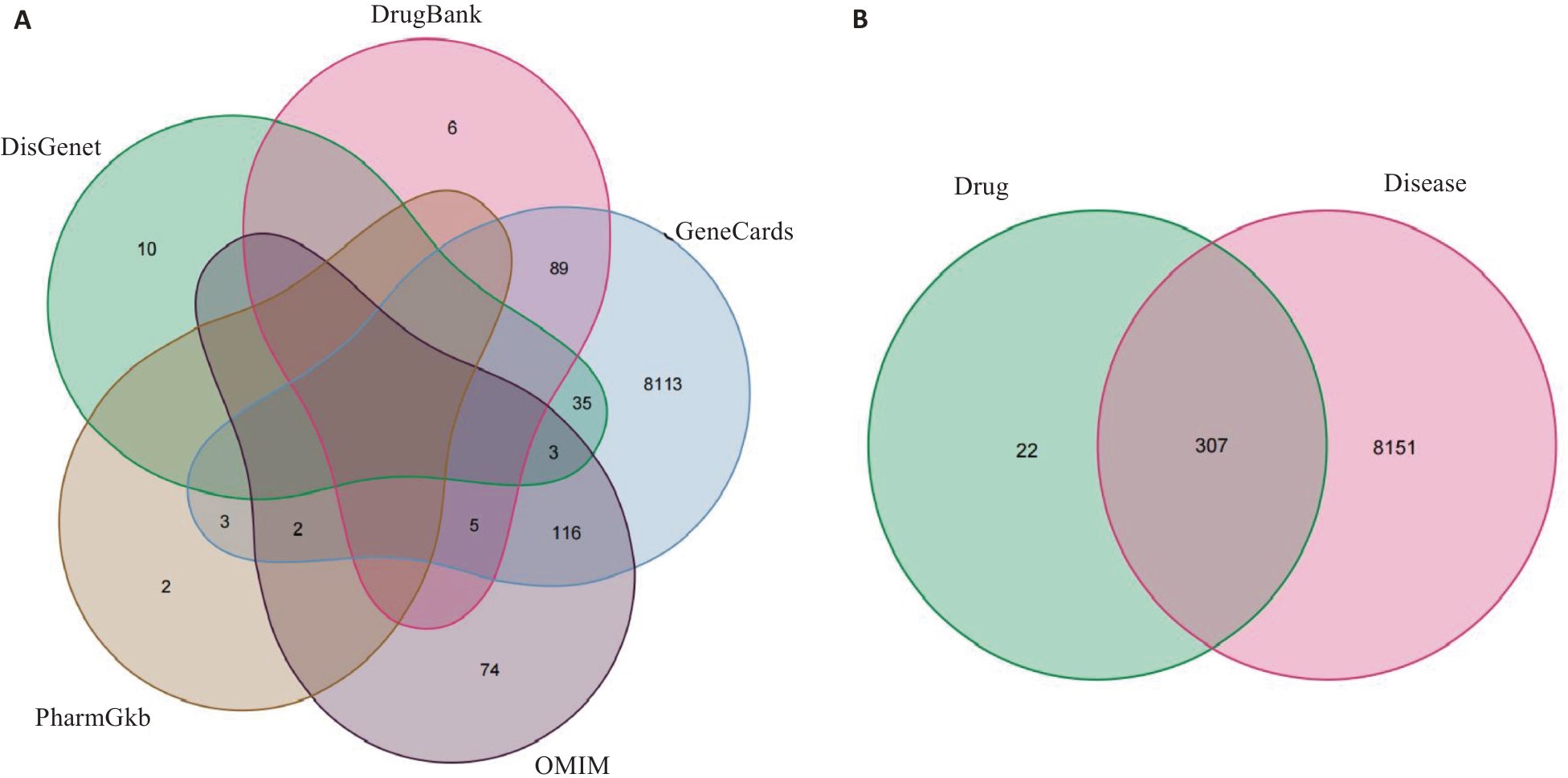
图1 RRP与CKD重叠靶点的鉴定
Fig.1 Identification of intersecting targets between RRP and CKD. A: Venn diagram of intersecting genes from databases; B: Venn diagram of intersecting target genes between RRP and CKD.
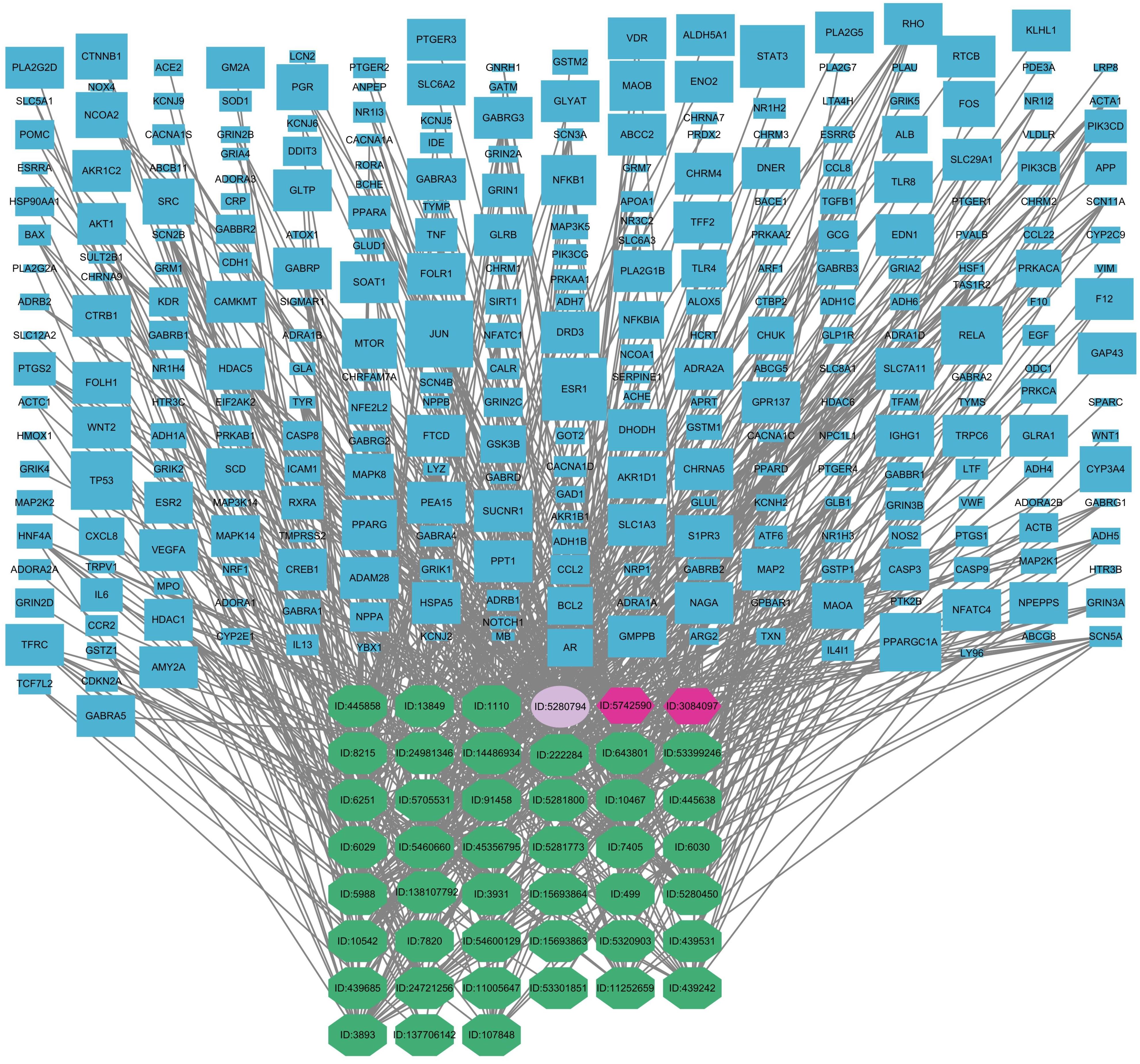
图2 RRP-成份-靶点网络图
Fig.2 RRP-component-target network diagram. Squares represent target genes, octagons represent active components from BATMAN-TCM, hexagons represent active components from TCMSP, and circles represent common active components from both TCMSP and BATMAN-TCM.
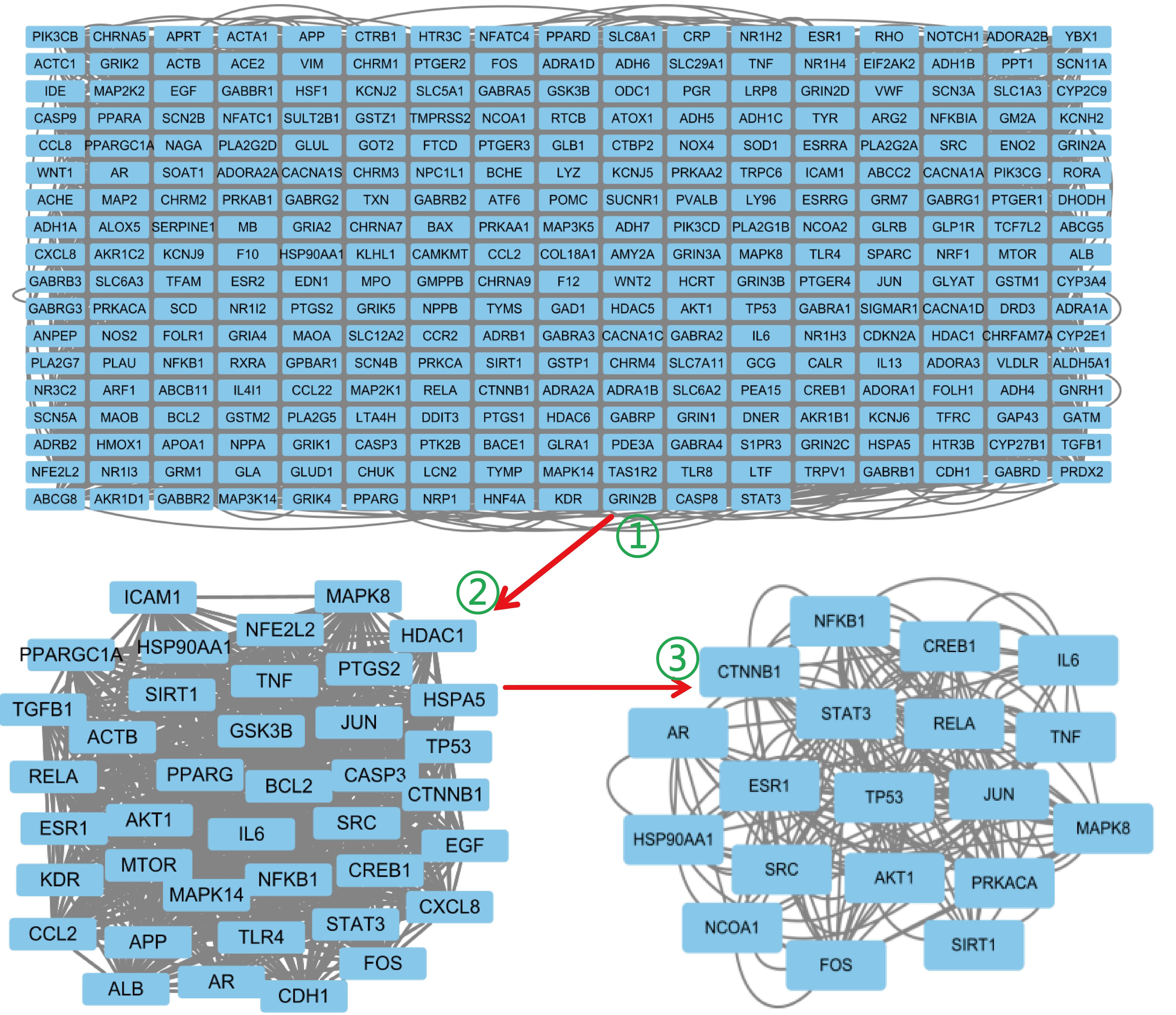
图3 PPI网络中核心基因的筛选
Fig.3 Screening of core genes in the PPI network.
| Name | Betweenness | Closeness | Degree | Eigenvector | LAC | Network |
|---|---|---|---|---|---|---|
| JUN | 29.251 | 0.857 | 30 | 0.320 | 14.400 | 23.626 |
| STAT3 | 19.715 | 0.818 | 28 | 0.310 | 14.857 | 22.161 |
| ESR1 | 19.287 | 0.818 | 28 | 0.307 | 14.571 | 22.076 |
| RELA | 13.129 | 0.783 | 26 | 0.293 | 14.462 | 20.310 |
| TP53 | 16.546 | 0.783 | 26 | 0.292 | 13.538 | 18.684 |
| NFKB1 | 9.175 | 0.720 | 22 | 0.253 | 12.364 | 15.697 |
| CTNNB1 | 9.246 | 0.692 | 20 | 0.220 | 9.600 | 11.510 |
| FOS | 7.160 | 0.692 | 20 | 0.238 | 11.600 | 13.429 |
| SRC | 8.572 | 0.692 | 20 | 0.223 | 10.000 | 11.902 |
| AKT1 | 5.111 | 0.667 | 18 | 0.211 | 10.222 | 11.554 |
| MAPK8 | 2.760 | 0.667 | 18 | 0.230 | 12.444 | 13.466 |
| CREB1 | 4.860 | 0.667 | 18 | 0.215 | 10.222 | 11.166 |
| PRKACA | 3.344 | 0.643 | 16 | 0.193 | 9.000 | 9.600 |
| AR | 6.808 | 0.643 | 16 | 0.172 | 7.500 | 8.693 |
| TNF | 2.238 | 0.621 | 14 | 0.170 | 8.571 | 9.231 |
| IL6 | 1.352 | 0.621 | 14 | 0.171 | 9.714 | 10.462 |
| HSP90AA1 | 0.556 | 0.600 | 12 | 0.145 | 8.667 | 9.455 |
| SIRT1 | 0.222 | 0.581 | 10 | 0.132 | 7.200 | 8.000 |
| NCOA1 | 0.667 | 0.563 | 8 | 0.099 | 4.000 | 4.571 |
表2 拓扑参数评分结果
Tab.2 Topological parameter scoring results
| Name | Betweenness | Closeness | Degree | Eigenvector | LAC | Network |
|---|---|---|---|---|---|---|
| JUN | 29.251 | 0.857 | 30 | 0.320 | 14.400 | 23.626 |
| STAT3 | 19.715 | 0.818 | 28 | 0.310 | 14.857 | 22.161 |
| ESR1 | 19.287 | 0.818 | 28 | 0.307 | 14.571 | 22.076 |
| RELA | 13.129 | 0.783 | 26 | 0.293 | 14.462 | 20.310 |
| TP53 | 16.546 | 0.783 | 26 | 0.292 | 13.538 | 18.684 |
| NFKB1 | 9.175 | 0.720 | 22 | 0.253 | 12.364 | 15.697 |
| CTNNB1 | 9.246 | 0.692 | 20 | 0.220 | 9.600 | 11.510 |
| FOS | 7.160 | 0.692 | 20 | 0.238 | 11.600 | 13.429 |
| SRC | 8.572 | 0.692 | 20 | 0.223 | 10.000 | 11.902 |
| AKT1 | 5.111 | 0.667 | 18 | 0.211 | 10.222 | 11.554 |
| MAPK8 | 2.760 | 0.667 | 18 | 0.230 | 12.444 | 13.466 |
| CREB1 | 4.860 | 0.667 | 18 | 0.215 | 10.222 | 11.166 |
| PRKACA | 3.344 | 0.643 | 16 | 0.193 | 9.000 | 9.600 |
| AR | 6.808 | 0.643 | 16 | 0.172 | 7.500 | 8.693 |
| TNF | 2.238 | 0.621 | 14 | 0.170 | 8.571 | 9.231 |
| IL6 | 1.352 | 0.621 | 14 | 0.171 | 9.714 | 10.462 |
| HSP90AA1 | 0.556 | 0.600 | 12 | 0.145 | 8.667 | 9.455 |
| SIRT1 | 0.222 | 0.581 | 10 | 0.132 | 7.200 | 8.000 |
| NCOA1 | 0.667 | 0.563 | 8 | 0.099 | 4.000 | 4.571 |
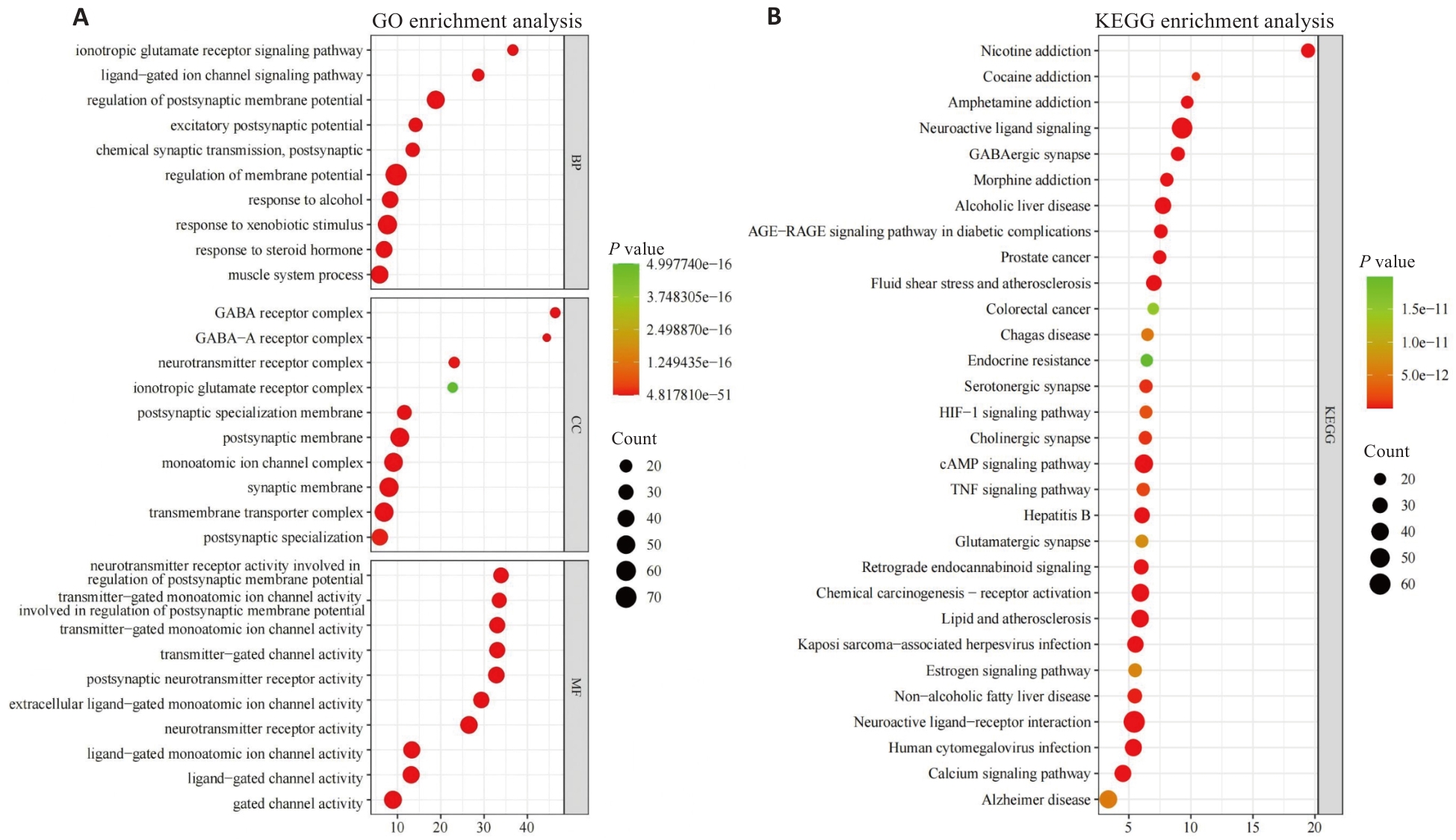
图4 RRP治疗CKD交集靶点基因的GO和 KEGG 富集分析
Fig.4 GO and KEGG enrichment analysis of intersecting target genes for RRP treatment of CKD.
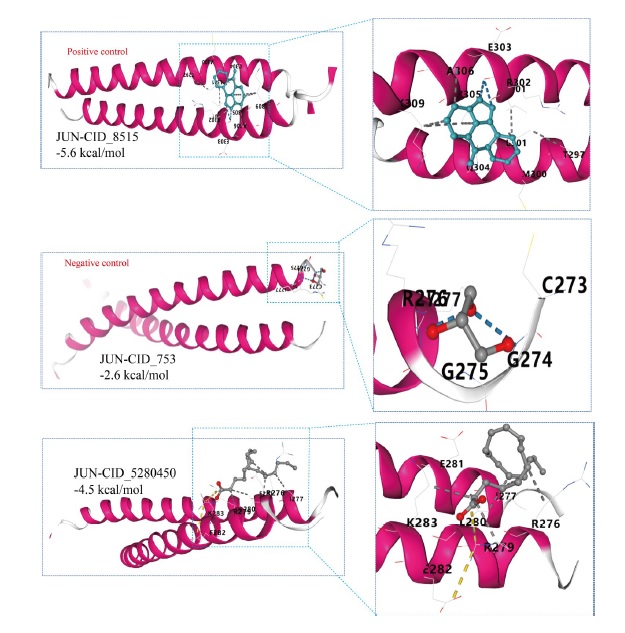
图5 靶点蛋白(JUN)受体与活性成份配体(CID_5280450)的分子对接
Fig.5 Molecular docking of target protein receptors (JUN) with active component ligands (CID_5280450).
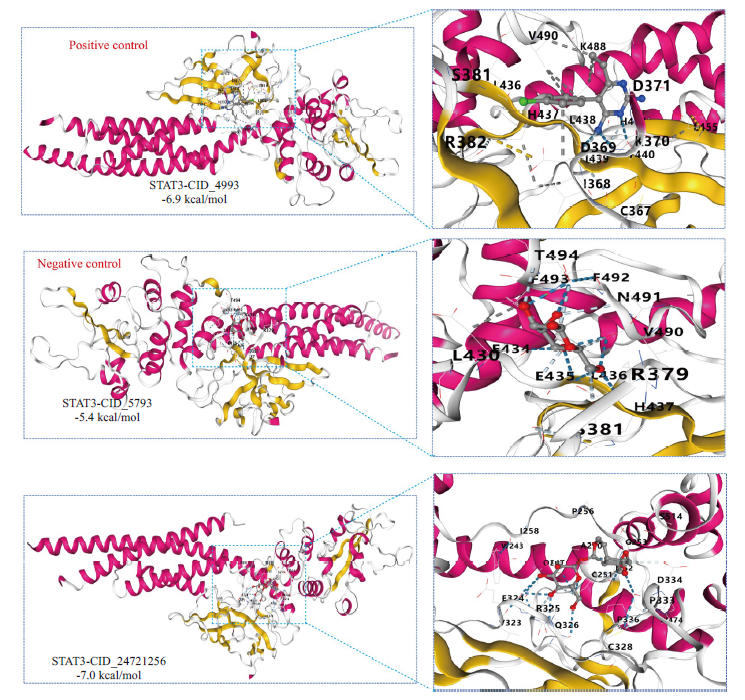
图6 靶点蛋白(STAT3)受体与活性成份配体(CID_24721256)的分子对接
Fig.6 Molecular docking of target protein receptors (STAT3) with active component ligands (CID_5280450).
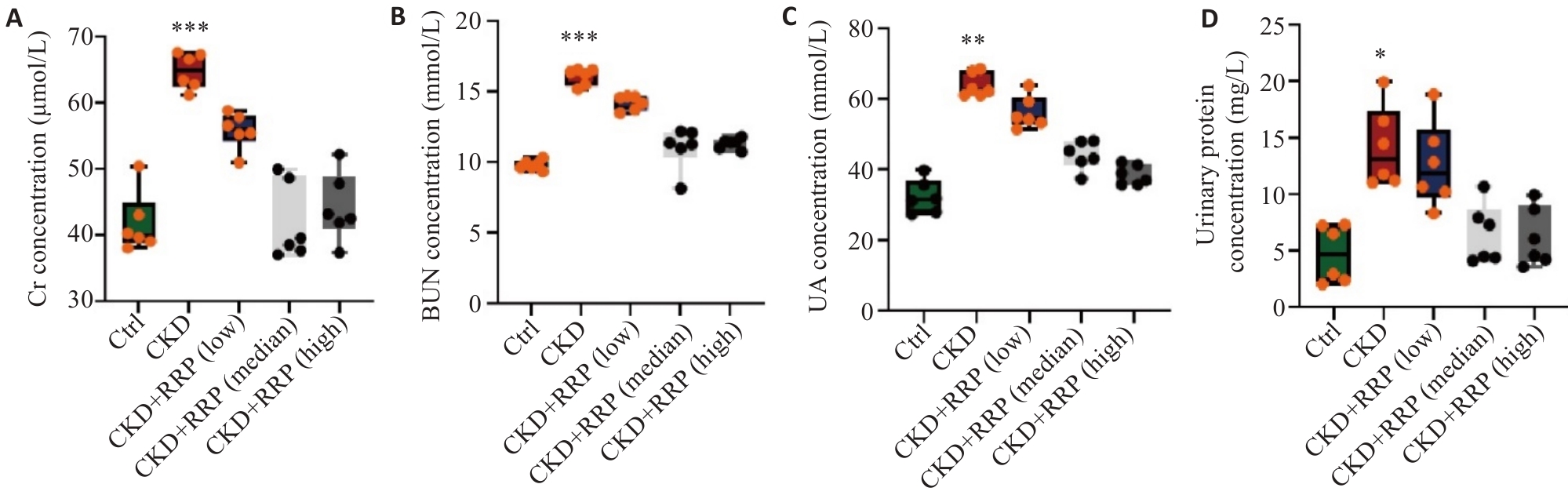
图7 小鼠肌酐、尿素氮、尿酸及尿蛋白水平变化
Fig.7 Changes in in creatinine (A), blood urea nitrogen (B), uric acid (C), and urinary protein (D) levels in mouse models of chronic kidney disease treated with RRP at low, median and high doses (n=6). *P<0.05, **P<0.01, ***P<0.001 vs ctrl group, CKD+RRP (low), CKD+RRP (median), or CKD+RRP (high) (n=6).
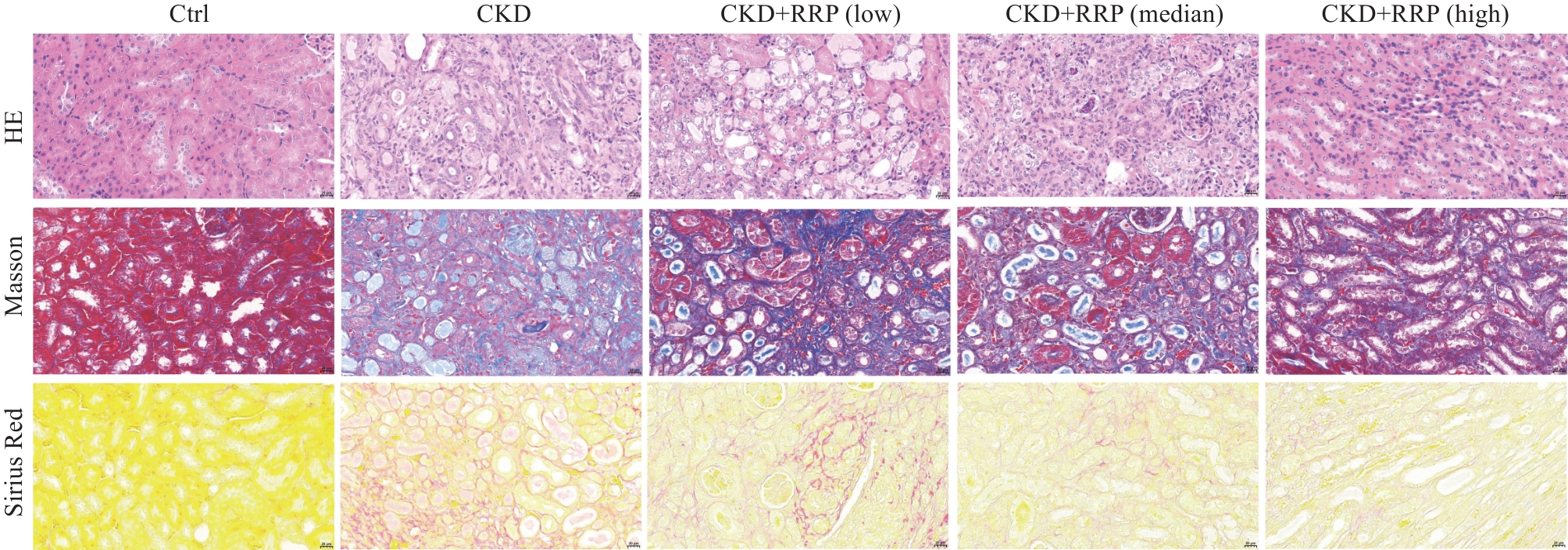
图8 小鼠肾组织病理染色
Fig.8 Histopathological staining of mouse kidney tissue (Original magnification: ×400).
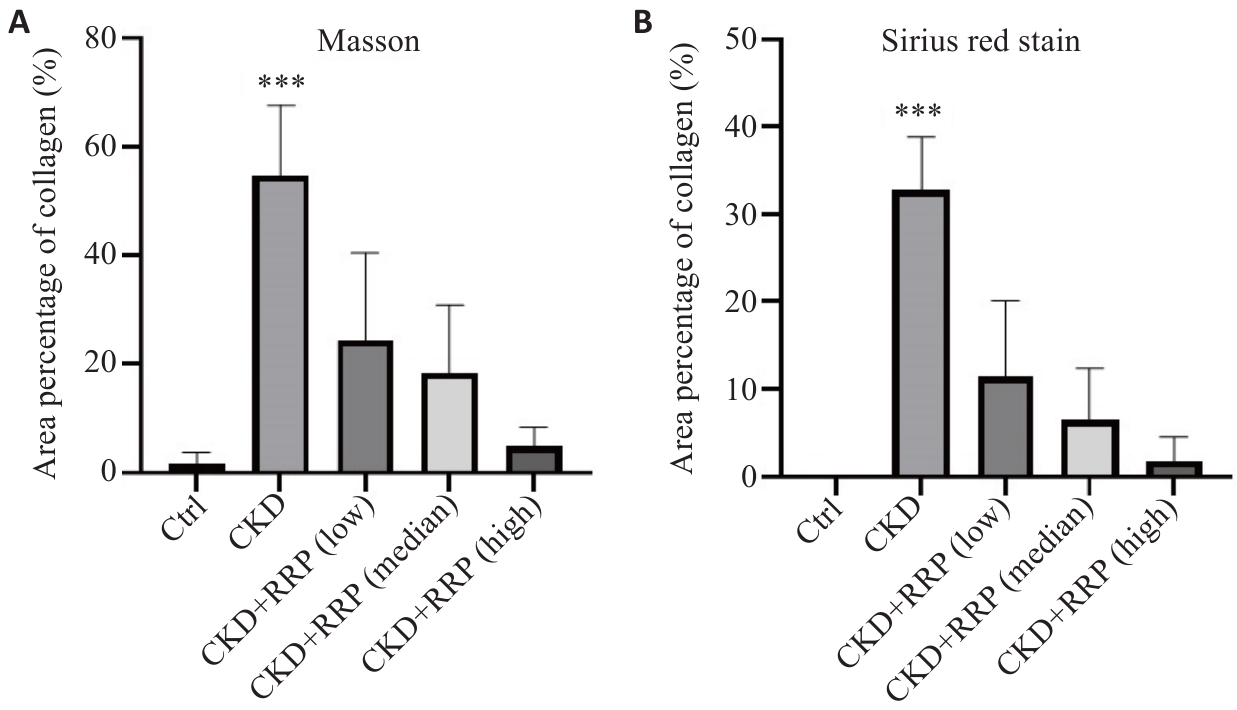
图 9 小鼠肾组织病理染色定量分析结果
Fig.9 Quantitative analysis of pathological staining of mouse kidney tissue (n=6). ***P<0.001 vs ctrl group, CKD+RRP (low), CKD+RRP (median), or CKD+RRP (high).
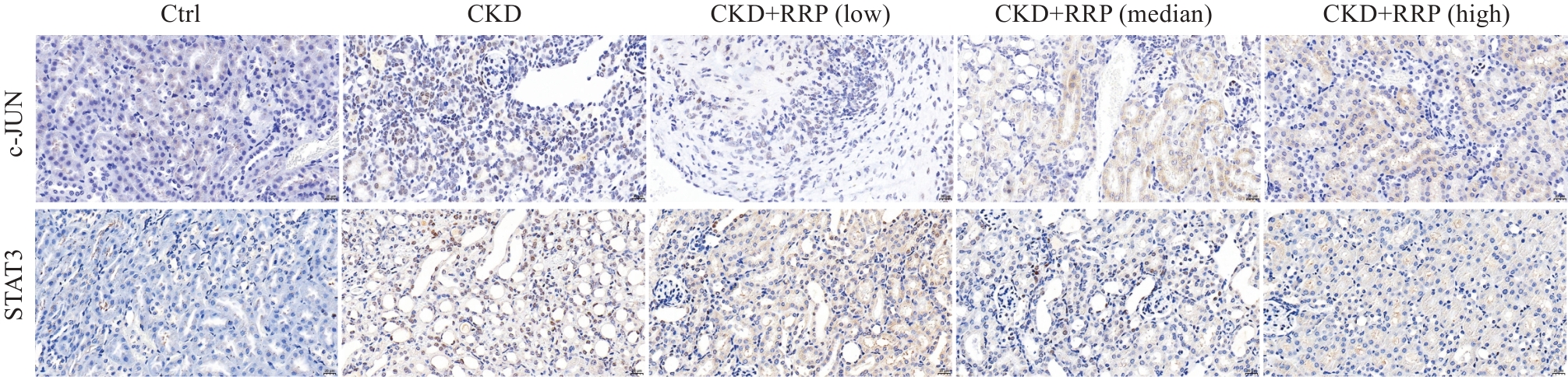
图10 小鼠肾组织JUN和STAT3的IHC染色
Fig.10 Immunohistochemical staining of JUN and STAT3 in mouse kidney tissue (×400).

图11 小鼠肾组织p-JUN和p-STAT3的双荧光染色
Fig.11 Double fluorescence staining of p-JUN and p-STAT3 in mouse kidney tissue (×400).
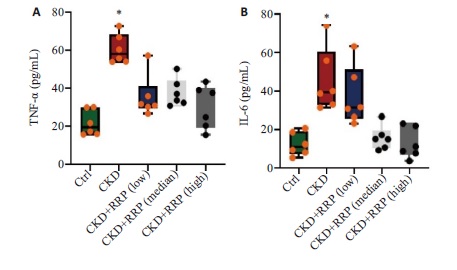
图12 小鼠肾组织TNF-α和IL-6水平
Fig.12 Levels of TNF‑α and IL-6 in mousekidney tissue ( (n=6). A: TNF‑α levels in thekidney; B: IL-6 levels in the kidney. *P<0.05vs
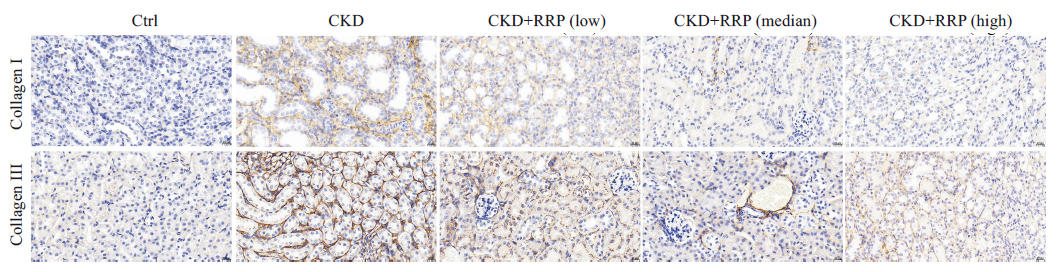
图13 小鼠肾组织Collagen I和Collagen III的IHC染色
Fig.13 Collagen I and collagen III staining of mouse kidney tissue (×400).
| [1] | Deng L, Guo SJ, Liu YP, et al. Global, regional, and national burden of chronic kidney disease and its underlying etiologies from 1990 to 2021: a systematic analysis for the Global Burden of Disease Study 2021[J]. BMC Public Health, 2025, 25(1): 636. doi:10.1186/s12889-025-21851-z |
| [2] | Eckardt KU, Delgado C, Heerspink HJL, et al. Trends and perspectives for improving quality of chronic kidney disease care: conclusions from a Kidney Disease: Improving Global Outcomes (KDIGO) Controversies Conference[J]. Kidney Int, 2023, 104(5): 888-903. |
| [3] | GBD 2023 Chronic Kidney Disease Collaborators. Global, regional, and national burden of chronic kidney disease in adults, 1990-2023, and its attributable risk factors: a systematic analysis for the Global Burden of Disease Study 2023[J]. Lancet, 2025, 406(10518): 2461-82. |
| [4] | Wang LH, He YN, Han C, et al. Global burden of chronic kidney disease and risk factors, 1990-2021: an update from the global burden of disease study 2021[J]. Front Public Health, 2025, 13: 1542329. doi:10.3389/fpubh.2025.1672557 |
| [5] | Yan MT, Chao CT, Lin SH. Chronic kidney disease: strategies to retard progression[J]. Int J Mol Sci, 2021, 22(18): 10084. doi:10.3390/ijms221810084 |
| [6] | 杨一歌, 李 鹤, 张秀立, 等. 慢性肾病及相关并发症治疗药物研究进展[J]. 药学学报, 2022, 57(9): 2682-95. |
| [7] | Francis A, Harhay MN, Ong ACM, et al. Chronic kidney disease and the global public health agenda: an international consensus[J]. Nat Rev Nephrol, 2024, 20(7): 473-85. doi:10.1038/s41581-024-00820-6 |
| [8] | 罗卫红, 李佳欣, 蒋建平, 等. 急性肾损伤进展至慢性肾脏病的临床特征和危险因素: 前瞻性、观察性队列研究[J]. 中华肾脏病杂志, 2020, 36(8): 625-30. doi:10.3760/cma.j.cn441217-20200528-00112 |
| [9] | Lameire NH, Levin A, Kellum JA, et al. Harmonizing acute and chronic kidney disease definition and classification: report of a Kidney Disease: Improving Global Outcomes (KDIGO) Consensus Conference[J]. Kidney Int, 2021, 100(3): 516-26. doi:10.1016/j.kint.2021.06.028 |
| [10] | Baker LW, Ovincy C, Souvalian L, et al. Contemporary management of advanced chronic kidney disease: an evidence-based review[J]. Eur J Intern Med, 2026, 143: 106557. doi:10.1016/j.ejim.2025.106557 |
| [11] | Alicic RZ, Neumiller JJ, Tuttle KR. Combination therapy: an upcoming paradigm to improve kidney and cardiovascular outcomes in chronic kidney disease[J]. Nephrol Dial Transplant, 2025, 40(): i3-17. doi:10.1093/ndt/gfae212 |
| [12] | 董玉君, 包骏轶, 徐书杭. 基于《黄帝内经》“咸入肾”探讨中医防治慢性肾脏病[J]. 亚太传统医药, 2024, 20(2): 199-202. |
| [13] | 王 筝, 刘文康, 冯桃花, 等. 慢性肾脏病毒瘀相关病机探讨[J]. 河北中医, 2019, 41(12): 1893-5, 1920. |
| [14] | Qian TY, He YN, Han C, et al. Current status and prospects of traditional Chinese medicine combined with stem cell therapy for chronic kidney disease[J]. Front Pharmacol, 2025, 15: 1505206. doi:10.3389/fphar.2024.1505206 |
| [15] | 束安梅, 高雨嫣, 朱逸晖, 等. 梓醇抑制AGEs刺激肾内皮细胞介导巨噬细胞活化的作用研究[J]. 中国药理学通报, 2020, 36(11): 1513-9. doi:10.3969/j.issn.1001-1978.2020.11.007 |
| [16] | 张春辉, 吕 静. 基于网络药理学探讨参芪地黄汤治疗慢性肾脏病作用机制[J]. 实用中医内科杂志, 2023, 37(1): 8-12, 后插4-后插8. doi:10.13729/j.issn.1671-7813.Z20220228 |
| [17] | Liu ZH, Xu QY, Wang Y, et al. Catalpol from Rehmannia glutinosa Targets Nrf2/NF-κB Signaling Pathway to Improve Renal Anemia and Fibrosis[J]. Am J Chin Med, 2024, 52(5): 1451-85. doi:10.1142/s0192415x24500575 |
| [18] | 许 原, 王 冰, 任 路, 等. 基于网络药理学的熟地黄-山茱萸药治疗阿尔茨海默病的作用机制分析[J]. 实用中医内科杂志, 2021, 35(11): 9-11, 147-8. |
| [19] | 章新友, 陈晴晴, 唐琍萍. 熟地黄调节AMPK/mTOR信号通路对环磷酰胺诱导早发性卵巢功能不全小鼠的影响[J]. 中药材, 2024, 47(8): 2072-6. |
| [20] | 何 莹, 唐赛男, 张 敏, 等. 淫羊藿苷通过TNC/Wnt/β-catenin通路延缓慢性肾脏病进程中的保护作用[J]. 时珍国医国药, 2024, 35(7): 1578-81. |
| [21] | Liang Y, Qu LY, Liu ZJ, et al. The IRE1/JNK signaling pathway regulates inflammation cytokines and production of glomerular extracellular matrix in the acute kidney injury to chronic kidney disease transition[J]. Mol Biol Rep, 2022, 49(8): 7709-18. doi:10.1007/s11033-022-07588-7 |
| [22] | Liu YJ, Wang WK, Zhang JT, et al. JAK/STAT signaling in diabetic kidney disease[J]. Front Cell Dev Biol, 2023, 11: 1233259. doi:10.3389/fcell.2023.1233259 |
| [23] | Yi HA, Jiang YB, Li W, et al. Scutellarin prevents obesity-induced renal fibrosis via reduced activation of AP-1[J]. J Transl Med, 2025, 23(1): 611. doi:10.1186/s12967-025-06616-x |
| [24] | Zhang JQ, Li YY, Zhang XY, et al. Cellular senescence of renal tubular epithelial cells in renal fibrosis[J]. Front Endocrinol, 2023, 14: 1085605. doi:10.3389/fendo.2023.1085605 |
| [25] | Park JY, Yoo KD, Bae E, et al. Blockade of STAT3 signaling alleviates the progression of acute kidney injury to chronic kidney disease through antiapoptosis[J]. Am J Physiol Renal Physiol, 2022, 322(5): F553-72. doi:10.1152/ajprenal.00595.2020 |
| [26] | Pan J, Shi M, Guo F, et al. Pharmacologic inhibiting STAT3 delays the progression of kidney fibrosis in hyperuricemia-induced chronic kidney disease[J]. Life Sci, 2021, 285: 119946. doi:10.1016/j.lfs.2021.119946 |
| [27] | Zhang JH, Peng JQ, Zhang T, et al. Identification of the Main Chemical constituents and mechanism of Renshen Guben oral liquid against Renal Fibrosis[J]. Chin Med, 2023, 18(1): 56. doi:10.1186/s13020-023-00762-4 |
| [28] | Bhadange R, Dagar N, Gaikwad AB. Levosimendan mitigates renal fibrosis via TGF-β1/Smad axis modulation in UUO rats[J]. Biomed Pharmacother, 2025, 187: 118124. doi:10.1016/j.biopha.2025.118124 |
| [29] | Jia JH, Chen JF, Wang GL, et al. Progress of research into the pharmacological effect and clinical application of the traditional Chinese medicine Rehmanniae Radix [J]. Biomed Pharmacother, 2023, 168: 115809. doi:10.1016/j.biopha.2023.115809 |
| [30] | 王琳琳, 田 萍, 张 薇, 等. 地黄醇提物通过激活SIRT1/Nrf2/HO-1信号通路改善CUMS大鼠抑郁样行为[J]. 中国药学杂志, 2025, 60(12): 1269-78. doi:10.11669/cpj.2025.12.007 |
| [1] | 李淼, 于桂莹, 王金城, 谢抗, 欧阳雨林, 王能, 温蕊嘉, 王伟, 李春. 金银花通过调控STAT3/PGC-1α轴减轻氧化应激改善缺血后心力衰竭[J]. 南方医科大学学报, 2026, 46(7): 1563-1575. |
| [2] | 程园园, 黄传兵, 张娟, 朱雅文, 钱爱. 重骨颗粒通过调控Nrf2通路改善膝骨关节炎肝肾亏虚证患者的软骨损伤[J]. 南方医科大学学报, 2026, 46(5): 1028-1038. |
| [3] | 韩亮, 李百超, 王炳哲, 张志伟, 张九娜. 吐根酚碱通过Ras信号通路抑制结直肠癌的恶性生物学行为[J]. 南方医科大学学报, 2026, 46(5): 1121-1130. |
| [4] | 马扬, 郭龙辉, 王锦帼, 肖文萍, 吕运成, 范晓明. 灯盏乙素通过调控MMP7与LCN2改善大鼠代谢功能障碍相关脂肪性肝病[J]. 南方医科大学学报, 2026, 46(4): 907-922. |
| [5] | 刘泽, 毛樟坤, 尤达, 王俊杰, 何咏梅, 余伊雯, 文志强, 方会龙, 何汶霞. 宽缨酮靶向抑制STAT3减轻线粒体功能障碍和炎症缓解急性肾损伤[J]. 南方医科大学学报, 2026, 46(3): 570-581. |
| [6] | 李钊泳, 周凤华, 孙晓敏, 赵华杉, 金瑶, 何培坤, 贾钰华. 降脂祛斑方多成分协同调控炎症-代谢网络改善2型糖尿病合并高脂血症:网络药理学与临床验证[J]. 南方医科大学学报, 2026, 46(1): 83-93. |
| [7] | 呼琴, 金华. 清肾颗粒通过调控miR-23b及Nrf2通路改善慢性肾脏病湿热证患者的肾功能:基于网络药理学和临床试验[J]. 南方医科大学学报, 2025, 45(9): 1867-1879. |
| [8] | 杨子为, 吕畅, 董柱, 计书磊, 毕生辉, 张雪花, 王晓武. 金樱子通过调控Src-AKT1轴抑制肺动脉高压平滑肌增殖[J]. 南方医科大学学报, 2025, 45(9): 1889-1902. |
| [9] | 云琦, 杜若丽, 贺玉莹, 张贻欣, 王佳慧, 叶红伟, 李正红, 高琴. 肉桂酸通过抑制TLR4减轻阿霉素诱导的小鼠心肌损伤铁死亡的发生[J]. 南方医科大学学报, 2025, 45(9): 1946-1958. |
| [10] | 饶璐, 丁家和, 魏江平, 阳勇, 张小梅, 王计瑞. 槐花通过抑制PI3K/AKT通路减轻炎症反应治疗银屑病[J]. 南方医科大学学报, 2025, 45(9): 1989-1996. |
| [11] | 陈鑫源, 吴成挺, 李瑞迪, 潘雪芹, 张耀丹, 陶俊宇, 林才志. 双术汤通过P53/SLC7A11/GPX4通路诱导胃癌细胞铁死亡[J]. 南方医科大学学报, 2025, 45(7): 1363-1371. |
| [12] | 王立明, 陈宏睿, 杜燕, 赵鹏, 王玉洁, 田燕歌, 刘新光, 李建生. 益气滋肾方通过抑制PI3K/Akt/NF-κB通路改善小鼠慢性阻塞性肺疾病的炎症反应[J]. 南方医科大学学报, 2025, 45(7): 1409-1422. |
| [13] | 朱胤福, 李怡燃, 王奕, 黄颖而, 龚昆翔, 郝文波, 孙玲玲. 桂枝茯苓丸活性成分常春藤皂苷元通过抑制JAK2/STAT3通路抑制宫颈癌细胞的生长[J]. 南方医科大学学报, 2025, 45(7): 1423-1433. |
| [14] | 何丽君, 陈晓菲, 闫陈昕, 师林. 扶正化积汤治疗非小细胞肺癌的分子机制:基于网络药理学及体外实验验证[J]. 南方医科大学学报, 2025, 45(6): 1143-1152. |
| [15] | 李国永, 黎仁玲, 刘艺婷, 柯宏霞, 李菁, 王新华. 牛蒡子治疗小鼠病毒性肺炎后肺纤维化的机制:基于代谢组学、网络药理学和实验验证方法[J]. 南方医科大学学报, 2025, 45(6): 1185-1199. |
| 阅读次数 | ||||||
|
全文 |
|
|||||
|
摘要 |
|
|||||
