
南方医科大学学报 ›› 2026, Vol. 46 ›› Issue (6): 1423-1433.doi: 10.12122/j.issn.1673-4254.2026.06.22
• • 上一篇
张明旭1,2( ), 吴迪恒1,2, 林嘉泽1, 吕祎君2, 周凌宏1(), 甄鑫1(), 周浩3(), 秦耿耿1,2()
收稿日期:2025-09-08
出版日期:2026-06-20
发布日期:2026-06-24
通讯作者:
周凌宏,甄鑫,周浩,秦耿耿
E-mail:826135508@qq.com;smart@smu.edu.cn;xinzhen@smu.edu.cn;630304495@qq.com;zealotq@smu.edu.cn
作者简介:张明旭,在读硕士研究生,E-mail: 826135508@qq.com
基金资助:
Mingxu ZHANG1,2(), Diheng WU1,2, Jiaze LIN1, Yijun LÜ2, Linghong ZHOU1(), Xin ZHEN1(), Hao ZHOU3(), Genggeng QIN1,2()
Received:2025-09-08
Online:2026-06-20
Published:2026-06-24
Contact:
Linghong ZHOU, Xin ZHEN, Hao ZHOU, Genggeng QIN
E-mail:826135508@qq.com;smart@smu.edu.cn;xinzhen@smu.edu.cn;630304495@qq.com;zealotq@smu.edu.cn
Supported by:摘要:
目的 构建一个基于Transformer的多模态数据编码模型用于预测医院获得性感染。 方法 收集公开医学数据库MIMIC-IV中300 000条患者的实验室检验数据,同时在南方医院收集1172例患者的实验室检验数据和其中274例患者的X线胸片。使用本研究提出的基于Transformer的编码模型处理数据并接入机器学习分类器对医院获得性感染(HAI)进行预测。提取X线胸片影像组学特征和深度特征,采用特征融合算法将其与实验室检验数据融合后对呼吸机相关性肺炎(VAP)进行预测。通过准确率 (ACC)、AUC、灵敏度 (SEN) 和特异度 (SPE)评价模型性能,并将本研究所提出算法与传统机器学习分类算法进行定量比较,验证模型的有效性和可行性。 结果 结果显示本研究所构建的模型在内部验证中AUC可达0.989;在外部验证中,在预测HAI问题上的最优模型的AUC达到0.98,在融合影像特征后预测VAP任务中,最优模型的AUC达到0.93,均高于预设的基线模型性能。 结论 基于Transformer的实验室检验数据处理模型在预测HAI的问题中具有优秀的预测能力和较高的临床应用价值,并拓展性的对HAI的亚型进行了预测,取得了较好的结果。
张明旭, 吴迪恒, 林嘉泽, 吕祎君, 周凌宏, 甄鑫, 周浩, 秦耿耿. 基于Transformer的影像与检验数据多模态预测模型在医院获得性感染的应用研究[J]. 南方医科大学学报, 2026, 46(6): 1423-1433.
Mingxu ZHANG, Diheng WU, Jiaze LIN, Yijun LÜ, Linghong ZHOU, Xin ZHEN, Hao ZHOU, Genggeng QIN. A Transformer-based multimodal model for predicting hospital-acquired infections using imaging and clinical laboratory data[J]. Journal of Southern Medical University, 2026, 46(6): 1423-1433.
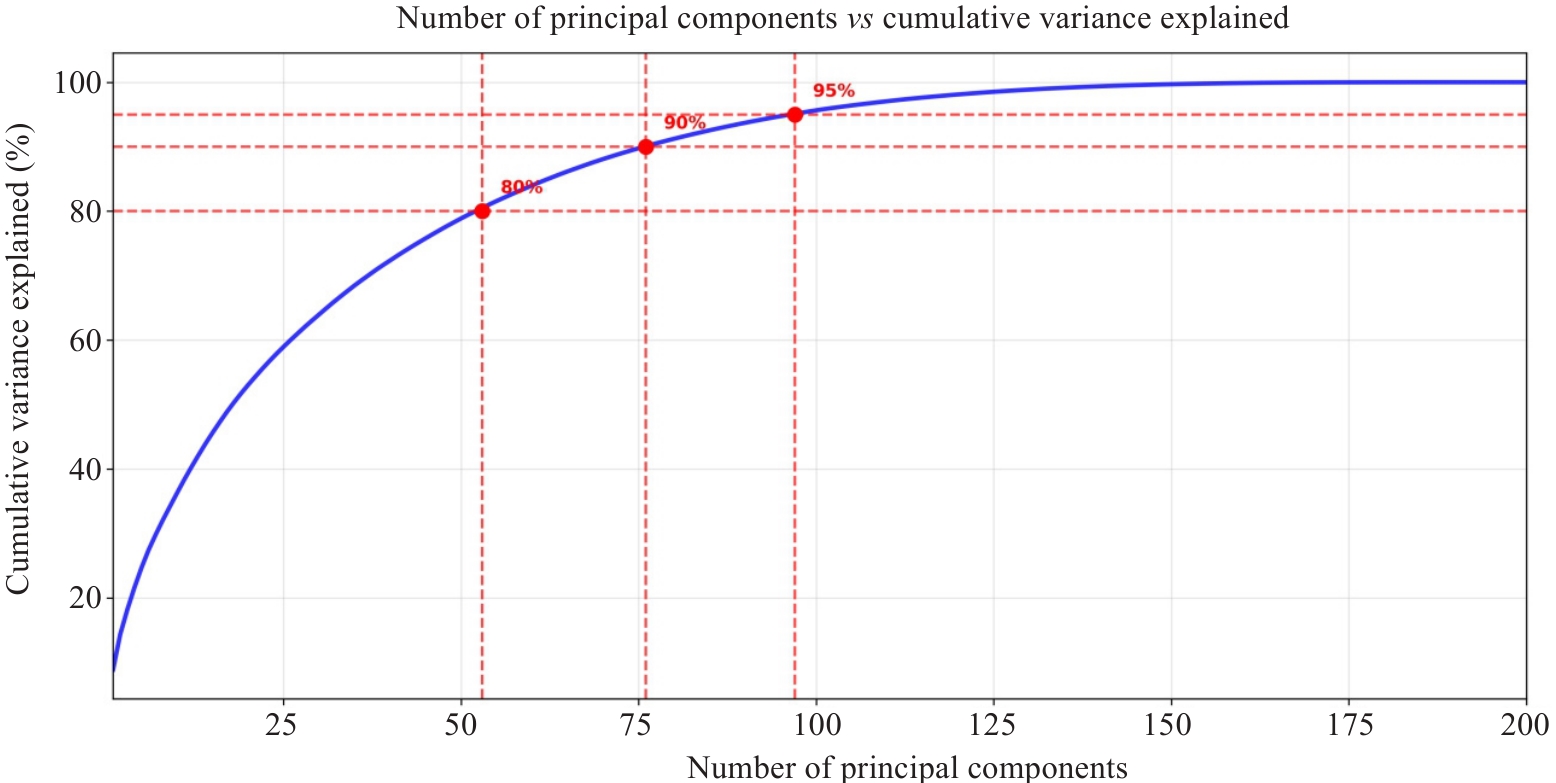
图1 主成分累计方差解释率
Fig.1 Cumulative variance explained by principal components.
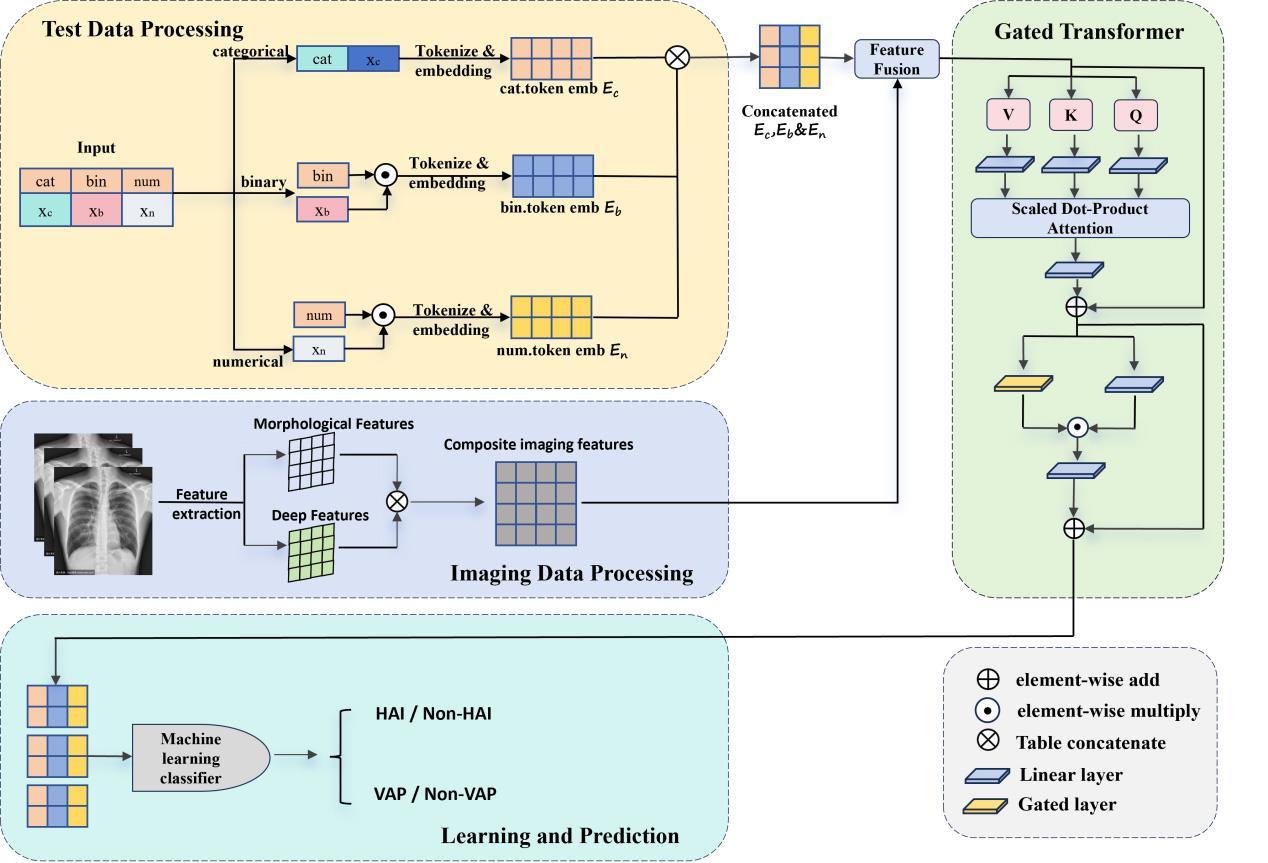
图2 基于Transformer的多模态数据预测医院获得性感染模型构建流程图
Fig.2 Flowchart of construction of a Transformer-based multimodal data prediction model for hospital-acquired infections.
| Task name | Data source | Sample size | Data modality | Model version | Baseline model |
|---|---|---|---|---|---|
| Hai internal validation | MIMIC-IV | 300 000 lab records | Laboratory test data | Transformer encoding model | None |
| Hai external validation | Nanfang Hospital | 1172 patients | Laboratory test data | Transformer encoding model | Machine learning models |
| Vap prediction | Nanfang Hospital | 274 patients | Laboratory test data+ Chest X-ray images | Transformer encoding model+feature fusion model | Transformer encoding model |
表1 各任务数据说明表
Tab.1 Data description table for tasks
| Task name | Data source | Sample size | Data modality | Model version | Baseline model |
|---|---|---|---|---|---|
| Hai internal validation | MIMIC-IV | 300 000 lab records | Laboratory test data | Transformer encoding model | None |
| Hai external validation | Nanfang Hospital | 1172 patients | Laboratory test data | Transformer encoding model | Machine learning models |
| Vap prediction | Nanfang Hospital | 274 patients | Laboratory test data+ Chest X-ray images | Transformer encoding model+feature fusion model | Transformer encoding model |
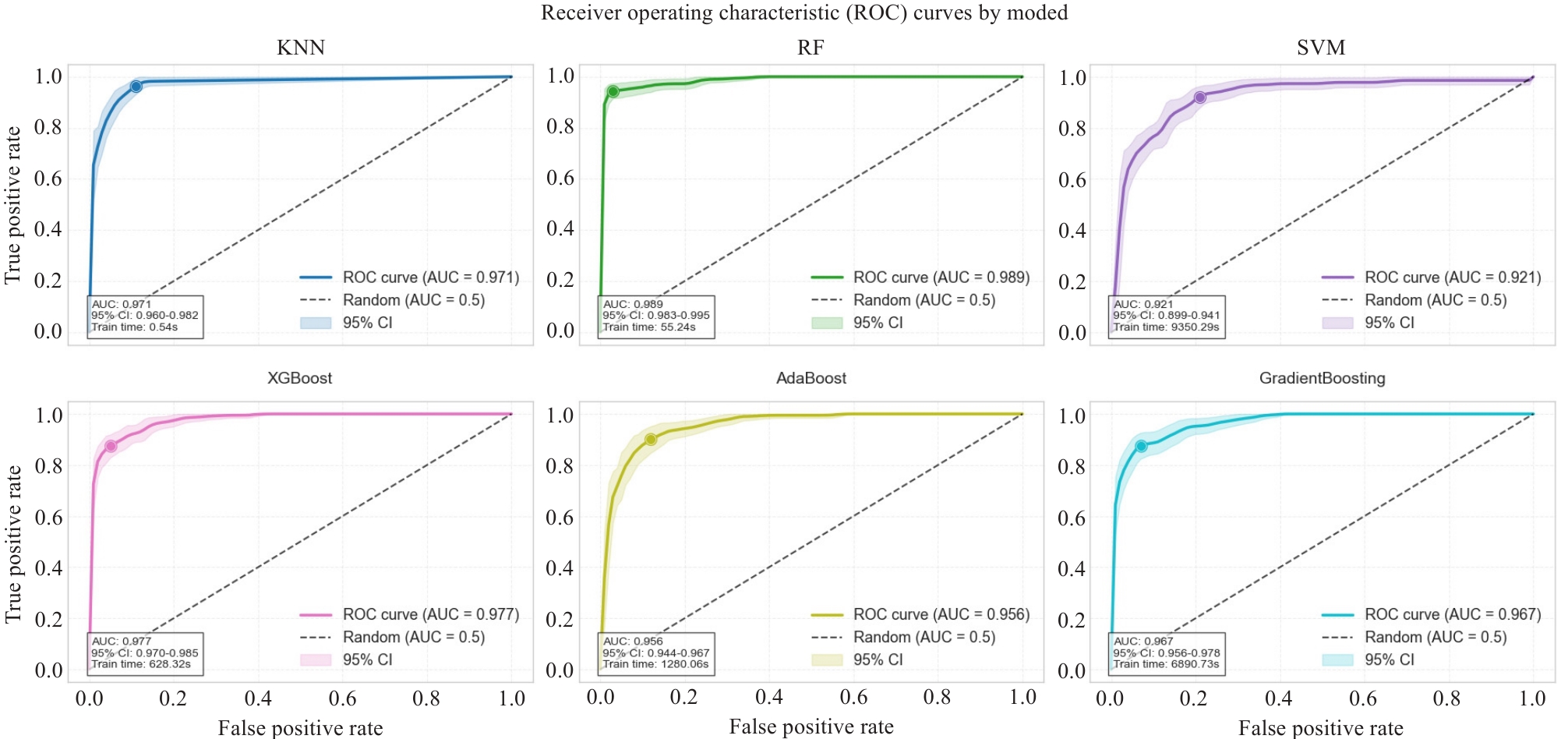
图3 MIMIC-IV数据集建模后内部验证结果
Fig. 3 Internal validation results of post-modeling on the MIMIC-IV dataset.
| Model | Acc (95% CI) | AUC (95% CI) | Sen (95% CI) | Spe (95% CI) | PPV (95% CI) | NPV (95% CI) |
|---|---|---|---|---|---|---|
| Baseline | ||||||
| KNN | 0.67 (0.65-0.70) | 0.71 (0.69-0.74) | 0.70 (0.67-0.74) | 0.64 (0.60-0.68) | 0.66 (0.62-0.70) | 0.68 (0.65-0.72) |
| RF | 0.72 (0.70-0.74) | 0.78 (0.75-0.80) | 0.77 (0.67-0.83) | 0.67 (0.62-0.76) | 0.70 (0.66-0.75) | 0.74 (0.69-0.79) |
| SVM | 0.70 (0.68-0.73) | 0.72 (0.69-0.75) | 0.72 (0.68-0.77) | 0.68 (0.63-0.72) | 0.70 (0.66-0.73) | 0.71 (0.68-0.76) |
| XGBoost | 0.73 (0.71-0.76) | 0.79 (0.76-0.81) | 0.77 (0.73-0.82) | 0.69 (0.64-0.74) | 0.71 (0.68-0.75) | 0.75 (0.72-0.79) |
| AdaBoost | 0.71 (0.69-0.74) | 0.76 (0.74-0.79) | 0.74 (0.71-0.79) | 0.69 (0.64-0.73) | 0.70 (0.67-0.74) | 0.73 (0.69-0.77) |
| GradientBoost | 0.72 (0.70-0.75) | 0.78 (0.76-0.81) | 0.77 (0.73-0.81) | 0.68 (0.64-0.73) | 0.71 (0.67-0.75) | 0.74 (0.71-0.77) |
| Improved algorithm | ||||||
| KNN | 0.79 (0.73-0.86) | 0.88 (0.82-0.93) | 0.86 (0.61-0.93) | 0.72 (0.65-0.96) | 0.75 (0.68-0.95) | 0.75 (0.68-0.95) |
| RF | 0.96 (0.92-0.99) | 0.95 (0.90-0.99) | 0.98 (0.94-1.00) | 0.93 (0.86-0.98) | 0.93 (0.87-0.98) | 0.93 (0.87-0.98) |
| SVM | 0.89 (0.83-0.94) | 0.93 (0.88-0.97) | 0.88 (0.81-0.98) | 0.90 (0.75-0.96) | 0.89 (0.78-0.96) | 0.89 (0.78-0.96) |
| XGBoost | 0.94 (0.90-0.98) | 0.97 (0.93-0.99) | 0.96 (0.94-0.99) | 0.88 (0.81-0.98) | 0.89 (0.82-0.98) | 0.89 (0.82-0.98) |
| AdaBoost | 0.93 (0.89-0.97) | 0.98 (0.95-0.99) | 0.93 (0.88-0.98) | 0.93 (0.82-0.98) | 0.93 (0.83-0.98) | 0.93 (0.83-0.98) |
| GradientBoost | 0.94 (0.90-0.98) | 0.97 (0.94-0.99) | 0.97 (0.94-1.00) | 0.88 (0.83-0.98) | 0.89 (0.84-0.98) | 0.89 (0.84-0.98) |
表2 在真实医院数据下的外部验证分类结果对比
Tab.2 Comparative analysis of external validation classification results for real-world hospital data
| Model | Acc (95% CI) | AUC (95% CI) | Sen (95% CI) | Spe (95% CI) | PPV (95% CI) | NPV (95% CI) |
|---|---|---|---|---|---|---|
| Baseline | ||||||
| KNN | 0.67 (0.65-0.70) | 0.71 (0.69-0.74) | 0.70 (0.67-0.74) | 0.64 (0.60-0.68) | 0.66 (0.62-0.70) | 0.68 (0.65-0.72) |
| RF | 0.72 (0.70-0.74) | 0.78 (0.75-0.80) | 0.77 (0.67-0.83) | 0.67 (0.62-0.76) | 0.70 (0.66-0.75) | 0.74 (0.69-0.79) |
| SVM | 0.70 (0.68-0.73) | 0.72 (0.69-0.75) | 0.72 (0.68-0.77) | 0.68 (0.63-0.72) | 0.70 (0.66-0.73) | 0.71 (0.68-0.76) |
| XGBoost | 0.73 (0.71-0.76) | 0.79 (0.76-0.81) | 0.77 (0.73-0.82) | 0.69 (0.64-0.74) | 0.71 (0.68-0.75) | 0.75 (0.72-0.79) |
| AdaBoost | 0.71 (0.69-0.74) | 0.76 (0.74-0.79) | 0.74 (0.71-0.79) | 0.69 (0.64-0.73) | 0.70 (0.67-0.74) | 0.73 (0.69-0.77) |
| GradientBoost | 0.72 (0.70-0.75) | 0.78 (0.76-0.81) | 0.77 (0.73-0.81) | 0.68 (0.64-0.73) | 0.71 (0.67-0.75) | 0.74 (0.71-0.77) |
| Improved algorithm | ||||||
| KNN | 0.79 (0.73-0.86) | 0.88 (0.82-0.93) | 0.86 (0.61-0.93) | 0.72 (0.65-0.96) | 0.75 (0.68-0.95) | 0.75 (0.68-0.95) |
| RF | 0.96 (0.92-0.99) | 0.95 (0.90-0.99) | 0.98 (0.94-1.00) | 0.93 (0.86-0.98) | 0.93 (0.87-0.98) | 0.93 (0.87-0.98) |
| SVM | 0.89 (0.83-0.94) | 0.93 (0.88-0.97) | 0.88 (0.81-0.98) | 0.90 (0.75-0.96) | 0.89 (0.78-0.96) | 0.89 (0.78-0.96) |
| XGBoost | 0.94 (0.90-0.98) | 0.97 (0.93-0.99) | 0.96 (0.94-0.99) | 0.88 (0.81-0.98) | 0.89 (0.82-0.98) | 0.89 (0.82-0.98) |
| AdaBoost | 0.93 (0.89-0.97) | 0.98 (0.95-0.99) | 0.93 (0.88-0.98) | 0.93 (0.82-0.98) | 0.93 (0.83-0.98) | 0.93 (0.83-0.98) |
| GradientBoost | 0.94 (0.90-0.98) | 0.97 (0.94-0.99) | 0.97 (0.94-1.00) | 0.88 (0.83-0.98) | 0.89 (0.84-0.98) | 0.89 (0.84-0.98) |
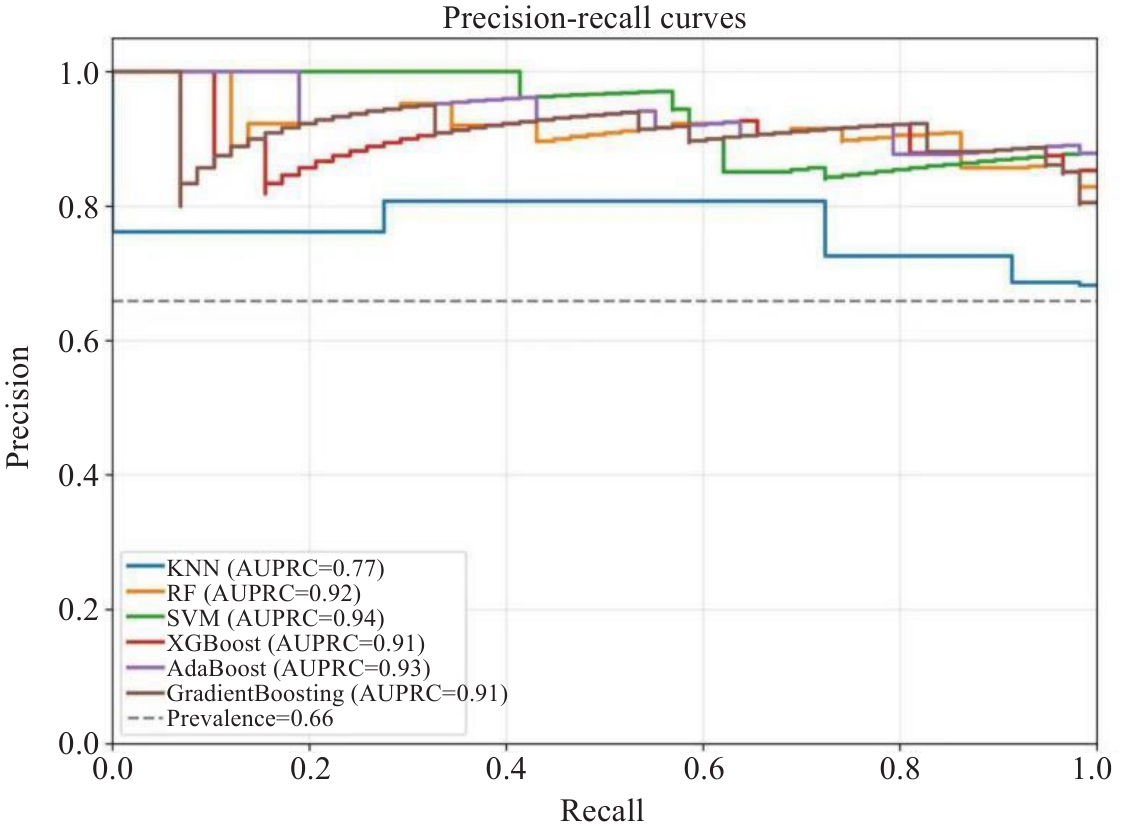
图4 本研究所提出的模型在真实临床数据下的PR曲线
Fig.4 PR curve of the proposed model for real-world clinical data.
| Model | Acc (95% CI) | AUC (95% CI) | Sen (95% CI) | Spe (95% CI) | PPV (95% CI) | NPV (95% CI) |
|---|---|---|---|---|---|---|
| Laboratory test data | ||||||
| KNN | 0.80 (0.72-0.94) | 0.76 (0.68-0.85) | 0.82 (0.69-0.94) | 0.67 (0.56-0.80) | 0.75 (0.66-0.87) | 0.79 (0.68-0.90) |
| RF | 0.89 (0.82-0.96) | 0.92 (0.84-0.94) | 0.80 (0.71-0.89) | 0.77 (0.68-0.87) | 0.82 (0.75-0.90) | 0.72 (0.63-0.84) |
| SVM | 0.72 (0.64-0.80) | 0.68 (0.59-0.78) | 0.82 (0.74-0.91) | 0.65 (0.52-0.79) | 0.65 (0.57-0.79) | 0.82 (0.68-0.95) |
| XGBoost | 0.88 (0.83-0.94) | 0.90 (0.83-0.96) | 0.79 (0.67-0.93) | 0.80 (0.64-0.95) | 0.80 (0.72-0.88) | 0.85 (0.79-0.92) |
| AdaBoost | 0.87 (0.80-0.93) | 0.86 (0.80-0.93) | 0.85 (0.74-0.96) | 0.71 (0.59-0.86) | 0.92 (0.80-1.00) | 0.68 (0.57-0.80) |
| GradientBoost | 0.92 (0.87-0.97) | 0.89 (0.82-0.94) | 0.81 (0.74-0.90) | 0.90 (0.85-1.00) | 0.85 (0.72-0.98) | 0.77 (0.70-0.84) |
| Fused data | ||||||
| KNN | 0.71 (0.65-0.84) | 0.82 (0.73-0.88) | 0.84 (0.72-0.95) | 0.75 (0.62-0.89) | 0.84 (0.73-0.94) | 0.80 (0.68-0.92) |
| RF | 0.88 (0.80-0.96) | 0.93 (0.88-0.97) | 0.88 (0.78-0.98) | 0.72 (0.63-0.82) | 0.89 (0.80-0.97) | 0.79 (0.72-0.87) |
| SVM | 0.85 (0.74-0.96) | 0.88 (0.80-0.95) | 0.91 (0.82-1.00) | 0.82 (0.71-0.93) | 0.90 (0.85-0.95) | 0.88 (0.78-0.95) |
| XGBoost | 0.94 (0.89-0.98) | 0.93 (0.86-0.97) | 0.95 (0.89-1.00) | 0.89 (0.78-1.00) | 0.82 (0.77-0.87) | 0.94 (0.84-0.99) |
| AdaBoost | 0.90 (0.84-0.97) | 0.91 (0.84-0.98) | 0.89 (0.82-0.96) | 0.76 (0.65-0.87) | 0.90 (0.82-0.99) | 0.92 (0.87-0.98) |
| GradientBoost | 0.97 (0.94-1.00) | 0.92 (0.85-0.95) | 0.85 (0.78-0.94) | 0.85 (0.76-0.95) | 0.95 (0.89-1.00) | 0.84 (0.77-0.92) |
表3 实验室检验数据分类结果与融合影像数据分类结果对比
Tab.3 Comparison of the classification results from laboratory test data with those from fused imaging data
| Model | Acc (95% CI) | AUC (95% CI) | Sen (95% CI) | Spe (95% CI) | PPV (95% CI) | NPV (95% CI) |
|---|---|---|---|---|---|---|
| Laboratory test data | ||||||
| KNN | 0.80 (0.72-0.94) | 0.76 (0.68-0.85) | 0.82 (0.69-0.94) | 0.67 (0.56-0.80) | 0.75 (0.66-0.87) | 0.79 (0.68-0.90) |
| RF | 0.89 (0.82-0.96) | 0.92 (0.84-0.94) | 0.80 (0.71-0.89) | 0.77 (0.68-0.87) | 0.82 (0.75-0.90) | 0.72 (0.63-0.84) |
| SVM | 0.72 (0.64-0.80) | 0.68 (0.59-0.78) | 0.82 (0.74-0.91) | 0.65 (0.52-0.79) | 0.65 (0.57-0.79) | 0.82 (0.68-0.95) |
| XGBoost | 0.88 (0.83-0.94) | 0.90 (0.83-0.96) | 0.79 (0.67-0.93) | 0.80 (0.64-0.95) | 0.80 (0.72-0.88) | 0.85 (0.79-0.92) |
| AdaBoost | 0.87 (0.80-0.93) | 0.86 (0.80-0.93) | 0.85 (0.74-0.96) | 0.71 (0.59-0.86) | 0.92 (0.80-1.00) | 0.68 (0.57-0.80) |
| GradientBoost | 0.92 (0.87-0.97) | 0.89 (0.82-0.94) | 0.81 (0.74-0.90) | 0.90 (0.85-1.00) | 0.85 (0.72-0.98) | 0.77 (0.70-0.84) |
| Fused data | ||||||
| KNN | 0.71 (0.65-0.84) | 0.82 (0.73-0.88) | 0.84 (0.72-0.95) | 0.75 (0.62-0.89) | 0.84 (0.73-0.94) | 0.80 (0.68-0.92) |
| RF | 0.88 (0.80-0.96) | 0.93 (0.88-0.97) | 0.88 (0.78-0.98) | 0.72 (0.63-0.82) | 0.89 (0.80-0.97) | 0.79 (0.72-0.87) |
| SVM | 0.85 (0.74-0.96) | 0.88 (0.80-0.95) | 0.91 (0.82-1.00) | 0.82 (0.71-0.93) | 0.90 (0.85-0.95) | 0.88 (0.78-0.95) |
| XGBoost | 0.94 (0.89-0.98) | 0.93 (0.86-0.97) | 0.95 (0.89-1.00) | 0.89 (0.78-1.00) | 0.82 (0.77-0.87) | 0.94 (0.84-0.99) |
| AdaBoost | 0.90 (0.84-0.97) | 0.91 (0.84-0.98) | 0.89 (0.82-0.96) | 0.76 (0.65-0.87) | 0.90 (0.82-0.99) | 0.92 (0.87-0.98) |
| GradientBoost | 0.97 (0.94-1.00) | 0.92 (0.85-0.95) | 0.85 (0.78-0.94) | 0.85 (0.76-0.95) | 0.95 (0.89-1.00) | 0.84 (0.77-0.92) |
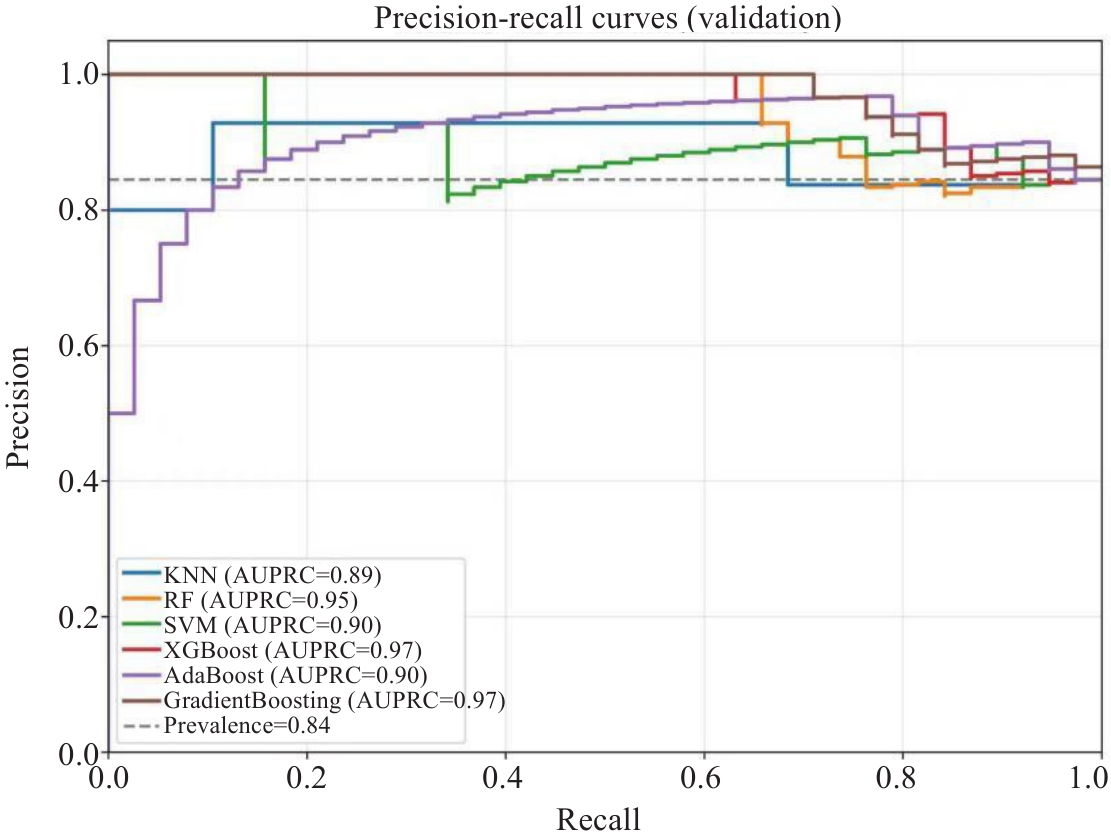
图5 融合数据在本研究所提出的模型下的PR曲线
Fig.5 PR curve of the fused data evaluated by the proposed model.
| [1] | Mouajou V, Adams K, DeLisle G, et al. Hand hygiene compliance in the prevention of hospital-acquired infections: a systematic review[J]. J Hosp Infect, 2022, 119: 33-48. doi:10.1016/j.jhin.2021.09.016 |
| [2] | Migliara G, Di Paolo C, Barbato D, et al. Multimodal surveillance of healthcare associated infections in an intensive care unit of a large teaching hospital[J]. Ann Ig, 2019, 31(5): 399-413. |
| [3] | Eid MH, Ţânţu MM, Latour JM, et al. Suction circuit flushing with chlorhexidine decreases ventilator-associated pneumonia: a quasi-experimental study[J]. Front Med, 2023, 10: 1295277. doi:10.3389/fmed.2023.1295277 |
| [4] | Giang C, Calvert J, Rahmani K, et al. Predicting ventilator-associated pneumonia with machine learning[J]. Medicine, 2021, 100(23): e26246. doi:10.1097/md.0000000000026246 |
| [5] | Kassicieh CS, Kassicieh AJ, Rumalla K, et al. Hospital-acquired infection following spinal tumor surgery: a frailty-driven pre-operative risk model[J]. Clin Neurol Neurosurg, 2023, 225: 107591. doi:10.1016/j.clineuro.2023.107591 |
| [6] | Sun C, Pei LJ, Zhang YL, et al. Deep learning-based risk prediction model for postoperative healthcare-associated infections[J]. Zhongguo Yi Xue Ke Xue Yuan Xue Bao, 2022, 44(1): 9-16. |
| [7] | Ellingsen G, Hertzum M, Christensen B, et al. Large-scale EHR suites and path-dependence[J]. Stud Health Technol Inform, 2022, 295: 372-5. doi:10.3233/shti220742 |
| [8] | Neubig L, Larsen D, Kunduk M, et al. Unstructured electronic health records of dysphagic patients analyzed by large language models[J]. IEEE J Transl Eng Health Med, 2025, 13: 237-45. doi:10.1109/JTEHM.2025.3571255 |
| [9] | Sun MH, Engelhard MM, Bedoya AD, et al. Incorporating informatively collected laboratory data from EHR in clinical prediction models[J]. BMC Med Inform Decis Mak, 2024, 24(1): 206. doi:10.1186/s12911-024-02612-1 |
| [10] | Wang Y, Xiao YY, Yang QD, et al. Clinical prediction models for multidrug-resistant organism colonisation or infection in critically ill patients: a systematic review protocol[J]. BMJ Open, 2022, 12(9): e064566. doi:10.1136/bmjopen-2022-064566 |
| [11] | Jiang YX, Li ZM, Jiang WT, et al. Risk prediction model for postoperative pneumonia in esophageal cancer patients: a systematic review[J]. Front Oncol, 2024, 14: 1419633. doi:10.3389/fonc.2024.1419633 |
| [12] | Liang ZJ, Xu YJ, Hong YF, et al. A survey of multimodel large language models[C]//Proceedings of the 3rd International Conference on Computer, Artificial Intelligence and Control Engineering. Xi' an China. ACM, 2024: 405-409. doi:10.1145/3672758.3672824 |
| [13] | Li SW, Zhang Y, Lin YS, et al. Development and validation of prediction models for nosocomial infection and prognosis in hospitalized patients with cirrhosis[J]. Antimicrob Resist Infect Control, 2024, 13(1): 85. doi:10.1186/s13756-024-01444-y |
| [14] | 国家卫生健康委员会. 医院感染诊断标准(试行)[EB/OL]. |
| [15] | Sun JM, Wang ZF. TransTab: learning transferable tabular transformers across tables[C]//Advances in Neural Information Processing Systems 35. November 28-December 9, 2022. OrleansNew, Louisiana, USA. Neural Information Processing Systems Foundation, Inc. (NeurIPS), 2022: 2902-2915. doi:10.52202/068431-0210 |
| [16] | Lin BY, Lee S, Khanna R, et al. Birds have four legs?! NumerSense: probing numerical commonsense knowledge of pre-trained language models[EB/OL]. 2020: arXiv: 2005.00683. . doi:10.18653/v1/2020.emnlp-main.557 |
| [17] | Wang ZF, Gao CF, Xiao C, et al. MediTab: scaling medical tabular data predictors via data consolidation, enrichment, and refinement[EB/OL]. 2023: arXiv: 2305.12081. |
| [18] | Tsai YH, Bai SJ, Pu Liang P, et al. Multimodal transformer for unaligned multimodal language sequences[J]. Proc Conf Assoc Comput Linguist Meet, 2019, 2019: 6558-69. doi:10.18653/v1/p19-1656 |
| [19] | Tao YZ, Sun T, Muhamed A, et al. Gated transformer for decoding human brain EEG signals[J]. Annu Int Conf IEEE Eng Med Biol Soc, 2021, 2021: 125-30. doi:10.1109/embc46164.2021.9630210 |
| [20] | Zhang Z, Xie J, Zhong W, et al. A multi-modal feature fusion classification model based on distance matching and discriminative representation learning for differentiation of high-grade glioma from solitary brain metastasis[J]. J South Med Univ, 2024, 44(1): 138-45. |
| [21] | Gasparetto A, Marcuzzo M, Zangari A, et al. A survey on text classification algorithms: from text to predictions[J]. Information, 2022, 13(2): 83. doi:10.3390/info13020083 |
| [22] | Ucar T, Hajiramezanali E, Edwards L. Subtab: Subsetting features of tabular data for self-supervised representation learning[J]. Adv Neural Inf Process Syst, 2021, 34: 18853-65. |
| [23] | Wang XL, Jin YC, Schmitt S, et al. Recent advances in Bayesian optimization[J]. ACM Comput Surv, 2023, 55(13s): 1-36. doi:10.1145/3582078 |
| [24] | Feng T, Noren DP, Kulkarni C, et al. Machine learning-based clinical decision support for infection risk prediction[J]. Front Med, 2023, 10: 1213411. doi:10.3389/fmed.2023.1213411 |
| [25] | Cho Y, Lee HK, Kim J, et al. Prediction of hospital-acquired influenza using machine learning algorithms: a comparative study[J]. BMC Infect Dis, 2024, 24(1): 466. doi:10.1186/s12879-024-09358-1 |
| [26] | El Arab RA, Almoosa Z, Alkhunaizi M, et al. Artificial intelligence in hospital infection prevention: an integrative review[J]. Front Public Health, 2025, 13: 1547450. doi:10.3389/fpubh.2025.1547450 |
| [27] | Chang CW, Chang CH, Chien CY, et al. Predictive modelling of hospital-acquired infection in acute ischemic stroke using machine learning[J]. Sci Rep, 2024, 14(1): 31066. doi:10.1038/s41598-024-82280-3 |
| [28] | Li Y, Cao Y, Wang M, et al. Development and validation of machine learning models to predict MDRO colonization or infection on ICU admission by using electronic health record data[J]. Antimicrob Resist Infect Control, 2024, 13(1): 74. doi:10.1186/s13756-024-01428-y |
| [29] | Alzu'bi AA, Watzlaf VJM, Sheridan P. Electronic health record (EHR) abstraction[J]. Perspect Health Inf Manag, 2021, 18(Spring): 1g. |
| [30] | Han X, Wu WQ, Zhao HM, et al. Developing and validating a prediction model for in-hospital mortality in patients with ventilator-associated pneumonia in the ICU[J]. Ann Palliat Med, 2022, 11(5): 1799-810. doi:10.21037/apm-22-502 |
| [31] | Zhang JB, Yang PP, Zeng L, et al. Ventilator-associated pneumonia prediction models based on AI: scoping review[J]. JMIR Med Inform, 2024, 12: e57026. doi:10.2196/57026 |
| [32] | Cui ZG, Dong YF, Yang HZ, et al. Machine learning prediction models for multidrug-resistant organism infections in ICU ventilator-associated pneumonia patients: Analysis using the MIMIC-IV database[J]. Comput Biol Med, 2025, 190: 110028. doi:10.1016/j.compbiomed.2025.110028 |
| [33] | Liang YJ, Zhu CR, Tian C, et al. Early prediction of ventilator-associated pneumonia in critical care patients: a machine learning model[J]. BMC Pulm Med, 2022, 22(1): 250. doi:10.1186/s12890-022-02031-w |
| [34] | Hsu JF, Lin YC, Lin CY, et al. Deep learning models for early and accurate diagnosis of ventilator-associated pneumonia in mechanically ventilated neonates[J]. Comput Biol Med, 2025, 189: 109942. doi:10.1016/j.compbiomed.2025.109942 |
| [1] | 许家宁, 毛钇骁, 张煜. 基于分层注意力驱动多实例学习的肾透明细胞癌数字病理分级分期[J]. 南方医科大学学报, 2026, 46(5): 1175-1184. |
| [2] | 王童, 段曹辉, 娄昕, 冯前进. 基于血管增强一致性保持扩散模型的3T到7T SWI生成方法[J]. 南方医科大学学报, 2026, 46(5): 1185-1192. |
| [3] | 陈博湧, 汪新怡, 赵新新, 宋婷, 李永宝. 基于Swin-ResViT网络的低质量动态cine-MR至高质量定位MR图像实时生成研究[J]. 南方医科大学学报, 2026, 46(4): 929-938. |
| [4] | 谭顺谦, 卓俐, 曾敏, 黄方俊, 朱君, 蔡光瑶, 甄鑫. 基于实验室指标的Transformer模型可高效鉴别卵巢癌[J]. 南方医科大学学报, 2026, 46(4): 939-945. |
| [5] | 卢学麒, 陈华元, 吴秋岑, 温耀棋, 刘国光, 陈超敏. 一种基于深度特征融合的可解释性12导联心电图自动诊断模型研究[J]. 南方医科大学学报, 2026, 46(1): 208-218. |
| [6] | 吴秋岑, 卢学麒, 温耀棋, 洪永, 吴煜良, 陈超敏. II导联心电图中心肌梗死检测与定位:基于多尺度残差模块融合改进通道注意力模型[J]. 南方医科大学学报, 2025, 45(8): 1777-1790. |
| [7] | 郑子瑜, 杨夏颖, 吴圣杰, 张诗婕, 吕国荣, 柳培忠, 王珺, 何韶铮. 多特征融合的产时超声胎方位识别模型[J]. 南方医科大学学报, 2025, 45(7): 1563-1570. |
| [8] | 任煜瀛, 黄凌霄, 杜方, 姚新波. 基于改进RT-DETR的多尺度特征融合的高效轻量皮肤病理检测方法[J]. 南方医科大学学报, 2025, 45(2): 409-421. |
| [9] | 渠梦, 傅蓉. ResLSTM-TemporalSE:多导联心电信号的自动分类[J]. 南方医科大学学报, 2025, 45(12): 2708-2717. |
| [10] | 谢辉荣, 胡潮滨, 梁国华, 韩红喆, 黄牧, 冯前进. 大学生心理压力智能评估:基于融合文本与影像的多模态模型的设计及验证[J]. 南方医科大学学报, 2025, 45(11): 2504-2510. |
| [11] | 贺亚迪, 周炫汝, 金锦辉, 宋婷. 基于PE-CycleGAN网络的鼻咽癌自适应放疗CBCT-sCT生成研究[J]. 南方医科大学学报, 2025, 45(1): 179-186. |
| [12] | 周沛珊, 阳维, 李青原, 郭小芳, 傅蓉, 刘思德. 手工提取的视觉特征与深度特征的融合模型用于消化性溃疡再出血风险分级[J]. 南方医科大学学报, 2025, 45(1): 197-205. |
| [13] | 方威扬, 肖慧, 王爽, 林晓明, 陈超敏. 基于MRI影像和临床参数特征融合的深度学习模型预测术前肝细胞癌的细胞角蛋白19状态[J]. 南方医科大学学报, 2024, 44(9): 1738-1751. |
| [14] | 欧嘉志, 詹长安, 杨丰. 一维卷积神经网络的自编码癫痫发作异常检测模型[J]. 南方医科大学学报, 2024, 44(9): 1796-1804. |
| [15] | 胡雯然, 傅蓉. 基于全局-局部注意力机制和YOLOv5的宫颈细胞图像异常检测模型[J]. 南方医科大学学报, 2024, 44(7): 1217-1226. |
| 阅读次数 | ||||||
|
全文 |
|
|||||
|
摘要 |
|
|||||
