
南方医科大学学报 ›› 2026, Vol. 46 ›› Issue (10): 2434-2446.doi: 10.12122/j.issn.1673-4254.2026.10.13
• • 上一篇
郝易飞1( ), 蔡炼清2, 唐丝雨2, 于晓萱2, 李艳1, 王秀1(), 朱洁1,2,3()
收稿日期:2026-03-26
出版日期:2026-10-20
发布日期:2026-10-26
通讯作者:
王秀,朱洁
E-mail:3462857600@qq.com;wangxiuu@sina.com;janezhutcm@foxmail.com
作者简介:郝易飞,在读硕士研究生,E-mail: 3462857600@qq.com
基金资助:
Yifei HAO1(), Lianqing CAI2, Siyu TANG2, Xiaoxuan YU2, Yan LI1, Xiu WANG1(), Jie ZHU1,2,3()
Received:2026-03-26
Online:2026-10-20
Published:2026-10-26
Contact:
Xiu WANG, Jie ZHU
E-mail:3462857600@qq.com;wangxiuu@sina.com;janezhutcm@foxmail.com
Supported by:摘要:
目的 基于网络药理学、分子对接、分子动力学模拟与动物实验相结合的多技术融合策略探究加味清络饮(JWQLY)调控Hedgehog信号通路促进滑膜细胞凋亡治疗类风湿性关节炎(RA)的作用机制研究。 方法 通过网络药理学分析确定JWQLY治疗RA的核心成分、关键靶点及信号通路,采用分子对接和分子动力学模拟对核心成分与关键靶点的结合活性进行验证。采用完全弗氏佐剂诱导建立AIA大鼠模型,在疗效观察阶段,将造模成功的大鼠随机分为正常组、模型组、甲氨蝶呤(MTX)(0.5 mg·kg-1·d-1)组、JWQLY低、中、高剂量(1.03、3.1、9.3 g·kg-1·d-1)组。观察大鼠一般生理指标、足爪肿胀度及关节炎指数(AI)评分;采用HE染色观察滑膜组织病理学变化;采用TUNEL法检测细胞凋亡;采用ELISA法检测血清白细胞介素-1β(IL-1β)、血管内皮生长因子(VEGF)水平。在机制验证阶段,将造模成功的AIA大鼠模型随机分为正常组、模型组、JWQLY高(9.3 g·kg-1·d-1)组、抑制剂组(维莫德吉,10 mg·kg-1·d-1)及JWQLY+抑制剂组。观察大鼠一般生理指标、足爪肿胀度及关节炎指数(AI)评分;采用HE染色观察滑膜组织病理学变化;采用免疫组化法检测滑膜组织Bcl-2、Bax蛋白表达;采用Western blotting法检测滑膜组织Ihh、Smo、Gli1、cleaved-caspase-3、cleaved-caspase-9蛋白表达。 结果 通过网络药理学筛选JWQLY靶点518个、RA疾病靶点4210个,交集靶点306个。GO富集分析显示靶点主要涉及凋亡过程的负调控、炎症反应等生物过程;KEGG通路富集分析显示靶点显著富集于Hedgehog信号通路以及凋亡信号通路。分子对接及分子动力学模拟结果表明,核心成分与Hedgehog通路关键靶点Shh等具有稳定的结合活性。疗效观察阶段结果显示,与正常组比较,模型组大鼠足爪肿胀明显,AI评分、病理评分、血清IL-1β及VEGF水平显著升高(P<0.05),且呈剂量依赖性。机制验证阶段结果显示,与模型组比较,抑制剂组和JWQLY+抑制剂组滑膜组织Ihh、Smo、Gli1、Bcl-2蛋白表达显著降低(P<0.05),Bax、cleaved-caspase-3、cleaved-caspase-9蛋白表达及细胞凋亡率显著升高(P<0.05);JWQLY与抑制剂联用后对Hedgehog通路产生协同抑制作用,进一步促进滑膜细胞凋亡。 结论 JWQLY通过抑制Hedgehog信号通路激活,下调Bcl-2/Bax比值,促进滑膜细胞凋亡,进而缓解类风湿关节炎病变。
郝易飞, 蔡炼清, 唐丝雨, 于晓萱, 李艳, 王秀, 朱洁. 加味清络饮通过调控Hedgehog信号通路促进滑膜细胞凋亡缓解大鼠类风湿性关节炎病变[J]. 南方医科大学学报, 2026, 46(10): 2434-2446.
Yifei HAO, Lianqing CAI, Siyu TANG, Xiaoxuan YU, Yan LI, Xiu WANG, Jie ZHU. Jiawei Qingluo Yin alleviates rheumatoid arthritis in rats by inhibiting activation of the Hedgehog signaling pathway to promote apoptosis of synovial cells[J]. Journal of Southern Medical University, 2026, 46(10): 2434-2446.
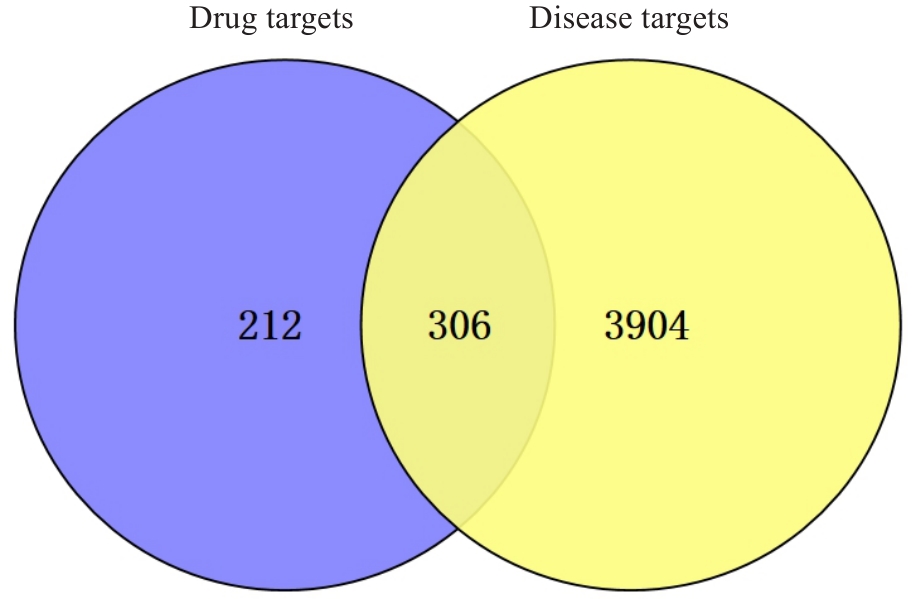
图1 JWQLY中药成分靶点与类风湿性关节炎靶点韦恩图
Fig.1 Venn diagram of the targets of components of Jiawei Qingluo Yin (JWQLY) and rheumatoid arthritis (RA) targets.
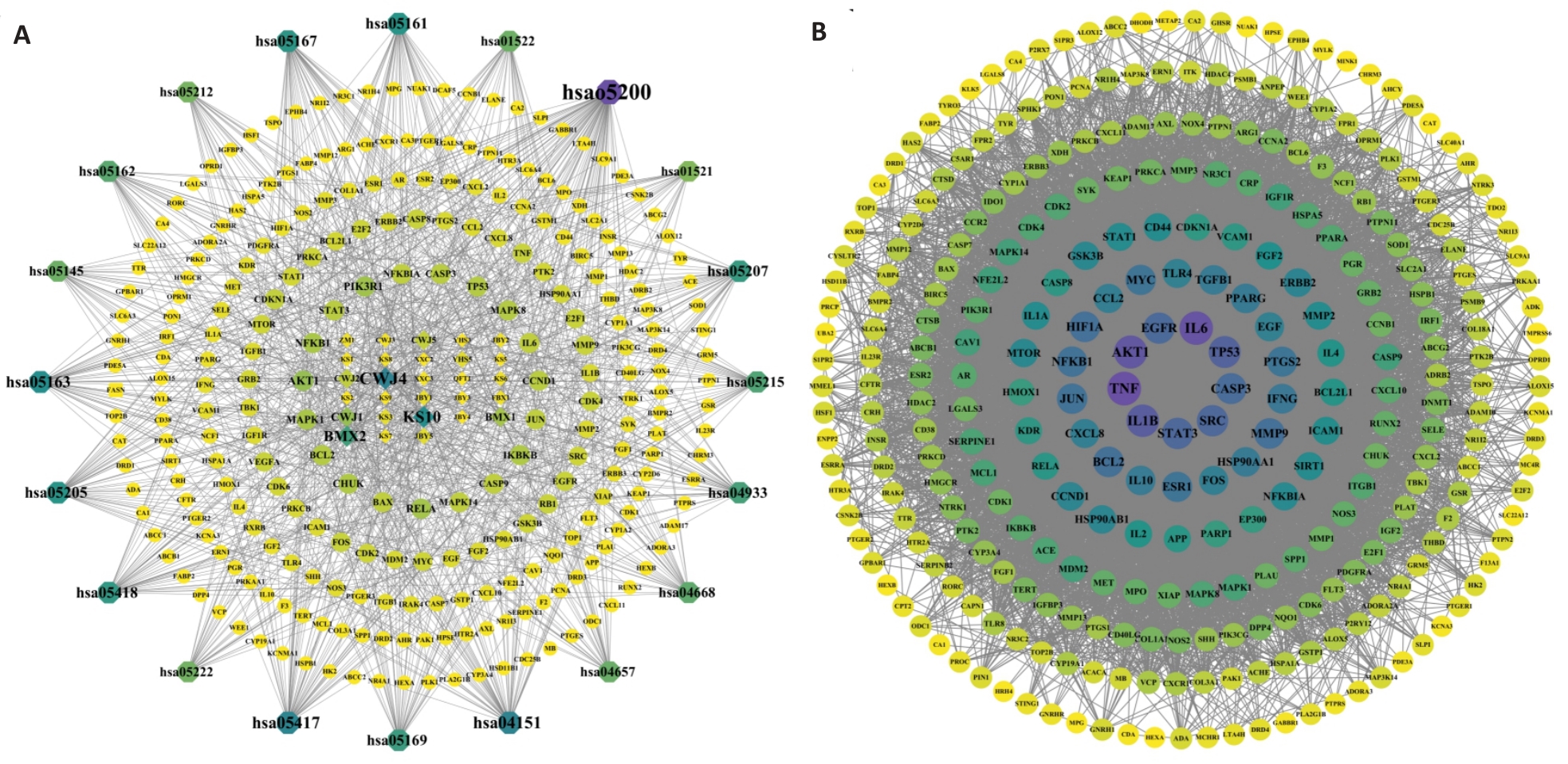
图2 成分-靶点-通路网络图(A)、PPI网络图(B)
Fig.2 Component-Target-Pathway network diagram (A) and PPI network diagram (B).
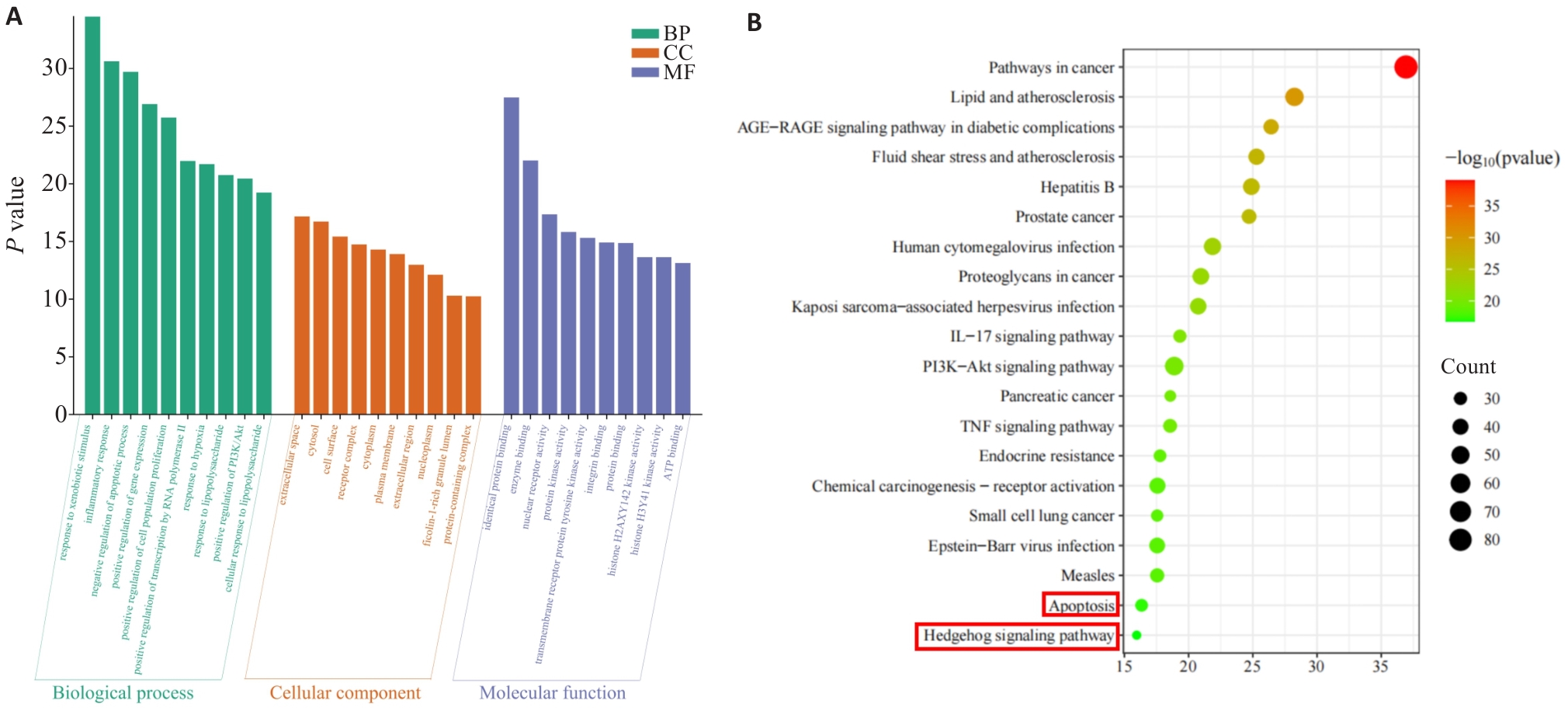
图3 GO富集分析条形图(A)和KEGG富集分析气泡图(B)
Fig.3 Bar plot of GO enrichment analysis (A) and bubble plot of KEGG enrichment analysis (B).
| Constituent | GSK3B | ARRB1 | CCND1 | SHH | BCL2 |
|---|---|---|---|---|---|
| Luteolin | -7.6 | -7.1 | -8.1 | -8.8 | -7.8 |
| Quercetin | -7.2 | -8.2 | -7.2 | -7.2 | -7.7 |
| Beta-sitosterol | -7.5 | -7.1 | -7.9 | -9.0 | -7.1 |
| Kaempferol | -8.0 | -7.2 | -7.8 | -7.5 | -7.9 |
| Stigmasterol | -7.8 | -6.6 | -7.6 | -7.6 | -7.9 |
表1 分子对接结合能结果
Tab.1 Results of molecular docking binding energy
| Constituent | GSK3B | ARRB1 | CCND1 | SHH | BCL2 |
|---|---|---|---|---|---|
| Luteolin | -7.6 | -7.1 | -8.1 | -8.8 | -7.8 |
| Quercetin | -7.2 | -8.2 | -7.2 | -7.2 | -7.7 |
| Beta-sitosterol | -7.5 | -7.1 | -7.9 | -9.0 | -7.1 |
| Kaempferol | -8.0 | -7.2 | -7.8 | -7.5 | -7.9 |
| Stigmasterol | -7.8 | -6.6 | -7.6 | -7.6 | -7.9 |
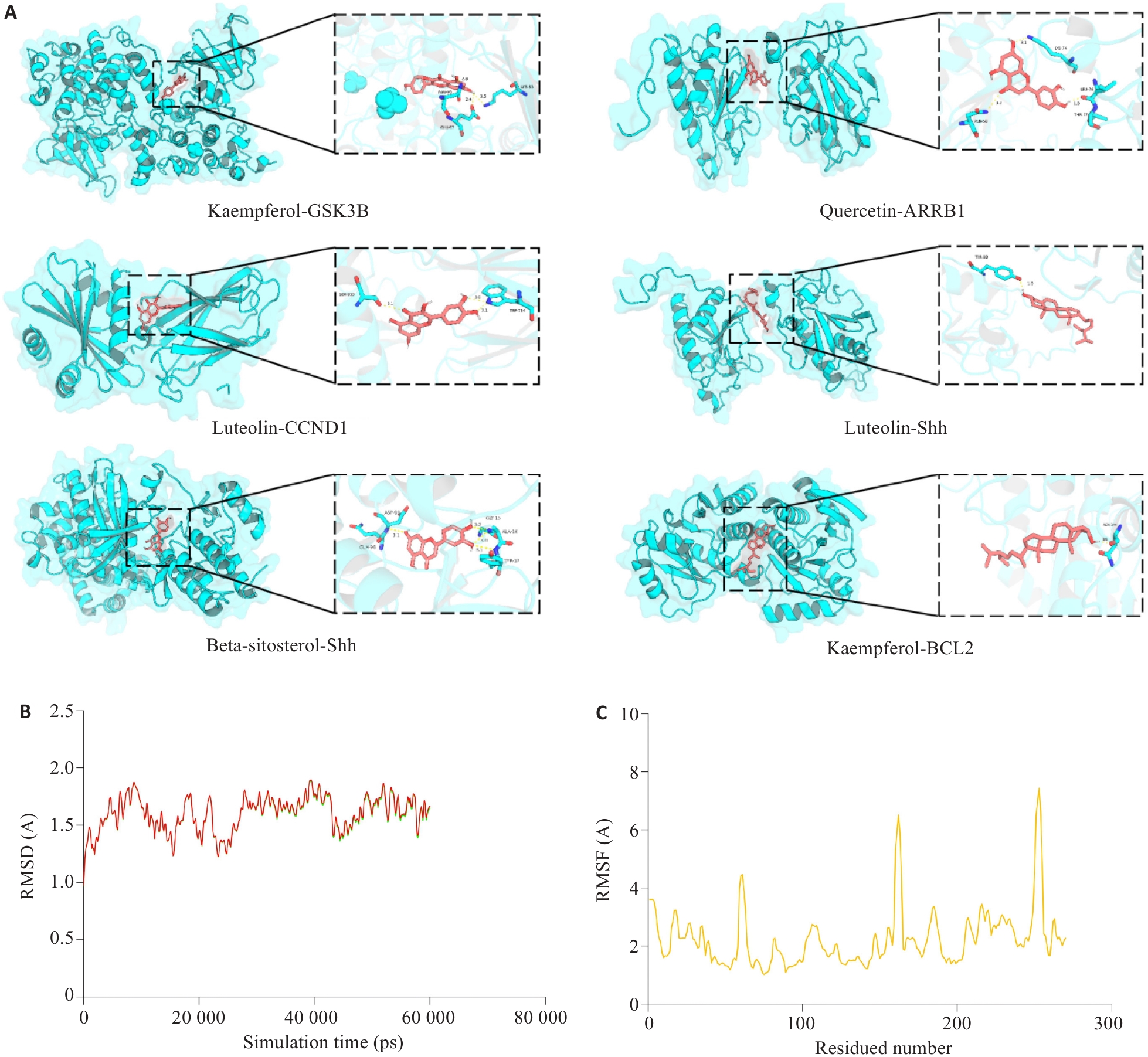
图4 关键成分与核心靶点分子对接结果及分子动力学模拟
Fig.4 Molecular docking results and molecular dynamics simulation of the key components of JWQLY and the core targets. A: Molecular docking binding between the key compounds (quercetin, beta-sitosterol, luteolin, and kaempferol) and the core targets (GSK3B, ARRB1, CCND1, SHH, and BCL2). B: RMSD fluctuation curve of the Shh-Beta-sitosterol complex during molecular dynamics simulation over time (ps). C. RMSF distribution of residues in the Shh-Beta-sitosterol complex.
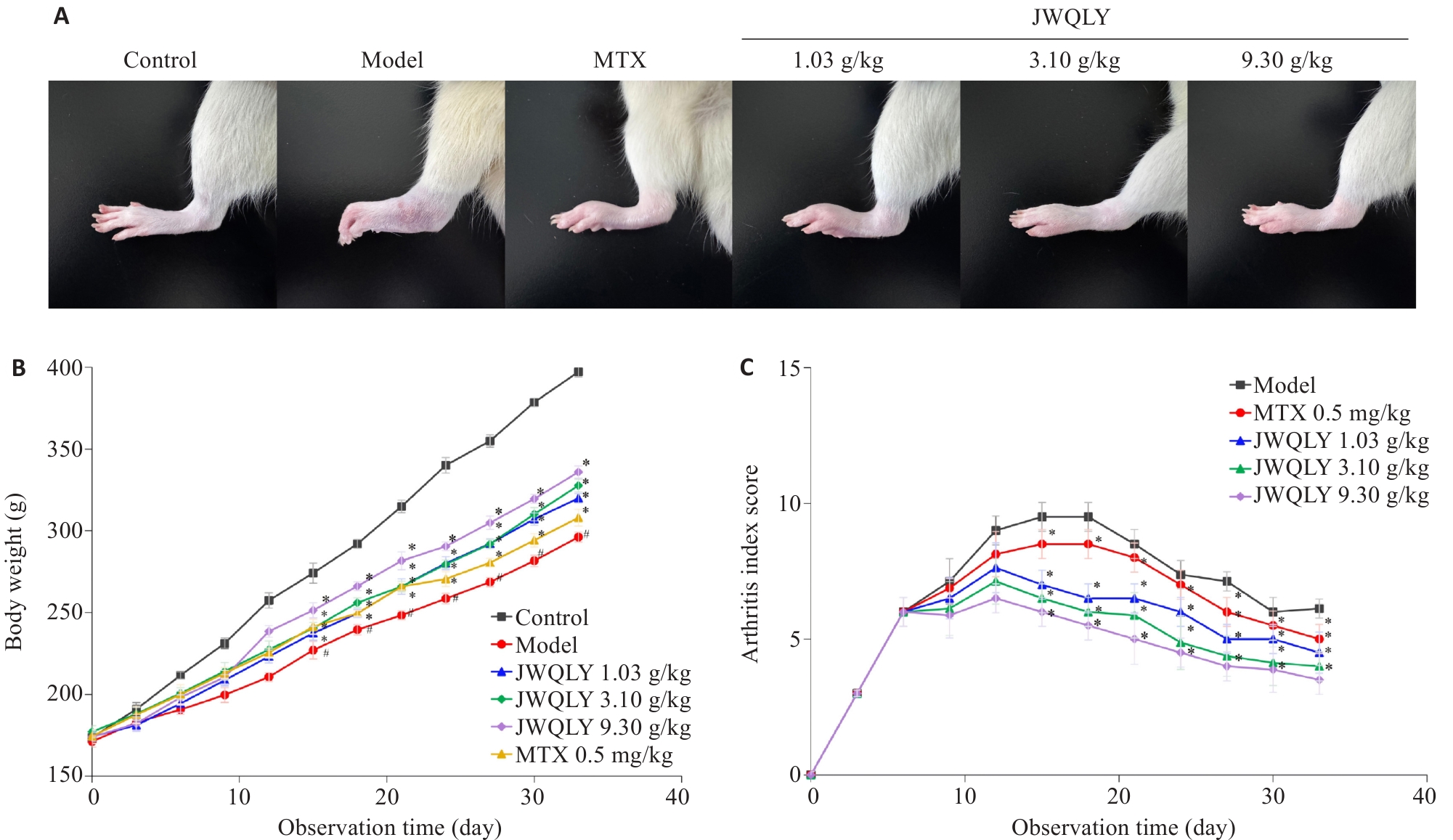
图5 JWQLY对大鼠体质量和关节炎的影响
Fig.5 Effects of JWQLY on body weight and arthritis in rats with antigen-induced arthritis (AIA) (Mean±SD, n=8). A: Representative images of paw swelling in rats from each group. B: Changes in body weight of the rats in different groups. C: Arthritis index scores of the rats in different groups. #P<0.05 vs Control group; *P<0.05 vs Model group.
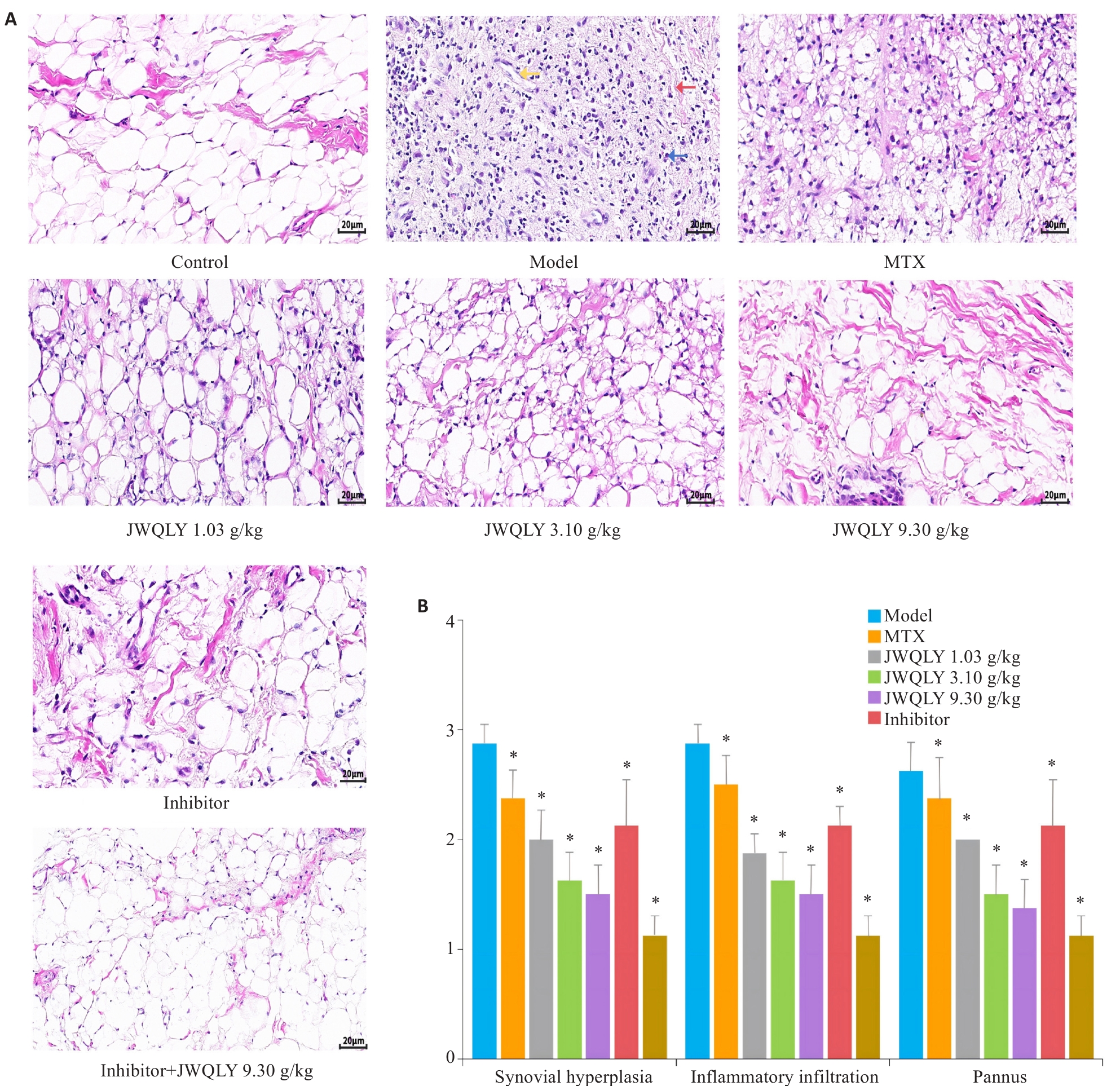
图6 JWQLY对大鼠滑膜组织的影响
Fig.6 Effects of JWQLY on synovial tissue of AIA rats (Mean±SD, n=8). A: HE staining of synovial tissues from rats in different groups (Original magnification: ×200). B: Histopathological scores of synovial tissues of the rats in AIA model and treatment groups. Red arrows indicate fibroblast proliferation, blue arrows indicate inflammatory cell infiltration, and yellow arrows indicate pannus formation. *P<0.05 vs Model group.
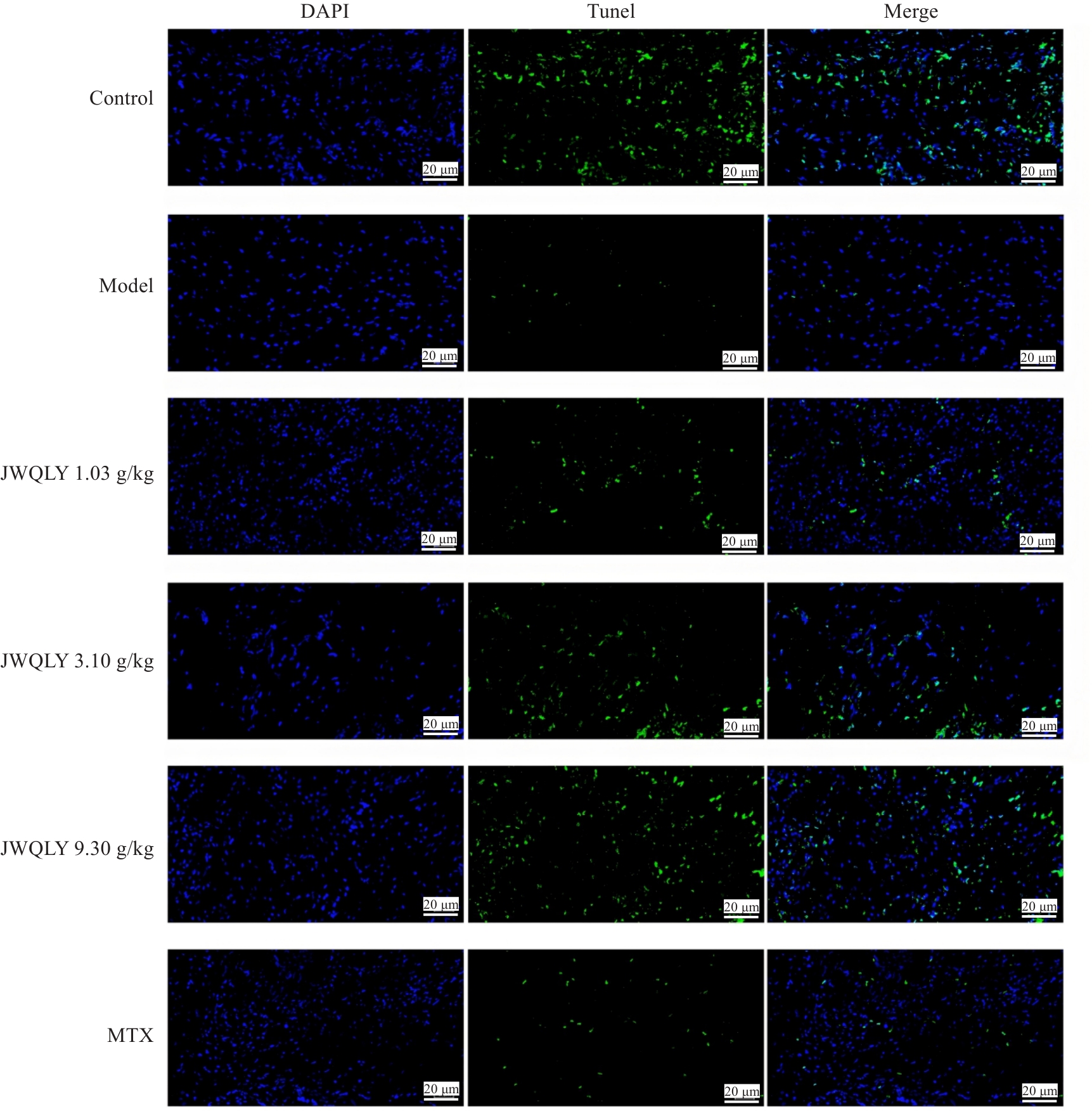
图7 JWQLY对细胞凋亡的TUNEL染色
Fig.7 TUNEL staining of synovial cell apoptosis in AIA rats treated with JWQLY (Mean±SD, n=3).
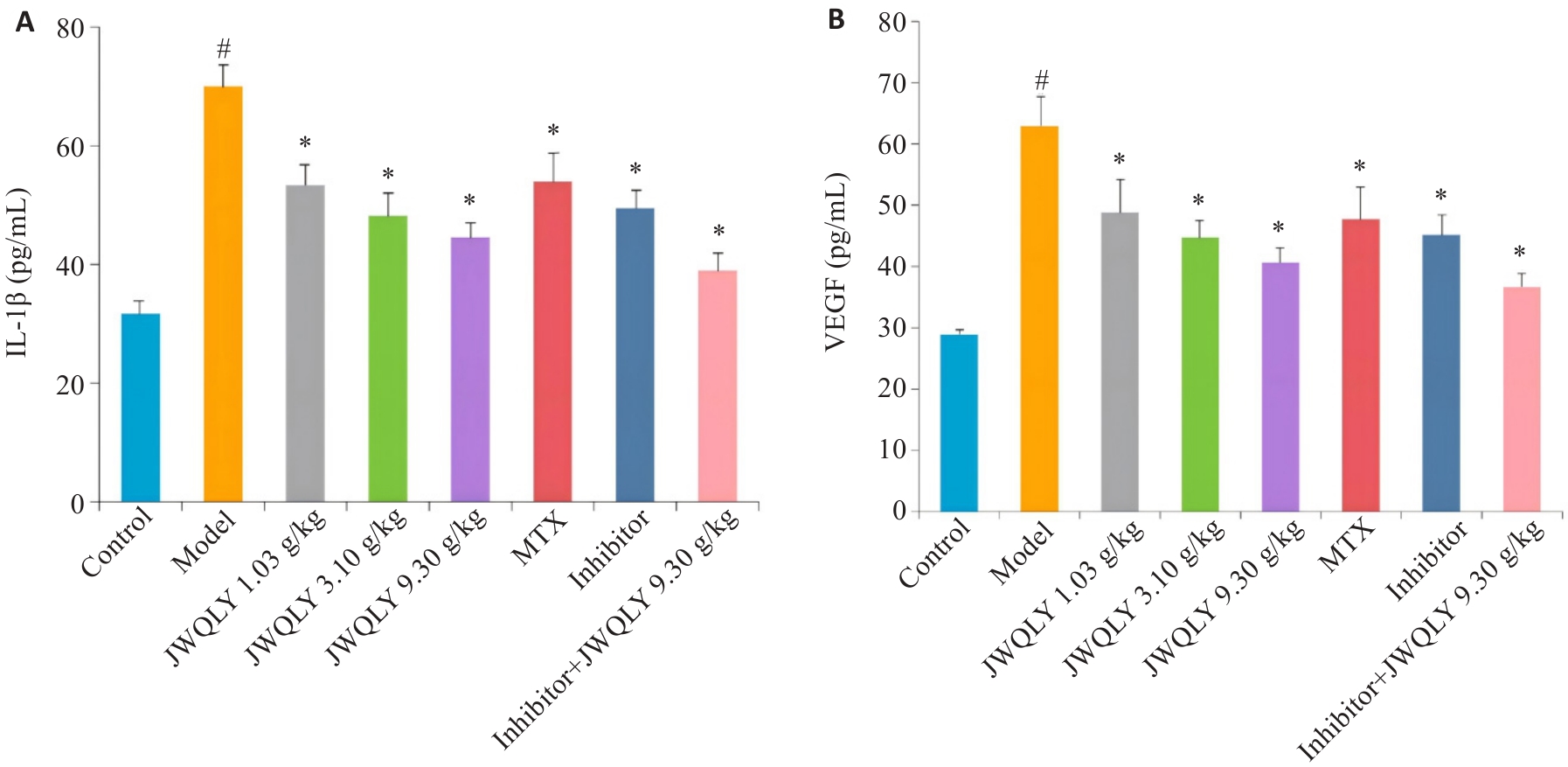
图8 JWQLY对血清IL-1β和VEGF水平的影响
Fig.8 Results of ELISA for detecting serum levels of IL-1β (A) and VEGF (B) in rats from each group (Mean±SD, n=6). #P<0.05 vs Control group; *P<0.05 vs Model group.
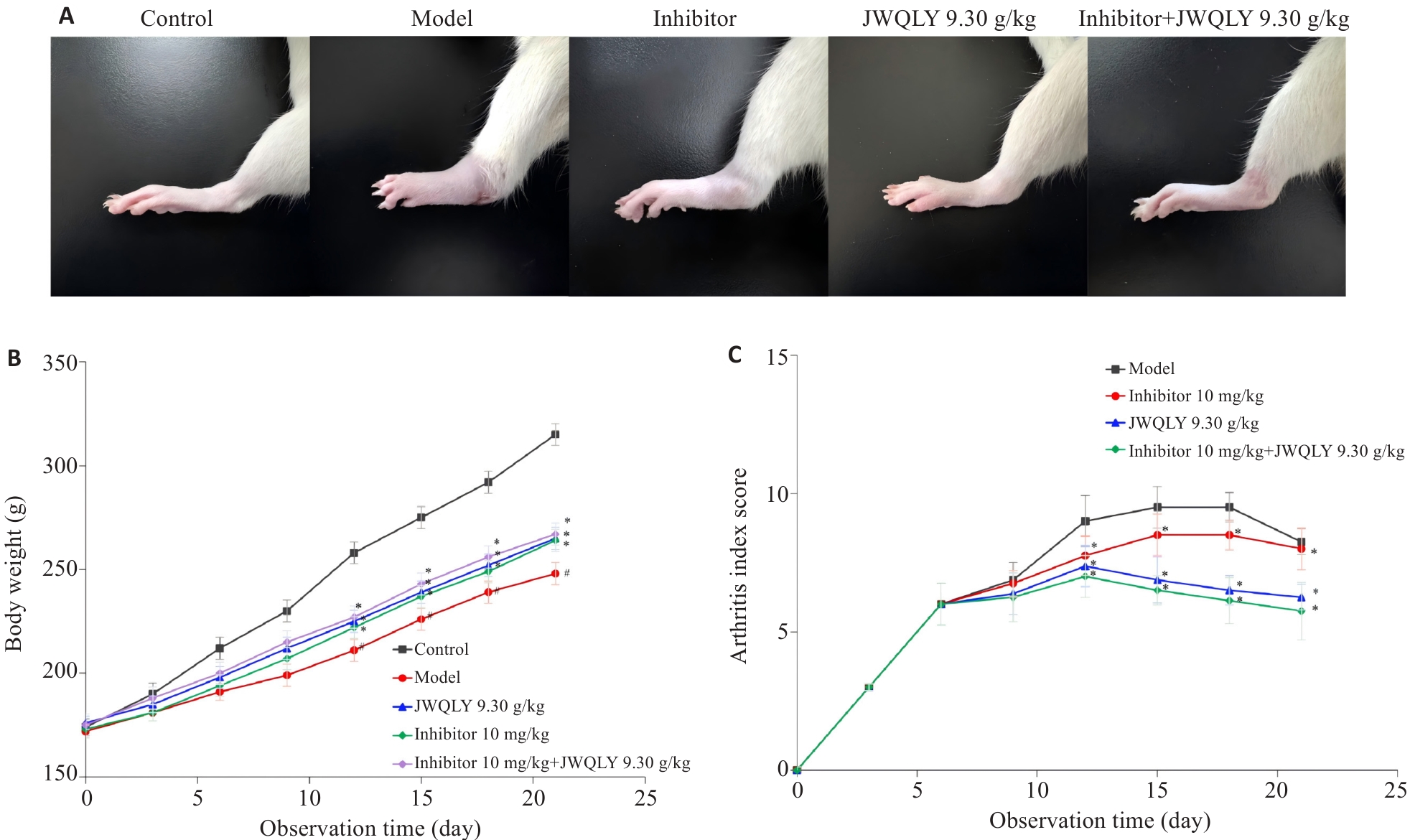
图9 JWQLY和抑制剂对大鼠体质量和关节炎的影响
Fig.9 Effects of JWQLY and inhibitor on body weight and arthritis in the rats (Mean±SD, n=8). A: Representative images of paw swelling in rats from each group. B: Changes in body weight of the rats in different groups. C: Arthritis index scores of the rats in different groups. #P<0.05 vs Control group; *P<0.05 vs Model group.
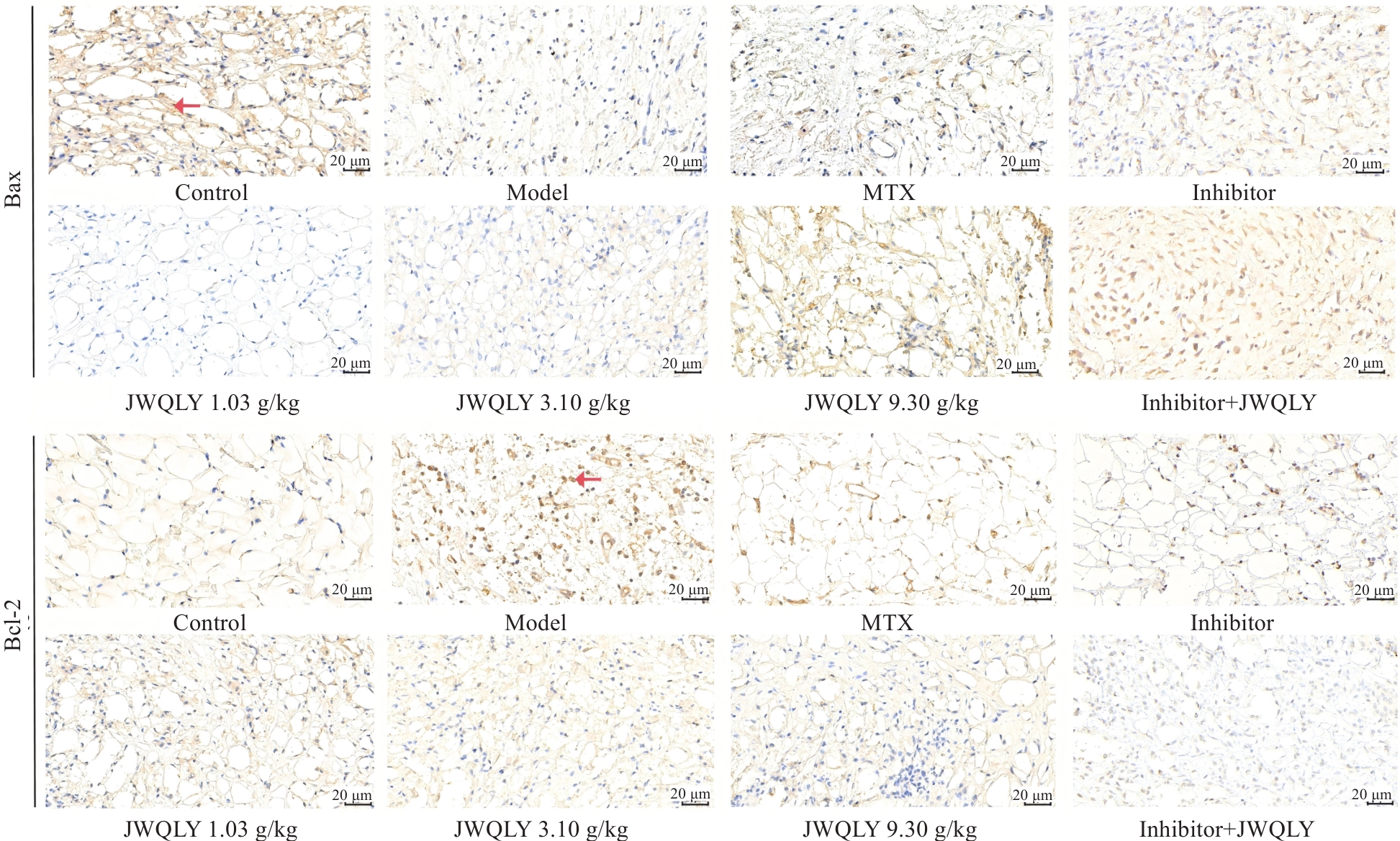
图10 JWQLY对各组BAX、BCL-2蛋白表达的影响, 红色箭头示阳性表达区域(胞质棕黄色染色)
Fig.10 Effect of JWQLY on the protein expressions of BAX and BCL-2 in each group detected by immunohistochemistry. Red arrows indicate the positive expression areas (cytoplasmic brown-yellow staining).
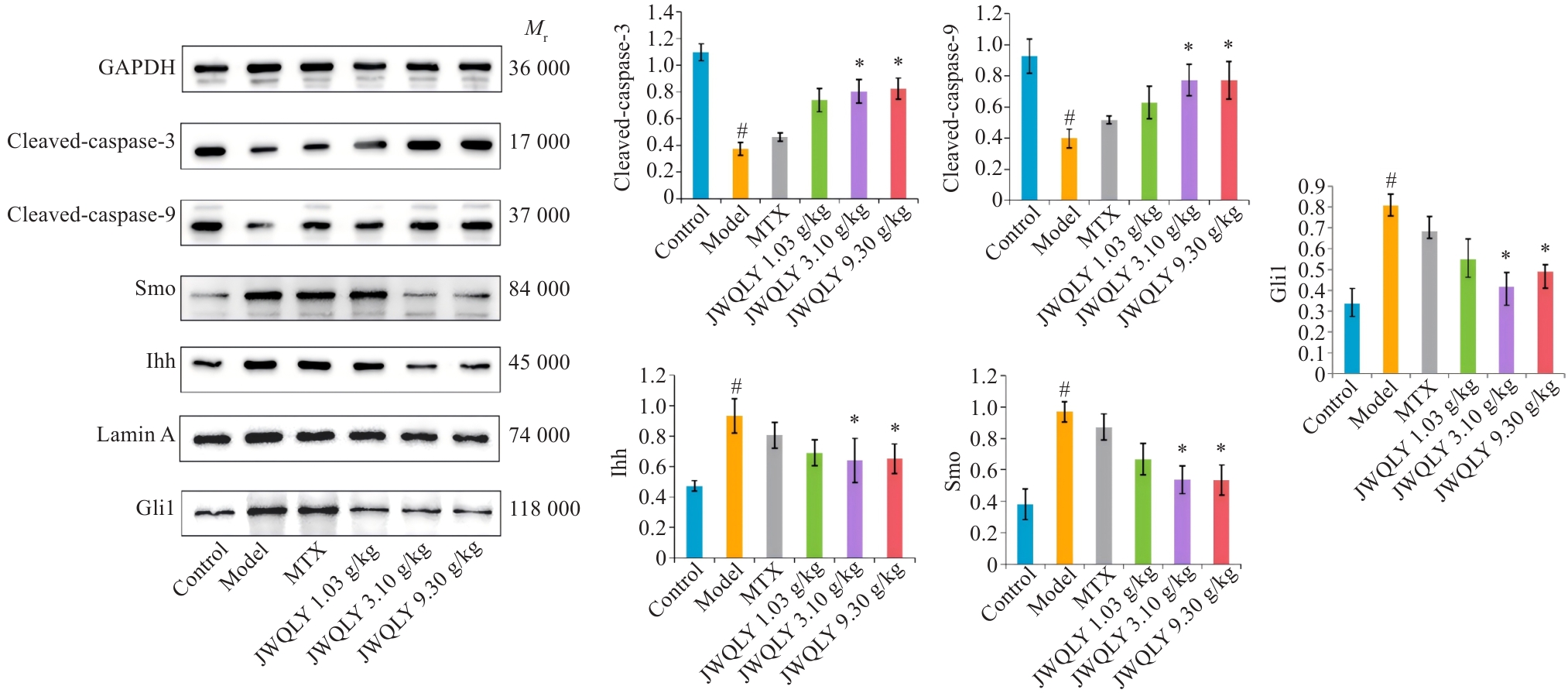
图11 JWQLY对各组Ihh、Smo、Gli1、cleaved-caspase-3、cleaved-caspase-9蛋白表达的影响
Fig.11 Effect of JWQLY on protein expression of Ihh, Smo, Gli1, cleaved caspase-3 and cleaved caspase-9 in each group (Mean±SD, n=3). #P<0.05 vs Control group; *P<0.05 vs Model group.
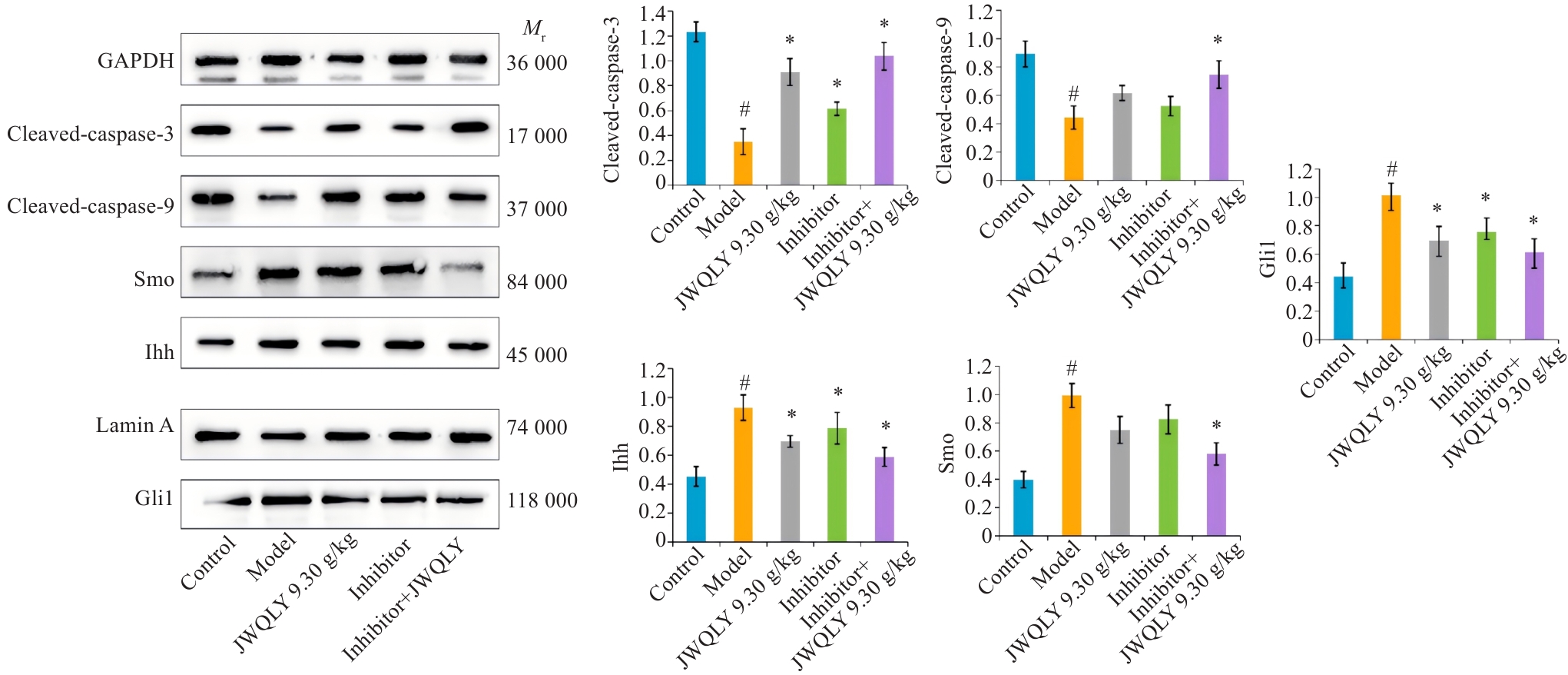
图12 JWQLY对各组Ihh、Smo、Gli1、cleaved-caspase-3、cleaved-caspase-9蛋白表达的影响
Fig.12 Effect of JWQLY and Hedgehog inhibitor on proteins expression of Ihh, Smo, Gli1, cleaved caspase-3 and cleaved caspase-9 in each group (Mean±SD, n=3). #P<0.05 vs Control group; *P<0.05 vs Model group.
| [1] | 韩 珂, 丁子夏, 何晓宇, 等. 程序性细胞死亡在类风湿关节炎中的研究进展[J]. 生理学报, 2024, 76(5): 827-40. doi:10.13294/j.aps.2024.0047 |
| [2] | Díaz-González F, Hernández-Hernández MV. Rheumatoid arthritis. Med Clin, 2023;161(12):533. doi:10.1016/j.medcle.2023.07.008 |
| [3] | 国家皮肤与免疫疾病临床医学研究中心(北京协和医院), 中国医师协会风湿免疫专科医师分会, 中国康复医学会风湿免疫病康复专业委员会, 等. 2024中国类风湿关节炎诊疗指南[J]. 中华内科杂志, 2024, 63(11): 1059-77. |
| [4] | Ba X, Huang Y, Shen P, et al. WTD attenuating rheumatoid arthritis via suppressing angiogenesis and modulating the PI3K/AKT/mTOR/HIF-1α pathway[J]. Front Pharmacol, 2021, 12: 696802. doi:10.3389/fphar.2021.696802 |
| [5] | Sanmartí R, Tornero J, Narváez J, et al. Efficacy and safety of glucocorticoids in rheumatoid arthritis: Systematic literature review[J]. Reumatol Clin, 2020, 16(3): 222-8. doi:10.1016/j.reumae.2018.06.004 |
| [6] | 刘 伟, 杨 梅, 董振华. 董振华治疗类风湿关节炎经验[J]. 北京中医药, 2024, 43(6): 661-3. doi:10.16025/j.1674-1307.2024.06.016 |
| [7] | 伊宝心, 高永翔. 从“痹证”到“络病”: 类风湿性关节炎中医病机演变与新范式[J]. 亚洲急诊医学病例研究, 2025, 13(4): 396-405. |
| [8] | 李 梢. 网络靶标: 中药方剂网络药理学研究的一个切入点[J]. 中国中药杂志, 2011, 36(15): 2017-20. |
| [9] | 郭 凯, 王 楠, 张梦真, 等. 加味清络饮对佐剂性关节炎大鼠代谢与免疫调控的作用研究[J].中药材, 2025, 48(7): 1813-9. |
| [10] | Shi X, Li LL, Liu ZY, et al. Exploring the mechanism of metformin action in Alzheimer's disease and type 2 diabetes based on network pharmacology, molecular docking, and molecular dynamic simulation[J]. Ther Adv Endocrinol Metab, 2023, 14: 20420188231187493. doi:10.1177/20420188231187493 |
| [11] | Yang MF, Lai YW, Gan D, et al. Possible molecular exploration of herbal pair Haizao-Kunbu in the treatment of Graves' disease by network pharmacology, molecular docking, and molecular dynamic analysis[J]. Front Endocrinol, 2023, 14: 1236549. doi:10.3389/fendo.2023.1236549 |
| [12] | 钟玉梅, 郭彦玎, 罗 堃, 等. 基于Tim-3/Gal-9信号通路探讨艾灸调控巨噬细胞极化抑制类风湿关节炎滑膜炎性反应的作用机制[J]. 针刺研究, 2026, 51(5): 593-601. |
| [13] | 孙敬方. 动物实验方法学[M]. 北京: 人民卫生出版社, 2001. |
| [14] | Németh T, Nagy G, Pap T. Synovial fibroblasts as potential drug targets in rheumatoid arthritis, where do we stand and where shall we go?[J]. Ann Rheum Dis, 2022, 81(8): 1055-64. doi:10.1136/annrheumdis-2021-222021 |
| [15] | Yue SR, Fan JY, Xie DL, et al. Unveiling the therapeutic potential: targeting fibroblast-like synoviocytes in rheumatoid arthritis[J]. Expert Rev Mol Med, 2025, 27: e18. doi:10.1017/erm.2025.11 |
| [16] | 陈 平, 杜小正, 王海东, 等. 从NF-κB/Bcl-2信号通路调控成纤维样滑膜细胞凋亡角度探讨中医药抑制类风湿关节炎滑膜炎症机制的研究进展[J]. 中医研究, 2024, 37(1): 87-91. |
| [17] | Meng QL, Wei K, Shan Y. E3 ubiquitin ligase gene BIRC3 modulates TNF-induced cell death pathways and promotes aberrant proliferation in rheumatoid arthritis fibroblast-like synoviocytes[J]. Front Immunol, 2024, 15: 1433898. doi:10.3389/fimmu.2024.1433898 |
| [18] | Chen YH, Han T, Guo ZH, et al. Editorial: Immunomodulatory roles of fibroblast-like synoviocytes in rheumatoid arthritis[J]. Front Immunol, 2024, 15: 1415672. doi:10.3389/fimmu.2024.1415672 |
| [19] | 曹周芳, 汪 元, 王梦娜, 等. LINC00837/miR-671-5p/SERPINE2功能轴促进类风湿关节炎成纤维细胞样滑膜细胞的恶性病理学过程[J]. 南方医科大学学报, 2025, 45(2): 371-8. |
| [20] | Jiang ZM, Zeng SL, Huang TQ, et al. Sinomenine ameliorates rheumatoid arthritis by modulating tryptophan metabolism and activating aryl hydrocarbon receptor via gut microbiota regulation[J]. Sci Bull, 2023, 68(14): 1540-55. doi:10.1016/j.scib.2023.06.027 |
| [21] | 张 游, 唐旖雯, 彭玉婷, 等. 青藤碱治疗类风湿关节炎的作用机制研究进展[J]. 广西中医药大学学报, 2025, 28(3): 59-63. |
| [22] | 文培培, 高 宇, 王晓云, 等. 温针疗法联合豨莶草对风湿性关节炎大鼠滑膜细胞活性及SphK1/S1P/S1PR1信号的影响[J]. 针灸临床杂志, 2022, 38(11): 75-81. |
| [23] | 梁子涵, 王旖瑶, 赖逸翔, 等. 刺五加提取物及其活性成分免疫调节作用的研究进展[J]. 中草药, 2022, 53(15): 4895-904. doi:10.7501/j.issn.0253-2670.2022.15.033 |
| [24] | Su YZ, Xing H, Kang J, et al. Role of the hedgehog signaling pathway in rheumatic diseases: an overview[J]. Front Immunol, 2022, 13: 940455. doi:10.3389/fimmu.2022.940455 |
| [25] | Yan YL, Sun CX, Hoang MH, et al. Hedgehog signaling pathway: a research review on a new therapeutic target for rheumatoid arthritis[J]. Autoimmun Rev, 2025, 24(12): 103918. doi:10.1016/j.autrev.2025.103918 |
| [26] | Zhang YX, Beachy PA. Cellular and molecular mechanisms of Hedgehog signalling[J]. Nat Rev Mol Cell Biol, 2023, 24(9): 668-87. doi:10.1038/s41580-023-00591-1 |
| [27] | Hu YC, Peng LR, Zhuo XY, et al. Hedgehog signaling pathway in fibrosis and targeted therapies[J]. Biomolecules, 2024, 14(12): 1485. doi:10.3390/biom14121485 |
| [28] | Sigafoos AN, Paradise BD, Fernandez-Zapico ME. Hedgehog/GLI signaling pathway: transduction, regulation, and implications for disease[J]. Cancers, 2021, 13(14): 3410. doi:10.3390/cancers13143410 |
| [29] | Yang J, Andre P, Ye L, et al. The Hedgehog signalling pathway in bone formation[J]. Int J Oral Sci, 2015, 7(2): 73-9. doi:10.1038/ijos.2015.14 |
| [30] | Zhu SL, Dang JL, Shi YM, et al. Sonic hedgehog promotes synovial inflammation and articular damage through p38 mitogen-activated protein kinase signaling in experimental arthritis[J]. J Autoimmun, 2022, 132: 102902. doi:10.1016/j.jaut.2022.102902 |
| [31] | Morton JP, Mongeau ME, Klimstra DS, et al. Sonic hedgehog acts at multiple stages during pancreatic tumorigenesis[J]. Proc Natl Acad Sci USA, 2007, 104(12): 5103-8. doi:10.1073/pnas.0701158104 |
| [32] | Bigelow RLH, Chari NS, Undén AB, et al. Transcriptional regulation of bcl-2 mediated by the sonic hedgehog signaling pathway through gli-1[J]. J Biol Chem, 2004, 279(2): 1197-205. doi:10.1074/jbc.m310589200 |
| [33] | 张兴民, 蒋 明, 刘 峰. 类风湿关节炎病人滑膜细胞增生与fas和bcl-2基因的表达[J]. 中华医学杂志, 1998, 78(3): 175-8. doi:10.3760/j:issn:0376-2491.1998.03.005 |
| [34] | Perlman H, Georganas C, Pagliari LJ, et al. Bcl-2 expression in synovial fibroblasts is essential for maintaining mitochondrial homeostasis and cell viability[J]. J Immunol, 2000, 164(10): 5227-35. doi:10.4049/jimmunol.164.10.5227 |
| [1] | 梁云腾, 高倩, 李悦怡, 黄菁宇, 刘凯鲁, 洪艳丽, 周惠芳, 聂晓伟. 五子衍宗丸通过调控TGF-β1/PI3K/Akt/mTOR通路抑制颗粒细胞凋亡改善卵巢储备功能减退[J]. 南方医科大学学报, 2026, 46(9): 2185-2195. |
| [2] | 马园园, 刘悦, 高宁, 霍宇萌, 陈美霓, 李佳文, 刘佳浩, 张满秋, 严冰冰, 许诺, 赵菊梅. 黄芪注射液通过多成分靶向CCL2/FOS/PPARG/CXCL8抑制宫颈癌恶性进展[J]. 南方医科大学学报, 2026, 46(9): 2206-2221. |
| [3] | 李春宁, 杨琪琪, 张振丰, 鲍亮, 姜天鑫, 张玉, 李飞. 电针通过调控TLR4/MyD88/NF-κB信号通路减轻膝关节骨关节炎大鼠膝关节软骨凋亡[J]. 南方医科大学学报, 2026, 46(8): 1886-1895. |
| [4] | 梅小利, 吴思澜, 罗金萍, 黄文涛, 孙建彬, 黄崇刚. 基于Th17/Treg免疫平衡探讨松节方对类风湿性关节炎风寒湿痹证模型大鼠的干预作用[J]. 南方医科大学学报, 2026, 46(8): 1896-1904. |
| [5] | 张雨, 孙康, 刘举达, 王舒晗, 裴静. 消核冲剂激活ASK1/MKK4/JNK通路促进乳腺上皮细胞凋亡改善大鼠乳腺增生分子机制[J]. 南方医科大学学报, 2026, 46(8): 1936-1946. |
| [6] | 乔通, 张龙涛, 章雨, 黄菊, 李晴晴, 耿志军, 胡建国, 李静. 异香草酸激活PPARγ通路改善线粒体功能缓解葡聚糖硫酸钠诱导的小鼠溃疡性结肠炎[J]. 南方医科大学学报, 2026, 46(7): 1487-1497. |
| [7] | 张龙涛, 章雨, 乔通, 张可妮, 尹林, 黄菊, 李静, 耿志军, 胡建国. 丁香酸甲酯通过抑制MAPK通路调控肠上皮细胞凋亡减轻葡聚糖硫酸钠诱导的小鼠结肠炎[J]. 南方医科大学学报, 2026, 46(7): 1685-1695. |
| [8] | 李瑾, 贺一杰, 毕芳芳, 陈浚鑫, 范桢颜, 张宇, 陈恩宇, 肖鸿文, 吴云, 田华, 周宇宏. 靶向抑制miR-503可通过上调Apelin表达减轻小鼠心肌梗死损伤[J]. 南方医科大学学报, 2026, 46(6): 1235-1243. |
| [9] | 魏佳, 蒋伟, 夏林莺, 吕侣, 杨强. GDF11通过抑制硫氧还蛋白1硝基化失活减轻心肌缺血/再灌注损伤[J]. 南方医科大学学报, 2026, 46(5): 1075-1083. |
| [10] | 林雨星, 石思楠, 汪婧, 林思悦, 张杰, 林珊珊, 陈伊舒榕, 张铃, 蔡巧燕. 清达颗粒下调P53信号通路抑制高血压小鼠脑微血管内皮细胞凋亡[J]. 南方医科大学学报, 2026, 46(5): 1102-1110. |
| [11] | 马丹, 曹书源, 姜毅, 彭煜策, 何岸, 罗明昊, 罗素新. 褪黑素通过抑制STING信号通路减轻糖尿病小鼠心肌细胞坏死性凋亡[J]. 南方医科大学学报, 2026, 46(5): 1157-1166. |
| [12] | 宋淇乐, 苗益恺, 冯小桐, 王一凡, 刘伟, 魏琪, 于新汝, 陈文文, 付晓艳. 硒代胱氨酸通过诱导活性氧产生启动氧化应激损伤抑制结肠癌细胞生长[J]. 南方医科大学学报, 2026, 46(3): 532-540. |
| [13] | 温贺新, 林洁, 左芦根, 刘牧林. 珠子草素通过拮抗肠上皮细胞凋亡与调控肠道Th1/Th2免疫平衡改善克罗恩病样小鼠结肠炎[J]. 南方医科大学学报, 2026, 46(3): 655-665. |
| [14] | 张语洋, 申颖, 佟欣雨, 段宇魁, 罗云娜, 郭文奇. 水飞蓟宾通过诱导细胞自噬及凋亡双重机制抑制兔青光眼术后纤维化[J]. 南方医科大学学报, 2026, 46(3): 666-674. |
| [15] | 许茜, 刘尔祺, 张巧凤, 刘海鑫, 林新培, 林瑶. 早发型帕金森病相关基因Ddx56维持斑马鱼神经发育及抗凋亡的实验研究[J]. 南方医科大学学报, 2026, 46(10): 2357-2371. |
| 阅读次数 | ||||||
|
全文 |
|
|||||
|
摘要 |
|
|||||
