
南方医科大学学报 ›› 2026, Vol. 46 ›› Issue (10): 2357-2371.doi: 10.12122/j.issn.1673-4254.2026.10.06
• • 上一篇
许茜( ), 刘尔祺, 张巧凤, 刘海鑫, 林新培, 林瑶()
收稿日期:2025-12-23
出版日期:2026-10-20
发布日期:2026-10-26
通讯作者:
林瑶
E-mail:xmuxuqian@163.com;55380098@qq.com
作者简介:许 茜,博士,教授,博士生导师,E-mail: xmuxuqian@163.com
基金资助:
Qian XU(), Erqi LIU, Qiaofeng ZHANG, Haixin LIU, Xinpei LIN, Yao LIN()
Received:2025-12-23
Online:2026-10-20
Published:2026-10-26
Contact:
Yao LIN
E-mail:xmuxuqian@163.com;55380098@qq.com
摘要:
目的 通过对课题组前期筛查的与早发型帕金森病(PD)发病相关的候选基因的体内与体外功能验证,探讨目标基因在生命发育早期阶段对多巴胺神经元存活的影响。 方法 通过原位杂交和荧光定量PCR检测野生型AB品系斑马鱼Ddx56、Galnt13两个候选基因的时序表达和组织特异性分布、检测Ddx56、Galnt13基因敲降斑马鱼模型中PD及多巴胺神经元相关基因表达情况,筛选出影响表型权重更大的Ddx56基因,进一步构建Ddx56干扰及过表达慢病毒载体并转染SH-SY5Y细胞,通过流式细胞仪检测各组细胞凋亡率,RNA-seq检测Ddx56敲降引起的基因变化差异,鉴定Ddx56基因在神经系统早期发育中的作用。 结果 Ddx56及Galnt13均在胚胎早期广泛表达,其中Ddx56主要在脑、精巢中高表达,Galnt13主要在脑、眼中高表达;Ddx56敲低时,PD相关基因Sncga、Sncgb、Polg、Pink1、Parkin、Lrrk2、Gba、Sncb基因表达显著改变(P<0.05);Galnt13敲低时,PD相关基因Sncgb、Syn2b、Lrrk2基因表达差异显著(P<0.05);Ddx56敲降组细胞凋亡比例增高(P<0.05),Ddx56敲降引起的差异基因变化主要集中在免疫系统、能量代谢、蛋白翻译、信号转导等方面,尤其在核糖体和代谢通路方面,差异表达的基因均不少于20个;差异表达基因与PD、亨廷顿氏病、阿尔茨海默症等神经退行性疾病有显著关联,并改变了体内氧化磷酸化水平。 结论 Ddx56基因在胚胎发育早期及脑部高表达,敲降后能引起PD及多巴胺神经元相关基因表达变化并引起多巴胺神经元凋亡,可能作为PD预测及早期诊断的生物标记物。
许茜, 刘尔祺, 张巧凤, 刘海鑫, 林新培, 林瑶. 早发型帕金森病相关基因Ddx56维持斑马鱼神经发育及抗凋亡的实验研究[J]. 南方医科大学学报, 2026, 46(10): 2357-2371.
Qian XU, Erqi LIU, Qiaofeng ZHANG, Haixin LIU, Xinpei LIN, Yao LIN. Role of Ddx56 gene associated with early-onset Parkinson disease in maintaining neural development and protecting against dopaminergic neuron apoptosis in zebrafish[J]. Journal of Southern Medical University, 2026, 46(10): 2357-2371.
| Gene | Primer (5'-3') |
|---|---|
| Ddx56 | F:TCATCAGCCAGTTCAATCAAGG |
| Galnt13 | F:GTGATTCCCAAAGAAGAGCAGG |
表1 Ddx56和Galnt13探针引物序列
Tab.1 Probe and primer sequences for Ddx56 and Galnt13
| Gene | Primer (5'-3') |
|---|---|
| Ddx56 | F:TCATCAGCCAGTTCAATCAAGG |
| Galnt13 | F:GTGATTCCCAAAGAAGAGCAGG |
| Gene | Primer (5'-3') | Fragment length (bp) |
|---|---|---|
| Galnt13 | F:GTCTTCCTTGCTATACTTCAG GTCTTGGGTCTTCCTCTTGCTATACTTCAG | 259 |
| R:TCGTCTTACAGCCATCCAGC | ||
| Ddx56 | F:AAGGCTCTGGCGGATTTAGG | 181 |
| R:CCTGCTCTCGTACAGTCTGTTT | ||
| F: | 358 | |
| R: | ||
| Sncga | F:GCAGCCGCCAAAACCAAAGA | 134 |
| R:CCAGCCACAGCAGTATCACT | ||
| Sncgb | F:TCCAGAAGACCACCGACCAG | 152 |
| R:TTCCATACCACCATGAGAGA | ||
| Syn2b | F:AGTCATCCCATCCTCTCTTG | 104 |
| R:CTCTGCCTTTGCTTCGTCCT | ||
| Polg | F:GCTCTGGTTTTTGATGTGGA | 182 |
| R:CTGGAGTTTGCGAGGGTTTC | ||
| Dj-1 | F:TGTGAAAGAGGTGTTGAAGG | 120 |
| R:GGATGAGTAGTAACTGTGCT | ||
| Pink1 | F:GTACCTGGAGGTGTGTGTGC | 104 |
| R:CTCTGTGAGCGATGTTTTGT | ||
| Parkin | F:CCATCACCAAAACCACTCAC | 110 |
| R:GCACCACTCGAACTTACACT | ||
| Lrrk2 | F:TATTCGTTCGGTCTGCTGCT | 196 |
| R:TGTCCTGGGGGTTTTCTCTC | ||
| Gba | F:ACCAGGAGGCAAAGAACACA | 198 |
| R:GGACCTAGATCCAGGGCAAT | ||
| β-Synucleins (Sncb) | F:CAGCAAGACCAAAGACAGCG | 170 |
| R:TGGCTTCCTGACCAAACTCC |
表2 帕金森相关基因实时荧光定量PCR引物序列
Tab.2 Primer sequences for real-time quantitative PCR for Parkinson disease (PD)-associated genes
| Gene | Primer (5'-3') | Fragment length (bp) |
|---|---|---|
| Galnt13 | F:GTCTTCCTTGCTATACTTCAG GTCTTGGGTCTTCCTCTTGCTATACTTCAG | 259 |
| R:TCGTCTTACAGCCATCCAGC | ||
| Ddx56 | F:AAGGCTCTGGCGGATTTAGG | 181 |
| R:CCTGCTCTCGTACAGTCTGTTT | ||
| F: | 358 | |
| R: | ||
| Sncga | F:GCAGCCGCCAAAACCAAAGA | 134 |
| R:CCAGCCACAGCAGTATCACT | ||
| Sncgb | F:TCCAGAAGACCACCGACCAG | 152 |
| R:TTCCATACCACCATGAGAGA | ||
| Syn2b | F:AGTCATCCCATCCTCTCTTG | 104 |
| R:CTCTGCCTTTGCTTCGTCCT | ||
| Polg | F:GCTCTGGTTTTTGATGTGGA | 182 |
| R:CTGGAGTTTGCGAGGGTTTC | ||
| Dj-1 | F:TGTGAAAGAGGTGTTGAAGG | 120 |
| R:GGATGAGTAGTAACTGTGCT | ||
| Pink1 | F:GTACCTGGAGGTGTGTGTGC | 104 |
| R:CTCTGTGAGCGATGTTTTGT | ||
| Parkin | F:CCATCACCAAAACCACTCAC | 110 |
| R:GCACCACTCGAACTTACACT | ||
| Lrrk2 | F:TATTCGTTCGGTCTGCTGCT | 196 |
| R:TGTCCTGGGGGTTTTCTCTC | ||
| Gba | F:ACCAGGAGGCAAAGAACACA | 198 |
| R:GGACCTAGATCCAGGGCAAT | ||
| β-Synucleins (Sncb) | F:CAGCAAGACCAAAGACAGCG | 170 |
| R:TGGCTTCCTGACCAAACTCC |
| Gene | Primer (5'-3') | Fragment length (bp) |
|---|---|---|
| Th1 | F:TCAGAAGTTTGTTGGGAGG | 237 |
| R:CTGGTTTCAAGATGGTGGA | ||
| Th2 | F:GTCTCGCTTGGAGCATCAG | 155 |
| R:TTAGAAAGGGCATACAACA | ||
| Vat2 | F:GTGTCGGTGTATGGAAGTG | 164 |
| R:AAGAAACAAAGAGGAGCAA | ||
| Ddc | F:TTCCCACTGCCCACTCTTA | 151 |
| R:TCCGGTAGTTTCAGCATCTTT | ||
| Mao | F:TGCTGAAGAATGGGACAAG | 141 |
| R:AGAAACCACAAAGCCGAAA | ||
| Dat | F:AGACTCCATCCCTCCCATAGC | 115 |
| R:CATCATTTACCCAGAAGCCATT | ||
| Comta | F:GAATGTGGGCGACGAGAAA | 114 |
| R:CGAGCGATGCGAACAGTAG | ||
| Drd1a | F:ATTTGGGTCGCATTTGATA | 126 |
| R:CACCCTGGGAGTCATCTTC | ||
| Drd2a | F:ATCACAAACCGAAACCCTT | 195 |
| R:GACCTGGATCTCAAATGCT | ||
| Drd2b | F:TTTTGTTGTCTACTCCTCCAT | 144 |
| R:GCATCAGCGTCTGTCTTCT | ||
| Drd3 | F:TGGGCAGTTTATTTGGAAG | 177 |
| R:GCTGTGGGTGGTGTTGTAT | ||
| Drd4a | F:ACCACCACCAACTACTTCAT | 135 |
| R:CAGTCCATCACATACGGTCA | ||
| Drd4b | F:TCAAGACGACGACAAACTA | 121 |
| R:ACATTCAAGGACCAAACAC | ||
| Drd5a | F:CTGCGTCAGCGACACCACCT | 108 |
| R:GAGAAGCCCTTGCGGAACT |
表3 多巴胺相关基因实时荧光定量PCR引物序列
Tab.3 Primer sequences for real-time quantitative PCR for dopamine (DA) neuron-related genes
| Gene | Primer (5'-3') | Fragment length (bp) |
|---|---|---|
| Th1 | F:TCAGAAGTTTGTTGGGAGG | 237 |
| R:CTGGTTTCAAGATGGTGGA | ||
| Th2 | F:GTCTCGCTTGGAGCATCAG | 155 |
| R:TTAGAAAGGGCATACAACA | ||
| Vat2 | F:GTGTCGGTGTATGGAAGTG | 164 |
| R:AAGAAACAAAGAGGAGCAA | ||
| Ddc | F:TTCCCACTGCCCACTCTTA | 151 |
| R:TCCGGTAGTTTCAGCATCTTT | ||
| Mao | F:TGCTGAAGAATGGGACAAG | 141 |
| R:AGAAACCACAAAGCCGAAA | ||
| Dat | F:AGACTCCATCCCTCCCATAGC | 115 |
| R:CATCATTTACCCAGAAGCCATT | ||
| Comta | F:GAATGTGGGCGACGAGAAA | 114 |
| R:CGAGCGATGCGAACAGTAG | ||
| Drd1a | F:ATTTGGGTCGCATTTGATA | 126 |
| R:CACCCTGGGAGTCATCTTC | ||
| Drd2a | F:ATCACAAACCGAAACCCTT | 195 |
| R:GACCTGGATCTCAAATGCT | ||
| Drd2b | F:TTTTGTTGTCTACTCCTCCAT | 144 |
| R:GCATCAGCGTCTGTCTTCT | ||
| Drd3 | F:TGGGCAGTTTATTTGGAAG | 177 |
| R:GCTGTGGGTGGTGTTGTAT | ||
| Drd4a | F:ACCACCACCAACTACTTCAT | 135 |
| R:CAGTCCATCACATACGGTCA | ||
| Drd4b | F:TCAAGACGACGACAAACTA | 121 |
| R:ACATTCAAGGACCAAACAC | ||
| Drd5a | F:CTGCGTCAGCGACACCACCT | 108 |
| R:GAGAAGCCCTTGCGGAACT |
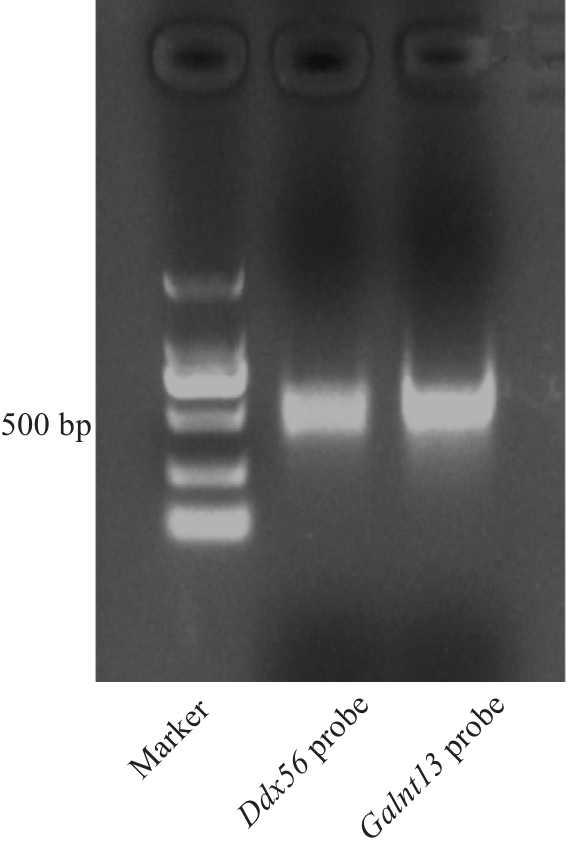
图1 Ddx56和Galnt13基因探针电泳检测图
Fig.1 Detection of Ddx56 and Galnt13 gene probes by gel electrophoresis. Marker is the 2000 bp DNA Ladder; the Ddx56 probe is approximately 550 bp, and the Galnt13 probe is approximately 600 bp.
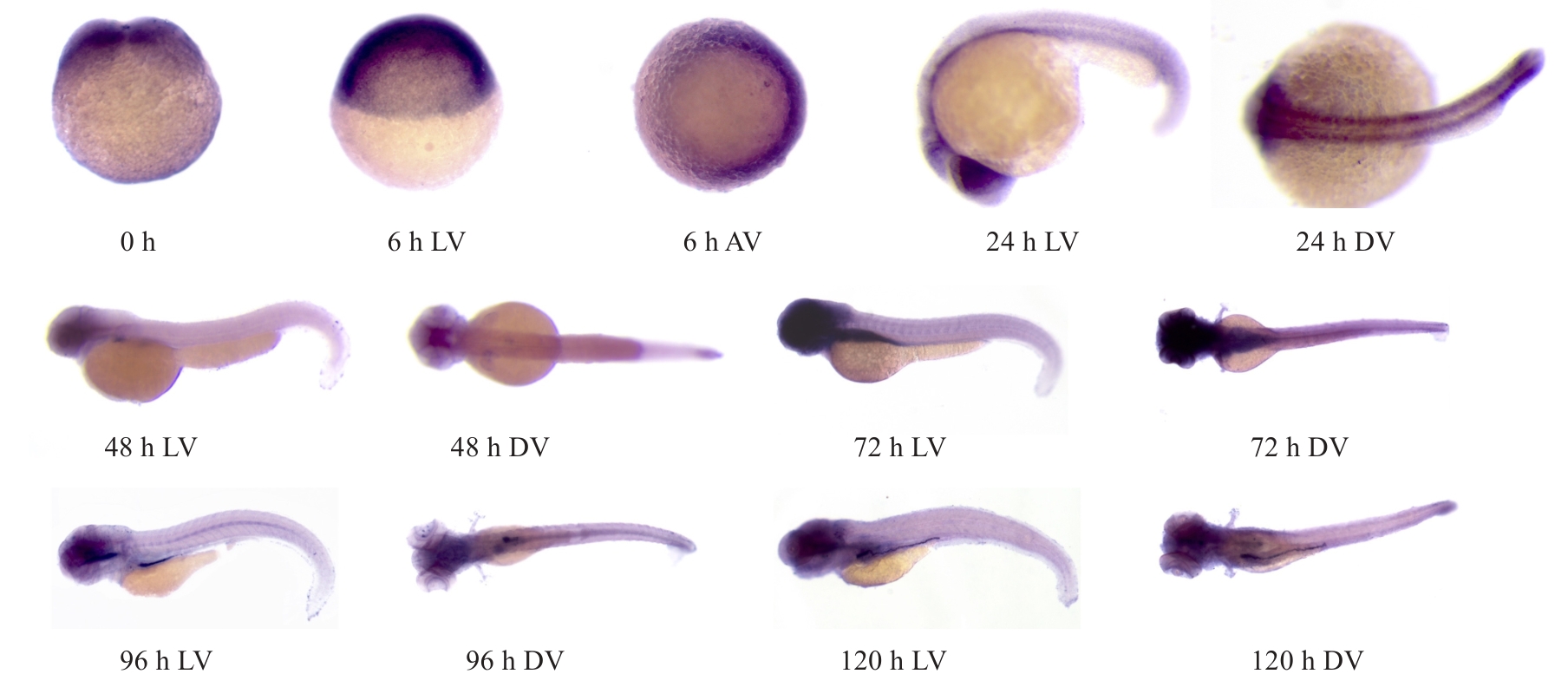
图2 Ddx56基因在早期胚胎发育阶段的表达
Fig.2 Expression of Ddx56 during early embryonic development of zebrafish. LV: Lateral view; AV : Anterior view; DV: Dorsal view.
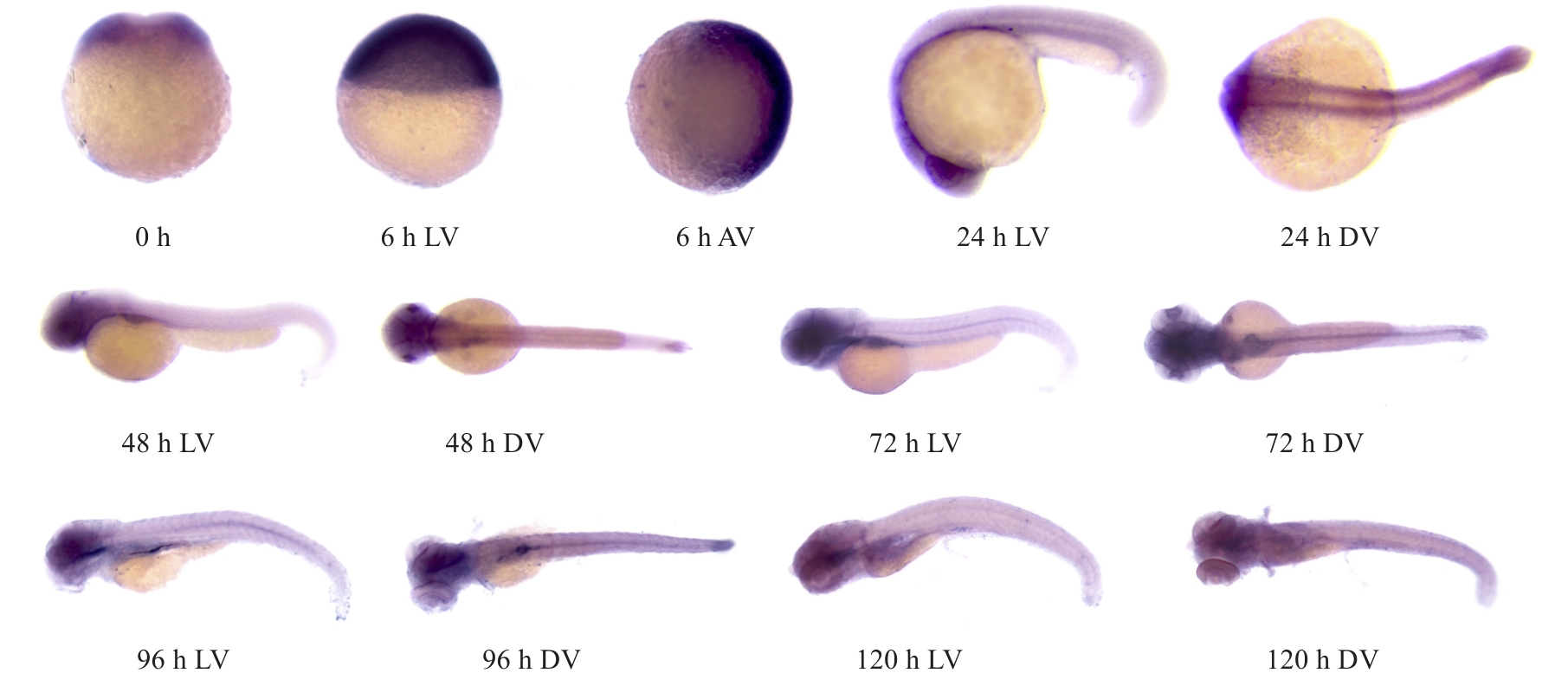
图3 Galnt13基因在早期胚胎发育阶段的表达
Fig.3 Expression of Galnt13 during early embryonic development of zebrafish.
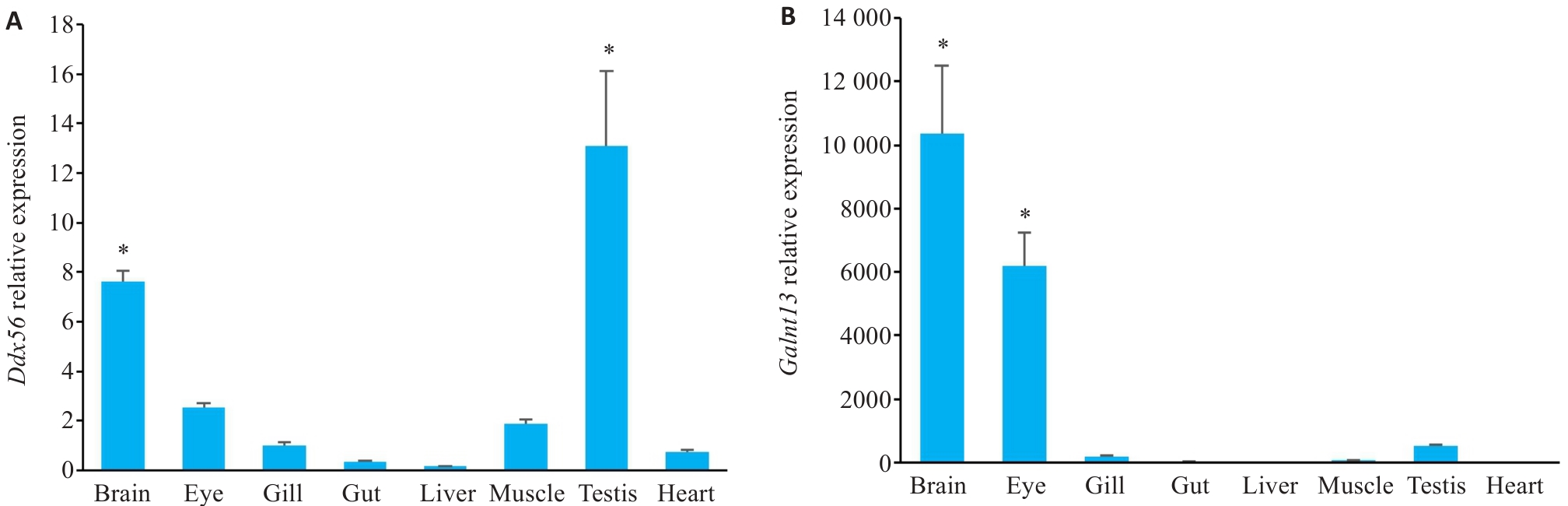
图4 Ddx56与Galnt13基因在斑马鱼各个器官中的表达情况
Fig.4 Expression of Ddx56 (A) and Galnt13 (B) in various organs of zebrafish (n=3). *P<0.05 vs other organs.
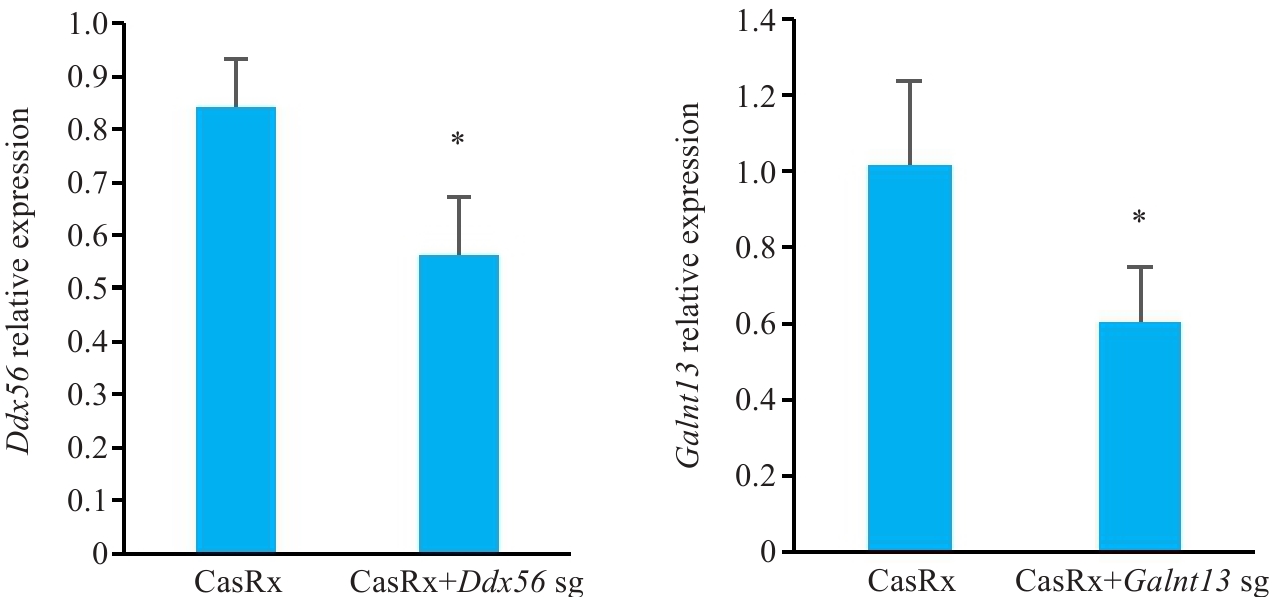
图5 Ddx56、Galnt13基因敲降效率荧光定量结果
Fig.5 qRT-PCR analysis of Ddx56 and Galnt13 knockdown efficiency (n=3). *P<0.05 vs CasRx.
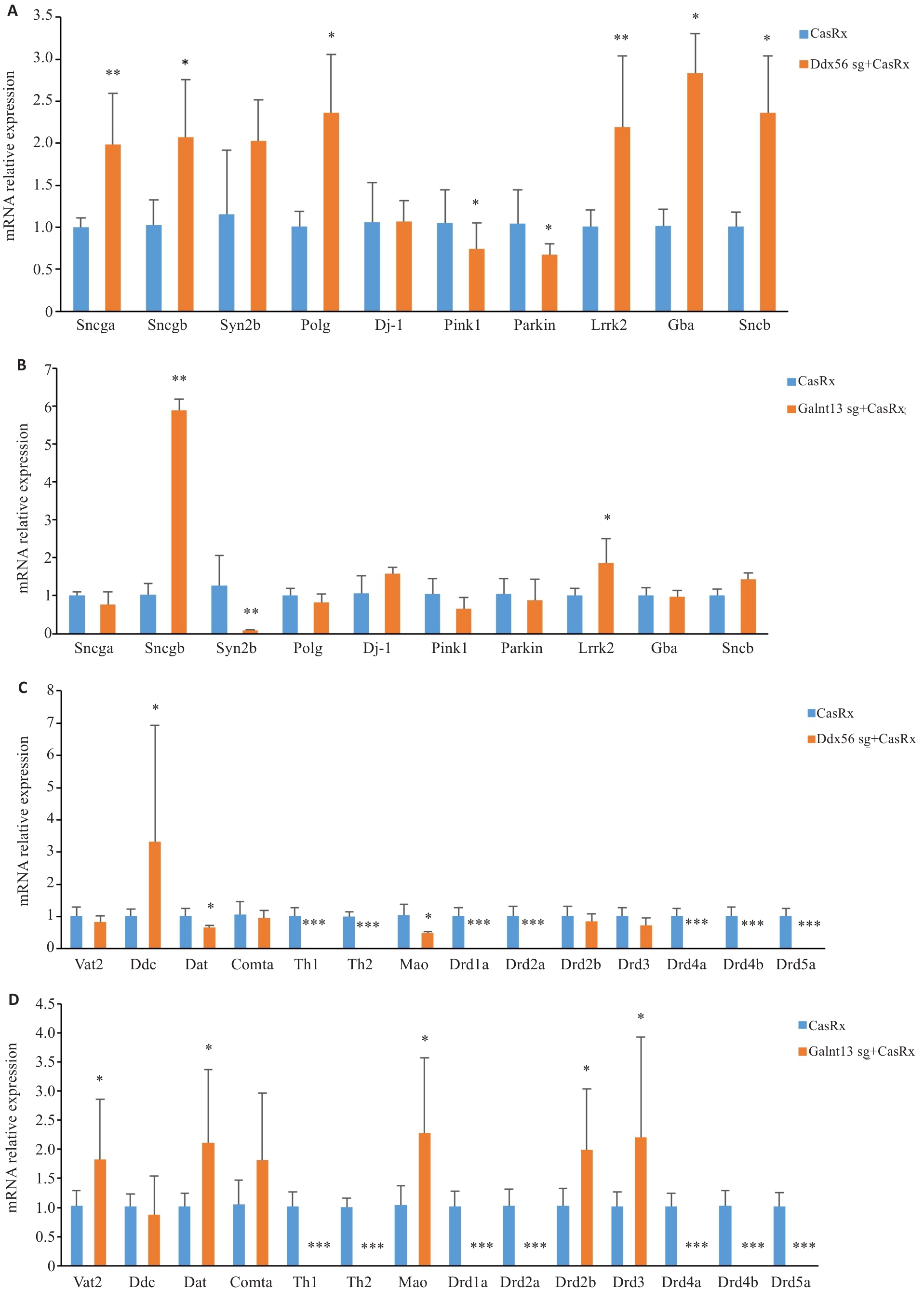
图6 Galnt13、Ddx56敲降后斑马鱼PD、DA相关基因表达情况
Fig.6 Expression of PD- and DA neuron-associated genes in zebrafish after Ddx56 or Galnt13 knockdown (n=3). A: Expression of PD-related genes following Ddx56 knockdown. B: Expression of PD-related genes following Galnt13 knockdown. C: Expression of DA-related genes following Ddx56 knockdown. D: Expression of DA-related genes following Galnt13 knockdown. *P<0.05, **P<0.01, ***P<0.001 vs CasRx control group.
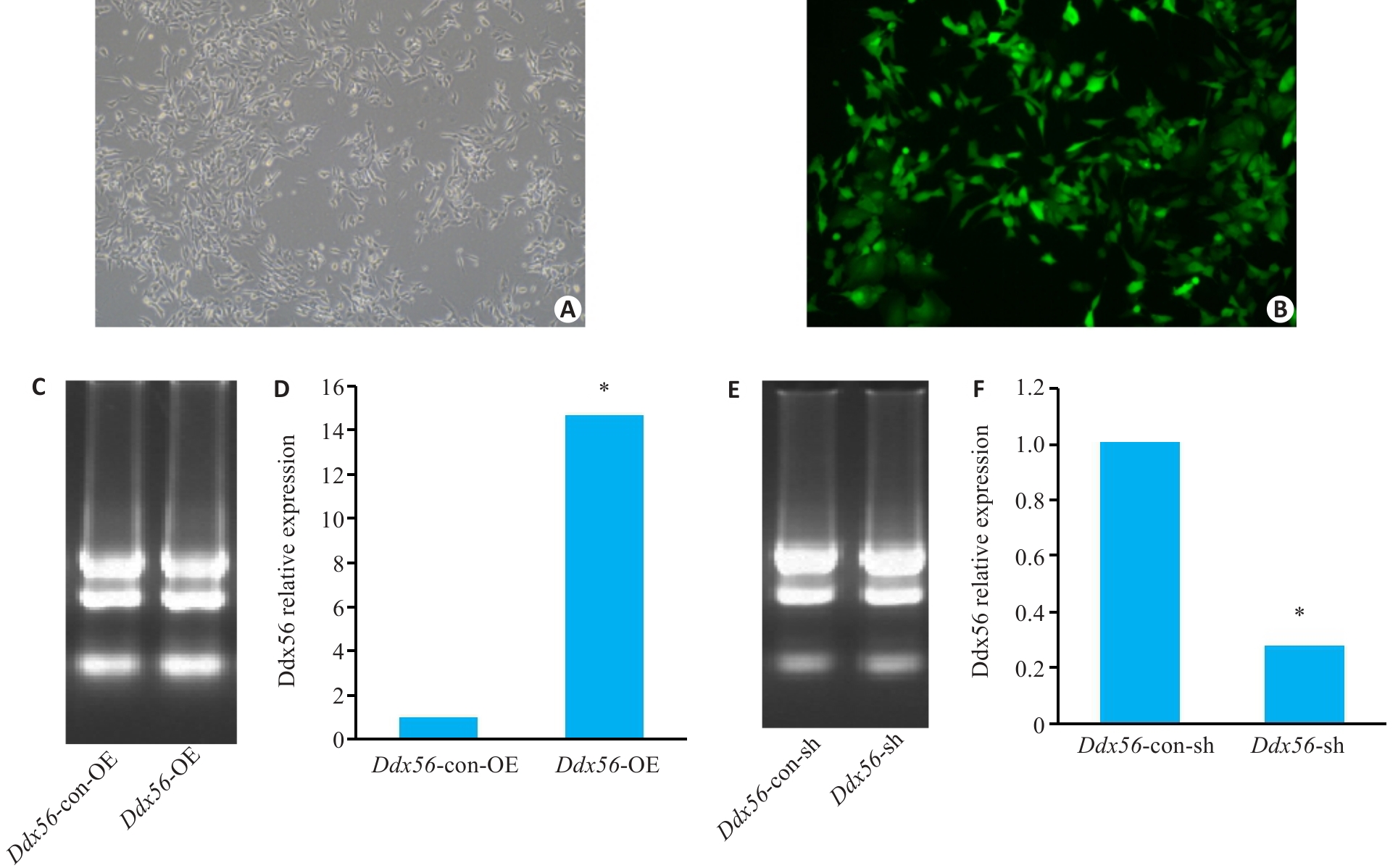
图7 SH-SY5Y-ZsGreen-PURO的感染效率和Ddx56基因过表达/敲降效率
Fig.7 Infection efficiency of SH-SY5Y-ZsGreen-PURO cells and efficiency of Ddx56 overexpression or knockdown (n=3). A: Bright-field image of SH-SY5Y-ZsGreen-PURO cells (Original magnification: ×400). B: Fluorescence image of SH-SY5Y-ZsGreen-PURO cells (×400). C: Electrophoresis gel of Ddx56 overexpression. D: Statistical graph of Ddx56 overexpression. E: Electrophoresis gel of Ddx56 knockdown. F: Statistical graph of Ddx56 knockdown. *P<0.05.
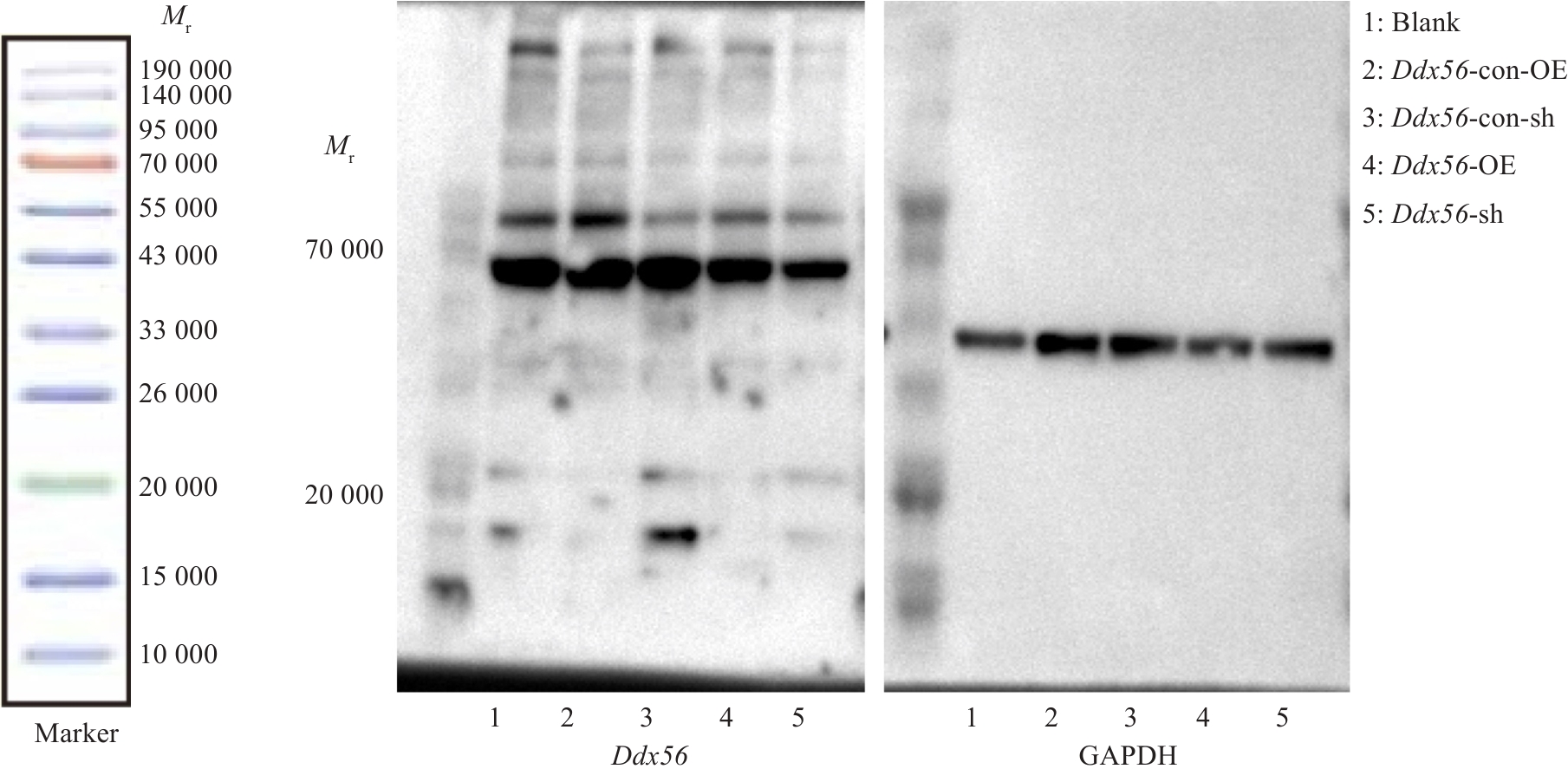
图8 Ddx56蛋白过表达和敲降效率检测
Fig.8 Detection of Ddx56 protein overexpression and knockdown efficiency.
| Item | Blank | Ddx56-con-OE | Ddx56-con-sh | Ddx56-OE | Ddx56-sh |
|---|---|---|---|---|---|
| GAPDH | 140.25 | 183.60 | 179.49 | 137.24 | 163.96 |
| Ddx56 | 178.12 | 199.04 | 218.13 | 194.95 | 142.65 |
| Ddx56/GAPDH | 1.27 | 1.08 | 1.22 | 1.42 | 0.87 |
表4 Ddx56蛋白过表达和敲降灰度分析结果
Tab.4 Gray-scale analysis results of Ddx56 protein overexpression and knockdown (n=3)
| Item | Blank | Ddx56-con-OE | Ddx56-con-sh | Ddx56-OE | Ddx56-sh |
|---|---|---|---|---|---|
| GAPDH | 140.25 | 183.60 | 179.49 | 137.24 | 163.96 |
| Ddx56 | 178.12 | 199.04 | 218.13 | 194.95 | 142.65 |
| Ddx56/GAPDH | 1.27 | 1.08 | 1.22 | 1.42 | 0.87 |
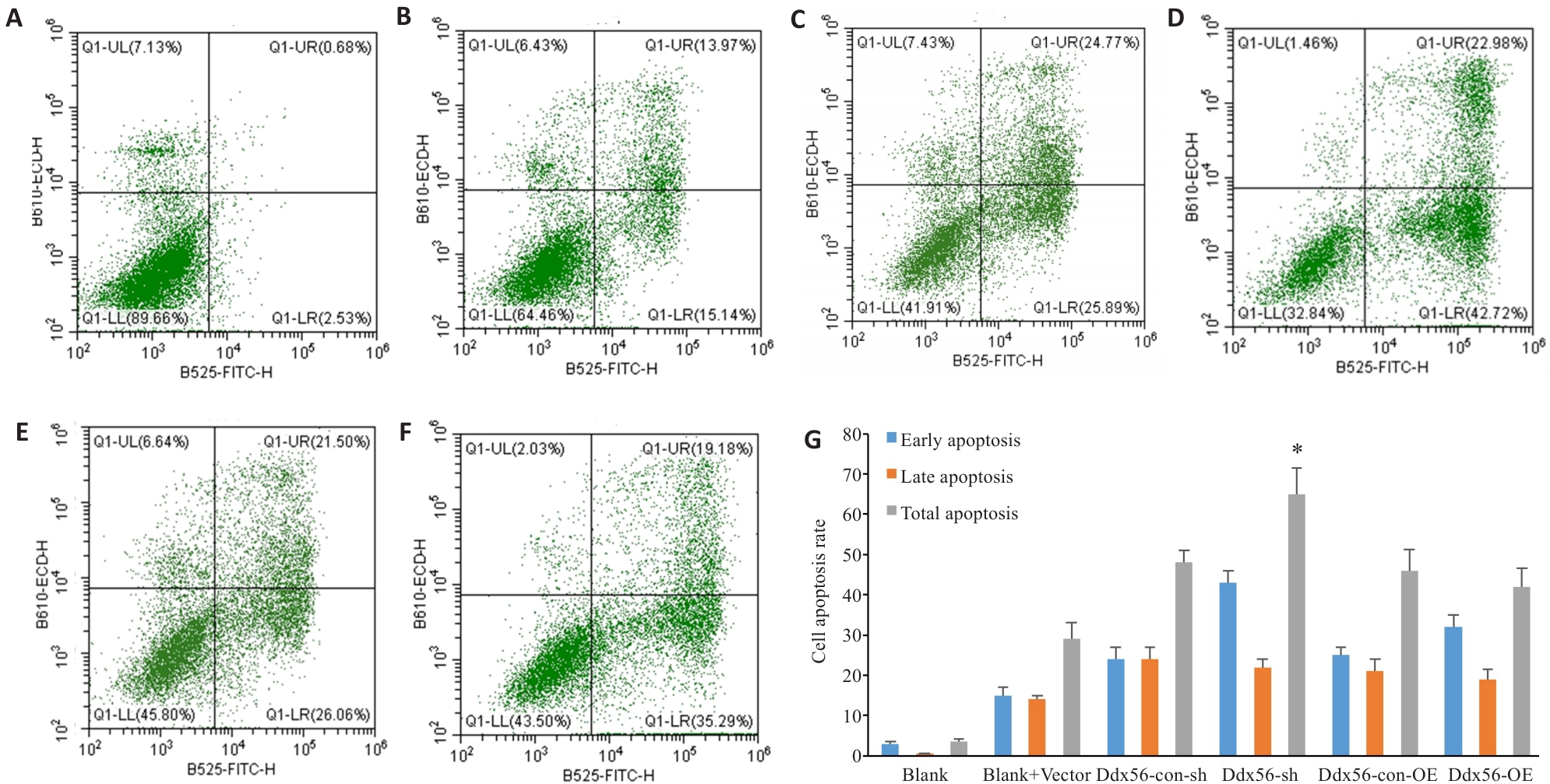
图9 Ddx56基因对SH-SY5Y细胞凋亡的影响
Fig.9 Effect of Ddx56 knockdown or overexpression on apoptosis in SH-SY5Y cells (n=3). A: Blank. B: Blank+Vector. C: Ddx56-con-sh (knockdown control). D: Ddx56-sh (knockdown). E: Ddx56-con-OE (overexpression control). F: Ddx56-OE (overexpression). G: Apoptosis rates. *P<0.05 vs Ddx56-con-sh.
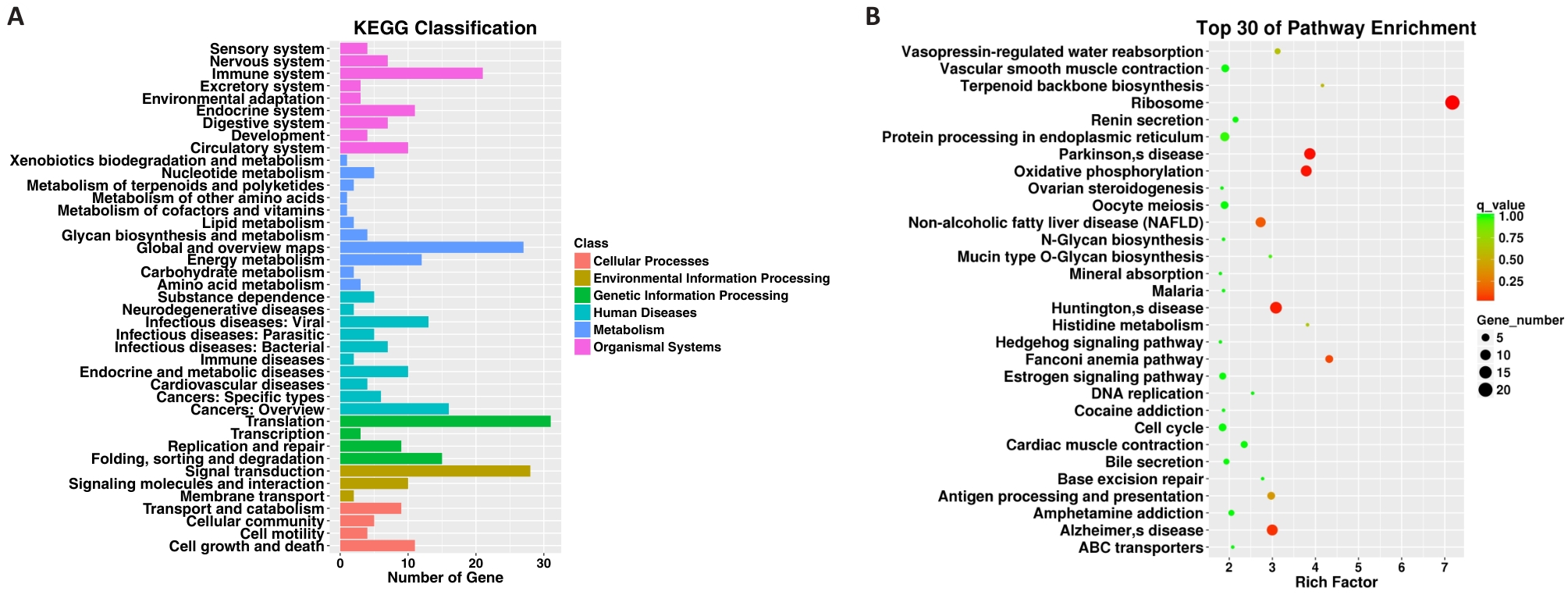
图10 Ddx56敲降引起的转录组变化KEGG功能聚类与通路富集
Fig.10 KEGG functional clustering (A) and pathway enrichment (B) of transcriptomic changes induced by Ddx56 knockdown.
| Pathway | Gene count | Differentially expressed genes (DEGs) |
|---|---|---|
| TNF pathway | 3 | Casp3, Creb1, Mmp9 |
| Hippo pathway | 2 | Ppp1cb, Mob1b |
| VEGF pathway | 1 | Pla2g4a |
| Wnt pathway | 3 | Cxxc4, Prkacb, Gpc4 |
| cGMP-PKG pathway | 3 | Ppp1cb, Creb1, Kcnma1 |
| TGF-beta pathway | 2 | Rbl1, Acvr2a |
| HIF-1pathway | 2 | Tfrc, Cul2 |
| cAMP pathway | 5 | Sucnr1, Ppp1cb, Creb1, Oxtr, Abcc4 |
| AMPK pathway | 3 | Creb1, Cptic, Lepr |
| NF-kappa B pathway | 1 | Bcl2a1 |
| PI3K-Akt pathway | 4 | Gng11, Creb1, Hsp90aa1, Itgb1 |
| Jak-STAT pathway | 1 | Lepr |
| Ras pathway | 4 | Gng11, Prkacb, Pla2g4a, Tbk1 |
| Calcium pathway | 3 | Prkacb, Avpr1a, Oxtr |
| MAPK pathway | 3 | Casp3, Prkacb, Pla2g4a |
| Rap1 pathway | 2 | Cnr1, Itgb1 |
| Hedgehog pathway | 2 | Csnk1g3, Prkacb |
| Sphingolipid pathway | 1 | Fcer1a |
| mRNA pathway | 2 | Ppp1cb, Rnmt |
| Ribosome biogenesis pathway | 3 | Rmrp, Sbds, Nmd3 |
| RNA transport pathway | 5 | Eif1ax, Thoc7, Strap, Eif3e, Nmd3 |
| Aminoacyl-tRNA biosynthesis pathway | 1 | Rars |
| Ribosome pathway | 20 | Rps7, Rps17, Rps3a, Rps15a, Rps21, Rpl6, Rsl24d1, Rpl27, Rpl30, Rpl26, Mrpl13, Rpl23, Rpl7, Rpl31,Mrpl1, Rpl39, Rpl34, Rpl41, Rpl11, Rpl17 |
| Metabolic pathway | 26 | Cox7c, Tusc3, Cox6c, Ndufb3, Minpp1, Hprt1, Atp5c1, Ndufa4, Atp5j, Mocs2, Pla2g4a, Cox7b, Atp5e, Galnt1, Polr2k, Uqcrb, Idi1, Dpm1, Atp5i, Aoc1, Ndufs4, Galnt5, Apip, Fpgt, Cmpk1, Pole2 |
| Fatty acid metabolism pathway | 1 | Cpt1c |
表5 Ddx56敲降引起的转录组变化KEGG功能聚类
Tab.5 KEGG functional clustering of transcriptomic changes induced by Ddx56 knockdown
| Pathway | Gene count | Differentially expressed genes (DEGs) |
|---|---|---|
| TNF pathway | 3 | Casp3, Creb1, Mmp9 |
| Hippo pathway | 2 | Ppp1cb, Mob1b |
| VEGF pathway | 1 | Pla2g4a |
| Wnt pathway | 3 | Cxxc4, Prkacb, Gpc4 |
| cGMP-PKG pathway | 3 | Ppp1cb, Creb1, Kcnma1 |
| TGF-beta pathway | 2 | Rbl1, Acvr2a |
| HIF-1pathway | 2 | Tfrc, Cul2 |
| cAMP pathway | 5 | Sucnr1, Ppp1cb, Creb1, Oxtr, Abcc4 |
| AMPK pathway | 3 | Creb1, Cptic, Lepr |
| NF-kappa B pathway | 1 | Bcl2a1 |
| PI3K-Akt pathway | 4 | Gng11, Creb1, Hsp90aa1, Itgb1 |
| Jak-STAT pathway | 1 | Lepr |
| Ras pathway | 4 | Gng11, Prkacb, Pla2g4a, Tbk1 |
| Calcium pathway | 3 | Prkacb, Avpr1a, Oxtr |
| MAPK pathway | 3 | Casp3, Prkacb, Pla2g4a |
| Rap1 pathway | 2 | Cnr1, Itgb1 |
| Hedgehog pathway | 2 | Csnk1g3, Prkacb |
| Sphingolipid pathway | 1 | Fcer1a |
| mRNA pathway | 2 | Ppp1cb, Rnmt |
| Ribosome biogenesis pathway | 3 | Rmrp, Sbds, Nmd3 |
| RNA transport pathway | 5 | Eif1ax, Thoc7, Strap, Eif3e, Nmd3 |
| Aminoacyl-tRNA biosynthesis pathway | 1 | Rars |
| Ribosome pathway | 20 | Rps7, Rps17, Rps3a, Rps15a, Rps21, Rpl6, Rsl24d1, Rpl27, Rpl30, Rpl26, Mrpl13, Rpl23, Rpl7, Rpl31,Mrpl1, Rpl39, Rpl34, Rpl41, Rpl11, Rpl17 |
| Metabolic pathway | 26 | Cox7c, Tusc3, Cox6c, Ndufb3, Minpp1, Hprt1, Atp5c1, Ndufa4, Atp5j, Mocs2, Pla2g4a, Cox7b, Atp5e, Galnt1, Polr2k, Uqcrb, Idi1, Dpm1, Atp5i, Aoc1, Ndufs4, Galnt5, Apip, Fpgt, Cmpk1, Pole2 |
| Fatty acid metabolism pathway | 1 | Cpt1c |
| The pathway function | The number of DEGs | Q values (adjusted P-values) |
|---|---|---|
| Ribosome | 20 | 1.28E-09 |
| Parkinson disease | 12 | 0.006253826 |
| Oxidative phosphorylation | 11 | 0.009234468 |
| Huntington disease | 13 | 0.017892934 |
| Alzheimer disease | 11 | 0.043900536 |
| Fanconi anemia | 5 | 0.089089127 |
表6 Ddx56敲降引起的转录组变化KEGG通路富集
Tab.6 KEGG pathway enrichment of transcriptomic changes induced by Ddx56 knockdown
| The pathway function | The number of DEGs | Q values (adjusted P-values) |
|---|---|---|
| Ribosome | 20 | 1.28E-09 |
| Parkinson disease | 12 | 0.006253826 |
| Oxidative phosphorylation | 11 | 0.009234468 |
| Huntington disease | 13 | 0.017892934 |
| Alzheimer disease | 11 | 0.043900536 |
| Fanconi anemia | 5 | 0.089089127 |
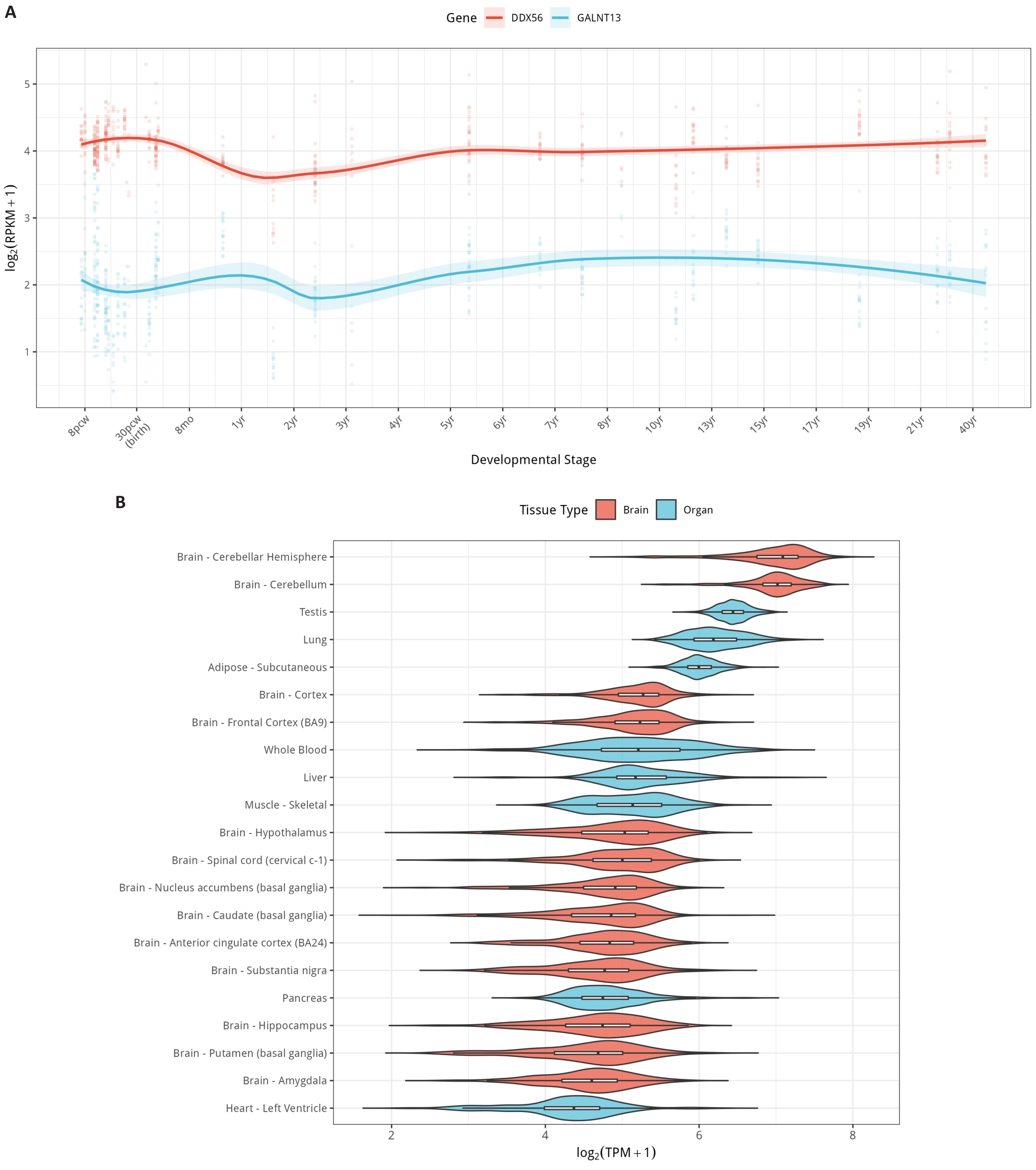
图11 Ddx56与Galnt13在人类全脑发育过程中及不同组织中的表达
Fig.11 Expression of Ddx56 and Galnt13 during human whole-brain development and in different tissues. A: Expression of Ddx56 and Galnt13 during human whole-brain development, based on RNA-seq data from the Genotype-Tissue Expression (GTEx) database. B: Expression of Ddx56 in various tissues based on GTEx database (red indicates different brain regions, and blue indicates other tissues).
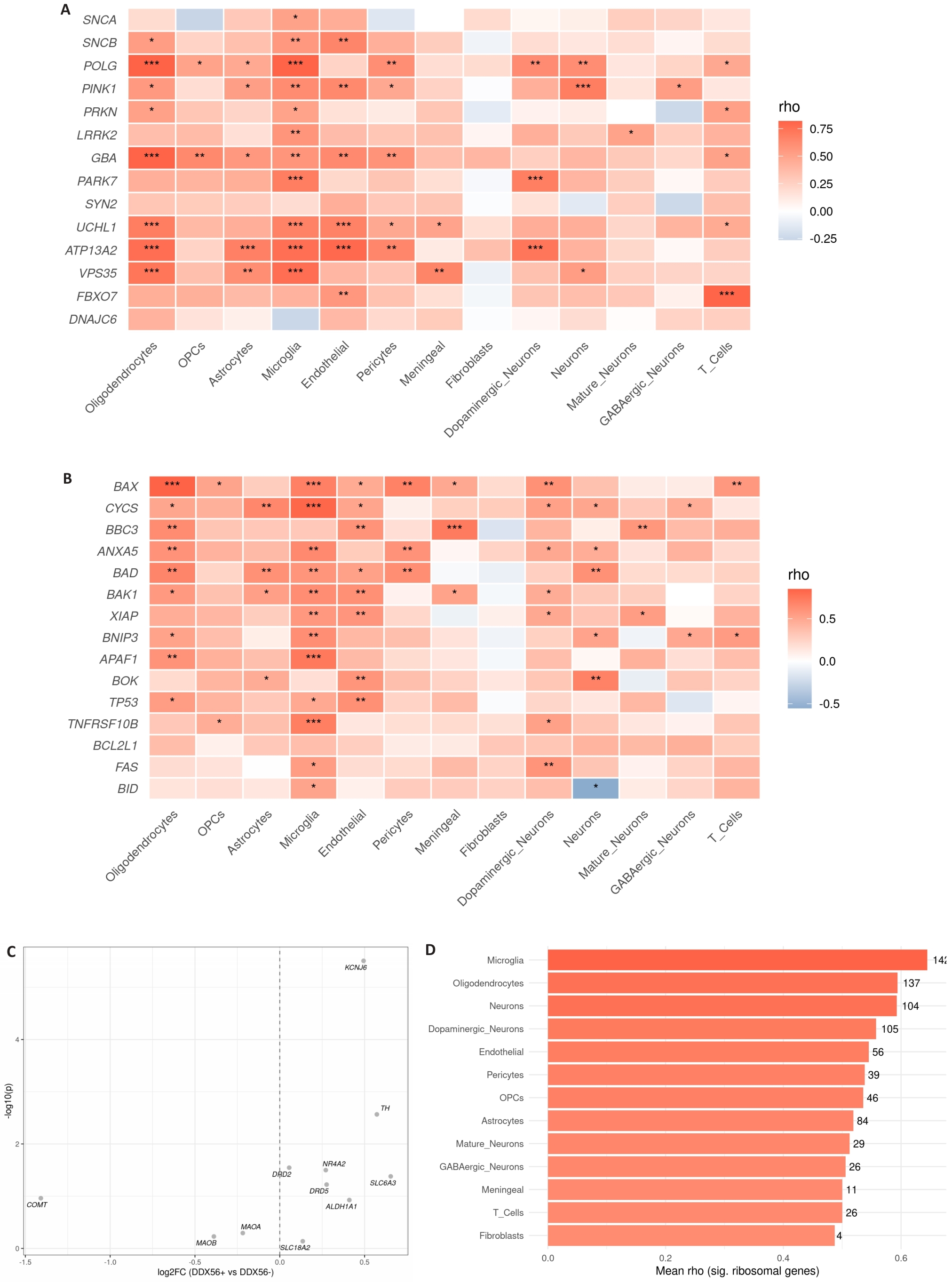
图12 Ddx56在人类单细胞转录组数据中的功能分析
Fig.12 Functional analysis of Ddx56 in human single-cell transcriptomic data. A: Rho (Spearman's correlation coefficient) of Ddx56 with PD-related genes across human brain cell populations. B: Rho of Ddx56 with apoptosis-related genes across human brain cell populations. C: DA-related differentially expressed genes between Ddx56+ and Ddx56- cells. D: Correlation strength (average Rho) of Ddx56 with ribosomal genes across different human brain cell populations. *P<0.05, **P<0.01, ***P<0.001.
| [1] | GBD 2016 Neurology Collaborators. Global, regional, and national burden of neurological disorders, 1990-2016: a systematic analysis for the Global Burden of Disease Study 2016[J]. Lancet Neurol, 2019, 18(5): 459-80. |
| [2] | Grotewold N, Albin RL. Update: descriptive epidemiology of Parkinson disease[J]. Park Relat Disord, 2024, 120: 106000. doi:10.1016/j.parkreldis.2024.106000 |
| [3] | Lim SY, Klein C. Parkinson's disease is predominantly a genetic disease[J]. J Park Dis, 2024, 14(3): 467-82. doi:10.3233/jpd-230376 |
| [4] | Abu Manneh R, Chairta PP, Mitsi E, et al. Genetic study of early onset Parkinson's disease in Cyprus[J]. Int J Mol Sci, 2022, 23(23): 15369. doi:10.3390/ijms232315369 |
| [5] | Mehanna R, Smilowska K, Fleisher J, et al. Age cutoff for early-onset Parkinson's disease: recommendations from the international Parkinson and movement disorder society task force on early onset Parkinson's disease[J]. Movement Disord Clin Pract, 2022, 9(7): 869-78. doi:10.1002/mdc3.13523 |
| [6] | Kroemer G, Maier AB, Cuervo AM, et al. From geroscience to precision geromedicine: Understanding and managing aging[J]. Cell, 2025, 188(8): 2043-62. doi:10.1016/j.cell.2025.03.011 |
| [7] | Wu D, Sun JK, Chow KH. Neuronal cell cycle reentry events in the aging brain are more prevalent in neurodegeneration and lead to cellular senescence[J]. PLoS Biol, 2024, 22(4): e3002559. doi:10.1371/journal.pbio.3002559 |
| [8] | Mato-Blanco X, Kim SK, Jourdon A, et al. Early developmental origins of cortical disorders modeled in human neural stem cells[J]. Nat Commun, 2025, 16: 6347. doi:10.1038/s41467-025-61316-w |
| [9] | Whalley LJ, Dick FD, McNeill G. A life-course approach to the aetiology of late-onset dementias[J]. Lancet Neurol, 2006, 5(1): 87-96. doi:10.1016/s1474-4422(05)70286-6 |
| [10] | Miller Z, Twardowski LM, Reader BF, et al. Mechanisms and markers of lung ageing in health and disease[J]. Eur Respir Rev, 2025, 34(177): 240233. doi:10.1183/16000617.0233-2024 |
| [11] | Cogan G, Lesage S, Brice A. The genetics of autosomal recessive early-onset Parkinson's disease[J]. Curr Opin Neurobiol, 2025, 95: 103141. doi:10.1016/j.conb.2025.103141 |
| [12] | Hua P, Zhao YW, Zeng Q, et al. Genetic analysis of patients with early-onset Parkinson's disease in Eastern China[J]. Front Aging Neurosci, 2022, 14: 849462. doi:10.3389/fnagi.2022.849462 |
| [13] | Hickman J, Tsai A, Fullard M, et al. Early-onset Parkinson's disease: unique features and management approaches[J]. Curr Neurol Neurosci Rep, 2026, 26(1): 3. doi:10.1007/s11910-025-01470-2 |
| [14] | Tay YW, Tan AH, Lim JL, et al. Genetic study of early-onset Parkinson's disease in the Malaysian population[J]. Park Relat Disord, 2023, 111: 105399. doi:10.1016/j.parkreldis.2023.105399 |
| [15] | Cook L, Verbrugge J, Schwantes-An TH, et al. Parkinson's disease variant detection and disclosure: PD GENEration, a North American study[J]. Brain, 2024, 147(8): 2668-79. doi:10.1093/brain/awae142 |
| [16] | Vollstedt EJ, Schaake S, Lohmann K, et al. Embracing monogenic Parkinson's Disease: The MJFF Global Genetic PD Cohort[J]. Mov Disord, 2023, 38(2): 286-303. |
| [17] | Sharma D, Jankowsky E. The Ded1/DDX3 subfamily of DEAD-box RNA helicases[J]. Crit Rev Biochem Mol Biol, 2014, 49(4): 343-60. doi:10.3109/10409238.2014.931339 |
| [18] | Valiente-Echeverría F, Hermoso MA, Soto-Rifo R. RNA helicase DDX3: at the crossroad of viral replication and antiviral immunity[J]. Rev Med Virol, 2015, 25(5): 286-99. doi:10.1002/rmv.1845 |
| [19] | Zhao JZ, Xu LM, Ren GM, et al. Identification and characterization of DEAD-box RNA helicase DDX3 in rainbow trout (Oncorhynchus mykiss) and its relationship with infectious hematopoietic necrosis virus infection[J]. Dev Comp Immunol, 2022, 135: 104493. doi:10.1016/j.dci.2022.104493 |
| [20] | Meier-Stephenson V, Mrozowich T, Pham M, et al. DEAD-box helicases: the Yin and Yang roles in viral infections[J]. Biotechnol Genet Eng Rev, 2018, 34(1): 3-32. doi:10.1080/02648725.2018.1467146 |
| [21] | 许 茜, 范丽华, 林昆明, 等. 早发型帕金森病家系相关基因的筛查和危险度分析[J]. 海南医学院学报, 2024, 30(12): 888-96. |
| [22] | Qian H, Kang XJ, Hu J, et al. Reversing a model of Parkinson's disease with in situ converted nigral neurons[J]. Nature, 2020, 582(7813): 550-6. doi:10.1038/s41586-020-2388-4 |
| [23] | Alrouji M, Al-Kuraishy HM, Al-Gareeb AI, et al. Orexin pathway in Parkinson's disease: a review[J]. Mol Biol Rep, 2023, 50(7): 6107-20. doi:10.1007/s11033-023-08459-5 |
| [24] | Abou-Hany HO, El-Sherbiny M, Elshaer S, et al. Neuro-modulatory impact of felodipine against experimentally-induced Parkinson's disease: Possible contribution of PINK1-Parkin mitophagy pathway[J]. Neuropharmacology, 2024, 250: 109909. doi:10.1016/j.neuropharm.2024.109909 |
| [25] | Westenberger A, Brüggemann N, Klein C. Genetics of Parkinson's disease: from causes to treatment[J]. Cold Spring Harb Perspect Med, 2025, 15(7): a041774. doi:10.1101/cshperspect.a041774 |
| [26] | Park M, Lee YG. Association of family history and polygenic risk score with longitudinal prognosis in Parkinson disease[J]. Neurol Genet, 2024, 10: e200115. doi:10.1212/nxg.0000000000200115 |
| [27] | Kopalli SR, Vadia N, Varma P, et al. Neurodevelopmental origins of neurodegeneration: a lifespan perspective on brain vulnerability[J]. Brain Res, 2026, 1873: 150134. doi:10.1016/j.brainres.2025.150134 |
| [28] | Towns C, Fang ZH, Tan MMX, et al. Parkinson's families project: a UK-wide study of early onset and familial Parkinson's disease[J]. NPJ Parkinsons Dis, 2024,10(1): 188. |
| [29] | Boura I, Poplawska-Domaszewicz K, Limbachiya N, et al. Prodromal Parkinson's disease[J]. Neurol Clin, 2025, 43(2): 209-28. doi:10.1016/j.ncl.2024.12.004 |
| [30] | Keller PJ, Schmidt AD, Wittbrodt J, et al. Reconstruction of zebrafish early embryonic development by scanned light sheet microscopy[J]. Science, 2008, 322(5904): 1065-9. doi:10.1126/science.1162493 |
| [31] | Varshney GK, Carrington B, Pei WH, et al. A high-throughput functional genomics workflow based on CRISPR/Cas9-mediated targeted mutagenesis in zebrafish[J]. Nat Protoc, 2016, 11(12): 2357-75. doi:10.1038/nprot.2016.141 |
| [32] | Liu HH, Sun NY, Liu ZX, et al. Knockout of bcas3 gene causes neurodevelopment defects in zebrafish[J]. Biol Res, 2025, 58(1): 34. doi:10.1186/s40659-025-00615-4 |
| [33] | Howe K, Clark MD, Torroja CF, et al. The zebrafish reference genome sequence and its relationship to the human genome[J]. Nature, 2013, 496(7446): 498-503. |
| [34] | Xicoy H, Wieringa B, Martens GJM. The SH-SY5Y cell line in Parkinson’s disease research: a systematic review[J]. Mol Neurodegener, 2017, 12(1): 10. doi:10.1186/s13024-017-0149-0 |
| [35] | Li S, Liu YX, Dong YY, et al. DEAD-box helicase DDX24 is essential for endothelial mitochondrial function to maintain the blood-brain barrier[J]. Cell Rep, 2025, 44(10): 116428. doi:10.1016/j.celrep.2025.116428 |
| [36] | Pan X, Qian GH, Liu L, et al. Genetic analysis and reporting from whole-exome sequencing data in 1052 patients with intellectual disability[J]. J Mol Med, 2026, 104(1): 48. doi:10.1007/s00109-026-02652-2 |
| [37] | Duan WC, Huang GY, Sui Y, et al. Deficiency of DDX3X results in neurogenesis defects and abnormal behaviors via dysfunction of the Notch signaling[J]. Proc Natl Acad Sci USA, 2024, 121(45): e2404173121. doi:10.1073/pnas.2404173121 |
| [38] | Seaby EG, Godwin A, et al. Monoallelic de novo variants in DDX17 cause a neurodevelopmental disorder[J]. Brain, 2025, 148(4): 1155-68. doi:10.1093/brain/awae320 |
| [39] | Deng Y, Zou X, et al. GalNAc-T13 maintains neurite architecture and memory retention via O-GalNAc glycosylation of seizure protein 6[J]. Proc Natl Acad Sci USA, 2026, 123(10): e2508476123. doi:10.1073/pnas.2508476123 |
| [40] | 许淑娟, 谢晶莹, 毕英杰, 等. DDX56对脑心肌炎病毒体外增殖的调控作用研究[J]. 中华微生物学和免疫学杂志, 2020, 40(12): 909-15. doi:10.3760/cma.j.cn112309-20200820-00409 |
| [41] | Pirinçal A, Turan K. Human DDX56 protein interacts with influenza A virus NS1 protein and stimulates the virus replication[J]. Genet Mol Biol, 2021, 44: e20200158. doi:10.1590/1678-4685-gmb-2020-0158 |
| [42] | Kouyama Y, Masuda T, Fujii A, et al. Oncogenic splicing abnormalities induced by DEAD-Box Helicase 56 amplification in colorectal cancer[J]. Cancer Sci, 2019, 110(10): 3132-44. doi:10.1111/cas.14163 |
| [43] | Ruan ZH, Zhang YT, Quan Q, et al. Pan-cancer analysis identifies DDX56 as a prognostic biomarker associated with immune infiltration and drug sensitivity[J]. Front Genet, 2022, 13: 1004467. doi:10.3389/fgene.2022.1004467 |
| [44] | Wu QQ, Luo XY, Terp MG, et al. DDX56 modulates post-transcriptional Wnt signaling through miRNAs and is associated with early recurrence in squamous cell lung carcinoma[J]. Mol Cancer, 2021, 20(1): 108. doi:10.1186/s12943-021-01403-w |
| [45] | Driver JA, Logroscino G, Buring JE, et al. A prospective cohort study of cancer incidence following the diagnosis of Parkinson's disease[J]. Cancer Epidemiol Biomark Prev, 2007, 16(6): 1260-5. doi:10.1158/1055-9965.epi-07-0038 |
| [46] | Ibáñez K, Boullosa C, Tabarés-Seisdedos R, et al. Molecular evidence for the inverse comorbidity between central nervous system disorders and cancers detected by transcriptomic meta-analyses[J]. PLoS Genet, 2014, 10(2): e1004173. doi:10.1371/journal.pgen.1004173 |
| [47] | Brennand KJ, Marchetto MC, Benvenisty N, et al. Creating patient-specific neural cells for the in vitro study of brain disorders[J]. Stem Cell Reports, 2015, 5(6): 933-45. doi:10.1016/j.stemcr.2015.10.011 |
| [1] | 叶丽旋, 廖雨欣, 刘琼, 张佳, 高磊, 董钊扬. 逍遥散通过SKN-1抗氧化通路改善秀丽隐杆线虫帕金森病模型α-突触核蛋白聚集和神经元损伤[J]. 南方医科大学学报, 2026, 46(9): 2023-2034. |
| [2] | 马园园, 刘悦, 高宁, 霍宇萌, 陈美霓, 李佳文, 刘佳浩, 张满秋, 严冰冰, 许诺, 赵菊梅. 黄芪注射液通过多成分靶向CCL2/FOS/PPARG/CXCL8抑制宫颈癌恶性进展[J]. 南方医科大学学报, 2026, 46(9): 2206-2221. |
| [3] | 张雨, 孙康, 刘举达, 王舒晗, 裴静. 消核冲剂激活ASK1/MKK4/JNK通路促进乳腺上皮细胞凋亡改善大鼠乳腺增生分子机制[J]. 南方医科大学学报, 2026, 46(8): 1936-1946. |
| [4] | 乔通, 张龙涛, 章雨, 黄菊, 李晴晴, 耿志军, 胡建国, 李静. 异香草酸激活PPARγ通路改善线粒体功能缓解葡聚糖硫酸钠诱导的小鼠溃疡性结肠炎[J]. 南方医科大学学报, 2026, 46(7): 1487-1497. |
| [5] | 石科林, 齐霄川, 徐世祥, 高缘圆, 房明哲, 胡俊诚, 王春景, 刘长青, 郭俣. CHIR99021通过抑制GSK-3β/NF-κB信号通路减轻帕金森病小鼠的神经炎症[J]. 南方医科大学学报, 2026, 46(7): 1593-1600. |
| [6] | 侯玲, 唐莉莉, 陈清, 孙径汇, 陈小娟, 李炜, 赵杨. 温肾养肝方通过调节肠道生物活性物质改善帕金森病模型小鼠的肠道功能[J]. 南方医科大学学报, 2026, 46(5): 1131-1138. |
| [7] | 任乾千, 张宝文, 刘醒然, 丁伟利, 陈丹丹, 寇现娟. 40 Hz光闪烁刺激通过抑制STING信号通路改善帕金森病小鼠的认知功能障碍[J]. 南方医科大学学报, 2026, 46(10): 2325-2337. |
| [8] | 陈丹丹, 任乾千, 吕梦林, 张宝文, 刘醒然, 张蒙, 王阳, 寇现娟. 天麻钩藤饮通过抑制坏死性凋亡通路改善帕金森病小鼠的运动功能障碍[J]. 南方医科大学学报, 2025, 45(8): 1571-1580. |
| [9] | 常笑语, 张瀚文, 曹红亭, 侯玲, 孟鑫, 陶虹, 罗彦, 李光华. 热应激对大鼠胸主动脉内皮细胞生物钟基因 Bmal1和细胞周期蛋白表达水平的影响[J]. 南方医科大学学报, 2025, 45(7): 1353-1362. |
| [10] | 储菲, 陈孝华, 宋博文, 杨晶晶, 左芦根. 苏荠宁黄酮通过抑制PI3K/AKT信号通路拮抗肠上皮细胞凋亡改善小鼠实验性结肠炎[J]. 南方医科大学学报, 2025, 45(4): 819-828. |
| [11] | 黄妍, 陈曦, 秦梦晨, 高磊. 活络效灵丹促进斑马鱼尾鳍再生的核心靶点与免疫调控机制[J]. 南方医科大学学报, 2025, 45(3): 494-505. |
| [12] | 马思雨, 陈美庆, 吴天宇, 赵文红. 膳食亚麻木酚素通过调控Bcl2/Bax/caspase3信号轴通道改善大鼠母体反式脂肪酸暴露所导致的子代肾损伤[J]. 南方医科大学学报, 2025, 45(12): 2658-2666. |
| [13] | 刘柳青, 王坤, 王雪晴, 杜冰心. 枸杞多糖通过下调miR-23a减轻顺铂诱导的颗粒细胞损伤[J]. 南方医科大学学报, 2025, 45(11): 2340-2349. |
| [14] | 陶露, 陈悦, 黄林林, 郑旺, 宋雪, 项平, 胡建国. 珠子草素通过调控p38/JNK信号通路抑制肠上皮细胞凋亡保护肠屏障改善克罗恩病样肠炎[J]. 南方医科大学学报, 2025, 45(11): 2483-2495. |
| [15] | 刘硕, 李静, 吴兴旺. Swertiamarin通过抑制肠上皮细胞细胞凋亡改善TNBS诱导的实验性结肠炎[J]. 南方医科大学学报, 2024, 44(8): 1545-1552. |
| 阅读次数 | ||||||
|
全文 |
|
|||||
|
摘要 |
|
|||||
