
南方医科大学学报 ›› 2026, Vol. 46 ›› Issue (9): 2113-2122.doi: 10.12122/j.issn.1673-4254.2026.09.11
• • 上一篇
钱爱1( ), 黄传兵1,2(), 朱雅文1, 胡可心1, 宋昕冉1, 许宇翔1
收稿日期:2026-02-02
出版日期:2026-09-20
发布日期:2026-09-30
通讯作者:
黄传兵
E-mail:1838929252@qq.com;chuanbinh@163.com
作者简介:钱 爱,在读博士研究生,E-mail: 1838929252@qq.com
基金资助:
Ai QIAN1(), Chuanbing HUANG1,2(), Yawen ZHU1, Kexin HU1, Xinran SONG1, Yuxiang XU1
Received:2026-02-02
Online:2026-09-20
Published:2026-09-30
Contact:
Chuanbing HUANG
E-mail:1838929252@qq.com;chuanbinh@163.com
Supported by:摘要:
目的 基于网络药理学、分子对接技术,通过临床验证,探讨芪黄健脾滋肾颗粒(QJZG)对系统性红斑狼疮(SLE)肾损害患者巨噬细胞极化的影响。 方法 运用TCMSP、GeneCards、DrugBank、OMIM、TTD数据库获取QJZG及SLE、肾损害相关靶点;取三者交集得到潜在作用靶点;使用Cytoscape软件版本3.10.3,构建活性化合物与潜在靶标之间的相互作用网络及蛋白质互作关系网络。基于网络拓扑分析筛选出核心化合物成分与关键靶点,进而开展分子对接模拟验证。临床纳入62例SLE患者和30例健康人,将SLE患者分为观察组和对照组(n=31);运用Western blotting技术检测巨噬细胞极化相关蛋白(iNOS、Arg-1)的表达,RT-qPCR技术检测AMPK/ULK1信号通路(AMPK、mTOR、HIF-1α、ULK1)mRNA表达;并观察经QJZG干预后对SLE患者中医证候积分、肾功能(CREA、BUN、eGFR)及免疫功能指标(CD4+T cell、CD8+T cell、CD4+T cell/CD8+T cell)表达的影响。 结果 经筛选得到QJZG作用于SLE肾损害的关键活性成分3种,核心靶点基因9个;富集分析显示可能涉及TNF、HIF-1、mTOR、cAMP等信号通路;分子对接模拟分析表明,所选核心活性成分与潜在关键靶点之间展现出良好的结合能力,呈现出类似的结合活性特征,其中HIF-1α、mTOR是结合活性较好的靶蛋白。临床试验证实QJZG能够显著降低血清中CREA、BUN、iNOS蛋白、mTOR mRNA、HIF-1α mRNA、CD8+T cell表达水平(P<0.01),升高血清中eGFR、Arg-1蛋白、AMPK mRNA、ULK1 mRNA、CD4+T cell、CD4+T cell/CD8+T cell水平(P<0.01),降低中医证候积分(P<0.01)。 结论 揭示了QJZG通过多成分、多靶点协同调控SLE肾损伤的作用特征。复方中所含的槲皮素、山奈酚及7-O-甲基异微凸剑叶莎醇等代表性组份,可能通过与HIF-1α、mTOR等靶点结合,激活AMPK/ULK1信号通路,进而调控巨噬细胞极化,体现了中药复方“整体调控、多途径干预”的独特优势。
钱爱, 黄传兵, 朱雅文, 胡可心, 宋昕冉, 许宇翔. 芪黄健脾滋肾颗粒通过调控巨噬细胞免疫代谢重编程改善系统性红斑狼疮患者的肾脏损伤[J]. 南方医科大学学报, 2026, 46(9): 2113-2122.
Ai QIAN, Chuanbing HUANG, Yawen ZHU, Kexin HU, Xinran SONG, Yuxiang XU. Qihuang Jianpi Zishen Granule ameliorates renal injury in patients with systemic lupus erythematosus by regulating immunometabolic reprogramming of macrophages[J]. Journal of Southern Medical University, 2026, 46(9): 2113-2122.
| Gene | Amplicon size (bp) | Forward primer (5'→3') | Reverse primer (5'→3') |
|---|---|---|---|
| β-actin | 96 | CCCTGGAGAAGAGCTACGAG | GGAAGGAAGGCTGGAAGAGT |
| AMPK | 99 | CTTCGGCAAAGTGAAGATTG | CCAACAACATCTAAACTGCG |
| mTOR | 178 | GGCCAATGACCCAACATCTC | CATGATGCGATGCTCGATGT |
| HIF-1α | 168 | TAAGAAACCACCTATGACCTGC | TCTGGCTCATATCCCATCAA |
| ULK1 | 88 | CTTTTGTTTCTCCGTTGGGG | GGGCTGCTAATCCGAATCC |
表1 引物序列
Tab.1 Primer sequences for RT-qPCR
| Gene | Amplicon size (bp) | Forward primer (5'→3') | Reverse primer (5'→3') |
|---|---|---|---|
| β-actin | 96 | CCCTGGAGAAGAGCTACGAG | GGAAGGAAGGCTGGAAGAGT |
| AMPK | 99 | CTTCGGCAAAGTGAAGATTG | CCAACAACATCTAAACTGCG |
| mTOR | 178 | GGCCAATGACCCAACATCTC | CATGATGCGATGCTCGATGT |
| HIF-1α | 168 | TAAGAAACCACCTATGACCTGC | TCTGGCTCATATCCCATCAA |
| ULK1 | 88 | CTTTTGTTTCTCCGTTGGGG | GGGCTGCTAATCCGAATCC |
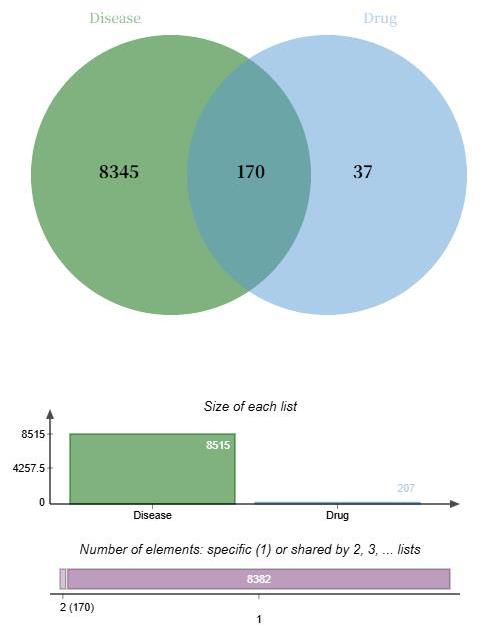
图1 活性成分靶点与疾病相关靶点交集的韦恩图
Fig.1 Venn diagram showing intersection between the targets of active ingredients of Qihuang Jianpi Zishen Granule (QJZG) and the disease.
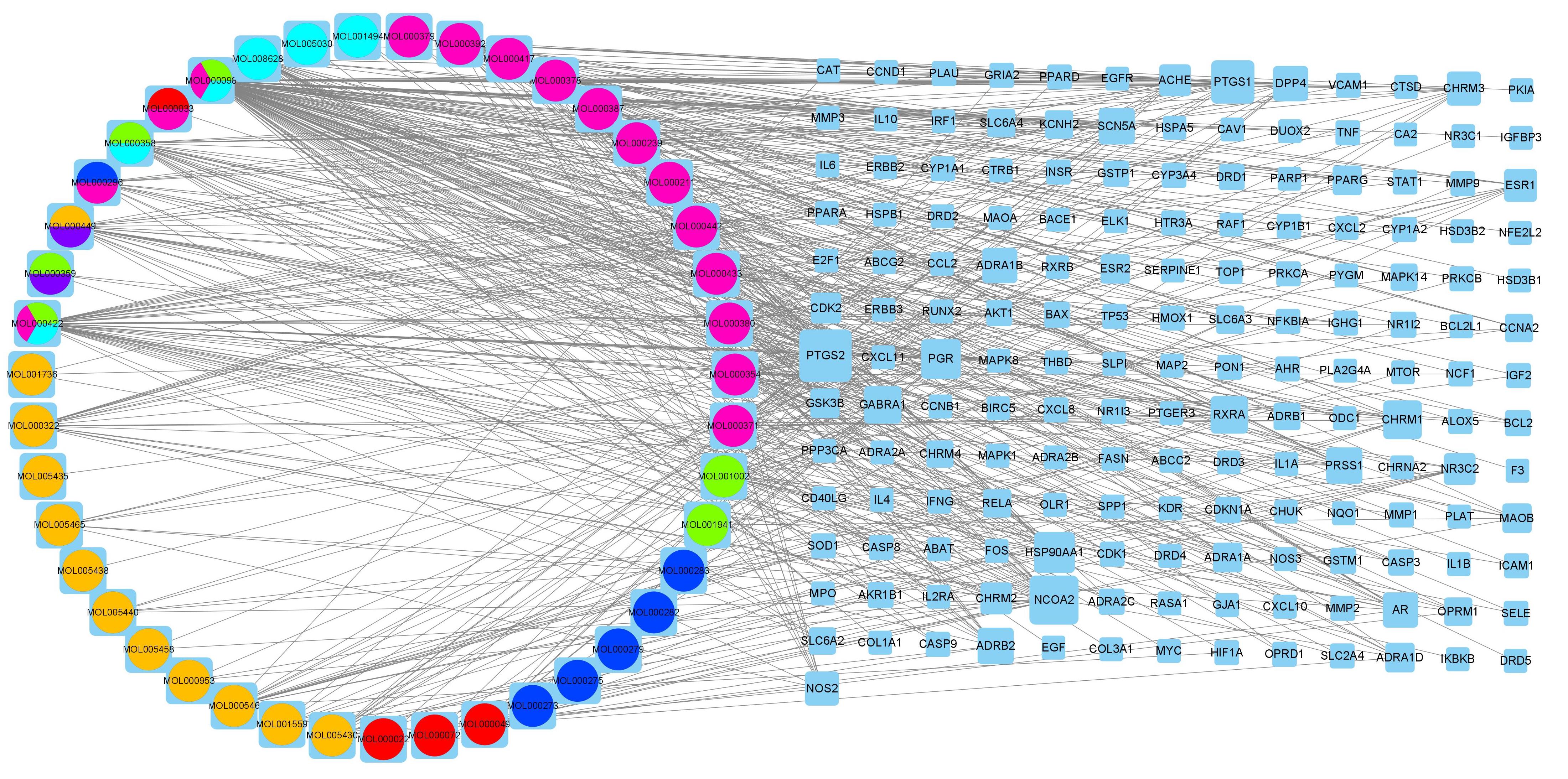
图2 主要活性成分-靶点网络
Fig.2 Component-target network.
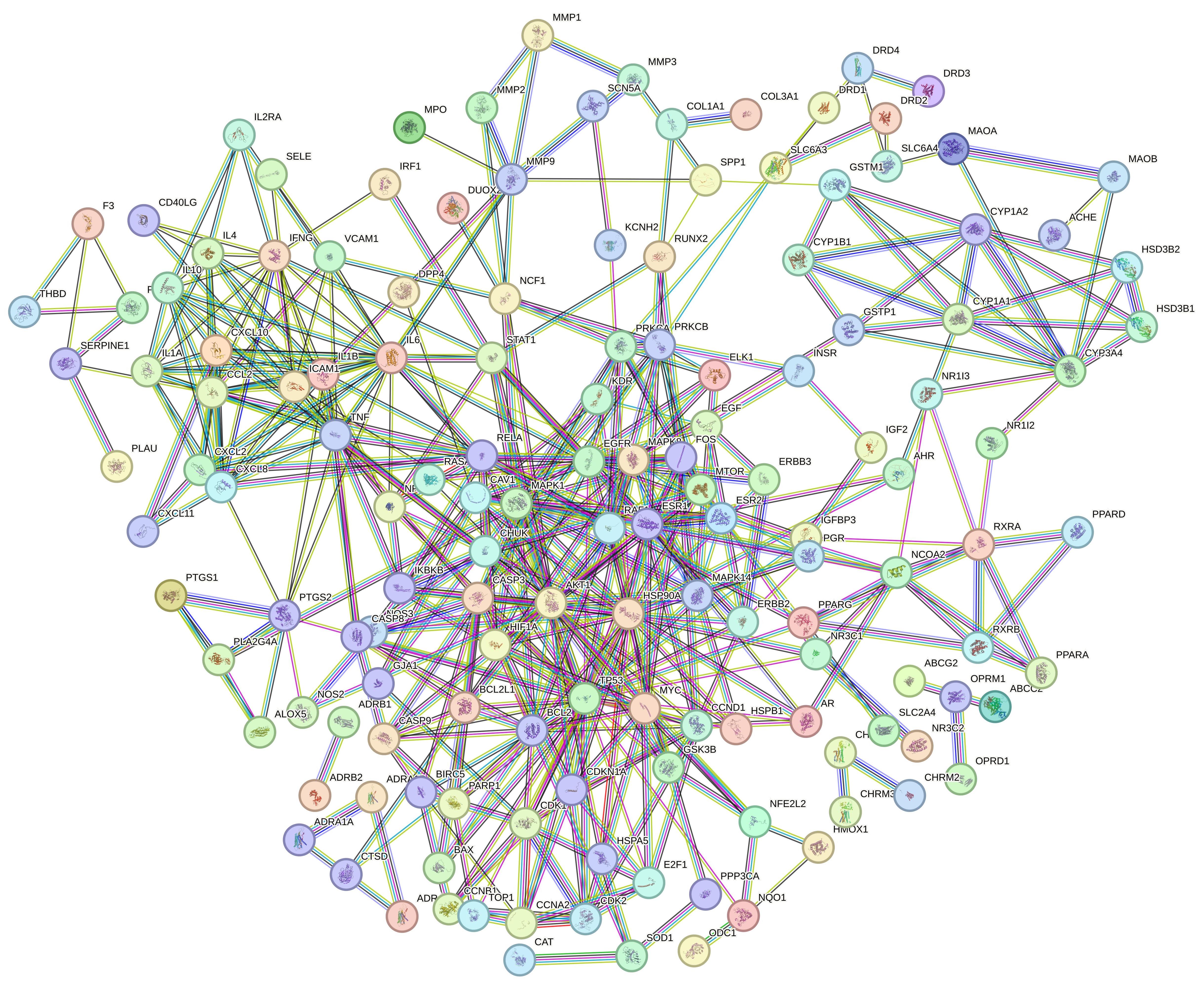
图3 PPI网络
Fig.3 Protein-protein interaction network.
| Ggene name | Protein name | Degree | Protein number |
|---|---|---|---|
| TP53 | Tumor protein p53 | 40 | Q12888 |
| MAPK1 | Mitogen-activated protein kinase 1 | 30 | O94737 |
| AKT1 | AKT Serine/Threonine Kinase 1 | 32 | Q38998 |
| HSP90AA1 | Heat shock protein90alpha family class A member1 | 24 | O94826 |
| IL-6 | Interleukin 6 | 30 | P05231 |
| ESR1 | Estrogen receptor 1 | 26 | P03372 |
| TNF | Tumor necrosis factor | 30 | Q9UNG2 |
| BCL2 | Apoptosis regulator Bcl-2 | 22 | Q9JJV8 |
| FOS | Protein c-Fos | 24 | O77628 |
表2 核心靶点信息
Tab.2 Core target information
| Ggene name | Protein name | Degree | Protein number |
|---|---|---|---|
| TP53 | Tumor protein p53 | 40 | Q12888 |
| MAPK1 | Mitogen-activated protein kinase 1 | 30 | O94737 |
| AKT1 | AKT Serine/Threonine Kinase 1 | 32 | Q38998 |
| HSP90AA1 | Heat shock protein90alpha family class A member1 | 24 | O94826 |
| IL-6 | Interleukin 6 | 30 | P05231 |
| ESR1 | Estrogen receptor 1 | 26 | P03372 |
| TNF | Tumor necrosis factor | 30 | Q9UNG2 |
| BCL2 | Apoptosis regulator Bcl-2 | 22 | Q9JJV8 |
| FOS | Protein c-Fos | 24 | O77628 |
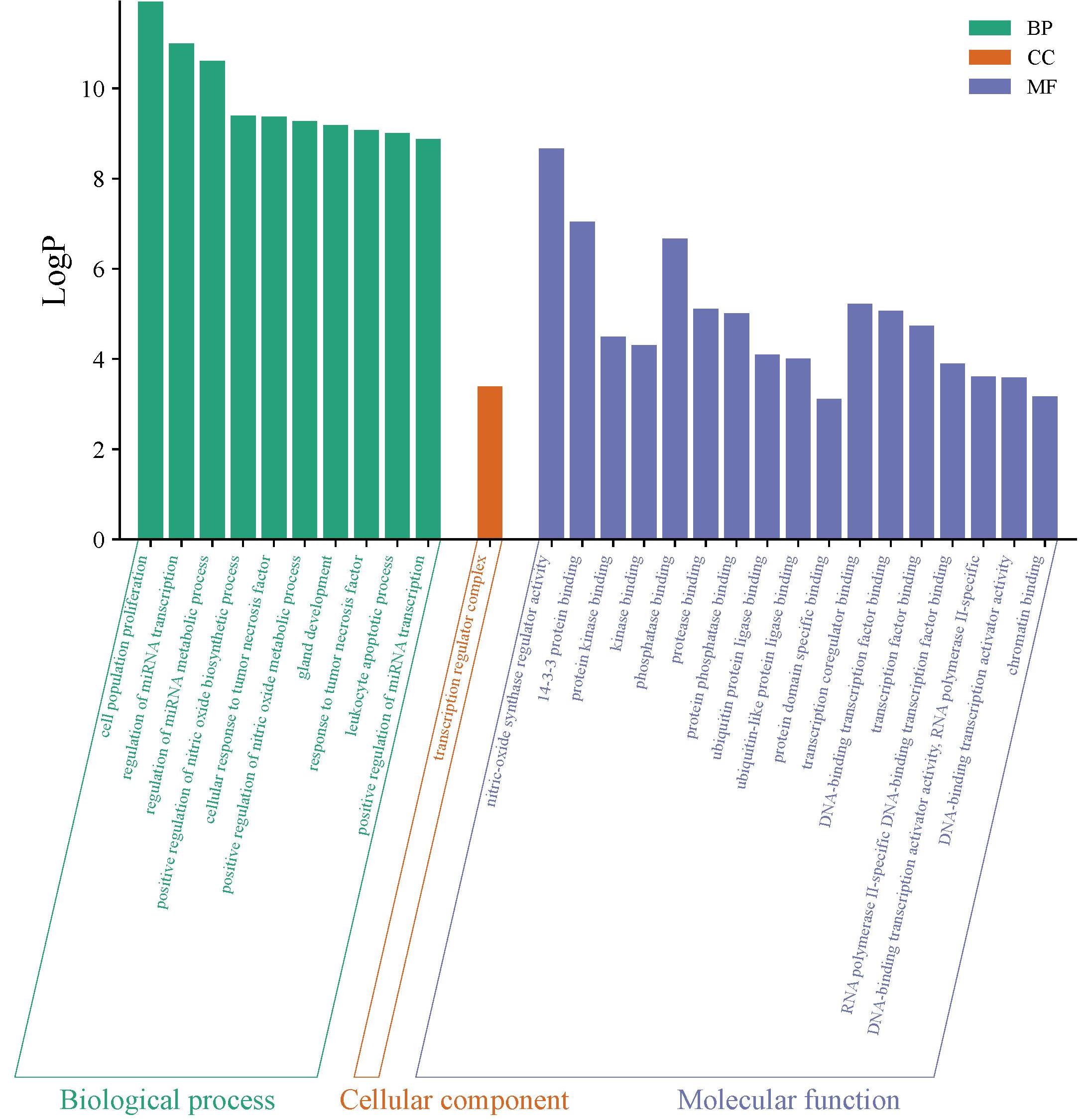
图4 GO功能富集分析结果图
Fig.4 Results of GO functional enrichment analysis.
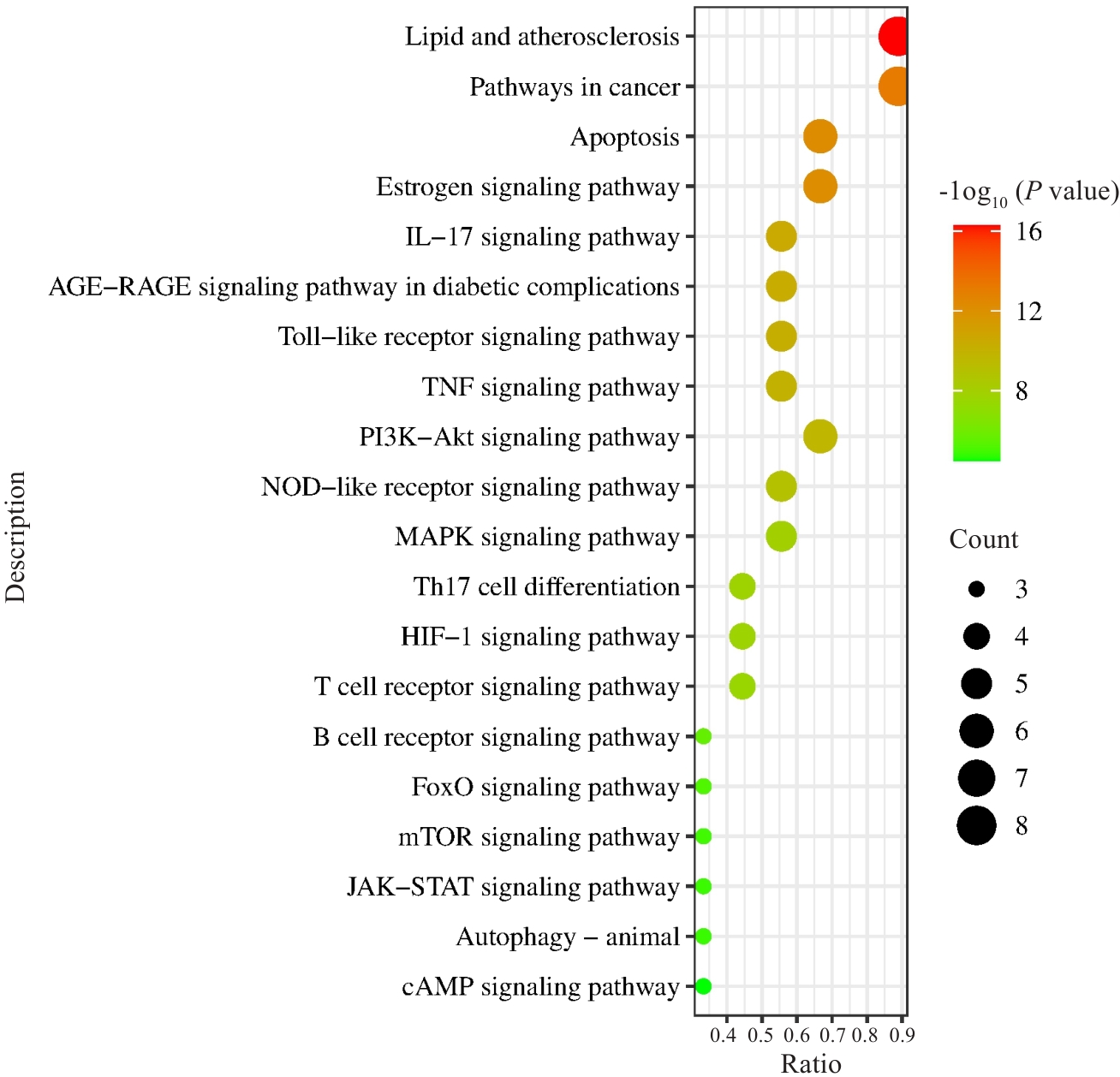
图5 KEGG通路富集分析图
Fig.5 KEGG pathway enrichment analysis.
| Key ingtedients | Target | Affinity (kcal/mol) |
|---|---|---|
| Quercetin | HIF-1α | -7.0 |
| mTOR | -7.0 | |
| Kaempferol | HIF-1α | -7.0 |
| mTOR | -6.7 | |
| 7-O-methylisomucronulatol | HIF-1α | -6.7 |
| mTOR | -6.0 |
表3 活性成分与核心模块靶点的分子对接结果
Tab.3 Molecular docking results of the active components against the core module targets
| Key ingtedients | Target | Affinity (kcal/mol) |
|---|---|---|
| Quercetin | HIF-1α | -7.0 |
| mTOR | -7.0 | |
| Kaempferol | HIF-1α | -7.0 |
| mTOR | -6.7 | |
| 7-O-methylisomucronulatol | HIF-1α | -6.7 |
| mTOR | -6.0 |
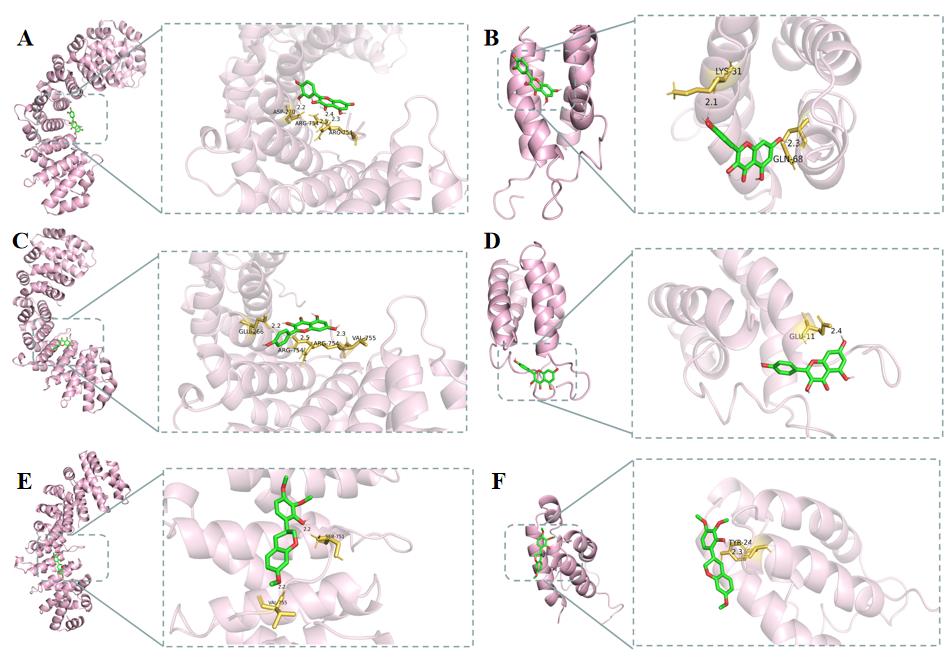
图6 高活性组分与核心模块靶点的分子对接模式图
Fig.6 Molecular docking patterns between highly active components and the core module targets. A: HIF-1α+quercetin.B:mTOR+quercetin. C: HIF-1α+kaempferol.D: mTOR+kaempferol. E: HIF-1α+7-O-methylisomucronulatol.F: mTOR+7-O-methylisomucronulatol.
| Group | TCM syndrome scores | |
|---|---|---|
| Pre-treatment | Post-treatment | |
| Control | 22.29±2.27 | 16.87±1.77** |
| Observation | 21.32±2.21 | 12.68±1.49**△△ |
表4 两组患者中医证候积分的比较
Tab.4 Comparison of TCM syndrome scores between the two groups of SLE patients (n=31, Mean±SD)
| Group | TCM syndrome scores | |
|---|---|---|
| Pre-treatment | Post-treatment | |
| Control | 22.29±2.27 | 16.87±1.77** |
| Observation | 21.32±2.21 | 12.68±1.49**△△ |
| Index | Control | Observation | ||
|---|---|---|---|---|
| Pre-treatment | Post-treatment | Pre-treatment | Post-treatment | |
| CREA | 76.55±14.22 | 70.01±10.55** | 77.50±14.84 | 64.15±8.85**△△ |
| BUN | 13.95±3.85 | 8.45±1.45** | 13.03±3.35 | 6.50±1.45**△△ |
| eGFR | 93.36±15.30 | 109.78±17.02** | 93.60±20.46 | 124.50±30.50**△△ |
表5 两组患者CREA、BUN、eGFR的比较
Tab.5 Comparison of CREA, BUN, eGFR between the two groups of SLE patients (n=31, Mean±SD)
| Index | Control | Observation | ||
|---|---|---|---|---|
| Pre-treatment | Post-treatment | Pre-treatment | Post-treatment | |
| CREA | 76.55±14.22 | 70.01±10.55** | 77.50±14.84 | 64.15±8.85**△△ |
| BUN | 13.95±3.85 | 8.45±1.45** | 13.03±3.35 | 6.50±1.45**△△ |
| eGFR | 93.36±15.30 | 109.78±17.02** | 93.60±20.46 | 124.50±30.50**△△ |
| Index | Control | Observation | ||
|---|---|---|---|---|
| Pre-treatment | Post-treatment | Pre-treatment | Post-treatment | |
| iNOS | 1.07±0.08 | 0.83±0.05** | 1.08±0.08 | 0.52±0.07**△△ |
| Arg-1 | 0.59±0.09 | 0.82±0.04** | 0.60±0.08 | 1.15±0.06**△△ |
表6 两组患者iNOS、Arg-1的比较
Tab.6 Comparison of iNOS and Arg-1 between the two groups of SLE patients (n=31, Mean±SD)
| Index | Control | Observation | ||
|---|---|---|---|---|
| Pre-treatment | Post-treatment | Pre-treatment | Post-treatment | |
| iNOS | 1.07±0.08 | 0.83±0.05** | 1.08±0.08 | 0.52±0.07**△△ |
| Arg-1 | 0.59±0.09 | 0.82±0.04** | 0.60±0.08 | 1.15±0.06**△△ |
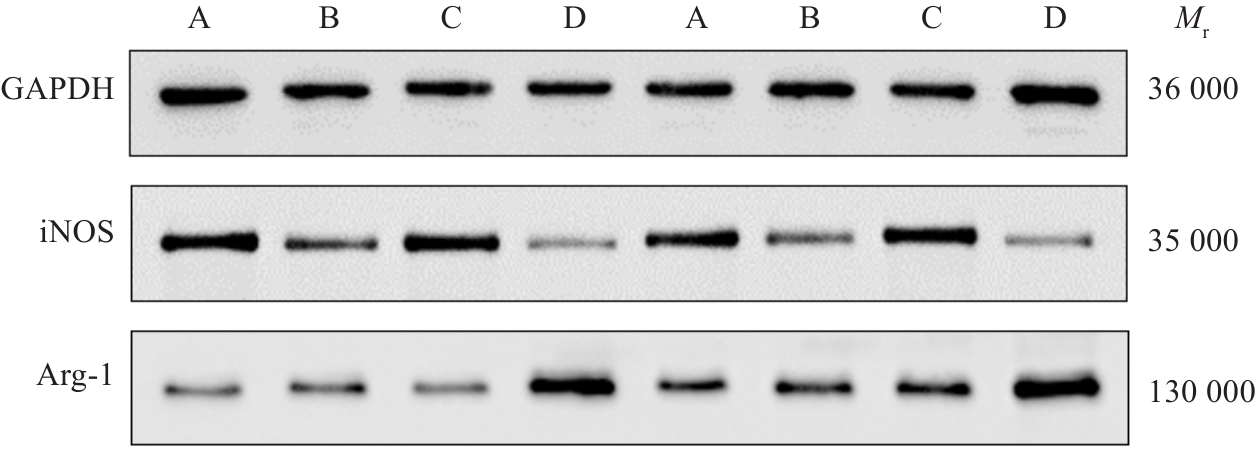
图7 两组患者巨噬细胞标志蛋白表达的比较
Fig.7 Macrophage marker protein expression in the two groups of SLE patients. A: Control group (before treatment). B: Control group (after treatment). C: QJZG treatment group (before treatment). D: QJZG treatment group (after treatment).
| Index | Normal (n=30) | Control (n=31) | Observation (n=31) | |||
|---|---|---|---|---|---|---|
| Pre-treatment | Post-treatment | Pre-treatment | Post-treatment | Pre-treatment | Post-treatment | |
| AMPK | 1.65±0.61 | - | 0.86±0.22▲▲ | 1.26±0.55** | 0.93±0.22▲▲ | 1.50±0.24**△△ |
| mTOR | 0.73±0.27 | - | 1.17±0.27▲▲ | 1.00±0.07** | 1.24±0.27▲▲ | 0.85±0.13**△△ |
| HIF-1α | 0.45±0.10 | - | 0.77±0.17▲▲ | 0.65±0.15** | 0.80±0.16▲▲ | 0.48±0.12**△△ |
| ULK1 | 2.45±0.83 | - | 1.18±0.53▲▲ | 1.63±0.82** | 1.13±0.37▲▲ | 2.11±0.79**△△ |
表7 各组AMPK、mTOR、HIF-1α、ULK1的比较
Tab.7 Comparison of AMPK, mTOR, HIF-1α, and ULK1 among the 3 groups of participants (Mean±SD)
| Index | Normal (n=30) | Control (n=31) | Observation (n=31) | |||
|---|---|---|---|---|---|---|
| Pre-treatment | Post-treatment | Pre-treatment | Post-treatment | Pre-treatment | Post-treatment | |
| AMPK | 1.65±0.61 | - | 0.86±0.22▲▲ | 1.26±0.55** | 0.93±0.22▲▲ | 1.50±0.24**△△ |
| mTOR | 0.73±0.27 | - | 1.17±0.27▲▲ | 1.00±0.07** | 1.24±0.27▲▲ | 0.85±0.13**△△ |
| HIF-1α | 0.45±0.10 | - | 0.77±0.17▲▲ | 0.65±0.15** | 0.80±0.16▲▲ | 0.48±0.12**△△ |
| ULK1 | 2.45±0.83 | - | 1.18±0.53▲▲ | 1.63±0.82** | 1.13±0.37▲▲ | 2.11±0.79**△△ |
| Index | Control | Observation | ||
|---|---|---|---|---|
| Pre-treatment | Post-treatment | Pre-treatment | Post-treatment | |
| CD4+(%) | 26.05±5.77 | 44.54±5.66** | 25.67±5.31 | 57.12±5.41**△△ |
| CD8+(%) | 46.45±9.87 | 30.32±3.87** | 44.66±9.38 | 24.04±2.27**△△ |
| CD4+/CD8+ | 0.56±0.03 | 1.47±0.04** | 0.58±0.04 | 2.38±0.02**△△ |
表8 两组患者免疫功能指标的比较
Tab.8 Comparison of immune function related indicators between the two groups of SLE patients (n=31, Mean±SD)
| Index | Control | Observation | ||
|---|---|---|---|---|
| Pre-treatment | Post-treatment | Pre-treatment | Post-treatment | |
| CD4+(%) | 26.05±5.77 | 44.54±5.66** | 25.67±5.31 | 57.12±5.41**△△ |
| CD8+(%) | 46.45±9.87 | 30.32±3.87** | 44.66±9.38 | 24.04±2.27**△△ |
| CD4+/CD8+ | 0.56±0.03 | 1.47±0.04** | 0.58±0.04 | 2.38±0.02**△△ |
| [1] | Durcan L, O’Dwyer T, Petri M. Management strategies and future directions for systemic lupus erythematosus in adults[J]. Lancet, 2019, 393(10188): 2332-43. doi:10.1016/s0140-6736(19)30237-5 |
| [2] | Gasparotto M, Gatto M, Binda V, et al. Lupus nephritis: clinical presentations and outcomes in the 21st century[J]. Rheumatology, 2020, 59(): v39-51. doi:10.1093/rheumatology/keaa381 |
| [3] | Caster DJ, Powell DW. Utilization of biomarkers in lupus nephritis[J]. Adv Chronic Kidney Dis, 2019, 26(5): 351-9. doi:10.1053/j.ackd.2019.09.001 |
| [4] | 李 明, 尚双双, 李云飞, 等. 芪黄健脾滋肾颗粒治疗脾肾亏虚型系统性红斑狼疮的临床疗效观察[J]. 时珍国医国药, 2023, 34(2): 370-3. doi:10.3969/j.issn.1008-0805.2023.02.31 |
| [5] | 钱 爱, 程园园, 朱雅文, 等. 芪黄健脾滋肾颗粒治疗系统性红斑狼疮的疗效观察[J]. 安徽中医药大学学报, 2023, 42(6): 7-12. doi:10.3969/j.issn.2095-7246.2023.06.003 |
| [6] | 李云飞, 庞利君, 束龙武, 等. 芪黄健脾滋肾方在脾肾两虚型系统性红斑狼疮患者达标治疗中的临床疗效观察[J]. 中药药理与临床, 2024, 40(11): 62-6. |
| [7] | Cheng Q, Mou LJ, Su WJ, et al. Ferroptosis of CD163+ tissue-infiltrating macrophages and CD10+ PC(+) epithelial cells in lupus nephritis[J]. Front Immunol, 2023, 14: 1171318. doi:10.3389/fimmu.2023.1171318 |
| [8] | Cheng Y, Liu L, Ye Y, et al. Roles of macrophages in lupus nephritis. Front Pharmacol. 2024 Nov 14;15:1477708. doi:10.3389/fphar.2024.1477708 |
| [9] | Hung CM, Lombardo PS, Malik N, et al. AMPK/ULK1-mediated phosphorylation of Parkin ACT domain mediates an early step in mitophagy[J]. Sci Adv, 2021, 7(15): eabg4544. doi:10.1126/sciadv.abg4544 |
| [10] | Hu YQ, Chen H, Zhang LY, et al. The AMPK-MFN2 axis regulates MAM dynamics and autophagy induced by energy stresses[J]. Autophagy, 2021, 17(5): 1142-56. doi:10.1080/15548627.2020.1749490 |
| [11] | Aringer M, Costenbader KH, Dörner T, et al. Response to: ''2019 European League Against Rheumatism/American College of Rheumatology classification criteria for systemic lupus erythematosus' by Aringer et Al' by Cui et al[J]. Ann Rheum Dis, 2022, 81(9): e166. doi:10.1136/annrheumdis-2020-218615 |
| [12] | 路志正. 实用中医风湿病学[M]. 北京: 人民卫生出版社, 1996: 490-497. |
| [13] | 国家中医药管理局.中医病证诊断疗效标准[M].南京:南京大学出版社,1994:20. |
| [14] | 姜 泉. 实用中医风湿免疫病学[M]. 北京: 中国中医药出版社, 2022. |
| [15] | Ding T, Yi TT, Li Y, et al. Luteolin attenuates lupus nephritis by regulating macrophage oxidative stress via HIF-1α pathway[J]. Eur J Pharmacol, 2023, 953: 175823. doi:10.1016/j.ejphar.2023.175823 |
| [16] | Bai ZR, Lu ZM, Liu R, et al. Iguratimod restrains circulating follicular helper T cell function by inhibiting glucose metabolism via Hif1α-HK2 axis in rheumatoid arthritis[J]. Front Immunol, 2022, 13: 757616. doi:10.3389/fimmu.2022.757616 |
| [17] | 褚福瑞. 芪黄健脾滋肾颗粒体内外物质基础及对系统性红斑狼疮的网络药理学研究[D]. 合肥: 安徽中医药大学, 2023. |
| [18] | Chen HY, Chiang YF, Hong YH, et al. Quercetin ameliorates renal injury and pyroptosis in lupus nephritis through inhibiting IL-33/ST2 pathway in vitro and in vivo [J]. Antioxidants, 2022, 11(11): 2238. doi:10.3390/antiox11112238 |
| [19] | Song ZY, Ji LN, Wu S, et al. Molecular mechanism of QH-BJ drug pair in the treatment of systemic lupus erythematosus based on network pharmacology and molecular docking[J]. Medicine, 2022, 101(48): e32062. doi:10.1097/md.0000000000032062 |
| [20] | Guo MF, Dai YJ, Gao JR, et al. Uncovering the mechanism of Astragalus membranaceus in the treatment of diabetic nephropathy based on network pharmacology[J]. J Diabetes Res, 2020, 2020: 5947304. doi:10.1155/2020/5947304 |
| [21] | O'Neill LAJ, Kishton RJ, Rathmell J. A guide to immunometabolism for immunologists[J]. Nat Rev Immunol, 2016, 16(9): 553-65. doi:10.1038/nri.2016.70 |
| [22] | Orecchioni M, Ghosheh Y, Pramod AB, et al. Macrophage polarization: different gene signatures in M1(LPS+) vs. classically and M2(LPS-) vs. alternatively activated macrophages[J]. Front Immunol, 2019, 10: 1084. doi:10.3389/fimmu.2019.01084 |
| [23] | Ma ZW, Li L, Livingston MJ, et al. p53/microRNA-214/ULK1 axis impairs renal tubular autophagy in diabetic kidney disease[J]. J Clin Invest, 2020, 130(9): 5011-26. doi:10.1172/jci135536 |
| [24] | Ba X, Huang Y, Shen P, et al. WTD attenuating rheumatoid arthritis via suppressing angiogenesis and modulating the PI3K/AKT/mTOR/HIF-1α pathway[J]. Front Pharmacol, 2021, 12: 696802. doi:10.3389/fphar.2021.696802 |
| [25] | Wang SY, Liu RC, Yu Q, et al. Metabolic reprogramming of macrophages during infections and cancer[J]. Cancer Lett, 2019, 452: 14-22. doi:10.1016/j.canlet.2019.03.015 |
| [26] | Liang CL, Wei YY, Chen Y, et al. Zhen-Wu-Tang ameliorates lupus nephritis by diminishing renal tissue-resident memory CD8+ T cells via suppressing IL-15/STAT3 pathway[J]. Biomed Pharmacother, 2024, 174: 116597. doi:10.1016/j.biopha.2024.116597 |
| [27] | Escalona E, Olate-Briones A, Albornoz-Muñoz S, et al. Neu1 deficiency and fibrotic lymph node microenvironment lead to imbalance in M1/M2 macrophage polarization[J]. Front Immunol, 2024, 15: 1462853. doi:10.3389/fimmu.2024.1462853 |
| [28] | Yuan YX, Hu RC, Park J, et al. Macrophage-derived chemokine CCL22 establishes local LN-mediated adaptive thermogenesis and energy expenditure[J]. Sci Adv, 2024, 10(26): eadn5229. doi:10.1126/sciadv.adn5229 |
| [29] | Cai WW, Cheng JW, Zong SY, et al. The glycolysis inhibitor 2-deoxyglucose ameliorates adjuvant-induced arthritis by regulating macrophage polarization in an AMPK-dependent manner[J]. Mol Immunol, 2021, 140: 186-95. doi:10.1016/j.molimm.2021.10.007 |
| [30] | Yuan SW, Zeng YT, Li JW, et al. Phenotypical changes and clinical significance of CD4+/CD8+ T cells in SLE[J]. Lupus Sci Med, 2022, 9(1): e000660. doi:10.1136/lupus-2022-000660 |
| [31] | Geng R, Shang HJ, Chen ZQ, et al. ROS-responsive resiquimod prodrug nanoparticles for macrophage reprogramming and enhanced immune checkpoint inhibitor therapy in bladder cancer[J]. Biomaterials, 2026, 326: 123677. doi:10.1016/j.biomaterials.2025.123677 |
| [32] | Bai LX, Feng CJ, Xu X, et al. Investigation of the immunomodulatory effects and molecular mechanisms of cichoric acid on cyclophosphamide-induced immunosuppression in mice[J]. Int Immunopharmacol, 2026, 168(Pt 1): 115865. doi:10.1016/j.intimp.2025.115865 |
| [33] | 钱 爱. 基于AMPK/ULK1信号通路调控巨噬细胞M1/M2极化途径探讨芪黄健脾滋肾颗粒对SLE肾损害的干预机制[D]. 合肥: 安徽中医药大学, 2025. |
| [1] | 林灶强, 江梦瑶, 冯流畅, 方坤洋, 方萍君, 谭秦湘. 熟地黄通过多靶点机制治疗慢性肾脏病[J]. 南方医科大学学报, 2026, 46(7): 1611-1621. |
| [2] | 程园园, 黄传兵, 张娟, 朱雅文, 钱爱. 重骨颗粒通过调控Nrf2通路改善膝骨关节炎肝肾亏虚证患者的软骨损伤[J]. 南方医科大学学报, 2026, 46(5): 1028-1038. |
| [3] | 韩亮, 李百超, 王炳哲, 张志伟, 张九娜. 吐根酚碱通过Ras信号通路抑制结直肠癌的恶性生物学行为[J]. 南方医科大学学报, 2026, 46(5): 1121-1130. |
| [4] | 李云飞, 黄传兵, 庞利君, 朱子衡, 李明. 健脾滋肾方改善系统性红斑狼疮小鼠肾损害:基于p53-MDM2信号轴介导的铁死亡[J]. 南方医科大学学报, 2026, 46(4): 785-793. |
| [5] | 马扬, 郭龙辉, 王锦帼, 肖文萍, 吕运成, 范晓明. 灯盏乙素通过调控MMP7与LCN2改善大鼠代谢功能障碍相关脂肪性肝病[J]. 南方医科大学学报, 2026, 46(4): 907-922. |
| [6] | 肖洁, 金凌岳, 段丽娜, 龚英, 李海侠. 唾液链球菌胞外囊泡通过活化自然杀伤细胞加剧系统性红斑狼疮肾炎病理进展[J]. 南方医科大学学报, 2026, 46(3): 541-549. |
| [7] | 李钊泳, 周凤华, 孙晓敏, 赵华杉, 金瑶, 何培坤, 贾钰华. 降脂祛斑方多成分协同调控炎症-代谢网络改善2型糖尿病合并高脂血症:网络药理学与临床验证[J]. 南方医科大学学报, 2026, 46(1): 83-93. |
| [8] | 呼琴, 金华. 清肾颗粒通过调控miR-23b及Nrf2通路改善慢性肾脏病湿热证患者的肾功能:基于网络药理学和临床试验[J]. 南方医科大学学报, 2025, 45(9): 1867-1879. |
| [9] | 杨子为, 吕畅, 董柱, 计书磊, 毕生辉, 张雪花, 王晓武. 金樱子通过调控Src-AKT1轴抑制肺动脉高压平滑肌增殖[J]. 南方医科大学学报, 2025, 45(9): 1889-1902. |
| [10] | 云琦, 杜若丽, 贺玉莹, 张贻欣, 王佳慧, 叶红伟, 李正红, 高琴. 肉桂酸通过抑制TLR4减轻阿霉素诱导的小鼠心肌损伤铁死亡的发生[J]. 南方医科大学学报, 2025, 45(9): 1946-1958. |
| [11] | 饶璐, 丁家和, 魏江平, 阳勇, 张小梅, 王计瑞. 槐花通过抑制PI3K/AKT通路减轻炎症反应治疗银屑病[J]. 南方医科大学学报, 2025, 45(9): 1989-1996. |
| [12] | 汤忠富, 黄传兵, 李明, 程丽丽, 陈君洁, 尚双双, 刘思娣. 芪黄健脾滋肾颗粒通过抑制MyD88/NF-κB通路减轻MRL/lpr小鼠肾损害[J]. 南方医科大学学报, 2025, 45(8): 1625-1632. |
| [13] | 陈鑫源, 吴成挺, 李瑞迪, 潘雪芹, 张耀丹, 陶俊宇, 林才志. 双术汤通过P53/SLC7A11/GPX4通路诱导胃癌细胞铁死亡[J]. 南方医科大学学报, 2025, 45(7): 1363-1371. |
| [14] | 王立明, 陈宏睿, 杜燕, 赵鹏, 王玉洁, 田燕歌, 刘新光, 李建生. 益气滋肾方通过抑制PI3K/Akt/NF-κB通路改善小鼠慢性阻塞性肺疾病的炎症反应[J]. 南方医科大学学报, 2025, 45(7): 1409-1422. |
| [15] | 朱胤福, 李怡燃, 王奕, 黄颖而, 龚昆翔, 郝文波, 孙玲玲. 桂枝茯苓丸活性成分常春藤皂苷元通过抑制JAK2/STAT3通路抑制宫颈癌细胞的生长[J]. 南方医科大学学报, 2025, 45(7): 1423-1433. |
| 阅读次数 | ||||||
|
全文 |
|
|||||
|
摘要 |
|
|||||
