
南方医科大学学报 ›› 2025, Vol. 45 ›› Issue (11): 2405-2415.doi: 10.12122/j.issn.1673-4254.2025.11.13
潘兴旭1( ), 张秉祺2, 张智华1,3(), 曹秋实1,3()
收稿日期:2025-06-24
出版日期:2025-11-20
发布日期:2025-11-28
通讯作者:
张智华,曹秋实
E-mail:17860358705@163.com;1868@hbucm.edu.cn;2987@hbucm.edu.cn
作者简介:潘兴旭,在读硕士研究生,E-mail: 17860358705@163.com
基金资助:
Xingxu PAN1(), Bingqi ZHANG2, Zhihua ZHANG1,3(), Qiushi CAO1,3()
Received:2025-06-24
Online:2025-11-20
Published:2025-11-28
Contact:
Zhihua ZHANG, Qiushi CAO
E-mail:17860358705@163.com;1868@hbucm.edu.cn;2987@hbucm.edu.cn
Supported by:摘要:
目的 通过孟德尔随机化和动物实验探讨肠道菌群和肾结石之间的因果关系。 方法 基于MiBioGen联盟肠道菌群全基因组关联(GWAS)数据和IEU Open GWAS数据肾结石数据(ukb-b-8297),分别作为暴露因素和结局变量。主要采用逆方差加权法(IVW)进行分析,并辅以MR-Egger回归法、加权中位数法(WME)、加权模式法(WM)和简单众数法(SM),同时进行异质性、多效性和留一法敏感性分析。动物实验中,将12只雄性SD大鼠随机分为对照组和模型组,6只/组,通过1%乙二醇和2%氯化铵联合建立草酸钙肾结石模型,连续干预28 d后收集尿液、血液及肠道样本。检测肾功能以及肠道屏障相关指标,并结合组织学染色以及免疫组化评估肾脏与结肠的病理学变化。采用16S rRNA测序分析肠道菌群多样性以及丰度差异,并利用Wilcoxon秩和检验及LEfSe分析筛选差异菌属。 结果 MR分析显示,毛螺杆菌科NK4A136 group(Lachnospiraceae NK4A136
潘兴旭, 张秉祺, 张智华, 曹秋实. 戈登杆菌属丰度降低与肾结石风险增加相关:一项孟德尔随机化分析与动物实验研究[J]. 南方医科大学学报, 2025, 45(11): 2405-2415.
Xingxu PAN, Bingqi ZHANG, Zhihua ZHANG, Qiushi CAO. Reduced intestinal abundance of Gordonibacter increases risk of kidney stones: a Mendelian randomization study and evidence from rat models[J]. Journal of Southern Medical University, 2025, 45(11): 2405-2415.
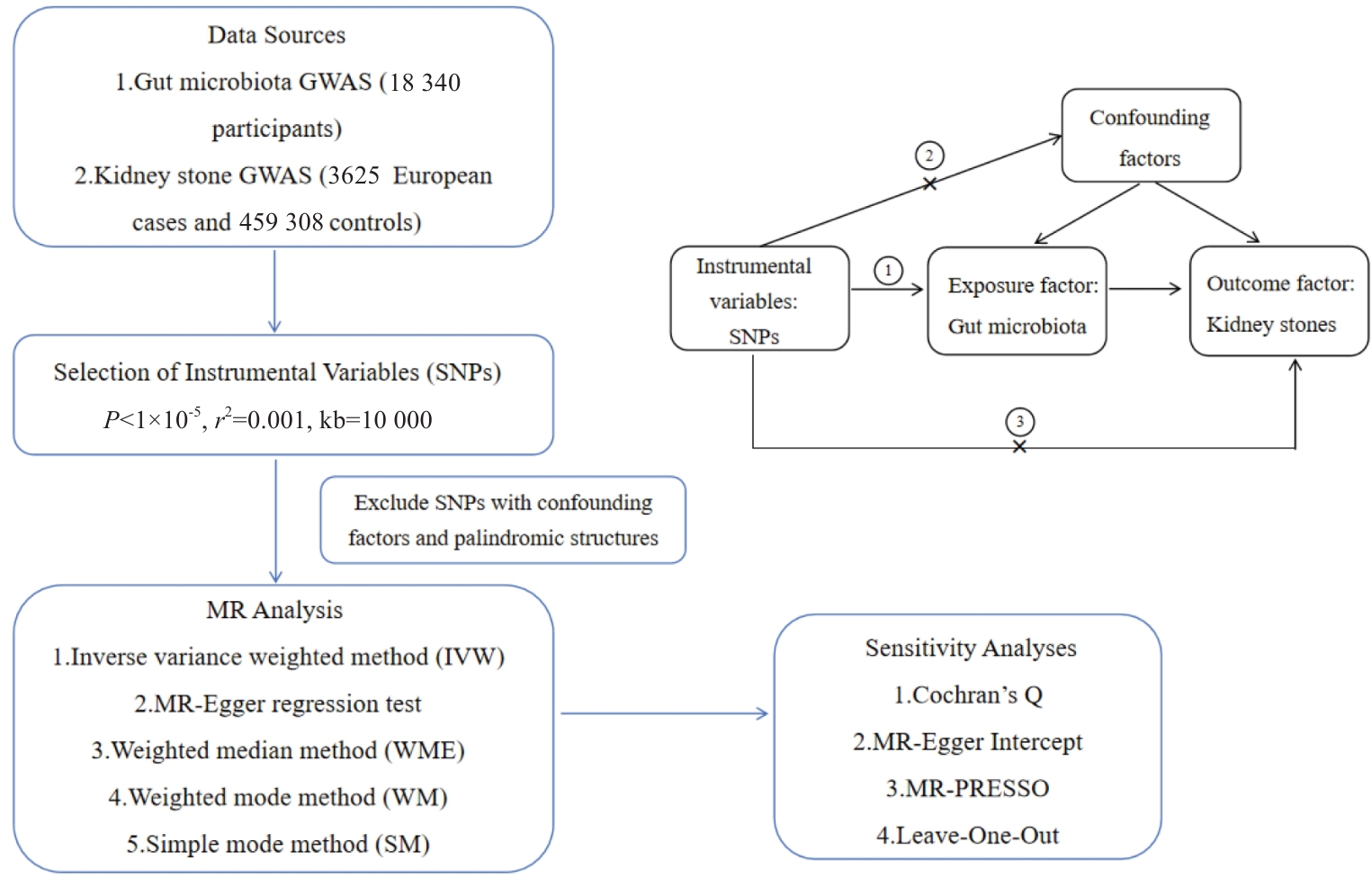
图1 孟德尔随机化分析假设以及流程图
Fig.1 Hypotheses and flowchart of Mendelian randomization analysis.
| Exposure and outcome | Sample size | Number of SNPs | Data source |
|---|---|---|---|
| Gut microbiota | S=18 340 | 122 110 | https://mibiogen.gcc.rug.nl/menu/main/home/ |
| Kidney stones | N=462 933 | 9 851 867 | https://gwas.mrcieu.ac.uk/ |
表1 暴露因素和结局变量介绍
Tab.1 Exposure factors and outcome variables in Mendelian randomization analysis
| Exposure and outcome | Sample size | Number of SNPs | Data source |
|---|---|---|---|
| Gut microbiota | S=18 340 | 122 110 | https://mibiogen.gcc.rug.nl/menu/main/home/ |
| Kidney stones | N=462 933 | 9 851 867 | https://gwas.mrcieu.ac.uk/ |
| Gut microbiota and SNPs | EA | OA | Beta | P | R2 | F |
|---|---|---|---|---|---|---|
| Lachnospiraceae NK4A136 group | ||||||
| rs10952110 | G | T | 0.05 | 9.08×10⁻⁶ | 0.001179 | 19.794033 |
| rs11263806 | A | G | -0.05 | 5.07×10⁻⁶ | 0.001169 | 20.186367 |
| rs12611395 | A | G | -0.09 | 5.83×10⁻⁶ | 0.001238 | 20.432599 |
| rs160061 | A | G | 0.05 | 2.12×10⁻⁶ | 0.001309 | 22.593643 |
| rs28540839 | A | C | 0.05 | 9.34×10⁻⁶ | 0.001258 | 21.121397 |
| rs2880566 | T | C | 0.06 | 5.61×10⁻⁶ | 0.001149 | 19.813151 |
| rs68104925 | T | C | -0.06 | 2.37×10⁻⁶ | 0.001313 | 22.644336 |
| rs954878 | A | G | -0.05 | 1.78×10⁻⁶ | 0.001321 | 22.779485 |
| Gordonibacter | ||||||
| rs13412653 | A | C | 0.11 | 8.61×10⁻⁶ | 0.005404 | 20.218430 |
| rs322296 | G | A | 0.18 | 4.02×10⁻⁶ | 0.006203 | 22.426840 |
| rs35042269 | C | A | -0.18 | 8.11×10⁻⁶ | 0.005528 | 19.974041 |
| rs4596722 | A | G | 0.10 | 9.06×10⁻⁶ | 0.005276 | 19.737801 |
| rs71545975 | A | G | -0.15 | 7.04×10⁻⁶ | 0.005771 | 20.627711 |
| rs7294633 | C | T | 0.13 | 3.44×10⁻⁷ | 0.007068 | 26.486697 |
| rs768830 | G | A | 0.15 | 7.76×10⁻⁶ | 0.005398 | 20.201590 |
表2 与肾结石相关的菌属的SNPs特征
Tab.2 SNP characteristics of bacterial genera associated with kidney stones
| Gut microbiota and SNPs | EA | OA | Beta | P | R2 | F |
|---|---|---|---|---|---|---|
| Lachnospiraceae NK4A136 group | ||||||
| rs10952110 | G | T | 0.05 | 9.08×10⁻⁶ | 0.001179 | 19.794033 |
| rs11263806 | A | G | -0.05 | 5.07×10⁻⁶ | 0.001169 | 20.186367 |
| rs12611395 | A | G | -0.09 | 5.83×10⁻⁶ | 0.001238 | 20.432599 |
| rs160061 | A | G | 0.05 | 2.12×10⁻⁶ | 0.001309 | 22.593643 |
| rs28540839 | A | C | 0.05 | 9.34×10⁻⁶ | 0.001258 | 21.121397 |
| rs2880566 | T | C | 0.06 | 5.61×10⁻⁶ | 0.001149 | 19.813151 |
| rs68104925 | T | C | -0.06 | 2.37×10⁻⁶ | 0.001313 | 22.644336 |
| rs954878 | A | G | -0.05 | 1.78×10⁻⁶ | 0.001321 | 22.779485 |
| Gordonibacter | ||||||
| rs13412653 | A | C | 0.11 | 8.61×10⁻⁶ | 0.005404 | 20.218430 |
| rs322296 | G | A | 0.18 | 4.02×10⁻⁶ | 0.006203 | 22.426840 |
| rs35042269 | C | A | -0.18 | 8.11×10⁻⁶ | 0.005528 | 19.974041 |
| rs4596722 | A | G | 0.10 | 9.06×10⁻⁶ | 0.005276 | 19.737801 |
| rs71545975 | A | G | -0.15 | 7.04×10⁻⁶ | 0.005771 | 20.627711 |
| rs7294633 | C | T | 0.13 | 3.44×10⁻⁷ | 0.007068 | 26.486697 |
| rs768830 | G | A | 0.15 | 7.76×10⁻⁶ | 0.005398 | 20.201590 |
| Gut microbiota and methods | Number of SNPs | Beta | P | OR (95% CI) |
|---|---|---|---|---|
| Lachnospiraceae NK4A136 group | ||||
| MR-Egger | 8 | -0.0124 | 0.1751 | 0.9877 (0.9723, 1.0034) |
| WME | 8 | -0.0017 | 0.3190 | 0.9983 (0.9950, 1.0016) |
| IVW | 8 | -0.0026 | 0.0393 | 0.9974 (0.9948, 0.9999) |
| SM | 8 | -0.0003 | 0.9142 | 0.9997 (0.9944, 1.0051) |
| WM | 8 | -0.0003 | 0.9148 | 0.9997 (0.9943, 1.0051) |
| Gordonibacter | ||||
| MR-Egger | 7 | -0.0012 | 0.7112 | 0.9988 (0.9926, 1.0050) |
| WME | 7 | -0.0013 | 0.1220 | 0.9987 (0.9970, 1.0004) |
| IVW | 7 | -0.0013 | 0.0403 | 0.9987 (0.9974, 0.9999) |
| SM | 7 | -0.0014 | 0.2828 | 0.9986 (0.9963, 1.0009) |
| WM | 7 | -0.0014 | 0.3155 | 0.9986 (0.9960, 1.0011) |
表3 剔除回文和混杂因素之后的MR分析的主要结果
Tab.3 Main results of Mendelian randomization analysis after excluding palindromic and confounding factors
| Gut microbiota and methods | Number of SNPs | Beta | P | OR (95% CI) |
|---|---|---|---|---|
| Lachnospiraceae NK4A136 group | ||||
| MR-Egger | 8 | -0.0124 | 0.1751 | 0.9877 (0.9723, 1.0034) |
| WME | 8 | -0.0017 | 0.3190 | 0.9983 (0.9950, 1.0016) |
| IVW | 8 | -0.0026 | 0.0393 | 0.9974 (0.9948, 0.9999) |
| SM | 8 | -0.0003 | 0.9142 | 0.9997 (0.9944, 1.0051) |
| WM | 8 | -0.0003 | 0.9148 | 0.9997 (0.9943, 1.0051) |
| Gordonibacter | ||||
| MR-Egger | 7 | -0.0012 | 0.7112 | 0.9988 (0.9926, 1.0050) |
| WME | 7 | -0.0013 | 0.1220 | 0.9987 (0.9970, 1.0004) |
| IVW | 7 | -0.0013 | 0.0403 | 0.9987 (0.9974, 0.9999) |
| SM | 7 | -0.0014 | 0.2828 | 0.9986 (0.9963, 1.0009) |
| WM | 7 | -0.0014 | 0.3155 | 0.9986 (0.9960, 1.0011) |

图2 孟德尔随机化分析散点图
Fig.2 Mendelian randomization analysis scatter plot.
| Exposure factor | Cochran's Q heterogeneity test | Genetic pleiotropy | MR-PRESSO | |||
|---|---|---|---|---|---|---|
| Methods | Q | P | MR-Egger intercept | P | P | |
| Lachnospiraceae NK4A136 group | IVW | 6.031 | 0.536 | 5.40×10⁻⁴ | 0.267 | 0.543 |
| MR-Egger | 4.533 | 0.605 | ||||
| Gordonibacter | IVW | 4.719 | 0.580 | -1.32×10⁻⁵ | 0.976 | 0.594 |
| MR-Egger | 4.718 | 0.451 | ||||
表4 敏感性分析
Tab.4 Sensitivity analysis
| Exposure factor | Cochran's Q heterogeneity test | Genetic pleiotropy | MR-PRESSO | |||
|---|---|---|---|---|---|---|
| Methods | Q | P | MR-Egger intercept | P | P | |
| Lachnospiraceae NK4A136 group | IVW | 6.031 | 0.536 | 5.40×10⁻⁴ | 0.267 | 0.543 |
| MR-Egger | 4.533 | 0.605 | ||||
| Gordonibacter | IVW | 4.719 | 0.580 | -1.32×10⁻⁵ | 0.976 | 0.594 |
| MR-Egger | 4.718 | 0.451 | ||||

图3 留一法分析结果
Fig.3 Leave-one-out method analysis results.

图4 草酸钙肾结石大鼠代谢和肾脏相关指标变化
Fig.4 Changes in metabolism and renal-related indicators in the rat models of calcium oxalate kidney stone. A: Urinary oxalate. B: Serum creatinine. C: Blood urea nitrogen. D: Kidney injury molecule-1 (KIM-1). (Mean±SD, n=6). **P<0.01, ****P<0.0001 vs control group. EN: Model group.

图5 乙二醇联合氯化铵造模对肾脏和肠道组织形态的影响
Fig.5 Changes in renal and intestinal tissue morphology in the rat modes of calcium oxalate kidney stone. A: HE staining. B: Von Kossa staining. C: Alcian blue staining of the intestine (scale bar=100 μm). D-F: Immunohistochemical staining showing changes in Occludin, ZO-1, and the oxalate transporter SLC26A6 in the intestine. G: Quantitative analysis of mucin by Alcian blue staining. H-J: Optical density (OD) values of Occludin, ZO-1, and SLC26A6 (Mean±SD, n=3). *P<0.05 vs control group.

图6 草酸钙肾结石模型下肠道微生物组成发生改变
Fig.6 Changes in the composition of gut microbiota in the rat modes of calcium oxalate kidney stones. A: α-diversity assessed using Observed species, Shannon, and Simpson indices. B: β-diversity evaluated by PCA, PCoA, and NMDS analyses. C: Bar chart of bacterial community composition at the genus level. D: Heatmap of the differential genera identified by Wilcoxon rank-sum test. E: Heatmap analysis of the control and model groups at the genus level further illustrates that the relative abundance of bacterial taxa is positively correlated with color intensity.

图7 LEfSe分析
Fig.7 LEfSe analysis. A: Bar chart showing the major differential taxa between the control and model groups identified by LEfSe analysis. B: Bar chart of intergroup differences in Gordonibacter (the solid line represents the mean, and the dashed line represents the median).
| [1] | Singh P, Harris PC, Sas DJ, et al. The genetics of kidney stone disease and nephrocalcinosis[J]. Nat Rev Nephrol, 2022, 18(4): 224-40. doi:10.1038/s41581-021-00513-4 |
| [2] | Geraghty R, Lovegrove C, Howles S, et al. Role of genetic testing in kidney stone disease: a narrative review[J]. Curr Urol Rep, 2024, 25(12): 311-23. doi:10.1007/s11934-024-01225-5 |
| [3] | Ming SX, Tian J, Ma K, et al. Oxalate-induced apoptosis through ERS-ROS-NF-κB signalling pathway in renal tubular epithelial cell[J]. Mol Med, 2022, 28(1): 88. doi:10.1186/s10020-022-00494-5 |
| [4] | Miller AW, Penniston KL, Fitzpatrick K, et al. Mechanisms of the intestinal and urinary microbiome in kidney stone disease[J]. Nat Rev Urol, 2022, 19(12): 695-707. doi:10.1038/s41585-022-00647-5 |
| [5] | Jin X, Jian ZY, Chen XT, et al. Short chain fatty acids prevent glyoxylate-induced calcium oxalate stones by GPR43-dependent immunomodulatory mechanism[J]. Front Immunol, 2021, 12: 729382. doi:10.3389/fimmu.2021.729382 |
| [6] | Arvans D, Jung YC, Antonopoulos D, et al. Oxalobacter formigenes- derived bioactive factors stimulate oxalate transport by intestinal epithelial cells[J]. J Am Soc Nephrol, 2017, 28(3): 876-87. doi:10.1681/asn.2016020132 |
| [7] | Ariceta G, Collard L, Abroug S, et al. ePHex: a phase 3, double-blind, placebo-controlled, randomized study to evaluate long-term efficacy and safety of Oxalobacter formigenes in patients with primary hyperoxaluria[J]. Pediatr Nephrol, 2023, 38(2): 403-15. doi:10.1007/s00467-022-05591-5 |
| [8] | Milliner D, Hoppe B, Groothoff J. A randomised Phase II/III study to evaluate the efficacy and safety of orally administered Oxalobacter formigenes to treat primary hyperoxaluria[J]. Urolithiasis, 2018, 46(4): 313-23. doi:10.1007/s00240-017-0998-6 |
| [9] | Xu MY, Qin YG, Xia YJ, et al. Screening of oxalate-degrading probiotics and preventive effect of Lactiplantibacillus plantarum AR1089 on kidney stones[J]. Food Funct, 2024, 15(19): 10163-78. doi:10.1039/d4fo03133d |
| [10] | Yuan TH, Xia YQ, Li BJ, et al. Gut microbiota in patients with kidney stones: a systematic review and meta-analysis[J]. BMC Microbiol, 2023, 23(1): 143. doi:10.1186/s12866-023-02891-0 |
| [11] | Ticinesi A, Milani C, Guerra A, et al. Understanding the gut-kidney axis in nephrolithiasis: an analysis of the gut microbiota composition and functionality of stone formers[J]. Gut, 2018, 67(12): 2097-106. doi:10.1136/gutjnl-2017-315734 |
| [12] | Emdin CA, Khera AV, Kathiresan S. Mendelian randomization[J]. JAMA, 2017, 318(19): 1925. doi:10.1001/jama.2017.17219 |
| [13] | Davey Smith G, Hemani G. Mendelian randomization: genetic anchors for causal inference in epidemiological studies[J]. Hum Mol Genet, 2014, 23(R1): R89-98. doi:10.1093/hmg/ddu328 |
| [14] | 李文婕, 洪耀南, 黄 蕊, 等. 自身免疫性疾病是再生障碍性贫血的危险因素: 一项孟德尔随机化分析[J]. 南方医科大学学报, 2025, 45(4): 871-9. |
| [15] | 姚 辰, 李文佳, 庞瑞明, 等. 臀肌腱炎、原发性髋关节病可能导致髂胫束综合征: 一项孟德尔随机化研究[J]. 南方医科大学学报, 2024, 44(9): 1821-30. |
| [16] | Liu MH, Zhang YJ, Wu J, et al. Causal relationship between kidney stones and gut microbiota contributes to the gut-kidney axis: a two-sample Mendelian randomization study[J]. Front Microbiol, 2023, 14: 1204311. doi:10.3389/fmicb.2023.1204311 |
| [17] | Gronau QF, Wagenmakers EJ. Limitations of Bayesian leave-one-out cross-validation for model selection[J]. Comput Brain Behav, 2019, 2(1): 1-11. doi:10.1007/s42113-018-0011-7 |
| [18] | Verbanck M, Chen CY, Neale B, et al. Detection of widespread horizontal pleiotropy in causal relationships inferred from Mendelian randomization between complex traits and diseases[J]. Nat Genet, 2018, 50(5): 693-8. doi:10.1038/s41588-018-0099-7 |
| [19] | Hussain B, Wu CC, Tsai HC, et al. Species-level characterization of gut microbiota and their metabolic role in kidney stone formation using full-length 16S rRNA sequencing[J]. Urolithiasis, 2024, 52(1): 115. doi:10.1007/s00240-024-01610-2 |
| [20] | Davies NM, Holmes MV, Davey Smith G. Reading Mendelian randomisation studies: a guide, glossary, and checklist for clinicians[J]. BMJ, 2018, 362: k601. doi:10.1136/bmj.k601 |
| [21] | Bowden J, Davey Smith G, Burgess S. Mendelian randomization with invalid instruments: effect estimation and bias detection through egger regression[J]. Int J Epidemiol, 2015, 44(2): 512-25. doi:10.1093/ije/dyv080 |
| [22] | Bowden J, Davey Smith G, Haycock PC, et al. Consistent estimation in mendelian randomization with some invalid instruments using a weighted Median estimator[J]. Genet Epidemiol, 2016, 40(4): 304-14. doi:10.1002/gepi.21965 |
| [23] | Hartwig FP, Davey Smith G, Bowden J. Robust inference in summary data Mendelian randomization via the zero modal pleiotropy assumption[J]. Int J Epidemiol, 2017, 46(6): 1985-98. doi:10.1093/ije/dyx102 |
| [24] | 曹秋实, 巴元明, 罗俊华, 等. 排石冲剂对大鼠草酸钙结石生成的干预效果及其机制研究[J]. 中国全科医学, 2015, 18(18): 2205-9. |
| [25] | Li NN, Niu LL, Liu Y, et al. Taking SCFAs produced by Lactobacillus reuteri orally reshapes gut microbiota and elicits antitumor responses[J]. J Nanobiotechnology, 2024, 22(1): 241. doi:10.1186/s12951-024-02506-4 |
| [26] | Zhou SK, Xu JD, Gao XQ, et al. Fructus Jujubae cooperated with water-expelling members in Shizao decoction alleviated intestinal injury and malignant ascites by modulating gut microbiota and metabolic homeostasis[J]. Phytomedicine, 2024, 133: 155895. doi:10.1016/j.phymed.2024.155895 |
| [27] | Ye JM, Meng Q, Jin KZ, et al. Phage cocktail alleviated type 2 diabetes by reshaping gut microbiota and decreasing proinfla-mmatory cytokines[J]. Appl Microbiol Biotechnol, 2024, 108(1): 9. doi:10.1007/s00253-023-12912-7 |
| [28] | Maslowski KM, Vieira AT, Ng A, et al. Regulation of inflammatory responses by gut microbiota and chemoattractant receptor GPR43[J]. Nature, 2009, 461(7268): 1282-6. doi:10.1038/nature08530 |
| [29] | Noonin C, Thongboonkerd V. Beneficial roles of gastrointestinal and urinary microbiomes in kidney stone prevention via their oxalate-degrading ability and beyond[J]. Microbiol Res, 2024, 282: 127663. doi:10.1016/j.micres.2024.127663 |
| [30] | Zhang MW, Cui SM, Mao BY, et al. Ellagic acid and intestinal microflora metabolite urolithin A: a review on its sources, metabolic distribution, health benefits, and biotransformation[J]. Crit Rev Food Sci Nutr, 2023, 63(24): 6900-22. doi:10.1080/10408398.2022.2036693 |
| [31] | Yasuda T, Takagi T, Asaeda K, et al. Urolithin A-mediated augmentation of intestinal barrier function through elevated secretory mucin synthesis[J]. Sci Rep, 2024, 14(1): 15706. doi:10.1038/s41598-024-65791-x |
| [32] | Han DD, Wu YJ, Lu DD, et al. Polyphenol-rich diet mediates interplay between macrophage-neutrophil and gut microbiota to alleviate intestinal inflammation[J]. Cell Death Dis, 2023, 14(10): 656. doi:10.1038/s41419-023-06190-4 |
| [33] | Hering NA, Luettig J, Jebautzke B, et al. The punicalagin metabolites ellagic acid and urolithin a exert different strengthening and anti-inflammatory effects on tight junction-mediated intestinal barrier function in vitro [J]. Front Pharmacol, 2021, 12: 610164. doi:10.3389/fphar.2021.610164 |
| [34] | Ma LY, Ni YH, Wang Z, et al. Spermidine improves gut barrier integrity and gut microbiota function in diet-induced obese mice[J]. Gut Microbes, 2020, 12(1): 1-19. doi:10.1080/19490976.2020.1832857 |
| [35] | Hu SW, Wang JH, Xu YL, et al. Anti-inflammation effects of fucosylated chondroitin sulphate from Acaudina molpadioides by altering gut microbiota in obese mice[J]. Food Funct, 2019, 10(3): 1736-46. doi:10.1039/c8fo02364f |
| [36] | Portincasa P, Bonfrate L, Vacca M, et al. Gut microbiota and short chain fatty acids: implications in glucose homeostasis[J]. Int J Mol Sci, 2022, 23(3): 1105. doi:10.3390/ijms23031105 |
| [37] | Huang G, Zhou YZ, Cheng H, et al. Genome and transcriptome analysis of Enterococcus faecium from intestinal colonization and Enterococcus faecium from urinary tract infection[J]. Front Microbiol, 2023, 14: 1273949. doi:10.3389/fmicb.2023.1273949 |
| [38] | Notting F, Pirovano W, Sybesma W, et al. The butyrate-producing and spore-forming bacterial genus Coprococcus as a potential biomarker for neurological disorders[J]. Gut Microbiome (Camb), 2023, 4: e16. doi:10.1017/gmb.2023.14 |
| [39] | Zhou ZJ, Feng DX, Shi DH, et al. Untargeted and targeted metabolomics reveal bile acid profile changes in rats with ethylene glycol-induced calcium oxalate nephrolithiasis[J]. Chem Biol Interact, 2023, 381: 110570. doi:10.1016/j.cbi.2023.110570 |
| [40] | Shi JY, Wang YJ, Bao QW, et al. Polygonatum cyrtonema Hua polysaccharide alleviates ulcerative colitis via gut microbiota-independent modulation of inflammatory immune response[J]. Carbohydr Polym, 2025, 356: 123387. doi:10.1016/j.carbpol.2025.123387 |
| [41] | Kuo WT, Odenwald MA, Turner JR, et al. Tight junction proteins occludin and ZO-1 as regulators of epithelial proliferation and survival[J]. Ann N Y Acad Sci, 2022, 1514(1): 21-33. doi:10.1111/nyas.14798 |
| [42] | Anbazhagan AN, Ge Y, Priyamvada S, et al. A direct link implicating loss of SLC26A6 to gut microbial dysbiosis, compromised barrier integrity, and inflammation[J]. Gastroenterology, 2024, 167(4): 704-17.e3. doi:10.1053/j.gastro.2024.05.002 |
| [43] | Whittamore JM, Hatch M. Oxalate flux across the intestine: contributions from membrane transporters[J]. Compr Physiol, 2021, 12(1): 2835-75. doi:10.1002/j.2040-4603.2022.tb00199.x |
| [44] | 陈健鑫, 李生华. 基于孟德尔随机化方法分析肠道菌群与肾结石病的关联性研究[J]. 医药前沿, 2024(12): 6-11. |
| [45] | Yatsunenko T, Rey FE, Manary MJ, et al. Human gut microbiome viewed across age and geography[J]. Nature, 2012, 486(7402): 222-7. doi:10.1038/nature11053 |
| [46] | Ticinesi A, Nouvenne A, Chiussi G, et al. Calcium oxalate nephrolithiasis and gut microbiota: not just a gut-kidney axis. a nutritional perspective[J]. Nutrients, 2020, 12(2): 548. doi:10.3390/nu12020548 |
| [1] | 邓楚玉, 王雪莹, 甘立祥, 王大禹, 郑晓燕, 唐纯志. 电针足三里改善高脂血症小鼠的血脂紊乱:基于肠道菌群结构的改善[J]. 南方医科大学学报, 2025, 45(8): 1633-1642. |
| [2] | 黄凯悦, 齐景馨, 罗文谦, 林怡萱, 陈梅妹, 甘慧娟. 温胆汤通过调控肠道菌群-胆汁酸轴改善代谢综合征痰证大鼠的代谢表型[J]. 南方医科大学学报, 2025, 45(6): 1174-1184. |
| [3] | 李文婕, 洪耀南, 黄蕊, 李煜宸, 张莹, 张蕴, 吴迪炯. 自身免疫性疾病是再生障碍性贫血的危险因素:一项孟德尔随机化分析[J]. 南方医科大学学报, 2025, 45(4): 871-879. |
| [4] | 罗嘉纯, Sodnomjamts Batzaya, 高雪锋, 陈晶宇, 余政颖, 熊莎莎, 曹虹. Akkermansia muciniphila改善gp120转基因小鼠的肠-脑相互作用障碍[J]. 南方医科大学学报, 2025, 45(3): 554-565. |
| [5] | 高俊杰, 叶开, 吴竞. 槲皮素通过调控TP53基因抑制肾透明细胞癌的增殖和迁移[J]. 南方医科大学学报, 2025, 45(2): 313-321. |
| [6] | 刘莹, 李柏睿, 李永财, 常禄博, 王娇, 杨琳, 颜永刚, 屈凯, 刘继平, 张岗, 沈霞. 加味逍遥丸通过神经递质调节、抗炎抗氧化及肠道菌群调控改善大鼠的抑郁样行为[J]. 南方医科大学学报, 2025, 45(2): 347-358. |
| [7] | 马会华, 闫奎坡, 刘刚, 徐亚洲, 张磊, 李一卓. 1990~2021年心房颤动/扑动流行病学及其危险因素分析:基于2021年中国全球疾病负担研究与孟德尔随机化研究的系统分析[J]. 南方医科大学学报, 2025, 45(10): 2182-2190. |
| [8] | 姚辰, 李文佳, 庞瑞明, 周继红. 臀肌腱炎、原发性髋关节病可能导致髂胫束综合征—一项孟德尔随机化研究[J]. 南方医科大学学报, 2024, 44(9): 1821-1830. |
| [9] | 钟帷韬, 李伟松, 李泽霖, 王强, 张旺明. 睡眠性状与特发性正常压力脑积水的因果关联:一项两样本双向孟德尔随机化研究[J]. 南方医科大学学报, 2024, 44(8): 1612-1619. |
| [10] | 刘佳进, 缪长宏, 徐健康, 余伟杰, 陈继鑫, 唐好知, 刘爱峰. 肠道菌群与色素沉着绒毛结节性滑膜炎之间的因果关系:基于孟德尔随机化分析[J]. 南方医科大学学报, 2024, 44(7): 1397-1406. |
| [11] | 李和平, 李高桦, 张学华, 王亚楠. 直肠癌炎症蛋白因子的遗传驱动:孟德尔随机化方法在临床预后研究中的应用[J]. 南方医科大学学报, 2024, 44(7): 1361-1370. |
| [12] | 李新翼, 刘玉杰, 邓克崇, 胡义奎. 调节肠道菌群可改善卒中后大鼠的神经功能和抑郁症状[J]. 南方医科大学学报, 2024, 44(2): 405-410. |
| [13] | 朱继伟, 卢曼路, 焦倩倩, 孙运良, 刘 璐, 丁红红, 于 燕, 潘 磊. 基于16S rRNA测序分析阻塞性睡眠呼吸暂停患者肠道靶标菌群的变化[J]. 南方医科大学学报, 2024, 44(1): 146-155. |
| [14] | 占雯婕, 赵 玲. 1型糖尿病可能增加甲状腺毒症的风险:基于两样本孟德尔随机化方法[J]. 南方医科大学学报, 2023, 43(8): 1396-1401. |
| [15] | 苏 超, 田彧潇, 张 清, 万田豪, 夏 迪. 肌肉质量增加可能导致椎间盘退变:一项两样本孟德尔随机化研究[J]. 南方医科大学学报, 2023, 43(12): 2029-2034. |
| 阅读次数 | ||||||
|
全文 |
|
|||||
|
摘要 |
|
|||||
