
南方医科大学学报 ›› 2026, Vol. 46 ›› Issue (10): 2456-2470.doi: 10.12122/j.issn.1673-4254.2026.10.15
• • 上一篇
乔世杰1( ), 游进顺1, 王昶2,3, 熊红萍4, 李书楠1()
收稿日期:2026-03-09
出版日期:2026-10-20
发布日期:2026-10-26
通讯作者:
李书楠
E-mail:2277605219@qq.com;fjmulsn@126.com
作者简介:乔世杰,博士,E-mail: 2277605219@qq.com
基金资助:
Shijie QIAO1(), Jinshun YOU1, Chang WANG2,3, Hongping XIONG4, Shunan LI1()
Received:2026-03-09
Online:2026-10-20
Published:2026-10-26
Contact:
Shunan LI
E-mail:2277605219@qq.com;fjmulsn@126.com
摘要:
目的 通过引入证素辨证原理,结合机器学习技术,从而构建2型糖尿病视网膜病变(T2DR)的预测模型,为其发生的综合性、精准化预测提供思路和方法。 方法 基于横断面调查资料,按照病例报告表和四诊信息表,以T2DR、2型糖尿病(T2DM)患者为研究对象,采集其状态参数并区分差异性,以此形成具有中医特色的T2DR发生潜在预测因子集合;再使用LASSO回归分析从中筛选出对T2DR发生最具预测价值的状态特征;最后使用逻辑回归(LR)、人工神经网络(ANN)、极致梯度提升(XGBoost)、随机森林(RF)、支持向量机(SVM)、K近邻(KNN)6种机器学习技术,构建能够综合反映T2DR发生的预测模型,并进行模型内部验证和评估各预测特征的重要性。 结果 本研究共纳入T2DM组376例,T2DR组273例,通过对两组筛选出有统计学意义的状态因素进行LASSO分析,发现肝证素、肺证素、阳亢证素、血虚证素、热证素、2型糖尿病性肾病(T2DKD)、脾证素、阴虚证素、血瘀证素、2型糖尿病性周围神经病(T2DPN)、气滞证素、肾证素、2型糖尿病性周围血管病(T2DPVD)、气虚证素、筋骨证素、津亏证素、心率、腰臀比(WHR)、饮食量情况、痰证素、血尿素氮(BUN)、尿素(Urea)、T2DM病程、血红蛋白(HGB)、丙氨酸氨基转移酶(ALT)、天冬氨酸氨基转移酶(AST)、臀围对T2DR发生最具预测价值。通过LR、ANN、XGBoost、RF、SVM、KNN六种ML技术构建T2DR发生的预测建模。区分度评估:采用准确率、精确率、召回率、特异度、假正例率、F1分数、ROC曲线、AUC(95% CI)、Delong检验和500次Bootstrap方法,发现LR、KNN模型具有良好的区分度。校准度评估:采用GiViTI校准带、Platt scaling方法,发现LR模型的概率输出在全局中具有高度可靠性和校准稳健性;采用十组校准曲线、Brier score、等渗回归方法,发现KNN模型的概率预测属于良好水平。临床实用性评估:采用DCA评估LR、KNN模型在训练及验证人群中的临床效用,发现LR与KNN模型在广泛的阈值概率范围内均可提供正的临床净效益,且LR模型在整个范围内的净效益曲线均位于KNN模型之上,尤其在验证集中表现明显,表明其在指导个体化决策方面具有更高的潜在价值。因此,本研究将LR模型作为最优预测模型。 结论 融入证素因素利用机器学习技术构建的预测模型,可以有效发挥中医药预测疾病的治未病优势,从而实现对T2DM人群易发T2DR的综合性预测,辅助临床决策。
乔世杰, 游进顺, 王昶, 熊红萍, 李书楠. 基于证素辨证原理的2型糖尿病视网膜病变预测模型构建[J]. 南方医科大学学报, 2026, 46(10): 2456-2470.
Shijie QIAO, Jinshun YOU, Chang WANG, Hongping XIONG, Shunan LI. Construction of predictive models for type 2 diabetic retinopathy based on the principle of differentiation of syndrome elements[J]. Journal of Southern Medical University, 2026, 46(10): 2456-2470.
| No. | Syndrome elements | T2DM(n=376) | T2DR(n=273) | χ2/Z/t | P | |
|---|---|---|---|---|---|---|
| 1 | Yin deficiency | Severe | 233 | 269 | 120.711 | <0.01 |
| Non-severe | 143 | 4 | ||||
| 2 | Phlegm | Severe | 147 | 193 | 63.32 | <0.01 |
| Non-severe | 229 | 80 | ||||
| 3 | Liver | Severe | 177 | 266 | 185.149 | <0.01 |
| Non-severe | 199 | 7 | ||||
| 4 | Heat | Severe | 111 | 179 | 83.144 | <0.01 |
| Non-severe | 265 | 94 | ||||
| 5 | Kidney | Severe | 130 | 195 | 85.929 | <0.01 |
| Non-severe | 246 | 78 | ||||
| 6 | Dampness | Severe | 156 | 175 | 32.364 | <0.01 |
| Non-severe | 220 | 98 | ||||
| 7 | Yang deficiency | Severe | 112 | 153 | 45.134 | <0.01 |
| Non-severe | 264 | 120 | ||||
| 8 | Blood deficiency | Severe | 93 | 216 | 187.562 | <0.01 |
| Non-severe | 283 | 57 | ||||
| 9 | Blood stasis | Severe | 52 | 101 | 47.133 | <0.01 |
| Non-severe | 324 | 172 | ||||
| 10 | Qi deficiency | Severe | 45 | 128 | 98.639 | <0.01 |
| Non-severe | 331 | 145 | ||||
| 11 | Qi stagnation | Severe | 42 | 90 | 46.379 | <0.01 |
| Non-severe | 334 | 183 | ||||
| 12 | Yang excess | Severe | 4 | 65 | 86.122 | <0.01 |
| Non-severe | 372 | 208 | ||||
| 13 | Heart spirit | Severe | 16 | 38 | 19.365 | <0.01 |
| Non-severe | 360 | 235 | ||||
| 14 | Spleen | Severe | 5 | 28 | 26.144 | <0.01 |
| Non-severe | 371 | 245 | ||||
| 15 | Heart | Severe | 1 | 10 | 10.954 | <0.01 |
| Non-severe | 375 | 263 | ||||
| 16 | Essence deficiency | Severe | 0 | 6 | 8.341 | <0.01 |
| Non-severe | 376 | 267 | ||||
| 17 | Tendon-bone | Severe | 11 | 43 | 34.106 | <0.01 |
| Non-severe | 365 | 230 | ||||
| 18 | Gallbladder | Severe | 0 | 0 | - | - |
| Non-severe | 376 | 273 | ||||
| 19 | Cold | Severe | 2 | 10 | 8.544 | <0.01 |
| Non-severe | 374 | 263 | ||||
| 20 | Jin deficiency | Severe | 0 | 3 | 4.151 | <0.05 |
| Non-severe | 376 | 270 | ||||
| 21 | Meridian | Severe | 1 | 4 | 2.975 | >0.05 |
| Non-severe | 375 | 269 | ||||
| 22 | Stomach | Severe | 2 | 5 | 2.504 | >0.05 |
| Non-severe | 374 | 268 | ||||
| 23 | Lung | Severe | 2 | 33 | 41.397 | <0.01 |
| Non-severe | 374 | 240 | ||||
| 24 | Dryness | Severe | 0 | 1 | 1.379 | >0.05 |
| Non-severe | 376 | 272 | ||||
表1 中医证素筛选(频率≥20%,例)
Tab.1 Screening of Traditional Chinese medicine (TCM) syndrome elements (frequency≥20%, n)
| No. | Syndrome elements | T2DM(n=376) | T2DR(n=273) | χ2/Z/t | P | |
|---|---|---|---|---|---|---|
| 1 | Yin deficiency | Severe | 233 | 269 | 120.711 | <0.01 |
| Non-severe | 143 | 4 | ||||
| 2 | Phlegm | Severe | 147 | 193 | 63.32 | <0.01 |
| Non-severe | 229 | 80 | ||||
| 3 | Liver | Severe | 177 | 266 | 185.149 | <0.01 |
| Non-severe | 199 | 7 | ||||
| 4 | Heat | Severe | 111 | 179 | 83.144 | <0.01 |
| Non-severe | 265 | 94 | ||||
| 5 | Kidney | Severe | 130 | 195 | 85.929 | <0.01 |
| Non-severe | 246 | 78 | ||||
| 6 | Dampness | Severe | 156 | 175 | 32.364 | <0.01 |
| Non-severe | 220 | 98 | ||||
| 7 | Yang deficiency | Severe | 112 | 153 | 45.134 | <0.01 |
| Non-severe | 264 | 120 | ||||
| 8 | Blood deficiency | Severe | 93 | 216 | 187.562 | <0.01 |
| Non-severe | 283 | 57 | ||||
| 9 | Blood stasis | Severe | 52 | 101 | 47.133 | <0.01 |
| Non-severe | 324 | 172 | ||||
| 10 | Qi deficiency | Severe | 45 | 128 | 98.639 | <0.01 |
| Non-severe | 331 | 145 | ||||
| 11 | Qi stagnation | Severe | 42 | 90 | 46.379 | <0.01 |
| Non-severe | 334 | 183 | ||||
| 12 | Yang excess | Severe | 4 | 65 | 86.122 | <0.01 |
| Non-severe | 372 | 208 | ||||
| 13 | Heart spirit | Severe | 16 | 38 | 19.365 | <0.01 |
| Non-severe | 360 | 235 | ||||
| 14 | Spleen | Severe | 5 | 28 | 26.144 | <0.01 |
| Non-severe | 371 | 245 | ||||
| 15 | Heart | Severe | 1 | 10 | 10.954 | <0.01 |
| Non-severe | 375 | 263 | ||||
| 16 | Essence deficiency | Severe | 0 | 6 | 8.341 | <0.01 |
| Non-severe | 376 | 267 | ||||
| 17 | Tendon-bone | Severe | 11 | 43 | 34.106 | <0.01 |
| Non-severe | 365 | 230 | ||||
| 18 | Gallbladder | Severe | 0 | 0 | - | - |
| Non-severe | 376 | 273 | ||||
| 19 | Cold | Severe | 2 | 10 | 8.544 | <0.01 |
| Non-severe | 374 | 263 | ||||
| 20 | Jin deficiency | Severe | 0 | 3 | 4.151 | <0.05 |
| Non-severe | 376 | 270 | ||||
| 21 | Meridian | Severe | 1 | 4 | 2.975 | >0.05 |
| Non-severe | 375 | 269 | ||||
| 22 | Stomach | Severe | 2 | 5 | 2.504 | >0.05 |
| Non-severe | 374 | 268 | ||||
| 23 | Lung | Severe | 2 | 33 | 41.397 | <0.01 |
| Non-severe | 374 | 240 | ||||
| 24 | Dryness | Severe | 0 | 1 | 1.379 | >0.05 |
| Non-severe | 376 | 272 | ||||
| No. | Indicators | T2DM (n=376) | T2DR (n=273) | χ2/Z/t | P | |
|---|---|---|---|---|---|---|
| 1 | Gender | Male | 216 | 137 | 3.364 | >0.05 |
| Female | 160 | 136 | ||||
| 2 | Age (years) | 60.54±13.02 | 61.33±12.41 | -0.784 | >0.05 | |
| 3 | Residence | Urban | 230 | 166 | 0.009 | >0.05 |
| Rural | 146 | 107 | ||||
| 4 | Occupation | Employed | 166 | 107 | 1.593 | >0.05 |
| Unemployed | 210 | 166 | ||||
| 5 | Marital status | Married | 313 | 222 | 0.405 | >0.05 |
| Unmarried | 63 | 51 | ||||
| 6 | Education level | Illiterate | 24 | 38 | -3.682 | <0.01 |
| Primary school | 119 | 95 | ||||
| Junior high school | 107 | 78 | ||||
Senior high school/technical secondary school/vocational high school | 83 | 44 | ||||
| College/associate degree | 43 | 17 | ||||
| Master's degree or above | 0 | 1 | ||||
| 7 | Household income (CNY/month) | ≤1000 | 28 | 24 | -1.569 | >0.05 |
| 1001-2000 | 35 | 38 | ||||
| 2001-5000 | 113 | 79 | ||||
| ≥5001 | 200 | 132 | ||||
| 8 | Living arrangement | Living with others | 330 | 244 | 0.402 | >0.05 |
| Living alone | 46 | 29 | ||||
| 9 | Religious belief | None | 224 | 155 | 0.51 | >0.05 |
| Yes | 152 | 118 | ||||
| 10 | History of insulin therapy | None | 288 | 156 | 27.697 | <0.01 |
| Yes | 88 | 117 | ||||
| 11 | Smoking history | None | 280 | 211 | 0.684 | >0.05 |
| Yes | 96 | 62 | ||||
| 12 | Smoking quantity | Non-smoker | 280 | 211 | -0.746 | >0.05 |
| <1 pack/day | 48 | 27 | ||||
| 1-2 packs/day | 36 | 29 | ||||
| >2 packs/day | 12 | 6 | ||||
| 13 | Drinking history | None | 287 | 221 | 1.987 | >0.05 |
| Yes | 89 | 52 | ||||
| 14 | Diet:time | Irregular | 147 | 122 | 2.039 | >0.05 |
| Regular | 229 | 151 | ||||
| 15 | Diet:dietary intake | Overeating | 224 | 133 | 7.532 | <0.01 |
| Controlled | 152 | 140 | ||||
| 16 | Diet:category-Staple food | Rice-based | 297 | 223 | 1.129 | >0.05 |
| Wheat-based | 17 | 9 | ||||
| Mixed | 60 | 39 | ||||
| Other | 2 | 2 | ||||
| 17 | Diet:category-non-staple food | Vegetable-based | 220 | 173 | 4.599 | >0.05 |
| White meat-based | 109 | 65 | ||||
| Red meat-based | 3 | 6 | ||||
| Balanced | 44 | 29 | ||||
| 18 | Diet:Snacking status | None | 167 | 126 | 0.193 | >0.05 |
| Yes | 209 | 147 | ||||
| 19 | Dietary preference | None | 43 | 24 | 1.195 | >0.05 |
| Yes | 333 | 249 | ||||
| 20 | Physical labor | Light | 290 | 201 | -0.96 | >0.05 |
| Moderate | 77 | 67 | ||||
| Heavy | 9 | 5 | ||||
| 21 | Exercise habits and frequency | None | 117 | 82 | -0.266 | >0.05 |
| Occasional (1-2 times/week) | 16 | 9 | ||||
| Sometimes (3-4 times/week) | 7 | 12 | ||||
| Frequently (5-6 times/week) | 8 | 2 | ||||
| Daily | 228 | 168 | ||||
| 22 | Participation in T2DM education programs | None | 366 | 269 | 1.069 | >0.05 |
| Yes | 10 | 4 | ||||
| 23 | Attention to health preservation and healthcare | Mostly ignored | 300 | 230 | -1.515 | >0.05 |
| Moderate | 53 | 33 | ||||
| Highly valued | 23 | 10 | ||||
| 24 | Regular blood glucose monitoring | None | 306 | 198 | 7.149 | <0.01 |
| Yes | 70 | 75 | ||||
表2 影响因素和临床理化指标筛选
Tab.2 Screening of influencing factors and clinical biochemical indicators (n)[Mean±SD, M (P25, P75)]
| No. | Indicators | T2DM (n=376) | T2DR (n=273) | χ2/Z/t | P | |
|---|---|---|---|---|---|---|
| 1 | Gender | Male | 216 | 137 | 3.364 | >0.05 |
| Female | 160 | 136 | ||||
| 2 | Age (years) | 60.54±13.02 | 61.33±12.41 | -0.784 | >0.05 | |
| 3 | Residence | Urban | 230 | 166 | 0.009 | >0.05 |
| Rural | 146 | 107 | ||||
| 4 | Occupation | Employed | 166 | 107 | 1.593 | >0.05 |
| Unemployed | 210 | 166 | ||||
| 5 | Marital status | Married | 313 | 222 | 0.405 | >0.05 |
| Unmarried | 63 | 51 | ||||
| 6 | Education level | Illiterate | 24 | 38 | -3.682 | <0.01 |
| Primary school | 119 | 95 | ||||
| Junior high school | 107 | 78 | ||||
Senior high school/technical secondary school/vocational high school | 83 | 44 | ||||
| College/associate degree | 43 | 17 | ||||
| Master's degree or above | 0 | 1 | ||||
| 7 | Household income (CNY/month) | ≤1000 | 28 | 24 | -1.569 | >0.05 |
| 1001-2000 | 35 | 38 | ||||
| 2001-5000 | 113 | 79 | ||||
| ≥5001 | 200 | 132 | ||||
| 8 | Living arrangement | Living with others | 330 | 244 | 0.402 | >0.05 |
| Living alone | 46 | 29 | ||||
| 9 | Religious belief | None | 224 | 155 | 0.51 | >0.05 |
| Yes | 152 | 118 | ||||
| 10 | History of insulin therapy | None | 288 | 156 | 27.697 | <0.01 |
| Yes | 88 | 117 | ||||
| 11 | Smoking history | None | 280 | 211 | 0.684 | >0.05 |
| Yes | 96 | 62 | ||||
| 12 | Smoking quantity | Non-smoker | 280 | 211 | -0.746 | >0.05 |
| <1 pack/day | 48 | 27 | ||||
| 1-2 packs/day | 36 | 29 | ||||
| >2 packs/day | 12 | 6 | ||||
| 13 | Drinking history | None | 287 | 221 | 1.987 | >0.05 |
| Yes | 89 | 52 | ||||
| 14 | Diet:time | Irregular | 147 | 122 | 2.039 | >0.05 |
| Regular | 229 | 151 | ||||
| 15 | Diet:dietary intake | Overeating | 224 | 133 | 7.532 | <0.01 |
| Controlled | 152 | 140 | ||||
| 16 | Diet:category-Staple food | Rice-based | 297 | 223 | 1.129 | >0.05 |
| Wheat-based | 17 | 9 | ||||
| Mixed | 60 | 39 | ||||
| Other | 2 | 2 | ||||
| 17 | Diet:category-non-staple food | Vegetable-based | 220 | 173 | 4.599 | >0.05 |
| White meat-based | 109 | 65 | ||||
| Red meat-based | 3 | 6 | ||||
| Balanced | 44 | 29 | ||||
| 18 | Diet:Snacking status | None | 167 | 126 | 0.193 | >0.05 |
| Yes | 209 | 147 | ||||
| 19 | Dietary preference | None | 43 | 24 | 1.195 | >0.05 |
| Yes | 333 | 249 | ||||
| 20 | Physical labor | Light | 290 | 201 | -0.96 | >0.05 |
| Moderate | 77 | 67 | ||||
| Heavy | 9 | 5 | ||||
| 21 | Exercise habits and frequency | None | 117 | 82 | -0.266 | >0.05 |
| Occasional (1-2 times/week) | 16 | 9 | ||||
| Sometimes (3-4 times/week) | 7 | 12 | ||||
| Frequently (5-6 times/week) | 8 | 2 | ||||
| Daily | 228 | 168 | ||||
| 22 | Participation in T2DM education programs | None | 366 | 269 | 1.069 | >0.05 |
| Yes | 10 | 4 | ||||
| 23 | Attention to health preservation and healthcare | Mostly ignored | 300 | 230 | -1.515 | >0.05 |
| Moderate | 53 | 33 | ||||
| Highly valued | 23 | 10 | ||||
| 24 | Regular blood glucose monitoring | None | 306 | 198 | 7.149 | <0.01 |
| Yes | 70 | 75 | ||||
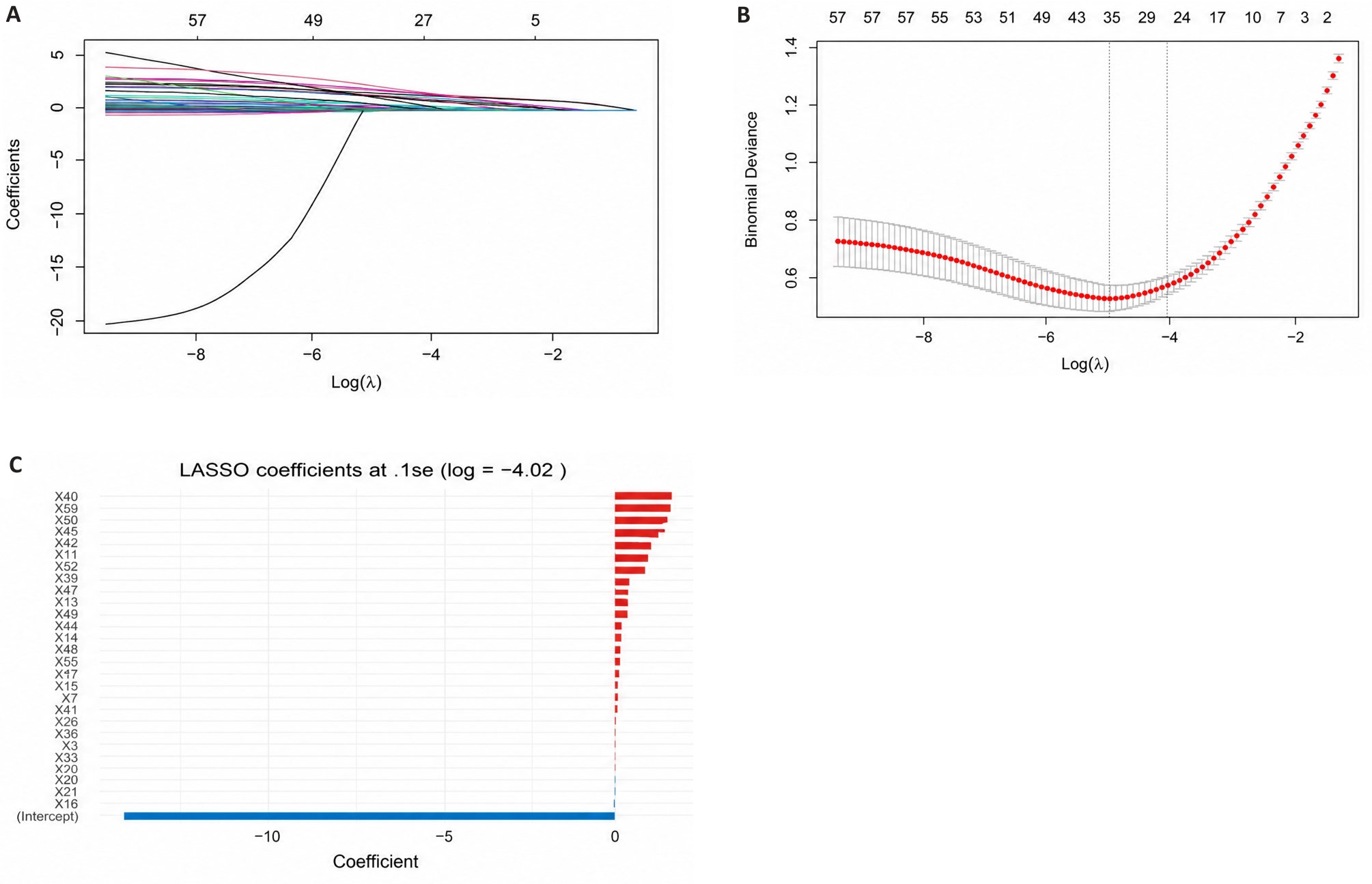
图1 Lasso回归预测因子筛选过程中的系数路径图(A)、交叉验证误差图(B)和非零系数条形图(C)
Fig.1 Coefficient path plot (A), cross-validation error plot (B), and bar chart of non-zero coefficients (C) in Lasso regression predictor selection. X40: Liver syndrome element; X59: Lung syndrome element; X50: Yang excess syndrome element; X45: blood deficiency syndrome element; X42: Heat syndrome element; X11: T2DKD; X52: Spleen syndrome element; X39: Yin deficiency syndrome element; X47: Blood stasis syndrome element; X13: T2DPN; X49: Qi stagnation syndrome element; X44: Kidney syndrome element; X14: T2DPVD; X48: Qi deficiency syndrome element; X55: Tendon-bone syndrome element; X57: Jin deficiency syndrome element; X17: HR; X15: WHR; X7: Dietary intake status; X41: Phlegm syndrome element; X26: BUN; X36: Urea; X3: T2DM duration; X33: HGB; X20: ALT; X21: AST; X16: HC.
| Diseases | Training set | Validation set | χ2 | P |
|---|---|---|---|---|
| T2DR (n=273) | 192 (42.11) | 81 (41.97) | 0.001 | >0.05 |
| T2DM (n=376) | 264 (57.89) | 112 (58.03) |
表3 训练集和验证集中T2DR与T2DM患者分布情况对比
Tab.3 Comparison of the distribution of T2DR and T2DM patients in the training and validation sets [n(%)]
| Diseases | Training set | Validation set | χ2 | P |
|---|---|---|---|---|
| T2DR (n=273) | 192 (42.11) | 81 (41.97) | 0.001 | >0.05 |
| T2DM (n=376) | 264 (57.89) | 112 (58.03) |
| No. | Models | Accuracy | Precision | Recall | Specificity | False positive rate | F1 score | AUC (95% CI) |
|---|---|---|---|---|---|---|---|---|
| 1 | LR | 0.877 | 0.925 | 0.771 | 0.955 | 0.045 | 0.841 | 0.956 (0.938-0.973) |
| 2 | ANN | 0.965 | 0.978 | 0.938 | 0.985 | 0.015 | 0.957 | 0.991 (0.984-0.998) |
| 3 | XGBoost | 0.974 | 0.979 | 0.958 | 0.985 | 0.015 | 0.968 | 0.996 (0.993-0.999) |
| 4 | RF | 0.982 | 0.989 | 0.969 | 0.992 | 0.008 | 0.979 | 1.000 (0.999-1.000) |
| 5 | SVM | 0.958 | 0.968 | 0.932 | 0.977 | 0.023 | 0.950 | 0.988 (0.979-0.997) |
| 6 | KNN | 0.890 | 0.908 | 0.823 | 0.939 | 0.061 | 0.863 | 0.961 (0.945-0.977) |
表4 6种ML模型在训练集上的性能比较
Tab.4 Performance comparison of the six ML models on the training set
| No. | Models | Accuracy | Precision | Recall | Specificity | False positive rate | F1 score | AUC (95% CI) |
|---|---|---|---|---|---|---|---|---|
| 1 | LR | 0.877 | 0.925 | 0.771 | 0.955 | 0.045 | 0.841 | 0.956 (0.938-0.973) |
| 2 | ANN | 0.965 | 0.978 | 0.938 | 0.985 | 0.015 | 0.957 | 0.991 (0.984-0.998) |
| 3 | XGBoost | 0.974 | 0.979 | 0.958 | 0.985 | 0.015 | 0.968 | 0.996 (0.993-0.999) |
| 4 | RF | 0.982 | 0.989 | 0.969 | 0.992 | 0.008 | 0.979 | 1.000 (0.999-1.000) |
| 5 | SVM | 0.958 | 0.968 | 0.932 | 0.977 | 0.023 | 0.950 | 0.988 (0.979-0.997) |
| 6 | KNN | 0.890 | 0.908 | 0.823 | 0.939 | 0.061 | 0.863 | 0.961 (0.945-0.977) |
| No. | Models | Accuracy | Precision | Recall | Specificity | False positive rate | F1 score | AUC (95% CI) |
|---|---|---|---|---|---|---|---|---|
| 1 | LR | 0.881 | 0.872 | 0.840 | 0.911 | 0.089 | 0.855 | 0.952 (0.924-0.979) |
| 2 | ANN | 0.808 | 0.782 | 0.753 | 0.848 | 0.152 | 0.767 | 0.875 (0.825-0.926) |
| 3 | XGBoost | 0.870 | 0.818 | 0.889 | 0.857 | 0.143 | 0.852 | 0.961 (0.937-0.984) |
| 4 | RF | 0.886 | 0.839 | 0.901 | 0.875 | 0.125 | 0.869 | 0.957 (0.932-0.983) |
| 5 | SVM | 0.876 | 0.800 | 0.938 | 0.830 | 0.170 | 0.864 | 0.957 (0.932-0.983) |
| 6 | KNN | 0.881 | 0.863 | 0.852 | 0.902 | 0.098 | 0.857 | 0.942 (0.912-0.973) |
表5 6种ML模型在验证集上的性能比较
Tab.5 Performance comparison of the six ML models on the validation set
| No. | Models | Accuracy | Precision | Recall | Specificity | False positive rate | F1 score | AUC (95% CI) |
|---|---|---|---|---|---|---|---|---|
| 1 | LR | 0.881 | 0.872 | 0.840 | 0.911 | 0.089 | 0.855 | 0.952 (0.924-0.979) |
| 2 | ANN | 0.808 | 0.782 | 0.753 | 0.848 | 0.152 | 0.767 | 0.875 (0.825-0.926) |
| 3 | XGBoost | 0.870 | 0.818 | 0.889 | 0.857 | 0.143 | 0.852 | 0.961 (0.937-0.984) |
| 4 | RF | 0.886 | 0.839 | 0.901 | 0.875 | 0.125 | 0.869 | 0.957 (0.932-0.983) |
| 5 | SVM | 0.876 | 0.800 | 0.938 | 0.830 | 0.170 | 0.864 | 0.957 (0.932-0.983) |
| 6 | KNN | 0.881 | 0.863 | 0.852 | 0.902 | 0.098 | 0.857 | 0.942 (0.912-0.973) |
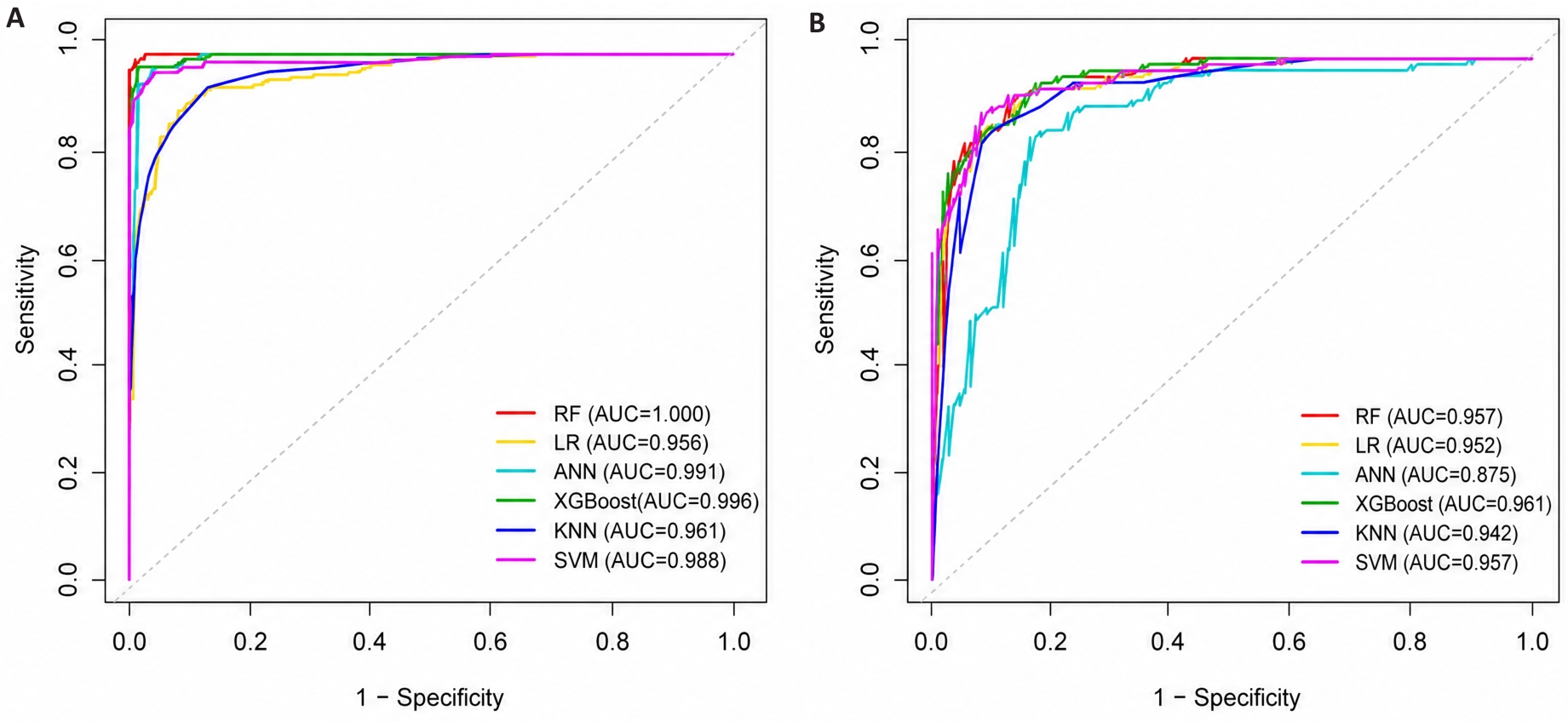
图2 6种ML模型在训练集(A)和验证集(B)上的ROC曲线
Fig.2 ROC curves of 6 ML models on the training (A) and validation (B) sets.
| No. | Models | Training set AUC | Validation set AUC | P |
|---|---|---|---|---|
| 1 | LR | 0.956 | 0.952 | >0.05 |
| 2 | ANN | 0.991 | 0.875 | <0.01 |
| 3 | XGBoost | 0.996 | 0.961 | <0.01 |
| 4 | RF | 1.000 | 0.957 | <0.01 |
| 5 | SVM | 0.988 | 0.957 | <0.05 |
| 6 | KNN | 0.961 | 0.942 | >0.05 |
表6 6种ML模型的Delong检验
Tab.6 DeLong test of the 6 ML models
| No. | Models | Training set AUC | Validation set AUC | P |
|---|---|---|---|---|
| 1 | LR | 0.956 | 0.952 | >0.05 |
| 2 | ANN | 0.991 | 0.875 | <0.01 |
| 3 | XGBoost | 0.996 | 0.961 | <0.01 |
| 4 | RF | 1.000 | 0.957 | <0.01 |
| 5 | SVM | 0.988 | 0.957 | <0.05 |
| 6 | KNN | 0.961 | 0.942 | >0.05 |
| No. | LR | KNN | |
|---|---|---|---|
| 1 | Training set | Validation set | |
| 2 | Training set | -1.281 | |
| 3 | Validation set | 0.873 | |
表7 LR模型与KNN模型的Delong检验(Z值)
Tab.7 DeLong test between the LR and KNN models (Z value)
| No. | LR | KNN | |
|---|---|---|---|
| 1 | Training set | Validation set | |
| 2 | Training set | -1.281 | |
| 3 | Validation set | 0.873 | |
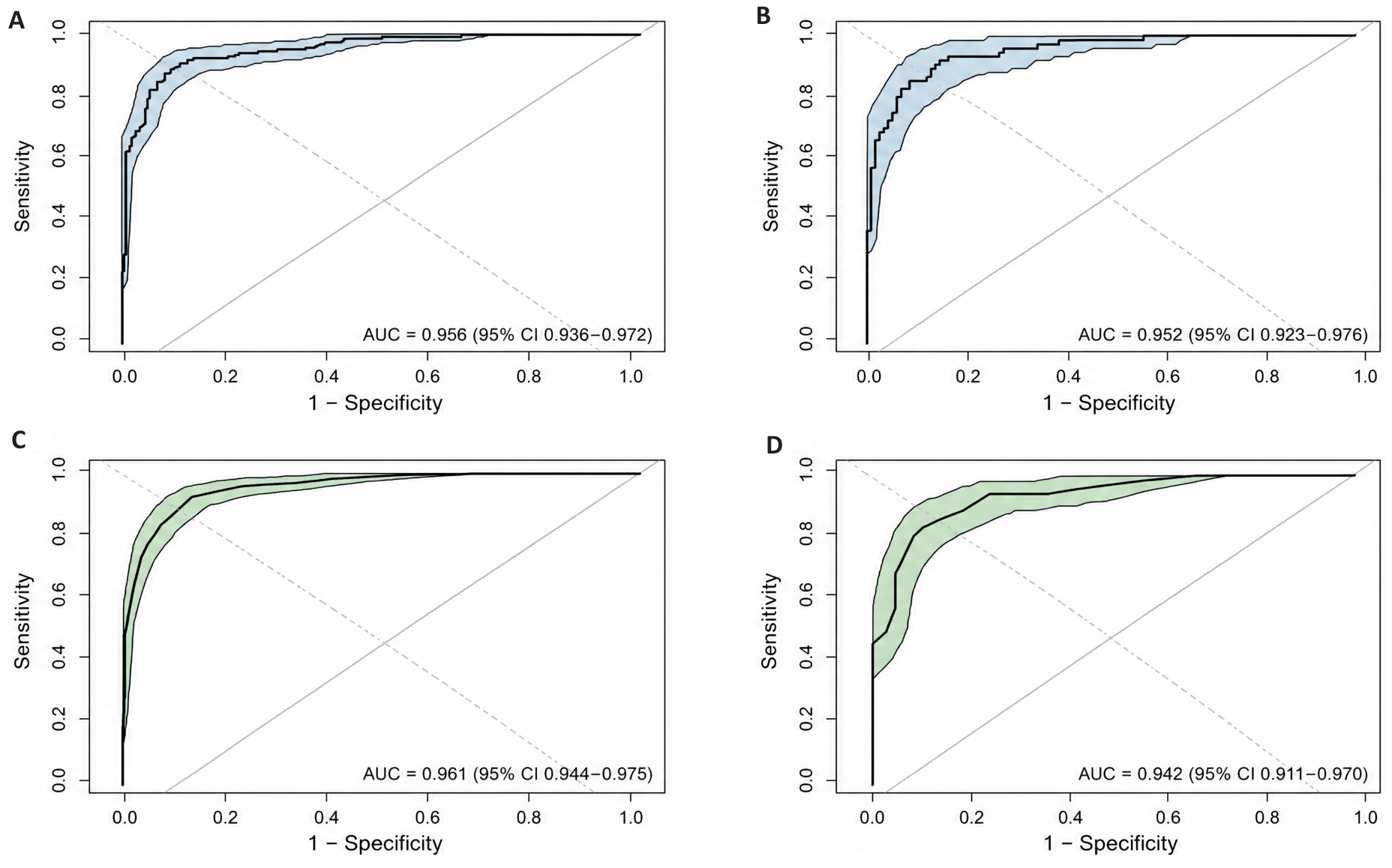
图3 LR和KNN模型500次Bootstrap后在训练集(A、C)和验证集(B、D)上的ROC曲线
Fig.3 ROC curves of the LR and KNN models on the training (A, C) and validation (B, D) sets after 500 Bootstrap.
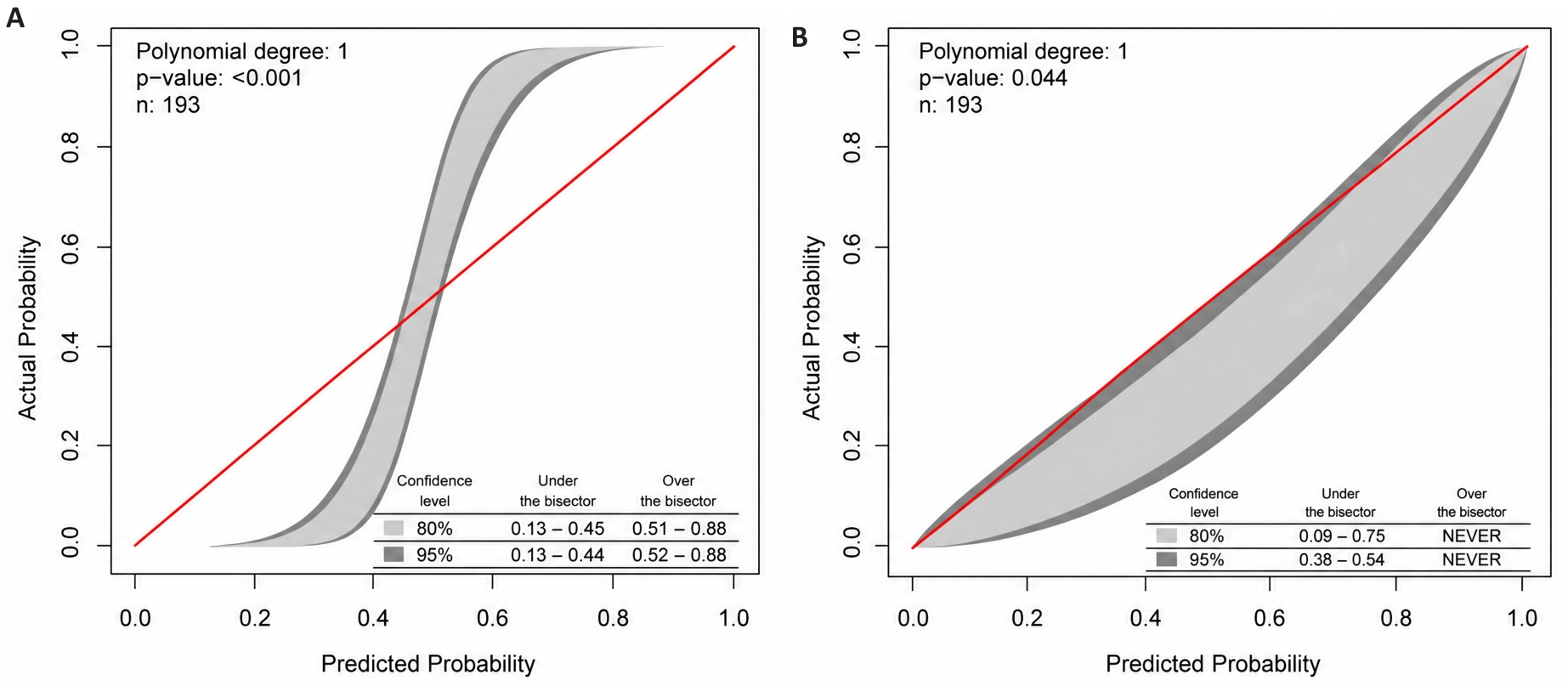
图4 LR模型的GiviTI校准带(A)和采用Platt scaling方法修正后的LR模型的GiviTI校准带(B)
Fig. 4 GiViTI calibration band of the LR model (A) and GiViTI calibration band of the LR model after Platt scaling correction (B).
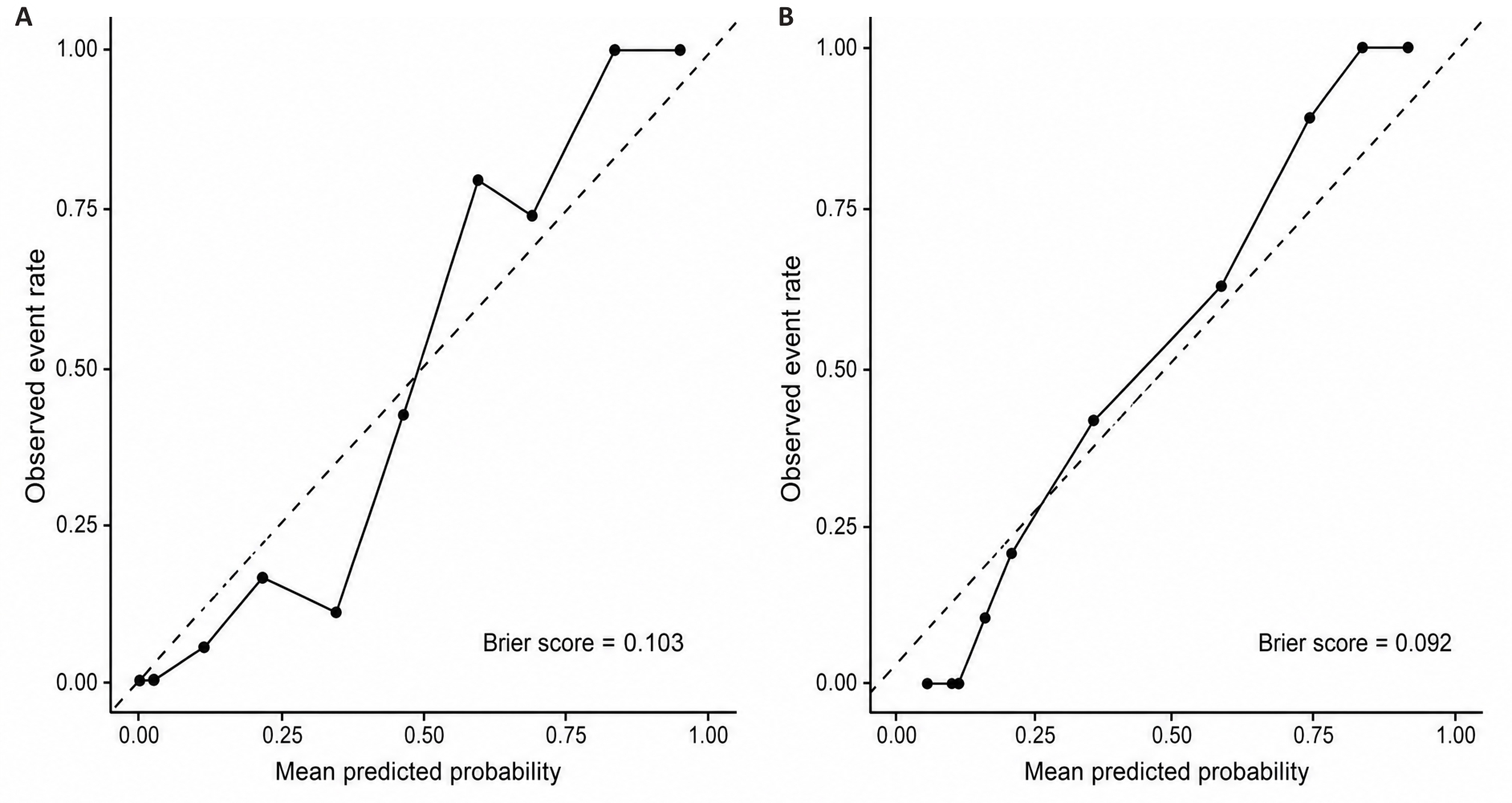
图 5 KNN模型的校准曲线(A)和采用等渗回归方法修正后的KNN模型的校准曲线(B)
Fig. 5 Calibration curve of the KNN model before (A) and after (B) isotonic regression correction.
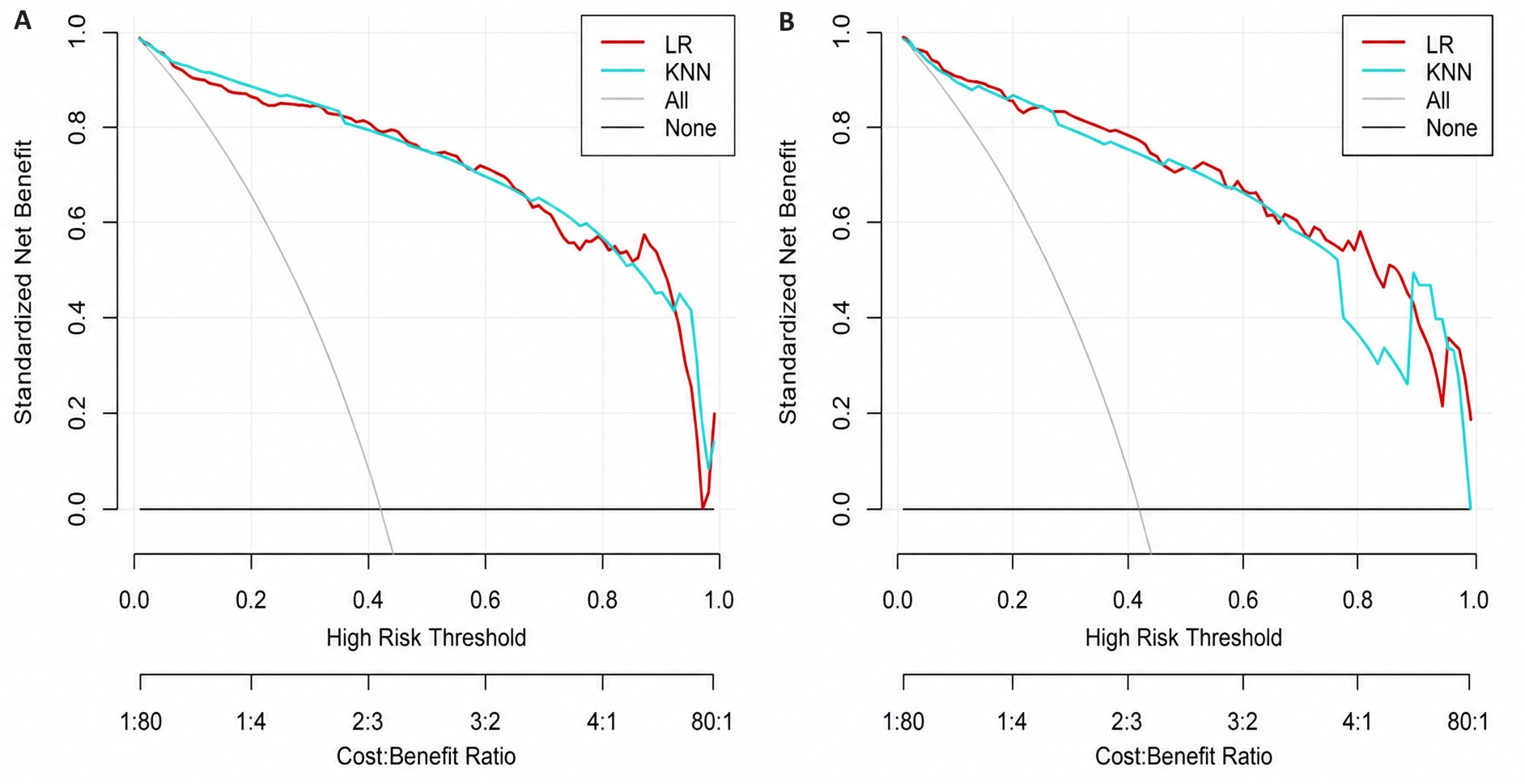
图6 LR和KNN模型在训练集(A)和验证集(B)上的DCA图
Fig. 6 DCA plots for the LR and KNN models on the training (A) and validation (B) sets.
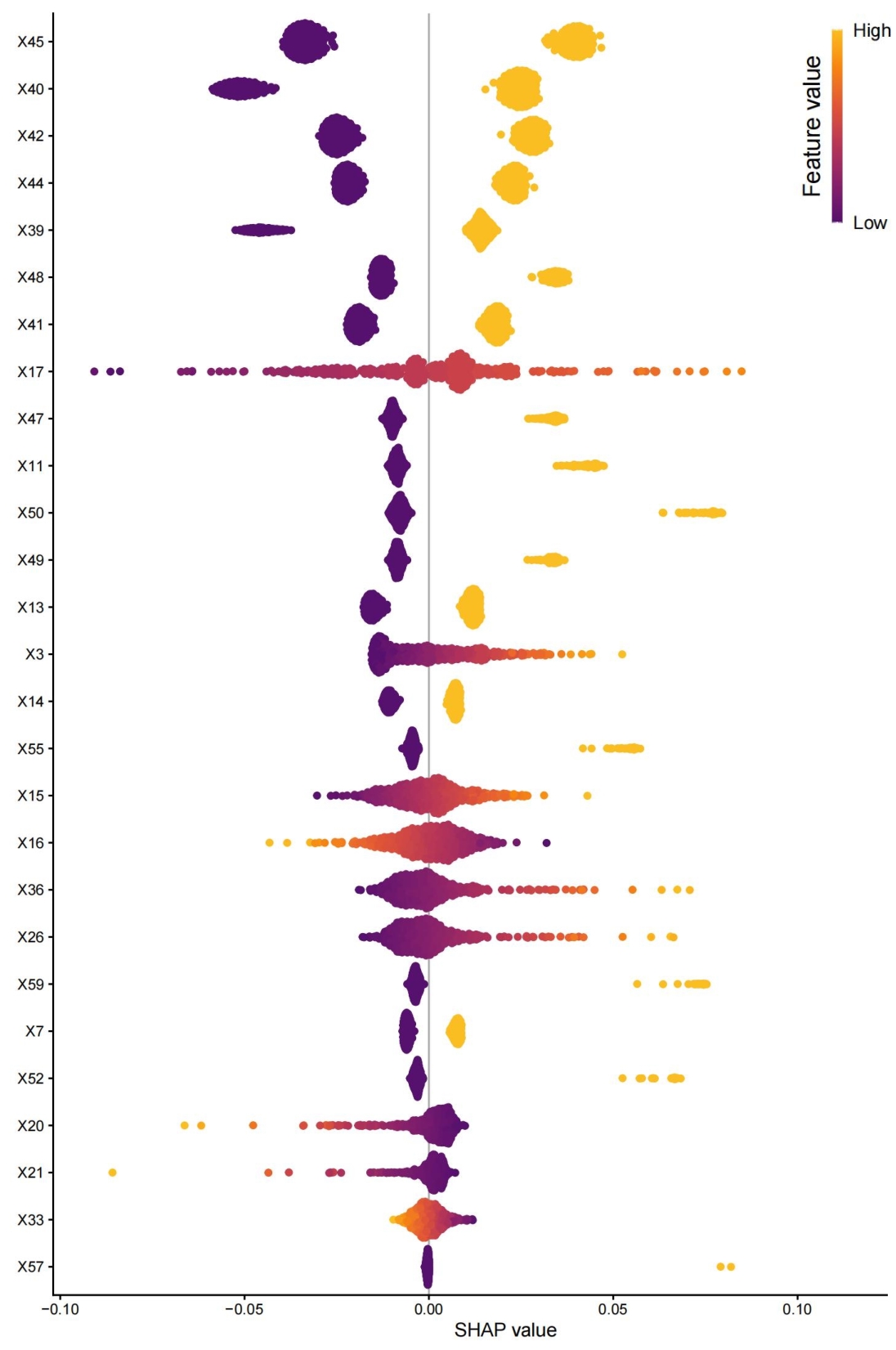
图7 LR模型的SHAP摘要图
Fig. 7 SHAP summary plot of the LR model.
| [1] | 中华医学会眼科学分会眼底病学组, 中国医师协会眼科医师分会眼底病学组, 许 迅, 等. 我国糖尿病视网膜病变临床诊疗指南(2022年): 基于循证医学修订[J]. 中华眼底病杂志, 2023, 39(2): 99-124. |
| [2] | Tan GS, Cheung N, Simó R, et al. Diabetic macular oedema[J]. Lancet Diabetes Endocrinol, 2017, 5(2): 143-55. doi:10.1016/s2213-8587(16)30052-3 |
| [3] | Solomon SD, Chew E, Duh EJ, et al. Diabetic retinopathy: a position statement by the American diabetes association[J]. Diabetes Care, 2017, 40(3): 412-8. doi:10.2337/dc16-2641 |
| [4] | 刘梦伟, 鲍新颖, 王 烁, 等. 中医药治疗糖尿病视网膜病变的研究进展[J].中医临床研究, 2022, 14(36): 45-47. doi:10.3969/j.issn.1674-7860.2022.36.012 |
| [5] | 李灿东, 纪立金, 鲁玉辉, 等. 论中医健康认知理论的逻辑起点[J]. 中华中医药杂志, 2011, 26(1): 109-11. |
| [6] | 中国医师协会中西医结合医师分会内分泌和代谢病学专业委员会. 糖尿病视网膜病变病证结合诊疗指南(2021-09-24)[J]. 世界中医药, 2021, 16(22): 3270-7. |
| [7] | 褚海琳, 任永霞. 糖尿病视网膜病变患者就诊延迟情况及就诊时间的影响因素分析[J]. 中国全科医学, 2022, 25(12): 1470-4. doi:10.12114/j.issn.1007-9572.2021.02.078 |
| [8] | Saeidian J, Mahmoudi T, Riazi-Esfahani H, et al. Automated assessment of the smoothness of retinal layers in optical coherence tomography images using a machine learning algorithm[J]. BMC Med Imaging, 2023, 23(1): 21. doi:10.1186/s12880-023-00976-w |
| [9] | 董旭辉, 陈德凤, 李 蓓, 等. 2型糖尿病患者发生视网膜病变风险预测模型的系统评价[J]. 中华现代护理杂志, 2024, 30(5): 644-50. |
| [10] | 武巾媛, 安洪庆. 糖尿病并发视网膜病变的关键影响因素分析和风险预测研究[J]. 现代预防医学, 2024, 51(3): 557-63. |
| [11] | 刘曦阳, 张 伟, 赵若冰, 等. 2型糖尿病视网膜病变风险预测模型的系统评价[J]. 中华现代护理杂志, 2023, 29(32): 4429-36. |
| [12] | van der Heijden AA, Nijpels G, Badloe F, et al. Prediction models for development of retinopathy in people with type 2 diabetes: systematic review and external validation in a Dutch primary care setting[J]. Diabetologia, 2020, 63(6): 1110-9. doi:10.1007/s00125-020-05134-3 |
| [13] | Usman TM, Saheed YK, Nsang A, et al. A systematic literature review of machine learning based risk prediction models for diabetic retinopathy progression[J]. Artif Intell Med, 2023, 143: 102617. doi:10.1016/j.artmed.2023.102617 |
| [14] | 朱文锋. 证素辨证学[M]. 北京: 人民卫生出版社, 2008. |
| [15] | 李灿东, 甘慧娟, 鲁玉辉, 等. 基于证素辨证原理的健康状态辨识研究[J]. 中华中医药杂志, 2011, 26(4): 754-7. |
| [16] | 张 怡, 杨 波, 李 茂, 等. 2018—2022年成都地区体检人群2型糖尿病流行病学特征及影响因素分析[J]. 现代预防医学, 2024, 51(17): 3157-62, 3179. doi:10.20043/j.cnki.MPM.202401474 |
| [17] | 陈玉冰. 2型糖尿病视网膜病与肾病相关关系及危险因素研究[D]. 石河子: 石河子大学, 2022. |
| [18] | 中华医学会糖尿病学分会. 中国2型糖尿病防治指南(基层版)[J]. 中华全科医师杂志, 2013, 12(8): 675-96. doi:10.3760/cma.j.issn.1671-7368.2013.08.038 |
| [19] | International Diabetes Federation.IDF Diabetes Atlas,11th edition[EB/OL].(2025-04-07)[2026-01-25].. |
| [20] | 佚名 编著. 黄帝内经·素问[M]. 北京: 中国医药科技出版社, 2023: 23, 34. |
| [21] | 赵 芳. 中重度非增殖期糖尿病视网膜病变中医证素与眼底改变及miRNA的研究[D]. 北京: 中国中医科学院, 2022. |
| [22] | 周 莹, 刘军彤, 杨宇峰, 等. 从“因虚致瘀”理论探讨糖尿病视网膜病变病机[J]. 中国中医基础医学杂志, 2022, 28(8): 1231-3, 1329. |
| [23] | 张玉娴, 王丽英, 苏伟娟, 等. 惜视饮治疗血虚络阻型糖尿病视网膜病变的临床研究[J]. 中医药通报, 2020, 19(5): 47-9, 43. |
| [24] | 田代华, 刘更生整理. 灵枢经[M]. 北京: 人民卫生出版社, 2023: 59, 79, 91. |
| [25] | 高文柱,校注.《诸病源候论》校注[M].北京:学苑出版社,2018: 290. |
| [26] | 熊 萌, 曾梅艳, 宋厚盼, 等. 基于现代文献分析的糖尿病视网膜病变中医证型及证素分布探讨[J]. 广州中医药大学学报, 2023, 40(3): 761-8. |
| [27] | 曾筱婷, 滕 月, 俞晓艺, 等. 真实世界中不同中医证型增殖型糖尿病视网膜病变患者行抗血管内皮生长因子联合玻璃体切除术治疗的疗效分析[J]. 广州中医药大学学报, 2024, 41(4): 906-16. |
| [28] | 段俊国,等.国际中医临床实践指南 糖尿病视网膜病变[J]. 世界中医药, 2025, 20(14): 2427-31. |
| [29] | 段俊国, 毕宏生. 中西医结合眼科学[M]. 4版. 北京: 中国中医药出版社, 2021: 203-4. |
| [30] | 李书楠. 基于证素原理的中医眼底望诊方法建立及2型糖尿病视网膜病变的临床验证研究[D]. 长沙: 湖南中医药大学, 2022. |
| [31] | 翟丽萍, 王 旭, 王 谦, 等. 清化瘀热方通过IL-33/ST2通路缓解糖尿病视网膜病变大鼠中视网膜细胞炎症反应[J]. 南昌大学学报: 医学版, 2024, 64(6): 33-41, 封3. |
| [32] | 仝小林. 糖尿病中医药临床循证实践指南: 2016版[M]. 北京: 科学出版社, 2016: 141. |
| [33] | 吴红云, 袁振轩, 陈 芳, 等. 2型糖尿病视网膜病变患者中医证型分布及其与血清炎症因子及脂联素水平的相关性研究[J]. 广州中医药大学学报, 2024, 41(6): 1371-9. |
| [34] | 谢学军, 王明芳. 糖尿病视网膜病变的病机探讨[J]. 中国中医眼科杂志, 1995, 5(2): 86-8. |
| [35] | 卫晓琴. 基于“目诊仪”对糖尿病视网膜病变中医证候分布规律研究及相关因素分析[D]. 成都: 成都中医药大学, 2023. |
| [36] | 张 莹. 芪贞降糖颗粒治疗糖尿病性视网膜病变非增殖期肝肾阴虚证临床研究[J]. 中医学报, 2017, 32(12): 2354-8. |
| [1] | 陈翠妍, 张文娴, 蔡依琳, 欧阳媚, 梁叶, 梁铭标, 梁会营. 基于机器学习算法构建老年患者肺功能智能评估模型[J]. 南方医科大学学报, 2026, 46(9): 2091-2100. |
| [2] | 自胤余, 刘子淼, 邓镇. 基于血浆代谢组学与机器学习的缺血性卒中亚型判别及隐源性卒中病因预测[J]. 南方医科大学学报, 2026, 46(9): 2149-2158. |
| [3] | 李壮, 石欢, 陈洁婷, 梁欲琪, 吴迎朝, 左谦, 陈前军. 芍药苷靶向EZH2/CCNE1调控细胞周期与炎症微环境改善乳腺癌化疗期癌因性疲乏[J]. 南方医科大学学报, 2026, 46(8): 1835-1849. |
| [4] | 史士恒, 花代平, 项尚, 孙兰婷, 宣巧玉, 杨文明, 汪瀚. 基于机器学习的Wilson病脂肪肝预测模型的开发与验证[J]. 南方医科大学学报, 2026, 46(8): 1861-1869. |
| [5] | 朱梦欣, 刘晓, 赵珊, 张新, 刘超, 刘献孔, 綦浩辰, 韩铁生, 马冬. 可解释性机器学习模型对宫颈癌周围神经浸润的术前精准预测及临床决策支持:一项多中心回顾性研究[J]. 南方医科大学学报, 2026, 46(7): 1509-1519. |
| [6] | 陈萌萌, 郭润芳, 赵文洁, 王咏琪, 左芦根, 刘牧林, 李彬. 多维特征下的消化道恶性肿瘤患者焦虑情绪识别模型构建:基于多种可解释性机器学习算法[J]. 南方医科大学学报, 2026, 46(7): 1660-1670. |
| [7] | 陈浩, 李振汉, 纪梦佳, 汪鑫诚, 陈博峰, 管谦, 武嫚, 卢林明. 全球非酒精性脂肪性肝病负担的关键决定因素:基于GBD数据的机器学习联合孟德尔随机化验证[J]. 南方医科大学学报, 2026, 46(4): 770-784. |
| [8] | 杨新梅, 王咏琪, 莫晓华, 朱智航, 洪丹萍, 胡樱子, 彭凯琪, 徐艺轩, 刘锦岚, 郭文娟, 林绮文, 麦俊杰, 麦思茗, 卢京洁, 杨婵娟, 周燕玲, 程道猛, 余萌, 殷炜珍. 患儿个体与家庭特征对注意缺陷/多动障碍团体干预效果的预测:基于多维模型构建与分析[J]. 南方医科大学学报, 2026, 46(4): 794-802. |
| [9] | 陶红成, 梁富凯, 黄文波, 范思奇, 曾平. 酒精暴露与股骨头坏死的潜在关联:基于机器学习构建诊断模型[J]. 南方医科大学学报, 2026, 46(3): 559-569. |
| [10] | 向科霖, 章晓云, 黎征鹏, 徐志为, 刘素杰, 柴源. 胞葬相关基因UCP2、EGLN3、IL1B对骨关节炎的诊断价值及中药治疗预测:基于生物信息学及机器学习[J]. 南方医科大学学报, 2026, 46(3): 693-706. |
| [11] | 陈君尧, 陈泽宇, 林钊杰, 方梦浩, 沈超英, 许琦, 张晓怡, 卢鲁. 饮茶对胃肠道疾病风险的双重作用:基于可解释机器学习与大语言模型的联合预测辅助模型[J]. 南方医科大学学报, 2026, 46(2): 353-361. |
| [12] | 崔运能, 冯敏清, 姚亮凤, 严杰文, 李闻瀚, 黄燕平. 基于欠采样的影像组学机器学习模型术前预测子宫肌瘤高强度聚焦超声消融效果[J]. 南方医科大学学报, 2026, 46(1): 141-149. |
| [13] | 黄启智, 谢戴鹏, 姚霖彤, 李洽轩, 吴少伟, 周海榆. 肿瘤微环境特异性CT影像组学标签预测非小细胞肺癌免疫治疗疗效[J]. 南方医科大学学报, 2025, 45(9): 1903-1918. |
| [14] | 姜君, 封硕, 孙银贵, 安燕. 经尿道前列腺钬激光剜除术后低体温风险预测模型:基于逻辑回归、决策树和支持向量机[J]. 南方医科大学学报, 2025, 45(9): 2019-2025. |
| [15] | 周海忆, 何斯怡, 韩瑞芳, 关永格, 董丽娟, 宋阳. 艾灸通过调控miR-223-3p/NLRP3焦亡通路修复薄型子宫内膜[J]. 南方医科大学学报, 2025, 45(7): 1380-1388. |
| 阅读次数 | ||||||
|
全文 |
|
|||||
|
摘要 |
|
|||||
