
南方医科大学学报 ›› 2026, Vol. 46 ›› Issue (7): 1660-1670.doi: 10.12122/j.issn.1673-4254.2026.07.19
• • 上一篇
陈萌萌1( ), 郭润芳4, 赵文洁4, 王咏琪1, 左芦根2,3, 刘牧林2(), 李彬1,4,5()
收稿日期:2025-12-17
出版日期:2026-07-20
发布日期:2026-07-20
通讯作者:
刘牧林,李彬
E-mail:20231002151@stu.bbmu.edu.cn;liumulin66@aliyun.com;libin@bbmu.edu.cn
作者简介:陈萌萌,在读硕士研究生,E-mail: 20231002151@stu.bbmu.edu.cn
基金资助:
Mengmeng CHEN1(), Runfang GUO4, Wenjie ZHAO4, Yongqi WANG1, Lugen ZUO2,3, Mulin LIU2(), Bin LI1,4,5()
Received:2025-12-17
Online:2026-07-20
Published:2026-07-20
Contact:
Mulin LIU, Bin LI
E-mail:20231002151@stu.bbmu.edu.cn;liumulin66@aliyun.com;libin@bbmu.edu.cn
摘要:
目的 通过机器学习算法研究消化道恶性肿瘤患者在临床诊疗过程中伴发焦虑情绪的相关危险因素。 方法 收集2022年11月~2023年4月蚌埠医科大学第一附属医院280例消化道恶性肿瘤患者数据,并于2024年11月至2025年4月对数据进行再分析,依据医院焦虑抑郁量表将焦虑分量表评分≥8分的患者纳入焦虑组,<8分纳入非焦虑组;采用逻辑回归、决策树、随机森林、K-近邻、支持向量机、轻量梯度提升机6种机器学习算法预测焦虑情绪,比较各模型性能指标,并根据最优模型的特征重要性排序及SHAP分析结果,分析焦虑情绪影响因素。 结果 在预测消化道恶性肿瘤患者焦虑情绪的6种机器学习算法中,随机森林模型表现最优,其准确率为0.73、精确率为0.48、召回率为0.86、特异度为0.69、F1-Score为0.62、ROC曲线下面积为0.85,优于其他算法,对消化道恶性肿瘤患者焦虑情绪的识别分类更精准。根据最优模型的特征重要性排序,影响患者焦虑情绪的前10位关键因素依次为总胆固醇(0.0406)、性别(0.0224)、白蛋白(0.0157)、血小板计数(0.0152)、白细胞计数(0.0121)、视黄醇结合蛋白(0.0116)、总蛋白(0.0115)、BMI(0.0098)、C反应蛋白(0.0096)、血小板分布宽度(0.0095)。 结论 随机森林模型为消化道恶性肿瘤患者焦虑情绪提供了较好的预测性能及关键因素筛选,为临床医生早期识别与干预提供辅助决策。
陈萌萌, 郭润芳, 赵文洁, 王咏琪, 左芦根, 刘牧林, 李彬. 多维特征下的消化道恶性肿瘤患者焦虑情绪识别模型构建:基于多种可解释性机器学习算法[J]. 南方医科大学学报, 2026, 46(7): 1660-1670.
Mengmeng CHEN, Runfang GUO, Wenjie ZHAO, Yongqi WANG, Lugen ZUO, Mulin LIU, Bin LI. Construction of an anxiety recognition model for patients with malignant gastrointestinal tumors based on multidimensional features and multiple interpretable machine learning[J]. Journal of Southern Medical University, 2026, 46(7): 1660-1670.
| Indicator type | Detailed indicators |
|---|---|
| Demographic indicators | Gender, age, BMI, marital status, economics, residence, religion |
| Comorbidity history | Past medical history |
| Personal history | Alcohol consumption history, alcohol consumption, smoking history |
| Scale indicators | PG-SGA, QLQ-C30 |
| Therapeutic factors | Initial diagnosis, diagnosis (stomach, colon, rectum and others), cancer recurrence/metastasis, stoma requirement, current treatments received, prior treatment received, length of hospital stay |
| Test indicators | Prealbumin, total protein, albumin, albumin/globulin ratio, total cholesterol, retinol-binding protein, C-reactive protein, white blood cell count, neutrophil, lymphocyte count, platelet count, mean platelet volume, platelet distribution width |
表1 消化道恶性肿瘤患者数据指标
Tab.1 Demographic and clinical data of patients with malignant gastrointestinal tumors
| Indicator type | Detailed indicators |
|---|---|
| Demographic indicators | Gender, age, BMI, marital status, economics, residence, religion |
| Comorbidity history | Past medical history |
| Personal history | Alcohol consumption history, alcohol consumption, smoking history |
| Scale indicators | PG-SGA, QLQ-C30 |
| Therapeutic factors | Initial diagnosis, diagnosis (stomach, colon, rectum and others), cancer recurrence/metastasis, stoma requirement, current treatments received, prior treatment received, length of hospital stay |
| Test indicators | Prealbumin, total protein, albumin, albumin/globulin ratio, total cholesterol, retinol-binding protein, C-reactive protein, white blood cell count, neutrophil, lymphocyte count, platelet count, mean platelet volume, platelet distribution width |
| Characteristics | Anxious patients (n=68) | Non-anxious patients (n=212) | χ2/t | P |
|---|---|---|---|---|
| Gender | 11.772 | <0.001 | ||
| Male | 33 (48.5) | 151 (71.2) | ||
| Female | 35( 51.5) | 61 (28.8) | ||
| Age (year, Mean±SD) | 60.8±11.7 | 63.9±10.7 | 2.085 | 0.303 |
| Marital status | 3.868 | 0.147 | ||
| Single | 1 (1.5) | 0 (0.0) | ||
| Married | 66 (97.0) | 211 (99.5) | ||
| Divorced | 1 (1.5) | 1 (0.5) | ||
| Monthly income (yuan) | 0.560 | 0.573 | ||
| <1000 | 36 (52.9) | 117 (55.2) | ||
| 1000-5000 | 28 (41.2) | 71 (33.5) | ||
| 5001-10 000 | 3 (4.4) | 17 (8.0) | ||
| >10 000 | 1 (1.5) | 7 (3.3) | ||
| Initial diagnosis | 1.942 | 0.163 | ||
| Yes | 39 (57.4) | 101 (47.6) | ||
| No | 29 (42.6) | 111 (52.4) | ||
| Diagnosis | 7.599 | 0.520 | ||
| Stomach | 17 (25.0) | 62 (29.2) | ||
| Colon | 18 (26.4) | 58 (27.4) | ||
| Rectum | 25 (36.8) | 86 (40.6) | ||
| Others* | 8 (11.8) | 6 (2.8) | ||
| Alcohol consumption history | 5.345 | 0.021 | ||
| No | 48 (70.6) | 116 (54.7) | ||
| Yes | 20 (29.4) | 96 (45.3) | ||
| Smoking | 2.881 | 0.090 | ||
| No | 47 (69.1) | 122 (57.5) | ||
| Yes | 21 (30.9) | 90 (42.5) | ||
| Residence | 0.245 | 0.621 | ||
| City | 25 (36.8) | 71 (33.5) | ||
| Village | 43 (63.2) | 141 (66.5) | ||
| Payment method (medical insurance) | 0.620 | 0.969 | ||
| Urban employees | 5 (7.3) | 19 (9.0) | ||
| Urban residents | 45 (66.2) | 134 (63.2) | ||
| Rural medical | 18 (26.5) | 56 (26.4) | ||
| Others# | 0 (0.0) | 3 (1.4) | ||
| Religion | 2.200 | 0.138 | ||
| No | 54 (79.4) | 184 (86.8) | ||
| Yes | 14 (20.6) | 28 (13.2) | ||
| Past medical history | 1.744 | 0.187 | ||
| No | 25 (36.8) | 60 (28.3) | ||
| Yes | 43 (63.2) | 152 (71.7) | ||
| Cancer recurrence/metastasis | 1.591 | 0.207 | ||
| No | 45 (66.2) | 157 (74.1) | ||
| Yes | 23(33.8) | 55(25.9) |
表2 焦虑状态与非焦虑状态患者人口统计学特征比较
Tab.2 Comparison of demographic characteristics between patients with and without anxiety [n (%)]
| Characteristics | Anxious patients (n=68) | Non-anxious patients (n=212) | χ2/t | P |
|---|---|---|---|---|
| Gender | 11.772 | <0.001 | ||
| Male | 33 (48.5) | 151 (71.2) | ||
| Female | 35( 51.5) | 61 (28.8) | ||
| Age (year, Mean±SD) | 60.8±11.7 | 63.9±10.7 | 2.085 | 0.303 |
| Marital status | 3.868 | 0.147 | ||
| Single | 1 (1.5) | 0 (0.0) | ||
| Married | 66 (97.0) | 211 (99.5) | ||
| Divorced | 1 (1.5) | 1 (0.5) | ||
| Monthly income (yuan) | 0.560 | 0.573 | ||
| <1000 | 36 (52.9) | 117 (55.2) | ||
| 1000-5000 | 28 (41.2) | 71 (33.5) | ||
| 5001-10 000 | 3 (4.4) | 17 (8.0) | ||
| >10 000 | 1 (1.5) | 7 (3.3) | ||
| Initial diagnosis | 1.942 | 0.163 | ||
| Yes | 39 (57.4) | 101 (47.6) | ||
| No | 29 (42.6) | 111 (52.4) | ||
| Diagnosis | 7.599 | 0.520 | ||
| Stomach | 17 (25.0) | 62 (29.2) | ||
| Colon | 18 (26.4) | 58 (27.4) | ||
| Rectum | 25 (36.8) | 86 (40.6) | ||
| Others* | 8 (11.8) | 6 (2.8) | ||
| Alcohol consumption history | 5.345 | 0.021 | ||
| No | 48 (70.6) | 116 (54.7) | ||
| Yes | 20 (29.4) | 96 (45.3) | ||
| Smoking | 2.881 | 0.090 | ||
| No | 47 (69.1) | 122 (57.5) | ||
| Yes | 21 (30.9) | 90 (42.5) | ||
| Residence | 0.245 | 0.621 | ||
| City | 25 (36.8) | 71 (33.5) | ||
| Village | 43 (63.2) | 141 (66.5) | ||
| Payment method (medical insurance) | 0.620 | 0.969 | ||
| Urban employees | 5 (7.3) | 19 (9.0) | ||
| Urban residents | 45 (66.2) | 134 (63.2) | ||
| Rural medical | 18 (26.5) | 56 (26.4) | ||
| Others# | 0 (0.0) | 3 (1.4) | ||
| Religion | 2.200 | 0.138 | ||
| No | 54 (79.4) | 184 (86.8) | ||
| Yes | 14 (20.6) | 28 (13.2) | ||
| Past medical history | 1.744 | 0.187 | ||
| No | 25 (36.8) | 60 (28.3) | ||
| Yes | 43 (63.2) | 152 (71.7) | ||
| Cancer recurrence/metastasis | 1.591 | 0.207 | ||
| No | 45 (66.2) | 157 (74.1) | ||
| Yes | 23(33.8) | 55(25.9) |
| Characteristics | Non-anxious patients (n=34) | Anxious patients (n=17) | χ2/t | P |
|---|---|---|---|---|
| Gender | 1.545 | 0.214 | ||
| Male | 20 (60.6) | 13 (39.4) | ||
| Female | 14 (77.8) | 4 (22.2) | ||
| Age (year, Mean±SD) | 62.5±10.2 | 59.2±10.0 | 1.075 | 0.288 |
| Marital status | 0.510 | 0.475 | ||
| Married | 33 (66.0) | 17 (34.0) | ||
| Divorced | 1 (100.0) | 0 (0.0) | ||
| Monthly income (yuan) | 4.196 | 0.241 | ||
| <1000 | 14 (73.7) | 5 (26.3) | ||
| 1000-5000 | 13 (65.0) | 7 (35.0) | ||
| 5001-10000 | 2 (33.3) | 4 (66.7) | ||
| >10000 | 5 (83.3) | 1 (16.7) | ||
| Initial diagnosis | 0.510 | 0.475 | ||
| Yes | 33 (66.0) | 17 (34.0) | ||
| No | 1 (100.0) | 0 (0.0) | ||
| Diagnosis | 0.04 | 0.842 | ||
| Colon | 15 (65.2) | 8 (34.8) | ||
| Rectum | 19 (67.9) | 9 (32.1) | ||
| Alcohol consumption history | 0.706 | 0.401 | ||
| No | 10 (58.8) | 7 (41.2) | ||
| Yes | 24 (70.6) | 10 (29.4) | ||
| Smoking history | 0.706 | 0.401 | ||
| No | 10 (58.8) | 7 (41.2) | ||
| Yes | 24 (70.6) | 10 (29.4) | ||
| Residence | 0.490 | 0.484 | ||
| City | 7 (58.3) | 5 (41.7) | ||
| Village | 27 (69.2) | 12 (30.8) | ||
| Payment method (medical insurance) | 2.472 | 0.291 | ||
| Urban employees | 3 (42.9) | 4 (57.1) | ||
| Urban residents | 30 (69.8) | 13 (30.2) | ||
| Others | 1 (100.0) | 0 (0.0) | ||
| Religion | 0.995 | 0.318 | ||
| No | 26 (63.4) | 15 (36.6) | ||
| Yes | 8 (80.0) | 2 (20.0) | ||
| Past medical history | 0.999 | 0.318 | ||
| No | 21 (72.4) | 8 (27.6) | ||
| Yes | 13 (59.1) | 9 (40.9) | ||
| Cancer recurrence/metastasis | 1.594 | 0.207 | ||
| No | 31 (64.6) | 17 (35.4) | ||
| Yes | 3 (100.0) | 0 (0.0) |
表3 外部验证集焦虑状态与非焦虑状态患者人口统计学特征比较
Tab.3 Comparison of demographic characteristics between patients with and without anxiety in external validation set [n (%)]
| Characteristics | Non-anxious patients (n=34) | Anxious patients (n=17) | χ2/t | P |
|---|---|---|---|---|
| Gender | 1.545 | 0.214 | ||
| Male | 20 (60.6) | 13 (39.4) | ||
| Female | 14 (77.8) | 4 (22.2) | ||
| Age (year, Mean±SD) | 62.5±10.2 | 59.2±10.0 | 1.075 | 0.288 |
| Marital status | 0.510 | 0.475 | ||
| Married | 33 (66.0) | 17 (34.0) | ||
| Divorced | 1 (100.0) | 0 (0.0) | ||
| Monthly income (yuan) | 4.196 | 0.241 | ||
| <1000 | 14 (73.7) | 5 (26.3) | ||
| 1000-5000 | 13 (65.0) | 7 (35.0) | ||
| 5001-10000 | 2 (33.3) | 4 (66.7) | ||
| >10000 | 5 (83.3) | 1 (16.7) | ||
| Initial diagnosis | 0.510 | 0.475 | ||
| Yes | 33 (66.0) | 17 (34.0) | ||
| No | 1 (100.0) | 0 (0.0) | ||
| Diagnosis | 0.04 | 0.842 | ||
| Colon | 15 (65.2) | 8 (34.8) | ||
| Rectum | 19 (67.9) | 9 (32.1) | ||
| Alcohol consumption history | 0.706 | 0.401 | ||
| No | 10 (58.8) | 7 (41.2) | ||
| Yes | 24 (70.6) | 10 (29.4) | ||
| Smoking history | 0.706 | 0.401 | ||
| No | 10 (58.8) | 7 (41.2) | ||
| Yes | 24 (70.6) | 10 (29.4) | ||
| Residence | 0.490 | 0.484 | ||
| City | 7 (58.3) | 5 (41.7) | ||
| Village | 27 (69.2) | 12 (30.8) | ||
| Payment method (medical insurance) | 2.472 | 0.291 | ||
| Urban employees | 3 (42.9) | 4 (57.1) | ||
| Urban residents | 30 (69.8) | 13 (30.2) | ||
| Others | 1 (100.0) | 0 (0.0) | ||
| Religion | 0.995 | 0.318 | ||
| No | 26 (63.4) | 15 (36.6) | ||
| Yes | 8 (80.0) | 2 (20.0) | ||
| Past medical history | 0.999 | 0.318 | ||
| No | 21 (72.4) | 8 (27.6) | ||
| Yes | 13 (59.1) | 9 (40.9) | ||
| Cancer recurrence/metastasis | 1.594 | 0.207 | ||
| No | 31 (64.6) | 17 (35.4) | ||
| Yes | 3 (100.0) | 0 (0.0) |
| Model | Hyperparameter search ranges |
|---|---|
| Baseline LR | penalty=l2; C=1.0; solver=lbfgs; max_iter=5000; random_state=42; tol=1e-4 |
| LR | C ∈ {0.5, 1.0, 2.0, 5.0, 8.0, 10.0}; penalty ∈ {l2, elasticnet}; solver ∈ {lbfgs, saga}; l1_ratio ∈ {0.1, 0.3, 0.5, 0.7, 0.9}( only elasticnet);class_weight ∈ {balanced, {0:1,1:1.2}}; max_iter=5000;tol=1e-4; warm_start=True |
| RF | n_estimators=200; max_depth ∈ {6, 8}; min_samples_split ∈ {8, 10}; min_samples_leaf=3; max_features='log2'; max_leaf_nodes ∈ {15, 20}; bootstrap=True; oob_score=True; class_weight='balanced'; criterion='gini'; ccp_alpha ∈ {0.01, 0.02} |
| DT | max_depth ∈ {10, 12, 15}; min_samples_split ∈ {4, 6, 8}; min_samples_leaf ∈ {2, 3, 4}; max_features ∈ {'sqrt', 'log2', None};min_impurity_decrease ∈ {0.0001, 0.0005}; class_weight='balanced'; criterion ∈ {'gini', 'entropy'}; splitter='best'; ccp_alpha ∈ {0.001, 0.005} |
| KNN | n_neighbors ∈ {5, 7, 9, 11, 13};weights ∈ {'uniform', 'distance'};p ∈ {1, 2};leaf_size ∈ {10, 20, 30}; algorithm ∈ {'ball_tree', 'kd_tree'};metric ∈ {'minkowski', 'cosine', 'euclidean'} |
| SVM | C ∈ {0.1, 1, 10, 100}; gamma ∈ {'scale', 'auto', 0.001, 0.01, 0.1}; kernel ∈ {'rbf', 'linear', 'poly'}; class_weight='balanced'; probability=True; tol=1e-3; max_iter=10000 |
| LightGBM | n_estimators=100; learning_rate=0.1; max_depth=2; num_leaves=10; scale_pos_weight=pos_weight |
表4 机器学习超参数搜寻范围
Tab.4 Hyperparameter search ranges for each machine learning model
| Model | Hyperparameter search ranges |
|---|---|
| Baseline LR | penalty=l2; C=1.0; solver=lbfgs; max_iter=5000; random_state=42; tol=1e-4 |
| LR | C ∈ {0.5, 1.0, 2.0, 5.0, 8.0, 10.0}; penalty ∈ {l2, elasticnet}; solver ∈ {lbfgs, saga}; l1_ratio ∈ {0.1, 0.3, 0.5, 0.7, 0.9}( only elasticnet);class_weight ∈ {balanced, {0:1,1:1.2}}; max_iter=5000;tol=1e-4; warm_start=True |
| RF | n_estimators=200; max_depth ∈ {6, 8}; min_samples_split ∈ {8, 10}; min_samples_leaf=3; max_features='log2'; max_leaf_nodes ∈ {15, 20}; bootstrap=True; oob_score=True; class_weight='balanced'; criterion='gini'; ccp_alpha ∈ {0.01, 0.02} |
| DT | max_depth ∈ {10, 12, 15}; min_samples_split ∈ {4, 6, 8}; min_samples_leaf ∈ {2, 3, 4}; max_features ∈ {'sqrt', 'log2', None};min_impurity_decrease ∈ {0.0001, 0.0005}; class_weight='balanced'; criterion ∈ {'gini', 'entropy'}; splitter='best'; ccp_alpha ∈ {0.001, 0.005} |
| KNN | n_neighbors ∈ {5, 7, 9, 11, 13};weights ∈ {'uniform', 'distance'};p ∈ {1, 2};leaf_size ∈ {10, 20, 30}; algorithm ∈ {'ball_tree', 'kd_tree'};metric ∈ {'minkowski', 'cosine', 'euclidean'} |
| SVM | C ∈ {0.1, 1, 10, 100}; gamma ∈ {'scale', 'auto', 0.001, 0.01, 0.1}; kernel ∈ {'rbf', 'linear', 'poly'}; class_weight='balanced'; probability=True; tol=1e-3; max_iter=10000 |
| LightGBM | n_estimators=100; learning_rate=0.1; max_depth=2; num_leaves=10; scale_pos_weight=pos_weight |
| Model (test) | Accuracy | Precision | Recall | Specificity | F1-Score | AUC (95% CI) |
|---|---|---|---|---|---|---|
| Baseline_LR | 0.52 | 0.31 | 0.79 | 0.43 | 0.45 | 0.60(0.43-0.77) |
| LR | 0.61 | 0.35 | 0.64 | 0.60 | 0.45 | 0.71(0.54-0.86) |
| RF | 0.73 | 0.48 | 0.86 | 0.69 | 0.62 | 0.85 (0.71-0.96) |
| DT | 0.71 | 0.46 | 0.79 | 0.69 | 0.58 | 0.81 (0.71-0.89) |
| KNN | 0.54 | 0.33 | 0.86 | 0.43 | 0.48 | 0.68 (0.53-0.82) |
| SVM | 0.52 | 0.29 | 0.64 | 0.48 | 0.40 | 0.69(0.51-0.86) |
| LightGBM | 0.75 | 0.5 | 0.86 | 0.71 | 0.63 | 0.78 (0.61-0.91) |
表5 机器学习算法预测焦虑的性能比较
Tab.5 Predicting performance of the machine learning algorithms
| Model (test) | Accuracy | Precision | Recall | Specificity | F1-Score | AUC (95% CI) |
|---|---|---|---|---|---|---|
| Baseline_LR | 0.52 | 0.31 | 0.79 | 0.43 | 0.45 | 0.60(0.43-0.77) |
| LR | 0.61 | 0.35 | 0.64 | 0.60 | 0.45 | 0.71(0.54-0.86) |
| RF | 0.73 | 0.48 | 0.86 | 0.69 | 0.62 | 0.85 (0.71-0.96) |
| DT | 0.71 | 0.46 | 0.79 | 0.69 | 0.58 | 0.81 (0.71-0.89) |
| KNN | 0.54 | 0.33 | 0.86 | 0.43 | 0.48 | 0.68 (0.53-0.82) |
| SVM | 0.52 | 0.29 | 0.64 | 0.48 | 0.40 | 0.69(0.51-0.86) |
| LightGBM | 0.75 | 0.5 | 0.86 | 0.71 | 0.63 | 0.78 (0.61-0.91) |
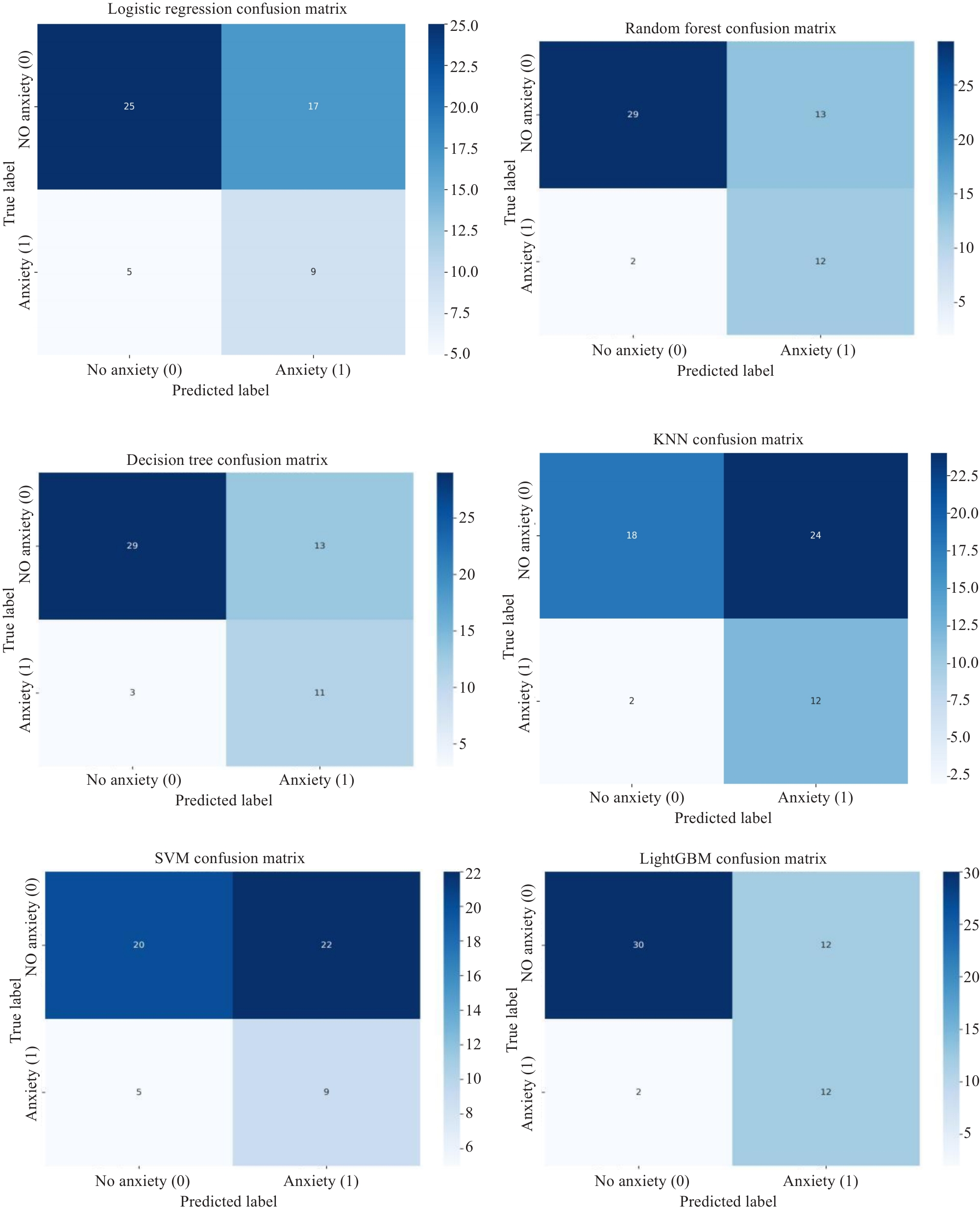
图1 模型混淆矩阵
Fig.1 Model confusion matrix. A: LR; B: RF; C: DT; D: KNN; E: SVM; F: LightGBM.
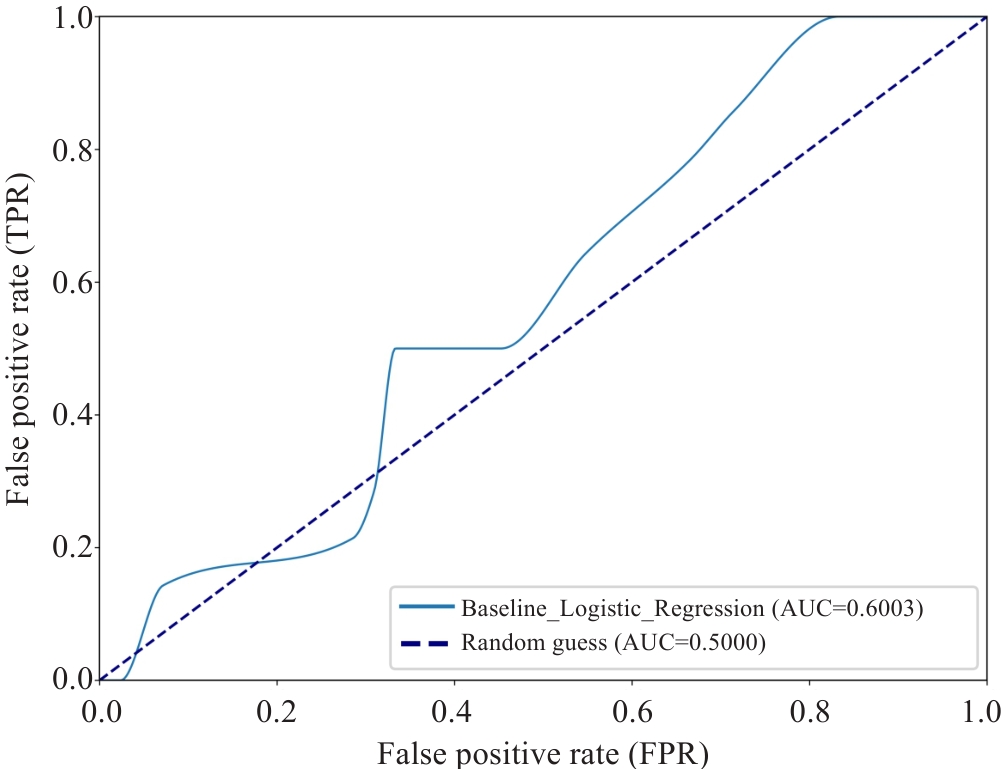
图2 基线模型ROC曲线
Fig.2 ROC curve of the baseline model.
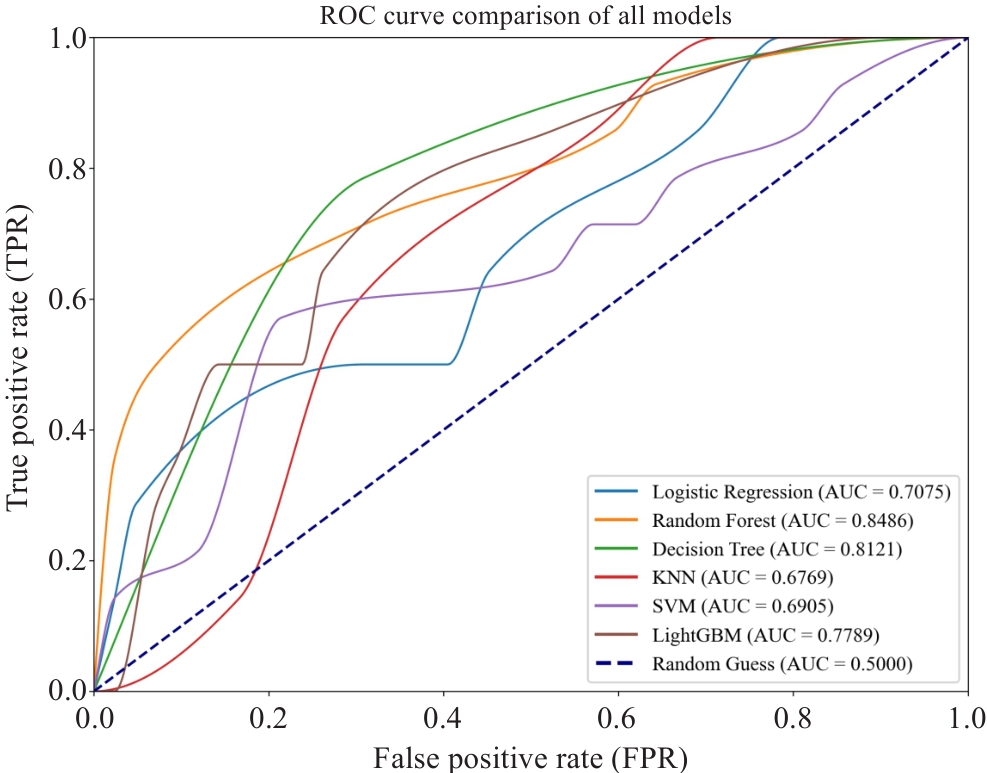
图3 模型ROC曲线对比
Fig.3 Comparison of ROC curves of the models.
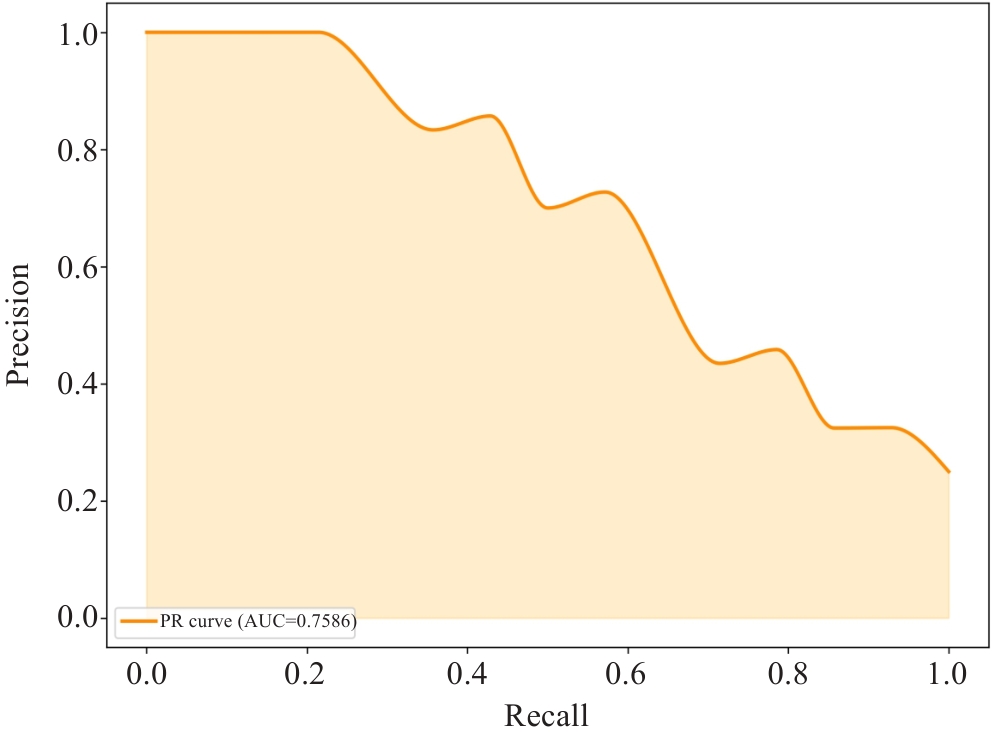
图4 RF模型Precision-Recall曲线
Fig.4 Precision-recall curve of the RF model.
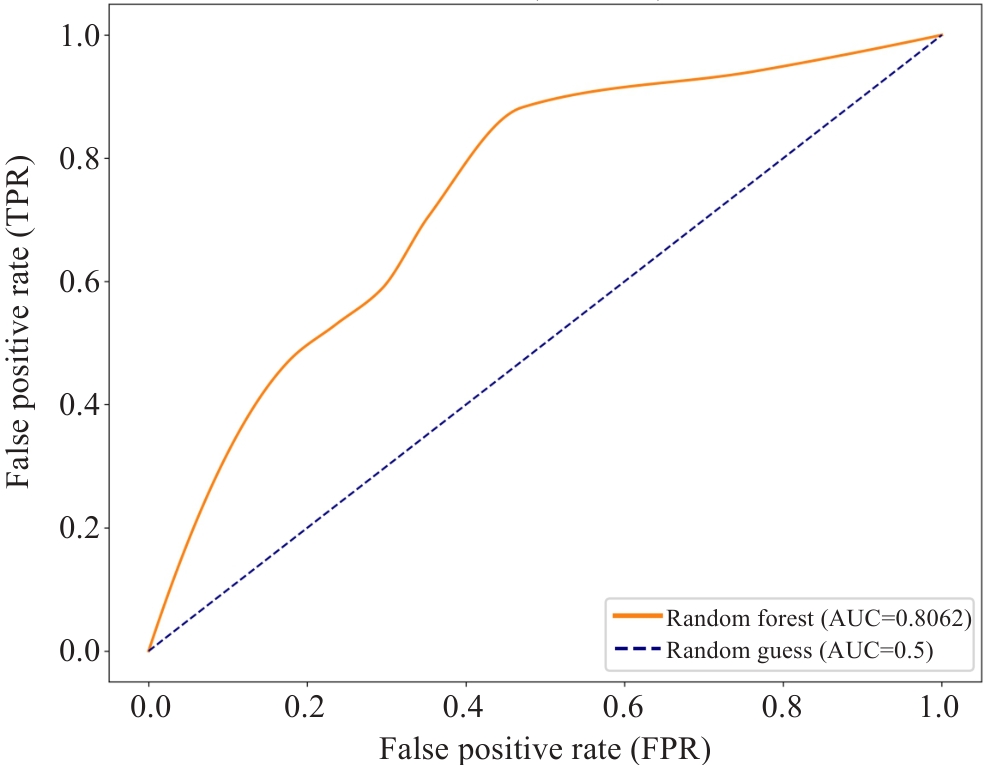
图5 外部验证集模型ROC曲线
Fig.5 ROC curve of the model on the external validation set.
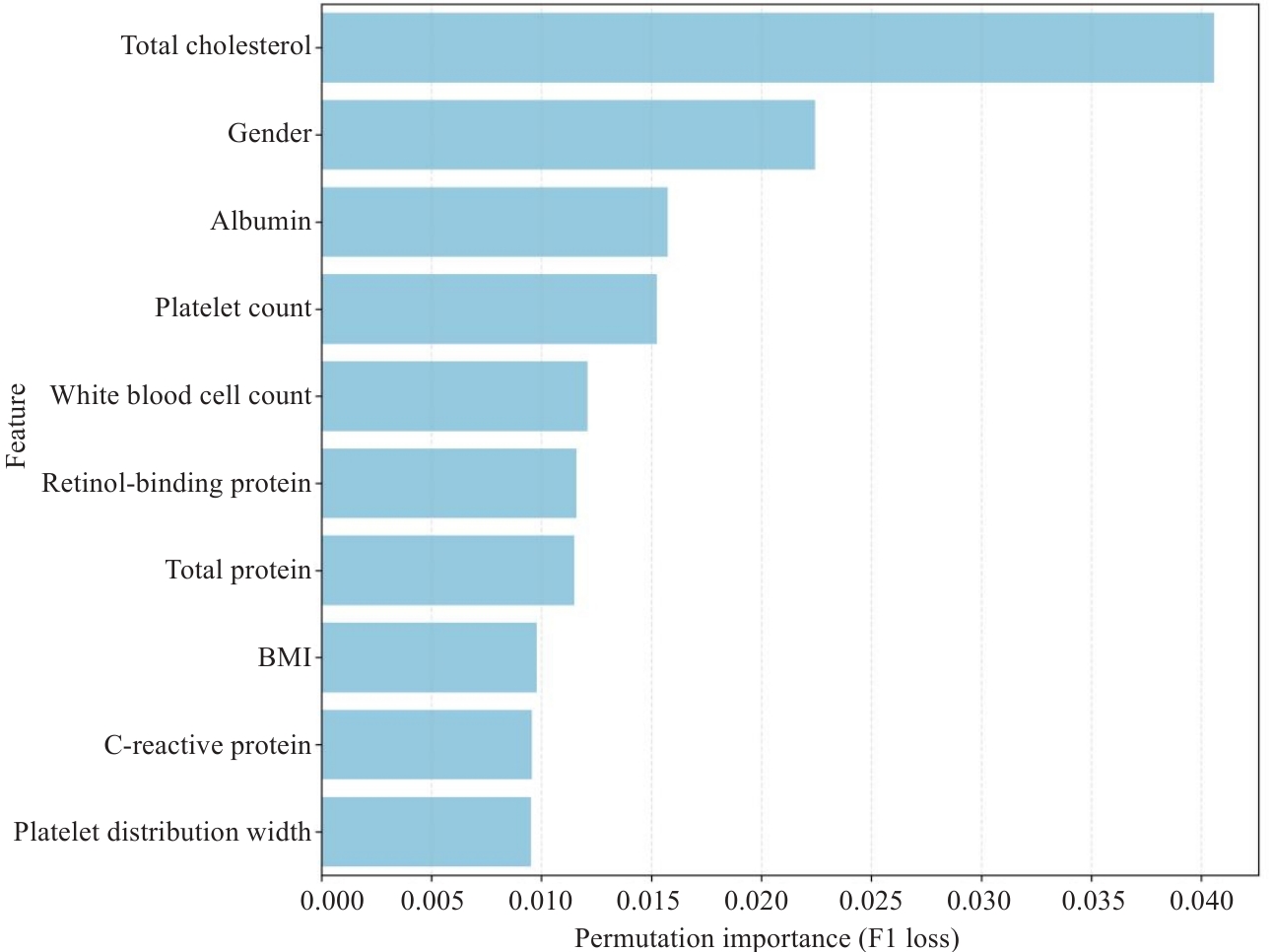
图6 关键特征重要性排序
Fig.6 Ranking of key feature importance.
| Feature | Importance |
|---|---|
| Total cholesterol | 0.0406 |
| Gender | 0.0224 |
| Albumin | 0.0157 |
| Platelet count | 0.0152 |
| White blood cell count | 0.0121 |
| Retinol-binding protein | 0.0116 |
| Total protein | 0.0115 |
| BMI | 0.0098 |
| C-reactive protein | 0.0096 |
| Platelet distribution width | 0.0095 |
表6 特征权重数值表
Tab.6 Table of feature weights
| Feature | Importance |
|---|---|
| Total cholesterol | 0.0406 |
| Gender | 0.0224 |
| Albumin | 0.0157 |
| Platelet count | 0.0152 |
| White blood cell count | 0.0121 |
| Retinol-binding protein | 0.0116 |
| Total protein | 0.0115 |
| BMI | 0.0098 |
| C-reactive protein | 0.0096 |
| Platelet distribution width | 0.0095 |
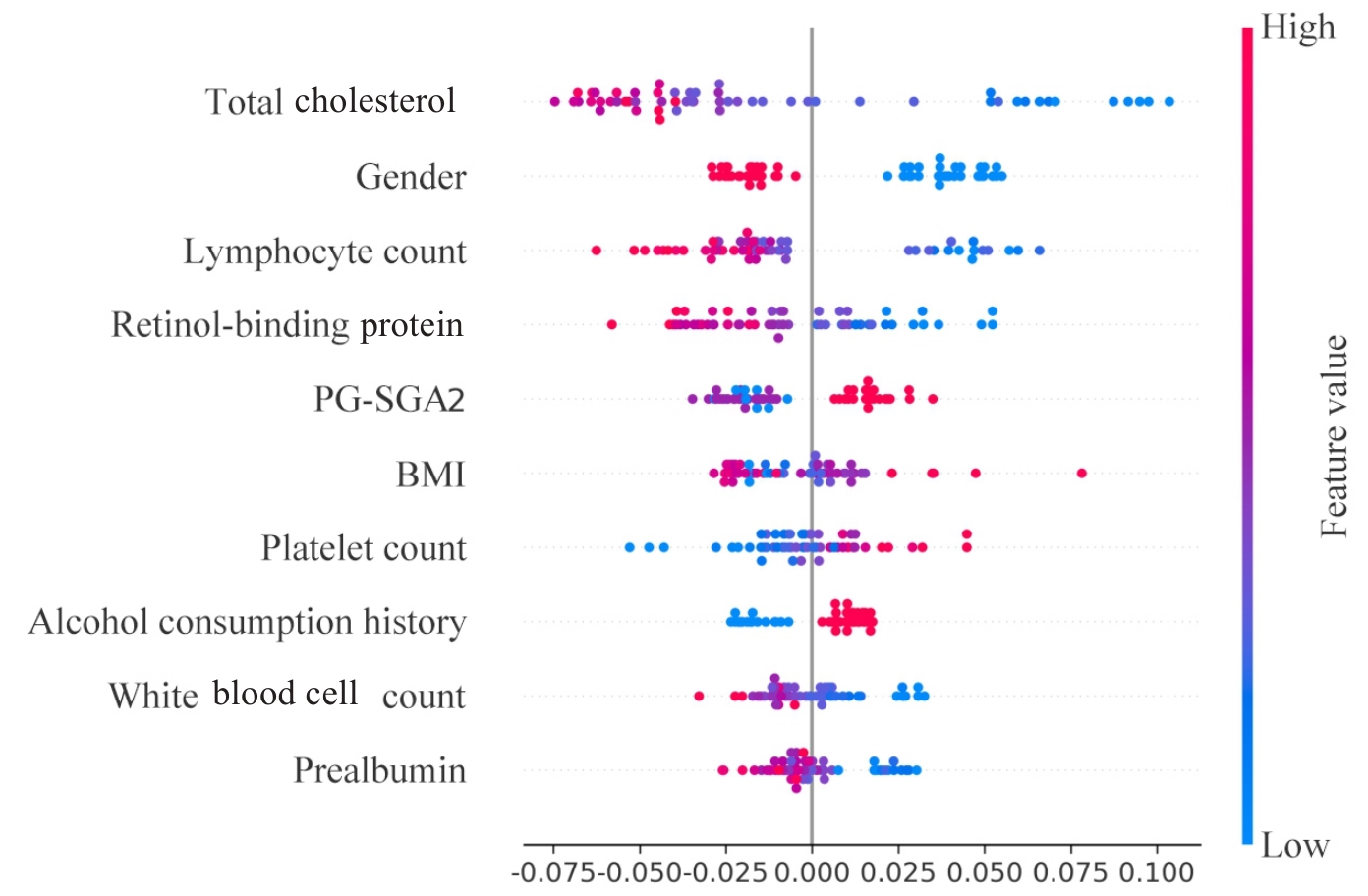
图7 SHAP特征重要性摘要图
Fig.7 Summary of SHAP feature importance.
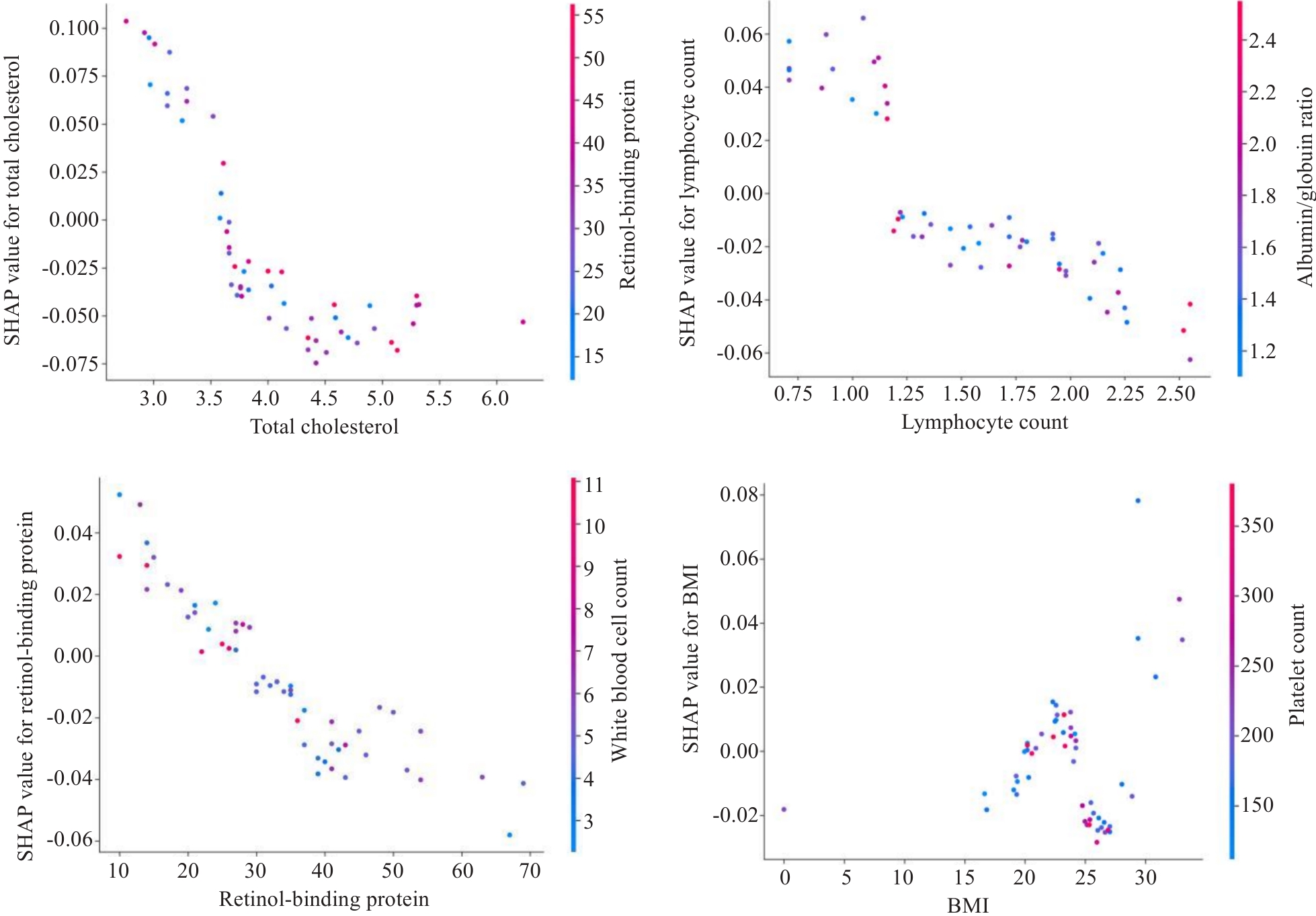
图8 关键特征SHAP依赖图
Fig.8 Key feature SHAP dependency plots. A: Total cholesterol SHAP dependency plot. B: Retinol-binding protein SHAP dependency plot. C: Lymphocyte count SHAP dependency plot. D: BMI SHAP dependency plot.
| [1] | Wang JY, Li DM, Ye FZ, et al. Global epidemiology of early-onset digestive system malignancy: a systematic analysis for the global burden of disease study 2021[J]. J Gastroenterol Hepatol, 2025, 40(6): 1525-35. doi:10.1111/jgh.17012 |
| [2] | Han BF, Zheng RS, Zeng HM, et al. Cancer incidence and mortality in China, 2022[J]. J Natl Cancer Cent, 2024, 4(1): 47-53. doi:10.1016/j.jncc.2024.01.006 |
| [3] | Gonzales J, Marchix J, Aymeric L, et al. Fecal supernatant from adult with autism spectrum disorder alters digestive functions, intestinal epithelial barrier, and enteric nervous system[J]. Microorganisms, 2021, 9(8): 1723. doi:10.3390/microorganisms9081723 |
| [4] | Zheng X, Jin Q, Lu Q, et al. Effect of comprehensive nursing intervention on perioperative anxiety and sleep quality in elderly patients with digestive tract malignancies[J]. Am J Transl Res, 2022, 14(10): 7189-98. |
| [5] | Fu WH, Hu ZL, Liao YJ, et al. Relationship between preoperative psychological stress and short-term prognosis in elderly patients with femoral neck fracture[J]. World J Psychiatry, 2024, 14(6): 838-47. doi:10.5498/wjp.v14.i6.838 |
| [6] | Shen PL, Tian ZL, Liu N, et al. Effect of radical prostatectomy on anxiety, depression, and quality of life in patients diagnosed with prostate cancer[J]. World J Psychiatry, 2025, 15(12): 110915. doi:10.5498/wjp.v15.i12.110915 |
| [7] | Andreis F, Mirandola M, Deori C, et al. Fear of cancer recurrence: an exploratory study on its impact on quality of life and emotional distress in patients undergoing systemic cancer therapy[J]. Pall Supp Care, 2025, 23: e208. doi:10.1017/s1478951525101016 |
| [8] | Qin N, Yi SJ, Dai CY, et al. Associations of serum Cortisol and inflammatory marker features with depression and anxiety in young women with gynecologic cancer[J]. Support Care Cancer, 2023, 31(12): 674. doi:10.1007/s00520-023-08145-z |
| [9] | Monroy-Iglesias MJ, Russell B, Martin S, et al. Anxiety and depression in patients with non-site-specific cancer symptoms: data from a rapid diagnostic clinic[J]. Front Oncol, 2024, 14: 1358888. doi:10.3389/fonc.2024.1358888 |
| [10] | Ortega MA, Álvarez-Mon MA, García-Montero C, et al. Microbiota-gut-brain axis mechanisms in the complex network of bipolar disorders: potential clinical implications and translational opportunities[J]. Mol Psychiatry, 2023, 28(7): 2645-73. doi:10.1038/s41380-023-01964-w |
| [11] | Deng X, Hu YH, Xiong YJ, et al. Correlation of anxiety and depression with mindfulness in esophageal cancer patients undergoing esophagectomy and analysis of risk factors[J]. World J Psychiatry, 2025, 15(9): 104813. doi:10.5498/wjp.v15.i9.104813 |
| [12] | Sánchez-Diestro LE, Macias-Montero R, Ramalho-Galhanas AI, et al. Nutritional status assessment using the patient-generated subjective global assessment (PG-SGA) in individuals with colorectal cancer undergoing chemotherapy regimens[J]. J Clin Med, 2025, 14(18): 6664. doi:10.3390/jcm14186664 |
| [13] | Feng J, Gossmann A, Sahiner B, et al. Bayesian logistic regression for online recalibration and revision of risk prediction models with performance guarantees[J]. J Am Med Inform Assoc, 2022, 29(5): 841-52. doi:10.1093/jamia/ocab280 |
| [14] | 杨艳平, 李 荣. 基于决策树-逻辑回归模型的心脏病影响因素[J]. 工业控制计算机, 2024, 37(8): 114-6. |
| [15] | 汤 涛, 曹 磊, 曹 力, 等. 基于多机器学习方法的静脉血栓栓塞症实时预警平台构建及应用[J]. 医学信息学杂志, 2022, 43(10): 66-9, 75. |
| [16] | 王新峰, 黄 伟. 变分自编码器对甲基化缺失数据的填补[J]. 计算机工程与应用, 2022, 58(12): 149-54. doi:10.3778/j.issn.1002-8331.2109-0135 |
| [17] | Oppegaard K, Harris CS, Shin J, et al. Anxiety profiles are associated with stress, resilience and symptom severity in outpatients receiving chemotherapy[J]. Support Care Cancer, 2021, 29(12): 7825-36. doi:10.1007/s00520-021-06372-w |
| [18] | Götze H, Friedrich M, Taubenheim S, et al. Depression and anxiety in long-term survivors 5 and 10 years after cancer diagnosis[J]. Support Care Cancer, 2020, 28(1): 211-20. doi:10.1007/s00520-019-04805-1 |
| [19] | Hasan EM, Calma CL, Tudor A, et al. Gender differences in coping, depression, and anxiety in patients with non-metastatic lung cancer[J]. Cancer Manag Res, 2022, 14: 2041-52. doi:10.2147/cmar.s368992 |
| [20] | Hao SR, Zhang Z, Zhou YY, et al. Altered gut bacterial–fungal interKingdom networks in children and adolescents with depression[J]. J Affect Disord, 2023, 332: 64-71. doi:10.1016/j.jad.2023.03.086 |
| [21] | Moon J, Jeon SW, An Y, et al. Life stressors and depressive symptoms: the moderating roles of alcohol consumption and age[J]. Brain Sci, 2025, 15(10): 1126. doi:10.3390/brainsci15101126 |
| [22] | Tan DJH, Quek SXZ, Yong JN, et al. Global prevalence of depression and anxiety in patients with hepatocellular carcinoma: Systematic review and meta-analysis[J]. Clin Mol Hepatol, 2022, 28(4): 864-75. doi:10.3350/cmh.2022.0136 |
| [23] | Peoples AR, Oswald LB, Ose J, et al. Impact of the COVID-19 pandemic on rural and urban cancer patients' experiences, health behaviors, and perceptions[J]. J Rural Health, 2022, 38(4): 886-99. doi:10.1111/jrh.12648 |
| [24] | Tilg H, Petta S, Stefan N, et al. Metabolic dysfunction–associated steatotic liver disease in adults: a review[J]. JAMA, 2026, 335(2): 163. doi:10.1001/jama.2025.19615 |
| [25] | 王 妮, 胡 芳, 赵漪文. 基于正念减压的心理干预对甲状腺乳头状癌术后患者负性情绪及依从性的影响[J]. 国际护理学杂志, 2025, 44(17): 3212-7. |
| [26] | 张文慧, 唐溶崧, 王晶玭, 等. 中青年2型糖尿病患者病耻感现状及影响因素研究[J]. 中国糖尿病杂志, 2022, 30(9): 666-71. |
| [27] | 蔡久梅, 陈 伟, 郑喜兰. 结直肠癌术后病人癌症复发恐惧研究进展[J]. 护理研究, 2023, 37(7): 1228-31. doi:10.12102/j.issn.1009-6493.2023.07.020 |
| [28] | Schapira L, Zheng Y, Gelber SI, et al. Trajectories of fear of cancer recurrence in young breast cancer survivors[J]. Cancer, 2022, 128(2): 335-43. doi:10.1002/cncr.33921 |
| [29] | 吴 琼, 周 兵. 首发老年抑郁症病人睡眠纺缍波、血清总胆固醇水平与抑郁、焦虑和认知功能的关系[J]. 国际精神病学杂志, 2024, 51(6): 1772-5. |
| [30] | Denche-Zamorano Á, Pisà-Canyelles J, Barrios-Fernández S, et al. Evaluation of the association of physical activity levels with self-perceived health, depression, and anxiety in Spanish individuals with high cholesterol levels: a retrospective cross-sectional study[J]. PeerJ, 2024, 12: e17169. doi:10.7717/peerj.17169 |
| [31] | Marcarini JAC, Grippa WR, Neto LCBS, et al. Nutritional status of women with non-metastatic breast cancer receiving outpatient chemotherapy[J]. Nutrition, 2024, 123: 112411. doi:10.1016/j.nut.2024.112411 |
| [32] | McFarland DC, Applebaum AJ, Bengtsen E, et al. Potential use of albumin and neutrophil-to-lymphocyte ratio to guide the evaluation and treatment of cancer-related depression and anxiety[J]. Psychooncology, 2022, 31(2): 306-15. doi:10.1002/pon.5811 |
| [33] | Houston H, Beck I, Albert C, et al. Anxiety symptoms predict head and neck cancer survival: Exploring mediation by systemic inflammation and tumor response to treatment[J]. Psychooncology, 2024, 33(7): e6375. doi:10.1002/pon.6375 |
| [34] | Saylam B, İncel ÖD. Quantifying digital biomarkers for well-being: stress, anxiety, positive and negative affect via wearable devices and their time-based predictions[J]. Sensors, 2023, 23(21): 8987. doi:10.3390/s23218987 |
| [35] | 肖 湉. 基于机器学习的结直肠癌化疗患者中重度癌因性疲乏风险预测模型研究[D]. 成都: 成都医学院, 2025. |
| [1] | 朱梦欣, 刘晓, 赵珊, 张新, 刘超, 刘献孔, 綦浩辰, 韩铁生, 马冬. 可解释性机器学习模型对宫颈癌周围神经浸润的术前精准预测及临床决策支持:一项多中心回顾性研究[J]. 南方医科大学学报, 2026, 46(7): 1509-1519. |
| [2] | 陈浩, 李振汉, 纪梦佳, 汪鑫诚, 陈博峰, 管谦, 武嫚, 卢林明. 全球非酒精性脂肪性肝病负担的关键决定因素:基于GBD数据的机器学习联合孟德尔随机化验证[J]. 南方医科大学学报, 2026, 46(4): 770-784. |
| [3] | 陶红成, 梁富凯, 黄文波, 范思奇, 曾平. 酒精暴露与股骨头坏死的潜在关联:基于机器学习构建诊断模型[J]. 南方医科大学学报, 2026, 46(3): 559-569. |
| [4] | 向科霖, 章晓云, 黎征鹏, 徐志为, 刘素杰, 柴源. 胞葬相关基因UCP2、EGLN3、IL1B对骨关节炎的诊断价值及中药治疗预测:基于生物信息学及机器学习[J]. 南方医科大学学报, 2026, 46(3): 693-706. |
| [5] | 陈君尧, 陈泽宇, 林钊杰, 方梦浩, 沈超英, 许琦, 张晓怡, 卢鲁. 饮茶对胃肠道疾病风险的双重作用:基于可解释机器学习与大语言模型的联合预测辅助模型[J]. 南方医科大学学报, 2026, 46(2): 353-361. |
| [6] | 崔运能, 冯敏清, 姚亮凤, 严杰文, 李闻瀚, 黄燕平. 基于欠采样的影像组学机器学习模型术前预测子宫肌瘤高强度聚焦超声消融效果[J]. 南方医科大学学报, 2026, 46(1): 141-149. |
| [7] | 黄启智, 谢戴鹏, 姚霖彤, 李洽轩, 吴少伟, 周海榆. 肿瘤微环境特异性CT影像组学标签预测非小细胞肺癌免疫治疗疗效[J]. 南方医科大学学报, 2025, 45(9): 1903-1918. |
| [8] | 姜君, 封硕, 孙银贵, 安燕. 经尿道前列腺钬激光剜除术后低体温风险预测模型:基于逻辑回归、决策树和支持向量机[J]. 南方医科大学学报, 2025, 45(9): 2019-2025. |
| [9] | 陈梅妹, 王洋, 雷黄伟, 张斐, 黄睿娜, 杨朝阳. 基于多种机器学习算法和语音情绪特征的阈下抑郁辨识模型构建[J]. 南方医科大学学报, 2025, 45(4): 711-717. |
| [10] | 袁萍, 胡秀莉, 漆国佳, 代秀, 褚相远, 陈卫航, 石修权. 睡眠质量低下与创伤患者创伤后应激障碍的发生相关[J]. 南方医科大学学报, 2024, 44(6): 1166-1172. |
| [11] | 陈莉莉, 吴天宇, 张铭, 丁子夏, 张妍, 杨依清, 郑佳倩, 张小楠. 类风湿关节炎的潜在生物标志物及其免疫调控机制:基于GEO数据库[J]. 南方医科大学学报, 2024, 44(6): 1098-1108. |
| [12] | 申采玉, 王帅, 周锐盈, 汪雨贺, 高琴, 陈兴智, 杨枢. 慢性心力衰竭合并肺部感染患者院内死亡风险预测:基于可解释性机器学习方法[J]. 南方医科大学学报, 2024, 44(6): 1141-1148. |
| [13] | 左志威, 孟庆良, 崔家康, 郭克磊, 卞华. 基于硬皮病线粒体相关基因的人工神经网络模型的构建[J]. 南方医科大学学报, 2024, 44(5): 920-929. |
| [14] | 金佳欣, 马鹏珍, 王尔玉, 谢颖桢. 急性缺血性卒中患者复发的独立影响因素及风险预测列线图模型构建:基于Lasso回归[J]. 南方医科大学学报, 2024, 44(12): 2375-2381. |
| [15] | 黄晓茵, 陈凤莲, 张煜, 梁淑君. 多参数多区域MRI影像组学特征与临床信息联合模型可有效预测脑胶质瘤患者生存期[J]. 南方医科大学学报, 2024, 44(10): 2004-2014. |
| 阅读次数 | ||||||
|
全文 |
|
|||||
|
摘要 |
|
|||||
