
南方医科大学学报 ›› 2026, Vol. 46 ›› Issue (7): 1723-1730.doi: 10.12122/j.issn.1673-4254.2026.07.25
• • 上一篇
苏柏尔1,2( ), 张颖2, 闫智娴2, 邹颖2, 成禹帆3, 李天舒4, 李晋铭2, 陈晓彤2, 梁春祺5, 徐镕2, 杨晟明6, 彭渤2, 陈豪1(), 余江1(), 胡彦锋1()
收稿日期:2026-04-02
出版日期:2026-07-20
发布日期:2026-07-20
通讯作者:
陈豪,余江,胡彦锋
E-mail:1424554892@qq.com;chenhao.05@163.com;balbc@163.com;yfenghu@qq.com
作者简介:苏柏尔,南方医科大学临床医学八年制本硕博连读,E-mail: 1424554892@qq.com基金资助:
Boer SU1,2(), Ying ZHANG2, Zhixian YAN2, Ying ZOU2, Yufan CHENG3, Tianshu LI4, Jinming LI2, Xiaotong CHEN2, Chunqi LIANG5, Rong XU2, Shengming YANG6, Bo PENG2, Hao CHEN1(), Jiang YU1(), Yanfeng HU1()
Received:2026-04-02
Online:2026-07-20
Published:2026-07-20
Contact:
Hao CHEN, Jiang YU, Yanfeng HU
E-mail:1424554892@qq.com;chenhao.05@163.com;balbc@163.com;yfenghu@qq.com
Supported by:摘要:
随着医学科技的飞速发展,微创手术已成为治疗复杂外科疾病的重要手段。然而,手术具有高风险性以及技术密集型的特征,使得术者操作差异、团队协作效率及突发事件的处理能力成为了影响患者预后的关键因素。目前,建立系统的技能评估与质量控制体系,被认为是降低风险、提高围手术期安全性的关键措施。然而,传统技能评估与质量控制方式(如主观评分、术后分析等)虽然有一定的价值,但是因为标准不一、耗时耗力与缺乏实时反馈等缺点已经难以满足当前外科精准化的需求。近些年来,人工智能(AI)特别是基于计算机视觉的深度学习技术,在手术动作识别、手术流程阶段分析、术中安全监测等方面表现出巨大的潜力,推动了手术技能评估与质量控制自动化、客观化与精准化的发展。本文系统梳理AI在微创外科手术技能评估与质量控制领域的最新研究进展,重点讨论基于AI的技能评估与质量控制算法模型,分析模型泛化性、隐私保护及多中心适用性等问题,并展望未来智能精准外科的临床应用前景。
苏柏尔, 张颖, 闫智娴, 邹颖, 成禹帆, 李天舒, 李晋铭, 陈晓彤, 梁春祺, 徐镕, 杨晟明, 彭渤, 陈豪, 余江, 胡彦锋. 人工智能在微创外科手术技能评估与质量控制中的应用研究进展[J]. 南方医科大学学报, 2026, 46(7): 1723-1730.
Boer SU, Ying ZHANG, Zhixian YAN, Ying ZOU, Yufan CHENG, Tianshu LI, Jinming LI, Xiaotong CHEN, Chunqi LIANG, Rong XU, Shengming YANG, Bo PENG, Hao CHEN, Jiang YU, Yanfeng HU. Application of artificial intelligence for surgical skill assessment and quality control in minimally invasive surgery: progress, problems and prospect[J]. Journal of Southern Medical University, 2026, 46(7): 1723-1730.
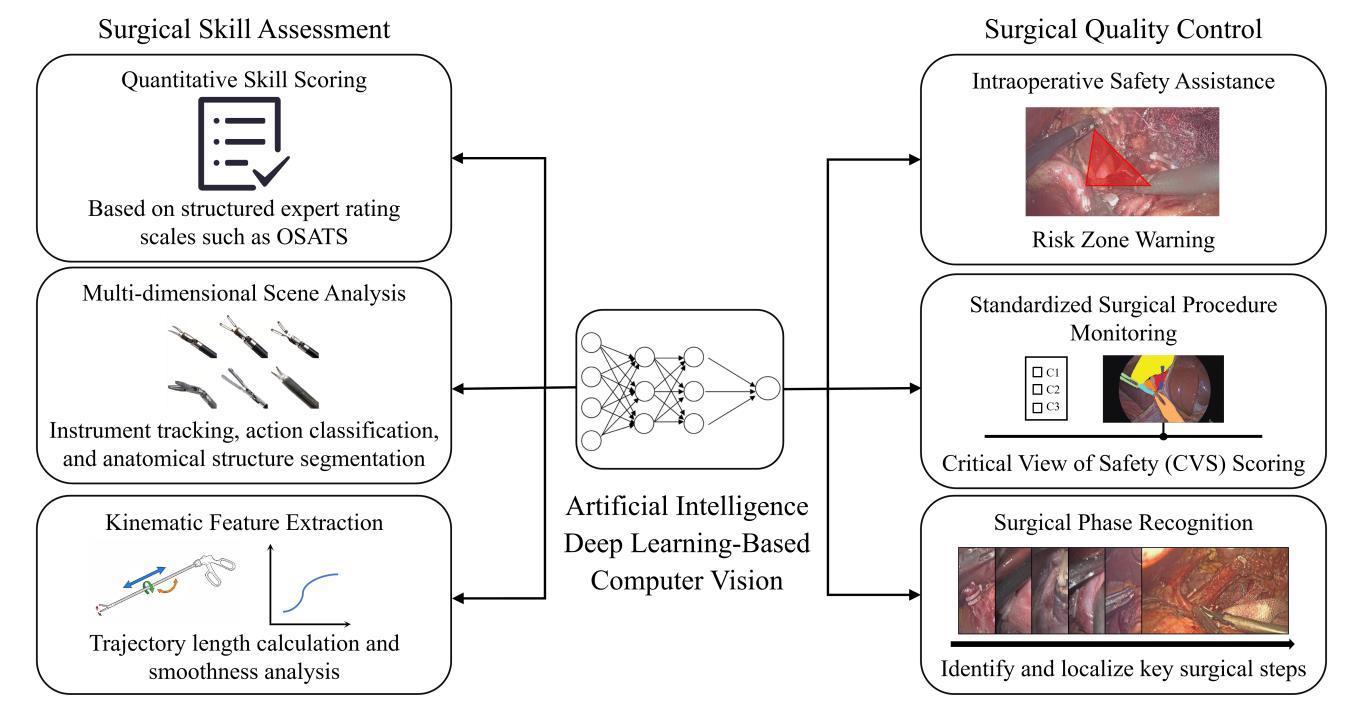
图1 人工智能在微创外科手术技能评估与质量控制中的应用
Fig.1 Application of artificial intelligence (AI) in surgical skill assessment and quality control of minimally invasive surgery. OSATS: Objective structured assessment of technical skills; CVS: Critical view of safety.
| [1] | Sullivan R, Alatise OI, Anderson BO, et al. Global cancer surgery: delivering safe, affordable, and timely cancer surgery[J]. Lancet Oncol, 2015, 16(11): 1193-224. doi:10.1016/s1470-2045(15)00223-5 |
| [2] | Meara JG, Greenberg SLM. The Lancet Commission on Global Surgery Global surgery 2030: Evidence and solutions for achieving health, welfare and economic development[J]. Surgery, 2015, 157(5): 834-5. doi:10.1016/j.surg.2015.02.009 |
| [3] | Howard R, Johnson E, Berlin NL, et al. Hospital and surgeon variation in 30-day complication rates after ventral hernia repair[J]. Am J Surg, 2021, 222(2): 417-23. doi:10.1016/j.amjsurg.2020.12.021 |
| [4] | Birkmeyer JD, Stukel TA, Siewers AE, et al. Surgeon volume and operative mortality in the United States[J]. N Engl J Med, 2003, 349(22): 2117-27. doi:10.1016/j.accreview.2003.12.065 |
| [5] | Lau D, Deviren V, Ames CP. The impact of surgeon experience on perioperative complications and operative measures following thoracolumbar 3-column osteotomy for adult spinal deformity: overcoming the learning curve[J]. J Neurosurg Spine, 2020, 32(2): 207-20. doi:10.3171/2019.7.spine19656 |
| [6] | 中国医师协会内镜医师分会腹腔镜外科专业委员会, 中国研究型医院学会机器人与腹腔镜外科专业委员会, 中国腹腔镜胃肠外科研究组. 中国腹腔镜胃癌根治手术质量控制专家共识(2017版)[J]. 中华消化外科杂志, 2017, 16(6): 539-47. |
| [7] | Julià D, Gómez N, Codina-Cazador A. Surgical skill and complication rates after bariatric surgery [J]. N Engl J Med, 2014, 370(3): 285. doi:10.1056/NEJMc1313890#SA3 |
| [8] | Soomro NA, Hashimoto DA, Porteous AJ, et al. Systematic review of learning curves in robot-assisted surgery[J]. BJS Open, 2020, 4(1): 27-44. doi:10.1002/bjs5.50235 |
| [9] | Balvardi S, Kammili A, Hanson M, et al. The association between video-based assessment of intraoperative technical performance and patient outcomes: a systematic review[J]. Surg Endosc, 2022, 36(11): 7938-48. doi:10.1007/s00464-022-09296-6 |
| [10] | Martin JA, Regehr G, Reznick R, et al. Objective structured assessment of technical skill (OSATS) for surgical residents[J]. Br J Surg, 1997, 84(2): 273-8. doi:10.1046/j.1365-2168.1997.02502.x |
| [11] | Dindo D, Demartines N, Clavien PA. Classification of surgical complications: a new proposal with evaluation in a cohort of 6336 patients and results of a survey[J]. Ann Surg, 2004, 240(2): 205-13. doi:10.1097/01.sla.0000133083.54934.ae |
| [12] | Chen C, White L, Kowalewski T, et al. Crowd-Sourced Assessment of Technical Skills: a novel method to evaluate surgical performance[J]. J Surg Res, 2014, 187(1): 65-71. doi:10.1016/j.jss.2013.09.024 |
| [13] | Chen J, Cheng N, Cacciamani G, et al. Objective assessment of robotic surgical technical skill: a systematic review[J]. J Urol, 2019, 201(3): 461-9. doi:10.1016/j.juro.2018.06.078 |
| [14] | Suganyadevi S, Seethalakshmi V, Balasamy K. A review on deep learning in medical image analysis[J]. Int J Multimed Info Retr, 2022, 11(1): 19-38. doi:10.1007/s13735-021-00218-1 |
| [15] | Maier-Hein L, Vedula SS, Speidel S, et al. Surgical data science for next-generation interventions[J]. Nat Biomed Eng, 2017, 1(9): 691-6. doi:10.1038/s41551-017-0132-7 |
| [16] | Varghese C, Harrison EM, O’Grady G, et al. Artificial intelligence in surgery[J]. Nat Med, 2024, 30(5): 1257-68. doi:10.1038/s41591-024-02970-3 |
| [17] | Singh V, Vasisht S, Hashimoto DA. Artificial intelligence in surgery: what is needed for ongoing innovation[J]. Surg Oxf, 2025, 43(3): 129-34. doi:10.1016/j.mpsur.2024.12.005 |
| [18] | Allan M, Shvets A, Kurmann T, et al. 2017 robotic instrument segmentation challenge[EB/OL]. 2019: arXiv: 1902.06426. . doi:10.48550/arXiv.1902.06426 |
| [19] | Baby B, Thapar D, Chasmai M, et al. From Forks to forceps: a new framework for instance segmentation of surgical instruments[C]//2023 IEEE/CVF Winter Conference on Applications of Computer Vision (WACV), Waikoloa, HI, USA. IEEE, 2023: 6180-90. doi:10.1109/wacv56688.2023.00613 |
| [20] | Carstens M, Rinner FM, Bodenstedt S, et al. The Dresden surgical anatomy dataset for abdominal organ segmentation in surgical data science[J]. Sci Data, 2023, 10: 3. doi:10.1038/s41597-022-01719-2 |
| [21] | Kamtam DN, Shrager JB, Malla SD, et al. Deep learning approaches to surgical video segmentation and object detection: a scoping review[J]. Comput Biol Med, 2025, 194: 110482. doi:10.1016/j.compbiomed.2025.110482 |
| [22] | Nema S, Vachhani L. Surgical instrument detection and tracking technologies: Automating dataset labeling for surgical skill assessment[J]. Front Robot AI, 2022, 9: 1030846. doi:10.3389/frobt.2022.1030846 |
| [23] | Hirohata Y, Sogabe M, Miyazaki T, et al. Confidence-aware self-supervised learning for dense monocular depth estimation in dynamic laparoscopic scene[J]. Sci Rep, 2023, 13: 15380. doi:10.1038/s41598-023-42713-x |
| [24] | Mascagni P, Alapatt D, Sestini L, et al. Computer vision in surgery: from potential to clinical value[J]. Npj Digit Med, 2022, 5: 163. doi:10.1038/s41746-022-00707-5 |
| [25] | Selva J, Johansen AS, Escalera S, et al. Video transformers: a survey[J]. IEEE Trans Pattern Anal Mach Intell, 2023, 45(11): 12922-43. doi:10.1109/tpami.2023.3243465 |
| [26] | Funke I, Mees ST, Weitz J, et al. Video-based surgical skill assessment using 3D convolutional neural networks[J]. Int J Comput Assist Radiol Surg, 2019, 14(7): 1217-25. doi:10.1007/s11548-019-01995-1 |
| [27] | Twinanda AP, Shehata S, Mutter D, et al. EndoNet: a deep architecture for recognition tasks on laparoscopic videos[J]. IEEE Trans Med Imaging, 2017, 36(1): 86-97. doi:10.1109/tmi.2016.2593957 |
| [28] | Madani A, Namazi B, Altieri MS, et al. Artificial intelligence for intraoperative guidance: using semantic segmentation to identify surgical anatomy during laparoscopic cholecystectomy[J]. Ann Surg, 2022, 276(2): 363-9. doi:10.1097/sla.0000000000004594 |
| [29] | Zia A, Sharma Y, Bettadapura V, et al. Video and accelerometer-based motion analysis for automated surgical skills assessment[J]. Int J Comput Assist Radiol Surg, 2018, 13(3): 443-55. doi:10.1007/s11548-018-1704-z |
| [30] | Maier-Hein L, Eisenmann M, Sarikaya D, et al. Surgical data science-from concepts toward clinical translation[J]. Med Image Anal, 2022, 76: 102306. doi:10.1016/j.media.2021.102306 |
| [31] | Loftus TJ, Tighe PJ, Filiberto AC, et al. Artificial intelligence and surgical decision-making[J]. JAMA Surg, 2020, 155(2): 148. doi:10.1001/jamasurg.2019.4917 |
| [32] | 苟龙飞, 陈 畅, 苏柏尔, 等. 人工智能在微创外科手术中的应用研究进展[J]. 中华消化外科杂志, 2025, 24(5): 599-608. |
| [33] | Pedrett R, Mascagni P, Beldi G, et al. Technical skill assessment in minimally invasive surgery using artificial intelligence: a systematic review[J]. Surg Endosc, 2023, 37(10): 7412-24. doi:10.1007/s00464-023-10335-z |
| [34] | Vassiliou MC, Feldman LS, Andrew CG, et al. A global assessment tool for evaluation of intraoperative laparoscopic skills[J]. Am J Surg, 2005, 190(1): 107-13. doi:10.1016/j.amjsurg.2005.04.004 |
| [35] | Goh AC, Goldfarb DW, Sander JC, et al. Global evaluative assessment of robotic skills: validation of a clinical assessment tool to measure robotic surgical skills[J]. J Urol, 2012, 187(1): 247-52. doi:10.1016/j.juro.2011.09.032 |
| [36] | Ryan JF, Mador B, Lai K, et al. Validity evidence for procedure-specific competence assessment tools in general surgery: a scoping review[J]. Ann Surg, 2022, 275(3): 482-7. doi:10.1097/sla.0000000000005207 |
| [37] | Kurashima Y, Watanabe Y, Hiki N, et al. Development of a novel tool to assess skills in laparoscopic gastrectomy using the Delphi method: the Japanese operative rating scale for laparoscopic distal gastrectomy (JORS-LDG)[J]. Surg Endosc, 2019, 33(12): 3945-52. doi:10.1007/s00464-019-06681-6 |
| [38] | Haug TR, Miskovic D, Ørntoft MW, et al. Development of a procedure-specific tool for skill assessment in left- and right-sided laparoscopic complete mesocolic excision[J]. Colorectal Dis, 2023, 25(1): 31-43. doi:10.1111/codi.16317 |
| [39] | Haug TR, Ørntoft MW, Miskovic D, et al. Technical assessment in minimally invasive complete mesocolic excision: Is the complete mesocolic excision competency assessment tool valid and reliable?[J]. Colorectal Dis, 2023, 25(11): 2139-46. doi:10.1111/codi.16756 |
| [40] | Crochet P, Netter A, Schmitt A, et al. Performance assessment for total laparoscopic hysterectomy in the operating room: validity evidence of a procedure-specific rating scale[J]. J Minim Invasive Gynecol, 2021, 28(10): 1743-50.e3. doi:10.1016/j.jmig.2021.02.013 |
| [41] | de Montbrun SL, Roberts PL, Lowry AC, et al. A novel approach to assessing technical competence of colorectal surgery residents: the development and evaluation of the colorectal objective structured assessment of technical skill (COSATS)[J]. Ann Surg, 2013, 258(6): 1001-6. doi:10.1097/SLA.0b013e31829b32b8 |
| [42] | de Montbrun S, Roberts PL, Satterthwaite L, et al. Implementing and evaluating a national certification technical skills examination: the colorectal objective structured assessment of technical skill[J]. Ann Surg, 2016, 264(1): 1-6. doi:10.1097/sla.0000000000001620 |
| [43] | Reznick RK, MacRae H. Teaching surgical skills: changes in the wind[J]. N Engl J Med, 2006, 355(25): 2664-9. doi:10.1056/nejmra054785 |
| [44] | Datta V, MacKay S, Mandalia M, et al. The use of electromagnetic motion tracking analysis to objectively measure open surgical skill in the laboratory-based model[J]. J Am Coll Surg, 2001, 193(5): 479-85. doi:10.1016/S1072-7515(01)01041-9 |
| [45] | Lefor AK, Harada K, Dosis A, et al. Motion analysis of the JHU-ISI gesture and skill assessment working set using robotics video and motion assessment software[J]. Int J Comput Assist Radiol Surg, 2020, 15(12): 2017-25. doi:10.1007/s11548-020-02259-z |
| [46] | Ahmidi N, Tao LL, Sefati S, et al. A dataset and benchmarks for segmentation and recognition of gestures in robotic surgery[J]. IEEE Trans Biomed Eng, 2017, 64(9): 2025-41. doi:10.1109/tbme.2016.2647680 |
| [47] | Dosis A. Synchronized video and motion analysis for the assessment of procedures in the operating theater[J]. Arch Surg, 2005, 140(3): 293. doi:10.1001/archsurg.140.3.293 |
| [48] | Ghasemloonia A, Maddahi Y, Zareinia K, et al. Surgical skill assessment using motion quality and smoothness[J]. J Surg Educ, 2017, 74(2): 295-305. doi:10.1016/j.jsurg.2016.10.006 |
| [49] | Oh DS, Ershad M, Wee JO, et al. Comparison of Global Evaluative Assessment of Robotic Surgery with objective performance indicators for the assessment of skill during robotic-assisted thoracic surgery[J]. Surgery, 2023, 174(6): 1349-55. doi:10.1016/j.surg.2023.08.008 |
| [50] | Kil I, Eidt JF, Groff RE, et al. Assessment of open surgery suturing skill: Simulator platform, force-based, and motion-based metrics[J]. Front Med, 2022, 9: 897219. doi:10.3389/fmed.2022.897219 |
| [51] | Viriyasiripong S, Lopez A, Mandava SH, et al. Accelerometer measurement of head movement during laparoscopic surgery as a tool to evaluate skill development of surgeons[J]. J Surg Educ, 2016, 73(4): 589-94. doi:10.1016/j.jsurg.2016.01.008 |
| [52] | Aghazadeh F, Zheng B, Tavakoli M, et al. Assessment of surgical proficiency based on evaluating muscle activity, bimanual muscle coordination, and fatigue susceptibility in simulated laparoscopic tasks[J]. Med Biol Eng Comput, 2026, 64(3): 847-59. doi:10.1007/s11517-025-03484-x |
| [53] | Jun SK, Sathia Narayanan M, Singhal P, et al. Evaluation of robotic minimally invasive surgical skills using motion studies[J]. J Robotic Surg, 2013, 7(3): 241-9. doi:10.1007/s11701-013-0419-y |
| [54] | Kil I, Eidt JF, Singapogu RB, et al. Assessment of open surgery suturing skill: image-based metrics using computer vision[J]. J Surg Educ, 2024, 81(7): 983-93. doi:10.1016/j.jsurg.2024.03.020 |
| [55] | Igaki T, Kitaguchi D, Matsuzaki H, et al. Automatic surgical skill assessment system based on concordance of standardized surgical field development using artificial intelligence[J]. JAMA Surg, 2023, 158(8): e231131. doi:10.1001/jamasurg.2023.1131 |
| [56] | Anastasiou D, Jin YM, Stoyanov D, et al. Keep your eye on the best: contrastive regression transformer for skill assessment in robotic surgery[J]. IEEE Robot Autom Lett, 2023, 8(3): 1755-62. doi:10.1109/lra.2023.3242466 |
| [57] | Khalid S, Rudzicz F. SurGNN: Explainable visual scene understanding and assessment of surgical skill using graph neural networks[EB/OL]. 2023: arXiv: 2308.13073. . |
| [58] | Zhang XM, Liang L, Liu L, et al. Graph neural networks and their current applications in bioinformatics[J]. Front Genet, 2021, 12: 690049. doi:10.3389/fgene.2021.690049 |
| [59] | Ghodoussipour S, Reddy SS, Ma RZ, et al. An objective assessment of performance during robotic partial nephrectomy: validation and correlation of automated performance metrics with intraoperative outcomes[J]. J Urol, 2021, 205(5): 1294-302. doi:10.1097/JU.0000000000001839 |
| [60] | Otiato MX, Ma RZ, Chu TN, et al. Surgical gestures to evaluate apical dissection of robot-assisted radical prostatectomy[J]. J Robot Surg, 2024, 18(1): 245. doi:10.1007/s11701-024-01902-0 |
| [61] | Donabedian A. The quality of care: how can it be assessed?[J]. JAMA, 1988, 260(12): 1743. doi:10.1001/jama.1988.03410120089033 |
| [62] | Japanese Gastric Cancer Association. Japanese gastric cancer treatment guidelines 2025 (7th edition)[J]. Gastric Cancer, 2026, 29(2): 271-99. doi:10.1007/s10120-025-01698-4 |
| [63] | Song JH, Shin HJ, Hyung WJ, et al. Predictive value of KLASS-02-QC assessment score on KLASS-02 surgical outcomes: validation of surgeon quality control and standardization for D2 lympha-denectomy[J]. Ann Surg, 2023, 278(5): e1011-7. doi:10.1097/sla.0000000000005810 |
| [64] | Kim HI, Hur H, Kim YN, et al. Standardization of D2 lymphadenectomy and surgical quality control (KLASS-02-QC): a prospective, observational, multicenter study [NCT01283893][J]. BMC Cancer, 2014, 14: 209. doi:10.1186/1471-2407-14-209 |
| [65] | Kotsis SV, Chung KC. Application of the "see one, do one, teach one" concept in surgical training[J]. Plast Reconstr Surg, 2013, 131(5): 1194-201. doi:10.1097/prs.0b013e318287a0b3 |
| [66] | Solis-Pazmino P, Xu V, Ma R, et al. Laparoscopic vs Robotic surgery for obstructing colon cancer-a National Surgical Quality Impro-vement Program database analysis[J]. J Gastrointest Surg, 2025, 29(11): 102194. doi:10.1016/j.gassur.2025.102194 |
| [67] | Driessen SRC, Van Zwet EW, Haazebroek P, et al. A dynamic quality assessment tool for laparoscopic hysterectomy to measure surgical outcomes[J]. Am J Obstet Gynecol, 2016, 215(6): 754. e1-8. doi:10.1016/j.ajog.2016.07.004 |
| [68] | Wang WP, Liu J, Wang JF, et al. Comparing robot-assisted vs. laparoscopic proctectomy for rectal cancer surgical and oncological outcomes[J]. Front Surg, 2025, 12: 1628649. doi:10.3389/fsurg.2025.1628649 |
| [69] | Claassen YHM, de Steur WO, Hartgrink HH, et al. Surgicopathological quality control and protocol adherence to lymphadenectomy in the CRITICS gastric cancer trial[J]. Ann Surg, 2018, 268(6): 1008-13. doi:10.1097/sla.0000000000002444 |
| [70] | de Jongh C, Triemstra L, van der Veen A, et al. Surgical quality and prospective quality control of the D2-gastrectomy for gastric cancer in the multicenter randomized LOGICA-trial[J]. Eur J Surg Oncol, 2023, 49(10): 107018. doi:10.1016/j.ejso.2023.107018 |
| [71] | Vincent C, Moorthy K, Sarker SK, et al. Systems approaches to surgical quality and safety: from concept to measurement[J]. Ann Surg, 2004, 239(4): 475-82. doi:10.1097/01.sla.0000118753.22830.41 |
| [72] | Meng Y, Donoho DA, Altshuler M, et al. AI-driven evaluation of surgical skill via action recognition[EB/OL]. 2025: arXiv: 2512.24411. . |
| [73] | McLeod M, Leung K, Pramesh CS, et al. Quality indicators in surgical oncology: systematic review of measures used to compare quality across hospitals[J]. BJS Open, 2024, 8(2): zrae009. doi:10.1093/bjsopen/zrae009 |
| [74] | Haynes AB, Weiser TG, Berry WR, et al. A surgical safety checklist to reduce morbidity and mortality in a global population[J]. N Engl J Med, 2009, 360(5): 491-9. doi:10.1056/NEJMsa0810119 |
| [75] | Fudickar A, Hörle K, Wiltfang J, et al. The effect of the WHO Surgical Safety Checklist on complication rate and communication[J]. Dtsch Arztebl Int, 2012, 109(42): 695-701. |
| [76] | Haugen AS, Sevdalis N, Søfteland E. Impact of the World Health Organization surgical safety checklist on patient safety[J]. Anesthesiology, 2019, 131(2): 420-5. doi:10.1097/ALN.0000000000002674 |
| [77] | Adrales G, Ardito F, Chowbey P, et al. Laparoscopic cholecystectomy critical view of safety (LC-CVS): a multi-national validation study of an objective, procedure-specific assessment using video-based assessment (VBA)[J]. Surg Endosc, 2024, 38(2): 922-30. doi:10.1007/s00464-023-10479-y |
| [78] | Grüter AAJ, Daams F, Bonjer HJ, et al. Surgical quality assessment of critical view of safety in 283 laparoscopic cholecystectomy videos by surgical residents and surgeons[J]. Surg Endosc, 2024, 38(7): 3609-14. doi:10.1007/s00464-024-10873-0 |
| [79] | Athanasiadis DI, Makhecha K, Blundell N, et al. How accurate are surgeons at assessing the quality of their critical view of safety during laparoscopic cholecystectomy?[J]. J Surg Res, 2025, 305: 36-40. doi:10.1016/j.jss.2024.10.048 |
| [80] | Liu YZ, Zhao S, Zhang G, et al. Multilevel effective surgical workflow recognition in robotic left lateral sectionectomy with deep learning: experimental research[J]. Int J Surg, 2023, 109(10): 2941-52. doi:10.1097/JS9.0000000000000559 |
| [81] | Kitaguchi D, Takeshita N, Matsuzaki H, et al. Automated laparoscopic colorectal surgery workflow recognition using artificial intelligence: Experimental research[J]. Int J Surg, 2020, 79: 88-94. doi:10.1016/j.ijsu.2020.05.015 |
| [82] | Wu SD, Chen ZX, Liu RW, et al. SurgSmart: an artificial intelligent system for quality control in laparoscopic cholecystectomy: an observational study[J]. Int J Surg, 2023, 109(5): 1105-14. doi:10.1097/js9.0000000000000329 |
| [83] | Peng ZY, Wang ZB, Yan Y, et al. Development of an AI-driven digital assistance system for real-time safety evaluation and quality control in laparoscopic liver surgery[J]. Front Oncol, 2025, 15: 1678525. doi:10.3389/fonc.2025.1678525 |
| [84] | Stefanie S, Lena M, Danail S, et al. Endoscopic Vision Challenge 2023[J]. Zenodo, 2023. 10.5281/zenodo.8315050 . |
| [85] | Mascagni P, Vardazaryan A, Alapatt D, et al. Artificial intelligence for surgical safety: automatic assessment of the critical view of safety in laparoscopic cholecystectomy using deep learning[J]. Ann Surg, 2022, 275(5): 955-61. doi:10.1097/sla.0000000000004351 |
| [86] | Wang CC, Alaya Cheikh F, Kaaniche M, et al. Variational based smoke removal in laparoscopic images[J]. BioMedical Eng Online, 2018, 17(1): 139. doi:10.1186/s12938-018-0590-5 |
| [87] | Münzer B, Schoeffmann K, Böszörmenyi L. Content-based processing and analysis of endoscopic images and videos: a survey[J]. Multimed Tools Appl, 2018, 77(1): 1323-62. doi:10.1007/s11042-016-4219-z |
| [88] | Mountney P, Yang GZ. Context specific descriptors for tracking deforming tissue[J]. Med Image Anal, 2012, 16(3): 550-61. doi:10.1016/j.media.2011.02.010 |
| [89] | Ruskin KJ, Hueske-Kraus D. Alarm fatigue: impacts on patient safety[J]. Curr Opin Anaesthesiol, 2015, 28(6): 685-90. doi:10.1097/ACO.0000000000000260 |
| [90] | Phansalkar S, Edworthy J, Hellier E, et al. A review of human factors principles for the design and implementation of medication safety alerts in clinical information systems[J]. J Am Med Inform Assoc, 2010, 17(5): 493-501. doi:10.1136/jamia.2010.005264 |
| [91] | Amann J, Blasimme A, Vayena E, et al. Explainability for artificial intelligence in healthcare: a multidisciplinary perspective[J]. BMC Med Inform Decis Mak, 2020, 20(1): 310. doi:10.1186/s12911-020-01332-6 |
| [92] | Topol EJ. High-performance medicine: the convergence of human and artificial intelligence[J]. Nat Med, 2019, 25(1): 44-56. doi:10.1038/s41591-018-0300-7 |
| [93] | Hashimoto DA, Rosman G, Rus D, et al. Artificial intelligence in surgery: promises and perils[J]. Ann Surg, 2018, 268(1): 70-6. doi:10.1097/SLA.0000000000002693 |
| [1] | 朱君, 谭顺谦, 黄方俊, 蔡光瑶, 甄鑫. 医疗先验引导的TabMap深度学习模型用于卵巢癌预测及可解释性研究[J]. 南方医科大学学报, 2026, 46(7): 1714-1722. |
| [2] | 吴细旋, 沙桐, 胡鸿彬, 孙毛毛, 吴洁, 陈仲清. 急性胰腺炎患者早期有创机械通气需求模型的构建与验证:基于可解释机器学习[J]. 南方医科大学学报, 2026, 46(6): 1339-1348. |
| [3] | 张明旭, 吴迪恒, 林嘉泽, 吕祎君, 周凌宏, 甄鑫, 周浩, 秦耿耿. 基于Transformer的影像与检验数据多模态预测模型在医院获得性感染的应用研究[J]. 南方医科大学学报, 2026, 46(6): 1423-1433. |
| [4] | 许家宁, 毛钇骁, 张煜. 基于分层注意力驱动多实例学习的肾透明细胞癌数字病理分级分期[J]. 南方医科大学学报, 2026, 46(5): 1175-1184. |
| [5] | 王童, 段曹辉, 娄昕, 冯前进. 基于血管增强一致性保持扩散模型的3T到7T SWI生成方法[J]. 南方医科大学学报, 2026, 46(5): 1185-1192. |
| [6] | 陈博湧, 汪新怡, 赵新新, 宋婷, 李永宝. 基于Swin-ResViT网络的低质量动态cine-MR至高质量定位MR图像实时生成研究[J]. 南方医科大学学报, 2026, 46(4): 929-938. |
| [7] | 谭顺谦, 卓俐, 曾敏, 黄方俊, 朱君, 蔡光瑶, 甄鑫. 基于实验室指标的Transformer模型可高效鉴别卵巢癌[J]. 南方医科大学学报, 2026, 46(4): 939-945. |
| [8] | 卢学麒, 陈华元, 吴秋岑, 温耀棋, 刘国光, 陈超敏. 一种基于深度特征融合的可解释性12导联心电图自动诊断模型研究[J]. 南方医科大学学报, 2026, 46(1): 208-218. |
| [9] | 程浩然, 严鸿斌, 袁子云, 庄泽鸿, 孙学刚, 姚学清. 大语言模型在肿瘤诊断中的文字报告与医学影像应用研究进展[J]. 南方医科大学学报, 2026, 46(1): 231-238. |
| [10] | 吴秋岑, 卢学麒, 温耀棋, 洪永, 吴煜良, 陈超敏. II导联心电图中心肌梗死检测与定位:基于多尺度残差模块融合改进通道注意力模型[J]. 南方医科大学学报, 2025, 45(8): 1777-1790. |
| [11] | 郑子瑜, 杨夏颖, 吴圣杰, 张诗婕, 吕国荣, 柳培忠, 王珺, 何韶铮. 多特征融合的产时超声胎方位识别模型[J]. 南方医科大学学报, 2025, 45(7): 1563-1570. |
| [12] | 渠梦, 傅蓉. ResLSTM-TemporalSE:多导联心电信号的自动分类[J]. 南方医科大学学报, 2025, 45(12): 2708-2717. |
| [13] | 李欣洋, 许桂晓, 刘洁宏, 冯衍秋. 人工智能辅助压缩感知加速技术对鼻咽癌MRI影像组学特征提取及分期诊断模型性能的影响[J]. 南方医科大学学报, 2025, 45(11): 2518-2526. |
| [14] | 谢辉荣, 胡潮滨, 梁国华, 韩红喆, 黄牧, 冯前进. 大学生心理压力智能评估:基于融合文本与影像的多模态模型的设计及验证[J]. 南方医科大学学报, 2025, 45(11): 2504-2510. |
| [15] | 贺亚迪, 周炫汝, 金锦辉, 宋婷. 基于PE-CycleGAN网络的鼻咽癌自适应放疗CBCT-sCT生成研究[J]. 南方医科大学学报, 2025, 45(1): 179-186. |
| 阅读次数 | ||||||
|
全文 |
|
|||||
|
摘要 |
|
|||||
