
Journal of Southern Medical University ›› 2026, Vol. 46 ›› Issue (10): 2456-2470.doi: 10.12122/j.issn.1673-4254.2026.10.15
Shijie QIAO1( ), Jinshun YOU1, Chang WANG2,3, Hongping XIONG4, Shunan LI1()
Received:2026-03-09
Online:2026-10-20
Published:2026-10-26
Contact:
Shunan LI
E-mail:2277605219@qq.com;fjmulsn@126.com
Shijie QIAO, Jinshun YOU, Chang WANG, Hongping XIONG, Shunan LI. Construction of predictive models for type 2 diabetic retinopathy based on the principle of differentiation of syndrome elements[J]. Journal of Southern Medical University, 2026, 46(10): 2456-2470.
Add to citation manager EndNote|Ris|BibTeX
URL: https://www.j-smu.com/EN/10.12122/j.issn.1673-4254.2026.10.15
| No. | Syndrome elements | T2DM(n=376) | T2DR(n=273) | χ2/Z/t | P | |
|---|---|---|---|---|---|---|
| 1 | Yin deficiency | Severe | 233 | 269 | 120.711 | <0.01 |
| Non-severe | 143 | 4 | ||||
| 2 | Phlegm | Severe | 147 | 193 | 63.32 | <0.01 |
| Non-severe | 229 | 80 | ||||
| 3 | Liver | Severe | 177 | 266 | 185.149 | <0.01 |
| Non-severe | 199 | 7 | ||||
| 4 | Heat | Severe | 111 | 179 | 83.144 | <0.01 |
| Non-severe | 265 | 94 | ||||
| 5 | Kidney | Severe | 130 | 195 | 85.929 | <0.01 |
| Non-severe | 246 | 78 | ||||
| 6 | Dampness | Severe | 156 | 175 | 32.364 | <0.01 |
| Non-severe | 220 | 98 | ||||
| 7 | Yang deficiency | Severe | 112 | 153 | 45.134 | <0.01 |
| Non-severe | 264 | 120 | ||||
| 8 | Blood deficiency | Severe | 93 | 216 | 187.562 | <0.01 |
| Non-severe | 283 | 57 | ||||
| 9 | Blood stasis | Severe | 52 | 101 | 47.133 | <0.01 |
| Non-severe | 324 | 172 | ||||
| 10 | Qi deficiency | Severe | 45 | 128 | 98.639 | <0.01 |
| Non-severe | 331 | 145 | ||||
| 11 | Qi stagnation | Severe | 42 | 90 | 46.379 | <0.01 |
| Non-severe | 334 | 183 | ||||
| 12 | Yang excess | Severe | 4 | 65 | 86.122 | <0.01 |
| Non-severe | 372 | 208 | ||||
| 13 | Heart spirit | Severe | 16 | 38 | 19.365 | <0.01 |
| Non-severe | 360 | 235 | ||||
| 14 | Spleen | Severe | 5 | 28 | 26.144 | <0.01 |
| Non-severe | 371 | 245 | ||||
| 15 | Heart | Severe | 1 | 10 | 10.954 | <0.01 |
| Non-severe | 375 | 263 | ||||
| 16 | Essence deficiency | Severe | 0 | 6 | 8.341 | <0.01 |
| Non-severe | 376 | 267 | ||||
| 17 | Tendon-bone | Severe | 11 | 43 | 34.106 | <0.01 |
| Non-severe | 365 | 230 | ||||
| 18 | Gallbladder | Severe | 0 | 0 | - | - |
| Non-severe | 376 | 273 | ||||
| 19 | Cold | Severe | 2 | 10 | 8.544 | <0.01 |
| Non-severe | 374 | 263 | ||||
| 20 | Jin deficiency | Severe | 0 | 3 | 4.151 | <0.05 |
| Non-severe | 376 | 270 | ||||
| 21 | Meridian | Severe | 1 | 4 | 2.975 | >0.05 |
| Non-severe | 375 | 269 | ||||
| 22 | Stomach | Severe | 2 | 5 | 2.504 | >0.05 |
| Non-severe | 374 | 268 | ||||
| 23 | Lung | Severe | 2 | 33 | 41.397 | <0.01 |
| Non-severe | 374 | 240 | ||||
| 24 | Dryness | Severe | 0 | 1 | 1.379 | >0.05 |
| Non-severe | 376 | 272 | ||||
Tab.1 Screening of Traditional Chinese medicine (TCM) syndrome elements (frequency≥20%, n)
| No. | Syndrome elements | T2DM(n=376) | T2DR(n=273) | χ2/Z/t | P | |
|---|---|---|---|---|---|---|
| 1 | Yin deficiency | Severe | 233 | 269 | 120.711 | <0.01 |
| Non-severe | 143 | 4 | ||||
| 2 | Phlegm | Severe | 147 | 193 | 63.32 | <0.01 |
| Non-severe | 229 | 80 | ||||
| 3 | Liver | Severe | 177 | 266 | 185.149 | <0.01 |
| Non-severe | 199 | 7 | ||||
| 4 | Heat | Severe | 111 | 179 | 83.144 | <0.01 |
| Non-severe | 265 | 94 | ||||
| 5 | Kidney | Severe | 130 | 195 | 85.929 | <0.01 |
| Non-severe | 246 | 78 | ||||
| 6 | Dampness | Severe | 156 | 175 | 32.364 | <0.01 |
| Non-severe | 220 | 98 | ||||
| 7 | Yang deficiency | Severe | 112 | 153 | 45.134 | <0.01 |
| Non-severe | 264 | 120 | ||||
| 8 | Blood deficiency | Severe | 93 | 216 | 187.562 | <0.01 |
| Non-severe | 283 | 57 | ||||
| 9 | Blood stasis | Severe | 52 | 101 | 47.133 | <0.01 |
| Non-severe | 324 | 172 | ||||
| 10 | Qi deficiency | Severe | 45 | 128 | 98.639 | <0.01 |
| Non-severe | 331 | 145 | ||||
| 11 | Qi stagnation | Severe | 42 | 90 | 46.379 | <0.01 |
| Non-severe | 334 | 183 | ||||
| 12 | Yang excess | Severe | 4 | 65 | 86.122 | <0.01 |
| Non-severe | 372 | 208 | ||||
| 13 | Heart spirit | Severe | 16 | 38 | 19.365 | <0.01 |
| Non-severe | 360 | 235 | ||||
| 14 | Spleen | Severe | 5 | 28 | 26.144 | <0.01 |
| Non-severe | 371 | 245 | ||||
| 15 | Heart | Severe | 1 | 10 | 10.954 | <0.01 |
| Non-severe | 375 | 263 | ||||
| 16 | Essence deficiency | Severe | 0 | 6 | 8.341 | <0.01 |
| Non-severe | 376 | 267 | ||||
| 17 | Tendon-bone | Severe | 11 | 43 | 34.106 | <0.01 |
| Non-severe | 365 | 230 | ||||
| 18 | Gallbladder | Severe | 0 | 0 | - | - |
| Non-severe | 376 | 273 | ||||
| 19 | Cold | Severe | 2 | 10 | 8.544 | <0.01 |
| Non-severe | 374 | 263 | ||||
| 20 | Jin deficiency | Severe | 0 | 3 | 4.151 | <0.05 |
| Non-severe | 376 | 270 | ||||
| 21 | Meridian | Severe | 1 | 4 | 2.975 | >0.05 |
| Non-severe | 375 | 269 | ||||
| 22 | Stomach | Severe | 2 | 5 | 2.504 | >0.05 |
| Non-severe | 374 | 268 | ||||
| 23 | Lung | Severe | 2 | 33 | 41.397 | <0.01 |
| Non-severe | 374 | 240 | ||||
| 24 | Dryness | Severe | 0 | 1 | 1.379 | >0.05 |
| Non-severe | 376 | 272 | ||||
| No. | Indicators | T2DM (n=376) | T2DR (n=273) | χ2/Z/t | P | |
|---|---|---|---|---|---|---|
| 1 | Gender | Male | 216 | 137 | 3.364 | >0.05 |
| Female | 160 | 136 | ||||
| 2 | Age (years) | 60.54±13.02 | 61.33±12.41 | -0.784 | >0.05 | |
| 3 | Residence | Urban | 230 | 166 | 0.009 | >0.05 |
| Rural | 146 | 107 | ||||
| 4 | Occupation | Employed | 166 | 107 | 1.593 | >0.05 |
| Unemployed | 210 | 166 | ||||
| 5 | Marital status | Married | 313 | 222 | 0.405 | >0.05 |
| Unmarried | 63 | 51 | ||||
| 6 | Education level | Illiterate | 24 | 38 | -3.682 | <0.01 |
| Primary school | 119 | 95 | ||||
| Junior high school | 107 | 78 | ||||
Senior high school/technical secondary school/vocational high school | 83 | 44 | ||||
| College/associate degree | 43 | 17 | ||||
| Master's degree or above | 0 | 1 | ||||
| 7 | Household income (CNY/month) | ≤1000 | 28 | 24 | -1.569 | >0.05 |
| 1001-2000 | 35 | 38 | ||||
| 2001-5000 | 113 | 79 | ||||
| ≥5001 | 200 | 132 | ||||
| 8 | Living arrangement | Living with others | 330 | 244 | 0.402 | >0.05 |
| Living alone | 46 | 29 | ||||
| 9 | Religious belief | None | 224 | 155 | 0.51 | >0.05 |
| Yes | 152 | 118 | ||||
| 10 | History of insulin therapy | None | 288 | 156 | 27.697 | <0.01 |
| Yes | 88 | 117 | ||||
| 11 | Smoking history | None | 280 | 211 | 0.684 | >0.05 |
| Yes | 96 | 62 | ||||
| 12 | Smoking quantity | Non-smoker | 280 | 211 | -0.746 | >0.05 |
| <1 pack/day | 48 | 27 | ||||
| 1-2 packs/day | 36 | 29 | ||||
| >2 packs/day | 12 | 6 | ||||
| 13 | Drinking history | None | 287 | 221 | 1.987 | >0.05 |
| Yes | 89 | 52 | ||||
| 14 | Diet:time | Irregular | 147 | 122 | 2.039 | >0.05 |
| Regular | 229 | 151 | ||||
| 15 | Diet:dietary intake | Overeating | 224 | 133 | 7.532 | <0.01 |
| Controlled | 152 | 140 | ||||
| 16 | Diet:category-Staple food | Rice-based | 297 | 223 | 1.129 | >0.05 |
| Wheat-based | 17 | 9 | ||||
| Mixed | 60 | 39 | ||||
| Other | 2 | 2 | ||||
| 17 | Diet:category-non-staple food | Vegetable-based | 220 | 173 | 4.599 | >0.05 |
| White meat-based | 109 | 65 | ||||
| Red meat-based | 3 | 6 | ||||
| Balanced | 44 | 29 | ||||
| 18 | Diet:Snacking status | None | 167 | 126 | 0.193 | >0.05 |
| Yes | 209 | 147 | ||||
| 19 | Dietary preference | None | 43 | 24 | 1.195 | >0.05 |
| Yes | 333 | 249 | ||||
| 20 | Physical labor | Light | 290 | 201 | -0.96 | >0.05 |
| Moderate | 77 | 67 | ||||
| Heavy | 9 | 5 | ||||
| 21 | Exercise habits and frequency | None | 117 | 82 | -0.266 | >0.05 |
| Occasional (1-2 times/week) | 16 | 9 | ||||
| Sometimes (3-4 times/week) | 7 | 12 | ||||
| Frequently (5-6 times/week) | 8 | 2 | ||||
| Daily | 228 | 168 | ||||
| 22 | Participation in T2DM education programs | None | 366 | 269 | 1.069 | >0.05 |
| Yes | 10 | 4 | ||||
| 23 | Attention to health preservation and healthcare | Mostly ignored | 300 | 230 | -1.515 | >0.05 |
| Moderate | 53 | 33 | ||||
| Highly valued | 23 | 10 | ||||
| 24 | Regular blood glucose monitoring | None | 306 | 198 | 7.149 | <0.01 |
| Yes | 70 | 75 | ||||
Tab.2 Screening of influencing factors and clinical biochemical indicators (n)[Mean±SD, M (P25, P75)]
| No. | Indicators | T2DM (n=376) | T2DR (n=273) | χ2/Z/t | P | |
|---|---|---|---|---|---|---|
| 1 | Gender | Male | 216 | 137 | 3.364 | >0.05 |
| Female | 160 | 136 | ||||
| 2 | Age (years) | 60.54±13.02 | 61.33±12.41 | -0.784 | >0.05 | |
| 3 | Residence | Urban | 230 | 166 | 0.009 | >0.05 |
| Rural | 146 | 107 | ||||
| 4 | Occupation | Employed | 166 | 107 | 1.593 | >0.05 |
| Unemployed | 210 | 166 | ||||
| 5 | Marital status | Married | 313 | 222 | 0.405 | >0.05 |
| Unmarried | 63 | 51 | ||||
| 6 | Education level | Illiterate | 24 | 38 | -3.682 | <0.01 |
| Primary school | 119 | 95 | ||||
| Junior high school | 107 | 78 | ||||
Senior high school/technical secondary school/vocational high school | 83 | 44 | ||||
| College/associate degree | 43 | 17 | ||||
| Master's degree or above | 0 | 1 | ||||
| 7 | Household income (CNY/month) | ≤1000 | 28 | 24 | -1.569 | >0.05 |
| 1001-2000 | 35 | 38 | ||||
| 2001-5000 | 113 | 79 | ||||
| ≥5001 | 200 | 132 | ||||
| 8 | Living arrangement | Living with others | 330 | 244 | 0.402 | >0.05 |
| Living alone | 46 | 29 | ||||
| 9 | Religious belief | None | 224 | 155 | 0.51 | >0.05 |
| Yes | 152 | 118 | ||||
| 10 | History of insulin therapy | None | 288 | 156 | 27.697 | <0.01 |
| Yes | 88 | 117 | ||||
| 11 | Smoking history | None | 280 | 211 | 0.684 | >0.05 |
| Yes | 96 | 62 | ||||
| 12 | Smoking quantity | Non-smoker | 280 | 211 | -0.746 | >0.05 |
| <1 pack/day | 48 | 27 | ||||
| 1-2 packs/day | 36 | 29 | ||||
| >2 packs/day | 12 | 6 | ||||
| 13 | Drinking history | None | 287 | 221 | 1.987 | >0.05 |
| Yes | 89 | 52 | ||||
| 14 | Diet:time | Irregular | 147 | 122 | 2.039 | >0.05 |
| Regular | 229 | 151 | ||||
| 15 | Diet:dietary intake | Overeating | 224 | 133 | 7.532 | <0.01 |
| Controlled | 152 | 140 | ||||
| 16 | Diet:category-Staple food | Rice-based | 297 | 223 | 1.129 | >0.05 |
| Wheat-based | 17 | 9 | ||||
| Mixed | 60 | 39 | ||||
| Other | 2 | 2 | ||||
| 17 | Diet:category-non-staple food | Vegetable-based | 220 | 173 | 4.599 | >0.05 |
| White meat-based | 109 | 65 | ||||
| Red meat-based | 3 | 6 | ||||
| Balanced | 44 | 29 | ||||
| 18 | Diet:Snacking status | None | 167 | 126 | 0.193 | >0.05 |
| Yes | 209 | 147 | ||||
| 19 | Dietary preference | None | 43 | 24 | 1.195 | >0.05 |
| Yes | 333 | 249 | ||||
| 20 | Physical labor | Light | 290 | 201 | -0.96 | >0.05 |
| Moderate | 77 | 67 | ||||
| Heavy | 9 | 5 | ||||
| 21 | Exercise habits and frequency | None | 117 | 82 | -0.266 | >0.05 |
| Occasional (1-2 times/week) | 16 | 9 | ||||
| Sometimes (3-4 times/week) | 7 | 12 | ||||
| Frequently (5-6 times/week) | 8 | 2 | ||||
| Daily | 228 | 168 | ||||
| 22 | Participation in T2DM education programs | None | 366 | 269 | 1.069 | >0.05 |
| Yes | 10 | 4 | ||||
| 23 | Attention to health preservation and healthcare | Mostly ignored | 300 | 230 | -1.515 | >0.05 |
| Moderate | 53 | 33 | ||||
| Highly valued | 23 | 10 | ||||
| 24 | Regular blood glucose monitoring | None | 306 | 198 | 7.149 | <0.01 |
| Yes | 70 | 75 | ||||
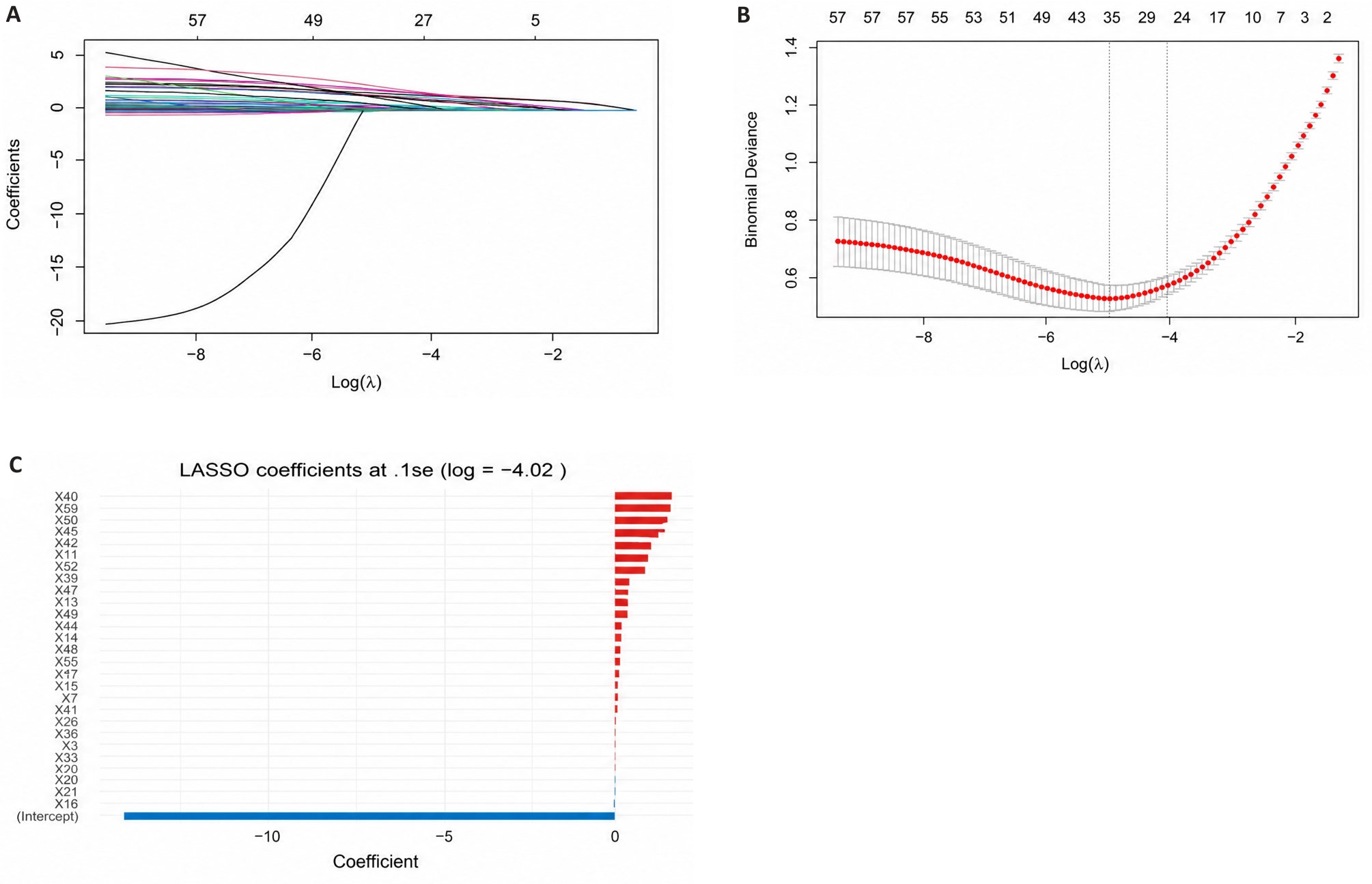
Fig.1 Coefficient path plot (A), cross-validation error plot (B), and bar chart of non-zero coefficients (C) in Lasso regression predictor selection. X40: Liver syndrome element; X59: Lung syndrome element; X50: Yang excess syndrome element; X45: blood deficiency syndrome element; X42: Heat syndrome element; X11: T2DKD; X52: Spleen syndrome element; X39: Yin deficiency syndrome element; X47: Blood stasis syndrome element; X13: T2DPN; X49: Qi stagnation syndrome element; X44: Kidney syndrome element; X14: T2DPVD; X48: Qi deficiency syndrome element; X55: Tendon-bone syndrome element; X57: Jin deficiency syndrome element; X17: HR; X15: WHR; X7: Dietary intake status; X41: Phlegm syndrome element; X26: BUN; X36: Urea; X3: T2DM duration; X33: HGB; X20: ALT; X21: AST; X16: HC.
| Diseases | Training set | Validation set | χ2 | P |
|---|---|---|---|---|
| T2DR (n=273) | 192 (42.11) | 81 (41.97) | 0.001 | >0.05 |
| T2DM (n=376) | 264 (57.89) | 112 (58.03) |
Tab.3 Comparison of the distribution of T2DR and T2DM patients in the training and validation sets [n(%)]
| Diseases | Training set | Validation set | χ2 | P |
|---|---|---|---|---|
| T2DR (n=273) | 192 (42.11) | 81 (41.97) | 0.001 | >0.05 |
| T2DM (n=376) | 264 (57.89) | 112 (58.03) |
| No. | Models | Accuracy | Precision | Recall | Specificity | False positive rate | F1 score | AUC (95% CI) |
|---|---|---|---|---|---|---|---|---|
| 1 | LR | 0.877 | 0.925 | 0.771 | 0.955 | 0.045 | 0.841 | 0.956 (0.938-0.973) |
| 2 | ANN | 0.965 | 0.978 | 0.938 | 0.985 | 0.015 | 0.957 | 0.991 (0.984-0.998) |
| 3 | XGBoost | 0.974 | 0.979 | 0.958 | 0.985 | 0.015 | 0.968 | 0.996 (0.993-0.999) |
| 4 | RF | 0.982 | 0.989 | 0.969 | 0.992 | 0.008 | 0.979 | 1.000 (0.999-1.000) |
| 5 | SVM | 0.958 | 0.968 | 0.932 | 0.977 | 0.023 | 0.950 | 0.988 (0.979-0.997) |
| 6 | KNN | 0.890 | 0.908 | 0.823 | 0.939 | 0.061 | 0.863 | 0.961 (0.945-0.977) |
Tab.4 Performance comparison of the six ML models on the training set
| No. | Models | Accuracy | Precision | Recall | Specificity | False positive rate | F1 score | AUC (95% CI) |
|---|---|---|---|---|---|---|---|---|
| 1 | LR | 0.877 | 0.925 | 0.771 | 0.955 | 0.045 | 0.841 | 0.956 (0.938-0.973) |
| 2 | ANN | 0.965 | 0.978 | 0.938 | 0.985 | 0.015 | 0.957 | 0.991 (0.984-0.998) |
| 3 | XGBoost | 0.974 | 0.979 | 0.958 | 0.985 | 0.015 | 0.968 | 0.996 (0.993-0.999) |
| 4 | RF | 0.982 | 0.989 | 0.969 | 0.992 | 0.008 | 0.979 | 1.000 (0.999-1.000) |
| 5 | SVM | 0.958 | 0.968 | 0.932 | 0.977 | 0.023 | 0.950 | 0.988 (0.979-0.997) |
| 6 | KNN | 0.890 | 0.908 | 0.823 | 0.939 | 0.061 | 0.863 | 0.961 (0.945-0.977) |
| No. | Models | Accuracy | Precision | Recall | Specificity | False positive rate | F1 score | AUC (95% CI) |
|---|---|---|---|---|---|---|---|---|
| 1 | LR | 0.881 | 0.872 | 0.840 | 0.911 | 0.089 | 0.855 | 0.952 (0.924-0.979) |
| 2 | ANN | 0.808 | 0.782 | 0.753 | 0.848 | 0.152 | 0.767 | 0.875 (0.825-0.926) |
| 3 | XGBoost | 0.870 | 0.818 | 0.889 | 0.857 | 0.143 | 0.852 | 0.961 (0.937-0.984) |
| 4 | RF | 0.886 | 0.839 | 0.901 | 0.875 | 0.125 | 0.869 | 0.957 (0.932-0.983) |
| 5 | SVM | 0.876 | 0.800 | 0.938 | 0.830 | 0.170 | 0.864 | 0.957 (0.932-0.983) |
| 6 | KNN | 0.881 | 0.863 | 0.852 | 0.902 | 0.098 | 0.857 | 0.942 (0.912-0.973) |
Tab.5 Performance comparison of the six ML models on the validation set
| No. | Models | Accuracy | Precision | Recall | Specificity | False positive rate | F1 score | AUC (95% CI) |
|---|---|---|---|---|---|---|---|---|
| 1 | LR | 0.881 | 0.872 | 0.840 | 0.911 | 0.089 | 0.855 | 0.952 (0.924-0.979) |
| 2 | ANN | 0.808 | 0.782 | 0.753 | 0.848 | 0.152 | 0.767 | 0.875 (0.825-0.926) |
| 3 | XGBoost | 0.870 | 0.818 | 0.889 | 0.857 | 0.143 | 0.852 | 0.961 (0.937-0.984) |
| 4 | RF | 0.886 | 0.839 | 0.901 | 0.875 | 0.125 | 0.869 | 0.957 (0.932-0.983) |
| 5 | SVM | 0.876 | 0.800 | 0.938 | 0.830 | 0.170 | 0.864 | 0.957 (0.932-0.983) |
| 6 | KNN | 0.881 | 0.863 | 0.852 | 0.902 | 0.098 | 0.857 | 0.942 (0.912-0.973) |
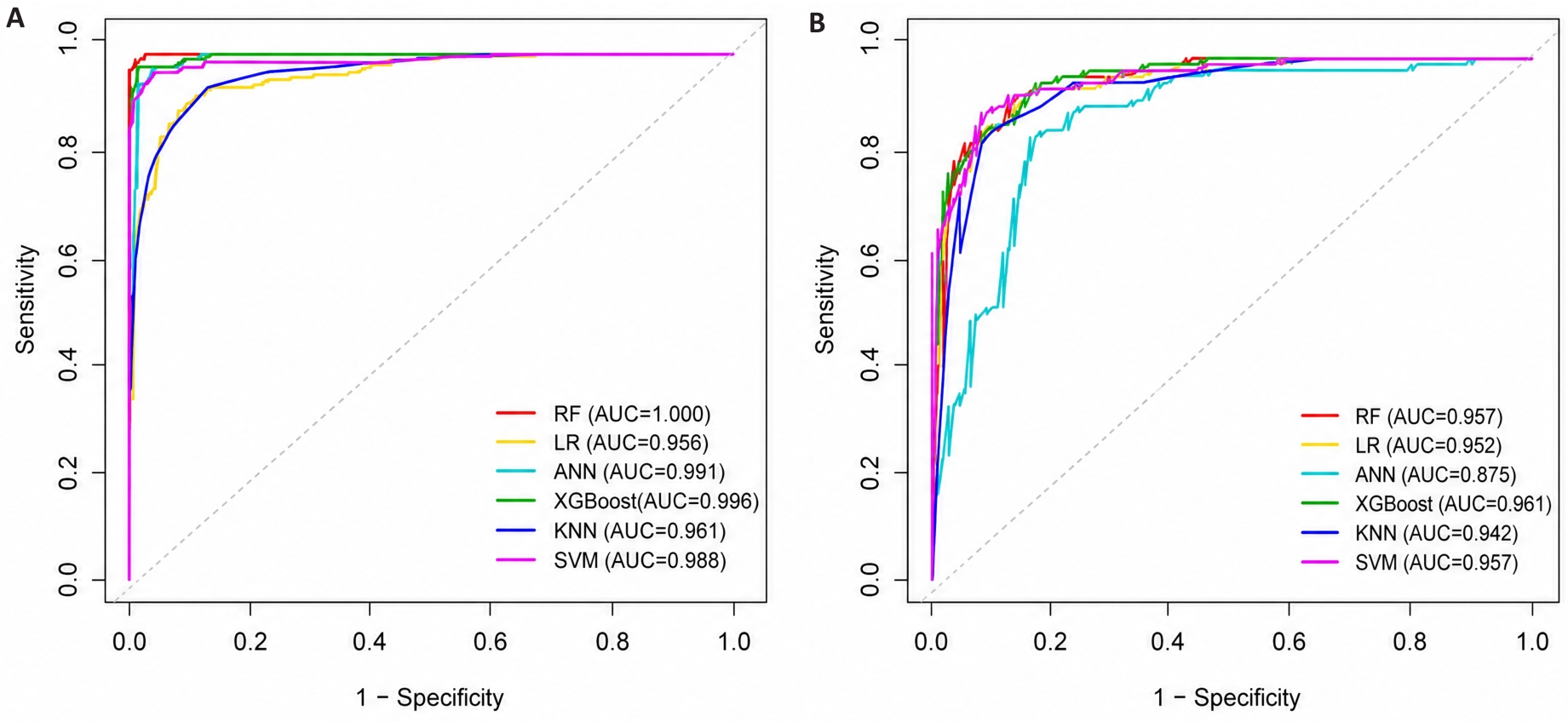
Fig.2 ROC curves of 6 ML models on the training (A) and validation (B) sets.
| No. | Models | Training set AUC | Validation set AUC | P |
|---|---|---|---|---|
| 1 | LR | 0.956 | 0.952 | >0.05 |
| 2 | ANN | 0.991 | 0.875 | <0.01 |
| 3 | XGBoost | 0.996 | 0.961 | <0.01 |
| 4 | RF | 1.000 | 0.957 | <0.01 |
| 5 | SVM | 0.988 | 0.957 | <0.05 |
| 6 | KNN | 0.961 | 0.942 | >0.05 |
Tab.6 DeLong test of the 6 ML models
| No. | Models | Training set AUC | Validation set AUC | P |
|---|---|---|---|---|
| 1 | LR | 0.956 | 0.952 | >0.05 |
| 2 | ANN | 0.991 | 0.875 | <0.01 |
| 3 | XGBoost | 0.996 | 0.961 | <0.01 |
| 4 | RF | 1.000 | 0.957 | <0.01 |
| 5 | SVM | 0.988 | 0.957 | <0.05 |
| 6 | KNN | 0.961 | 0.942 | >0.05 |
| No. | LR | KNN | |
|---|---|---|---|
| 1 | Training set | Validation set | |
| 2 | Training set | -1.281 | |
| 3 | Validation set | 0.873 | |
Tab.7 DeLong test between the LR and KNN models (Z value)
| No. | LR | KNN | |
|---|---|---|---|
| 1 | Training set | Validation set | |
| 2 | Training set | -1.281 | |
| 3 | Validation set | 0.873 | |
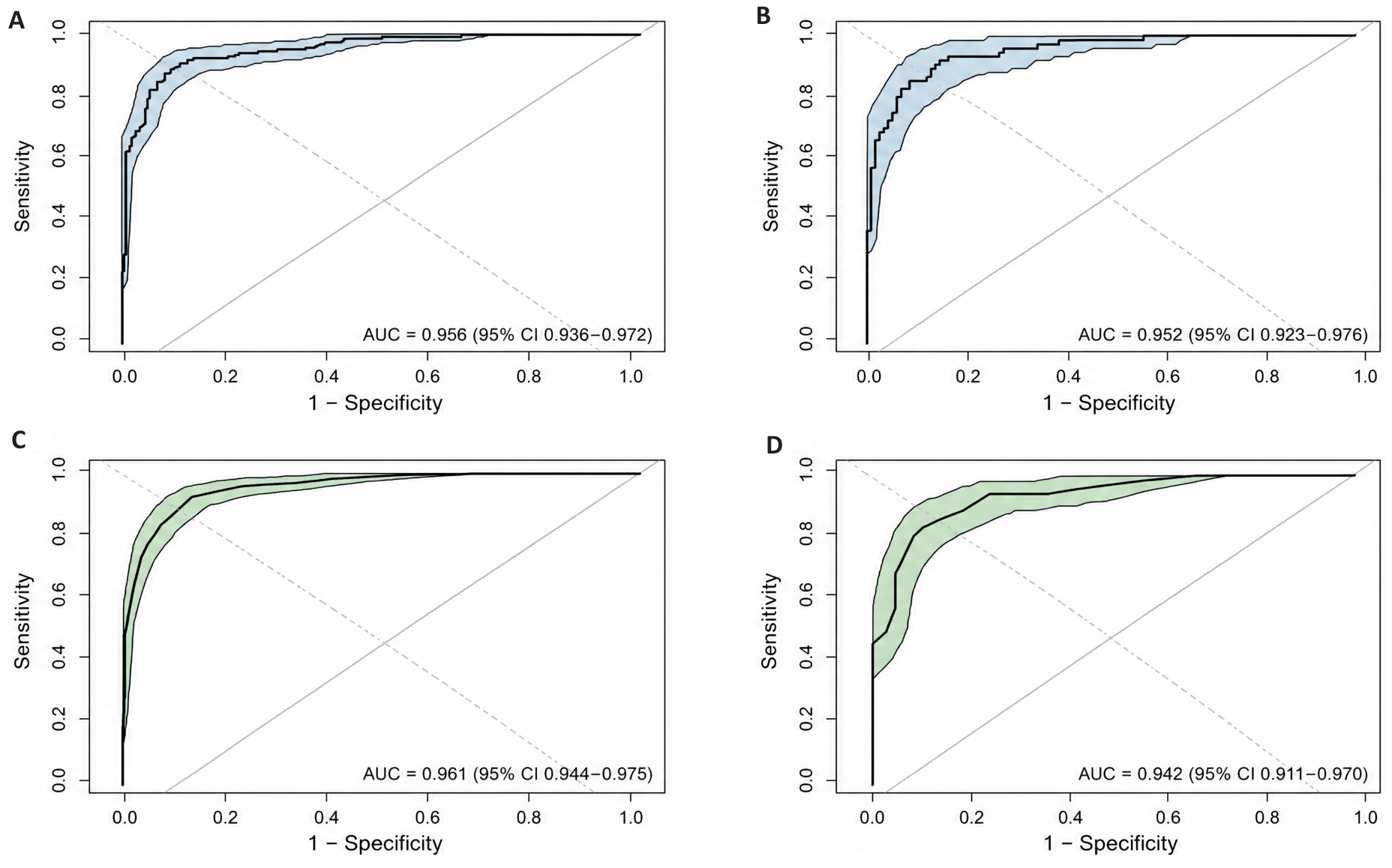
Fig.3 ROC curves of the LR and KNN models on the training (A, C) and validation (B, D) sets after 500 Bootstrap.
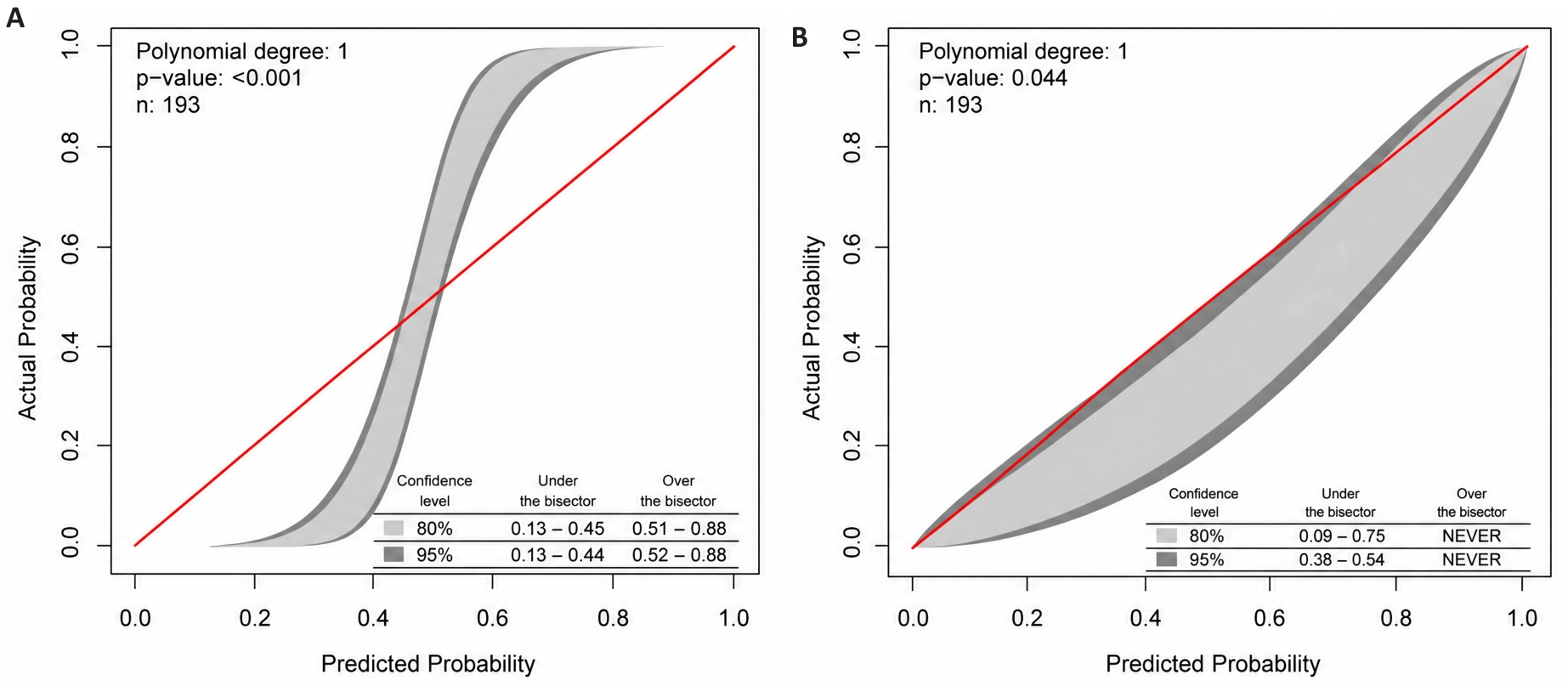
Fig. 4 GiViTI calibration band of the LR model (A) and GiViTI calibration band of the LR model after Platt scaling correction (B).
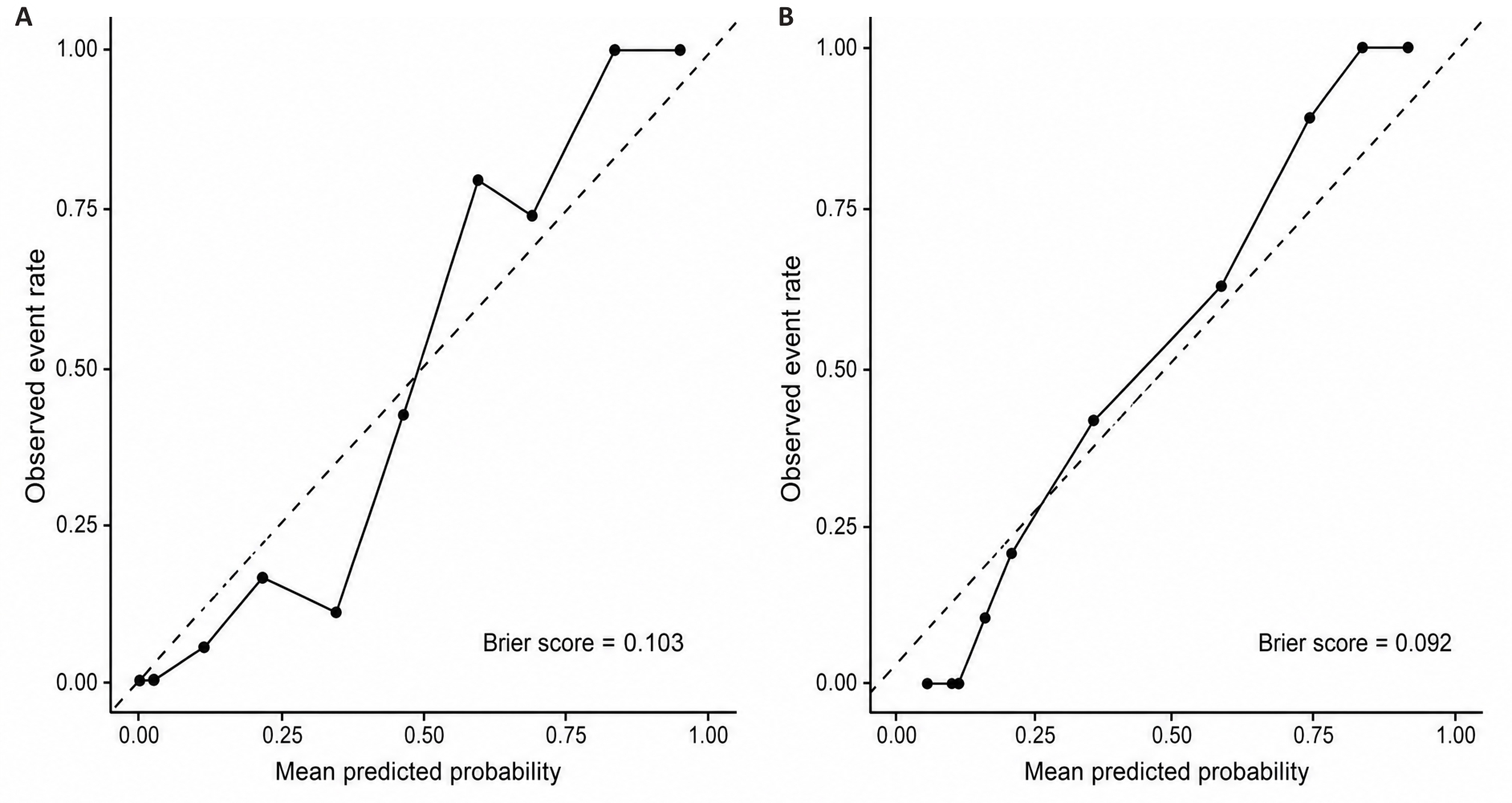
Fig. 5 Calibration curve of the KNN model before (A) and after (B) isotonic regression correction.
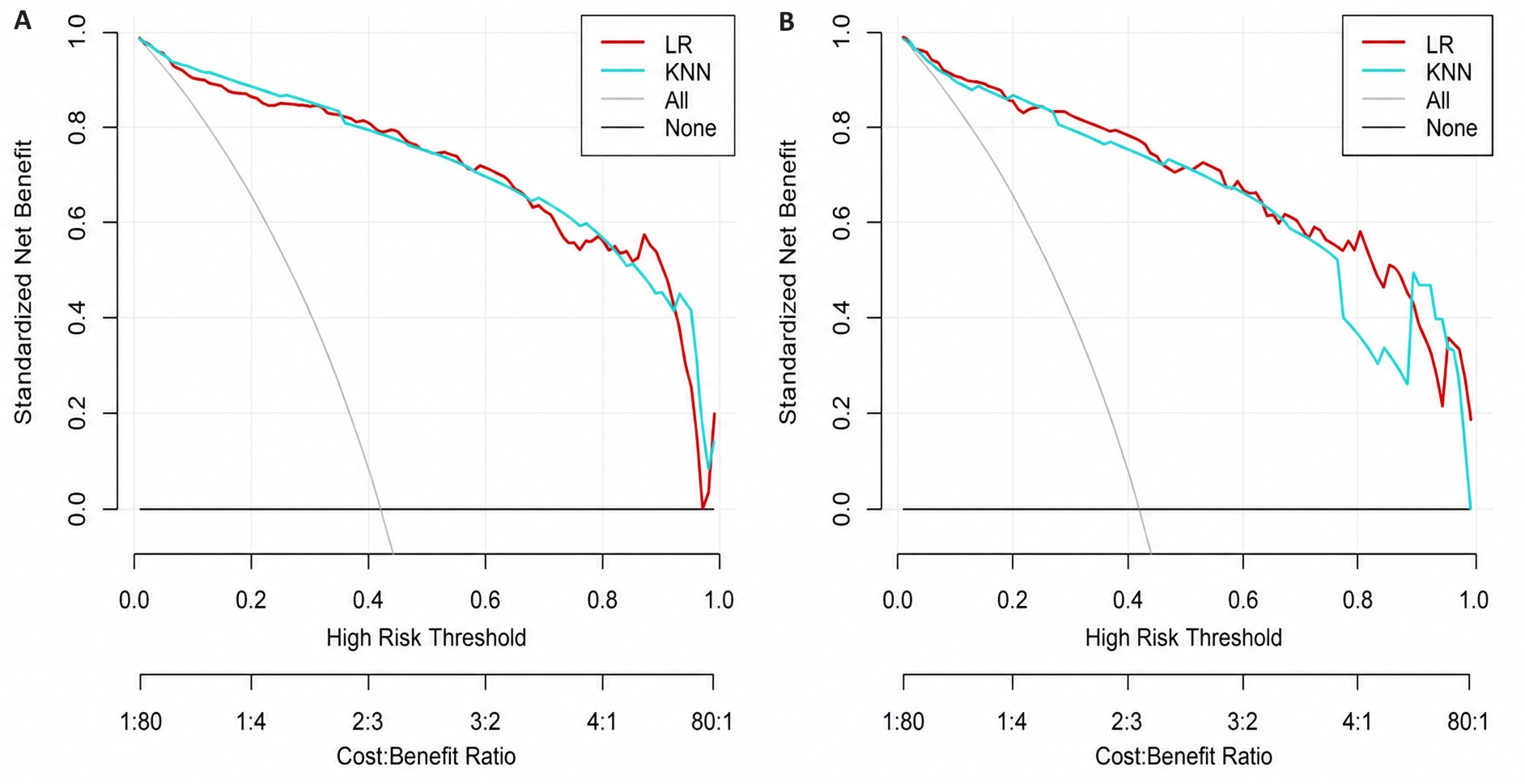
Fig. 6 DCA plots for the LR and KNN models on the training (A) and validation (B) sets.
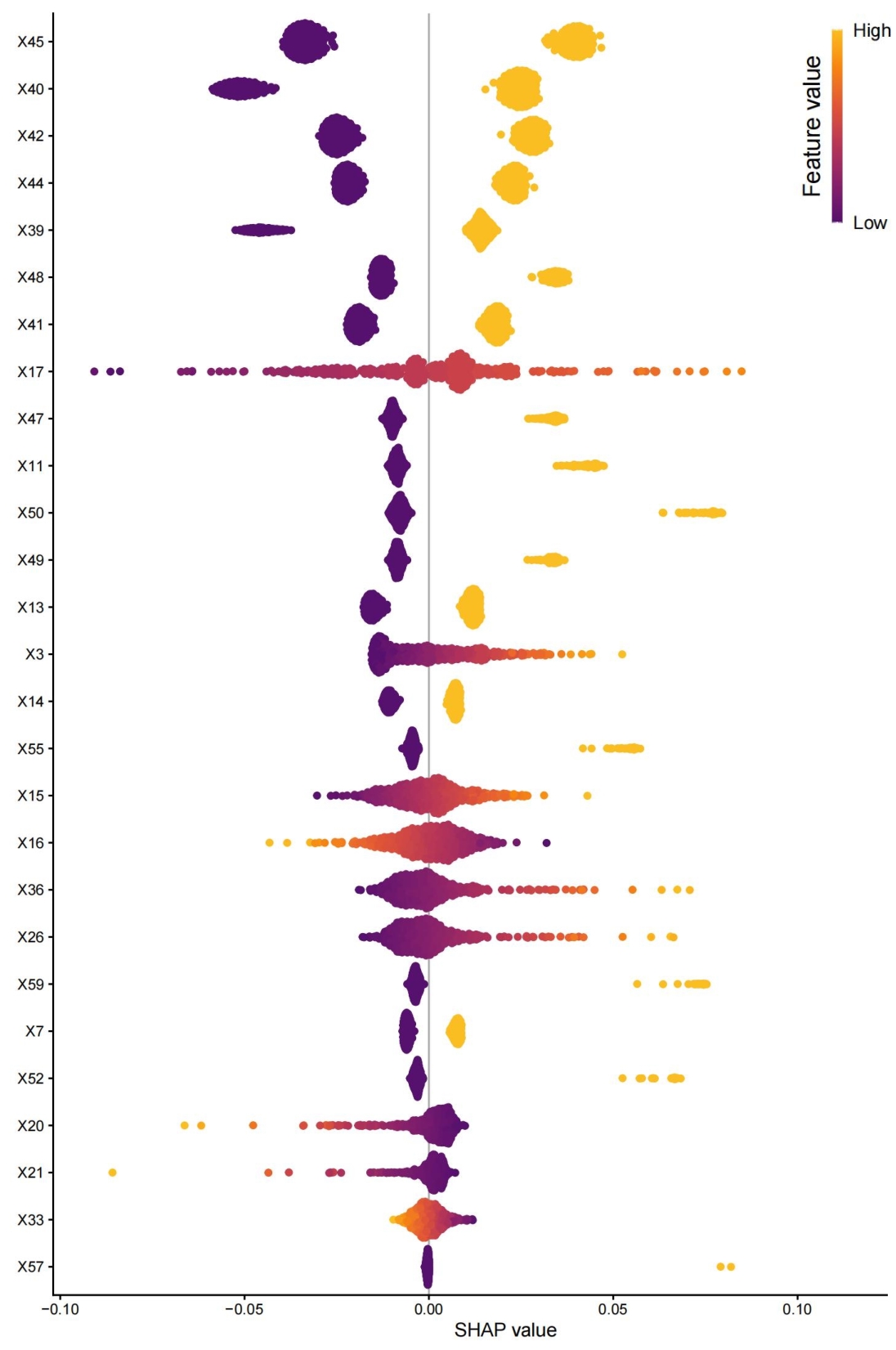
Fig. 7 SHAP summary plot of the LR model.
| [1] | 中华医学会眼科学分会眼底病学组, 中国医师协会眼科医师分会眼底病学组, 许 迅, 等. 我国糖尿病视网膜病变临床诊疗指南(2022年): 基于循证医学修订[J]. 中华眼底病杂志, 2023, 39(2): 99-124. |
| [2] | Tan GS, Cheung N, Simó R, et al. Diabetic macular oedema[J]. Lancet Diabetes Endocrinol, 2017, 5(2): 143-55. doi:10.1016/s2213-8587(16)30052-3 |
| [3] | Solomon SD, Chew E, Duh EJ, et al. Diabetic retinopathy: a position statement by the American diabetes association[J]. Diabetes Care, 2017, 40(3): 412-8. doi:10.2337/dc16-2641 |
| [4] | 刘梦伟, 鲍新颖, 王 烁, 等. 中医药治疗糖尿病视网膜病变的研究进展[J].中医临床研究, 2022, 14(36): 45-47. doi:10.3969/j.issn.1674-7860.2022.36.012 |
| [5] | 李灿东, 纪立金, 鲁玉辉, 等. 论中医健康认知理论的逻辑起点[J]. 中华中医药杂志, 2011, 26(1): 109-11. |
| [6] | 中国医师协会中西医结合医师分会内分泌和代谢病学专业委员会. 糖尿病视网膜病变病证结合诊疗指南(2021-09-24)[J]. 世界中医药, 2021, 16(22): 3270-7. |
| [7] | 褚海琳, 任永霞. 糖尿病视网膜病变患者就诊延迟情况及就诊时间的影响因素分析[J]. 中国全科医学, 2022, 25(12): 1470-4. doi:10.12114/j.issn.1007-9572.2021.02.078 |
| [8] | Saeidian J, Mahmoudi T, Riazi-Esfahani H, et al. Automated assessment of the smoothness of retinal layers in optical coherence tomography images using a machine learning algorithm[J]. BMC Med Imaging, 2023, 23(1): 21. doi:10.1186/s12880-023-00976-w |
| [9] | 董旭辉, 陈德凤, 李 蓓, 等. 2型糖尿病患者发生视网膜病变风险预测模型的系统评价[J]. 中华现代护理杂志, 2024, 30(5): 644-50. |
| [10] | 武巾媛, 安洪庆. 糖尿病并发视网膜病变的关键影响因素分析和风险预测研究[J]. 现代预防医学, 2024, 51(3): 557-63. |
| [11] | 刘曦阳, 张 伟, 赵若冰, 等. 2型糖尿病视网膜病变风险预测模型的系统评价[J]. 中华现代护理杂志, 2023, 29(32): 4429-36. |
| [12] | van der Heijden AA, Nijpels G, Badloe F, et al. Prediction models for development of retinopathy in people with type 2 diabetes: systematic review and external validation in a Dutch primary care setting[J]. Diabetologia, 2020, 63(6): 1110-9. doi:10.1007/s00125-020-05134-3 |
| [13] | Usman TM, Saheed YK, Nsang A, et al. A systematic literature review of machine learning based risk prediction models for diabetic retinopathy progression[J]. Artif Intell Med, 2023, 143: 102617. doi:10.1016/j.artmed.2023.102617 |
| [14] | 朱文锋. 证素辨证学[M]. 北京: 人民卫生出版社, 2008. |
| [15] | 李灿东, 甘慧娟, 鲁玉辉, 等. 基于证素辨证原理的健康状态辨识研究[J]. 中华中医药杂志, 2011, 26(4): 754-7. |
| [16] | 张 怡, 杨 波, 李 茂, 等. 2018—2022年成都地区体检人群2型糖尿病流行病学特征及影响因素分析[J]. 现代预防医学, 2024, 51(17): 3157-62, 3179. doi:10.20043/j.cnki.MPM.202401474 |
| [17] | 陈玉冰. 2型糖尿病视网膜病与肾病相关关系及危险因素研究[D]. 石河子: 石河子大学, 2022. |
| [18] | 中华医学会糖尿病学分会. 中国2型糖尿病防治指南(基层版)[J]. 中华全科医师杂志, 2013, 12(8): 675-96. doi:10.3760/cma.j.issn.1671-7368.2013.08.038 |
| [19] | International Diabetes Federation.IDF Diabetes Atlas,11th edition[EB/OL].(2025-04-07)[2026-01-25].. |
| [20] | 佚名 编著. 黄帝内经·素问[M]. 北京: 中国医药科技出版社, 2023: 23, 34. |
| [21] | 赵 芳. 中重度非增殖期糖尿病视网膜病变中医证素与眼底改变及miRNA的研究[D]. 北京: 中国中医科学院, 2022. |
| [22] | 周 莹, 刘军彤, 杨宇峰, 等. 从“因虚致瘀”理论探讨糖尿病视网膜病变病机[J]. 中国中医基础医学杂志, 2022, 28(8): 1231-3, 1329. |
| [23] | 张玉娴, 王丽英, 苏伟娟, 等. 惜视饮治疗血虚络阻型糖尿病视网膜病变的临床研究[J]. 中医药通报, 2020, 19(5): 47-9, 43. |
| [24] | 田代华, 刘更生整理. 灵枢经[M]. 北京: 人民卫生出版社, 2023: 59, 79, 91. |
| [25] | 高文柱,校注.《诸病源候论》校注[M].北京:学苑出版社,2018: 290. |
| [26] | 熊 萌, 曾梅艳, 宋厚盼, 等. 基于现代文献分析的糖尿病视网膜病变中医证型及证素分布探讨[J]. 广州中医药大学学报, 2023, 40(3): 761-8. |
| [27] | 曾筱婷, 滕 月, 俞晓艺, 等. 真实世界中不同中医证型增殖型糖尿病视网膜病变患者行抗血管内皮生长因子联合玻璃体切除术治疗的疗效分析[J]. 广州中医药大学学报, 2024, 41(4): 906-16. |
| [28] | 段俊国,等.国际中医临床实践指南 糖尿病视网膜病变[J]. 世界中医药, 2025, 20(14): 2427-31. |
| [29] | 段俊国, 毕宏生. 中西医结合眼科学[M]. 4版. 北京: 中国中医药出版社, 2021: 203-4. |
| [30] | 李书楠. 基于证素原理的中医眼底望诊方法建立及2型糖尿病视网膜病变的临床验证研究[D]. 长沙: 湖南中医药大学, 2022. |
| [31] | 翟丽萍, 王 旭, 王 谦, 等. 清化瘀热方通过IL-33/ST2通路缓解糖尿病视网膜病变大鼠中视网膜细胞炎症反应[J]. 南昌大学学报: 医学版, 2024, 64(6): 33-41, 封3. |
| [32] | 仝小林. 糖尿病中医药临床循证实践指南: 2016版[M]. 北京: 科学出版社, 2016: 141. |
| [33] | 吴红云, 袁振轩, 陈 芳, 等. 2型糖尿病视网膜病变患者中医证型分布及其与血清炎症因子及脂联素水平的相关性研究[J]. 广州中医药大学学报, 2024, 41(6): 1371-9. |
| [34] | 谢学军, 王明芳. 糖尿病视网膜病变的病机探讨[J]. 中国中医眼科杂志, 1995, 5(2): 86-8. |
| [35] | 卫晓琴. 基于“目诊仪”对糖尿病视网膜病变中医证候分布规律研究及相关因素分析[D]. 成都: 成都中医药大学, 2023. |
| [36] | 张 莹. 芪贞降糖颗粒治疗糖尿病性视网膜病变非增殖期肝肾阴虚证临床研究[J]. 中医学报, 2017, 32(12): 2354-8. |
| [1] | Cuiyan CHEN, Wenxian ZHANG, Yilin CAI, Mei OUYANG, Ye LIANG, Mingbiao LIANG, Huiying LIANG. Development of a machine learning-based model for assessing pulmonary function in elderly patients [J]. Journal of Southern Medical University, 2026, 46(9): 2091-2100. |
| [2] | Yinyu ZI, Zimiao LIU, Zhen DENG. Plasma metabolomics combined with machine learning for classifying ischemic stroke subtypes and predicting the etiology of cryptogenic stroke [J]. Journal of Southern Medical University, 2026, 46(9): 2149-2158. |
| [3] | Zhuang LI, Huan SHI, Jieting CHEN, Yuqi LIANG, Yingchao WU, Qian ZUO, Qianjun CHEN. Paeoniflorin alleviates cancer-related fatigue during chemotherapy for breast cancer by targeting EZH2/CCNE1 to regulate cell cycle and inflammatory microenvironment [J]. Journal of Southern Medical University, 2026, 46(8): 1835-1849. |
| [4] | Shiheng SHI, Daiping HUA, Shang XIANG, Lanting SUN, Qiaoyu XUAN, Wenming YANG, Han WANG. Development and validation of a machine learning-based prediction model for fatty liver in Wilson disease [J]. Journal of Southern Medical University, 2026, 46(8): 1861-1869. |
| [5] | Mengxin ZHU, Xiao LIU, Shan ZHAO, Xin ZHANG, Chao LIU, Xiankong LIU, Haochen QI, Tiesheng HAN, Dong MA. Interpretable machine learning models for preoperative precision prediction of perineural invasion in cervical cancer to support treatment decision: a multicenter retrospective study [J]. Journal of Southern Medical University, 2026, 46(7): 1509-1519. |
| [6] | Mengmeng CHEN, Runfang GUO, Wenjie ZHAO, Yongqi WANG, Lugen ZUO, Mulin LIU, Bin LI. Construction of an anxiety recognition model for patients with malignant gastrointestinal tumors based on multidimensional features and multiple interpretable machine learning [J]. Journal of Southern Medical University, 2026, 46(7): 1660-1670. |
| [7] | Hao CHEN, Zhenhan LI, Mengjia JI, Xincheng WANG, Bofeng CHEN, Qian GUAN, Man WU, Linming LU. Key determinants of global burden of non-alcoholic fatty liver disease: machine learning combined with Mendelian randomization analysis based on GBD data [J]. Journal of Southern Medical University, 2026, 46(4): 770-784. |
| [8] | Hongcheng TAO, Fukai LIANG, Wenbo HUANG, Siqi FAN, Ping ZENG. Analysis of potential association of alcohol exposure with femoral head osteonecrosis and construction of a diagnostic model using machine learning [J]. Journal of Southern Medical University, 2026, 46(3): 559-569. |
| [9] | Kelin XIANG, Xiaoyu ZHANG, Zhengpeng LI, Zhiwei XU, Sujie LIU, Yuan CHAI. Identification of efferocytosis-related genes in osteoarthritis and prediction of traditional Chinese medicines based on bioinformatics and machine learning [J]. Journal of Southern Medical University, 2026, 46(3): 693-706. |
| [10] | Junyao CHEN, Zeyu CHEN, Zhaojie LIN, Menghao FANG, Chaoying SHEN, Qi XU, Xiaoyi ZHANG, Lu LU. Dual role of tea consumption in gastrointestinal disease risks: analysis using a risk prediction model integrating interpretable machine learning and large language model [J]. Journal of Southern Medical University, 2026, 46(2): 353-361. |
| [11] | Yunneng CUI, Minqing FENG, Liangfeng YAO, Jiewen YAN, Wenhan LI, Yanping HUANG. Enhancement of radiomics-based machine learning models for predicting efficacy of high-intensity focused ultrasound ablation of uterine fibroids using undersampling methods [J]. Journal of Southern Medical University, 2026, 46(1): 141-149. |
| [12] | Qizhi HUANG, Daipeng XIE, Lintong YAO, Qiaxuan LI, Shaowei WU, Haiyu ZHOU. Tumor microenvironment-specific CT radiomics signature for predicting immunotherapy response in non-small cell lung cancer [J]. Journal of Southern Medical University, 2025, 45(9): 1903-1918. |
| [13] | Jun JIANG, Shuo FENG, Yingui SUN, Yan AN. Construction of risk prediction models of hypothermia after transurethral holmium laser enucleation of the prostate based on three machine learning algorithms [J]. Journal of Southern Medical University, 2025, 45(9): 2019-2025. |
| [14] | Zhuolin GUO, Zhiheng ZHANG, Xindeng GUO, Weiwei YANG, Zhiqing LIANG, Jinying OU, Huihui CAO, Zibin LU, Linzhong YU, Junshan LIU. Comparison of anti-inflammatory, antibacterial and analgesic activities of formulated granules versus traditional decoction of Yinqiao Powder [J]. Journal of Southern Medical University, 2025, 45(5): 1003-1012. |
| [15] | Meimei CHEN, Yang WANG, Huangwei LEI, Fei ZHANG, Ruina HUANG, Zhaoyang YANG. Construction of recognition models for subthreshold depression based on multiple machine learning algorithms and vocal emotional characteristics [J]. Journal of Southern Medical University, 2025, 45(4): 711-717. |
| Viewed | ||||||
|
Full text |
|
|||||
|
Abstract |
|
|||||
