
南方医科大学学报 ›› 2026, Vol. 46 ›› Issue (8): 1926-1935.doi: 10.12122/j.issn.1673-4254.2026.08.20
• • 上一篇
李德臣1,2( ), 李彦杰2(), 杨新宇1, 王亚文1, 渠燕飞1
收稿日期:2025-12-22
出版日期:2026-08-20
发布日期:2026-08-01
通讯作者:
李彦杰
E-mail:3397216447@qq.com;yanjieli2008@126.com
作者简介:李德臣,在读硕士研究生,E-mail: 3397216447@qq.com
基金资助:
Dechen LI1,2(), Yanjie LI2(), Xinyu YANG1, Yawen WANG1, Yanfei QU1
Received:2025-12-22
Online:2026-08-20
Published:2026-08-01
Contact:
Yanjie LI
E-mail:3397216447@qq.com;yanjieli2008@126.com
摘要:
目的 孟德尔随机化(MR)探究肠道菌群(GM)与阿尔茨海默症(AD)的因果关联及循环代谢物的介导作用,为AD相关生物标志物和干预靶点提供遗传学依据。 方法 基于全基因组关联分析数据,采用两样本MR设计开展研究。筛选473种GM及233种循环代谢物的有效工具变量,通过R软件进行统计分析,以逆方差加权法作为主要分析方法,MR-Egger法和加权中位数法作为补充验证;结合多种敏感性分析评估结果稳定性,并通过反向MR分析验证因果关系方向;再进一步采用中介MR分析明确循环代谢物的潜在介导效应。 结果 马赛阴性杆菌丰度与AD发病风险之间存在正向因果关联(OR=1.204,95% CI:1.020-1.421,P=0.028),敏感性分析结果稳定可靠(P>0.05),反向MR分析未发现AD对马赛阴性杆菌丰度存在显著因果效应(P=0.678)。中介MR分析显示,在马赛阴性杆菌对AD的总效应中,经极小型极低密度脂蛋白中游离胆固醇与总脂质比率(v-VLDL FC/TL)介导的间接效应占6.63%。 结论 从遗传因果推断层面提示,马赛阴性杆菌可能与AD发病风险升高相关,且v-VLDL FC/TL可能在其中发挥部分中介作用,这为AD的预防和治疗提供了潜在靶点。
李德臣, 李彦杰, 杨新宇, 王亚文, 渠燕飞. 473种肠道菌群与阿尔茨海默症:基于233种循环代谢物的孟德尔随机化中介分析[J]. 南方医科大学学报, 2026, 46(8): 1926-1935.
Dechen LI, Yanjie LI, Xinyu YANG, Yawen WANG, Yanfei QU. Association between 473 gut microbiota and Alzheimer's disease: a Mendelian randomization mediation analysis of 233 circulating metabolites[J]. Journal of Southern Medical University, 2026, 46(8): 1926-1935.
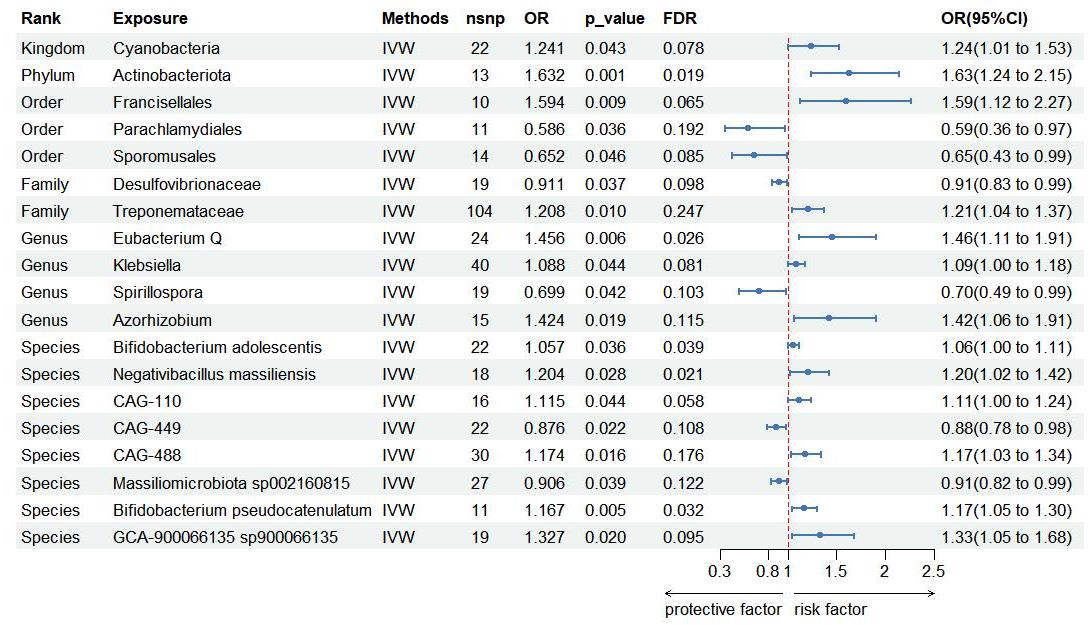
图1 19种肠道菌群与阿尔茨海默症-IVW分析方法的森林图
Fig.1 Forest plot of the association between 19 gut microbiota and Alzheimer's disease (AD) using the IVW method.
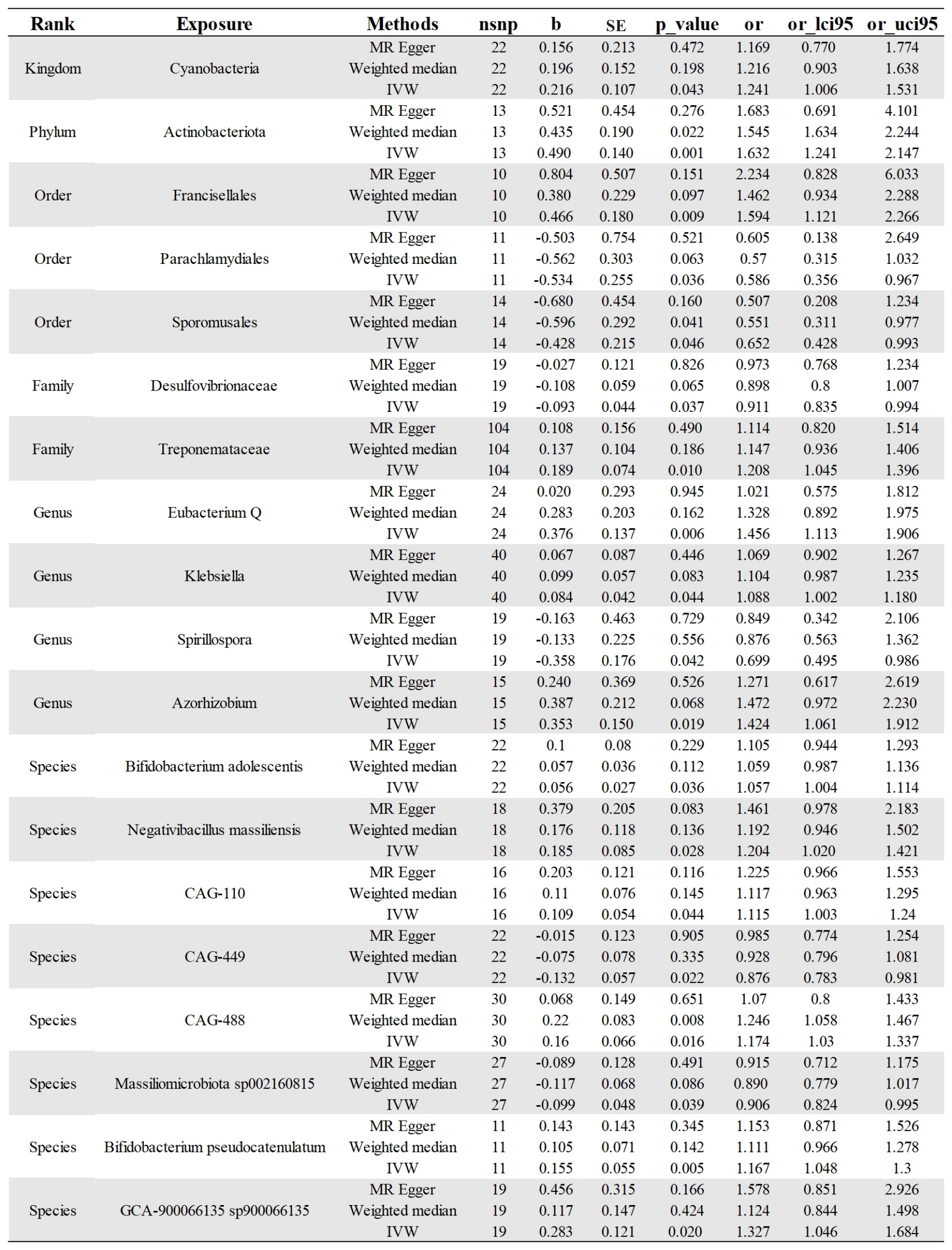
图2 19种肠道菌群与阿尔茨海默症的3种分析方法结果
Fig. 2 3 analytical methods for the association between 19 gut microbiota and AD.
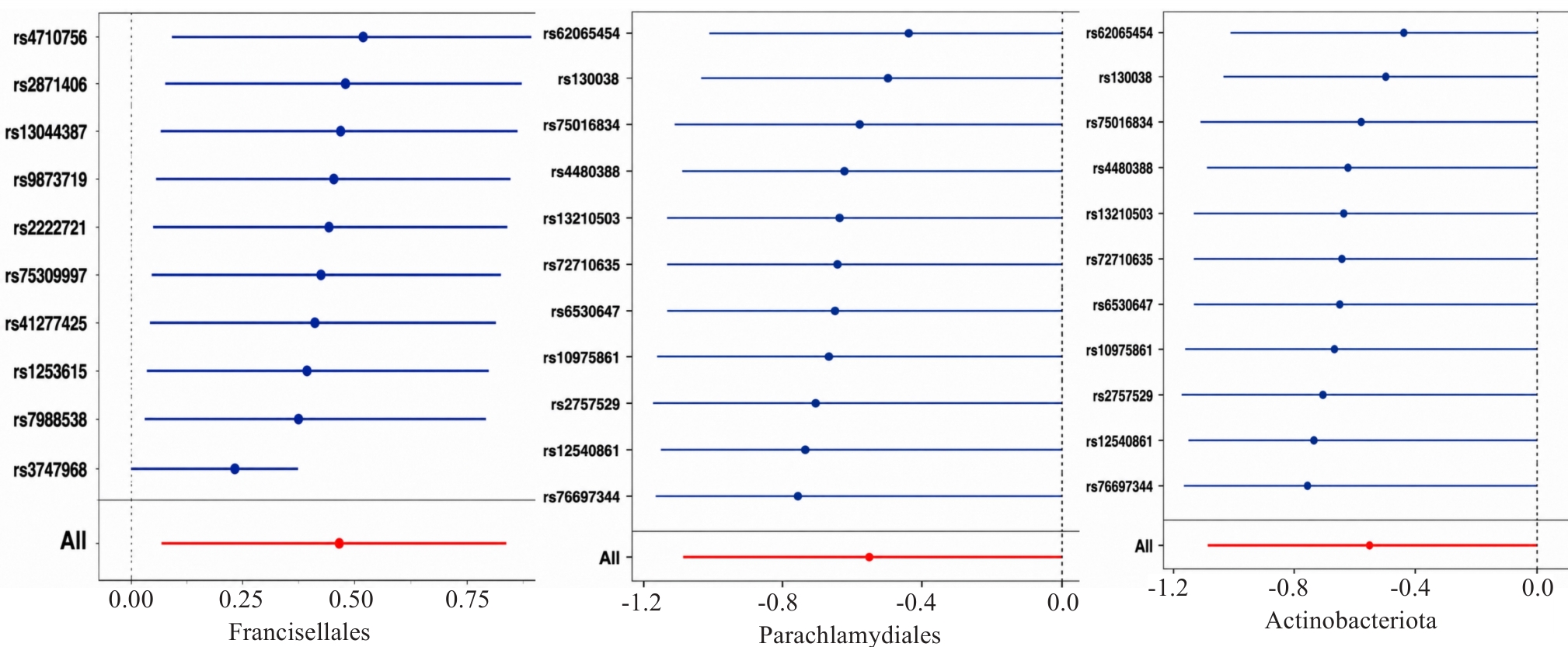
图3 19种肠道菌群与阿尔茨海默症的部分留一法分析结果
Fig.3 Results of leave-one-out analysis for the association between 19 gut microbiota taxa and AD.
| Rank | Outcome | Method | β | SE | P |
|---|---|---|---|---|---|
| Kingdom | Cyanobacteria | IVW | -0.016 | 0.009 | 0.082 |
| Phylum | Actinobacteriota | IVW | 0.011 | 0.018 | 0.548 |
| Order | Francisellales | IVW | -0.005 | 0.007 | 0.447 |
| Order | Parachlamydiales | IVW | -0.007 | 0.006 | 0.223 |
| Order | Sporomusales | IVW | 0.004 | 0.005 | 0.382 |
| Family | Desulfovibrionaceae | IVW | 0.008 | 0.015 | 0.608 |
| Family | Treponemataceae | IVW | -0.011 | 0.016 | 0.513 |
| Genus | Eubacterium Q | IVW | -0.006 | 0.020 | 0.766 |
| Genus | Klebsiella | IVW | -0.002 | 0.006 | 0.690 |
| Genus | Spirillospora | IVW | 0.016 | 0.014 | 0.254 |
| Genus | Azorhizobium | IVW | -0.001 | 0.006 | 0.850 |
| Species | Bifidobacterium adolescentis | IVW | -0.012 | 0.008 | 0.135 |
| Species | Negativibacillus massiliensis | IVW | 0.006 | 0.015 | 0.678 |
| Species | CAG-110 | IVW | -0.004 | 0.028 | 0.898 |
| Species | CAG-449 | IVW | -0.006 | 0.009 | 0.496 |
| Species | CAG-488 | IVW | 0.001 | 0.033 | 0.996 |
| Species | Massiliomicrobiota sp002160815 | IVW | -0.001 | 0.013 | 0.974 |
| Species | Bifidobacterium pseudocatenulatum | IVW | 0.001 | 0.005 | 0.807 |
| Species | GCA-900066135 sp900066135 | IVW | 0.001 | 0.007 | 0.990 |
表2 19种肠道菌群与阿尔茨海默症的反向MR分析结果
Tab.2 Results of reverse Mendelian randomization analysis between AD and 19 gut microbiota taxa
| Rank | Outcome | Method | β | SE | P |
|---|---|---|---|---|---|
| Kingdom | Cyanobacteria | IVW | -0.016 | 0.009 | 0.082 |
| Phylum | Actinobacteriota | IVW | 0.011 | 0.018 | 0.548 |
| Order | Francisellales | IVW | -0.005 | 0.007 | 0.447 |
| Order | Parachlamydiales | IVW | -0.007 | 0.006 | 0.223 |
| Order | Sporomusales | IVW | 0.004 | 0.005 | 0.382 |
| Family | Desulfovibrionaceae | IVW | 0.008 | 0.015 | 0.608 |
| Family | Treponemataceae | IVW | -0.011 | 0.016 | 0.513 |
| Genus | Eubacterium Q | IVW | -0.006 | 0.020 | 0.766 |
| Genus | Klebsiella | IVW | -0.002 | 0.006 | 0.690 |
| Genus | Spirillospora | IVW | 0.016 | 0.014 | 0.254 |
| Genus | Azorhizobium | IVW | -0.001 | 0.006 | 0.850 |
| Species | Bifidobacterium adolescentis | IVW | -0.012 | 0.008 | 0.135 |
| Species | Negativibacillus massiliensis | IVW | 0.006 | 0.015 | 0.678 |
| Species | CAG-110 | IVW | -0.004 | 0.028 | 0.898 |
| Species | CAG-449 | IVW | -0.006 | 0.009 | 0.496 |
| Species | CAG-488 | IVW | 0.001 | 0.033 | 0.996 |
| Species | Massiliomicrobiota sp002160815 | IVW | -0.001 | 0.013 | 0.974 |
| Species | Bifidobacterium pseudocatenulatum | IVW | 0.001 | 0.005 | 0.807 |
| Species | GCA-900066135 sp900066135 | IVW | 0.001 | 0.007 | 0.990 |
| Exposure | Outcome | Methods | β | SE | P |
|---|---|---|---|---|---|
| AD | v-VLDL FC/TL | MR Egger | -0.009 | 0.012 | 0.457 |
| AD | v-VLDL FC/TL | Weighted median | -0.016 | 0.007 | 0.135 |
| AD | v-VLDL FC/TL | IVW | -0.005 | 0.008 | 0.547 |
表3 代谢物(v-VLDL FC/TL)与阿尔茨海默症的反向因果分析
Tab.3 Reverse causal analysis of metabolites (v-VLDL FC/TL) and AD
| Exposure | Outcome | Methods | β | SE | P |
|---|---|---|---|---|---|
| AD | v-VLDL FC/TL | MR Egger | -0.009 | 0.012 | 0.457 |
| AD | v-VLDL FC/TL | Weighted median | -0.016 | 0.007 | 0.135 |
| AD | v-VLDL FC/TL | IVW | -0.005 | 0.008 | 0.547 |
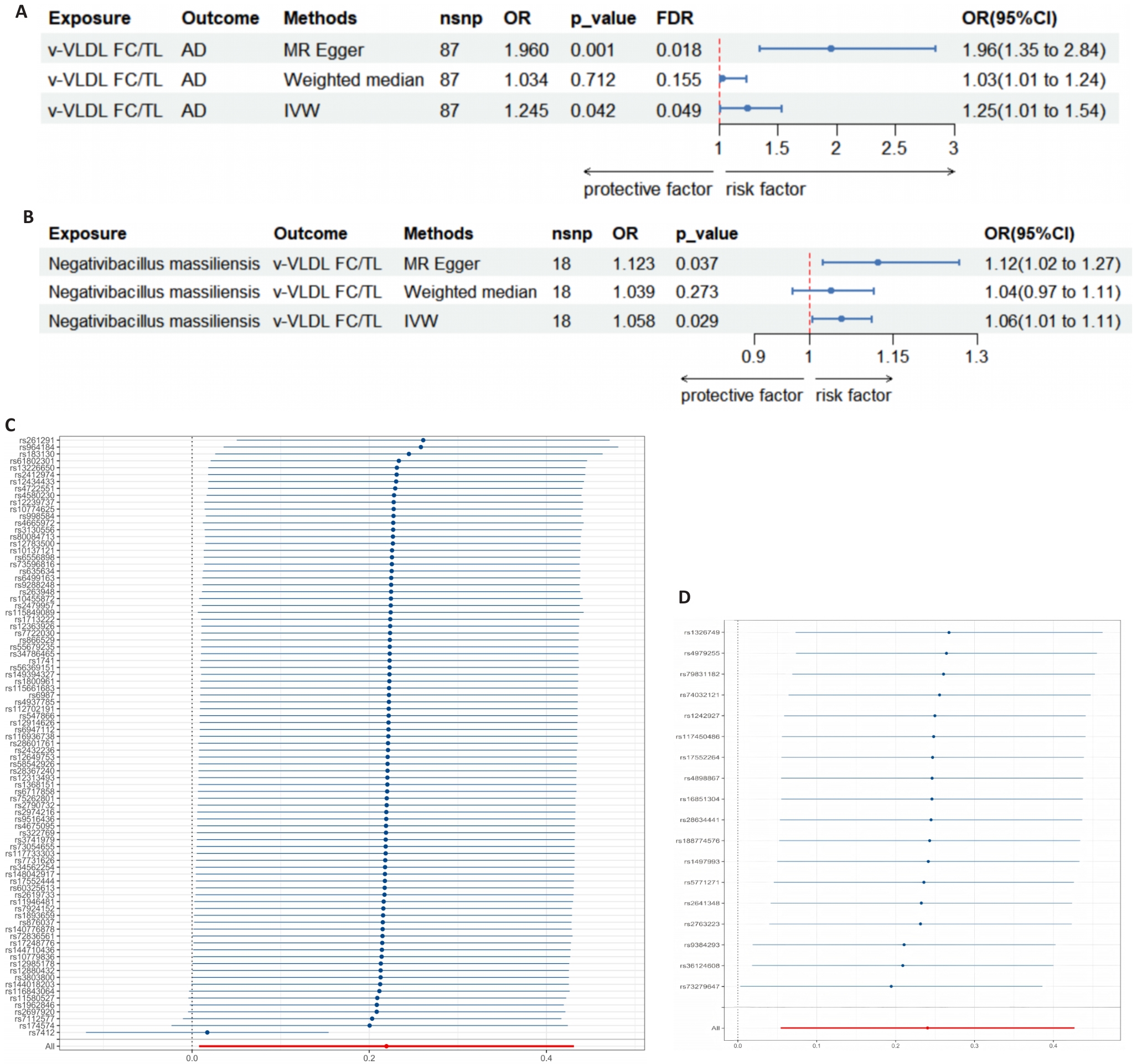
图4 马赛阴性杆菌-代谢物-阿尔茨海默症的因果关联分析图
Fig.4 Causal association analysis among Negativibacillus massiliensis, metabolites, and AD. A: Forest plot of the association between the metabolite (v-VLDL FC/TL) and AD. B: Forest plot of the association between Negativibacillus massiliensis and v-VLDL FC/TL. C: Leave-one-out analysis of the association between v-VLDL FC/TL and AD. D: Leave-one-out analysis of the association between Negativibacillus massiliensis and v-VLDL FC/TL.
| Exposure | SNPs | Beta | P | F |
|---|---|---|---|---|
| Negativibacillus massiliensis | rs117450486 | 0.013 | 4.1e-08 | 30.106 |
| Negativibacillus massiliensis | rs1242927 | 0.002 | 1.9e-06 | 22.731 |
| Negativibacillus massiliensis | rs1326749 | 0.018 | 8.5e-06 | 19.813 |
| Negativibacillus massiliensis | rs1497993 | 0.043 | 8.7e-06 | 19.786 |
| Negativibacillus massiliensis | rs16851304 | -0.009 | 7.3e-06 | 20.108 |
| Negativibacillus massiliensis | rs17552264 | 0.018 | 6.6e-06 | 20.294 |
| Negativibacillus massiliensis | rs188774576 | 0.029 | 5.1e-06 | 20.801 |
| Negativibacillus massiliensis | rs2641348 | -0.021 | 5.5e-06 | 20.648 |
| Negativibacillus massiliensis | rs2763223 | -0.017 | 8.7e-06 | 19.774 |
| Negativibacillus massiliensis | rs28634441 | 0.009 | 4e-06 | 21.271 |
| Negativibacillus massiliensis | rs36124608 | 0.039 | 9e-06 | 19.719 |
| Negativibacillus massiliensis | rs4898867 | -0.007 | 6.6e-06 | 20.299 |
| Negativibacillus massiliensis | rs4979255 | -0.016 | 5.3e-06 | 20.716 |
| Negativibacillus massiliensis | rs5771271 | -0.023 | 3.7e-06 | 21.393 |
| Negativibacillus massiliensis | rs73279647 | -0.116 | 4.7e-06 | 20.969 |
| Negativibacillus massiliensis | rs74032121 | -0.001 | 2.7e-06 | 22.055 |
| Negativibacillus massiliensis | rs79831182 | -0.016 | 9.4e-06 | 19.621 |
| Negativibacillus massiliensis | rs9384293 | 0.039 | 8.4e-06 | 19.845 |
表5 马赛阴性杆菌相关SNP及其在孟德尔随机化分析中的工具变量特征
Tab.5 SNPs associated with Negativibacillus and their instrumental variable characteristics in Mendelian randomization analysis
| Exposure | SNPs | Beta | P | F |
|---|---|---|---|---|
| Negativibacillus massiliensis | rs117450486 | 0.013 | 4.1e-08 | 30.106 |
| Negativibacillus massiliensis | rs1242927 | 0.002 | 1.9e-06 | 22.731 |
| Negativibacillus massiliensis | rs1326749 | 0.018 | 8.5e-06 | 19.813 |
| Negativibacillus massiliensis | rs1497993 | 0.043 | 8.7e-06 | 19.786 |
| Negativibacillus massiliensis | rs16851304 | -0.009 | 7.3e-06 | 20.108 |
| Negativibacillus massiliensis | rs17552264 | 0.018 | 6.6e-06 | 20.294 |
| Negativibacillus massiliensis | rs188774576 | 0.029 | 5.1e-06 | 20.801 |
| Negativibacillus massiliensis | rs2641348 | -0.021 | 5.5e-06 | 20.648 |
| Negativibacillus massiliensis | rs2763223 | -0.017 | 8.7e-06 | 19.774 |
| Negativibacillus massiliensis | rs28634441 | 0.009 | 4e-06 | 21.271 |
| Negativibacillus massiliensis | rs36124608 | 0.039 | 9e-06 | 19.719 |
| Negativibacillus massiliensis | rs4898867 | -0.007 | 6.6e-06 | 20.299 |
| Negativibacillus massiliensis | rs4979255 | -0.016 | 5.3e-06 | 20.716 |
| Negativibacillus massiliensis | rs5771271 | -0.023 | 3.7e-06 | 21.393 |
| Negativibacillus massiliensis | rs73279647 | -0.116 | 4.7e-06 | 20.969 |
| Negativibacillus massiliensis | rs74032121 | -0.001 | 2.7e-06 | 22.055 |
| Negativibacillus massiliensis | rs79831182 | -0.016 | 9.4e-06 | 19.621 |
| Negativibacillus massiliensis | rs9384293 | 0.039 | 8.4e-06 | 19.845 |
| [1] | Scheltens P, De Strooper B, Kivipelto M, et al. Alzheimer's disease[J]. Lancet, 2021, 397(10284): 1577-90. doi:10.1016/s0140-6736(20)32205-4 |
| [2] | Twarowski B, Herbet M. Inflammatory processes in Alzheimer's disease-pathomechanism, diagnosis and treatment: a review[J]. Int J Mol Sci, 2023, 24(7): 6518. doi:10.3390/ijms24076518 |
| [3] | Ossenkoppele R, van der Kant R, Hansson O. Tau biomarkers in Alzheimer’s disease: towards implementation in clinical practice and trials[J]. Lancet Neurol, 2022, 21(8): 726-34. doi:10.1016/s1474-4422(22)00168-5 |
| [4] | Rostagno AA. Pathogenesis of Alzheimer's disease[J]. Int J Mol Sci, 2022, 24(1): 107. doi:10.3390/ijms24010107 |
| [5] | Bomasang-Layno E, Bronsther R. Diagnosis and treatment of Alzheimer's disease: : an update[J]. Dela J Public Health, 2021, 7(4): 74-85. doi:10.32481/djph.2021.09.009 |
| [6] | Li SP, Han WF, He QC, et al. Relationship between intestinal microflora and hepatocellular cancer based on gut-liver axis theory[J]. Contrast Media Mol Imaging, 2022, 2022: 6533628. doi:10.1155/2022/6533628 |
| [7] | Socała K, Doboszewska U, Szopa A, et al. The role of microbiota-gut-brain axis in neuropsychiatric and neurological disorders[J]. Pharmacol Res, 2021, 172: 105840. doi:10.1016/j.phrs.2021.105840 |
| [8] | O’Riordan KJ, Moloney GM, Keane L, et al. The gut microbiota-immune-brain axis: Therapeutic implications[J]. Cell Rep Med, 2025, 6(3): 101982. doi:10.1016/j.xcrm.2025.101982 |
| [9] | Lu X, Xue ZY, Qian Y, et al. Changes in intestinal microflora and its metabolites underlie the cognitive impairment in preterm rats[J]. Front Cell Infect Microbiol, 2022, 12: 945851. doi:10.3389/fcimb.2022.945851 |
| [10] | Silva YP, Bernardi A, Frozza RL. The role of short-chain fatty acids from gut microbiota in gut-brain communication[J]. Front Endocrinol, 2020, 11: 25. doi:10.3389/fendo.2020.00025 |
| [11] | He M, Wei WQ, Zhang YC, et al. Gut microbial metabolites SCFAs and chronic kidney disease[J]. J Transl Med, 2024, 22(1): 172. doi:10.1186/s12967-024-04974-6 |
| [12] | Wang YL, Li L, Zhao XD, et al. Intestinal microflora changes in patients with mild Alzheimer's disease in a Chinese cohort[J]. J Alzheimers Dis, 2022, 88(2): 563-75. doi:10.3233/jad-220076 |
| [13] | Elmas A, Spehar K, Do R, et al. Associations of circulating biomarkers with disease risks: a two-sample Mendelian randomization study[J]. Int J Mol Sci, 2024, 25(13): 7376. doi:10.3390/ijms25137376 |
| [14] | Bhattacharyya U, John J, Lam M, et al. Circulating blood-based proteins in psychopathology and cognition: a Mendelian randomization study[J]. JAMA Psychiatry, 2025, 82(5): 481-91. doi:10.1001/jamapsychiatry.2025.0033 |
| [15] | Lv YC, Cheng X, Dong Q. SGLT1 and SGLT2 inhibition, circulating metabolites, and cerebral small vessel disease: a mediation Mendelian Randomization study[J]. Cardiovasc Diabetol, 2024, 23(1): 157. doi:10.1186/s12933-024-02255-6 |
| [16] | Huang SY, Yang YX, Zhang YR, et al. Investigating causal relations between circulating metabolites and Alzheimer's disease: a Mendelian randomization study[J]. J Alzheimers Dis, 2022, 87(1): 463-77. doi:10.3233/jad-220050 |
| [17] | Tettevi EJ, Simpong DL, Maina M, et al. Antibiotic-induced gut dysbiosis modulates Alzheimer's disease-associated gene expression and protein aggregation in 3xTg-AD mice via the gut–brain axis[J]. Brain Behav, 2025, 15(10): e70946. doi:10.1002/brb3.70946 |
| [18] | 雷雯慧, 高 婕, 徐 鹏, 等. 阿尔茨海默病肠道细菌和真菌菌群结构和组成改变研究[J]. 中国微生态学杂志, 2024, 36(5): 577-83. doi:10.13381/j.cnki.cjm.202405013 |
| [19] | Loh JS, Mak WQ, Tan LKS, et al. Microbiota-gut-brain axis and its therapeutic applications in neurodegenerative diseases[J]. Signal Transduct Target Ther, 2024, 9(1): 37. doi:10.1038/s41392-024-01743-1 |
| [20] | Qin YW, Havulinna AS, Liu Y, et al. Combined effects of host genetics and diet on human gut microbiota and incident disease in a single population cohort[J]. Nat Genet, 2022, 54(2): 134-42. doi:10.1038/s41588-021-00991-z |
| [21] | Karjalainen MK, Karthikeyan S, Oliver-Williams C, et al. Genome-wide characterization of circulating metabolic biomarkers[J]. Nature, 2024, 628(8006): 130-8. |
| [22] | Li PS, Wang HY, Guo L, et al. Association between gut microbiota and preeclampsia-eclampsia: a two-sample Mendelian random-ization study[J]. BMC Med, 2022, 20(1): 443. doi:10.1186/s12916-022-02657-x |
| [23] | Wu J, Li CS, Huang WY, et al. Gut microbiota promote the propagation of pathologic α-syn from gut to brain in a gut-originated mouse model of Parkinson's disease[J]. Brain Behav Immun, 2025, 128: 152-69. doi:10.1016/j.bbi.2025.04.001 |
| [24] | Yadav S, Raj RG. Parkinson's disease and the gut microbiota connection: unveiling dysbiosis and exploring therapeutic horizons[J]. Neuroscience, 2025, 581: 1-15. doi:10.1016/j.neuroscience.2025.07.003 |
| [25] | Yan ZZ, Yang F, Cao JW, et al. Alterations of gut microbiota and metabolome with Parkinson's disease[J]. Microb Pathog, 2021, 160: 105187. doi:10.1016/j.micpath.2021.105187 |
| [26] | Kalyanaraman B, Cheng G, Hardy M. Gut microbiome, short-chain fatty acids, alpha-synuclein, neuroinflammation, and ROS/RNS: Relevance to Parkinson's disease and therapeutic implications[J]. Redox Biol, 2024, 71: 103092. doi:10.1016/j.redox.2024.103092 |
| [27] | Aho VTE, Houser MC, Pereira PAB, et al. Relationships of gut microbiota, short-chain fatty acids, inflammation, and the gut barrier in Parkinson's disease[J]. Mol Neurodegener, 2021, 16(1): 6. doi:10.1186/s13024-021-00427-6 |
| [28] | Chen Z, Chen ZY, Jin XL. Mendelian randomization supports causality between overweight status and accelerated aging[J]. Aging Cell, 2023, 22(8): e13899. doi:10.1111/acel.13899 |
| [29] | Lv XF, Liang FQ, Liu SS, et al. Causal relationship between diet and knee osteoarthritis: a Mendelian randomization analysis[J]. PLoS One, 2024, 19(1): e0297269. doi:10.1371/journal.pone.0297269 |
| [30] | Liang Z, Zhao L, Lou Y, et al. Causal effects of circulating lipids and lipid-lowering drugs on the risk of epilepsy: a two-sample Mendelian randomization study[J]. QJM, 2023, 116(6): 421-8. doi:10.1093/qjmed/hcad048 |
| [31] | Zhu X, Huang SJ, Kang WY, et al. Associations between polyunsaturated fatty acid concentrations and Parkinson's disease: a two-sample Mendelian randomization study[J]. Front Aging Neurosci, 2023, 15: 1123239. doi:10.3389/fnagi.2023.1123239 |
| [32] | Ndongo S, Dubourg G, Bittar F, et al. Marseillibacter massiliensis gen. nov., sp. nov., a new bacterial genus isolated from the human gut[J]. New Microbes New Infect, 2017, 16: 30-1. doi:10.1016/j.nmni.2016.12.006 |
| [33] | Tran VTA, Kang YJ, Kim HK, et al. Oral pathogenic bacteria-inducing neurodegenerative microgliosis in human neural cell platform[J]. Int J Mol Sci, 2021, 22(13): 6925. doi:10.3390/ijms22136925 |
| [34] | Wu LC, Du LL, Ju QQ, et al. Silencing TLR4/MyD88/NF‑κB signaling pathway alleviated inflammation of corneal epithelial cells infected by ISE[J]. Inflammation, 2021, 44(2): 633-44. doi:10.1007/s10753-020-01363-1 |
| [35] | Shi J, Wang F, Tang L, et al. Akkermansia muciniphila attenuates LPS-induced acute kidney injury by inhibiting TLR4/NF‑κB pathway[J]. FEMS Microbiol Lett, 2022, 369(1): fnac103. doi:10.1093/femsle/fnac103 |
| [36] | Wu XY, Wei JJ, Ran W, et al. The gut microbiota-xanthurenic acid-aromatic hydrocarbon receptor axis mediates the anticolitic effects of trilobatin[J]. Adv Sci, 2025, 12(10): 2412234. doi:10.1002/advs.202412234 |
| [37] | Yu X, Shen GX, Zhang Y, et al. Genetically predicted small dense low-density lipoprotein cholesterol and ischemic stroke subtype: multivariable Mendelian randomization study[J]. Front Endocrinol, 2024, 15: 1404234. doi:10.3389/fendo.2024.1404234 |
| [38] | Hashemi M, Banerjee S, Lyubchenko YL. Free cholesterol accelerates aβ self-assembly on membranes at physiological concentration[J]. Int J Mol Sci, 2022, 23(5): 2803. doi:10.3390/ijms23052803 |
| [1] | 钟瀚翔, 赵渊宇, 傅宏, 董家勇, 丁国善, 陈瑶, 郭闻渊. 东亚人群口腔微生物群与肝细胞癌的因果关系:一项孟德尔随机化研究[J]. 南方医科大学学报, 2026, 46(7): 1467-1473. |
| [2] | 杨琳, 于嘉祥, 韩磊, 戴俭宇. 免疫细胞表型与梅尼埃病的因果关联:一项双向双样本孟德尔随机化分析与动物实验研究[J]. 南方医科大学学报, 2026, 46(7): 1671-1684. |
| [3] | 王淼, 卢必超, 孟昊阳, 周姝含, 毛宁峰, 张洋, 吕文亮. NDUFA13与CRIP1调控慢阻肺B细胞损伤并具备潜在诊断价值[J]. 南方医科大学学报, 2026, 46(6): 1349-1364. |
| [4] | 张浚琪, 白净, 任行, 叶学帅, 檀梦天, 杨勇, 李磊, 付泽娴. 菌群移植通过调节TLR4/MyD88/NF-κB信号通路抑制小鼠结肠肿瘤生长[J]. 南方医科大学学报, 2026, 46(5): 1139-1148. |
| [5] | 陈浩, 李振汉, 纪梦佳, 汪鑫诚, 陈博峰, 管谦, 武嫚, 卢林明. 全球非酒精性脂肪性肝病负担的关键决定因素:基于GBD数据的机器学习联合孟德尔随机化验证[J]. 南方医科大学学报, 2026, 46(4): 770-784. |
| [6] | 梁仁杰, 王荷颖, 李兆艳, 陈惠萍, 王奕淳, 闵莉. 柴胡疏肝散加减可改善胆囊胆固醇结石肝郁证小鼠肝郁和结石程度[J]. 南方医科大学学报, 2026, 46(3): 615-628. |
| [7] | 梁笑笑, 栾慧林, 马鹏珍, 邓文珠, 金佳欣, 全晨阳, 陈婷婷, 杨友财, 谢颖桢. 基于生命八要素的心血管健康评分与缺血性脑卒中预后相关性及临床检验指标的中介效应:一项多中心前瞻性队列研究[J]. 南方医科大学学报, 2026, 46(2): 239-246. |
| [8] | 陈梅妹, 黄睿娜, 杨朝阳. 血浆代谢物介导炎症蛋白对阿尔茨海默病的因果效应:一项孟德尔随机化分析研究[J]. 南方医科大学学报, 2026, 46(2): 278-285. |
| [9] | 姜思捷, 宫澜, 郑华. 嗜粘蛋白阿克曼氏菌与心血管及代谢性疾病相关性的研究进展[J]. 南方医科大学学报, 2026, 46(2): 473-478. |
| [10] | 张越, 段雨婷, 张晨, 喻璐喆, 刘颖颖, 邢丽花, 王雷, 俞年军, 彭代银, 陈卫东, 王妍妍. 茯苓多糖通过调节肠道微生物群减轻环磷酰胺引起的肠道屏障和免疫损伤[J]. 南方医科大学学报, 2026, 46(1): 34-46. |
| [11] | 邓楚玉, 王雪莹, 甘立祥, 王大禹, 郑晓燕, 唐纯志. 电针足三里改善高脂血症小鼠的血脂紊乱:基于肠道菌群结构的改善[J]. 南方医科大学学报, 2025, 45(8): 1633-1642. |
| [12] | 黄凯悦, 齐景馨, 罗文谦, 林怡萱, 陈梅妹, 甘慧娟. 温胆汤通过调控肠道菌群-胆汁酸轴改善代谢综合征痰证大鼠的代谢表型[J]. 南方医科大学学报, 2025, 45(6): 1174-1184. |
| [13] | 李文婕, 洪耀南, 黄蕊, 李煜宸, 张莹, 张蕴, 吴迪炯. 自身免疫性疾病是再生障碍性贫血的危险因素:一项孟德尔随机化分析[J]. 南方医科大学学报, 2025, 45(4): 871-879. |
| [14] | 罗嘉纯, Sodnomjamts Batzaya, 高雪锋, 陈晶宇, 余政颖, 熊莎莎, 曹虹. Akkermansia muciniphila改善gp120转基因小鼠的肠-脑相互作用障碍[J]. 南方医科大学学报, 2025, 45(3): 554-565. |
| [15] | 高俊杰, 叶开, 吴竞. 槲皮素通过调控TP53基因抑制肾透明细胞癌的增殖和迁移[J]. 南方医科大学学报, 2025, 45(2): 313-321. |
| 阅读次数 | ||||||
|
全文 |
|
|||||
|
摘要 |
|
|||||
