
南方医科大学学报 ›› 2026, Vol. 46 ›› Issue (6): 1407-1415.doi: 10.12122/j.issn.1673-4254.2026.06.20
• • 上一篇
史雪珂1,2( ), 陈婷玉1, 高静1, 吴明莉1, 李瑞青1, 苏凯奇1, 吕转1, 宋晓磊1, 冯晓东1()
收稿日期:2025-10-16
出版日期:2026-06-20
发布日期:2026-06-24
通讯作者:
冯晓东
E-mail:15836840441@163.com;fxd0502@163.com
作者简介:史雪珂,在读硕士研究生,E-mail: 15836840441@163.com
基金资助:
Xueke SHI1,2(), Tingyu CHEN1, Jing GAO1, Mingli WU1, Ruiqing LI1, Kaiqi SU1, Zhuan LÜ1, Xiaolei SONG1, Xiaodong FENG1()
Received:2025-10-16
Online:2026-06-20
Published:2026-06-24
Contact:
Xiaodong FENG
E-mail:15836840441@163.com;fxd0502@163.com
Supported by:摘要:
目的 探讨电针血清对 OGD/R 损伤HT22神经元的保护作用,并初步探索 PI3K/Akt 信号通路在其中的可能参与机制。 方法 通过公共数据库进行生物信息学分析,筛选卒中相关差异通路;在此基础上采用线栓法建立大脑中动脉缺血再灌注(MCAO/R)大鼠模型,制备电针“神庭”“百会”穴血清及模型血清。体外培养HT22神经元并建立OGD/R模型后,分为对照组、模型组、电针血清组、PI3K抑制剂组(LY294002,20 μmol/L)及电针血清+PI3K抑制剂组。采用CCK-8检测细胞活力,TUNEL染色评估细胞凋亡,尼氏染色观察神经元结构变化;Western blotting检测PI3K、Akt总蛋白及其磷酸化水平(p-PI3K、p-Akt),并检测其下游相关蛋白p-mTOR/mTOR及抗凋亡蛋白Bcl-2的表达变化,同时检测突触可塑性相关蛋白NMDAR1、PSD-95的表达;RT-qPCR法检测PI3K、Akt、NMDAR1、PSD-95的mRNA表达水平。 结果 与对照组相比,模型组HT22神经元活力下降、凋亡增加、尼氏体数量减少且染色变浅(P<0.05)。电针血清干预可提高细胞存活率、降低凋亡并改善神经元形态(P<0.05);PI3K抑制剂LY294002则进一步加重神经元损伤。与电针血清组相比,电针血清+PI3K抑制剂组的保护作用有所减弱;但与单独抑制剂组相比,其细胞状态仍得到改善(P<0.05)。在分子水平上,与对照组相比,模型组HT22神经元中p-PI3K/PI3K、p-Akt/Akt及p-mTOR/mTOR比值均降低(P<0.05),Bcl-2蛋白表达亦明显下调(P<0.05);同时,突触可塑性相关蛋白NMDAR1和PSD-95的表达亦降低(P<0.05)。电针血清能上调这些蛋白的表达,而LY294002则呈现抑制作用。电针血清+PI3K抑制剂组的蛋白表达水平介于电针血清组与抑制剂组之间。RT-qPCR检测显示,PI3K、Akt、NMDAR1及PSD-95的mRNA表达变化趋势与其相应蛋白水平一致。 结论 电针“神庭”“百会”穴血清对OGD/R所致HT22神经元损伤具有一定的保护作用,其效应可能与 PI3K/Akt 信号通路的激活及其下游相关分子的参与,并伴随突触可塑性相关分子的上调有关。
史雪珂, 陈婷玉, 高静, 吴明莉, 李瑞青, 苏凯奇, 吕转, 宋晓磊, 冯晓东. 电针血清通过激活PI3K/Akt信号通路改善OGD/R模型HT22神经元突触可塑性[J]. 南方医科大学学报, 2026, 46(6): 1407-1415.
Xueke SHI, Tingyu CHEN, Jing GAO, Mingli WU, Ruiqing LI, Kaiqi SU, Zhuan LÜ, Xiaolei SONG, Xiaodong FENG. Serum from rats with electroacupuncture activates the PI3K/Akt signaling pathway to improve synaptic plasticity in HT22 neurons with oxygen and glucose deprivation[J]. Journal of Southern Medical University, 2026, 46(6): 1407-1415.
| Gene name | Sequence (5' to 3') | |
|---|---|---|
| PI3K | Forward | CTCCCCAGCTGCTGTAACTC |
| Reverse | AGGTTCCACAAGTCCAGGTG | |
| Akt | Forward | ACTCATTCCAGACCCACGAC |
| Reverse | CCGGTACACCACGTTCTTCT | |
| NMDAR1 | Forward | CTGCGACCCCAAGATTGTCA |
| Reverse | TATTGGCCTGGTTTACTGCCT | |
| PSD-95 | Forward | TTGCGGCTAGAGGCATCCA |
| Reverse | GTCCCCCTGGTTTAGGAATCC |
表1 引物序列
Tab.1 Primer sequence for RT-qPCR
| Gene name | Sequence (5' to 3') | |
|---|---|---|
| PI3K | Forward | CTCCCCAGCTGCTGTAACTC |
| Reverse | AGGTTCCACAAGTCCAGGTG | |
| Akt | Forward | ACTCATTCCAGACCCACGAC |
| Reverse | CCGGTACACCACGTTCTTCT | |
| NMDAR1 | Forward | CTGCGACCCCAAGATTGTCA |
| Reverse | TATTGGCCTGGTTTACTGCCT | |
| PSD-95 | Forward | TTGCGGCTAGAGGCATCCA |
| Reverse | GTCCCCCTGGTTTAGGAATCC |
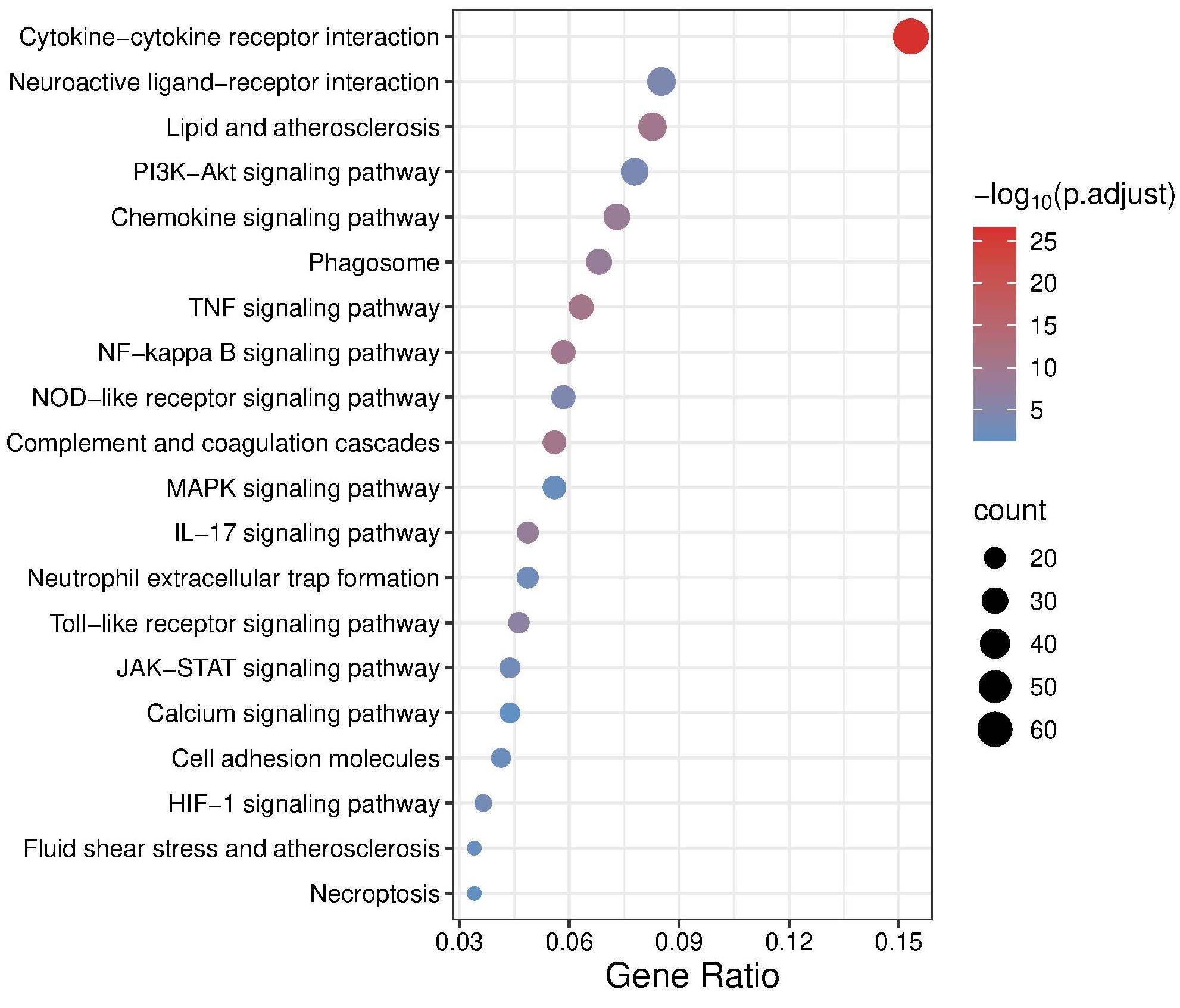
图1 KEGG富集分析
Fig.1 KEGG enrichment analysis.
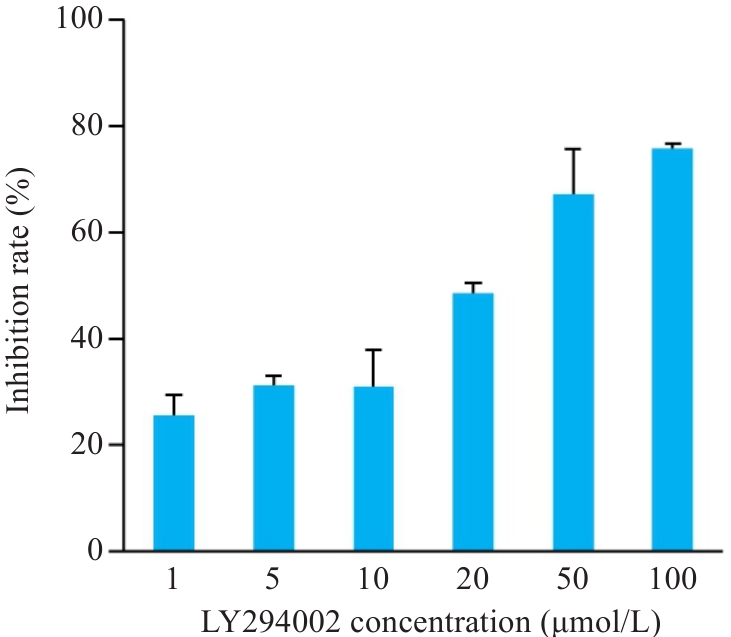
图2 不同浓度LY294002对HT22神经元的抑制作用
Fig.2 Inhibitory effect of different concentrations of LY294002 on HT22 neurons (n=4).
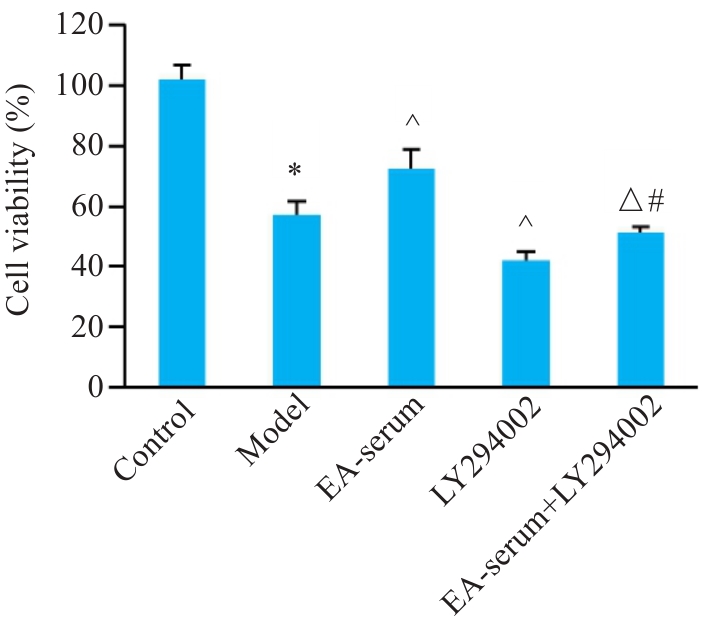
图3 各组HT22神经元存活率
Fig.3 Cell viability of HT22 neurons in each group (n=4). *P<0.05 vs Control group; ^P<0.05 vs Model group; △P<0.05 vs EA-serum group; #P<0.05 vs LY294002 group.
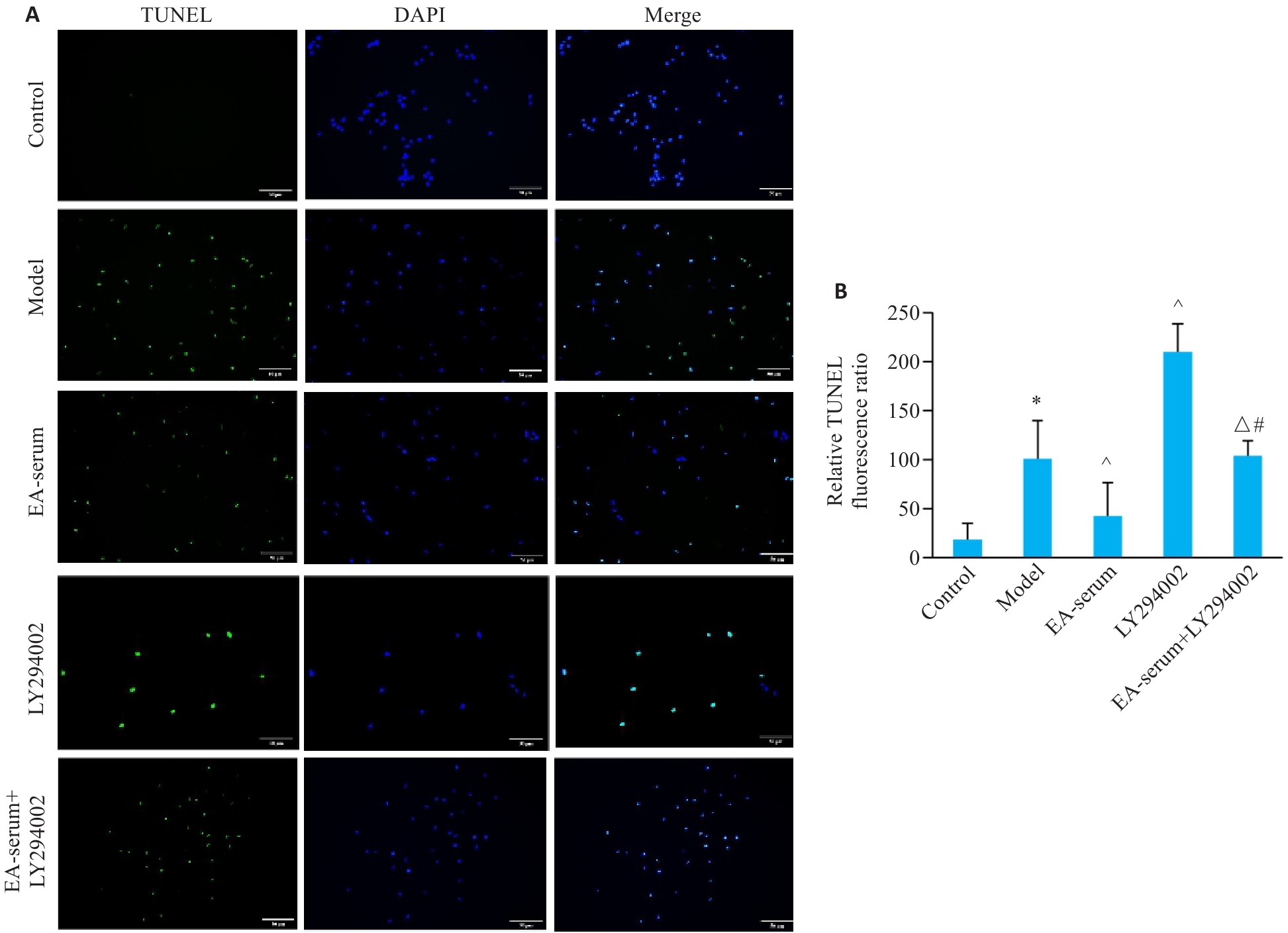
图4 HT22神经元TUNEL染色结果
Fig.4 TUNEL staining results of HT22 neurons (n=3). A: TUNEL staining results of HT22 neurons in each group (Original magnification: ×100); B: Quantitative analysis of the relative TUNEL fluorescence ratio of HT22 neurons in each group. *P<0.05 vs Control group; ^P<0.05 vs Model group; △P<0.05 vs EA-serum group; #P<0.05 vs LY294002 group.

图5 各组HT22神经元尼氏染色结果
Fig.5 Nissl staining results of HT22 neurons in each group (Scale bar=50 μm).
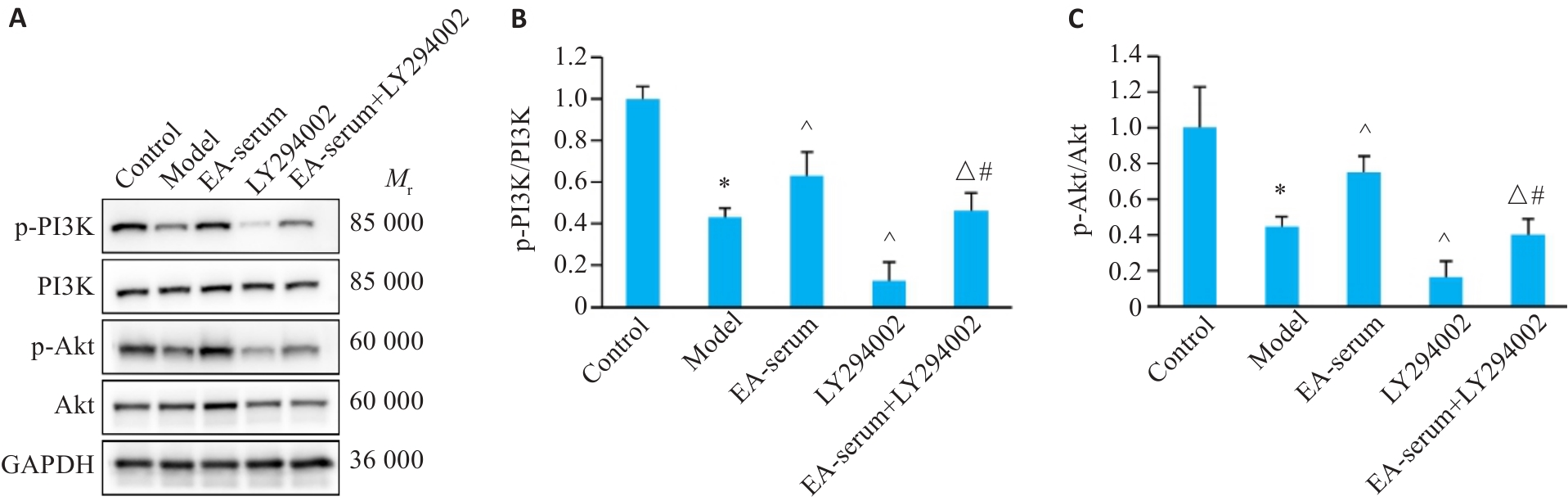
图6 各组HT22神经元p-PI3K、p-Akt蛋白相对表达量的比较
Fig.6 Comparison of the relative expression levels of p-PI3K and p-Akt proteins in HT22 neurons in each group (n=3). A: Expressions of PI3K and Akt proteins in HT22 neurons in each group detected by Western blotting. B: Quantitative analysis of the p-PI3K/PI3K ratio. C: Quantitative analysis of the p-Akt/Akt ratio. *P<0.05 vs Control group; ^P<0.05 vs Model group; △P<0.05 vs EA-serum group; #P<0.05 vs LY294002 group.
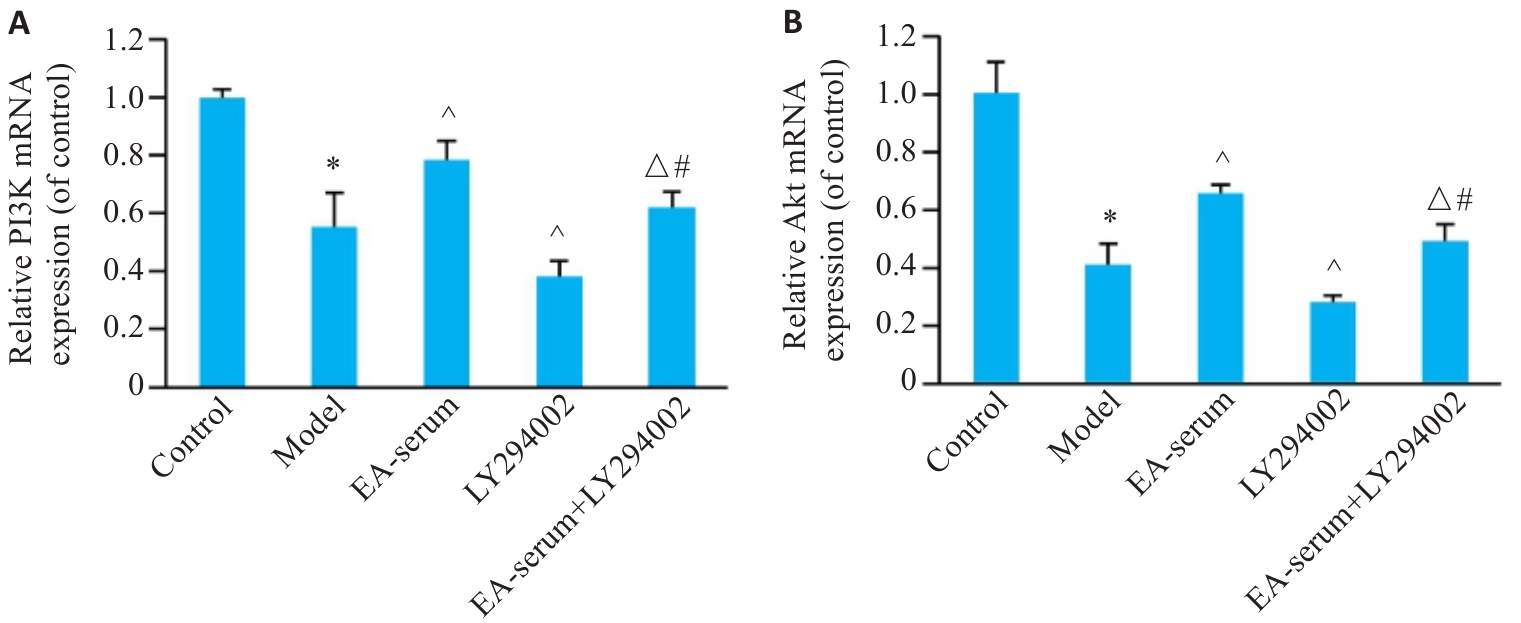
图7 各组HT22神经元PI3K、Akt mRNA相对表达量的比较
Fig.7 Comparison of the relative mRNA expression levels of PI3K and Akt in HT22 neurons in each group (n=3). A: Quantitative analysis of PI3K mRNA relative expression by RT-qPCR. B: Quantitative analysis of Akt mRNA relative expression by RT-qPCR. *P<0.05 vs Control group; ^P<0.05 vs Model group; △P<0.05 vs EA-serum group; #P<0.05 vs LY294002 group.
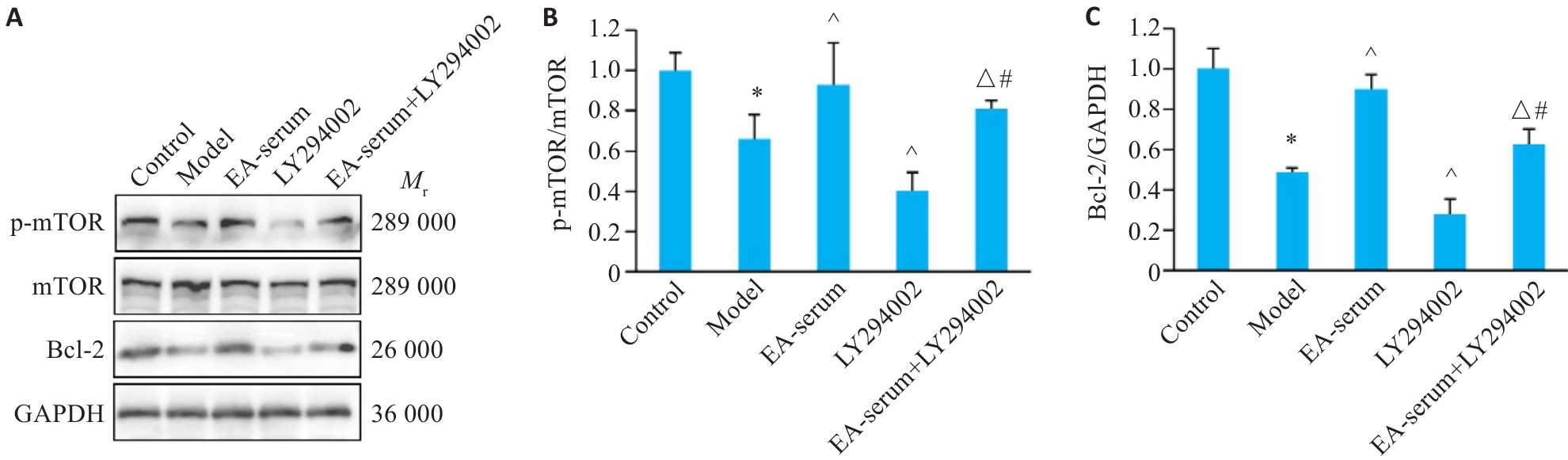
图8 各组HT22神经元p-mTOR、Bcl-2蛋白相对表达量的比较
Fig.8 Comparison of relative expression levels of p-mTOR and Bcl-2 proteins in HT22 neurons in each group (n=3). A: Expression of p-mTOR and Bcl-2 proteins in HT22 neurons in each group detected by Western blotting. B: Quantitative analysis of the p-mTOR/mTOR ratio. C: Quantitative analysis of the Bcl-2/GAPDH ratio. *P<0.05 vs Control group; ^P<0.05 vs Model group; △P<0.05 vs EA-serum group; #P<0.05 vs LY294002 group.
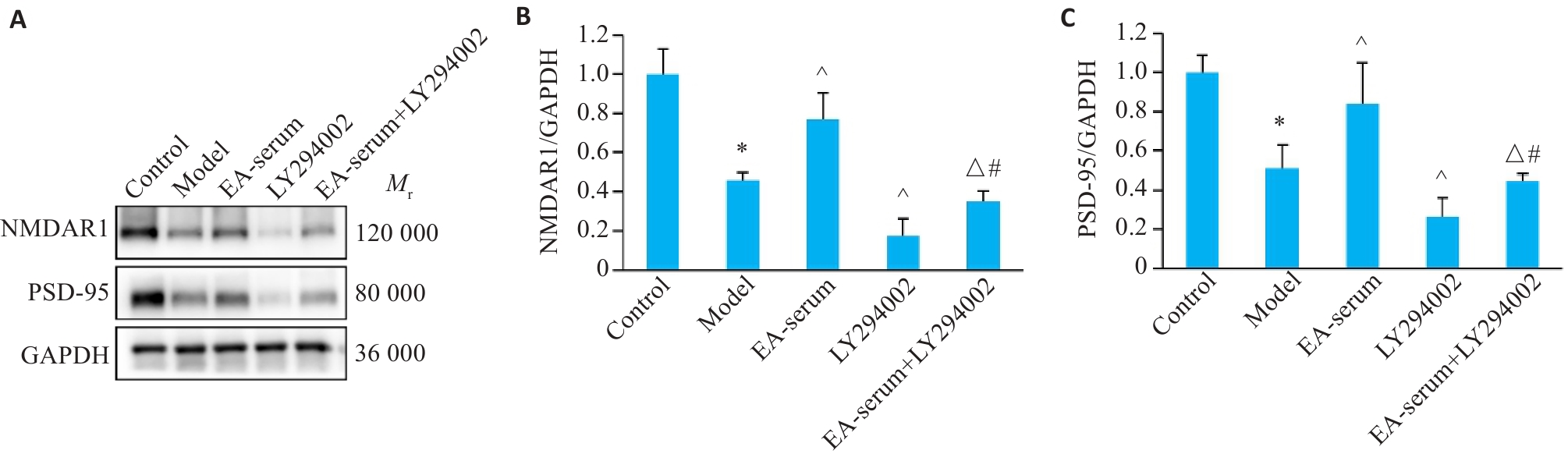
图9 各组HT22神经元NMDAR1、PSD-95蛋白相对表达量的比较
Fig.9 Comparison of the relative expression levels of NMDAR1 and PSD-95 proteins in HT22 neurons in each group (n=3). A: The expression of NMDAR1 and PSD-95 proteins in HT22 neurons in each group detected by Western blotting. B: Quantitative analysis of the NMDAR1/GAPDH ratio. C: Quantitative analysis of the PSD-95/GAPDH ratio. *P<0.05 vs Control group; ^P<0.05 vs Model group; △P<0.05 vs EA-serum group; #P<0.05 vsLY294002 group.
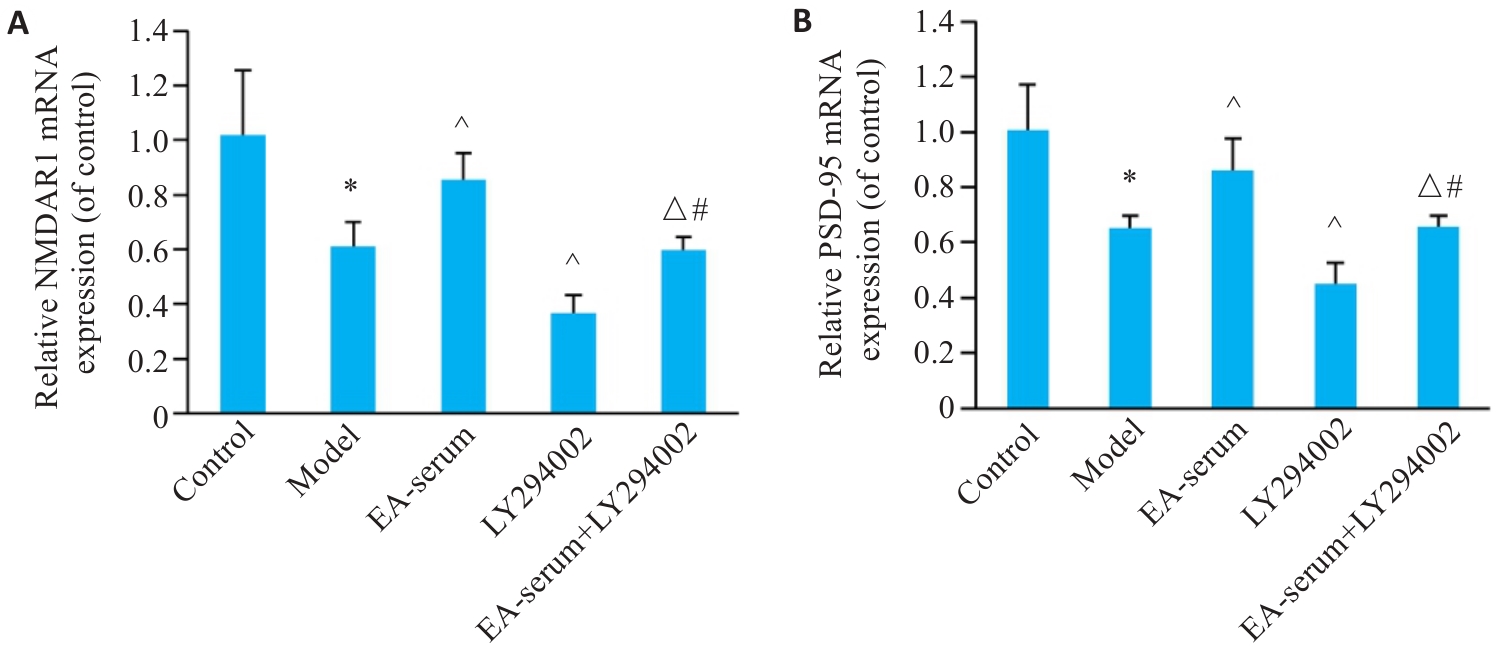
图10 各组HT22神经元NMDAR1、PSD-95 mRNA相对表达量的比较
Fig.10 Comparison of relative mRNA expression levels of NMDAR1 and PSD-95 in HT22 neurons in each group (n=3). A: Quantitative analysis of NMDAR1 mRNA relative expression by RT-qPCR. B: Quantitative analysis of PSD-95 mRNA relative expression by RT-qPCR. *P<0.05 vs Control group; ^P<0.05 vs Model group; △P<0.05 vs EA-serum group; #P<0.05 vs LY294002 group.
| [1] | Lim JS, Lee JJ, Woo CW. Post-stroke cognitive impairment: pathophysiological insights into brain disconnectome from advanced neuroimaging analysis techniques[J]. J Stroke, 2021, 23(3): 297-311. doi:10.5853/JOS.2021.02376 |
| [2] | El Husseini N, Katzan IL, Rost NS, et al. Cognitive impairment after ischemic and hemorrhagic stroke: a scientific statement from the American heart association/American stroke association[J]. Stroke, 2023, 54(6): 272-91. doi:10.1161/str.0000000000000430 |
| [3] | He AN, Wang Z, Wu X, et al. Incidence of post-stroke cognitive impairment in patients with first-ever ischemic stroke: a multicenter cross-sectional study in China[J]. Lancet Reg Health West Pac, 2023, 33: 100687. doi:10.1016/j.lanwpc.2023.100687 |
| [4] | Li ZX, Wang HY, Xiao GX, et al. Recovery of post-stroke cognitive and motor deficiencies by Shuxuening injection via regulating hippocampal BDNF-mediated Neurotrophin/Trk Signaling[J]. Biomed Pharmacother, 2021, 141: 111828. doi:10.1016/j.biopha.2021.111828 |
| [5] | Magee JC, Grienberger C. Synaptic plasticity forms and functions[J]. Annu Rev Neurosci, 2020, 43: 95-117. doi:10.1146/annurev-neuro-090919-022842 |
| [6] | Dai XM, Lin AL, Zhuang LP, et al. Targeting SIK3 to modulate hippocampal synaptic plasticity and cognitive function by regulating the transcription of HDAC4 in a mouse model of Alzheimer's disease[J]. Neuropsychopharmacology, 2024, 49(6): 942-52. doi:10.1038/s41386-023-01775-1 |
| [7] | Weaver NA, Kuijf HJ, Aben HP, et al. Strategic infarct locations for post-stroke cognitive impairment: a pooled analysis of individual patient data from 12 acute ischaemic stroke cohorts[J]. Lancet Neurol, 2021, 20(6): 448-59. doi:10.1016/S1474-4422(21)00060-0 |
| [8] | Sánchez-Castillo C, Cuartero MI, Fernández-Rodrigo A, et al. Functional specialization of different PI3K isoforms for the control of neuronal architecture, synaptic plasticity, and cognition[J]. Sci Adv, 2022, 8(47): eabq8109. doi:10.1126/sciadv.abq8109 |
| [9] | Qin ZS, Zheng Y, Zhou XD, et al. Shexiang Baoxin pill, a proprietary multi-constituent Chinese medicine, prevents locomotor and cognitive impairment caused by brain ischemia and reperfusion injury in rats: a potential therapy for neuropsychiatric sequelae of stroke[J]. Front Pharmacol, 2021, 12: 665456. doi:10.3389/fphar.2021.665456 |
| [10] | Cao H, Zuo CC, Gu ZY, et al. High frequency repetitive transcranial magnetic stimulation alleviates cognitive deficits in 3xTg-AD mice by modulating the PI3K/Akt/GLT-1 axis[J]. Redox Biol, 2022, 54: 102354. doi:10.1016/j.redox.2022.102354 |
| [11] | Choi J, Kim D, Jeong H, et al. A novel miR-4536-3p inhibition ameliorates Alzheimer's disease by reducing Aβ accumulation and tau phosphorylation[J]. Alzheimers Res Ther, 2025, 17(1): 189. doi:10.1186/s13195-025-01834-3 |
| [12] | Hu GT, Zhou CH, Wang J, et al. Electroacupuncture treatment ameliorates depressive-like behavior and cognitive dysfunction via CB1R dependent mitochondria biogenesis after experimental global cerebral ischemic stroke[J]. Front Cell Neurosci, 2023, 17: 1135227. doi:10.3389/fncel.2023.1135227 |
| [13] | 孙可心, 白艳杰, 王 岩, 等. 基于缺氧诱导因子-1α/丙酮酸脱氢酶激酶1通路探讨通督 醒神针刺法调控糖酵解改善脑卒中后认知障碍的作用机制[J/OL]. 针刺研究, 2025, 50(12): 1387-95. |
| [14] | 张 慧, 杨 帆, 龙学平, 等. 针刺血清对无镁培养的新生大鼠海马神经元微管相关蛋白2和生长相关蛋白43表达的影响[J/OL]. 针刺研究, 2021, 46(12): 1029-35, 1066. |
| [15] | 苏凯奇, 吕 转, 吴明莉, 等. 电针对缺血再灌注后学习记忆障碍大鼠 BDNF/TrkB/PI3K/akt通路的影响及对海马神经元保护作用研究[J]. 中国全科医学, 2023, 26(33): 4187-93. |
| [16] | 谢亚威, 赵永辰, 李轶璠, 等. 针灸干预卒中后认知障碍的作用机制研究进展[J/OL]. 中 华中医药杂志, 2024, 39(7): 3571-4. |
| [17] | 苏凯奇, 吕 转, 吴明莉, 等. 电针后留针联合认知训练治疗脑卒中后认知功能障碍:多 中心随机对照试验[J]. 中国针灸, 2023, 43(11): 1221-5. |
| [18] | 林如辉, 夏金言, 马小涵, 等. 电针通过促进突触再生改善脑缺血再灌注损伤大鼠的学 习记忆功能[J]. 南方医科大学学报, 2024, 44(12): 2317-26. |
| [19] | 吕 转, 陈玉龙, 王亚敏, 等. 通督醒神针刺调节肠道微生物改善缺血性脑卒中后认知障碍的临床机制研究[J]. 世界科学技术-中医药现代化, 2025, 27(2): 545-55. |
| [20] | Lin BB, Wang MX, Chen XC, et al. Involvement of P2X7R-mediated microglia polarization and neuroinflammation in the response to electroacupuncture on post-stroke memory impairment[J]. Brain Res Bull, 2024, 212: 110967. doi:10.1016/j.brainresbull.2024.110967 |
| [21] | 张浛芮, 吕鹤群, 曾春利, 等. 基于lncRNA H19的m6A甲基化调控S1PR2/TLR4/NLRP3 通路探讨电针血清对缺血性脑卒中后血脑屏障的作用机制[J/OL]. 世界科学技术-中医药现代化, 2024, 26(10): 2716-25. |
| [22] | 陈露露, 阮晓迪, 高 静, 等. 电针血清对氧糖剥夺/复氧糖后HT22神经元铁死亡的影响[J]. 海南医学院学报, 2025, 31(24): 1851-61. |
| [23] | Torres-López C, Cuartero MI, García-Culebras A, et al. Ipsilesional hippocampal GABA is elevated and correlates with cognitive impairment and maladaptive neurogenesis after cortical stroke in mice[J]. Stroke, 2023, 54(10): 2652-65. doi:10.1161/strokeaha.123.043516 |
| [24] | Zhang LJ, Cui HZ, Hu WD, et al. Targeting MAD2B as a strategy for ischemic stroke therapy[J]. J Adv Res, 2025, 72: 369-85. doi:10.1016/j.jare.2024.07.003 |
| [25] | 袁宏伟, 刘云霞, 张 含, 等. “通督醒神”法针灸联合认知训练治疗卒中后轻度认知障碍:随机对照试验[J]. 中国针灸, 2022, 42(8): 839-43. doi:10.13703/j.0255-2930.20210811-0005 |
| [26] | Lang JW, Luo JC, Lang JC, et al. Electroacupuncture alleviated post-stroke cognitive impairment via the mTOR/NLRP3-mediated autophagy-inflammatory pathway[J]. Eur J Med Res, 2024, 29(1): 532. doi:10.1186/s40001-024-02131-9 |
| [27] | Yu J, Li JL, Matei N, et al. Intranasal administration of recombinant prosaposin attenuates neuronal apoptosis through GPR37/PI3K/Akt/ASK1 pathway in MCAO rats[J]. Exp Neurol, 2024, 373: 114656. doi:10.1016/j.expneurol.2023.114656 |
| [28] | Ugalde-Triviño L, Díaz-Guerra M. PSD-95: an effective target for stroke therapy using neuroprotective peptides[J]. Int J Mol Sci, 2021, 22(22): 12585. doi:10.3390/ijms222212585 |
| [29] | 于云红, 谢 炜, 李 慧. 柴胡疏肝汤通过上调ASIC1蛋白调节NMDAR通道改善大鼠癫痫后的认知障碍[J]. 南方医科大学学报, 2025, 45(7): 1506-12. |
| [30] | Wright WJ, Hedrick NG, Komiyama T. Distinct synaptic plasticity rules operate across dendritic compartments in vivo during learning[J]. Science, 2025, 388(6744): 322-8. doi:10.1126/science.ads4706 |
| [1] | 尹林, 章雨, 张可妮, 乔通, 张龙涛, 黄菊, 李静, 胡建国, 耿志军. 1,3-二咖啡酰奎宁酸通过抑制PI3K/Akt通路减轻氧化应激缓解葡聚糖硫酸钠诱导的小鼠结肠炎[J]. 南方医科大学学报, 2026, 46(6): 1244-1255. |
| [2] | 杨丹, 赵方毓, 何一多, 朱红, 刘昕, 陈显兵. 头顶一颗珠通过调节内质网自噬保护卒中后认知障碍大鼠的神经功能[J]. 南方医科大学学报, 2026, 46(6): 1365-1373. |
| [3] | 徐陈陈, 韩永升, 程楠, 董健健. 通腑养髓治法通过抑制PKR介导的突触损伤改善Wilson病TX小鼠认知功能[J]. 南方医科大学学报, 2026, 46(4): 880-889. |
| [4] | 温贺新, 林洁, 左芦根, 刘牧林. 珠子草素通过拮抗肠上皮细胞凋亡与调控肠道Th1/Th2免疫平衡改善克罗恩病样小鼠结肠炎[J]. 南方医科大学学报, 2026, 46(3): 655-665. |
| [5] | 杨佳瑶, 何玉莲, 郭延垒, 尚芳红, 花雷, 阳勇, 张小梅, 魏江平. 党参-茯苓配伍调控ERα/PI3K/Akt信号通路改善单侧颈总动脉永久结扎痴呆大鼠的认知障碍[J]. 南方医科大学学报, 2026, 46(2): 247-258. |
| [6] | 邱佳惠, 陈萌, 满如, 陈鑫, 邱东瑞, 常启同, 马洪玉. 化瘀通便汤通过抑制PI3K/Akt信号通路促进慢传输型便秘大鼠肠道Cajal间质细胞的胞葬作用[J]. 南方医科大学学报, 2026, 46(2): 293-300. |
| [7] | 赵铖, 李稳, 郑宝寿, 王光明, 肖芝松, 李云鹏. lncRNA SNHG12与ELAVL1相互作用激活PI3K/AKT信号通路促进前列腺癌细胞多西他赛的耐药机制[J]. 南方医科大学学报, 2026, 46(1): 183-190. |
| [8] | 饶璐, 丁家和, 魏江平, 阳勇, 张小梅, 王计瑞. 槐花通过抑制PI3K/AKT通路减轻炎症反应治疗银屑病[J]. 南方医科大学学报, 2025, 45(9): 1989-1996. |
| [9] | 王庆阁, 赵晓慧, 何宇轩, 刘飞祥, 张运克. 芪芎左归颗粒通过上调BDNF/TrkB通路提高衰老大鼠突触可塑性[J]. 南方医科大学学报, 2025, 45(8): 1589-1598. |
| [10] | 吴璇, 方家敏, 韩玮玮, 陈琳, 孙菁, 金齐力. 高表达PRELID1促进胃癌细胞上皮间质转化并与不良预后相关[J]. 南方医科大学学报, 2025, 45(7): 1535-1542. |
| [11] | 陈悦, 肖林雨, 任侣, 宋雪, 李静, 胡建国. 水晶兰苷通过抑制PI3K/AKT信号通路减少神经元凋亡改善脊髓损伤后小鼠的运动功能[J]. 南方医科大学学报, 2025, 45(4): 774-784. |
| [12] | 储菲, 陈孝华, 宋博文, 杨晶晶, 左芦根. 苏荠宁黄酮通过抑制PI3K/AKT信号通路拮抗肠上皮细胞凋亡改善小鼠实验性结肠炎[J]. 南方医科大学学报, 2025, 45(4): 819-828. |
| [13] | 董妍妍, 张可敬, 储俊, 储全根. 抵当汤含药血清通过PI3K/Akt/mTOR信号通路增强高糖诱导的大鼠肾小球内皮细胞自噬[J]. 南方医科大学学报, 2025, 45(3): 461-469. |
| [14] | 黄菊, 殷丽霞, 牛民主, 耿志军, 左芦根, 李静, 胡建国. 紫花前胡苷通过抑制肠上皮细胞焦亡改善2,4,6-三硝基苯磺酸诱导的小鼠实验性结肠炎[J]. 南方医科大学学报, 2025, 45(2): 261-268. |
| [15] | 徐皓男, 张放, 黄钰莹, 姚其盛, 管悦琴, 陈浩. 百蕊草通过调节肠道菌群和调控EGFR/PI3K/Akt信号通路改善小鼠抗生素相关性腹泻[J]. 南方医科大学学报, 2025, 45(2): 285-295. |
| 阅读次数 | ||||||
|
全文 |
|
|||||
|
摘要 |
|
|||||
