
南方医科大学学报 ›› 2026, Vol. 46 ›› Issue (6): 1395-1406.doi: 10.12122/j.issn.1673-4254.2026.06.19
• • 上一篇
黄伟平1( ), 颜欢畅2(), 李顺铭3, 吴昊3, 蔡衍珊3, 韩志刚3(), 唐时幸1,4()
收稿日期:2025-12-19
出版日期:2026-06-20
发布日期:2026-06-24
通讯作者:
韩志刚,唐时幸
E-mail:1092064569@qq.com;yanhch7@mail.sysu.edu.cn;zhiganghan616@163.com;tamgshixing@smu.edu.cn
作者简介:黄伟平,在读硕士研究生,E-mail: 1092064569@qq.com基金资助:
Weiping HUANG1(), Huanchang YAN2(), Shunming LI3, Hao WU3, Yanshan CAI3, Zhigang HAN3(), Shixing TANG1,4()
Received:2025-12-19
Online:2026-06-20
Published:2026-06-24
Contact:
Zhigang HAN, Shixing TANG
E-mail:1092064569@qq.com;yanhch7@mail.sysu.edu.cn;zhiganghan616@163.com;tamgshixing@smu.edu.cn
Supported by:摘要:
目的 探讨广州市HIV-1基因型和人口流动性对HIV-1传播的影响,为精准防控提供科学依据。 方法 针对2008~2020年在广州新确诊的HIV-1感染者(PLWH),收集人口学信息,并根据感染者的户籍地和确诊后1年内住址变更信息,将其分为广州籍非流动(广州户籍、1年内住址无变化)、广州籍流动(广州户籍、1年内住址有变化)以及非广州籍非流动(非广州户籍、1年内住址无变化)和非广州籍流动(非广州户籍、1年内住址有变化)人口。同时收集PLWH HIV-1 pol基因序列并分型,采用HIV-TRACE方法构建分子传播网络,以传播网络的度值识别高风险传播者,并采用多分类Logistic回归模型识别感染者特征和HIV-1传播的危险因素。 结果 本研究共纳入6783名PLWH,广州籍非流动、广州籍流动、非广州籍非流动和非广州籍流动人口分别占24.0%、0.90%、56.4%和18.6%。主要流行的HIV-1基因型包括CRF07_BC(39.6%)、CRF01_AE(33.0%)、CRF55_01B(11.9%)、B亚型(4.7%)、CRF08_BC(3.0%)和CRF59_01B(2.3%)。分子传播网络分析发现,43.3%(2934/6783)的PLWH构成596个分子传播簇。与HIV-1 B亚型相比,CRF01_AE(aOR=1.384,95% CI:1.072~1.798)、CRF07_BC(aOR=2.462,95% CI:1.911~3.192)、CRF55_01B(aOR=3.209,95% CI:2.424~4.271)和CRF59_01B(aOR=2.149,95% CI:1.437~3.219)的PLWH更可能传播。人口流动性与HIV-1传播风险无统计学差异,广州籍居民更可能参与CRF08_BC传播(aOR=4.241,95% CI:1.494~12.790),而非广州籍的流动人口传播CRF01_AE(aOR=0.740,95% CI:0.576~0.946)和B亚型(aOR=0.429,95% CI:0.182~0.922)的风险较低。高风险传播者的特征包括广州籍居民(aOR=1.390,95% CI:1.141~1.695)、男性(aOR=4.449,95% CI:2.402~8.242)、男男性行为史(MSM,aOR=1.783,95% CI:1.414~2.248)、感染CRF07_BC(aOR=3.062,95% CI:1.963~4.777)或CRF55_01B(aOR=5.031,95% CI:3.159~8.014)者。 结论 尽管广州PLWH中广州籍居民仅占24.9%,但广州籍居民在HIV-1传播网络中表现较高的传播风险。此外,HIV-1基因型和MSM也是影响HIV-1传播的重要因素。分子传播网络分析可帮助识别HIV-1传播的关键人群,并揭示危险因素,是精准防控和控制HIV-1感染的重要工具。
黄伟平, 颜欢畅, 李顺铭, 吴昊, 蔡衍珊, 韩志刚, 唐时幸. HIV-1基因型和人口流动性对广州HIV-1传播的影响:基于分子传播网络分析[J]. 南方医科大学学报, 2026, 46(6): 1395-1406.
Weiping HUANG, Huanchang YAN, Shunming LI, Hao WU, Yanshan CAI, Zhigang HAN, Shixing TANG. Impact of HIV-1 genotypes and population mobility on HIV-1 transmission in Guangzhou: a molecular transmission network analysis[J]. Journal of Southern Medical University, 2026, 46(6): 1395-1406.
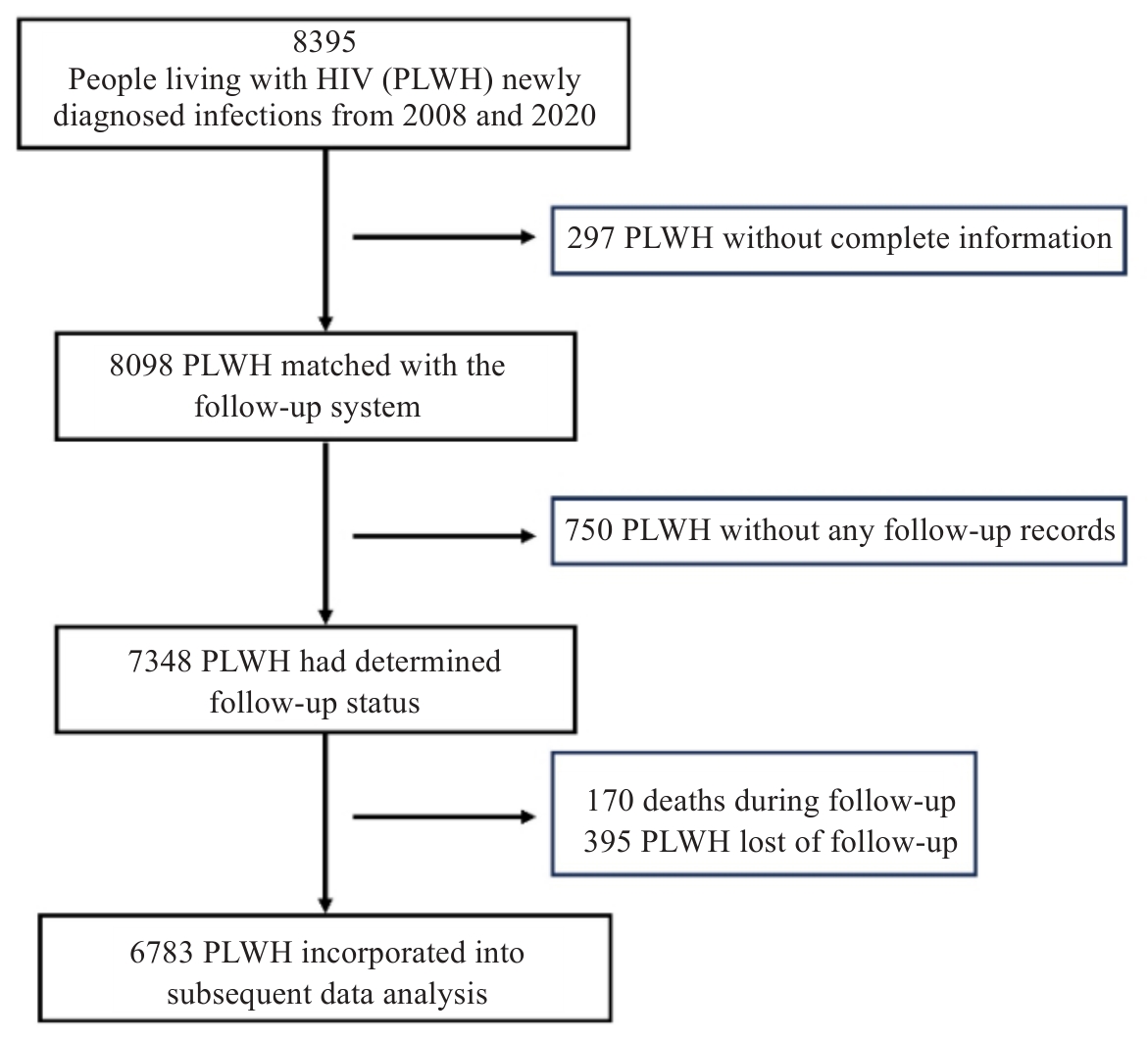
图1 纳入与排除的研究流程图
Fig.1 Study flowchart with the inclusion and exclusion criteria.
| Characteristics | Overall (n=6783) | CRF07_BC(n=2683) | CRF01_AE(n=2235) | CRF55_01B (n=805) | Subtype B (n=319) | CRF08_BC (n=201) | CRF59_01B (n=157) | Other genotypes (n=383) | χ2 | P |
|---|---|---|---|---|---|---|---|---|---|---|
| Mobility group | 65.93 | <0.001 | ||||||||
Non-Guangzhou residents, non-migrants | 3827 (56.4) | 1530 (57.0) | 1249 (55.9) | 481 (59.8) | 169 (53.0) | 80 (39.8) | 97 (61.8) | 221 (57.7) | ||
Non-Guangzhou residents, migrants | 1262 (18.6) | 461 (17.2) | 441 (19.7) | 140 (17.4) | 51 (16.0) | 69 (34.3) | 25 (15.9) | 75 (19.6) | ||
| Guangzhou residents | 1630 (24.0) | 658 (24.5) | 528 (23.6) | 183 (22.7) | 95 (29.8) | 48 (23.9) | 34 (21.7) | 84 (21.9) | ||
Guangzhou residents, migrants | 64 (0.9) | 34 (1.3) | 17 (0.8) | 1 (0.1) | 4 (1.3) | 4 (2.0) | 1 (0.6) | 3 (0.8) | ||
| Age group (year) | 231.25 | <0.001 | ||||||||
| 18-29 | 2987 (44.0) | 1249 (46.6) | 1023 (45.8) | 314 (39.0) | 142 (44.5) | 30 (14.9) | 59 (37.6) | 170 (44.4) | ||
| 30-39 | 1810 (26.7) | 711 (26.5) | 594 (26.6) | 231 (28.7) | 77 (24.1) | 48 (23.9) | 40 (25.5) | 109 (28.5) | ||
| 40-49 | 1124 (16.6) | 422 (15.7) | 332 (14.9) | 180 (22.4) | 38 (11.9) | 54 (26.9) | 36 (22.9) | 62 (16.2) | ||
| 50-59 | 539 (7.9) | 205 (7.6) | 163 (7.3) | 62 (7.7) | 29 (9.1) | 34 (16.9) | 16 (10.2) | 30 (7.8) | ||
| ≥60 | 323 (4.8) | 96 (3.6) | 123 (5.5) | 18 (2.2) | 33 (10.3) | 35 (17.4) | 6 (3.8) | 12 (3.1) | ||
| Gender | 137.51 | <0.001 | ||||||||
| Female | 547 (8.1) | 201 (7.5) | 211 (9.4) | 17 (2.1) | 22 (6.9) | 52 (25.9) | 6 (3.8) | 38 (9.9) | ||
| Male | 6236 (91.9) | 2482 (92.5) | 2024 (90.6) | 788 (97.9) | 297 (93.1) | 149 (74.1) | 151 (96.2) | 345 (90.1) | ||
| Marital status | 121.41 | <0.001 | ||||||||
| Unmarried | 4193 (61.8) | 1751 (65.3) | 1388 (62.1) | 462 (57.4) | 199 (62.4) | 58 (28.9) | 86 (54.8) | 249 (65.0) | ||
| Married or cohabiting | 2014 (29.7) | 713 (26.6) | 670 (30.0) | 262 (32.5) | 96 (30.1) | 115 (57.2) | 54 (34.4) | 104 (27.2) | ||
| Divorced or separated | 576 (8.5) | 219 (8.2) | 177 (7.9) | 81 (10.1) | 24 (7.5) | 28 (13.9) | 17 (10.8) | 30 (7.8) | ||
| Education level | 239.31 | <0.001 | ||||||||
| Primary school or less | 687 (10.1) | 233 (8.7) | 234 (10.5) | 63 (7.8) | 38 (11.9) | 73 (36.3) | 14 (8.9) | 32 (8.4) | ||
| Junior or senior high school | 3512 (51.8) | 1371 (51.1) | 1114 (49.8) | 463 (57.5) | 161 (50.5) | 123 (61.2) | 93 (59.2) | 187 (48.8) | ||
| College or above | 2584 (38.1) | 1079 (40.2) | 887 (39.7) | 279 (34.7) | 120 (37.6) | 5 (2.5) | 50 (31.8) | 164 (42.8) | ||
| Infection route | 546.32 | <0.001 | ||||||||
| HET | 2180 (32.1) | 718 (26.8) | 819 (36.6) | 195 (24.2) | 125 (39.2) | 151 (75.1) | 42 (26.8) | 130 (33.9) | ||
| IDU | 251 (3.7) | 145 (5.4) | 45 (2.0) | 4 (0.5) | 4 (1.3) | 42 (20.9) | 3 (1.9) | 8 (2.1) | ||
| MSM | 4352 (64.2) | 1820 (67.8) | 1371 (61.3) | 606 (75.3) | 190 (59.6) | 8 (4.0) | 112 (71.3) | 245 (64.0) | ||
| Diagnosis year | 73.68 | <0.001 | ||||||||
| 2008-2012 | 1035 (15.3) | 367 (13.7) | 406 (18.2) | 119 (14.8) | 72 (22.6) | 24 (11.9) | 9 (5.7) | 38 (9.9) | ||
| 2013-2016 | 2080 (30.7) | 806 (30.0) | 663 (29.7) | 286 (35.5) | 95 (29.8) | 49 (24.4) | 61 (38.9) | 120 (31.3) | ||
| 2017-2020 | 3668 (54.1) | 1510 (56.3) | 1166 (52.2) | 400 (49.7) | 152 (47.6) | 128 (63.7) | 87 (55.4) | 225 (58.7) | ||
| HIV status at diagnosis | 177.60 | <0.001 | ||||||||
| HIV infection | 4263 (62.8) | 1917 (71.4) | 1219 (54.5) | 465 (57.8) | 181 (56.7) | 115 (57.2) | 96 (61.1) | 270 (70.5) | ||
| AIDS | 2520 (37.2) | 766 (28.6) | 1016 (45.5) | 340 (42.2) | 138 (43.3) | 86 (42.8) | 61 (38.9) | 113 (29.5) |
表1 2008-2020年广州不同HIV-1基因型感染者的人口统计学、社会行为学和临床特征
Tab.1 Demographic, social-behavioral, and clinical characteristics of the PLWH in Guangzhou (2008-2020)
| Characteristics | Overall (n=6783) | CRF07_BC(n=2683) | CRF01_AE(n=2235) | CRF55_01B (n=805) | Subtype B (n=319) | CRF08_BC (n=201) | CRF59_01B (n=157) | Other genotypes (n=383) | χ2 | P |
|---|---|---|---|---|---|---|---|---|---|---|
| Mobility group | 65.93 | <0.001 | ||||||||
Non-Guangzhou residents, non-migrants | 3827 (56.4) | 1530 (57.0) | 1249 (55.9) | 481 (59.8) | 169 (53.0) | 80 (39.8) | 97 (61.8) | 221 (57.7) | ||
Non-Guangzhou residents, migrants | 1262 (18.6) | 461 (17.2) | 441 (19.7) | 140 (17.4) | 51 (16.0) | 69 (34.3) | 25 (15.9) | 75 (19.6) | ||
| Guangzhou residents | 1630 (24.0) | 658 (24.5) | 528 (23.6) | 183 (22.7) | 95 (29.8) | 48 (23.9) | 34 (21.7) | 84 (21.9) | ||
Guangzhou residents, migrants | 64 (0.9) | 34 (1.3) | 17 (0.8) | 1 (0.1) | 4 (1.3) | 4 (2.0) | 1 (0.6) | 3 (0.8) | ||
| Age group (year) | 231.25 | <0.001 | ||||||||
| 18-29 | 2987 (44.0) | 1249 (46.6) | 1023 (45.8) | 314 (39.0) | 142 (44.5) | 30 (14.9) | 59 (37.6) | 170 (44.4) | ||
| 30-39 | 1810 (26.7) | 711 (26.5) | 594 (26.6) | 231 (28.7) | 77 (24.1) | 48 (23.9) | 40 (25.5) | 109 (28.5) | ||
| 40-49 | 1124 (16.6) | 422 (15.7) | 332 (14.9) | 180 (22.4) | 38 (11.9) | 54 (26.9) | 36 (22.9) | 62 (16.2) | ||
| 50-59 | 539 (7.9) | 205 (7.6) | 163 (7.3) | 62 (7.7) | 29 (9.1) | 34 (16.9) | 16 (10.2) | 30 (7.8) | ||
| ≥60 | 323 (4.8) | 96 (3.6) | 123 (5.5) | 18 (2.2) | 33 (10.3) | 35 (17.4) | 6 (3.8) | 12 (3.1) | ||
| Gender | 137.51 | <0.001 | ||||||||
| Female | 547 (8.1) | 201 (7.5) | 211 (9.4) | 17 (2.1) | 22 (6.9) | 52 (25.9) | 6 (3.8) | 38 (9.9) | ||
| Male | 6236 (91.9) | 2482 (92.5) | 2024 (90.6) | 788 (97.9) | 297 (93.1) | 149 (74.1) | 151 (96.2) | 345 (90.1) | ||
| Marital status | 121.41 | <0.001 | ||||||||
| Unmarried | 4193 (61.8) | 1751 (65.3) | 1388 (62.1) | 462 (57.4) | 199 (62.4) | 58 (28.9) | 86 (54.8) | 249 (65.0) | ||
| Married or cohabiting | 2014 (29.7) | 713 (26.6) | 670 (30.0) | 262 (32.5) | 96 (30.1) | 115 (57.2) | 54 (34.4) | 104 (27.2) | ||
| Divorced or separated | 576 (8.5) | 219 (8.2) | 177 (7.9) | 81 (10.1) | 24 (7.5) | 28 (13.9) | 17 (10.8) | 30 (7.8) | ||
| Education level | 239.31 | <0.001 | ||||||||
| Primary school or less | 687 (10.1) | 233 (8.7) | 234 (10.5) | 63 (7.8) | 38 (11.9) | 73 (36.3) | 14 (8.9) | 32 (8.4) | ||
| Junior or senior high school | 3512 (51.8) | 1371 (51.1) | 1114 (49.8) | 463 (57.5) | 161 (50.5) | 123 (61.2) | 93 (59.2) | 187 (48.8) | ||
| College or above | 2584 (38.1) | 1079 (40.2) | 887 (39.7) | 279 (34.7) | 120 (37.6) | 5 (2.5) | 50 (31.8) | 164 (42.8) | ||
| Infection route | 546.32 | <0.001 | ||||||||
| HET | 2180 (32.1) | 718 (26.8) | 819 (36.6) | 195 (24.2) | 125 (39.2) | 151 (75.1) | 42 (26.8) | 130 (33.9) | ||
| IDU | 251 (3.7) | 145 (5.4) | 45 (2.0) | 4 (0.5) | 4 (1.3) | 42 (20.9) | 3 (1.9) | 8 (2.1) | ||
| MSM | 4352 (64.2) | 1820 (67.8) | 1371 (61.3) | 606 (75.3) | 190 (59.6) | 8 (4.0) | 112 (71.3) | 245 (64.0) | ||
| Diagnosis year | 73.68 | <0.001 | ||||||||
| 2008-2012 | 1035 (15.3) | 367 (13.7) | 406 (18.2) | 119 (14.8) | 72 (22.6) | 24 (11.9) | 9 (5.7) | 38 (9.9) | ||
| 2013-2016 | 2080 (30.7) | 806 (30.0) | 663 (29.7) | 286 (35.5) | 95 (29.8) | 49 (24.4) | 61 (38.9) | 120 (31.3) | ||
| 2017-2020 | 3668 (54.1) | 1510 (56.3) | 1166 (52.2) | 400 (49.7) | 152 (47.6) | 128 (63.7) | 87 (55.4) | 225 (58.7) | ||
| HIV status at diagnosis | 177.60 | <0.001 | ||||||||
| HIV infection | 4263 (62.8) | 1917 (71.4) | 1219 (54.5) | 465 (57.8) | 181 (56.7) | 115 (57.2) | 96 (61.1) | 270 (70.5) | ||
| AIDS | 2520 (37.2) | 766 (28.6) | 1016 (45.5) | 340 (42.2) | 138 (43.3) | 86 (42.8) | 61 (38.9) | 113 (29.5) |
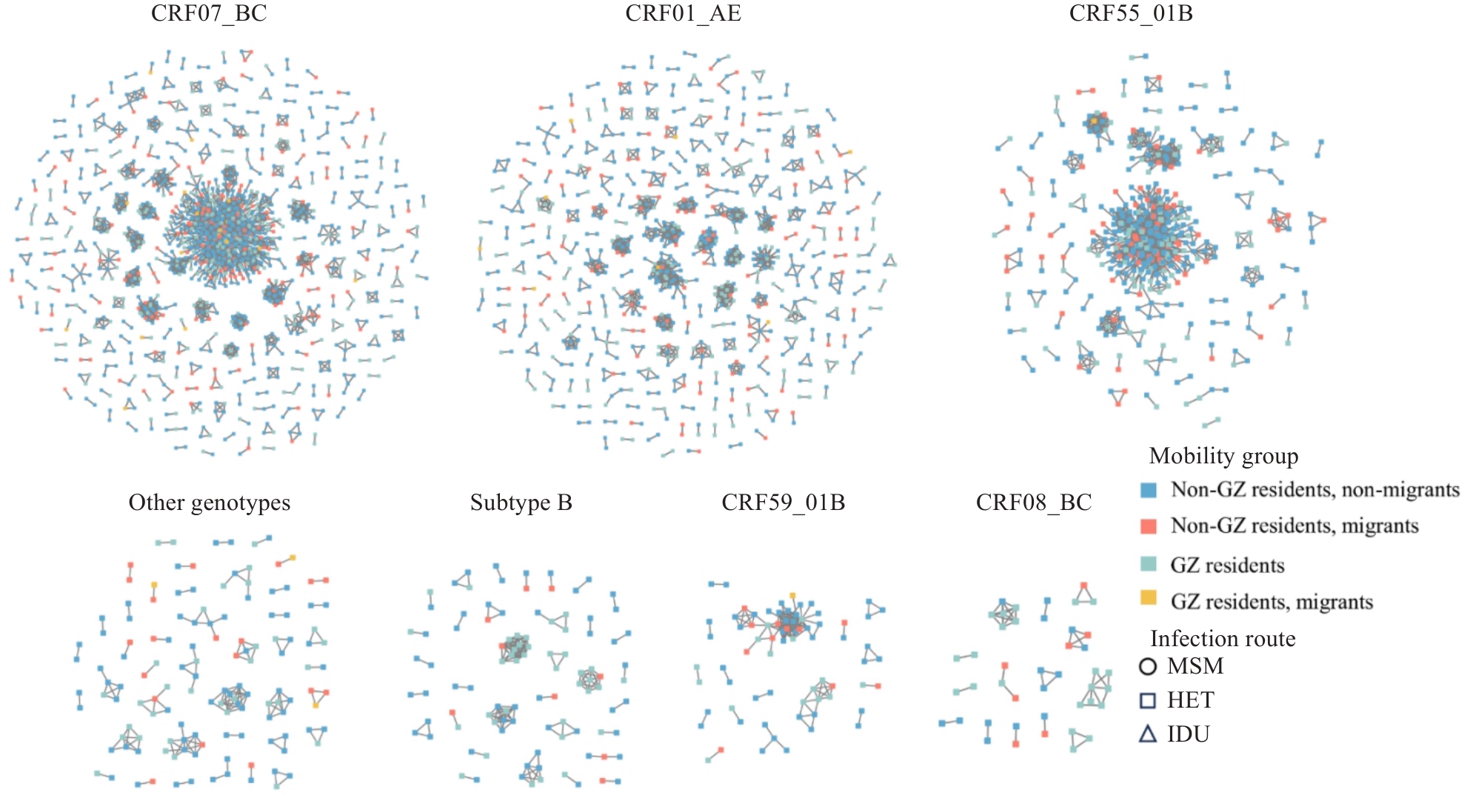
图2 广州的HIV-1分子传播网络
Fig.2 HIV-1 molecular transmission network in Guangzhou. Each node represents a person living with HIV and is colored according to household registration and mobility status. Edges indicate pairwise genetic distances of ≤0.8%. Node shapes indicate the primary route of HIV-1 transmission: men who have sex with men (MSM, circles), heterosexual contact (HET, squares), and injection drug use (IDU, triangles).
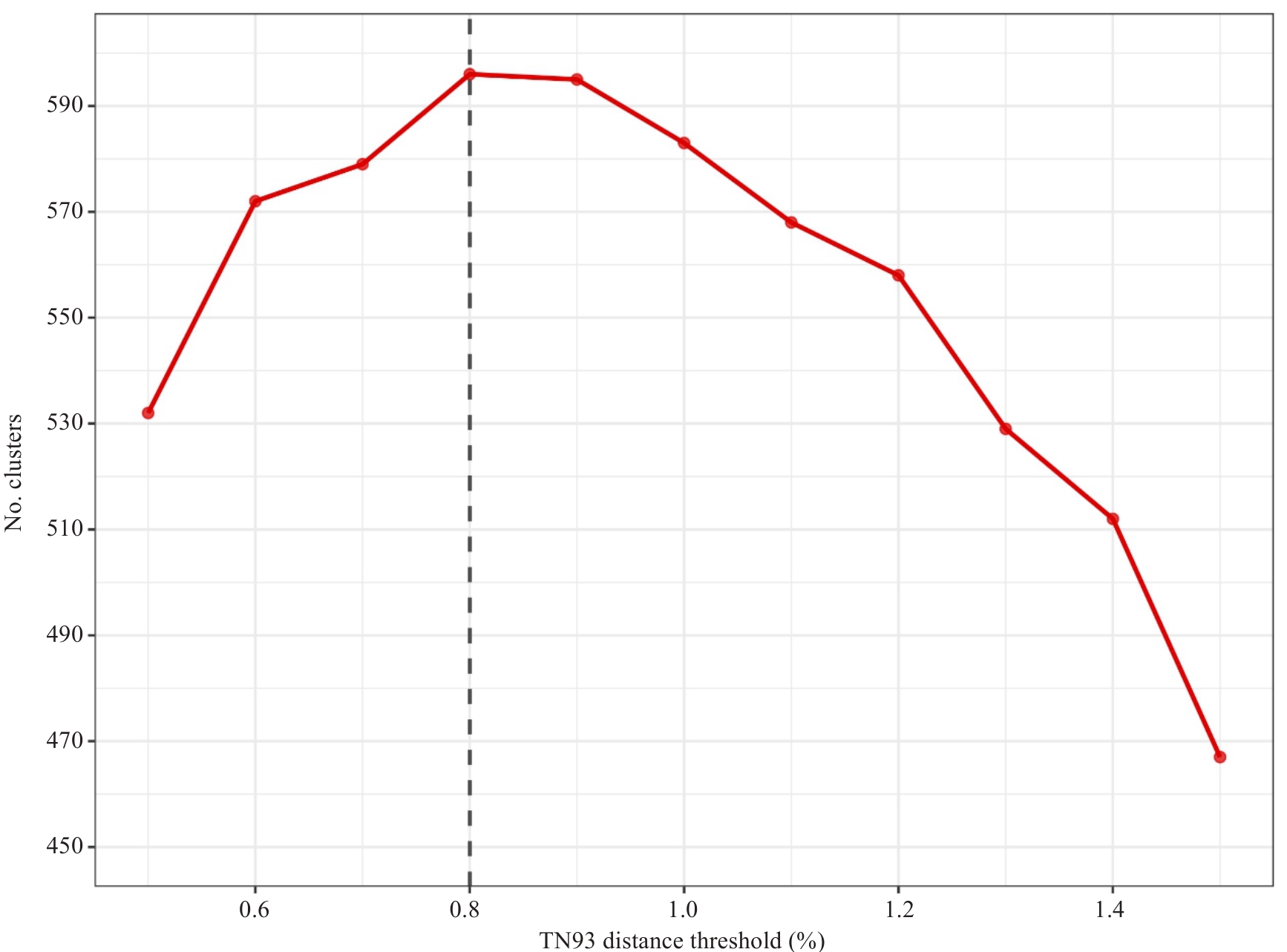
图3 广州HIV-1分子传播网络构建的最佳基因距离阈值
Fig.3 The optimal genetic distance threshold for the HIV-1 molecular transmission network in Guangzhou. The optimal GD threshold was determined as 0.8%, which identified the maximum number of clusters in the molecular transmission network.
| Characteristics | Clustered | Unclustered | Adjusted OR (95% CI) | P |
|---|---|---|---|---|
| (n=2934) | (n=3849) | |||
| Mobility Group | ||||
| Non-Guangzhou residents, non-migrants | 1727 (58.9) | 2100 (54.6) | Ref | |
| Non-Guangzhou residents, migrants | 440 (15.0) | 822 (21.4) | 0.780 (0.677-0.897) | 0.001 |
| Guangzhou residents | 737 (25.1) | 893 (23.2) | 1.698 (0.985-2.925) | 0.056 |
| Guangzhou residents, migrants | 30 (1.0) | 34 (0.9) | 1.100 (0.967-1.251) | 0.147 |
| Age group (year) | ||||
| 18-29 | 1417 (48.3) | 1570 (40.8) | Ref | |
| 30-39 | 775 (26.4) | 1035 (26.9) | 0.926 (0.812-1.056) | 0.252 |
| 40-49 | 420 (14.3) | 704 (18.3) | 0.896 (0.744-1.077) | 0.243 |
| 50-59 | 178 (6.1) | 361 (9.4) | 0.930 (0.726-1.188) | 0.562 |
| ≥60 | 144 (4.9) | 179 (4.7) | 1.782 (1.315-2.414) | <0.001 |
| Gender | ||||
| Female | 107 (3.6) | 440 (11.4) | Ref | |
| Male | 2827 (96.4) | 3409 (88.6) | 2.277 (1.794-2.912) | <0.001 |
| Marital status | ||||
| Unmarried | 1966 (67.0) | 2227 (57.9) | Ref | |
| Married or cohabiting | 758 (25.8) | 1256 (32.6) | 0.883 (0.754-1.034) | 0.122 |
| Divorced or separated | 210 (7.2) | 366 (9.5) | 0.814 (0.652-1.013) | 0.066 |
| Education level | ||||
| Primary school or less | 229 (7.8) | 458 (11.9) | Ref | |
| Junior or senior high school | 1446 (49.3) | 2066 (53.7) | 1.010 (0.829-1.232) | 0.923 |
| College or above | 1259 (42.9) | 1325 (34.4) | 1.028 (0.824-1.282) | 0.809 |
| Infection route | ||||
| HET | 731 (24.9) | 1449 (37.6) | Ref | |
| IDU | 41 (1.4) | 210 (5.5) | 0.297 (0.204-0.424) | <0.001 |
| MSM | 2162 (73.7) | 2190 (56.9) | 1.399 (1.223-1.602) | <0.001 |
| Diagnosis year | ||||
| 2008-2012 | 487 (16.6) | 548 (14.2) | Ref | |
| 2013-2016 | 1007 (34.3) | 1073 (27.9) | 0.823 (0.700-0.966) | 0.018 |
| 2017-2020 | 1440 (49.1) | 2228 (57.9) | 0.608 (0.523-0.707) | <0.001 |
| HIV status at diagnosis | ||||
| HIV infection | 1940 (66.1) | 2323 (60.4) | Ref | |
| AIDS | 994 (33.9) | 1526 (39.6) | 0.920 (0.825-1.027) | 0.138 |
| HIV-1 genotype | ||||
| Subtype B | 99 (3.4) | 220 (5.7) | Ref | |
| CRF01_AE | 803 (27.5) | 1432 (37.1) | 1.384 (1.072-1.798) | 0.014 |
| CRF07_BC | 1319 (44.9) | 1364 (35.5) | 2.462 (1.911-3.192) | <0.001 |
| CRF55_01B | 464 (15.8) | 341 (8.8) | 3.209 (2.424-4.271) | <0.001 |
| CRF08_BC | 43 (1.5) | 158 (4.1) | 1.190 (0.768-1.827) | 0.430 |
| CRF59_01B | 73 (2.5) | 84 (2.2) | 2.149 (1.437-3.219) | <0.001 |
| Other genotypes | 133 (4.5) | 250 (6.5) | 1.347 (0.973-1.868) | 0.073 |
表2 广州HIV-1传播网络成簇相关因素分析
Tab.2 Analysis of factors associated with clustering in the transmission network in Guangzhou
| Characteristics | Clustered | Unclustered | Adjusted OR (95% CI) | P |
|---|---|---|---|---|
| (n=2934) | (n=3849) | |||
| Mobility Group | ||||
| Non-Guangzhou residents, non-migrants | 1727 (58.9) | 2100 (54.6) | Ref | |
| Non-Guangzhou residents, migrants | 440 (15.0) | 822 (21.4) | 0.780 (0.677-0.897) | 0.001 |
| Guangzhou residents | 737 (25.1) | 893 (23.2) | 1.698 (0.985-2.925) | 0.056 |
| Guangzhou residents, migrants | 30 (1.0) | 34 (0.9) | 1.100 (0.967-1.251) | 0.147 |
| Age group (year) | ||||
| 18-29 | 1417 (48.3) | 1570 (40.8) | Ref | |
| 30-39 | 775 (26.4) | 1035 (26.9) | 0.926 (0.812-1.056) | 0.252 |
| 40-49 | 420 (14.3) | 704 (18.3) | 0.896 (0.744-1.077) | 0.243 |
| 50-59 | 178 (6.1) | 361 (9.4) | 0.930 (0.726-1.188) | 0.562 |
| ≥60 | 144 (4.9) | 179 (4.7) | 1.782 (1.315-2.414) | <0.001 |
| Gender | ||||
| Female | 107 (3.6) | 440 (11.4) | Ref | |
| Male | 2827 (96.4) | 3409 (88.6) | 2.277 (1.794-2.912) | <0.001 |
| Marital status | ||||
| Unmarried | 1966 (67.0) | 2227 (57.9) | Ref | |
| Married or cohabiting | 758 (25.8) | 1256 (32.6) | 0.883 (0.754-1.034) | 0.122 |
| Divorced or separated | 210 (7.2) | 366 (9.5) | 0.814 (0.652-1.013) | 0.066 |
| Education level | ||||
| Primary school or less | 229 (7.8) | 458 (11.9) | Ref | |
| Junior or senior high school | 1446 (49.3) | 2066 (53.7) | 1.010 (0.829-1.232) | 0.923 |
| College or above | 1259 (42.9) | 1325 (34.4) | 1.028 (0.824-1.282) | 0.809 |
| Infection route | ||||
| HET | 731 (24.9) | 1449 (37.6) | Ref | |
| IDU | 41 (1.4) | 210 (5.5) | 0.297 (0.204-0.424) | <0.001 |
| MSM | 2162 (73.7) | 2190 (56.9) | 1.399 (1.223-1.602) | <0.001 |
| Diagnosis year | ||||
| 2008-2012 | 487 (16.6) | 548 (14.2) | Ref | |
| 2013-2016 | 1007 (34.3) | 1073 (27.9) | 0.823 (0.700-0.966) | 0.018 |
| 2017-2020 | 1440 (49.1) | 2228 (57.9) | 0.608 (0.523-0.707) | <0.001 |
| HIV status at diagnosis | ||||
| HIV infection | 1940 (66.1) | 2323 (60.4) | Ref | |
| AIDS | 994 (33.9) | 1526 (39.6) | 0.920 (0.825-1.027) | 0.138 |
| HIV-1 genotype | ||||
| Subtype B | 99 (3.4) | 220 (5.7) | Ref | |
| CRF01_AE | 803 (27.5) | 1432 (37.1) | 1.384 (1.072-1.798) | 0.014 |
| CRF07_BC | 1319 (44.9) | 1364 (35.5) | 2.462 (1.911-3.192) | <0.001 |
| CRF55_01B | 464 (15.8) | 341 (8.8) | 3.209 (2.424-4.271) | <0.001 |
| CRF08_BC | 43 (1.5) | 158 (4.1) | 1.190 (0.768-1.827) | 0.430 |
| CRF59_01B | 73 (2.5) | 84 (2.2) | 2.149 (1.437-3.219) | <0.001 |
| Other genotypes | 133 (4.5) | 250 (6.5) | 1.347 (0.973-1.868) | 0.073 |
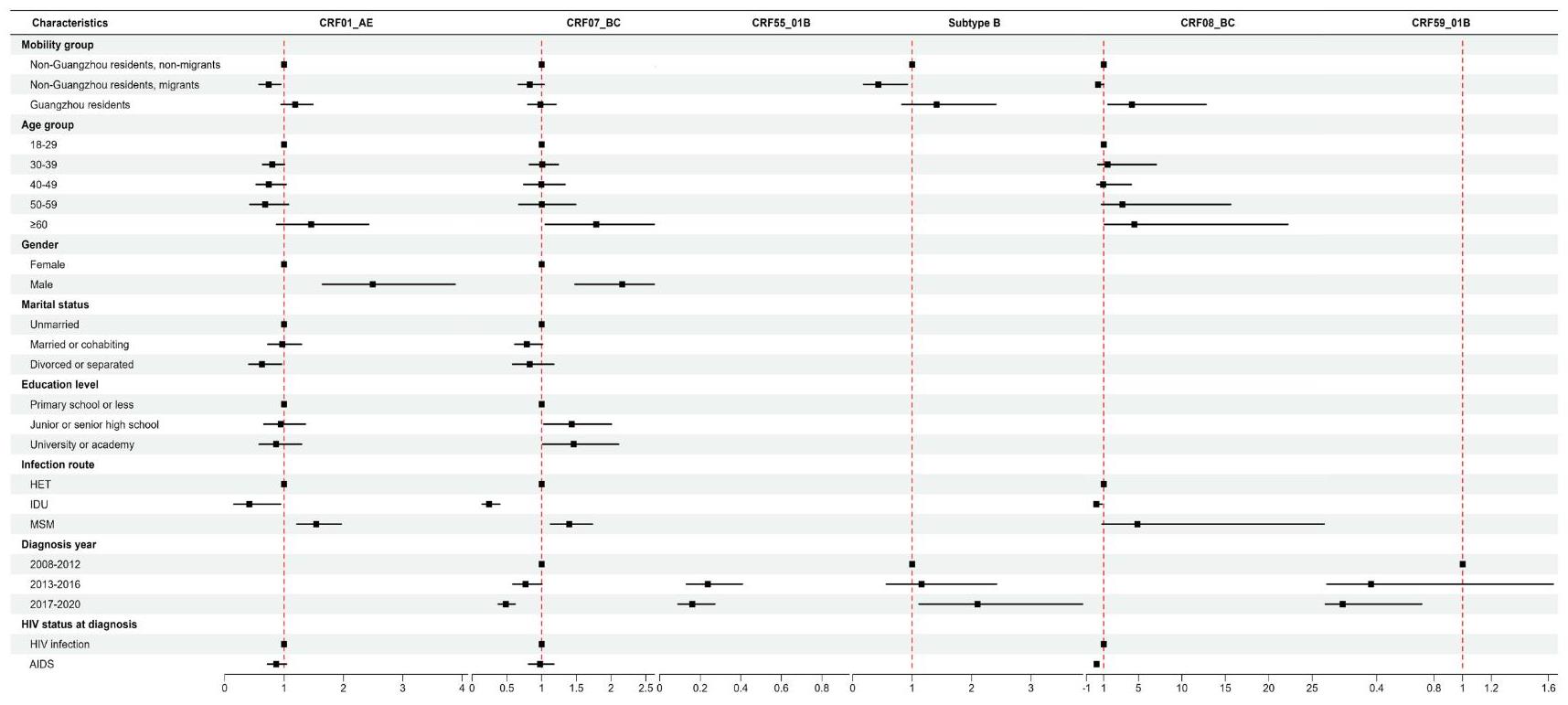
图4 不同HIV-1基因型感染者成簇相关因素
Fig.4 Factors associated with clustering among the PLWH. The adjusted odds ratios (aOR) were estimated using multivariate logistic regression models with the outcome being either clustered in the network or not. The red dashed line indicates aOR=1.
| Characteristics | CRF01_AE | CRF07_BC | CRF55_01B | Subtype B | CRF08_BC | CRF59_01B | Other genotypes | |||||||
|---|---|---|---|---|---|---|---|---|---|---|---|---|---|---|
AOR (95% CI) | P | AOR (95% CI) | P | AOR (95% CI) | P | AOR (95% CI) | P | AOR (95% CI) | P | AOR (95% CI) | P | AOR (95% CI) | P | |
| Mobility group | ||||||||||||||
Non-Guangzhou residents, non-migrants | Ref | Ref | - | - | Ref | Ref | - | - | - | - | ||||
Non-Guangzhou residents, migrants | 0.740 (0.576-0.946) | 0.017 | 0.829 (0.662-1.037) | 0.101 | - | - | 0.429 (0.182-0.922) | 0.039 | 0.344 (0.108-1.000) | 0.057 | - | - | - | - |
| Guangzhou residents | 1.187 (0.949-1.484) | 0.132 | 0.983 (0.801-1.207) | 0.872 | - | - | 1.412 (0.825-2.409) | 0.206 | 4.241 (1.494-12.790) | 0.008 | - | - | - | - |
| Age group (year) | ||||||||||||||
| 18-29 | Ref | Ref | - | - | - | - | Ref | - | - | Ref | ||||
| 30-39 | 0.801 (0.636-1.007) | 0.058 | 1.010 (0.822-1.241) | 0.928 | - | - | - | - | 1.439 (0.317-7.053) | 0.640 | - | - | 1.028 (0.589-1.793) | 0.921 |
| 40-49 | 0.741 (0.528-1.037) | 0.082 | 0.996 (0.741-1.339) | 0.977 | - | - | - | - | 0.930 (0.217-4.189) | 0.922 | - | - | 1.005 (0.408-2.445) | 0.991 |
| 50-59 | 0.680 (0.424-1.076) | 0.104 | 1.002 (0.672-1.491) | 0.991 | - | - | - | - | 3.161 (0.734-15.631) | 0.135 | - | - | 0.664 (0.182-2.169) | 0.512 |
| ≥60 | 1.457 (0.873-2.423) | 0.148 | 1.787 (1.052-3.038) | 0.032 | - | - | - | - | 4.533 (1.072-22.197) | 0.048 | - | - | 2.795 (0.561-12.835) | 0.191 |
| Gender | ||||||||||||||
| Female | Ref | Ref | - | - | - | - | - | - | - | Ref | ||||
| Male | 2.493 (1.645-3.881) | <0.001 | 2.160 (1.480-3.201) | <0.001 | - | - | - | - | - | - | - | 1.459 (0.504-4.887) | 0.507 | |
| Marital status | ||||||||||||||
| Unmarried | Ref | Ref | - | - | - | - | - | - | - | Ref | ||||
| Married or cohabiting | 0.969 (0.728-1.291) | 0.832 | 0.788 (0.614-1.012) | 0.062 | - | - | - | - | - | - | - | 0.469 (0.206-1.035) | 0.065 | |
| Divorced or separated | 0.628 (0.405-0.958) | 0.034 | 0.828 (0.583-1.175) | 0.292 | - | - | - | - | - | - | - | 0.513 (0.159-1.517) | 0.241 | |
| Education level | ||||||||||||||
| Primary school or lower | Ref | Ref | - | - | - | - | - | - | - | Ref | ||||
Junior or senior high school | 0.942 (0.657-1.360) | 0.745 | 1.433 (1.030-2.006) | 0.034 | - | - | - | - | - | - | - | 0.672 (0.256-1.866) | 0.428 | |
| College or above | 0.866 (0.581-1.297) | 0.481 | 1.461 (1.017-2.108) | 0.041 | - | - | - | - | - | - | - | 0.936 (0.334-2.744) | 0.901 | |
| Infection route | ||||||||||||||
| HET | Ref | Ref | - | - | - | - | Ref | - | - | Ref | ||||
| IDU | 0.414 (0.153-0.942) | 0.053 | 0.244 (0.144-0.399) | <0.001 | - | - | - | - | 0.150 (0.008-0.809) | 0.075 | - | - | 0.488 (0.024-3.381) | 0.532 |
| MSM | 1.542 (1.214-1.962) | <0.001 | 1.398 (1.128-1.732) | 0.002 | - | - | - | - | 4.873 (0.806-26.447) | 0.068 | - | - | 1.332 (0.717-2.510) | 0.368 |
| Diagnosis year | ||||||||||||||
| 2008-2012 | - | - | Ref | Ref | Ref | - | - | Ref | Ref | |||||
| 2013-2016 | - | - | 0.768 (0.585-1.006) | 0.056 | 0.237 (0.131-0.408) | <0.001 | 1.159 (0.564-2.421) | 0.690 | - | - | 0.360 (0.051-1.634) | 0.225 | 6.335 (2.015-28.125) | 0.005 |
| 2017-2020 | - | - | 0.484 (0.375-0.622) | <0.001 | 0.161 (0.090-0.272) | <0.001 | 2.102 (1.117-4.099) | 0.024 | - | - | 0.161 (0.023-0.714) | 0.028 | 4.486 (1.477-19.516) | 0.018 |
| HIV status at diagnosis | ||||||||||||||
| HIV infection | Ref | Ref | - | - | - | - | Ref | - | - | Ref | ||||
| AIDS | 0.867 (0.721-1.042) | 0.128 | 0.977 (0.812-1.176) | 0.806 | - | - | - | - | 0.182 (0.062-0.471) | 0.001 | - | - | 0.849 (0.498-1.433) | 0.543 |
表3 不同HIV-1基因型感染者成簇影响因素的多因素分析
Tab.3 Multivariable analysis of factors associated with clustering by HIV-1 genotypes among the PLWH in Guangzhou
| Characteristics | CRF01_AE | CRF07_BC | CRF55_01B | Subtype B | CRF08_BC | CRF59_01B | Other genotypes | |||||||
|---|---|---|---|---|---|---|---|---|---|---|---|---|---|---|
AOR (95% CI) | P | AOR (95% CI) | P | AOR (95% CI) | P | AOR (95% CI) | P | AOR (95% CI) | P | AOR (95% CI) | P | AOR (95% CI) | P | |
| Mobility group | ||||||||||||||
Non-Guangzhou residents, non-migrants | Ref | Ref | - | - | Ref | Ref | - | - | - | - | ||||
Non-Guangzhou residents, migrants | 0.740 (0.576-0.946) | 0.017 | 0.829 (0.662-1.037) | 0.101 | - | - | 0.429 (0.182-0.922) | 0.039 | 0.344 (0.108-1.000) | 0.057 | - | - | - | - |
| Guangzhou residents | 1.187 (0.949-1.484) | 0.132 | 0.983 (0.801-1.207) | 0.872 | - | - | 1.412 (0.825-2.409) | 0.206 | 4.241 (1.494-12.790) | 0.008 | - | - | - | - |
| Age group (year) | ||||||||||||||
| 18-29 | Ref | Ref | - | - | - | - | Ref | - | - | Ref | ||||
| 30-39 | 0.801 (0.636-1.007) | 0.058 | 1.010 (0.822-1.241) | 0.928 | - | - | - | - | 1.439 (0.317-7.053) | 0.640 | - | - | 1.028 (0.589-1.793) | 0.921 |
| 40-49 | 0.741 (0.528-1.037) | 0.082 | 0.996 (0.741-1.339) | 0.977 | - | - | - | - | 0.930 (0.217-4.189) | 0.922 | - | - | 1.005 (0.408-2.445) | 0.991 |
| 50-59 | 0.680 (0.424-1.076) | 0.104 | 1.002 (0.672-1.491) | 0.991 | - | - | - | - | 3.161 (0.734-15.631) | 0.135 | - | - | 0.664 (0.182-2.169) | 0.512 |
| ≥60 | 1.457 (0.873-2.423) | 0.148 | 1.787 (1.052-3.038) | 0.032 | - | - | - | - | 4.533 (1.072-22.197) | 0.048 | - | - | 2.795 (0.561-12.835) | 0.191 |
| Gender | ||||||||||||||
| Female | Ref | Ref | - | - | - | - | - | - | - | Ref | ||||
| Male | 2.493 (1.645-3.881) | <0.001 | 2.160 (1.480-3.201) | <0.001 | - | - | - | - | - | - | - | 1.459 (0.504-4.887) | 0.507 | |
| Marital status | ||||||||||||||
| Unmarried | Ref | Ref | - | - | - | - | - | - | - | Ref | ||||
| Married or cohabiting | 0.969 (0.728-1.291) | 0.832 | 0.788 (0.614-1.012) | 0.062 | - | - | - | - | - | - | - | 0.469 (0.206-1.035) | 0.065 | |
| Divorced or separated | 0.628 (0.405-0.958) | 0.034 | 0.828 (0.583-1.175) | 0.292 | - | - | - | - | - | - | - | 0.513 (0.159-1.517) | 0.241 | |
| Education level | ||||||||||||||
| Primary school or lower | Ref | Ref | - | - | - | - | - | - | - | Ref | ||||
Junior or senior high school | 0.942 (0.657-1.360) | 0.745 | 1.433 (1.030-2.006) | 0.034 | - | - | - | - | - | - | - | 0.672 (0.256-1.866) | 0.428 | |
| College or above | 0.866 (0.581-1.297) | 0.481 | 1.461 (1.017-2.108) | 0.041 | - | - | - | - | - | - | - | 0.936 (0.334-2.744) | 0.901 | |
| Infection route | ||||||||||||||
| HET | Ref | Ref | - | - | - | - | Ref | - | - | Ref | ||||
| IDU | 0.414 (0.153-0.942) | 0.053 | 0.244 (0.144-0.399) | <0.001 | - | - | - | - | 0.150 (0.008-0.809) | 0.075 | - | - | 0.488 (0.024-3.381) | 0.532 |
| MSM | 1.542 (1.214-1.962) | <0.001 | 1.398 (1.128-1.732) | 0.002 | - | - | - | - | 4.873 (0.806-26.447) | 0.068 | - | - | 1.332 (0.717-2.510) | 0.368 |
| Diagnosis year | ||||||||||||||
| 2008-2012 | - | - | Ref | Ref | Ref | - | - | Ref | Ref | |||||
| 2013-2016 | - | - | 0.768 (0.585-1.006) | 0.056 | 0.237 (0.131-0.408) | <0.001 | 1.159 (0.564-2.421) | 0.690 | - | - | 0.360 (0.051-1.634) | 0.225 | 6.335 (2.015-28.125) | 0.005 |
| 2017-2020 | - | - | 0.484 (0.375-0.622) | <0.001 | 0.161 (0.090-0.272) | <0.001 | 2.102 (1.117-4.099) | 0.024 | - | - | 0.161 (0.023-0.714) | 0.028 | 4.486 (1.477-19.516) | 0.018 |
| HIV status at diagnosis | ||||||||||||||
| HIV infection | Ref | Ref | - | - | - | - | Ref | - | - | Ref | ||||
| AIDS | 0.867 (0.721-1.042) | 0.128 | 0.977 (0.812-1.176) | 0.806 | - | - | - | - | 0.182 (0.062-0.471) | 0.001 | - | - | 0.849 (0.498-1.433) | 0.543 |
| Characteristics | Low degree (n=4878) | Medium degree (n=1131) | High degree (n=774) | χ2 | P |
|---|---|---|---|---|---|
| Mobility group | 41.719 | <0.001 | |||
| Non-Guangzhou residents, non-migrants | 2708 (55.5) | 669 (59.2) | 450 (58.1) | ||
| Non-Guangzhou residents, migrants | 995 (20.4) | 165 (14.6) | 102 (13.2) | ||
| Guangzhou residents | 1127 (23.1) | 290 (25.6) | 213 (27.5) | ||
| Guangzhou residents, migrants | 48 (1.0) | 7 (0.6) | 9 (1.2) | ||
| Age group (year) | 62.66 | <0.001 | |||
| 18-29 | 2045 (41.9) | 530 (46.9) | 412 (53.2) | ||
| 30-39 | 1286 (26.4) | 323 (28.6) | 201 (26.0) | ||
| 40-49 | 870 (17.8) | 157 (13.9) | 97 (12.5) | ||
| 50-59 | 428 (8.8) | 75 (6.6) | 36 (4.7) | ||
| ≥60 | 249 (5.1) | 46 (4.1) | 28 (3.6) | ||
| Gender | 125.519 | <0.001 | |||
| Female | 506 (10.4) | 29 (2.6) | 12 (1.6) | ||
| Male | 4372 (89.6) | 1102 (97.4) | 762 (98.4) | ||
| Marital status | 56.437 | <0.001 | |||
| Unmarried | 2886 (59.2) | 772 (68.3) | 535 (69.1) | ||
| Married or cohabiting | 1545 (31.7) | 293 (25.9) | 176 (22.7) | ||
| Divorced or separated | 447 (9.2) | 66 (5.8) | 63 (8.1) | ||
| Education level | 45.599 | <0.001 | |||
| Primary school or lower | 549 (11.3) | 84 (7.4) | 54 (7.0) | ||
| Junior or senior high school | 2574 (52.8) | 555 (49.1) | 383 (49.5) | ||
| College or above | 1755 (36.0) | 492 (43.5) | 337 (43.5) | ||
| Infection route | 229.675 | <0.001 | |||
| HET | 1776 (36.4) | 264 (23.3) | 140 (18.1) | ||
| IDU | 230 (4.7) | 16 (1.4) | 5 (0.6) | ||
| MSM | 2872 (58.9) | 851 (75.2) | 629 (81.3) | ||
| Diagnosis year | 166.88 | <0.001 | |||
| 2008-2012 | 670 (13.7) | 158 (14.0) | 207 (26.7) | ||
| 2013-2016 | 1395 (28.6) | 389 (34.4) | 296 (38.2) | ||
| 2017-2020 | 2813 (57.7) | 584 (51.6) | 271 (35.0) | ||
| HIV status at diagnosis | 14.673 | 0.001 | |||
| HIV infection | 3003 (61.6) | 764 (67.6) | 496 (64.1) | ||
| AIDS | 1875 (38.4) | 367 (32.4) | 278 (35.9) | ||
| HIV-1 genotype | 285.255 | <0.001 | |||
| Subtype B | 267 (5.5) | 28 (2.5) | 24 (3.1) | ||
| CRF01_AE | 1753 (35.9) | 316 (27.9) | 166 (21.4) | ||
| CRF07_BC | 1791 (36.7) | 515 (45.5) | 377 (48.7) | ||
| CRF55_01B | 466 (9.6) | 158 (14.0) | 181 (23.4) | ||
| CRF08_BC | 175 (3.6) | 25 (2.2) | 1 (0.1) | ||
| CRF59_01B | 115 (2.4) | 27 (2.4) | 15 (1.9) | ||
| Other genotypes | 311 (6.4) | 62 (5.5) | 10 (1.3) |
表4 HIV-1传播网络节点度值组的特征分布
Tab.4 Characteristics of the groups with low (<2), medium (2-6) and high (≥6) degrees in HIV-1 transmission network
| Characteristics | Low degree (n=4878) | Medium degree (n=1131) | High degree (n=774) | χ2 | P |
|---|---|---|---|---|---|
| Mobility group | 41.719 | <0.001 | |||
| Non-Guangzhou residents, non-migrants | 2708 (55.5) | 669 (59.2) | 450 (58.1) | ||
| Non-Guangzhou residents, migrants | 995 (20.4) | 165 (14.6) | 102 (13.2) | ||
| Guangzhou residents | 1127 (23.1) | 290 (25.6) | 213 (27.5) | ||
| Guangzhou residents, migrants | 48 (1.0) | 7 (0.6) | 9 (1.2) | ||
| Age group (year) | 62.66 | <0.001 | |||
| 18-29 | 2045 (41.9) | 530 (46.9) | 412 (53.2) | ||
| 30-39 | 1286 (26.4) | 323 (28.6) | 201 (26.0) | ||
| 40-49 | 870 (17.8) | 157 (13.9) | 97 (12.5) | ||
| 50-59 | 428 (8.8) | 75 (6.6) | 36 (4.7) | ||
| ≥60 | 249 (5.1) | 46 (4.1) | 28 (3.6) | ||
| Gender | 125.519 | <0.001 | |||
| Female | 506 (10.4) | 29 (2.6) | 12 (1.6) | ||
| Male | 4372 (89.6) | 1102 (97.4) | 762 (98.4) | ||
| Marital status | 56.437 | <0.001 | |||
| Unmarried | 2886 (59.2) | 772 (68.3) | 535 (69.1) | ||
| Married or cohabiting | 1545 (31.7) | 293 (25.9) | 176 (22.7) | ||
| Divorced or separated | 447 (9.2) | 66 (5.8) | 63 (8.1) | ||
| Education level | 45.599 | <0.001 | |||
| Primary school or lower | 549 (11.3) | 84 (7.4) | 54 (7.0) | ||
| Junior or senior high school | 2574 (52.8) | 555 (49.1) | 383 (49.5) | ||
| College or above | 1755 (36.0) | 492 (43.5) | 337 (43.5) | ||
| Infection route | 229.675 | <0.001 | |||
| HET | 1776 (36.4) | 264 (23.3) | 140 (18.1) | ||
| IDU | 230 (4.7) | 16 (1.4) | 5 (0.6) | ||
| MSM | 2872 (58.9) | 851 (75.2) | 629 (81.3) | ||
| Diagnosis year | 166.88 | <0.001 | |||
| 2008-2012 | 670 (13.7) | 158 (14.0) | 207 (26.7) | ||
| 2013-2016 | 1395 (28.6) | 389 (34.4) | 296 (38.2) | ||
| 2017-2020 | 2813 (57.7) | 584 (51.6) | 271 (35.0) | ||
| HIV status at diagnosis | 14.673 | 0.001 | |||
| HIV infection | 3003 (61.6) | 764 (67.6) | 496 (64.1) | ||
| AIDS | 1875 (38.4) | 367 (32.4) | 278 (35.9) | ||
| HIV-1 genotype | 285.255 | <0.001 | |||
| Subtype B | 267 (5.5) | 28 (2.5) | 24 (3.1) | ||
| CRF01_AE | 1753 (35.9) | 316 (27.9) | 166 (21.4) | ||
| CRF07_BC | 1791 (36.7) | 515 (45.5) | 377 (48.7) | ||
| CRF55_01B | 466 (9.6) | 158 (14.0) | 181 (23.4) | ||
| CRF08_BC | 175 (3.6) | 25 (2.2) | 1 (0.1) | ||
| CRF59_01B | 115 (2.4) | 27 (2.4) | 15 (1.9) | ||
| Other genotypes | 311 (6.4) | 62 (5.5) | 10 (1.3) |
| Characteristics | Medium degree | High degree | ||
|---|---|---|---|---|
| Adjusted OR (95% CI) | P | Adjusted OR (95% CI) | P | |
| Mobility group | ||||
| Non-Guangzhou residents, non-migrants | Ref | Ref | ||
| Non-Guangzhou residents, migrants | 0.784 (0.646-0.950) | 0.013 | 0.760 (0.598-0.967) | 0.026 |
| Guangzhou residents | 1.181 (1.000-1.395) | 0.050 | 1.390 (1.141-1.695) | 0.001 |
| Guangzhou residents, migrants | 0.865 (0.380-1.967) | 0.729 | 1.947 (0.884-4.289) | 0.098 |
| Age group (year) | ||||
| 18-29 | Ref | Ref | ||
| 30-39 | 1.087 (0.918-1.287) | 0.334 | 0.760 (0.617-0.937) | 0.010 |
| 40-49 | 0.933 (0.729-1.195) | 0.583 | 0.605 (0.445-0.824) | 0.001 |
| 50-59 | 1.113 (0.802-1.545) | 0.523 | 0.623 (0.402-0.964) | 0.033 |
| ≥60 | 1.282 (0.843-1.948) | 0.245 | 0.985 (0.582-1.669) | 0.957 |
| Gender | ||||
| Female | Ref | Ref | ||
| Male | 3.073 (2.048-4.610) | <0.001 | 4.449 (2.402-8.242) | <0.001 |
| Marital status | ||||
| Unmarried | Ref | Ref | ||
| Married or cohabiting | 0.908 (0.737-1.118) | 0.362 | 0.954 (0.737-1.235) | 0.719 |
| Divorced or separated | 0.686 (0.502-0.937) | 0.018 | 1.239 (0.875-1.755) | 0.226 |
| Education level | ||||
| Primary school or less | Ref | Ref | ||
| Junior or senior high school | 0.969 (0.737-1.276) | 0.825 | 0.778 (0.552-1.097) | 0.153 |
| College or above | 0.939 (0.695-1.270) | 0.684 | 0.695 (0.479-1.007) | 0.055 |
| Infection route | ||||
| HET | Ref | Ref | ||
| IDU | 0.347 (0.202-0.598) | <0.001 | 0.161 (0.064-0.408) | <0.001 |
| MSM | 1.482 (1.234-1.779) | <0.001 | 1.783 (1.414-2.248) | <0.001 |
| Diagnosis year | ||||
| 2008-2012 | Ref | Ref | ||
| 2013-2016 | 0.904 (0.728-1.122) | 0.360 | 0.516 (0.415-0.642) | <0.001 |
| 2017-2020 | 0.731 (0.595-0.898) | 0.003 | 0.261 (0.210-0.325) | <0.001 |
| HIV status at diagnosis | ||||
| HIV infection | Ref | Ref | ||
| AIDS | 0.914 (0.790-1.058) | 0.230 | 1.049 (0.881-1.248) | 0.593 |
| HIV-1 genotype | ||||
| Subtype B | Ref | Ref | ||
| CRF01_AE | 1.855 (1.230-2.797) | 0.003 | 1.252 (0.793-1.977) | 0.335 |
| CRF07_BC | 2.974 (1.981-4.466) | <0.001 | 3.062 (1.963-4.777) | <0.001 |
| CRF55_01B | 3.248 (2.103-5.015) | <0.001 | 5.031 (3.159-8.014) | <0.001 |
| CRF08_BC | 2.731 (1.508-4.946) | <0.001 | 0.195 (0.026-1.473) | 0.113 |
| CRF59_01B | 2.318 (1.299-4.136) | 0.004 | 1.903 (0.947-3.820) | 0.071 |
| Other genotypes | 2.037 (1.259-3.296) | 0.004 | 0.476 (0.221-1.024) | 0.058 |
表5 HIV-1分子传播网络的度值相关因素
Tab.5 Factors associated with high degree in HIV-1 molecular transmission network using multivariate logistic regression models
| Characteristics | Medium degree | High degree | ||
|---|---|---|---|---|
| Adjusted OR (95% CI) | P | Adjusted OR (95% CI) | P | |
| Mobility group | ||||
| Non-Guangzhou residents, non-migrants | Ref | Ref | ||
| Non-Guangzhou residents, migrants | 0.784 (0.646-0.950) | 0.013 | 0.760 (0.598-0.967) | 0.026 |
| Guangzhou residents | 1.181 (1.000-1.395) | 0.050 | 1.390 (1.141-1.695) | 0.001 |
| Guangzhou residents, migrants | 0.865 (0.380-1.967) | 0.729 | 1.947 (0.884-4.289) | 0.098 |
| Age group (year) | ||||
| 18-29 | Ref | Ref | ||
| 30-39 | 1.087 (0.918-1.287) | 0.334 | 0.760 (0.617-0.937) | 0.010 |
| 40-49 | 0.933 (0.729-1.195) | 0.583 | 0.605 (0.445-0.824) | 0.001 |
| 50-59 | 1.113 (0.802-1.545) | 0.523 | 0.623 (0.402-0.964) | 0.033 |
| ≥60 | 1.282 (0.843-1.948) | 0.245 | 0.985 (0.582-1.669) | 0.957 |
| Gender | ||||
| Female | Ref | Ref | ||
| Male | 3.073 (2.048-4.610) | <0.001 | 4.449 (2.402-8.242) | <0.001 |
| Marital status | ||||
| Unmarried | Ref | Ref | ||
| Married or cohabiting | 0.908 (0.737-1.118) | 0.362 | 0.954 (0.737-1.235) | 0.719 |
| Divorced or separated | 0.686 (0.502-0.937) | 0.018 | 1.239 (0.875-1.755) | 0.226 |
| Education level | ||||
| Primary school or less | Ref | Ref | ||
| Junior or senior high school | 0.969 (0.737-1.276) | 0.825 | 0.778 (0.552-1.097) | 0.153 |
| College or above | 0.939 (0.695-1.270) | 0.684 | 0.695 (0.479-1.007) | 0.055 |
| Infection route | ||||
| HET | Ref | Ref | ||
| IDU | 0.347 (0.202-0.598) | <0.001 | 0.161 (0.064-0.408) | <0.001 |
| MSM | 1.482 (1.234-1.779) | <0.001 | 1.783 (1.414-2.248) | <0.001 |
| Diagnosis year | ||||
| 2008-2012 | Ref | Ref | ||
| 2013-2016 | 0.904 (0.728-1.122) | 0.360 | 0.516 (0.415-0.642) | <0.001 |
| 2017-2020 | 0.731 (0.595-0.898) | 0.003 | 0.261 (0.210-0.325) | <0.001 |
| HIV status at diagnosis | ||||
| HIV infection | Ref | Ref | ||
| AIDS | 0.914 (0.790-1.058) | 0.230 | 1.049 (0.881-1.248) | 0.593 |
| HIV-1 genotype | ||||
| Subtype B | Ref | Ref | ||
| CRF01_AE | 1.855 (1.230-2.797) | 0.003 | 1.252 (0.793-1.977) | 0.335 |
| CRF07_BC | 2.974 (1.981-4.466) | <0.001 | 3.062 (1.963-4.777) | <0.001 |
| CRF55_01B | 3.248 (2.103-5.015) | <0.001 | 5.031 (3.159-8.014) | <0.001 |
| CRF08_BC | 2.731 (1.508-4.946) | <0.001 | 0.195 (0.026-1.473) | 0.113 |
| CRF59_01B | 2.318 (1.299-4.136) | 0.004 | 1.903 (0.947-3.820) | 0.071 |
| Other genotypes | 2.037 (1.259-3.296) | 0.004 | 0.476 (0.221-1.024) | 0.058 |
| [1] | UNAIDS. Global HIV & AIDS statistics-fact sheet [EB/OL]. (2025-06-10). [2026-01-04]. . |
| [2] | Chen ZW, Xu JQ, Jin X, et al. Grand challenges on HIV/AIDS in China-the 5th symposium, Yunnan 2024[J]. Emerg Microbes Infect, 2025, 14(1): 2492208. doi:10.1080/22221751.2025.2492208 |
| [3] | Williams A, Menon S, Crowe M, et al. Geographic and population distributions of human immunodeficiency virus (HIV)-1 and HIV-2 circulating subtypes: a systematic literature review and meta-analysis (2010-2021)[J]. J Infect Dis, 2023, 228(11): 1583-91. doi:10.1093/infdis/jiad327 |
| [4] | Wang D, Feng Y, Hao JJ, et al. National and regional molecular epidemiology of HIV-1-China, 2004-2023[J]. China CDC Wkly, 2024, 6(48): 1257-63. |
| [5] | Nair M, Gettins L, Fuller M, et al. Global and regional genetic diversity of HIV-1 in 2010-21: systematic review and analysis of prevalence[J]. Lancet Microbe, 2024, 5(11): 100912. doi:10.1016/s2666-5247(24)00151-4 |
| [6] | Liu X, Wang D, Hu J, et al. Changes in HIV-1 subtypes/sub-subtypes, and transmitted drug resistance among ART-Naïve HIV-infected individuals-China, 2004-2022[J]. China CDC Wkly, 2023, 5(30): 664-71. doi:10.46234/ccdcw2023.129 |
| [7] | Bouman JA, Venner CM, Walker C, et al. Per-pathogen virulence of HIV-1 subtypes A, C and D[J]. Proc Biol Sci, 2023, 290(1998): 20222572. doi:10.1098/rspb.2022.2572 |
| [8] | He Y, Tang Y, Hua Q, et al. Exploring dynamic changes in HIV-1 molecular transmission networks and key influencing factors: cross-sectional study[J]. JMIR Public Health Surveill, 2024, 10: e56593. doi:10.2196/56593 |
| [9] | Yuan DF, Liu SS, Ouyang F, et al. Prevention and control are not a regional matter: a spatial correlation and molecular linkage analysis based on newly reported HIV/AIDS patients in 2021 in Jiangsu, China[J]. Viruses, 2023, 15(10): 2053. doi:10.3390/v15102053 |
| [10] | Yuan D, Yu B, Liang S, et al. HIV-1 genetic transmission networks among people living with HIV/AIDS in Sichuan, China: a genomic and spatial epidemiological analysis[J]. Lancet Reg Health West Pac, 2021, 18: 100318. doi:10.1016/j.lanwpc.2021.100318 |
| [11] | Zhou YY, Luo Y, Cheng F, et al. Migration experiences and reported commercial and non-commercial sexual behaviors among newly diagnosed HIV infections in China: a cross-sectional study[J]. BMC Infect Dis, 2023, 23(1): 370. doi:10.1186/s12879-023-08333-6 |
| [12] | An MH, Zheng CL, Li H, et al. Independent epidemic patterns of HIV-1 CRF01_AE lineages driven by mobile population in Shenzhen, an immigrant city of China[J]. Virus Evol, 2021, 7(2): veab094. doi:10.1093/ve/veab094 |
| [13] | Pang XW, Ma J, He Q, et al. HIV molecular transmission networks among students in Guangxi: unraveling the dynamics of student-driven HIV epidemic[J]. Emerg Microbes Infect, 2025, 14(1): 2459142. doi:10.1080/22221751.2025.2459142 |
| [14] | An MH, Zheng CL, Chen L, et al. Sustained spread of HIV-1 CRF55_01B in its place of origin: dynamics and hotspots[J]. J Infect Dis, 2025, 231(1): 137-46. doi:10.1093/infdis/jiae428 |
| [15] | Shan D, Liu YH, Zang CP, et al. Characteristics and predictors of interprovincial migration following HIV diagnosis among men who have sex with men-China, 2016-2022[J]. China CDC Wkly, 2025, 7(2): 39-44. doi:10.46234/ccdcw2025.009 |
| [16] | Yan HC, Luo YF, Wu H, et al. Evolving molecular HIV clusters revealed genotype-specific dynamics in Guangzhou, China (2008-2020)[J]. Int J Infect Dis, 2024, 148: 107218. doi:10.1016/j.ijid.2024.107218 |
| [17] | Wirden M, Tombette F, Lambert-Niclot S, et al. Benefits of HIV-1 transmission cluster surveillance: a French retrospective observational study of the molecular and epidemiological co-evolution of recent circulating recombinant forms 94 and 132[J]. J Int AIDS Soc, 2025, 28(2): e26416. doi:10.1002/jia2.26416 |
| [18] | Shi Y, Zhang Q, Tian LB, et al. Spatiotemporal trends of HIV among international migrants: a 20-year surveillance study at Sichuan Ports, China[J]. Front Public Health, 2025, 13: 1681756. doi:10.3389/fpubh.2025.1681756 |
| [19] | Che Y, Wang J, Song C, et al. Trends and influencing factors of HIV health education receive rate among 0.57 million migrants in China from 2009 to 2017: a national population-based study[J]. BMC Public Health, 2023, 23(1): 1256. doi:10.1186/s12889-023-16140-6 |
| [20] | Xu YY, Jiang TY, Jiang L, et al. Combining molecular transmission network analysis and spatial epidemiology to reveal HIV-1 transmission pattern among the older people in Nanjing, China[J]. Virol J, 2024, 21(1): 218. doi:10.1186/s12985-024-02493-w |
| [21] | Gao RH, Li WT, Xu JH, et al. Characteristics of subtype and molecular transmission networks among newly diagnosed HIV-1 infections in patients residing in Taiyuan City, Shanxi Province, China, from 2021 to 2023[J]. Viruses, 2024, 16(7): 1174. doi:10.3390/v16071174 |
| [22] | Zhu M, Chen JF, Sun Z, et al. Spatiotemporal dynamics of HIV-1 transmission networks in a major migration hub: integrated phylogenetic and molecular evidence[J]. Front Microbiol, 2025, 16: 1682213. doi:10.3389/fmicb.2025.1682213 |
| [23] | 广州市统计局. 2024年广州市人口规模及分布情况 [EB/OL]. (2025-03-27). [2026-01-04]. . |
| [24] | Yan HC, Lu YF, Li SM, et al. A spatiotemporal analysis of a high-resolution molecular network reveals shifts of HIV-1 transmission hotspots in Guangzhou, China[J]. Viruses, 2025, 17(3): 384. doi:10.3390/v17030384 |
| [25] | Yan HC, Wu H, Li SM, et al. The origin and spread of HIV-1 CRF59_01B epidemic in China: a molecular network and phylogeographic analysis[J]. J Med Virol, 2024, 96(7): e29799. doi:10.1002/jmv.29799 |
| [26] | Yan HC, He WY, Huang LP, et al. The central role of nondisclosed men who have sex with men in human immunodeficiency virus-1 transmission networks in Guangzhou, China[J]. Open Forum Infect Dis, 2020, 7(5): ofaa154. doi:10.1093/ofid/ofaa154 |
| [27] | Kosakovsky Pond SL, Weaver S, Leigh Brown AJ, et al. HIV-TRACE (TRAnsmission cluster engine): a tool for large scale molecular epidemiology of HIV-1 and other rapidly evolving pathogens[J]. Mol Biol Evol, 2018, 35(7): 1812-9. doi:10.1093/molbev/msy016 |
| [28] | Huang LP, Wu H, Yan HC, et al. Syphilis testing as a proxy marker for a subgroup of men who have sex with men with a central role in HIV-1 transmission in Guangzhou, China[J]. Front Med, 2021, 8: 662689. doi:10.3389/fmed.2021.662689 |
| [29] | Zhang F, Yang Y, Liang N, et al. Transmission network and phylogenetic analysis reveal older male-centered transmission of CRF01_AE and CRF07_BC in Guangxi, China[J]. Emerg Microbes Infect, 2023, 12(1): 2147023. doi:10.1080/22221751.2022.2147023 |
| [30] | Martin TCS, Chaillon A, Graves SK, et al. Genetic network analysis to assess the risk of human immunodeficiency virus transmission among men who have sex with men seeking partners on the Internet[J]. Clin Infect Dis, 70(5): 925-32. doi:10.1093/cid/ciz278 |
| [31] | He L, Pan XH, Yang JZ, et al. HIV transmission risk among people living with HIV in Zhejiang Province, China: data from a large cross-sectional study, 2022[J]. Front Public Health, 2025, 13: 1550565. doi:10.3389/fpubh.2025.1550565 |
| [32] | Yu DE, Li M, Wei LJ, et al. High genetic diversity of HIV-1 pol region and molecular transmission networks among people living with HIV-1 in Haikou, South China, 2005-2022[J]. BMC Infect Dis, 2025, 25(1): 813. doi:10.1186/s12879-025-11184-y |
| [33] | Peng WW, Wu B, Chen J, et al. Adaptation and validation of a condom-related stigma scale for older adults in China[J]. BMC Public Health, 2025, 25(1): 536. doi:10.1186/s12889-025-21589-8 |
| [34] | Wang DY, Zhou XY, Yuan TZ, et al. Molecular transmission network characteristics and high-risk transmission analysis of newly reported HIV-1 subjects in Nantong, China[J]. Front Immunol, 2025, 16: 1716273. doi:10.3389/fimmu.2025.1716273 |
| [35] | Cao DQ, Xing H, Feng Y, et al. Molecular transmission network analysis reveals the challenge of HIV-1 in ageing patients in China: elderly people play a crucial role in the transmission of subtypes and high pretreatment drug resistance in developed Eastern China, 2019-2023[J]. Virol J, 2024, 21(1): 199. doi:10.1186/s12985-024-02455-2 |
| [36] | Zhao HH, Jiang J, Chai CL, et al. Geographic origins, transmission hotspots, and drug resistance mutations of HIV-1 CRF08_BC in Zhejiang Province, China[J]. Infection, 2025, 53(5): 1965-77. doi:10.1007/s15010-025-02530-y |
| [37] | Li K, Liu ML, Chen HH, et al. Using molecular transmission networks to understand the epidemic characteristics of HIV-1 CRF08_BC across China[J]. Emerg Microbes Infect, 2021, 10(1): 497-506. doi:10.1080/22221751.2021.1899056 |
| [38] | Pang XW, Xie B, He Q, et al. Distinct rates and transmission patterns of major HIV-1 subtypes among men who have sex with men in Guangxi, China[J]. Front Microbiol, 2024, 14: 1339240. doi:10.3389/fmicb.2023.1339240 |
| [39] | Zai JJ, Liu HZ, Lu ZZ, et al. Tracing the transmission dynamics of HIV-1 CRF55_01B[J]. Sci Rep, 2020, 10(1): 5098. doi:10.1038/s41598-020-61870-x |
| [40] | Cheng ZT, Yan HC, Li QM, et al. Enhanced transmissibility and decreased virulence of HIV-1 CRF07_BC may explain its rapid expansion in China[J]. Microbiol Spectr, 2022, 10(4): e00146-22. doi:10.1128/spectrum.00146-22 |
| [41] | Zhang YF, Wymant C, Laeyendecker O, et al. Evaluation of phylogenetic methods for inferring the direction of human immunodeficiency virus (HIV) transmission: HIV prevention trials network (HPTN) 052[J]. Clin Infect Dis, 2021, 72(1): 30-7. doi:10.1093/cid/ciz1247 |
| [1] | 黄鹏伟, 陈洁, 邹金虎, 高雪锋, 曹虹. 槲皮素促进应激颗粒G3BP1解聚改善HIV-1 gp120诱导的星形胶质细胞神经毒性[J]. 南方医科大学学报, 2025, 45(2): 304-312. |
| [2] | 杨少杰, 邓小燕, 张铁松, 肖 仪, 彭 亮, 李 莉, 何肖龙, 魏 轶, 刘利群, 曹 虹, 龙北国, 黄胜和. SBi4211通过抑制S100B/RAGE表达减轻gp120诱导的中枢神经损伤[J]. 南方医科大学学报, 2020, 40(12): 1693-1702. |
| [3] | 胡彤彤,龚泽龙,万 宇,李煜彬,高雪锋,伦静娴,黄胜和,曹 虹. α7nAChR基因敲除HIV-1gp120转基因小鼠模型的构建[J]. 南方医科大学学报, 2020, 40(08): 1184-1191. |
| [4] | 蓝燕,杨梓超,刘涵,程宏彦,刘叔文,谭穗懿. PSB0739抑制精液来源的淀粉样纤维形成[J]. 南方医科大学学报, 2018, 38(11): 1338-. |
| [5] | 柳红妙,麻宁宁,罗春,袁淑英,刘付励,姚新刚,周春琼,邹敏. ADS-J1 对SEVI增强HIV-1初始传播病毒及其慢性控制病毒感染的拮抗作用及机制[J]. 南方医科大学学报, 2018, 38(02): 211-. |
| [6] | 李锦清,宋亚丽,寻添荣,谭穗懿,刘叔文. 乳酸抑制精液来源淀粉样纤维的形成[J]. 南方医科大学学报, 2017, 37(07): 907-. |
| [7] | 潘登,周彬,杨洁,侯金林. 中国人群乙型肝炎病毒基因型间重组的鉴定[J]. 南方医科大学学报, 2014, 34(10): 1436-. |
| [8] | 胡丹阳,崔伟,罗燕萍,杨继勇,邓斌,徐娟,储冰峰,王成龙. 高龋学龄前儿童变形链球菌的水平传播方式[J]. 南方医科大学学报, 2014, 34(05): 636-. |
| [9] | 段恒,王玉芹,宋德寿,陈之朋,裘佳寅,陆路,姜世勃,刘叔文,谭穗懿. 作用于HIV-1 gp120小分子HIV进入抑制剂NC-2 的虚拟筛选及其作用机制[J]. 南方医科大学学报, 2013, 33(06): 826-. |
| [10] | 魏玲,姬艳丽,莫春妍,张润青,赵阳,骆宏,王贞,罗广平. 广州地区无偿献血者抗-Mur筛查及Mur抗原基因型检测[J]. 南方医科大学学报, 2012, 32(12): 1833-. |
| [11] | 曾俊,宗利丽,毛婷,黄郁馨,徐正美. Distribution of Candida albican genotype and Candida species is associated with the severity of vulvovagianl candidiasis[J]. 南方医科大学学报, 2011, 31(10): 1649-. |
| [12] | 王颜歌,何雅青,向文龙,廖玉学,陈清,俞守义,胡贵方. 深圳散发腹泻患者札如病毒的检测及型别分析[J]. 南方医科大学学报, 2011, 31(06): 1017-. |
| [13] | 多丽娜,王婷婷,宋兴勃,谢轶,陆小军,范红,应斌武,王兰兰,张磊. 分子线性探针技术分析四川地区结核分枝杆菌耐药情况[J]. 南方医科大学学报, 2011, 31(05): 822-. |
| [14] | 詹惠春; 聂军; 刘翼; 唐亚丽; 戴迎春; 李建栋; 陈清; 俞守义;. 广州儿童秋冬腹泻中人类杯状病毒感染的分子流行病学研究[J]. 南方医科大学学报, 2006, 26(07): 967-970. |
| [15] | 郭爱华; 刘志锋; 孙学刚; 李海玉; 邓鹏; 姜勇;. 一种基于HIV-1TAT蛋白质转导结构域细胞内转导系统的成功改建[J]. 南方医科大学学报, 2006, 26(05): 545-548. |
| 阅读次数 | ||||||
|
全文 |
|
|||||
|
摘要 |
|
|||||
