南方医科大学学报 ›› 2025, Vol. 45 ›› Issue (9): 2019-2025.doi: 10.12122/j.issn.1673-4254.2025.09.21
• • 上一篇
收稿日期:2024-11-25
出版日期:2025-09-20
发布日期:2025-09-28
通讯作者:
安燕
E-mail:anyanfy@sdsmu.edu.cn
作者简介:姜 君,在读硕士研究生,E-mail: fyjiangjun @sdsmu.edu.cn
基金资助:
Jun JIANG1, Shuo FENG2, Yingui SUN3, Yan AN3(
)
Received:2024-11-25
Online:2025-09-20
Published:2025-09-28
Contact:
Yan AN
E-mail:anyanfy@sdsmu.edu.cn
摘要:
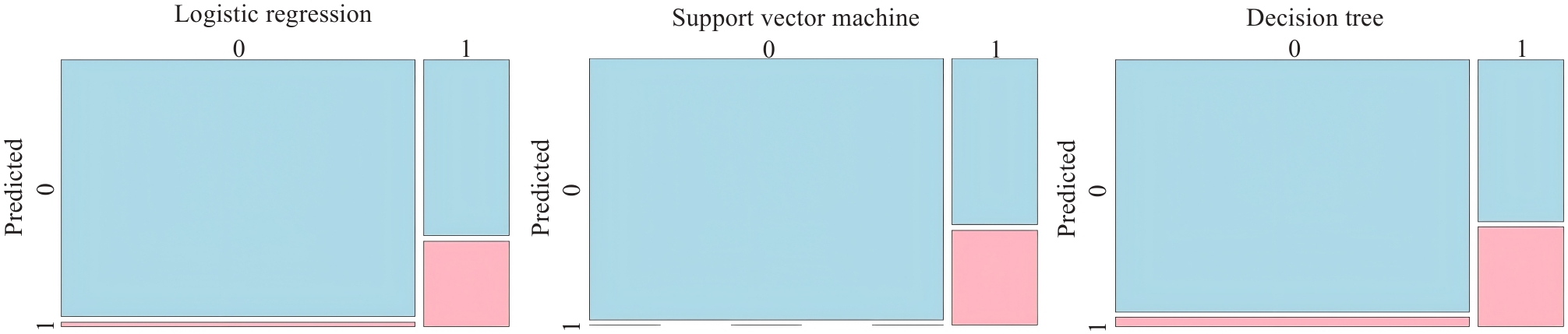
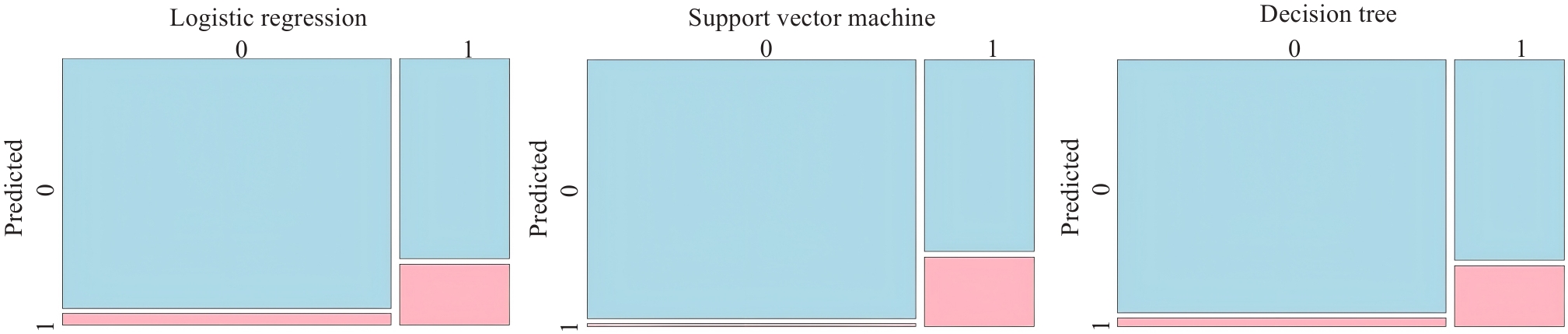
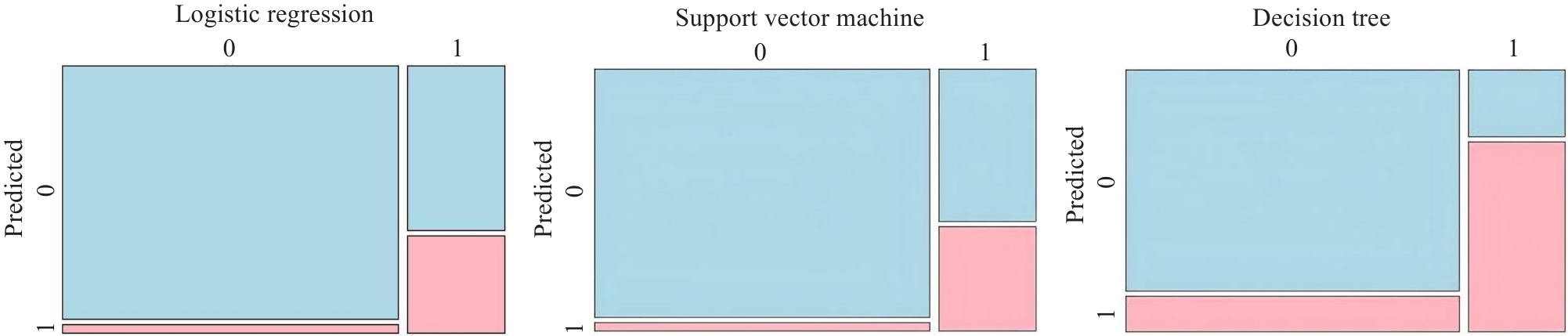
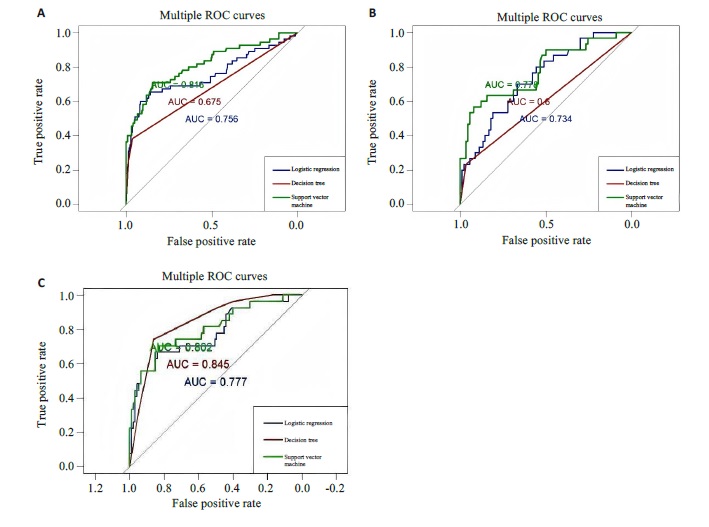
目的 运用逻辑回归、决策树和支持向量机构建经尿道前列腺钬激光剜除术后低体温风险预测模型并比较性能,为评估及预防经尿道前列腺钬激光剜除术后低体温提供依据。 方法 回顾性收集本中心403例、另一中心(潍坊市人民医院)120例经尿道前列腺钬激光剜除术后低体温患者的临床资料,采用逻辑回归、决策树和支持向量机3种机器学习方法构建经尿道前列腺钬激光剜除术后低体温风险预测模型,采用准确性、召回率、精确率、F1指数和受试者工作特征(ROC)曲线下面积(AUC)评价模型性能。 结果 纳入患者的手术时长、前列腺重量、术中冲洗量和是否偏瘦,共4个变量。本中心选择70%的数据集(283例)作为训练集,30%的数据集(120例)作为验证集,另一中心数据(120例)作为外部验证集。在训练集、验证集及外部验证集中,支持向量机的精确率及准确率均为最优,在训练集与验证集中支持向量机的ROC均为最优,逻辑回归次之,且二者在2个数据集中的AUC差异不大。对比支持向量机(SVM)模型与逻辑回归和决策树模型发现,SVM在验证集上的精确率、准确率、召回率、F1指数和AUC值方面均超过其他2种模型。SVM在外部验证集上的精确率、准确率均优于逻辑回归和决策树模型,召回率、F1指数、AUC值略低于决策树模型。SVM在训练集上的精确率、准确率、F1指数和AUC值均优于逻辑回归和决策树模型,尽管其召回率略低于决策树模型。 结论 支持向量机在构建经尿道前列腺钬激光剜除术后低体温风险预测模型中具有较高的性能及较好的泛化能力,可为相关临床决策提供指导建议。
姜君, 封硕, 孙银贵, 安燕. 经尿道前列腺钬激光剜除术后低体温风险预测模型:基于逻辑回归、决策树和支持向量机[J]. 南方医科大学学报, 2025, 45(9): 2019-2025.
Jun JIANG, Shuo FENG, Yingui SUN, Yan AN. Construction of risk prediction models of hypothermia after transurethral holmium laser enucleation of the prostate based on three machine learning algorithms[J]. Journal of Southern Medical University, 2025, 45(9): 2019-2025.
| Variables | Non-Hypothermia group (n=318) | Hypothermia group (n=85) | P |
|---|---|---|---|
| Age (year, Mean±SD) | 70.9±7.6 | 71.8±7.1 | 0.296 |
| Elderly | 0.572 | ||
| Yes | 294 (92.5) | 77 (90.6) | |
| No | 24 (7.5) | 8 (9.4) | |
| Underweight | <0.001 | ||
| Yes | 12 (3.8) | 16 (18.8) | |
| No | 306 (96.2) | 69 (81.2) | |
| Obesity | 0.678 | ||
| Yes | 13 (4.1) | 5 (5.9) | |
| No | 305 (95.9) | 80 (94.1) | |
| Alcohol history | 0.624 | ||
| Yes | 67 (21.1) | 20 (23.5) | |
| No | 251 (78.9) | 65 (76.5) | |
| Smoking history | 0.312 | ||
| Yes | 80 (25.2) | 26 (30.6) | |
| No | 238 (74.8) | 59 (69.4) | |
| Hypertension | 0.568 | ||
| Yes | 123 (38.7) | 30 (35.3) | |
| No | 195 (61.3) | 55 (64.7) | |
| Diabetes | 0.485 | ||
| Yes | 55 (17.3) | 12 (14.1) | |
| No | 263 (82.7) | 73 (85.9) | |
| Cardiovascular disease | 0.822 | ||
| Yes | 48 (15.1) | 12 (14.1) | |
| No | 270 (84.9) | 73 (85.9) | |
| Respiratory diseases | 0.94 | ||
| Yes | 18 (5.7) | 4 (4.7) | |
| No | 300 (94.3) | 81 (95.3) | |
| ASA | 0.899 | ||
| Ⅰ | 29 (9.1) | 10 (11.8) | |
| Ⅱ | 177 (55.7) | 47 (55.3) | |
| Ⅲ | 104 (32.7) | 26 (30.6) | |
| Ⅳ | 8 (2.5) | 2 (2.4) | |
| Preoperative body temperature | 36.4 (36.2, 36.5) | 36.3 (36.2, 36.5) | 0.389 |
| Hypoproteinemia 0.732 | |||
| Yes | 44(13.8) | 13(15.3) | |
| No | 274 (86.2) | 72 (84.7) | |
| Anemia | 0.848 | ||
| Yes | 57 (17.9) | 16 (18.8) | |
| No | 261 (82.1) | 69 (81.2) | |
| Preoperative blood glucose | 5.4 (4.9, 6.3) | 5.4 (4.8, 6.3) | 0.274 |
| Emergency surgery 0.982 | |||
| Yes | 10 (3.1) | 2 (2.4) | |
| No | 308 (96.9) | 83 (97.6) | |
| Operation duration | 100.0 (75.0, 130.0) | 122.0 (95.0, 180.0) | <0.001 |
| Prostate weight | 60.0 (45.0, 80.0) | 80.0 (50.0, 120.0) | <0.001 |
| Total Infusion volume | 1000.0 (1000.0, 1000.0) | 1000.0 (1000.0, 1500.0) | 0.216 |
| Intraoperative irrigation volume | 48 000.0 (36000.0, 60000.0) | 60 000.0 (45000.0, 90000.0) | <0.001 |
表1 研究对象基本资料
Tab.1 Baseline characteristics of the study participants
| Variables | Non-Hypothermia group (n=318) | Hypothermia group (n=85) | P |
|---|---|---|---|
| Age (year, Mean±SD) | 70.9±7.6 | 71.8±7.1 | 0.296 |
| Elderly | 0.572 | ||
| Yes | 294 (92.5) | 77 (90.6) | |
| No | 24 (7.5) | 8 (9.4) | |
| Underweight | <0.001 | ||
| Yes | 12 (3.8) | 16 (18.8) | |
| No | 306 (96.2) | 69 (81.2) | |
| Obesity | 0.678 | ||
| Yes | 13 (4.1) | 5 (5.9) | |
| No | 305 (95.9) | 80 (94.1) | |
| Alcohol history | 0.624 | ||
| Yes | 67 (21.1) | 20 (23.5) | |
| No | 251 (78.9) | 65 (76.5) | |
| Smoking history | 0.312 | ||
| Yes | 80 (25.2) | 26 (30.6) | |
| No | 238 (74.8) | 59 (69.4) | |
| Hypertension | 0.568 | ||
| Yes | 123 (38.7) | 30 (35.3) | |
| No | 195 (61.3) | 55 (64.7) | |
| Diabetes | 0.485 | ||
| Yes | 55 (17.3) | 12 (14.1) | |
| No | 263 (82.7) | 73 (85.9) | |
| Cardiovascular disease | 0.822 | ||
| Yes | 48 (15.1) | 12 (14.1) | |
| No | 270 (84.9) | 73 (85.9) | |
| Respiratory diseases | 0.94 | ||
| Yes | 18 (5.7) | 4 (4.7) | |
| No | 300 (94.3) | 81 (95.3) | |
| ASA | 0.899 | ||
| Ⅰ | 29 (9.1) | 10 (11.8) | |
| Ⅱ | 177 (55.7) | 47 (55.3) | |
| Ⅲ | 104 (32.7) | 26 (30.6) | |
| Ⅳ | 8 (2.5) | 2 (2.4) | |
| Preoperative body temperature | 36.4 (36.2, 36.5) | 36.3 (36.2, 36.5) | 0.389 |
| Hypoproteinemia 0.732 | |||
| Yes | 44(13.8) | 13(15.3) | |
| No | 274 (86.2) | 72 (84.7) | |
| Anemia | 0.848 | ||
| Yes | 57 (17.9) | 16 (18.8) | |
| No | 261 (82.1) | 69 (81.2) | |
| Preoperative blood glucose | 5.4 (4.9, 6.3) | 5.4 (4.8, 6.3) | 0.274 |
| Emergency surgery 0.982 | |||
| Yes | 10 (3.1) | 2 (2.4) | |
| No | 308 (96.9) | 83 (97.6) | |
| Operation duration | 100.0 (75.0, 130.0) | 122.0 (95.0, 180.0) | <0.001 |
| Prostate weight | 60.0 (45.0, 80.0) | 80.0 (50.0, 120.0) | <0.001 |
| Total Infusion volume | 1000.0 (1000.0, 1000.0) | 1000.0 (1000.0, 1500.0) | 0.216 |
| Intraoperative irrigation volume | 48 000.0 (36000.0, 60000.0) | 60 000.0 (45000.0, 90000.0) | <0.001 |
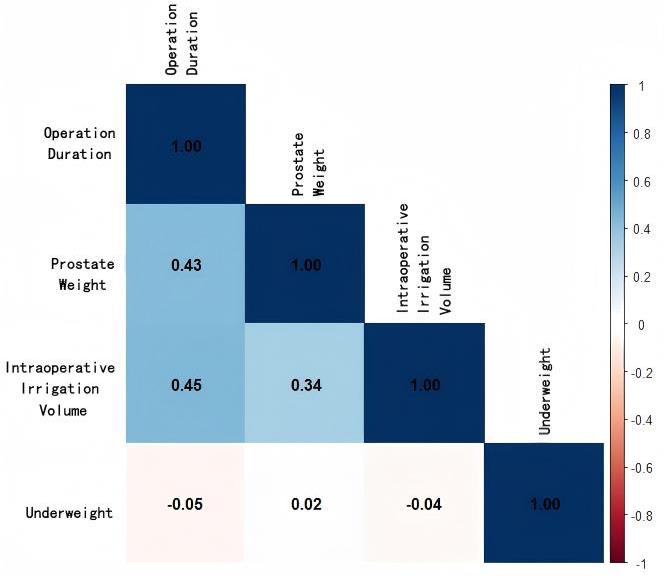
图1 经尿道前列腺钬激光剜除术后低体温危险因素的相关性分析图
Fig.1 Correlation analysis of risk factors for postoperative hypothermia after transurethral holmium laser enucleation of the prostate.
| Data set | Prediction model | Precision | Accuracy | Recall | F1 Index | AUC |
|---|---|---|---|---|---|---|
| Training set | Logistic regression | 0.818 | 0.855 | 0.327 | 0.468 | 0.756 |
| SVM | 1.000 | 0.876 | 0.364 | 0.533 | 0.816 | |
| Decision tree | 0.724 | 0.852 | 0.382 | 0.500 | 0.675 | |
| Validation set | Logistic regression | 0.636 | 0.775 | 0.233 | 0.341 | 0.734 |
| SVM | 0.889 | 0.808 | 0.267 | 0.410 | 0.778 | |
| Decision tree | 0.700 | 0.783 | 0.233 | 0.35 | 0.600 | |
| External validation set | Logistic regression | 0.769 | 0.833 | 0.370 | 0.500 | 0.777 |
| SVM | 0.786 | 0.842 | 0.407 | 0.537 | 0.802 | |
| Decision tree | 0.606 | 0.833 | 0.741 | 0.667 | 0.845 |
表2 3种机器学习模型对比
Tab.2 Comparison of 3 machine learning models
| Data set | Prediction model | Precision | Accuracy | Recall | F1 Index | AUC |
|---|---|---|---|---|---|---|
| Training set | Logistic regression | 0.818 | 0.855 | 0.327 | 0.468 | 0.756 |
| SVM | 1.000 | 0.876 | 0.364 | 0.533 | 0.816 | |
| Decision tree | 0.724 | 0.852 | 0.382 | 0.500 | 0.675 | |
| Validation set | Logistic regression | 0.636 | 0.775 | 0.233 | 0.341 | 0.734 |
| SVM | 0.889 | 0.808 | 0.267 | 0.410 | 0.778 | |
| Decision tree | 0.700 | 0.783 | 0.233 | 0.35 | 0.600 | |
| External validation set | Logistic regression | 0.769 | 0.833 | 0.370 | 0.500 | 0.777 |
| SVM | 0.786 | 0.842 | 0.407 | 0.537 | 0.802 | |
| Decision tree | 0.606 | 0.833 | 0.741 | 0.667 | 0.845 |
| [1] | Srinivasan A, Wang R. An update on minimally invasive surgery for benign prostatic hyperplasia: techniques, risks, and efficacy[J]. World J Mens Health, 2020, 38(4): 402-11. doi:10.5534/wjmh.190076 |
| [2] | Devlin CM, Simms MS, Maitland NJ. Benign prostatic hyperplasia-what do we know?[J]. BJU Int,2021,127(4): 389-99. doi:10.1111/bju.15229 |
| [3] | Ottaiano N, Shelton, Sanekommu G, et al. Surgical complications in the management of benign prostatic hyperplasia treatment[J]. Curr Urol Rep, 2022, 23(5): 83-92. doi:10.1007/s11934-022-01091-z |
| [4] | Shvero A, Calio B, Humphreys MR, et al. HoLEP: the new gold standard for surgical treatment of benign prostatic hyperplasia[J]. Can J Urol, 2021, 28(S2): 6-10. |
| [5] | Sandhu JS, Bixler BR, Dahm P, et al. Management of lower urinary tract symptoms attributed to benign prostatic hyperplasia (BPH): AUA Guideline amendment 2023[J]. J Urol, 2024, 211(1): 11-9. doi:10.1097/ju.0000000000003698 |
| [6] | Cho J, Lee J, Kim KM, et al. Effect of 10 minutes of prewarming and Pprewarmed intravenous fluid administration on the core temperature of patients undergoing transurethral surgery under general anesthesia[J]. Int J Med Sci, 2024, 21(1): 1-7. doi:10.7150/ijms.88943 |
| [7] | Yilmaz H, Khorshid L. The effects of active warming on core body temperature and thermal comfort in patients after transurethral resection of the prostate: a randomized clinical trial[J].Clin Nurs Res, 2023, 32(2): 313-22. doi:10.1177/10547738221090593 |
| [8] | Greener JG, Kandathil SM, Moffat L, et al. A guide to machine learning for biologists[J]. Nat Rev Mol Cell Biol, 2022, 23(1): 40-55. doi:10.1038/s41580-021-00407-0 |
| [9] | Sessler DI. Another concern about perioperative hypothermia[J]. J Clin Anesth, 2023, 87: 111089. doi:10.1016/j.jclinane.2023.111089 |
| [10] | Tanabe FM, Zanei SV, Whitaker IY. Do frail elderly people affect the nursing workload in intensive care units?[J]. Rev Esc Enferm USP, 2022, 56: e20210599. doi:10.1590/1980-220x-reeusp-2021-0599en |
| [11] | Kelly TN, Gu D, Chen J, et al. Cigarette smoking and risk of stroke in the chinese adult population[J]. Stroke, 2008, 39(6): 1688-93. doi:10.1161/strokeaha.107.505305 |
| [12] | Akombi BJ, Agho KE, Hall J, et al. Stunting, wasting and underweight in Sub-Saharan Africa: a systematic review[J]. Int J Environ Res Public Health, 2017, 14(8): 863. doi:10.3390/ijerph14080863 |
| [13] | Valeriani E, Cangemi R, Carnevale R, et al. Hypoalbuminemia as predictor of thrombotic events in patients with community-acquired pneumonia[J]. Int J Cardiol, 2024, 404: 131942. doi:10.1016/j.ijcard.2024.131942 |
| [14] | Hornedo KD, Jacob AK, Burt JM, et al. Non-invasive hemoglobin estimation for preoperative anemia screening[J]. Transfusion, 2023, 63(2): 315-22. doi:10.1111/trf.17237 |
| [15] | Piché ME, Tchernof A, DEsprés JP. Obesity phenotypes, diabetes, and cardiovascular diseases[J/OL]. Circ Res, 2020, 126(11): 1477-500. doi:10.1161/circresaha.120.316101 |
| [16] | How to develop a more accurate risk prediction model when there are few events[J]. BMJ (Clinical research ed.), 2016, 353: i3235. doi:10.1136/bmj.i3235 |
| [17] | Occhiuto C, SAntoro G, Tranchida PQ, et al. Pharmacological effects of the lipidosterolic extract from kigelia africana fruits in experimental benign prostatic hyperplasia induced by testosterone in sprague dawley rats[J]. J Exp Pharmacol, 2023, 15: 41-50. doi:10.2147/jep.s383699 |
| [18] | SYazarina SO, Zulkifli MZ, Hamzaini AH. Predicting outcome of trial of voiding without catheter in acute urinary retention with intravesical prostatic protrusion[J]. Malays J Med Sci, 2013, 20(1): 56-9. |
| [19] | Xiao H, Jiang Y, He W, et al. Identification and functional activity of matrix-remodeling associated 5 (MXRA5) in benign hyperplastic prostate[J]. Aging (Albany NY), 2020, 12(9): 8605-21. doi:10.18632/aging.103175 |
| [20] | Ou Z, He Y, Qi L, et al. Infiltrating mast cells enhance benign prostatic hyperplasia through IL-6/STAT3/Cyclin D1 signals[J]. Oncotarget,2017, 8(35): 59156-64. doi:10.18632/oncotarget.19465 |
| [21] | Zeng XT, Jin YH, Liu TZ, et al. Clinical practice guideline for transurethral plasmakinetic resection of prostate for benign prostatic hyperplasia (2021 Edition)[J]. Mil Med Res, 2022, 9(1): 14. |
| [22] | Zhu C, Wang DQ, Zi H, et al. Epidemiological trends of urinary tract infections, urolithiasis and benign prostatic hyperplasia in 203 countries and territories from 1990 to 2019[J]. Mil Med Res, 2021; 8(1): 64. doi:10.1186/s40779-021-00359-8 |
| [23] | Sarfraz S, Mäntynen PH, Laurila M, et al. Effect of surface tooling techniques of medical titanium implants on bacterial biofilm formation in vitro[J]. Materials (Basel), 2022, 15(9): 3228. doi:10.3390/ma15093228 |
| [24] | Lyon TD, Frank I, Tollefson MK, et al. Association of intraoperative hypothermia with oncologic outcomes following radical cystectomy[J]. Urol Oncol, 2021, 39(6): 370. doi:10.1016/j.urolonc.2020.11.036 |
| [25] | Morishige S, Ohyama T, Fujita N, et al. Risk factors for intraoperative hypothermia during holmium laser enucleation of the prostate[J]. Urol Int, 2023, 107(7): 672-7. doi:10.1159/000528721 |
| [26] | Speakman JR. Obesity and thermoregulation[J]. Handb Clin Neurol, 2018, 156: 431-43. doi:10.1016/b978-0-444-63912-7.00026-6 |
| [27] | Zell MA, Abdul-muhsin H, Navaratnam A, et al. Holmium laser enucleation of the prostate for very large benign prostatic hyperplasia (≥200 cc)[J]. World J Urol, 2021, 39(1): 129-34. doi:10.1007/s00345-020-03156-5 |
| [28] | Rauch S, Miller C, Bräuer A, et al. Perioperative hypothermia-a narrative review[J]. Int J Environ Res Public Health, 2021, 18(16): 8749. doi:10.3390/ijerph18168749 |
| [29] | Vogt P, Tolly R, Clifton M, et al. The development of an enhanced recovery protocol for kasai portoenterostomy[J]. Children (Basel), 2022, 9(11): 1675. doi:10.3390/children9111675 |
| [30] | CAO J, Sheng X, Ding Y, et al. Effect of warm bladder irrigation fluid for benign prostatic hyperplasia patients on perioperative hypothermia, blood loss and shiver: A meta-analysis[J]. Asian J Urol, 2019, 6(2): 183-91. doi:10.1016/j.ajur.2018.07.001 |
| [31] | Campbell G, Alderson P, Smith AF, et al. Warming of intravenous and irrigation fluids for preventing inadvertent perioperative hypothermia[J]. Cochrane Database Syst Rev, 2015, 2015(4): CD009891. doi:10.1002/14651858.cd009891.pub2 |

| [1] | 黄启智, 谢戴鹏, 姚霖彤, 李洽轩, 吴少伟, 周海榆. 肿瘤微环境特异性CT影像组学标签预测非小细胞肺癌免疫治疗疗效[J]. 南方医科大学学报, 2025, 45(9): 1903-1918. |
| [2] | 陈子贤, 周家伟, 谭磊, 黄志鹏, 薛康颐, 陈明坤. 基于免疫抑制性Neu_2中性粒细胞亚群模型精准预测前列腺癌生存预后及免疫治疗应答[J]. 南方医科大学学报, 2025, 45(8): 1643-1653. |
| [3] | 刘倚彤, 赵克, 王晓东. 1990~2035年东亚地区唇与口腔癌的疾病负担分析及未来预测[J]. 南方医科大学学报, 2025, 45(7): 1554-1562. |
| [4] | 陈梅妹, 王洋, 雷黄伟, 张斐, 黄睿娜, 杨朝阳. 基于多种机器学习算法和语音情绪特征的阈下抑郁辨识模型构建[J]. 南方医科大学学报, 2025, 45(4): 711-717. |
| [5] | 吕雪彩, 刘艳红, 韩诗怡, 张浩赟, 侯爱生, 周志康, 史立凯, 高洁, 曹江北, 张宏, 米卫东. 老年患者胃肠道手术后综合并发症的危险因素——一项多中心观察性研究[J]. 南方医科大学学报, 2025, 45(4): 736-743. |
| [6] | 申琳, 宋翠豪, 王聪敏, 高西, 安俊红, 李承新, 梁斌, 李霞. 溃疡性结肠炎并发坏疽性脓皮病患者发生营养风险的因素及预测模型[J]. 南方医科大学学报, 2025, 45(3): 514-521. |
| [7] | 骆金光, 陶怀祥, 闻志远, 陈龙, 胡昊, 关翰. 肿瘤相关成纤维细胞上调hsa-miR-18b-5p靶向FBXL3促进前列腺癌的增殖及转移[J]. 南方医科大学学报, 2024, 44(7): 1284-1296. |
| [8] | 潘甚豪, 李炎坤, 伍哲维, 毛玉玲, 王春艳. 子宫内膜异位症患者新鲜胚胎移植临床妊娠率预测模型的建立与验证[J]. 南方医科大学学报, 2024, 44(7): 1407-1415. |
| [9] | 陈莉莉, 吴天宇, 张铭, 丁子夏, 张妍, 杨依清, 郑佳倩, 张小楠. 类风湿关节炎的潜在生物标志物及其免疫调控机制:基于GEO数据库[J]. 南方医科大学学报, 2024, 44(6): 1098-1108. |
| [10] | 申采玉, 王帅, 周锐盈, 汪雨贺, 高琴, 陈兴智, 杨枢. 慢性心力衰竭合并肺部感染患者院内死亡风险预测:基于可解释性机器学习方法[J]. 南方医科大学学报, 2024, 44(6): 1141-1148. |
| [11] | 左志威, 孟庆良, 崔家康, 郭克磊, 卞华. 基于硬皮病线粒体相关基因的人工神经网络模型的构建[J]. 南方医科大学学报, 2024, 44(5): 920-929. |
| [12] | 周勇, 吴媛, 曾汇文, 陈翠梅, 谢群, 贺莉萍. 艰难梭菌的感染特征及其危险因素:基于中南地区某市住院腹泻患者的标本[J]. 南方医科大学学报, 2024, 44(5): 998-1003. |
| [13] | 戈 悦, 李建伟, 梁宏开, 侯六生, 左六二, 陈 珍, 卢剑海, 赵 新, 梁静漪, 彭 岚, 包静娜, 段佳欣, 刘 俐, 毛可晴, 曾振华, 胡鸿彬, 陈仲清. VA-ECMO患者院内死亡风险预测模型的构建及验证:一项多中心、回顾性、病例对照研究[J]. 南方医科大学学报, 2024, 44(3): 491-498. |
| [14] | 金佳欣, 马鹏珍, 王尔玉, 谢颖桢. 急性缺血性卒中患者复发的独立影响因素及风险预测列线图模型构建:基于Lasso回归[J]. 南方医科大学学报, 2024, 44(12): 2375-2381. |
| [15] | 胡嘉伟, 杜芳, 丁璐, 王路翔, 赵巍峰. 合并高血压病的乙型肝炎肝硬化患者发生肝细胞癌的风险评估:一项基于倾向性匹配评分的回顾性队列研究[J]. 南方医科大学学报, 2024, 44(11): 2243-2249. |
| 阅读次数 | ||||||
|
全文 |
|
|||||
|
摘要 |
|
|||||