
南方医科大学学报 ›› 2026, Vol. 46 ›› Issue (2): 473-478.doi: 10.12122/j.issn.1673-4254.2026.02.25
• • 上一篇
姜思捷1( ), 宫澜2(), 郑华1()
收稿日期:2025-02-06
出版日期:2026-02-20
发布日期:2026-03-10
通讯作者:
宫澜,郑华
E-mail:372324719@qq.com;l.gong@unsw.edu.au;gzhzmd@126.com
作者简介:姜思捷,在读博士研究生,E-mail: 372324719@qq.com基金资助:
Sijie JIANG1(), Lan GONG2(), Hua ZHENG1()
Received:2025-02-06
Online:2026-02-20
Published:2026-03-10
Contact:
Lan GONG, Hua ZHENG
E-mail:372324719@qq.com;l.gong@unsw.edu.au;gzhzmd@126.com
摘要:
心血管疾病(CVD)是全球主要的死亡原因之一,具有高发病率和死亡率,代谢性疾病是CVD的重要危险因素。近年来,越来越多的研究表明,肠道菌群在代谢性疾病和CVD的发生、发展及病理机制中扮演着重要角色。嗜黏蛋白阿克曼菌(A.muciniphila)是一种有潜力的二代益生菌,因其独特的代谢功能和免疫调节特性而备受关注。本文系统阐述A. muciniphila通过改善肠道屏障功能、调节脂质与葡萄糖代谢、增加短链脂肪酸生成、抑制炎症反应等多种途径,对代谢性疾病产生积极影响。同时,A. muciniphila也参与抗动脉粥样硬化、血压调控、减轻心房颤动和肺动脉高压等心血管保护过程,其机制涉及免疫调节、代谢物调控及肠道-心血管轴的多重交互,为相关疾病的干预提供了新的微生物靶点与策略。
姜思捷, 宫澜, 郑华. 嗜粘蛋白阿克曼氏菌与心血管及代谢性疾病相关性的研究进展[J]. 南方医科大学学报, 2026, 46(2): 473-478.
Sijie JIANG, Lan GONG, Hua ZHENG. Research progress on the correlation between Akkermansia muciniphila and cardiovascular diseases[J]. Journal of Southern Medical University, 2026, 46(2): 473-478.
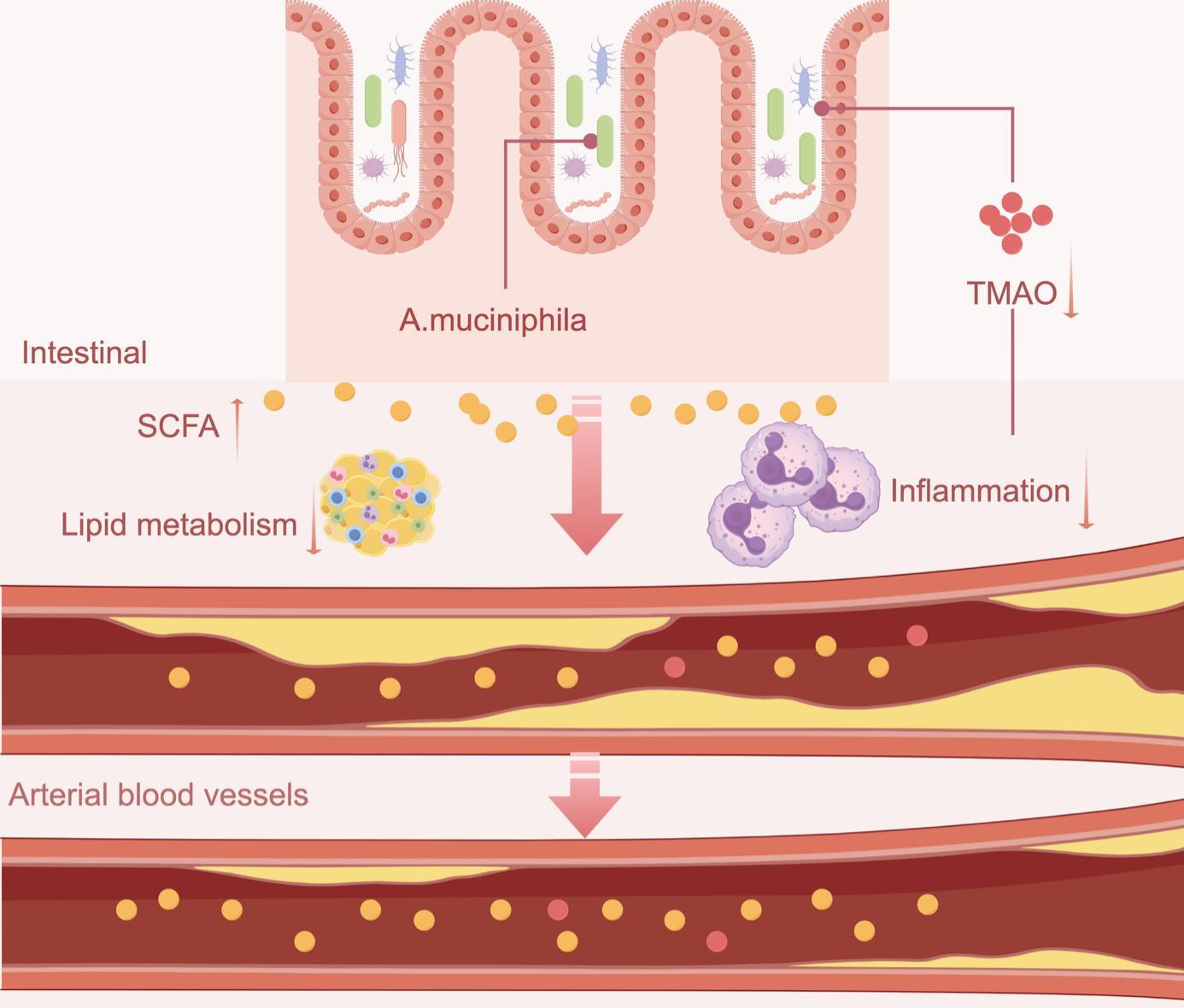
图1 A.muciniphila抗AS作用机制
Fig.1 Mechanism of anti-atherosclerosis action of A.muciniphila.
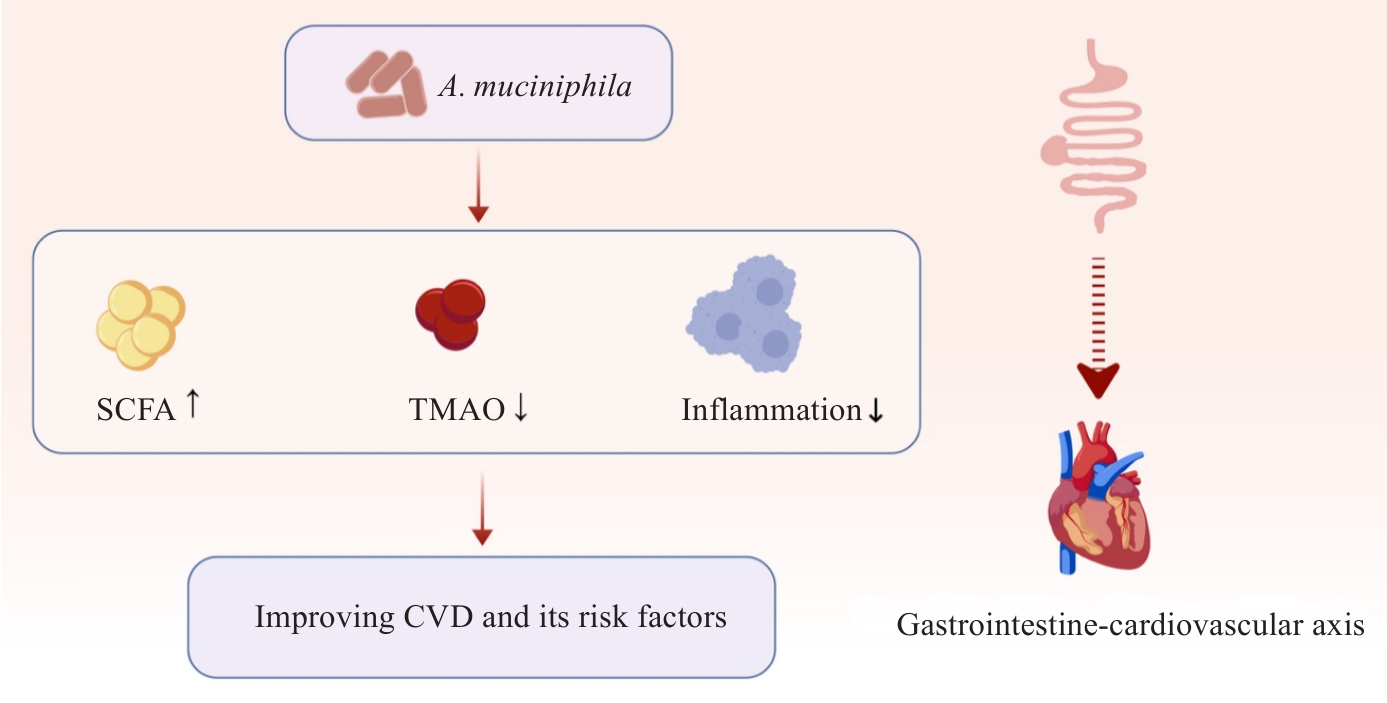
图2 A. muciniphila改善CVD可能机制
Fig.2 Possible mechanisms of A. muciniphila in improving CVD.
| [1] | Yusuf S, Joseph P, Rangarajan S, et al. Modifiable risk factors, cardiovascular disease, and mortality in 155 722 individuals from 21 high-income, middle-income, and low-income countries (PURE): a prospective cohort study[J]. Lancet, 2020, 395(10226): 795-808. doi:10.1016/s0140-6736(19)32008-2 |
| [2] | 刘明波, 何新叶, 杨晓红, 等. 《中国心血管健康与疾病报告2023》要点解读[J]. 中国全科医学, 2025, 28(1): 20-38. |
| [3] | Tsao CW, Aday AW, Almarzooq ZI, et al. Heart disease and stroke statistics-2022 update: a report from the American heart association[J]. Circulation, 2022, 145(8): e153-639. |
| [4] | Bansal A, Hiwale K. Updates in the management of coronary artery disease: a review article[J]. Cureus, 2023, 15(12): e50644. |
| [5] | 沙珊珊, 董世荣, 杨玉菊. 肠道菌群及代谢物调控宿主肠道免疫的研究进展[J]. 生物技术通报, 2023, 39(8): 126-36. |
| [6] | de Vos WM, Tilg H, Van Hul M, et al. Gut microbiome and health: mechanistic insights[J]. Gut, 2022, 71(5): 1020-32. doi:10.1136/gutjnl-2021-326789 |
| [7] | Zou YF, Song XJ, Liu N, et al. Intestinal flora: a potential new regulator of cardiovascular disease[J]. Aging Dis, 2022, 13(3): 753-72. doi:10.14336/ad.2021.1022 |
| [8] | Zhao YQ, Yang HJ, Wu P, et al. Akkermansia muciniphila: a promising probiotic against inflammation and metabolic disorders[J]. Virulence, 2024, 15(1): 2375555. doi:10.1080/21505594.2024.2375555 |
| [9] | Xiao X, Wu YY, Jie ZY, et al. Akkermansia Muciniphila supplementation improves hyperlipidemia, cardiac function, and gut microbiota in high fat fed apolipoprotein E-deficient mice[J]. Prostaglandins Other Lipid Mediat, 2024, 175: 106906. doi:10.1016/j.prostaglandins.2024.106906 |
| [10] | Al Samarraie A, Pichette M, Rousseau G. Role of the gut microbiome in the development of atherosclerotic cardiovascular disease[J]. Int J Mol Sci, 2023, 24(6): 5420. doi:10.3390/ijms24065420 |
| [11] | Gofron K, Berezowski A, Gofron M, et al. Akkermansia muciniphila -impact on the cardiovascular risk, the intestine inflammation and obesity[J]. Acta Biochim Pol, 2024, 71: 13550. doi:10.3389/abp.2024.13550 |
| [12] | Depommier C, Van Hul M, Everard A, et al. Pasteurized Akkermansia muciniphila increases whole-body energy expenditure and fecal energy excretion in diet-induced obese mice[J]. Gut Microbes, 2020, 11(5): 1231-45. doi:10.1080/19490976.2020.1737307 |
| [13] | Everard A, Belzer C, Geurts L, et al. Cross-talk between Akkermansia muciniphila and intestinal epithelium controls diet-induced obesity[J]. Proc Natl Acad Sci USA, 2013, 110(22): 9066-71. doi:10.1073/pnas.1219451110 |
| [14] | Depommier C, Everard A, Druart C, et al. Supplementation with Akkermansia muciniphila in overweight and obese human volunteers: a proof-of-concept exploratory study[J]. Nat Med, 2019, 25(7): 1096-103. doi:10.1038/s41591-019-0495-2 |
| [15] | Liu JQ, Liu YH, Huang CQ, et al. Quercetin-driven Akkermansia muciniphila alleviates obesity by modulating bile acid metabolism via an ILA/m6A/CYP8B1 signaling[J]. Adv Sci (Weinh), 2025, 12(12): e2412865. doi:10.1002/advs.202412865 |
| [16] | Schneeberger M, Everard A, Gómez-Valadés AG, et al. Akkermansia muciniphila inversely correlates with the onset of inflammation, altered adipose tissue metabolism and metabolic disorders during obesity in mice[J]. Sci Rep, 2015, 5: 16643. doi:10.1038/srep16643 |
| [17] | Shen J, Tong XD, Sud N, et al. Low-density lipoprotein receptor signaling mediates the triglyceride-lowering action of Akkermansia muciniphila in genetic-induced hyperlipidemia[J]. Arterioscler Thromb Vasc Biol, 2016, 36(7): 1448-56. doi:10.1161/atvbaha.116.307597 |
| [18] | Lukovac S, Belzer C, Pellis L, et al. Differential modulation by Akkermansia muciniphila and Faecalibacterium prausnitzii of host peripheral lipid metabolism and histone acetylation in mouse gut organoids[J]. mBio, 2014, 5(4): e01438-14. doi:10.1128/mbio.01438-14 |
| [19] | Jia BL, Zou YQ, Han X, et al. Gut microbiome-mediated mechanisms for reducing cholesterol levels: implications for ameliorating cardiovascular disease[J]. Trends Microbiol, 2023, 31(1): 76-91. doi:10.1016/j.tim.2022.08.003 |
| [20] | Plovier H, Everard A, Druart C, et al. A purified membrane protein from Akkermansia muciniphila or the pasteurized bacterium improves metabolism in obese and diabetic mice[J]. Nat Med, 2017, 23(1): 107-13. doi:10.1038/nm.4236 |
| [21] | Zheng XF, Huang WT, Li QB, et al. Membrane protein Amuc_1100 derived from Akkermansia muciniphila facilitates lipolysis and browning via activating the AC3/PKA/HSL pathway[J]. Microbiol Spectr, 2023, 11(2): e0432322. doi:10.1128/spectrum.04323-22 |
| [22] | Zhang W, Xu JH, Yu T, et al. Effects of berberine and metformin on intestinal inflammation and gut microbiome composition in db/db mice[J]. Biomed Pharmacother, 2019, 118: 109131. doi:10.1016/j.biopha.2019.109131 |
| [23] | Thingholm LB, Rühlemann MC, Koch M, et al. Obese individuals with and without type 2 diabetes show different gut microbial functional capacity and composition[J]. Cell Host Microbe, 2019, 26(2): 252-64.e10. doi:10.1016/j.chom.2019.07.004 |
| [24] | Akash MSH, Rehman K, Liaqat A. Tumor necrosis factor-alpha: role in development of insulin resistance and pathogenesis of type 2 diabetes mellitus[J]. J Cell Biochem, 2018, 119(1): 105-10. doi:10.1002/jcb.26174 |
| [25] | Bian XY, Wu WR, Yang LY, et al. Administration of Akkermansia muciniphila ameliorates dextran sulfate sodium-induced ulcerative colitis in mice[J]. Front Microbiol, 2019, 10: 2259. doi:10.3389/fmicb.2019.02259 |
| [26] | Liu MN, Zhang L, Dong XY, et al. Effects of Akkermansia muciniphila on the proliferation, apoptosis and insulin secretion of rat islet cell tumor cells[J]. Sichuan da Xue Xue Bao Yi Xue Ban, 2020, 51(1): 13-7. |
| [27] | 谭 玥, 毕亚艳. 血清尿酸在心血管疾病中的作用机制研究进展[J]. 疑难病杂志, 2022, 21(1): 90-3. |
| [28] | 张里华, 刘佳秀, 夏效东. 嗜黏蛋白阿克曼氏菌对高尿酸血症小鼠血清尿酸及组织炎症的影响及机制[J]. 食品科学, 2023, 44(5): 121-7. |
| [29] | Li J, Lin SQ, Vanhoutte PM, et al. Akkermansia muciniphila protects against atherosclerosis by preventing metabolic endotoxemia-induced inflammation in apoe-/- mice[J]. Circulation, 2016, 133(24): 2434-46. doi:10.1161/circulationaha.115.019645 |
| [30] | Reunanen J, Kainulainen V, Huuskonen L, et al. Akkermansia muciniphila adheres to enterocytes and strengthens the integrity of the epithelial cell layer[J]. Appl Environ Microbiol, 2015, 81(11): 3655-62. doi:10.1128/aem.04050-14 |
| [31] | Mulhall H, DiChiara JM, Huck O, et al. Pasteurized Akkermansia muciniphila reduces periodontal and systemic inflammation induced by Porphyromonas gingivalis in lean and obese mice[J]. J Clin Periodontol, 2022, 49(7): 717-29. doi:10.1111/jcpe.13629 |
| [32] | Katiraei S, de Vries MR, Costain AH, et al. Akkermansia muciniphila exerts lipid-lowering and immunomodulatory effects without affecting neointima formation in hyperlipidemic APOE*3-Leiden.CETP mice[J]. Mol Nutr Food Res, 2020, 64(15): e1900732. doi:10.1002/mnfr.201900732 |
| [33] | Kasahara K, Rey FE. The emerging role of gut microbial metabolism on cardiovascular disease[J]. Curr Opin Microbiol, 2019, 50: 64-70. doi:10.1016/j.mib.2019.09.007 |
| [34] | Seldin MM, Meng YH, Qi HX, et al. Trimethylamine N-oxide promotes vascular inflammation through signaling of mitogen-activated protein kinase and nuclear factor‑κB[J]. J Am Heart Assoc, 2016, 5(2): e002767. doi:10.1161/jaha.115.002767 |
| [35] | Sun S, Lulla A, Sioda M, et al. Gut microbiota composition and blood pressure[J]. Hypertension, 2019, 73(5): 998-1006. doi:10.1161/hypertensionaha.118.12109 |
| [36] | Lakshmanan AP, Murugesan S, Al Khodor S, et al. The potential impact of a probiotic: Akkermansia muciniphila in the regulation of blood pressure: the current facts and evidence[J]. J Transl Med, 2022, 20(1): 430. doi:10.1186/s12967-022-03631-0 |
| [37] | Derrien M, Belzer C, de Vos WM. Akkermansia muciniphila and its role in regulating host functions[J]. Microb Pathog, 2017, 106: 171-81. doi:10.1016/j.micpath.2016.02.005 |
| [38] | Martins FL, Bailey MA, Girardi ACC. Endogenous activation of glucagon-like peptide-1 receptor contributes to blood pressure control: role of proximal tubule Na+/H+ exchanger isoform 3, renal angiotensin II, and insulin sensitivity[J]. Hypertension, 2020, 76(3): 839-48. doi:10.1161/hypertensionaha.120.14868 |
| [39] | Buford TW, Sun Y, Roberts LM, et al. Angiotensin (1-7) delivered orally via probiotic, but not subcutaneously, benefits the gut-brain axis in older rats[J]. Geroscience, 2020, 42(5): 1307-21. doi:10.1007/s11357-020-00196-y |
| [40] | Robles-Vera I, Toral M, de la Visitación N, et al. Changes to the gut microbiota induced by losartan contributes to its antihypertensive effects[J]. Br J Pharmacol, 2020, 177(9): 2006-23. doi:10.1111/bph.14965 |
| [41] | Catry E, Bindels LB, Tailleux A, et al. Targeting the gut microbiota with inulin-type fructans: preclinical demonstration of a novel approach in the management of endothelial dysfunction[J]. Gut, 2018, 67(2): 271-83. doi:10.1136/gutjnl-2016-313316 |
| [42] | Zhao SQ, Liu W, Wang JQ, et al. Akkermansia muciniphila improves metabolic profiles by reducing inflammation in chow diet-fed mice[J]. J Mol Endocrinol, 2017, 58(1): 1-14. doi:10.1530/jme-16-0054 |
| [43] | Zhou J, Wang DK, Li BG, et al. Relationship between plasma trimethylamine N-oxide levels and renal dysfunction in patients with hypertension[J]. Kidney Blood Press Res, 2021, 46(4): 421-32. doi:10.1159/000513033 |
| [44] | Zhang WQ, Wang YJ, Zhang A, et al. TMA/TMAO in hypertension: novel horizons and potential therapies[J]. J Cardiovasc Transl Res, 2021, 14(6): 1117-24. doi:10.1007/s12265-021-10115-x |
| [45] | Li J, Zhao FQ, Wang YD, et al. Gut microbiota dysbiosis contributes to the development of hypertension[J]. Microbiome, 2017, 5(1): 14. doi:10.1186/s40168-016-0222-x |
| [46] | Zuo K, Li J, Li KB, et al. Disordered gut microbiota and alterations in metabolic patterns are associated with atrial fibrillation[J]. Gigascience, 2019, 8(6): giz058. doi:10.1093/gigascience/giz058 |
| [47] | Liang ZG, Dong ZX, Guo MH, et al. Trimethylamine N-oxide as a risk marker for ischemic stroke in patients with atrial fibrillation[J]. J Biochem Mol Toxicol, 2019, 33(2): e22246. doi:10.1002/jbt.22246 |
| [48] | Luo YC, Zhang Y, Han XJ, et al. Akkermansia muciniphila prevents cold-related atrial fibrillation in rats by modulation of TMAO induced cardiac pyroptosis[J]. EBioMedicine, 2022, 82: 104087. doi:10.1016/j.ebiom.2022.104087 |
| [49] | Huang LL, Zhang HD, Liu YJ, et al. The role of gut and airway microbiota in pulmonary arterial hypertension[J]. Front Microbiol, 2022, 13: 929752. doi:10.3389/fmicb.2022.929752 |
| [50] | Bao ZY, Li HM, Zhang SB, et al. Administration of A. muciniphila ameliorates pulmonary arterial hypertension by targeting miR-208a-3p/NOVA1 axis[J]. Acta Pharmacol Sin, 2023, 44(11): 2201-15. doi:10.1038/s41401-023-01126-2 |
| [51] | 贾秋瑾, 吕仕超, 张军平. 慢性心力衰竭患者肠道菌群改变的系统评价[J]. 中华心血管病杂志, 2021, 49(10): 1012-9. |
| [1] | 张越, 段雨婷, 张晨, 喻璐喆, 刘颖颖, 邢丽花, 王雷, 俞年军, 彭代银, 陈卫东, 王妍妍. 茯苓多糖通过调节肠道微生物群减轻环磷酰胺引起的肠道屏障和免疫损伤[J]. 南方医科大学学报, 2026, 46(1): 34-46. |
| [2] | 邓楚玉, 王雪莹, 甘立祥, 王大禹, 郑晓燕, 唐纯志. 电针足三里改善高脂血症小鼠的血脂紊乱:基于肠道菌群结构的改善[J]. 南方医科大学学报, 2025, 45(8): 1633-1642. |
| [3] | 黄凯悦, 齐景馨, 罗文谦, 林怡萱, 陈梅妹, 甘慧娟. 温胆汤通过调控肠道菌群-胆汁酸轴改善代谢综合征痰证大鼠的代谢表型[J]. 南方医科大学学报, 2025, 45(6): 1174-1184. |
| [4] | 罗嘉纯, Sodnomjamts Batzaya, 高雪锋, 陈晶宇, 余政颖, 熊莎莎, 曹虹. Akkermansia muciniphila改善gp120转基因小鼠的肠-脑相互作用障碍[J]. 南方医科大学学报, 2025, 45(3): 554-565. |
| [5] | 刘莹, 李柏睿, 李永财, 常禄博, 王娇, 杨琳, 颜永刚, 屈凯, 刘继平, 张岗, 沈霞. 加味逍遥丸通过神经递质调节、抗炎抗氧化及肠道菌群调控改善大鼠的抑郁样行为[J]. 南方医科大学学报, 2025, 45(2): 347-358. |
| [6] | 喻珍妮, 高竟哲, 孙惠, 冯芹, 那效旗, 张宁, 沈昆双, 王媛媛, 王喜军. 肠道菌群、T细胞在结直肠癌发病中的因果关联:孟德尔随机化分析[J]. 南方医科大学学报, 2025, 45(12): 2756-2766. |
| [7] | 潘兴旭, 张秉祺, 张智华, 曹秋实. 戈登杆菌属丰度降低与肾结石风险增加相关:一项孟德尔随机化分析与动物实验研究[J]. 南方医科大学学报, 2025, 45(11): 2405-2415. |
| [8] | 刘佳进, 缪长宏, 徐健康, 余伟杰, 陈继鑫, 唐好知, 刘爱峰. 肠道菌群与色素沉着绒毛结节性滑膜炎之间的因果关系:基于孟德尔随机化分析[J]. 南方医科大学学报, 2024, 44(7): 1397-1406. |
| [9] | 李新翼, 刘玉杰, 邓克崇, 胡义奎. 调节肠道菌群可改善卒中后大鼠的神经功能和抑郁症状[J]. 南方医科大学学报, 2024, 44(2): 405-410. |
| [10] | 朱继伟, 卢曼路, 焦倩倩, 孙运良, 刘 璐, 丁红红, 于 燕, 潘 磊. 基于16S rRNA测序分析阻塞性睡眠呼吸暂停患者肠道靶标菌群的变化[J]. 南方医科大学学报, 2024, 44(1): 146-155. |
| [11] | 库尔班乃木·卡合曼, 赵健锋, 穆凯代斯·艾合买提, 王汉铭, 朱稷蔚, 潘文涛, 卡思木江·阿西木江. 屎肠球菌QH06能减轻溃疡性结肠炎大鼠的结肠黏膜损伤[J]. 南方医科大学学报, 2022, 42(7): 976-987. |
| [12] | 王展强, 徐开宇, 周宏伟. 卒中患者肠道宏病毒组的组成和菌群特征[J]. 南方医科大学学报, 2021, 41(6): 862-869. |
| [13] | 韩 拓, 苑 昊, 叶琳樱, 江 旭, 白 亮, 王聪霞. COVID-19与心血管代谢性疾病的临床研究进展[J]. 南方医科大学学报, 2021, 41(4): 628-632. |
| [14] | 肖 瑶, 牛 玥, 毛明慧, 林 涵, 汪佰丽, 乌恩奇, 赵焕虎, 李树春. 2型糖尿病与肠道核心菌群的相关性[J]. 南方医科大学学报, 2021, 41(3): 358-369. |
| [15] | 林琼希, 伦静娴, 张吉敏, 何肖龙, 龚泽龙, 高雪峰, 曹 虹. 学龄期儿童肉类食品摄入模式对其肠道菌群结构的影响[J]. 南方医科大学学报, 2021, 41(12): 1801-1808. |
| 阅读次数 | ||||||
|
全文 |
|
|||||
|
摘要 |
|
|||||
