
南方医科大学学报 ›› 2025, Vol. 45 ›› Issue (11): 2518-2526.doi: 10.12122/j.issn.1673-4254.2025.11.25
• • 上一篇
李欣洋1( ), 许桂晓4,5,6,7, 刘洁宏1, 冯衍秋1,2,3()
收稿日期:2025-09-01
出版日期:2025-11-20
发布日期:2025-11-28
通讯作者:
冯衍秋
E-mail:lixinyang91@163.com;foree@smu.edu.cn
作者简介:李欣洋,在读硕士研究生,E-mail: lixinyang91@163.com
基金资助:
Xinyang LI1(), Guixiao XU4,5,6,7, Jiehong LIU1, Yanqiu FENG1,2,3()
Received:2025-09-01
Online:2025-11-20
Published:2025-11-28
Contact:
Yanqiu FENG
E-mail:lixinyang91@163.com;foree@smu.edu.cn
Supported by:摘要:
目的 评估人工智能辅助压缩感知(ACS)加速技术与传统磁共振并行成像(PI)加速技术相比,对鼻咽癌MRI影像组学特征提取及分期诊断模型性能的影响。 方法 纳入64例经3.0T MR扫描的初诊鼻咽癌患者。在关键成像参数保持一致的情况下,分别采用PI和ACS加速序列采集平扫T1加权、T2加权及增强T1加权图像。ACS组3种序列总扫描时间为227 s,较PI组(312 s)缩短约30%。使用开源工具Pyradiomics提取18个一阶特征和75个纹理特征,利用组内相关系数(ICC)评估ACS与PI图像组学特征的一致性。基于两组图像特征,分别采用最小绝对收缩与选择算子进行特征选择,并构建随机森林模型以区分鼻咽癌早期(T1-T2)与晚期(T3-T4)。通过受试者工作特征曲线下面积(AUC)评估模型的诊断性能,并使用DeLong检验比较两组模型性能的差异。 结果 ACS与PI图像提取的组学特征总体一致性较高,86.0%(240/279)的特征ICC值大于0.75。其中平扫T1加权、T2加权及增强T1加权图像平均ICC值分别为0.91±0.09、0.89±0.13和0.88±0.11。在鼻咽癌分期预测方面,基于ACS与PI图像特征所构建模型的AUC分别为0.89和0.90,DeLong检验显示两组模型性能差异无统计学意义(P=0.991)。 结论 ACS与PI加速序列所获图像在提取组学特征上具有较高的一致性,基于ACS图像构建的鼻咽癌分期预测模型与基于PI图像的模型在诊断效能上表现相当。ACS加速可显著缩短扫描时间,为鼻咽癌影像组学研究提供了一种可靠的磁共振高效加速采集方案。
李欣洋, 许桂晓, 刘洁宏, 冯衍秋. 人工智能辅助压缩感知加速技术对鼻咽癌MRI影像组学特征提取及分期诊断模型性能的影响[J]. 南方医科大学学报, 2025, 45(11): 2518-2526.
Xinyang LI, Guixiao XU, Jiehong LIU, Yanqiu FENG. Effect of AI-assisted compressed sensing acceleration on MRI radiomic feature extraction and staging model performance for nasopharyngeal carcinoma[J]. Journal of Southern Medical University, 2025, 45(11): 2518-2526.
| Characteristics | Dataset values |
|---|---|
| Number of patients (%) | 64 |
| Age (year, Mean±SD) | 44.2±11.3 (18-68) |
| Gender | |
| Male | 42(65.6%) |
| Female | 22(34.4%) |
| Histological type | |
| NKUC | 64 (100%) |
| T stage | |
| T1 | 7 (10.9%) |
| T2 | 6 (9.4%) |
| T3 | 40 (62.5%) |
| T4 | 11 (17.2%) |
| N stage | |
| N0 | 1 (1.6%) |
| N1 | 32 (50%) |
| N2 | 15 (23.4%) |
| N3 | 16 (25%) |
| M stage | |
| M0 | 59 (92.2%) |
| M1 | 5 (7.8%) |
表1 患者信息
Tab.1 Characteristics of the patients with NPC
| Characteristics | Dataset values |
|---|---|
| Number of patients (%) | 64 |
| Age (year, Mean±SD) | 44.2±11.3 (18-68) |
| Gender | |
| Male | 42(65.6%) |
| Female | 22(34.4%) |
| Histological type | |
| NKUC | 64 (100%) |
| T stage | |
| T1 | 7 (10.9%) |
| T2 | 6 (9.4%) |
| T3 | 40 (62.5%) |
| T4 | 11 (17.2%) |
| N stage | |
| N0 | 1 (1.6%) |
| N1 | 32 (50%) |
| N2 | 15 (23.4%) |
| N3 | 16 (25%) |
| M stage | |
| M0 | 59 (92.2%) |
| M1 | 5 (7.8%) |
| Sequences parameter | AX T2WI FSE ACS | AX T2WI FSE PI | AX T1WI FSE ACS | AX T1WI FSE PI | Post-contrast AX T1WI FSE ACS | Post-contrast AX T1WI FSE PI |
|---|---|---|---|---|---|---|
| Fov (mm) | 240×240 | 240×240 | 240×240 | 240×240 | 240×240 | 240×240 |
| TR/TE (ms) | 4800/120 | 4800/120 | 662/8.16 | 662/8.16 | 789/8.12 | 789/8.12 |
| Matrix | 384×269 | 384×269 | 384×307 | 384×307 | 384×307 | 384×307 |
| ETL | 28 | 28 | 2 | 2 | 2 | 2 |
| Bandwidth (Hz) | 260 | 260 | 280 | 280 | 250 | 250 |
| Average | 1 | 1 | 1 | 1 | 1 | 1 |
| Number slices | 40 | 40 | 40 | 40 | 40 | 40 |
| Spatial resolution | 0.89×0.63×5 | 0.89×0.63×5 | 0.78×0.63×5 | 0.78×0.63×5 | 0.78×0.63×5 | 0.78×0.63×5 |
| Acquisition | ACS | PI | ACS | PI | ACS | PI |
| Accelerating factors | 2.25 | 2 | 2.25 | 2 | 2.25 | 2 |
| Sequence acquisition time (s) | 59 | 82 | 93 | 140 | 75 | 90 |
表2 MRI 序列参数
Tab.2 MRI sequences and parameters
| Sequences parameter | AX T2WI FSE ACS | AX T2WI FSE PI | AX T1WI FSE ACS | AX T1WI FSE PI | Post-contrast AX T1WI FSE ACS | Post-contrast AX T1WI FSE PI |
|---|---|---|---|---|---|---|
| Fov (mm) | 240×240 | 240×240 | 240×240 | 240×240 | 240×240 | 240×240 |
| TR/TE (ms) | 4800/120 | 4800/120 | 662/8.16 | 662/8.16 | 789/8.12 | 789/8.12 |
| Matrix | 384×269 | 384×269 | 384×307 | 384×307 | 384×307 | 384×307 |
| ETL | 28 | 28 | 2 | 2 | 2 | 2 |
| Bandwidth (Hz) | 260 | 260 | 280 | 280 | 250 | 250 |
| Average | 1 | 1 | 1 | 1 | 1 | 1 |
| Number slices | 40 | 40 | 40 | 40 | 40 | 40 |
| Spatial resolution | 0.89×0.63×5 | 0.89×0.63×5 | 0.78×0.63×5 | 0.78×0.63×5 | 0.78×0.63×5 | 0.78×0.63×5 |
| Acquisition | ACS | PI | ACS | PI | ACS | PI |
| Accelerating factors | 2.25 | 2 | 2.25 | 2 | 2.25 | 2 |
| Sequence acquisition time (s) | 59 | 82 | 93 | 140 | 75 | 90 |
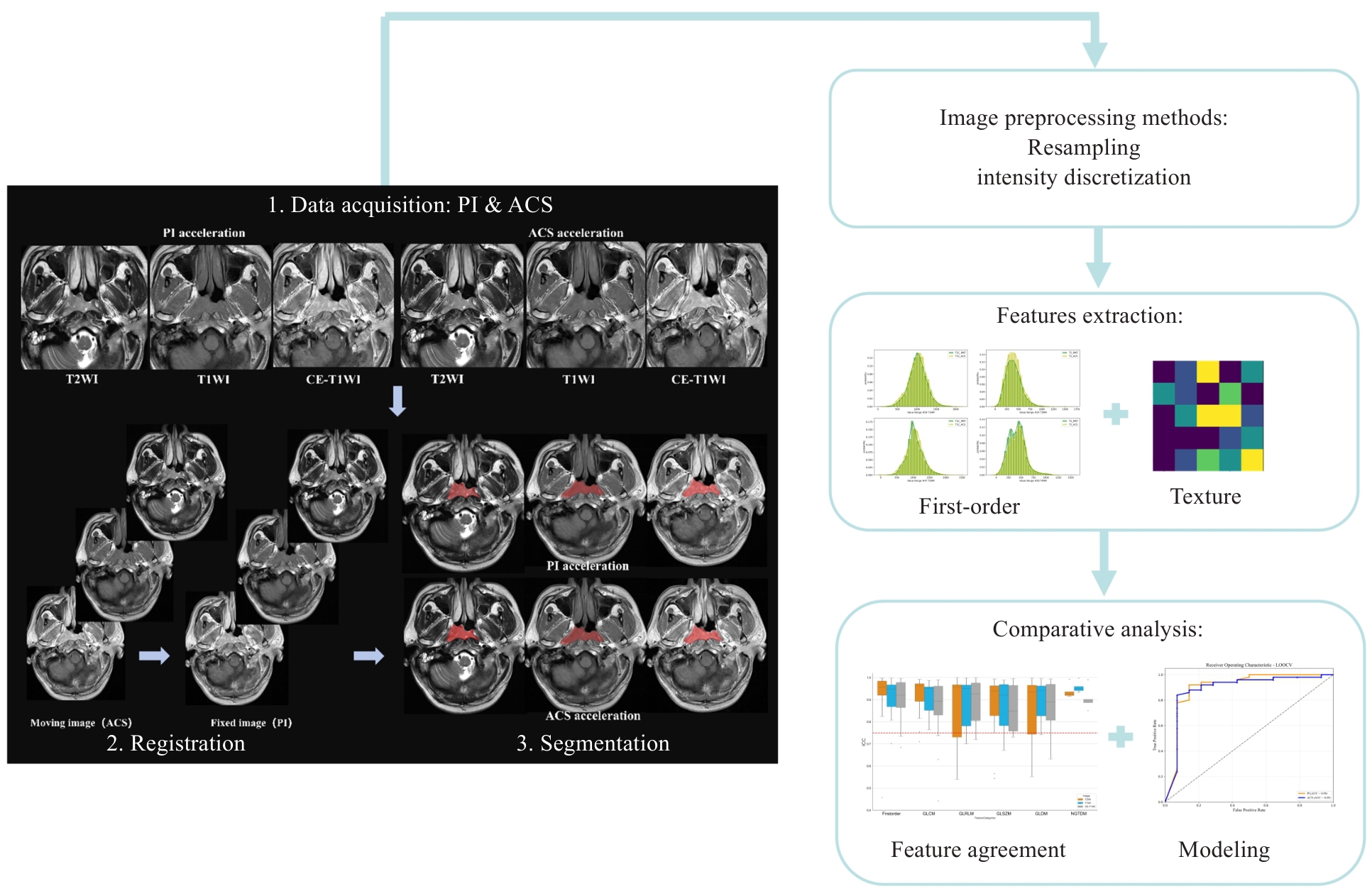
图1 两种加速序列图像预处理及一致性分析工作流程图
Fig.1 Workflow of image preprocessing and consistency analysis between the two accelerated MRI sequences.
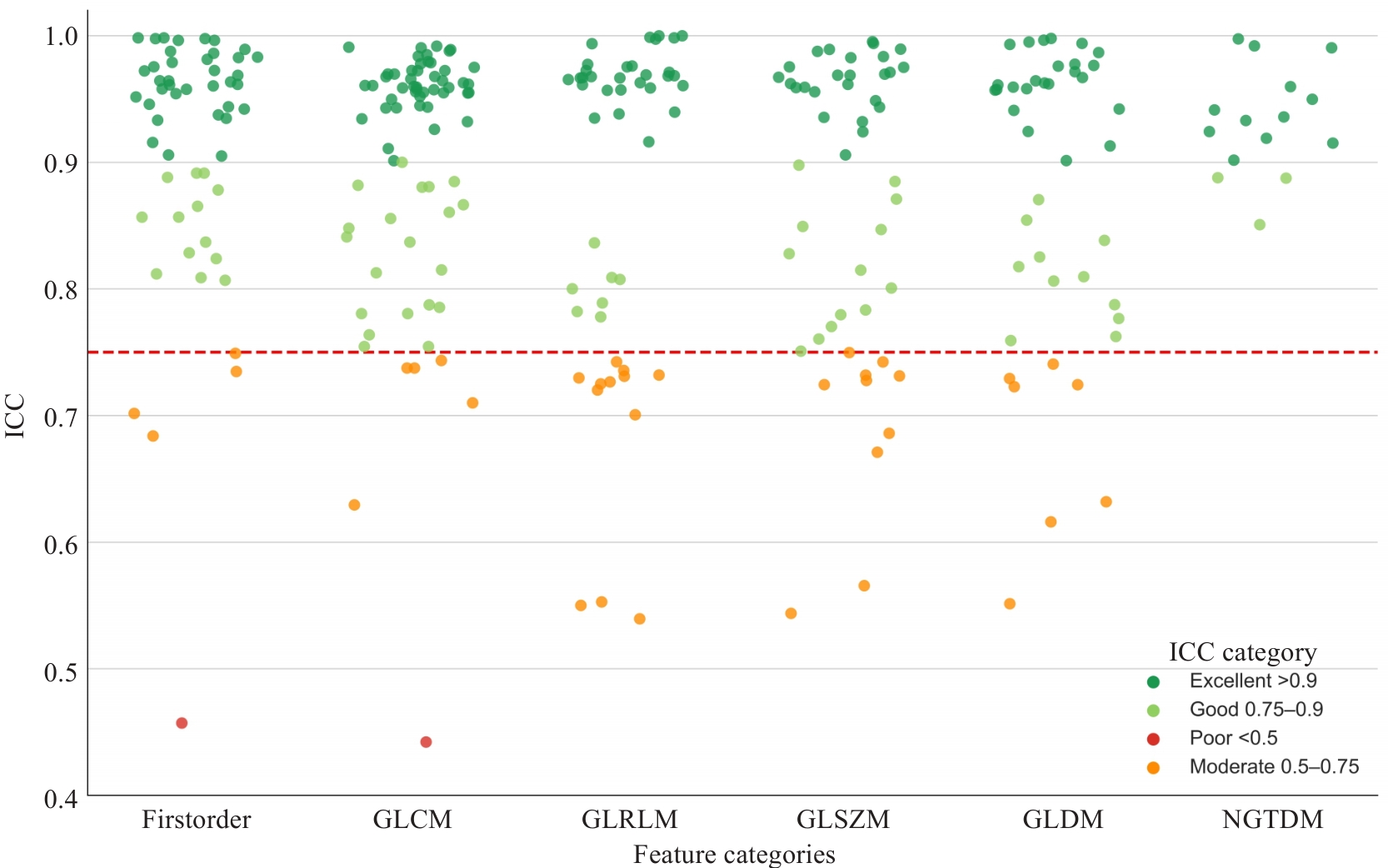
图2 3种序列(T1WI、T2WI 和 增强T1WI)提取所有特征的ICC值散点图
Fig.2 Scatter plot of intraclass correlation coefficients (ICCs) for all radiomic features extracted from T1WI, T2WI, and contrast-enhanced T1WI sequences, categorized by consistency levels. The red dashed line represents the ICC threshold of 0.75.
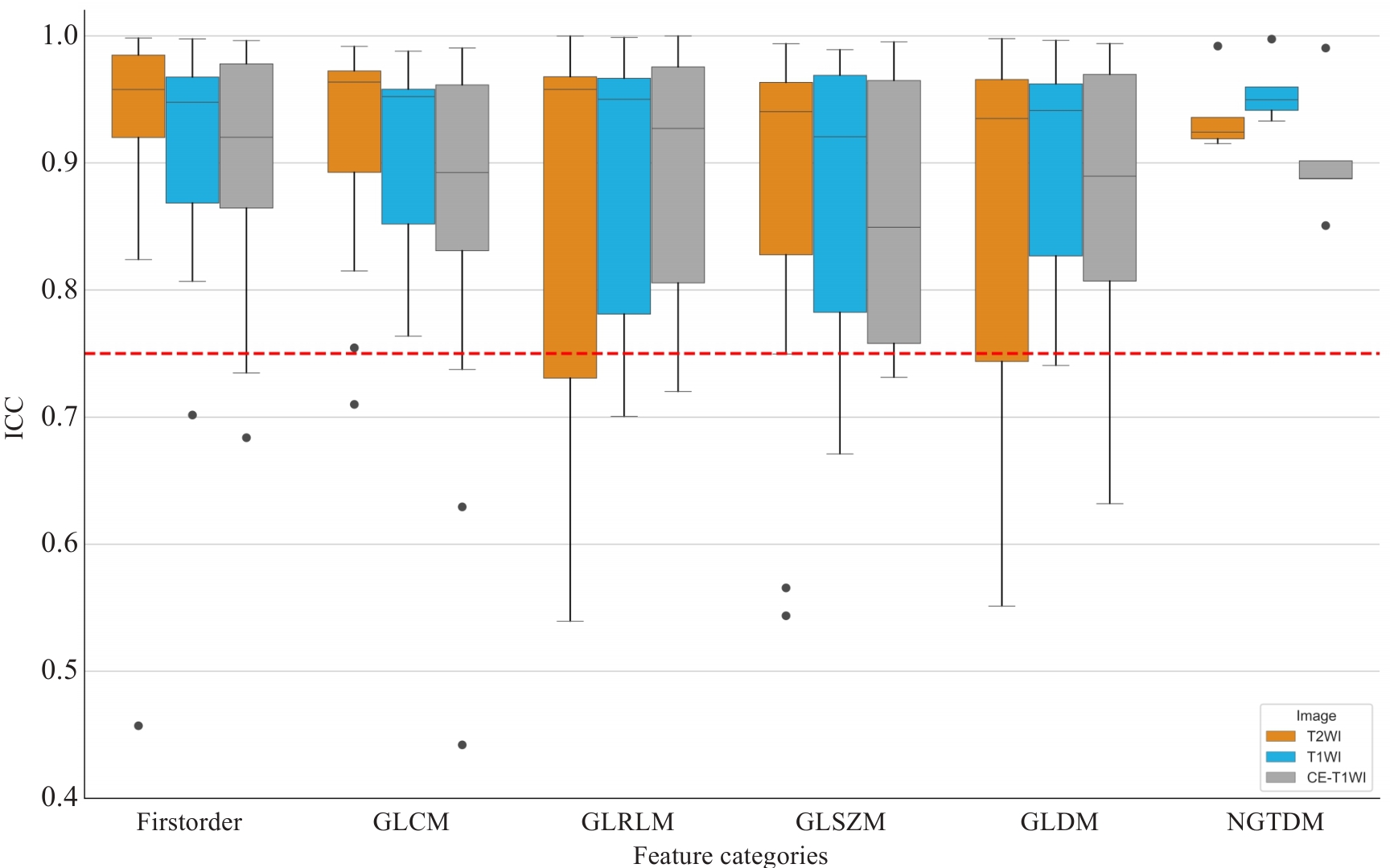
图3 3种MRI序列(T1WI、T2WI 和增强T1WI)提取的各类影像组学特征的ICC值箱线图
Fig.3 Boxplots of ICCs for different categories of radiomic features extracted from T1WI, T2WI, and contrast-enhanced T1WI (CE-T1WI) sequences. Each boxplot represents the distribution of ICCs within a specific feature category. The red dashed line indicates the reproducibility threshold at ICC=0.75, above which features are considered to have good agreement.
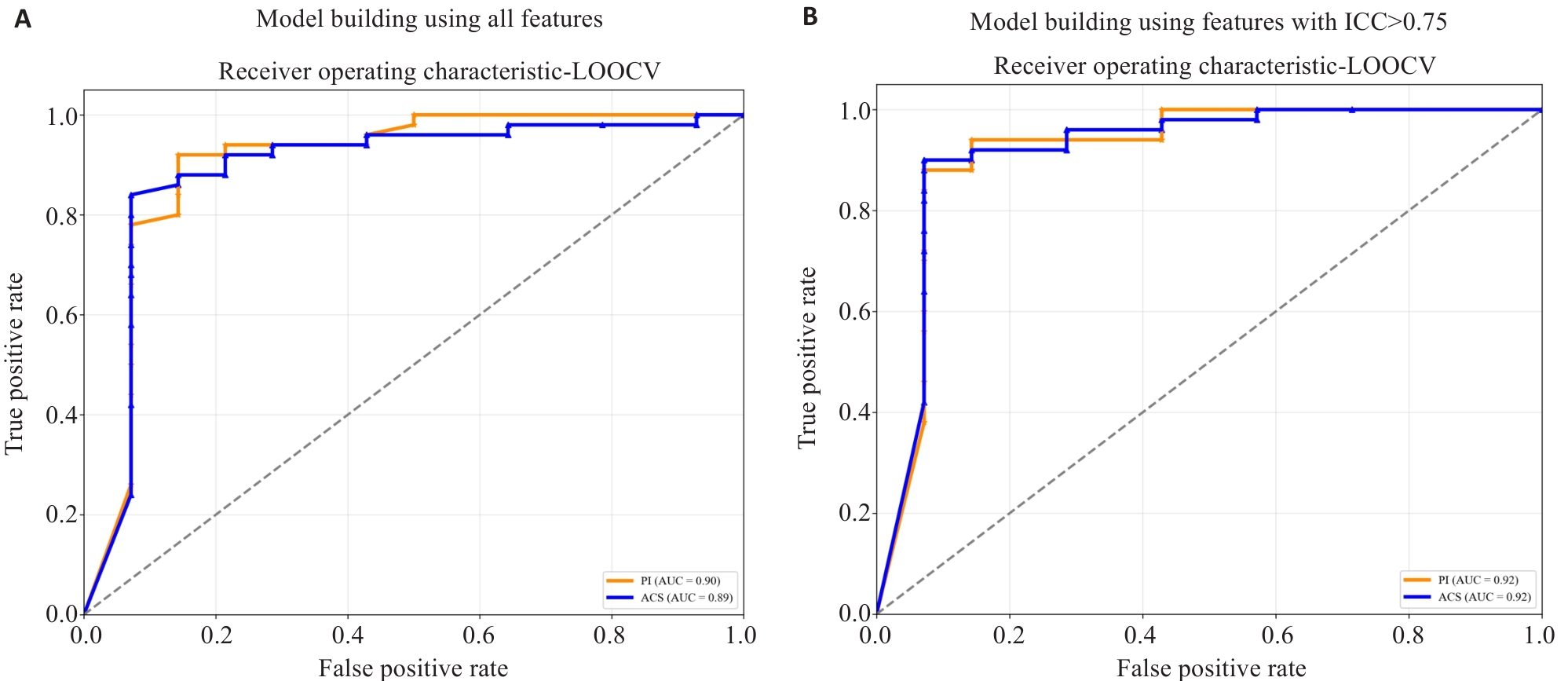
图4 基于PI和ACS加速图像构建的组学模型的ROC曲线
Fig.4 ROC curves of radiomics models constructed using PI- and ACS-accelerated images. The plots show the ROC curves of models built using all extracted features (A) and models built using only features with ICC>0.75 (B). The orange curve represents the model based on PI-accelerated images, and the blue curve represents the model based on ACS-accelerated images.
| Feature type | Method | Accuracy | AUC | F1-Score | Sensitivity | Specificity | P |
|---|---|---|---|---|---|---|---|
| All Features | PI | 0.891 | 0.889 | 0.931 | 0.940 | 0.714 | 0.991 |
| ACS | 0.891 | 0.902 | 0.931 | 0.940 | 0.714 | ||
| Features ICC>0.75 | PI | 0.891 | 0.916 | 0.931 | 0.940 | 0.714 | 0.998 |
| ACS | 0.906 | 0.916 | 0.939 | 0.920 | 0.857 |
表3 不同加速序列的预测性能(所有特征,特征ICC > 0.75)
Tab.3 Predictive performance of different acceleration sequences
| Feature type | Method | Accuracy | AUC | F1-Score | Sensitivity | Specificity | P |
|---|---|---|---|---|---|---|---|
| All Features | PI | 0.891 | 0.889 | 0.931 | 0.940 | 0.714 | 0.991 |
| ACS | 0.891 | 0.902 | 0.931 | 0.940 | 0.714 | ||
| Features ICC>0.75 | PI | 0.891 | 0.916 | 0.931 | 0.940 | 0.714 | 0.998 |
| ACS | 0.906 | 0.916 | 0.939 | 0.920 | 0.857 |
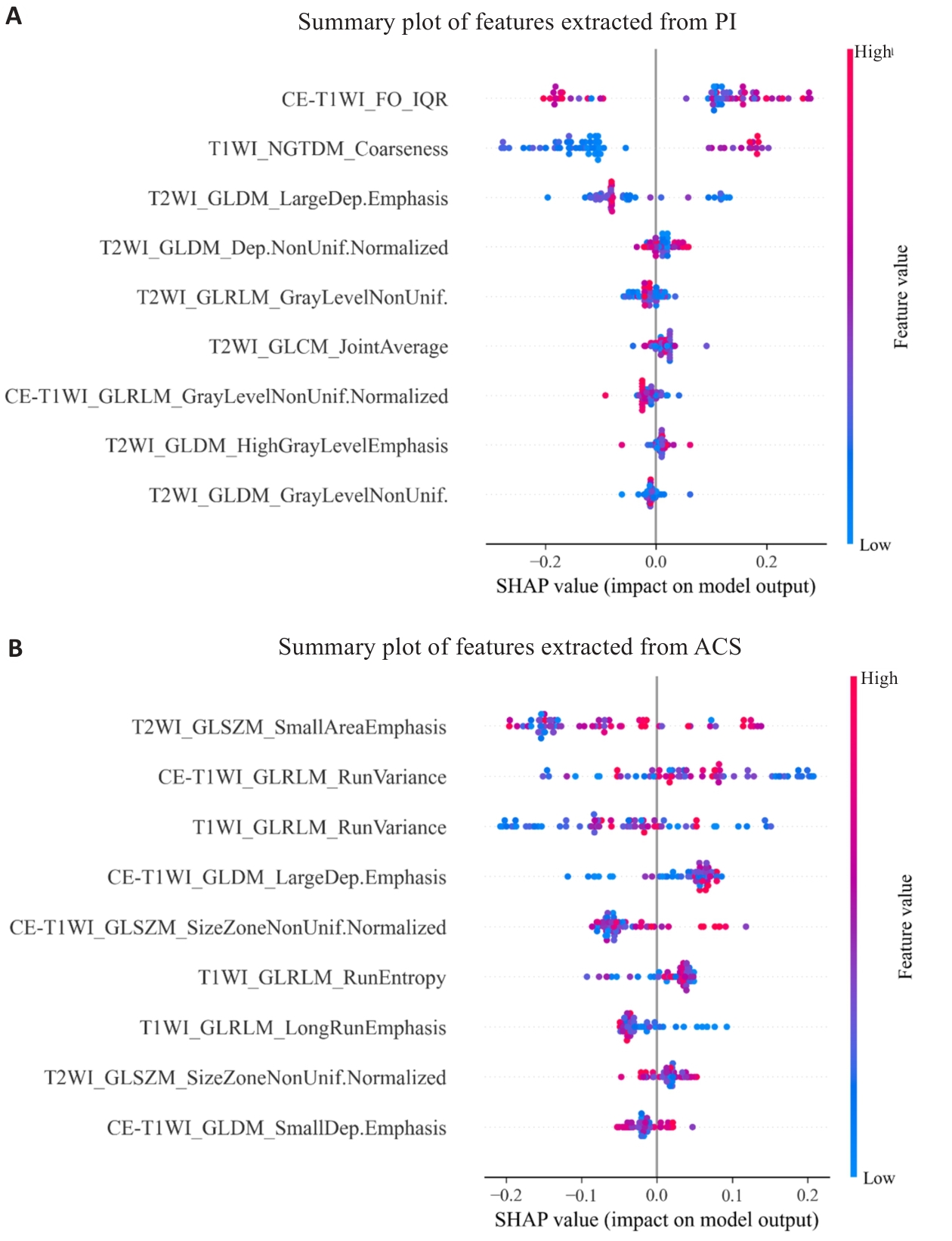
图5 基于随机森林模型的SHAP值特征贡献图
Fig.5 SHAP summary plots of feature contributions in random forest models. The plots show feature contributions for models constructed using features extracted from PI-accelerated images (A) and ACS-accelerated images (B).
| [1] | Chen YP, Chan ATC, Le QT, et al. Nasopharyngeal carcinoma[J]. Lancet, 2019, 394(10192): 64-80. doi:10.1016/s0140-6736(19)30956-0 |
| [2] | Ferlay J, Colombet M, Soerjomataram I, et al. Cancer statistics for the year 2020: an overview[J]. Int J Cancer, 2021, 149(4): 778-89. doi:10.1002/ijc.33588 |
| [3] | Liao XB, Mao YP, Liu LZ, et al. How does magnetic resonance imaging influence staging according to AJCC staging system for nasopharyngeal carcinoma compared with computed tomography [J]? Int J Radiat Oncol Biol Phys, 2008, 72(5): 1368-77. doi:10.1016/j.ijrobp.2008.03.017 |
| [4] | Wang F, Chen G, Zhang Z, et al. The Chinese society of clinical oncology (CSCO): clinical guidelines for the diagnosis and treatment of colorectal cancer, 2024 update[J]. Cancer Commun: Lond, 2025, 45(3): 332-79. doi:10.1002/cac2.12639 |
| [5] | Deshmane A, Gulani V, Griswold MA, et al. Parallel MR imaging[J]. J Magn Reson Imaging, 2012, 36(1): 55-72. doi:10.1002/jmri.23639 |
| [6] | Lustig M, Donoho D, Pauly JM. Sparse MRI: The application of compressed sensing for rapid MR imaging[J]. Magn Reson Med, 2007, 58(6): 1182-95. doi:10.1002/mrm.21391 |
| [7] | Griswold MA, Jakob PM, Heidemann RM, et al. Generalized autocalibrating partially parallel acquisitions (GRAPPA)[J]. Magn Reson Med, 2002, 47(6): 1202-10. doi:10.1002/mrm.10171 |
| [8] | Pruessmann KP, Weiger M, Scheidegger MB, et al. SENSE: Sensitivity encoding for fast MRI[J], Magn Reson Med, 1999;42(5): 952-62. doi:10.1002/(sici)1522-2594(199911)42:5<952::aid-mrm16>3.3.co;2-j |
| [9] | Fransen SJ, Roest C, Simonis FFJ, et al. The scientific evidence of commercial AI products for MRI acceleration: a systematic review[J]. Eur Radiol, 2025, 35(8): 4736-46. doi:10.1007/s00330-025-11423-5 |
| [10] | Lin DJ, Johnson PM, Knoll F, et al. Artificial intelligence for MR image reconstruction: an overview for clinicians[J]. J Magn Reson Imaging, 2021, 53(4): 1015-28. doi:10.1002/jmri.27078 |
| [11] | Ghodrati V, Shao J, Bydder M, et al. MR image reconstruction using deep learning: evaluation of network structure and loss functions[J]. Quant Imaging Med Surg, 2019, 9(9): 1516-27. doi:10.21037/qims.2019.08.10 |
| [12] | Sheng RF, Zheng LY, Jin KP, et al. Single-breath-hold T2WI liver MRI with deep learning-based reconstruction: a clinical feasibility study in comparison to conventional multi-breath-hold T2WI liver MRI[J]. Magn Reson Imag, 2021, 81: 75-81. doi:10.1016/j.mri.2021.06.014 |
| [13] | Liu HB, Deng DL, Zeng WL, et al. AI-assisted compressed sensing and parallel imaging sequences for MRI of patients with nasopharyngeal carcinoma: comparison of their capabilities in terms of examination time and image quality[J]. Eur Radiol, 2023, 33(11): 7686-96. doi:10.1007/s00330-023-09742-6 |
| [14] | Wang QZ, Zhao WL, Xing XY, et al. Feasibility of AI-assisted compressed sensing protocols in knee MR imaging: a prospective multi-reader study[J]. Eur Radiol, 2023, 33(12): 8585-96. doi:10.1007/s00330-023-09823-6 |
| [15] | 王思敏, 李 彦, 严福华, 等. 不同医用磁共振成像设备在中枢神经系统的临床图像质量评价与比较研究[J]. 磁共振成像, 2019(2): 83-8. |
| [16] | Ni M, He M, Yang YX, et al. Application research of AI-assisted compressed sensing technology in MRI scanning of the knee joint: 3D-MRI perspective[J]. Eur Radiol, 2024, 34(5): 3046-58. doi:10.1007/s00330-023-10368-x |
| [17] | Zhao Q, Xu J, Yang YX, et al. AI-assisted accelerated MRI of the ankle: clinical practice assessment[J]. Eur Radiol Exp, 2023, 7(1): 62. doi:10.1186/s41747-023-00374-5 |
| [18] | Lambin P, Leijenaar RTH, Deist TM, et al. Radiomics: the bridge between medical imaging and personalized medicine[J]. Nat Rev Clin Oncol, 2017, 14(12): 749-62. doi:10.1038/nrclinonc.2017.141 |
| [19] | Liu Z, Wang S, Dong D, et al. The applications of radiomics in precision diagnosis and treatment of oncology: opportunities and challenges[J]. Theranostics, 2019, 9(5): 1303-22. doi:10.7150/thno.30309 |
| [20] | Kim MJ, Choi Y, Sung YE, et al. Early risk-assessment of patients with nasopharyngeal carcinoma: the added prognostic value of MR-based radiomics[J]. Transl Oncol, 2021, 14(10): 101180. doi:10.1016/j.tranon.2021.101180 |
| [21] | Zhang L, Dong D, Li HL, et al. Development and validation of a magnetic resonance imaging-based model for the prediction of distant metastasis before initial treatment of nasopharyngeal carcinoma: a retrospective cohort study[J]. EBioMedicine, 2019, 40: 327-35. doi:10.1016/j.ebiom.2019.01.013 |
| [22] | Zhang B, Tian J, Dong D, et al. Radiomics features of multiparametric MRI as novel prognostic factors in advanced nasopharyngeal carcinoma[J]. Clin Cancer Res, 2017, 23(15): 4259-69. doi:10.1158/1078-0432.ccr-16-2910 |
| [23] | Zhang LL, Huang MY, Li Y, et al. Pretreatment MRI radiomics analysis allows for reliable prediction of local recurrence in non-metastatic T4 nasopharyngeal carcinoma[J]. EBioMedicine, 2019, 42: 270-80. doi:10.1016/j.ebiom.2019.03.050 |
| [24] | 张 璐. 基于磁共振影像组学的鼻咽癌远处转移风险评估模型构建及验证[D]. 南方医科大学, 2019. |
| [25] | Teng X, Wang Y, Nicol AJ, et al. Enhancing the clinical utility of radiomics: addressing the challenges of repeatability and repro-ducibility in CT and MRI[J]. Diagnostics: Basel, 2024, 14(16): 1835. doi:10.3390/diagnostics14161835 |
| [26] | Li S, Deng YQ, Zhu ZL, et al. A comprehensive review on radiomics and deep learning for nasopharyngeal carcinoma imaging[J]. Diagnostics: Basel, 2021, 11(9): 1523. doi:10.3390/diagnostics11091523 |
| [27] | Joo L, Jung SC, Lee H, et al. Stability of MRI radiomic features according to various imaging parameters in fast scanned T2-FLAIR for acute ischemic stroke patients[J]. Sci Rep, 2021, 11(1): 17143. doi:10.1038/s41598-021-96621-z |
| [28] | Rai R, Barton MB, Chlap P, et al. Repeatability and reproducibility of magnetic resonance imaging-based radiomic features in rectal cancer[J]. J Med Imaging: Bellingham, 2022, 9(4): 044005. doi:10.1117/1.jmi.9.4.044005 |
| [29] | Klontzas ME. Radiomics feature reproducibility: The elephant in the room[J]. Eur J Radiol, 2024, 175: 111430. doi:10.1016/j.ejrad.2024.111430 |
| [30] | Reschke P, Koch V, Gruenewald LD, et al. Deep learning-accelerated prostate MRI: improving speed, accuracy, and sustainability[J]. Acad Radiol, 2025, 14: S1076-6332(25)00571-9. doi:10.1016/j.acra.2025.06.022 |
| [31] | Schwier M, van Griethuysen J, Vangel MG, et al. Repeatability of multiparametric prostate MRI radiomics features[J]. Sci Rep, 2019, 9(1): 9441. doi:10.1038/s41598-019-45766-z |
| [32] | Zwanenburg A, Vallières M, Abdalah MA, et al. The image biomarker standardization initiative: standardized quantitative radiomics for high-throughput image-based phenotyping[J]. Radiology, 2020, 295(2): 328-38. doi:10.1148/radiol.2020191145 |
| [33] | Granzier RWY, Ibrahim A, Primakov S, et al. Test-retest data for the assessment of breast MRI radiomic feature repeatability[J]. J Magn Reson Imaging, 2022, 56(2): 592-604. doi:10.1002/jmri.28027 |
| [34] | Lu H, Parra NA, Qi J, et al. Repeatability of quantitative imaging features in prostate magnetic resonance imaging[J]. Front Oncol, 2020, 10: 551. doi:10.3389/fonc.2020.00551 |
| [35] | Scalco E, Belfatto A, Mastropietro A, et al. T2w-MRI signal normalization affects radiomics features reproducibility[J]. Med Phys, 2020, 47(4): 1680-91. doi:10.1002/mp.14038 |
| [36] | Koo TK, Li MY. A guideline of selecting and reporting intraclass correlation coefficients for reliability research[J]. J Chiropr Med, 2016, 15(2): 155-63. doi:10.1016/j.jcm.2016.02.012 |
| [37] | Bi Y, Xiang DX, Ge ZY, et al. An interpretable prediction model for identifying N7-methylguanosine sites based on XGBoost and SHAP[J]. Mol Ther Nucleic Acids, 2020, 22: 362-72. doi:10.1016/j.omtn.2020.08.022 |
| [38] | Shukla-Dave A, Obuchowski NA, Chenevert TL, et al. Quantitative imaging biomarkers alliance (QIBA) recommendations for improved precision of DWI and DCE-MRI derived biomarkers in multicenter oncology trials[J]. J Magn Reson Imaging, 2019, 49(7): e101-21. doi:10.1002/jmri.26805 |
| [39] | Salluzzi M, McCreary CR, Gobbi DG, et al. Short-term repeatability and long-term reproducibility of quantitative MR imaging biomarkers in a single centre longitudinal study[J]. NeuroImage, 2022, 260: 119488. doi:10.1016/j.neuroimage.2022.119488 |
| [40] | Ye S, Lim JY, Huang W. Statistical considerations for repeatability and reproducibility of quantitative imaging biomarkers[J]. BJR Open, 2022, 4(1): 20210083. doi:10.1259/bjro.20210083 |
| [41] | Orlhac F, Lecler A, Savatovski J, et al. How can we combat multicenter variability in MR radiomics? Validation of a correction procedure[J]. Eur Radiol, 2021, 31(4): 2272-80. doi:10.1007/s00330-020-07284-9 |
| [42] | Carré A, Battistella E, Niyoteka S, et al. AutoComBat: a generic method for harmonizing MRI-based radiomic features[J]. Sci Rep, 2022, 12(1): 12762. doi:10.1038/s41598-022-16609-1 |
| [43] | Zhao W, Hu Z, Kazerooni AF, et al. Physics-informed discretization for reproducible and robust radiomic feature extraction using quantitative MRI[J]. Invest Radiol, 2024, 59(5): 359-71. doi:10.1097/rli.0000000000001026 |
| [44] | 胡丽霞, 朱 进, 周阳泱, 等. 鼻咽癌动态增强MRI参数与临床病理特征的关系[J]. 中国医学影像技术, 2014, 30(4): 514-7. |
| [45] | Carbonell G, Kennedy P, Bane O, et al. Precision of MRI radiomics features in the liver and hepatocellular carcinoma[J]. Eur Radiol, 2022, 32(3): 2030-40. doi:10.1007/s00330-021-08282-1 |
| [46] | Perrin T, Midya A, Yamashita R, et al. Short-term reproducibility of radiomic features in liver parenchyma and liver malignancies on contrast-enhanced CT imaging[J]. Abdom Radiol, 2018, 43(12): 3271-8. doi:10.1007/s00261-018-1600-6 |
| [47] | Ibrahim A, Guha S, Lu L, et al. The reproducibility and predictivity of radiomic features extracted from dynamic contrast-enhanced computed tomography of hepatocellular carcinoma[J]. PLoS One, 2024, 19(9): e0310486. doi:10.1371/journal.pone.0310486 |
| [1] | 张力莹, 张同贞, 赵鑫. 基于乳腺影像报告和数据系统的DWI和T2WI形态评估对乳腺病变的诊断价值[J]. 南方医科大学学报, 2025, 45(9): 1809-1817. |
| [2] | 黄启智, 谢戴鹏, 姚霖彤, 李洽轩, 吴少伟, 周海榆. 肿瘤微环境特异性CT影像组学标签预测非小细胞肺癌免疫治疗疗效[J]. 南方医科大学学报, 2025, 45(9): 1903-1918. |
| [3] | 董振翔, 郭义昊, 刘蔷, 张益哲, 丘倩怡, 张晓东, 冯衍秋. 基于双极读出梯度的单重复时间腰椎定量磁化率成像[J]. 南方医科大学学报, 2025, 45(6): 1336-1342. |
| [4] | 曾玉梅, 李继科, 黄仲曦, 周毅波. 绒毛样蛋白VILL通过与LMO7蛋白相互作用抑制鼻咽癌细胞的增殖[J]. 南方医科大学学报, 2025, 45(5): 954-961. |
| [5] | 陶露, 韦卓利, 王月月, 项平. CEACAM6通过调控上皮间质转化抑制鼻咽癌细胞的增殖和迁移[J]. 南方医科大学学报, 2025, 45(3): 566-576. |
| [6] | 刘瑨禹, 梁淑君, 张煜. 基于多尺度监督与残差反馈的优化算法有效提高鼻咽癌CT图像视交叉及视神经分割精度[J]. 南方医科大学学报, 2025, 45(3): 632-642. |
| [7] | 李孝媛, 张逸悦, 顾雨铖, 陈霓红, 钱鑫宇, 张朋俊, 郝佳欣, 王峰. Tau蛋白沉积与脑代谢物的关联性:N-乙酰天门冬氨酸与肌酸作为进展期阿尔茨海默病的潜在生物标志物[J]. 南方医科大学学报, 2025, 45(11): 2350-2357. |
| [8] | 卢梓涵, 黄方俊, 蔡光瑶, 刘继红, 甄鑫. 针对缺失实验室指标多约束表征学习的卵巢癌鉴别方法[J]. 南方医科大学学报, 2025, 45(1): 170-178. |
| [9] | 从小凡, 陈腾, 李硕, 王媛媛, 周龙云, 李小龙, 张配, 孙小锦, 赵素容. 双氢青蒿素通过促进活性氧的产生增强鼻咽癌细胞对顺铂诱导凋亡的敏感性[J]. 南方医科大学学报, 2024, 44(8): 1553-1560. |
| [10] | 刘科, 马振岩, 付磊, 张丽萍, 阿鑫, 肖少波, 张震, 张洪博, 赵蕾, 钱赓. 心脏磁共振成像整体纵向应变对急性ST段抬高型心肌梗死后左心室重构的预测价值:403例前瞻性研究[J]. 南方医科大学学报, 2024, 44(6): 1033-1039. |
| [11] | 王媛媛, 陈腾, 从小凡, 李依然, 陈蕊, 张配, 孙小锦, 赵素容. 扁蒴藤素通过活性氧调控PI3K/AKT通路增强顺铂诱导鼻咽癌细胞凋亡[J]. 南方医科大学学报, 2024, 44(5): 904-912. |
| [12] | 刘云泽, 李宬润, 郭俊唐, 刘 阳. 基于临床-影像组学列线图模型鉴别局灶性机化性肺炎与肺腺癌[J]. 南方医科大学学报, 2024, 44(2): 397-404. |
| [13] | 胡玥, 曾玉, 王琳婧, 廖志伟, 谭剑明, 邝燕好, 龚攀, 齐斌, 甄鑫. 多模态多分类器融合模型预测放射性口腔黏膜炎的性能[J]. 南方医科大学学报, 2024, 44(12): 2434-2442. |
| [14] | 黄晓茵, 陈凤莲, 张煜, 梁淑君. 多参数多区域MRI影像组学特征与临床信息联合模型可有效预测脑胶质瘤患者生存期[J]. 南方医科大学学报, 2024, 44(10): 2004-2014. |
| [15] | 何慧珊, 郭二嘉, 蒙文仪, 王 彧, 王 雯, 何文乐, 吴元魁, 阳 维. 基于磁共振图像机器学习放射组学模型预测脑胶质瘤的强化[J]. 南方医科大学学报, 2024, 44(1): 194-200. |
| 阅读次数 | ||||||
|
全文 |
|
|||||
|
摘要 |
|
|||||
