
南方医科大学学报 ›› 2026, Vol. 46 ›› Issue (7): 1696-1702.doi: 10.12122/j.issn.1673-4254.2026.07.22
• • 上一篇
徐利珊1( ), 李柯柯1, 于米铼1, 植秋怡2, 安胜利1()
收稿日期:2025-10-28
出版日期:2026-07-20
发布日期:2026-07-20
通讯作者:
安胜利
E-mail:lishanxv@outlook.com;1069766473@qq.com
作者简介:徐利珊,在读硕士研究生,E-mail: lishanxv@outlook.com
基金资助:
Lishan XU1(), Keke LI1, Milai YU1, Qiuyi ZHI2, Shengli AN1()
Received:2025-10-28
Online:2026-07-20
Published:2026-07-20
Contact:
Shengli AN
E-mail:lishanxv@outlook.com;1069766473@qq.com
摘要:
目的 评估广东省输入基孔肯雅热(CHIKF)病例后不同干预措施的效果,为疫情防控提供量化的决策支持。 方法 以广东省输入性疫情及蚊媒监测数据为基础,构建人蚊耦合SEIR-SEI传播动力学模型,通过调控环境容纳系数(
徐利珊, 李柯柯, 于米铼, 植秋怡, 安胜利. 基于SEIR-SEI模型预测广东省输入性基孔肯雅热再传播风险[J]. 南方医科大学学报, 2026, 46(7): 1696-1702.
Lishan XU, Keke LI, Milai YU, Qiuyi ZHI, Shengli AN. Re-transmission risk prediction of imported Chikungunya fever in Guangdong Province using the SEIR-SEI model[J]. Journal of Southern Medical University, 2026, 46(7): 1696-1702.
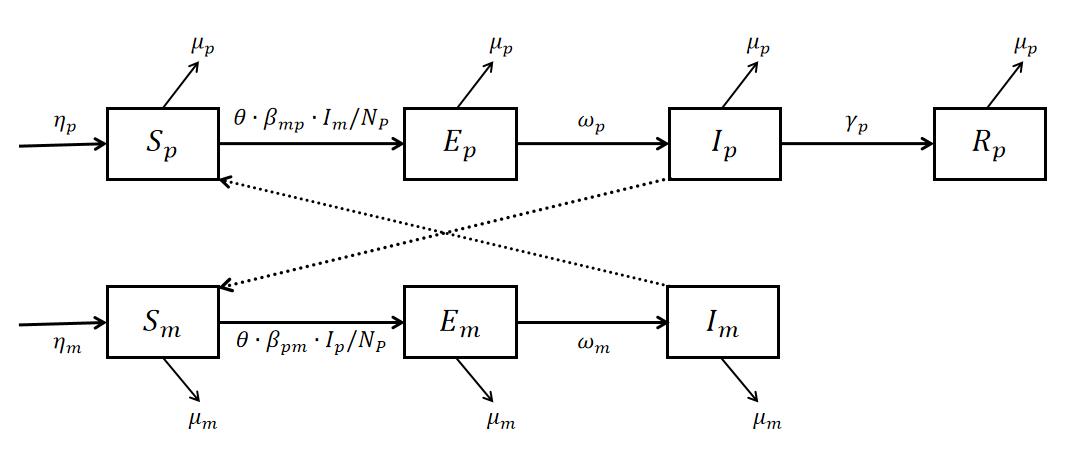
图1 CHIKF传播路径与仓室关系
Fig.1 Propagation path and compartment relationship of Chikungunya fever (CHIKF).
| Parameters | Description | Range of values | Value | Source |
|---|---|---|---|---|
| Natural human birth rate (per day) | - | 0.00889/365 | [ | |
| Natural human mortality rate (per day) | - | 0.00520/365 | [ | |
| Female mosquito oviposition rate (per day) | 0.1 | [ | ||
| Female mosquito mortality (per day) | 1/52-1/9 | 1/30 | [ | |
| Average number of bites (times as a unit) | 0-2 | 2 | [ | |
| The infection rate of infected mosquitoes to susceptible individuals caused by each bite | 0.5-0.8 | 0.80 | [ | |
| The infection rate of infected individuals to susceptible mosquitoes caused by each bite | - | 0.37 | [ | |
| Rate of conversion of latent patients to infected persons (per day) | 1/12-1 | 1/7 | [ | |
| Rate of conversion of latent mosquitoes into infected mosquitoes (per day) | 0.1-0.5 | 1/6 | [ | |
| Interval between onset and diagnosis (in days) | 1-7 | 7 | [ | |
| environmental carrying coefficient | 0-2 | 2 | [ |
表1 SEIR-SEI模型参数说明及取值
Tab.1 Parameter description and value of SEIR-SEI model
| Parameters | Description | Range of values | Value | Source |
|---|---|---|---|---|
| Natural human birth rate (per day) | - | 0.00889/365 | [ | |
| Natural human mortality rate (per day) | - | 0.00520/365 | [ | |
| Female mosquito oviposition rate (per day) | 0.1 | [ | ||
| Female mosquito mortality (per day) | 1/52-1/9 | 1/30 | [ | |
| Average number of bites (times as a unit) | 0-2 | 2 | [ | |
| The infection rate of infected mosquitoes to susceptible individuals caused by each bite | 0.5-0.8 | 0.80 | [ | |
| The infection rate of infected individuals to susceptible mosquitoes caused by each bite | - | 0.37 | [ | |
| Rate of conversion of latent patients to infected persons (per day) | 1/12-1 | 1/7 | [ | |
| Rate of conversion of latent mosquitoes into infected mosquitoes (per day) | 0.1-0.5 | 1/6 | [ | |
| Interval between onset and diagnosis (in days) | 1-7 | 7 | [ | |
| environmental carrying coefficient | 0-2 | 2 | [ |
| Year | Total | Source country | Discovery approach | Disposal place | |||||
|---|---|---|---|---|---|---|---|---|---|
| Asia | Africa | Fever screening | Accompanying inspection | Visiting hospital | Within province | Outside province | Unknown | ||
| 2008[ | 5 | 5 | 0 | 3 | 2 | - | 4 | 1 | - |
| 2009[ | 1 | 1 | 0 | 1 | - | - | 1 | - | - |
| 2010&2011[ | 5 | 2 | 3 | 5 | - | - | - | - | 5 |
| 2012[ | 1 | 1 | 0 | - | - | 1 | 1 | - | - |
| 2013[ | 2 | 2 | 0 | 2 | - | - | - | - | 2 |
| 2014[ | 1 | 1 | 0 | 1 | - | - | - | - | 1 |
| 2015[ | 1 | 1 | 0 | 1 | - | - | 1 | - | |
| 2016[ | 1 | 1 | 0 | 1 | - | - | - | - | 1 |
| 2017[ | 12 | 12 | 0 | 11 | - | 1 | 12 | - | - |
| 2018[ | 9 | 6 | 3 | 9 | - | - | 5 | 1 | 3 |
| 2019[ | 27 | 26 | 1 | 27 | - | - | 17 | 8 | 2 |
| Total | 65 | 58 | 7 | 61 | 2 | 2 | 41 | 10 | 14 |
表2 2008~2019年广东省输入性CHIKF概况
Tab.2 Summary of imported CHIKF in Guangdong Province from 2008 to 2019
| Year | Total | Source country | Discovery approach | Disposal place | |||||
|---|---|---|---|---|---|---|---|---|---|
| Asia | Africa | Fever screening | Accompanying inspection | Visiting hospital | Within province | Outside province | Unknown | ||
| 2008[ | 5 | 5 | 0 | 3 | 2 | - | 4 | 1 | - |
| 2009[ | 1 | 1 | 0 | 1 | - | - | 1 | - | - |
| 2010&2011[ | 5 | 2 | 3 | 5 | - | - | - | - | 5 |
| 2012[ | 1 | 1 | 0 | - | - | 1 | 1 | - | - |
| 2013[ | 2 | 2 | 0 | 2 | - | - | - | - | 2 |
| 2014[ | 1 | 1 | 0 | 1 | - | - | - | - | 1 |
| 2015[ | 1 | 1 | 0 | 1 | - | - | 1 | - | |
| 2016[ | 1 | 1 | 0 | 1 | - | - | - | - | 1 |
| 2017[ | 12 | 12 | 0 | 11 | - | 1 | 12 | - | - |
| 2018[ | 9 | 6 | 3 | 9 | - | - | 5 | 1 | 3 |
| 2019[ | 27 | 26 | 1 | 27 | - | - | 17 | 8 | 2 |
| Total | 65 | 58 | 7 | 61 | 2 | 2 | 41 | 10 | 14 |
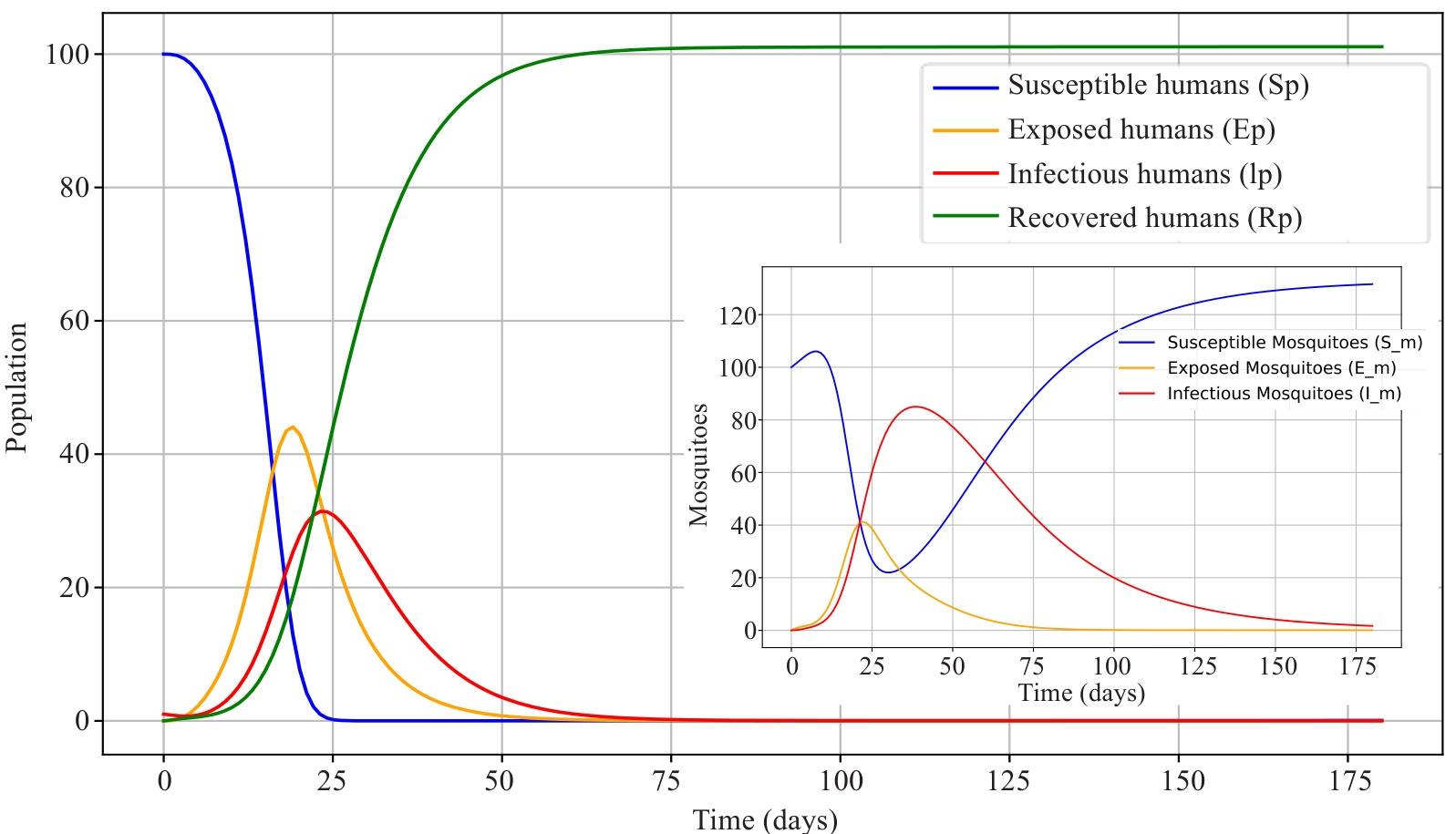
图2 无干预情景下CHIKF疫情走势图
Fig.2 CHIKF epidemic trend without intervention. The x-axis is the elapsed time in days since the first imported case was introduced into the community.
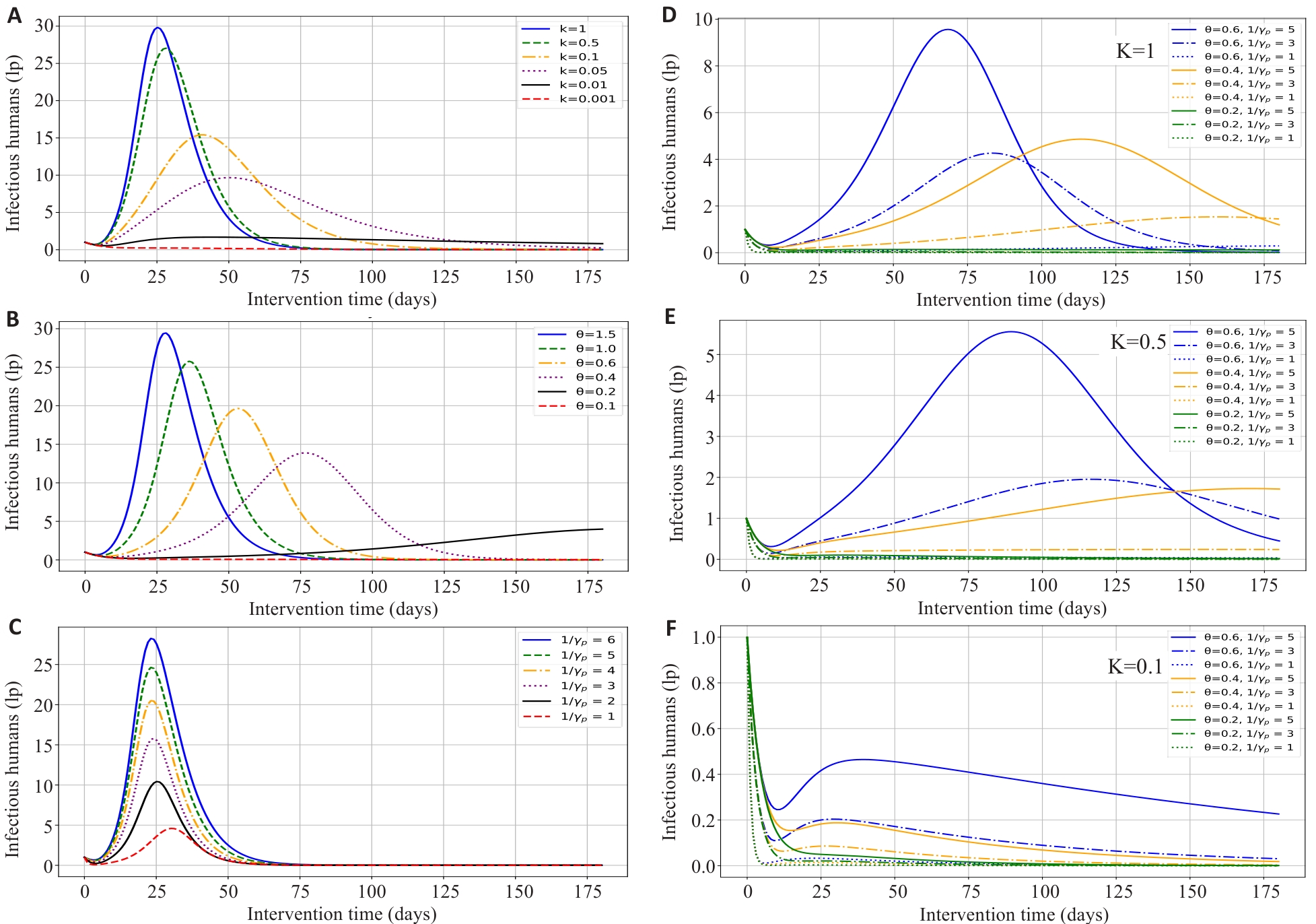
图3 单一干预及综合干预情景下CHIKF疫情走势图
Fig.3 CHIKF epidemic trend under single intervention and comprehensive intervention scenarios. The x-axis is the elapsed time in days since the first imported case was introduced into the community. A is only control the environment capacity coefficient k; B is only control the average number of bites (θ); C is only control the time from symptom onset to diagnosis 1/γp . D, E and F are the effects of comprehensive intervention when k is 1, 0.5 and 0.1, respectively.
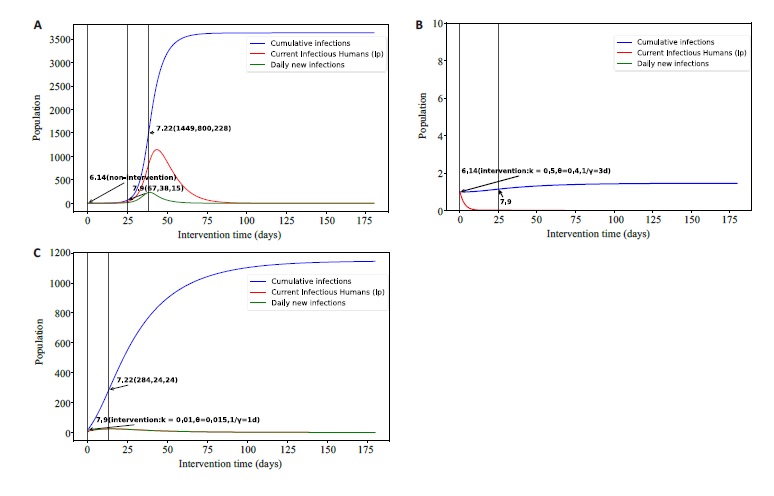
图4 佛山市S区L镇T社区不同干预情景下CHIKF疫情走势图
Fig.4 CHIKF epidemic trend in Community T of L Town (S District of Foshan) under different intervention scenarios. For A and B, the x‑axis is the elapsed time since the first imported case was introduced into the community. For C, the x‑axis is the elapsed time since intervention began on July 9 (local transmission already ongoing). A: Without intervention. B: Implementation of the comprehensive intervention proposed in this study upon the occurrence of the first case. C: Simulation of actual intervention measures initiated on July 9.
| [1] | 国家中医药局综合司, 国家卫生健康委办公厅. 基孔肯雅热诊疗方案(2025年版)[J]. 新发传染病电子杂志, 2025, 10(4): 89-93. |
| [2] | Chikungunya virus disease-Global situation[EB/OL][2025-10-23]. . doi:10.12968/indn.2025.8.4 |
| [3] | 林 苗, 李 华, 黄吉城, 等. 广东检验检疫局发现中国内地首例输入性基孔肯雅热病例[J]. 中国国境卫生检疫杂志, 2008, 31(4): 221-3, 236. |
| [4] | 陈 斌, 陈秋兰, 李 昱, 等. 2010~2019年中国输入性基孔肯雅热病例流行病学特征分析[J]. 疾病监测, 2021, 36(6): 539-43. |
| [5] | 黄 鹂, 张显光, 张 文, 等. 广东出入境检验检疫局口岸输入性基孔肯雅热监测分析[J]. 中国媒介生物学及控制杂志, 2013, 24(4): 357-60. doi:10.11853/j.issn.1003.4692.2013.04.025 |
| [6] | 熊益权, 陈 清. 1978~2014年我国登革热的流行病学分析[J]. 南方医科大学学报, 2014, 34(12): 1822-5. |
| [7] | 佛山市顺德区卫生健康局2025年7月15日发布《情况通报》_广东省疾病预防控制中心网站[EB/OL][2025-10-23]. . |
| [8] | 广东省基孔肯雅热监测信息( 2025年9月14日-20日)_广东省疾病预防控制中心网站[EB/OL][2025-10-23]. . |
| [9] | 冯 云, 张海林. 中国基孔肯雅热流行病学和病原生物学研究进展[J]. 中国热带医学, 2025, 25(5): 582-7. doi:10.13604/j.cnki.46-1064/r.2025.05.09 |
| [10] | 熊 曦, 黄文龙, 林桂鸿, 等. 全球基孔肯雅热流行现状及防治策略[J]. 广东医科大学学报, 2025, 43(5): 459-67. |
| [11] | 廖春晓, 杜海平, 王 波, 等. 基孔肯雅热的流行病学、临床特征与防控策略[J]. 中华流行病学杂志, 2025, 46(8): 1468-72. doi:10.3760/cma.j.cn112338-20250726-00527 |
| [12] | Dumont Y, Chiroleu F, Domerg C. On a temporal model for the Chikungunya disease: Modeling, theory and numerics[J]. Math Biosci, 2008, 213(1): 80-91. doi:10.1016/j.mbs.2008.02.008 |
| [13] | Dumont Y, Chiroleu F. Vector control for the Chikungunya disease[J]. Math Biosci Eng, 2010, 7(2): 313-45. doi:10.3934/mbe.2010.7.313 |
| [14] | Biggerstaff M, Alper D, Dredze M, et al. Results from the centers for disease control and prevention's predict the 2013-2014 Influenza Season Challenge[J]. BMC Infect Dis, 2016, 16(1): 357. doi:10.1186/s12879-016-1669-x |
| [15] | Vyhmeister E, Provan G, Doyle B, et al. Comparison of time series and mechanistic models of vector-borne diseases[J]. Spatial Spatio Temporal Epidemiol, 2022, 41: 100478. doi:10.1016/j.sste.2022.100478 |
| [16] | 李国群, 廖 瑜, 洪秀琴, 等. 基于SEIR-SEI模型长沙市输入性疟疾再传播风险预测[J]. 现代预防医学, 2021, 48(11): 1921-4, 1929. |
| [17] | Brady OJ, Godfray HCJ, Tatem AJ, et al. Adult vector control, mosquito ecology and malaria transmission[J]. Int Health, 2015, 7(2): 121-9. doi:10.1093/inthealth/ihv010 |
| [18] | 广东省统计局-广东统计年鉴 2024年[EB/OL][2025-10-23]. . |
| [19] | 高巨真, 曾昭玉, 薛景珉, 等. 白纹伊蚊寿命的研究: 实验室内雌蚊的存活[J]. 昆虫学报, 1984, 27(2): 182-8. |
| [20] | 段恒璐, 杨 军, 王义冠, 等. 不同温度下白纹伊蚊成蚊生存时间比较研究[J]. 中国媒介生物学及控制杂志, 2017, 28(3): 205-8. doi:10.11853/j.issn.1003.8280.2017.03.003 |
| [21] | 张韶华, 刘 强, 刘 阳, 等. 深圳市白纹伊蚊重复吸血习性观察[J]. 中国媒介生物学及控制杂志, 2015, 26(6): 561-4. |
| [22] | 邢学森, 王云甫. 基孔肯雅热: 全面科学认识与防控策略[J]. 公共卫生与预防医学, 2025, 36(5): 1-7. |
| [23] | 何 展, 吴文锋, 杨适乡, 等. 广东省茂名市首起输入性基孔肯雅热疫情调查[J]. 疾病监测, 2009, 24(3): 228-9. doi:10.3784/j.issn.1003-9961.2009.03.026 |
| [24] | 叶健忠, 史 蕾, 刘春芳, 等. 深圳口岸首例输入性基孔肯雅热病例应急处置及防控[J]. 口岸卫生控制, 2013, 18(1): 41-3. |
| [25] | 林 苗, 李 华, 戴 俊, 等. 口岸查验、实验室检测、快速联控三位一体构筑口岸防疫铜墙铁壁: 广东口岸成功处置3起输入性基孔肯雅热疫情[J]. 中国国境卫生检疫杂志, 2009, 32(5): 293-6. |
| [26] | 阳 帆, 张仁利, 黄达娜, 等. 深圳市一起输入性基孔肯雅热疫情的分子流行病学研究[J]. 中国卫生检验杂志, 2016, 26(13): 1909-12. |
| [27] | 深圳湾口岸检出基孔肯雅热传染病-中新网[EB/OL][2025-10-23]. . |
| [28] | 李小波, 黄吉城, 苏锦坤, 等. 2013年广东国境口岸入境发热患者的虫媒传染病检测情况分析[J]. 华南预防医学, 2015, 41(4): 395-6. |
| [29] | 深圳口岸检出2014年首例基孔肯雅热输入病例--时政--人民网[EB/OL][2025-10-23]. . |
| [30] | 深圳口岸检疫发现今年首例基孔肯雅热病例 | 国际旅行卫生健康咨询网[EB/OL][2025-10-23]. . |
| [31] | 深圳口岸检出年内首例输入性基孔肯雅热病例[J]. 口岸卫生控制, 2016, 21(5): 8. |
| [32] | 朱旗莉, 潘亮亮, 陈戊申, 等. 回溯1例输入性基孔肯雅热疫情处置[J]. 河南预防医学杂志, 2020, 31(9): 734-6. |
| [33] | 甄若楠, 苏文哲, 廖鑫龙, 等. 广州市境外输入性基孔肯雅热病例的流行病学和病原学特征分析[J]. 疾病监测, 2021, 36(1): 48-52. doi:10.3784/jbjc.202009040310 |
| [34] | 出入境当心了!深圳湾口岸检出一例基孔肯雅热病例_深圳新闻网[EB/OL][2025-10-23]. . |
| [35] | 罗湖口岸发现两例输入性基孔肯雅热病例_深圳新闻网[EB/OL][2025-10-23]. . |
| [36] | 珠海口岸首次检出输入性基孔肯雅热病例_央广网[EB/OL][2025-10-23]. . |
| [37] | 又是它!珠海口岸再次检出输入性基孔肯雅热病例_南方plus_南方+[EB/OL][2025-10-23]. . |
| [38] | 今年第三例!拱北海关检出输入性基孔肯雅热病例_南方plus_南方+[EB/OL][2025-10-23]. . |
| [39] | 李幸乐, 金湘东, 马建敏, 等. 2019年河南省一例输入性基孔肯雅热病例的发现与处置[J]. 疾病监测, 2020, 35(3): 202-5. |
| [40] | 芦瑞鹏, 程明基, 罗 傲, 等. 2018—2023年广东省白纹伊蚊成蚊密度监测[J]. 中国血吸虫病防治杂志, 2024, 36(6): 591-7. doi:10.16250/j.32.1374.2024074 |
| [41] | 广东省卫生统计学会. 第37 期学术沙龙预告「基孔肯雅热等传染病的统计分析方法」[EB/OL][2025-10-29]. . |
| [42] | Zhang M, Li YH, Huang XQ, et al. Epidemiological characteristics and transmission dynamics of the early stage Chikungunya fever outbreak in Foshan City, Guangdong Province, China in 2025[J]. Infect Dis Poverty, 2025, 14(1): 93. doi:10.1186/s40249-025-01364-y |
| [43] | 不灭的灯火,不歇的防线!腾冲社区夏日战“蚊”[EB/OL][2025-11-5]. . |
| [44] | 基孔肯雅热疫情可防可控!记住做好这三点[EB/OL][2025-11-5]. . |
| [45] | 佛山市人民政府门户网站[EB/OL][2025-11-5]. . |
| [46] | de Roo AM, Vondeling GT, Boer M, et al. The global health and economic burden of chikungunya from 2011 to 2020: a model-driven analysis on the impact of an emerging vector-borne disease[J]. BMJ Glob Health, 2024, 9(12): e016648. doi:10.1136/bmjgh-2024-016648 |
| [47] | 卢 娜, 周红宁. 我国登革热重要媒介白纹伊蚊抗药性研究进展[J]. 热带病与寄生虫学, 2022, 20(3): 165-9. |
| [48] | Zhang DJ, Maiga H, Li YJ, et al. Mating harassment may boost the effectiveness of the sterile insect technique for Aedes mosquitoes[J]. Nat Commun, 2024, 15: 1980. doi:10.1038/s41467-024-46268-x |
| [1] | 杨新梅, 王咏琪, 莫晓华, 朱智航, 洪丹萍, 胡樱子, 彭凯琪, 徐艺轩, 刘锦岚, 郭文娟, 林绮文, 麦俊杰, 麦思茗, 卢京洁, 杨婵娟, 周燕玲, 程道猛, 余萌, 殷炜珍. 患儿个体与家庭特征对注意缺陷/多动障碍团体干预效果的预测:基于多维模型构建与分析[J]. 南方医科大学学报, 2026, 46(4): 794-802. |
| [2] | 向科霖, 章晓云, 黎征鹏, 徐志为, 刘素杰, 柴源. 胞葬相关基因UCP2、EGLN3、IL1B对骨关节炎的诊断价值及中药治疗预测:基于生物信息学及机器学习[J]. 南方医科大学学报, 2026, 46(3): 693-706. |
| [3] | 陈君尧, 陈泽宇, 林钊杰, 方梦浩, 沈超英, 许琦, 张晓怡, 卢鲁. 饮茶对胃肠道疾病风险的双重作用:基于可解释机器学习与大语言模型的联合预测辅助模型[J]. 南方医科大学学报, 2026, 46(2): 353-361. |
| [4] | 崔运能, 冯敏清, 姚亮凤, 严杰文, 李闻瀚, 黄燕平. 基于欠采样的影像组学机器学习模型术前预测子宫肌瘤高强度聚焦超声消融效果[J]. 南方医科大学学报, 2026, 46(1): 141-149. |
| [5] | 姜君, 封硕, 孙银贵, 安燕. 经尿道前列腺钬激光剜除术后低体温风险预测模型:基于逻辑回归、决策树和支持向量机[J]. 南方医科大学学报, 2025, 45(9): 2019-2025. |
| [6] | 申琳, 宋翠豪, 王聪敏, 高西, 安俊红, 李承新, 梁斌, 李霞. 溃疡性结肠炎并发坏疽性脓皮病患者发生营养风险的因素及预测模型[J]. 南方医科大学学报, 2025, 45(3): 514-521. |
| [7] | 王飞, 李蔚然, 尚祥, 李飞. 中国农村社区老年人认知障碍预测模型的构建与验证——基于中国健康与养老追踪调查数据库[J]. 南方医科大学学报, 2025, 45(12): 2639-2645. |
| [8] | 潘甚豪, 李炎坤, 伍哲维, 毛玉玲, 王春艳. 子宫内膜异位症患者新鲜胚胎移植临床妊娠率预测模型的建立与验证[J]. 南方医科大学学报, 2024, 44(7): 1407-1415. |
| [9] | 申采玉, 王帅, 周锐盈, 汪雨贺, 高琴, 陈兴智, 杨枢. 慢性心力衰竭合并肺部感染患者院内死亡风险预测:基于可解释性机器学习方法[J]. 南方医科大学学报, 2024, 44(6): 1141-1148. |
| [10] | 戈 悦, 李建伟, 梁宏开, 侯六生, 左六二, 陈 珍, 卢剑海, 赵 新, 梁静漪, 彭 岚, 包静娜, 段佳欣, 刘 俐, 毛可晴, 曾振华, 胡鸿彬, 陈仲清. VA-ECMO患者院内死亡风险预测模型的构建及验证:一项多中心、回顾性、病例对照研究[J]. 南方医科大学学报, 2024, 44(3): 491-498. |
| [11] | 金佳欣, 马鹏珍, 王尔玉, 谢颖桢. 急性缺血性卒中患者复发的独立影响因素及风险预测列线图模型构建:基于Lasso回归[J]. 南方医科大学学报, 2024, 44(12): 2375-2381. |
| [12] | 罗 枭, 程 义, 吴 骋, 贺 佳. 预测重症缺血性脑卒中死亡风险的模型:基于内在可解释性机器学习方法[J]. 南方医科大学学报, 2023, 43(7): 1241-1247. |
| [13] | 张浩轩, 陆 进, 蒋成义, 方美芳. 基于人工智能技术的鼻咽癌风险预测模型的构建与评价[J]. 南方医科大学学报, 2023, 43(2): 271-279. |
| [14] | 廖家慧, 李涵懿, 詹长安, 杨 丰. 癫痫发作预测模型:斯托克韦尔变换的生成对抗与长短时记忆网络半监督方法[J]. 南方医科大学学报, 2023, 43(1): 17-28. |
| [15] | 朱 莹, 罗园香, 郭凤霞, 杨可立, 范慧敏, 刘翠珏, 黄 波, 唐小平, 关玉娟. 血清HBV RNA预测恩替卡韦治疗慢性乙型肝炎患者疗效的价值[J]. 南方医科大学学报, 2022, 42(8): 1250-1255. |
| 阅读次数 | ||||||
|
全文 |
|
|||||
|
摘要 |
|
|||||
