
南方医科大学学报 ›› 2026, Vol. 46 ›› Issue (7): 1671-1684.doi: 10.12122/j.issn.1673-4254.2026.07.20
• • 上一篇
杨琳( ), 于嘉祥, 韩磊, 戴俭宇()
收稿日期:2025-12-29
出版日期:2026-07-20
发布日期:2026-07-20
通讯作者:
戴俭宇
E-mail:18900926198@163.com;daijy2009boshi@163.com
作者简介:杨 琳,在读硕士研究生,E-mail: 18900926198@163.com
基金资助:
Lin YANG(), Jiaxiang YU, Lei HAN, Jianyu DAI()
Received:2025-12-29
Online:2026-07-20
Published:2026-07-20
Contact:
Jianyu DAI
E-mail:18900926198@163.com;daijy2009boshi@163.com
摘要:
目的 通过孟德尔随机化与动物实验探讨731种免疫细胞表型与梅尼埃病(MD)的因果关系。 方法 基于免疫细胞表型和MD的全基因组关联研究(GWAS)数据分别为暴露因素与结局变量,主要用逆方差加权法(IVW)分析,辅以MR-Egger、加权中位数等方法,并行异质性、多效性及留一法敏感性分析。动物实验中,将30只C57BL/6小鼠随机分为对照组、模型组及抗CD20单抗组,10只/组。采用耳后皮下注射脂多糖(LPS)制备膜迷路积水模型,抗CD20单抗组造模前尾静脉注射药物干预。通过听性脑干反应(ABR)、水迷宫及旷场实验评估小鼠听觉及前庭功能;HE染色观察内耳组织病理变化;免疫荧光检测CD19、CD27、CD3、CD39等免疫细胞标志物;qPCR、Western blotting、免疫组化检测TLR4/NF-κB通路及AQP3、ZO-1表达;ELISA检测血清中TNF-α、IL-6、IL-1β炎症因子水平。 结果 MR分析显示,CD19⁺B细胞亚群(OR=1.123~1.204)、CD27⁺IgD⁻CD38⁺B细胞(OR=1.248,95% CI:1.096~1.421,P=8.14×10⁻⁴)、CD3⁺T细胞亚群(OR=1.089~1.123)为主要危险因素;CD39⁺ CD4⁺ T细胞(OR=0.902,95% CI:0.838~0.972,P=6.46×10⁻³)为核心保护因素,敏感性分析提示结果稳健。且不存在异质性或水平多效性(P<0.05)或反向因果关系。动物实验中,模型组小鼠表现出明显听觉及前庭功能障碍;内耳膜迷路扩张积水;耳蜗组织中CD19、CD27、CD3表达增多,CD39、AQP3、ZO-1表达减少;TLR4/NF-κB通路激活,血清TNF-α、IL-6、IL-1β水平升高(P<0.05)。抗CD20单抗组上述异常得到改善。 结论 MR分析与动物实验均证实免疫细胞表型异常与MD存在因果关联,B细胞异常活化介导的免疫失衡是MD的重要因素,其通过激活TLR4/NF-κB通路,引发内耳炎症,下调AQP3、ZO-1表达,致水液代谢及屏障功能异常,导致听觉与前庭功能损伤;抗CD20单抗通过耗竭异常活化B细胞,逆转免疫失衡及下游分子通路异常,改善MD小鼠病理损伤与功能障碍,为MD免疫靶向治疗提供新依据。
杨琳, 于嘉祥, 韩磊, 戴俭宇. 免疫细胞表型与梅尼埃病的因果关联:一项双向双样本孟德尔随机化分析与动物实验研究[J]. 南方医科大学学报, 2026, 46(7): 1671-1684.
Lin YANG, Jiaxiang YU, Lei HAN, Jianyu DAI. Causal associations between immune cell phenotypes and Ménière's disease: a bidirectional two-sample Mendelian randomization study and validation in mice[J]. Journal of Southern Medical University, 2026, 46(7): 1671-1684.
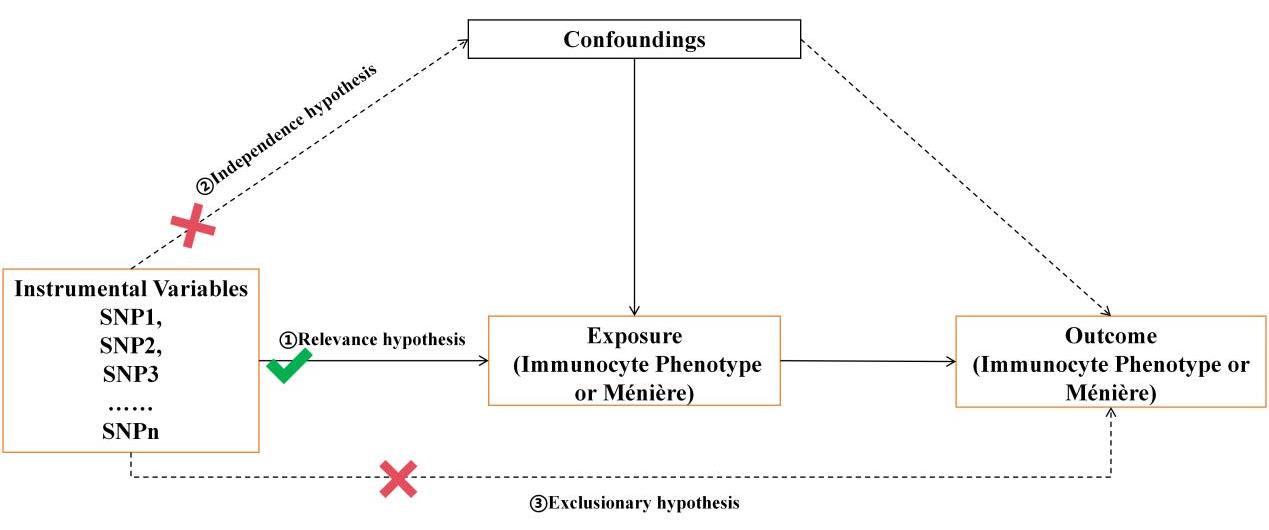
图1 孟德尔随机化分析假设以及流程图
Fig.1 Hypotheses and flowchart of Mendelian randomization analysis.
| Immune traits | ID | No. SNPs after LD | No. SNPs after F>10 | No. final IVs |
|---|---|---|---|---|
| IgD+ B cell absolute count | GCST90001400 | 13 | 13 | 13 |
| IgD+ CD24+ B cell absolute count | GCST90001412 | 22 | 22 | 22 |
| IgD- CD24- B cell absolute count | GCST90001414 | 15 | 15 | 15 |
| IgD- CD24- B cell %lymphocyte | GCST90001440 | 21 | 21 | 21 |
| CD62L- dendritic cell absolute count | GCST90001462 | 14 | 14 | 14 |
| CD86+ plasmacytoid dendritic cell %dendritic cell | GCST90001467 | 24 | 24 | 24 |
| Activated CD4 regulatory T cell %CD4 regulatory T cell | GCST90001487 | 24 | 24 | 24 |
| CD33- HLA DR- absolute count | GCST90001522 | 20 | 20 | 20 |
| CD45RA- CD4+ T cell %CD4+ T cell | GCST90001535 | 25 | 25 | 25 |
| Naive CD4+ T cell absolute count | GCST90001540 | 22 | 22 | 22 |
| Naive CD4+ T cell %CD4+ T cell | GCST90001541 | 30 | 30 | 30 |
| Terminally differentiated CD4- CD8- T cell absolute count | GCST90001572 | 20 | 20 | 20 |
| Terminally differentiated CD4- CD8- T cell %T cell | GCST90001574 | 21 | 21 | 21 |
| CD39+ CD4+ T cell absolute count | GCST90001660 | 25 | 25 | 25 |
| CD28+ CD45RA- CD8dim T cell %CD8dim T cell | GCST90001668 | 20 | 20 | 20 |
| CD28+ CD45RA- CD8dim T cell absolute count | GCST90001669 | 16 | 16 | 16 |
| CD25++ CD8+ T cell %T cell | GCST90001679 | 15 | 15 | 15 |
| CD19 on CD20- B cell | GCST90001721 | 18 | 18 | 18 |
| CD19 on IgD+ CD38- B cell | GCST90001726 | 26 | 26 | 26 |
| CD19 on IgD- CD24- B cell | GCST90001731 | 19 | 19 | 19 |
| CD19 on IgD- CD38- B cell | GCST90001733 | 20 | 20 | 20 |
| CD27 on IgD- CD38+ B cell | GCST90001803 | 15 | 15 | 15 |
| CD3 on effector memory CD8+ T cell | GCST90001839 | 18 | 18 | 18 |
| CD3 on CD28+ CD45RA- CD8+ T cell | GCST90001863 | 20 | 20 | 20 |
| CD34 on hematopoietic stem cell | GCST90001870 | 13 | 13 | 13 |
| CD16- CD56 on HLA DR+ natural killer | GCST90001885 | 20 | 20 | 20 |
| CCR7 on naive CD4+ T cell | GCST90001907 | 22 | 22 | 22 |
| CD127 on CD8+ T cell | GCST90001927 | 23 | 23 | 23 |
| CD127 on CD28- CD8+ T cell | GCST90001930 | 19 | 19 | 19 |
| FSC-A on HLA DR+ CD8+ T cell | GCST90001978 | 12 | 12 | 12 |
| PDL-1 on CD14- CD16+ monocyte | GCST90001999 | 18 | 18 | 18 |
| CD4 on CD4+ T cell | GCST90002022 | 22 | 22 | 22 |
| CD4 on naive CD4+ T cell | GCST90002024 | 19 | 19 | 19 |
| CD4 on effector memory CD4+ T cell | GCST90002025 | 21 | 21 | 21 |
| CD4 on terminally differentiated CD4+ T cell | GCST90002026 | 22 | 22 | 22 |
| CD4 on CD45RA+ CD4+ T cell | GCST90002027 | 26 | 26 | 26 |
| CD80 on myeloid dendritic cell | GCST90002035 | 24 | 24 | 24 |
| CD80 on monocyte | GCST90002039 | 20 | 20 | 20 |
| CD45 on CD33- HLA DR- | GCST90002045 | 15 | 15 | 15 |
| CD45 on granulocytic myeloid-derived suppressor cells | GCST90002047 | 17 | 17 | 17 |
| CD11c on CD62L+ myeloid dendritic cell | GCST90002088 | 22 | 22 | 22 |
| HLA DR on myeloid dendritic cell | GCST90002104 | 14 | 14 | 14 |
| HLA DR on plasmacytoid dendritic cell | GCST90002105 | 19 | 19 | 19 |
| HLA DR on HLA DR+ CD8+ T cell | GCST90002115 | 17 | 17 | 17 |
表2 每一步筛选的单核苷酸多态性(SNP)数量
Tab.2 Number of single-nucleotide polymorphisms (SNPs) at each screening step
| Immune traits | ID | No. SNPs after LD | No. SNPs after F>10 | No. final IVs |
|---|---|---|---|---|
| IgD+ B cell absolute count | GCST90001400 | 13 | 13 | 13 |
| IgD+ CD24+ B cell absolute count | GCST90001412 | 22 | 22 | 22 |
| IgD- CD24- B cell absolute count | GCST90001414 | 15 | 15 | 15 |
| IgD- CD24- B cell %lymphocyte | GCST90001440 | 21 | 21 | 21 |
| CD62L- dendritic cell absolute count | GCST90001462 | 14 | 14 | 14 |
| CD86+ plasmacytoid dendritic cell %dendritic cell | GCST90001467 | 24 | 24 | 24 |
| Activated CD4 regulatory T cell %CD4 regulatory T cell | GCST90001487 | 24 | 24 | 24 |
| CD33- HLA DR- absolute count | GCST90001522 | 20 | 20 | 20 |
| CD45RA- CD4+ T cell %CD4+ T cell | GCST90001535 | 25 | 25 | 25 |
| Naive CD4+ T cell absolute count | GCST90001540 | 22 | 22 | 22 |
| Naive CD4+ T cell %CD4+ T cell | GCST90001541 | 30 | 30 | 30 |
| Terminally differentiated CD4- CD8- T cell absolute count | GCST90001572 | 20 | 20 | 20 |
| Terminally differentiated CD4- CD8- T cell %T cell | GCST90001574 | 21 | 21 | 21 |
| CD39+ CD4+ T cell absolute count | GCST90001660 | 25 | 25 | 25 |
| CD28+ CD45RA- CD8dim T cell %CD8dim T cell | GCST90001668 | 20 | 20 | 20 |
| CD28+ CD45RA- CD8dim T cell absolute count | GCST90001669 | 16 | 16 | 16 |
| CD25++ CD8+ T cell %T cell | GCST90001679 | 15 | 15 | 15 |
| CD19 on CD20- B cell | GCST90001721 | 18 | 18 | 18 |
| CD19 on IgD+ CD38- B cell | GCST90001726 | 26 | 26 | 26 |
| CD19 on IgD- CD24- B cell | GCST90001731 | 19 | 19 | 19 |
| CD19 on IgD- CD38- B cell | GCST90001733 | 20 | 20 | 20 |
| CD27 on IgD- CD38+ B cell | GCST90001803 | 15 | 15 | 15 |
| CD3 on effector memory CD8+ T cell | GCST90001839 | 18 | 18 | 18 |
| CD3 on CD28+ CD45RA- CD8+ T cell | GCST90001863 | 20 | 20 | 20 |
| CD34 on hematopoietic stem cell | GCST90001870 | 13 | 13 | 13 |
| CD16- CD56 on HLA DR+ natural killer | GCST90001885 | 20 | 20 | 20 |
| CCR7 on naive CD4+ T cell | GCST90001907 | 22 | 22 | 22 |
| CD127 on CD8+ T cell | GCST90001927 | 23 | 23 | 23 |
| CD127 on CD28- CD8+ T cell | GCST90001930 | 19 | 19 | 19 |
| FSC-A on HLA DR+ CD8+ T cell | GCST90001978 | 12 | 12 | 12 |
| PDL-1 on CD14- CD16+ monocyte | GCST90001999 | 18 | 18 | 18 |
| CD4 on CD4+ T cell | GCST90002022 | 22 | 22 | 22 |
| CD4 on naive CD4+ T cell | GCST90002024 | 19 | 19 | 19 |
| CD4 on effector memory CD4+ T cell | GCST90002025 | 21 | 21 | 21 |
| CD4 on terminally differentiated CD4+ T cell | GCST90002026 | 22 | 22 | 22 |
| CD4 on CD45RA+ CD4+ T cell | GCST90002027 | 26 | 26 | 26 |
| CD80 on myeloid dendritic cell | GCST90002035 | 24 | 24 | 24 |
| CD80 on monocyte | GCST90002039 | 20 | 20 | 20 |
| CD45 on CD33- HLA DR- | GCST90002045 | 15 | 15 | 15 |
| CD45 on granulocytic myeloid-derived suppressor cells | GCST90002047 | 17 | 17 | 17 |
| CD11c on CD62L+ myeloid dendritic cell | GCST90002088 | 22 | 22 | 22 |
| HLA DR on myeloid dendritic cell | GCST90002104 | 14 | 14 | 14 |
| HLA DR on plasmacytoid dendritic cell | GCST90002105 | 19 | 19 | 19 |
| HLA DR on HLA DR+ CD8+ T cell | GCST90002115 | 17 | 17 | 17 |
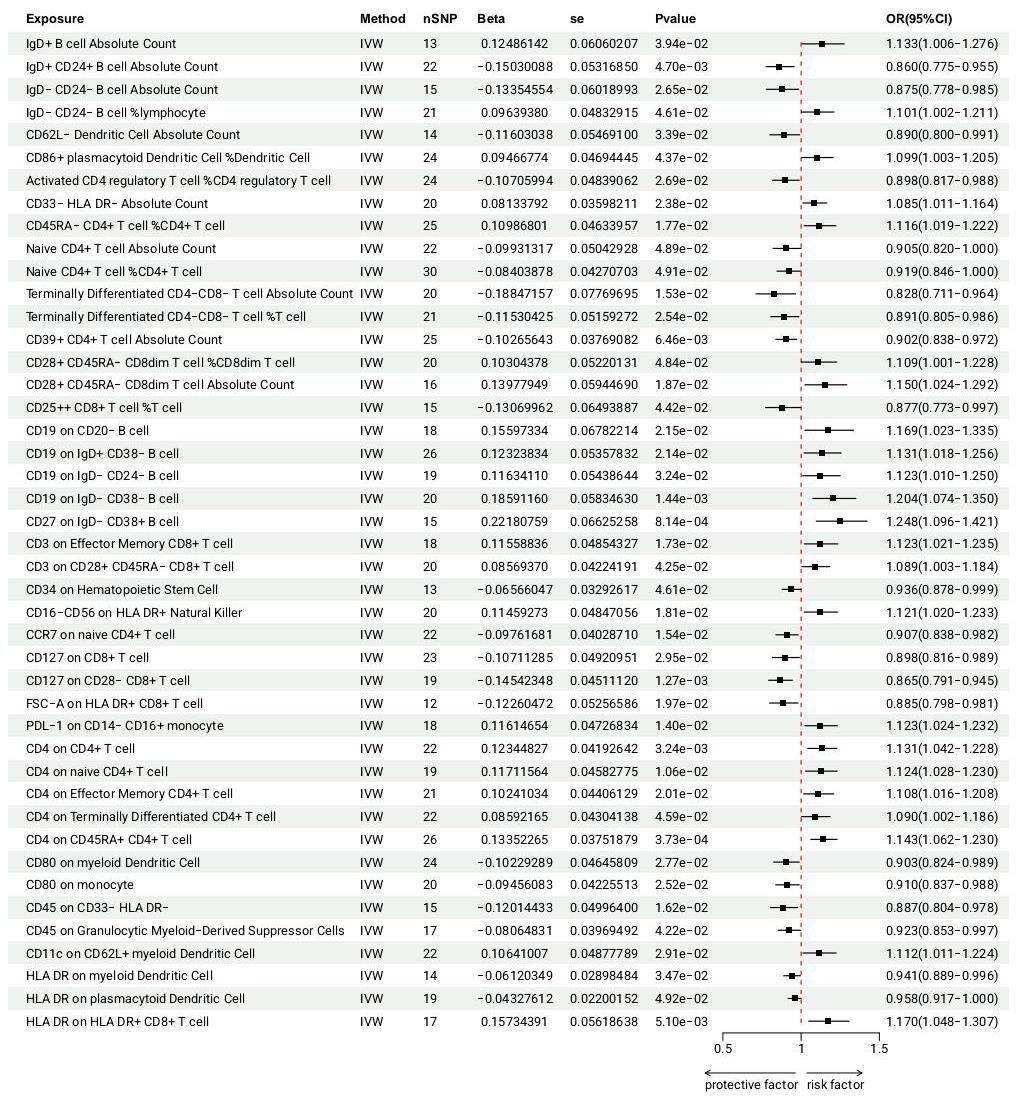
图2 逆方差加权法的正向孟德尔随机化分析结果
Fig.2 Results of forward Mendelian randomization analysis using the inverse variance weighted method.
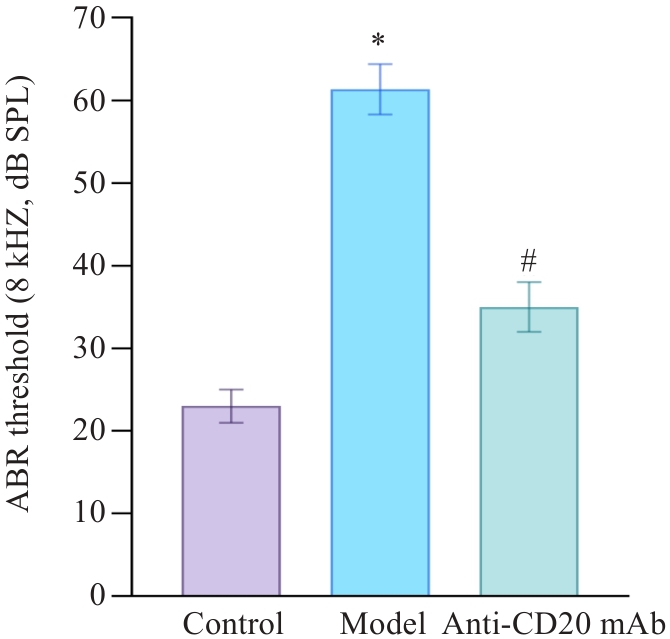
图3 各组小鼠 ABR 检测结果
Fig.3 Results of auditory brainstem response (ABR) test of the mice in each group (Mean±SD, n=20). *P<0.05 vs control group, #P<0.05 vs Model group.
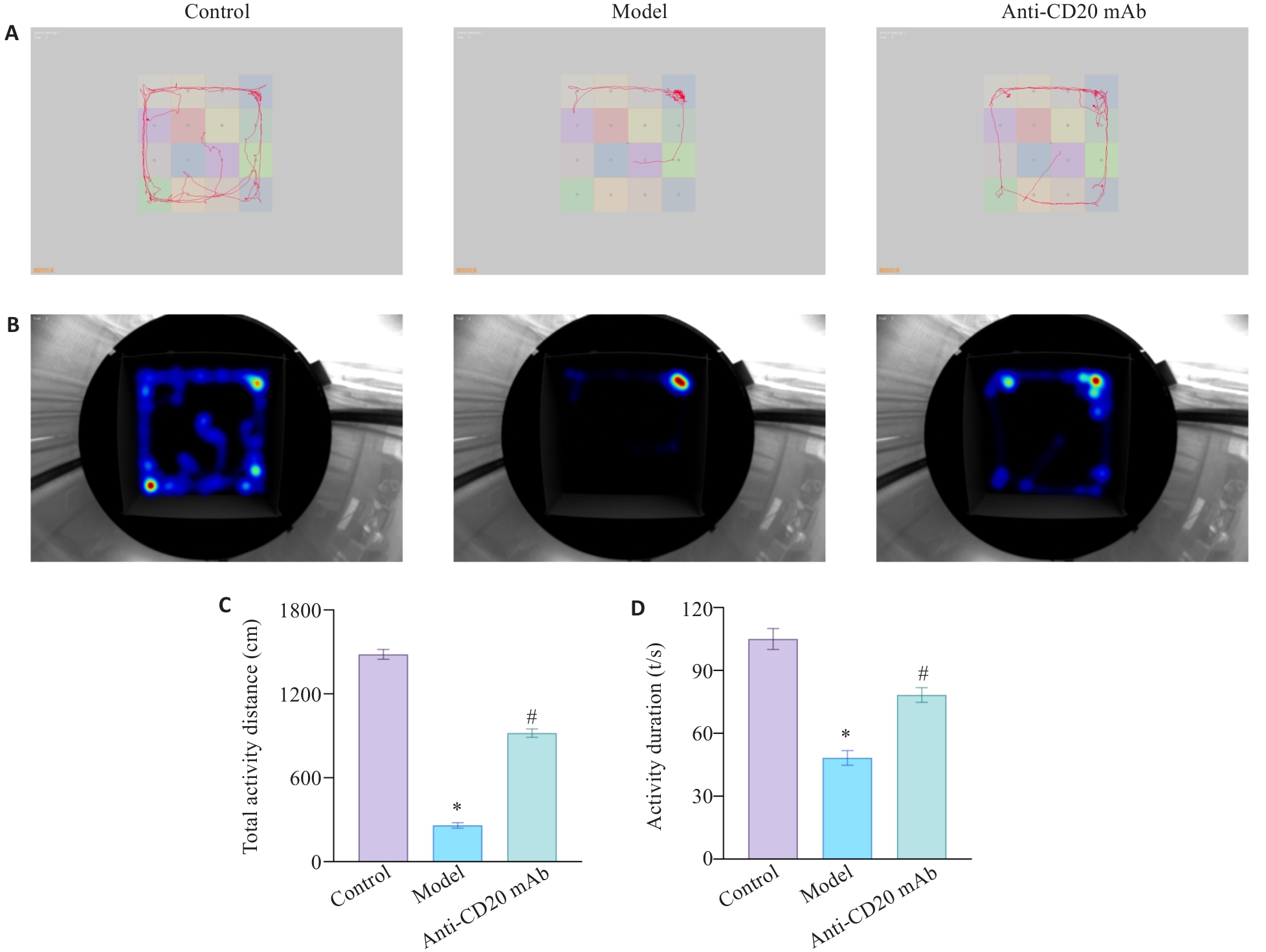
图4 各组小鼠旷场实验结果比较
Fig.4 Comparison of open field test results among the 3 groups of mice. A: Open field trajectory plot. B: Open field heatmap. C: Total activity distance. D: Activity duration (Mean±SD, n=10). *P<0.05 vs control group, #P<0.05 vs Model group.
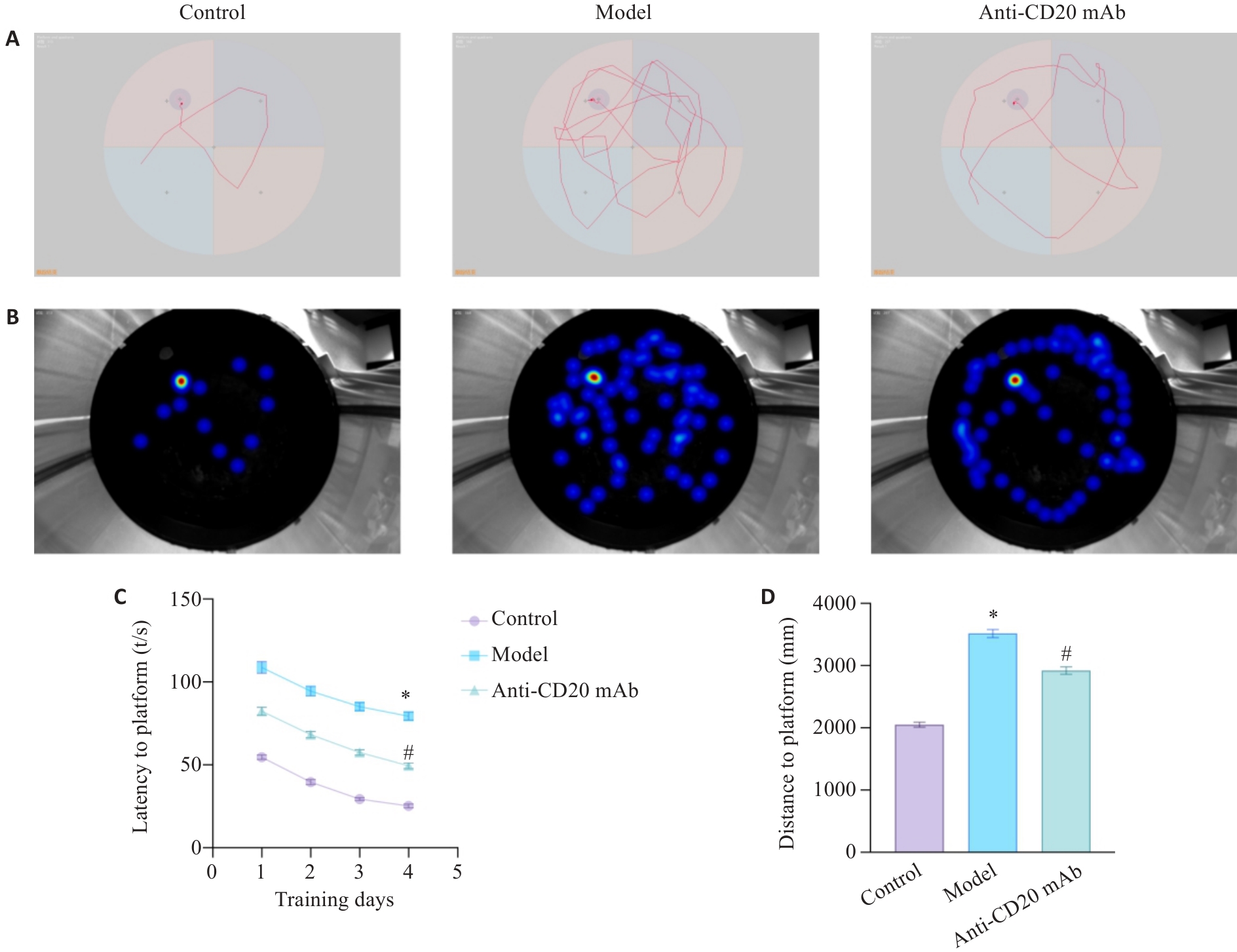
图5 各组小鼠Morris水迷宫实验结果比较
Fig.5 Comparison of Morris water maze test results among the 3 groups of mice. A: Morris Water Maze Trajectory Plot. B: Morris Water Maze Heatmap. C: Latency to platform. D: Distance to platform (Mean±SD, n=10).*P<0.05 vs control group, #P<0.05 vs Model group.
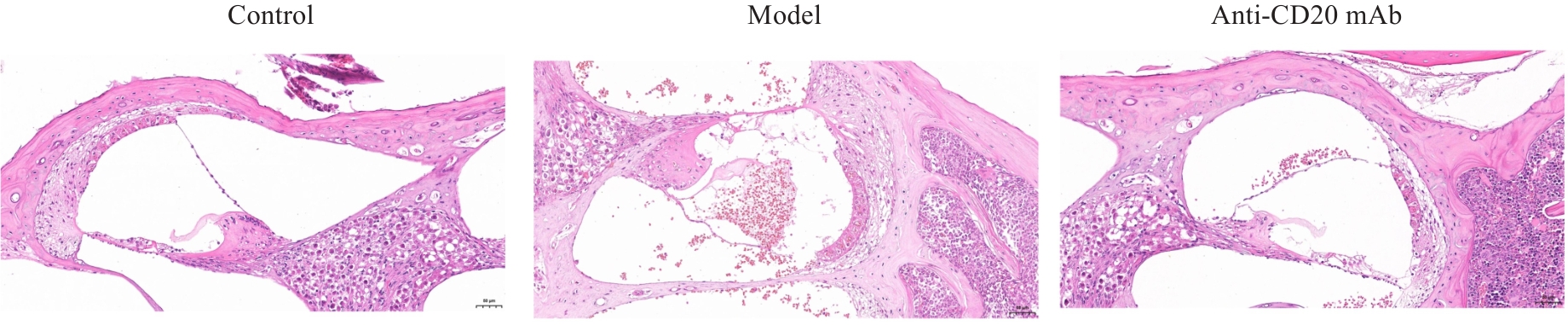
图6 各组小鼠耳蜗组织 HE 染色情况
Fig.6 HE staining of cochlear tissues in each group (Original magnification: ×200).
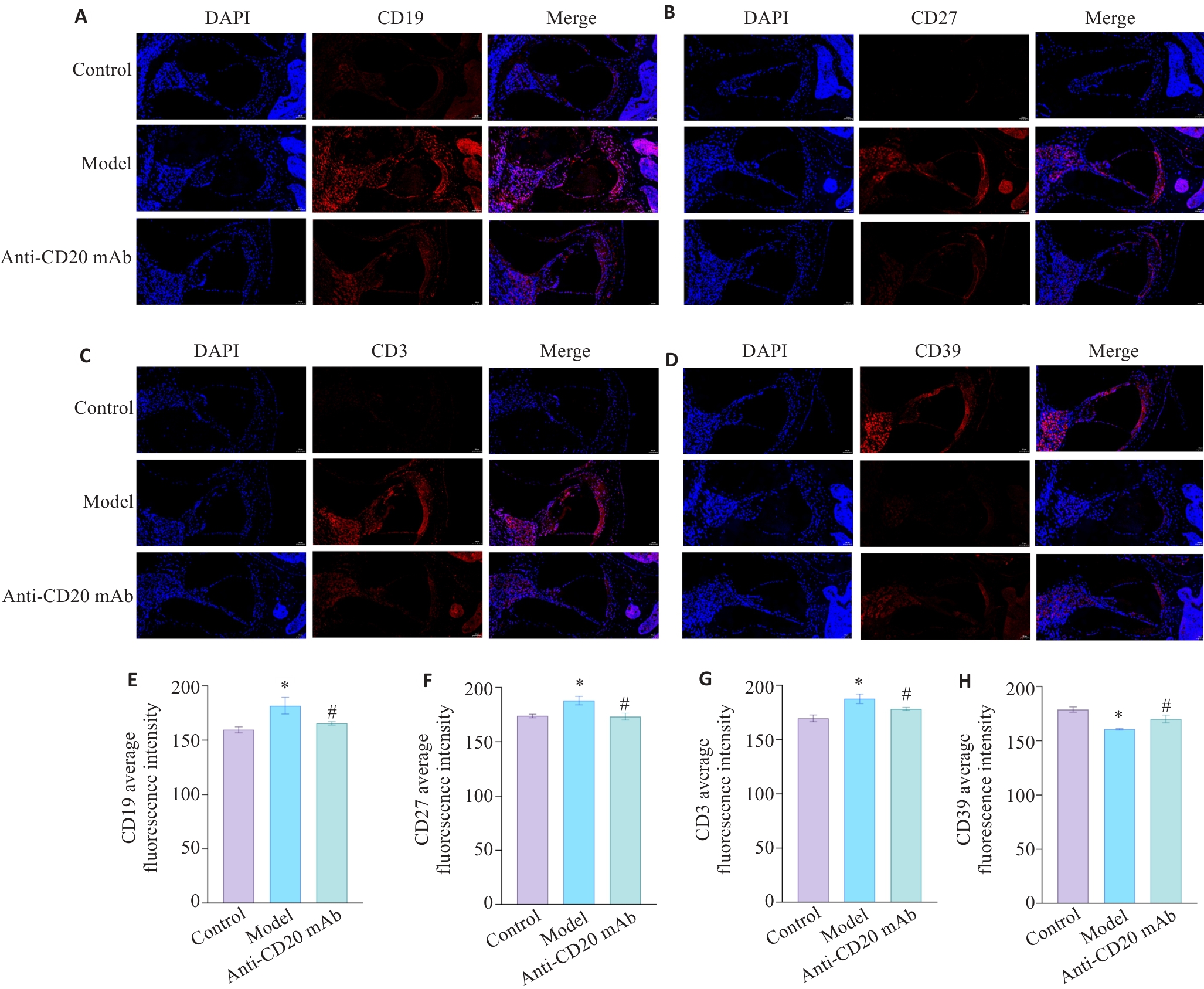
图7 各组小鼠耳蜗组织中CD19、CD27、CD3、CD39的表达
Fig.7 Expression of CD19, CD27, CD3, and CD39 in the cochlear tissues of mice in each group (×200). A: CD19 immunofluorescence staining. B: CD27 immunofluorescence staining. C: CD3 immunofluorescence staining. D: CD39 immunofluorescence staining. E,F: CD19, CD27, CD3 and CD39⁺ average fluorescence intensity (Mean±SD, n=8). *P<0.05 vs control group; #P<0.05 vs Model group.
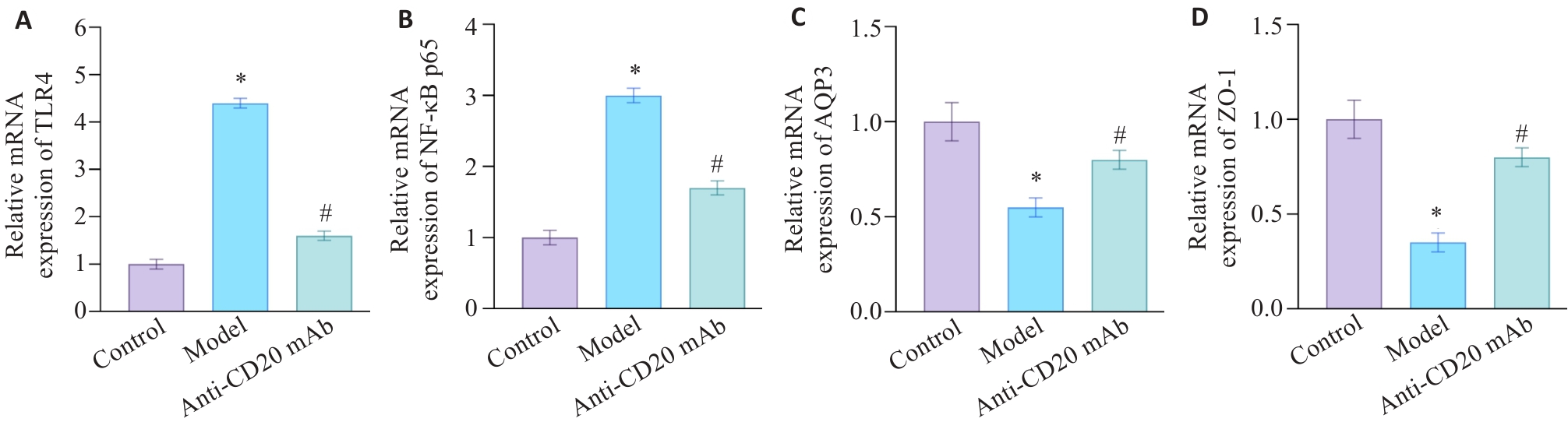
图8 各组小鼠耳蜗组织中TLR4、NF-κB、AQP3、ZO-1 mRNA相对表达
Fig.8 Relative expressions of TLR4 (A), NF-κB p65 (B), AQP3 (C) and ZO-1 (D) mRNA in the cochlear tissue of the mice in each group (Mean±SD, n=8). *P<0.05 vs Control group; #P<0.05 vs Model group.
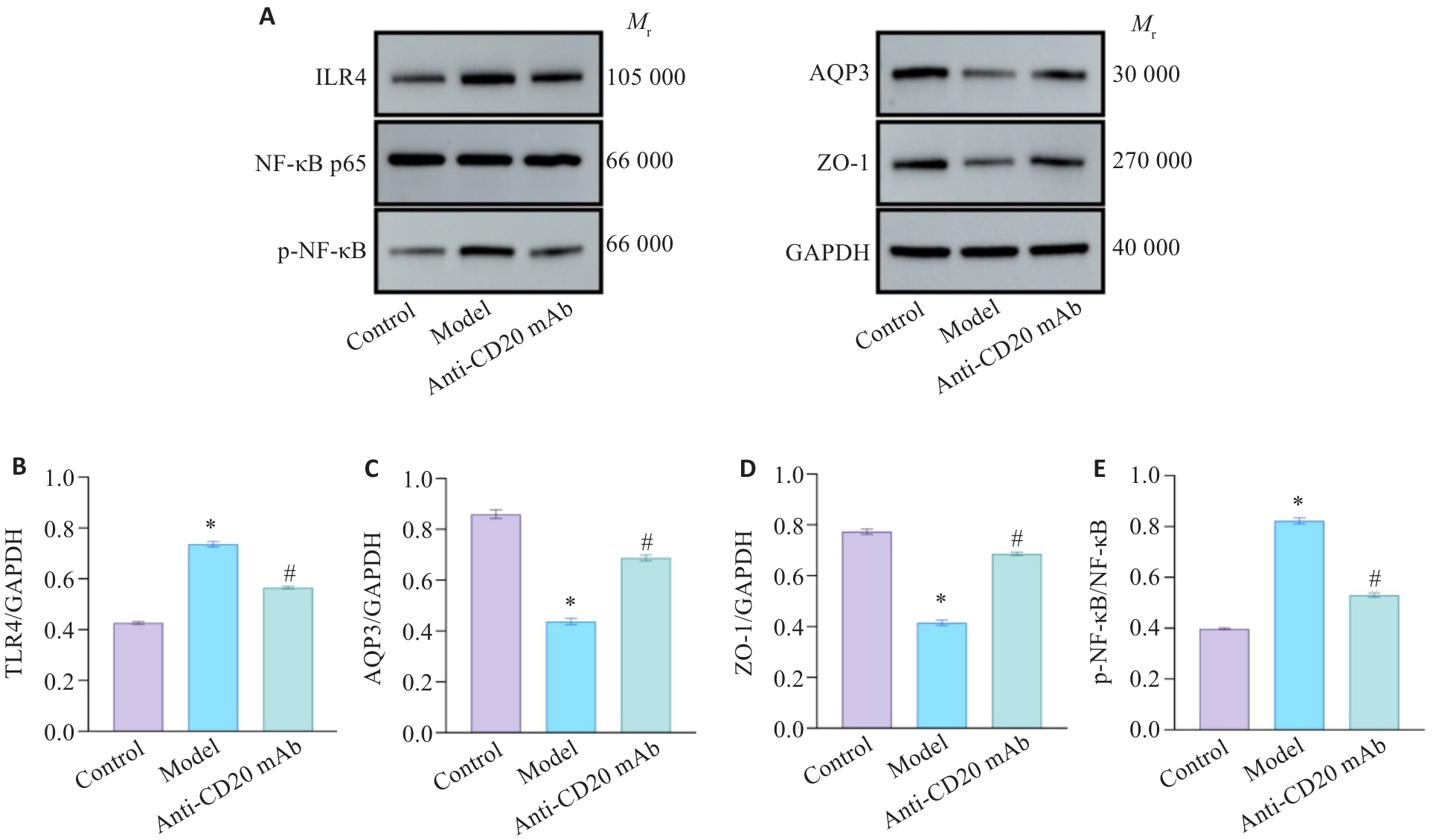
图9 Western blotting 检测各组小鼠耳蜗组织中TLR4、AQP3、ZO-1蛋白相对表达及p-NF-κB/NF-κB比值的比较
Fig.9 Relative expressions of TLR4, AQP3, ZO-1 proteins and the ratio of p-NF-κB/NF-κB in cochlear tissues of the mice in each group detected by Western blotting. A: Results of Western blotting of the proteins. B-D: Relative expressions of TLR4, AQP3 and ZO-1 proteins. E: Ratio of p-NF-κB/NF-κB. Data are presented as Mean±SD (n=8). *P<0.05 vs control group; #P<0.05 vs Model group.
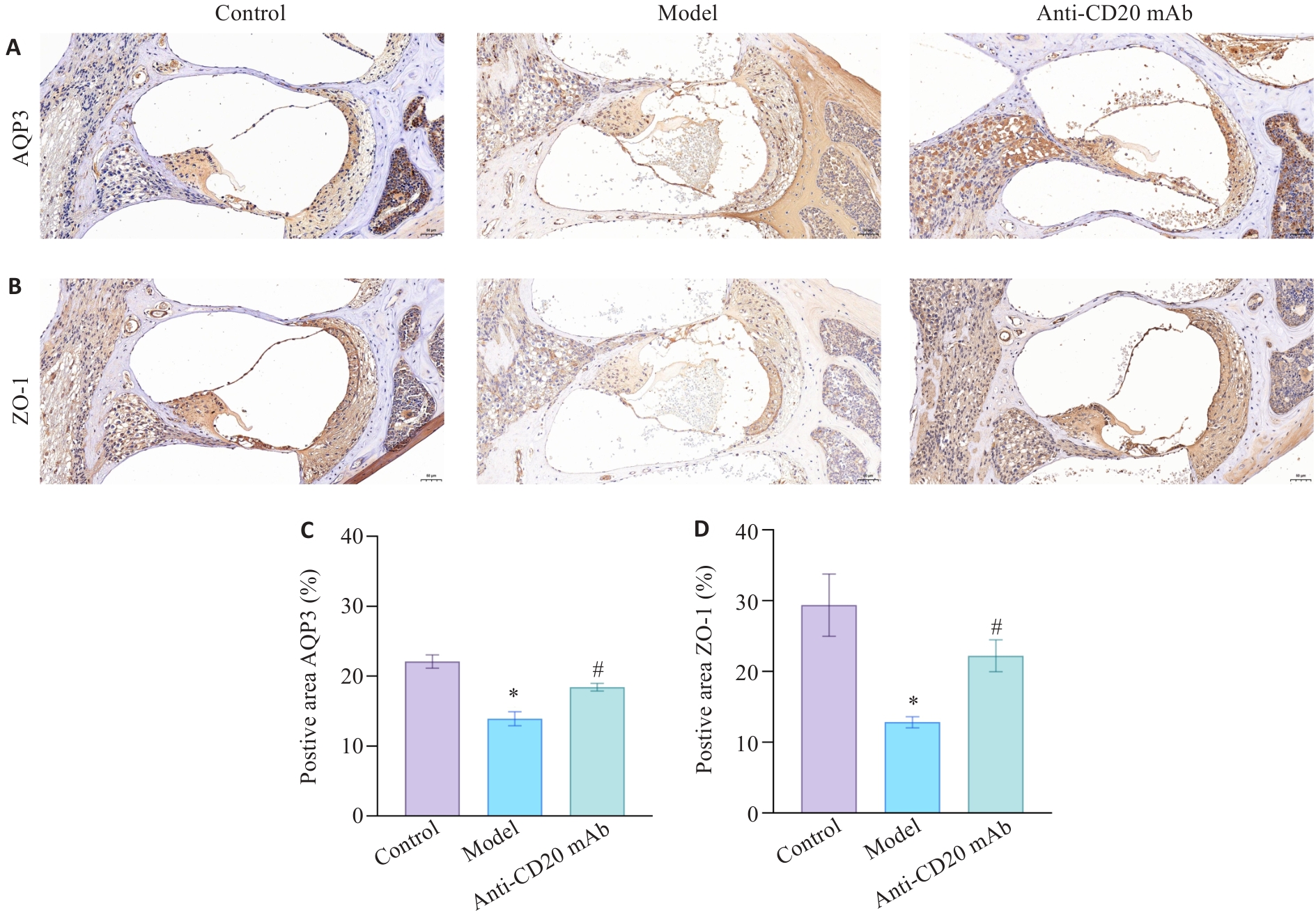
图10 各组小鼠耳蜗组织中AQP3、ZO-1的表达
Fig.10 Expression of AQP3 and ZO-1 in mouse cochlear tissues in each group (×200). A: AQP3 immunohistochemistry. B: ZO-1 immunohistochemistry. C-D: A450 nm values of AQP3 and ZO-1 (Mean±SD, n=8). *P<0.05 vs control group; #P<0.05 vs Model group.
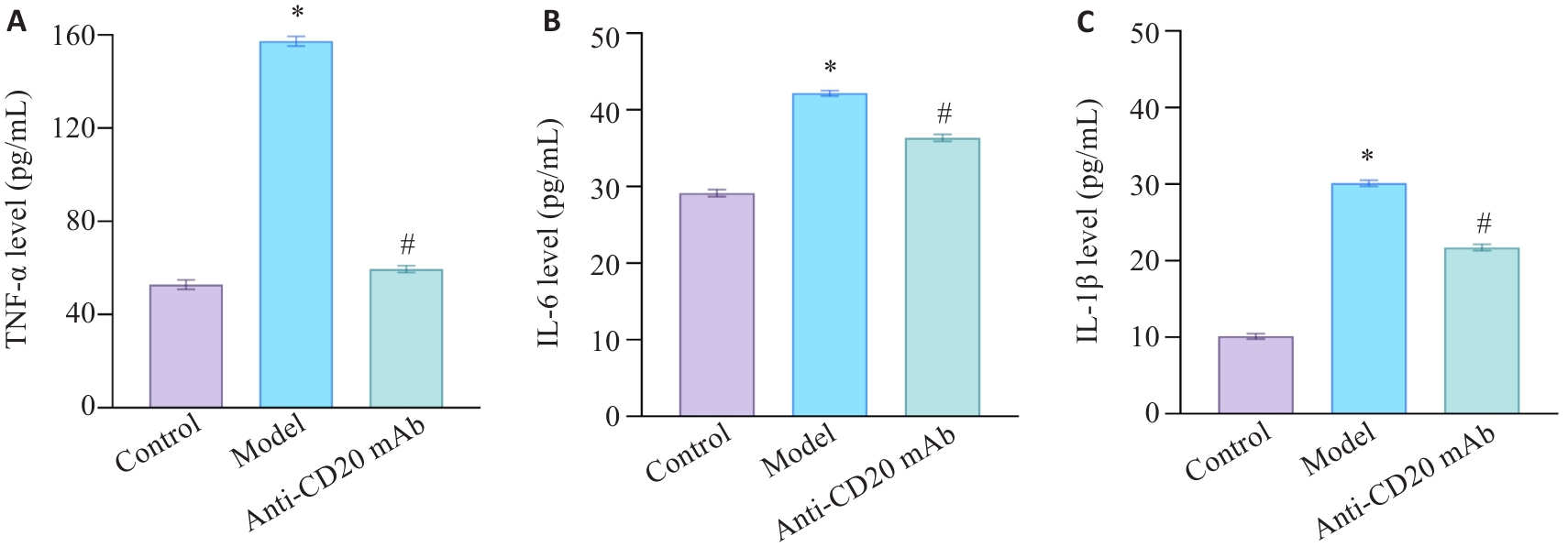
图11 各组小鼠血清中TNF-α、IL-6、IL-1β的含量
Fig.11 Serum levels of TNF-α (A), IL-6 (B) and IL-1β (C) in each group (Mean±SD, n=10). *P<0.05 vs control group; #P<0.05 vs Model group.
| [1] | Basura GJ, Adams ME, Monfared A, et al. Clinical practice guideline: ménière's disease[J]. Otolaryngol--head Neck Surg, 2020, 162(S2): S1-55. doi:10.1177/0194599820909438 |
| [2] | 中华耳鼻咽喉头颈外科杂志编辑委员会, 中华医学会耳鼻咽喉头颈外科学分会. 梅尼埃病诊断和治疗指南(2017)[J]. 中华耳鼻咽喉头颈外科杂志, 2017, 52(3): 167-72. doi:10.3760/cma.j.issn.1673-0860.2017.03.002 |
| [3] | Thompson-Harvey A, Friedland DR, Adams JA, et al. The demographics of menière's disease: selection bias or differential susceptibility?[J]. Otol Neurotol, 2023, 44(2): e95-102. doi:10.1097/mao.0000000000003780 |
| [4] | 于慧前, 李华伟, 李庆忠. 2020版 梅尼埃病临床实践指南解读[J]. 临床耳鼻咽喉头颈外科杂志, 2021, 35(5): 385-90. doi:10.13201/j.issn.2096-7993.2021.05.001 |
| [5] | Webster KE, Galbraith K, Harrington-Benton NA, et al. Systemic pharmacological interventions for Ménière's disease[J]. Cochrane Database Syst Rev, 2023, 2(2): CD015171. doi:10.1002/14651858.cd015171.pub2 |
| [6] | Lee A, Webster KE, George B, et al. Surgical interventions for ménière's disease[J]. Cochrane Database Syst Rev, 2023, 2(2): CD015249. doi:10.1002/14651858.cd015249.pub2 |
| [7] | Lucas JC, Hong RS. Recent surgical advances and continued controversies in medically refractory Meniere's disease[J]. Curr Opin Otolaryngol Head Neck Surg, 2023, 31(5): 325-31. doi:10.1097/moo.0000000000000907 |
| [8] | Lopez-Escamez JA, Liu Y. Epidemiology and genetics of Meniere's disease[J]. Curr Opin Neurol, 2024, 37(1): 88-94. doi:10.1097/wco.0000000000001227 |
| [9] | Yuan VG, Xia AP, Santa Maria PL. Immunological mechanisms in Meniere's disease[J]. Front Immunol, 2025, 16: 1639916. doi:10.3389/fimmu.2025.1639916 |
| [10] | Takeda T, Takeda S, Kakigi A. The clinical manifestation and treatment of Meniere's Disease from the viewpoint of the water homeostasis of the inner ear[J]. Auris Nasus Larynx, 2024, 51(6): 905-10. doi:10.1016/j.anl.2024.08.002 |
| [11] | Lopez-Escamez JA, Vela J, Frejo L. Immune-related disorders associated with ménière's disease: a systematic review and meta-analysis[J]. Otolaryngol-head Neck Surg, 2023, 169(5): 1122-31. doi:10.1002/ohn.386 |
| [12] | Jiang HL, Zhan YX, Zhao ML, et al. Immunological heterogeneity in Ménière's disease: CD4+ T cell subset profiling reveals three distinct Immunophenotypes[J]. J Neuroimmunol, 2025, 409: 578743. doi:10.1016/j.jneuroim.2025.578743 |
| [13] | Flook M, Escalera-Balsera A, Rybakowska P, et al. Single-cell immune profiling of Meniere Disease patients[J]. Clin Immunol, 2023, 252: 109632. doi:10.1016/j.clim.2023.109632 |
| [14] | Papadopoulou A, Åsvold BO, Burgess S, et al. Height, autoimmune thyroid disease, and thyroid cancer: a Mendelian randomization study[J]. Thyroid®, 2023, 33(12): 1476-82. doi:10.1089/thy.2023.0272 |
| [15] | Larsson SC, Butterworth AS, Burgess S. Mendelian randomization for cardiovascular diseases: principles and applications[J]. Eur Heart J, 2023, 44(47): 4913-24. doi:10.1093/eurheartj/ehad736 |
| [16] | 潘兴旭, 张秉祺, 张智华, 等. 戈登杆菌属丰度降低与肾结石风险增加相关: 一项孟德尔随机化分析与动物实验研究[J]. 南方医科大学学报, 2025, 45(11): 2405-15. |
| [17] | Long YW, Tang LH, Zhou YY, et al. Causal relationship between gut microbiota and cancers: a two-sample Mendelian randomisation study[J]. BMC Med, 2023, 21(1): 66. doi:10.1186/s12916-023-02761-6 |
| [18] | Kintu C, Soremekun O, Kamiza AB, et al. The causal effects of lipid traits on kidney function in Africans: bidirectional and multivariable Mendelian-randomization study[J]. EBioMedicine, 2023, 90: 104537. doi:10.1016/j.ebiom.2023.104537 |
| [19] | Zhang DG, Yu WQ, Liu JH, et al. Serum/glucocorticoid-inducible kinase 1 deficiency induces NLRP3 inflammasome activation and autoinflammation of macrophages in a murine endolymphatic Hydrops model[J]. Nat Commun, 2023, 14(1): 1249. doi:10.1038/s41467-023-36949-4 |
| [20] | 石 科, 李悦淇, 王 君, 等. 100 dB SPL 8~16 kHz倍频带噪声暴露对小鼠听觉功能的影响[J]. 中华耳科学杂志, 2025(7): 863-8. |
| [21] | 李文婕, 洪耀南, 黄 蕊, 等. 自身免疫性疾病是再生障碍性贫血的危险因素: 一项孟德尔随机化分析[J]. 南方医科大学学报, 2025, 45(4): 871-9. |
| [22] | 张仪铃, 周梓意, 郭 佳, 等. 免疫学视角下梅尼埃病的研究新进展[J]. 中华耳科学杂志, 2026, 24(2): 154-8. doi:10.3969/j.issn.1672-2922.2026.02.011 |
| [23] | Mougiakakos D, Krönke G, Völkl S, et al. CD19-targeted CAR T cells in refractory systemic lupus erythematosus[J]. N Engl J Med, 2021, 385(6): 567-9. doi:10.1056/nejmc2107725 |
| [24] | Chung MKY, Gong LQ, Kwong DL, et al. Functions of double-negative B cells in autoimmune diseases, infections, and cancers[J]. EMBO Mol Med, 2023, 15(9): e17341. doi:10.15252/emmm.202217341 |
| [25] | Timperi E, Barnaba V. CD39 regulation and functions in T cells[J]. Int J Mol Sci, 2021, 22(15): 8068. doi:10.3390/ijms22158068 |
| [26] | Liu DY, Hu XX, Chen ZY, et al. Key links in the physiological regulation of the immune system and disease induction: T cell receptor-CD3 complex[J]. Biochem Pharmacol, 2024, 227: 116441. doi:10.1016/j.bcp.2024.116441 |
| [27] | Ly S, Nedosekin D, Wong HK. Review of an anti-CD20 monoclonal antibody for the treatment of autoimmune diseases of the skin[J]. Am J Clin Dermatol, 2023, 24(2): 247-73. doi:10.1007/s40257-022-00751-7 |
| [28] | Monaghan NP, Shah S, Keith BA, et al. Proinflammatory cytokine profiles in menière's disease and vestibular migraine[J]. Otol Neurotol, 2025, 46(1): 88-95. doi:10.1097/mao.0000000000004372 |
| [29] | Song J, Huang XH, Luo Y, et al. Short-term exposure to a high-humidity environment triggers intestinal inflammation via AQP3[J]. Front Immunol, 2025, 16: 1563602. doi:10.3389/fimmu.2025.1563602 |
| [30] | 陈俊宏, 江 英, 周 利, 等. 连接蛋白在小鼠膜迷路积水模型中对耳蜗血-迷路屏障的影响[J]. 四川大学学报: 医学版, 2022, 53(2): 291-6. doi:10.12182/20220360207 |
| [31] | 任银先, 肖 芝, 于亚峰. 梅尼埃病与免疫细胞表型之间的关系: 双向孟德尔随机化研究[J]. 中华耳科学杂志, 2025, 23(5): 637-42. doi:10.3969/j.issn.1672-2922.2025.05.003 |
| [32] | Yatsunenko T, Rey FE, Manary MJ, et al. Human gut microbiome viewed across age and geography[J]. Nature, 2012, 486(7402): 222-7. doi:10.1038/nature11053 |
| [1] | 钟瀚翔, 赵渊宇, 傅宏, 董家勇, 丁国善, 陈瑶, 郭闻渊. 东亚人群口腔微生物群与肝细胞癌的因果关系:一项孟德尔随机化研究[J]. 南方医科大学学报, 2026, 46(7): 1467-1473. |
| [2] | 王淼, 卢必超, 孟昊阳, 周姝含, 毛宁峰, 张洋, 吕文亮. NDUFA13与CRIP1调控慢阻肺B细胞损伤并具备潜在诊断价值[J]. 南方医科大学学报, 2026, 46(6): 1349-1364. |
| [3] | 陈浩, 李振汉, 纪梦佳, 汪鑫诚, 陈博峰, 管谦, 武嫚, 卢林明. 全球非酒精性脂肪性肝病负担的关键决定因素:基于GBD数据的机器学习联合孟德尔随机化验证[J]. 南方医科大学学报, 2026, 46(4): 770-784. |
| [4] | 陈梅妹, 黄睿娜, 杨朝阳. 血浆代谢物介导炎症蛋白对阿尔茨海默病的因果效应:一项孟德尔随机化分析研究[J]. 南方医科大学学报, 2026, 46(2): 278-285. |
| [5] | 李文婕, 洪耀南, 黄蕊, 李煜宸, 张莹, 张蕴, 吴迪炯. 自身免疫性疾病是再生障碍性贫血的危险因素:一项孟德尔随机化分析[J]. 南方医科大学学报, 2025, 45(4): 871-879. |
| [6] | 高俊杰, 叶开, 吴竞. 槲皮素通过调控TP53基因抑制肾透明细胞癌的增殖和迁移[J]. 南方医科大学学报, 2025, 45(2): 313-321. |
| [7] | 喻珍妮, 高竟哲, 孙惠, 冯芹, 那效旗, 张宁, 沈昆双, 王媛媛, 王喜军. 肠道菌群、T细胞在结直肠癌发病中的因果关联:孟德尔随机化分析[J]. 南方医科大学学报, 2025, 45(12): 2756-2766. |
| [8] | 潘兴旭, 张秉祺, 张智华, 曹秋实. 戈登杆菌属丰度降低与肾结石风险增加相关:一项孟德尔随机化分析与动物实验研究[J]. 南方医科大学学报, 2025, 45(11): 2405-2415. |
| [9] | 马会华, 闫奎坡, 刘刚, 徐亚洲, 张磊, 李一卓. 1990~2021年心房颤动/扑动流行病学及其危险因素分析:基于2021年中国全球疾病负担研究与孟德尔随机化研究的系统分析[J]. 南方医科大学学报, 2025, 45(10): 2182-2190. |
| [10] | 姚辰, 李文佳, 庞瑞明, 周继红. 臀肌腱炎、原发性髋关节病可能导致髂胫束综合征—一项孟德尔随机化研究[J]. 南方医科大学学报, 2024, 44(9): 1821-1830. |
| [11] | 钟帷韬, 李伟松, 李泽霖, 王强, 张旺明. 睡眠性状与特发性正常压力脑积水的因果关联:一项两样本双向孟德尔随机化研究[J]. 南方医科大学学报, 2024, 44(8): 1612-1619. |
| [12] | 李和平, 李高桦, 张学华, 王亚楠. 直肠癌炎症蛋白因子的遗传驱动:孟德尔随机化方法在临床预后研究中的应用[J]. 南方医科大学学报, 2024, 44(7): 1361-1370. |
| [13] | 刘佳进, 缪长宏, 徐健康, 余伟杰, 陈继鑫, 唐好知, 刘爱峰. 肠道菌群与色素沉着绒毛结节性滑膜炎之间的因果关系:基于孟德尔随机化分析[J]. 南方医科大学学报, 2024, 44(7): 1397-1406. |
| [14] | 占雯婕, 赵 玲. 1型糖尿病可能增加甲状腺毒症的风险:基于两样本孟德尔随机化方法[J]. 南方医科大学学报, 2023, 43(8): 1396-1401. |
| [15] | 赵欢灵, 凌羽晓, 宓 帅, 朱家豪, 范佳耀, 杨 叶, 王 晶, 李迎君. Leptin循环水平与结直肠腺瘤及结直肠癌的关联性:一项病例对照和孟德尔随机化研究[J]. 南方医科大学学报, 2023, 43(12): 1989-1997. |
| 阅读次数 | ||||||
|
全文 |
|
|||||
|
摘要 |
|
|||||
