
南方医科大学学报 ›› 2026, Vol. 46 ›› Issue (7): 1509-1519.doi: 10.12122/j.issn.1673-4254.2026.07.05
• • 上一篇
朱梦欣1,4( ), 刘晓2, 赵珊3, 张新1,4, 刘超4, 刘献孔4, 綦浩辰4, 韩铁生1, 马冬1,4()
收稿日期:2026-01-07
出版日期:2026-07-20
发布日期:2026-07-20
通讯作者:
马冬
E-mail:zmx13375521993@163.com;madong119@ hebmu.edu.cn
作者简介:朱梦欣,在读硕士研究生,E-mail: zmx13375521993@163.com
基金资助:
Mengxin ZHU1,4(), Xiao LIU2, Shan ZHAO3, Xin ZHANG1,4, Chao LIU4, Xiankong LIU4, Haochen QI4, Tiesheng HAN1, Dong MA1,4()
Received:2026-01-07
Online:2026-07-20
Published:2026-07-20
Contact:
Dong MA
E-mail:zmx13375521993@163.com;madong119@ hebmu.edu.cn
Supported by:摘要:
目的 建立术前预测宫颈癌患者术后周围神经浸润(PNI)发生风险的机器学习模型和线上预测器,实现临床诊疗决策制定的人工智能应用。 方法 回顾性纳入845例于河北医科大学第四医院接受根治性手术治疗的宫颈癌患者病理资料,以7∶3的比例分为训练集(n=593)和测试集(n=252);同期纳入河北医科大学第二医院收治的223例宫颈癌患者组成外部验证集。LASSO筛选宫颈癌患者术后PNI发生相关术前特征变量,通过7种机器学习算法构建预测模型并通过ROC曲线下面积(AUC)和临床决策曲线(DCA)评价其预测效能及其在不同数据集的一致性。确定最优预测模型后进行SHAP解释,最终构建宫颈癌患者术后PNI发生风险的预测网站。 结果 共纳入1068例宫颈癌患者,其中192例(17.98%)患者术后病理结果呈现为PNI。LASSO回归分析共筛选:脉管间隙侵犯、间质浸润深度、淋巴结转移、阴道镜引导下穿刺活检、肿瘤最大直径、癌胚抗原、SCC-Ag、血小板/淋巴细胞比值、中性粒细胞/淋巴细胞比值、淋巴细胞*白蛋白/中性粒细胞比值、绝经情况、年龄和组织学类型等13个术前特征变量,7种算法对比,XGBoost模型在训练集和测试集中效能最佳,AUC分别为0.962和0.923,95% CI:0.942~0.979和0.874~0.960,敏感度为0.873、0.767,特异度为0.939、0.942。DCA分析结果同样显示XGBoost模型在较宽阈值范围内具有正向更大的净效益。基于SHAP可解释模型构建预测网站并进行外部验证,结果显示,该模型具有良好的泛化能力和预测准确性(AUC为0.924,准确率为0.933)。 结论 本研究开发的可解释性SHAP-XGBoost模型能够较好的预测宫颈癌患者术后周围神经浸润结局,基于该模型开发的预测网站可为宫颈癌诊疗决策制定提供辅助工具。
朱梦欣, 刘晓, 赵珊, 张新, 刘超, 刘献孔, 綦浩辰, 韩铁生, 马冬. 可解释性机器学习模型对宫颈癌周围神经浸润的术前精准预测及临床决策支持:一项多中心回顾性研究[J]. 南方医科大学学报, 2026, 46(7): 1509-1519.
Mengxin ZHU, Xiao LIU, Shan ZHAO, Xin ZHANG, Chao LIU, Xiankong LIU, Haochen QI, Tiesheng HAN, Dong MA. Interpretable machine learning models for preoperative precision prediction of perineural invasion in cervical cancer to support treatment decision: a multicenter retrospective study[J]. Journal of Southern Medical University, 2026, 46(7): 1509-1519.
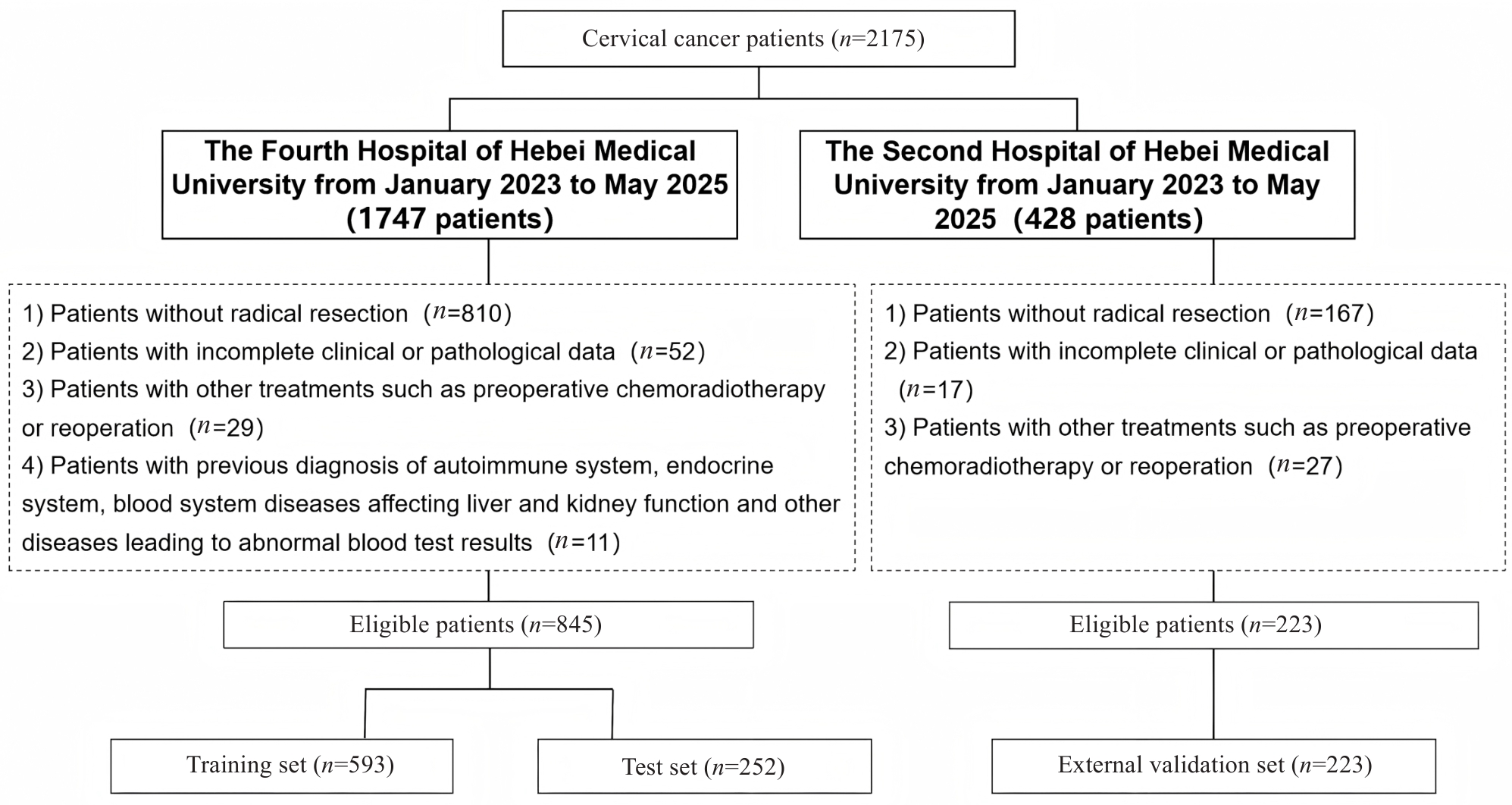
图1 样本筛查流程图
Fig.1 Sample screening flow chart.
| Variable | Total (n=845) | Training set (n=252) | Test set (n=593) | Pa | External validation set (n=223) | Pb |
|---|---|---|---|---|---|---|
| PNI | 0.994 | 0.331 | ||||
| Negative | 699 (82.96) | 209 (82.94) | 490 (82.63) | 177 (79.37) | ||
| Positive | 146 (17.04) | 43 (17.06) | 103 (17.37) | 46 (20.63) | ||
| LVSI | 0.918 | 0.912 | ||||
| Negative | 614 (72.66) | 182 (72.22) | 432 (72.85) | 164 (73.54) | ||
| Positive | 231 (27.34) | 70 (27.78) | 161 (27.15) | 59 (26.46) | ||
| DOI | 0.113 | 0.229 | ||||
| <1/3 | 446 (52.78) | 122 (48.41) | 324 (54.64) | 133 (59.64) | ||
| ≥1/3 | 399 (47.22) | 130 (51.59) | 269 (45.36) | 90 (40.36) | ||
| LNM | 0.549 | 1 | ||||
| Negative | 673 (79.64) | 197 (78.17) | 476 (80.27) | 179 (80.27) | ||
| Positive | 172 (20.36) | 55 (21.83) | 117 (19.73) | 44 (19.73) | ||
| Tumor size (cm) | 0.938 | 0.309 | ||||
| <4 | 681 (80.59) | 204 (80.95) | 477 (80.44) | 187 (83.86) | ||
| ≥4 | 164 (19.41) | 48 (19.05) | 116 (19.56) | 36 (16.14) | ||
| CDB | 0.621 | 0.028 | ||||
| LSIL | 57 (6.75) | 18 (7.14) | 39 (6.58) | 22 (9.86) | ||
| HSIL | 299 (35.38) | 83 (32.94) | 216 (36.42) | 96 (43.05) | ||
| CC | 489 (57.87) | 151 (59.92) | 338 (57.00) | 105 (47.09) | ||
| TCT | 0.772 | 0.934 | ||||
| <ASC-H | 324 (38.34) | 99 (39.29) | 225 (37.94) | 86 (38.57) | ||
| ≥ASC-H | 521 (61.66) | 153 (60.71) | 368 (62.06) | 137 (61.43) | ||
| Histological types | 0.366 | 0.543 | ||||
| SCC | 739 (87.46) | 215 (85.32) | 524 (88.36) | 202 (90.58) | ||
| AC | 98 (11.60) | 35 (13.89) | 63 (10.62) | 20 (8.97) | ||
| ASC | 8 (0.95) | 2 (0.79) | 6 (1.01) | 1 (0.45) | ||
| Age (year) | 0.341 | <0.001 | ||||
| <45 | 225 (26.63) | 61 (24.21) | 164 (27.66) | 165 (73.99) | ||
| ≥45 | 620 (73.37) | 191 (75.79) | 429 (72.34) | 58 (26.01) | ||
| Family history of tumor | 1 | 0.629 | ||||
| No | 715 (84.62) | 213 (84.52) | 502 (84.65) | 185 (82.96) | ||
| Yes | 130 (15.38) | 39 (15.48) | 91 (15.35) | 38 (17.04) | ||
| Menopausal status | 0.672 | 0.110 | ||||
| No | 353 (41.78) | 102(40.48) | 251 (42.33) | 109 (48.88) | ||
| Yes | 492 (58.22) | 150(59.52) | 342 (57.67) | 114 (51.12) | ||
| Gravidity | 0.496 | 0.771 | ||||
| 0 | 10 (1.18) | 3 (1.19) | 7 (1.18) | 2 (0.90) | ||
| 1-3 | 520 (61.54) | 163 (64.68) | 357 (60.20) | 140 (62.78) | ||
| ≥4 | 315 (37.28) | 86 (34.13) | 229 (38.62) | 81 (36.32) | ||
| Parity | 0.982 | 0.615 | ||||
| 0 | 21 (2.49) | 6 (2.38) | 15 (2.53) | 8 (3.59) | ||
| 1-2 | 639 (75.62) | 190 (75.40) | 449 (75.72) | 163 (73.09) | ||
| ≥3 | 185 (21.89) | 56 (22.22) | 129 (21.75) | 52 (23.32) | ||
| Hypertension | 0.572 | 0.700 | ||||
| No | 656 (77.63) | 192 (76.19) | 464 (78.25) | 171 (76.68) | ||
| Yes | 189 (22.37) | 60 (23.81) | 129 (21.75) | 52 (23.32) | ||
表1 宫颈癌患者临床资料特征
Tab.1 Clinical characteristics of cervical cancer patients [n (%), Mean±SD]
| Variable | Total (n=845) | Training set (n=252) | Test set (n=593) | Pa | External validation set (n=223) | Pb |
|---|---|---|---|---|---|---|
| PNI | 0.994 | 0.331 | ||||
| Negative | 699 (82.96) | 209 (82.94) | 490 (82.63) | 177 (79.37) | ||
| Positive | 146 (17.04) | 43 (17.06) | 103 (17.37) | 46 (20.63) | ||
| LVSI | 0.918 | 0.912 | ||||
| Negative | 614 (72.66) | 182 (72.22) | 432 (72.85) | 164 (73.54) | ||
| Positive | 231 (27.34) | 70 (27.78) | 161 (27.15) | 59 (26.46) | ||
| DOI | 0.113 | 0.229 | ||||
| <1/3 | 446 (52.78) | 122 (48.41) | 324 (54.64) | 133 (59.64) | ||
| ≥1/3 | 399 (47.22) | 130 (51.59) | 269 (45.36) | 90 (40.36) | ||
| LNM | 0.549 | 1 | ||||
| Negative | 673 (79.64) | 197 (78.17) | 476 (80.27) | 179 (80.27) | ||
| Positive | 172 (20.36) | 55 (21.83) | 117 (19.73) | 44 (19.73) | ||
| Tumor size (cm) | 0.938 | 0.309 | ||||
| <4 | 681 (80.59) | 204 (80.95) | 477 (80.44) | 187 (83.86) | ||
| ≥4 | 164 (19.41) | 48 (19.05) | 116 (19.56) | 36 (16.14) | ||
| CDB | 0.621 | 0.028 | ||||
| LSIL | 57 (6.75) | 18 (7.14) | 39 (6.58) | 22 (9.86) | ||
| HSIL | 299 (35.38) | 83 (32.94) | 216 (36.42) | 96 (43.05) | ||
| CC | 489 (57.87) | 151 (59.92) | 338 (57.00) | 105 (47.09) | ||
| TCT | 0.772 | 0.934 | ||||
| <ASC-H | 324 (38.34) | 99 (39.29) | 225 (37.94) | 86 (38.57) | ||
| ≥ASC-H | 521 (61.66) | 153 (60.71) | 368 (62.06) | 137 (61.43) | ||
| Histological types | 0.366 | 0.543 | ||||
| SCC | 739 (87.46) | 215 (85.32) | 524 (88.36) | 202 (90.58) | ||
| AC | 98 (11.60) | 35 (13.89) | 63 (10.62) | 20 (8.97) | ||
| ASC | 8 (0.95) | 2 (0.79) | 6 (1.01) | 1 (0.45) | ||
| Age (year) | 0.341 | <0.001 | ||||
| <45 | 225 (26.63) | 61 (24.21) | 164 (27.66) | 165 (73.99) | ||
| ≥45 | 620 (73.37) | 191 (75.79) | 429 (72.34) | 58 (26.01) | ||
| Family history of tumor | 1 | 0.629 | ||||
| No | 715 (84.62) | 213 (84.52) | 502 (84.65) | 185 (82.96) | ||
| Yes | 130 (15.38) | 39 (15.48) | 91 (15.35) | 38 (17.04) | ||
| Menopausal status | 0.672 | 0.110 | ||||
| No | 353 (41.78) | 102(40.48) | 251 (42.33) | 109 (48.88) | ||
| Yes | 492 (58.22) | 150(59.52) | 342 (57.67) | 114 (51.12) | ||
| Gravidity | 0.496 | 0.771 | ||||
| 0 | 10 (1.18) | 3 (1.19) | 7 (1.18) | 2 (0.90) | ||
| 1-3 | 520 (61.54) | 163 (64.68) | 357 (60.20) | 140 (62.78) | ||
| ≥4 | 315 (37.28) | 86 (34.13) | 229 (38.62) | 81 (36.32) | ||
| Parity | 0.982 | 0.615 | ||||
| 0 | 21 (2.49) | 6 (2.38) | 15 (2.53) | 8 (3.59) | ||
| 1-2 | 639 (75.62) | 190 (75.40) | 449 (75.72) | 163 (73.09) | ||
| ≥3 | 185 (21.89) | 56 (22.22) | 129 (21.75) | 52 (23.32) | ||
| Hypertension | 0.572 | 0.700 | ||||
| No | 656 (77.63) | 192 (76.19) | 464 (78.25) | 171 (76.68) | ||
| Yes | 189 (22.37) | 60 (23.81) | 129 (21.75) | 52 (23.32) | ||
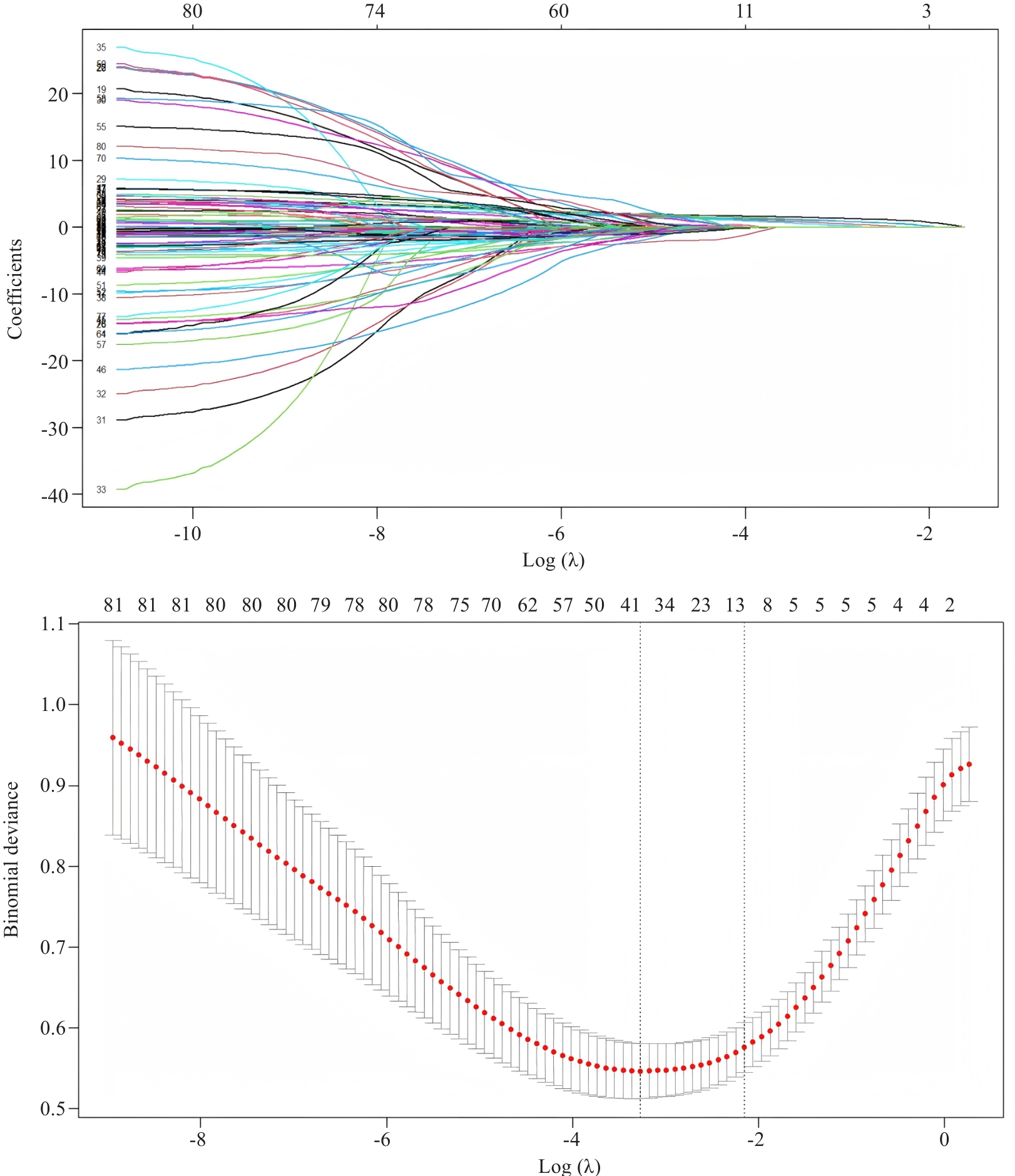
图2 LASSO 回归变量筛选
Fig.2 LASSO regression variable screening.
| Cohort | Model | AUC (95% CI) | Accuracy | F1 score | Sensitivity | Specificity |
|---|---|---|---|---|---|---|
| Training set | LR | 0.945 (0.921, 0.965) | 0.863 | 0.682 | 0.852 | 0.865 |
| RF | 0.947 (0.924, 0.969) | 0.905 | 0.757 | 0.853 | 0.916 | |
| GBDT | 0.934 (0.904, 0.958) | 0.834 | 0.651 | 0.891 | 0.822 | |
| ET | 0.941 (0.916, 0.963) | 0.919 | 0.769 | 0.784 | 0.947 | |
| LGB | 0.937 (0.912, 0.959) | 0.831 | 0.645 | 0.864 | 0.812 | |
| XGBoost | 0.962 (0.942, 0.979) | 0.926 | 0.800 | 0.873 | 0.939 | |
| CB | 0.950 (0.927, 0.969) | 0.871 | 0.705 | 0.862 | 0.877 | |
| Test set | LR | 0.921 (0.871, 0.961) | 0.852 | 0.662 | 0.773 | 0.881 |
| RF | 0.917 (0.866, 0.959) | 0.929 | 0.728 | 0.727 | 0.931 | |
| GBDT | 0.895 (0.838, 0.947) | 0.906 | 0.714 | 0.689 | 0.922 | |
| ET | 0.912 (0.860, 0.955) | 0.906 | 0.733 | 0.748 | 0.938 | |
| LGB | 0.905 (0.846, 0.946) | 0.862 | 0.665 | 0.743 | 0.891 | |
| XGBoost | 0.923 (0.874, 0.960) | 0.913 | 0.744 | 0.767 | 0.942 | |
| CB | 0.919 (0.873, 0.957) | 0.898 | 0.717 | 0.751 | 0.929 | |
| External validation set | LR | 0.820 (0.751, 0.881) | 0.768 | 0.798 | 0.795 | 0.716 |
| RF | 0.835 (0.756, 0.904) | 0.852 | 0.749 | 0.674 | 0.898 | |
| GBDT | 0.848 (0.773, 0.914) | 0.834 | 0.802 | 0.717 | 0.864 | |
| ET | 0.806 (0.729, 0.874) | 0.816 | 0.743 | 0.652 | 0.859 | |
| LGB | 0.827 (0.757, 0.890) | 0.803 | 0.761 | 0.717 | 0.825 | |
| XGBoost | 0.924 (0.874, 0.965) | 0.933 | 0.869 | 0.739 | 0.933 | |
| CB | 0.855 (0.792, 0.918) | 0.857 | 0.834 | 0.696 | 0.898 |
表2 7种模型的性能指标比较
Tab.2 Comparison of performance metrics for the 7 models
| Cohort | Model | AUC (95% CI) | Accuracy | F1 score | Sensitivity | Specificity |
|---|---|---|---|---|---|---|
| Training set | LR | 0.945 (0.921, 0.965) | 0.863 | 0.682 | 0.852 | 0.865 |
| RF | 0.947 (0.924, 0.969) | 0.905 | 0.757 | 0.853 | 0.916 | |
| GBDT | 0.934 (0.904, 0.958) | 0.834 | 0.651 | 0.891 | 0.822 | |
| ET | 0.941 (0.916, 0.963) | 0.919 | 0.769 | 0.784 | 0.947 | |
| LGB | 0.937 (0.912, 0.959) | 0.831 | 0.645 | 0.864 | 0.812 | |
| XGBoost | 0.962 (0.942, 0.979) | 0.926 | 0.800 | 0.873 | 0.939 | |
| CB | 0.950 (0.927, 0.969) | 0.871 | 0.705 | 0.862 | 0.877 | |
| Test set | LR | 0.921 (0.871, 0.961) | 0.852 | 0.662 | 0.773 | 0.881 |
| RF | 0.917 (0.866, 0.959) | 0.929 | 0.728 | 0.727 | 0.931 | |
| GBDT | 0.895 (0.838, 0.947) | 0.906 | 0.714 | 0.689 | 0.922 | |
| ET | 0.912 (0.860, 0.955) | 0.906 | 0.733 | 0.748 | 0.938 | |
| LGB | 0.905 (0.846, 0.946) | 0.862 | 0.665 | 0.743 | 0.891 | |
| XGBoost | 0.923 (0.874, 0.960) | 0.913 | 0.744 | 0.767 | 0.942 | |
| CB | 0.919 (0.873, 0.957) | 0.898 | 0.717 | 0.751 | 0.929 | |
| External validation set | LR | 0.820 (0.751, 0.881) | 0.768 | 0.798 | 0.795 | 0.716 |
| RF | 0.835 (0.756, 0.904) | 0.852 | 0.749 | 0.674 | 0.898 | |
| GBDT | 0.848 (0.773, 0.914) | 0.834 | 0.802 | 0.717 | 0.864 | |
| ET | 0.806 (0.729, 0.874) | 0.816 | 0.743 | 0.652 | 0.859 | |
| LGB | 0.827 (0.757, 0.890) | 0.803 | 0.761 | 0.717 | 0.825 | |
| XGBoost | 0.924 (0.874, 0.965) | 0.933 | 0.869 | 0.739 | 0.933 | |
| CB | 0.855 (0.792, 0.918) | 0.857 | 0.834 | 0.696 | 0.898 |
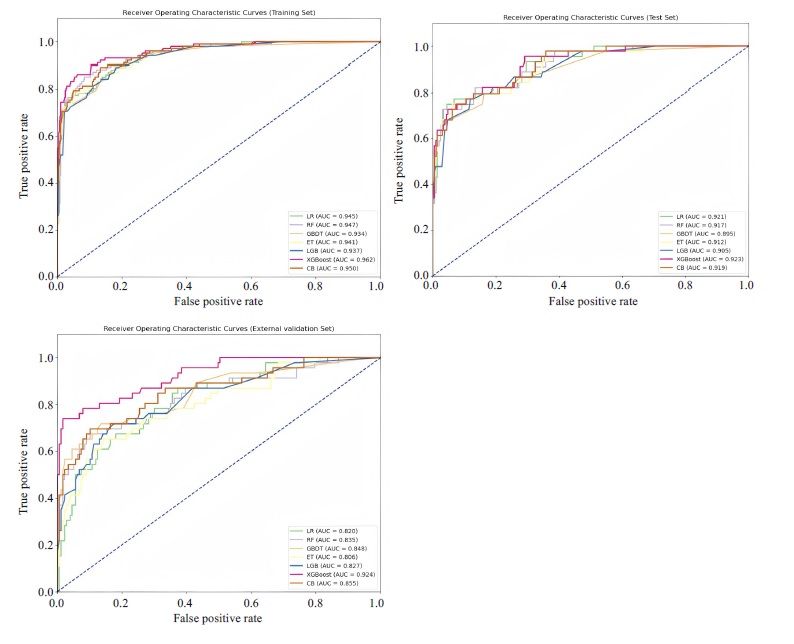
图3 训练集、测试集和验证集中7种机器学习模型的ROC曲线比较
Fig.3 Comparison of ROC curves for the 7 machine learning models across the training set, test set, and validation set.
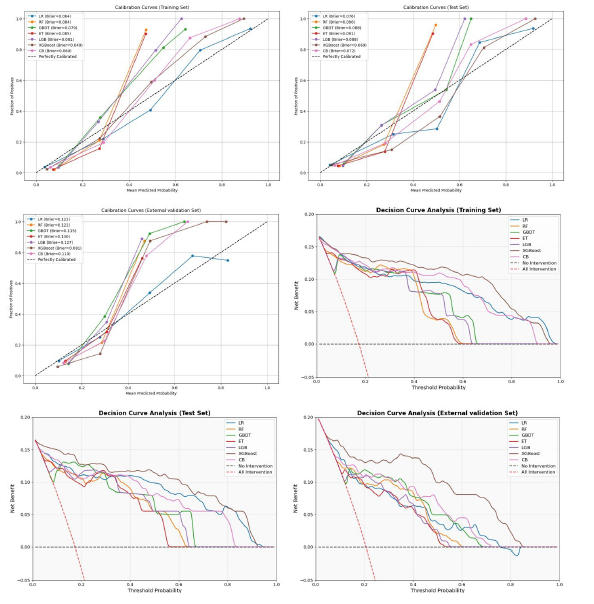
图4 训练集、测试集和验证集中7种模型的校准曲线和DCA曲线比较
Fig.4 Comparison of calibration curves and DCA curves for the 7 models across the training set, test set, and validation set.
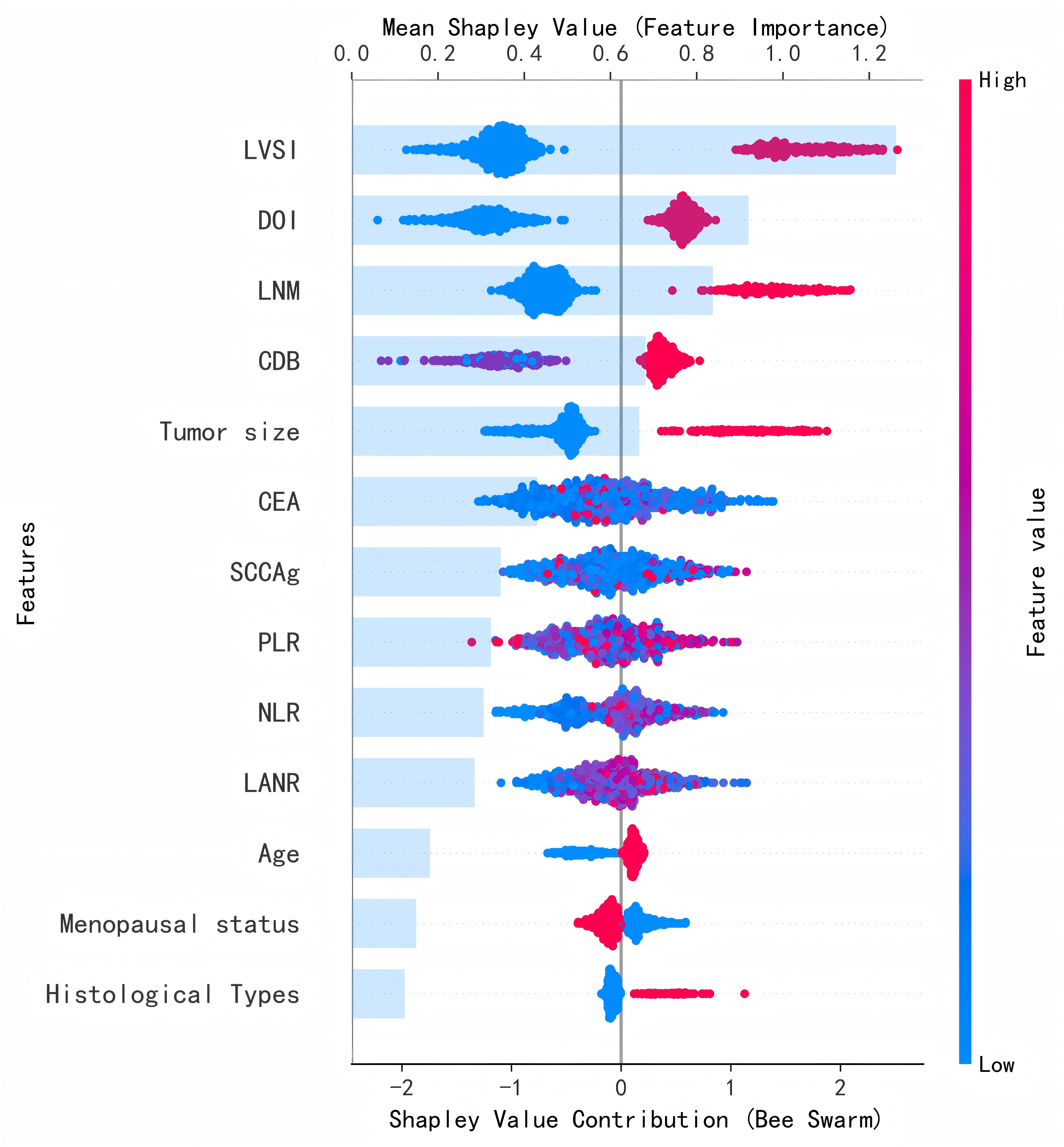
图5 XGBoost模型特征贡献程度的SHAP解释图
Fig.5 SHAP explanation plot of feature contribution levels in the XGBoost model.
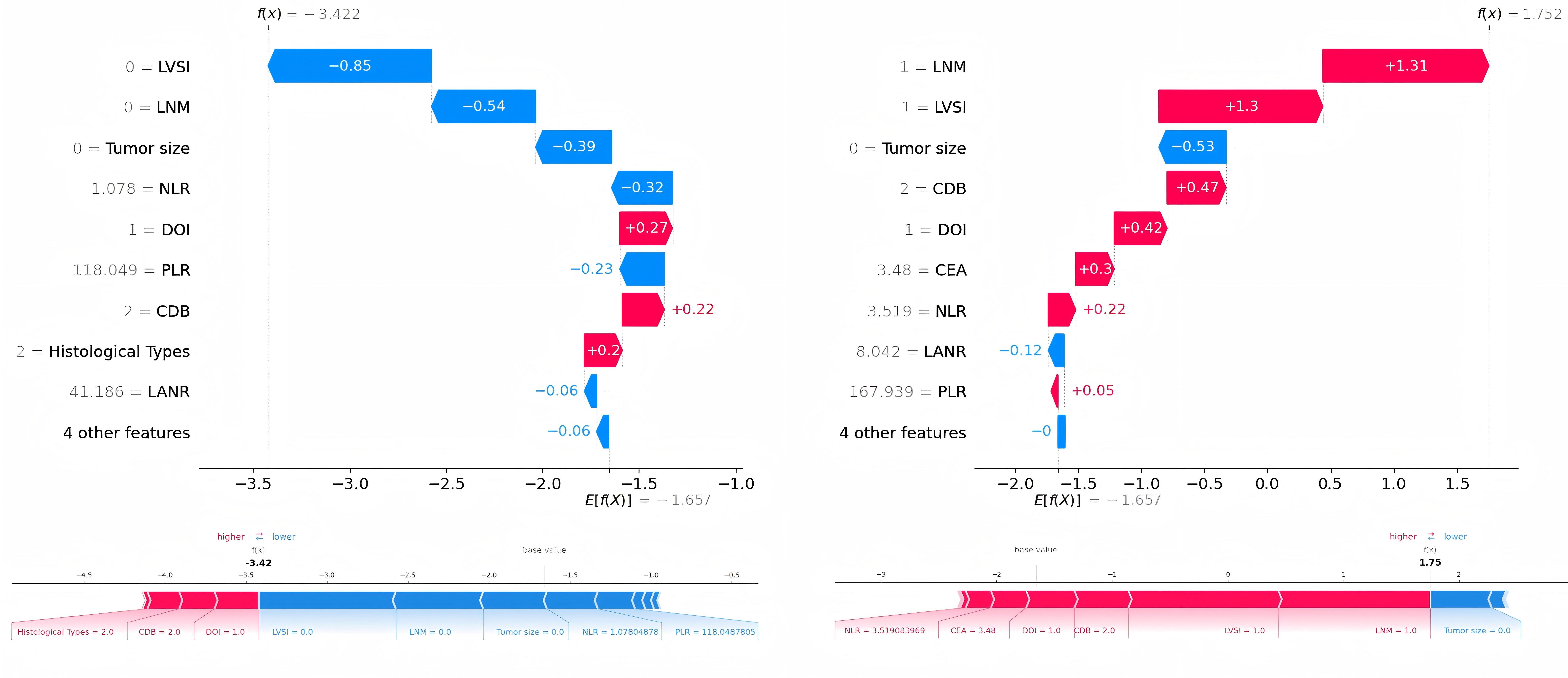
图6 XGBoost模型模型个体可视化的SHAP解释图
Fig.6 SHAP explanation plot for individual model visualization of the XGBoost model.
| [1] | Ogasawara A, Hasegawa K. Recent advances in immunotherapy for cervical cancer[J]. Int J Clin Oncol, 2025, 30(3): 434-48. doi:10.1007/s10147-025-02699-0 |
| [2] | Bray F, Laversanne M, Sung H, et al. Global cancer statistics 2022: GLOBOCAN estimates of incidence and mortality worldwide for 36 cancers in 185 countries[J]. CA Cancer J Clin, 2024, 74(3): 229-63. doi:10.3322/caac.21834 |
| [3] | Gallotta V, Conte C, Federico A, et al. Robotic versus laparoscopic radical hysterectomy in early cervical cancer: a case matched control study[J]. Eur J Surg Oncol, 2018, 44(6): 754-9. doi:10.1016/j.ejso.2018.01.092 |
| [4] | Li XY, Yang XJ, Lin SC, et al. Perineural invasion in cervical cancer[J]. Cancer Lett, 2025, 616: 217561. doi:10.1016/j.canlet.2025.217561 |
| [5] | Lee S, Bae J, Han M, et al. Efficacy of nerve-sparing radical hysterectomy vs. conventional radical hysterectomy in early-stage cervical cancer: a systematic review and meta-analysis[J]. Mol Clin Onc, 2019 12(2): 160-8. |
| [6] | Ceccaroni M, Roviglione G, Malzoni M, et al. Total laparoscopic vs. conventional open abdominal nerve-sparing radical hysterectomy: clinical, surgical, oncological and functional outcomes in 301 patients with cervical cancer[J]. J Gynecol Oncol, 2021, 32: e10. doi:10.3802/jgo.2021.32.e10 |
| [7] | Santoro A, Angelico G, Travaglino A, et al. Prognostic role of perineural invasion in vulvar squamous cell carcinoma: a systematic review and meta-analysis[J]. Eur J Surg Oncol, 2022, 48(12): 2354-9. doi:10.1016/j.ejso.2022.06.031 |
| [8] | Ho C, Chien T, Huang S, et al. Multivariate analysis of the prognostic factors and outcomes in early cervical cancer patients undergoing radical hysterectomy[J]. Gynecol Oncol, 2004, 93(2): 458-64. doi:10.1016/j.ygyno.2004.01.026 |
| [9] | Qi ZC, Yuan H, Li QS, et al. An MRI-based fusion model for preoperative prediction of perineural invasion status in patients with intrahepatic cholangiocarcinoma[J]. World J Surg Oncol, 2025, 23(1): 164. doi:10.1186/s12957-025-03819-w |
| [10] | Liu Z, Luo C, Chen X, et al. Noninvasive prediction of perineural invasion in intrahepatic cholangiocarcinoma by clinicoradiological features and computed tomography radiomics based on interpretable machine learning: a multicenter cohort study [J]. Int J Surg, 2024, 110(2): 1039-51. doi:10.1097/js9.0000000000001624 |
| [11] | Liu Y, Sun BJT, Zhang C, et al. Preoperative prediction of perineural invasion of rectal cancer based on a magnetic resonance imaging radiomics model: a dual-center study[J]. World J Gastroenterol, 2024, 30(16): 2233-48. doi:10.3748/wjg.v30.i16.2233 |
| [12] | Zhu Y, Zhang GN, Shi Y, et al. Perineural invasion in cervical cancer: pay attention to the indications of nerve-sparing radical hysterectomy[J]. Ann Transl Med, 2019, 7(9): 203. doi:10.21037/atm.2019.04.35 |
| [13] | Zhu Y, Zhang GN, Yang Y, et al. Perineural invasion in early-stage cervical cancer and its relevance following surgery[J]. Oncol Lett, 2018, 15(5): 6555-61. doi:info:doi/10.3892/ol.2018.8116 |
| [14] | Cho HC, Kim H, Cho HY, et al. Prognostic significance of perineural invasion in cervical cancer[J]. Int J Gynecol Pathol, 2013, 32(2): 228-33. doi:10.1097/pgp.0b013e318257df5f |
| [15] | Memarzadeh S. Lymphovascular and perineural invasion in the parametria: a prognostic factor for early-stage cervical cancer[J]. Obstet Gynecol, 2003, 102(3): 612-9. doi:10.1016/s0029-7844(03)00569-6 |
| [16] | Horn LC, Meinel A, Fischer U, et al. Perineural invasion in carcinoma of the cervix uteri: prognostic impact[J]. J Cancer Res Clin Oncol, 2010, 136(10): 1557-62. doi:10.1007/s00432-010-0813-z |
| [17] | Tang M, Liu QL, Yang XQ, et al. Perineural invasion as a prognostic risk factor in patients with early cervical cancer[J]. Oncol Lett, 2018: 1101-7. doi:10.3892/ol.2018.9674 |
| [18] | Skręt-Magierło J, Soja P, Skręt A, et al. Perineural space invasion in cervical cancer (FIGO IB1-IIB) accompanied by high-risk factors for recurrence[J]. J Can Res Ther, 2014, 10(4): 957. doi:10.4103/0973-1482.138126 |
| [19] | Chen XL, Duan H, Zhao HW, et al. Perineural invasion in cervical cancer: a multicenter retrospective study[J]. Eur J Surg Oncol, 2024, 50(6): 108313. doi:10.1016/j.ejso.2024.108313 |
| [20] | Wei WW, Wang HH, Zheng H, et al. Survival impacts of perineural invasion on patients under different radical hysterectomies due to early cervical cancer[J]. Front Oncol, 2022, 12: 889862. doi:10.3389/fonc.2022.889862 |
| [21] | Wan T, Cai GY, Gao SB, et al. Preoperative evaluation of perineural invasion in cervical cancer: development and independent validation of a novel predictive nomogram[J]. Front Oncol, 2021, 11: 774459. doi:10.3389/fonc.2021.774459 |
| [22] | Huang YN, Li JN, Li M, et al. Application of machine learning in predicting survival outcomes involving real-world data: a scoping review[J]. BMC Med Res Methodol, 2023, 23(1): 268. doi:10.1186/s12874-023-02078-1 |
| [23] | Obermeyer Z, Emanuel EJ. Predicting the future: big data, machine learning, and clinical medicine[J]. N Engl J Med, 2016, 375(13): 1216-9. doi:10.1056/nejmp1606181 |
| [24] | Elhaddad M, Hamam S. AI-driven clinical decision support systems: an ongoing pursuit of potential[J]. Cureus, 2024: 57728. doi:10.7759/cureus.57728 |
| [25] | 郭 曲, 许希中, 李卫民, 等. 系统性炎症指标预测早期宫颈癌淋巴结转移的列线图模型构建及评价 [J]. 现代妇产科进展, 2022, 31(12): 890-5. |
| [26] | 管停宏, 龚春霞, 涂 袁, 等. 全身炎症反应指数联合临床病理参数预测宫颈癌复发的模型建立与验证 [J]. 陆军军医大学学报, 2025, 47(16): 1950-61. |
| [27] | Skręt A, Skręt-Magierło JE, Książek M, et al. The diagnosis of perineural invasion: a crucial factor in novel algorithm of coexistence of conventional and nerve-sparing radical hysterectomy[J]. Diagnostics, 2021, 11(8): 1308. doi:10.3390/diagnostics11081308 |
| [28] | Shi RJ, Ke BW, Tang YL, et al. Perineural invasion: a potential driver of cancer-induced pain[J]. Biochem Pharmacol, 2023, 215: 115692. doi:10.1016/j.bcp.2023.115692 |
| [29] | Wan T, Tu H, Liu LL, et al. Perineural invasion should be regarded as an intermediate-risk factor for recurrence in surgically treated cervical cancer: a propensity score matching study[J]. Dis Markers, 2021, 2021: 1375123. doi:10.1155/2021/1375123 |
| [30] | Liebig C, Ayala G, Wilks JA, et al. Perineural invasion in cancer: a review of the literature[J]. Cancer, 2009, 115(15): 3379-91. doi:10.1002/cncr.24396 |
| [31] | Cai GY, Zhang SR, Gao SB, et al. What is the impact of perineural invasion on the prognosis of cervical cancer: a systematic review and meta-analysis[J]. BMC Cancer, 2025, 25(1): 491. doi:10.1186/s12885-025-13838-1 |
| [32] | Shaikh M, Shirodkar S, Doshi G. Unraveling the role of perineural invasion in cancer progression across multiple tumor types[J]. Med Oncol, 2025, 42(8): 283. doi:10.1007/s12032-025-02855-6 |
| [33] | Chen T, Zheng B, Yang P, et al. The incidence and prognosis value of perineural invasion in rectal carcinoma: from meta-analyses and real-world clinical pathological features[J]. Clin Oncol, 2023, 35(10): e611-21. doi:10.1016/j.clon.2023.05.008 |
| [34] | Bai LY, Yan LY, Guo YP, et al. Perineural invasion is a significant indicator of high malignant degree and poor prognosis in esophageal cancer: a systematic review and meta-analysis[J]. Front Oncol, 2022, 12: 816270. doi:10.3389/fonc.2022.816270 |
| [35] | Perkins RB, Wentzensen N, Guido RS, et al. Cervical cancer screening: a review[J]. Obstet Gynecol Surv, 2023, 78(12): 730-1. doi:10.1097/01.ogx.0001004660.29812.17 |
| [36] | Jonska-Gmyrek J, Gmyrek L, Zolciak-Siwinska A, et al. Pretreatment neutrophil to lymphocyte and platelet to lymphocyte ratios as predictive factors for the survival of cervical adenocarcinoma patients[J]. Cancer Manag Res, 2018, 10: 6029-38. doi:10.2147/cmar.s178745 |
| [37] | 许星月, 郭依琳, 王 璐, 等. 术前炎症免疫营养指标预测子宫颈癌淋巴结转移列线图模型构建及验证 [J]. 实用妇产科杂志, 2024, 40(8): 645-50. |
| [38] | Zhu TY, Chen ZY, Zhang BC, et al. Prognostic value of platelet to lymphocyte ratio in patients with cervical cancer: an updated systematic review and meta-analysis[J]. World J Surg Oncol, 2025, 23(1): 187. doi:10.1186/s12957-025-03838-7 |
| [39] | Wang YP, Yu TH, Yang ZH, et al. Radiomics based on magnetic resonance imaging for preoperative prediction of lymph node metastasis in head and neck cancer: Machine learning study[J]. Head Neck, 2022, 44(12): 2786-95. doi:10.1002/hed.27189 |
| [1] | 陈浩, 李振汉, 纪梦佳, 汪鑫诚, 陈博峰, 管谦, 武嫚, 卢林明. 全球非酒精性脂肪性肝病负担的关键决定因素:基于GBD数据的机器学习联合孟德尔随机化验证[J]. 南方医科大学学报, 2026, 46(4): 770-784. |
| [2] | 陶红成, 梁富凯, 黄文波, 范思奇, 曾平. 酒精暴露与股骨头坏死的潜在关联:基于机器学习构建诊断模型[J]. 南方医科大学学报, 2026, 46(3): 559-569. |
| [3] | 向科霖, 章晓云, 黎征鹏, 徐志为, 刘素杰, 柴源. 胞葬相关基因UCP2、EGLN3、IL1B对骨关节炎的诊断价值及中药治疗预测:基于生物信息学及机器学习[J]. 南方医科大学学报, 2026, 46(3): 693-706. |
| [4] | 陈君尧, 陈泽宇, 林钊杰, 方梦浩, 沈超英, 许琦, 张晓怡, 卢鲁. 饮茶对胃肠道疾病风险的双重作用:基于可解释机器学习与大语言模型的联合预测辅助模型[J]. 南方医科大学学报, 2026, 46(2): 353-361. |
| [5] | 崔运能, 冯敏清, 姚亮凤, 严杰文, 李闻瀚, 黄燕平. 基于欠采样的影像组学机器学习模型术前预测子宫肌瘤高强度聚焦超声消融效果[J]. 南方医科大学学报, 2026, 46(1): 141-149. |
| [6] | 黄启智, 谢戴鹏, 姚霖彤, 李洽轩, 吴少伟, 周海榆. 肿瘤微环境特异性CT影像组学标签预测非小细胞肺癌免疫治疗疗效[J]. 南方医科大学学报, 2025, 45(9): 1903-1918. |
| [7] | 姜君, 封硕, 孙银贵, 安燕. 经尿道前列腺钬激光剜除术后低体温风险预测模型:基于逻辑回归、决策树和支持向量机[J]. 南方医科大学学报, 2025, 45(9): 2019-2025. |
| [8] | 朱胤福, 李怡燃, 王奕, 黄颖而, 龚昆翔, 郝文波, 孙玲玲. 桂枝茯苓丸活性成分常春藤皂苷元通过抑制JAK2/STAT3通路抑制宫颈癌细胞的生长[J]. 南方医科大学学报, 2025, 45(7): 1423-1433. |
| [9] | 莫艳秀, 舒洋, 莫钰兰, 刘峻彤, 徐欧欧, 邓华菲, 王岐本. 敲除CDC20可明显抑制宫颈癌细胞的增殖及侵袭转移[J]. 南方医科大学学报, 2025, 45(6): 1200-1211. |
| [10] | 陈梅妹, 王洋, 雷黄伟, 张斐, 黄睿娜, 杨朝阳. 基于多种机器学习算法和语音情绪特征的阈下抑郁辨识模型构建[J]. 南方医科大学学报, 2025, 45(4): 711-717. |
| [11] | 岳雅清, 牟召霞, 王希波, 刘艳. Aurora-A过表达通过激活NF-κBp65/ARPC4信号轴促进宫颈癌细胞的侵袭和转移[J]. 南方医科大学学报, 2025, 45(4): 837-843. |
| [12] | 陈莉莉, 吴天宇, 张铭, 丁子夏, 张妍, 杨依清, 郑佳倩, 张小楠. 类风湿关节炎的潜在生物标志物及其免疫调控机制:基于GEO数据库[J]. 南方医科大学学报, 2024, 44(6): 1098-1108. |
| [13] | 申采玉, 王帅, 周锐盈, 汪雨贺, 高琴, 陈兴智, 杨枢. 慢性心力衰竭合并肺部感染患者院内死亡风险预测:基于可解释性机器学习方法[J]. 南方医科大学学报, 2024, 44(6): 1141-1148. |
| [14] | 左志威, 孟庆良, 崔家康, 郭克磊, 卞华. 基于硬皮病线粒体相关基因的人工神经网络模型的构建[J]. 南方医科大学学报, 2024, 44(5): 920-929. |
| [15] | 黄晓茵, 陈凤莲, 张煜, 梁淑君. 多参数多区域MRI影像组学特征与临床信息联合模型可有效预测脑胶质瘤患者生存期[J]. 南方医科大学学报, 2024, 44(10): 2004-2014. |
| 阅读次数 | ||||||
|
全文 |
|
|||||
|
摘要 |
|
|||||
