
南方医科大学学报 ›› 2026, Vol. 46 ›› Issue (6): 1228-1234.doi: 10.12122/j.issn.1673-4254.2026.06.03
• • 上一篇
孟冰冰1,2( ), 刘畅2,5(), 廖国松1,2(), 张凯1,2, 杨木泽1, 顾娟娟2, 娄景盛1,2, 刘艳红1,2, 傅强1,2, 曹江北1,2, 米卫东1,2,3,4(), 李皓1,2,3,4()
收稿日期:2025-10-25
出版日期:2026-06-20
发布日期:2026-06-24
通讯作者:
米卫东,李皓
E-mail:bingbing0121315@163.com;liuchang0121eason@163.com;lgs23@foxmail.com;wwdd1962@aliyun.com;lihao301@126.com
作者简介:孟冰冰,在读硕士研究生,E-mail: bingbing0121315@163.com基金资助:
Bingbing MENG1,2(), Chang LIU2,5(), Guosong LIAO1,2(), Kai ZHANG1,2, Muze YANG1, Juanjuan GU2, Jingsheng LOU1,2, Yanhong LIU1,2, Qiang FU1,2, Jiangbei CAO1,2, Weidong MI1,2,3,4(), Hao LI1,2,3,4()
Received:2025-10-25
Online:2026-06-20
Published:2026-06-24
Contact:
Weidong MI, Hao LI
E-mail:bingbing0121315@163.com;liuchang0121eason@163.com;lgs23@foxmail.com;wwdd1962@aliyun.com;lihao301@126.com
摘要:
目的 探讨术中应用右美托咪定与非心脏手术后老年患者术后睡眠障碍的关系。 方法 本研究为前瞻性队列研究,纳入2020年4月~2022年4月在多个中心接受非心脏手术且年龄≥65岁的老年患者。主要结局指标为术后3 d内睡眠障碍的发生率,采用睡眠质量数字评定量表进行评估;次要结局指标包括手术当晚及随后两晚的睡眠障碍发生率,以及术后重度疼痛、术后谵妄、急性肾损伤、脑卒中与肺部感染的发生率。通过单多因素logistic回归分析探讨右美托咪定与术后睡眠障碍的关联。采用倾向评分匹配法平衡基线特征,并进行亚组分析以探讨右美托咪定与术后睡眠障碍之间的关系。 结果 共纳入5245例患者,其中1352例(25.78%)在术后3 d发生术后睡眠障碍。右美托咪定组术后睡眠障碍发生率低于非右美托咪定组(未校正:21.0% vs 27.9%,P<0.001;倾向评分匹配:20.7% vs 25.4%,P<0.001)。右美托咪定与术后睡眠障碍风险降低相关(未校正模型:OR=0.69,95% CI:0.60~0.79,P<0.001;模型Ⅰ:OR=0.76,95% CI:0.66~0.87,P<0.001;模型Ⅱ:OR=0.75,95% CI:0.65~0.87,P<0.001;倾向评分匹配:OR=0.77,95% CI:0.65~0.91,P<0.001)。在性别、美国麻醉医师协会分级、手术时长及手术类型这些亚组中,右美托咪定与术后睡眠障碍之间的关联依然存在。此外,右美托咪定组患者术后重度疼痛、术后谵妄及肺部感染的发生率更低(P<0.05)。 结论 术中使用右美托咪定与非心脏手术后老年患者术后睡眠障碍发生率降低相关,且右美托咪定组患者术后重度疼痛、术后谵妄及肺部感染的发生率均低于非右美托咪定组。
孟冰冰, 刘畅, 廖国松, 张凯, 杨木泽, 顾娟娟, 娄景盛, 刘艳红, 傅强, 曹江北, 米卫东, 李皓. 术中应用右美托咪定对老年患者术后睡眠障碍的影响:一项前瞻性多中心队列研究[J]. 南方医科大学学报, 2026, 46(6): 1228-1234.
Bingbing MENG, Chang LIU, Guosong LIAO, Kai ZHANG, Muze YANG, Juanjuan GU, Jingsheng LOU, Yanhong LIU, Qiang FU, Jiangbei CAO, Weidong MI, Hao LI. Effect of intraoperative dexmedetomidine on postoperative sleep disturbance in elderly surgical patients: a prospective multicenter cohort study[J]. Journal of Southern Medical University, 2026, 46(6): 1228-1234.
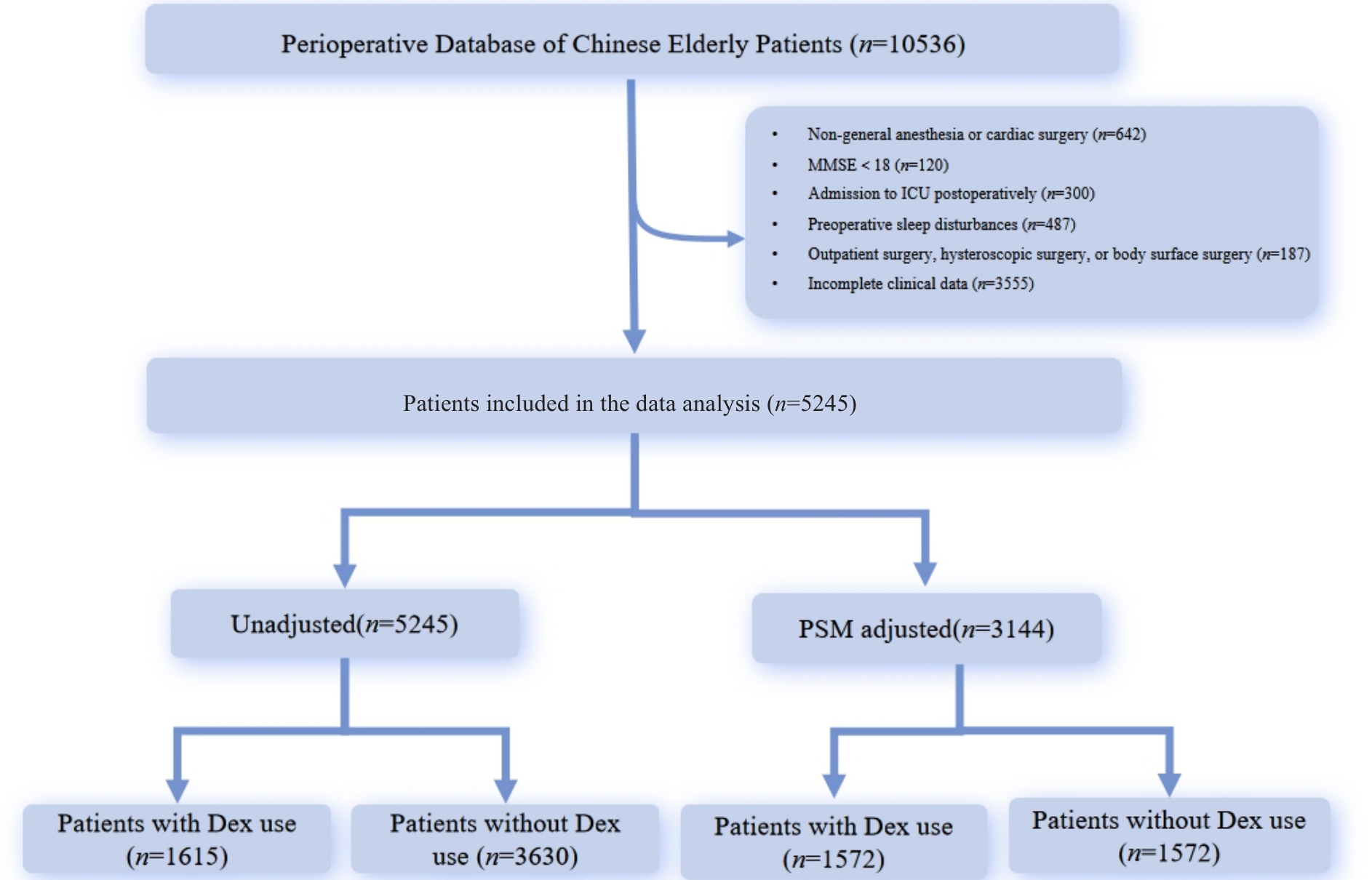
图1 研究对象筛选流程图
Fig.1 Flowchart of participant selection.
| Variable | Unadjusted sample (n =5245) | PSM adjusted (n =3144) | ||||||
|---|---|---|---|---|---|---|---|---|
| Non-DEX (n =3630) | DEX (n =1615) | P | SMD | Non-DEX (n =1572) | DEX (n =1572) | P | SMD | |
| Demographic characteristics | ||||||||
| Male [n (%)] | 2063 (56.8) | 1001 (62.0) | <0.001 | 0.105 | 952 (60.6) | 968 (61.6) | 0.583 | 0.021 |
| Age [year, Median (IQR)] | 70 (68, 74) | 71 (67, 75) | 0.223 | 0.059 | 71 (68, 75) | 71 (67,75) | 0.385 | 0.012 |
| BMI [kg/m2, Median (IQR)] | 24.22 (22.09, 26.64) | 23.53 (21.45, 25.80) | <0.001 | 0.226 | 23.74 (21.51, 26.03) | 23.66 (21.48, 25.82) | 0.226 | 0.048 |
| Smoking status [n (%)] | 979 (27.0) | 436 (27.0) | 1.000 | 0.001 | 424 (27.0) | 429 (27.3) | 0.873 | 0.007 |
| Drinking status [n (%)] | 948 (26.1) | 367 (22.7) | 0.010 | 0.079 | 385 (24.5) | 364 (23.2) | 0.402 | 0.031 |
| MMSE score [Median (IQR)] | 27 (25, 28) | 27 (25, 28) | 0.268 | 0.006 | 27.00 (25.00, 28.00) | 27.00 (25.00, 28.00) | 0.077 | 0.043 |
| Previous history [n (%)] | ||||||||
| Hypertension | 1802 (49.6) | 755 (46.7) | 0.057 | 0.058 | 776 (49.4) | 739 (47.0) | 0.199 | 0.047 |
| Diabetes | 763 (21.0) | 259 (16.0) | <0.001 | 0.128 | 269 (17.1) | 258 (16.4) | 0.633 | 0.019 |
| COPD | 122 (3.4) | 43 (2.7) | 0.211 | 0.041 | 59 (3.8) | 40 (2.5) | 0.066 | 0.069 |
| Preoperative use of benzodiazepines | 703 (19.4) | 69 (4.3) | <0.001 | 0.481 | 80 (5.1) | 69 (4.4) | 0.401 | 0.033 |
| Surgery-related factors | ||||||||
Intraoperative use of benzodiazepines [n (%)] | 1918 (52.8) | 981 (60.7) | <0.001 | 0.160 | 911 (58.0) | 938 (59.7) | 0.346 | 0.035 |
| ASA classification [n (%)] | <0.001 | 0.456 | 0.942 | 0.004 | ||||
| <III | 2800 (77.1) | 907 (56.2) | 904 (57.5) | 907 (57.7) | ||||
| ≥III | 830 (22.9) | 708 (43.8) | 668 (42.5) | 665 (42.3) | ||||
| Surgery type [n (%)] | <0.001 | 0.199 | 0.441 | 0.069 | ||||
| Head and neck | 182 (5.0) | 84 (5.2) | 73 (4.6) | 82 (5.2) | ||||
| Thorax and vessel | 513 (14.1) | 148 (9.2) | 162 (10.3) | 147 (9.4) | ||||
| Abdomen | 1830 (50.4) | 951 (58.9) | 882 (56.1) | 917 (58.3) | ||||
| Limbs and spine | 837 (23.1) | 328 (20.3) | 358 (22.8) | 324 (20.6) | ||||
| Others | 268 (7.4) | 104 (6.4) | 97 (6.2) | 102 (6.5) | ||||
| Surgery duration [h, Median (IQR)] | 2.42 (1.67, 3.42) | 2.58 (1.72, 3.55) | 0.002 | 0.090 | 2.50 (1.75, 3.58) | 2.50 (1.67, 3.52) | 0.949 | 0.010 |
| Blood loss [mL, Median (IQR)] | 80 (50, 200) | 100 (30, 200) | 0.068 | 0.116 | 100 (50, 200) | 100 (30, 200) | 0.294 | 0.049 |
| Urine volume [mL, Median (IQR)] | 300 (150, 600) | 400 (200, 650) | <0.001 | 0.112 | 400 (200, 650) | 400 (200, 700) | 0.074 | 0.015 |
表1 右美托咪定组与非右美托咪定组患者的基线特征
Tab.1 Baseline characteristics of patients with or without intraoperative dexmedetomidine administration
| Variable | Unadjusted sample (n =5245) | PSM adjusted (n =3144) | ||||||
|---|---|---|---|---|---|---|---|---|
| Non-DEX (n =3630) | DEX (n =1615) | P | SMD | Non-DEX (n =1572) | DEX (n =1572) | P | SMD | |
| Demographic characteristics | ||||||||
| Male [n (%)] | 2063 (56.8) | 1001 (62.0) | <0.001 | 0.105 | 952 (60.6) | 968 (61.6) | 0.583 | 0.021 |
| Age [year, Median (IQR)] | 70 (68, 74) | 71 (67, 75) | 0.223 | 0.059 | 71 (68, 75) | 71 (67,75) | 0.385 | 0.012 |
| BMI [kg/m2, Median (IQR)] | 24.22 (22.09, 26.64) | 23.53 (21.45, 25.80) | <0.001 | 0.226 | 23.74 (21.51, 26.03) | 23.66 (21.48, 25.82) | 0.226 | 0.048 |
| Smoking status [n (%)] | 979 (27.0) | 436 (27.0) | 1.000 | 0.001 | 424 (27.0) | 429 (27.3) | 0.873 | 0.007 |
| Drinking status [n (%)] | 948 (26.1) | 367 (22.7) | 0.010 | 0.079 | 385 (24.5) | 364 (23.2) | 0.402 | 0.031 |
| MMSE score [Median (IQR)] | 27 (25, 28) | 27 (25, 28) | 0.268 | 0.006 | 27.00 (25.00, 28.00) | 27.00 (25.00, 28.00) | 0.077 | 0.043 |
| Previous history [n (%)] | ||||||||
| Hypertension | 1802 (49.6) | 755 (46.7) | 0.057 | 0.058 | 776 (49.4) | 739 (47.0) | 0.199 | 0.047 |
| Diabetes | 763 (21.0) | 259 (16.0) | <0.001 | 0.128 | 269 (17.1) | 258 (16.4) | 0.633 | 0.019 |
| COPD | 122 (3.4) | 43 (2.7) | 0.211 | 0.041 | 59 (3.8) | 40 (2.5) | 0.066 | 0.069 |
| Preoperative use of benzodiazepines | 703 (19.4) | 69 (4.3) | <0.001 | 0.481 | 80 (5.1) | 69 (4.4) | 0.401 | 0.033 |
| Surgery-related factors | ||||||||
Intraoperative use of benzodiazepines [n (%)] | 1918 (52.8) | 981 (60.7) | <0.001 | 0.160 | 911 (58.0) | 938 (59.7) | 0.346 | 0.035 |
| ASA classification [n (%)] | <0.001 | 0.456 | 0.942 | 0.004 | ||||
| <III | 2800 (77.1) | 907 (56.2) | 904 (57.5) | 907 (57.7) | ||||
| ≥III | 830 (22.9) | 708 (43.8) | 668 (42.5) | 665 (42.3) | ||||
| Surgery type [n (%)] | <0.001 | 0.199 | 0.441 | 0.069 | ||||
| Head and neck | 182 (5.0) | 84 (5.2) | 73 (4.6) | 82 (5.2) | ||||
| Thorax and vessel | 513 (14.1) | 148 (9.2) | 162 (10.3) | 147 (9.4) | ||||
| Abdomen | 1830 (50.4) | 951 (58.9) | 882 (56.1) | 917 (58.3) | ||||
| Limbs and spine | 837 (23.1) | 328 (20.3) | 358 (22.8) | 324 (20.6) | ||||
| Others | 268 (7.4) | 104 (6.4) | 97 (6.2) | 102 (6.5) | ||||
| Surgery duration [h, Median (IQR)] | 2.42 (1.67, 3.42) | 2.58 (1.72, 3.55) | 0.002 | 0.090 | 2.50 (1.75, 3.58) | 2.50 (1.67, 3.52) | 0.949 | 0.010 |
| Blood loss [mL, Median (IQR)] | 80 (50, 200) | 100 (30, 200) | 0.068 | 0.116 | 100 (50, 200) | 100 (30, 200) | 0.294 | 0.049 |
| Urine volume [mL, Median (IQR)] | 300 (150, 600) | 400 (200, 650) | <0.001 | 0.112 | 400 (200, 650) | 400 (200, 700) | 0.074 | 0.015 |
| Outcome | Unadjusted sample (n =5245) | PSM adjusted (n =3144) | ||||
|---|---|---|---|---|---|---|
| Non-DEX (n =3630) | DEX (n =1615) | P | Non-DEX (n =1572) | DEX (n =1572) | P | |
| Primary outcome | ||||||
| Postoperative sleep disturbance | 1013 (27.9) | 339 (21.0) | <0.001 | 399 (25.4) | 325(20.7) | <0.001 |
| Secondary outcomes | ||||||
| Sleep disturbance on the night of surgery | 733 (20.2) | 238 (14.7) | <0.001 | 282 (17.9) | 233 (14.8) | 0.021 |
| Sleep disturbance on the first night after surgery | 354 (9.8) | 127 (7.9) | 0.033 | 144 (9.2) | 120 (7.6) | 0.139 |
| Sleep disturbance on the second night after surgery | 279 (7.7) | 113 (7.0) | 0.413 | 116 (7.4) | 107 (6.8) | 0.587 |
| Severe pain on the first postoperative day | 644 (17.7) | 159 (9.8) | <0.001 | 265 (16.9) | 158 (10.1) | <0.001 |
| Delirium within 7 days after surgery | 452 (12.5) | 139 (8.6) | <0.001 | 197 (12.5) | 137 (8.7) | <0.001 |
| AKI | 161 (4.4) | 84 (5.2) | 0.253 | 70 (4.5) | 79 (5.0) | 0.502 |
| Stroke | 18 (0.5) | 5 (0.3) | 0.474 | 7 (0.4) | 5 (0.3) | 0.772 |
| Pulmonary infection | 306 (8.4) | 89 (5.5) | <0.001 | 134 (8.5) | 86 (5.5) | 0.001 |
表2 倾向评分匹配校正前后主要结局与次要结局的差异比较
Tab.2 Comparison of primary and secondary outcomes before and after propensity score matching adjustments
| Outcome | Unadjusted sample (n =5245) | PSM adjusted (n =3144) | ||||
|---|---|---|---|---|---|---|
| Non-DEX (n =3630) | DEX (n =1615) | P | Non-DEX (n =1572) | DEX (n =1572) | P | |
| Primary outcome | ||||||
| Postoperative sleep disturbance | 1013 (27.9) | 339 (21.0) | <0.001 | 399 (25.4) | 325(20.7) | <0.001 |
| Secondary outcomes | ||||||
| Sleep disturbance on the night of surgery | 733 (20.2) | 238 (14.7) | <0.001 | 282 (17.9) | 233 (14.8) | 0.021 |
| Sleep disturbance on the first night after surgery | 354 (9.8) | 127 (7.9) | 0.033 | 144 (9.2) | 120 (7.6) | 0.139 |
| Sleep disturbance on the second night after surgery | 279 (7.7) | 113 (7.0) | 0.413 | 116 (7.4) | 107 (6.8) | 0.587 |
| Severe pain on the first postoperative day | 644 (17.7) | 159 (9.8) | <0.001 | 265 (16.9) | 158 (10.1) | <0.001 |
| Delirium within 7 days after surgery | 452 (12.5) | 139 (8.6) | <0.001 | 197 (12.5) | 137 (8.7) | <0.001 |
| AKI | 161 (4.4) | 84 (5.2) | 0.253 | 70 (4.5) | 79 (5.0) | 0.502 |
| Stroke | 18 (0.5) | 5 (0.3) | 0.474 | 7 (0.4) | 5 (0.3) | 0.772 |
| Pulmonary infection | 306 (8.4) | 89 (5.5) | <0.001 | 134 (8.5) | 86 (5.5) | 0.001 |
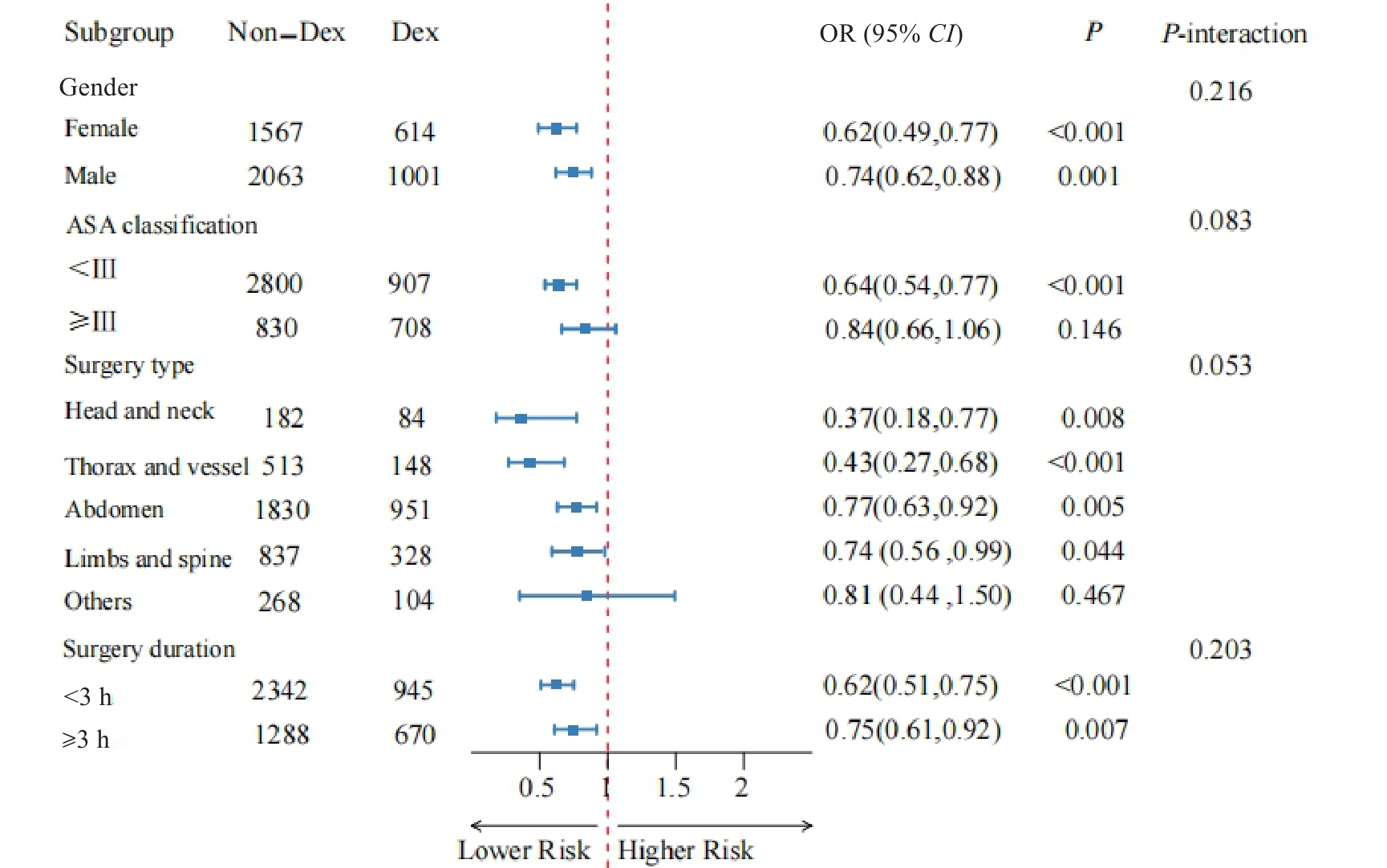
图2 不同亚组中右美托咪定与术后睡眠障碍关联的亚组分析图
Fig.2 Subgroup analysis of the association between dexmedetomidine and postoperative sleep disturbance.
| [1] | Rampes S, Ma KT, Divecha YA, et al. Postoperative sleep disorders and their potential impacts on surgical outcomes[J]. J Biomed Res, 2019, 34(4): 271-80. doi:10.7555/jbr.33.20190054 |
| [2] | Sipilä RM, Kalso EA. Sleep well and recover faster with less pain: a narrative review on sleep in the perioperative period[J]. J Clin Med, 2021, 10(9): 2000. doi:10.3390/jcm10092000 |
| [3] | Yang D, Yang L, Li Q, et al. Pharmacotherapy for improving postoperative sleep quality: a protocol for a systematic review and network meta-analysis[J]. BMJ Open, 2023, 13(2): e069724. doi:10.1136/bmjopen-2022-069724 |
| [4] | Hoyos CM, Gordon C, Terpening Z, et al. Circadian rhythm and sleep alterations in older people with lifetime depression: a case-control study[J]. BMC Psychiatry, 2020, 20(1): 192. doi:10.1186/s12888-020-02606-z |
| [5] | Gögenur I, Bisgaard T, Burgdorf S, et al. Disturbances in the circadian pattern of activity and sleep after laparoscopic versus open abdominal surgery[J]. Surg Endosc, 2009, 23(5): 1026-31. doi:10.1007/s00464-008-0112-9 |
| [6] | Ni PF, Dong HQ, Zhou Q, et al. Preoperative sleep disturbance exaggerates surgery-induced neuroinflammation and neuronal damage in aged mice[J]. Mediat Inflamm, 2019, 2019: 8301725. doi:10.1155/2019/8301725 |
| [7] | Varallo G, Giusti EM, Manna C, et al. Sleep disturbances and sleep disorders as risk factors for chronic postsurgical pain: a systematic review and meta-analysis[J]. Sleep Med Rev, 2022, 63: 101630. doi:10.1016/j.smrv.2022.101630 |
| [8] | Ou-yang CL, Ma LB, Wu XD, et al. Association of sleep quality on the night of operative day with postoperative delirium in elderly patients: a prospective cohort study[J]. Eur J Anaesthesiol, 2024, 41(3): 226-33. doi:10.1097/eja.0000000000001952 |
| [9] | Weerink MAS, Struys MMRF, Hannivoort LN, et al. Clinical pharmacokinetics and pharmacodynamics of dexmedetomidine[J]. Clin Pharmacokinet, 2017, 56(8): 893-913. doi:10.1007/s40262-017-0507-7 |
| [10] | Nelson LE, Lu J, Guo TZ, et al. The α2-adrenoceptor agonist dexmedetomidine converges on an endogenous sleep-promoting pathway to exert its sedative effects[J]. Anesthesiology, 2003, 98(2): 428-36. doi:10.1097/00000542-200302000-00024 |
| [11] | Coull JT, Jones MEP, Egan TD, et al. Attentional effects of noradrenaline vary with arousal level: selective activation of thalamic pulvinar in humans[J]. Neuroimage, 2004, 22(1): 315-22. doi:10.1016/j.neuroimage.2003.12.022 |
| [12] | Su X, Meng ZT, Wu XH, et al. Dexmedetomidine for prevention of delirium in elderly patients after non-cardiac surgery: a randomised, double-blind, placebo-controlled trial[J]. Lancet, 2016, 388(10054): 1893-902. doi:10.1016/S0140-6736(16)30580-3 |
| [13] | Wu XH, Cui F, Zhang C, et al. Low-dose dexmedetomidine improves sleep quality pattern in elderly patients after noncardiac surgery in the intensive care unit: a pilot randomized controlled trial[J]. Anesthesiology, 2016, 125(5): 979-91. doi:10.1097/ALN.0000000000001325 |
| [14] | Shi CX, Jin J, Pan Q, et al. Intraoperative use of dexmedetomidine promotes postoperative sleep and recovery following radical mastectomy under general anesthesia[J]. Oncotarget, 2017, 8(45): 79397-403. doi:10.18632/oncotarget.18157 |
| [15] | Tan WF, Miao EY, Jin F, et al. Changes in first postoperative night bispectral index after daytime sedation induced by dexmedeto-midine or midazolam under regional anesthesia: a randomized controlled trial[J]. Reg Anesth Pain Med, 2016, 41(3): 380-6. doi:10.1097/aap.0000000000000370 |
| [16] | Liao ZP, Liao W, Tan KS, et al. Decreased hospital charges and postoperative pain in septoplasty by application of enhanced recovery after surgery[J]. Ther Clin Risk Manag, 2018, 14: 1871-7. doi:10.2147/TCRM.S173687 |
| [17] | Martin S, Chandran A, Zografos L, et al. Evaluation of the impact of fibromyalgia on patients' sleep and the content validity of two sleep scales[J]. Health Qual Life Outcomes, 2009, 7: 64. doi:10.1186/1477-7525-7-64 |
| [18] | Cai JJ, Chen YJ, Hao XC, et al. Effect of intraoperative dexmedetomidine dose on postoperative first night sleep quality in elderly surgery patients: a retrospective study with propensity score-matched analysis[J]. Front Med, 2020, 7: 528. doi:10.3389/fmed.2020.00528 |
| [19] | Duan GY, Wang K, Peng TT, et al. The effects of intraoperative dexmedetomidine use and its different dose on postoperative sleep disturbance in patients who have undergone non-cardiac major surgery: a real-world cohort study[J]. Nat Sci Sleep, 2020, 12: 209-19. doi:10.2147/NSS.S239706 |
| [20] | Rood P, Frenzel T, Verhage R, et al. Development and daily use of a numeric rating score to assess sleep quality in ICU patients[J]. J Crit Care, 2019, 52: 68-74. doi:10.1016/j.jcrc.2019.04.009 |
| [21] | Lin DY, Brown B, Morrison C, et al. The Pericapsular Nerve Group (PENG) block combined with Local Infiltration Analgesia (LIA) compared to placebo and LIA in hip arthroplasty surgery: a multi-center double-blinded randomized-controlled trial[J]. BMC Anesthesiol, 2022, 22(1): 252. doi:10.1186/s12871-022-01787-2 |
| [22] | White MF, Tanabe S, Casey C, et al. Relationships between preoperative cortical thickness, postoperative electroencephalogram slowing, and postoperative delirium[J]. Br J Anaesth, 2021, 127(2): 236-44. doi:10.1016/j.bja.2021.02.028 |
| [23] | Qi YM, Li YJ, Zou JH, et al. Risk factors for postoperative delirium in geriatric patients with hip fracture: a systematic review and meta-analysis[J]. Front Aging Neurosci, 2022, 14: 960364. doi:10.3389/fnagi.2022.960364 |
| [24] | Palevsky PM, Liu KD, Brophy PD, et al. KDOQI US commentary on the 2012 KDIGO clinical practice guideline for acute kidney injury[J]. Am J Kidney Dis, 2013, 61(5): 649-72. doi:10.1053/j.ajkd.2013.02.349 |
| [25] | Li S, Li RW, Li MH, et al. Dexmedetomidine administration during brain tumour resection for prevention of postoperative delirium: a randomised trial[J]. Br J Anaesth, 2023, 130(2): e307-16. doi:10.1016/j.bja.2022.10.041 |
| [26] | Wu Y, Miao YH, Chen XZ, et al. A randomized placebo-controlled double-blind study of dexmedetomidine on postoperative sleep quality in patients with endoscopic sinus surgery[J]. BMC Anesthesiol, 2022, 22(1): 172. doi:10.1186/s12871-022-01711-8 |
| [27] | Poe GR, Foote S, Eschenko O, et al. Locus coeruleus: a new look at the blue spot[J]. Nat Rev Neurosci, 2020, 21(11): 644-59. doi:10.1038/s41583-020-0360-9 |
| [28] | Fan SM, Cheng XQ, Zhang PP, et al. The α2 adrenoceptor agonist and sedative/anaesthetic dexmedetomidine excites diverse neuronal types in the ventrolateral preoptic area of male mice[J]. ASN Neuro, 2023, 15(1): 17590914231191016. doi:10.1177/17590914231191016 |
| [29] | Wang XW, Cao JB, Lv BS, et al. Effect of perioperative dexmedetomidine on the endocrine modulators of stress response: a meta-analysis[J]. Clin Exp Pharmacol Physiol, 2015, 42(8): 828-36. doi:10.1111/1440-1681.12431 |
| [30] | Lai Y, Chen Q, Xiang CF, et al. Comparison of the effects of dexmedetomidine and lidocaine on stress response and postoperative delirium of older patients undergoing thoracoscopic surgery: a randomized controlled trial[J]. Clin Interv Aging, 2023, 18: 1275-83. doi:10.2147/CIA.S419835 |
| [31] | Zhang CL, Yan Y, Zhang Y, et al. Effects of esketamine combined with dexmedetomidine on postoperative delirium and quality of recovery in elderly patients undergoing thoracoscopic radical lung cancer surgery: a randomized controlled trial[J]. CNS Spectr, 2024, 29(5): 441-50. doi:10.1017/s1092852924002177 |
| [32] | Zhang X, Leng Y, Yuan XR, et al. Efficacy of perioperative dexmedetomidine in postoperative pain and neurocognitive functions in orthopedic surgery: a systematic review and meta-analysis with trial sequential analysis of randomized controlled trials[J]. Int J Surg, 2025, 111(5): 3525-42. doi:10.1097/JS9.0000000000002315 |
| [33] | Liu SS, Feng L, Yang HN, et al. Dexmedetomidine regulates sleep rhythm and alleviates neuroinflammation in rats under high-altitude hypoxia[J]. J Physiol Biochem, 2025, 81(4): 1125-41. doi:10.1007/s13105-025-01127-1 |
| [34] | Ji CY, Su XD, Gao CH, et al. Advances in the use of dexmedetomidine during the perioperative period to improve postoperative sleep quality in patients undergoing surgery[J]. J Int Med Res, 2024, 52(11): 03000605241290715. doi:10.1177/03000605241290715 |
| [35] | Ji C, Su X, Gao C, et al. Impact of different perioperative dexmedetomidine administration regimens on postoperative sleep quality in gastrointestinal tumor resection: a randomized controlled trial[J]. Wideochir Inne Tech Maloinwazyjne, 2025, 20(2): 157-64. |
| [36] | Zhang Z, Wang HB, Wang YF, et al. Risk of postoperative hyperalgesia in adult patients with preoperative poor sleep quality undergoing open-heart valve surgery[J]. J Pain Res, 2020, 13: 2553-60. doi:10.2147/JPR.S272667 |
| [37] | Yabe Y, Hagiwara Y, Sekiguchi T, et al. Sleep disturbance is associated with neck pain: a 3-year longitudinal study after the Great East Japan Earthquake[J]. BMC Musculoskelet Disord, 2022, 23: 459. doi:10.1186/s12891-022-05410-w |
| [38] | Vacas S, Degos V, Maze M. Fragmented sleep enhances postoperative neuroinflammation but not cognitive dysfunction[J]. Anesth Analg, 2017, 124(1): 270-6. doi:10.1213/ane.0000000000001675 |
| [39] | Bailey DR, Horodyski M, Vasilopoulos T, et al. Evaluation of sleep quality and its relationship with pain, mood, and physical function after orthopaedic trauma surgery: a prospective cohort study[J]. J Am Acad Orthop Surg, 2023, 31(7): 341-8. doi:10.5435/jaaos-d-22-00501 |
| [1] | 刘星扬, 吴静涵, 叶春艳, 王锷, 胡浩. 老年患者全麻期间颈总动脉血流的动态变化及其生理调控机制:一项前瞻性研究[J]. 南方医科大学学报, 2026, 46(4): 761-769. |
| [2] | 吕雪彩, 刘艳红, 韩诗怡, 张浩赟, 侯爱生, 周志康, 史立凯, 高洁, 曹江北, 张宏, 米卫东. 老年患者胃肠道手术后综合并发症的危险因素——一项多中心观察性研究[J]. 南方医科大学学报, 2025, 45(4): 736-743. |
| [3] | 吴新顺, 李劲草, 刘影, 邱仁洪, 王恒林, 薛瑞, 张扬, 李硕, 范琼尹, 董华进, 张有志, 曹江北. 大麻二酚通过调节昼夜节律改善大鼠全麻术后的睡眠障碍[J]. 南方医科大学学报, 2025, 45(4): 744-750. |
| [4] | 刘洋, 贾亿卿, 李程程, 毛汉丁, 刘树元, 单毅. 右美托咪定通过激活Nrf2/HO-1通路减轻热应激诱导的人骨骼肌细胞胀亡[J]. 南方医科大学学报, 2025, 45(3): 603-613. |
| [5] | 原梦瑶, 阮湘涵, 李扬, 张婷, 郝春香, 李皓, 娄景盛, 曹江北, 刘艳红, 米卫东, 张晓莹. 术前血清镁水平与非心脏手术老年患者术后谵妄风险的关系:一项回顾性队列研究[J]. 南方医科大学学报, 2025, 45(12): 2616-2627. |
| [6] | 张方圆, 刘刚. 右美托咪定通过激活Nrf2/HO-1/GPX4通路抑制肾小管上皮细胞的铁死亡[J]. 南方医科大学学报, 2024, 44(6): 1135-1140. |
| [7] | 苏雨薇, 孙 闻, 王 迪, 董钰妍, 丁 莹, 徐龙河, 刘永哲. 右美托咪定不能降低腹腔镜下根治性肾切除术后急性和慢性肾脏病的发病率:基于倾向性评分匹配法[J]. 南方医科大学学报, 2023, 43(4): 654-659. |
| [8] | 欧 毅, 刘 刚, 殷凤伟, 杨 杨, 张方圆. 乌司他丁联合右美托咪定对肝脏缺血再灌注损伤起保护作用:基于80例肝癌合并肝硬化行腹腔镜肝切除术患者[J]. 南方医科大学学报, 2022, 42(12): 1832-1838. |
| [9] | 许立倩, 魏 宁, 单美娟, 汪子怡, 叶天成, 梁赛珍, 李 乐, 朱 强, 何路遥, 白建杰, 陈碧霞, 徐金东. 加温湿化高流量鼻导管吸氧可减少老年患者麻醉复苏期缺氧事件发生[J]. 南方医科大学学报, 2021, 41(8): 1265-1269. |
| [10] | 韩 冰, 陈梦婷, 杨传铭, 李晓红. 右美托咪定预处理通过抑制NLRP3炎性小体激活减轻大鼠肠缺血再灌注诱导的急性肺损伤[J]. 南方医科大学学报, 2021, 41(12): 1857-1863. |
| [11] | 龚 拯, 龙小毛, 韦慧君, 唐 莹, 栗 俊, 马 利, 余 军. 右美托咪定联合肺保护性通气策略可减轻单肺通气食管癌根治术患者的肺损伤[J]. 南方医科大学学报, 2020, 40(07): 1013-1017. |
| [12] | 刘 刚,门运政,童旭辉,王雪如,胡 淼,姜牧君,孙志鹏,董淑英. 线粒体融合与裂变在右美托咪定减轻小鼠脑缺血再灌注损伤中的作用及其机制[J]. 南方医科大学学报, 2020, 40(04): 463-468. |
| [13] | 陈小慧,任晓强,马亚兵,葛莉,胡钟元,阎文军. 术后疼痛引起老年患者术后认知功能障碍的相关机制研究进展[J]. 南方医科大学学报, 2019, 39(09): 1122-. |
| [14] | 曹舸,张尔永. 右美托咪定对体外循环缺血再灌注损伤肺组织保护作用的相关信号通路[J]. 南方医科大学学报, 2019, 39(08): 980-. |
| [15] | 张津玮,张小宝,钱海涛,崔吉正,顾小萍. 右美托咪定可减轻大鼠胫骨骨折手术所致的术后认知功能障碍[J]. 南方医科大学学报, 2019, 39(03): 292-. |
| 阅读次数 | ||||||
|
全文 |
|
|||||
|
摘要 |
|
|||||
