
南方医科大学学报 ›› 2026, Vol. 46 ›› Issue (6): 1444-1454.doi: 10.12122/j.issn.1673-4254.2026.06.24
• • 上一篇
温耀棋1( ), 卢学麒1, 吴秋岑1, 陈华元2(), 陈超敏1()
收稿日期:2025-09-30
出版日期:2026-06-20
发布日期:2026-06-24
通讯作者:
陈华元,陈超敏
E-mail:1365909788@qq.com;415081161@qq.com;571611621@qq.com
作者简介:温耀棋,在读硕士研究生,E-mail: 1365909788@qq.com
基金资助:
Yaoqi WEN1(), Xueqi LU1, Qiucen WU1, Huayuan CHEN2(), Chaomin CHEN1()
Received:2025-09-30
Online:2026-06-20
Published:2026-06-24
Contact:
Huayuan CHEN, Chaomin CHEN
E-mail:1365909788@qq.com;415081161@qq.com;571611621@qq.com
摘要:
目的 提高心音异常的检出率,为自动化心音分析提供技术支持。 方法 本文提出了一种基于多尺度卷积与双塔注意力机制的模型(MS-DTNet),其通过深度可分离卷积以降低计算复杂度的同时结合多尺度卷积以并行获取不同感受野的特征,然后采用双塔结构兼顾短时与长时信息提取,并引入翻转注意力机制以进一步增强特征表征能力,从而提高对心音图分类的精度。 结果 使用公开数据集CinC2016对提出的模型进行五折交叉验证实验。在心音异常分类任务中,模型在测试集上的平均准确率、平均特异性、平均召回率、平均精确率、平均F1分数与平均ROC分别达到94.49%、93.44%、95.49%、93.81%、94.64%和98.65%,结果均优于其他几种模型。 结论 本研究提出的MS-DTNet模型在心音图分类表现出色,为后续的多源心音数据分析与临床辅助决策研究提供了有效的技术基础。
温耀棋, 卢学麒, 吴秋岑, 陈华元, 陈超敏. 心音异常高检出率模型MS-DTNet:融合多尺度卷积与双塔注意力的方法[J]. 南方医科大学学报, 2026, 46(6): 1444-1454.
Yaoqi WEN, Xueqi LU, Qiucen WU, Huayuan CHEN, Chaomin CHEN. MS-DTNet: an efficient model combining multi-scale convolution and dual-tower attention for detecting abnormal heart sounds[J]. Journal of Southern Medical University, 2026, 46(6): 1444-1454.
| Dataset | Label | Sum | Percentage | Describe |
|---|---|---|---|---|
| Training set and validation set | Normal | 2575 | 79.5% | S1 and S2 clear |
| Abnormal | 665 | 20.5% | Too much noise | |
| Testing Set | Normal | 150 | 49.8% | |
| Abnormal | 151 | 50.2% | ||
| Sum | 3541 | 100% |
表1 CinC2016数据集统计信息
Tab.1 CinC2016 dataset statistics
| Dataset | Label | Sum | Percentage | Describe |
|---|---|---|---|---|
| Training set and validation set | Normal | 2575 | 79.5% | S1 and S2 clear |
| Abnormal | 665 | 20.5% | Too much noise | |
| Testing Set | Normal | 150 | 49.8% | |
| Abnormal | 151 | 50.2% | ||
| Sum | 3541 | 100% |
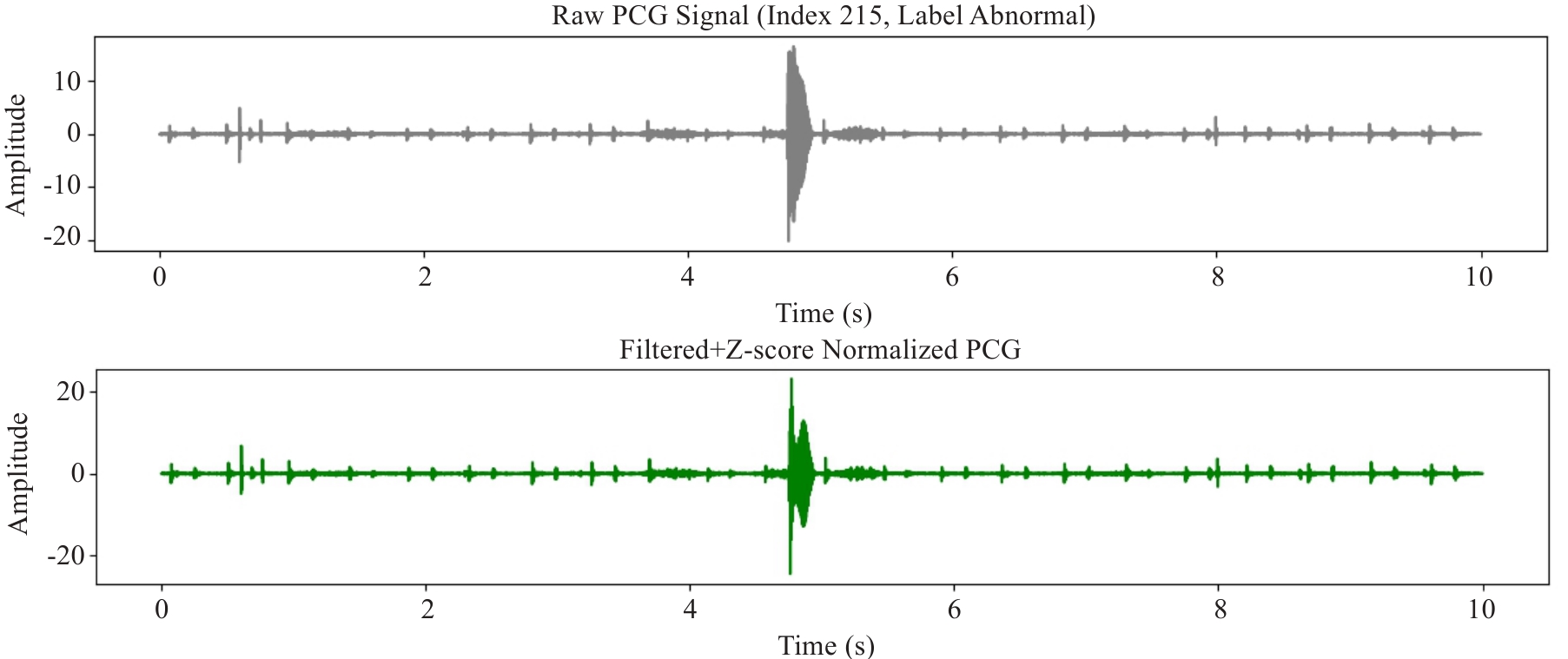
图1 不合格的心音图示例
Fig.1 An example of substandard phonocardiogram.
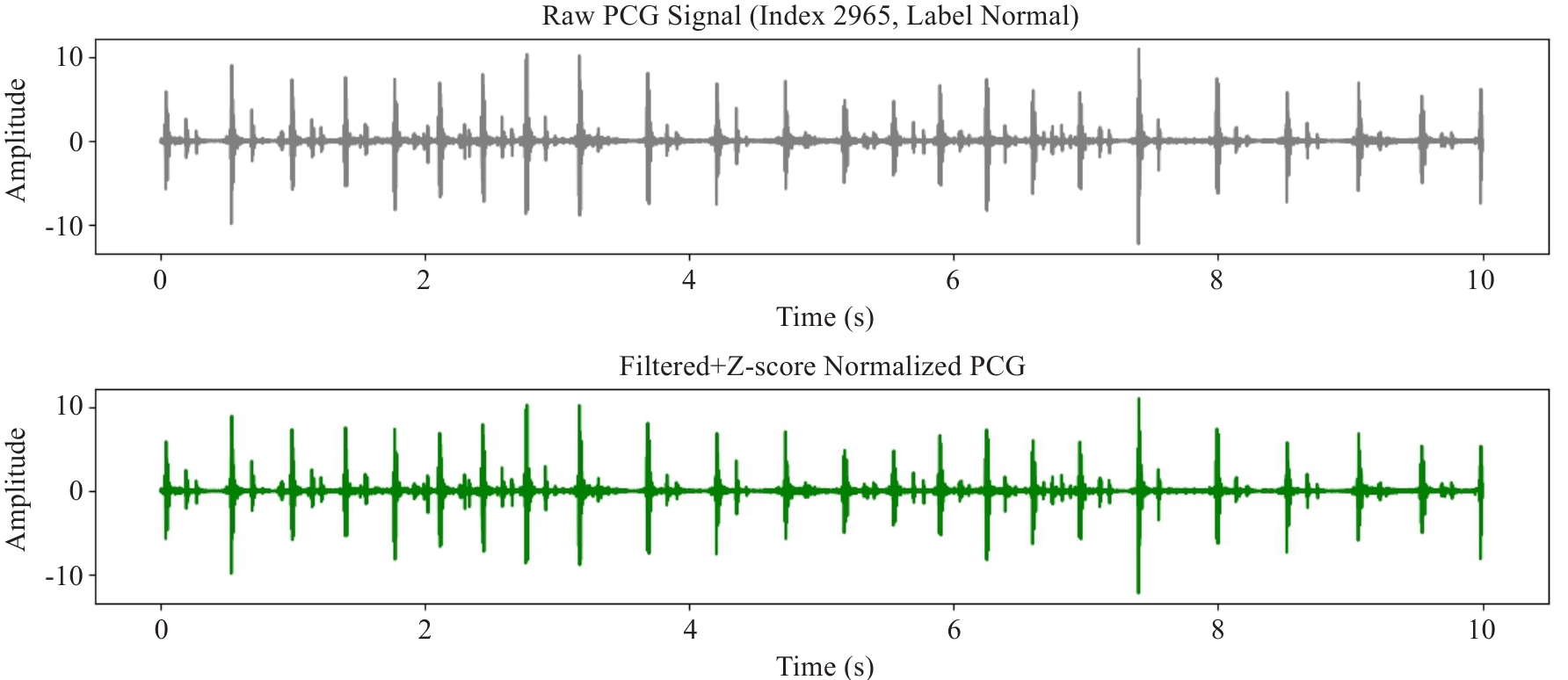
图2 有价值的心音图示例
Fig.2 An example of useful phonocardiogram.
| Total | Removed_few_peaks | Removed_low_Q | Recovered | Final_samples | Used_thresh |
|---|---|---|---|---|---|
| 3240 | 46 | 48 | 43 | 3189 | 0.25 |
表2 数据清洗结果
Tab.2 Result of data-cleaning
| Total | Removed_few_peaks | Removed_low_Q | Recovered | Final_samples | Used_thresh |
|---|---|---|---|---|---|
| 3240 | 46 | 48 | 43 | 3189 | 0.25 |
| Class | Training set | Validation set | Testing set | Sum | Training set (smote) |
|---|---|---|---|---|---|
| Normal | 2284 | 257 | 150 | 2691 | 2284 |
| Abnormal | 586 | 62 | 151 | 799 | 2284 |
| Sum | 2870 | 319 | 301 | 3490 | 4568 |
表3 数据处理后数据库统计信息
Tab.3 Database statistics after data processing
| Class | Training set | Validation set | Testing set | Sum | Training set (smote) |
|---|---|---|---|---|---|
| Normal | 2284 | 257 | 150 | 2691 | 2284 |
| Abnormal | 586 | 62 | 151 | 799 | 2284 |
| Sum | 2870 | 319 | 301 | 3490 | 4568 |
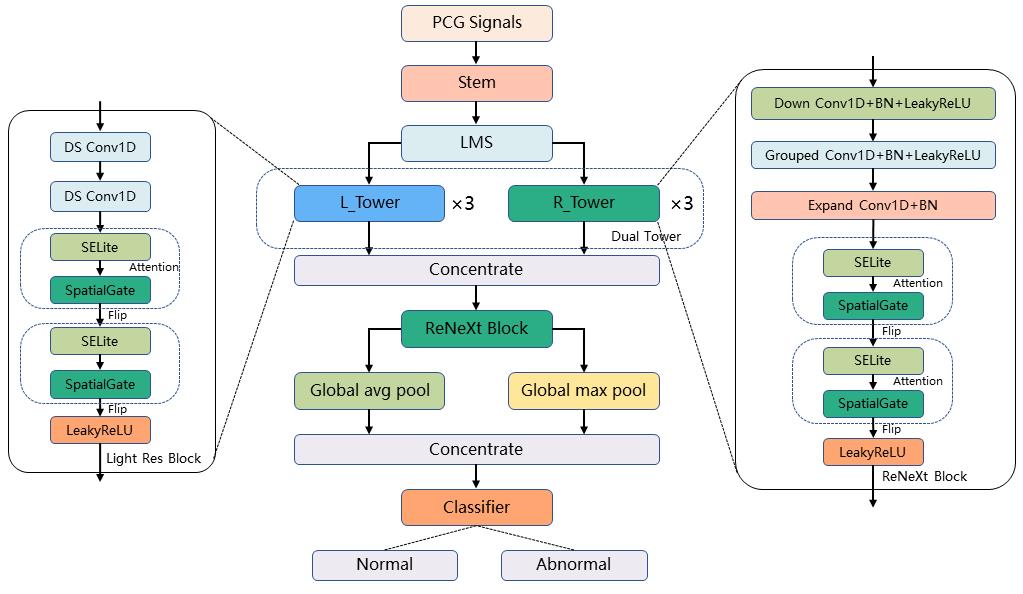
图3 MS-DTNet整体架构
Fig.3 Overall architecture of the MS-DTNet model.
| Module/block | Layer | Input | Output | Description of Feature Map Changes |
|---|---|---|---|---|
| Input | PCG single-channel signal | 1 | Input shape(B, 1, T) | |
| Stem | Conv(7×1, stride=2)+BN+ReLU | 1 | 48 (bc) | Output shape: (B, 48, T/2) |
| LMS | Conv1×1 reduction + parallel 3/5/7 convolutions + concat | 48 | 144 (bc×3) | Multi-scale feature concatenation |
| L_Tower_1 | Light Res Block (stride=2) | 144 | 96 (bc×2) | Downsample×2, includes flip attention mechanism |
| L_Tower_2 | Light Res Block (stride=1) | 96 | 192 (bc×4) | Channel number ×2 |
| L_Tower_3 | Light Res Block (stride=1) | 192 | 384 (bc×8) | Channel number ×2 |
| R_Tower_1 | ResNeXt1DBlock(stride=2) | 144 | 96 (bc×2) | Downsample×2, includes flip attention mechanism |
| R_Tower_2 | ResNeXt1DBlock(stride=1) | 96 | 192 (bc×4) | Channel number ×2 |
| R_Tower_3 | ResNeXt1DBlock(stride=1) | 192 | 384 (bc×8) | Channel number ×2 |
| Dual-tower fusion | Element-wise addition | 384 | 384 | Feature alignment and summation |
| ReNeXtBlock | ResNeXt1DBlock(stride=1) | 384 | 384 | Channel number unchanged |
| Global pooling | AvgPool+MaxPool | 384 | 768 (384+384) | Channel number ×2 |
| Classifier | Linear(768 | 768 | 1 | Binary classification output |
表4 MS-DTNet网络参数设置
Tab.4 MS-DTNet parameter settings
| Module/block | Layer | Input | Output | Description of Feature Map Changes |
|---|---|---|---|---|
| Input | PCG single-channel signal | 1 | Input shape(B, 1, T) | |
| Stem | Conv(7×1, stride=2)+BN+ReLU | 1 | 48 (bc) | Output shape: (B, 48, T/2) |
| LMS | Conv1×1 reduction + parallel 3/5/7 convolutions + concat | 48 | 144 (bc×3) | Multi-scale feature concatenation |
| L_Tower_1 | Light Res Block (stride=2) | 144 | 96 (bc×2) | Downsample×2, includes flip attention mechanism |
| L_Tower_2 | Light Res Block (stride=1) | 96 | 192 (bc×4) | Channel number ×2 |
| L_Tower_3 | Light Res Block (stride=1) | 192 | 384 (bc×8) | Channel number ×2 |
| R_Tower_1 | ResNeXt1DBlock(stride=2) | 144 | 96 (bc×2) | Downsample×2, includes flip attention mechanism |
| R_Tower_2 | ResNeXt1DBlock(stride=1) | 96 | 192 (bc×4) | Channel number ×2 |
| R_Tower_3 | ResNeXt1DBlock(stride=1) | 192 | 384 (bc×8) | Channel number ×2 |
| Dual-tower fusion | Element-wise addition | 384 | 384 | Feature alignment and summation |
| ReNeXtBlock | ResNeXt1DBlock(stride=1) | 384 | 384 | Channel number unchanged |
| Global pooling | AvgPool+MaxPool | 384 | 768 (384+384) | Channel number ×2 |
| Classifier | Linear(768 | 768 | 1 | Binary classification output |
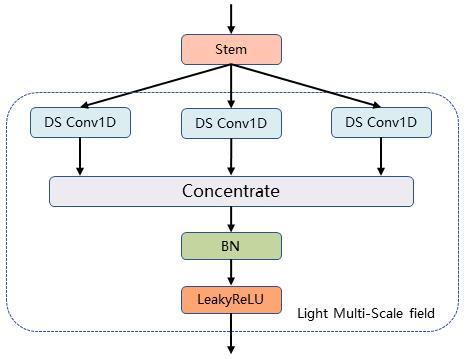
图4 轻量化多尺度感受野模块
Fig.4 Light multi-scale field module.
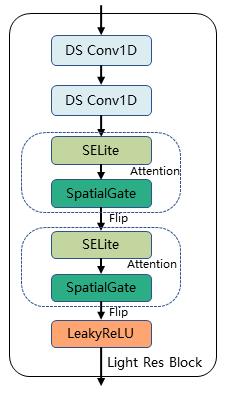
图5 轻量化残差块
Fig.5 Light Res Block.
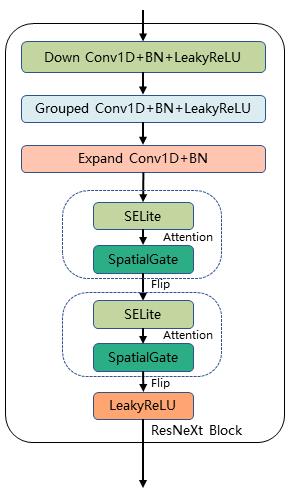
图6 ResNeXt 模块
Fig.6 ResNeXt Block.
| Item | Configuration/hyperparameter |
|---|---|
| Model | MS-DTNet (input channels=1) |
| Optimizer | AdamW |
| Initial learning rate | 0.001 |
| Learning rate scheduler | Cosine annealingLR (T_max=20) |
| Batch size | 32 |
| Epochs | 40 |
| Loss function | BCE withlogits loss |
| Random seed | 42 |
表5 实验配置
Tab.5 Experiment configuration
| Item | Configuration/hyperparameter |
|---|---|
| Model | MS-DTNet (input channels=1) |
| Optimizer | AdamW |
| Initial learning rate | 0.001 |
| Learning rate scheduler | Cosine annealingLR (T_max=20) |
| Batch size | 32 |
| Epochs | 40 |
| Loss function | BCE withlogits loss |
| Random seed | 42 |
| Fold | Acc (%) | Spe (%) | Recall (%) | Pre (%) | F1 (%) | AUC (%) |
|---|---|---|---|---|---|---|
| 1 | 97.34 | 97.97 | 96.73 | 98.01 | 97.37 | 99.49 |
| 2 | 95.68 | 96.60 | 94.80 | 96.69 | 95.73 | 98.52 |
| 3 | 96.01 | 96.00 | 96.02 | 96.02 | 96.02 | 98.64 |
| 4 | 97.01 | 96.00 | 96.03 | 96.10 | 96.02 | 98.91 |
| 5 | 97.01 | 95.33 | 98.68 | 95.51 | 97.07 | 99.38 |
| Average | 96.61±0.72 | 96.38±0.99 | 96.45±1.42 | 96.47±0.96 | 96.65±0.72 | 98.99±0.43 |
表6 MS-DTNet的分类性能(五折交叉验证)
Tab.6 Classification performance of MS-DTNet (5-fold cross validation)
| Fold | Acc (%) | Spe (%) | Recall (%) | Pre (%) | F1 (%) | AUC (%) |
|---|---|---|---|---|---|---|
| 1 | 97.34 | 97.97 | 96.73 | 98.01 | 97.37 | 99.49 |
| 2 | 95.68 | 96.60 | 94.80 | 96.69 | 95.73 | 98.52 |
| 3 | 96.01 | 96.00 | 96.02 | 96.02 | 96.02 | 98.64 |
| 4 | 97.01 | 96.00 | 96.03 | 96.10 | 96.02 | 98.91 |
| 5 | 97.01 | 95.33 | 98.68 | 95.51 | 97.07 | 99.38 |
| Average | 96.61±0.72 | 96.38±0.99 | 96.45±1.42 | 96.47±0.96 | 96.65±0.72 | 98.99±0.43 |
| Author | Framework | Core Idea | Dataset | ACC (%) |
|---|---|---|---|---|
| Bao XQ, et al[ | BiLSTM | Temporal modeling: using bidirectional recurrent units to capture PCG sequence dependencies | CinC 2016 | 92.64% |
| Xiao B, et al[ | CNN | Classic convolutional network: end-to-end extraction of local temporal features | CinC 2016 | 93.00% |
| Orozco-Reyes L, et al[ | WST-based 1D-CNN | Fusion of multi-scale wavelet scattering features with CNN | CinC 2016 | 85.90% |
| Harimi A, et al[ | 2DCNNs | 2D convolutional classification framework using time-frequency images as input | CinC 2016 | 92.19% |
| Suchithra KP, et al[ | CNN-LSTM | Hybrid architecture combining convolutional and recurrent modules | CinC 2016 | 89.68% |
| Karhade J, et al[ | TF-Deep CNN | Deep convolutional modeling of time-frequency features | CinC 2016 | 85.16% |
| Morshed M, et al[ | 1D-CNN | Lightweight 1D convolutional model for heart sound recognition | CinC 2016 | 92.59% |
| Our method | MS-DTNet | Multi-scale+Dual-Tower structure+Flip Attention mechanism | CinC 2016 | 96.61% |
表7 不同文献中分类算法的平均准确率对比结果
Tab.7 Comparison of classification avg-acc from this study with other methods
| Author | Framework | Core Idea | Dataset | ACC (%) |
|---|---|---|---|---|
| Bao XQ, et al[ | BiLSTM | Temporal modeling: using bidirectional recurrent units to capture PCG sequence dependencies | CinC 2016 | 92.64% |
| Xiao B, et al[ | CNN | Classic convolutional network: end-to-end extraction of local temporal features | CinC 2016 | 93.00% |
| Orozco-Reyes L, et al[ | WST-based 1D-CNN | Fusion of multi-scale wavelet scattering features with CNN | CinC 2016 | 85.90% |
| Harimi A, et al[ | 2DCNNs | 2D convolutional classification framework using time-frequency images as input | CinC 2016 | 92.19% |
| Suchithra KP, et al[ | CNN-LSTM | Hybrid architecture combining convolutional and recurrent modules | CinC 2016 | 89.68% |
| Karhade J, et al[ | TF-Deep CNN | Deep convolutional modeling of time-frequency features | CinC 2016 | 85.16% |
| Morshed M, et al[ | 1D-CNN | Lightweight 1D convolutional model for heart sound recognition | CinC 2016 | 92.59% |
| Our method | MS-DTNet | Multi-scale+Dual-Tower structure+Flip Attention mechanism | CinC 2016 | 96.61% |
| Model | Acc (%) | Spe (%) | Recall (%) | Pre (%) | F1 (%) | AUC (%) |
|---|---|---|---|---|---|---|
| Baseline | 81.95±2.14 | 71.87±8.52 | 89.93±7.49 | 76.73±3.41 | 82.88±2.22 | 89.28±2.82 |
| Baseline-LMS | 83.14±4.40 | 74.00±5.21 | 94.17±2.56 | 80.87±4.74 | 86.03±2.91 | 91.74±2.15 |
| Baseline-LMS-RT | 90.64±3.25 | 85.87±6.69 | 97.35±1.39 | 85.05±5.66 | 92.24±2.16 | 96.59±2.53 |
| Baseline-LMS-LT | 91.84±4.79 | 87.33±0.30 | 98.28±0.68 | 86.58±5.25 | 93.44±5.81 | 97.19±2.40 |
| Baseline-DT | 94.70±2.02 | 94.00±1.89 | 97.35±0.62 | 89.07±1.99 | 95.33±1.11 | 98.23±1.09 |
| MS-DTNet-noflip | 92.17±1.08 | 89.20±3.25 | 97.09±0.99 | 93.56±1.96 | 93.20±1.72 | 97.20±0.72 |
| MS-DTNet-SE | 93.10±0.77 | 90.53±6.25 | 97.62±1.95 | 92.28±1.44 | 94.22±1.79 | 97.59±1.90 |
| MS-DTNet-CBAM | 92.77±0.88 | 90.80±1.26 | 96.69±1.11 | 93.20±1.31 | 94.85±1.62 | 97.88±0.62 |
| MS-DTNet | 96.61±0.72 | 96.38±0.99 | 96.45±1.42 | 96.47±0.96 | 96.65±0.72 | 98.99±0.43 |
表8 消融实验结果
Tab.8 Ablation experimental results
| Model | Acc (%) | Spe (%) | Recall (%) | Pre (%) | F1 (%) | AUC (%) |
|---|---|---|---|---|---|---|
| Baseline | 81.95±2.14 | 71.87±8.52 | 89.93±7.49 | 76.73±3.41 | 82.88±2.22 | 89.28±2.82 |
| Baseline-LMS | 83.14±4.40 | 74.00±5.21 | 94.17±2.56 | 80.87±4.74 | 86.03±2.91 | 91.74±2.15 |
| Baseline-LMS-RT | 90.64±3.25 | 85.87±6.69 | 97.35±1.39 | 85.05±5.66 | 92.24±2.16 | 96.59±2.53 |
| Baseline-LMS-LT | 91.84±4.79 | 87.33±0.30 | 98.28±0.68 | 86.58±5.25 | 93.44±5.81 | 97.19±2.40 |
| Baseline-DT | 94.70±2.02 | 94.00±1.89 | 97.35±0.62 | 89.07±1.99 | 95.33±1.11 | 98.23±1.09 |
| MS-DTNet-noflip | 92.17±1.08 | 89.20±3.25 | 97.09±0.99 | 93.56±1.96 | 93.20±1.72 | 97.20±0.72 |
| MS-DTNet-SE | 93.10±0.77 | 90.53±6.25 | 97.62±1.95 | 92.28±1.44 | 94.22±1.79 | 97.59±1.90 |
| MS-DTNet-CBAM | 92.77±0.88 | 90.80±1.26 | 96.69±1.11 | 93.20±1.31 | 94.85±1.62 | 97.88±0.62 |
| MS-DTNet | 96.61±0.72 | 96.38±0.99 | 96.45±1.42 | 96.47±0.96 | 96.65±0.72 | 98.99±0.43 |
| [1] | World Health Organization. Global report on hypertension: the race against a silent killer[M]. World Health Organization, 2023. |
| [2] | 刘明波, 何新叶, 杨晓红, 等. 《中国心血管健康与疾病报告2023》要点解读[J]. 中国心血管杂志, 2024, 29(4): 305-24. doi:10.3969/j.issn.1007-5410.2024.04.002 |
| [3] | Rangayyan R M, Lehner R J. Phonocardiogram signal analysis: a review[J]. Critical Reviews Biomedical Engineering, 1987, 15(3): 211-36. |
| [4] | Krishnan PT, Balasubramanian P, Umapathy S. Automated heart sound classification system from unsegmented phonocardiogram (PCG) using deep neural network[J]. Phys Eng Sci Med, 2020, 43(2): 505-15. doi:10.1007/s13246-020-00851-w |
| [5] | LeCun Y, Bengio Y, Hinton G. Deep learning[J]. Nature, 2015, 521(7553): 436-44. doi:10.1038/nature14539 |
| [6] | Chen W, Sun Q, Chen XM, et al. Deep learning methods for heart sounds classification: a systematic review[J]. Entropy, 2021, 23(6): 667. doi:10.3390/E23060667 |
| [7] | Misal A, Sinha G R. Denoising of PCG signal by using wavelet transforms[J]. Advances in Computational Research, 2012, 4(1): 46-9. doi:10.26634/jcs.1.1.1740 |
| [8] | Farzam B, Shirazi J. The diagnosis of heart diseases based on PCG signals using MFCC coefficients and SVM classifier[J]. IJISET-International J Innovative Science, Engineering & Technology, 2014, 1(10): 230-8. |
| [9] | Ari S, Hembram K, Saha G. Detection of cardiac abnormality from PCG signal using LMS based least square SVM classifier[J]. Expert Syst Appl, 2010, 37(12): 8019-26. doi:10.1016/j.eswa.2010.05.088 |
| [10] | Ghosh SK, Tripathy RK, Ponnalagu R N. Classification of PCG signals using Fourier-based synchrosqueezing transform and support vector machine[C]//2021 IEEE Sensors. October 31-November 3, 2021. Sydney, Australia. IEEE, 2021: 1-4. DOI:10.1109/sensors47087.2021. 9639687 . |
| [11] | Arslan Ö. Automated detection of heart valve disorders with time-frequency and deep features on PCG signals[J]. Biomed Signal Process Control, 2022, 78: 103929. doi:10.1016/j.bspc.2022.103929 |
| [12] | Zhang X, Lin MJ, Hong Y, et al. MSFT: a multi-scale feature-based transformer model for arrhythmia classification[J]. Biomed Signal Process Control, 2025, 100: 106968. doi:10.1016/j.bspc.2024.106968 |
| [13] | Alzubaidi L, Zhang JL, Humaidi AJ, et al. Review of deep learning: concepts, CNN architectures, challenges, applications, future directions[J]. J Big Data, 2021, 8(1): 53. doi:10.1186/s40537-021-00444-8 |
| [14] | Sherstinsky A. Fundamentals of recurrent neural network (RNN) and long short-term memory (LSTM) network[J]. Phys D Nonlinear Phenom, 2020, 404: 132306. doi:10.1016/j.physd.2019.132306 |
| [15] | Wang J, Yang Y, Mao JH, et al. CNN-RNN: a unified framework for multi-label image classification[C]//2016 IEEE Conference on Computer Vision and Pattern Recognition (CVPR). June 27-30, 2016. Las Vegas, NV, USA. IEEE, 2016: 2285-94. DOI:10.1109/cvpr.2016.251 . |
| [16] | Han K, Xiao A, Wu E, et al. Transformer in transformer[J]. Advances Neural Information Processing Systems, 2021, 34: 15908-19. |
| [17] | Lin MJ, Zhang X, Hong Y, et al. RDiffGAN-ECG: High-quality specific R-peaks conditional ECG generation using denoising diffusion generative adversarial network with state space models[J]. Biomed Signal Process Control, 2026, 112: 108544. doi:10.1016/j.bspc.2025.108544 |
| [18] | Bao XQ, Xu YJ, Kamavuako EN. The effect of signal duration on the classification of heart sounds: a deep learning approach[J]. Sensors, 2022, 22(6): 2261. doi:10.3390/s22062261 |
| [19] | Xiao B, Xu YQ, Bi XL, et al. Heart sounds classification using a novel 1-D convolutional neural network with extremely low parameter consumption[J]. Neurocomputing, 2020, 392: 153-9. doi:10.1016/j.neucom.2018.09.101 |
| [20] | Orozco-Reyes L, Alonso-Arévalo MA, García-Canseco E, et al. A deep-learning approach to heart sound classification based on combined time-frequency representations[J]. Technologies, 2025, 13(4): 147. doi:10.3390/technologies13040147 |
| [21] | Harimi A, Majd Y, Gharahbagh AA, et al. Classification of heart sounds using chaogram transform and deep convolutional neural network transfer learning[J]. Sensors, 2022, 22(24): 9569. doi:10.3390/s22249569 |
| [22] | Suchithra KP, Mohan N. Deep learning-based classification ofPCG signals using chaogram transform andCNN-LSTM network[C]//Innovative Computing and Communications. Singapore: Springer, 2024: 567-76. doi:10.1007/978-981-97-3817-5_40 |
| [23] | Zhu LX, Qiu WY, Ma Y, et al. LEPCNet: a lightweight end-to-end PCG classification neural network model for wearable devices[J]. IEEE Trans Instrum Meas, 2024, 73: 1-11. doi:10.1109/tim.2023.3315401 |
| [24] | Barnawi A, Boulares M, Somai R. Simple and powerful PCG classification method based on selection and transfer learning for precision medicine application[J]. Bioengineering, 2023, 10(3): 294. doi:10.3390/bioengineering10030294 |
| [25] | Touahria R, Hacine-Gharbi A, Ravier P, et al. Relevant multi domain features selection based on mutual information for heart sound classification[C]//Proceedings of the 13th International Conference on Pattern Recognition Applications and Methods. February 24-26, 2024. Rome, Italy. SCITEPRESS-Science and Technology Publications, 2024: 918-23. DOI:10.5220/0012565300003654 . |
| [26] | Sondermann M, Bisgin P, Tschorn N, et al. Comparative Analysis of CNN and Transformer Architectures with Heart Cycle Normalization for Automated Phonocardiogram Classification[J]. arXiv preprint arXiv:, 2025. doi:10.1109/EMBC58623.2025.11251770 |
| [27] | Liu CY, Springer D, Li Q, et al. An open access database for the evaluation of heart sound algorithms[J]. Physiol Meas, 2016, 37(12): 2181-213. doi:10.1088/0967-3334/37/12/2181 |
| [28] | Egger J. PCG-cut: graph driven segmentation of the prostate central gland[J]. PLoS One, 2013, 8(10): e76645. doi:10.1371/journal.pone.0076645 |
| [29] | Cheadle C, Vawter MP, Freed WJ, et al. Analysis of microarray data using Z score transformation[J]. J Mol Diagn, 2003, 5(2): 73-81. doi:10.1016/s1525-1578(10)60455-2 |
| [30] | Sharma S. Digital signal processing[M]. Khanna Publishing, 2025. doi:10.1016/j.bspc.2024.106826 |
| [31] | Groeneveld RA, Meeden G. Measuring skewness and kurtosis[J]. Statistician, 1984, 33(4): 391. doi:10.2307/2987742 |
| [32] | KaySteven M. Fundamentals of statistical signal processing: estimation theory[M]. Technometrics,1995. doi:10.2307/1269750 |
| [33] | Boashash B.Time-Frequency Signal Analysis and Processing: A Comprehensive Review[M]. Oxford: Academic Press. doi:10.1016/b978-0-12-398499-9.09989-1 |
| [34] | Ramı́rez J, Segura JC, Benı́tez C, et al. Efficient voice activity detection algorithms using long-term speech information[J]. Speech Commun, 2004, 42(3/4): 271-87. doi:10.1016/j.specom.2003.10.002 |
| [35] | Rabiner L. On the use of autocorrelation analysis for pitch detection[J]. IEEE Trans Acoust, Speech, Signal Process, 1977, 25(1): 24-33. doi:10.1109/tassp.1977.1162905 |
| [36] | Kedem B. Spectral analysis and discrimination by zero-crossings[J]. Proc IEEE, 1986, 74(11): 1477-93. doi:10.1109/proc.1986.13663 |
| [37] | Sujit NR, Kumar CS, Rajesh CB. Improving the performance of cardiac abnormality detection from PCG signal[J]. AIP Conf Proc, 2016, 1715: 020053. doi:10.1063/1.4942735 |
| [38] | Elizar E, Zulkifley MA, Muharar R, et al. A review on multiscale-deep-learning applications[J]. Sensors, 2022, 22(19): 7384. doi:10.3390/s22197384 |
| [39] | He Q, Li XK, Cai B. Graph neural network recommendation algorithm based on improved dual tower model[J]. Sci Rep, 2024, 14: 3853. doi:10.1038/s41598-024-54376-3 |
| [40] | Meng T, Tao Y, Chen ZQ, et al. Depth evaluation for metal surface defects by eddy current testing using deep residual convolutional neural networks[J]. IEEE Trans Instrum Meas, 2021, 70: 1-13. doi:10.48550/arXiv.2104.02472 |
| [41] | Chollet F. Xception: deep learning with depthwise separable convolutions[C]//2017 IEEE Conference on Computer Vision and Pattern Recognition (CVPR). July 21-26, 2017. Honolulu, HI. IEEE, 2017: 1251-8. DOI:10.1109/cvpr. 2017. 195 . |
| [42] | Hu J, Shen L, Sun G. Squeeze-and-excitation networks[C]//2018 IEEE/CVF Conference on Computer Vision and Pattern Recognition. June 18-23, 2018. Salt Lake City, UT. IEEE, 2018: 7132-41. DOI:10.1109/cvpr.2018.00745 . |
| [43] | Cohen T, Welling M. Group equivariant convolutional networks[C]//International conference on machine learning. PMLR, 2016: 2990-9. doi:10.48550/arXiv.1602.07576 |
| [44] | Liu B, Wang C, Liu X, et al. HyMamba: Mamba with Hybrid Geometry-Feature Coupling for Efficient Point Cloud Classification[J]. arXiv preprint arXiv:, 2025. |
| [45] | Rastogi D, Johri P, Tiwari V, et al. Multi-class classification of brain tumour magnetic resonance images using multi-branch network with inception block and five-fold cross validation deep learning framework[J]. Biomed Signal Process Control, 2024, 88: 105602. doi:10.1016/j.bspc.2023.105602 |
| [46] | Karhade J, Dash S, Ghosh SK, et al. Time-frequency-domain deep learning framework for the automated detection of heart valve disorders using PCG signals[J]. IEEE Trans Instrum Meas, 2022, 71: 1-11. doi:10.1109/tim.2022.3163156 |
| [47] | Morshed M, Fattah SA. A deep neural network for heart valve defect classification from synchronously recorded ECG and PCG[J]. IEEE Sens Lett, 2023, 7(9): 1-4. doi:10.1109/lsens.2023.3307053 |
| [48] | Woo S, Park J, Lee JY, et al. CBAM: convolutional block attention module[C]//Computer Vision-ECCV 2018. Cham: Springer, 2018: 3-19. doi:10.1007/978-3-030-01234-2_1 |
| [49] | Tian GY, Lian C, Xu BR, et al. Classification of phonocardiogram based on multi-view deep network[J]. Neural Process Lett, 2023, 55(4): 3655-70. doi:10.1007/s11063-022-10771-3 |
| [1] | 许家宁, 毛钇骁, 张煜. 基于分层注意力驱动多实例学习的肾透明细胞癌数字病理分级分期[J]. 南方医科大学学报, 2026, 46(5): 1175-1184. |
| [2] | 郑子瑜, 杨夏颖, 吴圣杰, 张诗婕, 吕国荣, 柳培忠, 王珺, 何韶铮. 多特征融合的产时超声胎方位识别模型[J]. 南方医科大学学报, 2025, 45(7): 1563-1570. |
| [3] | 计寰宇, 王蕊, 高盛祥, 车文刚. SG-UNet:基于全局注意力和自校准卷积增强的黑色素瘤分割模型[J]. 南方医科大学学报, 2025, 45(6): 1317-1326. |
| [4] | 李苏强, 王周阳, 产思贤, 周小龙. AConvLSTM U-Net:基于双向稠密连接和注意力机制的多尺度颌骨囊肿分割模型[J]. 南方医科大学学报, 2025, 45(5): 1082-1092. |
| [5] | 任煜瀛, 黄凌霄, 杜方, 姚新波. 基于改进RT-DETR的多尺度特征融合的高效轻量皮肤病理检测方法[J]. 南方医科大学学报, 2025, 45(2): 409-421. |
| [6] | 陈紫豪, 郭延哺, 宋胜利, 郭全明, 周冬明. 基于多层语义与拓扑融合的异质图方法提升药物-靶标相互作用预测性能[J]. 南方医科大学学报, 2025, 45(11): 2394-2404. |
| [7] | 巩 高, 曹 石, 肖 慧, 方威扬, 阙与清, 刘子蔚, 陈超敏. 深度注意力机制结合临床特征预测肝细胞癌微血管浸润[J]. 南方医科大学学报, 2023, 43(5): 839-851. |
| [8] | 吴雪扬, 张 煜, 张 华, 钟 涛. 基于注意力机制和多模态特征融合的猕猴脑磁共振图像全脑分割[J]. 南方医科大学学报, 2023, 43(12): 2118-2125. |
| [9] | 邹青清, 王梦虹, 陆紫箫, 赵英华, 冯前进. 基于多序列MRI的3D关系注意力网络预测HLA-B27阴性中轴性脊柱关节病[J]. 南方医科大学学报, 2023, 43(11): 1955-1964. |
| [10] | 钟友闻, 车文刚, 高盛祥. 轻型多尺度黑色素瘤目标检测网络模型的建立:基于注意力机制调控[J]. 南方医科大学学报, 2022, 42(11): 1662-1671. |
| [11] | 张晓玥, 王永雄, 张佳鹏, 孙洪鑫, 王 东, 陈 羽, 周 志. 基于激活层前置压缩激励残差网络的早期胃癌筛查算法[J]. 南方医科大学学报, 2021, 41(11): 1616-1622. |
| [12] | 赖杰伟,陈韵岱,韩宝石,季磊,石亚君,黄志聪,阳维,冯前进. 基于DenseNet的心电数据自动诊断算法[J]. 南方医科大学学报, 2019, 39(01): 69-. |
| 阅读次数 | ||||||
|
全文 |
|
|||||
|
摘要 |
|
|||||
