
南方医科大学学报 ›› 2026, Vol. 46 ›› Issue (6): 1301-1312.doi: 10.12122/j.issn.1673-4254.2026.06.10
• • 上一篇
王沛齐1( ), 张凯1(), 王海军2, 杨路加1, 刘艳红1, 曹江北1, 李皓1, 米卫东1(), 娄景盛1()
收稿日期:2025-11-29
出版日期:2026-06-20
发布日期:2026-06-24
通讯作者:
米卫东,娄景盛
E-mail:qiqi218@sina.com;zhangkai971205@163.com;wwdd1962@163.com;loujingsheng@163.com
作者简介:王沛齐,主治医师,博士,E-mail: qiqi218@sina.com基金资助:
Peiqi WANG1(), Kai ZHANG1(), Haijun WANG2, Lujia YANG1, Yanhong LIU1, Jiangbei CAO1, Hao LI1, Weidong MI1(), Jingsheng LOU1()
Received:2025-11-29
Online:2026-06-20
Published:2026-06-24
Contact:
Weidong MI, Jingsheng LOU
E-mail:qiqi218@sina.com;zhangkai971205@163.com;wwdd1962@163.com;loujingsheng@163.com
Supported by:摘要:
目的 探讨术前心内科会诊是否可以降低非心脏手术患者主要不良心脏事件(MACE)的发生率。 方法 研究共纳入7019例65岁及以上非心脏手术患者,患者均存在心电图(ECG)异常。主要结局指标为术后30 d内MACE的发生率。按7∶3比例将人群分为开发队列和验证队列,并根据ECG异常风险分为高危组和低危组。各亚组建立了MACE预测模型,采用受试者工作特征曲线(ROC曲线)分析其预测效能,并通过决策曲线分析(DCA)评估术前心内科会诊的价值。 结果 开发队列共有4914例患者,3010例为低风险的异常心电图,其中61例发生MACE(2.0%),1904例为高风险的异常心电图,其中59例发生MACE(3.1%)。在MACE的预测模型中,低风险组包含6个危险因素(AUC=0.772),而高风险组包含5个危险因素(AUC=0.769)。对于低风险的异常心电图患者,接受心内科会诊并未显示出显著的益处(预测发生主要不良心脏事件的风险阈值为0.02)。高风险异常心电图组和合并某些危险因素的低风险异常心电图组中,接受心内科会诊显示出显著的获益(预测发生主要不良心脏事件的风险阈值分别为0.3和0.229)。 结论 高危异常ECG和有特定危险因素的低危异常ECG患者行心内科会诊可降低术后MACE发生率;而单纯低危异常ECG患者术前心内科会诊并未见明显获益,且未改善MACE的发生率。
王沛齐, 张凯, 王海军, 杨路加, 刘艳红, 曹江北, 李皓, 米卫东, 娄景盛. 术前心内科会诊对非心脏手术患者主要不良心脏事件的影响:一项回顾性队列研究[J]. 南方医科大学学报, 2026, 46(6): 1301-1312.
Peiqi WANG, Kai ZHANG, Haijun WANG, Lujia YANG, Yanhong LIU, Jiangbei CAO, Hao LI, Weidong MI, Jingsheng LOU. Impact of preoperative cardiology consultation on major adverse cardiac events in non-cardiac surgery patients: a retrospective cohort study[J]. Journal of Southern Medical University, 2026, 46(6): 1301-1312.
| Classification | Contents |
|---|---|
| Low-risk abnormal ECG | Sinus bradycardia (≥50 beats per minute ) Sinus tachycardia (≤120 beats per minute ) Sinus rhythm with occasional atrial premature beats Sinus rhythm with occasional premature ventricular contractions Sinus rhythm with first-degree atrioventricular block Sinus rhythm with incomplete right bundle branch block Sinus rhythm with localized right bundle branch block Sinus rhythm with complete right bundle branch block Sinus rhythm with left anterior fascicular block Sinus rhythm with left axis deviation Sinus rhythm with right axis deviation Sinus rhythm with low voltage in limb leads Sinus rhythm with early repolarization Sinus rhythm with normal P wave morphology Sinus rhythm with widened P wave morphology Sinus rhythm with abnormal T Sinus irregularity |
| High-risk abnormal ECG | Sinus bradycardia (≤49 beats per minute ) Sinus tachycardia(≥121 beats per minute ) Sinus rhythm with left ventricular hypertrophy Sinus rhythm with prolonged QTc interval Sinus rhythm with second-degree atrioventricular block Sinus rhythm with third-degree atrioventricular block Sinus rhythm with complete left bundle branch block Sinus rhythm with frequent premature atrial contractions Sinus rhythm with frequent atrial premature beats Sinus rhythm with atrial premature beats in a 2:1 pattern Sinus rhythm with elevated u-wave Sinus rhythm with abnormal Q-waves Sinus rhythm with inverted T waves in leads V4-V6 Sinus rhythm with high voltage T wave Sinus rhythm with ST-T depression Sinus rhythm with ST-T segment elevation Supraventricular tachycardia Ventricular tachycardia Paced rhythm Short pr syndrome Atrial fibrillation Atrial flutter Accelerated A-V junctional escape rhythm Brugada syndrome Pre-excitation syndrome Combination of two low-risk abnormal electrocardiographic findings Combination of two or more high-risk abnormal electrocardiographic findings |
表1 异常心电图分类
Tab.1 Classification of abnormal ECG
| Classification | Contents |
|---|---|
| Low-risk abnormal ECG | Sinus bradycardia (≥50 beats per minute ) Sinus tachycardia (≤120 beats per minute ) Sinus rhythm with occasional atrial premature beats Sinus rhythm with occasional premature ventricular contractions Sinus rhythm with first-degree atrioventricular block Sinus rhythm with incomplete right bundle branch block Sinus rhythm with localized right bundle branch block Sinus rhythm with complete right bundle branch block Sinus rhythm with left anterior fascicular block Sinus rhythm with left axis deviation Sinus rhythm with right axis deviation Sinus rhythm with low voltage in limb leads Sinus rhythm with early repolarization Sinus rhythm with normal P wave morphology Sinus rhythm with widened P wave morphology Sinus rhythm with abnormal T Sinus irregularity |
| High-risk abnormal ECG | Sinus bradycardia (≤49 beats per minute ) Sinus tachycardia(≥121 beats per minute ) Sinus rhythm with left ventricular hypertrophy Sinus rhythm with prolonged QTc interval Sinus rhythm with second-degree atrioventricular block Sinus rhythm with third-degree atrioventricular block Sinus rhythm with complete left bundle branch block Sinus rhythm with frequent premature atrial contractions Sinus rhythm with frequent atrial premature beats Sinus rhythm with atrial premature beats in a 2:1 pattern Sinus rhythm with elevated u-wave Sinus rhythm with abnormal Q-waves Sinus rhythm with inverted T waves in leads V4-V6 Sinus rhythm with high voltage T wave Sinus rhythm with ST-T depression Sinus rhythm with ST-T segment elevation Supraventricular tachycardia Ventricular tachycardia Paced rhythm Short pr syndrome Atrial fibrillation Atrial flutter Accelerated A-V junctional escape rhythm Brugada syndrome Pre-excitation syndrome Combination of two low-risk abnormal electrocardiographic findings Combination of two or more high-risk abnormal electrocardiographic findings |
| Characteristic | MACE No. (%) (n=7019) | |
|---|---|---|
| Negative (n=6848) | Positive (n=171) | |
| Cardiology consultation | ||
| No | 2132 (31.1%) | 6 (3.5%) |
| Yes | 4716 (68.9%) | 165 (96.5%) |
| Gender | ||
| Female | 3038 (44.4%) | 81 (47.4%) |
| Male | 3810 (55.6%) | 90 (52.6%) |
| Age (year) | ||
| <75 | 5555 (81.1%) | 111 (64.9%) |
| ≥75 | 1293 (18.9%) | 60 (35.1%) |
| BMI (kg/m2) | ||
| 18-24 | 2898 (42.3%) | 71 (41.5%) |
| <18 | 173 (2.5%) | 4 (2.3%) |
| >24 | 3777 (55.2%) | 96 (56.1%) |
| Comorbidities | ||
| Hypertension | 3390 (49.5%) | 105 (61.4%) |
| Cerebrovascular disease | 547 (8%) | 19 (11.1%) |
| Diabetes | 1768 (25.8%) | 44 (25.7%) |
| Coronary artery disease | 965 (14.1%) | 48 (28.1%) |
| Arrhythmia | 1174 (17.1%) | 51 (29.8%) |
| Valvular heart disease | 39 (0.6%) | 3 (1.8%) |
| Myocardial infarction | 105 (1.5%) | 12 (7%) |
| Congestive heart failure | 18 (0.3%) | 11 (6.4%) |
| Hepatic insufficiency | 363 (5.3%) | 8 (4.7%) |
| Renal insufficiency | 96 (1.4%) | 8 (4.7%) |
| RBC (1012/L) | ||
| 3.5-5.5 | 6290 (91.9%) | 136 (79.5%) |
| >5.5 | 68 (1%) | 1 (0.6%) |
| <3.5 | 490 (7.2%) | 34 (19.9%) |
| PLT (109/L) | ||
| 100-300 | 6008 (87.7%) | 144 (84.2%) |
| <100 | 157 (2.3%) | 0 (0%) |
| >300 | 683 (10%) | 27 (15.8%) |
| HGB (g/L) | ||
| 110-160 | 5906 (86.2%) | 124 (72.5%) |
| >160 | 184 (2.7%) | 6 (3.5%) |
| <110 | 758 (11.1%) | 41 (24%) |
| WBC (109/L) | ||
| 4-10 | 6004 (87.7%) | 147 (86%) |
| <4 | 588 (8.6%) | 8 (4.7%) |
| >10 | 256 (3.7%) | 16 (9.4%) |
| Cr (µmmol/L) | ||
| 44-110 | 6419 (93.7%) | 144 (84.2%) |
| <44 | 116 (1.7%) | 5 (2.9%) |
| >110 | 313 (4.6%) | 22 (12.9%) |
| GLU (mmol/L) | ||
| 3.4-6.1 | 5350 (78.1%) | 126 (73.7%) |
| <3.4 | 32 (0.5%) | 0 (0%) |
| >6.1 | 1466 (21.4%) | 45 (26.3%) |
| APTT (s) | ||
| ≤40 | 5846 (85.4%) | 136 (79.5%) |
| >40 | 1002 (14.6%) | 35 (20.5%) |
| D-dimer (ng/mL) | ||
| ≤0.5 | 4756 (69.5%) | 53 (31%) |
| >0.5 | 2092 (30.5%) | 118 (69%) |
| Abnormal ECG | ||
| Low-risk abnormal ECG | 4216 (61.6%) | 86 (50.3%) |
| High-risk abnormal ECG | 2632 (38.4%) | 85 (49.7%) |
| Type of surgery | ||
| ENT, ophthalamic, oral surgery and minor surgery | 1045 (15.3%) | 11 (6.4%) |
| Hepatobiliary pancreatic splenic surgery | 1390 (20.3%) | 22 (12.9%) |
| Orthopedic surgery | 681 (9.9%) | 13 (7.6%) |
| Pelvic surgery | 885 (12.9%) | 22 (12.9%) |
| Nervous system surgery | 994 (14.5%) | 25 (14.6%) |
| Gastrointestinal surgery | 1116 (16.3%) | 45 (26.3%) |
| Thoracic and vascular surgery | 737 (10.8%) | 33 (19.3%) |
表2 患者基线人口学和临床特征
Tab.2 Baseline demographic and clinical characteristics of the patients with and without MACE
| Characteristic | MACE No. (%) (n=7019) | |
|---|---|---|
| Negative (n=6848) | Positive (n=171) | |
| Cardiology consultation | ||
| No | 2132 (31.1%) | 6 (3.5%) |
| Yes | 4716 (68.9%) | 165 (96.5%) |
| Gender | ||
| Female | 3038 (44.4%) | 81 (47.4%) |
| Male | 3810 (55.6%) | 90 (52.6%) |
| Age (year) | ||
| <75 | 5555 (81.1%) | 111 (64.9%) |
| ≥75 | 1293 (18.9%) | 60 (35.1%) |
| BMI (kg/m2) | ||
| 18-24 | 2898 (42.3%) | 71 (41.5%) |
| <18 | 173 (2.5%) | 4 (2.3%) |
| >24 | 3777 (55.2%) | 96 (56.1%) |
| Comorbidities | ||
| Hypertension | 3390 (49.5%) | 105 (61.4%) |
| Cerebrovascular disease | 547 (8%) | 19 (11.1%) |
| Diabetes | 1768 (25.8%) | 44 (25.7%) |
| Coronary artery disease | 965 (14.1%) | 48 (28.1%) |
| Arrhythmia | 1174 (17.1%) | 51 (29.8%) |
| Valvular heart disease | 39 (0.6%) | 3 (1.8%) |
| Myocardial infarction | 105 (1.5%) | 12 (7%) |
| Congestive heart failure | 18 (0.3%) | 11 (6.4%) |
| Hepatic insufficiency | 363 (5.3%) | 8 (4.7%) |
| Renal insufficiency | 96 (1.4%) | 8 (4.7%) |
| RBC (1012/L) | ||
| 3.5-5.5 | 6290 (91.9%) | 136 (79.5%) |
| >5.5 | 68 (1%) | 1 (0.6%) |
| <3.5 | 490 (7.2%) | 34 (19.9%) |
| PLT (109/L) | ||
| 100-300 | 6008 (87.7%) | 144 (84.2%) |
| <100 | 157 (2.3%) | 0 (0%) |
| >300 | 683 (10%) | 27 (15.8%) |
| HGB (g/L) | ||
| 110-160 | 5906 (86.2%) | 124 (72.5%) |
| >160 | 184 (2.7%) | 6 (3.5%) |
| <110 | 758 (11.1%) | 41 (24%) |
| WBC (109/L) | ||
| 4-10 | 6004 (87.7%) | 147 (86%) |
| <4 | 588 (8.6%) | 8 (4.7%) |
| >10 | 256 (3.7%) | 16 (9.4%) |
| Cr (µmmol/L) | ||
| 44-110 | 6419 (93.7%) | 144 (84.2%) |
| <44 | 116 (1.7%) | 5 (2.9%) |
| >110 | 313 (4.6%) | 22 (12.9%) |
| GLU (mmol/L) | ||
| 3.4-6.1 | 5350 (78.1%) | 126 (73.7%) |
| <3.4 | 32 (0.5%) | 0 (0%) |
| >6.1 | 1466 (21.4%) | 45 (26.3%) |
| APTT (s) | ||
| ≤40 | 5846 (85.4%) | 136 (79.5%) |
| >40 | 1002 (14.6%) | 35 (20.5%) |
| D-dimer (ng/mL) | ||
| ≤0.5 | 4756 (69.5%) | 53 (31%) |
| >0.5 | 2092 (30.5%) | 118 (69%) |
| Abnormal ECG | ||
| Low-risk abnormal ECG | 4216 (61.6%) | 86 (50.3%) |
| High-risk abnormal ECG | 2632 (38.4%) | 85 (49.7%) |
| Type of surgery | ||
| ENT, ophthalamic, oral surgery and minor surgery | 1045 (15.3%) | 11 (6.4%) |
| Hepatobiliary pancreatic splenic surgery | 1390 (20.3%) | 22 (12.9%) |
| Orthopedic surgery | 681 (9.9%) | 13 (7.6%) |
| Pelvic surgery | 885 (12.9%) | 22 (12.9%) |
| Nervous system surgery | 994 (14.5%) | 25 (14.6%) |
| Gastrointestinal surgery | 1116 (16.3%) | 45 (26.3%) |
| Thoracic and vascular surgery | 737 (10.8%) | 33 (19.3%) |
| Characteristic | MACE No. (%) (n=4914) | |
|---|---|---|
| Negative (n=4794) | Positive (n=120) | |
| Gender | ||
| Female | 2135 (44.5%) | 55 (45.8%) |
| Male | 2659 (55.5%) | 65 (54.2%) |
| Age (year) | ||
| <75 | 3858 (80.5%) | 80 (66.7%) |
| ≥75 | 936 (19.5%) | 40 (33.3%) |
| BMI (kg/m2) | ||
| 18-24 | 2019 (42.1%) | 45 (37.5%) |
| <18 | 132 (2.8%) | 3 (2.5%) |
| >24 | 2643 (55.1%) | 72 (60%) |
| Comorbidities | ||
| Hypertension | 2417 (50.4%) | 72 (60%) |
| Cerebrovascular disease | 388 (8.1%) | 11 (9.2%) |
| Diabetes | 1219 (25.4%) | 32 (26.7%) |
| Coronary artery disease | 689 (14.4%) | 34 (28.3%) |
| Arrhythmia | 814 (17%) | 36 (30%) |
| Valvular heart disease | 26 (0.5%) | 3 (2.5%) |
| Myocardial infarction | 78 (1.6%) | 6 (5%) |
| Congestive heart failure | 10 (0.2%) | 4 (3.3%) |
| Hepatic insufficiency | 263 (5.5%) | 7 (5.8%) |
| Renal insufficiency | 66 (1.4%) | 5 (4.2%) |
| RBC (1012/L) | ||
| 3.5-5.5 | 4402 (91.8%) | 97 (80.8%) |
| >5.5 | 48 (1%) | 1 (0.8%) |
| <3.5 | 344 (7.2%) | 22 (18.3%) |
| PLT (109/L) | ||
| 100-300 | 4188 (87.4%) | 103 (85.8%) |
| <100 | 114 (2.4%) | 0 (0%) |
| >300 | 492 (10.3%) | 17 (14.2%) |
| HGB (g/L) | ||
| 110-160 | 4131 (86.2%) | 90 (75%) |
| >160 | 134 (2.8%) | 5 (4.2%) |
| <110 | 529 (11%) | 25 (20.8%) |
| WBC (109/L) | ||
| 4-10 | 4196 (87.5%) | 100 (83.3%) |
| <4 | 417 (8.7%) | 6 (5%) |
| >10 | 181 (3.8%) | 14 (11.7%) |
| Cr (µmmol/L) | ||
| 44-110 | 4506 (94%) | 101 (84.2%) |
| <44 | 70 (1.5%) | 4 (3.3%) |
| >110 | 218 (4.5%) | 15 (12.5%) |
| GLU (mmol/L) | ||
| 3.4-6.1 | 3760 (78.4%) | 85 (70.8%) |
| <3.4 | 26 (0.5%) | 0 (0%) |
| >6.1 | 1008 (21%) | 35 (29.2%) |
| APTT (s) | ||
| ≤40 | 4111 (85.8%) | 100 (83.3%) |
| >40 | 683 (14.2%) | 20 (16.7%) |
| D-dimer (ng/mL) | ||
| ≤0.5 | 3330 (69.5%) | 38 (31.7%) |
| >0.5 | 1464 (30.5%) | 82 (68.3%) |
| Abnormal ECG | ||
| Low-risk abnormal ECG | 2949 (61.5%) | 61 (50.8%) |
| High-risk abnormal ECG | 1845 (38.5%) | 59 (49.2%) |
| Type of surgery | ||
| ENT, ophthalamic, oral surgery and minor surgery | 732 (15.3%) | 9 (7.5%) |
| Hepatobiliary pancreatic splenic surgery | 967 (20.2%) | 19 (15.8%) |
| Orthopedic surgery | 474 (9.9%) | 11 (9.2%) |
| Pelvic surgery | 618 (12.9%) | 15 (12.5%) |
| Nervous system surgery | 697 (14.5%) | 14 (11.7%) |
| Gastrointestinal surgery | 764 (15.9%) | 30 (25%) |
| Thoracic and vascular surgery | 542 (11.3%) | 22 (18.3%) |
表3 开发队列的基线人口学和临床特征
Tab.3 Baseline demographic and clinical characteristics of the patients in the model development cohort
| Characteristic | MACE No. (%) (n=4914) | |
|---|---|---|
| Negative (n=4794) | Positive (n=120) | |
| Gender | ||
| Female | 2135 (44.5%) | 55 (45.8%) |
| Male | 2659 (55.5%) | 65 (54.2%) |
| Age (year) | ||
| <75 | 3858 (80.5%) | 80 (66.7%) |
| ≥75 | 936 (19.5%) | 40 (33.3%) |
| BMI (kg/m2) | ||
| 18-24 | 2019 (42.1%) | 45 (37.5%) |
| <18 | 132 (2.8%) | 3 (2.5%) |
| >24 | 2643 (55.1%) | 72 (60%) |
| Comorbidities | ||
| Hypertension | 2417 (50.4%) | 72 (60%) |
| Cerebrovascular disease | 388 (8.1%) | 11 (9.2%) |
| Diabetes | 1219 (25.4%) | 32 (26.7%) |
| Coronary artery disease | 689 (14.4%) | 34 (28.3%) |
| Arrhythmia | 814 (17%) | 36 (30%) |
| Valvular heart disease | 26 (0.5%) | 3 (2.5%) |
| Myocardial infarction | 78 (1.6%) | 6 (5%) |
| Congestive heart failure | 10 (0.2%) | 4 (3.3%) |
| Hepatic insufficiency | 263 (5.5%) | 7 (5.8%) |
| Renal insufficiency | 66 (1.4%) | 5 (4.2%) |
| RBC (1012/L) | ||
| 3.5-5.5 | 4402 (91.8%) | 97 (80.8%) |
| >5.5 | 48 (1%) | 1 (0.8%) |
| <3.5 | 344 (7.2%) | 22 (18.3%) |
| PLT (109/L) | ||
| 100-300 | 4188 (87.4%) | 103 (85.8%) |
| <100 | 114 (2.4%) | 0 (0%) |
| >300 | 492 (10.3%) | 17 (14.2%) |
| HGB (g/L) | ||
| 110-160 | 4131 (86.2%) | 90 (75%) |
| >160 | 134 (2.8%) | 5 (4.2%) |
| <110 | 529 (11%) | 25 (20.8%) |
| WBC (109/L) | ||
| 4-10 | 4196 (87.5%) | 100 (83.3%) |
| <4 | 417 (8.7%) | 6 (5%) |
| >10 | 181 (3.8%) | 14 (11.7%) |
| Cr (µmmol/L) | ||
| 44-110 | 4506 (94%) | 101 (84.2%) |
| <44 | 70 (1.5%) | 4 (3.3%) |
| >110 | 218 (4.5%) | 15 (12.5%) |
| GLU (mmol/L) | ||
| 3.4-6.1 | 3760 (78.4%) | 85 (70.8%) |
| <3.4 | 26 (0.5%) | 0 (0%) |
| >6.1 | 1008 (21%) | 35 (29.2%) |
| APTT (s) | ||
| ≤40 | 4111 (85.8%) | 100 (83.3%) |
| >40 | 683 (14.2%) | 20 (16.7%) |
| D-dimer (ng/mL) | ||
| ≤0.5 | 3330 (69.5%) | 38 (31.7%) |
| >0.5 | 1464 (30.5%) | 82 (68.3%) |
| Abnormal ECG | ||
| Low-risk abnormal ECG | 2949 (61.5%) | 61 (50.8%) |
| High-risk abnormal ECG | 1845 (38.5%) | 59 (49.2%) |
| Type of surgery | ||
| ENT, ophthalamic, oral surgery and minor surgery | 732 (15.3%) | 9 (7.5%) |
| Hepatobiliary pancreatic splenic surgery | 967 (20.2%) | 19 (15.8%) |
| Orthopedic surgery | 474 (9.9%) | 11 (9.2%) |
| Pelvic surgery | 618 (12.9%) | 15 (12.5%) |
| Nervous system surgery | 697 (14.5%) | 14 (11.7%) |
| Gastrointestinal surgery | 764 (15.9%) | 30 (25%) |
| Thoracic and vascular surgery | 542 (11.3%) | 22 (18.3%) |
| Characteristic | MACE No. (%) (n=3010) | OR (univariable) | OR (multivariable) | |
|---|---|---|---|---|
| Negative (n=2949) | Positive (n=61) | |||
| Gender | ||||
| Female | 1281 (43.4%) | 22 (36.1%) | 1 [Reference] | - |
| Male | 1668 (56.6%) | 39 (63.9%) | 1.36 (0.80-2.31, P=0.252) | - |
| Age (year) | ||||
| <75 | 2404 (81.5%) | 42 (68.9%) | 1 [Reference] | 1 [Reference] |
| ≥75 | 545 (18.5%) | 19 (31.1%) | 2.00 (1.15-3.46, P=0.014) | 1.52 (0.83-2.77, P=0.174) |
| BMI (kg/m2) | ||||
| 18-24 | 1240 (42%) | 27 (44.3%) | 1 [Reference] | - |
| <18 | 82 (2.8%) | 2 (3.3%) | 1.12 (0.26-4.79, P=0.878) | - |
| >24 | 1627 (55.2%) | 32 (52.5%) | 0.90 (0.54-1.52, P=0.700) | - |
| Medical condition | ||||
| Hypertension | 1399 (47.4%) | 35 (57.4%) | 1.49 (0.89-2.49, P=0.126) | - |
| Cerebrovascular disease | 218 (7.4%) | 6 (9.8%) | 1.37 (0.58-3.21, P=0.473) | - |
| Diabetes | 730 (24.8%) | 13 (21.3%) | 0.82 (0.44-1.53, P=0.538) | - |
| Coronary artery disease | 346 (11.7%) | 19 (31.1%) | 3.40 (1.96-5.92, P<0.001) | 2.74 (1.46-5.14, P=0.002) |
| Arrhythmia | 425 (14.4%) | 11 (18%) | 1.31 (0.67-2.53, P=0.428) | - |
| Valvular heart disease | 11 (0.4%) | 1 (1.6%) | 4.45 (0.57-35.03, P=0.156) | - |
| Myocardial infarction | 28 (0.9%) | 4 (6.6%) | 7.32 (2.49-21.56, P<0.001) | 1.45 (0.39-5.41, P=0.584) |
| Congestive heart failure | 3 (0.1%) | 2 (3.3%) | 33.29 (5.46-202.93, P<0.001) | 32.50 (4.44-237.91, P<0.001) |
| Hepatic insufficiency | 165 (5.6%) | 3 (4.9%) | 0.87 (0.27-2.81, P=0.820) | - |
| Renal insufficiency | 43 (1.5%) | 1 (1.6%) | 1.13 (0.15-8.31, P=0.907) | - |
| RBC (1012/L) | ||||
| 3.5-5.5 | 2722 (92.3%) | 47 (77%) | 1 [Reference] | 1 [Reference] |
| >5.5 | 30 (1%) | 0 (0%) | 0.00 (0.00-Inf, P=0.985) | 0.00 (0.00-Inf, P=0.982) |
| <3.5 | 197 (6.7%) | 14 (23%) | 4.12 (2.23-7.61, P<0.001) | 2.49 (0.95-6.50, P=0.062) |
| PLT (109/L) | ||||
| 100-300 | 2604 (88.3%) | 52 (85.2%) | 1 [Reference] | - |
| <100 | 69 (2.3%) | 0 (0%) | 0.00 (0.00-Inf, P=0.977) | - |
| >300 | 276 (9.4%) | 9 (14.8%) | 1.63 (0.80-3.35, P=0.181) | - |
| HGB (g/L) | ||||
| 110-160 | 2555 (86.6%) | 42 (68.9%) | 1 [Reference] | 1 [Reference] |
| >160 | 80 (2.7%) | 4 (6.6%) | 3.04 (1.06-8.69, P=0.038) | 4.83 (1.55-15.07, P=0.007) |
| <110 | 314 (10.6%) | 15 (24.6%) | 2.91 (1.59-5.30, P<0.001) | 0.86 (0.34-2.15, P=0.750) |
| WBC (109/L) | ||||
| 4-10 | 2582 (87.6%) | 47 (77%) | 1 [Reference] | 1 [Reference] |
| <4 | 262 (8.9%) | 4 (6.6%) | 0.84 (0.30-2.35, P=0.738) | 0.97 (0.33-2.83, P=0.951) |
| >10 | 105 (3.6%) | 10 (16.4%) | 5.23 (2.57-10.64, P<0.001) | 3.88 (1.79-8.41, P<0.001) |
| Cr (µmmol/L) | ||||
| 44-110 | 2781 (94.3%) | 48 (78.7%) | 1 [Reference] | 1 [Reference] |
| <44 | 40 (1.4%) | 2 (3.3%) | 2.90 (0.68-12.33, P=0.150) | 1.65 (0.31-8.73, P=0.556) |
| >110 | 128 (4.3%) | 11 (18%) | 4.98 (2.53-9.82, P<0.001) | 3.63 (1.73-7.62, P<0.001) |
| GLU (mmol/L) | ||||
| 3.4-6.1 | 2340 (79.3%) | 47 (77%) | 1 [Reference] | - |
| <3.4 | 13 (0.4%) | 0 (0%) | 0.00 (0.00-Inf, P=0.985) | - |
| >6.1 | 596 (20.2%) | 14 (23%) | 1.17 (0.64-2.14, P=0.611) | - |
| APTT (s) | ||||
| ≤40 | 2541 (86.2%) | 51 (83.6%) | 1 [Reference] | - |
| >40 | 408 (13.8%) | 10 (16.4%) | 1.22 (0.62-2.42, P=0.568) | - |
| D-dimer (ng/mL) | ||||
| ≤0.5 | 2097 (71.1%) | 21 (34.4%) | 1 [Reference] | 1 [Reference] |
| >0.5 | 852 (28.9%) | 40 (65.6%) | 4.69 (2.75-8.00, P<0.001) | 3.76 (2.10-6.72, P<0.001) |
| Type of surgery | ||||
| ENT, ophthalamic, oral surgery and minor surgery | 446 (15.1%) | 5 (8.2%) | 0.50 (0.20-1.26, P=0.141) | - |
| Hepatobiliary pancreatic splenic surgery | 604 (20.5%) | 9 (14.8%) | 0.67 (0.33-1.37, P=0.275) | - |
| Orthopedic surgery | 298 (10.1%) | 2 (3.3%) | 0.30 (0.07-1.24, P=0.097) | - |
| Pelvic surgery | 373 (12.6%) | 10 (16.4%) | 1.35 (0.68-2.69, P=0.387) | - |
| Nervous system surgery | 430 (14.6%) | 6 (9.8%) | 0.64 (0.27-1.49, P=0.301) | - |
| Gastrointestinal surgery | 471 (16%) | 13 (21.3%) | 1.42 (0.77-2.65, P=0.264) | - |
| Thoracic and vascular surgery | 327 (11.1%) | 16 (26.2%) | 2.85 (1.59-5.10, P<0.001) | 3.25 (1.72-6.11, P<0.001) |
表4 低危异常心电图组MACE的风险预测因素(开发队列)
Tab.4 Risk predictors of MACE in patients with low-risk abnormal ECG in model development cohort
| Characteristic | MACE No. (%) (n=3010) | OR (univariable) | OR (multivariable) | |
|---|---|---|---|---|
| Negative (n=2949) | Positive (n=61) | |||
| Gender | ||||
| Female | 1281 (43.4%) | 22 (36.1%) | 1 [Reference] | - |
| Male | 1668 (56.6%) | 39 (63.9%) | 1.36 (0.80-2.31, P=0.252) | - |
| Age (year) | ||||
| <75 | 2404 (81.5%) | 42 (68.9%) | 1 [Reference] | 1 [Reference] |
| ≥75 | 545 (18.5%) | 19 (31.1%) | 2.00 (1.15-3.46, P=0.014) | 1.52 (0.83-2.77, P=0.174) |
| BMI (kg/m2) | ||||
| 18-24 | 1240 (42%) | 27 (44.3%) | 1 [Reference] | - |
| <18 | 82 (2.8%) | 2 (3.3%) | 1.12 (0.26-4.79, P=0.878) | - |
| >24 | 1627 (55.2%) | 32 (52.5%) | 0.90 (0.54-1.52, P=0.700) | - |
| Medical condition | ||||
| Hypertension | 1399 (47.4%) | 35 (57.4%) | 1.49 (0.89-2.49, P=0.126) | - |
| Cerebrovascular disease | 218 (7.4%) | 6 (9.8%) | 1.37 (0.58-3.21, P=0.473) | - |
| Diabetes | 730 (24.8%) | 13 (21.3%) | 0.82 (0.44-1.53, P=0.538) | - |
| Coronary artery disease | 346 (11.7%) | 19 (31.1%) | 3.40 (1.96-5.92, P<0.001) | 2.74 (1.46-5.14, P=0.002) |
| Arrhythmia | 425 (14.4%) | 11 (18%) | 1.31 (0.67-2.53, P=0.428) | - |
| Valvular heart disease | 11 (0.4%) | 1 (1.6%) | 4.45 (0.57-35.03, P=0.156) | - |
| Myocardial infarction | 28 (0.9%) | 4 (6.6%) | 7.32 (2.49-21.56, P<0.001) | 1.45 (0.39-5.41, P=0.584) |
| Congestive heart failure | 3 (0.1%) | 2 (3.3%) | 33.29 (5.46-202.93, P<0.001) | 32.50 (4.44-237.91, P<0.001) |
| Hepatic insufficiency | 165 (5.6%) | 3 (4.9%) | 0.87 (0.27-2.81, P=0.820) | - |
| Renal insufficiency | 43 (1.5%) | 1 (1.6%) | 1.13 (0.15-8.31, P=0.907) | - |
| RBC (1012/L) | ||||
| 3.5-5.5 | 2722 (92.3%) | 47 (77%) | 1 [Reference] | 1 [Reference] |
| >5.5 | 30 (1%) | 0 (0%) | 0.00 (0.00-Inf, P=0.985) | 0.00 (0.00-Inf, P=0.982) |
| <3.5 | 197 (6.7%) | 14 (23%) | 4.12 (2.23-7.61, P<0.001) | 2.49 (0.95-6.50, P=0.062) |
| PLT (109/L) | ||||
| 100-300 | 2604 (88.3%) | 52 (85.2%) | 1 [Reference] | - |
| <100 | 69 (2.3%) | 0 (0%) | 0.00 (0.00-Inf, P=0.977) | - |
| >300 | 276 (9.4%) | 9 (14.8%) | 1.63 (0.80-3.35, P=0.181) | - |
| HGB (g/L) | ||||
| 110-160 | 2555 (86.6%) | 42 (68.9%) | 1 [Reference] | 1 [Reference] |
| >160 | 80 (2.7%) | 4 (6.6%) | 3.04 (1.06-8.69, P=0.038) | 4.83 (1.55-15.07, P=0.007) |
| <110 | 314 (10.6%) | 15 (24.6%) | 2.91 (1.59-5.30, P<0.001) | 0.86 (0.34-2.15, P=0.750) |
| WBC (109/L) | ||||
| 4-10 | 2582 (87.6%) | 47 (77%) | 1 [Reference] | 1 [Reference] |
| <4 | 262 (8.9%) | 4 (6.6%) | 0.84 (0.30-2.35, P=0.738) | 0.97 (0.33-2.83, P=0.951) |
| >10 | 105 (3.6%) | 10 (16.4%) | 5.23 (2.57-10.64, P<0.001) | 3.88 (1.79-8.41, P<0.001) |
| Cr (µmmol/L) | ||||
| 44-110 | 2781 (94.3%) | 48 (78.7%) | 1 [Reference] | 1 [Reference] |
| <44 | 40 (1.4%) | 2 (3.3%) | 2.90 (0.68-12.33, P=0.150) | 1.65 (0.31-8.73, P=0.556) |
| >110 | 128 (4.3%) | 11 (18%) | 4.98 (2.53-9.82, P<0.001) | 3.63 (1.73-7.62, P<0.001) |
| GLU (mmol/L) | ||||
| 3.4-6.1 | 2340 (79.3%) | 47 (77%) | 1 [Reference] | - |
| <3.4 | 13 (0.4%) | 0 (0%) | 0.00 (0.00-Inf, P=0.985) | - |
| >6.1 | 596 (20.2%) | 14 (23%) | 1.17 (0.64-2.14, P=0.611) | - |
| APTT (s) | ||||
| ≤40 | 2541 (86.2%) | 51 (83.6%) | 1 [Reference] | - |
| >40 | 408 (13.8%) | 10 (16.4%) | 1.22 (0.62-2.42, P=0.568) | - |
| D-dimer (ng/mL) | ||||
| ≤0.5 | 2097 (71.1%) | 21 (34.4%) | 1 [Reference] | 1 [Reference] |
| >0.5 | 852 (28.9%) | 40 (65.6%) | 4.69 (2.75-8.00, P<0.001) | 3.76 (2.10-6.72, P<0.001) |
| Type of surgery | ||||
| ENT, ophthalamic, oral surgery and minor surgery | 446 (15.1%) | 5 (8.2%) | 0.50 (0.20-1.26, P=0.141) | - |
| Hepatobiliary pancreatic splenic surgery | 604 (20.5%) | 9 (14.8%) | 0.67 (0.33-1.37, P=0.275) | - |
| Orthopedic surgery | 298 (10.1%) | 2 (3.3%) | 0.30 (0.07-1.24, P=0.097) | - |
| Pelvic surgery | 373 (12.6%) | 10 (16.4%) | 1.35 (0.68-2.69, P=0.387) | - |
| Nervous system surgery | 430 (14.6%) | 6 (9.8%) | 0.64 (0.27-1.49, P=0.301) | - |
| Gastrointestinal surgery | 471 (16%) | 13 (21.3%) | 1.42 (0.77-2.65, P=0.264) | - |
| Thoracic and vascular surgery | 327 (11.1%) | 16 (26.2%) | 2.85 (1.59-5.10, P<0.001) | 3.25 (1.72-6.11, P<0.001) |
| Characteristic | MACE No. (%) (n=1904) | OR (univariable) | OR (multivariable) | |
|---|---|---|---|---|
| Negative (n=1845) | Positive (n=59) | |||
| Gender | ||||
| Female | 854 (46.3%) | 33 (55.9%) | 1 [Reference] | 1 [Reference] |
| Male | 991 (53.7%) | 26 (44.1%) | 0.68 (0.40-1.14, P=0.146) | - |
| Age (year) | ||||
| <75 | 1454 (78.8%) | 38 (64.4%) | 1 [Reference] | 1 [Reference] |
| ≥75 | 391 (21.2%) | 21 (35.6%) | 2.06 (1.19-3.54, P=0.009) | 1.42 (0.79-2.54, P=0.239) |
| Facility | 28 (1.5%) | 1 (1.7%) | 1.12 (0.15-8.36, P=0.913) | - |
| ASA grade | ||||
| Ⅰ | 12 (0.7%) | 0 (0%) | 1 [Reference] | - |
| Ⅱ | 1365 (74%) | 31 (52.5%) | - | - |
| Ⅲ | 451 (24.4%) | 24 (40.7%) | - | - |
| Ⅳ | 17 (0.9%) | 4 (6.8%) | - | - |
| BMI (kg/m2) | ||||
| 18-24 | 779 (42.2%) | 18 (30.5%) | 1 [Reference] | |
| <18 | 50 (2.7%) | 1 (1.7%) | 0.87 (0.11-6.62, P=0.889) | - |
| >24 | 1016 (55.1%) | 40 (67.8%) | 1.70 (0.97-2.99, P=0.064) | - |
| Smoking | 143 (7.8%) | 2 (3.4%) | 0.42 (0.10-1.73, P=0.228) | - |
| Drinking | 444 (24.1%) | 10 (16.9%) | 0.64 (0.32-1.28, P=0.210) | - |
| Medical condition | ||||
| Hypertension | 1018 (55.2%) | 37 (62.7%) | 1.37 (0.80-2.33, P=0.253) | - |
| Cerebrovascular disease | 170 (9.2%) | 5 (8.5%) | 0.91 (0.36-2.31, P=0.847) | - |
| Diabetes | 489 (26.5%) | 19 (32.2%) | 1.32 (0.76-2.30, P=0.331) | - |
| Coronary artery disease | 343 (18.6%) | 15 (25.4%) | 1.49 (0.82-2.71, P=0.189) | - |
| Arrhythmia | 389 (21.1%) | 25 (42.4%) | 2.75 (1.62-4.67, P<0.001) | 2.03 (1.13-3.65, P=0.017) |
| Valvular heart disease | 15 (0.8%) | 2 (3.4%) | 4.28 (0.96-19.16, P=0.057) | - |
| Myocardial infarction | 50 (2.7%) | 2 (3.4%) | 1.26 (0.30-5.30, P=0.753) | - |
| Congestive heart failure | 7 (0.4%) | 2 (3.4%) | 9.21 (1.87-45.33, P=0.006) | 2.36 (0.37-15.04, P=0.365) |
| COPD | 36 (2%) | 1 (1.7%) | 0.87 (0.12-6.43, P=0.888) | - |
| Malignant tumor | 127 (6.9%) | 2 (3.4%) | 0.47 (0.11-1.97, P=0.304) | - |
| Hepatic insufficiency | 98 (5.3%) | 4 (6.8%) | 1.30 (0.46-3.65, P=0.623) | - |
| Renal insufficiency | 23 (1.2%) | 4 (6.8%) | 5.76 (1.93-17.22, P=0.002) | 3.57 (1.03-12.45, P=0.045) |
| Peripheral artery disease | 47 (2.5%) | 3 (5.1%) | 2.05 (0.62-6.78, P=0.240) | - |
| Cardiac intervention | 119 (6.4%) | 4 (6.8%) | 1.05 (0.38-2.96, P=0.919) | - |
| RBC (1012/L) | ||||
| 3.5-5.5 | 1680 (91.1%) | 50 (84.7%) | 1 [Reference] | 1 [Reference] |
| >5.5 | 18 (1%) | 1 (1.7%) | 1.87 (0.24-14.26, P=0.547) | - |
| <3.5 | 147 (8%) | 8 (13.6%) | 1.83 (0.85-3.93, P=0.122) | - |
| PLT (109/L) | ||||
| 100-300 | 1584 (85.9%) | 51 (86.4%) | 1 [Reference] | 1 [Reference] |
| <100 | 45 (2.4%) | 0 (0%) | - | - |
| >300 | 216 (11.7%) | 8 (13.6%) | 1.15 (0.54-2.46, P=0.718) | - |
| HGB (g/L) | ||||
| 110-160 | 1576 (85.4%) | 48 (81.4%) | 1 [Reference] | 1 [Reference] |
| >160 | 54 (2.9%) | 1 (1.7%) | 0.61 (0.08-4.49, P=0.626) | - |
| <110 | 215 (11.7%) | 10 (16.9%) | 1.53 (0.76-3.06, P=0.233) | - |
| HCT (%) | ||||
| 35-50 | 1457 (79%) | 43 (72.9%) | 1 [Reference] | 1 [Reference] |
| >50 | 13 (0.7%) | 0 (0%) | - | - |
| <35 | 375 (20.3%) | 16 (27.1%) | 1.45 (0.81-2.60, P=0.217) | - |
| CRP (mg/L) | ||||
| ≤8 | 1810 (98.1%) | 58 (98.3%) | 1 [Reference] | 1 [Reference] |
| >8 | 35 (1.9%) | 1 (1.7%) | 0.89 (0.12-6.62, P=0.911) | - |
| WBC (109/L) | ||||
| 4-10 | 1614 (87.5%) | 53 (89.8%) | 1 [Reference] | 1 [Reference] |
| <4 | 155 (8.4%) | 2 (3.4%) | 0.39 (0.09-1.63, P=0.198) | - |
| >10 | 76 (4.1%) | 4 (6.8%) | 1.60 (0.57-4.54, P=0.375) | - |
| ALB (g/L) | ||||
| 35-55 | 1662 (90.1%) | 48 (81.4%) | 1 [Reference] | 1 [Reference] |
| <35 | 183 (9.9%) | 11 (18.6%) | 2.08 (1.06-4.08, P=0.033) | 1.12 (0.55-2.31, P=0.751) |
| Cr (µmmol/L) | ||||
| 44-110 | 1725 (93.5%) | 53 (89.8%) | 1 [Reference] | 1 [Reference] |
| <44 | 30 (1.6%) | 2 (3.4%) | 2.17 (0.51-9.32, P=0.297) | - |
| >110 | 90 (4.9%) | 4 (6.8%) | 1.45 (0.51-4.09, P=0.486) | - |
| Glu (mmol/L) | ||||
| 3.4-6.1 | 1420 (77%) | 38 (64.4%) | 1 [Reference] | 1 [Reference] |
| <3.4 | 13 (0.7%) | 0 (0%) | - | 0.00 (0.00-Inf, P=0.984) |
表5 高危异常心电图组MACE的风险预测因素(开发队列)
Tab.5 Risk predictors of MACE in patients with high-risk abnormal ECG in model development cohort
| Characteristic | MACE No. (%) (n=1904) | OR (univariable) | OR (multivariable) | |
|---|---|---|---|---|
| Negative (n=1845) | Positive (n=59) | |||
| Gender | ||||
| Female | 854 (46.3%) | 33 (55.9%) | 1 [Reference] | 1 [Reference] |
| Male | 991 (53.7%) | 26 (44.1%) | 0.68 (0.40-1.14, P=0.146) | - |
| Age (year) | ||||
| <75 | 1454 (78.8%) | 38 (64.4%) | 1 [Reference] | 1 [Reference] |
| ≥75 | 391 (21.2%) | 21 (35.6%) | 2.06 (1.19-3.54, P=0.009) | 1.42 (0.79-2.54, P=0.239) |
| Facility | 28 (1.5%) | 1 (1.7%) | 1.12 (0.15-8.36, P=0.913) | - |
| ASA grade | ||||
| Ⅰ | 12 (0.7%) | 0 (0%) | 1 [Reference] | - |
| Ⅱ | 1365 (74%) | 31 (52.5%) | - | - |
| Ⅲ | 451 (24.4%) | 24 (40.7%) | - | - |
| Ⅳ | 17 (0.9%) | 4 (6.8%) | - | - |
| BMI (kg/m2) | ||||
| 18-24 | 779 (42.2%) | 18 (30.5%) | 1 [Reference] | |
| <18 | 50 (2.7%) | 1 (1.7%) | 0.87 (0.11-6.62, P=0.889) | - |
| >24 | 1016 (55.1%) | 40 (67.8%) | 1.70 (0.97-2.99, P=0.064) | - |
| Smoking | 143 (7.8%) | 2 (3.4%) | 0.42 (0.10-1.73, P=0.228) | - |
| Drinking | 444 (24.1%) | 10 (16.9%) | 0.64 (0.32-1.28, P=0.210) | - |
| Medical condition | ||||
| Hypertension | 1018 (55.2%) | 37 (62.7%) | 1.37 (0.80-2.33, P=0.253) | - |
| Cerebrovascular disease | 170 (9.2%) | 5 (8.5%) | 0.91 (0.36-2.31, P=0.847) | - |
| Diabetes | 489 (26.5%) | 19 (32.2%) | 1.32 (0.76-2.30, P=0.331) | - |
| Coronary artery disease | 343 (18.6%) | 15 (25.4%) | 1.49 (0.82-2.71, P=0.189) | - |
| Arrhythmia | 389 (21.1%) | 25 (42.4%) | 2.75 (1.62-4.67, P<0.001) | 2.03 (1.13-3.65, P=0.017) |
| Valvular heart disease | 15 (0.8%) | 2 (3.4%) | 4.28 (0.96-19.16, P=0.057) | - |
| Myocardial infarction | 50 (2.7%) | 2 (3.4%) | 1.26 (0.30-5.30, P=0.753) | - |
| Congestive heart failure | 7 (0.4%) | 2 (3.4%) | 9.21 (1.87-45.33, P=0.006) | 2.36 (0.37-15.04, P=0.365) |
| COPD | 36 (2%) | 1 (1.7%) | 0.87 (0.12-6.43, P=0.888) | - |
| Malignant tumor | 127 (6.9%) | 2 (3.4%) | 0.47 (0.11-1.97, P=0.304) | - |
| Hepatic insufficiency | 98 (5.3%) | 4 (6.8%) | 1.30 (0.46-3.65, P=0.623) | - |
| Renal insufficiency | 23 (1.2%) | 4 (6.8%) | 5.76 (1.93-17.22, P=0.002) | 3.57 (1.03-12.45, P=0.045) |
| Peripheral artery disease | 47 (2.5%) | 3 (5.1%) | 2.05 (0.62-6.78, P=0.240) | - |
| Cardiac intervention | 119 (6.4%) | 4 (6.8%) | 1.05 (0.38-2.96, P=0.919) | - |
| RBC (1012/L) | ||||
| 3.5-5.5 | 1680 (91.1%) | 50 (84.7%) | 1 [Reference] | 1 [Reference] |
| >5.5 | 18 (1%) | 1 (1.7%) | 1.87 (0.24-14.26, P=0.547) | - |
| <3.5 | 147 (8%) | 8 (13.6%) | 1.83 (0.85-3.93, P=0.122) | - |
| PLT (109/L) | ||||
| 100-300 | 1584 (85.9%) | 51 (86.4%) | 1 [Reference] | 1 [Reference] |
| <100 | 45 (2.4%) | 0 (0%) | - | - |
| >300 | 216 (11.7%) | 8 (13.6%) | 1.15 (0.54-2.46, P=0.718) | - |
| HGB (g/L) | ||||
| 110-160 | 1576 (85.4%) | 48 (81.4%) | 1 [Reference] | 1 [Reference] |
| >160 | 54 (2.9%) | 1 (1.7%) | 0.61 (0.08-4.49, P=0.626) | - |
| <110 | 215 (11.7%) | 10 (16.9%) | 1.53 (0.76-3.06, P=0.233) | - |
| HCT (%) | ||||
| 35-50 | 1457 (79%) | 43 (72.9%) | 1 [Reference] | 1 [Reference] |
| >50 | 13 (0.7%) | 0 (0%) | - | - |
| <35 | 375 (20.3%) | 16 (27.1%) | 1.45 (0.81-2.60, P=0.217) | - |
| CRP (mg/L) | ||||
| ≤8 | 1810 (98.1%) | 58 (98.3%) | 1 [Reference] | 1 [Reference] |
| >8 | 35 (1.9%) | 1 (1.7%) | 0.89 (0.12-6.62, P=0.911) | - |
| WBC (109/L) | ||||
| 4-10 | 1614 (87.5%) | 53 (89.8%) | 1 [Reference] | 1 [Reference] |
| <4 | 155 (8.4%) | 2 (3.4%) | 0.39 (0.09-1.63, P=0.198) | - |
| >10 | 76 (4.1%) | 4 (6.8%) | 1.60 (0.57-4.54, P=0.375) | - |
| ALB (g/L) | ||||
| 35-55 | 1662 (90.1%) | 48 (81.4%) | 1 [Reference] | 1 [Reference] |
| <35 | 183 (9.9%) | 11 (18.6%) | 2.08 (1.06-4.08, P=0.033) | 1.12 (0.55-2.31, P=0.751) |
| Cr (µmmol/L) | ||||
| 44-110 | 1725 (93.5%) | 53 (89.8%) | 1 [Reference] | 1 [Reference] |
| <44 | 30 (1.6%) | 2 (3.4%) | 2.17 (0.51-9.32, P=0.297) | - |
| >110 | 90 (4.9%) | 4 (6.8%) | 1.45 (0.51-4.09, P=0.486) | - |
| Glu (mmol/L) | ||||
| 3.4-6.1 | 1420 (77%) | 38 (64.4%) | 1 [Reference] | 1 [Reference] |
| <3.4 | 13 (0.7%) | 0 (0%) | - | 0.00 (0.00-Inf, P=0.984) |
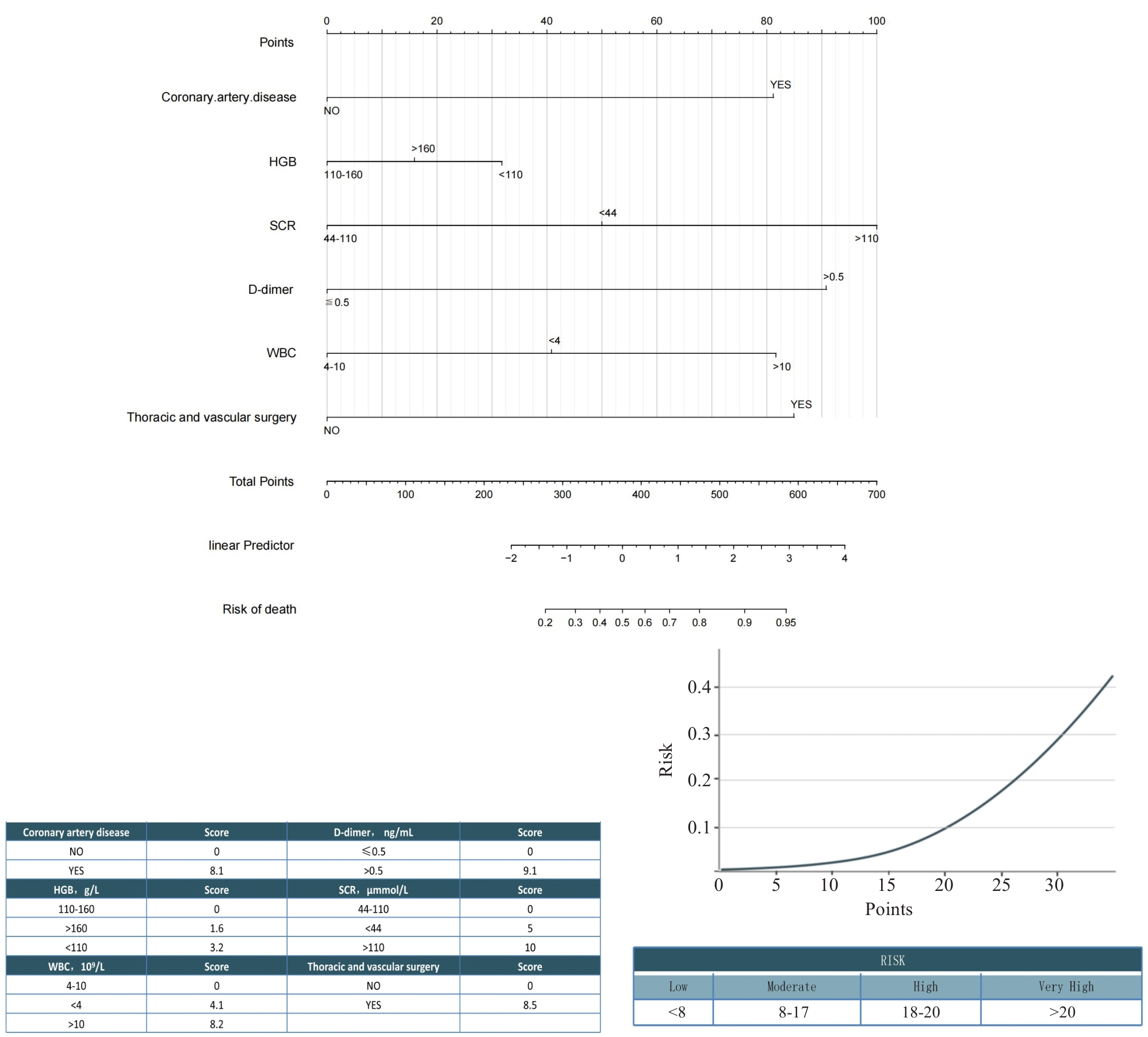
图1 低危异常心电图危险因素评分表
Fig.1 Risk factor scoring table for low-risk abnormal ECG.
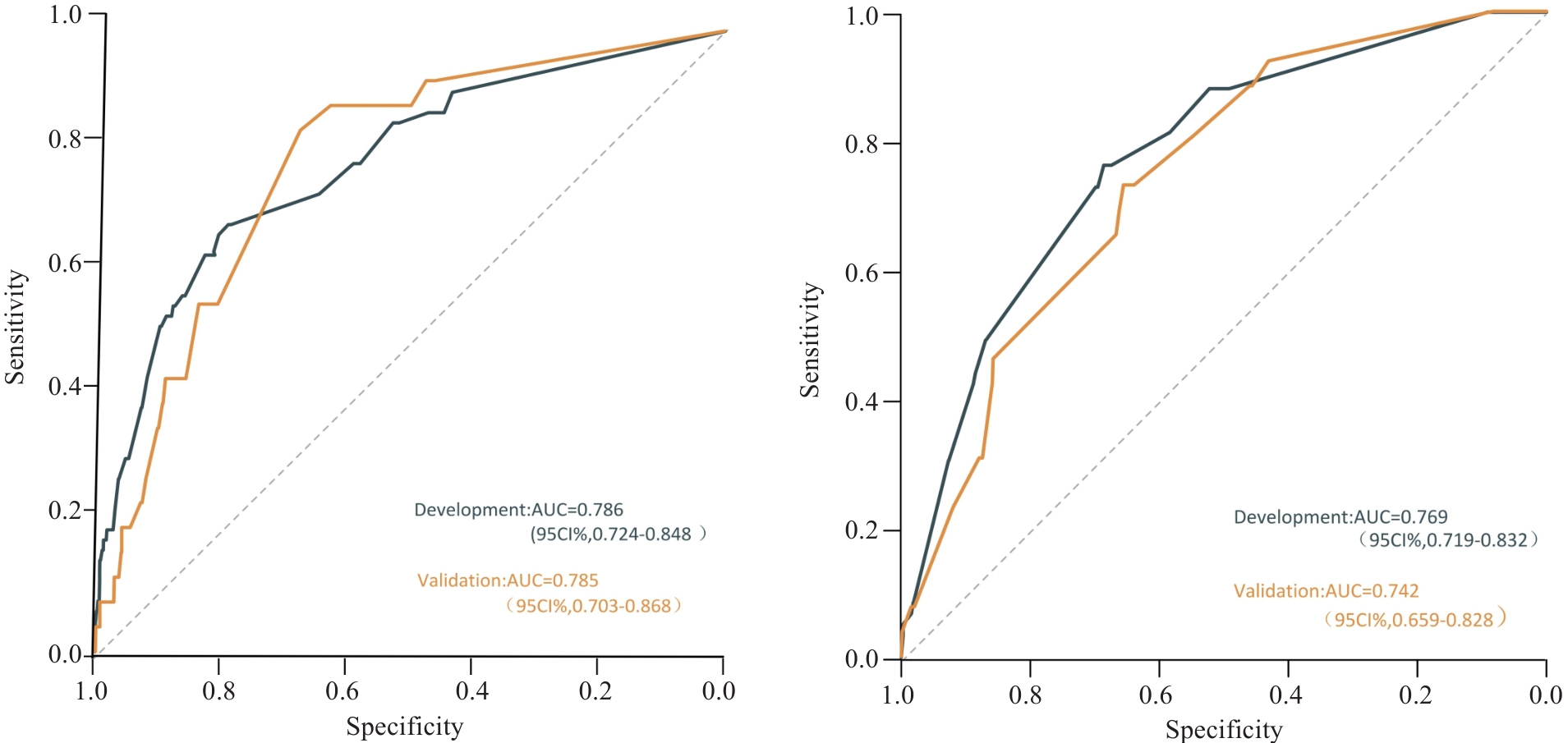
图 2 预测模型诊断效能的受试者工作特征曲线
Fig.2 Receiver operating characteristic curves of diagnostic performance of the prediction models.
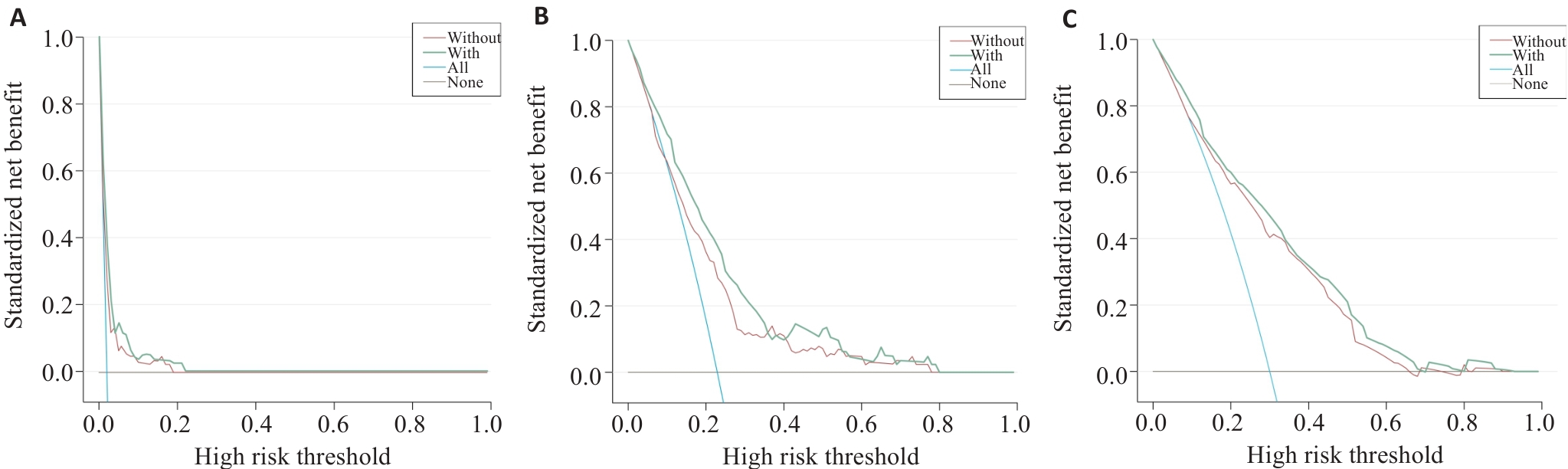
图3 决策曲线分析
Fig.3 Decision curve analysis (DCA). A: DCA for simple low-risk abnormal ECGs; B: DCA for low-risk abnormal ECGs with certain risk factors; C: DCA for high-risk abnormal ECGs.
| [1] | Hao LS, Xu X, Dupre ME, et al. Adequate access to healthcare and added life expectancy among older adults in China[J]. BMC Geriatr, 2020, 20(1): 129. doi:10.1186/s12877-020-01524-9 |
| [2] | Smilowitz NR, Berger JS. Perioperative cardiovascular risk assessment and management for noncardiac surgery: a review[J]. Jama, 2020, 324(3): 279. doi:10.1001/jama.2020.7840 |
| [3] | Beattie WS, Lalu M, Bocock M, et al. Systematic review and consensus definitions for the Standardized Endpoints in Perioperative Medicine (StEP) initiative: cardiovascular outcomes[J]. Br J Anaesth, 2021, 126(1): 56-66. |
| [4] | Ganguli I, Lupo C, Mainor AJ, et al. Prevalence and cost of care cascades after low-value preoperative electrocardiogram for cataract surgery in fee-for-service medicare beneficiaries[J]. JAMA Intern Med, 2019, 179(9): 1211-9. doi:10.1001/jamainternmed.2019.1739 |
| [5] | Payne CJ, Payne AR, Gibson SC, et al. Is there still a role for preoperative 12-lead electrocardiography[J]? World J Surg, 2011, 35(12): 2611-6. doi:10.1007/s00268-011-1289-y |
| [6] | Clendenin DJ, Athiraman U, Zurakowski D, et al. Accuracy of preoperative electrocardiographic and chest radiographic screening for prediction of left ventricular dysfunction in patients with suspected neuromuscular disorders[J]. Anesth Analg, 2010, 110(4): 1116-20. doi:10.1213/ane.0b013e3181d31ebd |
| [7] | Davis FM, Park YJ, Grey SF, et al. The clinical impact of cardiology consultation prior to major vascular surgery[J]. Ann Surg, 2018, 267(1): 189-95. doi:10.1097/sla.0000000000002014 |
| [8] | Hoehmann CL, Thompson J, Long M, et al. Unnecessary preoperative cardiology evaluation and transthoracic echocardio-gram delays time to surgery for geriatric hip fractures[J]. J Orthop Trauma, 2021, 35(4): 205-10. doi:10.1097/bot.0000000000001941 |
| [9] | Boniakowski AE, Davis FM, Phillips AR, et al. The effects of preoperative cardiology consultation prior to elective abdominal aortic aneurysm repair on patient morbidity[J]. Vascular, 2017, 25(4): 390-5. doi:10.1177/1708538116685946 |
| [10] | Coffman J, Tran T, Quast T, et al. Cost conscious care: preoperative evaluation by a cardiologist prior to low-risk procedures[J]. BMJ Open Qual, 2019, 8(2): e000481. doi:10.1136/bmjoq-2018-000481 |
| [11] | Zhao ML, Shang Z, Cai JG, et al. Development and validation of predictive model-HASBLAD score-for major adverse cardio-vascular events during perioperative period of non-cardiac surgery: a single center experience in China[J]. Front Cardiovasc Med, 2022, 9: 774191. doi:10.3389/fcvm.2022.774191 |
| [12] | Jammer I, Wickboldt N, Sander M, et al. Standards for definitions and use of outcome measures for clinical effectiveness research in perioperative medicine: European Perioperative Clinical Outcome (EPCO) definitions: a statement from the ESA-ESICM joint taskforce on perioperative outcome measures[J]. Eur J Anaesthesiol, 2015, 32(2): 88-105. doi:10.1097/eja.0000000000000118 |
| [13] | Alpert JS, Thygesen K, Antman E, et al. Myocardial infarction redefined: a consensus document of The Joint European Society of Cardiology/American College of Cardiology committee for the redefinition of myocardial infarction[J]. J Am Coll Cardiol, 2000, 36(3): 959-69. doi:10.1016/s0735-1097(00)00804-4 |
| [14] | Fleisher LA, Fleischmann KE, Auerbach AD, et al. 2014 ACC/AHA guideline on perioperative cardiovascular evaluation and management of patients undergoing noncardiac surgery: executive summary: a report of the American College of Cardiology/American Heart Association Task Force on Practice Guidelines [J]. Circulation, 2014, 130(24): 2215-45. doi:10.1161/cir.0000000000000105 |
| [15] | Thiele RH, Theodore DJ, Gan TJ. Outcome of organ dysfunction in the perioperative period[J]. Anesth Analg, 2021, 133(2): 393-405. doi:10.1213/ane.0000000000005603 |
| [16] | Dogan V, Biteker M, Özlek E, et al. Impact of preoperative cardiology consultation prior to intermediate-risk surgical procedures[J]. Eur J Clin Investig, 2018, 48(9): e12794. doi:10.1111/eci.12794 |
| [17] | Siddaiah H, Patil S, Shelvan A, et al. Preoperative laboratory testing: Implications of "Choosing Wisely" guidelines[J]. Best Pract Res Clin Anaesthesiol, 2020, 34(2): 303-14. doi:10.1016/j.bpa.2020.04.006 |
| [18] | Puelacher C, Gualandro D, Glarner N, et al. Long term outcomes in different aetiologies of perioperative myocardial infarction/injury after noncardiac surgery[J]. Eur Heart J, 2022, 43(): ehac544.2532. doi:10.1093/eurheartj/ehac544.2532 |
| [19] | Patel NJ, Paterick ZR, Schmidt M, et al. Cardiology consultation for non-cardiac surgery: Medical and legal explorations for clinicians[J]. Int J Cardiol, 2018, 267: 74-6. doi:10.1016/j.ijcard.2018.05.093 |
| [20] | Bock M, Fritsch G, Hepner DL. Preoperative laboratory testing[J]. Anesthesiol Clin, 2016, 34(1): 43-58. doi:10.1016/j.anclin.2015.10.005 |
| [21] | Cai P, Zhong WT, Wang Y, et al. Effects of white-coat, masked and sustained hypertension on coronary artery stenosis and cardiac arrhythmia[J]. Hypertens Res, 2020, 43(2): 121-31. doi:10.1038/s41440-019-0342-3 |
| [22] | Pérez-Riera AR, Carlos de Abreu L, Yanowitz F, et al. "Benign" early repolarization versus malignant early abnormalities: Clinical-electrocardiographic distinction and genetic basis[J]. Cardiol J, 2012, 19(4): 337-46. doi:10.5603/cj.2012.0063 |
| [23] | Martin SK, Cifu AS. Routine preoperative laboratory tests for elective surgery[J]. JAMA, 2017, 318(6): 567-8. doi:10.1001/jama.2017.7508 |
| [24] | Taylor GA, Oresanya LB, Kling SM, et al. Rethinking the routine: Preoperative laboratory testing among American Society of Anesthesiologists class 1 and 2 patients before low-risk ambulatory surgery in the 2017 National Surgical Quality Improvement Program cohort[J]. Surgery, 2022, 171(2): 267-74. doi:10.1016/j.surg.2021.07.036 |
| [25] | Oldroyd SH, Quintanilla BS, Makaryus AN. First-Degree Heart Block [M]. StatPearls. Treasure Island (FL). 2023. |
| [26] | Yamada T. Twelve-lead electrocardiographic localization of idiopathic premature ventricular contraction origins[J]. J Cardiovasc Electrophysiol, 2019, 30(11): 2603-17. doi:10.1111/jce.14152 |
| [27] | Cao D, Chandiramani R, Capodanno D, et al. Non-cardiac surgery in patients with coronary artery disease: risk evaluation and periprocedural management[J]. Nat Rev Cardiol, 2021, 18(1): 37-57. doi:10.1038/s41569-020-0410-z |
| [28] | Zhang XY, Wang SJ, Liu JX, et al. D-dimer and the incidence of heart failure and mortality after acute myocardial infarction[J]. Heart, 2021, 107(3): 237-44. doi:10.1136/heartjnl-2020-316880 |
| [29] | Bicciré FG, Pastori D, Tanzilli A, et al. Low serum albumin levels and in-hospital outcomes in patients with ST segment elevation myocardial infarction[J]. Nutr Metab Cardiovasc Dis, 2021, 31(10): 2904-11. doi:10.1016/j.numecd.2021.06.003 |
| [30] | Walther CP, Carter CW, Low CL, et al. Interdialytic creatinine change versus predialysis creatinine as indicators of nutritional status in maintenance hemodialysis[J]. Nephrol Dial Transplant, 2012, 27(2): 771-6. doi:10.1093/ndt/gfr389 |
| [31] | Antonoff MB. Commentary: Predicting patients at risk for complications after thoracic surgery: Application in the era of enhanced recovery[J]. J Thorac Cardiovasc Surg, 2019, 157(6): 2502-3. doi:10.1016/j.jtcvs.2019.02.007 |
| [32] | Kristono GA, Holley AS, Harding SA, et al. White blood cell subtypes as predictors of adverse cardiac events[J]. Coron Artery Dis, 2020, 31(5): 446-50. doi:10.1097/mca.0000000000000860 |
| [33] | Mohammed AA, Liu L, Mareal RM, et al. Combination of White Blood Cell Count to Mean Platelet Volume Ratio and Neutrophil-to-Platelet Ratio Predicts Long-Term Adverse Events in Patients with MINOCA [J]. Mediators Inflamm, 2022: 5642406. doi:10.1155/2022/5642406 |
| [34] | Lee C, Columbo JA, Stone DH, et al. Preoperative evaluation and perioperative management of patients undergoing major vascular surgery[J]. Vasc Med, 2022, 27(5): 496-512. doi:10.1177/1358863x221122552 |
| [35] | Korte W, Cattaneo M, Chassot PG, et al. Peri-operative management of antiplatelet therapy in patients with coronary artery disease: joint position paper by members of the working group on Perioperative Haemostasis of the Society on Thrombosis and Haemostasis Research (GTH), the working group on Perioperative Coagulation of the Austrian Society for Anesthesiology, Resuscitation and Intensive Care (ÖGARI) and the Working Group Thrombosis of the European Society for Cardiology (ESC)[J]. Thromb Haemost, 2011, 105(5): 743-9. doi:10.1160/TH10-04-0217 |
| [36] | Santangelo G, Faggiano A, Toriello F, et al. Risk of cardiovascular complications during non-cardiac surgery and preoperative cardiac evaluation[J]. Trends Cardiovasc Med, 2022, 32(5): 271-84. doi:10.1016/j.tcm.2021.06.003 |
| [37] | Reusser A, Blum S, Aeschbacher S, et al. QTc interval, cardiovascular events and mortality in patients with atrial fibrillation[J]. Int J Cardiol, 2018, 252: 101-5. doi:10.1016/j.ijcard.2017.11.078 |
| [38] | Krittayaphong R, Muenkaew M, Chiewvit P, et al. Electrocardio-graphic predictors of cardiovascular events in patients at high cardiovascular risk: a multicenter study [J]. J Geriatr Cardiol, 2019, 16(8): 630-8. |
| [39] | Jankowski J, Floege J, Fliser D, et al. Cardiovascular disease in chronic kidney disease: pathophysiological insights and therapeutic options[J]. Circulation, 2021, 143(11): 1157-72. doi:10.1161/circulationaha.120.050686 |
| [40] | Wang L, Cong HL, Zhang JX, et al. Triglyceride-glucose index predicts adverse cardiovascular events in patients with diabetes and acute coronary syndrome[J]. Cardiovasc Diabetol, 2020, 19(1): 80. doi:10.1186/s12933-020-01054-z |
| [41] | Tafesse E, Hurst M, Sugrue D, et al. Serum potassium as a predictor of adverse clinical outcomes in patients with increasing comorbidity burden[J]. Eur Heart J Qual Care Clin Outcomes, 2022, 8(1): 61-9. doi:10.1093/ehjqcco/qcaa078 |
| [1] | 孟冰冰, 刘畅, 廖国松, 张凯, 杨木泽, 顾娟娟, 娄景盛, 刘艳红, 傅强, 曹江北, 米卫东, 李皓. 术中应用右美托咪定对老年患者术后睡眠障碍的影响:一项前瞻性多中心队列研究[J]. 南方医科大学学报, 2026, 46(6): 1228-1234. |
| [2] | 刘星扬, 吴静涵, 叶春艳, 王锷, 胡浩. 老年患者全麻期间颈总动脉血流的动态变化及其生理调控机制:一项前瞻性研究[J]. 南方医科大学学报, 2026, 46(4): 761-769. |
| [3] | 吕雪彩, 刘艳红, 韩诗怡, 张浩赟, 侯爱生, 周志康, 史立凯, 高洁, 曹江北, 张宏, 米卫东. 老年患者胃肠道手术后综合并发症的危险因素——一项多中心观察性研究[J]. 南方医科大学学报, 2025, 45(4): 736-743. |
| [4] | 原梦瑶, 阮湘涵, 李扬, 张婷, 郝春香, 李皓, 娄景盛, 曹江北, 刘艳红, 米卫东, 张晓莹. 术前血清镁水平与非心脏手术老年患者术后谵妄风险的关系:一项回顾性队列研究[J]. 南方医科大学学报, 2025, 45(12): 2616-2627. |
| [5] | 许立倩, 魏 宁, 单美娟, 汪子怡, 叶天成, 梁赛珍, 李 乐, 朱 强, 何路遥, 白建杰, 陈碧霞, 徐金东. 加温湿化高流量鼻导管吸氧可减少老年患者麻醉复苏期缺氧事件发生[J]. 南方医科大学学报, 2021, 41(8): 1265-1269. |
| [6] | 陈小慧,任晓强,马亚兵,葛莉,胡钟元,阎文军. 术后疼痛引起老年患者术后认知功能障碍的相关机制研究进展[J]. 南方医科大学学报, 2019, 39(09): 1122-. |
| [7] | 郭筱燕,黄学成,王琦武. 术前强化他汀治疗对高龄冠心病患者冠脉介入治疗预后的影响[J]. 南方医科大学学报, 2015, 35(02): 295-. |
| [8] | 孙长江,张西志,陈勇. 厄洛替尼治疗老年晚期非小细胞肺癌的疗效[J]. 南方医科大学学报, 2012, 32(12): 1839-. |
| [9] | 黄劲松,黄克力,简旭华,吴敏,卢聪,郑少忆. 50岁以上的主动脉瓣病变患者的外科治疗:附73例报告[J]. 南方医科大学学报, 2012, 32(02): 258-. |
| 阅读次数 | ||||||
|
全文 |
|
|||||
|
摘要 |
|
|||||
