
南方医科大学学报 ›› 2026, Vol. 46 ›› Issue (10): 2325-2337.doi: 10.12122/j.issn.1673-4254.2026.10.04
• • 上一篇
任乾千1( ), 张宝文1, 刘醒然1,2, 丁伟利3,4, 陈丹丹1,5, 寇现娟1()
收稿日期:2025-03-16
出版日期:2026-10-20
发布日期:2026-10-26
通讯作者:
寇现娟
E-mail:906371632@qq.com;kouxianjuan@126.com
作者简介:任乾千,在读硕士研究生,E-mail: 906371632@qq.com
基金资助:
Qianqian REN1(), Baowen ZHANG1, Xingran LIU1,2, Weili DING3,4, Dandan CHEN1,5, Xianjuan KOU1()
Received:2025-03-16
Online:2026-10-20
Published:2026-10-26
Contact:
Xianjuan KOU
E-mail:906371632@qq.com;kouxianjuan@126.com
摘要:
目的 探究40 Hz光闪烁刺激对1-甲基-4-苯基-1,2,3,6-四氢吡啶(MPTP)诱导的亚急性帕金森病(PD)小鼠认知功能障碍的影响及其分子机制。 方法 将40只SPF级8周龄雄性C57BL/6小鼠随机分为对照组、PD模型组、40 Hz+PD干预组、PD+sh-NC组、PD+sh-STING组(n=8)。除对照组外,其余4组均采用腹腔注射MPTP(30 mg/kg)的方式建立亚急性PD小鼠模型;PD+sh-STING组进行脑立体定位注射AAV干扰STING基因;40 Hz+PD组进行连续4周的40 Hz光闪烁刺激干预。干预结束后通过行为学实验检测小鼠的运动能力与认知功能;采用免疫荧光染色观察小鼠海马S100钙结合蛋白A10(S100A10)、补体C3(C3)与星形胶质细胞蛋白GFAP的共定位水平;尼氏染色观察尼氏小体的数量;ELISA检测小鼠血清中的白介素含量;Western blotting和RT-qPCR分别检测黑质与海马组织中的α-突触核蛋白(α-syn)和酪氨酸羟化酶(TH)、突触可塑性、星形胶质细胞标志物、神经炎症、细胞因子信号传导抑制因子3(SOCS3)、JAK2-STAT3及STING通路相关蛋白与转录水平。 结果 与对照组相比,PD组小鼠运动能力与认知功能显著降低,TH蛋白表达降低(P<0.01),α-syn的表达增加(P<0.01)。40 Hz光闪烁刺激干预后PD小鼠认知功能得到改善,海马神经元数量显著增加(P<0.0001)、S100A10表达增加(P<0.05),p-STING/STING、C3、GFAP、IL-6、TNF-α表达减少(P<0.05)。与PD+sh-NC组小鼠相比,PD+sh-STING组小鼠认知功能明显恢复,海马区SOCS3、JAK2-STAT3表达水平无显著变化(P>0.05),而C3表达水平降低(P<0.05),S100A10表达水平则升高(P<0.05)。 结论 40 Hz光闪烁刺激可能通过抑制STING信号通路的异常激活,促进星形胶质细胞向A2型极化,改善海马突触可塑性,进而缓解PD小鼠的认知功能障碍。
任乾千, 张宝文, 刘醒然, 丁伟利, 陈丹丹, 寇现娟. 40 Hz光闪烁刺激通过抑制STING信号通路改善帕金森病小鼠的认知功能障碍[J]. 南方医科大学学报, 2026, 46(10): 2325-2337.
Qianqian REN, Baowen ZHANG, Xingran LIU, Weili DING, Dandan CHEN, Xianjuan KOU. 40 Hz flicker light stimulation suppresses STING signaling to improve cognitive dysfunction in mice with Parkinson disease[J]. Journal of Southern Medical University, 2026, 46(10): 2325-2337.
| Gene | Forward primer (5'-3') | Reverse primer (5'-3') |
|---|---|---|
| BDNF | TCATACTTCGGTTGCATGAAGG | AGACCTCTCGAACCTGCCC |
| SYN | AGCTCAACAAATCCCAGTCTCT | CGGATGGTCTCAGCTTTCAC |
| PSD93 | ATCATTCCTTACCTCGGCTAACT | TCAGAGGAGAGATGTGAGACTG |
| PSD95 | TGAGATCAGTCATAGCAGCTACT | CTTCCTCCCCTAGCAGGTCC |
| C1q | TGGAGACCTCTCAGGGATGG | CTTTCACGCCCTTCAGTCCT |
| Arg-1 | CTCCAAGCCAAAGTCCTTAGAG | AGGAGCTGTCATTAGGGACATC |
| C3 | TAGAGGCCCATGATGCTCAG | AAGTTTGCCACCACTGTCAC |
| S100A10 | TGGAAACCATGATGCTTACGTT | GAAGCCCACTTTGCCATCTC |
| IL-6 | TAGTCCTTCCTACCCCAATTTCC | TTGGTCCTTAGCCACTCCTTC |
| TNF-ɑ | GACGTGGAACTGGCAGAAGAG | TTGGTGGTTTGTGAGTGTGAG |
| GAPDH | GGTTGTCTCCTGCGACTTCA | TGGTCCAGGGTTTCTTACTCC |
表1 引物序列
Tab.1 Primer sequence for RT-qPCR
| Gene | Forward primer (5'-3') | Reverse primer (5'-3') |
|---|---|---|
| BDNF | TCATACTTCGGTTGCATGAAGG | AGACCTCTCGAACCTGCCC |
| SYN | AGCTCAACAAATCCCAGTCTCT | CGGATGGTCTCAGCTTTCAC |
| PSD93 | ATCATTCCTTACCTCGGCTAACT | TCAGAGGAGAGATGTGAGACTG |
| PSD95 | TGAGATCAGTCATAGCAGCTACT | CTTCCTCCCCTAGCAGGTCC |
| C1q | TGGAGACCTCTCAGGGATGG | CTTTCACGCCCTTCAGTCCT |
| Arg-1 | CTCCAAGCCAAAGTCCTTAGAG | AGGAGCTGTCATTAGGGACATC |
| C3 | TAGAGGCCCATGATGCTCAG | AAGTTTGCCACCACTGTCAC |
| S100A10 | TGGAAACCATGATGCTTACGTT | GAAGCCCACTTTGCCATCTC |
| IL-6 | TAGTCCTTCCTACCCCAATTTCC | TTGGTCCTTAGCCACTCCTTC |
| TNF-ɑ | GACGTGGAACTGGCAGAAGAG | TTGGTGGTTTGTGAGTGTGAG |
| GAPDH | GGTTGTCTCCTGCGACTTCA | TGGTCCAGGGTTTCTTACTCC |
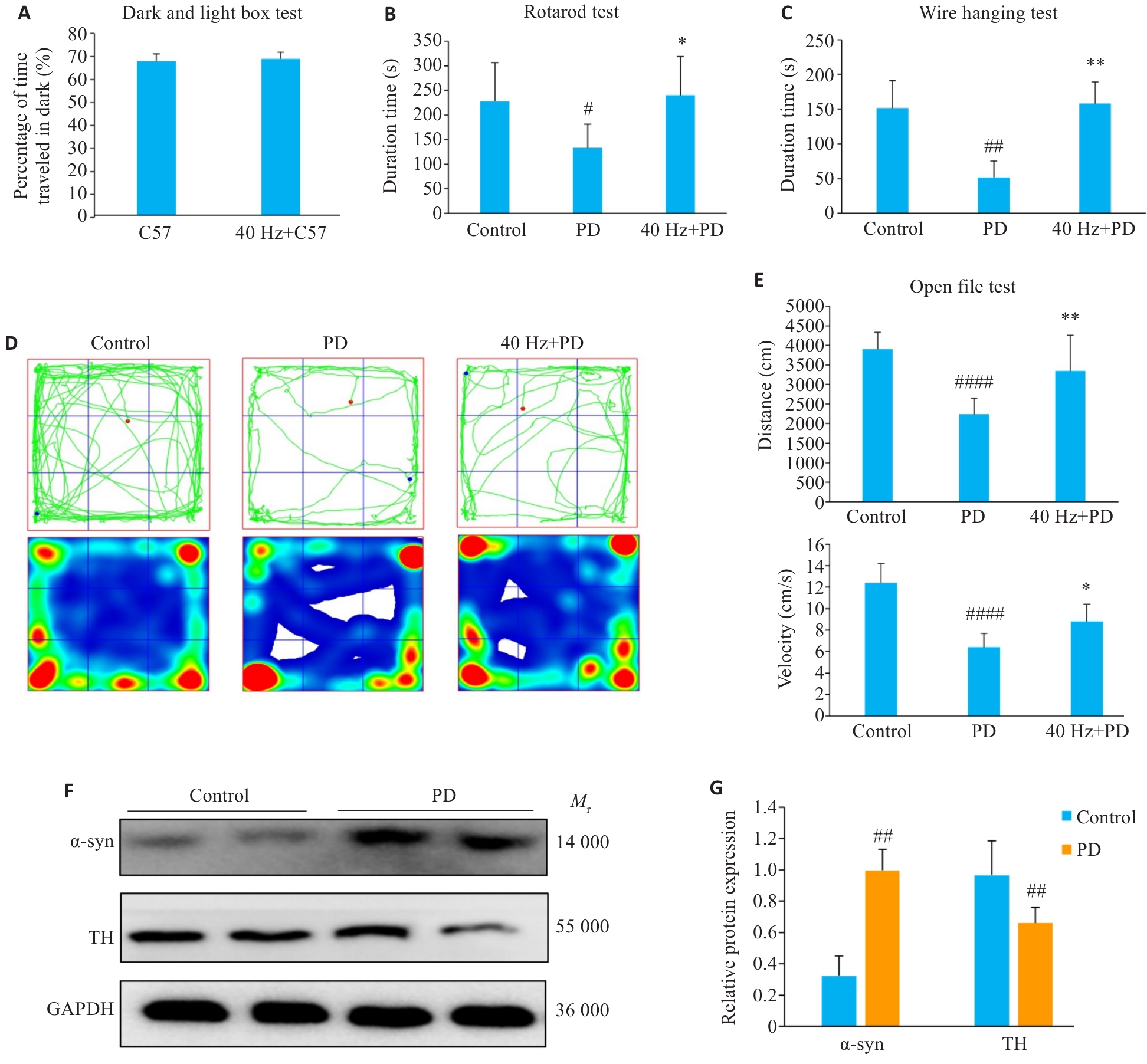
图1 PD小鼠造模以及运动功能检测结果
Fig.1 Modeling of Parkinson disease (PD) mice and motor function test results. A: Dark box residence time in the black-and-white box test. B: Duration time in the rotating rod test. C: Duration time in the hanging test. D: Pathway map and heat map of open field test. E: Total distance and movement speed in the open field test. F: Western blotting detection results. G: Expression levels of α-syn and TH proteins. Data are presented as Mean±SD and analyzed using one-way ANOVA. #P<0.05, ##P<0.01, ####P<0.0001 vs Control. *P<0.05, **P<0.01 vs PD.
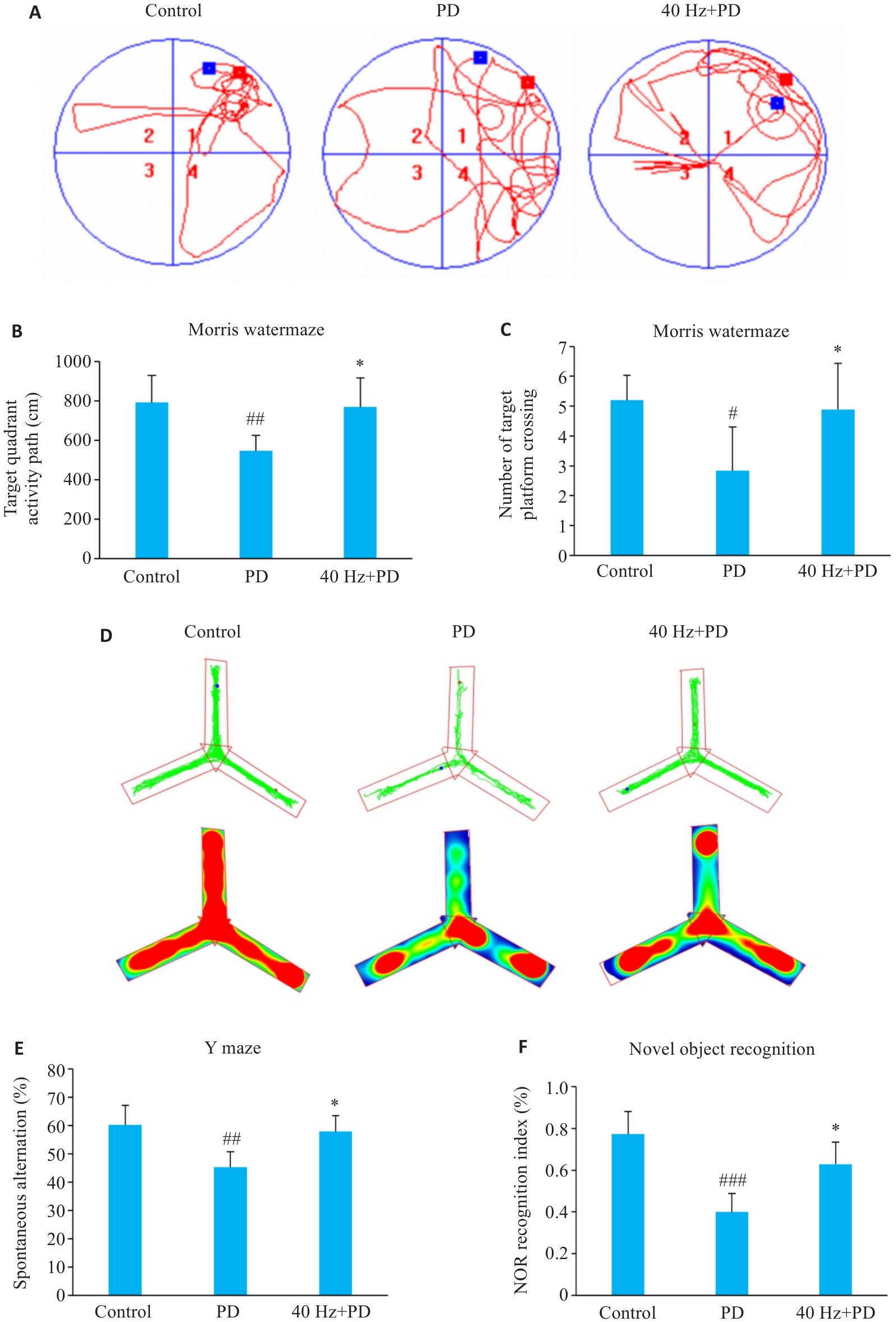
图2 各组小鼠认知功能检测结果
Fig.2 Cognitive function test results in each group. A: Water maze test trajectory. B: Target quadrant activity distance within the water maze. C: Number of target platform crossing within the water maze. D: Y maze test trajectory and heat map. E: Y maze spontaneous response alternation rate. F: Novel object recognition index. Data are presented as Mean±SD. #P<0.05,##P<0.01,###P<0.001 vs Control. *P<0.05 vs PD.
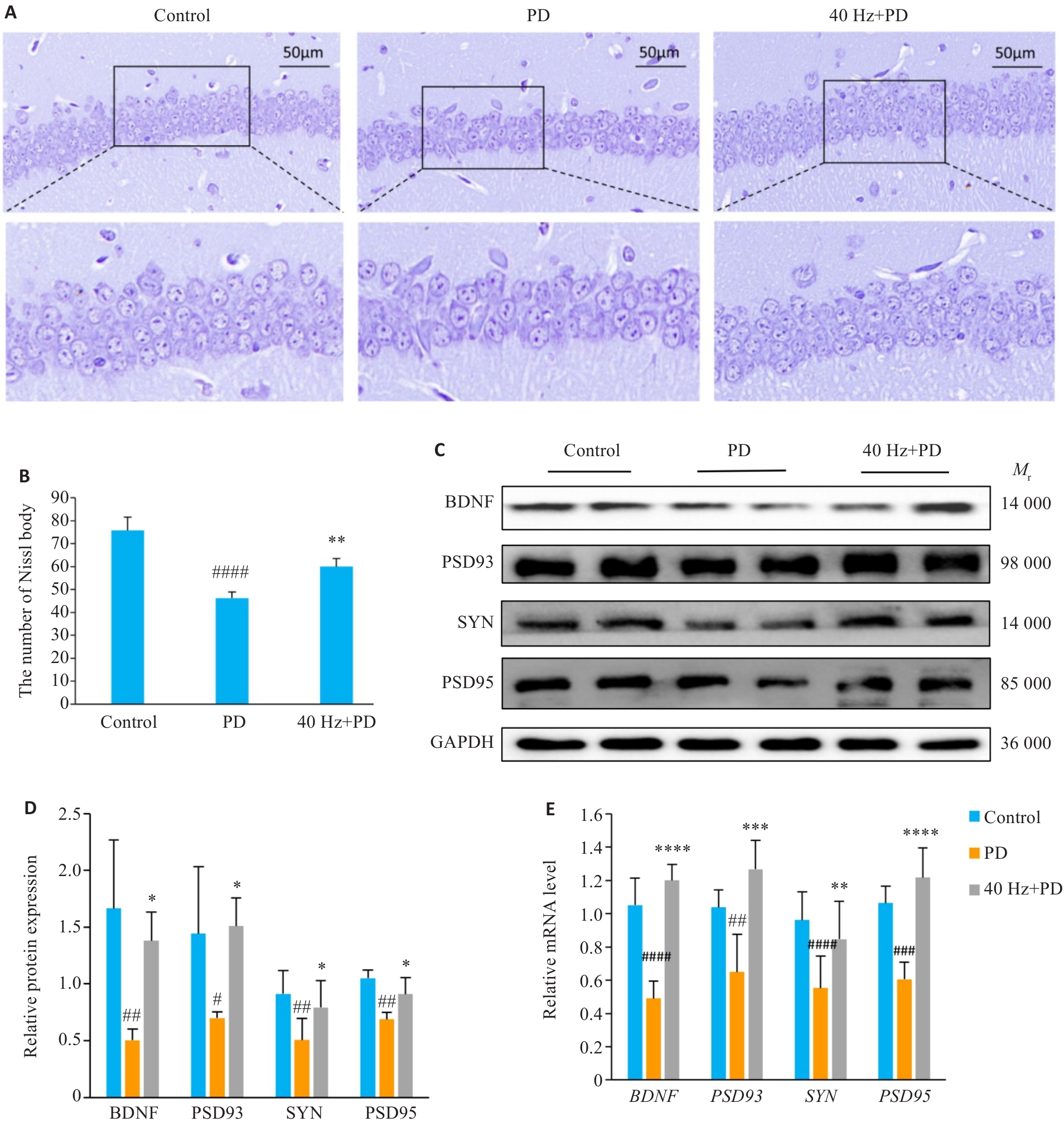
图3 各组小鼠海马神经元及突触相关检测结果
Fig.3 Detection results of hippocampal neurons and synapses in each group. A: Nissl staining of the hippocampus in each group (Original magnification: × 50). B: Nissl neuronal count statistics in the hippocampus in each group. C: Western blotting detection results. D: Analysis of Western blotting detection results. E: Analysis of RT-qPCR detection results. Data are presented as Mean±SD and analyzed using one-way ANOVA. #P<0.05,##P<0.01, ###P<0.001,####P<0.0001 vs Control. *P<0.05, **P<0.01, ***P<0.001, ****P<0.0001 vs PD.
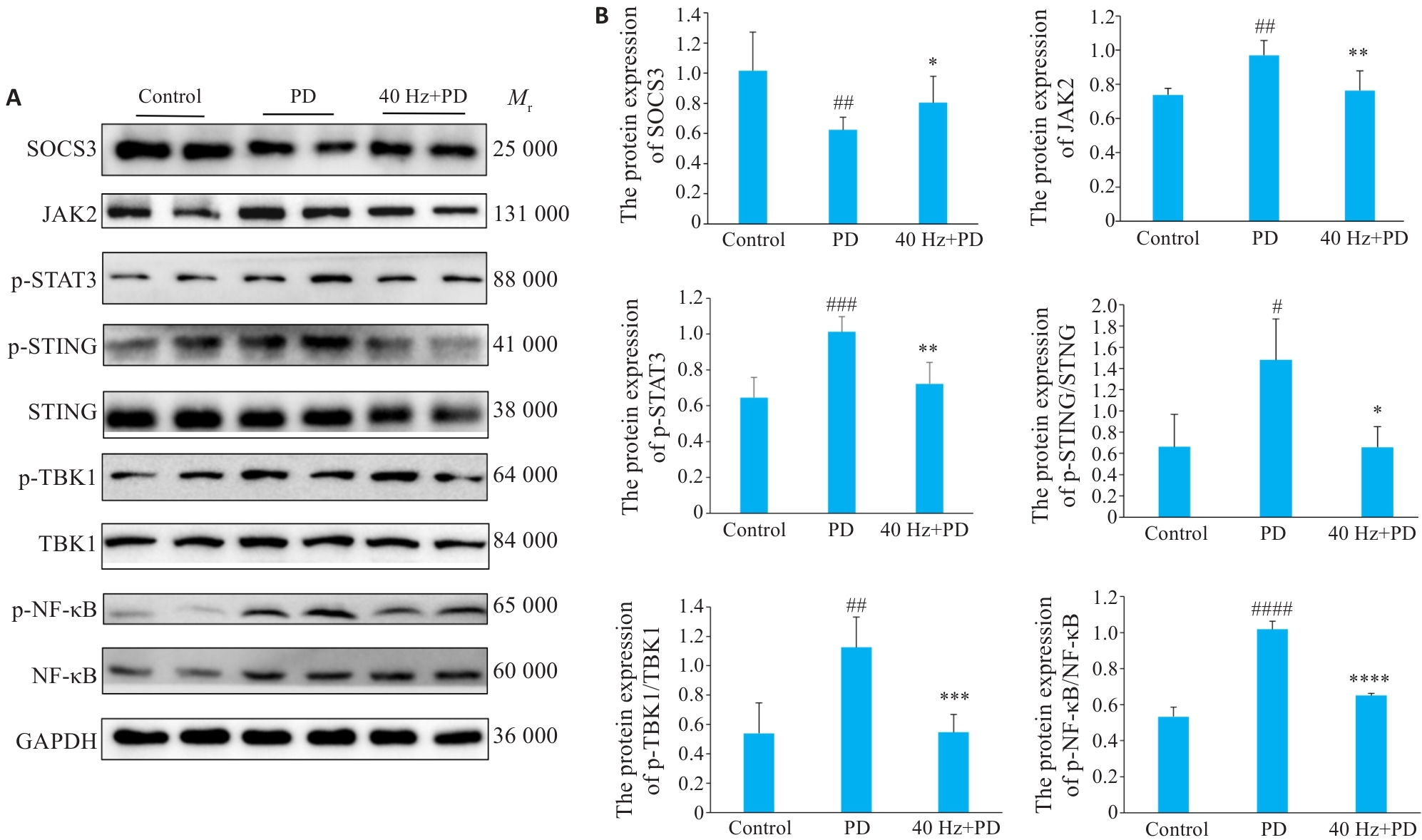
图4 各组小鼠海马SOCS3以及JAK2-STAT3-STING通路检测结果
Fig.4 Detection results of SOCS3 and the JAK2-STAT3-STING pathway in mouse hippocampus in each group. A: Western blotting detection results. B: Analysis of the results of Western blotting. Data are presented as Mean±SD and analyzed using one-way ANOVA. #P<0.05,##P<0.01, ###P<0.001,####P<0.0001 vs Control. *P<0.05, **P<0.01, ***P<0.001, ****P<0.0001 vs PD.
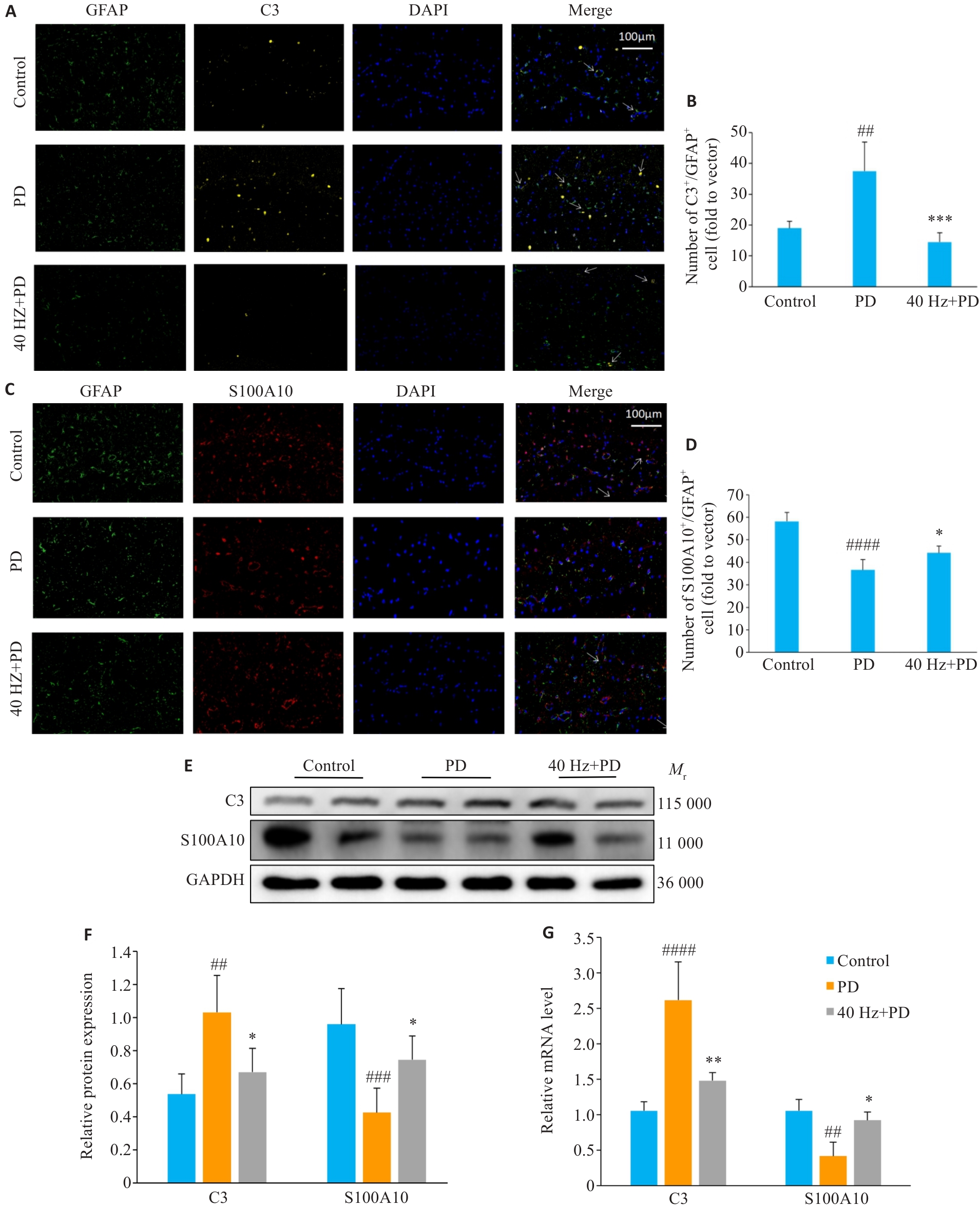
图5 各组小鼠海马星形胶质细胞极化表型检测结果
Fig.5 Detection results of hippocampal astrocyte polarization phenotypes in the mice in each group. A: Immunofluorescence staining of detecting hippocampal GFAP (green) and C3 (yellow) in each group (×100; arrows indicate co-staining regions of GFAP and C3). B: Quantitative analysis of immunofluorescence staining results. C: Immunofluorescence staining for detecting hippocampal GFAP (green) and S100A10 (red) in each group (×100; arrows indicate co-staining regions of GFAP and S100A10). D: Quantitative analysis of immunofluorescence staining results. E: Western blotting detection results. F: Quantitative analysis of Western blotting results. G: RT-qPCR detection analysis. Data are presented as Mean±SD and analyzed using one-way ANOVA. ##P<0.01, ###P<0.001,####P<0.0001 vs Control. *P<0.05, **P<0.01, ***P<0.001 vs PD.
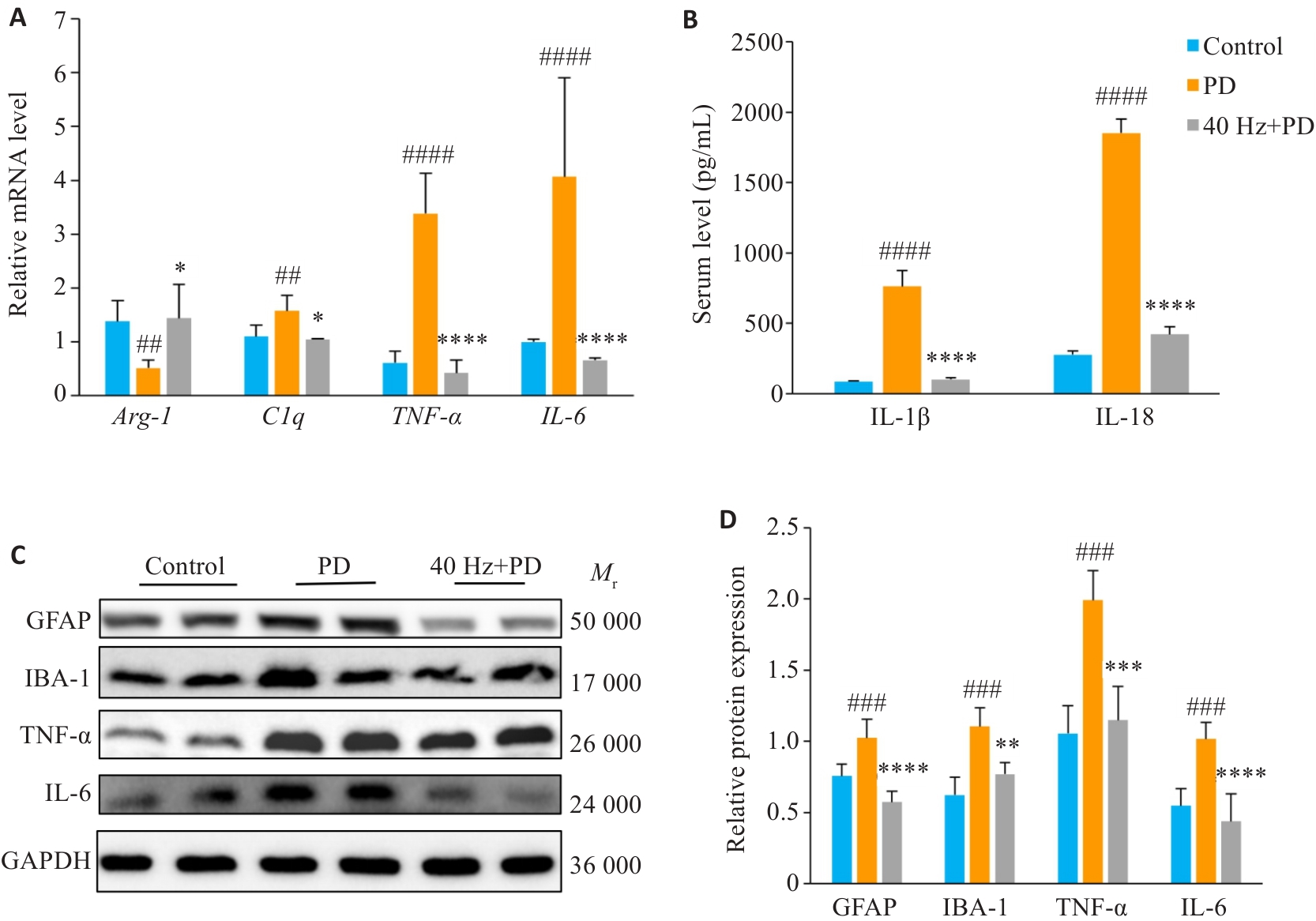
图6 各组小鼠海马神经炎症及全身性炎症检测结果
Fig.6 Detection results of hippocampal neuroinflammation and systemic inflammation in each group. A: Analysis of RT-qPCR detection results. B: Serum ELISA detection results. C: Western blotting detection results. D: Quantitative analysis of Western blotting detection results. Data are presented as Mean±SD and analyzed using one-way ANOVA. ##P<0.01, ###P<0.001, ####P<0.0001 vs Control. *P<0.05, **P<0.01, ***P<0.001, ****P<0.0001 vs PD.
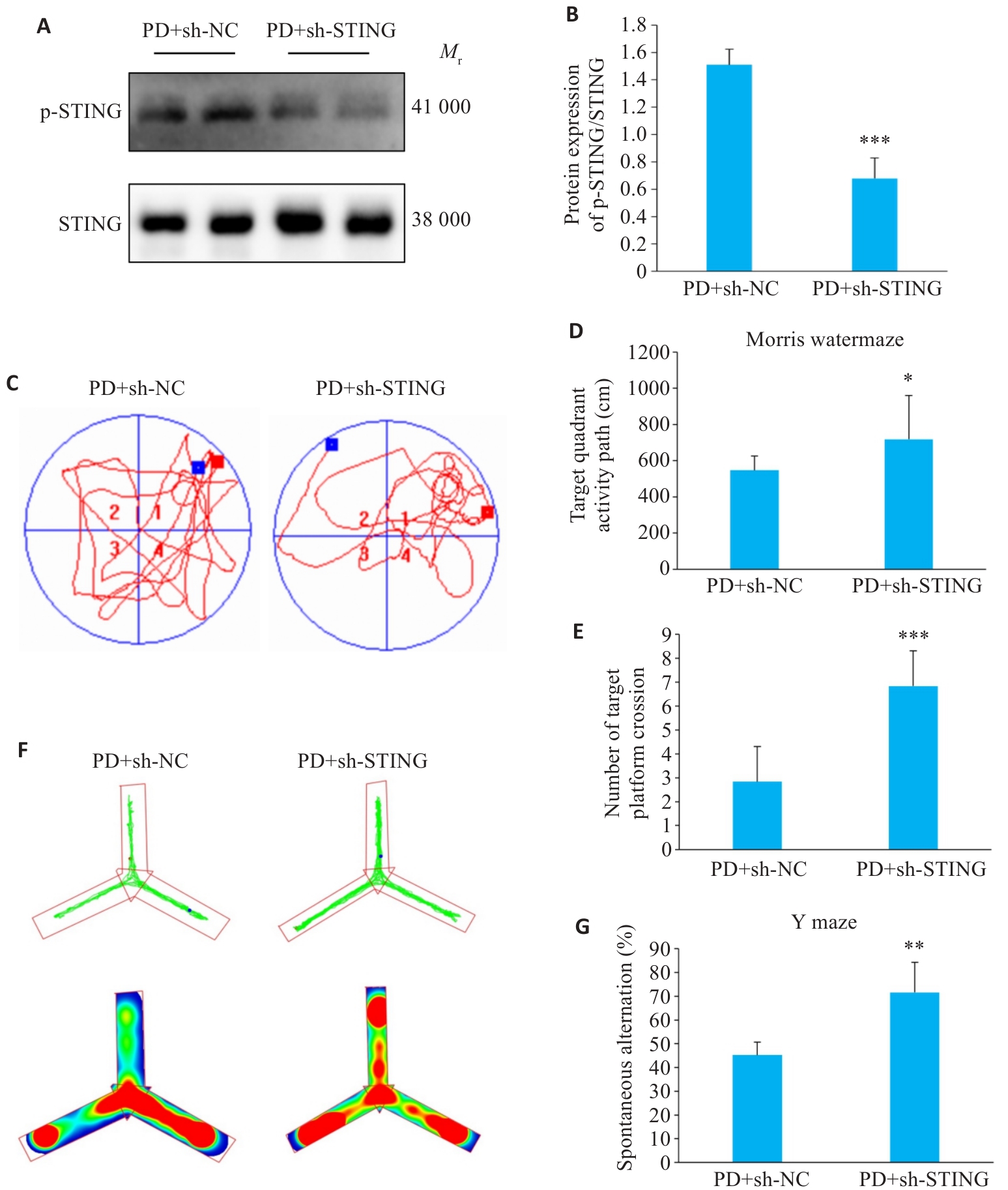
图7 STING干扰小鼠认知功能检测结果
Fig.7 Effect of STING knockdown on cognitive function of PD mice. A: Western blotting detection results. B: Quantitative analysis of Western blotting results. C: Water maze test trajectory. D: Target quadrant activity path within the water maze. E: Number of target platform crossings within the water maze. F: Y maze test trajectory and heat map. G: Y maze spontaneous response alternation rate. Data are presented as Mean±SD and analyzed using one-way ANOVA. *P<0.05, **P<0.01, ***P<0.001 vs PD+sh-NC.
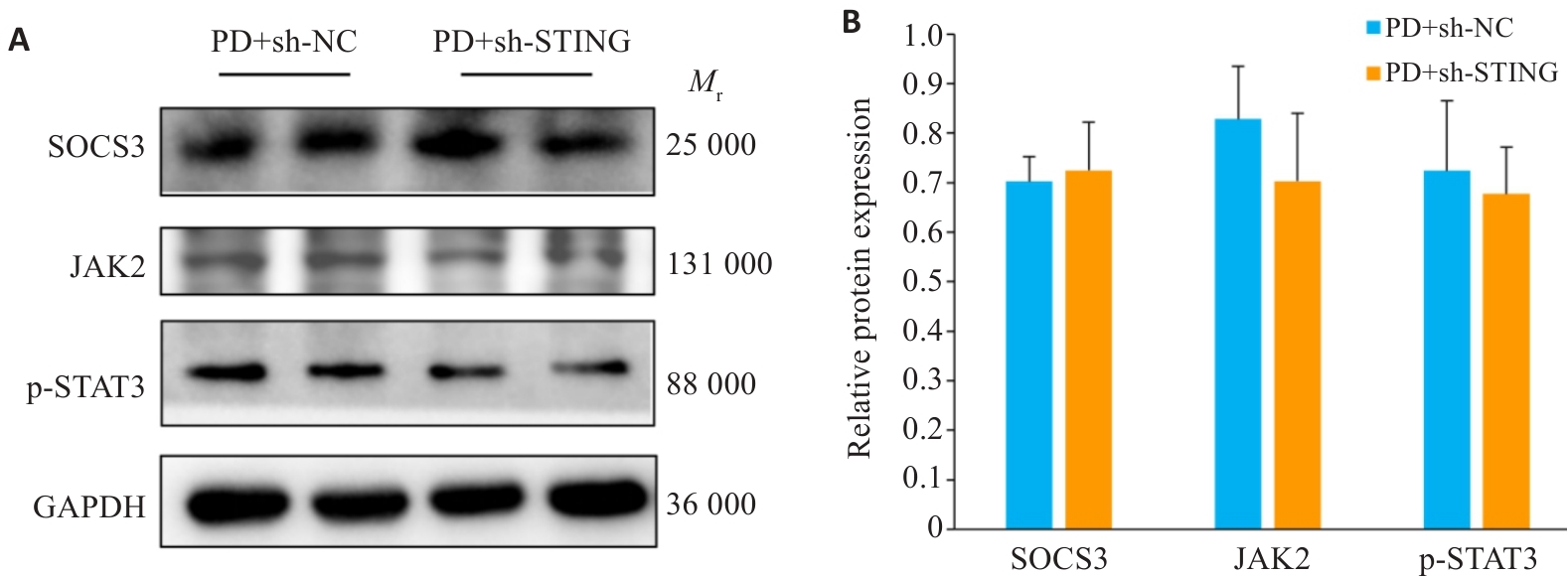
图8 STING干扰小鼠海马SOCS3-JAK2-STAT3信号通路检测结果
Fig.8 Detection results of the SOCS3-JAK2-STAT3 signaling pathway in the hippocampus of PD mice with STING knockdown. A: Western blotting detection results. B: Quantitative analysis of Western blotting results.
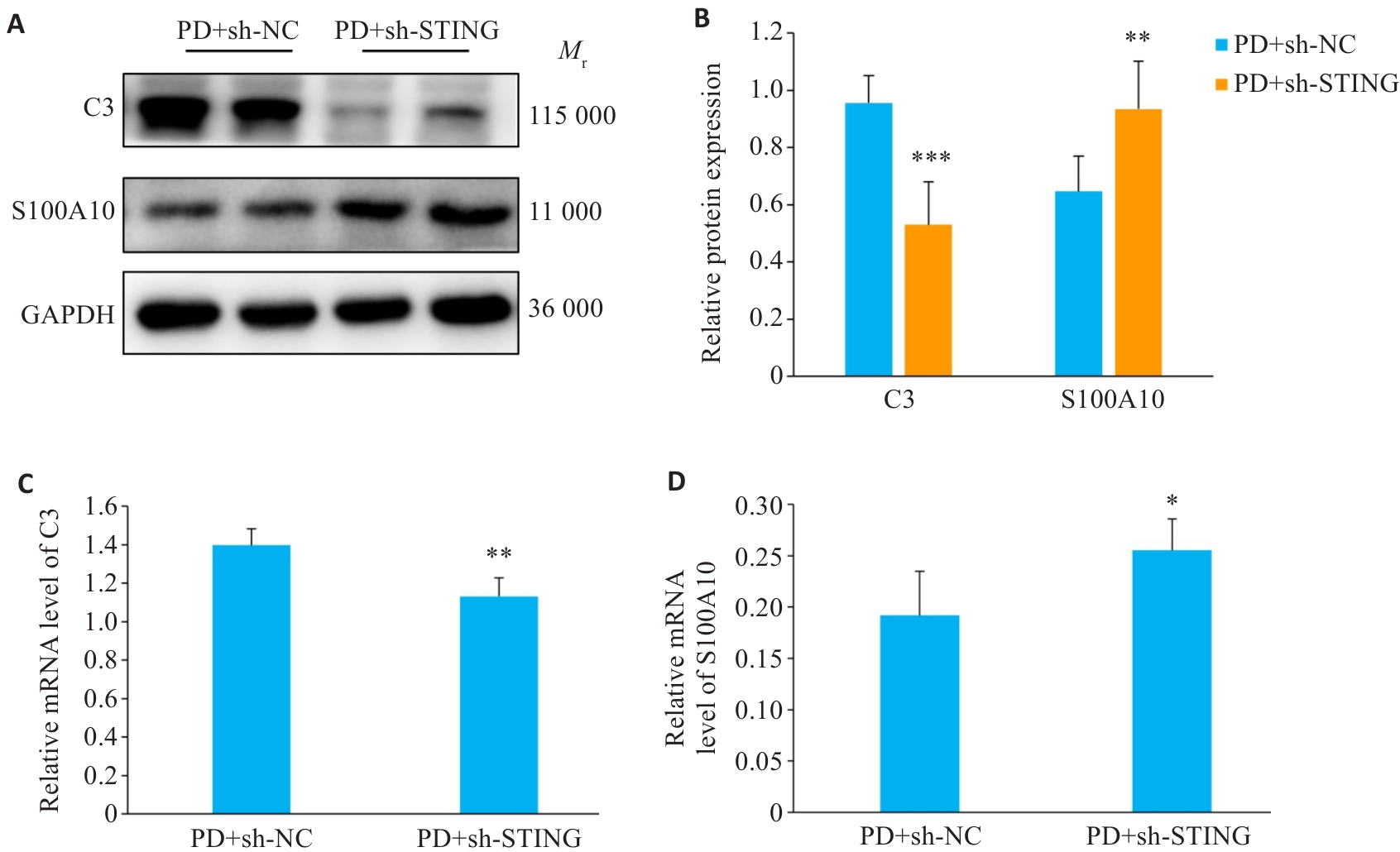
图9 STING干扰小鼠海马星形胶质细胞极化检测结果
Fig. 9 STING knockdown affects detection results of hippocampal astrocyte polarization in mice. A: Western blotting detection results. B: Quantitative analysis of Western blotting results. C: RT-qPCR for detection of C3. D: RT-qPCR for detection of S100A10. Data are presented as Mean±SD and analyzed using one-way ANOVA. *P<0.05, **P<0.01, ***P<0.001 vs sh-NC.
| [1] | Wallace ER, Segerstrom SC, van Horne CG, et al. Meta-analysis of cognition in Parkinson's disease mild cognitive impairment and dementia progression[J]. Neuropsychol Rev, 2022, 32(1): 149-60. doi:10.1007/s11065-021-09502-7 |
| [2] | Gibson LL, Weintraub D, Lemmen R, et al. Risk of dementia in Parkinson's disease: a systematic review and meta-analysis[J]. Mov Disord, 2024, 39(10): 1697-709. doi:10.1002/mds.29918 |
| [3] | Gallagher J, Gochanour C, Caspell-Garcia C, et al. Long-Term Dementia Risk in Parkinson Disease[J]. Neurology, 2024,103(5): e209699. |
| [4] | Ye H, Robak LA, Yu MG, et al. Genetics and pathogenesis of Parkinson's syndrome[J]. Annu Rev Pathol, 2023, 18: 95-121. doi:10.1146/annurev-pathmechdis-031521-034145 |
| [5] | Kouli A, Spindler LRB, Fryer TD, et al. Neuroinflammation is linked to dementia risk in Parkinson's disease[J]. Brain, 2024, 147(3): 923-35. doi:10.1093/brain/awad322 |
| [6] | Smajić S, Prada-Medina CA, Landoulsi Z, et al. Single-cell sequencing of human midbrain reveals glial activation and a Parkinson-specific neuronal state[J]. Brain, 2022, 145(3): 964-78. doi:10.1093/brain/awab446 |
| [7] | Jiang SY, Tian T, Yao H, et al. The cGAS-STING-YY1 axis accelerates progression of neurodegeneration in a mouse model of Parkinson's disease via LCN2-dependent astrocyte senescence[J]. Cell Death Differ, 2023, 30(10): 2280-92. doi:10.1038/s41418-023-01216-y |
| [8] | Chakrabarti S, Roy A, Prorok T, et al. Aspirin up-regulates suppressor of cytokine signaling 3 in glial cells via PPARα[J]. J Neurochem, 2019, 151(1): 50-63. doi:10.1111/jnc.14813 |
| [9] | Zhang H, Meng FB, Tang JX, et al. Lactate inhibits T-cell activation in sepsis through CD40LG downregulation and SOCS3-mediated JAK1/STAT3 pathway suppression[J]. Biochim Biophys Acta BBA Mol Basis Dis, 2025, 1871(7): 167923. doi:10.1016/j.bbadis.2025.167923 |
| [10] | Gao Y, Liu WN, Shi L, et al. Narirutin reduces microglia-mediated neuroinflammation by inhibiting the JAK2/STAT3 pathway in MPP+/MPTP-induced Parkinson's disease models[J]. Exp Neurol, 2025, 389: 115232. doi:10.1016/j.expneurol.2025.115232 |
| [11] | Meissner WG, Remy P, Giordana C, et al. Trial of lixisenatide in early Parkinson's disease[J]. N Engl J Med, 2024, 390(13): 1176-85. doi:10.1056/nejmoa2312323 |
| [12] | Adaikkan C, Tsai LH. Gamma entrainment: impact on neurocircuits, Glia, and therapeutic opportunities[J]. Trends Neurosci, 2020, 43(1): 24-41. doi:10.1016/j.tins.2019.11.001 |
| [13] | Zhang QS, Heng Y, Mou Z, et al. Reassessment of subacute MPTP-treated mice as animal model of Parkinson's disease[J]. Acta Pharmacol Sin, 2017, 38(10): 1317-28. doi:10.1038/aps.2017.49 |
| [14] | 韦雅露, 张玉雪, 卿天钰, 等. rAAV-PHP.eB病毒包装条件优化及其体外感染能力的研究[J]. 基因组学与应用生物学, 2025, 44(11): 1157-70. |
| [15] | 张 蒙, 孟祎静, 聂碧徽, 等. 自噬-STING信号在跑台运动抑制细胞焦亡改善PD小鼠认知功能障碍中的机制研究[J]. 体育科学, 2024, 44(10): 58-76. |
| [16] | Guillemaud O, Ceyzériat K, Saint-Georges T, et al. Complex roles for reactive astrocytes in the triple transgenic mouse model of Alzheimer disease[J]. Neurobiol Aging, 2020, 90: 135-46. doi:10.1016/j.neurobiolaging.2020.02.010 |
| [17] | Leite Silva ABR, Gonçalves de Oliveira RW, Diógenes GP, et al. Premotor, nonmotor and motor symptoms of Parkinson's Disease: a new clinical state of the art[J]. Ageing Res Rev, 2023, 84: 101834. doi:10.1016/j.arr.2022.101834 |
| [18] | Rau A, Philipsen L, Frings L, et al. Hippocampus and basal forebrain degeneration differentially impact cognition in Lewy body spectrum disorders[J]. Brain, 2025, 148(8): 2772-84. doi:10.1093/brain/awaf070 |
| [19] | 杨佳瑶, 何玉莲, 郭延垒, 等. 党参-茯苓配伍调控ERα/PI3K/Akt信号通路改善单侧颈总动脉永久结扎痴呆大鼠的认知障碍[J]. 南方医科大学学报, 2026, 46(2): 247-58. |
| [20] | Huang SY, Su ZY, Han YY, et al. Cordycepin improved the cognitive function through regulating adenosine A2A receptors in MPTP induced Parkinson's disease mice model[J]. Phytomedicine, 2023, 110: 154649. doi:10.1016/j.phymed.2023.154649 |
| [21] | Manippa V, Palmisano A, Nitsche MA, et al. Cognitive and neuropathophysiological outcomes of gamma-tACS in dementia: a systematic review[J]. Neuropsychol Rev, 2024, 34(1): 338-61. doi:10.1007/s11065-023-09589-0 |
| [22] | Huang FK, Huang QK, Zheng LY, et al. Effect of 40 Hz light flicker on behaviors of adult C57BL/6J mice[J]. Brain Res, 2023, 1814: 148441. doi:10.1016/j.brainres.2023.148441 |
| [23] | Rodríguez-Cruz A, Romo-Mancillas A, Mendiola-Precoma J, et al. "Effect of valerenic acid on neuroinflammation in a MPTP-induced mouse model of Parkinson's disease"[J]. IBRO Rep, 2020, 8: 28-35. doi:10.1016/j.ibror.2019.12.002 |
| [24] | Wolf D, Ayon-Olivas M, Sendtner M. BDNF-regulated modulation of striatal circuits and implications for Parkinson's disease and dystonia[J]. Biomedicines, 2024, 12(8): 1761. doi:10.3390/biomedicines12081761 |
| [25] | Soman SK, Swain M, Dagda RK. BDNF-TrkB signaling in mitochondria: implications for neurodegenerative diseases[J]. Mol Neurobiol, 2025, 62(2): 1756-69. doi:10.1007/s12035-024-04357-4 |
| [26] | Park SS, Park HS, Kim CJ, et al. Combined effects of aerobic exercise and 40-Hz light flicker exposure on early cognitive impairments in Alzheimer's disease of 3×Tg mice[J]. J Appl Physiol, 2022, 132(4): 1054-68. doi:10.1152/japplphysiol.00751.2021 |
| [27] | Lin ZL, Hou GQ, Yao YL, et al. 40-hz blue light changes hippocampal activation and functional connectivity underlying recognition memory[J]. Front Hum Neurosci, 2021, 15: 739333. doi:10.3389/fnhum.2021.739333 |
| [28] | 张宝文, 吕梦林, 陈丹丹, 等. 40 Hz光闪烁刺激调节NAD+/Sirt1/PGC-1α信号通路对帕金森病伴抑郁小鼠的影响[J]. 中国激光, 2025, 52(15): 113-25. |
| [29] | Zeng JL, Indajang J, Pitt D, et al. Lysosomal acidification impairment in astrocyte-mediated neuroinflammation[J]. J Neuroinflammation, 2025, 22(1): 72. doi:10.1186/s12974-025-03410-w |
| [30] | 黄鹏伟, 陈 洁, 邹金虎, 等. 槲皮素促进应激颗粒G3BP1解聚改善HIV-1 gp120诱导的星形胶质细胞神经毒性[J]. 南方医科大学学报, 2025, 45(2): 304-12. |
| [31] | Guo M, Guan A, Zhang MJ, et al. Exosome-mediated microglia-astrocyte interactions drive neuroinflammation in Parkinson's disease with Peli1 as a potential therapeutic target[J]. Pharmacol Res, 2025, 219: 107908. doi:10.1016/j.phrs.2025.107908 |
| [32] | Franklin TC, Bitarafan S, King AT, et al. Sensory neurostimulation promotes stress resilience with frequency-specificity[J]. bioRxiv. 2025, 2025:664223. |
| [33] | Xia XY, He XM, Zhao TM, et al. Inhibiting mtDNA-STING-NLRP3/IL-1β axis-mediated neutrophil infiltration protects neurons in Alzheimer's disease[J]. Cell Prolif, 2024, 57(1): e13529. doi:10.1111/cpr.13529 |
| [34] | Ferecskó AS, Smallwood MJ, Moore A, et al. STING-triggered CNS inflammation in human neurodegenerative diseases[J]. Biomedicines, 2023, 11(5): 1375. doi:10.3390/biomedicines11051375 |
| [35] | Huang XL, Hu Y, Jiang W, et al. Suppression of cGAS/STING pathway-triggered necroptosis in the hippocampus relates H2S to attenuate cognitive dysfunction of Parkinson's disease[J]. Exp Neurol, 2025, 385: 115093. doi:10.1016/j.expneurol.2024.115093 |
| [36] | Yue RZ, Guo X, Li WQ, et al. HDAC7 knockout mitigates astrocyte reactivity and neuroinflammation via the IRF3/cGAS/STING signaling pathway[J]. Front Cell Neurosci, 2025, 19: 1683595. doi:10.3389/fncel.2025.1683595 |
| [37] | He JQ, Qin ZJ, Cai YN, et al. USP11-PGAM5 axis promotes neurotoxic astrocyte reactivity by aggravating the mtDNA-cGAS-STING pathway after intracerebral hemorrhage[J]. Adv Sci, 2026, 13(1): e14283. doi:10.1002/advs.202514283 |
| [38] | Zhang W, Xu MJ, Chen FY, et al. Targeting the JAK2-STAT3 pathway to inhibit cGAS-STING activation improves neuronal senescence after ischemic stroke[J]. Exp Neurol, 2023, 368: 114474. doi:10.1016/j.expneurol.2023.114474 |
| [39] | Meng Y, Li XY, Bi YH, et al. Tregs promote astrocyte-neuron lactate shuttle via inhibiting STING pathway to improve neurological recovery after ischemic stroke[J]. CNS Neurosci Ther, 2026, 32(1): e70753. doi:10.1002/cns.70753 |
| [1] | 叶丽旋, 廖雨欣, 刘琼, 张佳, 高磊, 董钊扬. 逍遥散通过SKN-1抗氧化通路改善秀丽隐杆线虫帕金森病模型α-突触核蛋白聚集和神经元损伤[J]. 南方医科大学学报, 2026, 46(9): 2023-2034. |
| [2] | 石科林, 齐霄川, 徐世祥, 高缘圆, 房明哲, 胡俊诚, 王春景, 刘长青, 郭俣. CHIR99021通过抑制GSK-3β/NF-κB信号通路减轻帕金森病小鼠的神经炎症[J]. 南方医科大学学报, 2026, 46(7): 1593-1600. |
| [3] | 侯玲, 唐莉莉, 陈清, 孙径汇, 陈小娟, 李炜, 赵杨. 温肾养肝方通过调节肠道生物活性物质改善帕金森病模型小鼠的肠道功能[J]. 南方医科大学学报, 2026, 46(5): 1131-1138. |
| [4] | 马丹, 曹书源, 姜毅, 彭煜策, 何岸, 罗明昊, 罗素新. 褪黑素通过抑制STING信号通路减轻糖尿病小鼠心肌细胞坏死性凋亡[J]. 南方医科大学学报, 2026, 46(5): 1157-1166. |
| [5] | 徐陈陈, 韩永升, 程楠, 董健健. 通腑养髓治法通过抑制PKR介导的突触损伤改善Wilson病TX小鼠认知功能[J]. 南方医科大学学报, 2026, 46(4): 880-889. |
| [6] | 陈丹丹, 任乾千, 吕梦林, 张宝文, 刘醒然, 张蒙, 王阳, 寇现娟. 天麻钩藤饮通过抑制坏死性凋亡通路改善帕金森病小鼠的运动功能障碍[J]. 南方医科大学学报, 2025, 45(8): 1571-1580. |
| [7] | 刘露玉, 公茂伟, 廖国松, 赵维星, 傅强. 高血压通过UCP2下调介导的线粒体功能障碍加重大鼠术后学习记忆损伤[J]. 南方医科大学学报, 2025, 45(4): 725-735. |
| [8] | 王飞霞, 张政, 孙艳, 杨柳菁, 郭桐彤, 潘夜厅, 丁嵩涛, 蒋林, 刘含登. Bmal1可能介导了丁酸钠对帕金森病小鼠的神经保护作用[J]. 南方医科大学学报, 2024, 44(5): 876-884. |
| [9] | 桂建军, 孙晓东, 温 舒, 刘 欣, 覃冰清, 桑 明. 白藜芦醇对帕金森病模型小鼠多巴胺能神经元的保护作用:基于抑制TLR4/MyD88/NF-κB通路[J]. 南方医科大学学报, 2024, 44(2): 270-279. |
| [10] | 姜诚诚, 李洋洋, 段可欣, 詹婷婷, 陈子龙, 王永雪, 赵蕊, 马彩云, 郭俣, 刘长青. Parkin通过介导PINK 1/Parkin线粒体自噬信号通路加速小鼠帕金森病发展及加剧神经炎症发生[J]. 南方医科大学学报, 2024, 44(12): 2359-2366. |
| [11] | 任自敬, 周佩洋, 田静. 基于ceRNA芯片研究帕金森病患者血浆长链非编码RNA表达谱并验证lnc-CTSD-5∶1在PD细胞模型中的作用[J]. 南方医科大学学报, 2024, 44(11): 2146-2155. |
| [12] | 贺舒凝, 张佳豪, 杨若男, 袁 萍. 我国45岁及以上人群认知功能障碍的空间分布及其影响因素[J]. 南方医科大学学报, 2023, 43(4): 611-619. |
| [13] | 黄河灵, 高玉元, 聂 坤, 王丽娟. 巨噬细胞移动抑制因子介导MPP+/MPTP诱导的小胶质细胞NLRP3炎症小体的激活[J]. 南方医科大学学报, 2021, 41(7): 972-979. |
| [14] | 李 智, 李 虎, 姚尚龙, 程明华, 陈建颜. 右美托咪定剂量对老年脊柱手术患者术后认知功能障碍发生率及Aβ和细胞因子水平的影响:120例随机对照试验[J]. 南方医科大学学报, 2021, 41(4): 600-606. |
| [15] | 张雪卫, 傅 强. 脑脊液中β淀粉样蛋白42和神经丝轻链蛋白水平与术后神经认知功能障碍的相关性:基于90例66~78岁患者[J]. 南方医科大学学报, 2021, 41(4): 574-578. |
| 阅读次数 | ||||||
|
全文 |
|
|||||
|
摘要 |
|
|||||
