
Journal of Southern Medical University ›› 2025, Vol. 45 ›› Issue (11): 2394-2404.doi: 10.12122/j.issn.1673-4254.2025.11.12
Previous Articles Next Articles
Zihao CHEN1( ), Yanbu GUO1,2, Shengli SONG1(), Quanming GUO1, Dongming ZHOU3,4()
Received:2025-05-21
Online:2025-11-20
Published:2025-11-28
Contact:
Shengli SONG, Dongming ZHOU
E-mail:chenzh000523@163.com;2003010@zzuli.edu.cn;zhoudm@ynu.edu.cn
Supported by:Zihao CHEN, Yanbu GUO, Shengli SONG, Quanming GUO, Dongming ZHOU. A heterogeneous graph method integrating multi-layer semantics and topological information for improving drug-target interaction prediction[J]. Journal of Southern Medical University, 2025, 45(11): 2394-2404.
Add to citation manager EndNote|Ris|BibTeX
URL: https://www.j-smu.com/EN/10.12122/j.issn.1673-4254.2025.11.12

Fig.1 Overall framework of GMADT.
| Node type | Num | Edge type | Num |
|---|---|---|---|
| Drug | 708 | Drug-drug (interaction) | 10 036 |
| Protein | 1512 | Drug-drug (interaction) | 501 264 |
| Disease | 5603 | Drug-protein | 1923 |
| Side effect | 4192 | Drug-disease | 199 214 |
| Drug-side effect | 80 164 | ||
| Protein-disease | 1 596 745 | ||
| Protein-protein (interaction) | 7363 | ||
| Protein-protein (similarity) | 2 286 144 |
Tab.1 Information of the nodes and edges in the Luo dataset
| Node type | Num | Edge type | Num |
|---|---|---|---|
| Drug | 708 | Drug-drug (interaction) | 10 036 |
| Protein | 1512 | Drug-drug (interaction) | 501 264 |
| Disease | 5603 | Drug-protein | 1923 |
| Side effect | 4192 | Drug-disease | 199 214 |
| Drug-side effect | 80 164 | ||
| Protein-disease | 1 596 745 | ||
| Protein-protein (interaction) | 7363 | ||
| Protein-protein (similarity) | 2 286 144 |
| Node type | Num | Edge type | Num |
|---|---|---|---|
| Drug | 1094 | Drug-drug | 1 196 836 |
| Protein | 1556 | Drug-drug | 11 819 |
| Chemical structure | 881 | Drug-chemical substructure | 133 880 |
| Side effect | 4063 | Drug-side effect | 122 792 |
| Substituent | 738 | Drug-side effect | 20 798 |
| GO term | 4098 | Protein-GO term | 35 980 |
| Protein-protein | 2 421 136 |
Tab.2 Information of the nodes and edges in the Zheng dataset
| Node type | Num | Edge type | Num |
|---|---|---|---|
| Drug | 1094 | Drug-drug | 1 196 836 |
| Protein | 1556 | Drug-drug | 11 819 |
| Chemical structure | 881 | Drug-chemical substructure | 133 880 |
| Side effect | 4063 | Drug-side effect | 122 792 |
| Substituent | 738 | Drug-side effect | 20 798 |
| GO term | 4098 | Protein-GO term | 35 980 |
| Protein-protein | 2 421 136 |
| Methods | Luo dataset | ||
|---|---|---|---|
| AUC | AUPRC | ||
| DTINet | 0.879±0.004 | 0.906±0.003 | |
| NeoDTI | 0.955±0.003 | 0.889±0.004 | |
| GCN-DTI | 0.918±0.005 | 0.897±0.005 | |
| IMCHGAN | 0.956±0.004 | 0.959±0.003 | |
| HampDTI | 0.928±0.003 | 0.927±0.005 | |
| SGCL-DTI | 0.977±0.002 | 0.976±0.002 | |
| GSRF-DTI | 0.977±0.002 | 0.980±0.003 | |
| EEG-DTI | 0.954±0.003 | 0.964±0.004 | |
| MIDTI | 0.978±0.003 | 0.970±0.002 | |
| CE-DTI | 0.976±0.002 | 0.976±0.002 | |
| SHGCL-DTI | 0.957±0.004 | 0.958±0.003 | |
| AMGDTI | 0.977±0.002 | 0.977±0.002 | |
| GMADTI | 0.987±0.002 | 0.987±0.002 | |
Tab.3 Comparison results with baseline methods on the Luo dataset
| Methods | Luo dataset | ||
|---|---|---|---|
| AUC | AUPRC | ||
| DTINet | 0.879±0.004 | 0.906±0.003 | |
| NeoDTI | 0.955±0.003 | 0.889±0.004 | |
| GCN-DTI | 0.918±0.005 | 0.897±0.005 | |
| IMCHGAN | 0.956±0.004 | 0.959±0.003 | |
| HampDTI | 0.928±0.003 | 0.927±0.005 | |
| SGCL-DTI | 0.977±0.002 | 0.976±0.002 | |
| GSRF-DTI | 0.977±0.002 | 0.980±0.003 | |
| EEG-DTI | 0.954±0.003 | 0.964±0.004 | |
| MIDTI | 0.978±0.003 | 0.970±0.002 | |
| CE-DTI | 0.976±0.002 | 0.976±0.002 | |
| SHGCL-DTI | 0.957±0.004 | 0.958±0.003 | |
| AMGDTI | 0.977±0.002 | 0.977±0.002 | |
| GMADTI | 0.987±0.002 | 0.987±0.002 | |
| Methods | Zheng dataset | |
|---|---|---|
| AUC | AUPRC | |
| DTINet | 0.889±0.004 | 0.900±0.004 |
| NeoDTI | 0.946±0.003 | 0.846±0.005 |
| GCN-DTI | 0.922±0.004 | 0.914±0.004 |
| IMCHGAN | 0.946±0.002 | 0.929±0.003 |
| EEG-DTI | 0.942±0.003 | 0.941±0.003 |
| SGCL-DTI | 0.968±0.002 | 0.968±0.002 |
| SHGCL-DTI | 0.957±0.003 | 0.961±0.003 |
| CE-DTI | 0.972±0.003 | 0.972±0.002 |
| MIDTI | 0.954±0.002 | 0.949±0.004 |
| AMGDTI | 0.973±0.004 | 0.971±0.002 |
| GMADTI | 0.987±0.002 | 0.983±0.001 |
Tab.4 Comparison results with baseline methods on the Zheng dataset
| Methods | Zheng dataset | |
|---|---|---|
| AUC | AUPRC | |
| DTINet | 0.889±0.004 | 0.900±0.004 |
| NeoDTI | 0.946±0.003 | 0.846±0.005 |
| GCN-DTI | 0.922±0.004 | 0.914±0.004 |
| IMCHGAN | 0.946±0.002 | 0.929±0.003 |
| EEG-DTI | 0.942±0.003 | 0.941±0.003 |
| SGCL-DTI | 0.968±0.002 | 0.968±0.002 |
| SHGCL-DTI | 0.957±0.003 | 0.961±0.003 |
| CE-DTI | 0.972±0.003 | 0.972±0.002 |
| MIDTI | 0.954±0.002 | 0.949±0.004 |
| AMGDTI | 0.973±0.004 | 0.971±0.002 |
| GMADTI | 0.987±0.002 | 0.983±0.001 |
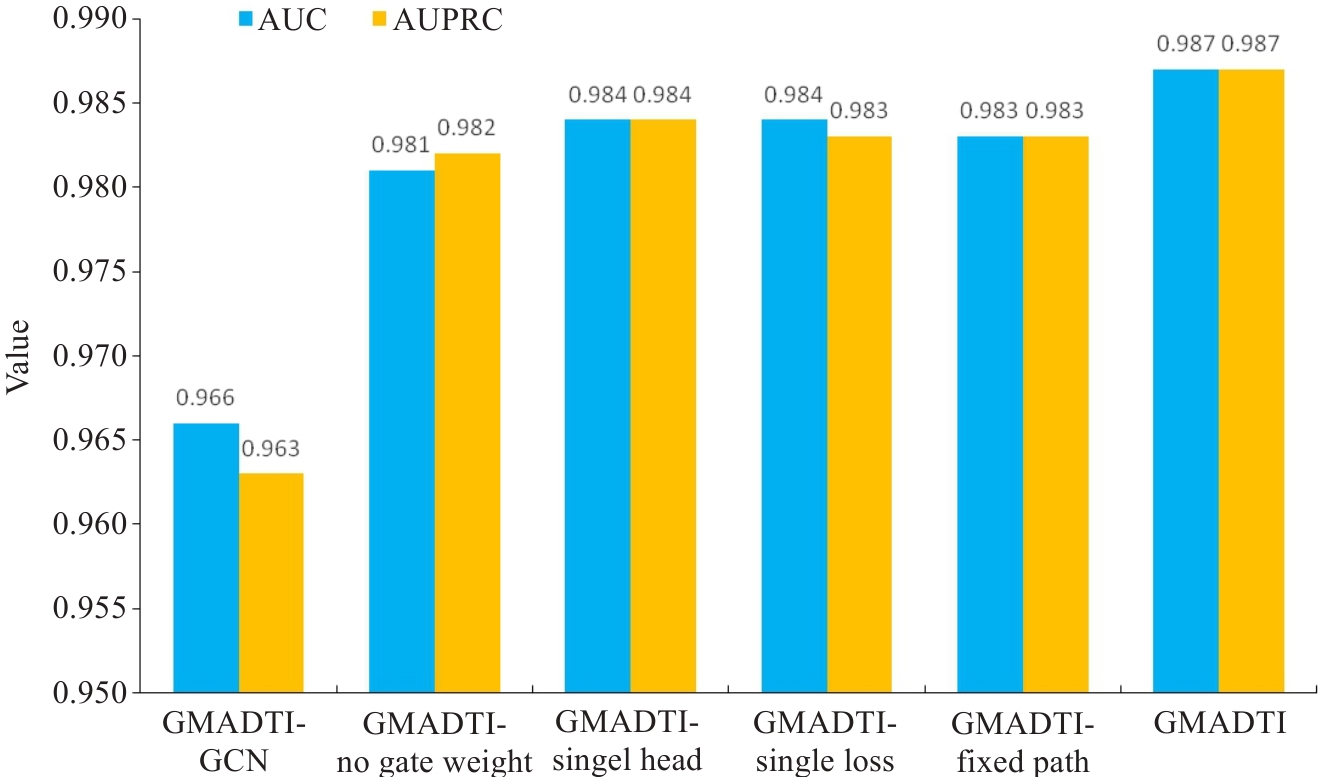
Fig.2 Comparison of GMADTI model and its variants on the Luo dataset.

Fig.3 Comparison of GMADTI model and its variants on the Zheng dataset.

Fig.4 Impact of number of attention heads on the performance of the GMADTI model.
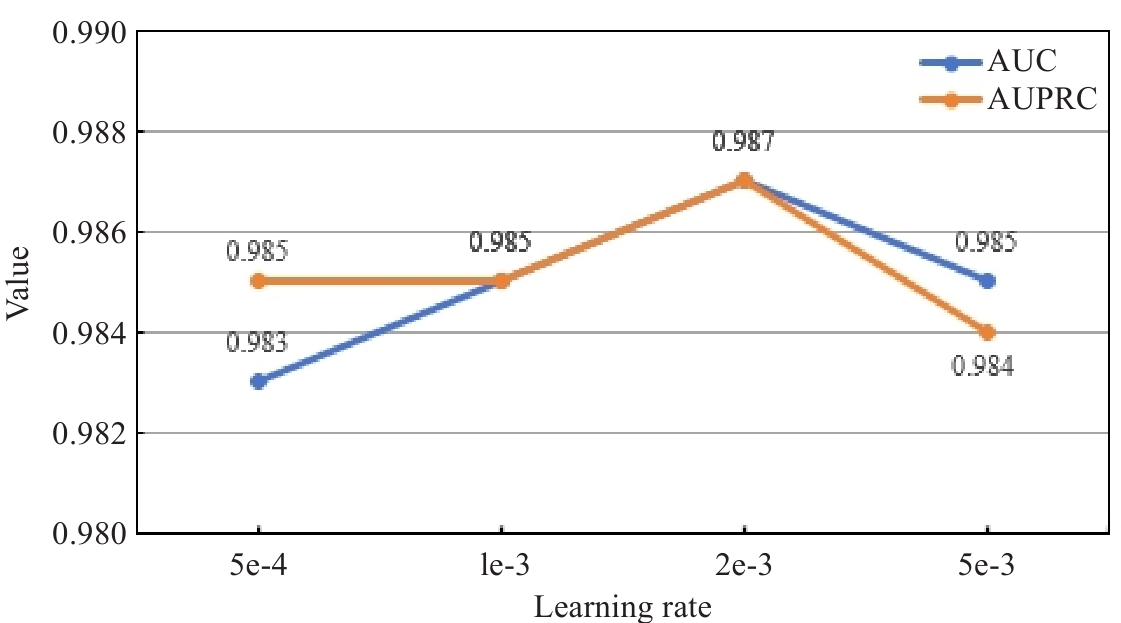
Fig.5 Impact of learning rates on performance of the GMADTI model.
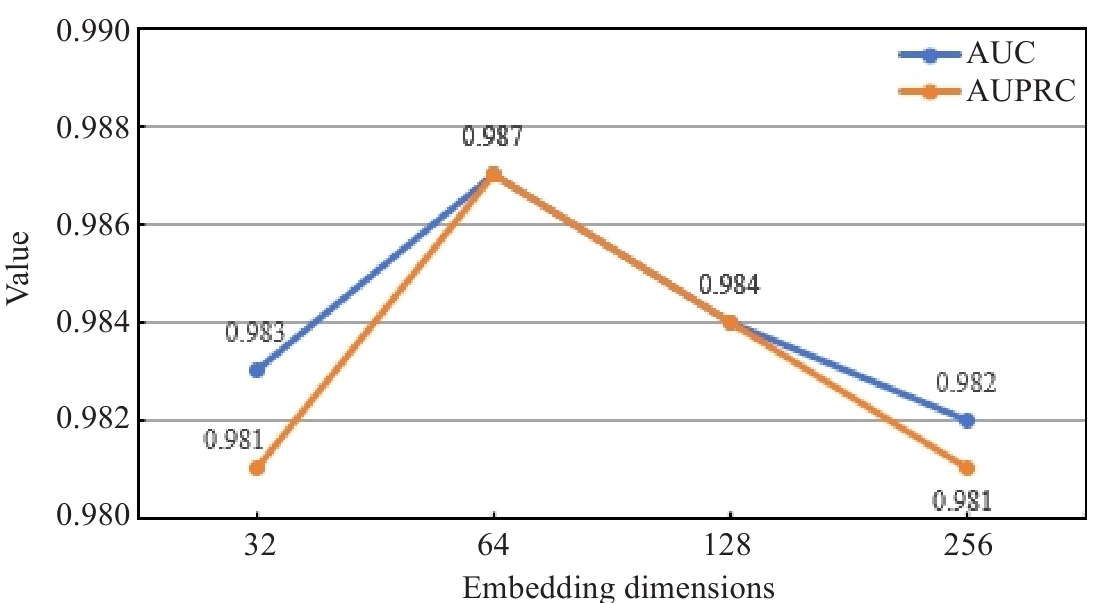
Fig.6 Impact of embedding dimensions on performance of the GMADTI model.

Fig.7 t-SNE visualization of drug and target node embeddings.

Fig.8 Attention weight heatmap for different samples on the drug side.
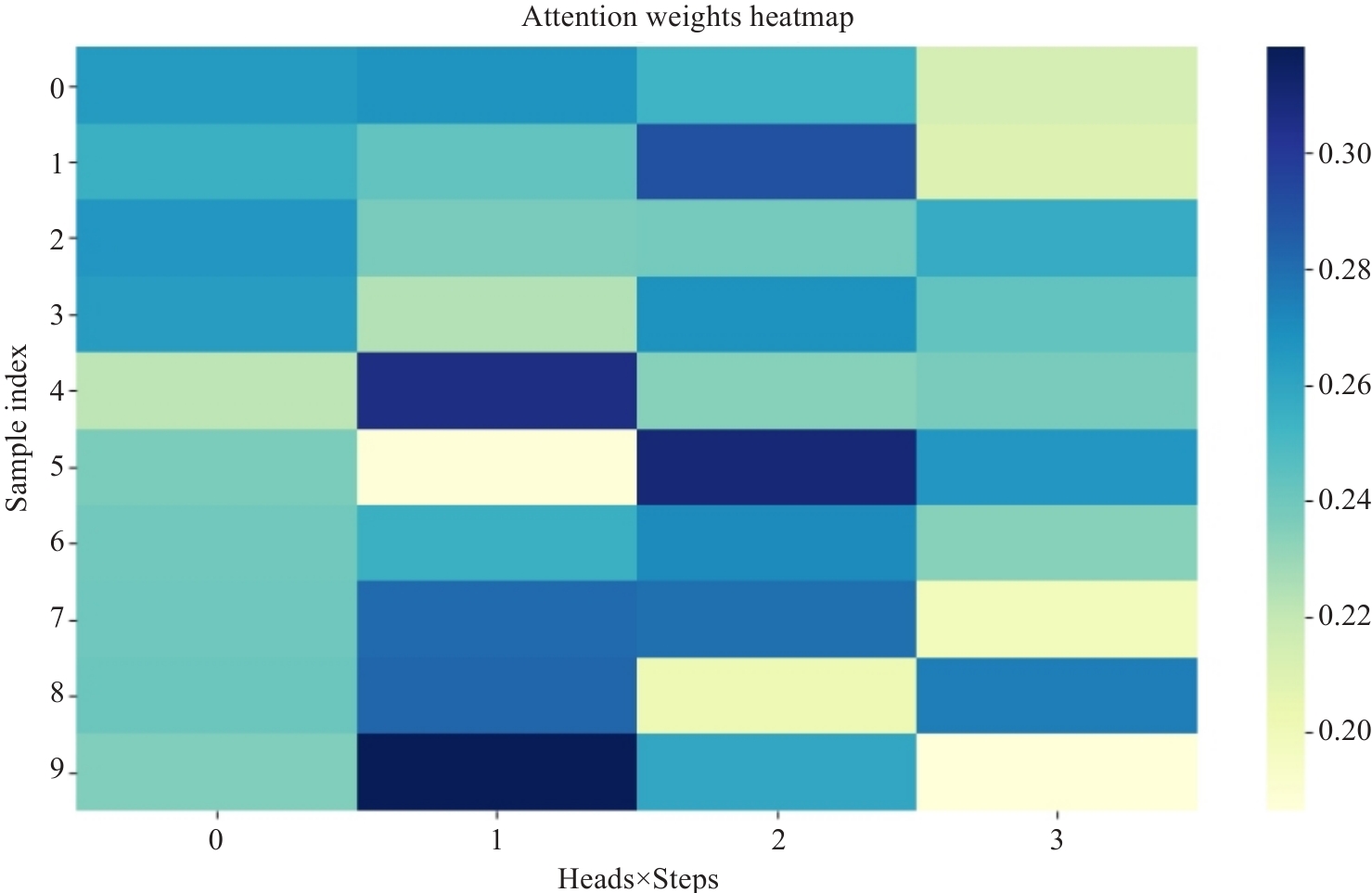
Fig.9 Attention weight heatmap for different samples on the target side.
| [1] | Abbasi Mesrabadi H, Faez K, Pirgazi J. Drug-target interaction prediction based on protein features, using wrapper feature selection[J]. Sci Rep, 2023, 13(1): 3594. doi:10.1038/s41598-023-30026-y |
| [2] | Dehghan A, Abbasi K, Razzaghi P, et al. CCL-DTI: contributing the contrastive loss in drug-target interaction prediction[J]. BMC Bioinformatics, 2024, 25(1): 48. doi:10.1186/s12859-024-05671-3 |
| [3] | 刘正美, 魏雪梅, 张俊鹏, 等. 药物分子与靶标蛋白结合亲和力预测研究进展[J].计算机工程与应用, 2024, 60(23): 79-90. |
| [4] | Khatun MS, Hasan MM, Kurata H. PreAIP: computational prediction of anti-inflammatory peptides by integrating multiple complementary features[J]. Front Genet, 2019, 10: 129. doi:10.3389/fgene.2019.00129 |
| [5] | Ru XQ, Wang LD, Li LH, et al. Exploration of the correlation between GPCRs and drugs based on a learning to rank algorithm[J]. Comput Biol Med, 2020, 119: 103660. doi:10.1016/j.compbiomed.2020.103660 |
| [6] | Ding YJ, Tang JJ, Guo F. Identification of drug-target interactions via multi-view graph regularized link propagation model[J]. Neurocomputing, 2021, 461: 618-31. doi:10.1016/j.neucom.2021.05.100 |
| [7] | Song W, Xu L, Han C, et al. Drug-target interaction predictions with multi-view similarity network fusion strategy and deep interactive attention mechanism[J]. Bioinformatics, 2024, 40(6): btae346. doi:10.1093/bioinformatics/btae346 |
| [8] | Luo Y, Zhao X, Zhou J, et al. A network integration approach for drug-target interaction prediction and computational drug repositioning from heterogeneous information[J]. Nat Commun, 2017, 8(1): 573. doi:10.1038/s41467-017-00680-8 |
| [9] | Zhou D, Xu Z, Li W, et al. MultiDTI: drug-target interaction prediction based on multi-modal representation learning to bridge the gap between new chemical entities and known heterogeneous network[J]. Bioinformatics, 2021, 37(23): 4485-92. doi:10.1093/bioinformatics/btab473 |
| [10] | Qiao G, Wang G, Li Y. Causal enhanced drug-target interaction prediction based on graph generation and multi-source information fusion[J]. Bioinformatics, 2024, 40(10): btae570. doi:10.1093/bioinformatics/btae570 |
| [11] | 秦海盈, 赵中英, 李建晖, 等.基于元路径与层次注意力的时序异质信息网络表示学习方法[J].模式识别与人工智能,2021, 34(12): 1093-102. |
| [12] | Li J, Wang J, Lv H, et al. IMCHGAN: inductive matrix completion with heterogeneous graph attention networks for drug-target interactions prediction[J]. IEEE/ACM Trans Comput Biol Bioinform, 2022, 19(2): 655-65. doi:10.1109/tcbb.2021.3088614 |
| [13] | Su Y, Hu Z, Wang F, et al. AMGDTI: drug-target interaction prediction based on adaptive meta-graph learning in heterogeneous network[J]. Brief Bioinform, 2023, 25(1): bbad474. doi:10.1093/bib/bbad474 |
| [14] | 潘柏儒, 丁卫平, 鞠恒荣, 等.基于粗糙图的图卷积神经网络算法[J].模式识别与人工智能, 2023, 35(9): 827-38. |
| [15] | Wan F, Hong L, Xiao A, et al. NeoDTI: neural integration of neighbor information from a heterogeneous network for discovering new drug-target interactions[J]. Bioinformatics, 2019, 35(1): 104-11. doi:10.1093/bioinformatics/bty543 |
| [16] | Zhao T, Hu Y, Valsdottir LR, et al. Identifying drug-target interactions based on graph convolutional network and deep neural network[J]. Brief Bioinform, 2021, 22(2): 2141-50. doi:10.1093/bib/bbaa044 |
| [17] | Peng J, Wang Y, Guan J, et al. An end-to-end heterogeneous graph representation learning-based framework for drug-target interaction prediction[J]. Brief Bioinform, 2021, 22(5): bbaa430. doi:10.1093/bib/bbaa430 |
| [18] | Zhu Y, Ning C, Zhang N, et al. GSRF-DTI: a framework for drug-target interaction prediction based on a drug-target pair network and representation learning on a large graph[J]. BMC Biol, 2024, 22(1): 156. doi:10.1186/s12915-024-01949-3 |
| [19] | Mukesh M Raghuwanshi Pradnya S Borkar Sachin U Balvir. Node2Vec and machine learning: a powerful Duo for link prediction in social network[J]. Jes, 2024, 20(2s): 639-49. doi:10.52783/jes.1530 |
| [20] | Johnson SJ, Murty MR, Navakanth I. A detailed review on word embedding techniques with emphasis on word2vec[J]. Multimed Tools Appl, 2024, 83(13): 37979-8007. doi:10.1007/s11042-023-17007-z |
| [21] | Ding Y, Yao Q, Zhao H, et al. Diffmg: Differentiable meta graph search for heterogeneous graph neural networks[C].Proceedings of the 27th ACM SIGKDD Conference on Knowledge Discovery & Data Mining, 2021: 279-88. doi:10.1145/3447548.3467447 |
| [22] | Guo YB, Zhou DM, Ruan XL, et al. Variational gated autoencoder-based feature extraction model for inferring disease-miRNA associations based on multiview features[J]. Neural Netw, 2023, 165: 491-505. doi:10.1016/j.neunet.2023.05.052 |
| [23] | Rasamoelina AD, Adjailia F, Sincak P. A review of activation function for artificial neural network[C]//2020 IEEE 18th World Symposium on Applied Machine Intelligence and Informatics (SAMI). January 23-25, 2020. Herlany, Slovakia. IEEE, 2020: 281-6. doi:10.1109/sami48414.2020.9108717 |
| [24] | Dubey SR, Singh SK, Chaudhuri BB. Activation functions in deep learning: a comprehensive survey and benchmark[J]. Neuroco-mputing, 2022, 503: 92-108. doi:10.1016/j.neucom.2022.06.111 |
| [25] | Deora P, Ghaderi R, Taheri H, et al.On the optimization and generalization of multi-head attention[J]. arXiv preprint arXiv:2310. 12680, 2023. |
| [26] | 郑子瑜, 杨夏颖, 吴圣杰, 等.多特征融合的产时超声胎方位识别模型[J].南方医科大学学报, 2025, 45(7): 1563-70. |
| [27] | Tian Y, Wang X, Yao X, et al. Predicting molecular properties based on the interpretable graph neural network with multistep focus mechanism[J]. Brief Bioinform, 2023, 24(1): bbac534. doi:10.1093/bib/bbac534 |
| [28] | Wang F, Liu H. Understanding the behaviour of contrastive loss[C].Proceedings of the IEEE/CVF conference on computer vision and pattern recognition, 2021: 2495-504. doi:10.1109/cvpr46437.2021.00252 |
| [29] | Ranjan P, Khan P, Kumar S, et al. $łog$-sigmoid activation-based long short-term memory for time-series data classification[J]. IEEE Trans Artif Intell, 2024, 5(2): 672-83. doi:10.1109/tai.2023.3265641 |
| [30] | Zheng Y, Peng H, Zhang XC, et al. Predicting drug targets from heterogeneous spaces using anchor graph hashing and ensemble learning[C]//2018 International Joint Conference on Neural Networks (IJCNN). July 8-13, 2018. Rio de Janeiro. IEEE, 2018: 1-7. doi:10.1109/ijcnn.2018.8489028 |
| [31] | Srivastava A, Rawat BS, Singh G, et al. A review of optimization algorithms for training neural networks[C]//2023 International Conference on Sustainable Emerging Innovations in Engineering and Technology (ICSEIET). September 14-15, 2023. Ghaziabad, India. IEEE, 2023: 886-90. doi:10.1109/icseiet58677.2023.10303287 |
| [32] | Wang H, Huang F, Xiong Z, et al. A heterogeneous network-based method with attentive meta-path extraction for predicting drug-target interactions[J]. Brief Bioinform, 2022, 23(4): bbac184. doi:10.1093/bib/bbac184 |
| [33] | Li Y, Qiao G, Gao X, et al. Supervised graph co-contrastive learning for drug-target interaction prediction[J]. Bioinformatics, 2022, 38(10): 2847-54. doi:10.1093/bioinformatics/btac164 |
| [34] | Yao KN, Wang XW, Li WN, et al. Semi-supervised heterogeneous graph contrastive learning for drug-target interaction prediction[J]. Comput Biol Med, 2023, 163: 107199. doi:10.1016/j.compbiomed.2023.107199 |
| No related articles found! |
| Viewed | ||||||
|
Full text |
|
|||||
|
Abstract |
|
|||||
