
Journal of Southern Medical University ›› 2026, Vol. 46 ›› Issue (1): 159-165.doi: 10.12122/j.issn.1673-4254.2026.01.17
Previous Articles Next Articles
Xiyu GAO( ), Jing XIAO, Na FENG, Chen GUO, Lifei CAO, Chunyan ZHANG, Yan ZHANG, Tuo HAN()
Received:2025-07-10
Online:2026-01-20
Published:2026-01-16
Contact:
Tuo HAN
E-mail:eclipse070@stu.xjtu.edu.cn;heart0228@xjtu.edu.cn
Supported by:Xiyu GAO, Jing XIAO, Na FENG, Chen GUO, Lifei CAO, Chunyan ZHANG, Yan ZHANG, Tuo HAN. β‑blockers after percutaneous coronary intervention does not reduce risks of all-cause mortality or major adverse cardiovascular events in patients with stable coronary artery disease[J]. Journal of Southern Medical University, 2026, 46(1): 159-165.
Add to citation manager EndNote|Ris|BibTeX
URL: https://www.j-smu.com/EN/10.12122/j.issn.1673-4254.2026.01.17
| Variable | Total (n=204) | Control group (n=149) | β-blocker group (n=55) | Statistic | P |
|---|---|---|---|---|---|
| Age (year) | 72.6±10.3 | 72.9±10.1 | 71.8±11.0 | 0.416 | 0.520 |
| Gender [n (%)] | 0.060 | 0.806 | |||
| Female | 62 (30.4) | 46 (30.9) | 16 (29.1) | ||
| Male | 142 (69.6) | 103 (69.1) | 39 (70.9) | ||
| Smoking [n (%)] | 101 (49.5) | 77 (51.7) | 24 (43.6) | 1.039 | 0.308 |
| BMI (kg/m2) | 23.6±3.9 | 23.4±3.8 | 24.3±4.1 | 2.018 | 0.157 |
| SBP (mmHg) | 136.3±20.4 | 135.8±19.6 | 137.5±22.7 | 0.254 | 0.615 |
| DBP (mmHg) | 77.4±13.2 | 77.2±12.9 | 77.9±14.1 | 0.108 | 0.743 |
| Hemoglobin (g/dL) | 13.6±2.0 | 13.6±1.9 | 13.5±2.2 | 0.037 | 0.847 |
| Albumin (g/L) | 3.9±0.5 | 3.9±0.5 | 3.9±0.5 | 0.167 | 0.683 |
| eGFR (mL/min/1.73 m2) | 61.3±24.6 | 63.8±24.2 | 54.7±24.6 | 5.583 | 0.019 |
| AST (U/L) | 24.7±11.0 | 25.5±11.6 | 22.6±8.7 | 2.841 | 0.093 |
| ALT (U/L) | 20.9±12.2 | 21.5±12.7 | 19.5±10.6 | 1.016 | 0.315 |
| TC (mg/dL) | 185.4±35.7 | 184.4±35.2 | 188.4±37.4 | 0.390 | 0.533 |
| TG (mg/dL) | 117.0 (83.5, 159.5) | 118.0 (84.0, 157.0) | 105.5 (73.5, 159.8) | 1.052 | 0.305 |
| HDL-C (mg/dL) | 50.2±13.2 | 49.9±13.0 | 51.1±13.8 | 0.314 | 0.576 |
| LDL-C (mg/dL) | 110.1±28.5 | 109.3±28.3 | 112.1±29.4 | 0.394 | 0.531 |
| HbA1C (%) | 6.0 (5.7, 6.7) | 6.0 (5.6, 6.6) | 6.0 (5.7, 7.0) | 2.139 | 0.144 |
| CRP (mg/dL) | 0.1 (0.0, 0.3) | 0.1 (0.0, 0.3) | 0.1 (0.1, 0.3) | 1.240 | 0.266 |
| LVEF (%) | 63.2±9.8 | 65.0±7.3 | 58.6±13.6 | 18.205 | <0.001 |
| Cerebral infarction [n (%)] | 35 (17.2) | 27 (18.1) | 8 (14.5) | 0.361 | 0.548 |
| Peripheral arterial disease [n (%)] | 53 (26.0) | 42 (28.2) | 11 (20) | 1.400 | 0.237 |
| Atrial fibrillation [n (%)] | 26 (12.7) | 13 (8.7) | 13 (23.6) | 8.032 | 0.005 |
| Hypertension [n (%)] | 151 (74.0) | 111 (74.5) | 40 (72.7) | 0.065 | 0.798 |
| Dyslipidemia [n (%)] | 104 (51.0) | 78 (52.3) | 26 (47.3) | 0.414 | 0.520 |
| Diabetes [n (%)] | 73 (35.8) | 50 (33.6) | 23 (41.8) | 1.193 | 0.275 |
Tab.1 Comparison of baseline characteristics between the β blocker users and non-users
| Variable | Total (n=204) | Control group (n=149) | β-blocker group (n=55) | Statistic | P |
|---|---|---|---|---|---|
| Age (year) | 72.6±10.3 | 72.9±10.1 | 71.8±11.0 | 0.416 | 0.520 |
| Gender [n (%)] | 0.060 | 0.806 | |||
| Female | 62 (30.4) | 46 (30.9) | 16 (29.1) | ||
| Male | 142 (69.6) | 103 (69.1) | 39 (70.9) | ||
| Smoking [n (%)] | 101 (49.5) | 77 (51.7) | 24 (43.6) | 1.039 | 0.308 |
| BMI (kg/m2) | 23.6±3.9 | 23.4±3.8 | 24.3±4.1 | 2.018 | 0.157 |
| SBP (mmHg) | 136.3±20.4 | 135.8±19.6 | 137.5±22.7 | 0.254 | 0.615 |
| DBP (mmHg) | 77.4±13.2 | 77.2±12.9 | 77.9±14.1 | 0.108 | 0.743 |
| Hemoglobin (g/dL) | 13.6±2.0 | 13.6±1.9 | 13.5±2.2 | 0.037 | 0.847 |
| Albumin (g/L) | 3.9±0.5 | 3.9±0.5 | 3.9±0.5 | 0.167 | 0.683 |
| eGFR (mL/min/1.73 m2) | 61.3±24.6 | 63.8±24.2 | 54.7±24.6 | 5.583 | 0.019 |
| AST (U/L) | 24.7±11.0 | 25.5±11.6 | 22.6±8.7 | 2.841 | 0.093 |
| ALT (U/L) | 20.9±12.2 | 21.5±12.7 | 19.5±10.6 | 1.016 | 0.315 |
| TC (mg/dL) | 185.4±35.7 | 184.4±35.2 | 188.4±37.4 | 0.390 | 0.533 |
| TG (mg/dL) | 117.0 (83.5, 159.5) | 118.0 (84.0, 157.0) | 105.5 (73.5, 159.8) | 1.052 | 0.305 |
| HDL-C (mg/dL) | 50.2±13.2 | 49.9±13.0 | 51.1±13.8 | 0.314 | 0.576 |
| LDL-C (mg/dL) | 110.1±28.5 | 109.3±28.3 | 112.1±29.4 | 0.394 | 0.531 |
| HbA1C (%) | 6.0 (5.7, 6.7) | 6.0 (5.6, 6.6) | 6.0 (5.7, 7.0) | 2.139 | 0.144 |
| CRP (mg/dL) | 0.1 (0.0, 0.3) | 0.1 (0.0, 0.3) | 0.1 (0.1, 0.3) | 1.240 | 0.266 |
| LVEF (%) | 63.2±9.8 | 65.0±7.3 | 58.6±13.6 | 18.205 | <0.001 |
| Cerebral infarction [n (%)] | 35 (17.2) | 27 (18.1) | 8 (14.5) | 0.361 | 0.548 |
| Peripheral arterial disease [n (%)] | 53 (26.0) | 42 (28.2) | 11 (20) | 1.400 | 0.237 |
| Atrial fibrillation [n (%)] | 26 (12.7) | 13 (8.7) | 13 (23.6) | 8.032 | 0.005 |
| Hypertension [n (%)] | 151 (74.0) | 111 (74.5) | 40 (72.7) | 0.065 | 0.798 |
| Dyslipidemia [n (%)] | 104 (51.0) | 78 (52.3) | 26 (47.3) | 0.414 | 0.520 |
| Diabetes [n (%)] | 73 (35.8) | 50 (33.6) | 23 (41.8) | 1.193 | 0.275 |
| Variable | Total (n=204) | Control group (n=149) | β-blocker group (n=55) | Statistic | P |
|---|---|---|---|---|---|
| Coronary angiography status | |||||
| LMT lesions | 13 (6.4) | 10 (6.7) | 3 (5.5) | 1.000 | |
| Bifurcation lesions | 102 (50.0) | 70 (47) | 32 (58.2) | 2.016 | 0.156 |
| Ostial lesions | 30 (14.7) | 22 (14.8) | 8 (14.5) | 0.002 | 0.969 |
| Calcified lesions | 29 (14.2) | 21 (14.1) | 8 (14.5) | 0.007 | 0.935 |
| CTO lesions | 12 (5.9) | 9 (6) | 3 (5.5) | - | 1.000 |
| Multi-vessel lesions | 53 (26.0) | 38 (25.5) | 15 (27.3) | 0.065 | 0.798 |
| Stent | - | 0.171 | |||
| BMS | 11 (5.4) | 6 (4) | 5 (9.1) | ||
| DES | 193 (94.6) | 143 (96) | 50 (90.9) | ||
| Medication | |||||
| Aspirin | 202 (99.0) | 148 (99.3) | 54 (98.2) | - | 0.467 |
| Thienopiridines | 200 (98.0) | 147 (98.7) | 53 (96.4) | - | 0.294 |
| Warfarin | 5 (2.5) | 2 (1.3) | 3 (5.5) | - | 0.123 |
| NOAC | 21 (10.3) | 12 (8.1) | 9 (16.4) | 3.004 | 0.083 |
| Ezetimibe | 3 (1.5) | 3 (2) | 0 (0) | - | 0.565 |
| PPI | 134 (65.7) | 104 (69.8) | 30 (54.5) | 4.147 | 0.042 |
| Statin | 111 (54.4) | 86 (57.7) | 25 (45.5) | 2.436 | 0.119 |
| ACEI | 19 (9.3) | 14 (9.4) | 5 (9.1) | 0.004 | 0.947 |
| ARB | 88 (43.1) | 66 (44.3) | 22 (40) | 0.302 | 0.583 |
| MRA | 11 (5.4) | 5 (3.4) | 6 (10.9) | - | 0.072 |
| Outcomes | |||||
| All-cause death | 18 (8.8) | 13 (8.7) | 5 (9.1) | - | 1.000 |
| MACEs | 19 (9.3) | 15 (10.1) | 4 (7.3) | 0.371 | 0.542 |
| Cardiovascular death | 6 (2.9) | 4 (2.7) | 2 (3.6) | - | 0.662 |
| Non-fatal MI | 3 (1.5) | 3 (2.0) | 0 (0.0) | - | 0.565 |
| Non-fatal stroke | 11 (5.4) | 9 (6.0) | 2 (3.6) | - | 0.731 |
Tab.2 Comparation of angiographic characteristics, medication and clinical outcomes [n (%)]
| Variable | Total (n=204) | Control group (n=149) | β-blocker group (n=55) | Statistic | P |
|---|---|---|---|---|---|
| Coronary angiography status | |||||
| LMT lesions | 13 (6.4) | 10 (6.7) | 3 (5.5) | 1.000 | |
| Bifurcation lesions | 102 (50.0) | 70 (47) | 32 (58.2) | 2.016 | 0.156 |
| Ostial lesions | 30 (14.7) | 22 (14.8) | 8 (14.5) | 0.002 | 0.969 |
| Calcified lesions | 29 (14.2) | 21 (14.1) | 8 (14.5) | 0.007 | 0.935 |
| CTO lesions | 12 (5.9) | 9 (6) | 3 (5.5) | - | 1.000 |
| Multi-vessel lesions | 53 (26.0) | 38 (25.5) | 15 (27.3) | 0.065 | 0.798 |
| Stent | - | 0.171 | |||
| BMS | 11 (5.4) | 6 (4) | 5 (9.1) | ||
| DES | 193 (94.6) | 143 (96) | 50 (90.9) | ||
| Medication | |||||
| Aspirin | 202 (99.0) | 148 (99.3) | 54 (98.2) | - | 0.467 |
| Thienopiridines | 200 (98.0) | 147 (98.7) | 53 (96.4) | - | 0.294 |
| Warfarin | 5 (2.5) | 2 (1.3) | 3 (5.5) | - | 0.123 |
| NOAC | 21 (10.3) | 12 (8.1) | 9 (16.4) | 3.004 | 0.083 |
| Ezetimibe | 3 (1.5) | 3 (2) | 0 (0) | - | 0.565 |
| PPI | 134 (65.7) | 104 (69.8) | 30 (54.5) | 4.147 | 0.042 |
| Statin | 111 (54.4) | 86 (57.7) | 25 (45.5) | 2.436 | 0.119 |
| ACEI | 19 (9.3) | 14 (9.4) | 5 (9.1) | 0.004 | 0.947 |
| ARB | 88 (43.1) | 66 (44.3) | 22 (40) | 0.302 | 0.583 |
| MRA | 11 (5.4) | 5 (3.4) | 6 (10.9) | - | 0.072 |
| Outcomes | |||||
| All-cause death | 18 (8.8) | 13 (8.7) | 5 (9.1) | - | 1.000 |
| MACEs | 19 (9.3) | 15 (10.1) | 4 (7.3) | 0.371 | 0.542 |
| Cardiovascular death | 6 (2.9) | 4 (2.7) | 2 (3.6) | - | 0.662 |
| Non-fatal MI | 3 (1.5) | 3 (2.0) | 0 (0.0) | - | 0.565 |
| Non-fatal stroke | 11 (5.4) | 9 (6.0) | 2 (3.6) | - | 0.731 |
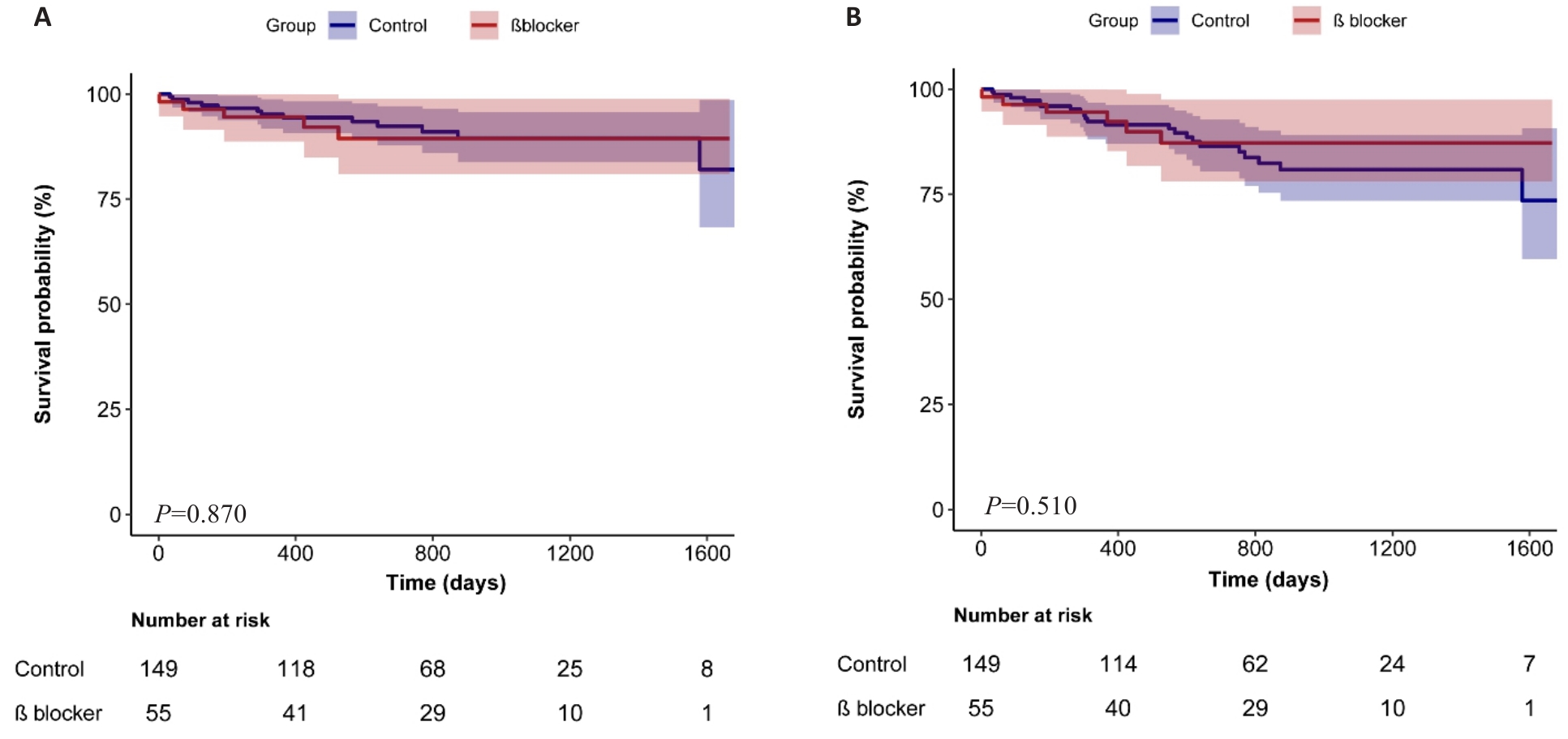
Fig.1 Kaplan-Meier survival curves of the patients with and without post-PCI β-blocker. A: All-cause mortality. B: MACEs.
| Model | All-cause death | MACEs | ||
|---|---|---|---|---|
| HR (95% CI) | P | HR (95% CI) | P | |
| Univariate Cox regression | 1.08 (0.38-3.04) | 0.881 | 0.73 (0.30-1.81) | 0.498 |
| Multivariate Cox regression* | 0.81 (0.24-2.72) | 0.735 | 0.62 (0.22-1.69) | 0.348 |
| PS adjustment | 0.69 (0.21-2.27) | 0.542 | 0.56 (0.20-1.52) | 0.255 |
| PS matching | 1.49 (0.25-8.91) | 0.664 | 0.59 (0.17-2.10) | 0.415 |
| IPTW | 0.60 (0.17-2.11) | 0.383 | 0.53 (0.20-1.45) | 0.244 |
| SMRW | 0.91 (0.33-2.54) | 0.881 | 0.64 (0.26-1.58) | 0.386 |
Tab.3 Comparison of outcomes of the patients in the two groups using Cox regression and propensity score
| Model | All-cause death | MACEs | ||
|---|---|---|---|---|
| HR (95% CI) | P | HR (95% CI) | P | |
| Univariate Cox regression | 1.08 (0.38-3.04) | 0.881 | 0.73 (0.30-1.81) | 0.498 |
| Multivariate Cox regression* | 0.81 (0.24-2.72) | 0.735 | 0.62 (0.22-1.69) | 0.348 |
| PS adjustment | 0.69 (0.21-2.27) | 0.542 | 0.56 (0.20-1.52) | 0.255 |
| PS matching | 1.49 (0.25-8.91) | 0.664 | 0.59 (0.17-2.10) | 0.415 |
| IPTW | 0.60 (0.17-2.11) | 0.383 | 0.53 (0.20-1.45) | 0.244 |
| SMRW | 0.91 (0.33-2.54) | 0.881 | 0.64 (0.26-1.58) | 0.386 |
| [1] | Chong B, Jayabaskaran J, Jauhari SM, et al. Global burden of cardiovascular diseases: projections from 2025 to 2050[J]. Eur J Prev Cardiol, 2025, 32(11): 1001-15. doi:10.1093/eurjpc/zwae281 |
| [2] | 中国心血管健康与疾病报告2024概要 [J]. 中国循环杂志, 2025, 40 (6): 521-59. |
| [3] | Navarese EP, Lansky AJ, Kereiakes DJ, et al. Cardiac mortality in patients randomised to elective coronary revascularisation plus medical therapy or medical therapy alone: a systematic review and meta-analysis[J]. Eur Heart J, 2021, 42(45): 4638-51. doi:10.1093/eurheartj/ehab246 |
| [4] | Hahn JY, Song YB, Oh JH, et al. Effect of P2Y12 inhibitor monotherapy vs dual antiplatelet therapy on cardiovascular events in patients undergoing percutaneous coronary intervention: the SMART-CHOICE randomized clinical trial[J]. JAMA, 2019, 321(24): 2428-37. doi:10.1001/jama.2019.8146 |
| [5] | Boberg J, Larsen FF, Pehrsson SK. The effects of beta blockade with (epanolol) and without (atenolol) intrinsic sympathomimetic activity in stable angina pectoris. The Visacor Study Group[J]. Clin Cardiol, 1992, 15(8): 591-5. doi:10.1002/clc.4960150808 |
| [6] | Vantrimpont P, Rouleau JL, Wun CC, et al. Additive beneficial effects of beta-blockers to angiotensin-converting enzyme inhibitors in the Survival and Ventricular Enlargement (SAVE) Study. SAVE Investigators[J]. J Am Coll Cardiol, 1997, 29(2): 229-36. doi:10.1016/s0735-1097(96)00489-5 |
| [7] | Dargie HJ. Effect of carvedilol on outcome after myocardial infarction in patients with left-ventricular dysfunction: the CAPRICORN randomised trial[J]. Lancet, 2001, 357(9266): 1385-90. doi:10.1016/s0140-6736(00)04560-8 |
| [8] | Park CS, Yang HM, Ki YJ, et al. Left ventricular ejection fraction 1 year after acute myocardial infarction identifies the benefits of the long-term use of β-blockers: analysis of data from the KAMIR-NIH registry[J]. Circ Cardiovasc Interv, 2021, 14(4): e010159. doi:10.1161/circinterventions.120.010159 |
| [9] | Packer M, Fowler MB, Roecker EB, et al. Effect of carvedilol on the morbidity of patients with severe chronic heart failure: results of the carvedilol prospective randomized cumulative survival (COPERNICUS) study[J]. Circulation, 2002, 106(17): 2194-9. doi:10.1161/01.cir.0000035653.72855.bf |
| [10] | Virani SS, Newby LK, Arnold SV, et al. 2023 AHA/ACC/ACCP/ASPC/NLA/PCNA guideline for the management of patients with chronic coronary disease: a report of the American heart association/American college of cardiology joint committee on clinical practice guidelines[J]. Circulation, 2023, 148(9): e9-e119. doi:10.1161/cir.0000000000001183 |
| [11] | Vrints C, Andreotti F, Koskinas KC, et al. 2024 ESC Guidelines for the management of chronic coronary syndromes[J]. Eur Heart J, 2024, 45(36): 3415-537. |
| [12] | 中华医学会心血管病学分会, 中华心血管病杂志编辑委员会. 中国慢性冠脉综合征患者诊断及管理指南[J]. 中华心血管病杂志, 2024, 52(6): 589-614. |
| [13] | Park J, Han JK, Kang J, et al. The clinical impact of β-blocker therapy on patients with chronic coronary artery disease after percutaneous coronary intervention[J]. Korean Circ J, 2022, 52(7): 544-55. doi:10.4070/kcj.2021.0395 |
| [14] | Khan SU, Akbar UA, Khan MS, et al. Beta-blockers after PCI for stable coronary artery disease and preserved left ventricular ejection fraction[J]. JACC Adv, 2025, 4(2): 101566. doi:10.1016/j.jacadv.2024.101566 |
| [15] | Consortium TC, Cao YN, Li L, et al. The ChinaMAP analytics of deep whole genome sequences in 10, 588 individuals[J]. Cell Res, 2020, 30(9): 717-31. doi:10.1038/s41422-020-0322-9 |
| [16] | Hwang MJ. Demographic change in east Asia: cultural legacies, contemporary challenges, and strategic responses[J]. China Popul Dev Stud, 2025, 9(2): 142-50. doi:10.1007/s42379-025-00198-3 |
| [17] | Suzuki S, Hashizume N, Kanzaki Y, et al. Prognostic significance of serum albumin in patients with stable coronary artery disease treated by percutaneous coronary intervention[J]. PLoS One, 2019, 14(7): e0219044. doi:10.1371/journal.pone.0219044 |
| [18] | Kim J, Kang D, Park H, et al. Long-term β‑blocker therapy and clinical outcomes after acute myocardial infarction in patients without heart failure: nationwide cohort study[J]. Eur Heart J, 2020, 41(37): 3521-9. doi:10.1093/eurheartj/ehaa376 |
| [19] | Dahl Aarvik M, Sandven I, Dondo TB, et al. Effect of oral β-blocker treatment on mortality in contemporary post-myocardial infarction patients: a systematic review and meta-analysis[J]. Eur Heart J Cardiovasc Pharmacother, 2019, 5(1): 12-20. doi:10.1093/ehjcvp/pvy034 |
| [20] | Ishak D, Aktaa S, Lindhagen L, et al. Association of beta-blockers beyond 1 year after myocardial infarction and cardiovascular outcomes[J]. Heart, 2023, 109(15): 1159-65. doi:10.1136/heartjnl-2022-322115 |
| [21] | Neumann A, Maura G, Weill A, et al. Clinical events after discontinuation of β‑blockers in patients without heart failure optimally treated after acute myocardial infarction: a cohort study on the French healthcare databases[J]. Circ Cardiovasc Qual Outcomes, 2018, 11(4): e004356. doi:10.1161/circoutcomes.117.004356 |
| [22] | Ibáñez B, Latini R, Rosselló X, et al. Beta-blockers after myocardial infarction without reduced ejection fraction[J]. N Engl J Med, 2025. |
| [23] | Munkhaugen J, Kristensen AMD, Halvorsen S, et al. Beta-blockers after myocardial infarction in patients without heart failure[J]. N Engl J Med, 2025. . |
| [24] | Sorbets E, Steg PG, Young R, et al. β-blockers, calcium antagonists, and mortality in stable coronary artery disease: an international cohort study[J]. Eur Heart J, 2019, 40(18): 1399-407. doi:10.1093/eurheartj/ehy811 |
| [25] | Bangalore S, Steg G, Deedwania P, et al. β-Blocker use and clinical outcomes in stable outpatients with and without coronary artery disease[J]. JAMA, 2012, 308(13): 1340-9. doi:10.1001/jama.2012.12559 |
| [26] | Godoy LC, Farkouh ME, Austin PC, et al. Association of beta-blocker therapy with cardiovascular outcomes in patients with stable ischemic heart disease[J]. J Am Coll Cardiol, 2023, 81(24): 2299-311. doi:10.1016/j.jacc.2023.04.021 |
| [27] | 应用β肾上腺素能受体阻滞剂规范治疗冠心病的中国专家共识[J]. 中国循环杂志, 2020, 35(02): 108-23. |
| [28] | Jin P, Ma J, Wu P, et al. PCSK9 inhibition mitigates vulnerable plaque formation induced by hyperhomocysteinemia through regulating lipid metabolism and inflammation[J]. Biochem Pharmacol, 2025, 239: 117031. doi:10.1016/j.bcp.2025.117137 |
| [29] | Biccirè FG, Häner J, Losdat S, et al. Concomitant coronary atheroma regression and stabilization in response to lipid-lowering therapy[J]. J Am Coll Cardiol, 2023, 82(18): 1737-47. doi:10.1016/j.jacc.2023.08.019 |
| [30] | Montalto C, Costa F, Leonardi S, et al. Dual antiplatelet therapy duration after percutaneous coronary intervention in patients with indication to oral anticoagulant therapy. A systematic review and meta-analysis of randomized controlled trials[J]. Eur Heart J Cardiovasc Pharmacother, 2023, 9(3): 220-30. doi:10.1093/ehjcvp/pvac065 |
| [31] | Kereiakes DJ. Dual antiplatelet therapy duration following percutaneous coronary intervention: time for a change[J]. J Soc Cardiovasc Angiogr Interv, 2025, 4(2): 102510. doi:10.1016/j.jscai.2024.102510 |
| Viewed | ||||||
|
Full text |
|
|||||
|
Abstract |
|
|||||
