
Journal of Southern Medical University ›› 2025, Vol. 45 ›› Issue (11): 2358-2364.doi: 10.12122/j.issn.1673-4254.2025.11.08
Yunnan LI( ), Qiaoyin ZHOU(), Shen LUO, Weilin LIN, Xinyao HUANG, Ying CAO
Received:2025-05-09
Online:2025-11-20
Published:2025-11-28
Contact:
Qiaoyin ZHOU
E-mail:thirty333sorry@163.com;zhouqy2017@qq.com
Yunnan LI, Qiaoyin ZHOU, Shen LUO, Weilin LIN, Xinyao HUANG, Ying CAO. Effect of needle-knife release on the median nerve and transverse carpal ligament in rabbits with carpal tunnel syndrome[J]. Journal of Southern Medical University, 2025, 45(11): 2358-2364.
Add to citation manager EndNote|Ris|BibTeX
URL: https://www.j-smu.com/EN/10.12122/j.issn.1673-4254.2025.11.08
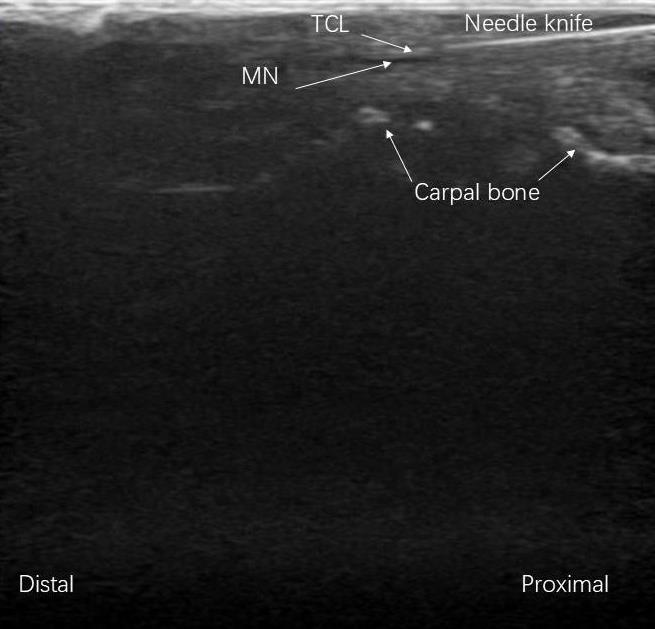
Fig.1 Procedure of ultrasound-guided needle knife release of the transverse carpal ligament (TCL) for treatment of carpal tunnel syndrome (CTS) in rabbits (long axis, longitudinal section). MN: Median nerve.
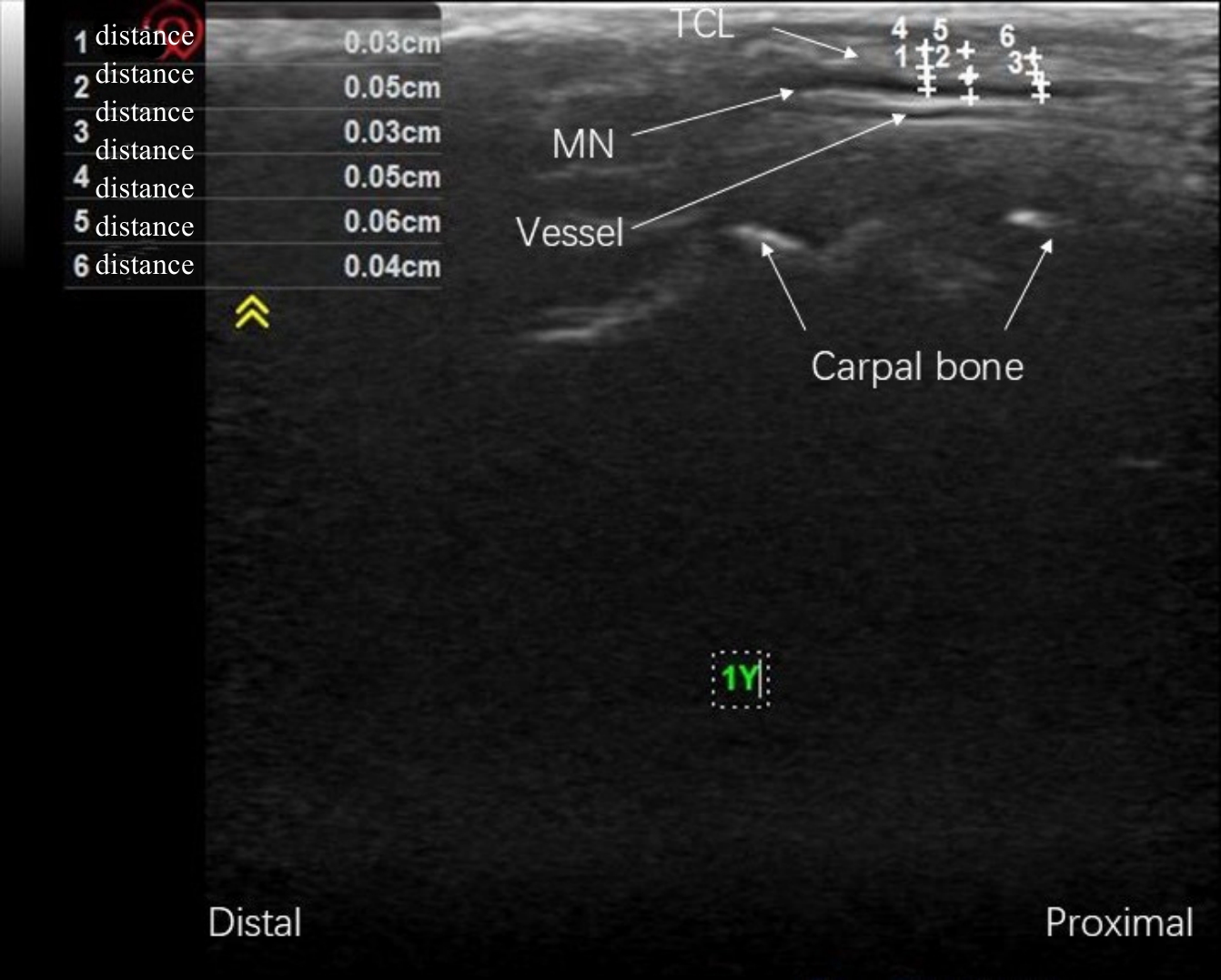
Fig.2 Ultrasonographic measurement of the thickness of TCL and MN (long axis, longitudinal section).
| Group | 3 days | 30 days |
|---|---|---|
| Control | 0.03±0.017 | 0.05±0.005△# |
| Model | 0.05±0.008 | 0.06±0.011*# |
| Ultrasound | 0.03±0.006 | 0.05±0.011△# |
| Non-ultrasound | 0.04±0.004 | 0.06±0.006*# |
| Sham treatment | 0.05±0.007 | 0.06±0.008*# |
| F/KW | 12.680 | 10.083 |
| P | <0.001 | <0.001 |
Tab.1 Thickness of the MN of the rabbits in the 5 groups (cm, Mean±SD)
| Group | 3 days | 30 days |
|---|---|---|
| Control | 0.03±0.017 | 0.05±0.005△# |
| Model | 0.05±0.008 | 0.06±0.011*# |
| Ultrasound | 0.03±0.006 | 0.05±0.011△# |
| Non-ultrasound | 0.04±0.004 | 0.06±0.006*# |
| Sham treatment | 0.05±0.007 | 0.06±0.008*# |
| F/KW | 12.680 | 10.083 |
| P | <0.001 | <0.001 |
| Group | 3 days | 30 days |
|---|---|---|
| Control | 0.06±0.014 | 0.06±0.005 |
| Model | 0.08±0.010* | 0.07±0.009*# |
| Ultrasound | 0.06±0.014△ | 0.06±0.017△ |
| Non-ultrasound | 0.07±0.010*△ | 0.07±0.008*△# |
| Sham treatment | 0.08±0.006* | 0.08±0.008* |
| KW | 44.167 | 35.941 |
| P | <0.001 | <0.001 |
Tab.2 Thickness of TCL of the rabbits in the 5 groups (cm, Mean±SD)
| Group | 3 days | 30 days |
|---|---|---|
| Control | 0.06±0.014 | 0.06±0.005 |
| Model | 0.08±0.010* | 0.07±0.009*# |
| Ultrasound | 0.06±0.014△ | 0.06±0.017△ |
| Non-ultrasound | 0.07±0.010*△ | 0.07±0.008*△# |
| Sham treatment | 0.08±0.006* | 0.08±0.008* |
| KW | 44.167 | 35.941 |
| P | <0.001 | <0.001 |
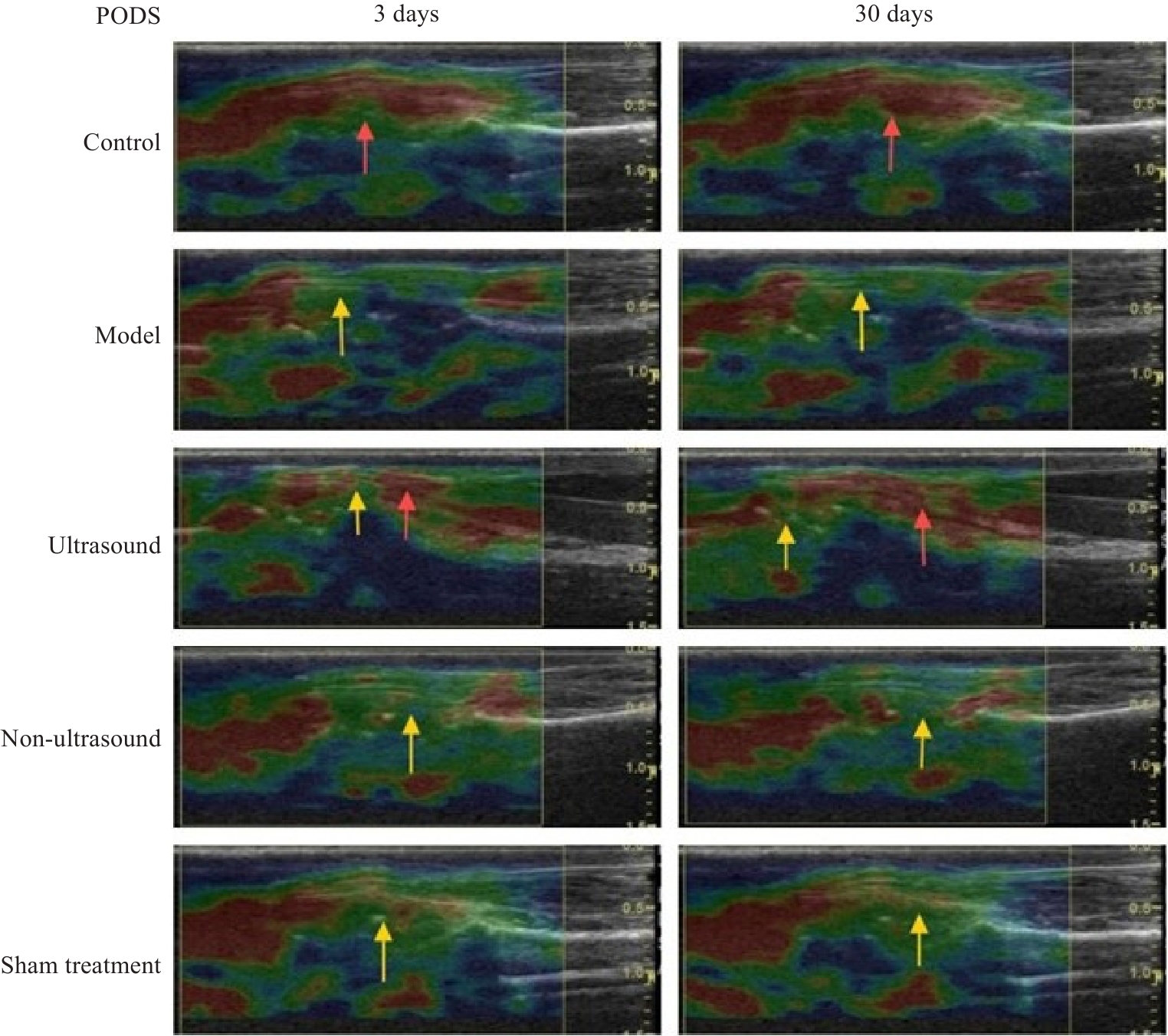
Fig.3 Ultrasound elastography of the TCL of the rabbits in the 5 groups. PODS:Postoperative days. Red arrow: Softer tissue; Yellow arrow: Firmer tissue.
| Group | 3 days | 30 days |
|---|---|---|
| Control | 50.87±4.46 | 41.00±1.98 |
| Model | 37.72±1.22* | 34.60±3.29 |
| Ultrasound | 42.93±2.47△ | 47.85±3.57△ |
| Non-ultrasound | 49.43±3.59 | 37.42±2.34# |
| Sham treatment | 37.25±1.98* | 40.14±2.30 |
| F/KW | 4.584 | 10.460 |
| P | 0.006 | 0.033 |
Tab.3 Sensory nerve conduction velocity of the rabbits in the 5 groups (m/s, Mean±SD)
| Group | 3 days | 30 days |
|---|---|---|
| Control | 50.87±4.46 | 41.00±1.98 |
| Model | 37.72±1.22* | 34.60±3.29 |
| Ultrasound | 42.93±2.47△ | 47.85±3.57△ |
| Non-ultrasound | 49.43±3.59 | 37.42±2.34# |
| Sham treatment | 37.25±1.98* | 40.14±2.30 |
| F/KW | 4.584 | 10.460 |
| P | 0.006 | 0.033 |
| Group | 3 days | 30 days |
|---|---|---|
| Control | 1.63±0.20 | 1.50±0.00 |
| Model | 1.63±0.14 | 1.65±0.10 |
| Ultrasound | 1.77±0.06 | 1.56±0.03# |
| Non-ultrasound | 1.87±0.11*△ | 1.60±0.10# |
| Sham treatment | 1.69±0.21 | 1.55±0.05 |
| KW | 8.279 | 3.732 |
| P | 0.082 | 0.443 |
Tab.4 DML of the rabbits in the 5 groups (ms, Mean±SD)
| Group | 3 days | 30 days |
|---|---|---|
| Control | 1.63±0.20 | 1.50±0.00 |
| Model | 1.63±0.14 | 1.65±0.10 |
| Ultrasound | 1.77±0.06 | 1.56±0.03# |
| Non-ultrasound | 1.87±0.11*△ | 1.60±0.10# |
| Sham treatment | 1.69±0.21 | 1.55±0.05 |
| KW | 8.279 | 3.732 |
| P | 0.082 | 0.443 |
| Group | 3 days | 30 days |
|---|---|---|
| Control | 7.64±1.09 | 13.79±1.26# |
| Model | 6.06±1.21 | 10.78±1.14# |
| Ultrasound | 7.30±0.66 | 8.50±0.32* |
| Non-ultrasound | 5.16±0.25 | 10.44±0.81# |
| Sham treatment | 6.19±1.09 | 7.48±0.66*△ |
| KW/F | 4.658 | 7.188 |
| P | 0.324 | <0.001 |
Tab.5 CAMP of the rabbits in the 5 groups (uV, Mean±SD)
| Group | 3 days | 30 days |
|---|---|---|
| Control | 7.64±1.09 | 13.79±1.26# |
| Model | 6.06±1.21 | 10.78±1.14# |
| Ultrasound | 7.30±0.66 | 8.50±0.32* |
| Non-ultrasound | 5.16±0.25 | 10.44±0.81# |
| Sham treatment | 6.19±1.09 | 7.48±0.66*△ |
| KW/F | 4.658 | 7.188 |
| P | 0.324 | <0.001 |
| Group | 3 days | 30 days |
|---|---|---|
| Control | 139.125±9.361 | 108.236±5.861△# |
| Model | 338.228±183.709 | 162.569±5.116 |
| Ultrasound | 159.577±34.440 | 117.525±44.296 |
| Non-ultrasound | 177.797±51.683 | 106.508±8.548△ |
| Sham treatment | 276.711±65.014* | 93.962±32.796# |
| KW/F | 1.592 | 0.208 |
| P | 0.468 | 0.355 |
Tab.6 Expression levels of IL-6 in the MN and TCL of the rabbits in the 5 groups (pg/mgprot, Mean±SD)
| Group | 3 days | 30 days |
|---|---|---|
| Control | 139.125±9.361 | 108.236±5.861△# |
| Model | 338.228±183.709 | 162.569±5.116 |
| Ultrasound | 159.577±34.440 | 117.525±44.296 |
| Non-ultrasound | 177.797±51.683 | 106.508±8.548△ |
| Sham treatment | 276.711±65.014* | 93.962±32.796# |
| KW/F | 1.592 | 0.208 |
| P | 0.468 | 0.355 |
| Group | 3 days | 30 days |
|---|---|---|
| Control | 145.062±22.129 | 146.645±5.093△ |
| Model | 390.195±241.577 | 197.483±3.653 |
| Ultrasound | 195.887±65.552 | 134.371±14.427△ |
| Non-ultrasound | 203.831±71.401 | 141.347±47.446 |
| Sham treatment | 262.956±71.852 | 121.410±50.371 |
| KW/F | 0.602 | 0.841 |
| P | 0.570 | 0.530 |
Tab.7 Expression levels of IL-17 in MN and TCL of the rabbits (pg/mgprot, Mean±SD)
| Group | 3 days | 30 days |
|---|---|---|
| Control | 145.062±22.129 | 146.645±5.093△ |
| Model | 390.195±241.577 | 197.483±3.653 |
| Ultrasound | 195.887±65.552 | 134.371±14.427△ |
| Non-ultrasound | 203.831±71.401 | 141.347±47.446 |
| Sham treatment | 262.956±71.852 | 121.410±50.371 |
| KW/F | 0.602 | 0.841 |
| P | 0.570 | 0.530 |
| Group | 3 days | 30 days |
|---|---|---|
| Control | 787.950±312.418 | 389.838±64.445 |
| Model | 996.362±474.798 | 472.707±127.407 |
| Ultrasound | 642.028±279.930 | 293.878±47.927 |
| Non-ultrasound | 1094.537±136.554 | 441.109±186.411# |
| Sham treatment | 1195.092±146.799 | 480.396±59.312# |
| KW/F | 0.686 | 0.484 |
| P | 0.577 | 0.748 |
Tab.8 Expression levels of PGE2 in the MN and TCL of the rabbits (pg/mgprot, Mean±SD)
| Group | 3 days | 30 days |
|---|---|---|
| Control | 787.950±312.418 | 389.838±64.445 |
| Model | 996.362±474.798 | 472.707±127.407 |
| Ultrasound | 642.028±279.930 | 293.878±47.927 |
| Non-ultrasound | 1094.537±136.554 | 441.109±186.411# |
| Sham treatment | 1195.092±146.799 | 480.396±59.312# |
| KW/F | 0.686 | 0.484 |
| P | 0.577 | 0.748 |
| [1] | Osiak K, Elnazir P, Walocha JA, et al. Carpal tunnel syndrome: state-of-the-art review[J]. Folia Morphol (Warsz), 2022, 81(4): 851-62. doi:10.5603/fm.a2021.0121 |
| [2] | Ari B, Akcicek M, Tasci I.et al. Correlations between transverse carpal ligament thickness measured on ultrasound and severity of carpal tunnel syndrome on electromyography and disease duration.[J]. Hand Surg Rehabil, 2022, 41(3): 377-83. doi:10.1016/j.hansur.2022.02.006 |
| [3] | Wallace JL. Prostaglandin biology in inflammatory bowel disease[J]. Gastroenterol Clin North Am, 2001, 30(4): 971-80. doi:10.1016/s0889-8553(05)70223-5 |
| [4] | McLoughlin RM, Hurst SM, Nowell MA.et al. Differential regulation of neutrophil-activating chemokines by IL-6 and its soluble receptor isoforms[J]. J Immunol, 2004, 172(9): 5676-83. doi:10.4049/jimmunol.172.9.5676 |
| [5] | Raucci F, Saviano A, Casillo GM, et al. IL-17-induced inflammation modulates the mPGES-1/PPAR‑γ pathway in monocytes/macro-phages[J]. Br J Pharmacol, 2022, 179(9): 1857-73. doi:10.1111/bph.15413 |
| [6] | 周俏吟, 申毅锋, 邱祖云, 等.超声引导针刀松解术在四肢末端病的临床解剖学中的应用研究[J].中国医药导报, 2023, 20(18): 20-4. |
| [7] | 周俏吟.超声引导下针刀松解腕横韧带治疗腕管综合征的作用机制研究[D].福建中医药大学, 2023. |
| [8] | 陈国良, 江大平, 许晓文. 分析腕管综合征患者接受高频超声与肌电图诊断的效果[J].中国医疗器械信息, 2024, 30(16): 129-31. |
| [9] | Chen YT, Miller Olson EK, Lee SH, et al. Assessing Diagnostic and Severity Grading Accuracy of Ultrasound Measurements for Carpal Tunnel Syndrome Compared to Electrodiagnostics[J]. PMR, 2021,13(8): 852-61. doi:10.1002/pmrj.12533 |
| [10] | Chen J, Fowler JR. Comparison of diagnostic accuracy of electrodiagnostic testing and ultrasonography for carpal tunnel syndrome[J]. Hand (N Y), 2023, 18(3): 407-12. doi:10.1177/15589447211038701 |
| [11] | Lee SK, Hwang SY, An YS, et al. The influence of transverse carpal ligament thickness on treatment decisions for idiopathic mild to moderate carpal tunnel syndrome[J]. Ann Plast Surg, 2020, 85(2): 127-34. doi:10.1097/sap.0000000000002386 |
| [12] | Wu H, Yang K, Chang X, et al. Evaluation of the transverse carpal ligament in carpal tunnel syndrome by shear wave elastography: a non-invasive approach of diagnosis and management[J]. Front Neurol, 2022, 13: 901104. doi:10.3389/fneur.2022.901104 |
| [13] | Ahmed A, Malik G, Imtiaz H, et al. Assessment of carpal tunnel syndrome with ultrasonography[J]. J Ayub Med Coll Abbottabad, 2022, 34(2): 295-9. doi:10.55519/jamc-02-9892 |
| [14] | Freeland AE, Tucci MA, Barbieri RA, et al. Biochemical evaluation of serum and flexor tenosynovium in carpal tunnel syndrome[J]. Microsurgery, 2002, 22(8): 378-85. doi:10.1002/micr.10065 |
| [15] | Tucci MA, Barbieri RA, Freeland AE. Biochemical and histological analysis of the flexor tenosynovium in patients with carpal tunnel syndrome[J]. Biomed Sci Instrum, 1997, 33: 246-51. |
| [16] | Rempel D, Dahlin L, Lundborg G. Pathophysiology of nerve compression syndromes: Response of peripheral nerves to loading[J]. J Bone Joint Surg Am, 1999, 81(11): 1600-10. doi:10.2106/00004623-199911000-00013 |
| [17] | Robben E, Dusar FR, Weyns V, et al. Ultrasound measurement of subsynovial connective tissue thickness in the carpal tunnel: An intrarater/interrater reliability and agreement study[J]. Hand Surg Rehabil, 2023, 42(6): 505-11. doi:10.1016/j.hansur.2023.08.006 |
| [18] | Nishida K, Yamasaki S, Ito Y, et al.FcεRI-mediated mast cell degranulation requires calcium-independent microtubule-dependent translocation of granules to the plasma membrane[J]. J Cell Biol, 2005, 170(1): 115-26. doi:10.1083/jcb.200501111 |
| [19] | Tsuge K, Inazumi T, Shimamoto A, , et al.Molecular mechanisms underlying prostaglandin E2-exacerbated inflammation and immune diseases[J]. Int Immunol, 2019, 31(9): 597-606. doi:10.1093/intimm/dxz021 |
| [20] | Onishi RM, Gaffen SL. Interleukin-17 and its target genes: mechanisms of interleukin-17 function in disease[J]. Immunology, 2010, 129(3): 311-21. doi:10.1111/j.1365-2567.2009.03240.x |
| [21] | Fossiez F, Banchereau J, Murray R, et al. Interleukin-17[J]. Int Rev Immunol, 1998, 16(5/6): 541-51. doi:10.3109/08830189809043008 |
| [22] | Murakami M, Naraba H, Tanioka T, et al. Regulation of prostaglandin E2 biosynthesis by inducible membrane-associated prostaglandin E2 synthase that acts in concert with cyclooxygenase-2[J]. J Biol Chem, 2000, 275(42): 32783-92. doi:10.1074/jbc.m003505200 |
| [23] | Akaogi J, Nozaki T, Satoh M, et al. Role of PGE2 and EP receptors in the pathogenesis of rheumatoid arthritis and as a novel therapeutic strategy[J]. Endocr Metab Immune Disord Drug Targets, 2006, 6(4): 383-94. doi:10.2174/187153006779025711 |
| [24] | Genova A, Dix O, Saefan A, et al. Carpal tunnel syndrome: a review of literature[J]. Cureus, 2020, 12(3): e7333. |
| [25] | 段承琪, 郭建明, 陈小波. 轻中度腕管综合征物理治疗的研究进展[J]. 实用手外科杂志, 2025, 39(1): 82-4. |
| [26] | Malakootian M, Soveizi M, Gholipour A, et al. Pathophysiology, diagnosis, treatment, and genetics of carpal tunnel syndrome: a review[J]. Cell Mol Neurobiol, 2023, 43(5): 1817-31. doi:10.1007/s10571-022-01297-2 |
| [27] | 刘子文, 刘文辉, 韩 海, 等. 正中神经主干联合返支松解治疗中重度腕管综合征的临床效果[J]. 中国卫生标准管理, 2024, 15(16): 80-4. |
| [28] | Castro-Menéndez M, Balvís-Balvís P, Oiartzabal-Alberdi I,et al.Percutaneous ultrasound-guided section of the transverse carpal ligament vs open surgery for the surgical treatment of carpal tunnel syndrome (CTS)[J]. Rev Esp Cir Ortop Traumatol, 2023, 67(4): T297-308. doi:10.1016/j.recot.2023.02.023 |
| [29] | Saaiq M. Presentation and outcome of carpal tunnel syndrome with mini incision open carpal tunnel release[J]. Med J Islam Repub Iran, 2021, 35: 67. doi:10.47176/mjiri.35.67 |
| [30] | Jin G Q, Yang J, Li C Y, et al. Treatment of carpal tunnel syndrome with mini-incision decompression[J]. China J Orthop Traumatol, 2012, 25(1): 58-61. |
| [31] | David I. Sonography-guided carpal tunnel release[J]. Hand Clin, 2022, 38(1): 75-82. doi:10.1016/j.hcl.2021.08.007 |
| [32] | Zhou Q, Shen Y, Zhu X, et al. Ultrasound-guided percutaneous release procedures in the transverse carpal ligament by acupotomy: A cadaveric study[J]. Front Surg, 2023, 9: 906109. doi:10.3389/fsurg.2022.906109 |
| No related articles found! |
| Viewed | ||||||
|
Full text |
|
|||||
|
Abstract |
|
|||||
