
南方医科大学学报 ›› 2026, Vol. 46 ›› Issue (8): 1835-1849.doi: 10.12122/j.issn.1673-4254.2026.08.11
• • 上一篇
李壮1( ), 石欢2,3,4, 陈洁婷2,3,4, 梁欲琪2,3,4, 吴迎朝2,4, 左谦2,3,4, 陈前军1,2,3,4()
收稿日期:2026-01-05
出版日期:2026-08-20
发布日期:2026-08-01
通讯作者:
陈前军
E-mail:lz2942853517@163.com;cqj55@163.com
作者简介:李 壮,在读博士研究生,E-mail: lz2942853517@163.com
基金资助:
Zhuang LI1(), Huan SHI2,3,4, Jieting CHEN2,3,4, Yuqi LIANG2,3,4, Yingchao WU2,4, Qian ZUO2,3,4, Qianjun CHEN1,2,3,4()
Received:2026-01-05
Online:2026-08-20
Published:2026-08-01
Contact:
Qianjun CHEN
E-mail:lz2942853517@163.com;cqj55@163.com
Supported by:摘要:
目的 通过机器学习方法、整合药理学及体外实验探讨白芍干预乳腺癌化疗期癌因性疲乏(CRF)的潜在分子机制及关键药效物质基础。 方法 从TCMSP、SwissTargetPrediction等数据库筛选白芍的活性成分及靶点,并利用Genecards和OMIM获取疾病靶点。结合GEO数据集(GSE41112),运用Limma包筛选化疗与非化疗组的差异表达核心基因。创新性地引入4种机器学习算法:随机森林(RF)、支持向量机(SVM)、极端梯度提升(XGBoost)和广义线性模型(GLM),筛选最具诊断价值的关键特征基因,并构建Nomogram预测模型。利用Kaplan-Meier Plotter和HPA数据库进行生存分析与免疫组化验证。进一步构建IL-17诱导的Py230乳腺癌细胞CRF模型,通过CCK-8、qRT-PCR、Western blotting和免疫荧光技术验证白芍主要活性成分芍药苷对核心靶点的调控作用。 结果 共筛选得到芍药苷、白芍苷及山奈酚等13个活性成分及475个药物靶点,与疾病差异基因映射后获得65个核心交集基因。富集分析显示主要涉及MAPK信号级联、昼夜节律调节及细胞周期等生物过程。免疫浸润分析表明,核心基因与CD8+T细胞、巨噬细胞等免疫细胞丰度显著相关。在4种机器学习模型中,支持向量机模型性能最佳,筛选出PSMB8、EZH2、CCNE1、PSEN2、CDK1为关键特征基因。基于此构建的Nomogram模型C-index=0.911,校准曲线及决策曲线分析均显示其具有良好的准确性与临床净获益。分子对接证实白芍核心成分与关键靶点具有较强的结合能。生存分析显示,EZH2和CCNE1的高表达与乳腺癌患者不良预后显著相关(P<0.05)。体外实验证实,化疗药物上调癌细胞中EZH2和CCNE1的mRNA和蛋白水平表达,而芍药苷能显著逆转这一病理改变(P<0.05),其效果与阳性抑制剂相当。 结论 白芍可能通过其活性成分芍药苷,靶向抑制EZH2和CCNE1的异常表达,调节细胞周期与炎症微环境,从而发挥缓解乳腺癌CRF的减毒增效作用。
李壮, 石欢, 陈洁婷, 梁欲琪, 吴迎朝, 左谦, 陈前军. 芍药苷靶向EZH2/CCNE1调控细胞周期与炎症微环境改善乳腺癌化疗期癌因性疲乏[J]. 南方医科大学学报, 2026, 46(8): 1835-1849.
Zhuang LI, Huan SHI, Jieting CHEN, Yuqi LIANG, Yingchao WU, Qian ZUO, Qianjun CHEN. Paeoniflorin alleviates cancer-related fatigue during chemotherapy for breast cancer by targeting EZH2/CCNE1 to regulate cell cycle and inflammatory microenvironment[J]. Journal of Southern Medical University, 2026, 46(8): 1835-1849.
| Gene | Forward primer (5'-3') | Reverse primer (5'-3') |
|---|---|---|
| GAPDH | GGAGTCCACTGGTGTCTTCA | GGAGTCCACTGGTGTCTTCA |
| EZH2 | CTGGTGGAAGAGCTGGAAGA | TGGTGCAGAGGAATAGAGCC |
| CCNE1 | AAGGAGCGGGACACCATGA | ACGGTCACGTTTGCCTTCC |
表1 引物序列
Tab.1 Primer sequence for RT-qPCR
| Gene | Forward primer (5'-3') | Reverse primer (5'-3') |
|---|---|---|
| GAPDH | GGAGTCCACTGGTGTCTTCA | GGAGTCCACTGGTGTCTTCA |
| EZH2 | CTGGTGGAAGAGCTGGAAGA | TGGTGCAGAGGAATAGAGCC |
| CCNE1 | AAGGAGCGGGACACCATGA | ACGGTCACGTTTGCCTTCC |
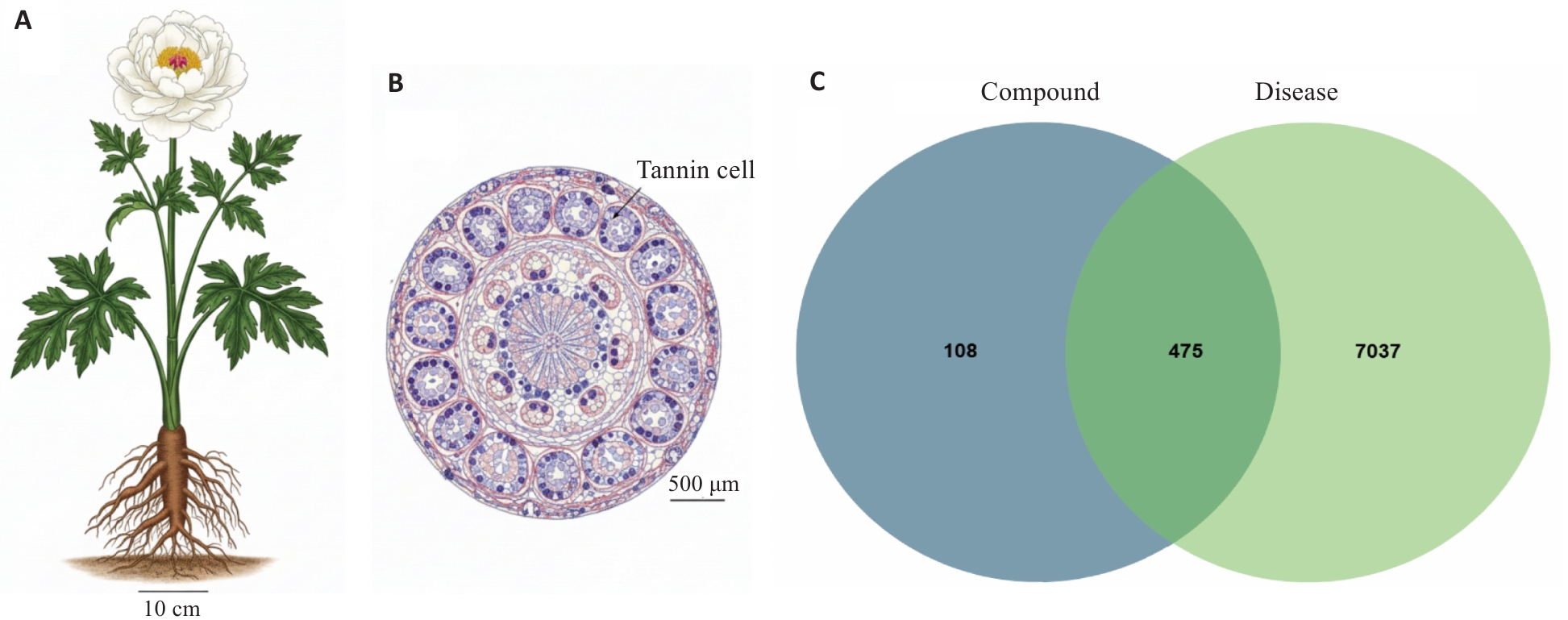
图1 白芍与疾病靶点图
Fig.1 Targets of Baishao and the disease. A: Botanical image of Paeonia lactiflora. B: Cross-section of Paeonia lactiflora root. C: Venn diagram.
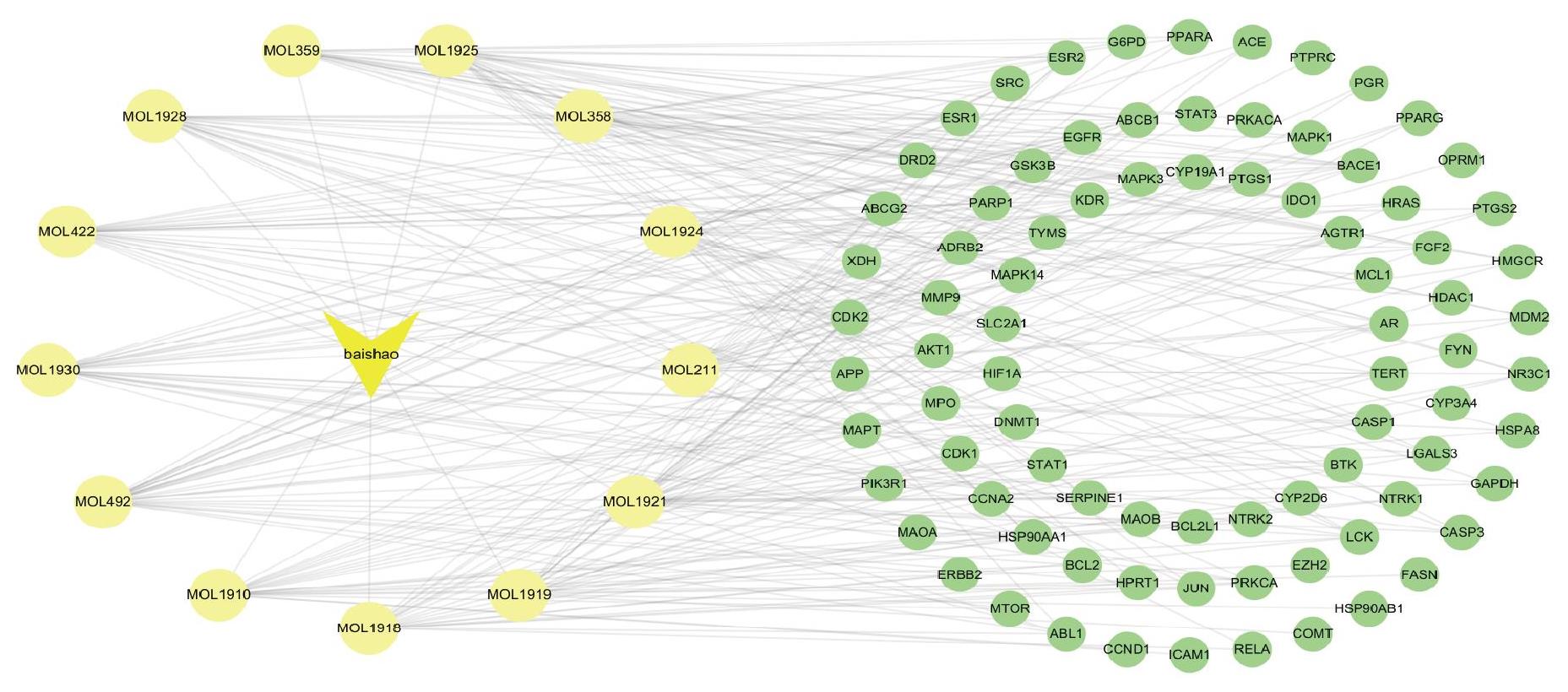
图2 "药物-成分-核心靶点"网络图
Fig.2 "Herb-Compound-Core Target" network.
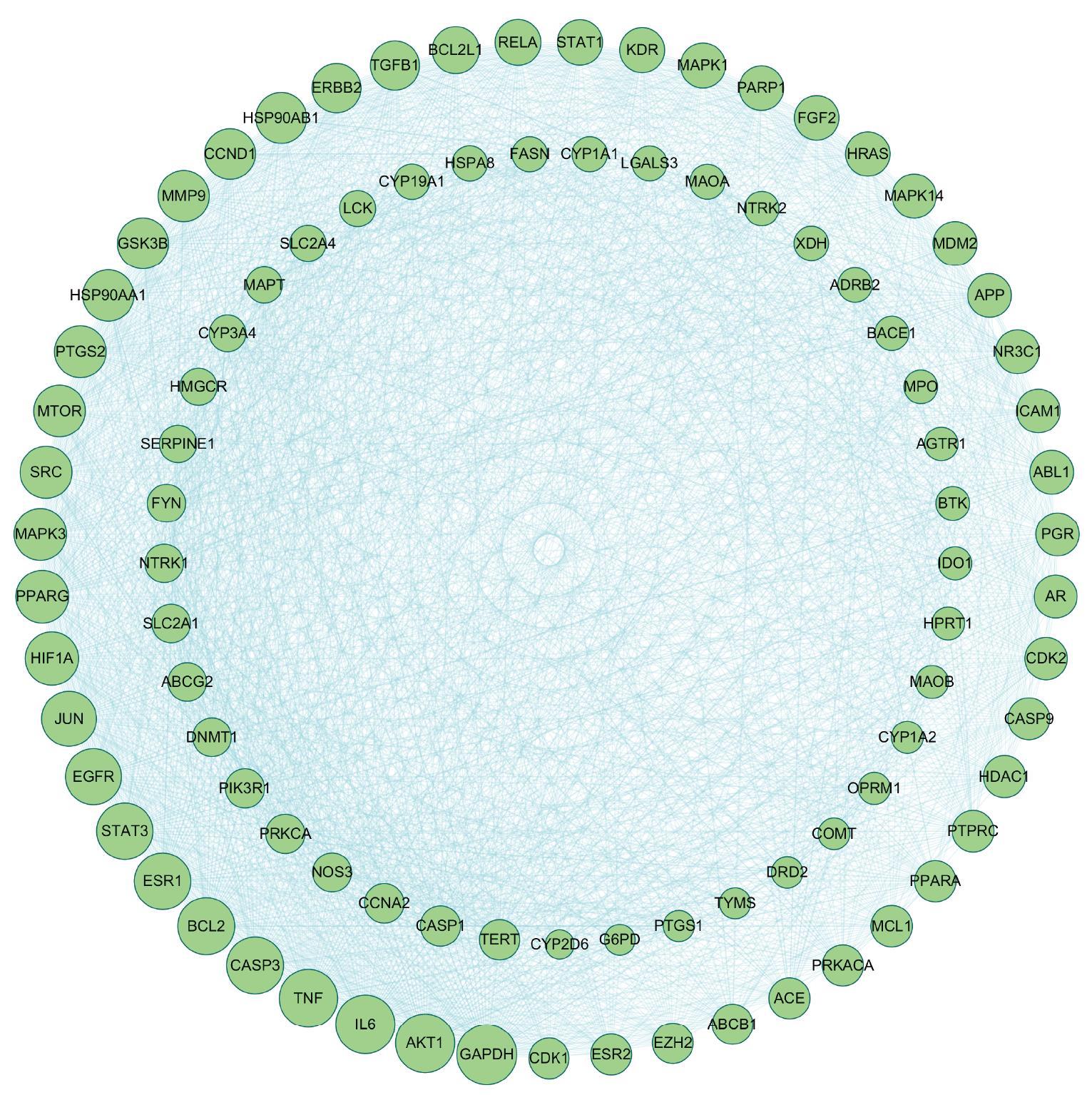
图3 PPI网络图
Fig.3 Protein-protein interaction (PPI) network diagram.
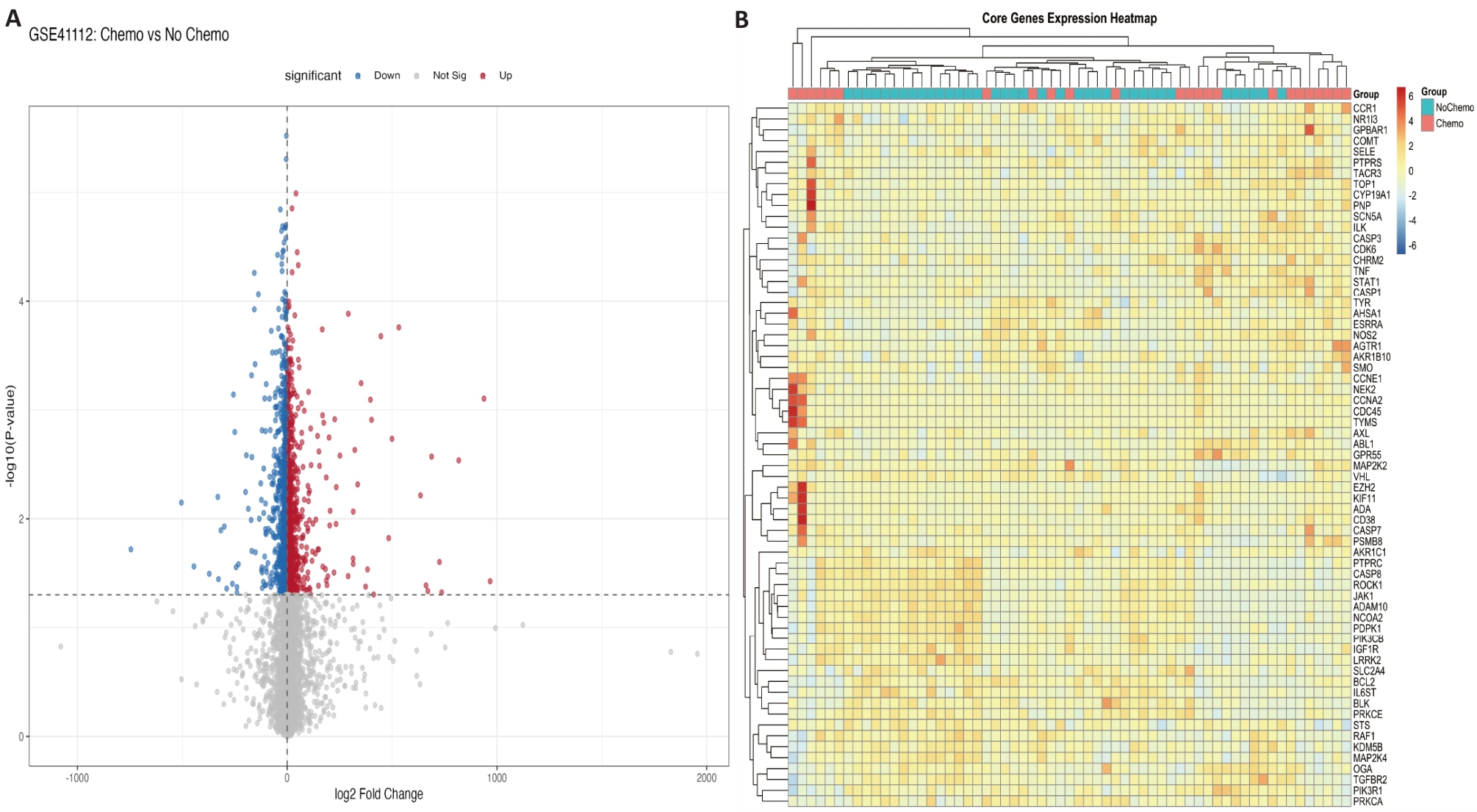
图4 核心基因的差异表达分析
Fig.4 Differential expression analysis of the core genes. A: Differential gene expression. B: Heatmap of the core genes.
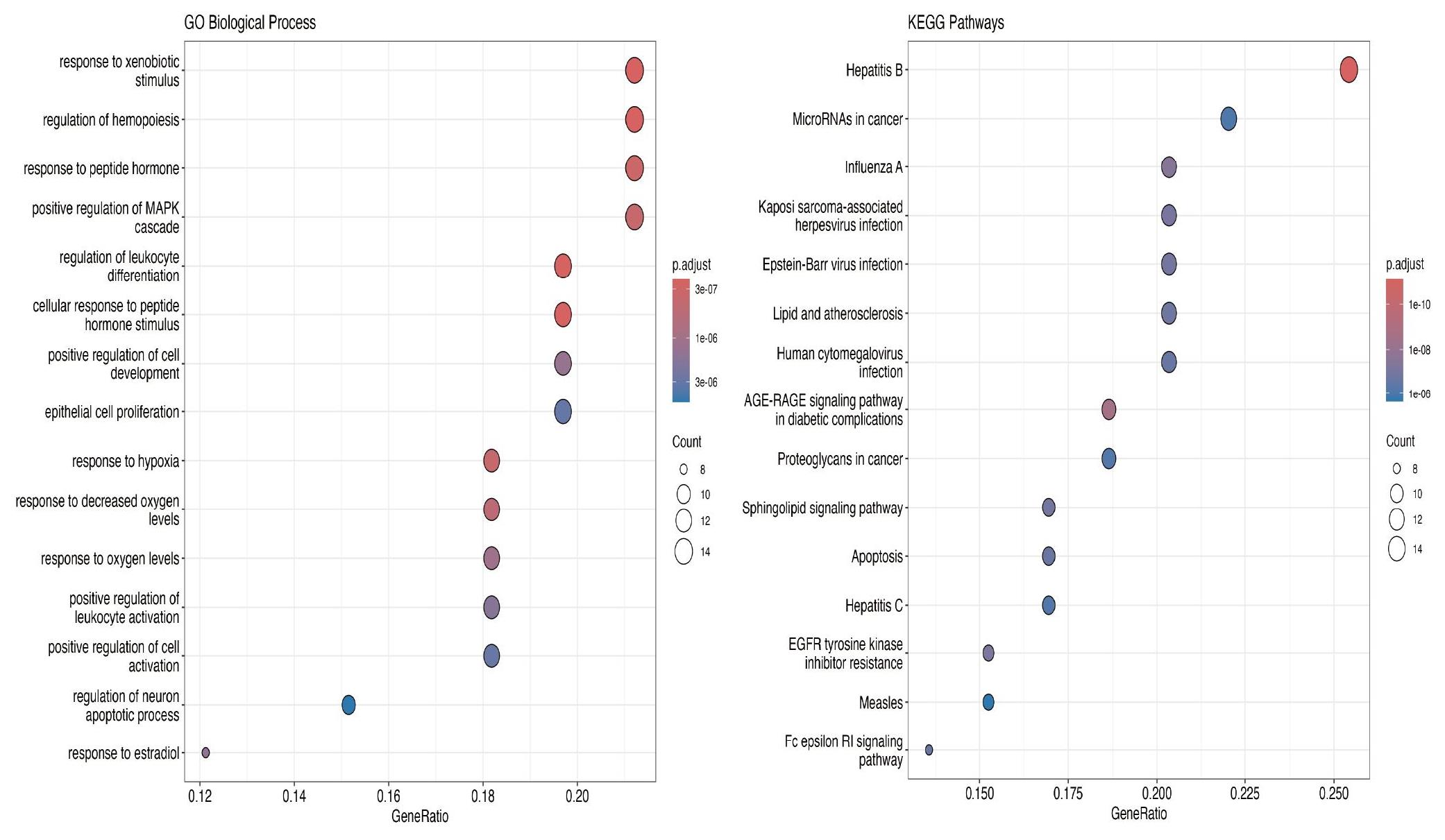
图5 GO和KEGG富集点图
Fig.5 GO and KEGG enrichment dot plot.
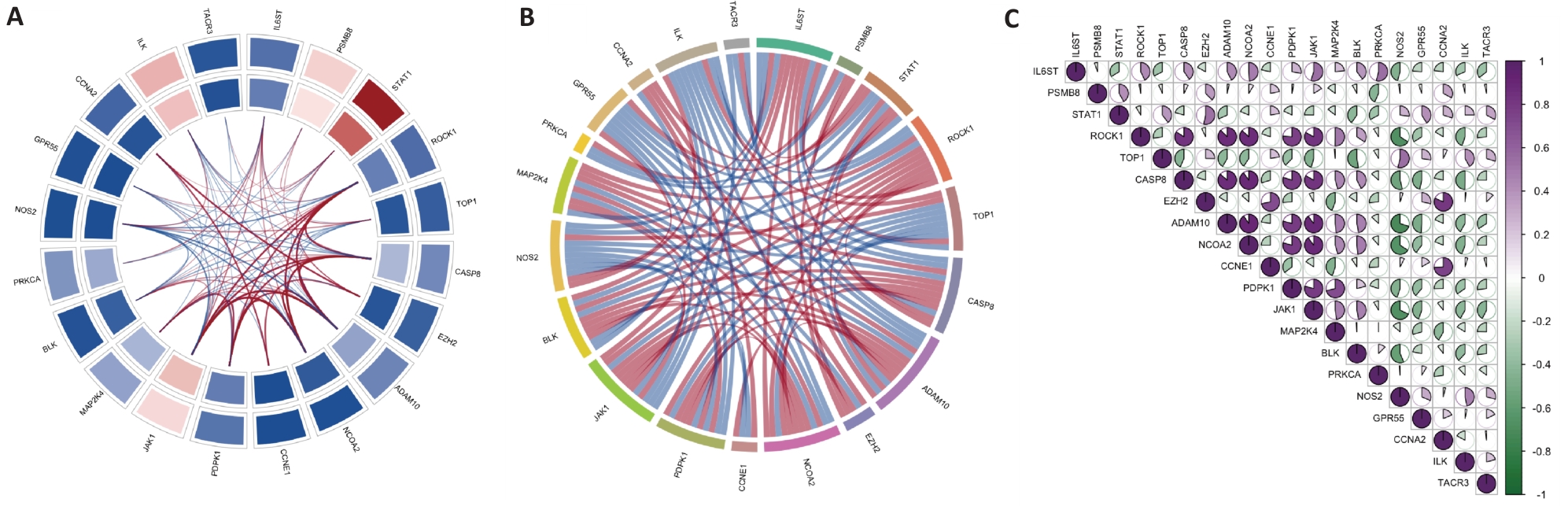
图6 核心基因的表达特征与共表达互作网络
Fig.6 Expression characteristics and co-expression interaction network of core genes. A: Circos plot of the core genes. B: Chord diagram of correlations among the core gene. C: Correlation heatmap of the core genes.
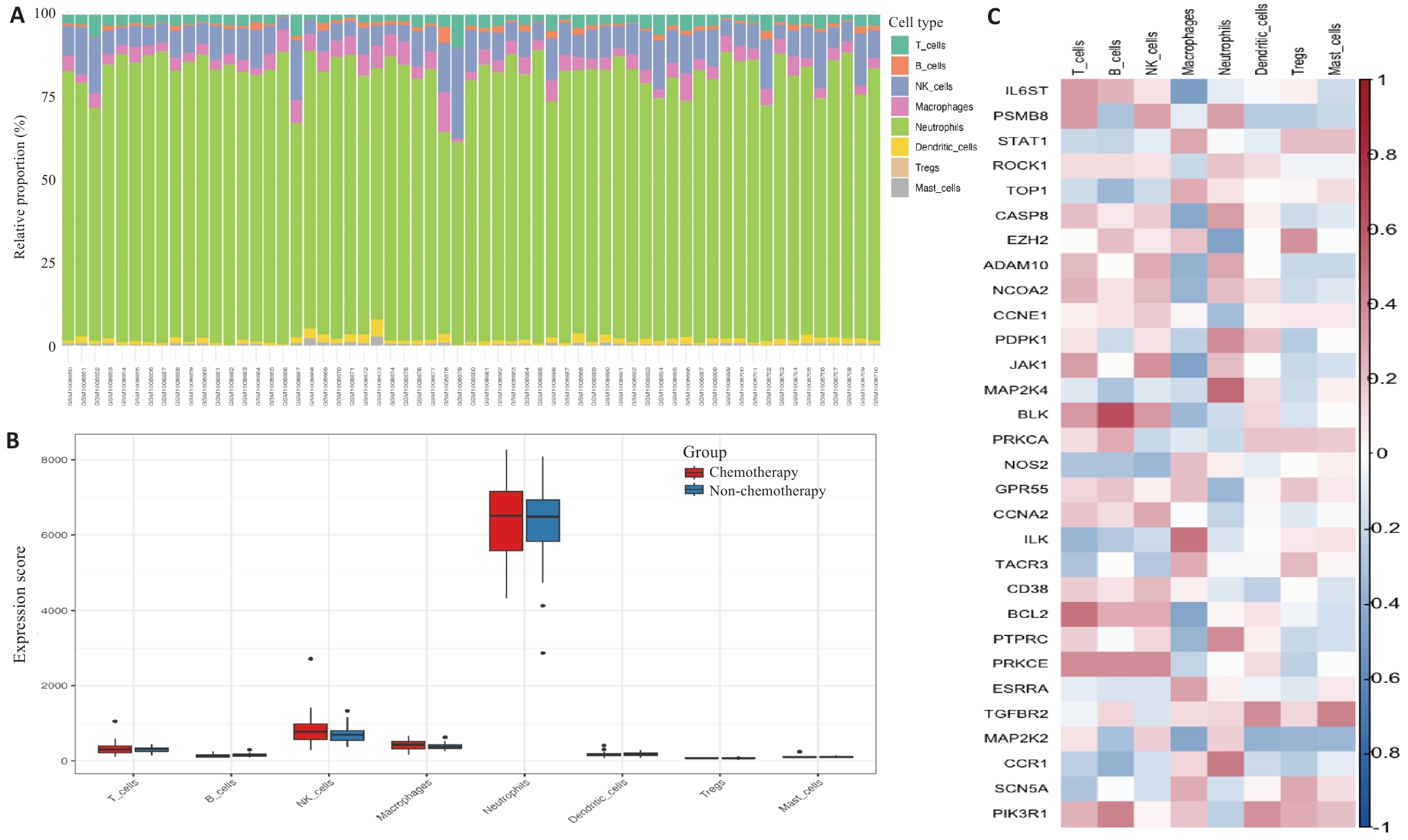
图7 免疫微环境浸润特征及核心靶点的免疫相关性分析
Fig.7 Infiltration characteristics of the immune microenvironment and immune correlation analysis of the core targets. A: Stacked bar plot of immune cell infiltration proportions. B: Boxplot for comparison of immune cell abundance between CRF and control groups. C: Correlation heatmap between the core genes and immune cells. *P<0.05.
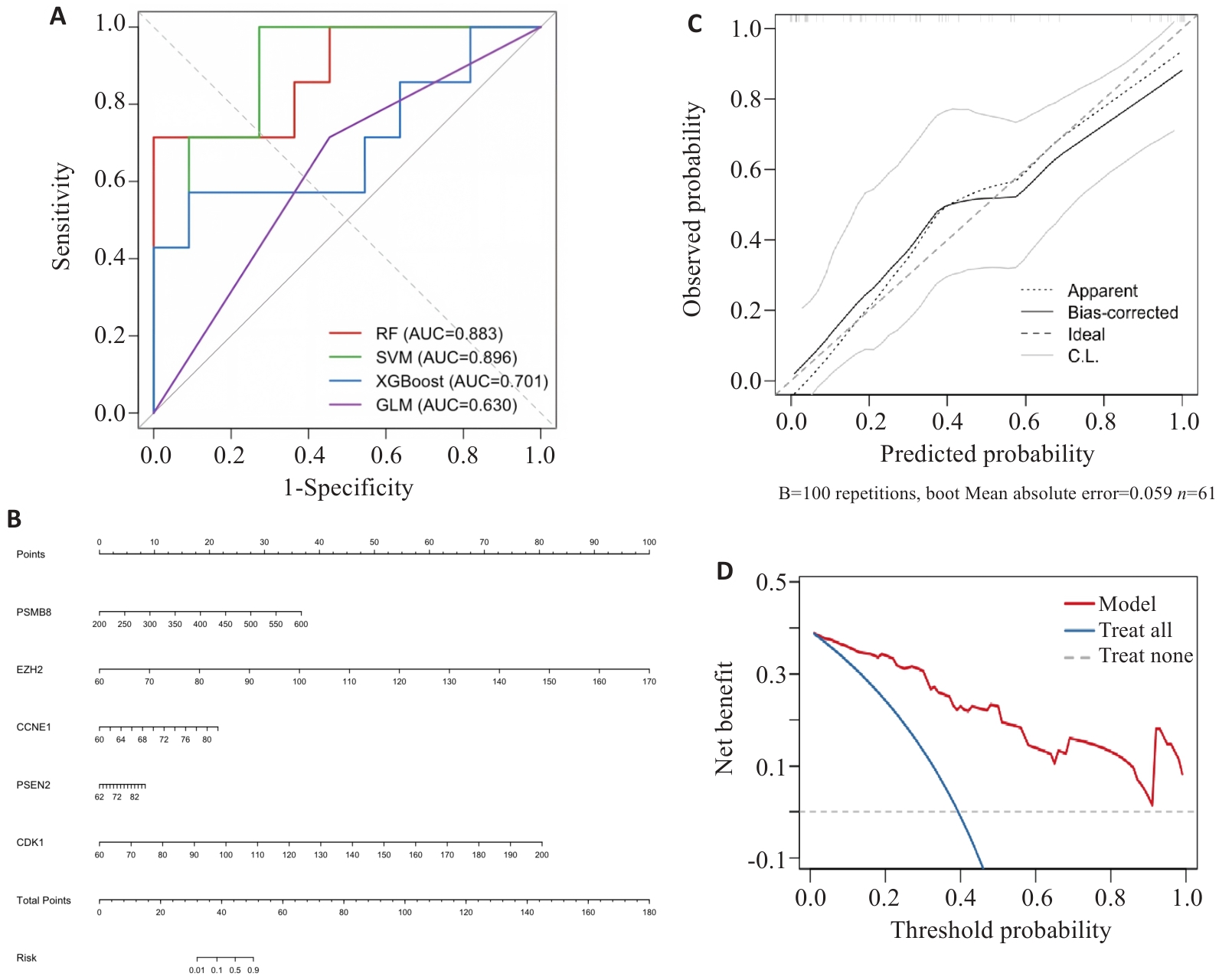
图8 关键特征基因预测模型的构建与列线图效能验证
Fig.8 Construction of the predictive model based on the key feature genes and performance validation of the nomogram. A: Comparison of ROC curves for diagnostic models. B: Nomogram for predicting the risk of CRF. C: Calibration curve. D: Decision curve analysis.
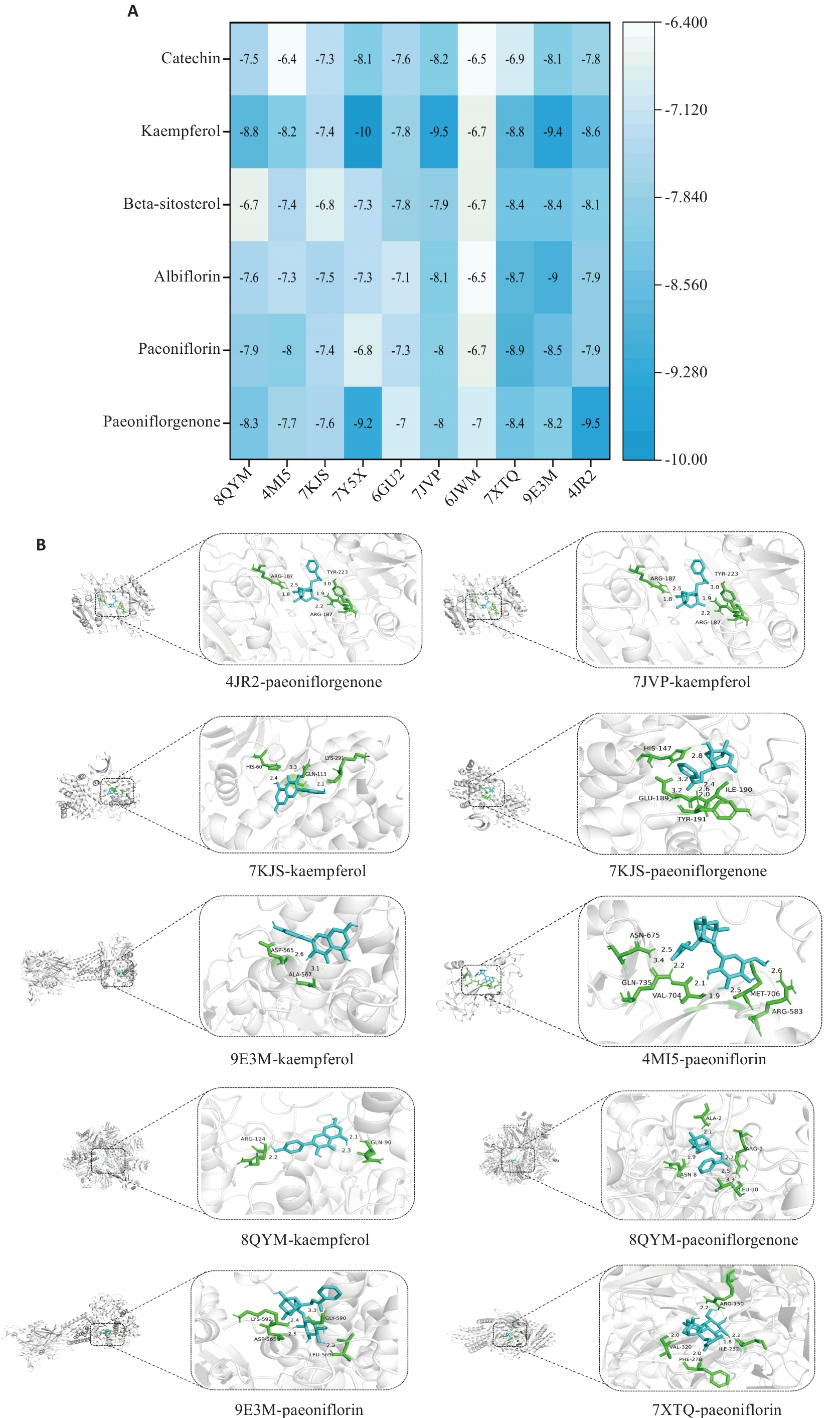
图 9 活性成分与关键靶点的分子对接分析
Fig.9 Molecular docking analysis of the active ingredients and key targets. A: Binding energy heatmap. B: Visualization of molecular docking results.
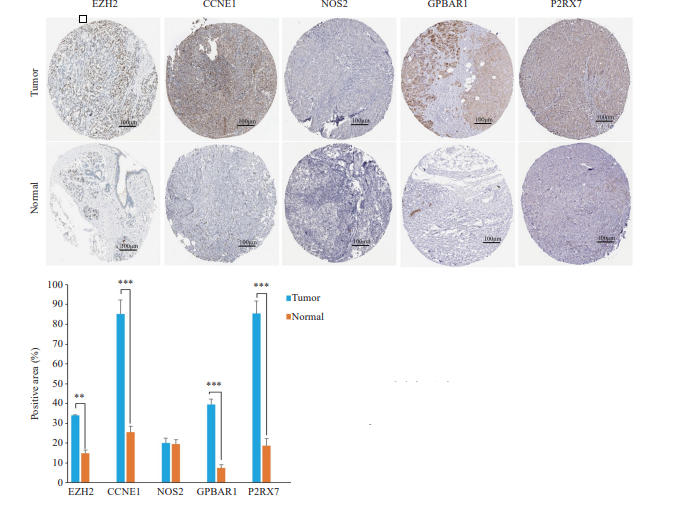
图11 乳腺癌组织与正常乳腺组织核心蛋白免疫组化染色的比较
Fig.11 Comparison of immunohistochemical stainingof the core proteins between breast cancer tissues andnormal breast tissues (n=3, scale bar=100 μm).**P<0.01,*** .P<0.001,
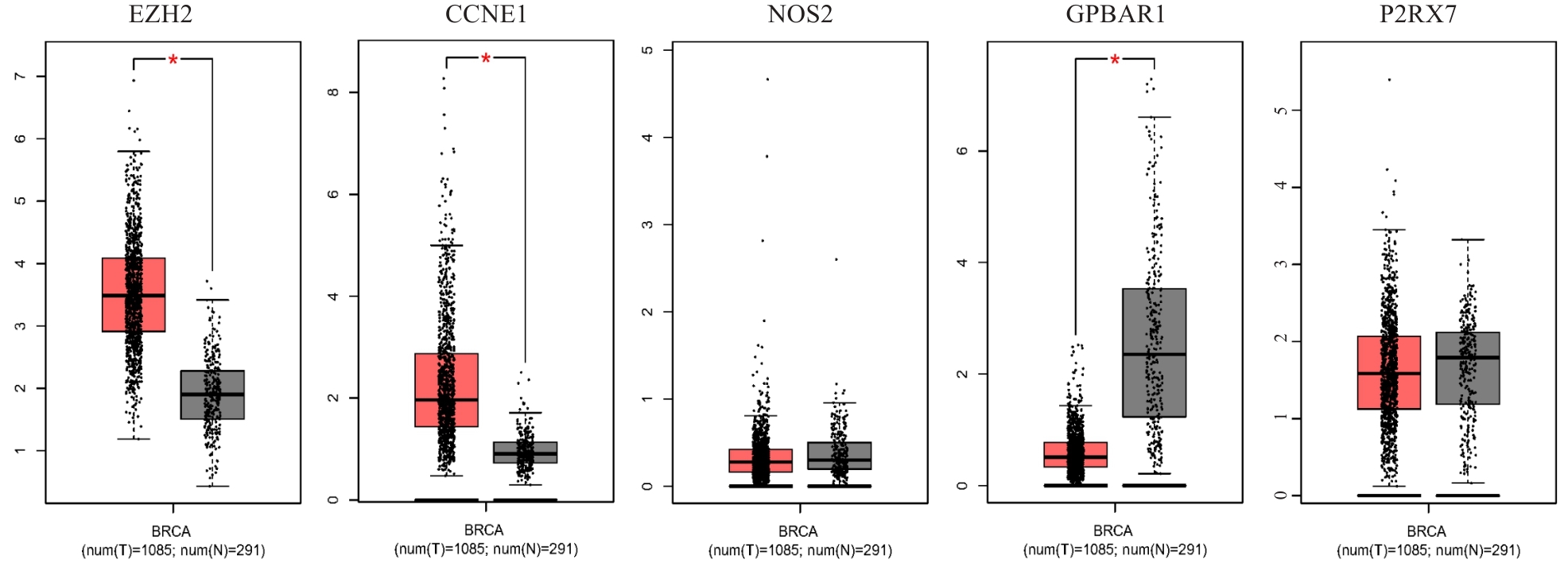
图12 核心基因在乳腺癌组织与正常乳腺组织中的mRNA表达差异分析
Fig.12 Boxplot for comparison of the core gene mRNA expressions between breast cancer and normal breast tissues (tumor=1085, normal=291). *P<0.05.
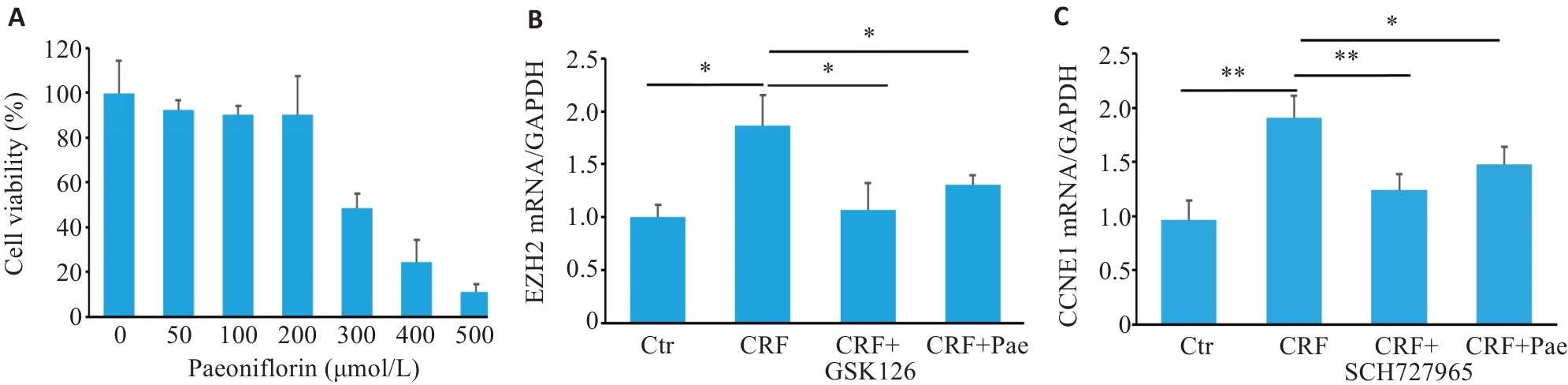
图13 芍药苷对Py230细胞活力及核心基因mRNA表达的影响
Fig.13 Effects of paeoniflorin on viability of Py230 cells and mRNA expressions of the core genes (n=3). A: Relative cell viability detected by CCK-8 assay after treatment with different concentrations of paeoniflorin for 24 h. B: Relative mRNA expression levels of EZH2 in each group. The Model group was induced by chemotherapeutic agents, and GSK126 served as a positive EZH2 inhibitor. C: Relative mRNA expression levels of CCNE1 in each group. SCH727965 served as a positive CCNE1 inhibitor. *P<0.05, **P<0.01.
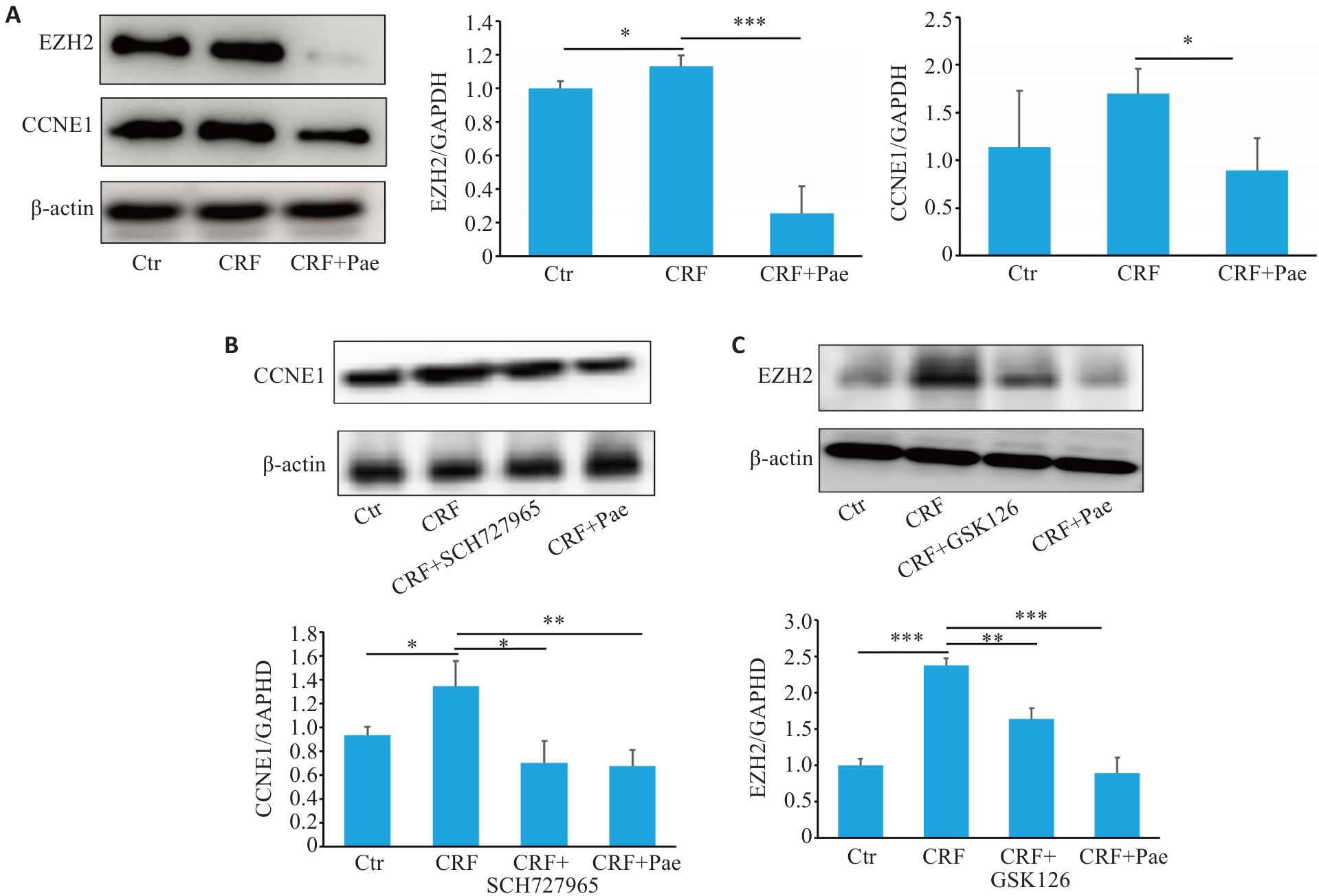
图14 各组乳腺癌细胞蛋白表达水平比较
Fig.14 Comparison of protein expression levels in breast cancer cells in each group (n=3). *P<0.05, **P<0.01, ***P<0.001.
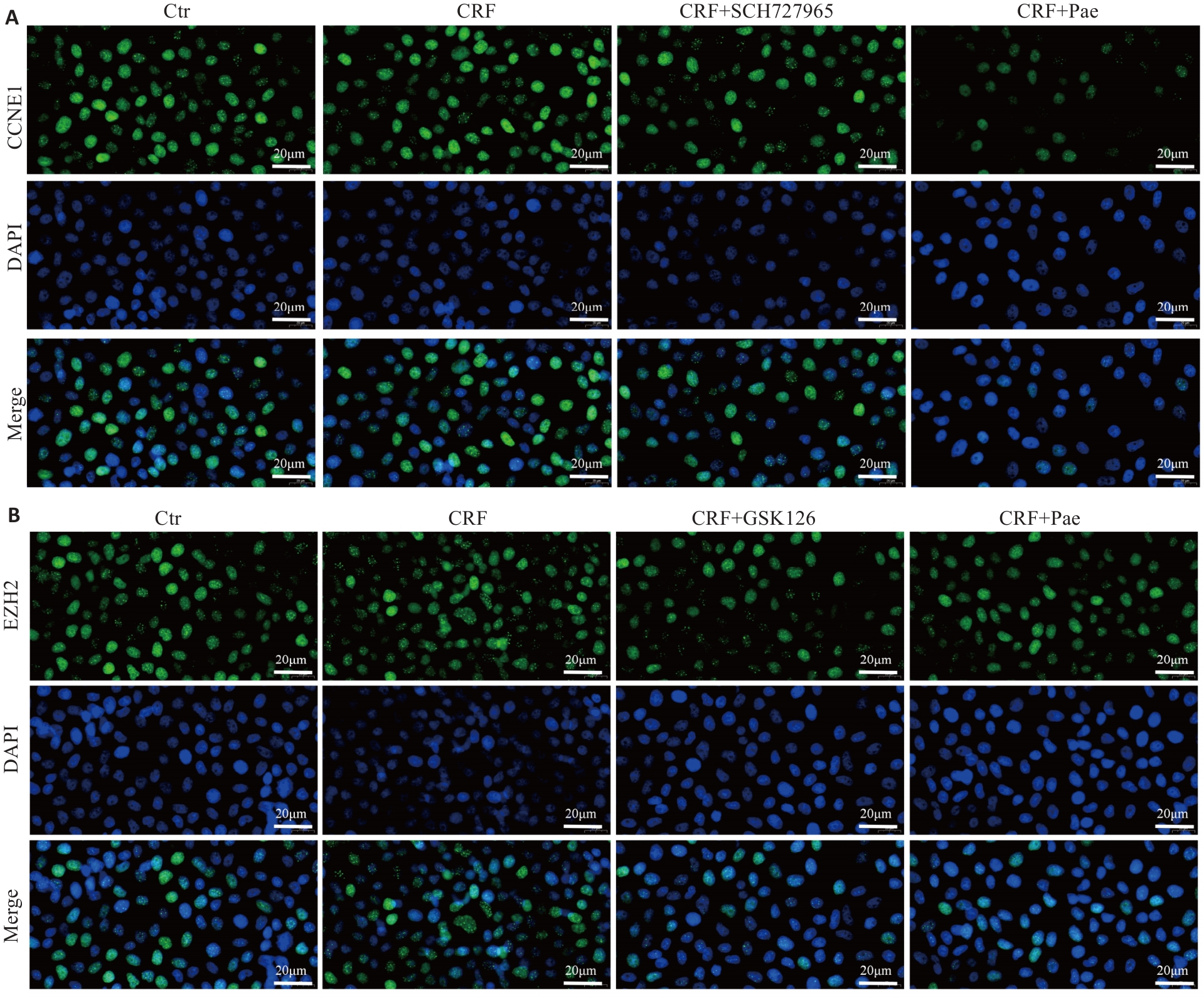
图15 芍药苷对乳腺癌细胞核心靶点CCNE1和EZH2蛋白表达及定位的调控
Fig.15 Regulatory effects of paeoniflorin on protein expressions and localization of the core targets CCNE1 and EZH2 in breast cancer cells (scale bar=20 μm). A: CCNE1 expression levels in breast cancer cell groups. B: EZH2 expression levels in breast cancer cell groups.
| [1] | Siegel RL, Kratzer TB, Giaquinto AN, et al. Cancer statistics, 2025[J]. CA Cancer J Clin, 2025, 75(1): 10-45. doi:10.3322/caac.21871 |
| [2] | 中国抗癌协会癌症康复与姑息治疗专业委员会,中国临床肿瘤学会肿瘤支持与康复治疗专家委员会 .癌症相关性疲乏诊断与治疗中国专家共识[J]. 中华医学杂志, 2022, 102(3): 180-9. doi:10.3760/cma.j.cn112137-20210811-01789 |
| [3] | 马永芳. 基于IMB模型的结肠癌化疗期患者癌因性疲乏护理方案的构建和应用研究[D]. 北华大学, 2025. |
| [4] | 梁 粲. 百笑灸联合参芪扶正注射液治疗肠癌化疗患者癌症相关性疲乏的临床研究[D]. 南京中医药大学, 2024. |
| [5] | Feng XL, Li ZH, Guo WH, et al. The effects of traditional Chinese medicine and dietary compounds on digestive cancer immunotherapy and gut microbiota modulation: a review[J]. Front Immunol, 2023, 14: 1087755. doi:10.3389/fimmu.2023.1087755 |
| [6] | 孙心悦, 王宽宇, 王 钢, 等. 扶正消岩颗粒通过调控AKT1/BAD/BCL-2通路改善乳腺癌化疗期癌因性疲乏[J]. 南方医科大学学报,2025, 45(12): 2646-57. |
| [7] | 王秋艳, 王世新, 隋方宇, 等. 白芍活性成分、药理作用及成分变化的影响因素研究进展[J]. 中草药, 2025, 56(5): 1817-29. doi:10.7501/j.issn.0253-2670.2025.05.030 |
| [8] | Zhang P, Wang ZX, Qiu HX, et al. Machine learning applied to serum and cerebrospinal fluid metabolomes revealed altered arginine metabolism in neonatal sepsis with meningoencephalitis[J]. Comput Struct Biotechnol J, 2021, 19: 3284-92. doi:10.1016/j.csbj.2021.05.024 |
| [9] | 李 鑫, 方崇锴, 黄 越, 等. 参芪固本方调控IL-17信号通路改善癌因性疲乏的作用机制[J]. 中国药房, 2025, 36(14): 1722-9. |
| [10] | 朱潇旭. 基于纹状体A2AR-ERK-NF-κB通路探讨逍遥散对肝郁脾虚证抑郁大鼠的神经保护作用机理[D]. 湖北中医药大学, 2022. |
| [11] | 徐方宁, 刘清珍, 张 悦, 等. 基于TRPV1-NLRP3通路探讨芍药苷缓解神经病理性疼痛的作用机制[J]. 医学研究与战创伤救治, 2025, 38(10): 1035-41. |
| [12] | 谢晓燕, 张 娟, 向 勇, 等. 芍药苷可逆转疼痛共病抑郁大鼠海马内脑源性神经营养因子含量的减少[J]. 中华中医药学刊, 2022, 40(12): 181-5, 308. |
| [13] | Li CC, Liu B, Xu JY, et al. Phloretin decreases microglia-mediated synaptic engulfment to prevent chronic mild stress-induced depression-like behaviors in the mPFC[J]. Theranostics, 2023, 13(3): 955-72. doi:10.7150/thno.76553 |
| [14] | 牛永强, 江 涛, 秦雪梅, 等. 蛋白质组学视角下的中药抗抑郁作用研究进展[J]. 中草药, 2025, 56(23): 8816-24. |
| [15] | Ye YH, Pei HR, Cao XL, et al. The study of a novel paeoniflorin-converting enzyme from Cunninghamella blakesleeana [J]. Molecules, 2023, 28(3): 1289. doi:10.3390/molecules28031289 |
| [16] | Zeng J, Xu H, Fan PZ, et al. Kaempferol blocks neutrophil extracellular traps formation and reduces tumour metastasis by inhibiting ROS-PAD4 pathway[J]. J Cellular Molecular Medi, 2020, 24(13): 7590-9. doi:10.1111/jcmm.15394 |
| [17] | He YL, Li J, Gong SH, et al. BNIP3 phosphorylation by JNK1/2 promotes mitophagy via enhancing its stability under hypoxia[J]. Cell Death Dis, 2022, 13(11): 966. doi:10.1038/s41419-022-05418-z |
| [18] | Arunachalam S, Nagoor Meeran MF, Azimullah S, et al. α-bisabolol attenuates doxorubicin induced renal toxicity by modulating NF-κB/MAPK signaling and caspase-dependent apoptosis in rats[J]. Int J Mol Sci, 2022, 23(18): 10528. doi:10.3390/ijms231810528 |
| [19] | Montero P, Milara J, Pérez-Leal M, et al. Paclitaxel-induced epidermal alterations: an in vitro preclinical assessment in primary keratinocytes and in a 3D epidermis model[J]. Int J Mol Sci, 2022, 23(3): 1142. doi:10.3390/ijms23031142 |
| [20] | Ekedahl H, Isaksson S, Ståhl O, et al. Low-grade inflammation in survivors of childhood cancer and testicular cancer and its association with hypogonadism and metabolic risk factors[J]. BMC Cancer, 2022, 22(1): 157. doi:10.1186/s12885-022-09253-5 |
| [21] | Bower JE. Cancer-related fatigue: mechanisms, risk factors, and treatments[J]. Nat Rev Clin Oncol, 2014, 11(10): 597-609. doi:10.1038/nrclinonc.2014.127 |
| [22] | Boyle CC, Bower JE, Eisenberger NI, et al. Stress to inflammation and anhedonia: Mechanistic insights from preclinical and clinical models[J]. Neurosci Biobehav Rev, 2023, 152: 105307. doi:10.1016/j.neubiorev.2023.105307 |
| [23] | Wang MM, Zhong B, Li M, et al. Identification of potential core genes and pathways predicting pathogenesis in head and neck squ-amous cell carcinoma[J]. Biosci Rep, 2021, 41(5): BSR20204148. doi:10.1042/bsr20204148 |
| [24] | Matthews HK, Bertoli C, de Bruin RAM. Cell cycle control in cancer[J]. Nat Rev Mol Cell Biol, 2022, 23(1): 74-88. doi:10.1038/s41580-021-00404-3 |
| [25] | Wang J, Zhou H. Mitochondrial quality control mechanisms as molecular targets in cardiac ischemia-reperfusion injury[J]. Acta Pharm Sin B, 2020, 10(10): 1866-79. doi:10.1016/j.apsb.2020.03.004 |
| [26] | 龙腾飞, 张红雁, 吴爱林, 等. 基于CGGA数据库的325例脑胶质瘤患者PSMB8表达水平与临床特征的相关性研究[J]. 安徽医科大学学报, 2021, 56(11): 1833-7. doi:10.19405/j.cnki.issn1000-1492.2021.11.031 |
| [27] | Pudova EA, Pavlov VS, Guvatova ZG, et al. Machine learning models for cancer research: a narrative review of bulk RNA-seq applications[J]. Int J Mol Sci, 2025, 26(24): 12081. doi:10.3390/ijms262412081 |
| [28] | Wang FL, Zain AM, Ren YJ, et al. Navigating the microarray landscape: a comprehensive review of feature selection techniques and their applications[J]. Front Big Data, 2025, 8: 1624507. doi:10.3389/fdata.2025.1624507 |
| [29] | Jiang L, Xu C, Bai Y, et al. Autosurv: interpretable deep learning framework for cancer survival analysis incorporating clinical and multi-omics data[J]. NPJ Precis Oncol, 2024, 8(1): 4. doi:10.1038/s41698-023-00494-6 |
| [30] | Zahedi R, Ghamsari R, Argha A, et al. Deep learning in spatially resolved transcriptomics: a comprehensive technical view[J]. Brief Bioinform, 2024, 25(2): bbae082. doi:10.1093/bib/bbae082 |
| [31] | He J, Song YJ, Li GP, et al. Fbxw7 increases CCL2/7 in CX3CR1hi macrophages to promote intestinal inflammation[J]. J Clin Investig, 2019, 129(9): 3877-93. doi:10.1172/jci123374 |
| [32] | Yoo KH, Oh S, Kang K, et al. Loss of EZH2 results in precocious mammary gland development and activation of STAT5-dependent genes[J]. Nucleic Acids Res, 2015, 43(18): 8774-89. doi:10.1093/nar/gkv776 |
| [33] | Lv Q, Xing Y, Liu J, et al. Lonicerin targets EZH2 to alleviate ulcerative colitis by autophagy-mediated NLRP3 inflammasome inactivation[J]. Acta Pharm Sin B, 2021, 11(9): 2880-99. doi:10.1016/j.apsb.2021.03.011 |
| [34] | Das A, Ranadive N, Kinra M, et al. An overview on chemotherapy-induced cognitive impairment and potential role of antidepressants[J]. Curr Neuropharmacol, 2020, 18(9): 838-51. doi:10.2174/1570159x18666200221113842 |
| [35] | Liu YC, Feng N, Li WW, et al. Costunolide plays an anti-neuroinflammation role in lipopolysaccharide-induced BV2 microglial activation by targeting cyclin-dependent kinase 2[J]. Molecules, 2020, 25(12): 2840. doi:10.3390/molecules25122840 |
| [36] | Ma JF, Meng QL, Zhan JP, et al. Paeoniflorin suppresses rheumatoid arthritis development via modulating the circ-FAM120A/miR-671-5p/MDM4 axis[J]. Inflammation, 2021, 44(6): 2309-22. doi:10.1007/s10753-021-01504-0 |
| [37] | Kim KH, Roberts CWM. Targeting EZH2 in cancer[J]. Nat Med, 2016, 22(2): 128-34. doi:10.1038/nm.4036 |
| [1] | 王坤, 侯顺福, 李勇, 刘清华, 尹崇高, 李洪利. miR-183-5p通过靶向调控KLHL24影响三阴性乳腺癌细胞增殖、侵袭、迁移及铁死亡[J]. 南方医科大学学报, 2026, 46(8): 1790-1798. |
| [2] | 朱梦欣, 刘晓, 赵珊, 张新, 刘超, 刘献孔, 綦浩辰, 韩铁生, 马冬. 可解释性机器学习模型对宫颈癌周围神经浸润的术前精准预测及临床决策支持:一项多中心回顾性研究[J]. 南方医科大学学报, 2026, 46(7): 1509-1519. |
| [3] | 陈萌萌, 郭润芳, 赵文洁, 王咏琪, 左芦根, 刘牧林, 李彬. 多维特征下的消化道恶性肿瘤患者焦虑情绪识别模型构建:基于多种可解释性机器学习算法[J]. 南方医科大学学报, 2026, 46(7): 1660-1670. |
| [4] | 方良毅, 谢德欢, 黄殿毅, 杜钦文, 杜莎莎, 朱腾, 孙恒文. 图像引导下植物色素贴与激光微点在乳腺癌放疗体表标记中的应用:一项随机对照研究[J]. 南方医科大学学报, 2026, 46(6): 1416-1422. |
| [5] | 陈浩, 李振汉, 纪梦佳, 汪鑫诚, 陈博峰, 管谦, 武嫚, 卢林明. 全球非酒精性脂肪性肝病负担的关键决定因素:基于GBD数据的机器学习联合孟德尔随机化验证[J]. 南方医科大学学报, 2026, 46(4): 770-784. |
| [6] | 范东伟, 李煊赫, 姚廷敬, 金从稳, 王兴亮, 黄诚. 毛兰素通过阻断Wnt/β-catenin信号抑制乳腺癌细胞增殖和迁移[J]. 南方医科大学学报, 2026, 46(4): 838-847. |
| [7] | 陶红成, 梁富凯, 黄文波, 范思奇, 曾平. 酒精暴露与股骨头坏死的潜在关联:基于机器学习构建诊断模型[J]. 南方医科大学学报, 2026, 46(3): 559-569. |
| [8] | 向科霖, 章晓云, 黎征鹏, 徐志为, 刘素杰, 柴源. 胞葬相关基因UCP2、EGLN3、IL1B对骨关节炎的诊断价值及中药治疗预测:基于生物信息学及机器学习[J]. 南方医科大学学报, 2026, 46(3): 693-706. |
| [9] | 陈君尧, 陈泽宇, 林钊杰, 方梦浩, 沈超英, 许琦, 张晓怡, 卢鲁. 饮茶对胃肠道疾病风险的双重作用:基于可解释机器学习与大语言模型的联合预测辅助模型[J]. 南方医科大学学报, 2026, 46(2): 353-361. |
| [10] | 徐乔, 李文杰, 张馨月, 陈越, 蒋子通, 李光哲, 严铭铭. 基于“抗氧化-炎症-色素沉着轴”优化白芍的提取工艺与美白功效评价[J]. 南方医科大学学报, 2026, 46(2): 443-455. |
| [11] | 崔运能, 冯敏清, 姚亮凤, 严杰文, 李闻瀚, 黄燕平. 基于欠采样的影像组学机器学习模型术前预测子宫肌瘤高强度聚焦超声消融效果[J]. 南方医科大学学报, 2026, 46(1): 141-149. |
| [12] | 张力莹, 张同贞, 赵鑫. 基于乳腺影像报告和数据系统的DWI和T2WI形态评估对乳腺病变的诊断价值[J]. 南方医科大学学报, 2025, 45(9): 1809-1817. |
| [13] | 黄启智, 谢戴鹏, 姚霖彤, 李洽轩, 吴少伟, 周海榆. 肿瘤微环境特异性CT影像组学标签预测非小细胞肺癌免疫治疗疗效[J]. 南方医科大学学报, 2025, 45(9): 1903-1918. |
| [14] | 姜君, 封硕, 孙银贵, 安燕. 经尿道前列腺钬激光剜除术后低体温风险预测模型:基于逻辑回归、决策树和支持向量机[J]. 南方医科大学学报, 2025, 45(9): 2019-2025. |
| [15] | 马思源, 张博超, 浦春. Circ_0000437通过靶向let-7b-5p/CTPS1轴促进乳腺癌细胞的增殖、侵袭、迁移及上皮间质转化[J]. 南方医科大学学报, 2025, 45(8): 1682-1696. |
| 阅读次数 | ||||||
|
全文 |
|
|||||
|
摘要 |
|
|||||
