
南方医科大学学报 ›› 2025, Vol. 45 ›› Issue (11): 2309-2319.doi: 10.12122/j.issn.1673-4254.2025.11.03
陈一镠1( ), 马民1(), 苏燃1, 朱寅宾1, 冯晴1, 罗嘉丽1, 冯伟峰2(), 颜显欣1()
收稿日期:2025-06-26
出版日期:2025-11-20
发布日期:2025-11-28
通讯作者:
冯伟峰,颜显欣
E-mail:cyl9708@163.com;tmamin@jnu.edu.cn;fwf2000ok@sina.com;871655006@qq.com
作者简介:陈一镠,在读博士研究生,E-mail:cyl9708@163.com基金资助:
Yiliu CHEN1(), Min MA1(), Ran SU1, Yinbin ZHU1, Qing FENG1, Jiali LUO1, Weifeng FENG2(), Xianxin YAN1()
Received:2025-06-26
Online:2025-11-20
Published:2025-11-28
Contact:
Weifeng FENG, Xianxin YAN
E-mail:cyl9708@163.com;tmamin@jnu.edu.cn;fwf2000ok@sina.com;871655006@qq.com
Supported by:摘要:
目的 探讨理冲消癥颗粒通过调控ANT3介导的线粒体凋亡通路增敏顺铂治疗卵巢癌的分子机制。 方法 LC-MS检测理冲消癥颗粒入血成分。采用皮下异种移植瘤模型,将BALB/c-nud小鼠随机分为3组(8只/组):Tumor组(仅接种肿瘤)、DDP组(每周腹腔注射1次0.1 mL的5 mg/kg的顺铂)、DDP_LCXZ组(在顺铂基础上按照15 g·kg-1·d-1灌胃0.2 mL的理冲消癥颗粒)。在实验过程中动态监测肿瘤体积、质量及小鼠体质量,并用HE染色观察肿瘤和肾脏的病理学变化。同时,采用RNA-seq筛选差异基因并行KEGG分析,电镜用于观察线粒体结构变化,Western blotting检测线粒体凋亡相关蛋白的表达。 结果 LC-MS共检测出218个成分为理冲消癥颗粒的入血成分;与Tumor组比较,DDP组与DDP_LCXZ联合用药组的肿瘤体积分别减少60.3%和72.6%(P<0.01)。转录组学结果显示,ANT3在DDP组与DDP_LCXZ联合用药组中的表达水平较对照组上调(P<0.05)。分子对接后发现理冲消癥颗粒的主要活性成分与ANT3的结合能均<-6 kcal mol。电镜显示,与Tumor组相比,DDP组肿瘤细胞线粒体肿胀及外膜损伤程度增加,DDP+LCXZ组该现象更为明显。Western blotting结果显示,DDP组和DDP+LCXZ组中BAX、ANT3、cleaved-caspase-3、cleaved-caspase-9表达水平升高,而BCL-2表达水平降低(P<0.05)。 结论 LCXZ通过上调ANT3,促进线粒体功能失衡并激活凋亡信号,从而增强顺铂对卵巢癌的抑瘤效应。
陈一镠, 马民, 苏燃, 朱寅宾, 冯晴, 罗嘉丽, 冯伟峰, 颜显欣. 理冲消癥颗粒通过上调ANT3介导的线粒体凋亡增强小鼠卵巢癌移植瘤对顺铂的敏感性[J]. 南方医科大学学报, 2025, 45(11): 2309-2319.
Yiliu CHEN, Min MA, Ran SU, Yinbin ZHU, Qing FENG, Jiali LUO, Weifeng FENG, Xianxin YAN. Lichong Xiaozheng Granules enhances cisplatin sensitivity of ovarian cancer xenografts in rats by regulating adenine nucleotide translocator 3-mediated mitochondrial apoptosis[J]. Journal of Southern Medical University, 2025, 45(11): 2309-2319.
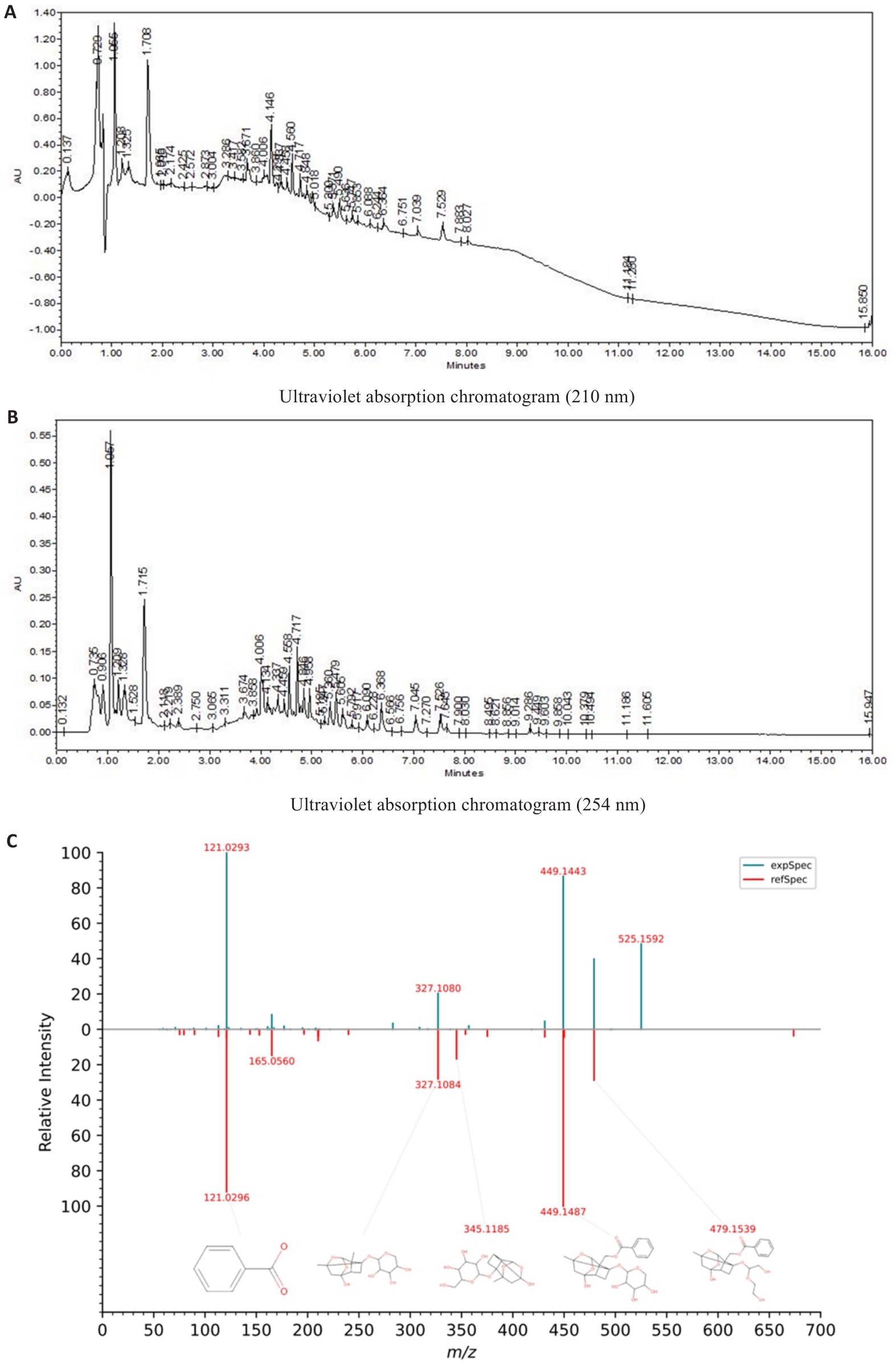
图1 理冲消癥颗粒的 HPLC-UV 指纹图谱及代表性成分质谱解析
Fig.1 HPLC-UV fingerprints and mass spectrometric analysis of Lichong Xiaozheng Granules (LCXZ). A, B: HPLC-UV fingerprint of LCXZ at 210 nm and 254 nm, respectively. C: High-resolution mass spectrometric fragmentation pathway of paeoniflorin.
| No. | Mass-to-charge ratio (m/z) | Formula | Mass Error (ppm) | Retention time (min) |
|---|---|---|---|---|
| M0001 | 387.1132 | C12H22O11 | -3.69 | 0.89 |
| M0002 | 170.0210 | C7H6O5 | -3.02 | 1.87 |
| M0003 | 329.0869 | C14H18O9 | -2.67 | 3.13 |
| M0004 | 183.0293 | C8H8O5 | -3.03 | 3.90 |
| M0005 | 356.1097 | C16H20O9 | -2.96 | 4.04 |
| M0006 | 496.1569 | C23H28O12 | -2.36 | 4.15 |
| M0007 | 457.1572 | C20H27NO11 | -2.76 | 4.29 |
| M0008 | 431.1910 | C19H30O8 | -3.31 | 4.51 |
| M0009 | 481.1692 | C23H28O11 | -2.65 | 4.62 |
| M0010 | 295.1044 | C14H17NO6 | -4.10 | 4.67 |
| M0011 | 480.1618 | C23H28O11 | -2.89 | 4.71 |
| M0012 | 446.1200 | C22H22O10 | -2.88 | 4.88 |
| M0013 | 428.1671 | C20H28O10 | -2.70 | 4.97 |
| M0014 | 580.2141 | C28H36O13 | -2.51 | 5.12 |
| M0015 | 433.1130 | C21H22O10 | -2.46 | 5.25 |
| M0016 | 463.1221 | C22H22O11 | -3.07 | 5.26 |
| M0017 | 441.1756 | C20H28O8 | -2.57 | 5.41 |
| M0018 | 507.1491 | C23H26O10 | -3.62 | 5.58 |
| M0019 | 161.0593 | C10H10O3 | -2.29 | 5.71 |
| M0020 | 507.1493 | C23H26O10 | -3.22 | 5.90 |
表1 理冲消癥颗粒中鉴定出的含量Top 20的入血化合物的信息
Tab.1 Information on the top 20 compounds of Lichong Xiaozheng Granules (LCXZ) detected in medicated mouse serum
| No. | Mass-to-charge ratio (m/z) | Formula | Mass Error (ppm) | Retention time (min) |
|---|---|---|---|---|
| M0001 | 387.1132 | C12H22O11 | -3.69 | 0.89 |
| M0002 | 170.0210 | C7H6O5 | -3.02 | 1.87 |
| M0003 | 329.0869 | C14H18O9 | -2.67 | 3.13 |
| M0004 | 183.0293 | C8H8O5 | -3.03 | 3.90 |
| M0005 | 356.1097 | C16H20O9 | -2.96 | 4.04 |
| M0006 | 496.1569 | C23H28O12 | -2.36 | 4.15 |
| M0007 | 457.1572 | C20H27NO11 | -2.76 | 4.29 |
| M0008 | 431.1910 | C19H30O8 | -3.31 | 4.51 |
| M0009 | 481.1692 | C23H28O11 | -2.65 | 4.62 |
| M0010 | 295.1044 | C14H17NO6 | -4.10 | 4.67 |
| M0011 | 480.1618 | C23H28O11 | -2.89 | 4.71 |
| M0012 | 446.1200 | C22H22O10 | -2.88 | 4.88 |
| M0013 | 428.1671 | C20H28O10 | -2.70 | 4.97 |
| M0014 | 580.2141 | C28H36O13 | -2.51 | 5.12 |
| M0015 | 433.1130 | C21H22O10 | -2.46 | 5.25 |
| M0016 | 463.1221 | C22H22O11 | -3.07 | 5.26 |
| M0017 | 441.1756 | C20H28O8 | -2.57 | 5.41 |
| M0018 | 507.1491 | C23H26O10 | -3.62 | 5.58 |
| M0019 | 161.0593 | C10H10O3 | -2.29 | 5.71 |
| M0020 | 507.1493 | C23H26O10 | -3.22 | 5.90 |

图2 理冲消癥颗粒协同顺铂抑制卵巢癌的增殖
Fig.2 LCXZ synergizes with cisplatin to inhibit ovarian cancer proliferation in nude mice. A: Measurement of tumor volume in the mice. B: Gross observation of the dissected tumors. C: Measurement of tumor weight. D: HE/Ki67 staining of the tumors,Arrows indicate widened intercellular spaces (Original magnification: ×400). *P<0.05 vs Tumor group, #P<0.05 vs DDP group (n=8).
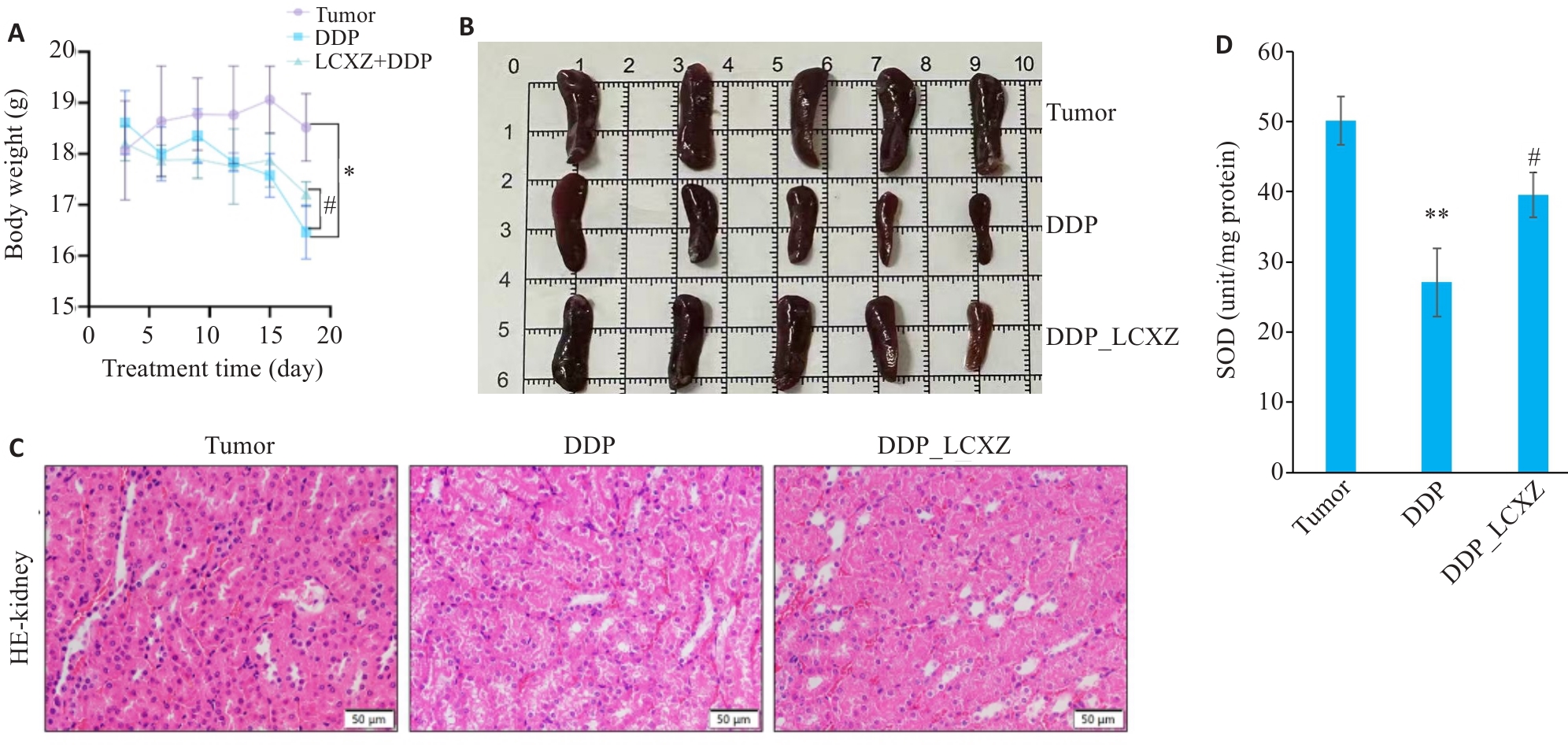
图3 理冲消癥颗粒缓解顺铂的毒性作用
Fig.3 LCXZ alleviates the toxic effect of cisplatin. A: Body weight changes of the tumor-bearing mice. B: Gross observation of the spleen of the mice. C: HE staining of renal tissues of the mice (×400). D: SOD content in the kidneys of the mice. *P<0.05, **P<0.01 vs Tumor group; #P<0.05 vs DDP group (n=8).
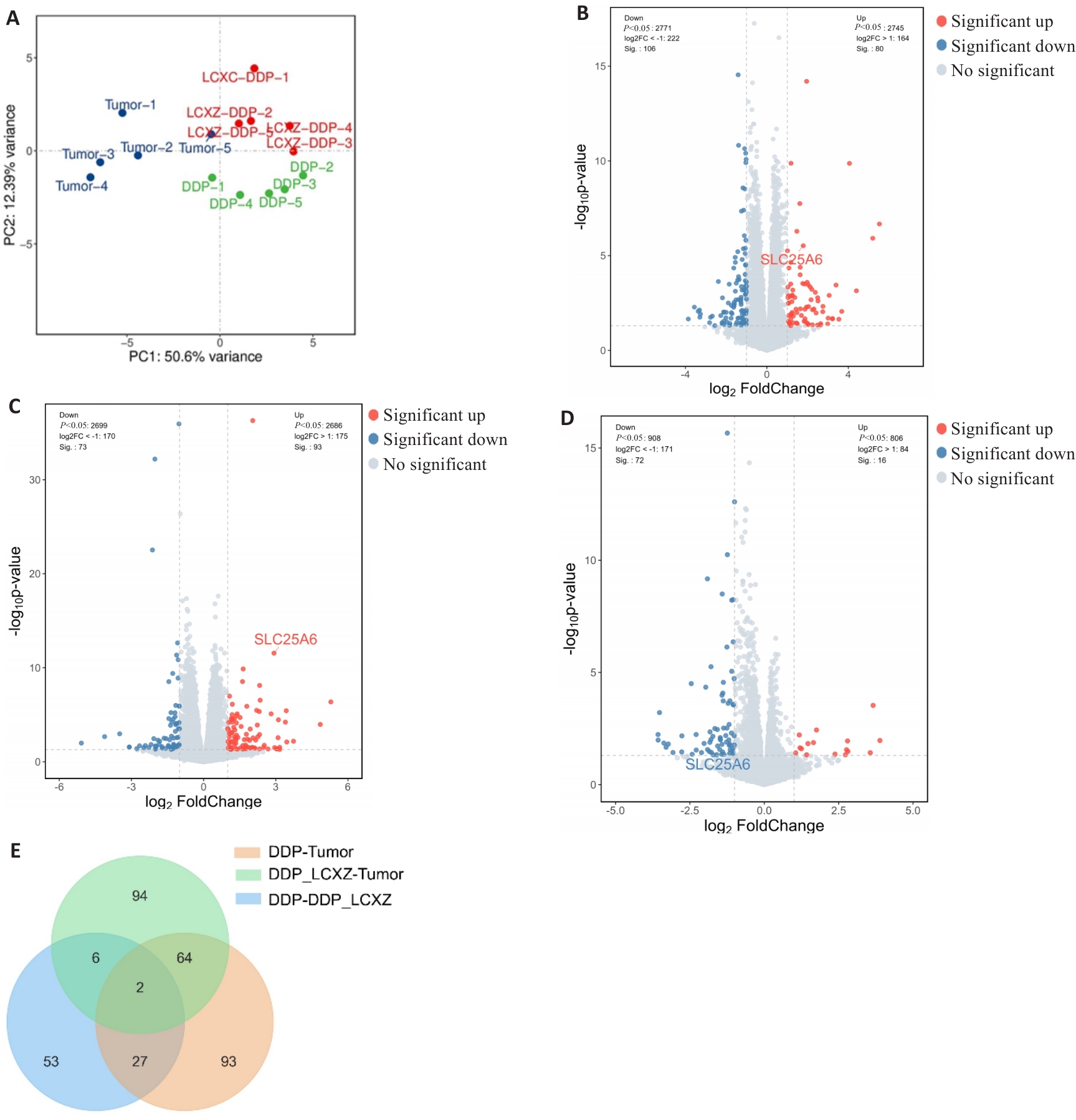
图4 理冲消癥颗粒协同顺铂治疗靶点的转录组学分析
Fig.4 Transcriptomic analysis of therapeutic targets of LCXZ combined with cisplatin. A: Principal component analysis. B: Volcano plot of the differential genes of DDP vs Tumor. C: Volcano plot of the differential genes of DDP_LCXZ vs Tumor. D: Volcano plot of the differential genes of DDP_LCXZ vs DDP. E: Venn diagram of the differential genes.
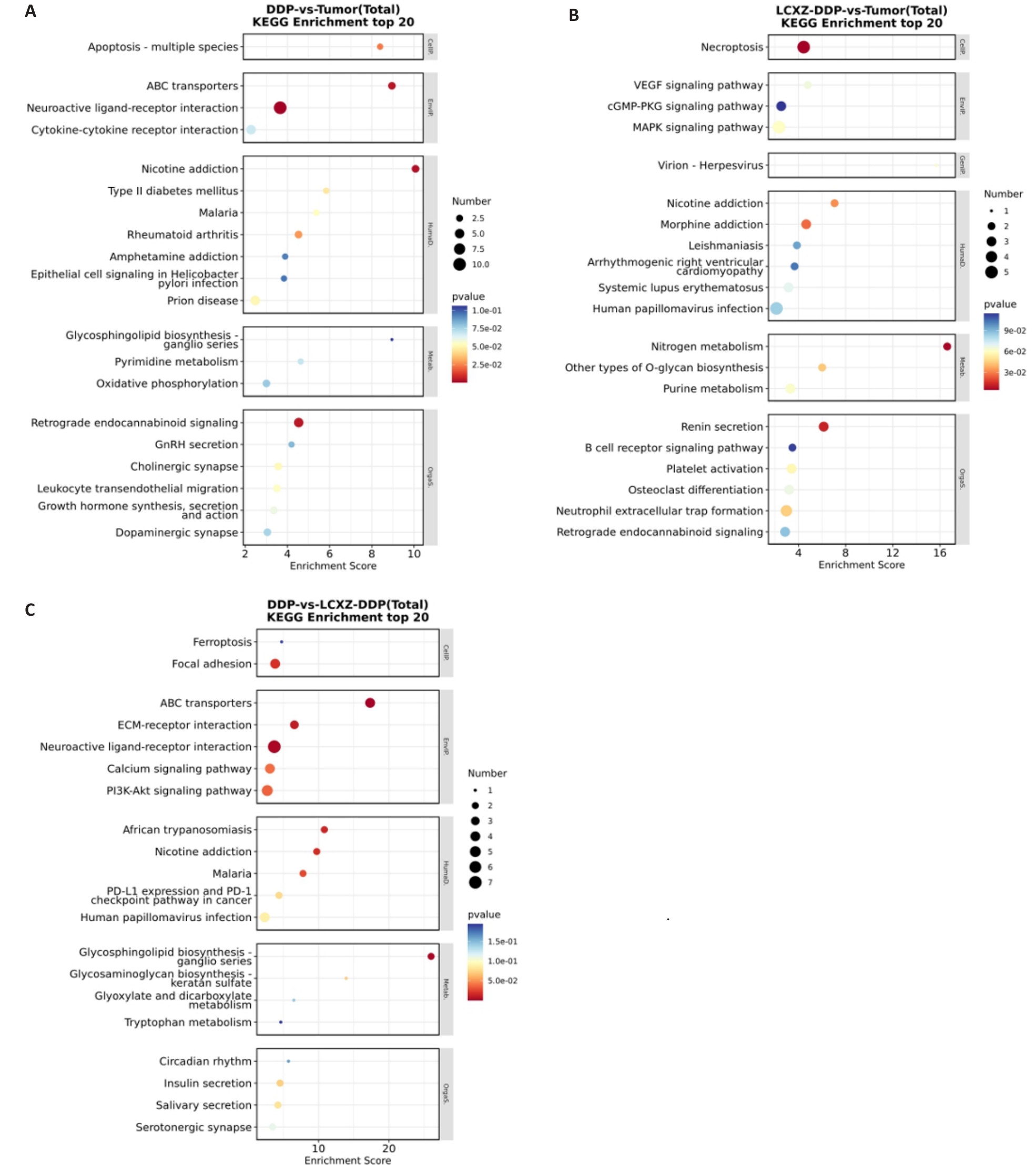
图5 理冲消癥颗粒协同顺铂治疗靶点的KEGG富集分析
Fig.5 KEGG enrichment analysis of the therapeutic targets of LCXZ combined with cisplatin. A: KEGG enrichment analysis of DDP vs Tumor. B: KEGG enrichment analysis of DDP_LCXZ vs Tumor. C: KEGG enrichment analysis of DDP_LCXZ vs DDP
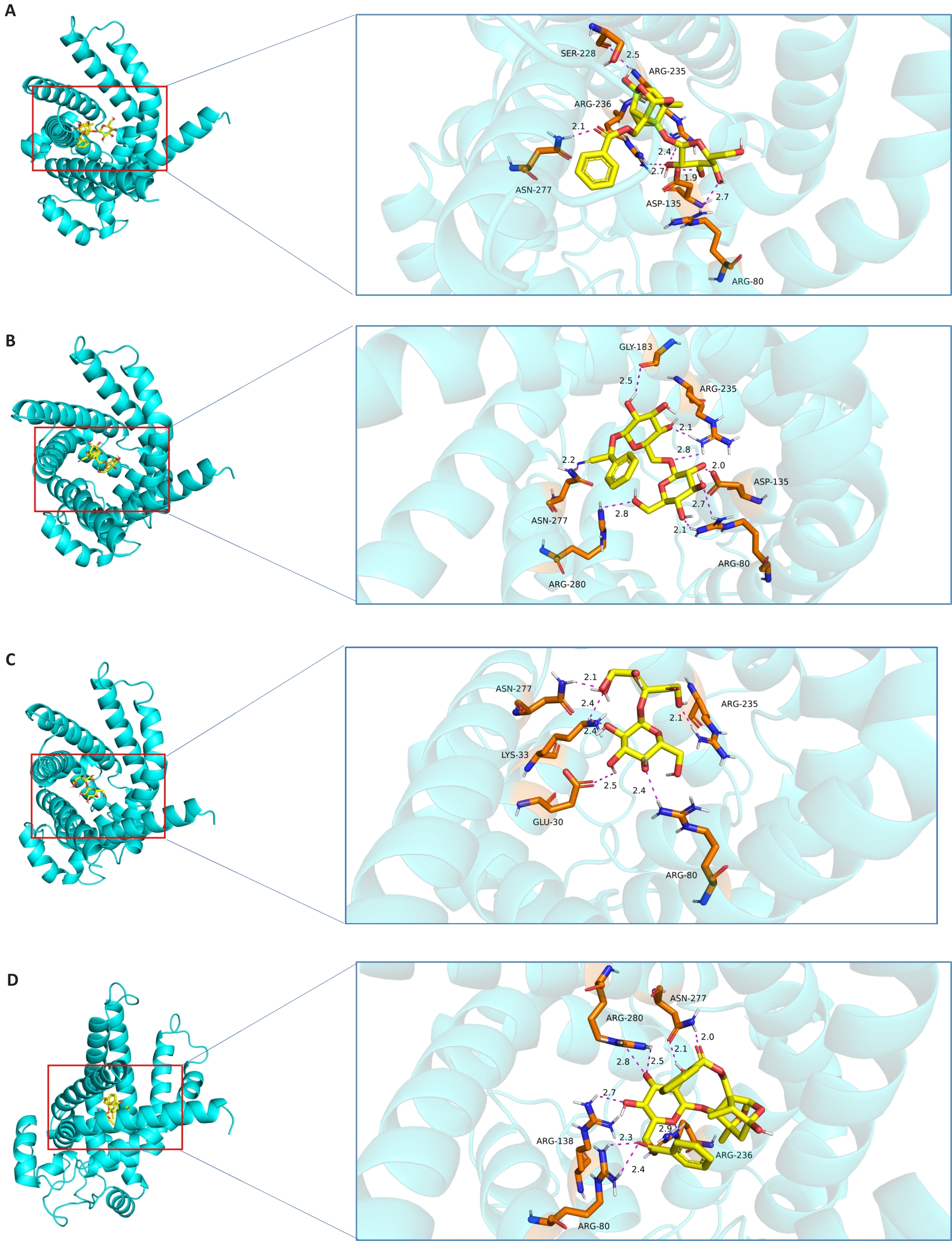
图6 理冲消癥颗粒主要成分的分子对接
Fig.6 Molecular docking of the main constituents of LCXZ. A: Paeoniflorin-ANT3 docking. B: L-amygdalin-ANT3 docking. C: Turanose-ANT3 docking. D: Benzoyl paeoniflorin-ANT3 docking.

图7 理冲消癥颗粒协同顺铂导致肿瘤细胞线粒体孔过度开放
Fig.7 LCXZ combined with cisplatin causes excessive opening of the mitochondrial pores in the tumor cells.( Left: scale bar=2 μm; Right: scale bar=1 μm. Labels: N:nucleus; M: mitochondria; ER:endoplasmic reticulum; ASS: autophagolysosomal structure).
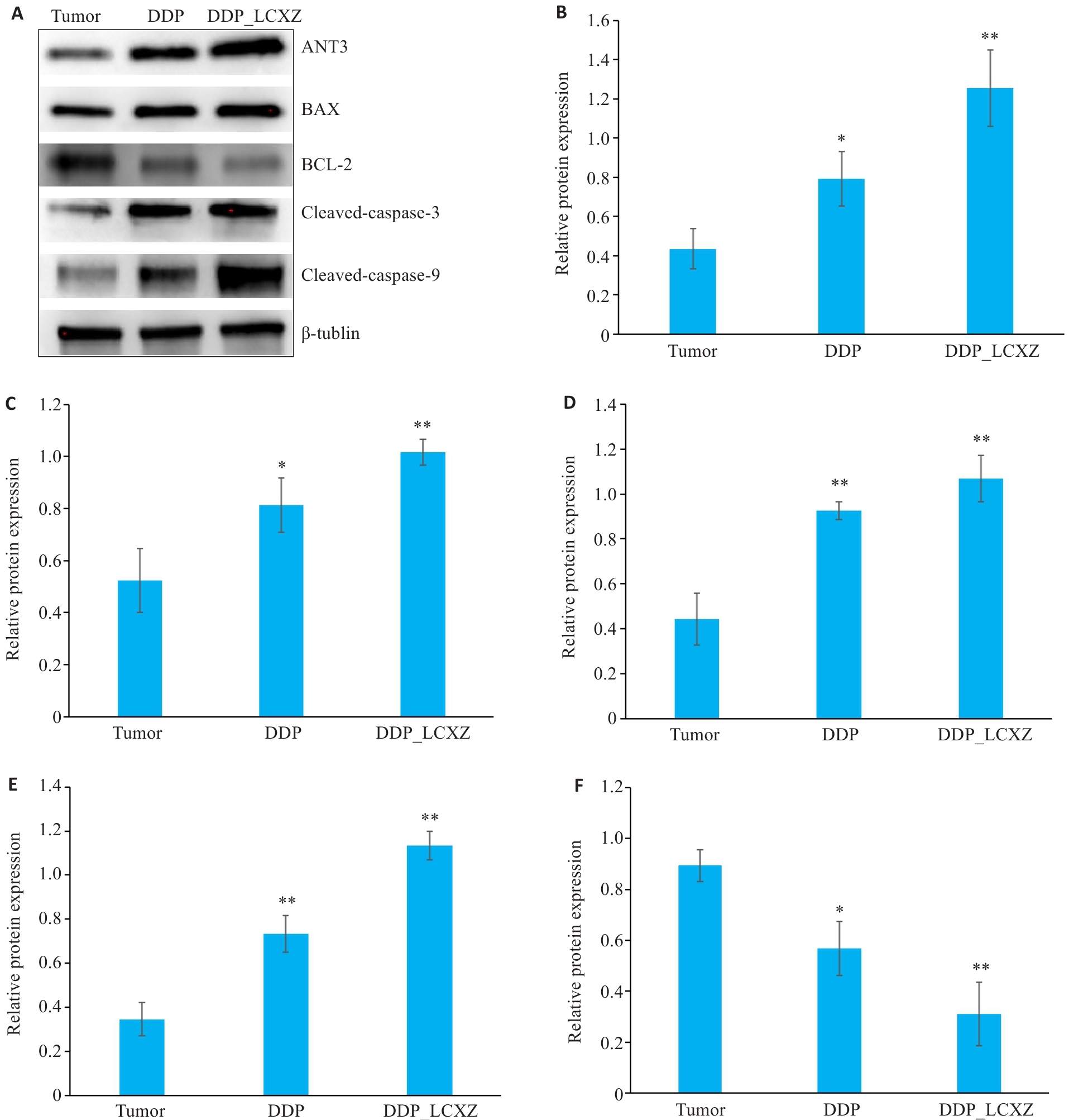
图8 理冲消癥颗粒介导的线粒体凋亡通路增敏顺铂
Fig.8 LCXZ -mediated mitochondrial apoptosis pathway sensitizes cisplatin. A: Representitative protein bands in Westen blotting. B-F: Relative protein expression levels of ANT3, BAX, cleaved caspase-3, cleaved caspase-9 and BCL-2, respectively. *P<0.05, **P<0.01 vs Tumor group (n=3).
| [1] | Sung H, Ferlay J, Siegel RL, et al. Global cancer statistics 2020: GLOBOCAN estimates of incidence and mortality worldwide for 36 cancers in 185 countries[J]. CA Cancer J Clin, 2021, 71(3): 209-49. doi:10.3322/caac.21660 |
| [2] | Chen WQ, Zheng RS, Baade PD, et al. Cancer statistics in China, 2015[J]. CA A Cancer J Clinicians, 2016, 66(2): 115-32. doi:10.3322/caac.21338 |
| [3] | Chen ZW, Shan JJ, Chen M, et al. Targeting GPX4 to induce ferroptosis overcomes chemoresistance mediated by the PAX8-AS1/GPX4 axis in intrahepatic cholangiocarcinoma[J]. Adv Sci (Weinh), 2025, 12(30): e01042. doi:10.1002/advs.202501042 |
| [4] | He ZK, Lian ZY, Wu JN, et al. PFKFB3 confers cisplatin resistance in gastric cancer by inhibiting ferroptosis through SLC7A11/xCT dephosphorylation[J]. Int Immunopharmacol, 2025, 159: 114914. doi:10.1016/j.intimp.2025.114914 |
| [5] | Dasari S, Tchounwou PB. Cisplatin in cancer therapy: molecular mechanisms of action[J]. Eur J Pharmacol, 2014, 740: 364-78. doi:10.1016/j.ejphar.2014.07.025 |
| [6] | Dibitetto D, Widmer CA, Rottenberg S. PARPi, BRCA, and gaps: controversies and future research[J]. Trends Cancer, 2024, 10(9): 857-69. doi:10.1016/j.trecan.2024.06.008 |
| [7] | Crocetto F, Ferro M, Buonerba C, et al. Comparing cardiovascular adverse events in cancer patients: a meta-analysis of combination therapy with angiogenesis inhibitors and immune checkpoint inhibitors versus angiogenesis inhibitors alone[J]. Crit Rev Oncol Hematol, 2023, 188: 104059. doi:10.1016/j.critrevonc.2023.104059 |
| [8] | Sahoo D, Deb P, Basu T, et al. Advancements in platinum-based anticancer drug development: a comprehensive review of strategies, discoveries, and future perspectives[J]. Bioorg Med Chem, 2024, 112: 117894. doi:10.1016/j.bmc.2024.117894 |
| [9] | Frigo E, Tommasin L, Lippe G, et al. The haves and have-nots: the mitochondrial permeability transition pore across species[J]. Cells, 2023, 12(10): 1409. doi:10.3390/cells12101409 |
| [10] | Shen X, Ma M, Mi R, et al. EFHD1 promotes osteosarcoma proliferation and drug resistance by inhibiting the opening of the mitochondrial membrane permeability transition pore (mPTP) by binding to ANT3[J]. Cell Mol Life Sci, 2024, 81(1): 236. doi:10.1007/s00018-024-05254-8 |
| [11] | Zhao L, Tang M, Bode AM, et al. ANTs and cancer: Emerging pathogenesis, mechanisms, and perspectives[J]. Biochim Biophys Acta BBA Rev Cancer, 2021, 1875(1): 188485. doi:10.1016/j.bbcan.2020.188485 |
| [12] | Ji XZ, Chu LJ, Su D, et al. MRPL12-ANT3 interaction involves in acute kidney injury via regulating MPTP of tubular epithelial cells[J]. iScience, 2023, 26(5): 106656. doi:10.1016/j.isci.2023.106656 |
| [13] | Zhang JY, Wang M, Wang RY, et al. Salvianolic acid A ameliorates arsenic trioxide-induced cardiotoxicity through decreasing cardiac mitochondrial injury and promotes its anticancer activity[J]. Front Pharmacol, 2018, 9: 487. doi:10.3389/fphar.2018.00487 |
| [14] | Feng AJ, Xu JK, Fu Y, et al. An integrative pharmacology-based study on the efficacy and mechanism of essential oil of Chaihu Guizhi Decoction on influenza A virus induced pneumonia in mice[J]. J Ethnopharmacol, 2025, 336: 118654. doi:10.1016/j.jep.2024.118654 |
| [15] | Wu L, Shen HY, Wu YZ, et al. Pharmacodynamics and potential synergistic effects of Mai-Luo-Ning injection on cardiovascular protection, based on molecular docking[J]. Chin J Nat Med, 2015, 13(11): 815-22. doi:10.1016/s1875-5364(15)30085-6 |
| [16] | 黎卓涵, 王艳萍, 蔡娱飞. 中医药治疗卵巢癌及并发症的优势分析[J]. 吉林中医药, 2022, 42(12): 1469-72. |
| [17] | Chen YL, Su R, Hu YG, et al. The active components and potential mechanisms of Li-Chong-Xiao-Zhen granules in the treatment of ovarian cancer: an integrated metabolomics, proteomics, network pharmacology and experimental validation[J]. J Ethnopharmacol, 2025, 343: 119474. doi:10.1016/j.jep.2025.119474 |
| [18] | Chen Y, Ma S, Pi D, et al. Luteolin induces pyroptosis in HT-29 cells by activating the Caspase1/Gasdermin D signalling pathway[J]. Front Pharmacol, 2022, 13: 952587. doi:10.3389/fphar.2022.952587 |
| [19] | Lheureux S, Braunstein M, Oza AM. Epithelial ovarian cancer: Evolution of management in the era of precision medicine[J]. CA Cancer J Clin, 2019, 69(4): 280-304. doi:10.3322/caac.21559 |
| [20] | Lai K, Chen Z, Lin S, et al. The IDH1-R132H mutation aggravates cisplatin-induced acute kidney injury by promoting ferroptosis through disrupting NDUFA1 and FSP1 interaction[J]. Cell Death Differ, 2025, 32(2): 242-55. doi:10.1038/s41418-024-01381-8 |
| [21] | Tang CY, Livingston MJ, Safirstein R, et al. Cisplatin nephrotoxicity: new insights and therapeutic implications[J]. Nat Rev Nephrol, 2023, 19(1): 53-72. doi:10.1038/s41581-022-00631-7 |
| [22] | Matulonis UA, Sood AK, Fallowfield L, et al. Ovarian cancer[J]. Nat Rev Dis Primers, 2016, 2: 16061. doi:10.1038/nrdp.2016.61 |
| [23] | Colombo N, Sessa C, du Bois A, et al. ESMO-ESGO consensus conference recommendations on ovarian cancer: pathology and molecular biology, early and advanced stages, borderline tumours and recurrent disease[J]. Ann Oncol, 2019, 30(5): 672-705. doi:10.1093/annonc/mdz062 |
| [24] | 杨才志, 黄仲羽, 林洁涛, 等. 林丽珠治疗卵巢癌用药规律探讨[J]. 广州中医药大学学报, 2019, 36(12): 2027-33. |
| [25] | 杨鹤年, 张津铖, 吴宿慧, 等. 中药配方颗粒制备工艺、质量评价、与传统汤剂一致性的研究现状分析[J]. 中国实验方剂学杂志, 2023, 29(8): 266-74. |
| [26] | Halestrap AP, Richardson AP. The mitochondrial permeability transition: a current perspective on its identity and role in ischaemia/reperfusion injury[J]. J Mol Cell Cardiol, 2015, 78: 129-41. doi:10.1016/j.yjmcc.2014.08.018 |
| [27] | Pan TH, Yang B, Yao S, et al. Exploring the multifaceted role of adenosine nucleotide translocase 2 in cellular and disease processes: a comprehensive review[J]. Life Sci, 2024, 351: 122802. doi:10.1016/j.lfs.2024.122802 |
| [28] | Liu G, Wang ZK, Wang ZY, et al. Mitochondrial permeability transition and its regulatory components are implicated in apoptosis of primary cultures of rat proximal tubular cells exposed to lead[J]. Arch Toxicol, 2016, 90(5): 1193-209. doi:10.1007/s00204-015-1547-0 |
| [29] | Kairys V, Baranauskiene L, Kazlauskiene M, et al. Recent advances in computational and experimental protein-ligand affinity determination techniques[J]. Expert Opin Drug Discov, 2024, 19(6): 649-70. doi:10.1080/17460441.2024.2349169 |
| [30] | Lai H, Wang LY, Qian RY, et al. Interformer: an interaction-aware model for protein-ligand docking and affinity prediction[J]. Nat Commun, 2024, 15: 10223. doi:10.1038/s41467-024-54440-6 |
| [31] | Genin EC, Plutino M, Bannwarth S, et al. CHCHD10 mutations promote loss of mitochondrial cristae junctions with impaired mitochondrial genome maintenance and inhibition of apoptosis[J]. EMBO Mol Med, 2016, 8(1): 58-72. doi:10.15252/emmm.201505496 |
| [32] | Martin-Solana E, Casado-Zueras L, Torres TE, et al. Disruption of the mitochondrial network in a mouse model of Huntington's disease visualized by in-tissue multiscale 3D electron microscopy[J]. Acta Neuropathol Commun, 2024, 12(1): 88. doi:10.1186/s40478-024-01802-2 |
| [33] | Li ZF, Feng JK, Zhao XC, et al. The extract of Pinellia ternata-induced apoptosis of leukemia cells by regulating the expression of bax, bcl-2 and caspase-3 protein expression in mice[J]. Transplant Proc, 2023, 55(9): 2232-40. doi:10.1016/j.transproceed.2023.08.015 |
| [1] | 郭晓娟, 杜瑞娟, 陈丽平, 郭克磊, 周彪, 卞华, 韩立. WW结构域E3泛素连接酶1调控卵巢癌肿瘤微环境中的免疫浸润[J]. 南方医科大学学报, 2025, 45(5): 1063-1073. |
| [2] | 卢梓涵, 黄方俊, 蔡光瑶, 刘继红, 甄鑫. 针对缺失实验室指标多约束表征学习的卵巢癌鉴别方法[J]. 南方医科大学学报, 2025, 45(1): 170-178. |
| [3] | 郭晓娟, 陈丽平, 吕 芹, 杜瑞娟, 罗 琴, 张 阳, 卞 华, 韩 立. 桂枝茯苓胶囊通过调控NF-κB通路抑制卵巢癌细胞的迁移和诱导卵巢癌细胞的凋亡[J]. 南方医科大学学报, 2023, 43(8): 1315-1321. |
| [4] | 张攀扬, 何明敏, 曾园媛, 蔡雄伟. 高级别浆液性卵巢癌复发相关的潜在功能性关键 miRNA-mRNA:基于生物信息学方法[J]. 南方医科大学学报, 2023, 43(1): 8-16. |
| [5] | 黄 珍, 沈浩明, 邓红玉, 孙丽莎, 屈 斌. MiR-125b-5p 抑制卵巢癌细胞的迁移和侵袭:基于靶向下调CD147的表达[J]. 南方医科大学学报, 2022, 42(9): 1389-1396. |
| [6] | 霍叶琳, 王 月, 安 娜, 杜 雪. TIM-3 基因在上皮性卵巢癌中高表达并促进癌细胞的增殖和迁移[J]. 南方医科大学学报, 2022, 42(2): 190-200. |
| [7] | 杨洁容, 陈小平. 类黑色素纳米颗粒联合近红外光照射具有良好的抗卵巢癌作用[J]. 南方医科大学学报, 2022, 42(11): 1681-1688. |
| [8] | 赵爱月, 苏云霞, 傅德强. MiR-4772通过调控卵巢癌免疫相关基因改变肿瘤免疫微环境[J]. 南方医科大学学报, 2022, 42(11): 1638-1645. |
| [9] | 黎权辉, 岑柏宏, 黄 文, 陈佳扬, 陈章浦, 庞建新, 付卫明, 贺 帅, 季爱民. 靶向卵巢癌细胞的miR-16/多肽纳米递释系统的制备及其功能验证[J]. 南方医科大学学报, 2021, 41(5): 736-746. |
| [10] | 刘 娟, 刘星辰, 魏宝宝, 刘 洁, 王悦华, 刘 辉. 稳定过表达XAF1基因对A2780卵巢癌细胞生物学功能的影响[J]. 南方医科大学学报, 2021, 41(5): 760-766. |
| [11] | 王 卉, 陈学平, 陈 运, 曹颖诗, 陈 瑶, 刘国炳, 黄莉萍. ENTPD5在上皮性卵巢癌组织中高表达:基于Oncomine数据库及生物信息学方法[J]. 南方医科大学学报, 2021, 41(4): 555-561. |
| [12] | 王莉洁, 韩 曦, 郑 霞, 周园园, 侯惠莲, 陈 葳, 李 旭, 赵 乐. 人参皂苷20(S)-Rg3通过抑制DNMT3A介导的启动子甲基化促进卵巢癌细胞中抑癌基因VHL的表达[J]. 南方医科大学学报, 2021, 41(1): 100-106. |
| [13] | 王丽华, 张 璇, 王亮亮, 王蓓蓓, 张 競, 李玉芝. IL-17A/IL-17RA通过上调自噬降低卵巢癌SKOV3细胞对顺铂敏感性[J]. 南方医科大学学报, 2020, 40(11): 1550-1556. |
| [14] | 陈 萱,黄静莹,吕育纯. STAT2在卵巢癌中表达升高并与卵巢癌患者生存不良有关[J]. 南方医科大学学报, 2020, 40(01): 34-41. |
| [15] | 梁军,邢慧敏,吴小华,张蕾,赵郡. 人卵巢癌SKOV3 细胞筛选获得的肿瘤干细胞样细胞在血管生成拟态形成中的作用[J]. 南方医科大学学报, 2019, 39(09): 1065-. |
| 阅读次数 | ||||||
|
全文 |
|
|||||
|
摘要 |
|
|||||
