
南方医科大学学报 ›› 2026, Vol. 46 ›› Issue (6): 1434-1443.doi: 10.12122/j.issn.1673-4254.2026.06.23
• • 上一篇
曾敏( ), 卓俐, 谭顺谦, 甄鑫()
收稿日期:2025-10-17
出版日期:2026-06-20
发布日期:2026-06-24
通讯作者:
甄鑫
E-mail:zm3198010172@i.smu.eud.cn;xinzhen@ smu.edu.cn
作者简介:曾 敏,在读硕士研究生,E-mail: zm3198010172@i.smu.eud.cn
基金资助:
Min ZENG(), Li ZHUO, Shunqian TAN, Xin ZHEN()
Received:2025-10-17
Online:2026-06-20
Published:2026-06-24
Contact:
Xin ZHEN
E-mail:zm3198010172@i.smu.eud.cn;xinzhen@ smu.edu.cn
Supported by:摘要:
目的 构建一种基于多约束潜在表征学习的双向特征映射肺炎鉴别分类模型,并验证其判别性能、可解释性及临床可行性。 方法 收集了2913名患者(1457名阳性和1456名阴性)的胸部X线(CXR)图像,并使用开源影像组学工具PyRadiomics从掩码中提取影像组学特征。使用本研究提出的基于多约束潜在表征学习的双向特征映射分类模型,将CXR的影像组学特征映射到潜在共享空间并建立分类模型。采用五折交叉验证方法和阳性预测值(PPV)、阴性预测值(NPV)、特异性(SPE)、灵敏度(SEN)、准确率(ACC)、ROC曲线下面积(AUC)评价该分类模型的鉴别性能。将本研究所提出的模型与其他特征分类模型对于肺炎的鉴别能力进行定量比较。决策曲线分析(DCA)和消融实验评估各约束模块的贡献。采用 SHAP 方法对影像组学特征的重要性进行解释,以提升模型的可解释性。本研究提出特征映射方法得到的低维潜在特征进行样本散点可视化实验,验证本研究所提出的特征映射分类模型的可行性和有效性。 结果 五折交叉验证结果显示本研究所提出的基于多约束表征学习的双向特征映射分类模型在鉴别肺炎中的PPV、NPV、SPE、SEN、ACC、AUC分别为0.796、0.830、0.784、0.838、0.811、0.893,决策曲线显示在临床可接受阈值内具有更高净受益,消融实验验证多约束模块的关键作用,SHAP 分析表明模型关注的特征具有医学合理性,且特征映射方法在可视化实验中具有优秀的表现。 结论 基于多约束潜在表征学习的双向特征映射分类模型在鉴别肺炎中的应用具有较强的鉴别能力和较高的应用价值。与其他分类模型相比,本研究提出的分类模型在肺炎的鉴别分类任务中具有较大的优势。
曾敏, 卓俐, 谭顺谦, 甄鑫. 基于多约束潜在表征学习的双向特征映射分类模型:肺炎鉴别诊断[J]. 南方医科大学学报, 2026, 46(6): 1434-1443.
Min ZENG, Li ZHUO, Shunqian TAN, Xin ZHEN. A bidirectional feature mapping classification model based on multi-constrained latent representation learning for differential diagnosis of pneumonia[J]. Journal of Southern Medical University, 2026, 46(6): 1434-1443.
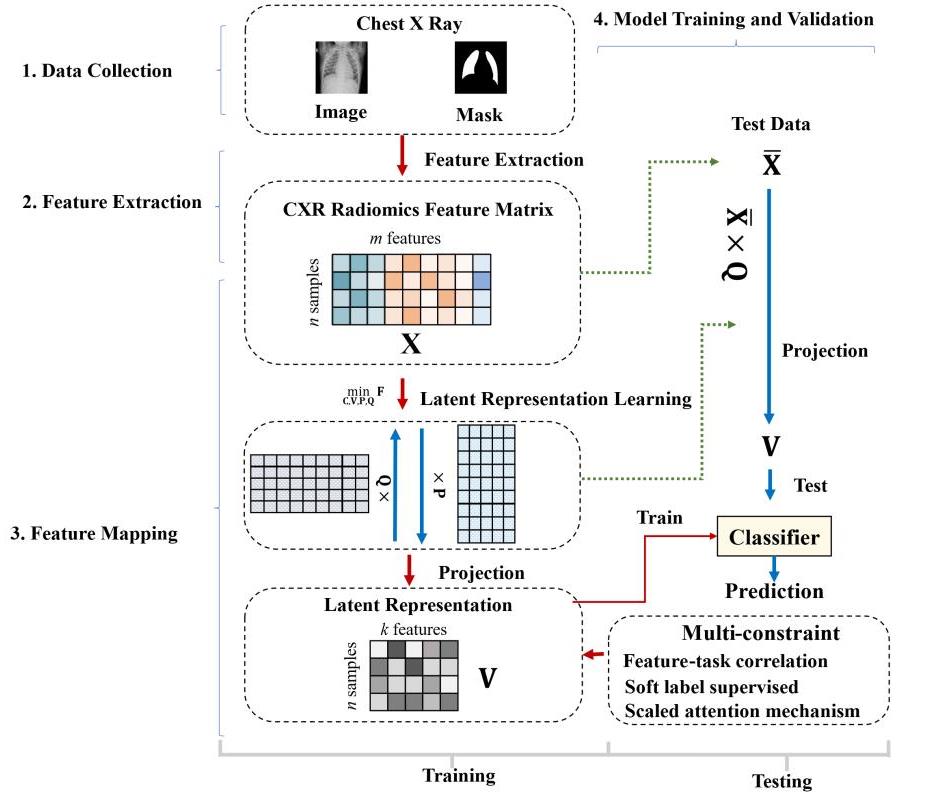
图1 基于多约束潜在表征学习的双向特征映射分类模型流程图
Fig.1 Framework of the feature mapping classification model based on multi-constrained latent representation learning.
| Types of radiomics features | Radiomics Features |
|---|---|
| First order features (n=19) | Energy, total energy, entropy minimum, 10th percentile, 90th percentile, maximum, mean, median, interquartile range, range, Mean Absolute Deviation (MAD), Robust Mean Absolute Deviation (rMAD), Root Mean Squared (RMS), Standard deviation, skewness, kurtosis, variance, uniformity |
| Shape features (n=10) | Elongation, major axis length, maximum diameter, mesh surface, minor axis length, perimeter, perimeter surface ratio, pixel surface, sphericity, spherical disproportion |
| Texture features (n=74) | 1GLCM (n=24), 2GLRLM (n=16), 3GLSZM (n=16), 4NGTDM (n=5), 5GLDM (n=14) |
表1 提取到的影像组学特征
Tab.1 Extracted radiomic features
| Types of radiomics features | Radiomics Features |
|---|---|
| First order features (n=19) | Energy, total energy, entropy minimum, 10th percentile, 90th percentile, maximum, mean, median, interquartile range, range, Mean Absolute Deviation (MAD), Robust Mean Absolute Deviation (rMAD), Root Mean Squared (RMS), Standard deviation, skewness, kurtosis, variance, uniformity |
| Shape features (n=10) | Elongation, major axis length, maximum diameter, mesh surface, minor axis length, perimeter, perimeter surface ratio, pixel surface, sphericity, spherical disproportion |
| Texture features (n=74) | 1GLCM (n=24), 2GLRLM (n=16), 3GLSZM (n=16), 4NGTDM (n=5), 5GLDM (n=14) |
Algorithm 1 Pseudocode of the Proposed Method |
|---|
Training stage Input: data feature matrix Output: projection Matrix for Data Representation Learning |
Begin Initialize For t to number of iterations do Update Update Update Update End End |
Testing stage Input: New test dataset Output: The projection of the new dataset onto the potential space obtain |
表2 特征映射算法伪代码
Tab.2 Pseudocode of the proposed feature mapping algorithm
Algorithm 1 Pseudocode of the Proposed Method |
|---|
Training stage Input: data feature matrix Output: projection Matrix for Data Representation Learning |
Begin Initialize For t to number of iterations do Update Update Update Update End End |
Testing stage Input: New test dataset Output: The projection of the new dataset onto the potential space obtain |
| Classifier | AUC | ACC | SEN | SPE | PPV | NPV |
|---|---|---|---|---|---|---|
| LDA | 0.881 | 0.800 | 0.780 | 0.820 | 0.814 | 0.789 |
| KNN | 0.854 | 0.779 | 0.729 | 0.828 | 0.811 | 0.754 |
| DecisionTree | 0.734 | 0.734 | 0.733 | 0.736 | 0.736 | 0.734 |
| SVM | 0.900 | 0.813 | 0.784 | 0.843 | 0.834 | 0.797 |
| RandomForest | 0.893 | 0.805 | 0.781 | 0.828 | 0.821 | 0.792 |
| XGBoost | 0.891 | 0.804 | 0.787 | 0.821 | 0.816 | 0.795 |
| MLP | 0.898 | 0.820 | 0.806 | 0.834 | 0.830 | 0.811 |
| ExtraTree | 0.893 | 0.811 | 0.838 | 0.784 | 0.796 | 0.830 |
表3 采用不同分类器的情况下模型的鉴别性能比较
Tab.3 Performance comparison of the model using different classifiers
| Classifier | AUC | ACC | SEN | SPE | PPV | NPV |
|---|---|---|---|---|---|---|
| LDA | 0.881 | 0.800 | 0.780 | 0.820 | 0.814 | 0.789 |
| KNN | 0.854 | 0.779 | 0.729 | 0.828 | 0.811 | 0.754 |
| DecisionTree | 0.734 | 0.734 | 0.733 | 0.736 | 0.736 | 0.734 |
| SVM | 0.900 | 0.813 | 0.784 | 0.843 | 0.834 | 0.797 |
| RandomForest | 0.893 | 0.805 | 0.781 | 0.828 | 0.821 | 0.792 |
| XGBoost | 0.891 | 0.804 | 0.787 | 0.821 | 0.816 | 0.795 |
| MLP | 0.898 | 0.820 | 0.806 | 0.834 | 0.830 | 0.811 |
| ExtraTree | 0.893 | 0.811 | 0.838 | 0.784 | 0.796 | 0.830 |
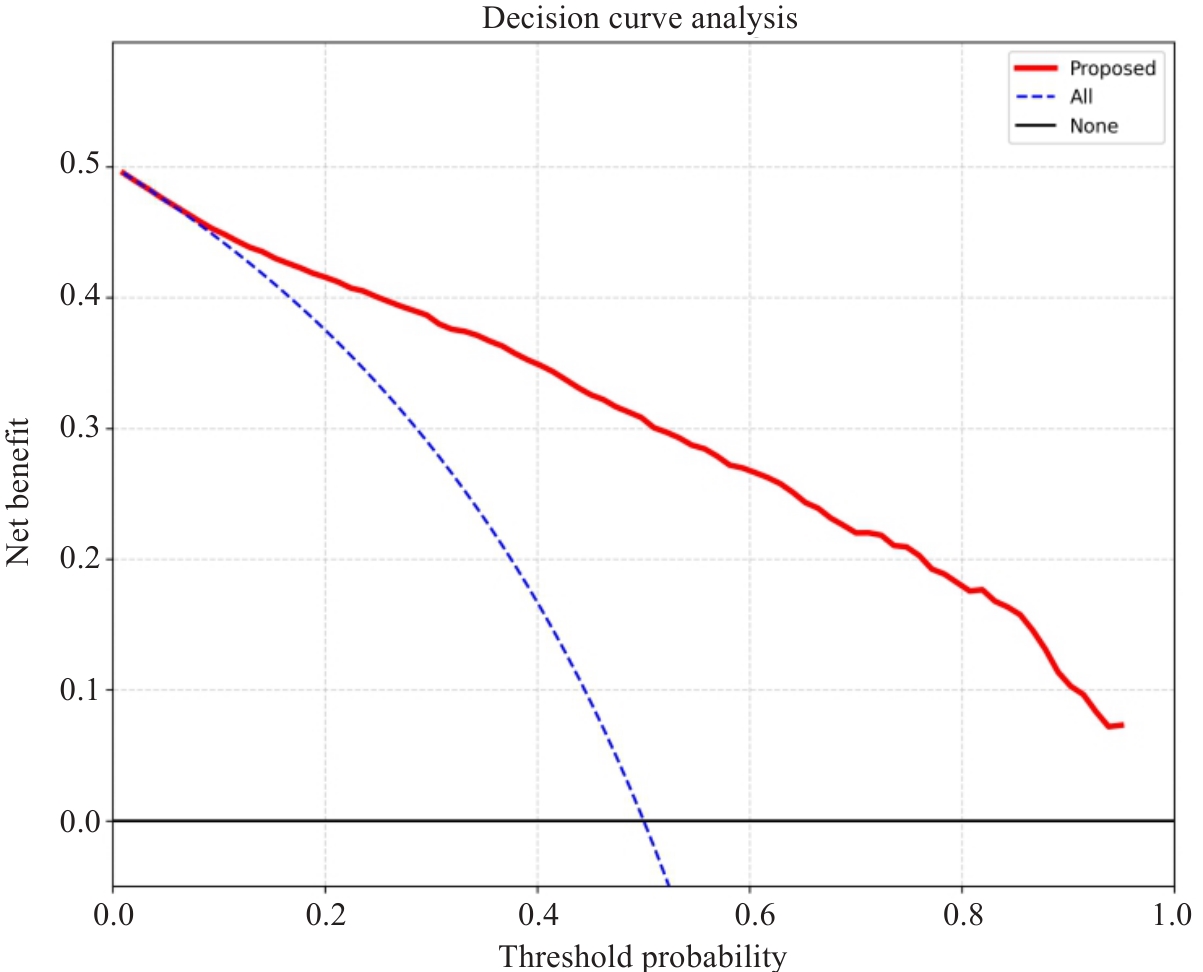
图2 极端随机树模型在肺炎分类任务中的决策曲线分析结果
Fig.2 Decision curve analysis of the Extra Trees model for pneumonia classification.
| Model | AUC | ACC | SEN | SPE | PPV | NPV |
|---|---|---|---|---|---|---|
| Basic Frame | 0.821 | 0.743 | 0.810 | 0.675 | 0.714 | 0.781 |
| 1w/o Scatter | 0.844 | 0.758 | 0.787 | 0.729 | 0.744 | 0.775 |
| w/o Soft | 0.864 | 0.780 | 0.832 | 0.728 | 0.755 | 0.812 |
| w/o Attention | 0.855 | 0.778 | 0.828 | 0.728 | 0.753 | 0.810 |
| Proposed | 0.893 | 0.811 | 0.838 | 0.784 | 0.796 | 0.830 |
表4 不同模块消融设置下模型分类性能比较
Tab.4 Comparison of classification performance of the model using different module ablation settings
| Model | AUC | ACC | SEN | SPE | PPV | NPV |
|---|---|---|---|---|---|---|
| Basic Frame | 0.821 | 0.743 | 0.810 | 0.675 | 0.714 | 0.781 |
| 1w/o Scatter | 0.844 | 0.758 | 0.787 | 0.729 | 0.744 | 0.775 |
| w/o Soft | 0.864 | 0.780 | 0.832 | 0.728 | 0.755 | 0.812 |
| w/o Attention | 0.855 | 0.778 | 0.828 | 0.728 | 0.753 | 0.810 |
| Proposed | 0.893 | 0.811 | 0.838 | 0.784 | 0.796 | 0.830 |
| Strategy | AUC | ACC | SEN | SPE | PPV | NPV |
|---|---|---|---|---|---|---|
| Baseline | 0.779 | 0.694 | 0.773 | 0.616 | 0.669 | 0.732 |
| Laplacian score | 0.738 | 0.681 | 0.728 | 0.633 | 0.666 | 0.701 |
| UDFS | 0.851 | 0.772 | 0.802 | 0.742 | 0.759 | 0.790 |
| CIFE | 0.839 | 0.758 | 0.807 | 0.709 | 0.735 | 0.787 |
| MIFS | 0.837 | 0.758 | 0.807 | 0.709 | 0.736 | 0.787 |
| mRMR | 0.838 | 0.760 | 0.810 | 0.710 | 0.737 | 0.790 |
| AutoEncoder | 0.876 | 0.791 | 0.816 | 0.765 | 0.778 | 0.807 |
| Isomap | 0.842 | 0.762 | 0.797 | 0.727 | 0.746 | 0.782 |
| Proposed method | 0.893 | 0.811 | 0.838 | 0.784 | 0.796 | 0.830 |
表5 基于多约束潜在表征学习的双向特征映射分类模型与其他模型在鉴别肺炎患者中的鉴别性能比较
Tab.5 Performance of the proposed bidirectional feature mapping classification model and other models for pneumonia discrimination
| Strategy | AUC | ACC | SEN | SPE | PPV | NPV |
|---|---|---|---|---|---|---|
| Baseline | 0.779 | 0.694 | 0.773 | 0.616 | 0.669 | 0.732 |
| Laplacian score | 0.738 | 0.681 | 0.728 | 0.633 | 0.666 | 0.701 |
| UDFS | 0.851 | 0.772 | 0.802 | 0.742 | 0.759 | 0.790 |
| CIFE | 0.839 | 0.758 | 0.807 | 0.709 | 0.735 | 0.787 |
| MIFS | 0.837 | 0.758 | 0.807 | 0.709 | 0.736 | 0.787 |
| mRMR | 0.838 | 0.760 | 0.810 | 0.710 | 0.737 | 0.790 |
| AutoEncoder | 0.876 | 0.791 | 0.816 | 0.765 | 0.778 | 0.807 |
| Isomap | 0.842 | 0.762 | 0.797 | 0.727 | 0.746 | 0.782 |
| Proposed method | 0.893 | 0.811 | 0.838 | 0.784 | 0.796 | 0.830 |
| Strategy | 1AUC-p | ACC-p | SEN-p | SPE-p | PPV-p | NPV-p |
|---|---|---|---|---|---|---|
| Baseline | 1.09E-05 | 2.58E-05 | 2.89E-04 | 2.89E-04 | 2.06E-05 | 1.61E-04 |
| Laplacian score | 3.38E-05 | 2.56E-04 | 2.76E-03 | 1.34E-04 | 1.60E-04 | 3.13E-02 |
| UDFS | 6.86E-03 | 2.41E-03 | 1.96E-02 | 1.28E-02 | 3.37E-03 | 8.33E-03 |
| CIFE | 2.06E-04 | 3.92E-04 | 1.74E-02 | 1.92E-03 | 1.28E-03 | 2.08E-03 |
| MIFS | 3.36E-04 | 1.13E-03 | 1.07E-02 | 1.97E-03 | 1.66E-03 | 3.04E-03 |
| mRMR | 1.80E-05 | 9.52E-04 | 3.19E-02 | 1.05E-03 | 9.09E-04 | 4.16E-03 |
| AutoEncoder | 3.20E-03 | 1.75E-02 | 1.68E-02 | 6.05E-02 | 2.72E-02 | 1.60E-02 |
| Isomap | 9.81E-05 | 1.97E-03 | 5.42E-03 | 5.19E-03 | 2.43E-03 | 2.86E-03 |
| Proposed method | - | - | - | - |
表6 基于多约束潜在表征学习的双向特征映射分类模型与其他模型在鉴别肺炎患者中的鉴别性能比较的显著性
Tab.6 Statistics for performance comparison between the proposed bidirectional feature mapping classification model and other models for pneumonia discrimination
| Strategy | 1AUC-p | ACC-p | SEN-p | SPE-p | PPV-p | NPV-p |
|---|---|---|---|---|---|---|
| Baseline | 1.09E-05 | 2.58E-05 | 2.89E-04 | 2.89E-04 | 2.06E-05 | 1.61E-04 |
| Laplacian score | 3.38E-05 | 2.56E-04 | 2.76E-03 | 1.34E-04 | 1.60E-04 | 3.13E-02 |
| UDFS | 6.86E-03 | 2.41E-03 | 1.96E-02 | 1.28E-02 | 3.37E-03 | 8.33E-03 |
| CIFE | 2.06E-04 | 3.92E-04 | 1.74E-02 | 1.92E-03 | 1.28E-03 | 2.08E-03 |
| MIFS | 3.36E-04 | 1.13E-03 | 1.07E-02 | 1.97E-03 | 1.66E-03 | 3.04E-03 |
| mRMR | 1.80E-05 | 9.52E-04 | 3.19E-02 | 1.05E-03 | 9.09E-04 | 4.16E-03 |
| AutoEncoder | 3.20E-03 | 1.75E-02 | 1.68E-02 | 6.05E-02 | 2.72E-02 | 1.60E-02 |
| Isomap | 9.81E-05 | 1.97E-03 | 5.42E-03 | 5.19E-03 | 2.43E-03 | 2.86E-03 |
| Proposed method | - | - | - | - |
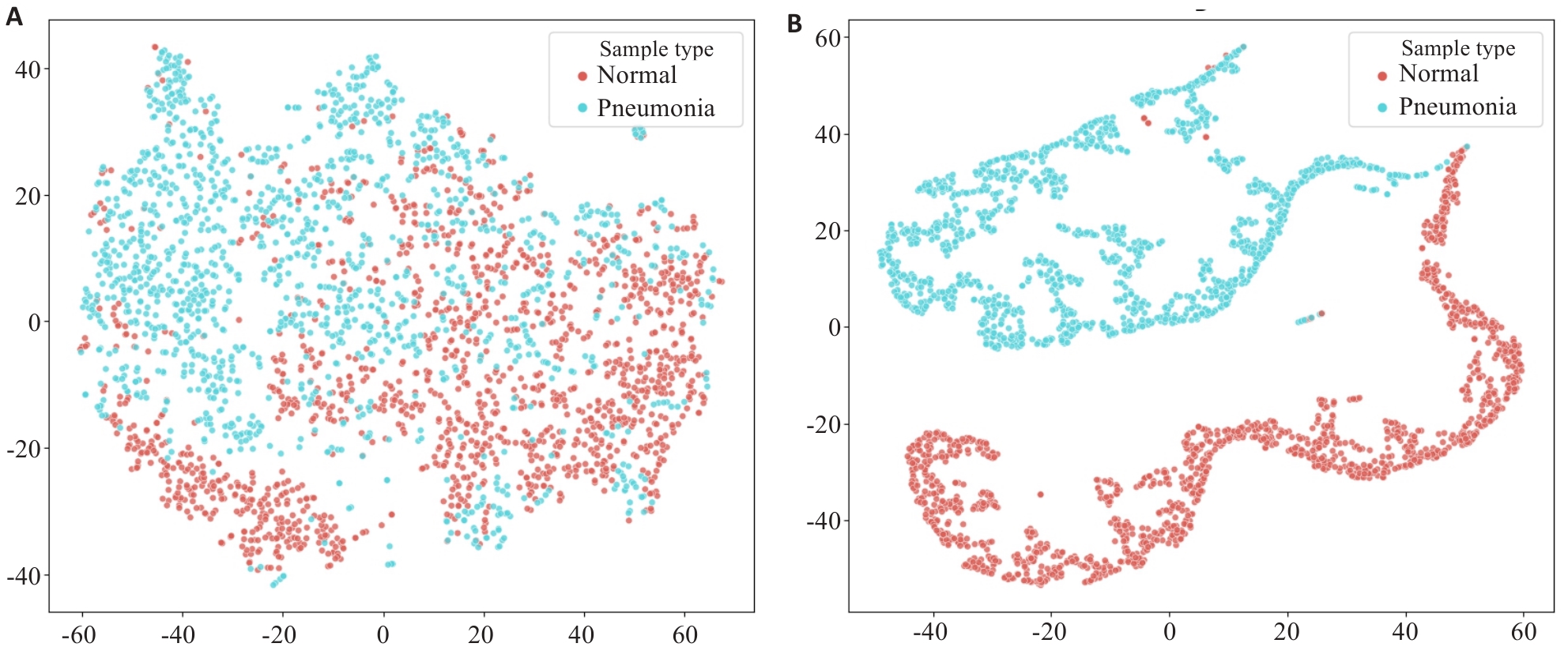
图3 原始特征(A)和潜在特征(B)样本散点可视化实验
Fig.3 Scatter plot visualization experiment of original features (A) and latent features (B) samples.
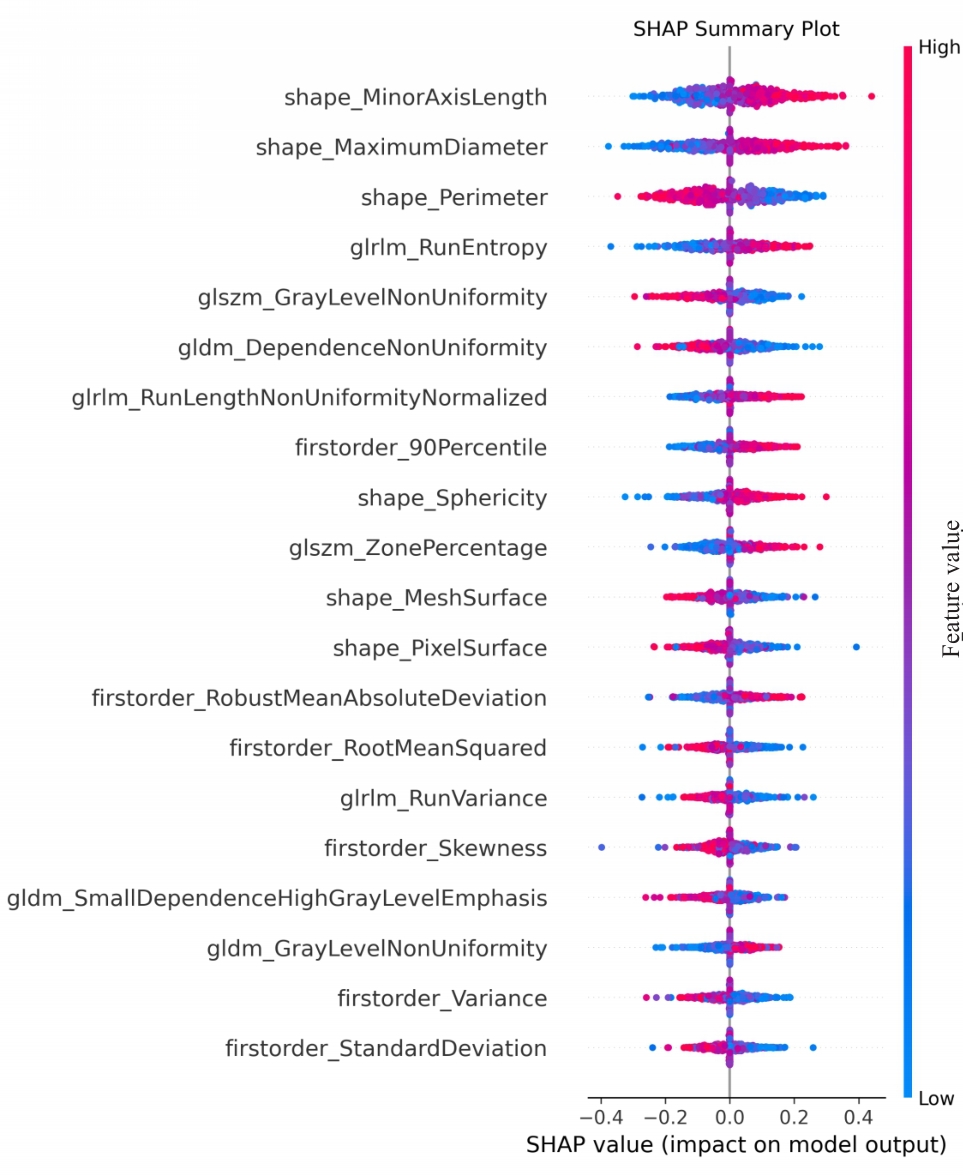
图4 模型的影像组学特征 SHAP 重要性分布图
Fig.4 SHAP summary plot of radiomic feature importance.
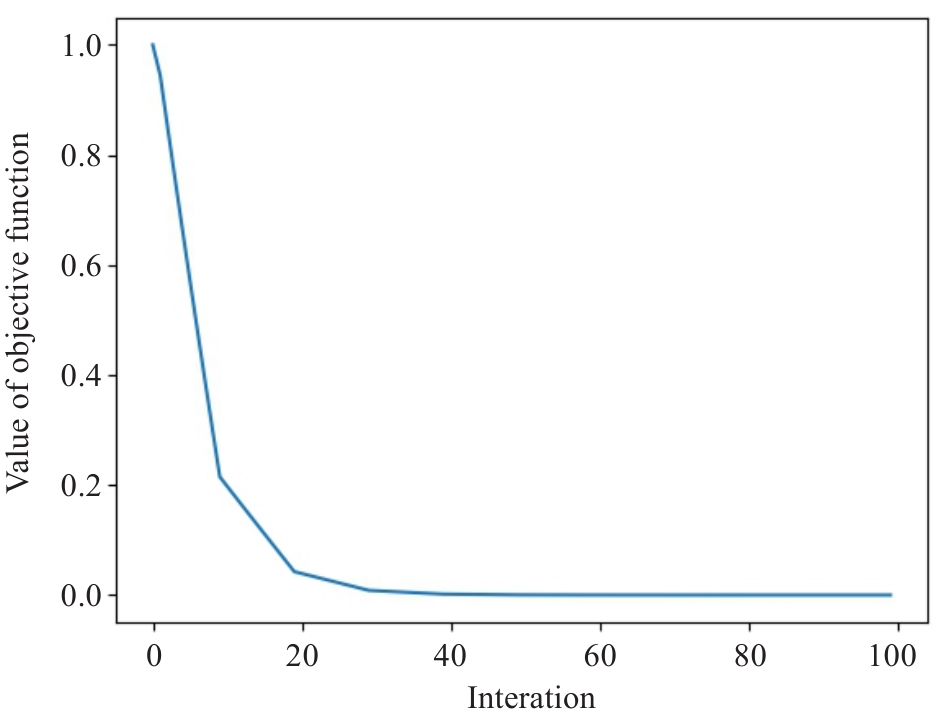
图5 所提方法在数据集上的收敛曲线
Fig.5 Convergence curve of the proposed method on a dataset.
| [1] | File TM Jr, Ramirez JA. Community-acquired pneumonia[J]. N Engl J Med, 2023, 389(7): 632-41. doi:10.1056/NEJMcp2303286 |
| [2] | de Benedictis FM, Kerem E, Chang AB, et al. Complicated pneumonia in children[J]. Lancet, 2020, 396(10253): 786-98. doi:10.1016/s0140-6736(20)31550-6 |
| [3] | Theilacker C, Sprenger R, Leverkus F, et al. Population-based incidence and mortality of community-acquired pneumonia in Germany[J]. PLoS One, 2021, 16(6): e0253118. doi:10.1371/journal.pone.0253118 |
| [4] | Rabbah J, Ridouani M, Hassouni L. Improving pneumonia diagnosis with high-accuracy CNN-Based chest X-ray image classification and integrated gradient[J]. Biomed Signal Process Control, 2025, 101: 107239. doi:10.1016/j.bspc.2024.107239 |
| [5] | Sharma S, Guleria K. A systematic literature review on deep learning approaches for pneumonia detection using chest X-ray images[J]. Multimed Tools Appl, 2024, 83(8): 24101-51. doi:10.1007/s11042-023-16419-1 |
| [6] | Koo HJ, Lim S, Choe J, et al. Radiographic and CT features of viral pneumonia[J]. Radiographics, 2018, 38(3): 719-39. doi:10.1148/rg.2018170048 |
| [7] | Fields BKK, Demirjian NL, Dadgar H, et al. Imaging of COVID-19: CT, mri, and pet[J]. Semin Nucl Med, 2021, 51(4): 312-20. doi:10.1053/j.semnuclmed.2020.11.003 |
| [8] | Syrjala H, Broas M, Ohtonen P, et al. Chest magnetic resonance imaging for pneumonia diagnosis in outpatients with lower respiratory tract infection[J]. Eur Respir J, 2017, 49(1): 1601303. doi:10.1183/13993003.01303-2016 |
| [9] | Li YY, Zhang ZY, Dai C, et al. Accuracy of deep learning for automated detection of pneumonia using chest X-Ray images: a systematic review and meta-analysis[J]. Comput Biol Med, 2020, 123: 103898. doi:10.1016/j.compbiomed.2020.103898 |
| [10] | Khan W, Zaki N, Ali L. Intelligent pneumonia identification from chest X-rays: a systematic literature review[J]. IEEE Access, 2021, 9: 51747-71. doi:10.1109/ACCESS.2021.3069937 |
| [11] | 李双双, 侯 震, 刘 娟, 等. 影像组学分析与建模工具综述[J]. 中国医学物理学杂志, 2018, 35(9): 1043-9. doi:10.3969/j.issn.1005-202X.2018.09.010 |
| [12] | Wang K, An Y, Zhou JC, et al. A novel Multi-Level feature selection method for radiomics[J]. Alex Eng J, 2023, 66: 993-9. doi:10.1016/j.aej.2022.10.069 |
| [13] | Horvat N, Papanikolaou N, Koh DM. Radiomics beyond the hype: a critical evaluation toward oncologic clinical use[J]. Radiol Artif Intell, 2024, 6(4): e230437. doi:10.1148/ryai.230437 |
| [14] | Lee E, Cao LD, Vishwa P, et al. Nimg-08. an integrated informatics model combining clinical factors, radiomics and a novel connectomics framework to distinguish pathologically-proven radionecrosis from progression in treated brain metastases[J]. Neuro Oncol, 2022, 24(): vii163. doi:10.1093/neuonc/noac209.627 |
| [15] | Ferretti M, Corino VDA. Integrating radiomic and 3D autoencoder-based features for Non-Small Cell Lung Cancer survival analysis[J]. Comput Methods Programs Biomed, 2025, 258: 108496. doi:10.1016/j.cmpb.2024.108496 |
| [16] | Choi W, Oh JH, Riyahi S, et al. Radiomics analysis of pulmonary nodules in low-dose CT for early detection of lung cancer[J]. Med Phys, 2018, 45(4): 1537-49. doi:10.1002/mp.12820 |
| [17] | Meng XC, Xia W, Xie PY, et al. Preoperative radiomic signature based on multiparametric magnetic resonance imaging for noninvasive evaluation of biological characteristics in rectal cancer[J]. Eur Radiol, 2019, 29(6): 3200-9. doi:10.1007/s00330-018-5763-x |
| [18] | Kong XY, He YM, Song ZH, et al. Deep probabilistic principal component analysis for process monitoring[J]. IEEE Trans Neural Netw Learn Syst, 2025, 36(4): 7422-36. doi:10.1109/tnnls.2024.3386890 |
| [19] | Wang LW, Tao SY, Zhu P, et al. Data-driven topology optimization with multiclass microstructures using latent variable Gaussian process[J]. J Mech Des, 2021, 143(3): 031708. doi:10.1115/1.4048628 |
| [20] | Goodfellow I, Pouget-Abadie J, Mirza M, et al. Generative adversarial networks[J]. Commun ACM, 2020, 63(11): 139-44. doi:10.1145/3422622 |
| [21] | Ning ZY, Du DH, Tu C, et al. Relation-aware shared representation learning for cancer prognosis analysis with auxiliary clinical variables and incomplete multi-modality data[J]. IEEE Trans Med Imaging, 2022, 41(1): 186-98. doi:10.1109/tmi.2021.3108802 |
| [22] | Ning ZY, Xiao Q, Feng QJ, et al. Relation-induced multi-modal shared representation learning for Alzheimer's disease diagnosis[J]. IEEE Trans Med Imaging, 2021, 40(6): 1632-45. doi:10.1109/tmi.2021.3063150 |
| [23] | Ning ZY, Lin ZH, Xiao Q, et al. Multi-constraint latent representation learning for prognosis analysis using multi-modal data[J]. IEEE Trans Neural Netw Learn Syst, 2023, 34(7): 3737-50. doi:10.1109/tnnls.2021.3112194 |
| [24] | Tahir AM, Chowdhury MEH, Qiblawey Y, et al. COVID-QU-Ex Dataset[DB/OL]. [2026-01-12]. . |
| [25] | van Griethuysen JJM, Fedorov A, Parmar C, et al. Computational radiomics system to decode the radiographic phenotype[J]. Cancer Res, 2017, 77(21): e104-7. doi:10.1158/0008-5472.can-17-0339 |
| [26] | Brown G, Pocock AC, Zhao MJ, et al. Conditional likelihood maximisation: a unifying framework for mutual information feature selection[J]. J Mach Learn Res, 2012, 13(1): 27-66. doi:10.1080/00207179.2012.669851 |
| [27] | Hoque N, Bhattacharyya DK, Kalita JK. MIFS-ND: a mutual information-based feature selection method[J]. Expert Syst Appl, 2014, 41(14): 6371-85. doi:10.1016/j.eswa.2014.04.019 |
| [28] | Wang R, Bian JT, Nie FP, et al. Unsupervised discriminative projection for feature selection[J]. IEEE Trans Knowl Data Eng, 2022, 34(2): 942-53. doi:10.1109/TKDE.2020.2983396 |
| [29] | Kavitha KR, Neeradha K, Athira, et al. Laplacian score and top scoring pair feature selection algorithms[C]//2020 Fourth International Conference on Computing Methodologies and Communication (ICCMC). March 11-13, 2020. Erode, India. IEEE, 2020: 214-9. doi:10.1109/ICCMC48092.2020.ICCMC-00041 |
| [30] | Wang YS, Yao HX, Zhao SC. Auto-encoder based dimensionality reduction[J]. Neurocomputing, 2016, 184: 232-42. doi:10.1016/j.neucom.2015.08.104 |
| [31] | Bugata P, Drotar P. On some aspects of minimum redundancy maximum relevance feature selection[J]. Sci China Inf Sci, 2019, 63(1): 112103. doi:10.1007/s11432-019-2633-y |
| [32] | Yousaf M, Rehman TU, Jing L. An extended isomap approach for nonlinear dimension reduction[J]. SN Comput Sci, 2020, 1(3): 160. doi:10.1007/s42979-020-00179-y |
| [33] | Cieslak MC, Castelfranco AM, Roncalli V, et al. T-Distributed Stochastic Neighbor Embedding (t-SNE): a tool for eco-physio-logical transcriptomic analysis[J]. Mar Genom, 2020, 51: 100723. doi:10.1016/j.margen.2019.100723 |
| [34] | Wang LJ, Mo TL, Wang XT, et al. A hierarchical fusion framework to integrate homogeneous and heterogeneous classifiers for medical decision-making[J]. Knowl Based Syst, 2021, 212: 106517. doi:10.1016/j.knosys.2020.106517 |
| [35] | He Q, Li X, Nathan Kim DW, et al. Feasibility study of a multi-criteria decision-making based hierarchical model for multi-modality feature and multi-classifier fusion: Applications in medical prognosis prediction[J]. Inf Fusion, 2020, 55: 207-19. doi:10.1016/j.inffus.2019.09.001 |
| [36] | Tayarani-Najaran MH. A novel ensemble machine learning and an evolutionary algorithm in modeling the COVID-19 epidemic and optimizing government policies[J]. IEEE Trans Syst Man Cybern Syst, 2022, 52(10): 6362-72. doi:10.1109/tsmc.2022.3143955 |
| [37] | Nan Y, Del Ser J, Walsh S, et al. Data harmonisation for information fusion in digital healthcare: a state-of-the-art systematic review, meta-analysis and future research directions[J]. Inf Fusion, 2022, 82: 99-122. doi:10.1016/j.inffus.2022.01.001 |
| [38] | Mattoli MV, Calcagni ML, Taralli S, et al. How often do we fail to classify the treatment response with [(18)F] FDG PET/CT acquired on different scanners? data from clinical oncological practice using an automatic tool for SUV harmonization[J]. Mol Imaging Biol, 2019, 21(6): 1210-9. doi:10.1007/s11307-019-01342-5 |
| [39] | Reuzé S, Orlhac F, Chargari C, et al. Prediction of cervical cancer recurrence using textural features extracted from 18F-FDG PET images acquired with different scanners[J]. Oncotarget, 2017, 8(26): 43169-79. doi:10.18632/oncotarget.17856 |
| [1] | 张明旭, 吴迪恒, 林嘉泽, 吕祎君, 周凌宏, 甄鑫, 周浩, 秦耿耿. 基于Transformer的影像与检验数据多模态预测模型在医院获得性感染的应用研究[J]. 南方医科大学学报, 2026, 46(6): 1423-1433. |
| [2] | 尹梦霞, 李蕊臣, 杨凯博, 焦伟杰, 刘新光. 利奈唑胺联用血必净通过抑制Hla-NLRP3通路减轻MRSA肺炎小鼠的炎症损伤[J]. 南方医科大学学报, 2026, 46(2): 412-422. |
| [3] | 崔运能, 冯敏清, 姚亮凤, 严杰文, 李闻瀚, 黄燕平. 基于欠采样的影像组学机器学习模型术前预测子宫肌瘤高强度聚焦超声消融效果[J]. 南方医科大学学报, 2026, 46(1): 141-149. |
| [4] | 黄启智, 谢戴鹏, 姚霖彤, 李洽轩, 吴少伟, 周海榆. 肿瘤微环境特异性CT影像组学标签预测非小细胞肺癌免疫治疗疗效[J]. 南方医科大学学报, 2025, 45(9): 1903-1918. |
| [5] | 李国永, 黎仁玲, 刘艺婷, 柯宏霞, 李菁, 王新华. 牛蒡子治疗小鼠病毒性肺炎后肺纤维化的机制:基于代谢组学、网络药理学和实验验证方法[J]. 南方医科大学学报, 2025, 45(6): 1185-1199. |
| [6] | 李泽涵, 梁萌, 韩根成, 张学武. 菊淀粉型巴戟天寡糖降低肺炎链球菌脑膜炎小鼠的症状评分和死亡率[J]. 南方医科大学学报, 2025, 45(3): 577-586. |
| [7] | 李欣洋, 许桂晓, 刘洁宏, 冯衍秋. 人工智能辅助压缩感知加速技术对鼻咽癌MRI影像组学特征提取及分期诊断模型性能的影响[J]. 南方医科大学学报, 2025, 45(11): 2518-2526. |
| [8] | 卢梓涵, 黄方俊, 蔡光瑶, 刘继红, 甄鑫. 针对缺失实验室指标多约束表征学习的卵巢癌鉴别方法[J]. 南方医科大学学报, 2025, 45(1): 170-178. |
| [9] | 吴垂杏, 钟伟雄, 谢金城, 杨蕊梦, 吴元魁, 许乙凯, 王琳婧, 甄鑫. 基于序列缺失的MRI多序列特征填补与融合互助模型:鉴别高低级别胶质瘤[J]. 南方医科大学学报, 2024, 44(8): 1561-1570. |
| [10] | 苑通, 郭玉莹, 张俊伶, 樊赛军. 正常小鼠血清通过抑制focal adhesion信号通路减轻小鼠放射性肺炎[J]. 南方医科大学学报, 2024, 44(5): 801-809. |
| [11] | 王 慧, 姜晓宇, 李飞雨. 肺炎克雷伯菌钼酸盐转运体modA基因缺失株的构建及其生物学特性[J]. 南方医科大学学报, 2024, 44(4): 748-756. |
| [12] | 谢继臣, 马仁惠, 李默然, 李 蓓, 熊莉娜. 肠道硝酸盐对肺炎克雷伯菌生长的影响及其调控机制[J]. 南方医科大学学报, 2024, 44(4): 757-764. |
| [13] | 刘云泽, 李宬润, 郭俊唐, 刘 阳. 基于临床-影像组学列线图模型鉴别局灶性机化性肺炎与肺腺癌[J]. 南方医科大学学报, 2024, 44(2): 397-404. |
| [14] | 苏晓玲, 廖道庸, 李超, 陈丽, 王婧芸, 甘甜, 罗浩荡, 伍宁, 何军. 唾液链球菌K12对肺炎支原体感染小鼠的预防作用[J]. 南方医科大学学报, 2024, 44(12): 2300-2307. |
| [15] | 黄晓茵, 陈凤莲, 张煜, 梁淑君. 多参数多区域MRI影像组学特征与临床信息联合模型可有效预测脑胶质瘤患者生存期[J]. 南方医科大学学报, 2024, 44(10): 2004-2014. |
| 阅读次数 | ||||||
|
全文 |
|
|||||
|
摘要 |
|
|||||
