
南方医科大学学报 ›› 2026, Vol. 46 ›› Issue (10): 2518-2535.doi: 10.12122/j.issn.1673-4254.2026.10.20
• • 上一篇
张佳娜1,2,4,5,6( ), 张霞2, 黄伟轩2, 叶丹丹2, 黄卓文2, 黄锦豪2, 翁晓雅2, 彭林3, 戴卫波3(), 黄晓其2()
收稿日期:2026-04-16
出版日期:2026-10-20
发布日期:2026-10-26
通讯作者:
戴卫波,黄晓其
E-mail:2440585936@qq.com;daiweibo007@163.com;huangxiaoqi@gzucm.edu.cn
作者简介:张佳娜,硕士,E-mail: 2440585936@qq.com
基金资助:
Jiana ZHANG1,2,4,5,6(), Xia ZHANG2, Weixuan HUANG2, Dandan YE2, Zhuowen HUANG2, Jinhao HUANG2, Xiaoya WENG2, Lin PENG3, Weibo DAI3(), Xiaoqi HUANG2()
Received:2026-04-16
Online:2026-10-20
Published:2026-10-26
Contact:
Weibo DAI, Xiaoqi HUANG
E-mail:2440585936@qq.com;daiweibo007@163.com;huangxiaoqi@gzucm.edu.cn
摘要:
目的 研究白头翁汤市售配方颗粒(FG)与标准汤剂(SD)的化学成分种类、含量及对DSS诱导的溃疡性结肠炎(UC)小鼠药效的一致性,为该配方颗粒的临床应用提供参考。 方法 通过超高效液相色谱-傅里叶变换静电场轨道阱高分辨质谱(UHPLC-Orbitrap HRMS)分析技术,结合mzCloud数据库、文献比对及对照品验证,对二者化学成分大致组成进行初步对比,并鉴定其主要化学成分;采用高效液相色谱技术建立白头翁汤指纹图谱和测定指标成分含量的液相色谱方法,以共有峰数量与总面积、指纹图谱相似度、出膏率、指标成分含量为评价指标,分析FG与SD的化学成分一致性;同时,将雄性Balb/c小鼠随机分为9组,每组8只:正常对照组,模型组,阳性药组(5-ASA,200 mg/kg),标准汤剂低、中、高剂量组(SDL,5 g/kg;SDM,10 g/kg;SDH,15 g/kg),配方颗粒低、中、高剂量组(FGL,5 g/kg;FGM,10 g/kg;FGH,15 g/kg)。各组自由饮食,除正常对照组自由饮用无菌水外,其余各组小鼠自由饮用3% DSS溶液,持续7 d以建立DSS诱导UC小鼠模型。通过评估小鼠宏观体征、结肠组织病理学、血清炎性因子水平及肠道黏膜屏障相关蛋白表达,综合评价二者药效。 结果 化学成分分析显示,FG和SD在正、负离子模式下的色谱峰数量、保留时间基本吻合,仅部分色谱峰的响应强度存在差异,共鉴定出39个主要成分;FG与SD指纹图谱共有峰种类与数目一致,相似度>0.99;FG共有峰总面积显著提高的相对比值分别为1.24、1.34、1.20,显著高于SD(P<0.05);FG的出膏率均值(18.09%)显著高于SD(13.71%);FG中白头翁皂苷B5、药根碱的含量显著高于SD(P<0.05),而黄柏内酯含量显著低于SD(P<0.05),其余10个指标成分二者无明显差异。药效学结果显示,FG与SD均能显著改善DSS诱导UC小鼠的宏观体征,修复结肠组织结构,提高抗炎因子水平,同时显著降低促炎因子水平以及提高黏膜屏障蛋白的表达,且两者药效差异无统计学意义。 结论 白头翁汤标准汤剂与配方颗粒在化学成分组成上基本一致,仅存在个别化学成分含量差异,且二者在改善DSS诱导的溃疡性结肠炎小鼠症状中表现出生物等效性。
张佳娜, 张霞, 黄伟轩, 叶丹丹, 黄卓文, 黄锦豪, 翁晓雅, 彭林, 戴卫波, 黄晓其. 白头翁汤配方颗粒与标准汤剂化学成分基本一致且对溃疡性结肠炎小鼠具有生物等效性[J]. 南方医科大学学报, 2026, 46(10): 2518-2535.
Jiana ZHANG, Xia ZHANG, Weixuan HUANG, Dandan YE, Zhuowen HUANG, Jinhao HUANG, Xiaoya WENG, Lin PENG, Weibo DAI, Xiaoqi HUANG. Comparison of Pulsatilla decoction formula granules versus its standard decoction for consistency of chemical components and bioequivalence in mice with ulcerative colitis[J]. Journal of Southern Medical University, 2026, 46(10): 2518-2535.
| Sample no. | Pulsatillae radix | Coptidis rhizoma | Phellodendri Chinensis cortex | Fraxini cortex |
|---|---|---|---|---|
| S1 | Henan (2403001) | Chongqing (20240301H01) | Sichuan (20240301H01) | Henan (2403006) |
| S2 | Henan (2403002) | Chongqing (240601) | Sichuan (230801) | Henan (2403007) |
| S3 | Henan (2403003) | Chongqing (20240701) | Sichuan (230201) | Henan (2403008) |
| S4 | Henan (2403004) | Chongqing (2408015151) | Sichuan (20240727) | Henan (2403009) |
| S5 | Jilin (240302281) | Chongqing (2408015152) | Sichuan (20240728) | Henan (2403010) |
| S6 | Liaoning (20240301B01) | Sichuan (230201) | Sichuan (20240729) | Henan (240101) |
| S7 | Liaoning (20240801) | Sichuan (231201841) | Sichuan (20240730) | Shaanxi (20240301Q01) |
| S8 | Liaoning (20240802) | Sichuan (231201) | Sichuan (20240811) | Shaanxi (20240801) |
| S9 | Liaoning (20240803) | Hebei (2408015151) | Sichuan (20240812) | Shaanxi (20240802) |
| S10 | Liaoning (20240804) | Hebei (2408015152) | Hubei (231002) | Shaanxi (20240803) |
| S11 | Hebei (20231001) | Hebei (2408015153) | Hubei (2407012391) | Shaanxi (20240804) |
| S12 | Inner Mongolia (2306001) | Hebei (2408015154) | Hubei (2407012392) | Sichuan (20231101) |
| S13 | Inner Mongolia (220801) | Hebei (2408015155) | Hubei (2407012393) | Jilin (220201) |
| S14 | Inner mongolia (230901) | Sichuan (240401) | Hunan (20240811) | Jilin (211001) |
| S15 | Jilin (230900211) | Sichuan (2306089) | Hunan (20240812) | Jilin (240601) |
表1 中药饮片产地信息
Tab.1 Origin information of decoction pieces of the Chinese Materia Medica
| Sample no. | Pulsatillae radix | Coptidis rhizoma | Phellodendri Chinensis cortex | Fraxini cortex |
|---|---|---|---|---|
| S1 | Henan (2403001) | Chongqing (20240301H01) | Sichuan (20240301H01) | Henan (2403006) |
| S2 | Henan (2403002) | Chongqing (240601) | Sichuan (230801) | Henan (2403007) |
| S3 | Henan (2403003) | Chongqing (20240701) | Sichuan (230201) | Henan (2403008) |
| S4 | Henan (2403004) | Chongqing (2408015151) | Sichuan (20240727) | Henan (2403009) |
| S5 | Jilin (240302281) | Chongqing (2408015152) | Sichuan (20240728) | Henan (2403010) |
| S6 | Liaoning (20240301B01) | Sichuan (230201) | Sichuan (20240729) | Henan (240101) |
| S7 | Liaoning (20240801) | Sichuan (231201841) | Sichuan (20240730) | Shaanxi (20240301Q01) |
| S8 | Liaoning (20240802) | Sichuan (231201) | Sichuan (20240811) | Shaanxi (20240801) |
| S9 | Liaoning (20240803) | Hebei (2408015151) | Sichuan (20240812) | Shaanxi (20240802) |
| S10 | Liaoning (20240804) | Hebei (2408015152) | Hubei (231002) | Shaanxi (20240803) |
| S11 | Hebei (20231001) | Hebei (2408015153) | Hubei (2407012391) | Shaanxi (20240804) |
| S12 | Inner Mongolia (2306001) | Hebei (2408015154) | Hubei (2407012392) | Sichuan (20231101) |
| S13 | Inner Mongolia (220801) | Hebei (2408015155) | Hubei (2407012393) | Jilin (220201) |
| S14 | Inner mongolia (230901) | Sichuan (240401) | Hunan (20240811) | Jilin (211001) |
| S15 | Jilin (230900211) | Sichuan (2306089) | Hunan (20240812) | Jilin (240601) |
| Sample No. | Pulsatillae radix | Coptidis rhizoma | Phellodendri Chinensis cortex | Fraxini cortex |
|---|---|---|---|---|
| S16 | A304A923 | A301A443 | A302A393 | A211B013 |
| S17 | AB4BA391 | AB4B0191 | AB47L182 | AB4BA871 |
| S18 | A2045681 | A3122301 | AB481031 | A211B011 |
表2 配方颗粒批号信息
Tab.2 Batch number information of the formula granules
| Sample No. | Pulsatillae radix | Coptidis rhizoma | Phellodendri Chinensis cortex | Fraxini cortex |
|---|---|---|---|---|
| S16 | A304A923 | A301A443 | A302A393 | A211B013 |
| S17 | AB4BA391 | AB4B0191 | AB47L182 | AB4BA871 |
| S18 | A2045681 | A3122301 | AB481031 | A211B011 |
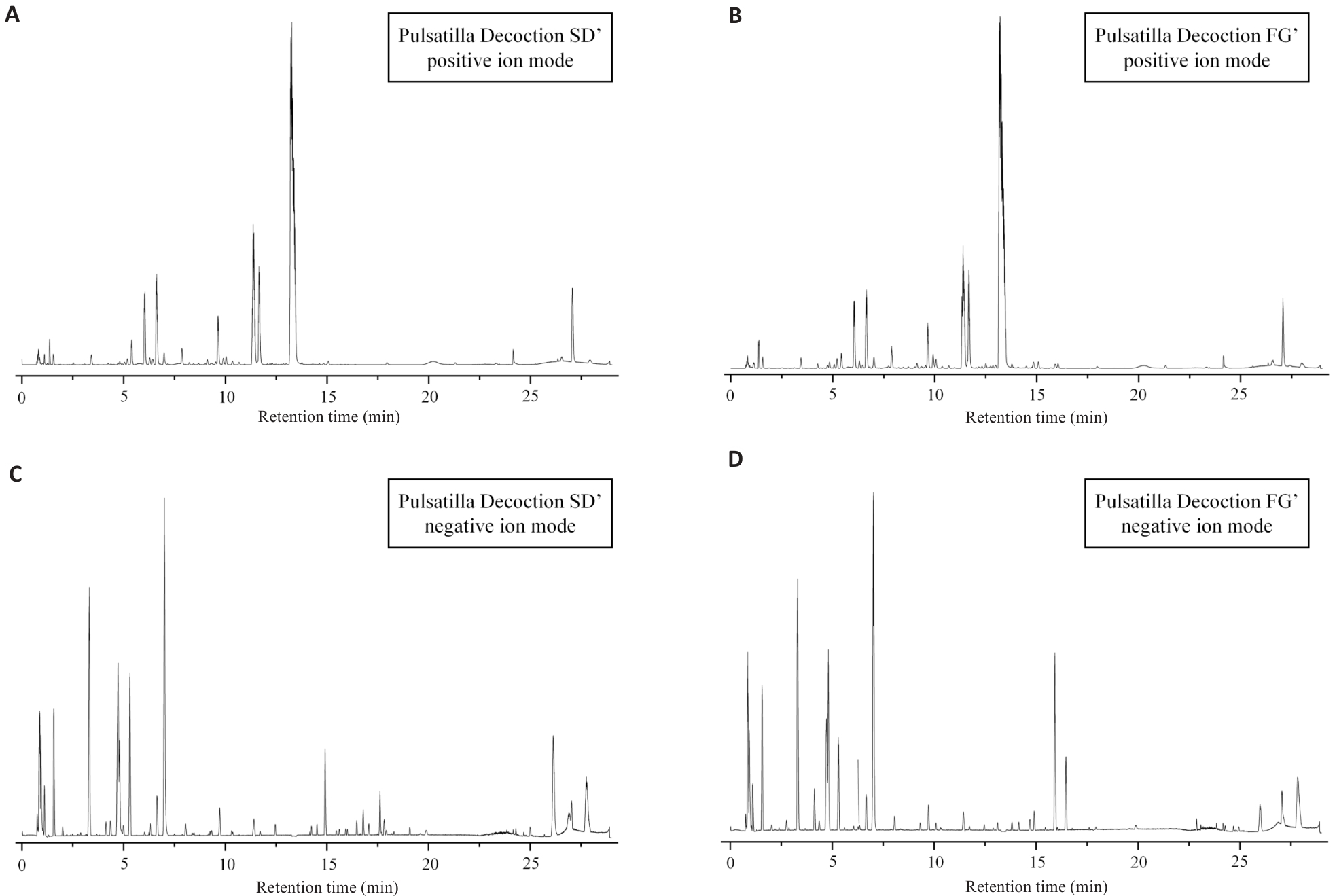
图1 白头翁汤标准汤剂(SD)与配方颗粒(FG)的正、负离子模式离子流图
Fig.1 Positive and negative ion mode ion current chromatograms of Pulsatilla Decoction standard decoction (SD) and formula granules (FG). A: Positive ion mode ion current chromatogram of Pulsatilla Decoction SD. B: Positive ion mode ion current chromatogram of Pulsatilla Decoction FG. C: Negative ion mode ion current chromatogram of Pulsatilla Decoction SD. D: Negative ion mode ion current chromatogram of Pulsatilla Decoction FG.
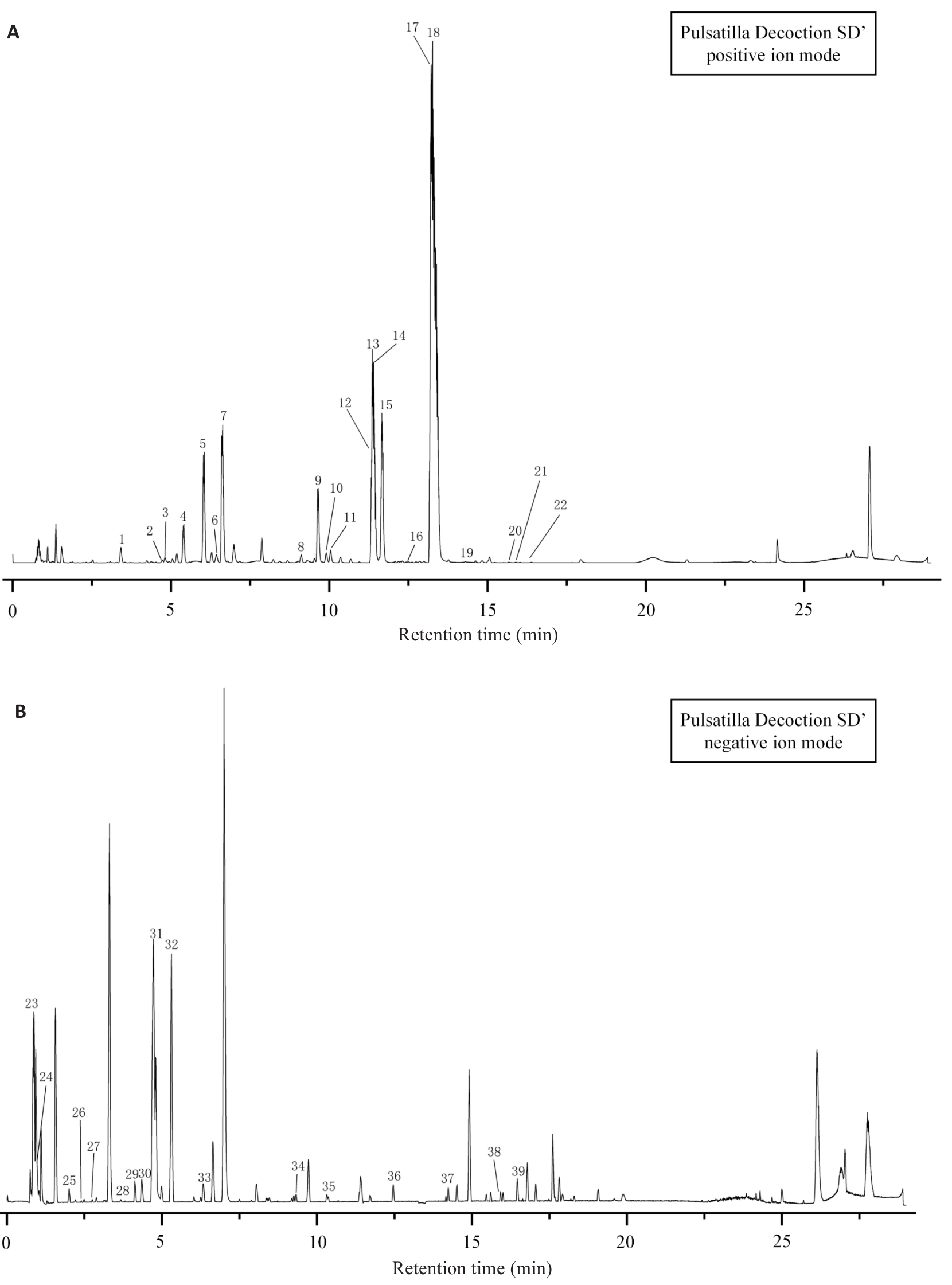
图2 白头翁汤的化学成分鉴定
Fig.2 Identification of chemical components in Pulsatilla Decoction. A: Positive ion mode ion current chromatogram of Pulsatilla Decoction SD. B: Negative ion mode ion current chromatogram of Pulsatilla Decoction SD.
| Peak No. | t/min | Molecular formula | Addition mode | m/z | MS/MS fragment ions | Compound | Source |
|---|---|---|---|---|---|---|---|
| 1 | 3.44 | C15H16O9 | [M+H]+ | 341.0867 | 179.0338, 133.0283, 105.0334, 89.0387 | Esculin* | Fraxini cortex |
| 2 | 4.70 | C10H8O4 | [M+H]+ | 193.0496 | 178.0261, 137.0598, 133.0285 | 4-Methylesculetin | Fraxini cortex |
| 3 | 4.88 | C9H6O4 | [M+H]+ | 179.0338 | 133.028, 123.0440, 105.0335, 89.0386 | Esculetin* | Fraxini cortex |
| 4 | 5.43 | C10H8O5 | [M+H]+ | 209.0443 | 209.0444, 166.0261, 149.0233 | Fraxetin | Fraxini cortex |
| 5 | 6.03 | C20H24NO4 | [M+H]+ | 342.1696 | 192.1019, 177.0784, 148.0758 | Phellodendrine* | Phellodendri chinensis cortex |
| 6 | 6.42 | C11H10O5 | [M+H]+ | 223.0601 | 208.0370、190.0260、162.0315 | isofraxidin | Fraxini cortex |
| 7 | 6.65 | C20H23NO4 | [M+H]+ | 342.1697 | 297.1121、265.0859、202.0777 | Magnoflorine | Coptidis rhizoma, phellodendri chinensis cortex |
| 8 | 9.13 | C21H25NO4 | [M+H]+ | 356.1855 | 311.1284、296.1044、279.1016、264.0775 | menisperine | Coptidis rhizoma, phellodendri chinensis cortex |
| 9 | 9.67 | C19H15NO4 | [M+H]+ | 322.1072 | 307.0835、279.0887、250.0860、202.0777 | Berberrubine | Coptidis rhizoma, phellodendri chinensis cortex |
| 10 | 9.92 | C19H17NO4 | [M+H]+ | 324.1228 | 309.0995、308.0919、294.0760、280.0970 | Demethyleneberberine | Coptidis rhizoma, phellodendri chinensis cortex |
| 11 | 10.06 | C20H17NO5 | [M+H]+ | 352.1177 | 308.0891、294.0739、276.0628 | Oxyeptiberberine* | Coptidis rhizoma, phellodendri chinensis cortex |
| 12 | 11.33 | C20H19NO4 | [M+H]+ | 338.1385 | 323.1153、322.1072、308.0916、294.1122 | Columbamine* | Coptidis rhizoma, phellodendri chinensis cortex |
| 13 | 11.39 | C20H17NO4 | [M+H]+ | 336.1230 | 320.0918、292.0969、278.0813 | Epiberberine* | Coptidis rhizoma, phellodendri chinensis cortex |
| 14 | 11.39 | C19H14NO4 | [M+H]+ | 320.0916 | 292.0951、262.0847、202.0777 | Coptisine chloride* | Coptidis rhizoma |
| 15 | 11.67 | C20H19NO4 | [M+H]+ | 338.1385 | 323.1149、322.1071、308.0917、294.1123 | Jatrorrhizine* | Coptidis rhizoma, phellodendri chinensis cortex |
| 16 | 12.51 | C19H15NO4 | [M+H]+ | 322.1072 | 307.0833、279.0885、202.0777 | Menisporphine | Coptidis rhizoma |
| 17 | 13.20 | C21H22NO4 | [M+H]+ | 352.1543 | 336.1231、308.1279、292.0967、278.0807 | Palmatine chloride* | Coptidis rhizoma, phellodendri chinensis cortex |
| 18 | 13.20 | C20H17NO4 | [M+H]+ | 336.1228 | 320.0900、278.0796、191.0719 | Berberine* | Coptidis rhizoma, phellodendri chinensis cortex |
| 19 | 14.48 | C22H23NO4 | [M+H]+ | 366.1698 | 350.1389、336.1230、308.1277、 | Dehydrocorydaline | Coptidis rhizoma, phellodendri chinensis cortex |
| 20 | 15.69 | C14H8N2O | [M+H]+ | 221.0709 | 221.0708、193.0760、192.0681 | Canthin-6-one | Phellodendri chinensis cortex |
| 21 | 15.89 | C14H13NO4 | [M+H]+ | 260.0916 | 245.0682、227.0578、216.0656、202.0504 | Skimmianin | Phellodendri chinensis cortex |
| 22 | 16.41 | C13H11NO3 | [M+H]+ | 230.0811 | 215.0574、202.0777、200.0334 | Fagarine | Phellodendri chinensis cortex |
| 23 | 0.87 | C7H12O6 | [M+H]- | 191.0559 | 127.0406、111.0090、93.0348、85.0296 | D-Quinic acid | Coptidis rhizoma |
| 24 | 1.03 | C6H8O7 | [M+H]- | 191.0196 | 129.0198、111.0091、85.0297 | Citric acid | Fraxini cortex、coptidis rhizoma |
| 25 | 2.00 | C9H10O5 | [M+H]- | 197.0454 | 179.0356、135.0456、123.0455、72.9933 | Danshensu | Coptidis rhizoma |
| 26 | 2.40 | C7H6O4 | [M+H]- | 153.0192 | 109.0295、108.0219、105.0127 | Protocatechuic acid | Coptidis rhizoma |
| 27 | 2.75 | C16H18O9 | [M+H]- | 353.0874 | 197.0569、173.0457、135.0457 | chlorogenic acid | Coptidis rhizoma、fraxini cortex、phellodendri chinensis cortex |
| 28 | 3.67 | C7H6O3 | [M+H]- | 137.0243 | 108.0217、79.0508 | 2,5-Dihydroxybenzaldehyde | Coptidis rhizoma |
| 29 | 4.13 | C19H28O11 | [M+H]- | 431.1555 | 119.0505、99.0089、73.0296、59.0140 | osmanthuside H | Fraxini cortex |
| 30 | 4.36 | C16H18O9 | [M+H]- | 353.0875 | 191.0565、173.0460、85.0296 | Neochlorogenic acid | Fraxini cortex、coptidis rhizoma、phellodendri chinensis cortex |
| 31 | 4.80 | C17H20O9 | [M+H]- | 367.1029 | 202.0788、193.0509、173.0455、134.0376 | 5-O-Feruloylquinic acid | Coptidis rhizoma |
| 32 | 5.30 | C16H18O10 | [M+H]- | 369.0822 | 207.0303、202.0788、163.0045 | Fraxin* | Fraxini cortex |
| 33 | 6.40 | C10H10O4 | [M+H]- | 193.0504 | 178.0277、134.0374、101.9250 | Ferulic Acid | Phellodendri chinensis cortex、fraxini cortex |
| 34 | 9.25 | C23H26O11 | [M+H]- | 477.1397 | 202.0788、179.0354、161.0246、133.0246 | calceolarioside A | Fraxini cortex |
| 35 | 10.32 | C20H22O6 | [M+H]- | 357.1340 | 202.0788、151.0405、136.0157 | Pinoresinol | Pulsatillae radix |
| 36 | 12.45 | C25H32O13 | [M+H]- | 539.1767 | 202.0788、149.0247、139.0401、121.0293 | Oleuropein | Fraxini cortex |
| 37 | 14.15 | C25H32O12 | [M+H]- | 523.1820 | 291.0876、202.0788、101.0242 | ligstroside | Fraxini cortex |
| 38 | 15.91 | C59H96O26 | [M+H]- | 1265.6161 | 749.4488、686.3580 | Pulchinenoside B4* | Pulsatillae radix |
| 39 | 16.46 | C59H96O26 | [M+H]- | 1265.6161 | 749.4492、603.3861、471.3498 | Pulchinenoside B5* | Pulsatillae radix |
表3 白头翁汤化学成分的鉴定结果
Tab.3 Identification results of chemical constituents in Pulsatilla Decoction
| Peak No. | t/min | Molecular formula | Addition mode | m/z | MS/MS fragment ions | Compound | Source |
|---|---|---|---|---|---|---|---|
| 1 | 3.44 | C15H16O9 | [M+H]+ | 341.0867 | 179.0338, 133.0283, 105.0334, 89.0387 | Esculin* | Fraxini cortex |
| 2 | 4.70 | C10H8O4 | [M+H]+ | 193.0496 | 178.0261, 137.0598, 133.0285 | 4-Methylesculetin | Fraxini cortex |
| 3 | 4.88 | C9H6O4 | [M+H]+ | 179.0338 | 133.028, 123.0440, 105.0335, 89.0386 | Esculetin* | Fraxini cortex |
| 4 | 5.43 | C10H8O5 | [M+H]+ | 209.0443 | 209.0444, 166.0261, 149.0233 | Fraxetin | Fraxini cortex |
| 5 | 6.03 | C20H24NO4 | [M+H]+ | 342.1696 | 192.1019, 177.0784, 148.0758 | Phellodendrine* | Phellodendri chinensis cortex |
| 6 | 6.42 | C11H10O5 | [M+H]+ | 223.0601 | 208.0370、190.0260、162.0315 | isofraxidin | Fraxini cortex |
| 7 | 6.65 | C20H23NO4 | [M+H]+ | 342.1697 | 297.1121、265.0859、202.0777 | Magnoflorine | Coptidis rhizoma, phellodendri chinensis cortex |
| 8 | 9.13 | C21H25NO4 | [M+H]+ | 356.1855 | 311.1284、296.1044、279.1016、264.0775 | menisperine | Coptidis rhizoma, phellodendri chinensis cortex |
| 9 | 9.67 | C19H15NO4 | [M+H]+ | 322.1072 | 307.0835、279.0887、250.0860、202.0777 | Berberrubine | Coptidis rhizoma, phellodendri chinensis cortex |
| 10 | 9.92 | C19H17NO4 | [M+H]+ | 324.1228 | 309.0995、308.0919、294.0760、280.0970 | Demethyleneberberine | Coptidis rhizoma, phellodendri chinensis cortex |
| 11 | 10.06 | C20H17NO5 | [M+H]+ | 352.1177 | 308.0891、294.0739、276.0628 | Oxyeptiberberine* | Coptidis rhizoma, phellodendri chinensis cortex |
| 12 | 11.33 | C20H19NO4 | [M+H]+ | 338.1385 | 323.1153、322.1072、308.0916、294.1122 | Columbamine* | Coptidis rhizoma, phellodendri chinensis cortex |
| 13 | 11.39 | C20H17NO4 | [M+H]+ | 336.1230 | 320.0918、292.0969、278.0813 | Epiberberine* | Coptidis rhizoma, phellodendri chinensis cortex |
| 14 | 11.39 | C19H14NO4 | [M+H]+ | 320.0916 | 292.0951、262.0847、202.0777 | Coptisine chloride* | Coptidis rhizoma |
| 15 | 11.67 | C20H19NO4 | [M+H]+ | 338.1385 | 323.1149、322.1071、308.0917、294.1123 | Jatrorrhizine* | Coptidis rhizoma, phellodendri chinensis cortex |
| 16 | 12.51 | C19H15NO4 | [M+H]+ | 322.1072 | 307.0833、279.0885、202.0777 | Menisporphine | Coptidis rhizoma |
| 17 | 13.20 | C21H22NO4 | [M+H]+ | 352.1543 | 336.1231、308.1279、292.0967、278.0807 | Palmatine chloride* | Coptidis rhizoma, phellodendri chinensis cortex |
| 18 | 13.20 | C20H17NO4 | [M+H]+ | 336.1228 | 320.0900、278.0796、191.0719 | Berberine* | Coptidis rhizoma, phellodendri chinensis cortex |
| 19 | 14.48 | C22H23NO4 | [M+H]+ | 366.1698 | 350.1389、336.1230、308.1277、 | Dehydrocorydaline | Coptidis rhizoma, phellodendri chinensis cortex |
| 20 | 15.69 | C14H8N2O | [M+H]+ | 221.0709 | 221.0708、193.0760、192.0681 | Canthin-6-one | Phellodendri chinensis cortex |
| 21 | 15.89 | C14H13NO4 | [M+H]+ | 260.0916 | 245.0682、227.0578、216.0656、202.0504 | Skimmianin | Phellodendri chinensis cortex |
| 22 | 16.41 | C13H11NO3 | [M+H]+ | 230.0811 | 215.0574、202.0777、200.0334 | Fagarine | Phellodendri chinensis cortex |
| 23 | 0.87 | C7H12O6 | [M+H]- | 191.0559 | 127.0406、111.0090、93.0348、85.0296 | D-Quinic acid | Coptidis rhizoma |
| 24 | 1.03 | C6H8O7 | [M+H]- | 191.0196 | 129.0198、111.0091、85.0297 | Citric acid | Fraxini cortex、coptidis rhizoma |
| 25 | 2.00 | C9H10O5 | [M+H]- | 197.0454 | 179.0356、135.0456、123.0455、72.9933 | Danshensu | Coptidis rhizoma |
| 26 | 2.40 | C7H6O4 | [M+H]- | 153.0192 | 109.0295、108.0219、105.0127 | Protocatechuic acid | Coptidis rhizoma |
| 27 | 2.75 | C16H18O9 | [M+H]- | 353.0874 | 197.0569、173.0457、135.0457 | chlorogenic acid | Coptidis rhizoma、fraxini cortex、phellodendri chinensis cortex |
| 28 | 3.67 | C7H6O3 | [M+H]- | 137.0243 | 108.0217、79.0508 | 2,5-Dihydroxybenzaldehyde | Coptidis rhizoma |
| 29 | 4.13 | C19H28O11 | [M+H]- | 431.1555 | 119.0505、99.0089、73.0296、59.0140 | osmanthuside H | Fraxini cortex |
| 30 | 4.36 | C16H18O9 | [M+H]- | 353.0875 | 191.0565、173.0460、85.0296 | Neochlorogenic acid | Fraxini cortex、coptidis rhizoma、phellodendri chinensis cortex |
| 31 | 4.80 | C17H20O9 | [M+H]- | 367.1029 | 202.0788、193.0509、173.0455、134.0376 | 5-O-Feruloylquinic acid | Coptidis rhizoma |
| 32 | 5.30 | C16H18O10 | [M+H]- | 369.0822 | 207.0303、202.0788、163.0045 | Fraxin* | Fraxini cortex |
| 33 | 6.40 | C10H10O4 | [M+H]- | 193.0504 | 178.0277、134.0374、101.9250 | Ferulic Acid | Phellodendri chinensis cortex、fraxini cortex |
| 34 | 9.25 | C23H26O11 | [M+H]- | 477.1397 | 202.0788、179.0354、161.0246、133.0246 | calceolarioside A | Fraxini cortex |
| 35 | 10.32 | C20H22O6 | [M+H]- | 357.1340 | 202.0788、151.0405、136.0157 | Pinoresinol | Pulsatillae radix |
| 36 | 12.45 | C25H32O13 | [M+H]- | 539.1767 | 202.0788、149.0247、139.0401、121.0293 | Oleuropein | Fraxini cortex |
| 37 | 14.15 | C25H32O12 | [M+H]- | 523.1820 | 291.0876、202.0788、101.0242 | ligstroside | Fraxini cortex |
| 38 | 15.91 | C59H96O26 | [M+H]- | 1265.6161 | 749.4488、686.3580 | Pulchinenoside B4* | Pulsatillae radix |
| 39 | 16.46 | C59H96O26 | [M+H]- | 1265.6161 | 749.4492、603.3861、471.3498 | Pulchinenoside B5* | Pulsatillae radix |
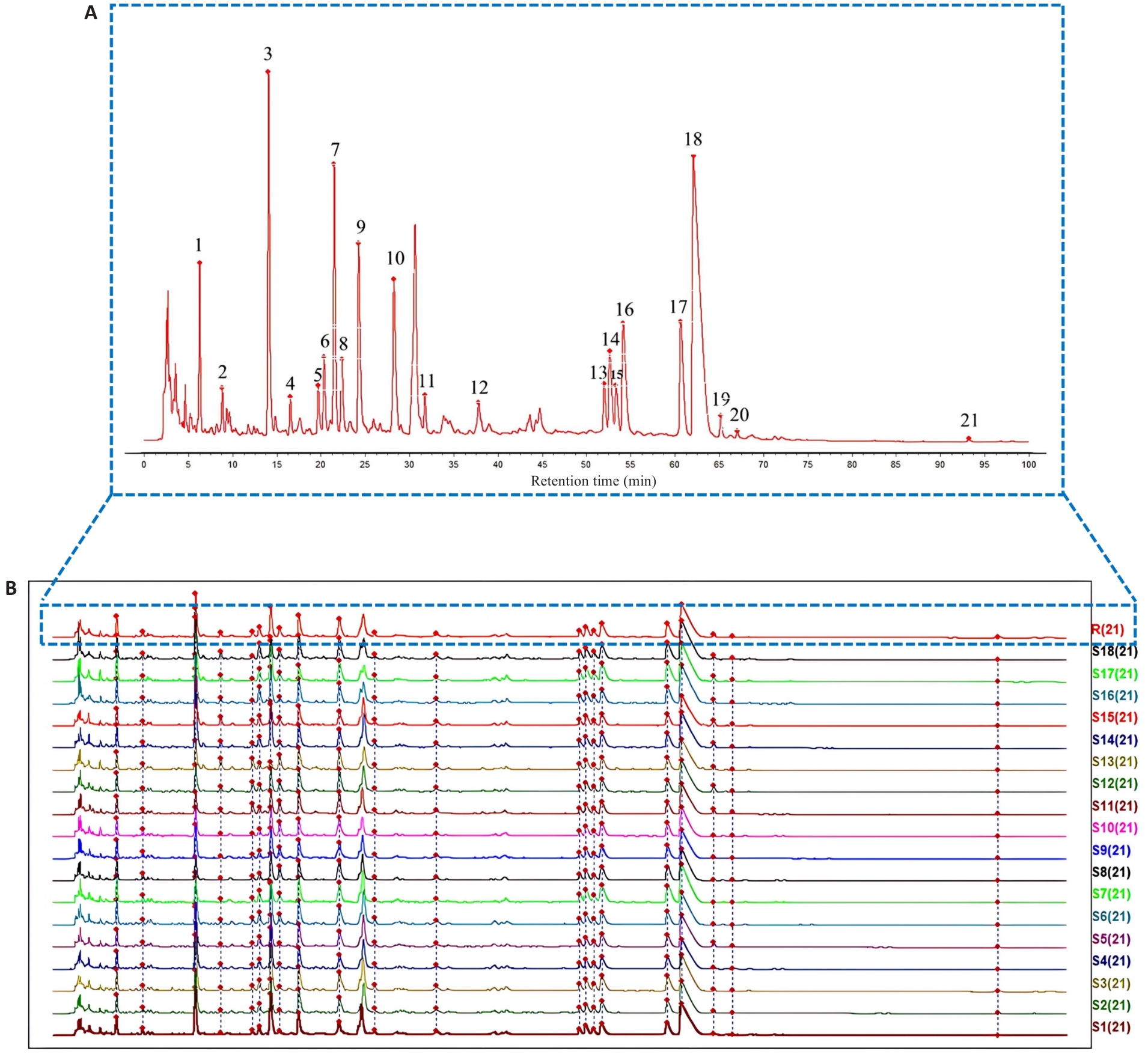
图3 白头翁汤对照特征图谱及各批次SD与FG的指纹图谱
Fig.3 Reference characteristic chromatogram of PD and chromatographic fingerprints of different batches of SD and FG. A: Reference characteristic chromatogram of PD. B: Chromatographic fingerprints of different batches of SD and FG. 3: Esculin; 7: Fraxin; 8: Esculetin; 10: Phellodendrine; 13: Columbamine; 14: Epiberberine; 15: Jatrorrhizine; 16: Coptisine; 17: Palmatine; 18: Berberine; 19: Pulsatilla saponin B4; 20: Pulsatilla saponin B5; 21: Obaculactone. S1-S15 are the chromatograms of 15 batches of standard decoction, S16-S18 are the chromatograms of 3 batches of formula granules, and R is the reference chromatogram.
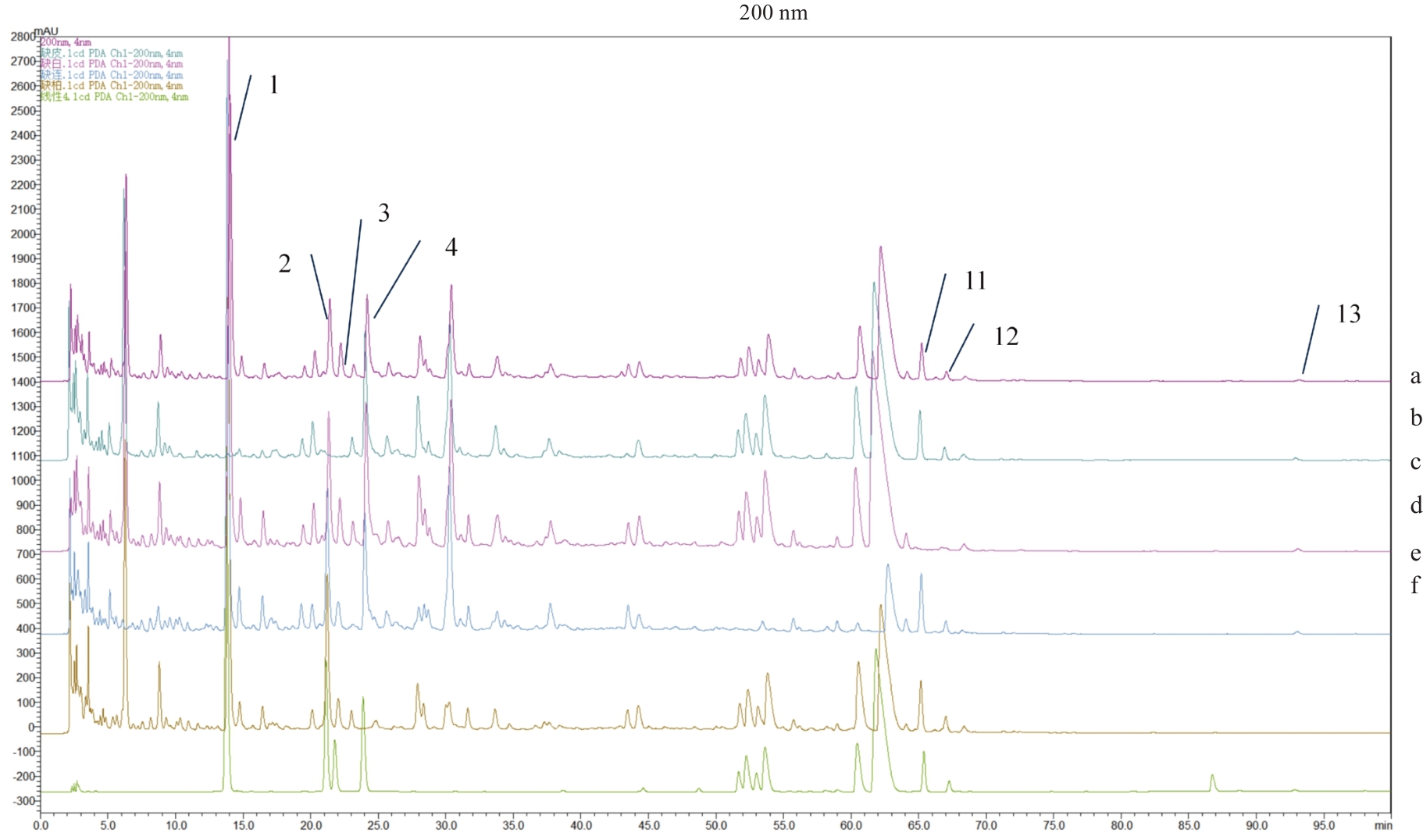
图4 白头翁汤HPLC专属性对照图(200 nm)
Fig.4 HPLC specificity control chromatogram of Pulsatilla decoction (200 nm). a: Test solution; b: Negative control solution without Fraxini Cortex; c: Negative control solution without Pulsatillae Radix; d: Negative control solution without Phellodendri Chinensis Cortex; e: Negative control solution without Coptidis Rhizoma; f: Mixed reference solution; 1: Esculin; 2: Fraxin; 3: Esculetin; 4: Phellodendrine; 11: Pulsatilla saponin B4; 12: Pulsatilla saponin B5; 13: Obaculactone.
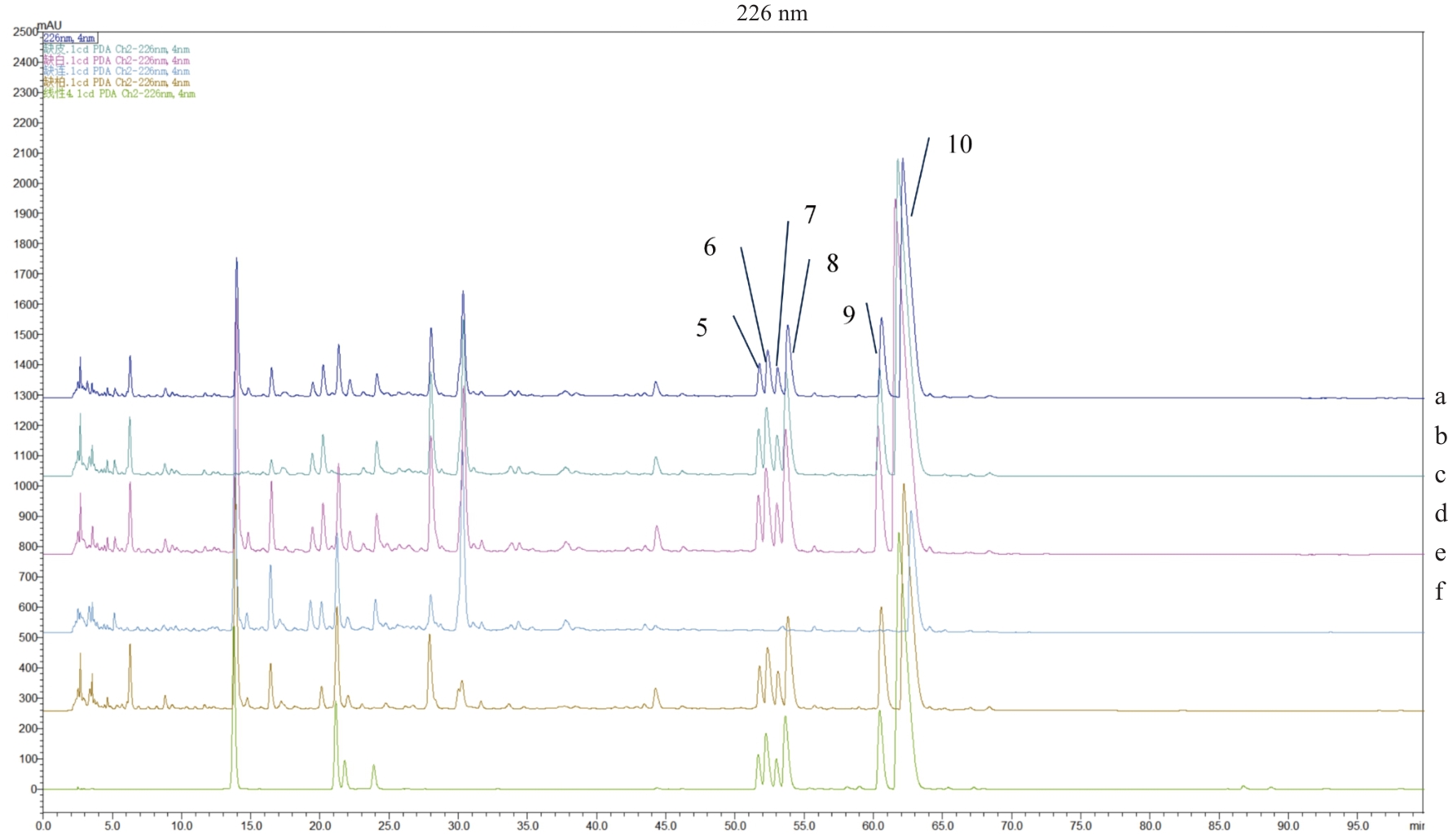
图5 白头翁汤HPLC专属性对照图(226 nm)
Fig.5 HPLC specificity control chromatogram of Pulsatilla decoction (226 nm). a: Test solution; b: Negative control solution without Fraxini Cortex; c: Negative control solution without Pulsatillae Radix; d: Negative control solution without Phellodendri Chinensis Cortex; e: Negative control solution without Coptidis Rhizoma; f: Mixed reference solution; 5: Columbamine, 6: Epiberberine, 7: Jatrorrhizine, 8: Coptisine, 9: Palmatine, 10: Berberine.
| Component | Linear regression equation | R² | Linear range (μg) |
|---|---|---|---|
| Esculin | y=61745 x-980865 | 0.9990 | 0.7194-7.1938 |
| Fraxin | y=38526x-89411 | 0.9996 | 0.4015-4.0147 |
| Esculetin | y=90115x-18611 | 0.9992 | 0.0683-0.6828 |
| Phellodendrine | y=103259x+5507.4 | 0.9997 | 0.1203-1.2032 |
| Columbamine | y=31333x+57764 | 0.9990 | 0.1032-1.0322 |
| Epiberberine | y=20939x+49037 | 0.9992 | 0.3261-3.2608 |
| Jatrorrhizine | y=41527x-19259 | 0.9994 | 0.0712-0.7123 |
| Coptisine | y=33414x-156425 | 0.9995 | 0.3540-3.5400 |
| Palmatine | y=35559x-65949 | 0.9995 | 0.3638-3.6378 |
| Berberine | y=38384x-826640 | 0.9995 | 2.2314-22.3139 |
| Pulsatilla saponin B4 | y=2742.7x+6535.7 | 0.9995 | 1.6894-16.8945 |
| Pulsatilla saponin B5 | y=2946.2x-8107.2 | 0.9998 | 0.4494-4.4942 |
| Obaculactone | y=8211x-8968.6 | 0.9994 | 0.0393-0.3932 |
表4 线性关系考察结果
Tab.4 Results of linearity analyses
| Component | Linear regression equation | R² | Linear range (μg) |
|---|---|---|---|
| Esculin | y=61745 x-980865 | 0.9990 | 0.7194-7.1938 |
| Fraxin | y=38526x-89411 | 0.9996 | 0.4015-4.0147 |
| Esculetin | y=90115x-18611 | 0.9992 | 0.0683-0.6828 |
| Phellodendrine | y=103259x+5507.4 | 0.9997 | 0.1203-1.2032 |
| Columbamine | y=31333x+57764 | 0.9990 | 0.1032-1.0322 |
| Epiberberine | y=20939x+49037 | 0.9992 | 0.3261-3.2608 |
| Jatrorrhizine | y=41527x-19259 | 0.9994 | 0.0712-0.7123 |
| Coptisine | y=33414x-156425 | 0.9995 | 0.3540-3.5400 |
| Palmatine | y=35559x-65949 | 0.9995 | 0.3638-3.6378 |
| Berberine | y=38384x-826640 | 0.9995 | 2.2314-22.3139 |
| Pulsatilla saponin B4 | y=2742.7x+6535.7 | 0.9995 | 1.6894-16.8945 |
| Pulsatilla saponin B5 | y=2946.2x-8107.2 | 0.9998 | 0.4494-4.4942 |
| Obaculactone | y=8211x-8968.6 | 0.9994 | 0.0393-0.3932 |
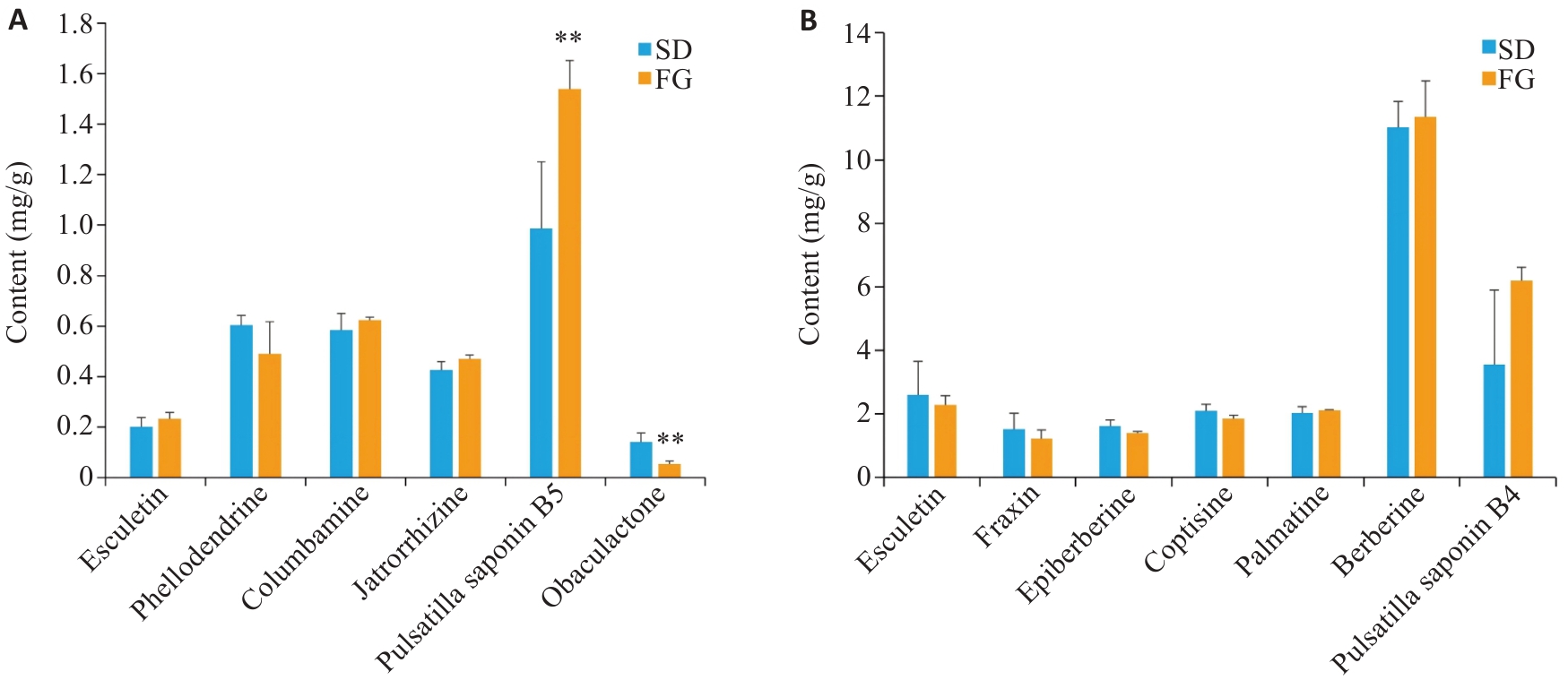
图6 13种指标成分含量对比
Fig.6 Comparison of the contents of 13 marker components. A: Low-content component comparison (n=3); B: High-content component comparison (n=3). **P<0.01 vs standard decoction.
| Sample name | Formula granule variety | Extraction rate of single herb | Extraction rate of decoction |
|---|---|---|---|
| S3 | - | - | 13.44% |
| S7 | - | - | 13.96% |
| S14 | - | - | 14.23% |
| S15 | Pulsatillae Radix | 24.70% | 17.65% |
| Coptidis Rhizoma | 19.40% | ||
| Phellodendri Chinensis Cortex | 18.30% | ||
| Fraxini Cortex | 8.20% | ||
| S16 | Pulsatillae Radix | 26.20% | 17.88% |
| Coptidis Rhizoma | 18.20% | ||
| Phellodendri Chinensis Cortex | 20.00% | ||
| Fraxini Cortex | 7.10% | ||
| S17 | Pulsatillae Radix | 27.60% | 18.75% |
| Coptidis Rhizoma | 19.40% | ||
| Phellodendri Chinensis Cortex | 19.80% | ||
| Fraxini Cortex | 8.20% |
表5 SD与FG的出膏率比较
Tab.5 Comparison of extraction rates between SD and FG (n=3)
| Sample name | Formula granule variety | Extraction rate of single herb | Extraction rate of decoction |
|---|---|---|---|
| S3 | - | - | 13.44% |
| S7 | - | - | 13.96% |
| S14 | - | - | 14.23% |
| S15 | Pulsatillae Radix | 24.70% | 17.65% |
| Coptidis Rhizoma | 19.40% | ||
| Phellodendri Chinensis Cortex | 18.30% | ||
| Fraxini Cortex | 8.20% | ||
| S16 | Pulsatillae Radix | 26.20% | 17.88% |
| Coptidis Rhizoma | 18.20% | ||
| Phellodendri Chinensis Cortex | 20.00% | ||
| Fraxini Cortex | 7.10% | ||
| S17 | Pulsatillae Radix | 27.60% | 18.75% |
| Coptidis Rhizoma | 19.40% | ||
| Phellodendri Chinensis Cortex | 19.80% | ||
| Fraxini Cortex | 8.20% |
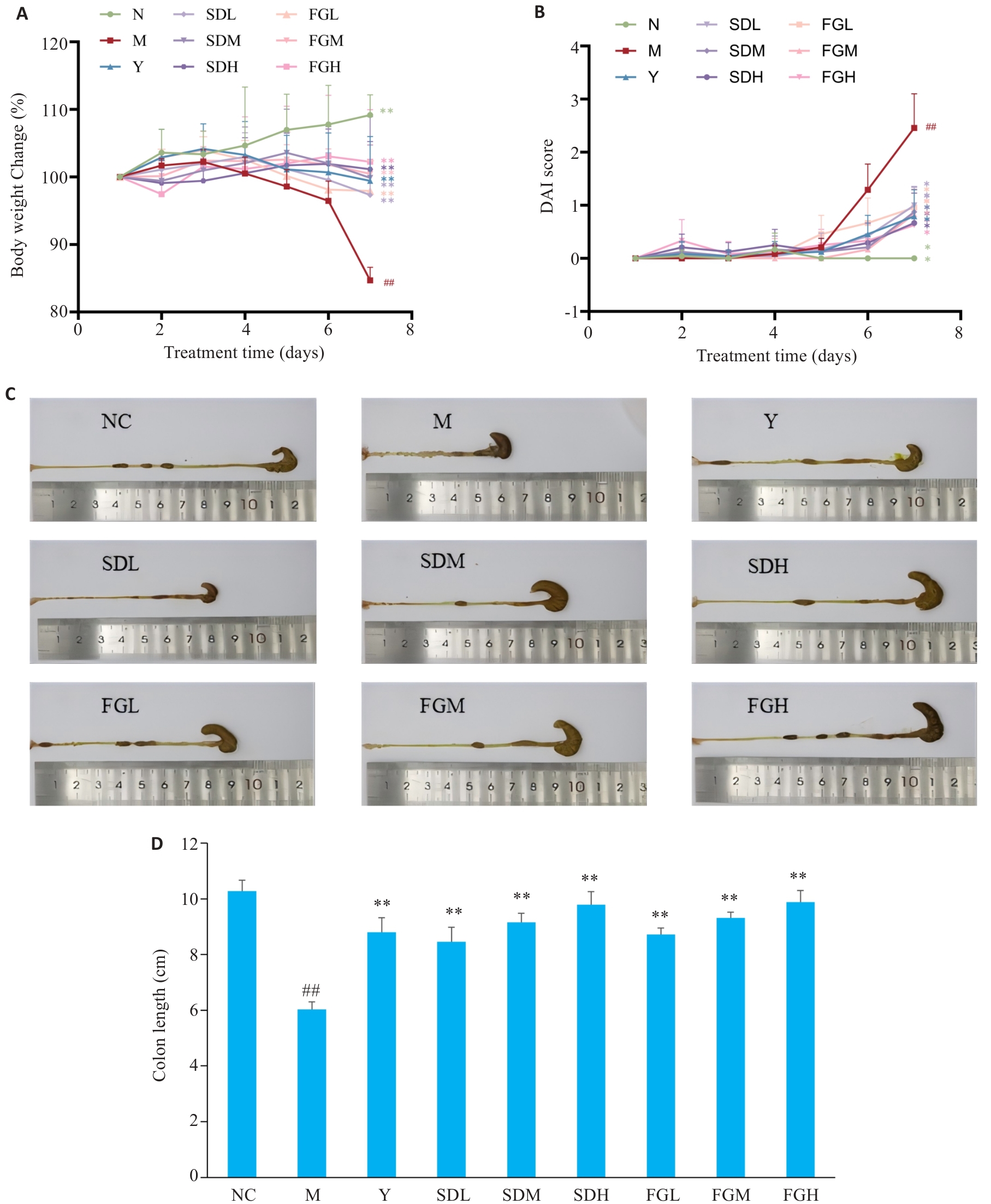
图7 各组小鼠基本体征对比
Fig.7 Comparison of basic physical conditions of mice of each group. A: Body weight change (n=8). B: DAI score (n=8). C: Representative images of colon. D: Colon length (n=8). Comparisons were performed using one-way ANOVA for multiple groups, ##P<0.01 vs N group; **P<0.01 vs M group.
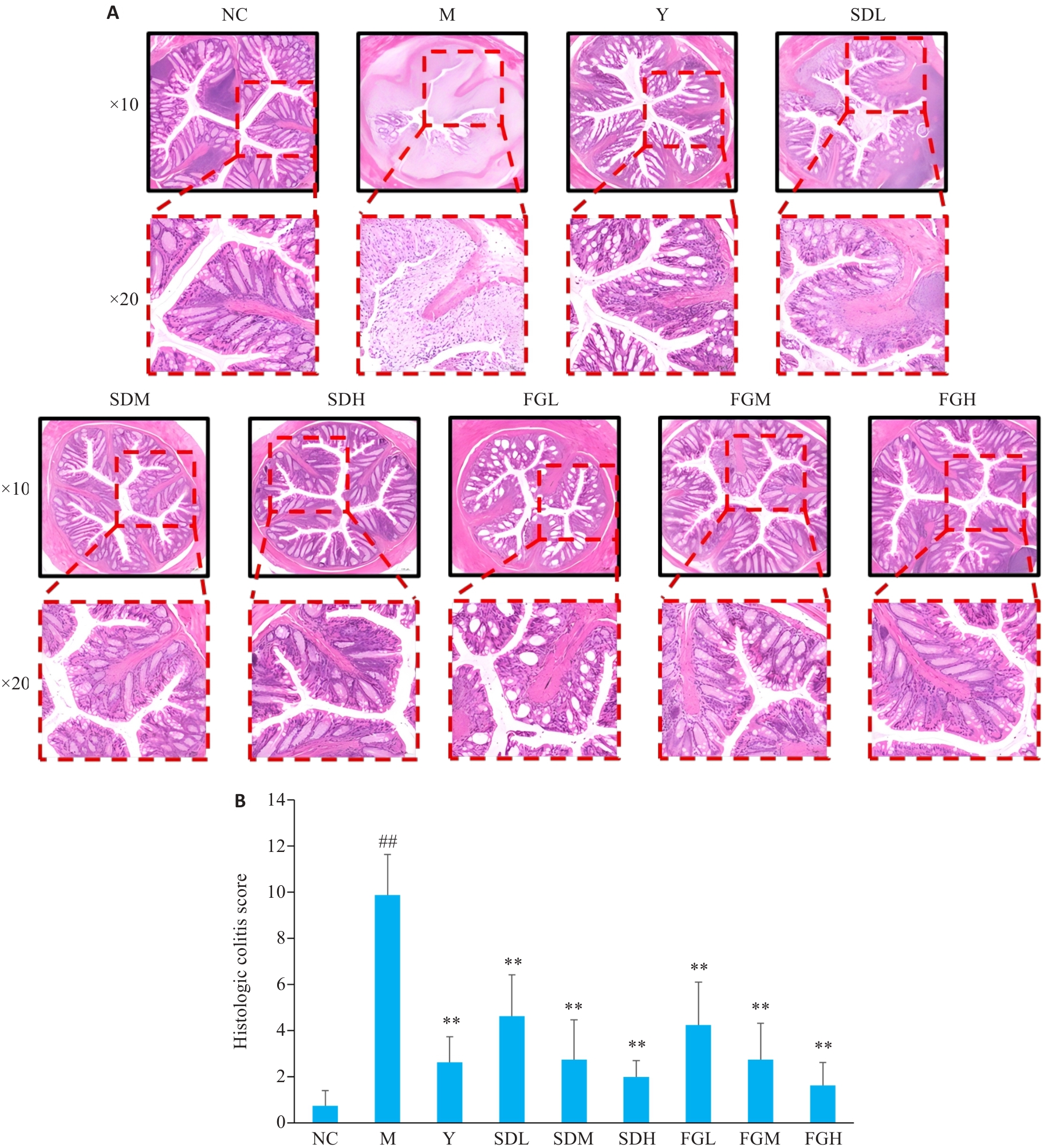
图8 各组小鼠结肠组织病理学对比
Fig.8 Comparison of colonic histopathology of the mice in each group. A: HE staining. B: Pathological score (n=8). ##P<0.01 vs NC group; **P<0.01 vs M group.
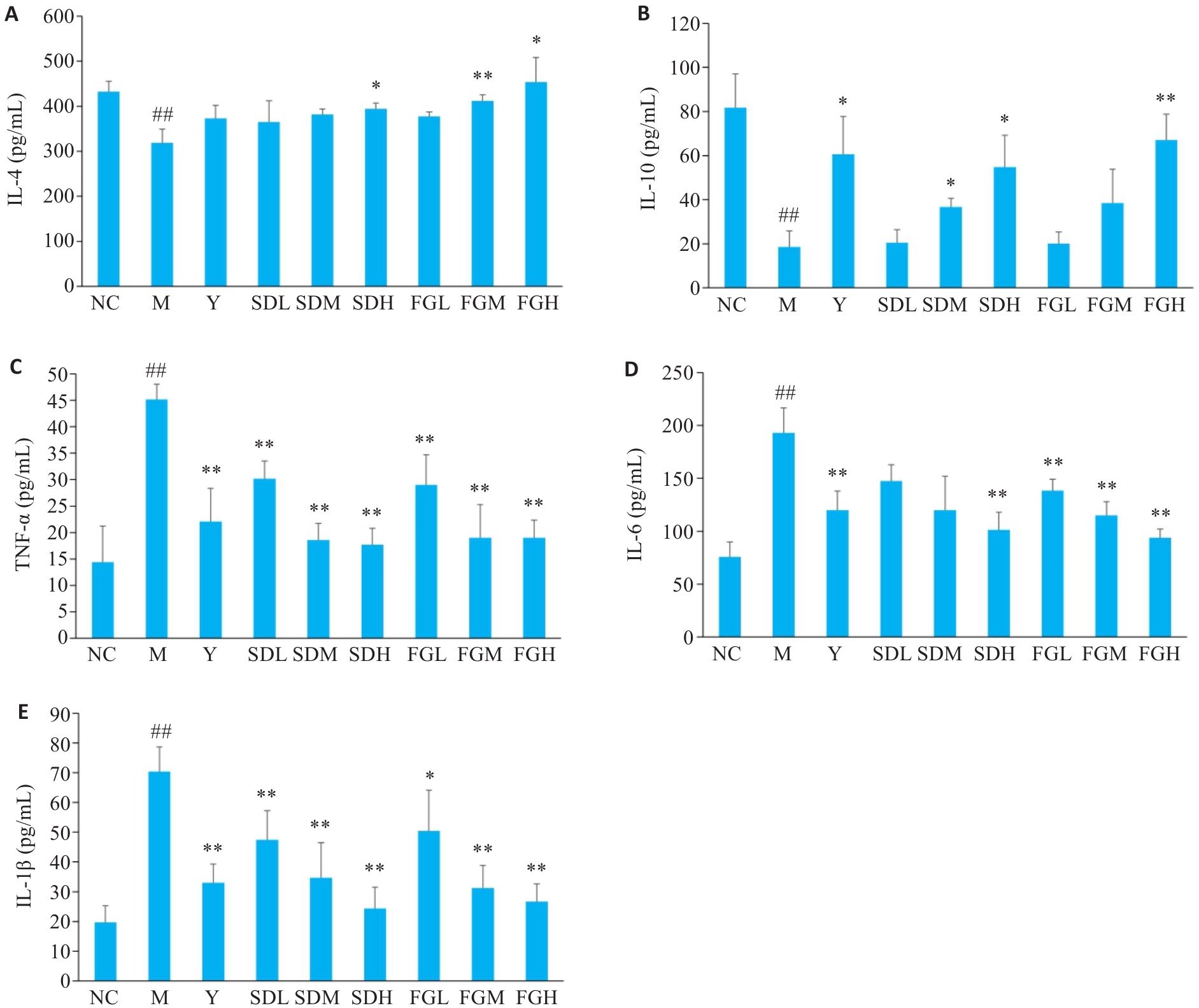
图9 各组小鼠血清炎症因子水平的对比
Fig.9 Comparison of serum inflammatory cytokine levels among the groups (n=6). A: IL-4. B: IL-10. C: TNF-α. D: IL-6. E: IL-1β. ##P<0.01 vs NC group; *P<0.05, **P<0.01 vs M group.
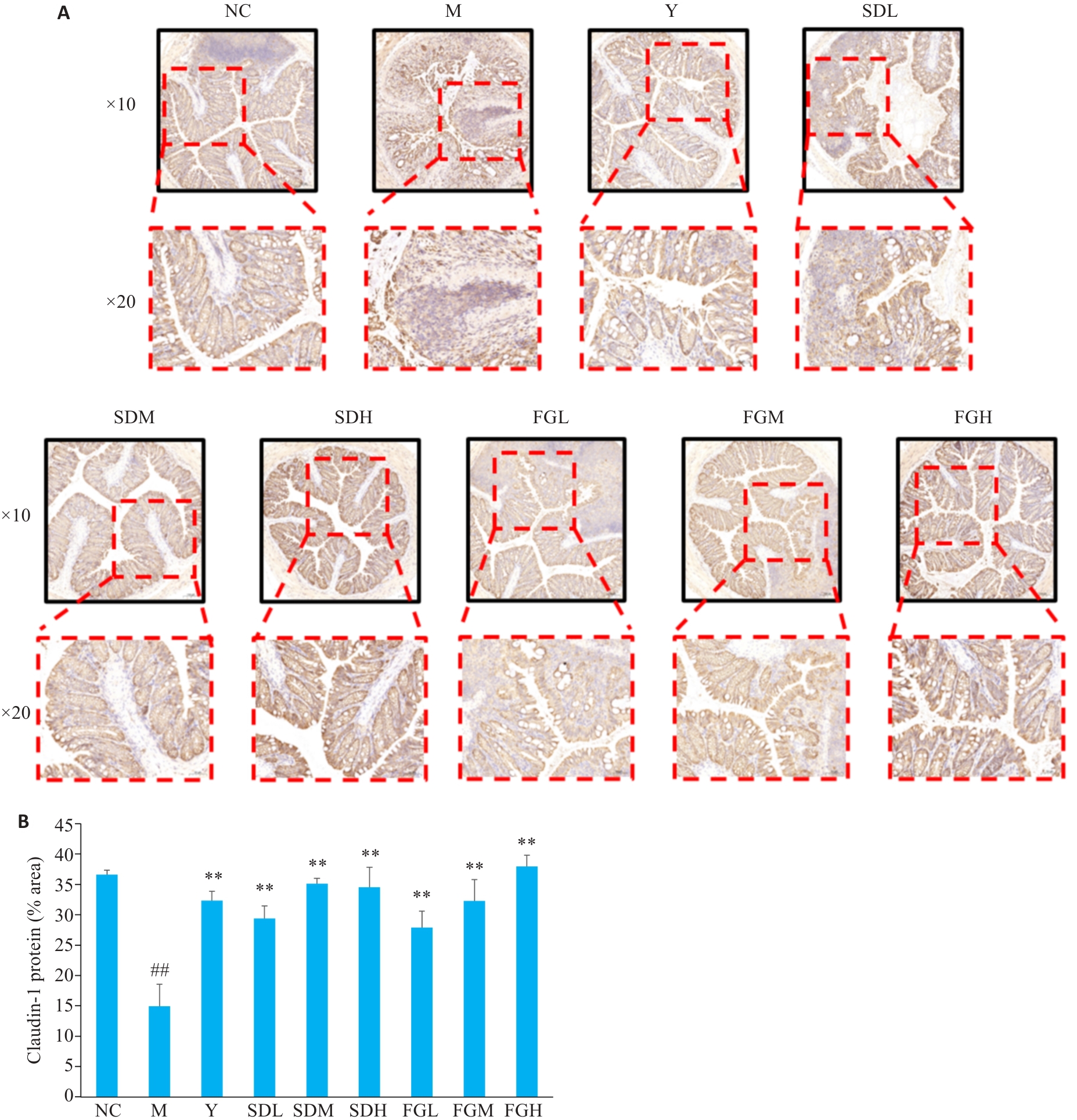
图10 各组小鼠肠道组织紧密连接蛋白 Claudin-1 免疫组化染色图像及定量分析
Fig.10 Representative immunohistochemical images and quantitative analysis of tight junction protein claudin-1 in intestinal tissues of mice in different groups. A: Representative immunohistochemical images of claudin-1; B: Protein expression of claudin-1 (n=3). ##P<0.01 vs NC group; **P<0.01 vs M group.
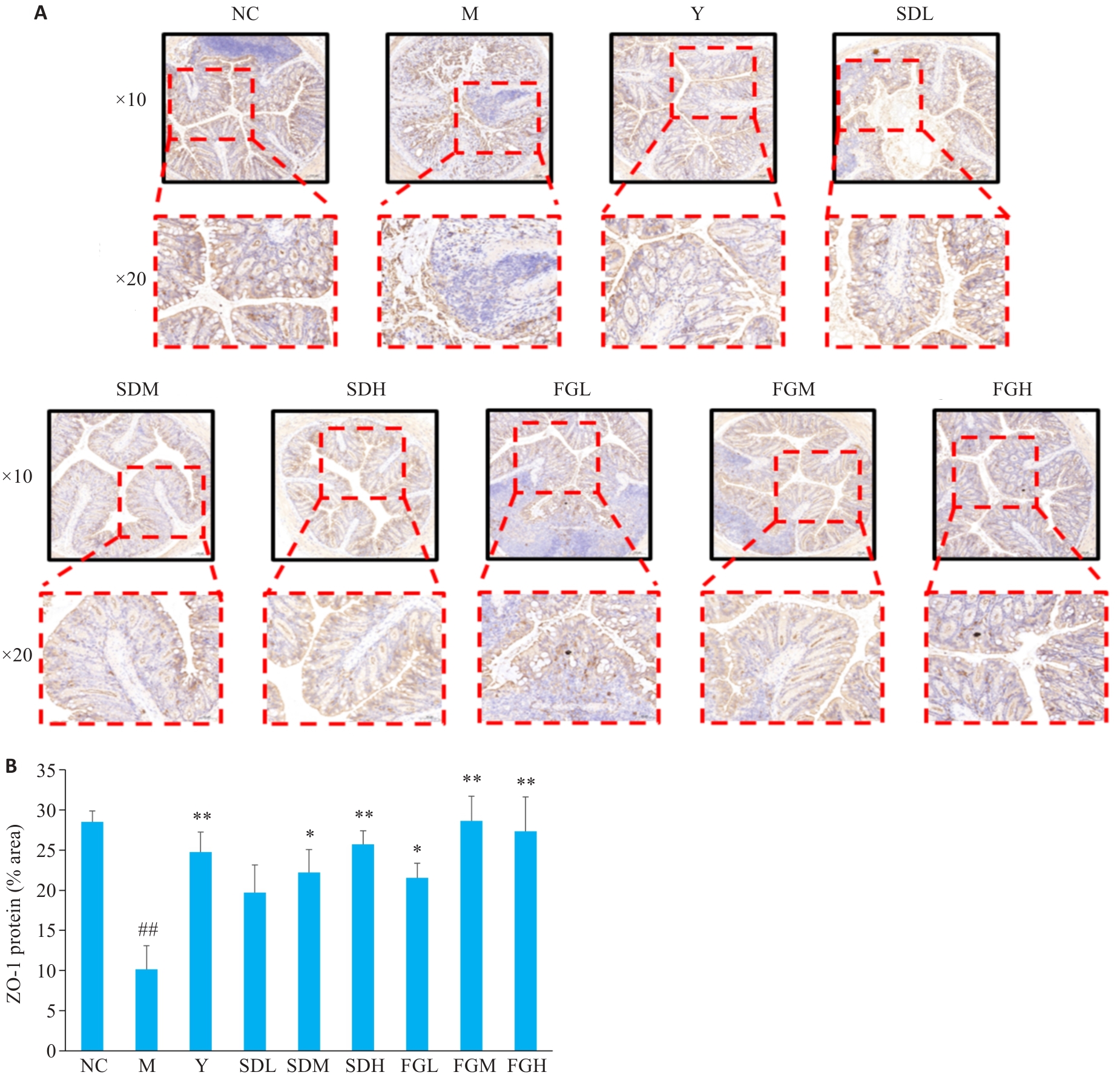
图11 各组小鼠肠道组织紧密连接蛋白 ZO-1免疫组化染色图像及定量分析
Fig.11 Representative immunohistochemical images and quantitative analysis of tight junction protein ZO-1 in intestinal tissues of mice in different groups. A: Representative immunohistochemical images of ZO-1. B: Protein expression of ZO-1 (n=3). ##P<0.01 vs NC group; *P<0.05, **P<0.01 vs M group.
| [1] | Zhu PP, Li G, Yang HJ. Trend analysis and regulatory strategies for traditional Chinese medicine formula granules[J]. Zhongguo Zhongyao Zazhi, 2024, 49(15): 4249-60. |
| [2] | Wu CF, Liao JB, Li D, et al. Clinical centralized safety monitoring and evaluation of traditional Chinese medicine formula granules[J]. Zhongguo Zhongyao Zazhi, 2023, 48(15): 4231-6. |
| [3] | 王 涛, 刘书琪, 黎耀宏, 等. 中药配方颗粒发展现状及企业生存策略探讨[J]. 中国实验方剂学杂志, 2023, 29(23): 166-73. |
| [4] | 杨鹤年, 张津铖, 吴宿慧, 等. 中药配方颗粒制备工艺、质量评价、与传统汤剂一致性的研究现状分析[J]. 中国实验方剂学杂志, 2023, 29(8): 266-74. |
| [5] | 国家药品监督管理局. 中药配方颗粒质量控制与标准制定技术要求 [EB/OL]. 国家药监局 2021 年第 16 号通告, 2021-01-26. |
| [6] | Zhang B, Qi DL, Deng XP, et al. Quantification of nineteen bioactive components in the ancient classical Chinese medicine formula of Wen-Dan decoction and its commercial preparations by UHPLC-QQQ-MS/MS[J]. Molecules, 2019, 24(11): 2031. doi:10.3390/molecules24112031 |
| [7] | Guo SB, Hu SW, Jiang LJ, et al. Quantitative determination of multi-class bioactive constituents for quality control of Yiqi Jiangzhi Granules[J]. Chin Herb Med, 2022, 14(2): 324-31. doi:10.1016/j.chmed.2022.03.001 |
| [8] | Xue T, Wang Q, Zhang PP, et al. Consistency between stir-frying Bombyx Batryticatus formula granules and traditional decoctions based on multi-component qualitative and quantitative analysis combined with GC-IMS and chemometrics[J]. J Pharm Biomed Anal, 2025, 264: 116971. doi:10.1016/j.jpba.2025.116971 |
| [9] | 张庆刚, 张代亮, 齐 红, 等. 钩藤降压方配方颗粒、传统汤剂化学成分一致性评价[J]. 中成药, 2025, 47(11): 3555-65. |
| [10] | 陈 剑, 周建富, 吴美兰, 等. 基于标准汤剂一致性的海桐皮(刺桐)配方颗粒质量标准研究[J]. 中国现代应用药学, 2026, 43(5): 813-22. |
| [11] | 袁兴钟滟, 吴灵娇, 杨 晨, 等. 基于关键质量属性在饮片-中间体-成品制剂过程传递的阿胶配方颗粒多维评价研究[J]. 中草药, 2026, 57(4): 1264-74. |
| [12] | 关欢欢, 白 雷, 袁冬平, 等. 中药制造全过程的品质传递控制与一致性评价研究进展[J]. 中草药, 2024, 55(5): 1728-37. doi:10.7501/j.issn.0253-2670.20243.05.030 |
| [13] | 李培生. 伤寒论讲义[M]. 上海: 上海科学技术出版社, 1985. |
| [14] | Wu R, Xi ZC, Liu MF, et al. Pulsatilla Decoction and its bioactive component β-peltatin induce G2/M cell cycle arrest and apoptosis in pancreatic cancer[J]. Chin Med, 2023, 18(1): 61. doi:10.1186/s13020-023-00774-0 |
| [15] | Deng LR, Han Q, Zou M, et al. Identification of potential immunomodulators from Pulsatilla decoction that act on therapeutic targets for ulcerative colitis based on pharmacological activity, absorbed ingredients, and in-silico molecular docking[J]. Chin Med, 2022, 17(1): 132. doi:10.1186/s13020-022-00684-7 |
| [16] | 于轶文, 曹佳蕾, 梁绿圆, 等. 白头翁汤化学成分、药理作用、临床研究进展及质量标志物预测分析 [J/OL]. 中华中医药学刊,1-14[2026-04-15]. . |
| [17] | Zhang LL, Zhu XL, Hu XC, et al. Baitouweng decoction regulates ferroptosis-mediated mitophagy and apoptosis through the SLC7A11/GPX4/FTH1 pathway in ulcerative colitis[J]. Phytomedicine, 2026, 153: 157898. doi:10.1016/j.phymed.2026.157898 |
| [18] | Li ZX, Song YG, Xu WZ, et al. Pulsatilla chinensis saponins improve SCFAs regulating GPR43-NLRP3 signaling pathway in the treatment of ulcerative colitis[J]. J Ethnopharmacol, 2023, 308: 116215. doi:10.1016/j.jep.2023.116215 |
| [19] | 徐蓓蕾, 张东琦, 杨娜娜, 等. 基于指纹图谱与谱效关系的白头翁潜在抗氧化质量标志物(Q-Marker)分析[J]. 中草药, 2025, 56(12): 4427-35. |
| [20] | Yang CH, Merlin D. Unveiling colitis: a journey through the dextran sodium sulfate-induced model[J]. Inflamm Bowel Dis, 2024, 30(5): 844-53. doi:10.1093/ibd/izad312 |
| [21] | Li XP, Wang ZH, Gao HY, et al. Pulsatillae Radix extract alleviates DSS-induced colitis via modulating gut microbiota and inflammatory signaling pathway in mice[J]. Heliyon, 2023, 9(11): e21869. doi:10.1016/j.heliyon.2023.e21869 |
| [22] | Miao ZW, Chen LP, Feng H, et al. Baitouweng decoction ameliorates ulcerative colitis in mice partially attributed to regulating Th17/treg balance and restoring intestinal epithelial barrier[J]. Front Pharmacol, 2021, 11: 531117. doi:10.3389/fphar.2020.531117 |
| [23] | CHENXuan-qing, Xiang-yu LV, LIUShi-jia. Baitouweng decoction alleviates dextran sulfate sodium-induced ulcerative colitis by regulating intestinal microbiota and the IL-6/STAT3 signaling pathway[J]. J Ethnopharmacol, 2021, 265: 113357. doi:10.1016/j.jep.2020.113357 |
| [24] | Chinese pharmacopoeia commission. 中华人民共和国药典-四部: 2025年版[M]. 北京: 中国医药科技出版社, 2025: 480. |
| [25] | 邓雅凤, 黄卓文, 罗忻昳, 等. 白头翁汤通过ALOX15与Rap1双靶点协同调控铁死亡修复溃疡性结肠炎小鼠肠黏膜屏障[J/OL].中国实验方剂学杂志, 1-19[2026-07-03].. |
| [26] | Katsandegwaza B, Horsnell W, Smith K. Inflammatory bowel disease: a review of pre-clinical murine models of human disease[J]. Int J Mol Sci, 2022, 23(16): 9344. doi:10.3390/ijms23169344 |
| [27] | Li MX, Li MY, Lei JX, et al. Huangqin decoction ameliorates DSS-induced ulcerative colitis: Role of gut microbiota and amino acid metabolism, mTOR pathway and intestinal epithelial barrier[J]. Phytomedicine, 2022, 100: 154052. doi:10.1016/j.phymed.2022.154052 |
| [28] | 张 萍, 李宁新, 李明华, 等. 2019年全国中药材及饮片质量分析报告[J]. 中国现代中药, 2020, 22(5): 663-71. doi:10.13313/j.issn.1673-4890.20200316002 |
| [29] | Huang XM, Liu XJ, Lin XY, et al. Thermodynamics driving phytochemical self-assembly morphological change and efficacy enhancement originated from single and co-decoction of traditional Chinese medicine[J]. J Nanobiotechnol, 2022, 20(1): 527. doi:10.1186/s12951-022-01734-w |
| [30] | 王凤霞, 陈芳雯, 沈成英, 等. 中药汤剂煎法的科学内涵研究进展[J]. 中国中药杂志, 2025, 50(4): 994-9. |
| [31] | 何 朝, 浦益琼. 中药复方汤液的相态差异分析研究进展 [J].中国实验方剂学杂志, 2022, 28(15): 259-266. doi:10.13422/j.cnki.syfjx.20212055 |
| [32] | 谢明辉, 张嘉懿, 蒋天晴, 等. 基于化学“组成-含量-相态”综合表征的黄连厚朴汤物质基础挖掘研究[J]. 中草药, 2025, 56(11): 3879-92. |
| [33] | 杨 薇, 李佳明, 刘圣金, 等. 基于HPLC/ICP-MS技术探讨白虎汤中石膏的配伍科学内涵[J]. 中药材, 2024, 47(7): 1765-72. |
| [34] | Ng SC, Shi HY, Hamidi N, et al. Worldwide incidence and prevalence of inflammatory bowel disease in the 21st century: a systematic review of population-based studies[J]. Lancet, 2017, 390(10114): 2769-78. doi:10.1016/s0140-6736(17)32448-0 |
| [35] | Pan SM, Wang CL, Hu ZF, et al. Baitouweng decoction repairs the intestinal barrier in DSS-induced colitis mice via regulation of AMPK/mTOR-mediated autophagy[J]. J Ethnopharmacol, 2024, 318(Pt A): 116888. doi:10.1016/j.jep.2023.116888 |
| [36] | Hu JY, Chen HX, Zhu L, et al. Baitouweng decoction modulates gut microbial production of indole-3-propionic acid and epithelial necroptosis to alleviate DSS-induced colitis in mice[J]. Chin Med, 2025, 20(1): 119. doi:10.1186/s13020-025-01143-9 |
| [37] | Niu C, Hu XL, Yuan ZW, et al. Pulsatilla decoction improves DSS-induced colitis via modulation of fecal-bacteria-related short-chain fatty acids and intestinal barrier integrity[J]. J Ethnopharmacol, 2023, 300: 115741. doi:10.1016/j.jep.2022.115741 |
| [38] | Fu ZX, Xie XY, Wang YL, et al. Modified Pulsatilla decoction ameliorates ulcerative colitis by affecting gut microbiota and metabolite profiles[J]. Front Microbiol, 2025, 16: 1582559. doi:10.3389/fmicb.2025.1582559 |
| [39] | Wei P, He QZ, Liu TT, et al. Baitouweng decoction alleviates dextran sulfate sodium-induced ulcerative colitis by suppressing leucine-related mTORC1 signaling and reducing oxidative stress[J]. J Ethnopharmacol, 2023, 304: 116095. doi:10.1016/j.jep.2022.116095 |
| [1] | 郭卓琳, 张智恒, 郭新邓, 杨苇巍, 梁芷晴, 区锦莹, 曹惠慧, 卢子滨, 余林中, 刘俊珊. 银翘散配方颗粒与传统汤剂在抗炎、抗菌及镇痛药效的差异比较[J]. 南方医科大学学报, 2025, 45(5): 1003-1012. |
| [2] | 冉念东, 刘杰, 徐剑, 张永萍, 郭江涛. 黑骨藤正丁醇萃取成分治疗大鼠阿尔茨海默病的药效学及作用机制[J]. 南方医科大学学报, 2025, 45(4): 785-798. |
| [3] | 郭新邓, 郭卓琳, 孙冬梅, 邹丽芳, 区锦莹, 余林中, 卢子滨, 曹惠慧, 刘俊珊. 连翘配方颗粒与饮片的抗炎、抗肿瘤和抑菌效果的比较研究[J]. 南方医科大学学报, 2024, 44(3): 594-604. |
| [4] | 张榆雪, 蓝洁莹, 马昕怡, 周琼, 秦梦晨, 高磊. 化橘红配方颗粒通过维持铁稳态并抑制脂质过氧化和铁死亡缓解斑马鱼脂肪性肝病[J]. 南方医科大学学报, 2024, 44(12): 2265-2275. |
| [5] | 晏子俊,谢江川,何丹,胡雪原,张景勍. 天门冬酰胺酶自组装空心纳米囊的药代动力学及生物等效性[J]. 南方医科大学学报, 2016, 36(01): 90-. |
| [6] | 孔艺,刘媛,李国锋,谢海辉. 大戟根的化学成分分析[J]. 南方医科大学学报, 2013, 33(12): 1748-. |
| [7] | 周鹏志,刘凤斌,罗琦,孙嫣,丁飞跃,陈斌. 白头翁汤对溃疡性结肠炎小鼠肠道miR-19a表达的影响[J]. 南方医科大学学报, 2012, 32(11): 1597-. |
| [8] | 王红,谭群友,张梨,程训官,张景勍. 溴吡斯的明分散片在兔体内的生物等效性研究[J]. 南方医科大学学报, 2011, 31(10): 1778-. |
| [9] | 吕本强; 邢学锋; 罗佳波;. 注射用双黄连冻干粉化学成分的分离与鉴别[J]. 南方医科大学学报, 2006, 26(10): 1471-. |
| 阅读次数 | ||||||
|
全文 |
|
|||||
|
摘要 |
|
|||||
