
南方医科大学学报 ›› 2026, Vol. 46 ›› Issue (10): 2548-2557.doi: 10.12122/j.issn.1673-4254.2026.10.22
• • 上一篇
余政颖1( ), 周炳亮1, 孟祥顺1, 王蕾2, 黄胜和3(), 曹虹1()
收稿日期:2026-03-05
出版日期:2026-10-20
发布日期:2026-10-26
通讯作者:
黄胜和,曹虹
E-mail:19568703090@163.com;shhuang35@gmail.com;gzhcao@smu.edu.cn
作者简介:余政颖,硕士,E-mail: 19568703090@163.com
基金资助:
Zhengying YU1(), Bingliang ZHOU1, Xiangshun MENG1, Lei WANG2, Shenghe HUANG3(), Hong CAO1()
Received:2026-03-05
Online:2026-10-20
Published:2026-10-26
Contact:
Shenghe HUANG, Hong CAO
E-mail:19568703090@163.com;shhuang35@gmail.com;gzhcao@smu.edu.cn
摘要:
目的 探讨醉茄素A(WA)对新生儿致脑膜炎大肠杆菌(NMEC)生物膜形成机制及黏附能力的干预效果。以及ibeR作为调节因子对NMEC生物膜形成机制和血脑屏障(BBB)的黏附作用的影响。 方法 用CCK-8法测定不同浓度WA处理后细胞的存活率。通过预实验、细胞毒性评估,筛选出合适的WA浓度用于正式实验。培养新生儿致脑膜炎大肠杆菌RS218(E44),用不同浓度WA干预设置分组,对照组、WA(1 μmol/L)、WA(2 μmol/L)、WA(5 μmol/L),测量吸光度(A600 nm)检测细菌生长能力,用结晶紫染色和生物膜形成指数(SBF)计算比较生物膜的形成能力。qPCR法检测添加WA后E44中ibeR、ibeA、ibeT、TnaA表达水平。培养已成功构建的ibeR缺失突变株(BR2),探究ibeR对生长能力、生物膜形成能力的影响。在体外培养人脑微血管内皮细胞(HBMECs),然后与E44及BR2进行共培养。针对不同的菌种,设立对照组以及WA(1 μmol/L)组、WA(2 μmol/L)组,以研究不同浓度WA和ibeR对菌株粘附率的影响。培养E44及BR2,不同浓度WA干预设置分组,测定上清液吲哚含量,为进一步探究吲哚在ibeR调控的生物膜形成中的作用,检测添加不同浓度吲哚下E44和BR2的生物膜含量。 结果 计算IC50的结果结合WA对细胞毒性的影响,选择WA干预浓度为2 μmol/L。WA不影响细菌增殖,但抑制生物膜形成能力,添加不同浓度的WA后,E44菌株形成的生物膜随着WA浓度增加减少(P<0.0001),BR2菌株无明显变化。qPCR结果显示,WA组的ibeR表达水平显著性下降(P<0.0001)。ibeR缺失不影响细菌增殖,相同时间点,BR2的生物膜形成能力均显著低于E44(P<0.0001)。ibeR缺失显著削弱菌黏附能力(P<0.0001),与对照组相比,WA组中E44粘附率显著性下降(P<0.0001),且随浓度增加,抑制效果越强(P<0.0001),BR2粘附率无明显变化。与对照组相比,添加不同浓度WA的E44组的吲哚产量显著增高(P<0.0001),生物膜含量显著降低(P<0.0001),BR2组无明显变化。 结论 ibeR缺失使NMEC粘附能力下降和抑制生物膜形成,ibeR通过调控吲哚的生成调节生物膜形成。WA可影响ibeR的表达,WA不影响细菌增殖仅抑制生物膜形成能力,WA通过影响ibeR抑制生物膜形成,对细菌粘附能力的有剂量依赖性影响。
余政颖, 周炳亮, 孟祥顺, 王蕾, 黄胜和, 曹虹. 醉茄素A通过下调 ibeR 表达抑制新生儿脑膜炎大肠杆菌的生物膜形成和黏附能力[J]. 南方医科大学学报, 2026, 46(10): 2548-2557.
Zhengying YU, Bingliang ZHOU, Xiangshun MENG, Lei WANG, Shenghe HUANG, Hong CAO. Withaferin A inhibits biofilm formation and adhesion of neonatal meningitis Escherichia coli by downregulating ibeR expression[J]. Journal of Southern Medical University, 2026, 46(10): 2548-2557.
| Gene | Primer sequences (5'-3')-F | Primer sequences (5'-3')-R |
|---|---|---|
| ibeA | AGTCGACTTGTACTCGGGTTAGAG | ATAACACCGATGCCAAC |
| ibeR | GATGTCGACGGGCTTTTCGGCGTCA | CGTCTAGATAAGGGCTAAACATATCG |
| ibeT | AATCCCTTATGGCGTAATG | GATCTAGAATGCCCGCAAGGGCG |
| TnaA | TGCAACCATCACCAGTAAC | GTCCATTACCACCGGAATATC |
| RRS | TATTGCACAATGGGCGCAAG | ACTTAACAAACCGCCTGCGT |
表1 qPCR的引物序列
Tab.1 Primer sequences used for qPCR
| Gene | Primer sequences (5'-3')-F | Primer sequences (5'-3')-R |
|---|---|---|
| ibeA | AGTCGACTTGTACTCGGGTTAGAG | ATAACACCGATGCCAAC |
| ibeR | GATGTCGACGGGCTTTTCGGCGTCA | CGTCTAGATAAGGGCTAAACATATCG |
| ibeT | AATCCCTTATGGCGTAATG | GATCTAGAATGCCCGCAAGGGCG |
| TnaA | TGCAACCATCACCAGTAAC | GTCCATTACCACCGGAATATC |
| RRS | TATTGCACAATGGGCGCAAG | ACTTAACAAACCGCCTGCGT |
| Test category | Main assessment content | Maximum score |
|---|---|---|
| Motor test | Forelimb/hindlimb flexion when suspended by tail, walking along a straight line, etc. | 6 Points |
| Sensory test | Placing test, proprioceptive test | 2 Points |
| Balance beam test | Ability to maintain balance and walk on a balance beam | 6 Points |
| Reflexes and abnormal movements | Pinna reflex, corneal reflex, startle reflex, and presence of seizures/myoclonus | 4 Points |
表2 mNSS评分表
Tab.2 Modified neurological severity score
| Test category | Main assessment content | Maximum score |
|---|---|---|
| Motor test | Forelimb/hindlimb flexion when suspended by tail, walking along a straight line, etc. | 6 Points |
| Sensory test | Placing test, proprioceptive test | 2 Points |
| Balance beam test | Ability to maintain balance and walk on a balance beam | 6 Points |
| Reflexes and abnormal movements | Pinna reflex, corneal reflex, startle reflex, and presence of seizures/myoclonus | 4 Points |
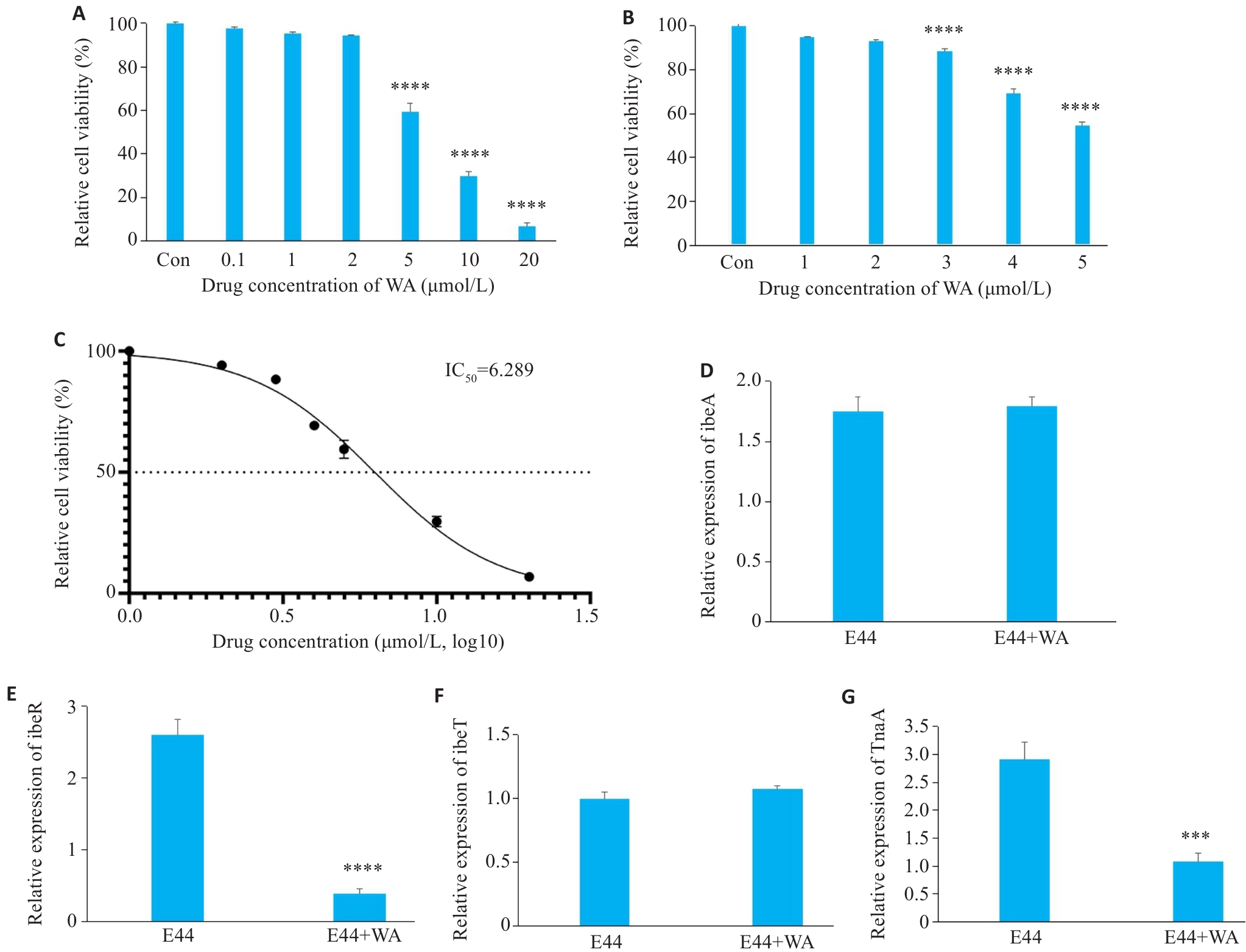
图1 WA对HBMECs细胞活性的影响,WA干预E44后ibeR、ibeA、ibeT、TnaA表达情况
Fig 1 Effect of WA on viability of cultured human brain microvascular endothelial cells (HBMECs) and expression levels of ibeR, ibeA and ibeT in E44 strain. A: Relative viability of HBMECs treated with different concentrations of WA in preliminary experiment (n=6). B: Relative cell viability after WA treatment in formal experiment (n=6). C: Dose-effect curve and calculation of IC50 of WA in HBMECs (n=6). D-G: Expression levels of ibeA, ibeR, ibeT and TnaA in E44 and WA-treated E44 (n=3). ***P<0.001 vs E44 group, ****P<0.0001 vs WA(2 μmol/L) group or E44 group.
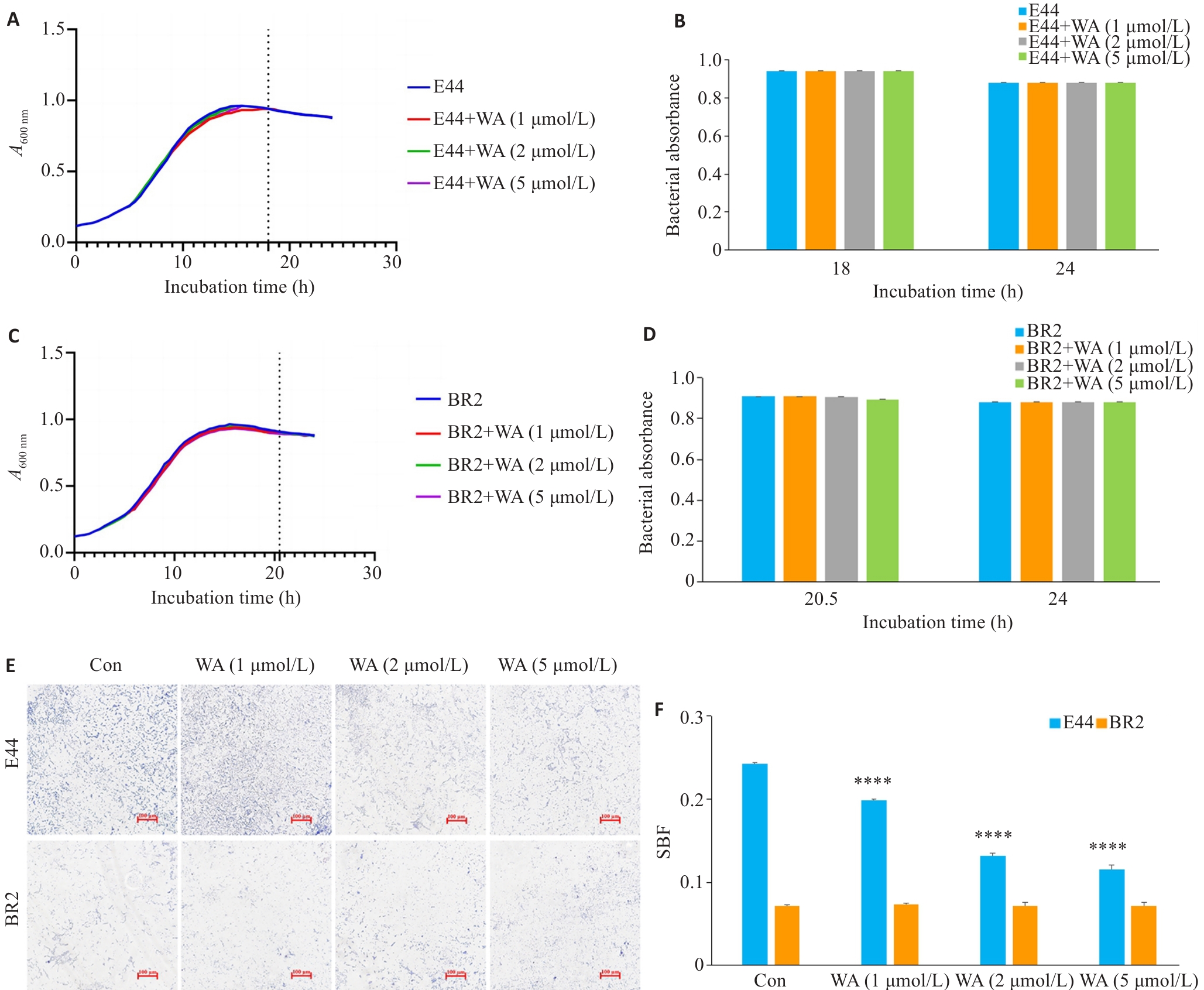
图2 WA干预下,E44和BR2菌株的生长情况和生物膜含量
Fig.2 Growth and biofilm content of E44 and BR2 strains with WA treatment. A, C: Growth curves of E44 and BR2 strains treated with different concentrations of WA (n=4). B, D: Absorbance of E44 at 18 and 24 h and of BR2 at 20.5 h and 24 h (n=4). E: Microscopic observation of biofilms formed by the two strains after WA intervention (Crystal violet staining). F: Absorbance of the stained biofilms dissolved in anhydrous ethanol for calculating SBF (n=3). ****P<0.0001 vs control group.
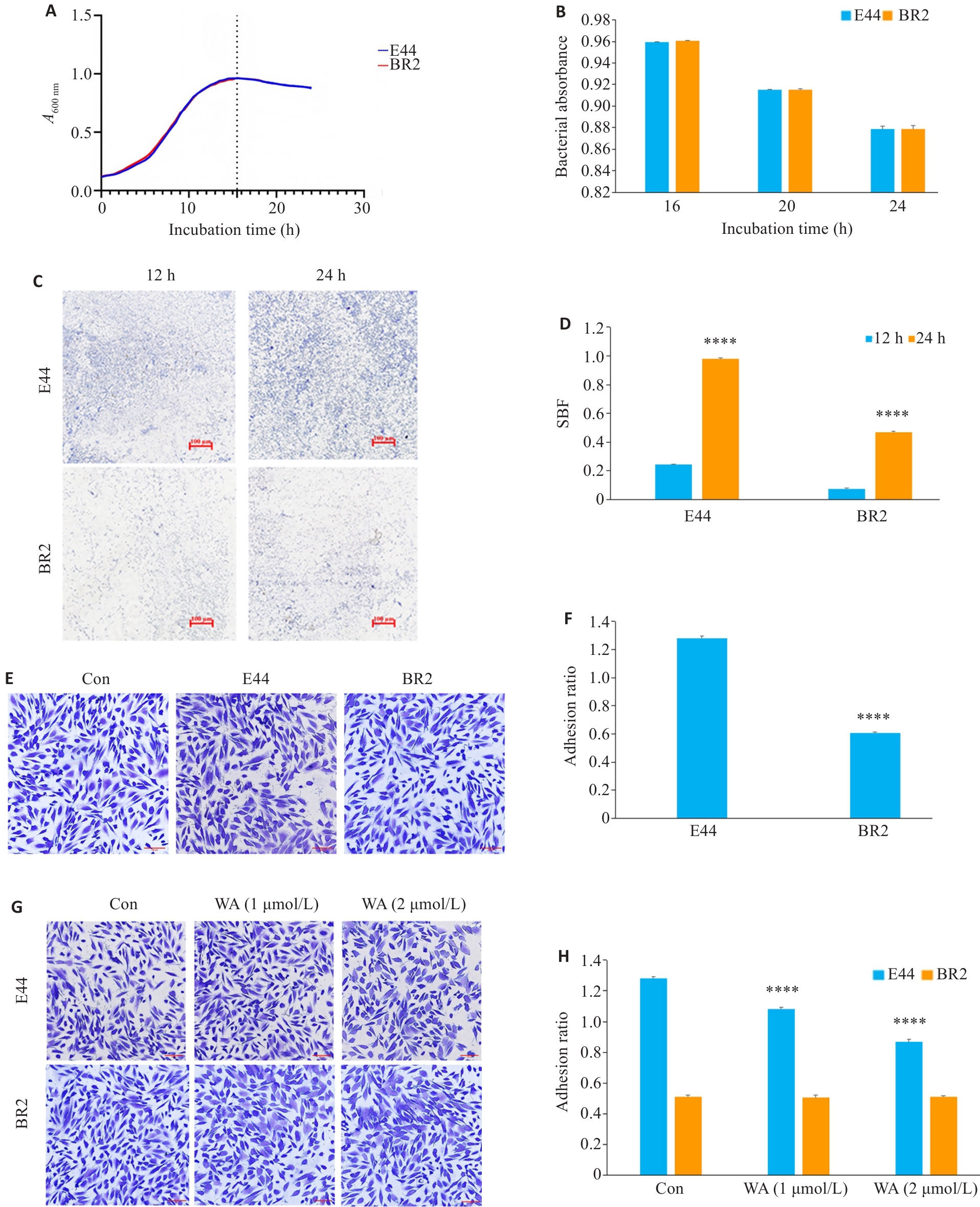
图3 E44和BR2菌株的生长情况和粘附率
Fig 3 Growth and adhesion rate of E44 and BR2 strains. A: Growth curves of E44 and BR2 strains. B: Absorbance of E44 and BR2 at 16, 20 and 24 h. C: Microscopic observation of biofilms formed by the two strains at 12 and 24 h (Crystal violet staining). D: Absorbance of the stained biofilms dissolved in anhydrous ethanol for calculating SBF. E, G: Observation of bacterial adhesion after staining (×200). F, H: Adhesion ratios of the two strains. ****P<0.0001 vs E44 group or control group.
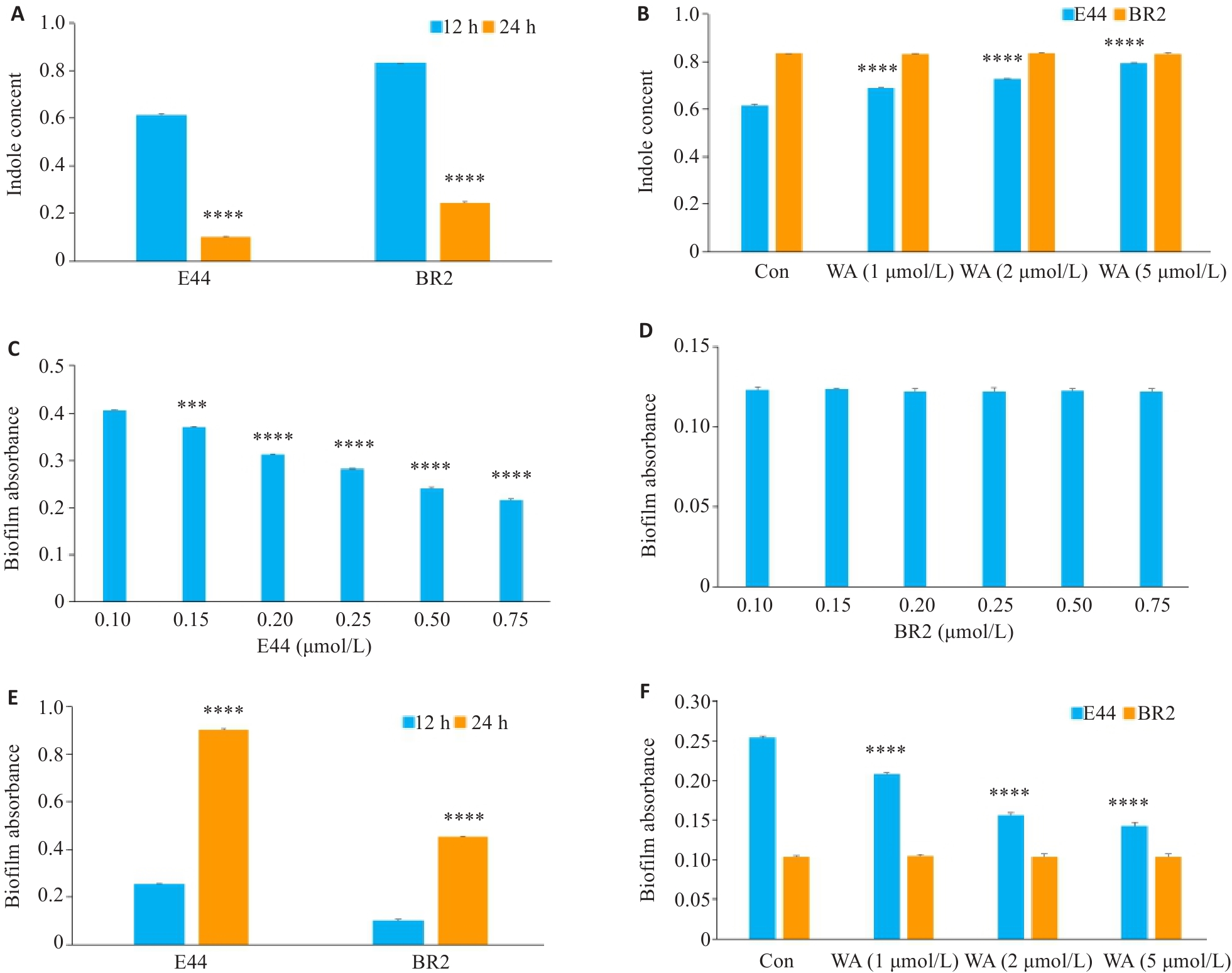
图4 E44和BR2菌株上清液吲哚水平及生物膜形成机制
Fig 4 Indole levels in the supernatants of E44 and BR2 strains and mechanism of biofilm formation. A: Indole levels in the supernatants of E44 and BR2 strains collected at 12 and 24 h (n=3). B: Detection of indole levels in the supernatants of the two strains cultured in the presence of different concentrations of WA (n=3). C, D: Detection of biofilms of E44 and BR2 treated with exogenous indole (n=3). E: Detection of biofilm formation of E44 and BR2 strains at 12 and 24 h (n=3). F: Detection of biofilm formation of the two strains cultured in the presence of different concentrations of WA (n=3). ***P<0.001 vs control group, ****P<0.0001 vs E44 group or control group.
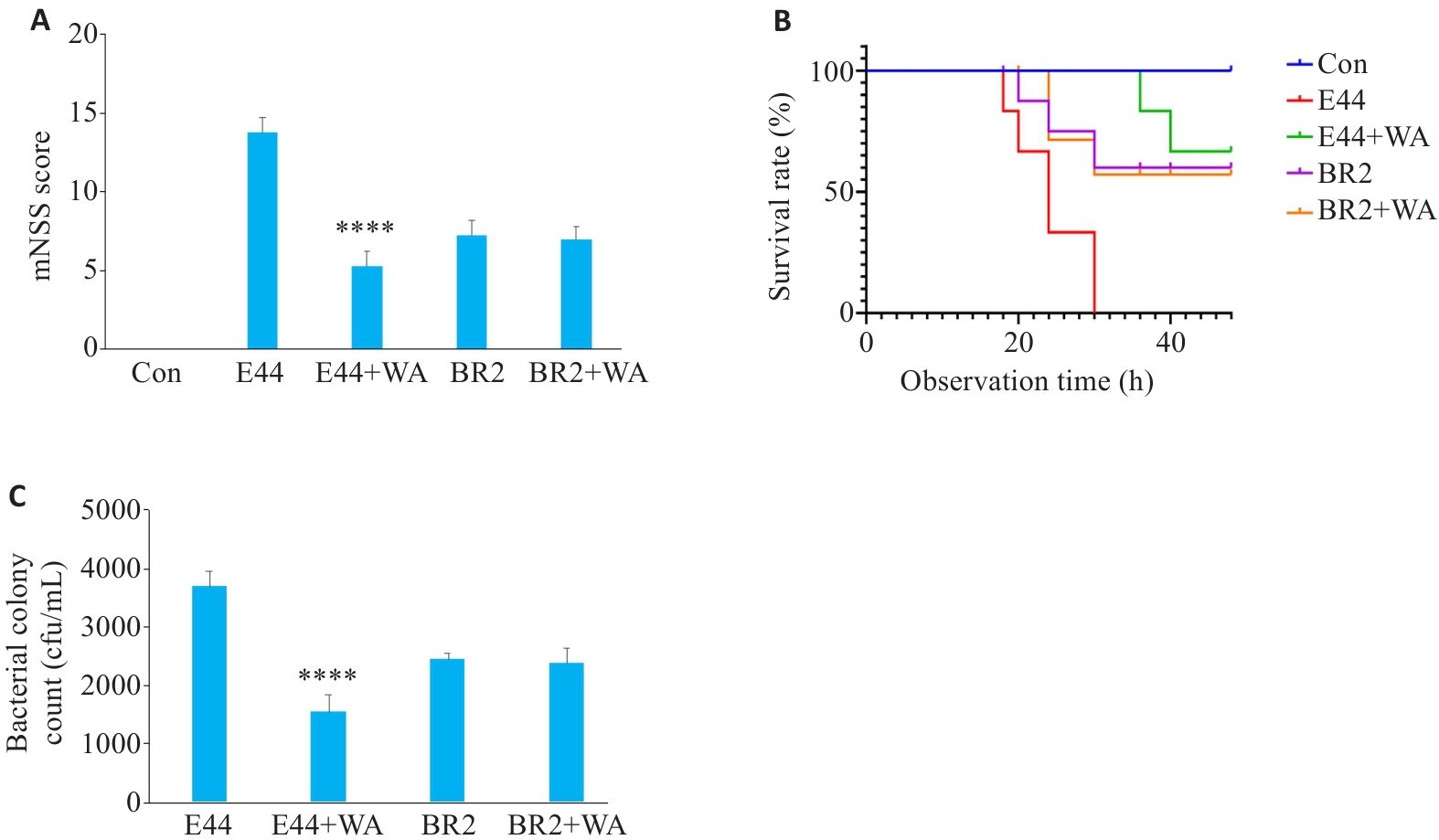
图5 检测脑膜炎模型鼠的构建是否成功, 并初步评估WA的干预效果
Fig.5 Validation of meningitis modeling in mice and assessment of the therapeutic effect of WA. A: Effects of WA on mNSS scores in mice with meningitis (n=4). B: Kaplan-Meier survival curves of the mice in each group (n=6). C: Bacterial loads in the cerebrospinal fluid (CSF) of the mice (n=3). ****P<0.0001 vs control group or E44 group.
| [1] | Peng XS, Zhu QX, Liu J, et al. Prevalence and antimicrobial resistance patterns of bacteria isolated from cerebrospinal fluid among children with bacterial meningitis in China from 2016 to 2018: a multicenter retrospective study[J]. Antimicrob Resist Infect Control, 2021, 10(1): 24. doi:10.1186/s13756-021-00895-x |
| [2] | Antoine C, Laforêt F, Goya-Jorge E, et al. Phage targeting neonatal meningitis E. coli K1 in vitro in the intestinal microbiota of pregnant donors and impact on bacterial populations[J]. Int J Mol Sci, 2023, 24(13): 10580. doi:10.3390/ijms241310580 |
| [3] | Wang XH, Zhang YH, Chen XR, et al. RIPK1 kinase drove brain microvascular endothelial cells death and blood-brain barrier disruption in neonatal Escherichia coli meningitis[J]. Nat Commun, 2025, 16(1): 7309. doi:10.1038/s41467-025-62760-4 |
| [4] | Yang JH, Ma W, Wu YY, et al. O-Acetylation of capsular polysialic acid enables Escherichia coli K1 escaping from Siglec-mediated innate immunity and lysosomal degradation of E. coli-Containing vacuoles in Macrophage-like cells[J]. Microbiol Spectr, 2021, 9(3): e00399-21. doi:10.1128/spectrum.00399-21 |
| [5] | Fan Y, Sun HM, Yang W, et al. YbdO promotes the pathogenicity of Escherichia coli K1 by regulating capsule synthesis[J]. Int J Mol Sci, 2022, 23(10): 5543. doi:10.3390/ijms23105543 |
| [6] | Venketaraman V, Hajjar K, Sheren N. E. coli meningitis[M]//In Vitro and In Vivo Models to Study Infections of the Central Nervous System. New York, NY: Springer US, 2025: 27-33. doi:10.1007/978-1-0716-4674-8_2 |
| [7] | Liu YL, Zhu ML, Fu XQ, et al. Escherichia coli causing neonatal meningitis during 2001-2020: a study in Eastern China[J]. Int J Gen Med, 2021, 14: 3007-16. doi:10.2147/ijgm.s317299 |
| [8] | Alkeskas A, Ogrodzki P, Saad M, et al. The molecular characterisation of Escherichia coli K1 isolated from neonatal nasogastric feeding tubes[J]. BMC Infect Dis, 2015, 15(1): 449. doi:10.1186/s12879-015-1210-7 |
| [9] | Karygianni L, Ren Z, Koo H, et al. Biofilm matrixome: extracellular components in structured microbial communities[J]. Trends Microbiol, 2020, 28(8): 668-81. doi:10.1016/j.tim.2020.03.016 |
| [10] | Mechmechani S, Gharsallaoui A, Karam L, et al. Pepsin and trypsin treatment combined with carvacrol: an efficient strategy to fight Pseudomonas aeruginosa and Enterococcus faecalis biofilms[J]. Microorganisms, 2023, 11(1): 143. doi:10.3390/microorganisms11010143 |
| [11] | Uruén C, Chopo-Escuin G, Tommassen J, et al. Biofilms as promoters of bacterial antibiotic resistance and tolerance[J]. Antibiotics, 2020, 10(1): 3. doi:10.3390/antibiotics10010003 |
| [12] | Carbone A, Cascioferro S, Parrino B, et al. Thiazole analogues of the marine alkaloid nortopsentin as inhibitors of bacterial biofilm formation[J]. Molecules, 2021, 26(1): 81. doi:10.3390/molecules26010081 |
| [13] | Mohamad F, Alzahrani RR, Alsaadi A, et al. An explorative review on advanced approaches to overcome bacterial resistance by curbing bacterial biofilm formation[J]. Infect Drug Resist, 2023, 16: 19-49. doi:10.2147/idr.s380883 |
| [14] | Huynh BT, Padget M, Garin B, et al. Burden of bacterial resistance among neonatal infections in low income countries: how convincing is the epidemiological evidence[J]? BMC Infect Dis, 2015, 15(1): 127. doi:10.1186/s12879-015-0843-x |
| [15] | Birlutiu V, Birlutiu RM. An overview of the epidemiology of multidrug resistance and bacterial resistance mechanisms: what solutions are available? a comprehensive review[J]. Microorganisms, 2025, 13(9): 2194. doi:10.3390/microorganisms13092194 |
| [16] | Fu P, Xu HM, Jing CM, et al. Bacterial epidemiology and antimicrobial resistance profiles in children reported by the ISPED program in China, 2016 to 2020[J]. Microbiol Spectr, 2021, 9(3): e00283-21. doi:10.1128/spectrum.00283-21 |
| [17] | Beaumont AL, Kermorvant-Duchemin E, Breurec S, et al. Neonatal colonization with antibiotic-resistant pathogens in low- and middle-income countries: a systematic review and meta-analysis[J]. JAMA Netw Open, 2024, 7(11): e2441596. doi:10.1001/jamanetworkopen.2024.41596 |
| [18] | Sora VM, Meroni G, Martino PA, et al. Extraintestinal pathogenic Escherichia coli: virulence factors and antibiotic resistance[J]. Pathogens, 2021, 10(11): 1355. doi:10.3390/pathogens10111355 |
| [19] | Bok E, Mazurek-Popczyk J, Wojciech M, et al. Extraintestinal traits of pathogenicity and sequence type lineages in commensal Escherichia coli from adults and young children: genotypic and phenotypic profiles. Front Microbiol. 2025, 16: 1579685. doi:10.3389/fmicb.2025.1579685 |
| [20] | Edison LK, Kariyawasam S. From the gut to the brain: transcriptomic insights into neonatal meningitis Escherichia coli across diverse host niches[J]. Pathogens, 2025, 14(5): 485. doi:10.3390/pathogens14050485 |
| [21] | Paul S, Chakraborty S, Anand U, et al. Withania somnifera (L.) Dunal (Ashwagandha): a comprehensive review on ethnopharma-cology, pharmacotherapeutics, biomedicinal and toxicological aspects[J]. Biomed Pharmacother, 2021, 143: 112175. doi:10.1016/j.biopha.2021.112175 |
| [22] | Sajida, Prabhu A. Anti-angiogenic, apoptotic and matrix metalloproteinase inhibitory activity of Withania somnifera (ashwagandha) on lung adenocarcinoma cells[J]. Phytomedicine, 2021, 90: 153639. doi:10.1016/j.phymed.2021.153639 |
| [23] | Murugan R, Subramaniyan S, Priya S, et al. Bacterial clearance and anti-inflammatory effect of Withaferin A against human pathogen of Staphylococcus aureus in infected zebrafish[J]. Aquat Toxicol, 2023, 260: 106578. doi:10.1016/j.aquatox.2023.106578 |
| [24] | Wijetunge DSS, Katani R, Kapur V, et al. Complete genome sequence of Escherichia coli strain RS218 (O18: H7: K1), associated with neonatal meningitis[J]. Genome Announc, 2015, 3(4): e00804-15. doi:10.1128/genomea.00804-15 |
| [25] | Paris T, Kiss A, Signor L, et al. The IbeA protein from adherent invasive Escherichia coli is a flavoprotein sharing structural homology with FAD-dependent oxidoreductases[J]. FEBS J, 2024, 291(1): 177-203. doi:10.1111/febs.16969 |
| [26] | Chi F, Wang Y, Gallaher TK, et al. Identification of IbeR as a stationary-phase regulator in meningitic Escherichia coli K1 that carries a loss-of-function mutation in rpoS[J]. J Biomed Biotechnol, 2009, 2009: 520283. doi:10.1155/2009/520283 |
| [27] | Wang SH, Bao YL, Meng QM, et al. IbeR facilitates stress-resistance, invasion and pathogenicity of avian pathogenic Escherichia coli [J]. PLoS One, 2015, 10(3): e0119698. doi:10.1371/journal.pone.0119698 |
| [28] | Razzaq Meo S, Van de Wiele T, Defoirdt T. Indole signaling in Escherichia coli: a target for antivirulence therapy?[J]. Gut Microbes, 2025, 17(1): 2499573. doi:10.1080/19490976.2025.2499573 |
| [29] | Xiroudaki S, Sabbatini S, Pecoraro C, et al. Development of a new indole derivative dry powder for inhalation for the treatment of biofilm-associated lung infections[J]. Int J Pharm, 2023, 631: 122492. doi:10.1016/j.ijpharm.2022.122492 |
| [30] | Wang YS, Bian ZR, Wang Y. Biofilm formation and inhibition mediated by bacterial quorum sensing[J]. Appl Microbiol Biotechnol, 2022, 106(19): 6365-81. doi:10.1007/s00253-022-12150-3 |
| [31] | Martinez-Medina M, Naves P, Blanco J, et al. Biofilm formation as a novel phenotypic feature of adherent-invasive Escherichia coli (AIEC)[J]. BMC Microbiol, 2009, 9: 202. doi:10.1186/1471-2180-9-202 |
| [32] | Bustamante P, Ramos-Corominas MN, Martinez-Medina M. Contribution of toxin-antitoxin systems to adherent-invasive E. coli pathogenesis[J]. Microorganisms, 2024, 12(6): 1158. doi:10.3390/microorganisms12061158 |
| [33] | Fan Y, Bai J, Xi DY, et al. RpoE facilitates stress-resistance, invasion, and pathogenicity of Escherichia coli K1[J]. Microorganisms, 2022, 10(5): 879. doi:10.3390/microorganisms10050879 |
| [34] | Holmes CL, Anderson MT, Mobley HLT, et al. Pathogenesis of gram-negative bacteremia[J]. Clin Microbiol Rev, 2021, 34(2): e00234-20. doi:10.1128/cmr.00234-20 |
| [35] | Lê‑Bury P, Echenique-Rivera H, Pizarro-Cerdá J, et al. Determinants of bacterial survival and proliferation in blood[J]. FEMS Microbiol Rev, 2024, 48(3): fuae013. doi:10.1093/femsre/fuae013 |
| [36] | Kodori M, Nikmanesh B, Hakimi H, et al. Antibiotic susceptibility and biofilm formation of bacterial isolates derived from pediatric patients with cystic fibrosis from Tehran, Iran[J]. Arch Razi Inst, 2021, 76(2): 397-406. |
| [37] | Banerjee D, Shivapriya PM, Gautam PK, et al. A review on basic biology of bacterial biofilm infections and their treatments by nanotechnology-based approaches[J]. Proc Natl Acad Sci Ind Sect B Biol Sci, 2020, 90(2): 243-59. doi:10.1007/s40011-018-01065-7 |
| [38] | Cascioferro S, Carbone D, Parrino B, et al. Therapeutic strategies to counteract antibiotic resistance in MRSA biofilm-associated infections[J]. ChemMedChem, 2021, 16(1): 65-80. doi:10.1002/cmdc.202000677 |
| [39] | Liu JD, Van Treeck KE, Marston WA, et al. Ultrasound-mediated antibiotic delivery to in vivo biofilm infections: a review[J]. Chembiochem, 2024, 25(20): e202400181. doi:10.1002/cbic.202400181 |
| [40] | Mayer C, Borges A, Flament-Simon SC, et al. Quorum sensing architecture network in Escherichia coli virulence and pathogenesis[J]. FEMS Microbiol Rev, 2023, 47(4): fuad031. doi:10.1093/femsre/fuad031 |
| [1] | 王静娴, 任自敬, 周佩洋. S1PR5激动与过表达通过调控氧化应激增强脑微血管内皮细胞屏障功能抵抗氧糖剥夺/复氧复糖损伤[J]. 南方医科大学学报, 2025, 45(7): 1451-1459. |
| [2] | 李泽涵, 梁萌, 韩根成, 张学武. 菊淀粉型巴戟天寡糖降低肺炎链球菌脑膜炎小鼠的症状评分和死亡率[J]. 南方医科大学学报, 2025, 45(3): 577-586. |
| [3] | 秦萌, 孙思宇, 刘佳琪, 高玉娇, 汪昊, 王友坤, 孙奥, 严加纯, 汪金宝, 于影. 白藜芦醇改善PM2.5诱导的脑缺血再灌注损伤小鼠血脑屏障及维持线粒体动力学平衡[J]. 南方医科大学学报, 2025, 45(12): 2690-2698. |
| [4] | 赵倩, 张振, 周星琦, 荣翔宇, 刘雪柔, 赵新丽, 王豪杰, 庞金龙, 李姗姗, 李娴. 川芎增强替莫唑胺对小鼠脑转移黑色素瘤脑的抑制作用[J]. 南方医科大学学报, 2024, 44(6): 1088-1097. |
| [5] | 许光明, 高安迪, 丛 斌. 束缚应激通过激活Rho/ROCK通路诱导大鼠杏仁核血脑屏障的损伤[J]. 南方医科大学学报, 2024, 44(3): 411-419. |
| [6] | 李新翼, 刘玉杰, 邓克崇, 胡义奎. 调节肠道菌群可改善卒中后大鼠的神经功能和抑郁症状[J]. 南方医科大学学报, 2024, 44(2): 405-410. |
| [7] | 牛雯雯, 荣翔宇, 赵 倩, 刘雪柔, 徐廉松, 李姗姗, 李 娴. 酒川芎增强阿美替尼对EGFR突变型非小细胞肺癌脑移植瘤的抑制作用[J]. 南方医科大学学报, 2023, 43(3): 375-382. |
| [8] | 李 晒, 李 丽, 闵思敏, 刘赛赛, 秦志文, 熊志尚, 徐建国, 王博文, 丁渡山, 赵士弟. 大豆异黄酮可减轻大鼠脑缺血/再灌注损伤:基于抑制铁死亡及炎症级联反应[J]. 南方医科大学学报, 2023, 43(2): 323-330. |
| [9] | 李 帆, 朱艳艳, 孙晓明, 胡慧娟, 周苗苗, 白怡雪, 胡 浩. 邻苯二甲酸二乙基己酯可能通过损伤血脑屏障诱导小鼠焦虑样行为和学习记忆障碍[J]. 南方医科大学学报, 2022, 42(8): 1237-1243. |
| [10] | 袁 巧, 谢丽英, 陈朝俊. 黄芪多糖减轻大脑中动脉闭塞模型大鼠的血脑屏障损伤:基于抑制P2X7R通道[J]. 南方医科大学学报, 2022, 42(11): 1705-1711. |
| [11] | 何佳宁, 梁东生, 梁悦娥, 左诗雅, 赵望泓. 新型抗菌肽KR-1的设计、筛选及抗菌活性评价[J]. 南方医科大学学报, 2021, 41(6): 923-930. |
| [12] | 徐丽,林迪斯,杨靖,李健,李蓓. 肺炎克雷伯菌KbvR调控因子对细菌生物膜与荚膜形成能力的影响[J]. 南方医科大学学报, 2016, 36(10): 1435-. |
| [13] | 徐巧玲,孙凤军,冯伟,刘晓,刘亚巍. DNaseⅠ对金黄色葡萄球菌生物膜形成的影响[J]. 南方医科大学学报, 2015, 35(09): 1356-. |
| [14] | 张立科,邱嘉文,梁晓路,黄宝怡,李妍,杜蕾,龙敏,罗军,黄胜和,曹虹. CD44在新生隐球菌体外感染血脑屏障中对单核细胞迁移的影响[J]. 南方医科大学学报, 2015, 35(04): 468-. |
| [15] | 李妍,杜蕾,袁霖,陈德喜,邱嘉文,何肖龙,曹虹,黄胜和. 外周血中血脑屏障损伤新型标记物脑微血管内皮细胞检测方法的建立[J]. 南方医科大学学报, 2014, 34(12): 1733-. |
| 阅读次数 | ||||||
|
全文 |
|
|||||
|
摘要 |
|
|||||
