
南方医科大学学报 ›› 2026, Vol. 46 ›› Issue (3): 638-645.doi: 10.12122/j.issn.1673-4254.2026.03.17
• 基础研究 • 上一篇
李杰( ), 刘毅楠, 王栋, 李浩鹏, 贺西京, 卢腾()
收稿日期:2025-09-24
出版日期:2026-03-20
发布日期:2026-03-26
通讯作者:
卢腾
E-mail:15191589376@163.com;luteng656@126.com
作者简介:李 杰,在读博士研究生,E-mail: 15191589376@163.com
基金资助:
Jie LI(), Yinan LIU, Dong WANG, Haopeng LI, Xijing HE, Teng LU()
Received:2025-09-24
Online:2026-03-20
Published:2026-03-26
Contact:
Teng LU
E-mail:15191589376@163.com;luteng656@126.com
Supported by:摘要:
目的 对比新型Ti-3Zr-2Sn-3Mo-25Nb β钛合金与传统Ti-6Al-4V钛合金椎弓根钉棒固定系统在后路腰椎椎体间融合术(PLIF)中的生物力学差异。 方法 通过体外力学测试评估β钛合金螺钉、连接棒以及二者组成的固定系统抵抗弯曲、拉伸、压缩以及扭转载荷的力学性能。构建两种PLIF有限元模型,从而比较Ti-6Al-4V与β钛合金钉棒固定系统对活动度(ROM)、终板以及植入物应力的影响。 结果 体外力学测试显示,β钛合金螺钉具有良好的抗弯曲(455.95±18.66 N)与扭转(9.03±0.20 N·m)性能。β钛合金棒可负载最大拉力为17647.06 ± 101.89 N。β钛合金钉棒系统负载最大压力为417.65±5.09 N、最大扭矩为25.00±0.70 N·m。与Ti-6Al-4V相比,β钛合金模型中ROM增加2.6%~8.3%,椎间植骨、椎间融合器、终板的峰值应力分别增加1.4%~8.5%、2.2%~9.4%、2.2%~10.1%,骨-螺钉界面、钉棒系统的峰值应力分别降低8.8%~23.7%、19.0%~33.1%。 结论 β钛合金椎弓根固定系统具有良好的体外力学性能,它可能提供与传统Ti-6Al-4V固定系统相似的稳定性,同时明显降低钉棒系统的应力集中。新型Ti-3Zr-2Sn-3Mo-25Nb β钛合金椎弓根钉棒固定系统具有良好的应用潜力。
李杰, 刘毅楠, 王栋, 李浩鹏, 贺西京, 卢腾. 新型β钛合金椎弓根钉棒固定系统的体外力学测试与有限元分析[J]. 南方医科大学学报, 2026, 46(3): 638-645.
Jie LI, Yinan LIU, Dong WANG, Haopeng LI, Xijing HE, Teng LU. In vitro mechanical testing and finite element analysis of a novel β-Titanium alloy pedicle screw-rod fixation system[J]. Journal of Southern Medical University, 2026, 46(3): 638-645.
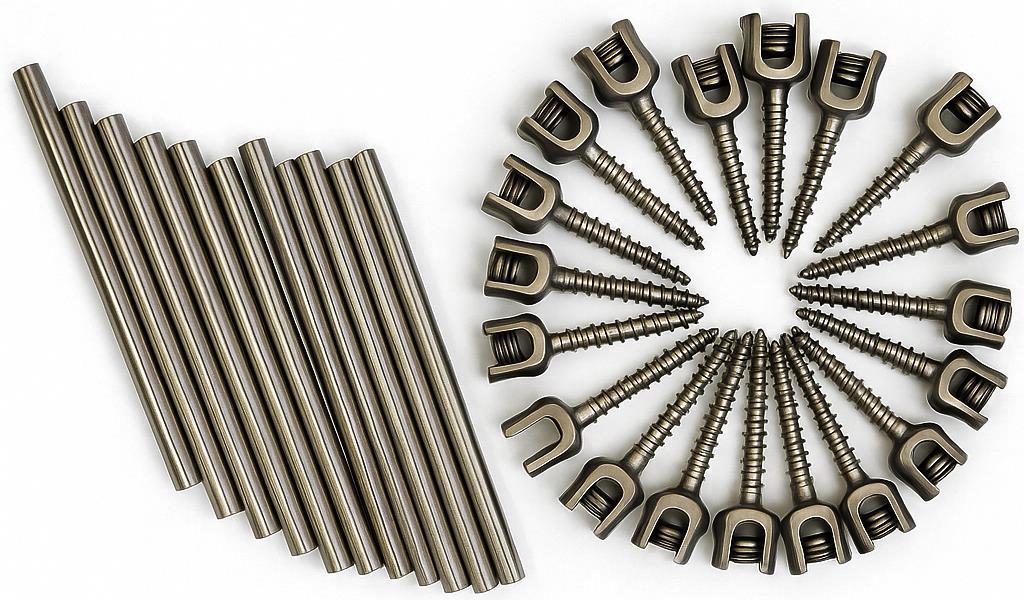
图1 β钛合金螺钉及固定棒成品
Fig.1 Finished β-Titanium alloy screws and the connecting rods.
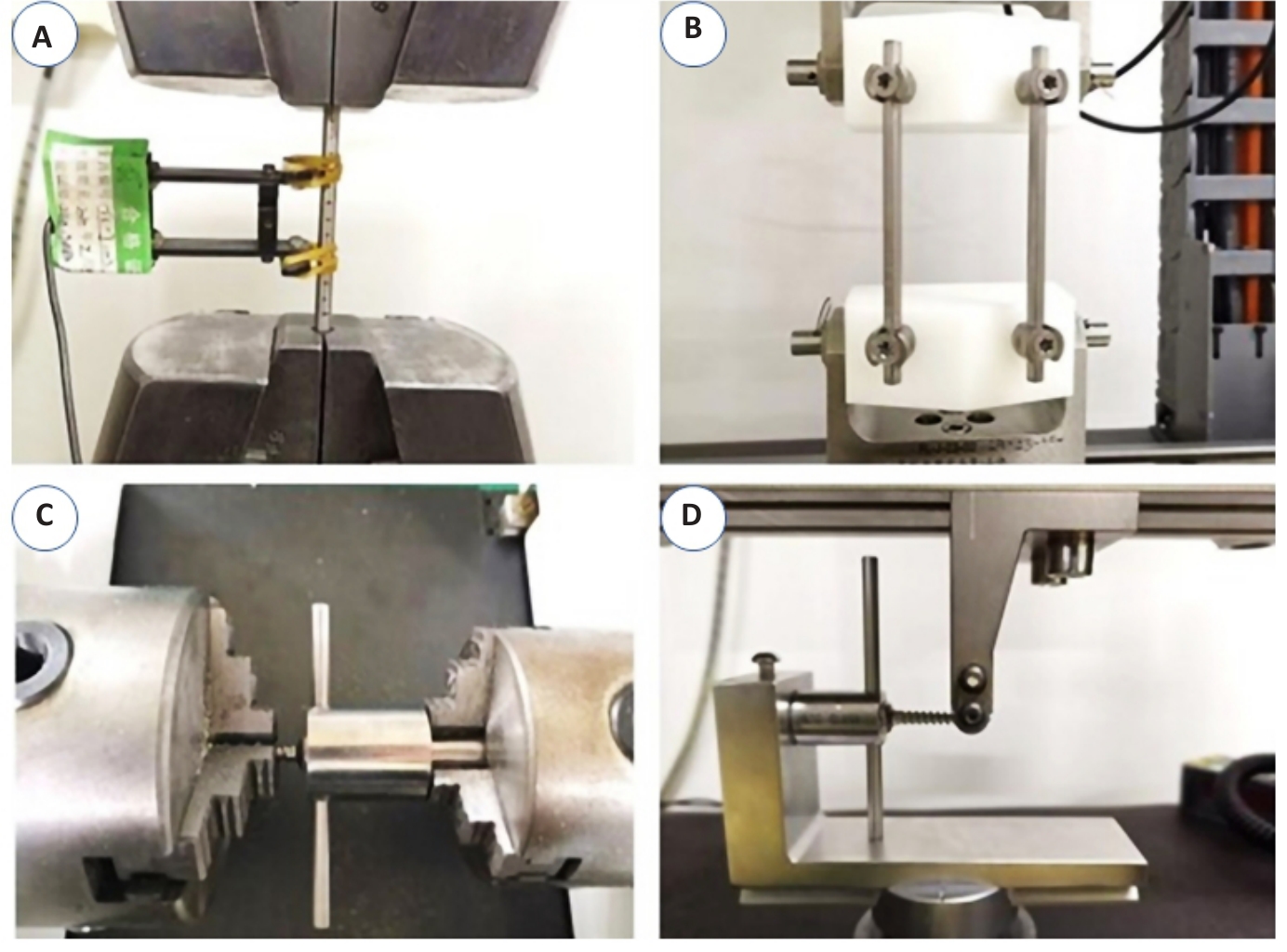
图2 β钛合金钉棒静态力学性能测试过程
Fig.2 Static mechanical testing of β-titanium alloy screws and rods. A: Tensile test of the β-titanium alloy rod. B: Compression-torsion test of the β-titanium alloy screw-rod system. C: Torsion test of the β-titanium alloy screw. D: Bending test of the β-titanium alloy screw.
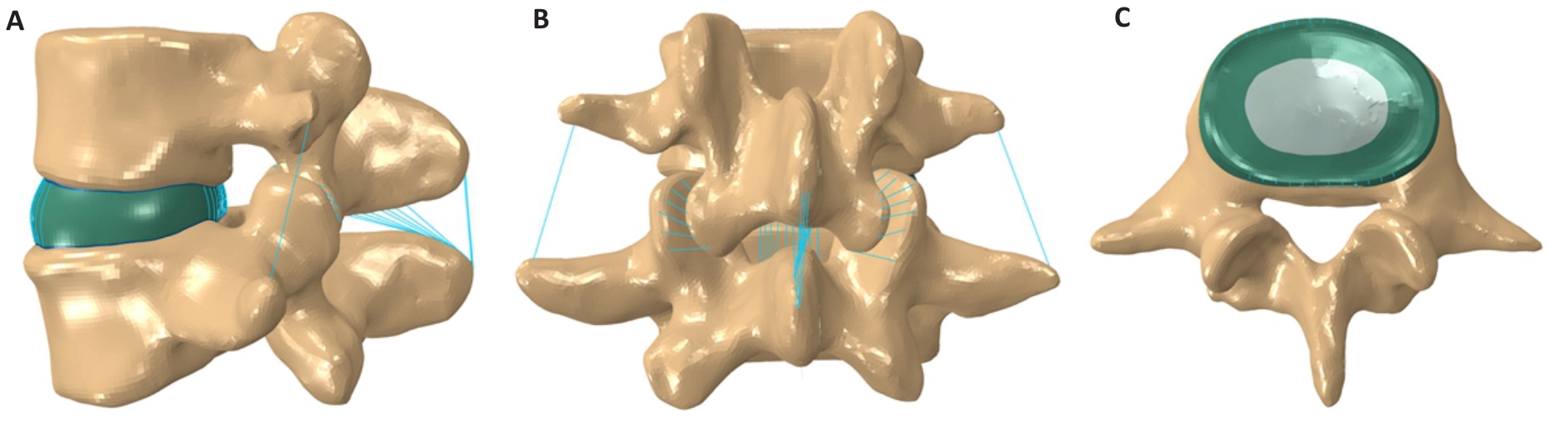
图3 完整L4-L5腰椎有限元模型
Fig.3 Intact L4-L5 lumbar finite element model. A: Lateral view. B: Posterior view. C: Axial view.
| Materials | Element type | Constitutive equation | Young's modulus | Poisson's ratio (μ) |
|---|---|---|---|---|
| Cortical bone | C3D4 | Isotropic elastic | 12 GPa | 0.3 |
| Cancellous bone | C3D4 | neo-Hookean | C10 = 19.38 MPa, D = 0.0252 MPa | |
| Bony endplate | C3D8I | Isotropic elastic | 1.2 GPa | 0.29 |
| Cartilage endplate | C3D8I | neo-Hookean | C10 = 4.10 MPa, D =0.03 MPa | |
| Nucleus pulposus | C3D8H | Mooney-Rivlin | C10 = 0.12 MPa, C01 = 0.03 MPa | |
| Annulus ground | C3D8H | Mooney-Rivlin | C10 = 0.18 MPa, C01 = 0.045 MPa | |
| Annulus fiber | T3D2 | Hypoelastic | 360-550 MPa | |
| Screws and rods | C3D4 | Isotropic elastic | 110 GPa, 55 GPa | 0.3 |
| Cage | C3D4 | Isotropic elastic | 3.6 GPa | 0.25 |
| Bone grafts | C3D4 | Isotropic elastic | 100 MPa | 0.2 |
表1 有限元模型中的材料属性与单元类型
Tab.1 Material properties and element types in the finite element models
| Materials | Element type | Constitutive equation | Young's modulus | Poisson's ratio (μ) |
|---|---|---|---|---|
| Cortical bone | C3D4 | Isotropic elastic | 12 GPa | 0.3 |
| Cancellous bone | C3D4 | neo-Hookean | C10 = 19.38 MPa, D = 0.0252 MPa | |
| Bony endplate | C3D8I | Isotropic elastic | 1.2 GPa | 0.29 |
| Cartilage endplate | C3D8I | neo-Hookean | C10 = 4.10 MPa, D =0.03 MPa | |
| Nucleus pulposus | C3D8H | Mooney-Rivlin | C10 = 0.12 MPa, C01 = 0.03 MPa | |
| Annulus ground | C3D8H | Mooney-Rivlin | C10 = 0.18 MPa, C01 = 0.045 MPa | |
| Annulus fiber | T3D2 | Hypoelastic | 360-550 MPa | |
| Screws and rods | C3D4 | Isotropic elastic | 110 GPa, 55 GPa | 0.3 |
| Cage | C3D4 | Isotropic elastic | 3.6 GPa | 0.25 |
| Bone grafts | C3D4 | Isotropic elastic | 100 MPa | 0.2 |
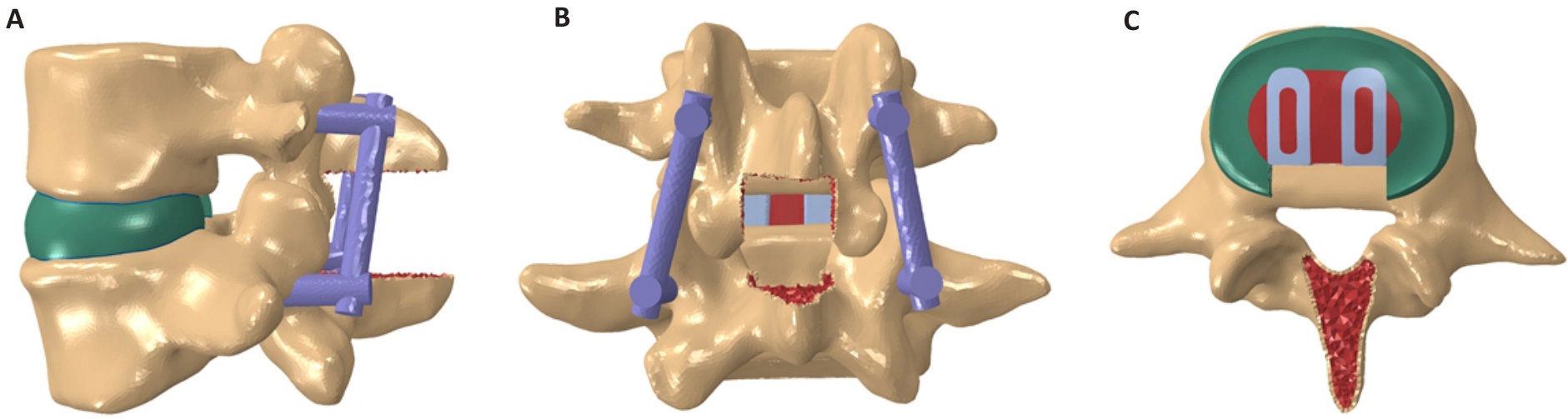
图4 后路腰椎椎体间融合术(PLIF)模型
Fig.4 Posterior lumbar interbody fusion (PLIF) model. A: Lateral view. B: Posterior view. C: Axial view.
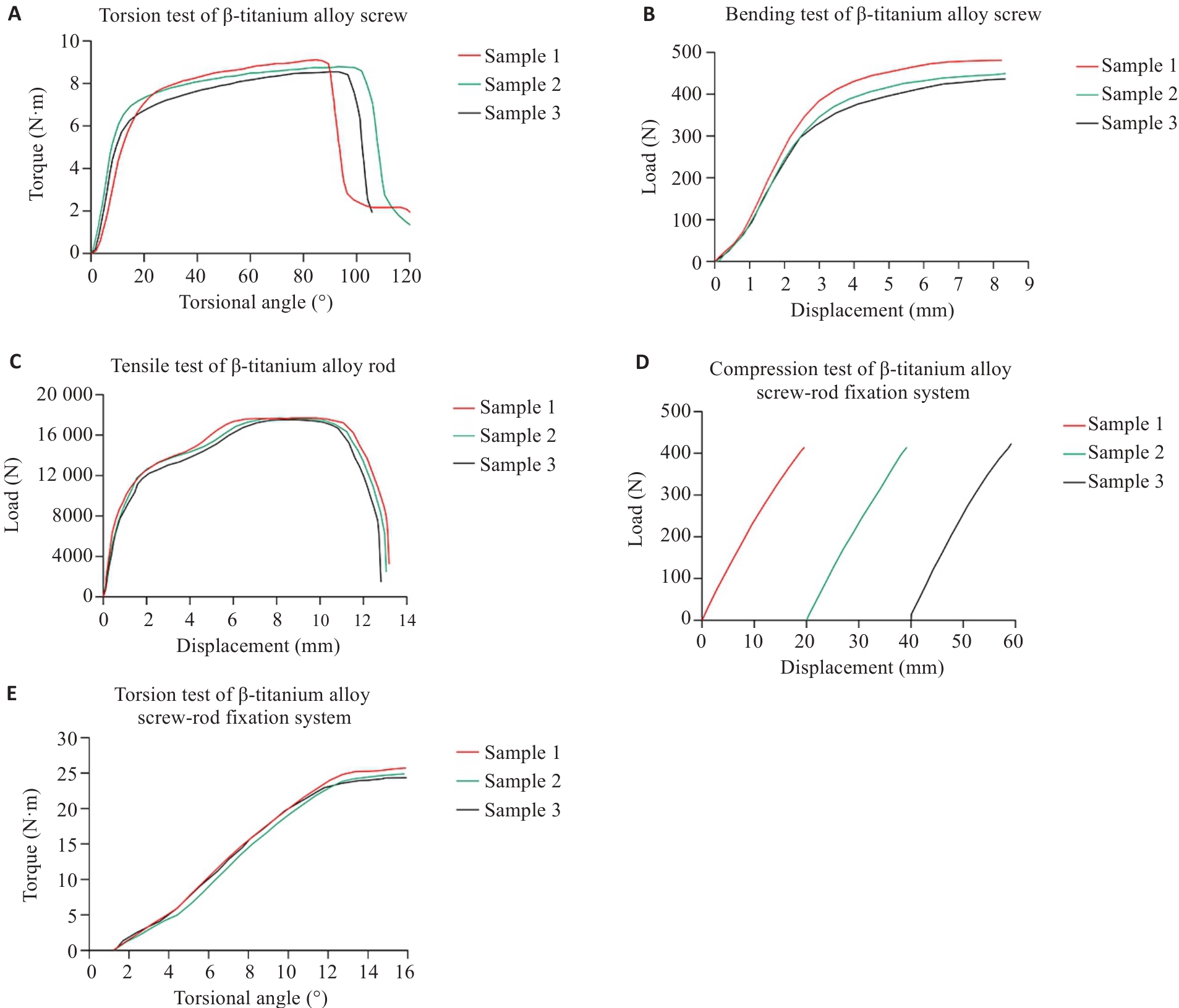
图5 β钛合金椎弓根钉棒固定系统的体外力学性能测试
Fig.5 Results of in vitro mechanical testing of the β-titanium alloy pedicle screw-rod fixation system. A: Torsion test of the β‑titanium alloy screw. B: Bending test of the β‑titanium alloy screw. C: Tensile test of the β‑titanium alloy rod. D: Compression test of the β-titanium alloy screw-rod fixation system. E: Torsion test of the β‑titanium alloy screw-rod fixation system.
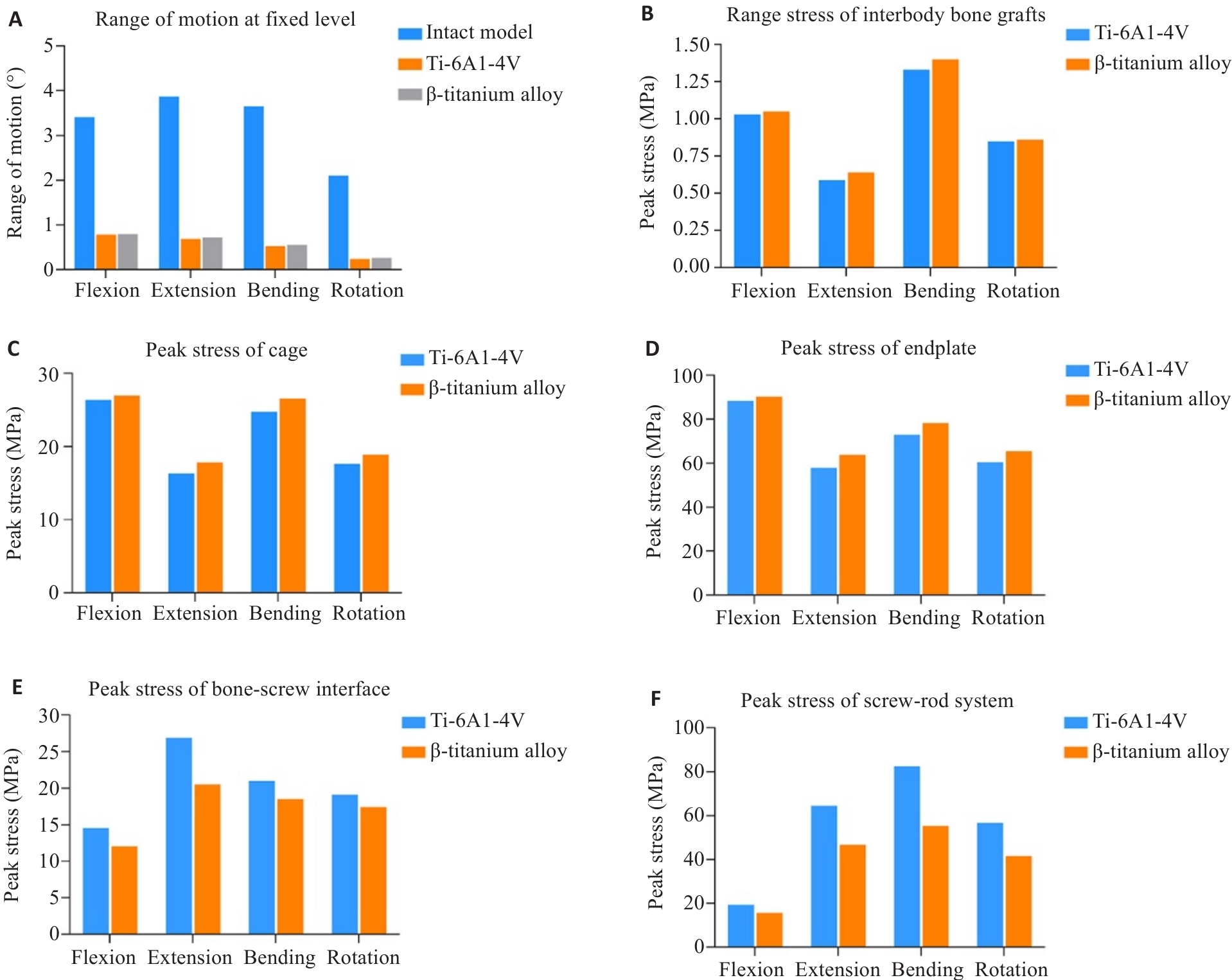
图6 节段活动度与组件应力分析结果
Fig.6 Results of segmental range of motion and stress within components. A: Segment range of motion for each model. B: Peak stress in the interbody bone graft. C: Peak stress in the cage. D: Peak stress in the endplate. E: Peak stress at the bone-screw interface. F: Peak stress in the screw-rod system.
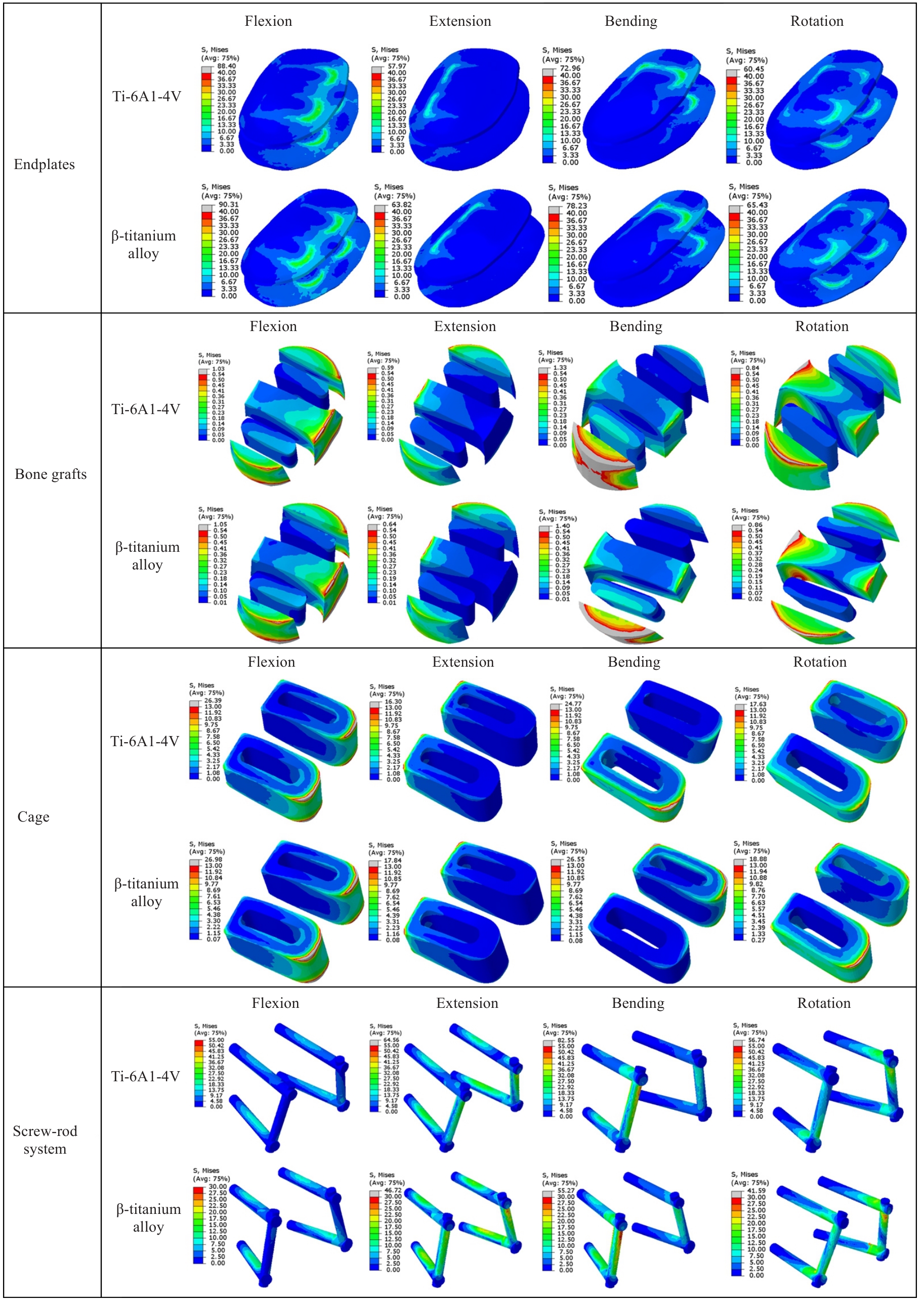
图7 终板、植骨、cage以及钉棒系统的应力云图
Fig.7 Stress nephogram of the endplate, interbody bone graft, cage, and screw-rod system.
| [1] | Chang MC, Choo YJ, Lee GW. Pedicle screws versus cortical screws in posterior lumbar interbody fusion surgery for degenerative spondylolisthesis: a systematic review and meta-analysis[J]. Spine J, 2021, 21(7): 1126-34. doi:10.1016/j.spinee.2021.02.019 |
| [2] | Eastlack RK, Nunley PD, Poelstra KA, et al. Finite element analysis comparing a PEEK posterior fixation device versus pedicle screws for lumbar fusion[J]. J Orthop Surg Res, 2023, 18(1): 855. doi:10.1186/s13018-023-04349-5 |
| [3] | Son HJ, Choi SH, Heo DR, et al. Outcomes of the use of cement-augmented cannulated pedicle screws in lumbar spinal fusion[J]. Spine J, 2021, 21(11): 1857-65. doi:10.1016/j.spinee.2021.05.005 |
| [4] | Lam TN, Trinh MG, Huang CC, et al. Investigation of bone growth in additive-manufactured pedicle screw implant by using Ti-6Al-4V and bioactive glass powder composite[J]. Int J Mol Sci, 2020, 21(20): E7438. doi:10.3390/ijms21207438 |
| [5] | Li J, Cao S, Zhao B. Biomechanical comparison of polyetheretherketone rods and titanium alloy rods in transforaminal lumbar interbody fusion: a finite element analysis[J]. BMC Surg, 2024, 24(1): 169. doi:10.1186/s12893-024-02462-8 |
| [6] | Zhang H, Wang Z, Wang Y, et al. Biomaterials for interbody fusion in bone tissue engineering[J]. Front Bioeng Biotechnol, 2022, 10: 900992. doi:10.3389/fbioe.2022.900992 |
| [7] | Loenen ACY, Peters MJM, Bevers RTJ, et al. Early bone ingrowth and segmental stability of a trussed titanium cage versus a polyether ether ketone cage in an ovine lumbar interbody fusion model[J]. Spine J, 2022, 22(1): 174-82. doi:10.1016/j.spinee.2021.07.011 |
| [8] | Wong KK, Hsu HC, Wu SC, et al. A review: design from beta titanium alloys to medium-entropy alloys for biomedical applications[J]. Materials: Basel, 2023, 16(21): 7046. doi:10.3390/ma16217046 |
| [9] | Xiang W, Yuan W, Deng H, et al. Effect of aging temperature on the microstructure and mechanical properties of a novel β titanium alloy[J]. Materials: Basel, 2023, 16(23): 7393. doi:10.3390/ma16237393 |
| [10] | Hua Z, Zhang D, Guo L, et al. Negative mixing enthalpy medium-entropy Ti-Zr-Nb-Al alloys with ultrahigh elastic admissible strain, strength-elongation product, and biocompatibility for bone implant applications[J]. Acta Biomater, 2025, 197: 476-94. doi:10.1016/j.actbio.2025.03.030 |
| [11] | Kacsó AB, Peter I. A review of past research and some future perspectives regarding titanium alloys in biomedical applications[J]. J Funct Biomater, 2025, 16(4): 144. doi:10.3390/jfb16040144 |
| [12] | Song T, Chen Z, Cui X, et al. Strong and ductile titanium-oxygen-iron alloys by additive manufacturing[J]. Nature, 2023, 618(7963): 63-8. doi:10.1038/s41586-023-05952-6 |
| [13] | Calazans Neto JV, Celles CAS, de Andrade CSAF, et al. Recent advances and prospects in β-type titanium alloys for dental implants applications[J]. ACS Biomater Sci Eng, 2024, 10(10): 6029-60. doi:10.1021/acsbiomaterials.4c00963 |
| [14] | Tshephe TS, Akinwamide SO, Olevsky E, et al. Additive manufacturing of titanium-based alloys-A review of methods, properties, challenges, and prospects[J]. Heliyon, 2022, 8(3): e09041. doi:10.1016/j.heliyon.2022.e09041 |
| [15] | Wang L, Zhou W, Yu Z, et al. An in vitro evaluation of the hierarchical micro/nanoporous structure of a Ti3Zr2Sn3Mo25Nb alloy after surface dealloying[J]. ACS Appl Mater Interfaces, 2021, 13(13): 15017-30. doi:10.1021/acsami.1c02140 |
| [16] | Jing WS, Zhang MH, Jin L, et al. Assessment of osteoinduction using a porous hydroxyapatite coating prepared by micro-arc oxidation on a new titanium alloy[J]. Int J Surg, 2015, 24: 51-6. doi:10.1016/j.ijsu.2015.08.030 |
| [17] | Yu S, Yu ZT, Wang G, et al. Biocompatibility and osteoconduction of active porous calcium-phosphate films on a novel Ti-3Zr-2Sn-3Mo-25Nb biomedical alloy[J]. Colloids Surf B Biointerfaces, 2011, 85(2): 103-15. doi:10.1016/j.colsurfb.2011.02.025 |
| [18] | Li J, Cao S, Guo D, et al. Biomechanical properties of different anterior and posterior techniques for atlantoaxial fixation: a finite element analysis[J]. J Orthop Surg Res, 2023, 18(1): 456. doi:10.1186/s13018-023-03905-3 |
| [19] | Li K, Cao S, Chen J, et al. Determining a relative total lumbar range of motion to alleviate adjacent segment degeneration after transforaminal lumbar interbody fusion: a finite element analysis[J]. BMC Musculoskelet Disord, 2024, 25(1): 197. doi:10.1186/s12891-024-07322-3 |
| [20] | Lu T, Ren JK, Sun ZW, et al. Relationship between the elastic modulus of the cage material and the biomechanical properties of transforaminal lumbar interbody fusion: a logarithmic regression analysis based on parametric finite element simulations[J]. Comput Meth Programs Biomed, 2022, 214: 106570. doi:10.1016/j.cmpb.2021.106570 |
| [21] | Lu T, Sun ZW, Xia HH, et al. Comparing the osteogenesis outcomes of different lumbar interbody fusions (A/O/X/T/PLIF) by evaluating their mechano-driven fusion processes[J]. Comput Biol Med, 2024, 171: 108215. doi:10.1016/j.compbiomed.2024.108215 |
| [22] | Li J, Du Z, Cao S, et al. Quantitative relationships between elastic modulus of rod and biomechanical properties of transforaminal lumbar interbody fusion: a finite element analysis[J]. Front Bioeng Biotechnol, 2024, 12: 1510597. doi:10.3389/fbioe.2024.1510597 |
| [23] | Wong CE, Hu HT, Kao LH, et al. Biomechanical feasibility of semi-rigid stabilization and semi-rigid lumbar interbody fusion: a finite element study[J]. BMC Musculoskelet Disord, 2022, 23(1): 10. doi:10.1186/s12891-021-04958-3 |
| [24] | Xie Y, Ma L, Yang Z, et al. Biomechanical analysis of posterior, transforaminal, extreme, oblique, and anterior lumbar interbody fusion surgical models: a finite element study[J]. Comput Methods Biomech Biomed Engin, 2025: 1-14. doi:10.1080/10255842.2025.2514135 |
| [25] | Sarraf M, Rezvani Ghomi E, Alipour S, et al. A state-of-the-art review of the fabrication and characteristics of titanium and its alloys for biomedical applications[J]. Bio Des Manuf, 2022, 5(2): 371-95. doi:10.1007/s42242-021-00170-3 |
| [26] | Straumal BB, Anisimova NY, Kiselevskiy MV, et al. Influence of the phase composition of titanium alloys on cell adhesion and surface colonization[J]. Materials, 2023, 16(22): 7130. doi:10.3390/ma16227130 |
| [27] | Dias Corpa Tardelli J, Bolfarini C, Cândido dos Reis A. Comparative analysis of corrosion resistance between beta titanium and Ti-6Al-4V alloys: a systematic review[J]. J Trace Elem Med Biol, 2020, 62: 126618. doi:10.1016/j.jtemb.2020.126618 |
| [28] | Liu J, Wang K, Li X, et al. Biocompatibility and osseointegration properties of a novel high strength and low modulus β-Ti10Mo6Zr4Sn3Nb alloy[J]. Front Bioeng Biotechnol, 2023, 11: 1127929. doi:10.3389/fbioe.2023.1127929 |
| [29] | Sass JO, Sellin ML, Kauertz E, et al. Advanced Ti-Nb-Ta alloys for bone implants with improved functionality[J]. J Funct Biomater, 2024, 15(2): 46. doi:10.3390/jfb15020046 |
| [30] | Okulov A, Berger S, Okulov I. Influence of β-stabilizer element on microstructure and mechanical behavior of porous titanium alloy synthesized by liquid metal dealloying[J]. Materials: Basel, 2023, 16(16): 5699. doi:10.3390/ma16165699 |
| [31] | Sing SL. Perspectives on additive manufacturing enabled beta-titanium alloys for biomedical applications[J]. Int J Bioprint, 2022, 8(1): 478. doi:10.18063/ijb.v8i1.478 |
| [32] | Giorgio I, Dell'Isola F, Andreaus U, et al. An orthotropic continuum model with substructure evolution for describing bone remodeling: an interpretation of the primary mechanism behind Wolff's law[J]. Biomech Model Mechanobiol, 2023, 22(6): 2135-52. doi:10.1007/s10237-023-01755-w |
| [1] | 陈建民, 刘国印, 包天翼, 柏天婷, 张二来, 赵建宁. 钢板内固定系统重建椎管的生物力学分析[J]. 南方医科大学学报, 2023, 43(3): 331-339. |
| [2] | 孙 悦, 郭 蕴, 李建成, 刘 亮, 杨东昆, 陈 默, 胡 恺. 数字化设计游离腓骨瓣重建下颌骨缺损的三维有限元分析[J]. 南方医科大学学报, 2021, 41(12): 1892-1898. |
| [3] | 胡翰生, 王静成, 卢志华, 范卫民. 髋关节三维有限元模型的构建及关节囊修复预后分析[J]. 南方医科大学学报, 2020, 40(12): 1826-1830. |
| [4] | 庞亚倩,张 凯,刘 亮,冯大军,刘 畅,王 晶,杜 悦,郭振飞. 下颌骨囊性病变的三维有限元模型生物力学分析[J]. 南方医科大学学报, 2020, 40(06): 911-915. |
| [5] | 卢腾,张廷,董军,臧全金,杨宝辉,王栋,李浩鹏,贺西京. 颈前路融合手术对相邻节段影响的有限元分析[J]. 南方医科大学学报, 2017, 37(01): 49-. |
| [6] | 欧阳汉斌,谢普生,邓羽平,杨洋,陈鹏宇,黄华军,黄文华. 基于CT灰度赋值的有限元模型建立及其在截骨矫形中的应用[J]. 南方医科大学学报, 2016, 36(07): 979-. |
| [7] | 崔壮,余斌,李雪,许长鹏,宋锦旗,欧阳汉斌,刁喜才,陈丽光. 双螺钉内固定行距下关节融合后初稳性的三维有限元分析[J]. 南方医科大学学报, 2012, 32(11): 1588-. |
| [8] | 周建伟,吴继功,张美超,朱青安,谭荣,马华松,邹德威. 球囊扩张骨水泥填充治疗股骨头缺血坏死的有限元分析和生物力学研究[J]. 南方医科大学学报, 2011, 31(10): 1724-. |
| 阅读次数 | ||||||
|
全文 |
|
|||||
|
摘要 |
|
|||||
