
南方医科大学学报 ›› 2026, Vol. 46 ›› Issue (10): 2372-2383.doi: 10.12122/j.issn.1673-4254.2026.10.07
• • 上一篇
周泽彬1( ), 杨雨林1, 颜欢畅2, 万鑫1, 雷芷柔1, 王海鹰1, 唐时幸1,3()
收稿日期:2026-03-20
出版日期:2026-10-20
发布日期:2026-10-26
通讯作者:
唐时幸
E-mail:smuzebin@163.com;tamgshixing@smu.edu.cn
作者简介:周泽彬,在读硕士研究生,E-mail: smuzebin@163.com
基金资助:
Zebin ZHOU1(), Yulin YANG1, Huanchang YAN2, Xin WAN1, Zhirou LEI1, Haiying WANG1, Shixing TANG1,3()
Received:2026-03-20
Online:2026-10-20
Published:2026-10-26
Contact:
Shixing TANG
E-mail:smuzebin@163.com;tamgshixing@smu.edu.cn
Supported by:摘要:
目的 探讨HIV-1 CRF59_01B和CRF55_01B在中国男男同性性行为人群(MSM)群体中快速传播的分子机制,研究HIV-1 Gagp17蛋白特征性突变(ΔKSKK缺失突变和 KSKK→KSQQ替换突变)的分子进化和扩散路径。 方法 分析CRF59_01B和CRF55_01B基因序列中Gagp17蛋白特征性突变,构建携带ΔKSKK缺失突变和KSKK→KSQQ替换突变的HIV-1突变质粒并评估其对病毒释放及成熟的影响。通过贝叶斯离散系统地理分析,重建上述特征性变异的时空扩散图和关键迁移链。 结果 与HIV-1 B亚型比较,90%(9/10)的CRF59_01B毒株Gagp17蛋白第110-113位氨基酸缺失(ΔKSKK缺失突变),约79%(23/29)的CRF55_01B毒株由KSKK突变为KSQQ。携带ΔKSKK缺失突变和KSKK→KSQQ替换突变的病毒,细胞培养液中HIV-1 Gagp24蛋白浓度较野生型(WT)分别上升约173%和99%,病毒释放效率分别增加至161%和152%,HIV-1 Gag蛋白剪切效率分别提升47%和64%(P<0.05),携带典型玉米状核心的病毒比例由18%升至25%~27%。分子进化分析发现,ΔKSKK缺失突变于1938年起源于非洲南部(P=0.832),以澳大利亚为跨洲际枢纽向亚洲扩散,中国在扩散传播链中发挥“桥梁”作用。KSKK→KSQQ替换突变于1929年起源于赞比亚(P=0.918)并输入中国,随后以泰国和澳大利亚为传播枢纽向美洲、欧洲及亚洲扩散。 结论 起源于非洲的HIV-1 Gagp17蛋白KSKK→KSQQ替换突变和ΔKSKK缺失突变成为 CRF55_01B和CRF59_01B病毒的特征性变异,通过调控HIV-1病毒释放和Gag蛋白剪切成熟,提高了病毒复制和感染力,进而可能影响病毒传播效率。
周泽彬, 杨雨林, 颜欢畅, 万鑫, 雷芷柔, 王海鹰, 唐时幸. HIV-1 CRF55_01B和CRF59_01B病毒Gagp17蛋白KSKK→KSQQ替换突变和ΔKSKK缺失突变对病毒释放与成熟的调控研究[J]. 南方医科大学学报, 2026, 46(10): 2372-2383.
Zebin ZHOU, Yulin YANG, Huanchang YAN, Xin WAN, Zhirou LEI, Haiying WANG, Shixing TANG. Gagp17 protein KSKK→KSQQ substitution and ΔKSKK deletion mutations promote HIV-1 release and Gagp17 maturation in HIV-1 CRF55_01B and CRF59_01B strains[J]. Journal of Southern Medical University, 2026, 46(10): 2372-2383.
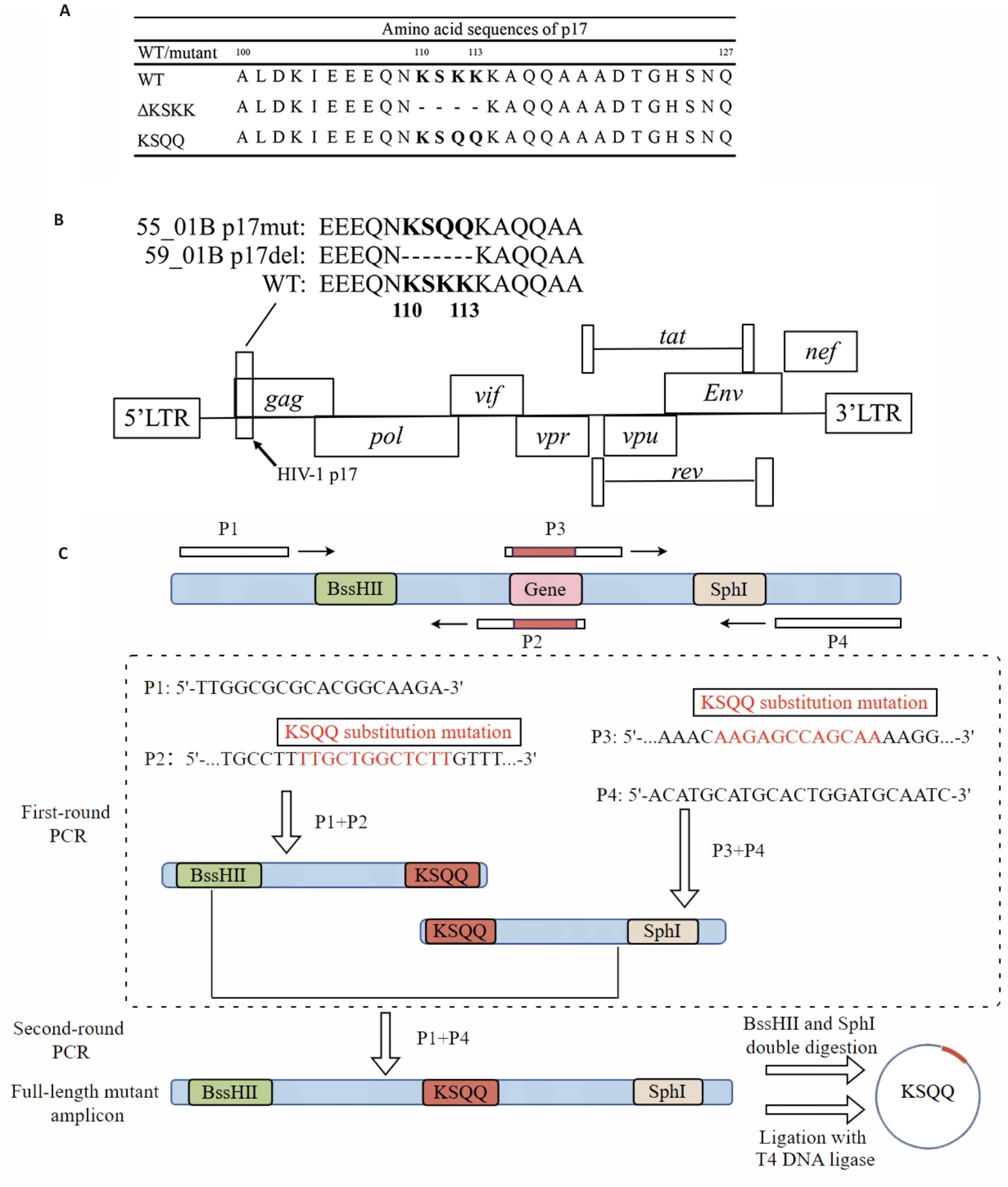
图1 HIV-1基因组、p17突变体和重叠PCR延伸示意图
Fig.1 Schematic diagram of the HIV-1 genome, p17 mutants, and overlap PCR extension. A: HIV-1 genome is shown with a detailed view of p17 mutations, highlighting the KSQQ mutation and the KSKK deletion within Gagp17. B: Wild-type (WT) HIV-1 and Gagp17 mutants. The KSQQ mutation and KSKK deletion in Gagp17 are highlighted and compared with WT HIV-1. C: Construction of a KSQQ mutant gene fragment by overlap extension PCR.
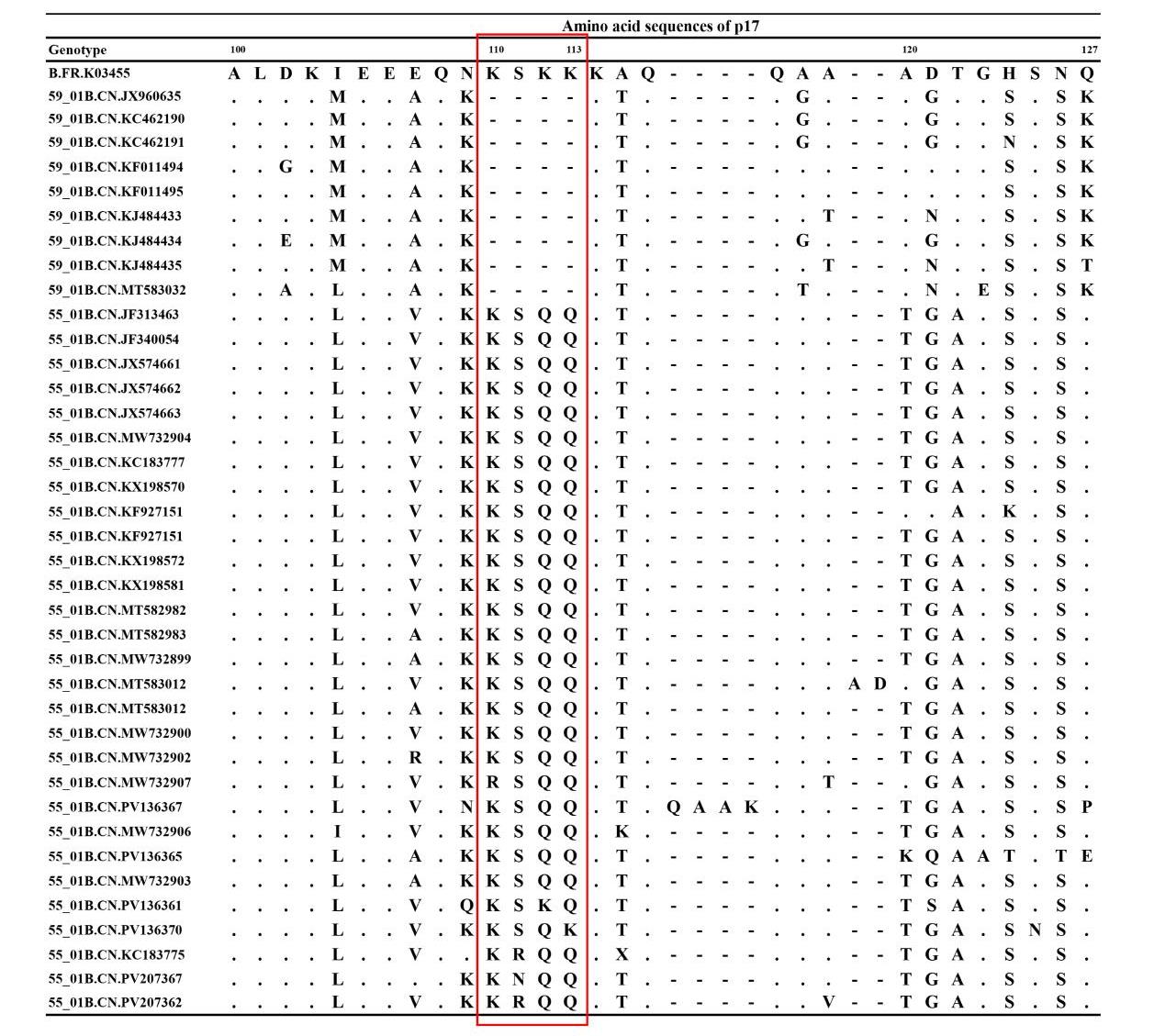
图2 HIV-1 Gag p17氨基酸序列的比对
Fig.2 Alignment of HIV-1 Gagp17 amino acid sequences. The sequences were retrieved from the LANL HIV Sequence Database (https://www.hiv.lanl.gov/). The alignment was generated using MEGA6.014 and BioEdit7.1.9; numbering is based on HXB2 (B.FR.K03455). Dots (.) indicate residues identical to the HXB2 reference; dashes (-) denote amino acid deletions.
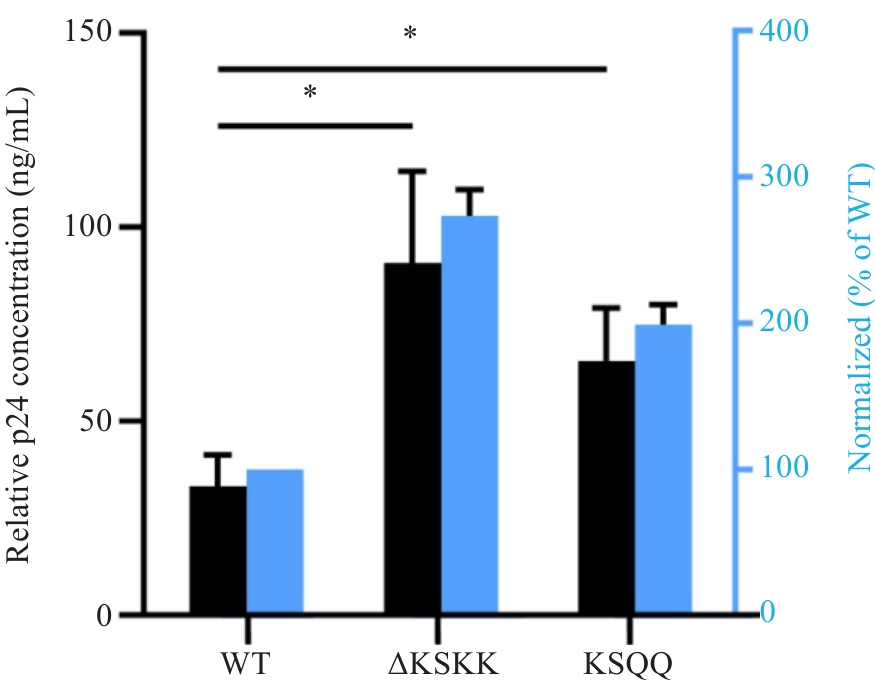
图3 ELISA检测HIV-1 病毒感染细胞上清液中HIV-1 p24蛋白浓度
Fig.3 Detection of HIV-1 p24 concentration in the supernatant of cells transfected with HIV-1 p17 WT and mutants by using ELISA. Left y axis and black are the concentration of HIV-1 p24 while right y axis and blue are HIV-1 p24 level relative of that of WT (100%). WT: Wild type of pNL-4-3/KFS with KSKK served as the control. *P<0.05 (n=3).
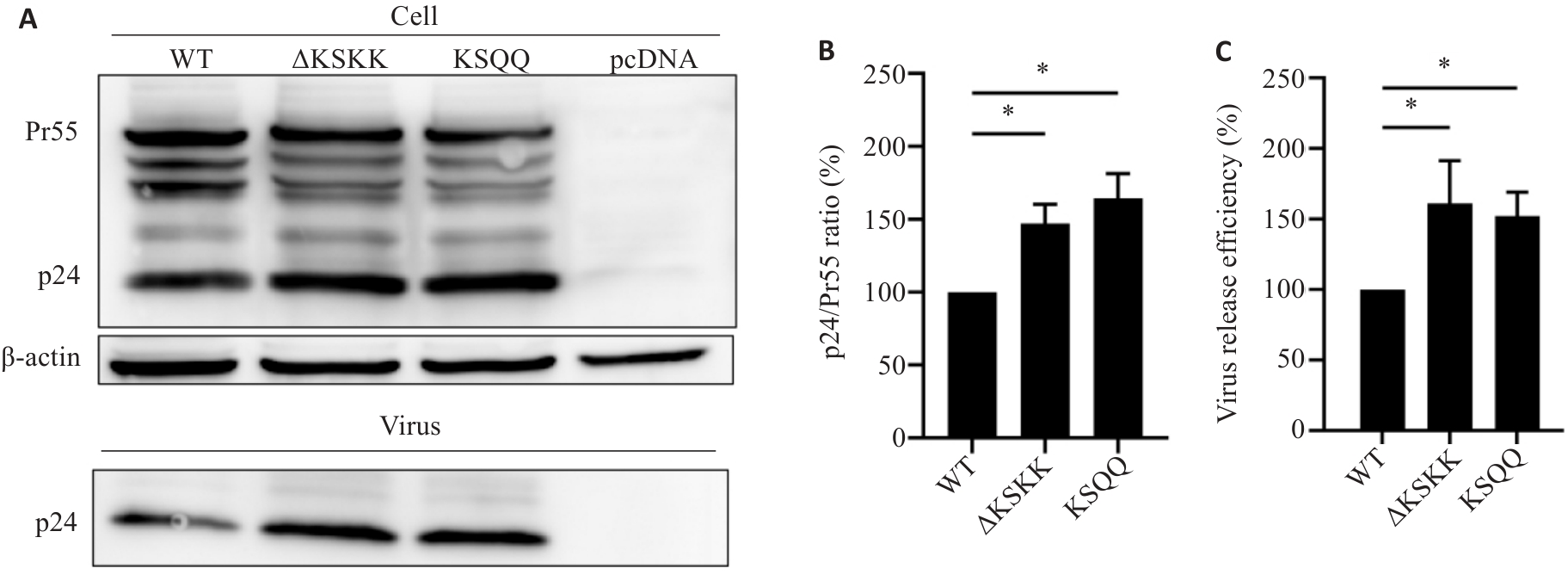
图4 Western blotting评价HIV-1 p17突变病毒释放和Gag蛋白加工效率
Fig.4 Evaluation of HIV-1 p17 mutant virus release and Gag protein processing efficiency by Western blotting. A: Western blotting for detecting cellular and viral proteins. B: Gag protein processing efficiency. C: Virus release efficiency. WT: pNL-4-3/KFS with KSKK served as the control, with its release and protein processing efficiencies as 100%. *P<0.05 (n=3).
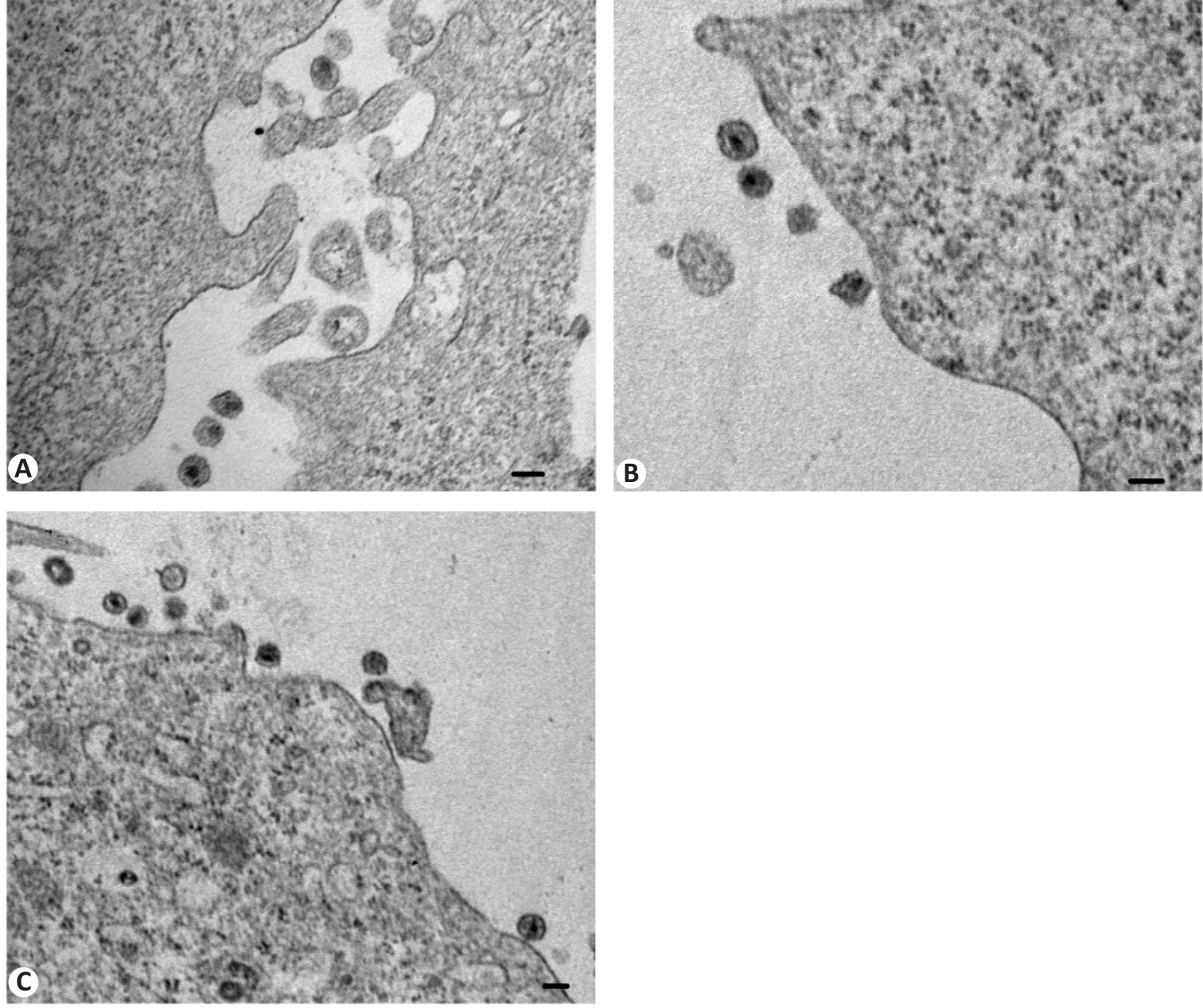
图5 WT与Gagp17突变体病毒颗粒的电子显微照片
Fig.5 Electron micrographs of wild-type (WT) and Gagp17 mutant viral particles. A: WT. B: ΔKSKK deletion mutant. C: KSQQ substitution mutant. Scale bar=100 nm.
| Virus | Cell type | Number of particles (n) | Number of particles with different core shapes [n (%)] | ||
|---|---|---|---|---|---|
| Cone shaped | Centric | Acentric | |||
| WT | Hela | 33 | 6 (18.2)a | 12 (36.4) | 15 (45.4) |
| ΔKSKK | Hela | 55 | 15 (27.2) | 20 (36.4) | 20 (36.4) |
| KSQQ | Hela | 48 | 12 (25.0) | 19 (50.0) | 12 (25.0) |
表1 HIV-1 WT与Gagp17突变型病毒颗粒的电镜分析结果
Tab.1 Electron microscopy analysis of wild-type HIV-1 and Gagp17 mutant viral particles
| Virus | Cell type | Number of particles (n) | Number of particles with different core shapes [n (%)] | ||
|---|---|---|---|---|---|
| Cone shaped | Centric | Acentric | |||
| WT | Hela | 33 | 6 (18.2)a | 12 (36.4) | 15 (45.4) |
| ΔKSKK | Hela | 55 | 15 (27.2) | 20 (36.4) | 20 (36.4) |
| KSQQ | Hela | 48 | 12 (25.0) | 19 (50.0) | 12 (25.0) |
| Subtype/CRF | Total (n) | ΔKSKK [n (%)] | KSQQ [n (%)]** |
|---|---|---|---|
| C | 2996 | 38 (20.4) | 2958 (54.2) |
| 01_AE | 1670 | 17 (9.1) | 1653 (30.3) |
| 07_BC | 135 | 42 (22.6) | 93 (1.7) |
| F1 | 92 | 0 (0.0) | 92 (1.7) |
| BC | 87 | 25 (13.4) | 62 (1.1) |
| 01B | 69 | 1 (0.5) | 68 (1.2) |
| 01BC | 54 | 1 (0.5) | 53 (1.0) |
| G | 53 | 4 (2.2) | 49 (0.9) |
| 107 | 47 | 1 (0.5) | 46 (0.8) |
| 55_01B | 23 | 0 (0.0) | 23 (0.4) |
| BF1 | 21 | 1 (0.5) | 20 (0.4) |
| 01C | 18 | 2 (1.1) | 16 (0.3) |
| A1 | 16 | 6 (3.2) | 10 (0.2) |
| A1C | 12 | 2 (1.1) | 10 (0.2) |
| H | 10 | 3 (1.6) | 7 (0.1) |
| 07C | 10 | 3 (1.6) | 7 (0.1) |
| 145_0755 | 10 | 0 (0.0) | 10 (0.2) |
| 59_01B | 9 | 9 (4.8) | 0 (0.0) |
| 24_BG | 9 | 0 (0.0) | 9 (0.2) |
| 33_01B | 9 | 0 (0.0) | 9 (0.2) |
| F2 | 8 | 1 (0.5) | 7 (0.1) |
| 12_BF | 8 | 0 (0.0) | 8 (0.1) |
| 137_0107 | 8 | 0 (0.0) | 8 (0.1) |
| 02_AG | 7 | 1 (0.5) | 6 (0.1) |
| 85_BC | 7 | 0 (0.0) | 7 (0.1) |
| 119_0107 | 7 | 0 (0.0) | 7 (0.1) |
| 89_BF1 | 7 | 0 (0.0) | 7 (0.1) |
| B | 4 | 4 (2.2) | 0 (0.0) |
| 62_BC | 3 | 3 (1.6) | 0 (0.0) |
| 152_DG | 3 | 3 (1.6) | 0 (0.0) |
| Othersa | 233 | 19 (10.2) | 214 (3.9) |
| Total | 5645 | 186 | 5459 |
表2 携带Gagp17 ΔKSKK缺失突变和KSKK→KSQQ替换突变的HIV-1病毒亚型分布
Tab.2 HIV-1 subtype distribution of the mutant viruses with ΔKSKK deletion mutation or KSKK→KSQQ substitution mutation in Gagp17 amino acids
| Subtype/CRF | Total (n) | ΔKSKK [n (%)] | KSQQ [n (%)]** |
|---|---|---|---|
| C | 2996 | 38 (20.4) | 2958 (54.2) |
| 01_AE | 1670 | 17 (9.1) | 1653 (30.3) |
| 07_BC | 135 | 42 (22.6) | 93 (1.7) |
| F1 | 92 | 0 (0.0) | 92 (1.7) |
| BC | 87 | 25 (13.4) | 62 (1.1) |
| 01B | 69 | 1 (0.5) | 68 (1.2) |
| 01BC | 54 | 1 (0.5) | 53 (1.0) |
| G | 53 | 4 (2.2) | 49 (0.9) |
| 107 | 47 | 1 (0.5) | 46 (0.8) |
| 55_01B | 23 | 0 (0.0) | 23 (0.4) |
| BF1 | 21 | 1 (0.5) | 20 (0.4) |
| 01C | 18 | 2 (1.1) | 16 (0.3) |
| A1 | 16 | 6 (3.2) | 10 (0.2) |
| A1C | 12 | 2 (1.1) | 10 (0.2) |
| H | 10 | 3 (1.6) | 7 (0.1) |
| 07C | 10 | 3 (1.6) | 7 (0.1) |
| 145_0755 | 10 | 0 (0.0) | 10 (0.2) |
| 59_01B | 9 | 9 (4.8) | 0 (0.0) |
| 24_BG | 9 | 0 (0.0) | 9 (0.2) |
| 33_01B | 9 | 0 (0.0) | 9 (0.2) |
| F2 | 8 | 1 (0.5) | 7 (0.1) |
| 12_BF | 8 | 0 (0.0) | 8 (0.1) |
| 137_0107 | 8 | 0 (0.0) | 8 (0.1) |
| 02_AG | 7 | 1 (0.5) | 6 (0.1) |
| 85_BC | 7 | 0 (0.0) | 7 (0.1) |
| 119_0107 | 7 | 0 (0.0) | 7 (0.1) |
| 89_BF1 | 7 | 0 (0.0) | 7 (0.1) |
| B | 4 | 4 (2.2) | 0 (0.0) |
| 62_BC | 3 | 3 (1.6) | 0 (0.0) |
| 152_DG | 3 | 3 (1.6) | 0 (0.0) |
| Othersa | 233 | 19 (10.2) | 214 (3.9) |
| Total | 5645 | 186 | 5459 |
| Time period | Total (n)b | ΔKSKK [n (%)] | KSQQ [n (%)]** |
|---|---|---|---|
| Before 2000 | 142 | 8 (4.3) | 134 (2.5) |
| 2000-2010 | 2102 | 117 (62.9) | 1985 (36.4) |
| After 2010 | 3401 | 61 (32.8) | 3340 (61.1) |
| Total | 5645 | 186 | 5459 |
表3 携带Gagp17 ΔKSKK缺失突变和KSKK→KSQQ替换突变的HIV-1病毒的时间分布
Tab.3 Temporal distribution of the mutant viruses with ΔKSKK deletion mutation or KSKK→KSQQ substitution in Gagp17 amino acids
| Time period | Total (n)b | ΔKSKK [n (%)] | KSQQ [n (%)]** |
|---|---|---|---|
| Before 2000 | 142 | 8 (4.3) | 134 (2.5) |
| 2000-2010 | 2102 | 117 (62.9) | 1985 (36.4) |
| After 2010 | 3401 | 61 (32.8) | 3340 (61.1) |
| Total | 5645 | 186 | 5459 |
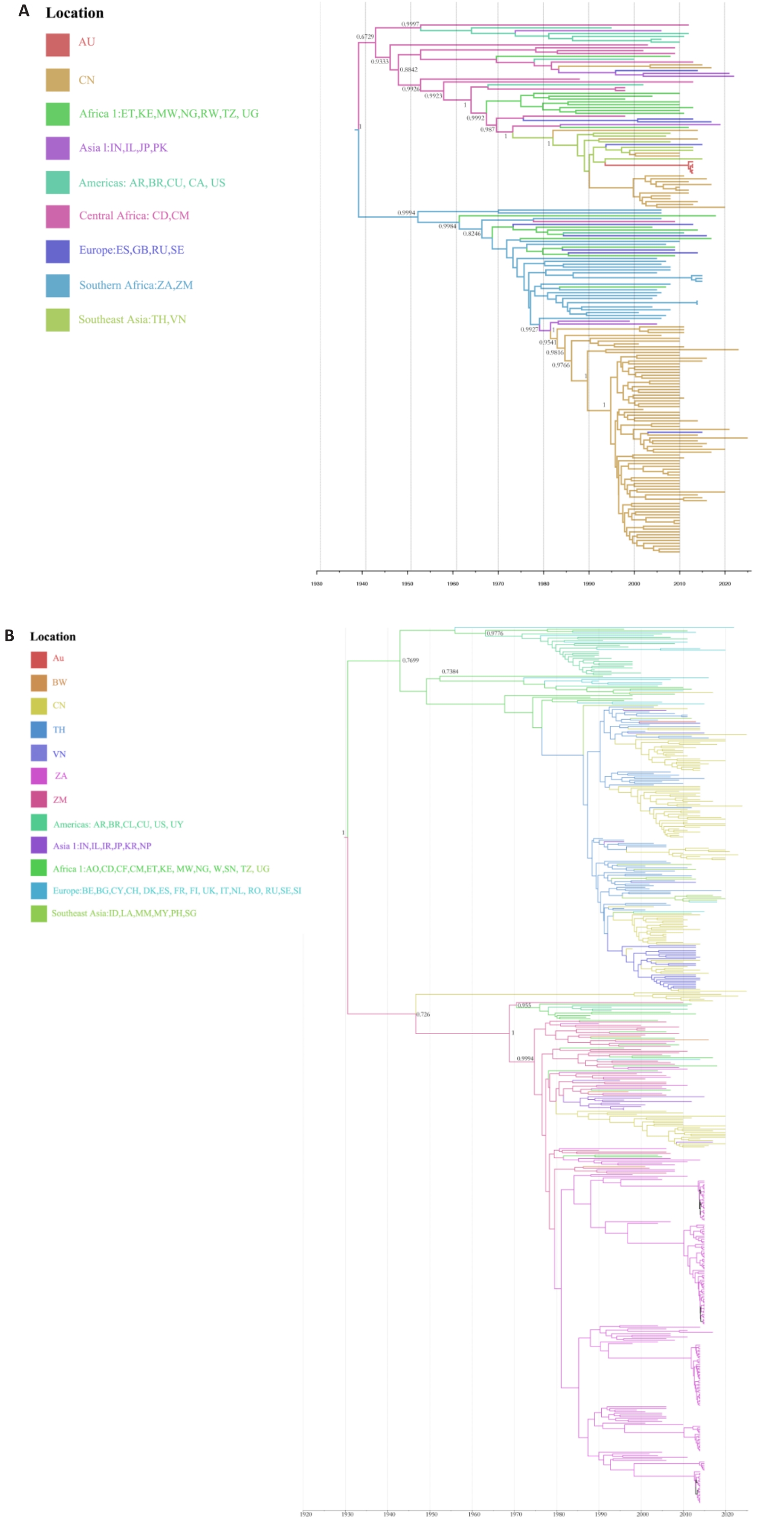
图6 HIV-1 Gagp17突变的时空分布
Fig.6 Spatiotemporal distribution of mutations in HIV-1 Gagp17. A: ΔKSKK deletion mutation. B: KSKK→KSQQ substitution mutation. Location: Country composition within each block.
| Region | Total outflow ∑PP | Total inflow ∑PP | Net flow: out-in | Regional role |
|---|---|---|---|---|
| Australia | 2.7619 | 0.6334 | 2.1285 | Super-hub |
| Southern africa | 2.1524 | 0 | 2.1524 | Primary source |
| Southeast asia | 1.7959 | 0.5807 | 1.2152 | Secondary source |
| Asia1 | 1.522 | 1.7731 | -0.2511 | Intermediate hub |
| China | 0.9626 | 1.4752 | -0.5126 | Receiver |
| Europe | 0.6948 | 1.3893 | -0.6945 | Receiver |
| Africa1 | 0.6039 | 1.833 | -1.2291 | Receiver |
| Central africa | 0 | 1.8842 | -1.8842 | Primary sink |
| Americas | 0 | 0.9246 | -0.9246 | Sink |
表5 HIV-1 ΔKSKK缺失突变病毒传播净流向表
Tab.5 Net flow direction of transmission for HIV-1 ΔKSKK mutant virus
| Region | Total outflow ∑PP | Total inflow ∑PP | Net flow: out-in | Regional role |
|---|---|---|---|---|
| Australia | 2.7619 | 0.6334 | 2.1285 | Super-hub |
| Southern africa | 2.1524 | 0 | 2.1524 | Primary source |
| Southeast asia | 1.7959 | 0.5807 | 1.2152 | Secondary source |
| Asia1 | 1.522 | 1.7731 | -0.2511 | Intermediate hub |
| China | 0.9626 | 1.4752 | -0.5126 | Receiver |
| Europe | 0.6948 | 1.3893 | -0.6945 | Receiver |
| Africa1 | 0.6039 | 1.833 | -1.2291 | Receiver |
| Central africa | 0 | 1.8842 | -1.8842 | Primary sink |
| Americas | 0 | 0.9246 | -0.9246 | Sink |
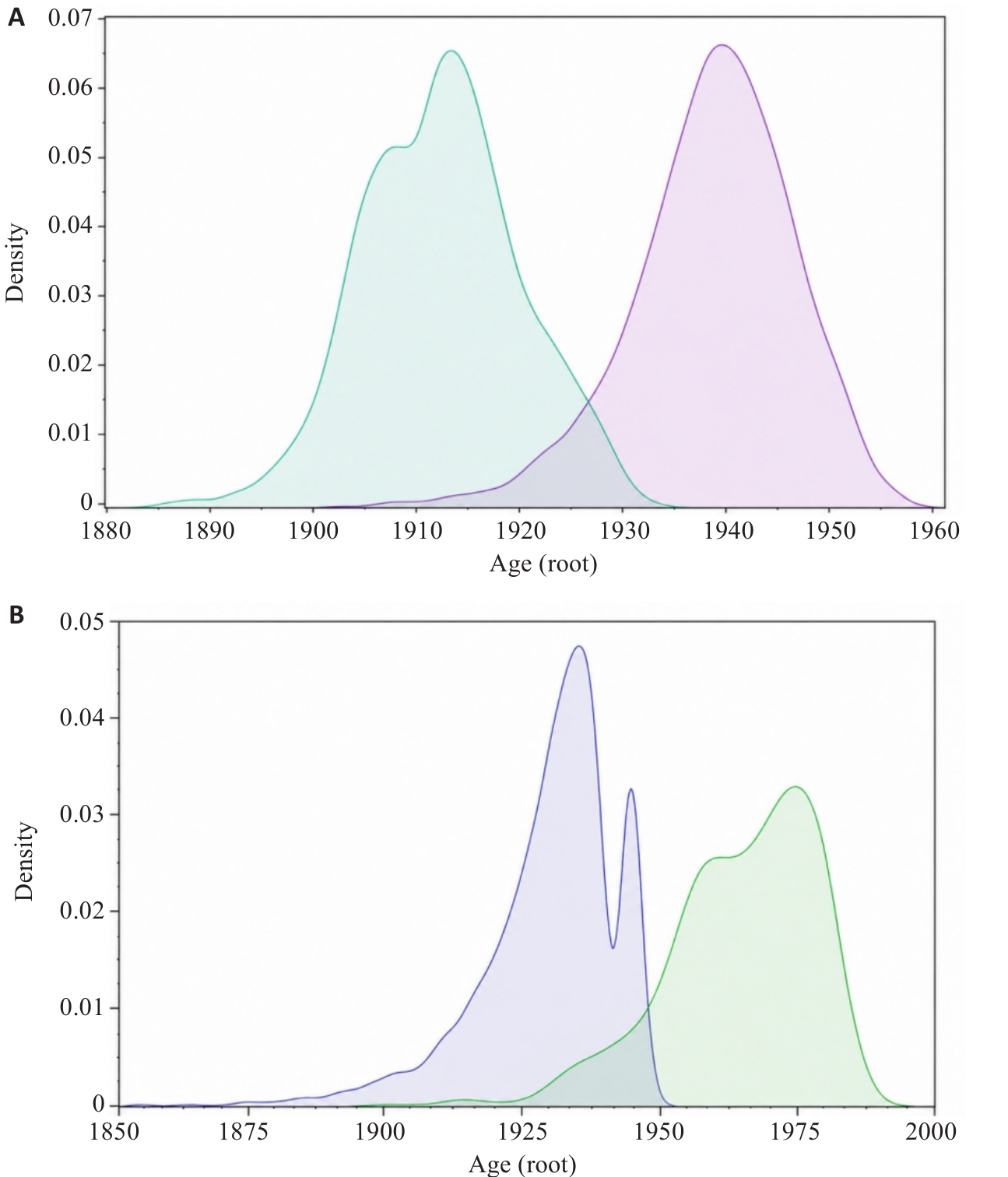
图7 根节点年龄的先验与后验密度分布对比(敏感性分析)
Fig.7 Comparison of prior and posterior density distributions for root node age (sensitivity analysis). Green line: prior density curve obtained from sampling the prior only (without data); Purple and pink line: posterior density curve obtained from the main analysis (including data). A: ΔKSKK deletion mutation. B: KSKK→KSQQ substitution mutation. The overlapping area between the prior and posterior curves is less than 20%. This figure is used to assess the sensitivity of phylogeographic inference to prior assumptions.
| [1] | Wang D, Feng Y, Hao JJ, et al. National and regional molecular epidemiology of HIV-1: China, 2004-2023[J]. China CDC Week, 2024, 6: 1257-63. |
| [2] | Gui T, Zhao J, Sun CR, et al. Genetic characterization of a unique recombinant originating from CRF55_01B, CRF01_AE, and CRF07_BC in Shenzhen, China[J]. AIDS Res Hum Retroviruses, 2015, 31(5): 559-63. doi:10.1089/aid.2014.0337 |
| [3] | 唐 虎, 杨梓杰, 郑陈丽, 等. 深圳市2022—2023年新报告HIV/AIDS患者HIV-1分子传播网络特征[J]. 中国艾滋病性病, 2025, 31(3): 254-60. |
| [4] | Luo YF, Wu H, Liang CY, et al. Molecular cluster, transmission characteristics, origin and dynamics analysis of HIV-1 CRF59_01B in China: a molecular epidemiology study[J]. Acta Trop, 2024, 260: 107396. doi:10.1016/j.actatropica.2024.107396 |
| [5] | Yan HC, Wu H, Li SM, et al. The origin and spread of HIV-1 CRF59_01B epidemic in China: a molecular network and phylogeographic analysis[J]. J Med Virol, 2024, 96(7): e29799. doi:10.1002/jmv.29799 |
| [6] | Qu K, Ke ZL, Zila V, et al. Maturation of the matrix and viral membrane of HIV-1[J]. Science, 2021, 373(6555): 700-4. doi:10.1126/science.abe6821 |
| [7] | Wen Y, Feigenson GW, Vogt VM, et al. Mechanisms of PI(4, 5)P2 enrichment in HIV-1 viral membranes[J]. J Mol Biol, 2020, 432(19): 5343-64. doi:10.1016/j.jmb.2020.07.018 |
| [8] | Zhang YX, Li MZ, Lin FY, et al. HIV-1 matrix protein p17: a key factor in HIV-associated cancers[J]. Front Virol, 2025, 5: 1584507. doi:10.3389/fviro.2025.1584507 |
| [9] | Cabrera-Rodríguez R, Pérez-Yanes S, Lorenzo-Sánchez I, et al. HIV infection: shaping the complex, dynamic, and interconnected network of the cytoskeleton[J]. Int J Mol Sci, 2023, 24(17): 13104. doi:10.3390/ijms241713104 |
| [10] | Stacey JCV, Hrebík D, Nand E, et al. The conserved HIV-1 spacer peptide 2 triggers matrix lattice maturation[J]. Nature, 2025, 640(8057): 258-64. doi:10.1038/s41586-025-08624-9 |
| [11] | Zhang LF, Li S, Xu XY, et al. HIV-1 p17 matrix protein enhances type I interferon responses through the p17-OLA1-STING axis[J]. J Cell Sci, 2024, 137(2): jcs261500. doi:10.1242/jcs.261500 |
| [12] | Samal AB, Green TJ, Saad JS. Atomic view of the HIV-1 matrix lattice; implications on virus assembly and envelope incorporation[J]. Proc Natl Acad Sci U S A, 2022, 119(23): e2200794119. doi:10.1073/pnas.2200794119 |
| [13] | Bukrinskaya A. HIV-1 matrix protein: a mysterious regulator of the viral life cycle[J]. Virus Res, 2007, 124(1/2): 1-11. doi:10.1016/j.virusres.2006.07.001 |
| [14] | Morikawa Y, Kishi T, Zhang WH, et al. A molecular determinant of human immunodeficiency virus particle assembly located in matrix antigen p17[J]. J Virol, 1995, 69(7): 4519-23. doi:10.1128/jvi.69.7.4519-4523.1995 |
| [15] | Bielejec F, Baele G, Vrancken B, et al. SpreaD3: interactive visualization of spatiotemporal history and trait evolutionary processes[J]. Mol Biol Evol, 2016, 33(8): 2167-9. doi:10.1093/molbev/msw082 |
| [16] | Tee KK, Thomson MM, Hemelaar J. Editorial: HIV-1 genetic diversity, volume II[J]. Front Microbiol, 2022, 13: 1007037. doi:10.3389/fmicb.2022.1007037 |
| [17] | Yan HC, Luo YF, Wu H, et al. Evolving molecular HIV clusters revealed genotype-specific dynamics in Guangzhou, China (2008-2020)[J]. Int J Infect Dis, 2024, 148: 107218. doi:10.1016/j.ijid.2024.107218 |
| [18] | Lacouture C, Carrio B, Favard C, et al. HIV-1 assembly–when virology meets biophysics[J]. J Cell Sci, 2024, 137(19): jcs262064. doi:10.1242/jcs.262064 |
| [19] | Sumner C, Ono A. Relationship between HIV-1 gag multimerization and membrane binding[J]. Viruses, 2022, 14(3): 622. doi:10.3390/v14030622 |
| [20] | Freed EO. HIV-1 assembly, release and maturation[J]. Nat Rev Microbiol, 2015, 13(8): 484-96. doi:10.1038/nrmicro3490 |
| [21] | Chukkapalli V, Hogue IB, Boyko V, et al. Interaction between the human immunodeficiency virus type 1 Gag matrix domain and phosphatidylinositol-(4, 5)‑bisphosphate is essential for efficient gag membrane binding[J]. J Virol, 2008, 82(5): 2405-17. doi:10.1128/jvi.01614-07 |
| [22] | Breitschwerdt S, Grandel B, Asbach B, et al. Consensus sequences for gag and pol introduced into HIV-1 clade B laboratory strains differentially influence the impact of point mutations associated with immune escape and with drug resistance on viral replicative capacity[J]. Viruses, 2025, 17(6): 842. doi:10.3390/v17060842 |
| [23] | Sonawane A, Selvam D, Yue L, et al. Virulence and replicative fitness of HIV-1 transmitted/founder (T/F) viruses harbouring drug resistance-associated mutation[J]. Viruses, 2024, 16(12): 1854. doi:10.3390/v16121854 |
| [24] | Mattei S, Glass B, Hagen WJH, et al. The structure and flexibility of conical HIV-1 capsids determined within intact virions[J]. Science, 2016, 354(6318): 1434-7. doi:10.1126/science.aah4972 |
| [25] | Worobey M, Gemmel M, Teuwen DE, et al. Direct evidence of extensive diversity of HIV-1 in Kinshasa by 1960[J]. Nature, 2008, 455(7213): 661-4. doi:10.1038/nature07390 |
| [26] | Zhang WQ, Han XX, An MH, et al. Identification and characterization of a novel HIV-1 circulating recombinant form (CRF59_01B) identified among men-who-have-sex-with-men in China[J]. PLoS One, 2014, 9(6): e99693. doi:10.1371/journal.pone.0099693 |
| [27] | Han XX, An MH, Zhang WQ, et al. Genome sequences of a novel HIV-1 circulating recombinant form, CRF55_01B, identified in China[J]. Genome Announc, 2013, 1(1): e00050-12. doi:10.1128/genomea.00050-12 |
| [1] | 徐利珊, 李柯柯, 于米铼, 植秋怡, 安胜利. 基于SEIR-SEI模型预测广东省输入性基孔肯雅热再传播风险[J]. 南方医科大学学报, 2026, 46(7): 1696-1702. |
| [2] | 黄伟平, 颜欢畅, 李顺铭, 吴昊, 蔡衍珊, 韩志刚, 唐时幸. HIV-1基因型和人口流动性对广州HIV-1传播的影响:基于分子传播网络分析[J]. 南方医科大学学报, 2026, 46(6): 1395-1406. |
| [3] | 黄鹏伟, 陈洁, 邹金虎, 高雪锋, 曹虹. 槲皮素促进应激颗粒G3BP1解聚改善HIV-1 gp120诱导的星形胶质细胞神经毒性[J]. 南方医科大学学报, 2025, 45(2): 304-312. |
| [4] | 杨少杰, 邓小燕, 张铁松, 肖 仪, 彭 亮, 李 莉, 何肖龙, 魏 轶, 刘利群, 曹 虹, 龙北国, 黄胜和. SBi4211通过抑制S100B/RAGE表达减轻gp120诱导的中枢神经损伤[J]. 南方医科大学学报, 2020, 40(12): 1693-1702. |
| [5] | 胡彤彤,龚泽龙,万 宇,李煜彬,高雪锋,伦静娴,黄胜和,曹 虹. α7nAChR基因敲除HIV-1gp120转基因小鼠模型的构建[J]. 南方医科大学学报, 2020, 40(08): 1184-1191. |
| [6] | 蓝燕,杨梓超,刘涵,程宏彦,刘叔文,谭穗懿. PSB0739抑制精液来源的淀粉样纤维形成[J]. 南方医科大学学报, 2018, 38(11): 1338-. |
| [7] | 柳红妙,麻宁宁,罗春,袁淑英,刘付励,姚新刚,周春琼,邹敏. ADS-J1 对SEVI增强HIV-1初始传播病毒及其慢性控制病毒感染的拮抗作用及机制[J]. 南方医科大学学报, 2018, 38(02): 211-. |
| [8] | 李锦清,宋亚丽,寻添荣,谭穗懿,刘叔文. 乳酸抑制精液来源淀粉样纤维的形成[J]. 南方医科大学学报, 2017, 37(07): 907-. |
| [9] | 胡丹阳,崔伟,罗燕萍,杨继勇,邓斌,徐娟,储冰峰,王成龙. 高龋学龄前儿童变形链球菌的水平传播方式[J]. 南方医科大学学报, 2014, 34(05): 636-. |
| [10] | 段恒,王玉芹,宋德寿,陈之朋,裘佳寅,陆路,姜世勃,刘叔文,谭穗懿. 作用于HIV-1 gp120小分子HIV进入抑制剂NC-2 的虚拟筛选及其作用机制[J]. 南方医科大学学报, 2013, 33(06): 826-. |
| [11] | 郭爱华; 刘志锋; 孙学刚; 李海玉; 邓鹏; 姜勇;. 一种基于HIV-1TAT蛋白质转导结构域细胞内转导系统的成功改建[J]. 南方医科大学学报, 2006, 26(05): 545-548. |
| [12] | 王征爱; . 新年献词[J]. 南方医科大学学报, 2006, 26(02): 2-2. |
| [13] | 王征爱. 新年献词[J]. 南方医科大学学报, 2006, 26(01): 0-2. |
| 阅读次数 | ||||||
|
全文 |
|
|||||
|
摘要 |
|
|||||
