
南方医科大学学报 ›› 2026, Vol. 46 ›› Issue (10): 2471-2481.doi: 10.12122/j.issn.1673-4254.2026.10.16
• • 上一篇
郑朝元1( ), 于瑛蕾1, 张颢严1, 李盈2, 郭冰1()
收稿日期:2026-04-30
出版日期:2026-10-20
发布日期:2026-10-26
通讯作者:
郭冰
E-mail:13982453221@163.com;guobing0111@scu.edu.cn
作者简介:郑朝元,在读硕士研究生,E-mail:13982453221@163.com
基金资助:
Chaoyuan ZHENG1(), Yinglei YU1, Haoyan ZHANG1, Ying LI2, Bing GUO1()
Received:2026-04-30
Online:2026-10-20
Published:2026-10-26
Contact:
Bing GUO
E-mail:13982453221@163.com;guobing0111@scu.edu.cn
摘要:
目的 探讨全氟和多氟烷基物质(PFAS)暴露与估测脉搏波传导速度(ePWV)的关联,并分析内源性性激素(雌二醇和睾酮)在其中的交互作用。 方法 基于2013~2016年美国国家健康和营养调查(NHANES)数据,以健康成年参与者为研究对象。采用加权多元线性回归和限制性立方样条模型(RCS)评估单一PFAS组分与ePWV的线性及非线性关联;采用加权分位数和(WQS)回归评估PFAS混合暴露与ePWV的关联,并进一步开展年龄分层WQS分析。为评估混合暴露结果的稳健性,进一步采用双重稳健估计分析高、低PFAS混合暴露组间ePWV水平差异。最后分别在加法和乘法尺度下检验性激素与PFAS的交互作用。 结果 调整混杂因素后,所有5种纳入分析的PFAS单体均与ePWV呈显著正向关联。RCS分析显示,仅PFOS与ePWV呈显著非线性关联。WQS回归分析结果显示PFAS混合暴露与ePWV显著正向关联。本研究纳入的两种全氟磺酸类物质:全氟辛烷磺酸(PFOS)和全氟己烷磺酸(PFHS)占据了主导地位,权重分别为47.5%和24.3%,是驱动该关联的主要贡献组分。年龄分层WQS分析显示,PFAS混合暴露与ePWV的正向关联主要见于中老年人群,且PFOS和PFHS在不同年龄层中仍具有较高权重。双重稳健估计结果表示,高PFAS混合暴露组人群的ePWV相比低暴露组平均升高了1.284m/s(95% CI:1.078~1.490;P<0.001)。乘法尺度交互分析显示,PFAS与ePWV的正向关联在高水平雌二醇和高水平睾酮人群中相对较弱。具体表现为,这两种性激素均与全氟己烷磺酸(PFHS)存在显著负向交互。此外,雌二醇特异性地与全氟辛烷磺酸(PFOS)及全氟壬酸(PFNA)存在负向交互,而睾酮特异性地与全氟辛酸(PFOA)呈现负向交互。 结论 PFAS暴露与ePWV升高存在关联,全氟磺酸类物质(PFOS、PFHS)为关键驱动组分,双重稳健估计进一步支持了该关联。此外,乘法尺度交互分析显示,PFAS与ePWV的正向关联在高水平性激素人群中相对较弱。
郑朝元, 于瑛蕾, 张颢严, 李盈, 郭冰. 全氟和多氟烷基物质暴露与动脉硬化相关指标存在正向关联及性激素水平的交互作用[J]. 南方医科大学学报, 2026, 46(10): 2471-2481.
Chaoyuan ZHENG, Yinglei YU, Haoyan ZHANG, Ying LI, Bing GUO. Positive association of exposure to per- and polyfluoroalkyl substances with arterial stiffness parameters and its interaction with sex hormone levels[J]. Journal of Southern Medical University, 2026, 46(10): 2471-2481.
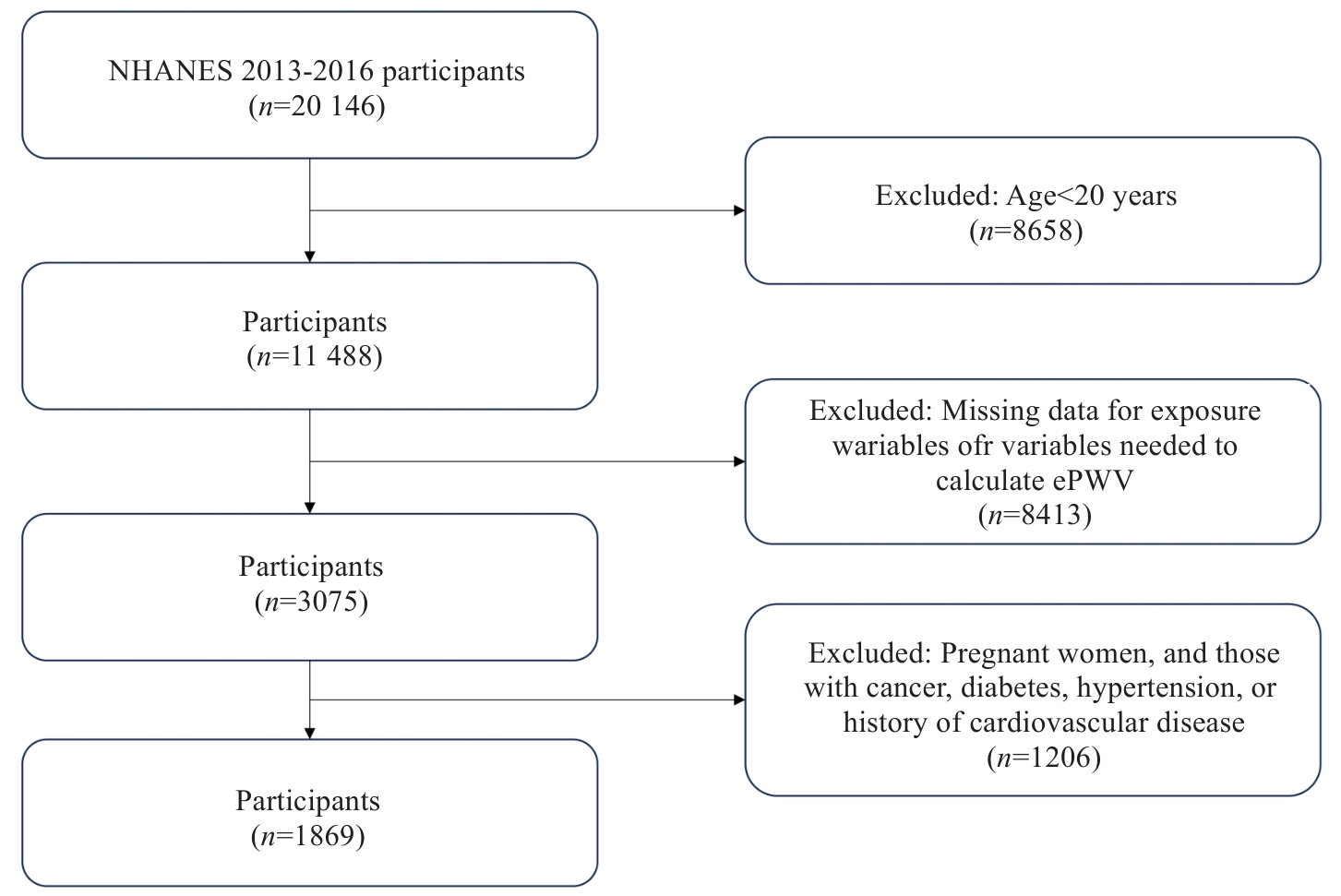
图1 研究对象纳入与排除标准
Fig.1 Inclusion and exclusion criteria of the participants.
| Variable | Overall (n=1869) | 2013-2014 (n=918) | 2015-2016 (n=951) | P |
|---|---|---|---|---|
| Age (years) | 42.4±15.5 | 42.5±15.4 | 42.2±-15.6 | 0.582 |
| Gender | 0.917 | |||
| Male | 864 (46.2%) | 426 (46.4%) | 438 (46.1%) | |
| Female | 1005 (53.8%) | 492 (53.6%) | 513 (53.9%) | |
| Race/ethnicity | <0.001 | |||
| Mexican american | 289 (15.5%) | 125 (13.6%) | 164 (17.2%) | |
| Other hispanic | 219 (11.7%) | 86 (9.4%) | 133 (14.0%) | |
| Non-hispanic white | 675 (36.1%) | 377 (41.1%) | 298 (31.3%) | |
| Non-hispanic black | 373 (20.0%) | 170 (18.5%) | 203 (21.3%) | |
| Other | 313 (16.7%) | 160 (17.4%) | 153 (16.1%) | |
| Education level | 0.247 | |||
| Low | 364 (19.5%) | 189 (20.6%) | 175 (18.4%) | |
| High | 1503 (80.5%) | 727 (79.4%) | 776 (81.6%) | |
| Missing | 2 | 2 | 0 | |
| BMI category | 0.459 | |||
| Underweight | 31 (1.7%) | 17 (1.9%) | 14 (1.5%) | |
| Normal | 558 (30.0%) | 269 (29.5%) | 289 (30.5%) | |
| Overweight | 616 (33.1%) | 316 (34.6%) | 300 (31.6%) | |
| Obese | 657 (35.3%) | 311 (34.1%) | 346 (36.5%) | |
| Missing | 7 | 5 | 2 | |
| Smoking status | 0.919 | |||
| Never | 1158 (62.1%) | 565(61.6%) | 593 (62.5%) | |
| Former | 322 (17.3%) | 161(17.6%) | 161 (17.0%) | |
| Current | 386 (20.7%) | 191(20.8%) | 195 (20.5%) | |
| Missing | 3 | 1 | 2 | |
| Alcohol drinking | 0.078 | |||
| No | ,043 (67.9%) | 494 (65.7%) | 549 (70.0%) | |
| Yes | 493 (32.1%) | 258 (34.3%) | 235 (30.0%) | |
| Missing | 333 | 166 | 167 | |
| Physical activity | 0.168 | |||
| Inactive | 240 (16.7%) | 127 (18.1%) | 113 (15.3%) | |
| Active | 1199 (83.3%) | 573 (81.9%) | 626 (84.7%) | |
| Missing | 430 | 218 | 212 | |
| Menopausal status | 0.560 | |||
| Postmenopausal | 304 (17.2%) | 142 (16.3%) | 162 (18.0%) | |
| Premenopausal | 602 (34.0%) | 304 (34.9%) | 298 (33.2%) | |
| Missing | 99 (5.3%) | 46 (5.0%) | 53 (5.6%) | |
| Ever used female hormone therapy | 0.978 | |||
| No | 798 (45.1%) | 391 (44.9%) | 407 (45.3%) | |
| Yes | 108 (6.1%) | 54 (6.2%) | 54 (6.0%) | |
| Missing | 99 (5.3%) | 47 (5.1%) | 52 (5.5%) | |
| Dietary types | 0.265 | |||
| Normal | 1532 (87.0%) | 761 (88.2%) | 771 (86.0%) | |
| Low calorie diet | 146 (8.3%) | 66 (7.6%) | 80 (8.9%) | |
| Low fat diet | 32 (1.8%) | 12 (1.4%) | 20 (2.2%) | |
| Low salt diet | 11 (0.6%) | 3 (0.3%) | 8 (0.9%) | |
| Other special diet | 39 (2.3%) | 21 (2.4%) | 18 (2.0%) | |
| Missing | 109 (5.8%) | 55 (6.0%) | 54 (5.7%) | |
| Ever thyroid problem | 0.711 | |||
| No | 1717 (92.0%) | 846 (92.3%) | 871 (91.7%) | |
| Yes | 150 (8.0%) | 71 (7.7%) | 79 (8.3%) | |
| Missing | 2 (0.1%) | 1 (0.1%) | 1 (0.1%) | |
| Decreased kidney function or albuminuria | 0.253 | |||
| No | 1712 (91.6%) | 834 (90.8%) | 878 (92.4%) | |
| Yes | 156 (8.4%) | 84 (9.2%) | 72 (7.6%) | |
| Missing | 1 (0.1%) | 0 (0.0%) | 1 (0.1%) | |
| Elevated triglycerides | 0.208 | |||
| No | 1686 (90.3%) | 820 (89.3%) | 866 (91.2%) | |
| es | 182 (9.7%) | 98 (10.7%) | 84 (8.8%) | |
| Missing | 1 (0.1%) | 0 (0.0%) | 1 (0.1%) | |
| High total cholesterol | 0.510 | |||
| No | 1204 (64.5%) | 599 (65.3%) | 605 (63.7%) | |
| Yes | 664 (35.5%) | 319 (34.7%) | 345 (36.3%) | |
| Missing | 1 (0.1%) | 0 (0.0%) | 1 (0.1%) | |
| Fasting plasma glucose (mg/dL) | 98.5 (93.0, 106.0) | 97.0 (91.0, 103.0) | 99.5 (93.0, 107.0) | <0.001 |
| Missing | 939 (50.2%) | 460 (50.1%) | 479 (50.4%) | |
| Estimated pulse wave velocity (m/s) | 7.4±1.6 | 7.4±1.6 | 7.4±1.6 | 0.654 |
| Perfluorooctanoic acid (ng/mL) | 1.8 (1.1, 2.6) | 1.9 (1.3, 2.8) | 1.6 (1.0, 2.4) | <0.001 |
| Perfluorooctane sulfonate (ng/mL) | 4.8 (2.8, 8.2) | 5.1 (3.1, 8.5) | 4.6 (2.7, 7.8) | 0.004 |
| Perfluorononanoic acid (ng/mL) | 0.6 (0.4, 1.0) | 0.7 (0.5, 1.0) | 0.6 (0.4, 0.9) | <0.001 |
| Perfluorohexane sulfonate (ng/mL) | 1.2 (0.6, 2.1) | 1.3 (0.7, 2.3) | 1.1 (0.6, 1.9) | <0.001 |
| Perfluorodecanoic acid (ng/mL) | 0.2 (0.1, 0.3) | 0.2 (0.1, 0.3) | 0.1 (0.1, 0.3) | <0.001 |
| Estradiol (pg/mL) | 25.8 (16.0, 50.0) | 26.1 (15.5, 50.6) | 25.6 (16.4, 48.2) | 0.676 |
| Testosterone (ng/mL) | 45.0 (19.9, 398.0) | 46.1 (19.9, 395.0) | 44.1 (20.0, 405.0) | 0.860 |
表1 参与者的基线特征
Tab.1 Baseline characteristics of the participants
| Variable | Overall (n=1869) | 2013-2014 (n=918) | 2015-2016 (n=951) | P |
|---|---|---|---|---|
| Age (years) | 42.4±15.5 | 42.5±15.4 | 42.2±-15.6 | 0.582 |
| Gender | 0.917 | |||
| Male | 864 (46.2%) | 426 (46.4%) | 438 (46.1%) | |
| Female | 1005 (53.8%) | 492 (53.6%) | 513 (53.9%) | |
| Race/ethnicity | <0.001 | |||
| Mexican american | 289 (15.5%) | 125 (13.6%) | 164 (17.2%) | |
| Other hispanic | 219 (11.7%) | 86 (9.4%) | 133 (14.0%) | |
| Non-hispanic white | 675 (36.1%) | 377 (41.1%) | 298 (31.3%) | |
| Non-hispanic black | 373 (20.0%) | 170 (18.5%) | 203 (21.3%) | |
| Other | 313 (16.7%) | 160 (17.4%) | 153 (16.1%) | |
| Education level | 0.247 | |||
| Low | 364 (19.5%) | 189 (20.6%) | 175 (18.4%) | |
| High | 1503 (80.5%) | 727 (79.4%) | 776 (81.6%) | |
| Missing | 2 | 2 | 0 | |
| BMI category | 0.459 | |||
| Underweight | 31 (1.7%) | 17 (1.9%) | 14 (1.5%) | |
| Normal | 558 (30.0%) | 269 (29.5%) | 289 (30.5%) | |
| Overweight | 616 (33.1%) | 316 (34.6%) | 300 (31.6%) | |
| Obese | 657 (35.3%) | 311 (34.1%) | 346 (36.5%) | |
| Missing | 7 | 5 | 2 | |
| Smoking status | 0.919 | |||
| Never | 1158 (62.1%) | 565(61.6%) | 593 (62.5%) | |
| Former | 322 (17.3%) | 161(17.6%) | 161 (17.0%) | |
| Current | 386 (20.7%) | 191(20.8%) | 195 (20.5%) | |
| Missing | 3 | 1 | 2 | |
| Alcohol drinking | 0.078 | |||
| No | ,043 (67.9%) | 494 (65.7%) | 549 (70.0%) | |
| Yes | 493 (32.1%) | 258 (34.3%) | 235 (30.0%) | |
| Missing | 333 | 166 | 167 | |
| Physical activity | 0.168 | |||
| Inactive | 240 (16.7%) | 127 (18.1%) | 113 (15.3%) | |
| Active | 1199 (83.3%) | 573 (81.9%) | 626 (84.7%) | |
| Missing | 430 | 218 | 212 | |
| Menopausal status | 0.560 | |||
| Postmenopausal | 304 (17.2%) | 142 (16.3%) | 162 (18.0%) | |
| Premenopausal | 602 (34.0%) | 304 (34.9%) | 298 (33.2%) | |
| Missing | 99 (5.3%) | 46 (5.0%) | 53 (5.6%) | |
| Ever used female hormone therapy | 0.978 | |||
| No | 798 (45.1%) | 391 (44.9%) | 407 (45.3%) | |
| Yes | 108 (6.1%) | 54 (6.2%) | 54 (6.0%) | |
| Missing | 99 (5.3%) | 47 (5.1%) | 52 (5.5%) | |
| Dietary types | 0.265 | |||
| Normal | 1532 (87.0%) | 761 (88.2%) | 771 (86.0%) | |
| Low calorie diet | 146 (8.3%) | 66 (7.6%) | 80 (8.9%) | |
| Low fat diet | 32 (1.8%) | 12 (1.4%) | 20 (2.2%) | |
| Low salt diet | 11 (0.6%) | 3 (0.3%) | 8 (0.9%) | |
| Other special diet | 39 (2.3%) | 21 (2.4%) | 18 (2.0%) | |
| Missing | 109 (5.8%) | 55 (6.0%) | 54 (5.7%) | |
| Ever thyroid problem | 0.711 | |||
| No | 1717 (92.0%) | 846 (92.3%) | 871 (91.7%) | |
| Yes | 150 (8.0%) | 71 (7.7%) | 79 (8.3%) | |
| Missing | 2 (0.1%) | 1 (0.1%) | 1 (0.1%) | |
| Decreased kidney function or albuminuria | 0.253 | |||
| No | 1712 (91.6%) | 834 (90.8%) | 878 (92.4%) | |
| Yes | 156 (8.4%) | 84 (9.2%) | 72 (7.6%) | |
| Missing | 1 (0.1%) | 0 (0.0%) | 1 (0.1%) | |
| Elevated triglycerides | 0.208 | |||
| No | 1686 (90.3%) | 820 (89.3%) | 866 (91.2%) | |
| es | 182 (9.7%) | 98 (10.7%) | 84 (8.8%) | |
| Missing | 1 (0.1%) | 0 (0.0%) | 1 (0.1%) | |
| High total cholesterol | 0.510 | |||
| No | 1204 (64.5%) | 599 (65.3%) | 605 (63.7%) | |
| Yes | 664 (35.5%) | 319 (34.7%) | 345 (36.3%) | |
| Missing | 1 (0.1%) | 0 (0.0%) | 1 (0.1%) | |
| Fasting plasma glucose (mg/dL) | 98.5 (93.0, 106.0) | 97.0 (91.0, 103.0) | 99.5 (93.0, 107.0) | <0.001 |
| Missing | 939 (50.2%) | 460 (50.1%) | 479 (50.4%) | |
| Estimated pulse wave velocity (m/s) | 7.4±1.6 | 7.4±1.6 | 7.4±1.6 | 0.654 |
| Perfluorooctanoic acid (ng/mL) | 1.8 (1.1, 2.6) | 1.9 (1.3, 2.8) | 1.6 (1.0, 2.4) | <0.001 |
| Perfluorooctane sulfonate (ng/mL) | 4.8 (2.8, 8.2) | 5.1 (3.1, 8.5) | 4.6 (2.7, 7.8) | 0.004 |
| Perfluorononanoic acid (ng/mL) | 0.6 (0.4, 1.0) | 0.7 (0.5, 1.0) | 0.6 (0.4, 0.9) | <0.001 |
| Perfluorohexane sulfonate (ng/mL) | 1.2 (0.6, 2.1) | 1.3 (0.7, 2.3) | 1.1 (0.6, 1.9) | <0.001 |
| Perfluorodecanoic acid (ng/mL) | 0.2 (0.1, 0.3) | 0.2 (0.1, 0.3) | 0.1 (0.1, 0.3) | <0.001 |
| Estradiol (pg/mL) | 25.8 (16.0, 50.0) | 26.1 (15.5, 50.6) | 25.6 (16.4, 48.2) | 0.676 |
| Testosterone (ng/mL) | 45.0 (19.9, 398.0) | 46.1 (19.9, 395.0) | 44.1 (20.0, 405.0) | 0.860 |
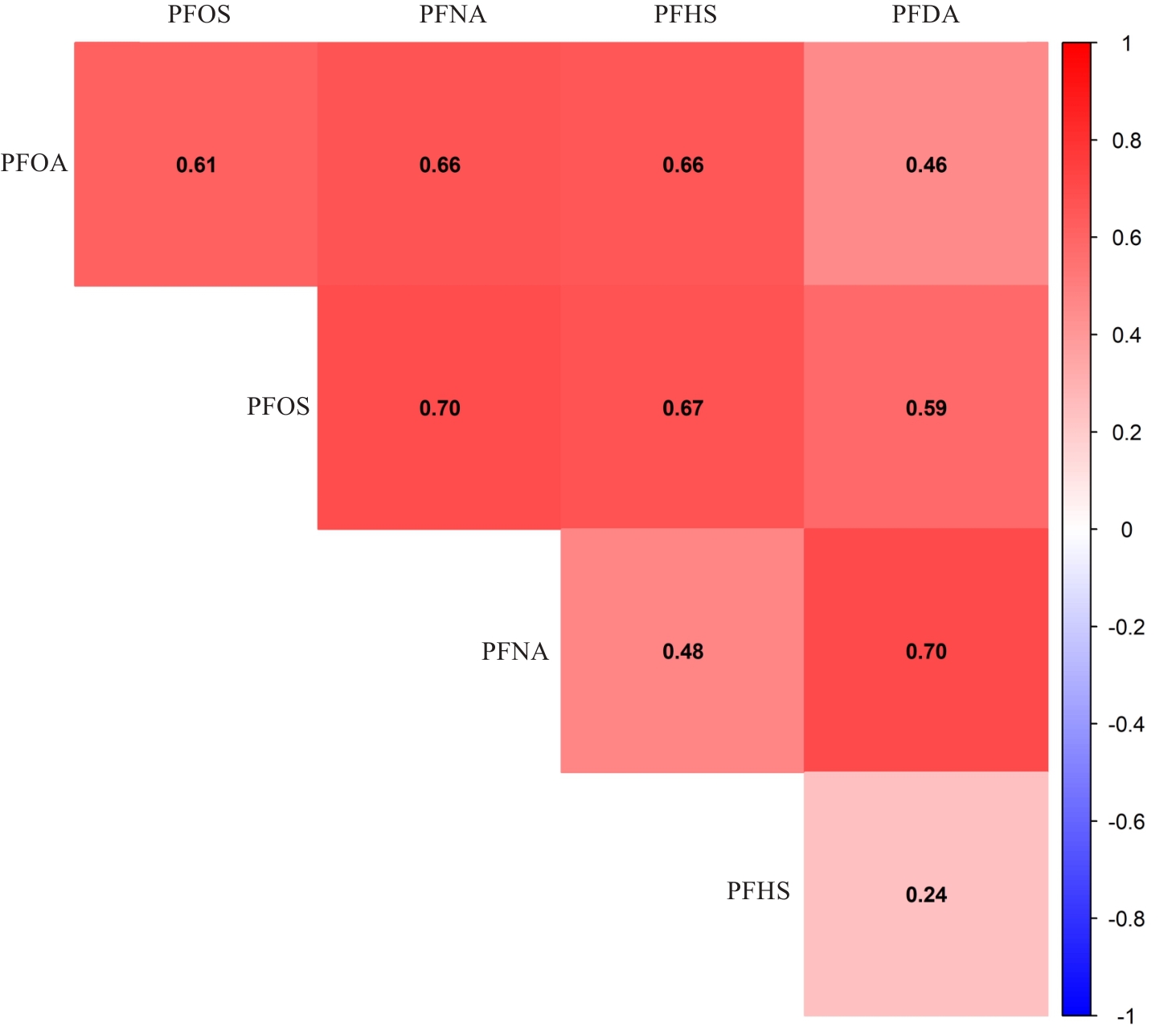
图2 PFAS组分间的Spearman秩相关系数矩阵热图
Fig.2 Heatmap of Spearman rank correlation coefficients among PFAS components. PFOA: Perfluorooctanoic acid; PFOS: Perfluorooctane sulfonate; PFNA: Perfluorononanoic acid; PFHS: Perfluorohexane sulfonate; PFDA: Perfluorodecanoic acid.
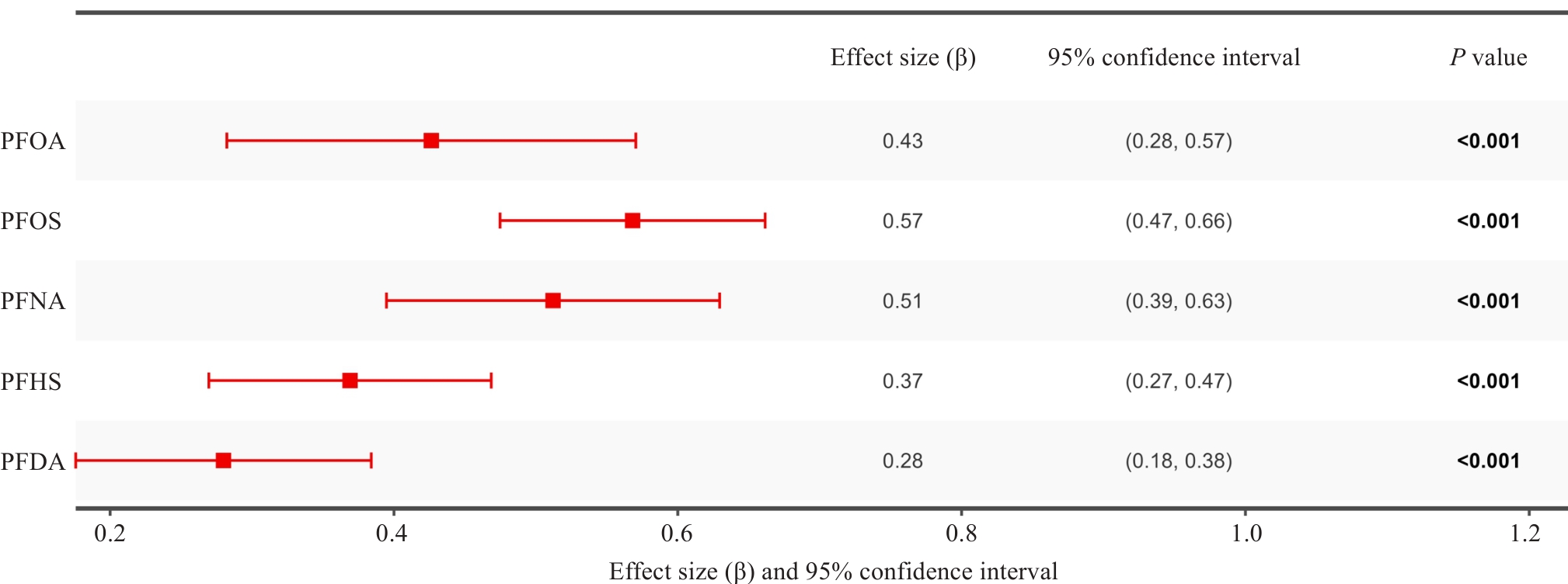
图3 PFAS组分与ePWV的加权多元线性回归分析
Fig.3 Weighted multiple linear regression analysis of PFAS components and estimated pulse wave velocity (ePWV).
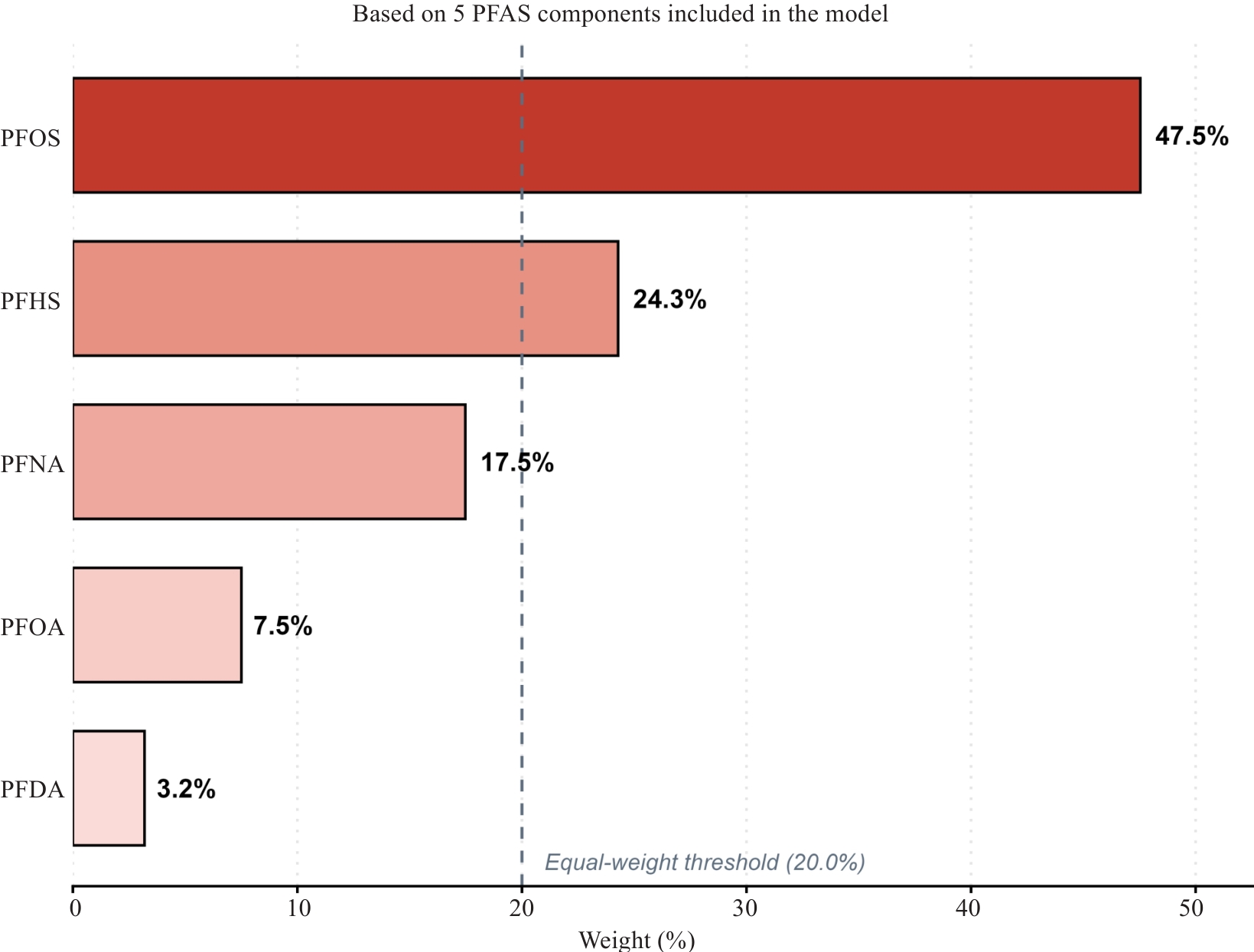
图4 基于 WQS 回归模型的各 PFAS 组分对混合暴露效应的相对权重贡献
Fig.4 Relative weight contributions of individual PFAS components to the mixture effect based on the WQS regression model.
| Hormone | Hormone level | β (95% CI) | P interaction |
|---|---|---|---|
| Estradiol | Low | 0.891 (0.751, 1.032) | <0.01 |
| Moderate | 0.670 (0.558, 0.783) | ||
| High | 0.428 (0.291, 0.565) | ||
| Testosterone | Low | 0.814 (0.659, 0.970) | <0.001 |
| Moderate | 0.432 (0.335, 0.529) | ||
| High | 0.193 (0.099, 0.287) |
表2 不同性激素水平下PFAS混合暴露与ePWV的分层关联及乘法交互检验
Tab.2 Associations and multiplicative interaction tests between PFAS mixture exposure and ePWV across different sex hormone levels
| Hormone | Hormone level | β (95% CI) | P interaction |
|---|---|---|---|
| Estradiol | Low | 0.891 (0.751, 1.032) | <0.01 |
| Moderate | 0.670 (0.558, 0.783) | ||
| High | 0.428 (0.291, 0.565) | ||
| Testosterone | Low | 0.814 (0.659, 0.970) | <0.001 |
| Moderate | 0.432 (0.335, 0.529) | ||
| High | 0.193 (0.099, 0.287) |
| E2 | T | ||||||
|---|---|---|---|---|---|---|---|
| PFAS | Hormone level | β (95% CI) | P interaction | PFAS | Hormone level | β (95% CI) | P interaction |
| PFOA | 0.134 | PFOA | <0.001 | ||||
| Low | 0.59 (0.36, 0.82) | Low | 0.87 (0.68, 1.07) | ||||
| Moderate | 0.29 (0.14, 0.44) | Moderate | 0.57 (0.43, 0.71) | ||||
| High | 0.21 (0.10, 0.32) | High | 0.19 (-0.06, 0.41) | ||||
| PFOS | <0.001 | PFOS | 0.092 | ||||
| Low | 0.81 (0.63, 0.99) | Low | 0.79 (0.63, 0.95) | ||||
| Moderate | 0.53 (0.41, 0.65) | Moderate | 0.63 (0.52, 0.74) | ||||
| High | 0.14 (0.05, 0.23) | High | 0.50 (0.31, 0.69) | ||||
| PFNA | <0.01 | PFNA | 0.278 | ||||
| Low | 0.75 (0.52, 0.98) | Low | 0.79 (0.59, 0.98) | ||||
| Moderate | 0.45 (0.32, 0.59) | Moderate | 0.62 (0.48, 0.76) | ||||
| High | 0.19 (0.09, 0.30) | High | 0.50 (0.28, 0.71) | ||||
| PFHS | <0.001 | PFHS | <0.001 | ||||
| Low | 0.69 (0.50, 0.88) | Low | 0.85 (0.70, 1.01) | ||||
| Moderate | 0.24 (0.12, 0.35) | Moderate | 0.42 (0.31, 0.53) | ||||
| High | 0.10 (0.01, 0.19) | High | 0.23 (0.04, 0.42) | ||||
| PFDA | 0.780 | PFDA | 0.884 | ||||
| Low | 0.38 (0.18, 0.59) | Low | 0.44 (0.24, 0.63) | ||||
| Moderate | 0.28 (0.17, 0.40) | Moderate | 0.36 (0.24, 0.48) | ||||
| High | 0.20 (0.11, 0.30) | High | 0.28 (0.10, 0.46) | ||||
表3 性激素对PFAS各组分与ePWV关联的交互作用
Tab.3 Interactions between sex hormones and individual PFAS components in relation to ePWV
| E2 | T | ||||||
|---|---|---|---|---|---|---|---|
| PFAS | Hormone level | β (95% CI) | P interaction | PFAS | Hormone level | β (95% CI) | P interaction |
| PFOA | 0.134 | PFOA | <0.001 | ||||
| Low | 0.59 (0.36, 0.82) | Low | 0.87 (0.68, 1.07) | ||||
| Moderate | 0.29 (0.14, 0.44) | Moderate | 0.57 (0.43, 0.71) | ||||
| High | 0.21 (0.10, 0.32) | High | 0.19 (-0.06, 0.41) | ||||
| PFOS | <0.001 | PFOS | 0.092 | ||||
| Low | 0.81 (0.63, 0.99) | Low | 0.79 (0.63, 0.95) | ||||
| Moderate | 0.53 (0.41, 0.65) | Moderate | 0.63 (0.52, 0.74) | ||||
| High | 0.14 (0.05, 0.23) | High | 0.50 (0.31, 0.69) | ||||
| PFNA | <0.01 | PFNA | 0.278 | ||||
| Low | 0.75 (0.52, 0.98) | Low | 0.79 (0.59, 0.98) | ||||
| Moderate | 0.45 (0.32, 0.59) | Moderate | 0.62 (0.48, 0.76) | ||||
| High | 0.19 (0.09, 0.30) | High | 0.50 (0.28, 0.71) | ||||
| PFHS | <0.001 | PFHS | <0.001 | ||||
| Low | 0.69 (0.50, 0.88) | Low | 0.85 (0.70, 1.01) | ||||
| Moderate | 0.24 (0.12, 0.35) | Moderate | 0.42 (0.31, 0.53) | ||||
| High | 0.10 (0.01, 0.19) | High | 0.23 (0.04, 0.42) | ||||
| PFDA | 0.780 | PFDA | 0.884 | ||||
| Low | 0.38 (0.18, 0.59) | Low | 0.44 (0.24, 0.63) | ||||
| Moderate | 0.28 (0.17, 0.40) | Moderate | 0.36 (0.24, 0.48) | ||||
| High | 0.20 (0.11, 0.30) | High | 0.28 (0.10, 0.46) | ||||
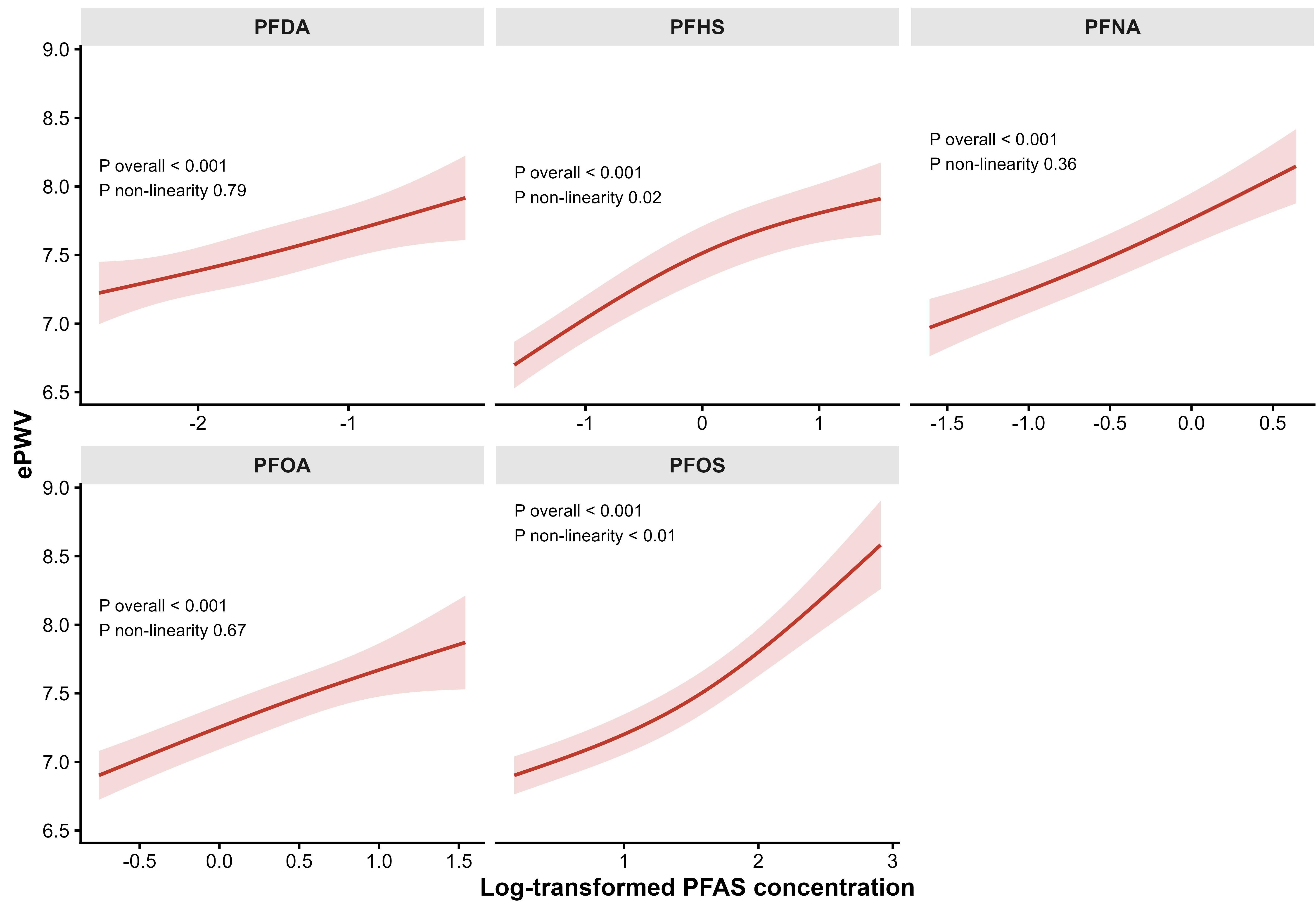
图5 PFAS组分与ePWV的非线性剂量反应关系
Fig.5 Nonlinear dose-response relationship between PFAS components and ePWV.
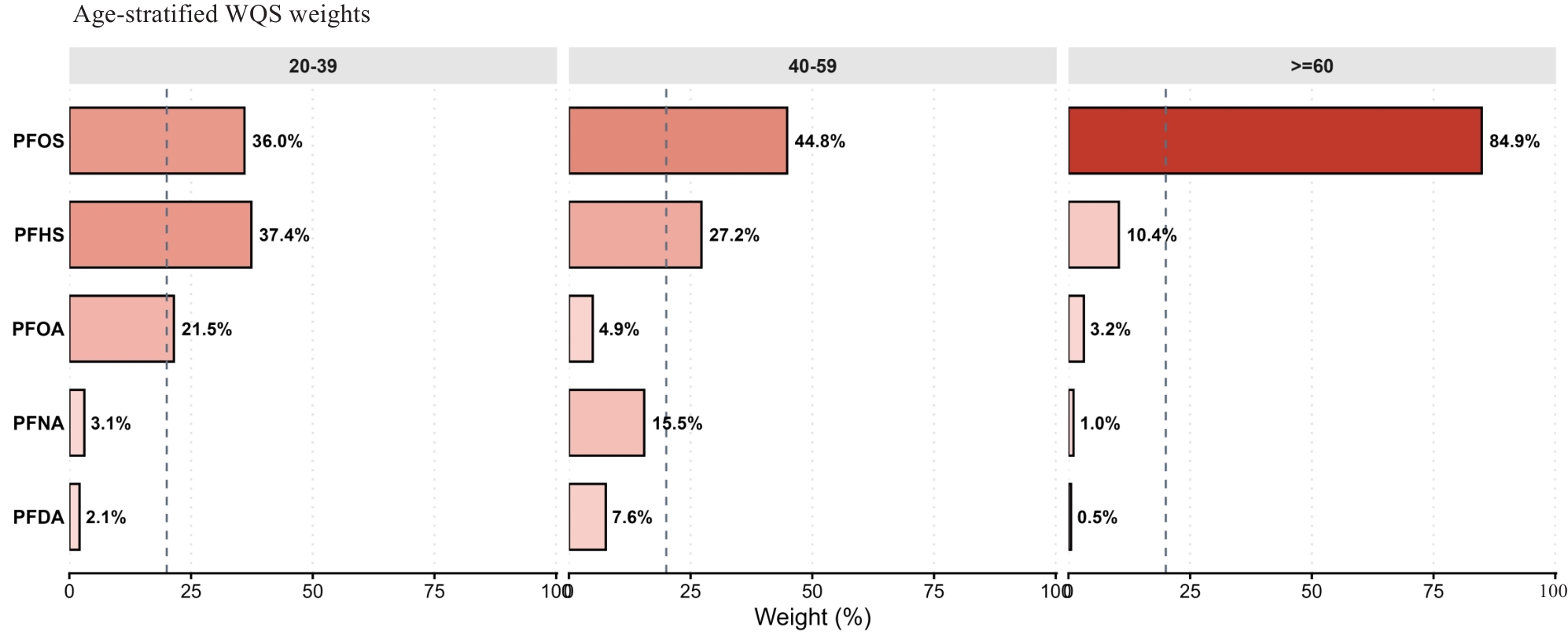
图6 年龄分层下基于WQS回归模型的各PFAS组分对混合暴露效应的相对权重贡献
Fig.6 Age-stratified relative weight contributions of PFAS components to the mixture exposure effect based on the WQS regression model.
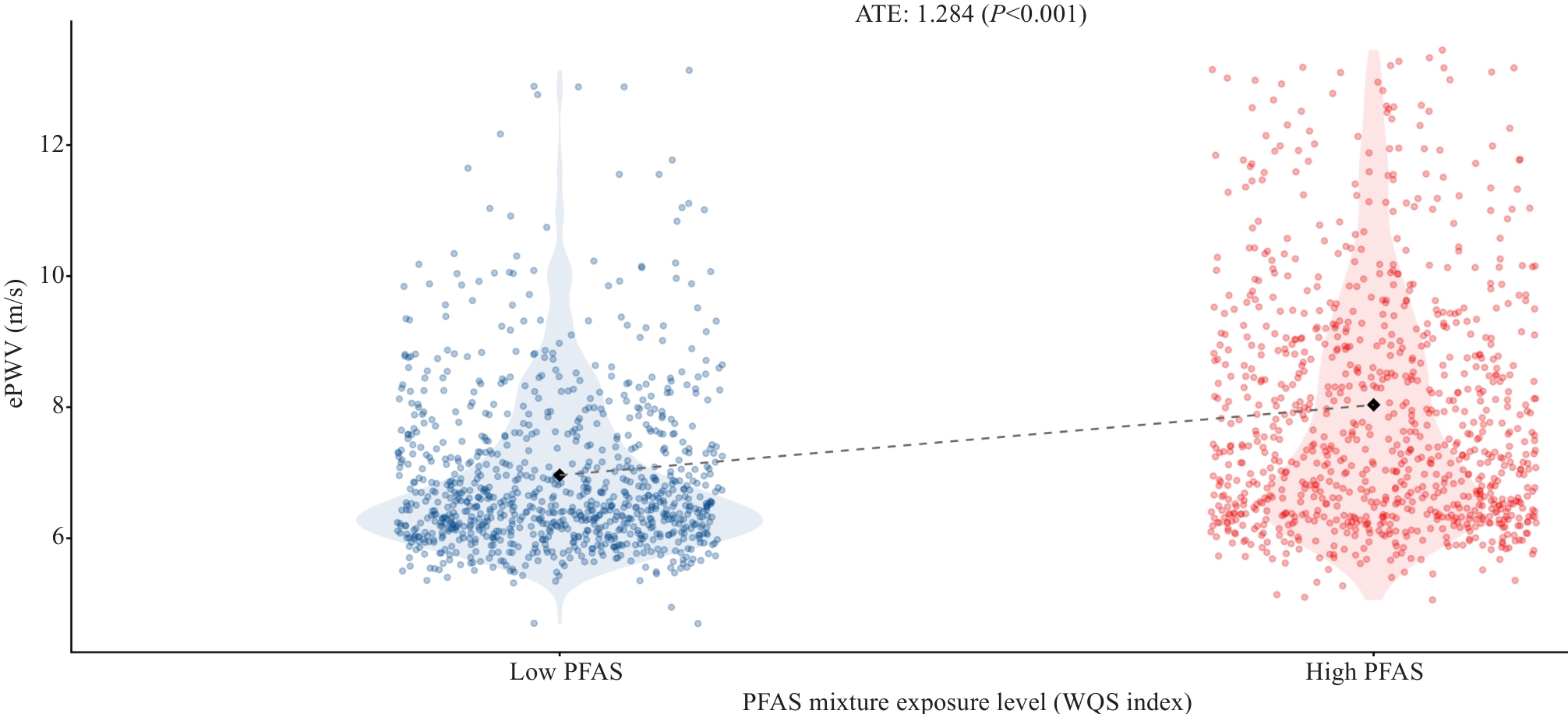
图7 双重稳健估计下PFAS混合暴露分组与ePWV水平差异
Fig.7 Doubly robust estimates of differences in ePWV between PFAS mixture exposure groups.
| [1] | Kwiatkowski CF, Andrews DQ, Birnbaum LS, et al. Scientific basis for managing PFAS as a chemical class[J]. Environ Sci Technol Lett, 2020, 7(8): 532-43. doi:10.1021/acs.estlett.0c00255 |
| [2] | Evich MG, Davis MJB, McCord JP, et al. Per- and polyfluoroalkyl substances in the environment[J]. Science, 2022, 375(6580): eabg9065. doi:10.1126/science.abg9065 |
| [3] | Zhou L, Andersson EM, Harari F, et al. Exposure to high levels of perfluoroalkyl substances through drinking water and risk of cardiovascular morbidity and mortality in a Swedish register-based study[J]. Environ Res, 2025, 286: 122765. doi:10.1016/j.envres.2025.122765 |
| [4] | Meneguzzi A, Fava C, Castelli M, et al. Exposure to perfluoroalkyl chemicals and cardiovascular disease: experimental and epidemiological evidence[J]. Front Endocrinol, 2021, 12: 706352. doi:10.3389/fendo.2021.706352 |
| [5] | Averina M, Brox J, Huber S, et al. Exposure to perfluoroalkyl substances (PFAS) and dyslipidemia, hypertension and obesity in adolescents. The Fit Futures study[J]. Environ Res, 2021, 195: 110740. doi:10.1016/j.envres.2021.110740 |
| [6] | Kang N, Chen W, Osazuwa N, et al. Longitudinal associations of PFAS exposure with insulin sensitivity and β‑cell function among hispanic women with a history of gestational diabetes mellitus[J]. Diabetes Care, 2025, 48(4): 564-8. doi:10.2337/dc24-2056 |
| [7] | Wittkopp S, Wu F, Windheim J, et al. Vascular endothelium as a target for perfluroalkyl substances (PFAs)[J]. Environ Res, 2022, 212: 113339. doi:10.1016/j.envres.2022.113339 |
| [8] | Gump BB, Hill DT, Robinson M, et al. Perfluoroalkyl substances (PFAS) and lead (Pb) as "cardiovascular disruptors" in 9-11-year-old children living in Syracuse, New York, United States[J]. Environ Res, 2023, 236: 116758. doi:10.1016/j.envres.2023.116758 |
| [9] | Connelly PJ, Casey H, Montezano AC, et al. Sex steroids receptors, hypertension, and vascular ageing[J]. J Hum Hypertens, 2022, 36(2): 120-5. doi:10.1038/s41371-021-00576-7 |
| [10] | Wu B, Sheng N, Li Z, et al. Positive associations of perfluoroalkyl and polyfluoroalkyl substances with hypertension may be attenuated by endogenous sex hormones: a nationally representative cross-sectional study[J]. Hypertension, 2024, 81(8): 1799-810. doi:10.1161/hypertensionaha.123.22127 |
| [11] | Heffernan KS, Stoner L, London AS, et al. Estimated pulse wave velocity as a measure of vascular aging[J]. PLoS One, 2023, 18(1): e0280896. doi:10.1371/journal.pone.0280896 |
| [12] | Greve SV, Laurent S, Olsen MH. Estimated pulse wave velocity calculated from age and mean arterial blood pressure[J]. Pulse, 2017, 4(4): 175-9. doi:10.1159/000453073 |
| [13] | Cheng WK, Kong FL, Pan HC, et al. Superior predictive value of estimated pulse wave velocity for all-cause and cardiovascular disease mortality risk in U.S. general adults[J]. BMC Public Health, 2024, 24(1): 600. doi:10.1186/s12889-024-18071-2 |
| [14] | Greve SV, Blicher MK, Kruger R, et al. Estimated carotid-femoral pulse wave velocity has similar predictive value as measured carotid-femoral pulse wave velocity[J]. J Hypertens, 2016, 34(7): 1279-89. doi:10.1097/hjh.0000000000000935 |
| [15] | Wu ML, Zhu ZW, Wan RJ, et al. Exposure to per- and polyfluoroalkyl substance and metabolic syndrome: a nationally representative cross-sectional study from NHANES, 2003-2018[J]. Environ Pollut, 2024, 346: 123615. doi:10.1016/j.envpol.2024.123615 |
| [16] | Lai TJ, Liang YY, Guan FL, et al. Association between remnant cholesterol and arterial stiffness: Evidence from NHANES 1999-2018[J]. Nutr Metab Cardiovasc Dis, 2025, 35(8): 104013. doi:10.1016/j.numecd.2025.104013 |
| [17] | Santos S, Maitre L, Warembourg C, et al. Applying the exposome concept in birth cohort research: a review of statistical approaches[J]. Eur J Epidemiol, 2020, 35(3): 193-204. doi:10.1007/s10654-020-00625-4 |
| [18] | Zong SL, Wang L, Wang ST, et al. Exposure to per- and polyfluoroalkyl substances is associated with impaired cardiovascular health: a cross-sectional study[J]. Front Public Health, 2024, 12: 1418134. doi:10.3389/fpubh.2024.1418134 |
| [19] | Zhu L, Liu BK, Hu Y, et al. Per- and polyfluoroalkyl substances, apolipoproteins and the risk of coronary heart disease in US men and women[J]. Environ Health, 2024, 23(1): 108. doi:10.1186/s12940-024-01147-2 |
| [20] | Schlezinger JJ, Gokce N. Perfluoroalkyl/polyfluoroalkyl substances: links to cardiovascular disease risk[J]. Circ Res, 2024, 134(9): 1136-59. doi:10.1161/circresaha.124.323697 |
| [21] | Wen ZJ, Wei YJ, Zhang YF, et al. A review of cardiovascular effects and underlying mechanisms of legacy and emerging per- and polyfluoroalkyl substances (PFAS)[J]. Arch Toxicol, 2023, 97(5): 1195-245. doi:10.1007/s00204-023-03477-5 |
| [22] | Connolly JC, Ishihara Y, Sawaya E, et al. Per- and polyfluoroalkyl substances (PFAS) enhance cholesterol accumulation and dysregulate inflammatory responses in macrophages[J]. Cardiovasc Toxicol, 2025, 25(10): 1455-70. doi:10.1007/s12012-025-10048-w |
| [23] | Vajeethaveesin N, Kanitwithayanun J, Suriyo T, et al. Perfluorooctane sulfonic acid: a possible risk factor of endothelial dysfunction based on in silico and in vitro studies[J]. Arch Toxicol, 2025, 99(7): 2975-91. doi:10.1007/s00204-025-04047-7 |
| [24] | Juhasz AL, Kastury F, Jones R, et al. PFOA, PFOS and PFHxS toxicokinetic considerations for the development of an in vivo approach for assessing PFAS relative bioavailability in soil[J]. Environ Int, 2025, 195: 109232. doi:10.1016/j.envint.2024.109232 |
| [25] | Fischer FC, Ludtke S, Thackray C, et al. Binding of per- and polyfluoroalkyl substances (PFAS) to serum proteins: implications for toxicokinetics in humans[J]. Environ Sci Technol, 2024, 58(2): 1055-63. doi:10.1021/acs.est.3c07415 |
| [26] | Nevzati E, Shafighi M, Bakhtian KD, et al. Estrogen induces nitric oxide production via nitric oxide synthase activation in endothelial cells[M]//Neurovascular Events After Subarachnoid Hemorrhage: Towards Experimental and Clinical Standardisation. Cham: Springer International Publishing, 2015: : 141-5. doi:10.1007/978-3-319-04981-6_24 |
| [27] | Perusquía M, Stallone JN. Do androgens play a beneficial role in the regulation of vascular tone? Nongenomic vascular effects of testosterone metabolites[J]. Am J Physiol Heart Circ Physiol, 2010, 298(5): H1301-7. doi:10.1152/ajpheart.00753.2009 |
| [28] | He YJ, Liao HL, Yang G, et al. Perfluorohexanesulfonic acid (PFHxS) impairs lipid homeostasis in zebrafish larvae through activation of PPARα[J]. Environ Sci Technol, 2024, 58(37): 16258-68. doi:10.1021/acs.est.4c03053 |
| [29] | Han R, Hu MX, Zhong Q, et al. Perfluorooctane sulphonate induces oxidative hepatic damage via mitochondria-dependent and NF‑κB/TNF-α-mediated pathway[J]. Chemosphere, 2018, 191: 1056-64. doi:10.1016/j.chemosphere.2017.08.070 |
| [30] | Moreau KL. Modulatory influence of sex hormones on vascular aging[J]. Am J Physiol Heart Circ Physiol, 2019, 316(3): H522-6. doi:10.1152/ajpheart.00745.2017 |
| [31] | Benninghoff AD, Bisson WH, Koch DC, et al. Estrogen-like activity of perfluoroalkyl acids in vivo and interaction with human and rainbow trout estrogen receptors in vitro [J]. Toxicol Sci, 2011, 120(1): 42-58. doi:10.1093/toxsci/kfq379 |
| [32] | Kudo N, Katakura M, Sato Y, et al. Sex hormone-regulated renal transport of perfluorooctanoic acid[J]. Chem Biol Interact, 2002, 139(3): 301-16. doi:10.1016/s0009-2797(02)00006-6 |
| [33] | VanderWeele TJ. Explanation in causal inference: developments in mediation and interaction[J]. Int J Epidemiol, 2016: dyw277. doi:10.1093/ije/dyw277 |
| [34] | An ZW, Mei YY, Tan ZZ, et al. Association between per- and polyfluoroalkyl substances exposure and blood pressure: From epidemiological evidence to mechanistic insights[J]. Ecotoxicol Environ Saf, 2025, 303: 118888. doi:10.1016/j.ecoenv.2025.118888 |
| [35] | Shi YM, Yu C, Zhou W, et al. Estimated pulse wave velocity as a predictor of all-cause and cardiovascular mortality in patients with hypertension in China: a prospective cohort study[J]. Front Cardiovasc Med, 2024, 11: 1365344. doi:10.3389/fcvm.2024.1365344 |
| [1] | 胡当立, 张 锋, 李蕙君, 许小艺, 文 萍, 郑 峥, 姚吉龙. 多囊卵巢综合征与牙周炎呈正相关:一项前瞻性研究[J]. 南方医科大学学报, 2024, 44(1): 36-44. |
| [2] | 黄建玉,马 骏,郭 琰,王 瑶,张群辉,钟俊达,姜文才,李雁卓,徐 琳. 高血压患者外周血红蛋白水平与动脉硬化程度显著相关[J]. 南方医科大学学报, 2020, 40(02): 240-245. |
| [3] | 鲁景元,顾建平,徐文健,楼文胜,汪涛. 药物涂层球囊与普通球囊治疗股腘动脉硬化闭塞的疗效比较:前瞻性随机对照试验[J]. 南方医科大学学报, 2017, 37(03): 296-. |
| [4] | 邵泽锋,王自正,顾建平,何旭,楼文胜,陈亮,陈国平,宋进华,王国品. 逆行穿刺内膜下成形术治疗膝下动脉长段硬化闭塞症[J]. 南方医科大学学报, 2014, 34(11): 1672-. |
| [5] | 胡兆霆,侯庆臻,赵素玲,梁燕琼,沈安娜. H型高血压患者颈动脉结构和功能变化及与亚临床炎症的相关性[J]. 南方医科大学学报, 2012, 32(08): 1175-. |
| [6] | 高国栋; 莫建伟; 徐书雯;. 皮质下动脉硬化性脑病63例临床分析[J]. 南方医科大学学报, 2006, 26(11): 1582-1583. |
| [7] | 高成杰; 徐达传; 裴强; 原晓景;. 青少年与老年人盆腔动脉三维CT显示差异性研究[J]. 南方医科大学学报, 2006, 26(05): 670-673. |
| [8] | 万海燕, 朱国英, 王人彭, 苏唏, 彭剑, 宋丹, 陈国洪. 紫杉醇洗脱支架治疗冠状动脉硬化性心脏病近期效果[J]. 南方医科大学学报, 2005, 25(10): 1299-1301. |
| [9] | 刘长青1, 吴赛珠1, 王子东2, 赖文岩1, 孙飞1. 睾酮对人单核细胞雄激素受体蛋白表达的影响[J]. 南方医科大学学报, 2004, 24(04): 389-391. |
| 阅读次数 | ||||||
|
全文 |
|
|||||
|
摘要 |
|
|||||
