
南方医科大学学报 ›› 2026, Vol. 46 ›› Issue (10): 2285-2295.doi: 10.12122/j.issn.1673-4254.2026.10.01
• •
杜庆锋1,2( ), 仝小林3()
收稿日期:2026-08-09
出版日期:2026-10-20
发布日期:2026-10-26
通讯作者:
仝小林
E-mail:dqf1689@smu.edu.cn;tongxiaolin@vip.163.com
作者简介:杜庆锋,博士,教授,E-mail: dqf1689@smu.edu.cn基金资助:
Qingfeng DU1,2(), Xiaolin TONG3()
Received:2026-08-09
Online:2026-10-20
Published:2026-10-26
Contact:
Xiaolin TONG
E-mail:dqf1689@smu.edu.cn;tongxiaolin@vip.163.com
摘要:
中西医结合学科历经七十年发展,逐步形成了以“单靶点”验证为主导的科研范式。该范式在“线性因果、变量较少”的问题域中成效卓著,但面对“非线性、多因素交织”的复杂问题域,其解释力日益不足。本文梳理了这一范式的成就与局限,深入分析其与学科核心问题域之间的结构性错配,进而提出“态靶因果”验证的科研范式。该范式以“宏观状态与微观事件之间的跨层级因果耦合”为验证对象,通过“寻找耦合-证明耦合-运用耦合”三个递进层次,以及“定义宏观表型、捕捉微观变量、干预验证共变、反向验证因果”四步研究闭环来实现操作化。文章进一步用“态靶因果”范式对吴以岭团队基于脉络学说防治微血管共病、陈香美团队基于“风湿扰肾”理论治疗IgA肾病、张亭栋-王振义-陈竺团队基于“以毒攻毒”理论治疗急性早幼粒细胞白血病等3个案例进行回顾分析与解读,展示了新范式对前期重要研究的内在逻辑解释力。最后,提出了宏观表型标准化、候选靶点库建设、跨层级统计方法发展、实验性反向验证、多中心平台建设、AI技术辅助应用以及方法学推广等未来重点任务。本文认为,“态靶因果”范式标志着中西医结合研究从“借用他人范式”走向“自主建构范式”,为学科建立与自身问题域相匹配的科研方法论提供了系统框架。
杜庆锋, 仝小林. 中西医结合科研范式的升级:从“单靶点”验证到“态靶因果”验证[J]. 南方医科大学学报, 2026, 46(10): 2285-2295.
Qingfeng DU, Xiaolin TONG. Upgrading the scientific research paradigm of integrated traditional Chinese and Western medicine: from "single-target" validation to "state-target causality" validation[J]. Journal of Southern Medical University, 2026, 46(10): 2285-2295.
| Dimension | Problem domains with linear causality and limited variables | Problem domains with nonlinearity and multiple interacting factors |
|---|---|---|
| Dominant paradigm | "Single target" validation paradigm | "State-target causality" validation paradigm |
| Causal structure | Clear, decomposable, and traceable causal chains | Entangled causal networks with nonlinear characteristics and emergent effects |
| Optimal epistemic strategy | Open the black-box and directly trace the causal chain | Grey-box approach: start from the macro level and gradually extend to the micro level |
| Causal inference methods | Reductionist analysis, controlled experiments, randomized controlled trials | Systems science, network analysis, multi-level causal inference |
| Validation logic | Verify the linear chain of "drug-target-effect" | Verify the cross-level causal coupling of " state-target-effect" |
| Evaluation endpoints | Changes in specific indicators or pathways | Symptom relief, functional recovery, quality of life improvement |
| Philosophical foundation | Reductionism | Systems theory |
表1 从“单靶点”到“态靶因果”的范式升级:两类问题域的认知策略对比
Tab.1 Paradigm upgrade from "single‑target" to "state‑target causality": a comparison of cognitive strategies for two types of problem domains
| Dimension | Problem domains with linear causality and limited variables | Problem domains with nonlinearity and multiple interacting factors |
|---|---|---|
| Dominant paradigm | "Single target" validation paradigm | "State-target causality" validation paradigm |
| Causal structure | Clear, decomposable, and traceable causal chains | Entangled causal networks with nonlinear characteristics and emergent effects |
| Optimal epistemic strategy | Open the black-box and directly trace the causal chain | Grey-box approach: start from the macro level and gradually extend to the micro level |
| Causal inference methods | Reductionist analysis, controlled experiments, randomized controlled trials | Systems science, network analysis, multi-level causal inference |
| Validation logic | Verify the linear chain of "drug-target-effect" | Verify the cross-level causal coupling of " state-target-effect" |
| Evaluation endpoints | Changes in specific indicators or pathways | Symptom relief, functional recovery, quality of life improvement |
| Philosophical foundation | Reductionism | Systems theory |
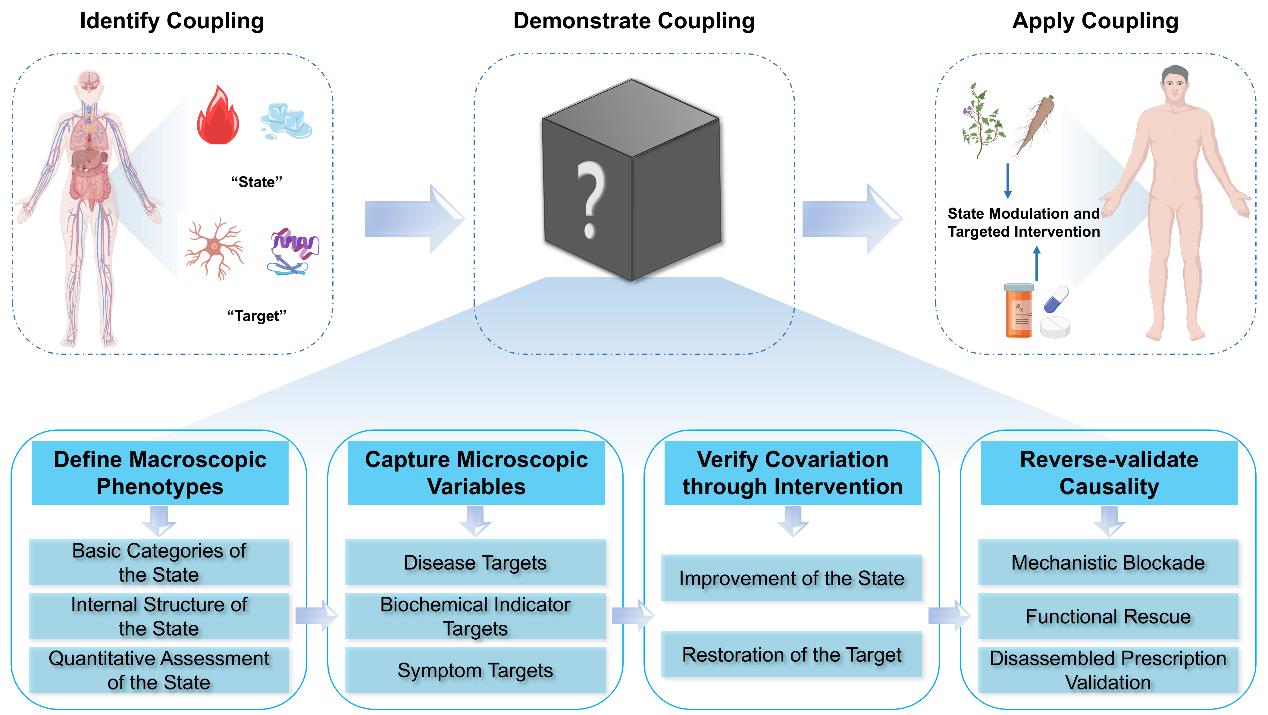
图1 "态靶因果"验证范式的三个递进层次与四步研究闭环
Fig.1 The 3 progressive levels and the 4-step research loop of the "state-target causality" validation paradigm (Created with BioGDP[29]).
| Four-step research loop | Wu Yiling team (microangiopathy) | Chen Xiangmei team (IgA nephropathy) | Arsenic trioxide therapy for acute promyelocytic leukemia (APL) |
|---|---|---|---|
| Define macroscopic phenotypes | Established diagnostic criteria for "Vessel-collateral and vascular system disease" based on syndrome differentiation; clarified the correspondence between the Yingwei theory and vascular endothelial function as well as neurohumoral regulation. | Established a "four-in-one" evaluation system integrating TCM syndromes, Western-medicine clinical features, pathology, and biomarkers; promoted the standardization and objectification of TCM syndrome in IgA nephropathy. | Took deficiency of healthy Qi and toxic pathogens as the core; defined major TCM syndrome classifications for APL (e.g., deficiency of Qi -blood, intense exuberant heat toxin, etc.) without objectively characterizing or standardizing the state. |
| Capture microscopic variables | Used mesenteric microcirculation and cardiac surface microvasculature techniques to reveal four categories of microscopic pathological features at the "Minute collaterals and microvessels" level. | Correlated TCM syndromes with immune-inflammatory factors, renal injury biomarkers, and renal histopathological changes. | Identified the molecular target of arsenic trioxide (ATO) as the PML-RARα fusion protein; elucidated the molecular mechanism by which ATO induces degradation of this protein. |
| Verify covariation through intervention | Administration of collateral-dredging drugs (Tongxinluo, Shensong Yangxin, and Qili Qiangxin) regulate both "Ying-Wei, Qi-blood" and the micro-pathological changes in "Minute collaterals and microvessels" in parallel. | Multi-center randomized controlled trials (RCT) confirmed that Huangkui Capsule reduced proteinuria and preserved renal function, while simultaneously improving immuno-inflammatory responses and renal microcirculation. | Verified that PML-RARα degradation after ATO treatment occurred synchronously with clinical remission in patients. |
| Reverse-validate causality | Systematic reverse validation has not yet been completed; percutaneous coronary intervention (PCI) and vasodilator interventions provided indirect supporting evidence for the restoration of Ying-Wei, Qi-blood regulation in the vessel collaterals. | Mechanistic studies have suggested regulatory effects on certain pathways; systematic target-blockade and rescue experiments remain insufficient. | ATO directly targets PML-RARα; altering the binding site reduces therapeutic efficacy. |
表2 3个历史案例与四步研究闭环的对应关系
Tab.2 Correspondence between the 3 historical cases and the 4‑step research loop
| Four-step research loop | Wu Yiling team (microangiopathy) | Chen Xiangmei team (IgA nephropathy) | Arsenic trioxide therapy for acute promyelocytic leukemia (APL) |
|---|---|---|---|
| Define macroscopic phenotypes | Established diagnostic criteria for "Vessel-collateral and vascular system disease" based on syndrome differentiation; clarified the correspondence between the Yingwei theory and vascular endothelial function as well as neurohumoral regulation. | Established a "four-in-one" evaluation system integrating TCM syndromes, Western-medicine clinical features, pathology, and biomarkers; promoted the standardization and objectification of TCM syndrome in IgA nephropathy. | Took deficiency of healthy Qi and toxic pathogens as the core; defined major TCM syndrome classifications for APL (e.g., deficiency of Qi -blood, intense exuberant heat toxin, etc.) without objectively characterizing or standardizing the state. |
| Capture microscopic variables | Used mesenteric microcirculation and cardiac surface microvasculature techniques to reveal four categories of microscopic pathological features at the "Minute collaterals and microvessels" level. | Correlated TCM syndromes with immune-inflammatory factors, renal injury biomarkers, and renal histopathological changes. | Identified the molecular target of arsenic trioxide (ATO) as the PML-RARα fusion protein; elucidated the molecular mechanism by which ATO induces degradation of this protein. |
| Verify covariation through intervention | Administration of collateral-dredging drugs (Tongxinluo, Shensong Yangxin, and Qili Qiangxin) regulate both "Ying-Wei, Qi-blood" and the micro-pathological changes in "Minute collaterals and microvessels" in parallel. | Multi-center randomized controlled trials (RCT) confirmed that Huangkui Capsule reduced proteinuria and preserved renal function, while simultaneously improving immuno-inflammatory responses and renal microcirculation. | Verified that PML-RARα degradation after ATO treatment occurred synchronously with clinical remission in patients. |
| Reverse-validate causality | Systematic reverse validation has not yet been completed; percutaneous coronary intervention (PCI) and vasodilator interventions provided indirect supporting evidence for the restoration of Ying-Wei, Qi-blood regulation in the vessel collaterals. | Mechanistic studies have suggested regulatory effects on certain pathways; systematic target-blockade and rescue experiments remain insufficient. | ATO directly targets PML-RARα; altering the binding site reduces therapeutic efficacy. |
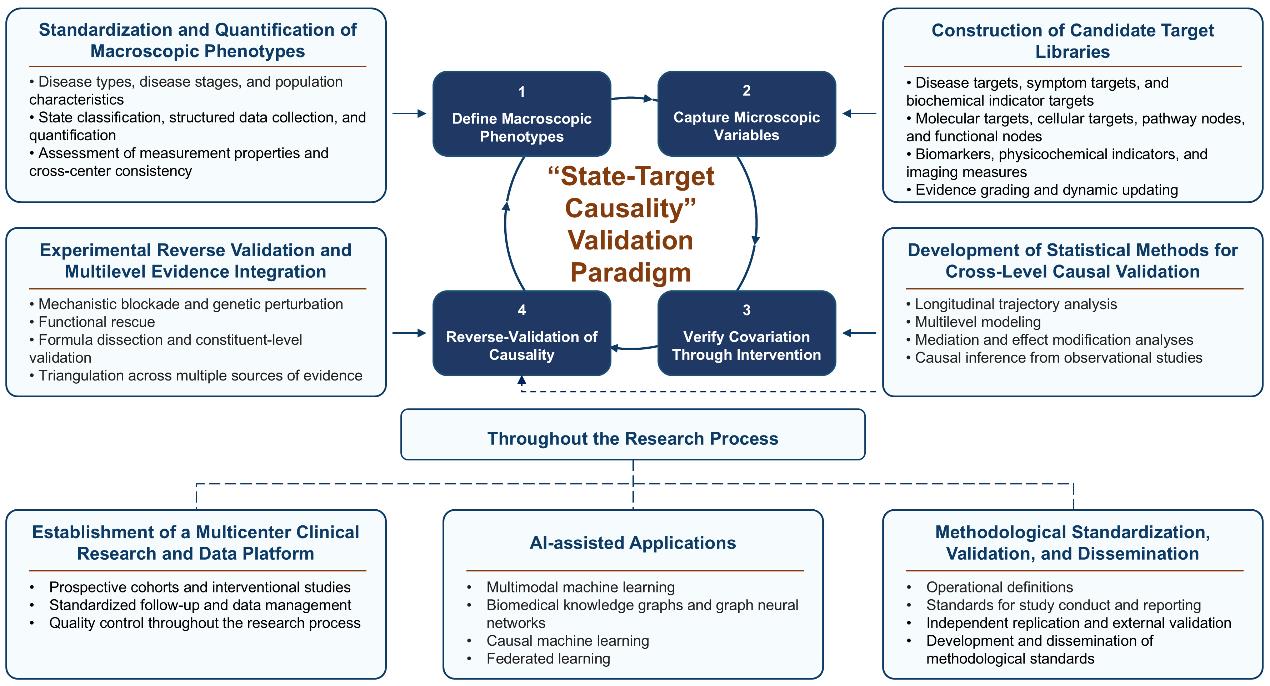
图2 态靶因果验证范式四步研究闭环及其支撑条件
Fig.2 The 4-step research loop of the "state-target causality" validation paradigm and its supporting conditions.
| [1] | 青蒿素结构研究协作组. 一种新型的倍半萜内酯: 青蒿素[J]. 科学通报, 1977, 22(3): 142. |
| [2] | 陈士奎. 我国开创的中西医结合科研及其启示(九): 张亭栋教授等与中药砒霜治疗急性早幼粒细胞白血病的中西医结合研究[J]. 中国中西医结合杂志, 2017, 37(11): 1292-6. |
| [3] | 沈自尹, 顾天爵, 姜春华, 等. 肾阴肾阳中西医结合辨证施治规律的初步探讨[J]. 上海中医药杂志, 1962,(1):19-23. |
| [4] | 陈士奎. 我国开创的中西医结合科研及其启示(一): 著名中西医结合医学家陈可冀院士与血瘀证及活血化瘀研究[J]. 中国中西医结合杂志, 2016, 36(9): 1029-31. |
| [5] | 邓中光, 邱仕君, 邓铁涛. 邓铁涛对重症肌无力的认识与辨证论治[J]. 中国医药学报, 1993, 8(2): 41-3. |
| [6] | 商洪才. 芪参益气滴丸对心肌梗死二级预防的临床试验研究通过专家组验收[J]. 天津中医药, 2010, 27(4):266. |
| [7] | 李 梢, 汪博洋, 曹 亮, 等. 基于网络靶标理论和技术的中药研发实践[J]. 中国中药杂志, 2023, 48(22): 5965-76. |
| [8] | 苏真真, 李 娜, 曹 亮, 等. 桂枝茯苓胶囊主要药理作用及临床应用研究进展[J]. 中国中药杂志, 2015, 40(6): 989-92. |
| [9] | 王 佩, 孔祥文, 张晶宇, 等. 基于“功效物质-物性参数-工艺参数”关联性分析的桂枝茯苓胶囊制药过程浓缩工序质量控制研究[J]. 中草药, 2026, 57(13): 5069-81. |
| [10] | Kuhn TS. The Structure of Scientific Revolutions[M]. 4th ed. Chicago: University of Chicago Press, 2012. |
| [11] | 仝小林,杜庆锋.试论中西医结合学科第一性原理:寻找、证明和运用生命复杂系统中宏观状态与微观事件之间的跨层级因果耦合[N]. 中国中医药报, 2026-07-09. |
| [12] | 何莉莎, 宋 攀, 赵林华, 等. 态靶辨证: 中医从宏观走向精准的历史选择[J]. 辽宁中医杂志, 2020, 47(1): 1-4. |
| [13] | 仝小林. 态靶医学: 中医未来发展之路[J]. 中国中西医结合杂志, 2021, 41(1): 16-8. |
| [14] | 乔丽萍, 王昭博, 李梦甜, 等. 仝小林教授态靶辨治糖尿病微血管病变的学术思想与病案举例[J]. 吉林中医药, 2023, 43(11): 1271-75. |
| [15] | 李 柳, 程海波, 孙东东, 等. 基于态靶辨治理论探讨结直肠癌辨治思路[J]. 南京中医药大学学报, 2026, 42(3): 330-5. doi:10.14148/j.issn.1672-0482.2026.0330 |
| [16] | 杜庆锋.中西医结合学科内涵“三点论”[N]. 中国中医药报, 2026-06-08. |
| [17] | 杜庆锋.发展中西医结合学科的“道、法、器”新模式[N]. 中国中医药报, 2026-06-18. |
| [18] | 薛崇祥, 李青伟, 邢惠琴, 等. 现代医学疾病阶段病理生理状态与态靶辨治关系[J]. 中国中西医结合杂志, 2024, 44(10): 1258-62. |
| [19] | Zhang P, Gao CF, Hua K, et al. Systematically decoding pathological morphologies and molecular profiles with unified multimodal embedding[J]. Nat Meth, 2026, 23(5): 903-8. doi:10.1038/s41592-026-03070-5 |
| [20] | 宋珏娴, 傅晓燕, 仝小林. 现代医学背景下中医诊疗体系的重构[J]. 中医杂志, 2018, 59(1): 6-9. |
| [21] | 仝小林, 何莉莎, 赵林华. 论“态靶因果”中医临床辨治方略[J]. 中医杂志, 2015, 56(17): 1441-4. |
| [22] | 袁亚男, 姜廷良, 周 兴, 等. 青蒿素的发现和发展[J]. 科学通报, 2017, 62(18): 1914-27. |
| [23] | 王继刚, 徐承超, 王彦钧, 等. 青蒿素: 一种从中药中发现的神奇药物[J]. Engineering, 2019, 5(1):72-88. doi:10.1016/j.eng.2018.11.011 |
| [24] | 中华医学会老年医学分会老年内分泌代谢疾病学组中国老年代谢综合征药物治疗专家共识编写组. 中国老年人代谢综合征药物治疗专家共识(2022)[J]. 中华老年医学杂志, 2022, 41(9): 1011-27. |
| [25] | Jing WH, Dong SJ, Xu YY, et al. Gut microbiota-derived tryptophan metabolites regulated by Wuji Wan to attenuate colitis through AhR signaling activation[J]. Acta Pharm Sin B, 2025, 15(1): 205-23. doi:10.1016/j.apsb.2024.11.009 |
| [26] | Wu ZF, Yang JR, Zhang MX, et al. Microplastics-induced gut microbiota dysbiosis accelerates Alzheimer's-like pathology and cognitive decline via the gut-brain axis[J]. Adv Sci, 2026: e76072. doi:10.1002/advs.76072 |
| [27] | 谭 微, 霍胜霞, 吴春兴, 等. 中药复方拆方领域研究现状及热点的文献计量学分析[J]. 数理医药学杂志, 2025, 38(10): 744-55. |
| [28] | Cheng XQ, Dai YQ, Shang BL, et al. Danggui Shaoyao San and disassembled prescription: neuroprotective effects via AMPK/mTOR-mediated autophagy in mice[J]. BMC Complement Med Ther, 2024, 24(1): 298. doi:10.1186/s12906-024-04588-x |
| [29] | Jiang S, Li HQ, Zhang L, et al. Generic Diagramming Platform (GDP): a comprehensive database of high-quality biomedical graphics[J]. Nucleic Acids Res, 2025, 53(D1): D1670-6. doi:10.1093/nar/gkae973 |
| [30] | 吴以岭. 络病学[M]. 3版. 北京: 中国中医药出版社, 2025. |
| [31] | 贾振华, 吴以岭, 高怀林, 等. “脉络—血管系统病”辨证诊断标准[J]. 中医杂志, 2007, (11):1027-32. |
| [32] | 张俊修. 孙络绌急-疏失-瘀阻-滋生的微血管病变中医微观病理特征研究[D]. 北京: 解放军总医院, 2017. |
| [33] | 吴以岭. 治疗冠心病心绞痛的通心络胶囊及其制备方法: CN1198332A[P]. 1998-11-11. doi:CN1198332 A |
| [34] | 成都艾比科生物科技有限公司. 一种应用于参松养心胶囊试生产中的提取工艺: CN201510602517.2[P]. 2015-11-25. |
| [35] | 刘奕训, 余河水, 康利平, 等. 芪苈强心胶囊活性部位中的组成成分研究[J]. 中草药, 2010, 41(7): 1060-5. |
| [36] | 吴以岭. 基于络病理论的中药新药研发[J]. 中国药理学与毒理学杂志, 2019, 33(9): 645. |
| [37] | 常丽萍, 李禄金, 魏 聪, 等. 基于主成分分析方法的“孙络—微血管”病变数学模型构建及通络干预研究[J]. 疑难病杂志, 2018, 17(7): 649-53, 666. |
| [38] | 高传玉, 杨 蕾, 张 静, 等. 通心络胶囊对经皮冠状动脉介入患者长期预后的影响[J]. 河北医药, 2007, (10): 1067-68. |
| [39] | 张平安, 梅永现, 胡建军, 等. 通心络对急性心肌梗死患者冠脉置入支架后无复流的保护和长期作用观察[J]. 临床合理用药杂志, 2015, 8(29): 38-39. |
| [40] | 吴以岭, 谷春华, 高学东, 等. 参松养心胶囊治疗冠心病室性早搏的随机双盲多中心临床研究[J]. 疑难病杂志, 2007, 6(8): 449-52. |
| [41] | 张洁晗. 络病理论指导微血管内皮细胞功能障碍介导的炎症反应在心律失常中的作用及参松养心胶囊的干预研究[D]. 石家庄: 河北医科大学, 2023. |
| [42] | 吴以岭, 谷春华, 徐贵成, 等. 芪苈强心胶囊治疗慢性心力衰竭随机双盲、多中心临床研究[J]. 疑难病杂志, 2007, (5): 263-66. doi:10.3969/j.issn.1671-6450.2007.05.003 |
| [43] | 徐 瑶, 郭 晶, 罗国金.一等功院士陈香美[N]. 健康时报, 2017-09-05. |
| [44] | 黄 锦, 李姗姗, 杨锦惠, 等. 从陈香美院士团队诊治IgA肾病谈中西医整合[J]. 医学争鸣, 2020, 11(1): 29-32, 36. |
| [45] | 余艳红, 秦怀金. 西医大家话中医-第二卷-钟南山 陈香美 张运 葛均波 贾伟平[M]. 北京: 中国中医药出版社, 2024. |
| [46] | Li P, Lin HL, Ni ZH, et al. Efficacy and safety of Abelmoschus manihot for IgA nephropathy: a multicenter randomized clinical trial[J]. Phytomedicine, 2020, 76: 153231. doi:10.1016/j.phymed.2020.153231 |
| [47] | 韩杨文轩. 黄秋葵花乙醇提取物治疗肾脏疾病的临床疗效及分子机制的研究进展[J]. 中文科技期刊数据库: 文摘版医药卫生, 2023(12): 164-7. |
| [48] | 邢增辉, 张一绚, 韩 冰, 等. 黄葵胶囊治疗IgA肾病、糖尿病肾病及膜性肾病疗效比较[J]. 中国中西医结合肾病杂志, 2023, 24(3): 207-12. doi:10.3969/j.issn.1009-587X.2023.03.007 |
| [49] | 张亭栋, 荣福祥. 癌灵一号注射液与辨证论治治疗急性粒细胞型白血病[J]. 黑龙江医药, 1979, 3(4): 7-11. |
| [50] | 孙清廉. 以毒攻毒话砒霜[J]. 开卷有益(求医问药), 2002, (8): 28. |
| [51] | Zhang XW, Yan XJ, Zhou ZR, et al. Arsenic trioxide controls the fate of the PML-RARalpha oncoprotein by directly binding PML[J]. Science, 2010, 328(5975): 240-3. |
| [52] | Hu J, Liu YF, Wu CF, et al. Long-term efficacy and safety of all-trans retinoic acid/arsenic trioxide-based therapy in newly diagnosed acute promyelocytic leukemia[J]. Proc Natl Acad Sci USA, 2009, 106(9): 3342-7. doi:10.1073/pnas.0813280106 |
| [53] | 唐闻佳. “上海方案”是如何炼成的[N]. 文汇报, 2018-08-26. |
| [54] | Ochoa D, Hercules A, Carmona M, et al. The next-generation Open Targets Platform: reimagined, redesigned, rebuilt[J]. Nucleic Acids Res, 2023, 51(D1): D1353-9. doi:10.1093/nar/gkac1046 |
| [55] | VanderWeele TJ. Mediation analysis: a practitioner's guide[J]. Annu Rev Public Health, 2016, 37: 17-32. doi:10.1146/annurev-publhealth-032315-021402 |
| [56] | Sanderson E, Glymour MM, Holmes MV, et al. Mendelian randomization[J]. Nat Rev Meth Primers, 2022, 2: 6. doi:10.1038/s43586-021-00092-5 |
| [57] | Hernán MA, Wang W, Leaf DE. Target trial emulation: a framework for causal inference from observational data[J]. JAMA, 2022, 328(24): 2446-7. doi:10.1001/jama.2022.21383 |
| [58] | Munafò MR, Davey Smith G. Robust research needs many lines of evidence[J]. Nature, 2018, 553(7689): 399-401. doi:10.1038/d41586-018-01023-3 |
| [59] | Acosta JN, Falcone GJ, Rajpurkar P, et al. Multimodal biomedical AI[J]. Nat Med, 2022, 28(9): 1773-84. doi:10.1038/s41591-022-01981-2 |
| [60] | Huang KX, Chandak P, Wang QW, et al. A foundation model for clinician-centered drug repurposing[J]. Nat Med, 2024, 30(12): 3601-13. doi:10.1038/s41591-024-03233-x |
| [61] | Feuerriegel S, Frauen D, Melnychuk V, et al. Causal machine learning for predicting treatment outcomes[J]. Nat Med, 2024, 30(4): 958-68. doi:10.1038/s41591-024-02902-1 |
| [62] | Dayan I, Roth HR, Zhong AX, et al. Federated learning for predicting clinical outcomes in patients with COVID-19[J]. Nat Med, 2021, 27(10): 1735-43. |
| [63] | Cui GQ, Li MZ, Guo WB, et al. AI driven network pharmacology: Multi-scale mechanisms of traditional Chinese medicine from molecular to patient analysis[J]. Comput Struct Biotechnol J, 2025, 27: 5087-104. doi:10.1016/j.csbj.2025.11.016 |
| [1] | . 慢性意识障碍中西医结合诊治专家共识(广东)[J]. 南方医科大学学报, 2026, 46(5): 1193-1202. |
| [2] | 鲁义, 刘存志, 耿武军, 郑孝振, 谢敬敦, 张广防, 刘超, 李云, 瞿燕, 陈磊, 黄希照, 田航, 黎玉辉, 李红新, 钟和英, 陶荣贵, 钟杰, 庄越, 马钧阳, 胡艳, 方剑, 赵高峰, 肖建斌, 屠伟峰, 孙嘉泽, 段玉婷, 王保. 广东省抗癌协会肿瘤麻醉及镇痛治疗专委会广州市中西医结合学会麻醉学分委会[J]. 南方医科大学学报, 2025, 45(8): 1800-1808. |
| 阅读次数 | ||||||
|
全文 |
|
|||||
|
摘要 |
|
|||||
