
南方医科大学学报 ›› 2026, Vol. 46 ›› Issue (7): 1576-1584.doi: 10.12122/j.issn.1673-4254.2026.07.11
• • 上一篇
侯杰1,2( ), 陈维琳2(), 彭亮2, 乔甫3, 康梅2(), 马莹2()
收稿日期:2025-11-07
出版日期:2026-07-20
发布日期:2026-07-20
通讯作者:
康梅,马莹
E-mail:microbe_houjie@hotmail.com;wl1335058287@163.com;kangmei@sina.com;majiying72@hotmail.com
作者简介:侯 杰,硕士,E-mail: microbe_houjie@hotmail.com基金资助:
Jie HOU1,2(), Weilin CHEN2(), Liang PENG2, Fu QIAO3, Mei KANG2(), Ying MA2()
Received:2025-11-07
Online:2026-07-20
Published:2026-07-20
Contact:
Mei KANG, Ying MA
E-mail:microbe_houjie@hotmail.com;wl1335058287@163.com;kangmei@sina.com;majiying72@hotmail.com
摘要:
目的 评估基于基质辅助激光解吸电离飞行时间质谱(MALDI-TOF MS)的抗真菌药物敏感性试验(MS-AFST)快速检测热带念珠菌氟康唑耐药性的临床应用潜能。 方法 回顾性分析2018~2023年四川大学华西医院血流感染热带念珠菌的检出情况,并经念珠菌显色培养与MALDI-TOF MS行菌种鉴定。抗真菌药物敏感性试验以 CLSI 微量肉汤稀释法(BMD)为参考标准,对比评估 Sensititre YeastOne 显色药敏试验、优化前处理后基于最小谱图改变浓度(MPCC)的 MS-AFST 法检测氟康唑耐药性的一致性。 结果 本研究纳入的41分离株均为热带念珠菌,其唑类耐药率和非野生型菌株占比在36.59%~68.29%,且唑类高度交叉耐药。Sensititre YeastOne与CLSI BMD的分类一致性和基本一致性均为100%,二者最小抑菌浓度高度相关。基于MPCC的MS-AFST可以3 h左右快速检测热带念珠菌氟康唑耐药表型,与CLSI BMD参考方法和Sensititre YeastOne的分类一致性均为92.68%,基本一致性均为90.24%,极重大误差2株,小误差1株。 结论 基于 MPCC 的 MS-AFST 可快速检测热带念珠菌氟康唑耐药性,且与参考方法一致性较好,但仍存在分类错误,需进一步优化方法并探究其机制。
侯杰, 陈维琳, 彭亮, 乔甫, 康梅, 马莹. MALDI-TOF MS 可快速检测热带念珠菌的氟康唑耐药性[J]. 南方医科大学学报, 2026, 46(7): 1576-1584.
Jie HOU, Weilin CHEN, Liang PENG, Fu QIAO, Mei KANG, Ying MA. Rapid detection of fluconazole resistance in Candida tropicalis using MALDI-TOF mass spectrometry[J]. Journal of Southern Medical University, 2026, 46(7): 1576-1584.
| Isolates | Sensititre YeastOne | CLSI BMD | MS-AFST | |||
|---|---|---|---|---|---|---|
| MIC (µg/mL) | Phenotype | MIC (µg/mL) | Phenotype | MPCC (µg/mL) | Phenotype | |
| 20200253 | 1 | S | 1 | S | 0.25 | S |
| 19200247 | 1 | S | 1 | S | 1 | S |
| 19200191 | 1 | S | 1 | S | 1 | S |
| 19200153 | 1 | S | 2 | S | 1 | S |
| 19200102 | 1 | S | 1 | S | 1 | S |
| 19200098 | 1 | S | 1 | S | 1 | S |
| 18200156 | 1 | S | 1 | S | 1 | S |
| 18200150 | 1 | S | 1 | S | 1 | S |
| 18200142 | 1 | S | 1 | S | 1 | S |
| 18200115 | 1 | S | 1 | S | 1 | S |
| 18200018 | 1 | S | 1 | S | 1 | S |
| 22200035 | 1 | S | 1 | S | 1 | S |
| 21200152 | 2 | S | 2 | S | 2 | S |
| 20200269 | 2 | S | 2 | S | 1 | S |
| 20200161 | 2 | S | 2 | S | 2 | S |
| 19200195 | 2 | S | 2 | S | 0.5 | S |
| 19200050 | 2 | S | 2 | S | 2 | S |
| 18200200 | 2 | S | 2 | S | 1 | S |
| 18200199 | 2 | S | 2 | S | 1 | S |
| 21200090 | 4 | SDD | 4 | SDD | 2 | S |
| 19200042 | 8 | R | 8 | R | 2 | S |
| 22200070 | 16 | R | 32 | R | 16 | R |
| 21200118 | 32 | R | 32 | R | 16 | R |
| 18200162 | 32 | R | 32 | R | 32 | R |
| 19200145 | 64 | R | 64 | R | 8 | R |
| 21200116 | 128 | R | 128 | R | 256 | R |
| 20200204 | 128 | R | 128 | R | 256 | R |
| 19200169 | 128 | R | 128 | R | 256 | R |
| 18200183 | 128 | R | 128 | R | 32 | R |
| 18200053 | 128 | R | 128 | R | 16 | R |
| 21200146 | 256 | R | 256 | R | 128 | R |
| 20200248 | 256 | R | 256 | R | 4 | S |
| 21200261 | 256 | R | 256 | R | 256 | R |
| 21200282 | 256 | R | 512 | R | 256 | R |
| 22200005 | 256 | R | 512 | R | 256 | R |
| 21200112 | 256 | R | 256 | R | 256 | R |
| 20200186 | 256 | R | 256 | R | 256 | R |
| 20200111 | 256 | R | 256 | R | 256 | R |
| 20200037 | 256 | R | 256 | R | 128 | R |
| 19200199 | 256 | R | 256 | R | 256 | R |
| 18200179 | 256 | R | 256 | R | 16 | R |
表1 热带念珠菌临床分离株氟康唑耐药性检测试验结果
Tab.1 Results for fluconazole resistance testing of clinical isolates of Candida tropicalis
| Isolates | Sensititre YeastOne | CLSI BMD | MS-AFST | |||
|---|---|---|---|---|---|---|
| MIC (µg/mL) | Phenotype | MIC (µg/mL) | Phenotype | MPCC (µg/mL) | Phenotype | |
| 20200253 | 1 | S | 1 | S | 0.25 | S |
| 19200247 | 1 | S | 1 | S | 1 | S |
| 19200191 | 1 | S | 1 | S | 1 | S |
| 19200153 | 1 | S | 2 | S | 1 | S |
| 19200102 | 1 | S | 1 | S | 1 | S |
| 19200098 | 1 | S | 1 | S | 1 | S |
| 18200156 | 1 | S | 1 | S | 1 | S |
| 18200150 | 1 | S | 1 | S | 1 | S |
| 18200142 | 1 | S | 1 | S | 1 | S |
| 18200115 | 1 | S | 1 | S | 1 | S |
| 18200018 | 1 | S | 1 | S | 1 | S |
| 22200035 | 1 | S | 1 | S | 1 | S |
| 21200152 | 2 | S | 2 | S | 2 | S |
| 20200269 | 2 | S | 2 | S | 1 | S |
| 20200161 | 2 | S | 2 | S | 2 | S |
| 19200195 | 2 | S | 2 | S | 0.5 | S |
| 19200050 | 2 | S | 2 | S | 2 | S |
| 18200200 | 2 | S | 2 | S | 1 | S |
| 18200199 | 2 | S | 2 | S | 1 | S |
| 21200090 | 4 | SDD | 4 | SDD | 2 | S |
| 19200042 | 8 | R | 8 | R | 2 | S |
| 22200070 | 16 | R | 32 | R | 16 | R |
| 21200118 | 32 | R | 32 | R | 16 | R |
| 18200162 | 32 | R | 32 | R | 32 | R |
| 19200145 | 64 | R | 64 | R | 8 | R |
| 21200116 | 128 | R | 128 | R | 256 | R |
| 20200204 | 128 | R | 128 | R | 256 | R |
| 19200169 | 128 | R | 128 | R | 256 | R |
| 18200183 | 128 | R | 128 | R | 32 | R |
| 18200053 | 128 | R | 128 | R | 16 | R |
| 21200146 | 256 | R | 256 | R | 128 | R |
| 20200248 | 256 | R | 256 | R | 4 | S |
| 21200261 | 256 | R | 256 | R | 256 | R |
| 21200282 | 256 | R | 512 | R | 256 | R |
| 22200005 | 256 | R | 512 | R | 256 | R |
| 21200112 | 256 | R | 256 | R | 256 | R |
| 20200186 | 256 | R | 256 | R | 256 | R |
| 20200111 | 256 | R | 256 | R | 256 | R |
| 20200037 | 256 | R | 256 | R | 128 | R |
| 19200199 | 256 | R | 256 | R | 256 | R |
| 18200179 | 256 | R | 256 | R | 16 | R |
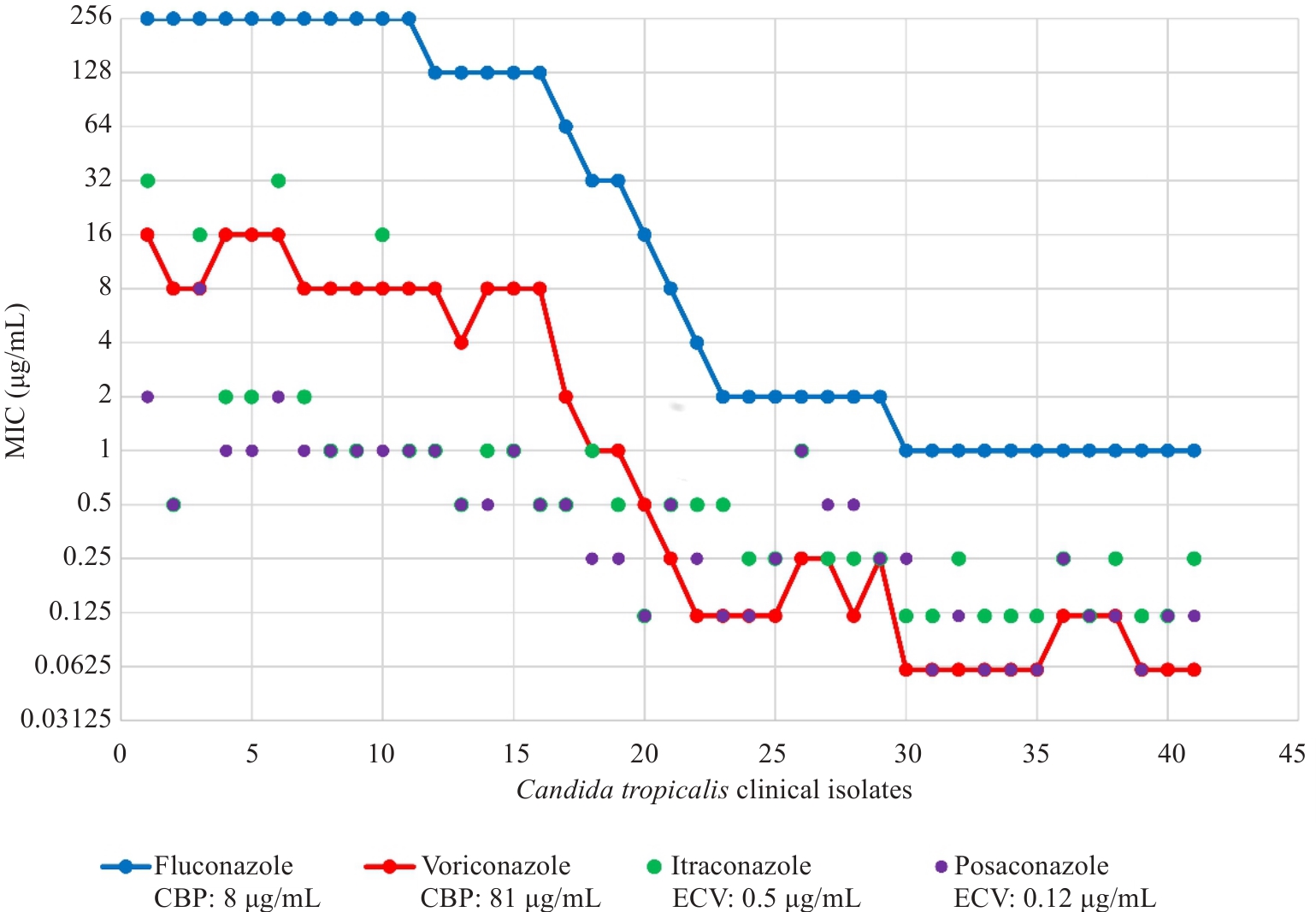
图1 热带念珠菌临床分离株唑类Sensititre YeastOne显色药敏试验结果
Fig.1 Results of Sensititre YeastOne chromogenic antifungal susceptibility testing of clinical isolates of Candida tropicalis. MIC: Minimum inhibitory concentration; CBP: Clinical breakpoint; ECV: Epidemiological cut-off.
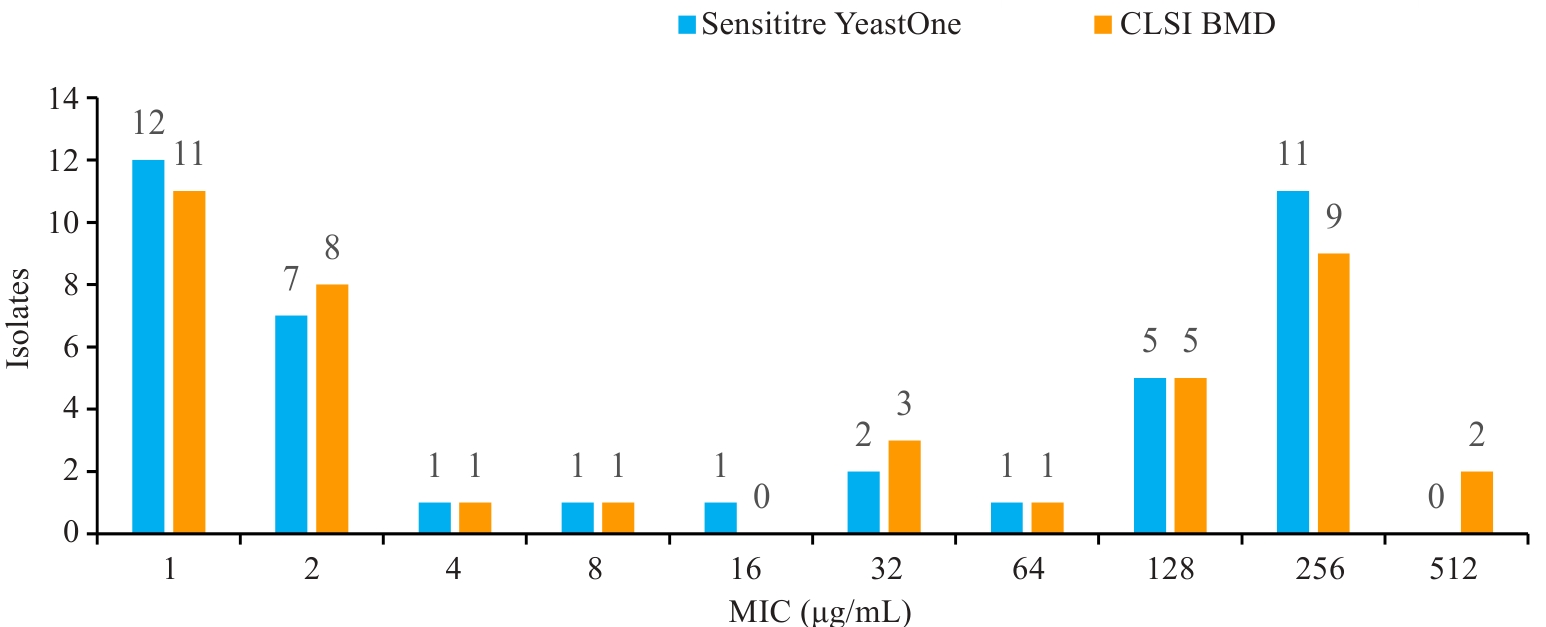
图2 热带念珠菌临床分离株微量肉汤稀释法氟康唑MIC分布图
Fig.2 MIC distribution of fluconazole in clinical isolates of Candida tropicalis by broth microdilution. CLSI BMD: Clinical and laboratory standards institute broth microdilution; MIC: Minimum inhibitory concentration.
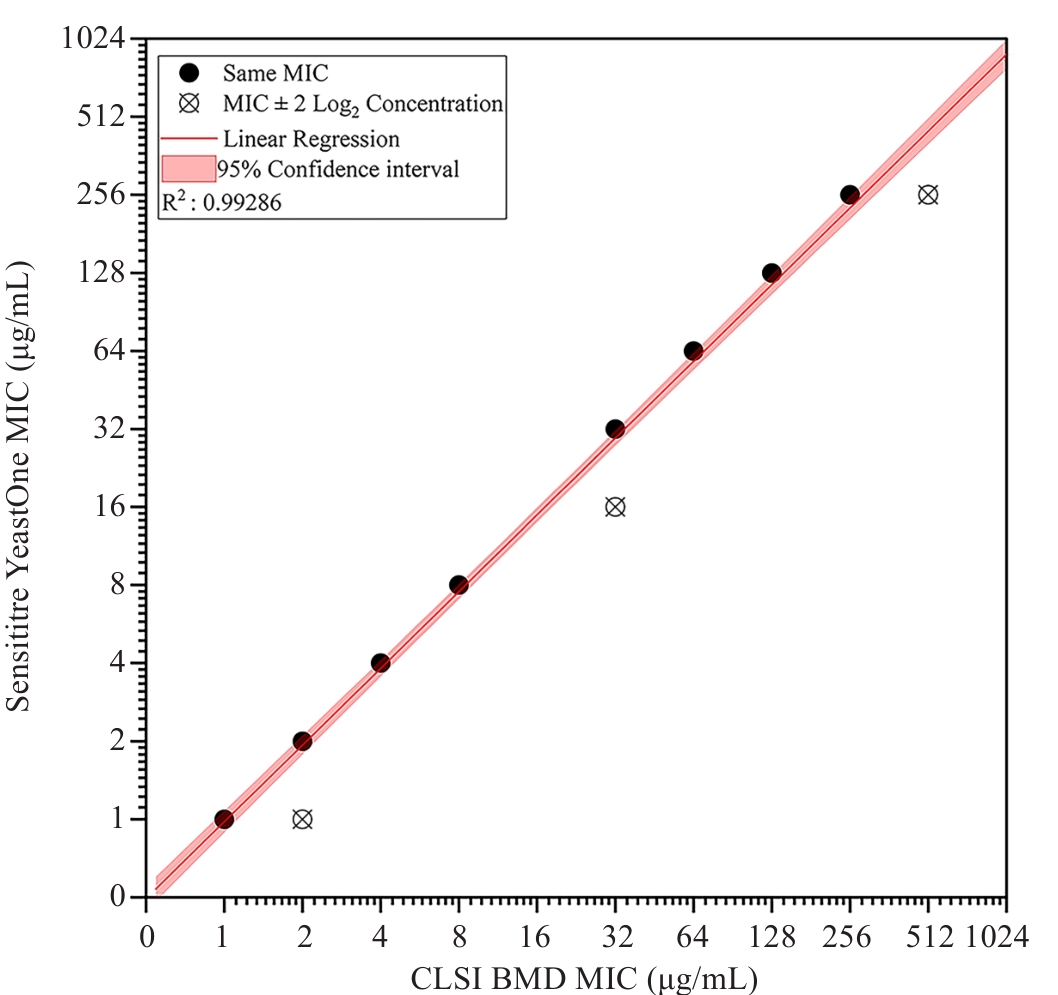
图3 热带念珠菌临床分离株两种微量肉汤稀释法检测氟康唑MIC线性回归
Fig.3 Linear regression of fluconazole MIC detected by two broth microdilution methods for Candida tropicalis clinical isolates.
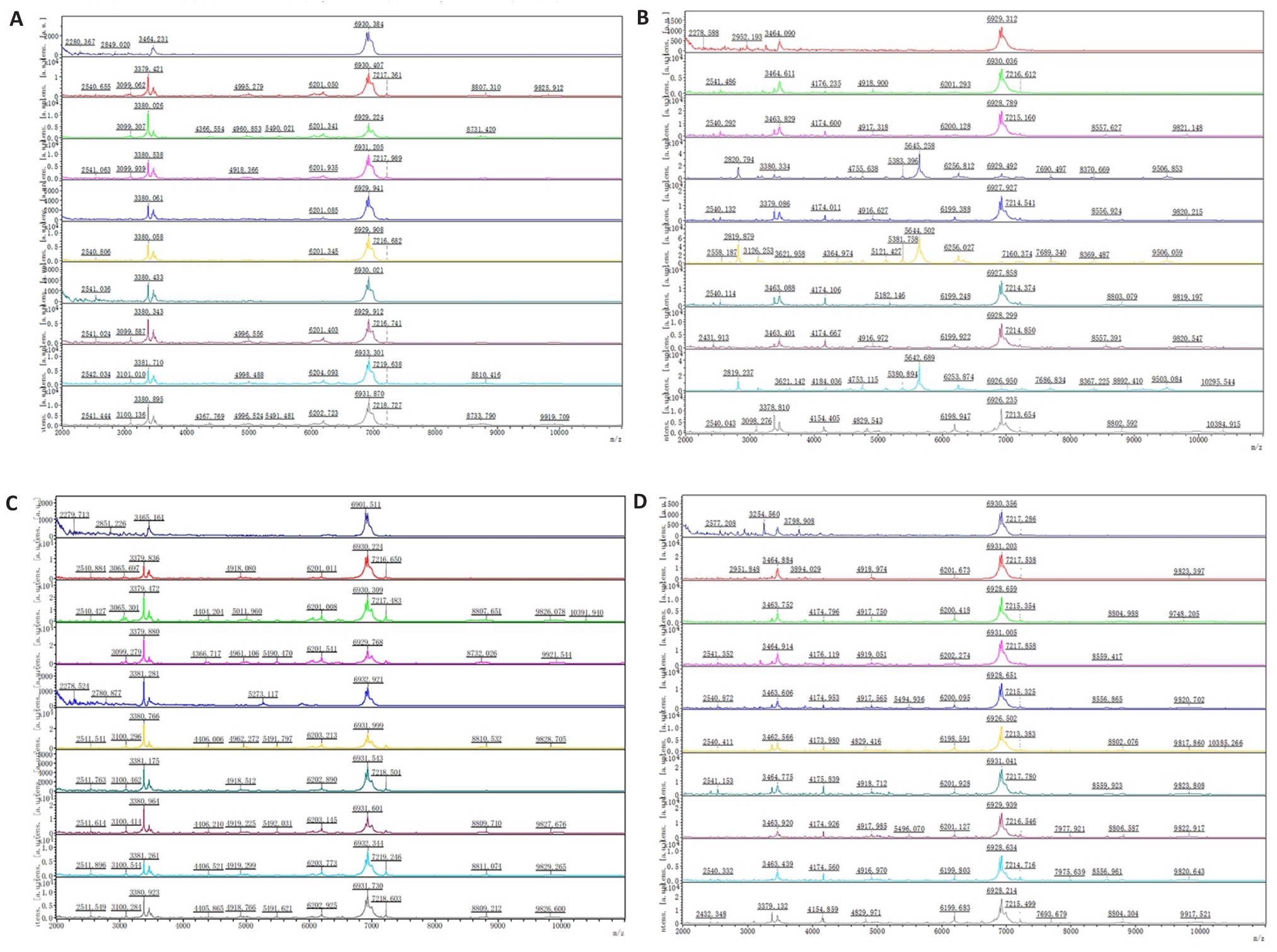
图4 4种不同样本质谱前处理方法的MALDI-TOF MS图
Fig.4 MALDI-TOF MS plots of 4 different sample pretreatment methods. A: First pretreatment protocol. B: Second pretreatment protocol. C: Third pre-treatment protocol. D: Fourth pretreatment protocol.
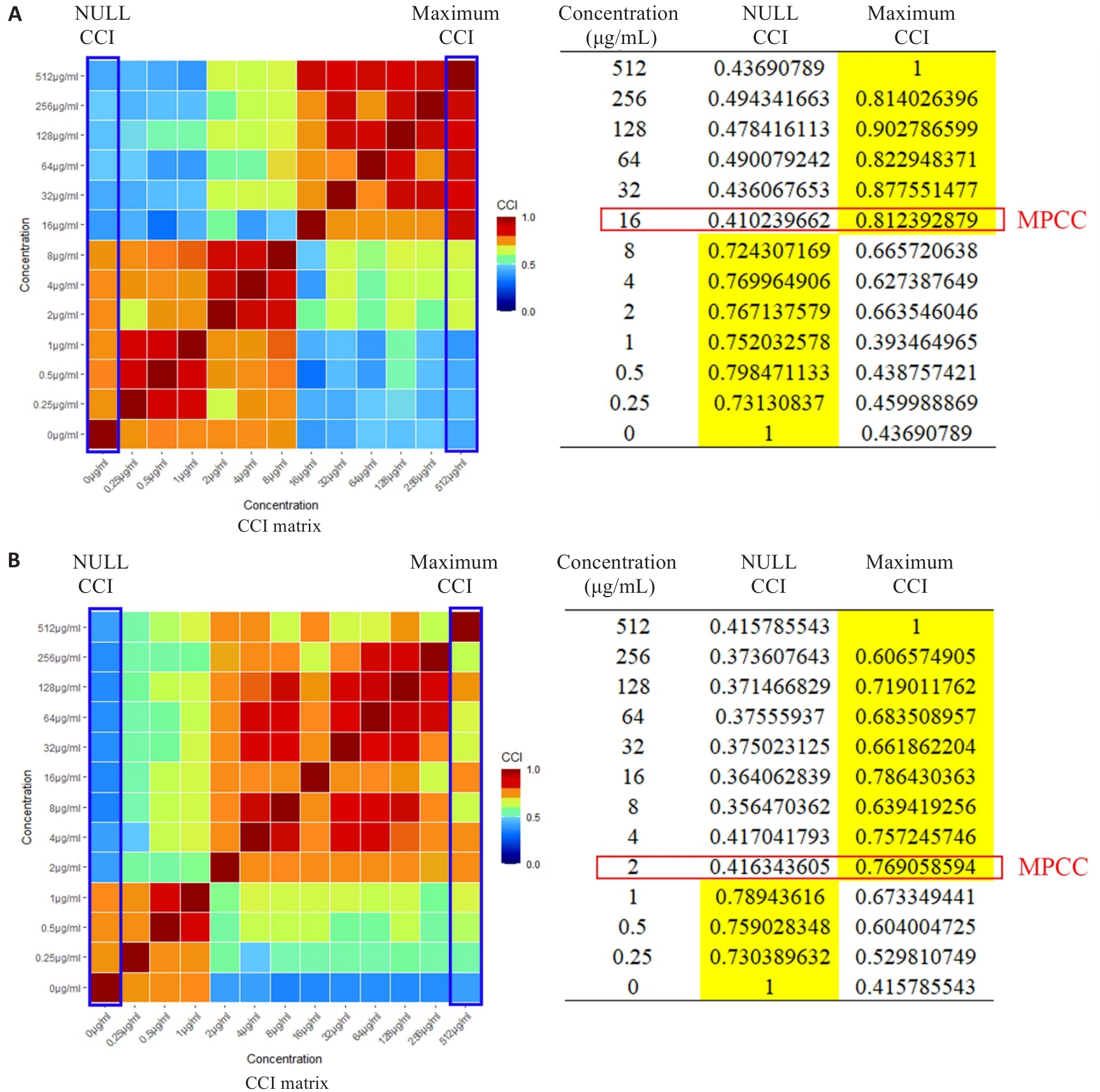
图5 热带念珠菌氟康唑耐药株与敏感株CCI矩阵热图
Fig.5 CCI matrix heatmap of fluconazole-resistant and fluconazole-susceptible strains of Candida tropicalis. A: Fluconazole resistant Candida tropicalis clinical isolate 22200070; B: Fluconazole susceptible Candida tropicalis clinical isolate 19200050. CCI: Composite correlation index; MPCC: Minimal profile change concentration.
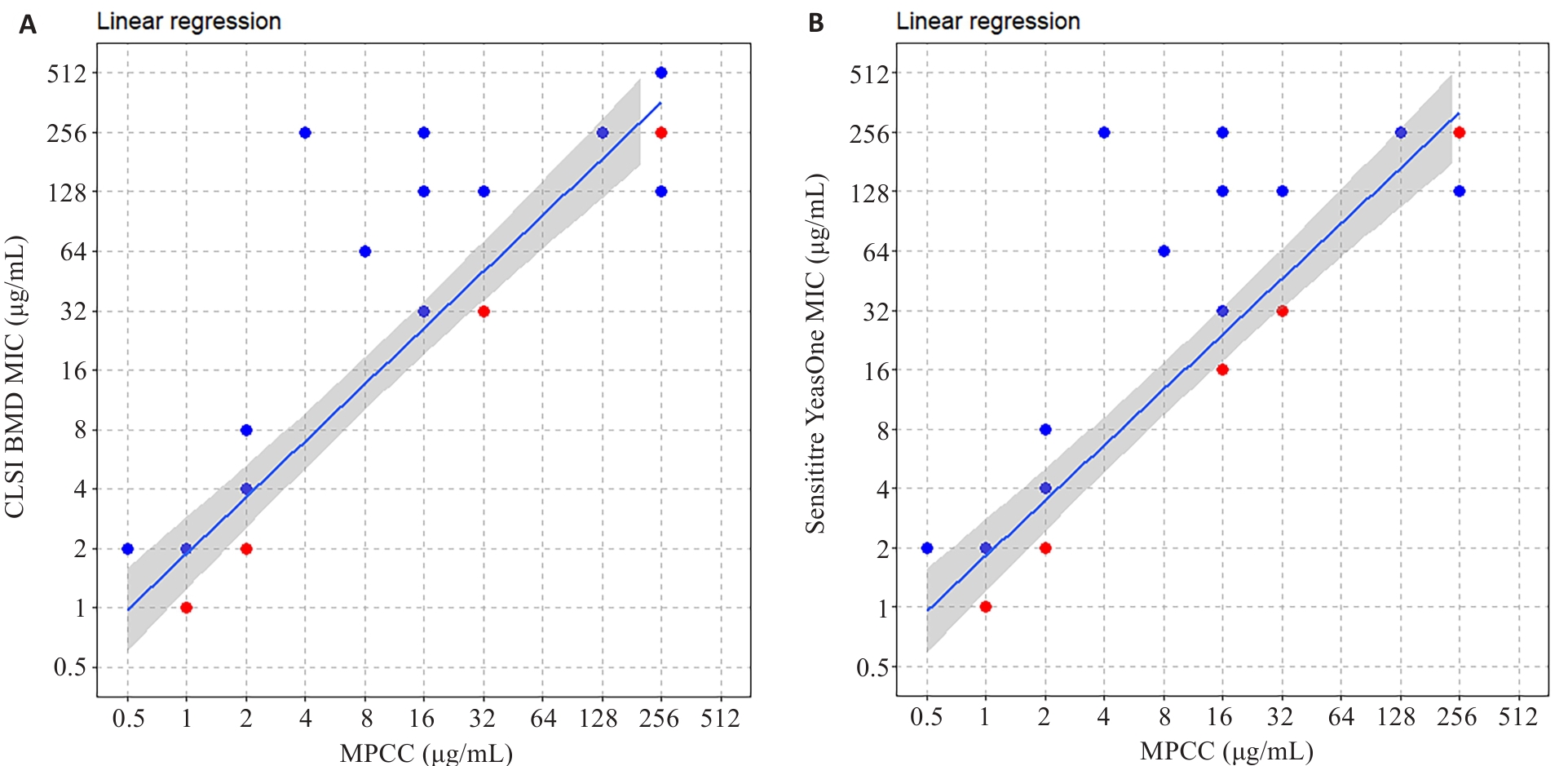
图6 热带念珠菌临床分离株氟康唑MPCC与MIC线性回归
Fig.6 Linear regression between fluconazole MPCC and MIC. A: CLSI BMD MIC compared with MPCC;B: Sensititre YeastOne MIC compared with MPCC.
| [1] | Xiao M, Sun ZY, Kang M, et al. Five-year national surveillance of invasive candidiasis: species distribution and azole susceptibility from the China hospital invasive fungal surveillance net (CHIF-NET) study[J]. J Clin Microbiol, 2018, 56(7): e00577-18. doi:10.1128/jcm.00577-18 |
| [2] | Xiao M, Chen SC, Kong FR, et al. Distribution and antifungal susceptibility of Candida Species causing candidemia in China: an update from the CHIF-NET study[J]. J Infect Dis, 2020, 221(): S139-47. doi:10.1093/infdis/jiz573 |
| [3] | Fan X, Xiao M, Liao K, et al. Notable increasing trend in azole non-susceptible Candida tropicalis causing invasive candidiasis in China (August 2009 to July 2014): molecular epidemiology and clinical azole consumption[J]. Front Microbiol, 2017, 8: 464. doi:10.3389/fmicb.2017.00464 |
| [4] | Hou J, Deng J, Liu Y, et al. Epidemiology, clinical characteristics, risk factors, and outcomes of candidemia in a large tertiary teaching hospital in western China: a retrospective 5-year study from 2016 to 2020[J]. Antibiotics, 2022, 11(6): 788. doi:10.3390/antibiotics11060788 |
| [5] | Xu H, Yu SY, Zhou ML, et al. Epidemiology and antifungal susceptibility patterns of invasive fungal infections from 2012 to 2014 in a teaching hospital in Central China[J]. Infect Drug Resist, 2019, 12: 3641-51. doi:10.2147/idr.s227839 |
| [6] | Garey KW, Rege M, Pai MP, et al. Time to initiation of fluconazole therapy impacts mortality in patients with candidemia: a multi-institutional study[J]. Clin Infect Dis, 2006, 43(1): 25-31. doi:10.1086/504810 |
| [7] | Huang AM, Newton D, Kunapuli A, et al. Impact of rapid organism identification via matrix-assisted laser desorption/ionization time-of-flight combined with antimicrobial stewardship team intervention in adult patients with bacteremia and candidemia[J]. Clin Infect Dis, 2013, 57(9): 1237-45. doi:10.1093/cid/cit498 |
| [8] | Knabl L, Lass-Flörl C. Antifungal susceptibility testing in Candida species: current methods and promising new tools for shortening the turnaround time[J]. Expert Rev Anti Infect Ther, 2020, 18(8): 779-87. doi:10.1080/14787210.2020.1760841 |
| [9] | Durand C, Maubon D, Cornet M, et al. Can we improve antifungal susceptibility testing[J]? Front Cell Infect Microbiol, 2021, 11: 720609. doi:10.3389/fcimb.2021.720609 |
| [10] | Marinach C, Alanio A, Palous M, et al. MALDI-TOF MS-based drug susceptibility testing of pathogens: The example of Candida albicans and fluconazole[J]. PROTEOMICS, 2009, 9(20): 4627-31. doi:10.1002/pmic.200900152 |
| [11] | Delavy M, Cerutti L, Croxatto A, et al. Machine learning approach for Candida albicans fluconazole resistance detection using matrix-assisted laser desorption/ionization time-of-flight mass spectrometry[J]. Front Microbiol, 2020, 10: 3000. doi:10.3389/fmicb.2019.03000 |
| [12] | Vatanshenassan M, Arastehfar A, Boekhout T, et al. Anidulafungin susceptibility testing of Candida glabrata isolates from blood cultures by the MALDI biotyper antibiotic (antifungal) susceptibility test rapid assay[J]. Antimicrob Agents Chemother, 2019, 63(9): e00554-19. doi:10.1128/aac.00554-19 |
| [13] | Paul S, Singh S, Chakrabarti A, et al. Stable isotope labelling: an approach for MALDI-TOF MS-based rapid detection of fluconazole resistance in Candida tropicalis [J]. J Antimicrob Chemother, 2019, 74(5): 1269-76. doi:10.1093/jac/dkz019 |
| [14] | Vatanshenassan M, Boekhout T, Lass-Flörl C, et al. Proof of concept for MBT ASTRA, a rapid matrix-assisted laser desorption ionization-time of flight mass spectrometry (MALDI-TOF MS)-based method to detect caspofungin resistance in Candida albicans and Candida glabrata[J]. J Clin Microbiol, 2018, 56(9): e00420-18. doi:10.1128/jcm.00420-18 |
| [15] | Saracli MA, Fothergill AW, Sutton DA, et al. Detection of triazole resistance among Candida species by matrix-assisted laser desorption/ionization-time of flight mass spectrometry (MALDI-TOF MS)[J]. Med Mycol, 2015, 53(7): 736-42. doi:10.1093/mmy/myv046 |
| [16] | Paul S, Singh P, A S S, et al. Rapid detection of fluconazole resistance in Candida tropicalis by MALDI-TOF MS[J]. Med Mycol, 2018, 56(2): 234-41. doi:10.1093/mmy/myx042 |
| [17] | CLSI. Performance Standards for Antifungal Susceptibility Testing of Yeasts: CLSI supplement M 27M44S,3rd ed . Wayne, PA: Clinical and Laboratory Standards Institute, 2022: 1-40 |
| [18] | CLSI. Performance Standards for Antifungal Susceptibility Testing of Yeasts: CLSI supplement M60,1st ed . Wayne, PA: Clinical and Laboratory Standards Institute, 2017: 1-13. |
| [19] | Vella A, De Carolis E, Vaccaro L, et al. Rapid antifungal susceptibility testing by matrix-assisted laser desorption ionization-time of flight mass spectrometry analysis[J]. J Clin Microbiol, 2013, 51(9): 2964-9. doi:10.1128/jcm.00903-13 |
| [20] | De Carolis E, Vella A, Florio AR, et al. Use of matrix-assisted laser desorption ionization-time of flight mass spectrometry for caspofungin susceptibility testing of Candida and Aspergillus species[J]. J Clin Microbiol, 2012, 50(7): 2479-83. doi:10.1128/jcm.00224-12 |
| [21] | SENSITITRE YEASTONE For in vitro Diagnostic Use [Z]. 2012. |
| [22] | Cantón E, Pemán J, Hervás D, et al. Comparison of three statistical methods for establishing tentative wild-type population and epidemiological cutoff values for echinocandins, amphotericin B, flucytosine, and six Candida species as determined by the colorimetric sensititre YeastOne method[J]. J Clin Microbiol, 2012, 50(12): 3921-6. doi:10.1128/jcm.01730-12 |
| [23] | Bertout S, Dunyach C, Drakulovski P, et al. Comparison of the Sensititre YeastOne® dilution method with the Clinical Laboratory Standards Institute (CLSI) M27-A3 microbroth dilution reference method for determining MIC of eight antifungal agents on 102 yeast strains[J]. Pathol Biol, 2011, 59(1): 48-51. doi:10.1016/j.patbio.2010.07.020 |
| [24] | Alexander BD, Byrne TC, Smith KL, et al. Comparative evaluation of etest and sensititre YeastOne panels against the clinical and laboratory standards institute M27-A2 reference broth microdilution method for TestingCandidaSusceptibility to seven antifungal agents[J]. J Clin Microbiol, 2007, 45(3): 698-706. doi:10.1128/jcm.01840-06 |
| [25] | Pfaller MA, Espinel-Ingroff A, Jones RN. Clinical evaluation of the Sensititre YeastOne colorimetric antifungal plate for antifungal susceptibility testing of the new triazoles voriconazole, posaconazole, and ravuconazole[J]. J Clin Microbiol, 2004, 42(10): 4577-80. doi:10.1128/jcm.42.10.4577-4580.2004 |
| [26] | Lombardi G, Farina C, Andreoni S, et al. Comparative evaluation of Sensititre® YeastOne vs. the NCCLS M27A protocol and E-test for antifungal susceptibility testing of yeasts[J]. Mycoses, 2004, 47(9/10): 397-401. doi:10.1111/j.1439-0507.2004.01013.x |
| [27] | Linares MJ, Charriel G, Solís F, et al. Comparison of two microdilution methods for testing susceptibility ofCandidaspp. to voriconazole[J]. J Clin Microbiol, 2004, 42(2): 899-902. doi:10.1128/jcm.42.2.899-902.2004 |
| [28] | Espinel-Ingroff A, Pfaller M, Messer SA, et al. Multicenter comparison of the Sensititre YeastOne colorimetric antifungal panel with the NCCLS M27-A2 reference method for testing new antifungal agents against clinical isolates of Candida spp[J]. J Clin Microbiol, 2004, 42(2): 718-21. doi:10.1128/jcm.42.2.718-721.2004 |
| [29] | Espinel-Ingroff A, Pfaller M, Messer SA, et al. Multicenter comparison of the sensititre YeastOne colorimetric antifungal panel with the national committee for clinical laboratory standards M27-a reference method for testing clinical isolates of common and EmergingCandidaspp., Cryptococcusspp., and other yeasts and yeast-like organisms[J]. J Clin Microbiol, 1999, 37(3): 591-5. doi:10.1128/jcm.37.3.591-595.1999 |
| [30] | Pfaller MA, Diekema DJ. Progress in antifungal susceptibility testing of Candida spp. by use of Clinical and Laboratory Standards Institute broth microdilution methods, 2010 to 2012[J]. J Clin Microbiol, 2012, 50(9): 2846-56. doi:10.1128/jcm.00937-12 |
| [31] | Pfaller MA, Andes D, Diekema DJ, et al. Wild-type MIC distributions, epidemiological cutoff values and species-specific clinical breakpoints for fluconazole and Candida: Time for harmonization of CLSI and EUCAST broth microdilution methods[J]. Drug Resist Updat, 2010, 13(6): 180-95. doi:10.1016/j.drup.2010.09.002 |
| [32] | Pfaller MA, Andes D, Arendrup MC, et al. Clinical breakpoints for voriconazole and Candida spp. revisited: review of microbiologic, molecular, pharmacodynamic, and clinical data as they pertain to the development of species-specific interpretive criteria[J]. Diagn Microbiol Infect Dis, 2011, 70(3): 330-43. doi:10.1016/j.diagmicrobio.2011.03.002 |
| [33] | Pfaller MA, Diekema DJ, Andes D, et al. Clinical breakpoints for the echinocandins and Candida revisited: Integration of molecular, clinical, and microbiological data to arrive at species-specific interpretive criteria[J]. Drug Resist Updat, 2011, 14(3): 164-76. doi:10.1016/j.drup.2011.01.004 |
| [34] | Heuer C, Bahnemann J, Scheper T, et al. Paving the way to overcome antifungal drug resistance: current practices and novel developments for rapid and reliable antifungal susceptibility testing[J]. Small Meth, 2021, 5(11): 2100713. doi:10.1002/smtd.202100713 |
| [35] | Espinel-Ingroff A, Barchiesi F, Cuenca-Estrella M, et al. International and multicenter comparison of EUCAST and CLSI M27-A2 broth microdilution methods for testing susceptibilities ofCandidaspp. to fluconazole, itraconazole, posaconazole, and voriconazole[J]. J Clin Microbiol, 2005, 43(8): 3884-9. doi:10.1128/jcm.43.8.3884-3889.2005 |
| [36] | Vella A, De Carolis E, Mello E, et al. Potential use of MALDI-ToF mass spectrometry for rapid detection of antifungal resistance in the human pathogen Candida glabrata[J]. Sci Rep, 2017, 7: 9099. doi:10.1038/s41598-017-09329-4 |
| [37] | Roberto AEM, Xavier DE, Vidal EE, et al. Rapid detection of echinocandins resistance by MALDI-TOF MS in Candida parapsilosis complex[J]. Microorganisms, 2020, 8(1): 109. doi:10.3390/microorganisms8010109 |
| [38] | De Carolis E, Marchionni F, La Rosa M, et al. Are we ready for nosocomial Candida auris infections? rapid identification and antifungal resistance detection using MALDI-TOF mass spectrometry may be the answer[J]. Front Cell Infect Microbiol, 2021, 11: 645049. doi:10.3389/fcimb.2021.645049 |
| [1] | 王应斌1,3, 王宏2, 郭辉玉3, 赵永忠2, 罗深秋2. 白假丝酵母ERG11基因突变分析[J]. 南方医科大学学报, 2005, 25(11): 1390-1393. |
| [2] | 陈曼彤. 反流性食管炎与幽门螺杆菌的相关性研究[J]. 南方医科大学学报, 2004, 24(03): 332-333. |
| 阅读次数 | ||||||
|
全文 |
|
|||||
|
摘要 |
|
|||||
